Prelims Nuggets

How to tell if a material is a superconductor?

Context: In the last week of July, researchers in South Korea said they had discovered that a material called LK-99 is a room-temperature superconductor. Independent researchers will have to check whether LK-99 is really a room-temperature superconductor before it is accepted as a legitimate claim.

What are Superconductors?

Superconductors are materials that when cooled to temperatures ranging from near absolute zero (0 degrees Kelvin, -273 degrees Celsius) have zero resistance or do not resist the flow of current.

The temperature at which electrical resistance is zero is called the critical temperature (Tc)  and this temperature is a characteristic of the material. 

E.g., Aluminium, niobium, magnesium diboride, yttrium barium copper oxide etc.

However, every superconductor made so far has required extraordinarily high pressures (millions of Pascal), and very low temperatures. E.g., Aluminium becomes superconducting at temperatures less than (minus) –250° C. 

Hence, scientists have been looking for such materials for decades which can remain superconductors at room temperature. 

Important properties of Superconductors:

Electronic effect (Infinite conductivity with Zero resistance) - The material will transport an electric current with zero resistance. 

(When the temperature of superconductors is reduced below a critical temperature, its resistance suddenly reduces to zero and thus it offers infinite conductivity). E.g., Mercury becomes a superconductor below 4 kelvin.

image 78
  • Magnetic effect (Complete expulsion of Magnetic field) - Superconductors are diamagnetic i.e., they oppose the magnetic field or do not allow the magnetic field lines to penetrate them. (This phenomenon is called Meissner effect)
    • However, there is a certain value of the magnetic field (critical magnetic field) beyond which the superconductors lose superconductivity and convert into conductors. 
image 1

Applications:

  • Elimination of the loss of energy: Superconductors can be used to make longer-lasting batteries and more-efficient power grids.
    • Need: Presently, a portion of the electricity generated at every power plant is lost during transmission because the wires and cables that carry the current have electrical resistance.
    • Significance of Superconductors: Once an electric current passes over a superconducting material, it can continue to flow without receiving power from any source as none of the energy involved is lost as heat.
  • Potential applications include- Magnetic-energy storage systems, magnetic levitation trains,  superconducting magnetic refrigerators, etc.

Huge potential for revolutionary technologies, including efficient quantum computers, as superconductors can exhibit quantum phenomena.

Major Freedom Fighters of India from 1857 to 1947 [List]

Here is a list of some of the most famous freedom fighters of India, who dedicated their lives to the cause of freedom.

India has been blessed with uncounted patriots who fought against the British Crown and gave their ultimate sacrifice to see their motherland free from its colonial masters.

This article cannot do justice to the true achievement or laurels of each one of them. 

Freedom Fighters of India

list of Freedom Fighters of India

However, for the sake of representation, we can write a brief about a few famous ones. 

Mangal Pandey (1827-1857):

Mangal Pandey

A soldier in the British East India Company, Pandey is remembered for sparking the Indian Rebellion of 1857, also known as the First War of Independence, when he rebelled against the introduction of greased cartridges.

Rani Lakshmibai of Jhansi (1828-1858):

Rani Lakshmibai of Jhansi

One of the leading figures of the Indian Rebellion of 1857, Rani Lakshmibai fought bravely against the British before dying in battle. She remains a symbol of resistance and bravery in India.

Bal Gangadhar Tilak (1856-1920):

Bal Gangadhar Tilak

Known as "Lokmanya," Tilak was one of the first leaders of the Indian independence movement.

He helped to lay the groundwork for the movement through the initiation of the Swadeshi movement, which was part of the Indian Nationalist struggle against British rule.

Lala Lajpat Rai (1865-1928):

Lala Lajpat Rai

Known as "Punjab Kesari" or the "Lion of Punjab", Rai was a significant figure in the Indian Nationalist movement. He was part of the Lal Bal Pal triumvirate.

He led the protest against the Simon Commission in 1928 where he died due to injuries inflicted by police.

Bipin Chandra Pal (1858-1932):

An early leader of the Indian Nationalist Movement, Pal was part of the Lal Bal Pal triumvirate. He was a proponent of militant nationalism and was one of the architects of the Swadeshi movement.

Mahatma Gandhi (1869-1948):

Mahatma Gandhi

Mahatma Gandhi Known as the "Father of the Nation", Gandhi led India to independence using his unique principles of Satyagraha (non-violent resistance) and truth.

His leadership of movements like the Salt March and the Quit India movement were critical in mobilizing the masses.

Jawaharlal Nehru (1889-1964):

A key figure in the Indian National Congress, Nehru became the first Prime Minister of India.

He was a major force in the push for full Indian sovereignty and was known for his advocacy of secularism, socialism, and democracy.

Subhas Chandra Bose (1897-1945):

Subhas Chandra Bose

Bose was a prominent figure who didn't agree with Gandhi's principle of non-violence.

He was a key leader in the Indian independence movement, leading the Indian National Army against British forces.

Bhagat Singh (1907-1931):

Singh was a socialist revolutionary whose two acts of dramatic violence against the British and execution at age 23 made him a folk hero of the Indian independence movement.

Vallabhbhai Patel (1875-1950):

Known as the "Iron Man of India," Patel was a staunch Gandhian and a skilled organizer.

He was instrumental in the political integration of over 500 princely states into the Union of India post-independence.

Maulana Abul Kalam Azad (1888-1958):

As a scholar and senior leader of the Indian National Congress, Azad advocated for a united India resisting sectarian division.

He was the president of the INC during the crucial period of 1940-46.

Rajendra Prasad (1884-1963):

Prasad was a key member of the Indian National Congress. He played a significant role in the Salt Satyagraha and the Quit India Movement.

He served as the president of the Constituent Assembly and later became the first President of independent India.

Sarojini Naidu (1879-1949):

Known as the "Nightingale of India," Naidu was a renowned poet and a key figure in India's independence movement. She was the first Indian woman to become the President of the Indian National Congress and the first woman to become the governor of an Indian state.

The list of Freedom Fighters name is countless and we have identified one of the most famous ones. 

Supernovae – the universe’s engines 

About Supernovae: 

About Supernovae
  • A star exists in a delicate equilibrium between opposing forces:
    • Outward energy and pressure resulting from nuclear fusion
    • Gravitational pull inward due to its considerable mass.
  • As long as a star can sustain nuclear fusion, releasing more energy than needed for the fusion process, it remains stable.
  • However, when this balance tips and the star's fusion can no longer counteract the force of gravity, a pivotal shift occurs.
  • Gravity gains the upper hand, causing the star to collapse rapidly, leading to a sudden explosion of its outer layers - an event known as a core-collapse supernova.
  • A substantial amount of energy, radiation, and elemental matter is ejected into the surrounding space during the supernova event.
  • Characterized by the explosive demise of a massive supergiant star, a supernova can release a staggering energy output of up to 10^44 joules, comparable to the Sun's cumulative energy emission over its 10-billion-year lifespan.
  • This cataclysmic process generally leads to the fusion of iron within the star's core, reaching the point where the binding energy of the iron group elements is the highest. Consequently, no further energy can be extracted from nuclear fusion.

Where Do Supernovas Occur?

  • Supernovas frequently occur in distant galaxies, but their observation within Milky Way galaxy is hindered by obstructive dust.
  • Back in 1604, Johannes Kepler made a notable discovery, identifying the most recent observed supernova within the Milky Way.
  • Notably, NASA's Chandra telescope has since uncovered the remnants of a more recent Milky Way supernova that erupted over a century ago.

Variants of Supernovae: 

  • The first variant of a supernova is observed in binary star systems.
  • Within these systems, two stars orbit a shared point. Specifically, a carbon-oxygen white dwarf, one of the binary stars, siphons matter from its companion.
  • Over time, this white dwarf accumulates an excess of matter, leading to an eventual explosive demise and the birth of a supernova.
  • The second class of supernova transpires as a single star concludes its life cycle.
  • As nuclear fuel depletes, a portion of the star's mass streams into its core.
  • Gradually, the core's immense weight becomes untenable against its own gravitational pull.
  • Consequently, the core undergoes a catastrophic collapse, giving rise to a monumental supernova explosion.
  • It's important to note that while our sun is a lone star, its mass is insufficient to trigger a supernova event.

Significance:

  • One variety of supernova has yielded crucial insights for scientists, underscoring the concept of an expanding universe that perpetually accelerates its growth.
  • Moreover, researchers have deduced that supernovas play a pivotal role in the universal dispersion of elements.
  • When a star undergoes explosion, it propels elemental matter and debris into space
  • The heavy metals present in Earth's crust, including valuable elements like gold and uranium, owe their origins to the intense conditions within certain supernovae, which occurred eons ago.

List of Major Important Dams in India [Map]

Dams play a vital role in a country's water management system, including irrigation, flood control, hydroelectric power generation, and water supply. A clear understanding of the important dams in India, their geographical location, and associated rivers is essential for the UPSC Civil Services Examination.

Important Dams in India

Important largest Dams in India on Map

Bhakra Nangal Dam

Located in Himachal Pradesh on the Sutlej River, Bhakra Nangal Dam is one of the highest gravity dams in the world. The dam's primary purposes include electricity generation and irrigation in Himachal Pradesh, Punjab, Haryana, and Rajasthan.

Hirakud Dam

Constructed across the Mahanadi River in Odisha, Hirakud Dam is one of the world's longest man-made dams. It is primarily used for irrigation, flood control, and power generation.

Tehri Dam

Tehri Dam, located on the Bhagirathi River in Uttarakhand, is the highest dam in India. It serves the dual purpose of hydroelectric power production and water supply for irrigation.

Sardar Sarovar Dam

Built on the Narmada River in Gujarat, Sardar Sarovar Dam is a part of the Narmada Valley Project. It provides irrigation facilities to Gujarat and Rajasthan, and electricity generation for four Indian states.

Nagarjuna Sagar Dam

Nagarjuna Sagar Dam, constructed on the Krishna River, lies between Telangana and Andhra Pradesh. The dam provides irrigation water to the Nalgonda, Prakasam, Khammam, and Guntur districts.

Indira Gandhi Canal

Although not a dam, it's crucial to mention the Indira Gandhi Canal, which originates from the Harike Barrage at the confluence of the Beas and Sutlej rivers in Punjab. This canal system is one of the largest in India and primarily provides irrigation in the Thar Desert region of Rajasthan.

Tungabhadra Dam

Tungabhadra Dam is built on the Tungabhadra River, a tributary of the Krishna River. Located in Karnataka, the dam provides irrigation and hydroelectricity to parts of Karnataka and Telangana.

DamLocation
Bhakra Nangal DamHimachal Pradesh
Hirakud DamOdisha
Tehri DamUttarakhand
Sardar Sarovar DamGujarat
Nagarjuna Sagar DamAndhra Pradesh & Telangana
Indira Gandhi CanalRajasthan
Tungabhadra DamKarnataka

What is the largest dam in India, and what are its key features?

The Tehri Dam, located in Uttarakhand, is the tallest dam in India. It serves multiple purposes, including electricity generation, irrigation, and flood control, with a significant capacity for hydroelectric power production.

How do dams contribute to India's electricity supply?

Dams contribute significantly to India's electricity supply by harnessing the potential of hydroelectric power, a renewable energy source that plays a crucial role in the nation's energy mix.

What role do dams play in flood control and irrigation in India?

Dams are instrumental in controlling floods by regulating river flow and providing a reliable water supply for irrigation, supporting agriculture in various regions.

Conclusion

Understanding the importance and geographical location of key dams in India forms a crucial part of the UPSC Civil Services Examination syllabus, primarily under Indian Geography. Aspirants should keep themselves updated with recent developments related to these dams, their significance, and the challenges associated with them.

This knowledge will enrich their answers and perspectives in both the Preliminary and Mains stages of the examination.

Millets in India: Millet Varieties & their Importance [Map]

The importance of millets in India cannot be overstated. These are primarily rainfed crops, making them highly suitable for areas with erratic rainfall patterns or water scarcity. They have high nutritional content and are beneficial for both human health and the environment.

This article offers an insight into the varieties of millets in India, their regional distribution, and their significance for the Indian economy and food security, all important aspects for the UPSC Civil Services Examination.

Millets: A Brief Overview

Millets are small-seeded grasses, drought-resistant and are capable of growing well in less fertile and marginal soils. The consumption of millets is an integral part of the food culture in many parts of India.

There are several types of millets, including Pearl Millet (Bajra), Finger Millet (Ragi), Foxtail Millet (Kangni), Proso Millet (Chena), Kodo Millet (Kodon), Little Millet (Kutki), and Barnyard Millet (Sanwa). Each of these millets has unique benefits, both nutritionally and environmentally.

Distribution and Production of Millets in India

Millets in India - MAP
Image Source: News18 & Lok Sabha
  • India is the largest producer of millets globally. Millet cultivation is widespread, although it varies in terms of concentration across states.
  • Pearl Millet: It is the most widely grown millet in India and constitutes a significant part of the diet in the states of Rajasthan, Gujarat, and Haryana.
  • Finger Millet: This is primarily cultivated in the dry regions of Karnataka, Andhra Pradesh, Tamil Nadu, Odisha, and Maharashtra.
  • Foxtail, Proso, Kodo, Little, and Barnyard Millets: These are predominantly grown in the central and eastern regions of India, in states like Madhya Pradesh, Uttar Pradesh, and Bihar.

Types of millets in India

There are several types of millets grown across different regions of India, known for their nutritional benefits and adaptability to diverse climatic conditions.

Here are the primary types of millets and some insights into their cultivation and nutritional profile:

Pearl Millet (Bajra):

  • Primarily grown in Rajasthan, Maharashtra, Gujarat, and Uttar Pradesh.
  • High in protein, fiber, and essential micronutrients like iron, zinc, and B vitamins.

Finger Millet (Ragi):

  • Majorly cultivated in Karnataka, Tamil Nadu, Andhra Pradesh, and Maharashtra.
  • Rich in calcium, iron, and amino acids, it's often recommended for bone health and diabetes management.

Foxtail Millet (Kangni):

  • Cultivated across Andhra Pradesh, Tamil Nadu, and Karnataka.
  • Known for its carbohydrate content, it also provides a good amount of dietary fiber, minerals, and essential fatty acids.

Barnyard Millet (Jhangora):

  • Grown in Uttarakhand, Maharashtra, and Madhya Pradesh.
  • It's a good source of protein and is rich in dietary fiber.

Kodo Millet (Kodon):

  • Cultivated in the central and southern regions of India.
  • Contains high amounts of polyphenols, an antioxidant that benefits general health.

Little Millet (Kutki):

  • Grown in Karnataka, Tamil Nadu, Andhra Pradesh, and West Bengal.
  • High in magnesium, which can help improve heart health.

Proso Millet (Chena):

  • Cultivated in regions of Maharashtra, Madhya Pradesh, and Tamil Nadu.
  • Known for its high protein content and the absence of gluten.

Sorghum Millet (Jowar):

  • Primarily cultivated in Maharashtra, Karnataka, and Andhra Pradesh.
  • Packed with nutrients including protein, fiber, and B vitamins.

Significance of Millets

Nutritional Value: Millets are rich in dietary fiber, iron, calcium, and B vitamins, providing a myriad of health benefits. For instance, Finger Millet is a remarkable source of calcium, while Pearl Millet is packed with protein.

Climate Resilient: Millets are climate-resilient crops and are typically grown in the semi-arid tropics of Asia and Africa, making them perfect for regions with harsh weather conditions and poor soil quality.

Food Security: The ability of millets to grow in difficult environmental conditions makes them a crucial crop for ensuring food security in the face of climate change.

Economic Significance: Millets play a significant role in rural economies, providing both food and fodder. They also contribute to the livelihood of small and marginal farmers.

Millets and Indian Government Initiatives

Recognizing the significance of millets, the Indian government has launched various initiatives to promote its cultivation and consumption. The government declared 2018 as the 'National Year of Millets' to boost the millet sector.

The 'Initiative for Nutritional Security through Intensive Millet Promotion (INSIMP)' scheme aims to increase millet production and awareness about their health benefits.

Additionally, millets have been incorporated into the Public Distribution System (PDS) and the Mid-Day Meal scheme to improve their accessibility and consumption.

Conclusion

Understanding the varieties of millets, their distribution in India, their nutritional and economic significance, as well as the government's initiatives to promote their cultivation and consumption is crucial from the UPSC Civil Services Examination perspective.

Millets are not just agricultural commodities; they are part of the solution for various socio-economic and environmental issues such as malnutrition, poverty, climate change, and sustainable development.

Thus, candidates must have a comprehensive understanding of this topic, as it intersects with various aspects of the IAS syllabus, including geography, economics, and issues related to health and the environment.

Are millets good for health?

Yes, millets are good for health. They are a good source of protein, fiber, key vitamins, and minerals.

What is National Millets Mission?

The National Millets Mission (NMM) is a government of India initiative launched in 2007 to promote the production and consumption of millets. The mission aims to increase the area under millet cultivation, improve the productivity of millet crops, and develop new millet-based products.

What is Shree Anna?

‘Shree’ means divine grace and ‘Anna’ means food grain, especially rice, So Shree Anna means a food grain with divine grace. In Union Budget 2023-24, Finance Minister named Millets as Shree Anna.

See also:

Geographical Indication Tags (GI)Major Tribes of India
Major ports in IndiaWhat is Millet?

List of Major important ports in India

India, with its vast coastline stretching over 7,500 kilometers, is dotted with several important ports that play a crucial role in the country's trade and economy. An understanding of the key ports in India, their geographical location, and operational significance is fundamental for aspirants of the UPSC Civil Services Examination.

Important Major Ports in India

Major Ports in India:

  • India has a total of 13 major ports, of which 12 ports are Government-owned and 1 is private. (Kamarajar Major Port in Ennore is privately owned).
  • The country has 7517 kilometres of coastline and its major ports handled 795 million tonnes of cargo in FY23.
List of Major important ports in India
(Current Major Ports in India)

About Vadhavan Port

  • Vadhavan Transhipment Port when developed will be a deep-sea port  in Palghar district of Maharashtra.
  • The port will be built on coast of the Arabian Sea.
  • Vadhavan port will form a major part of the proposed ‘India Middle-East Europe Economic Corridor (IMEC’).
  • It’s a key project within the Indian government’s Sagarmala initiative to enhance the performance of the country’s logistics sector.
image 38

Major Ports of India on Eastern Coast: 

1. Kolkata Port

  • Kolkata Port, now called Syama Prasad Mookerjee Port, is India’s oldest major river port situated in Kolkata, West Bengal.
  • It was built by the British East India Company.
  • Unlike most ports, Kolkata is a freshwater port with no salt content.
  • It has two main sections: Kolkata Dock in the city and a Deep-water dock at Haldia Dock Complex. 

2. Paradip Port

  • Paradip Port is a natural, deep-water harbour on the East coast of India in Paradip, in Odisha, 
  • It is where the Mahanadi River meets the Bay of Bengal.
  • The port is managed by the Paradip Port Authority (PPA), which is an independent corporation fully owned by the Government of India.

3. Visakhapatnam Port

  • Visakhapatnam Port is one of India’s twelve big ports and the main port of Andhra Pradesh. 
  • It’s the third largest state-owned port in India in terms of cargo volume, and the biggest on the Eastern Coast.
  • Positioned about halfway between Kolkata Port and Chennai Port, it is situated at a strategic location along the Bay of Bengal coast.

4. Kamarajar Port

  • Kamarajar Port Limited, previously known as Ennore Port, sits on the Coromandel coast in Tamil Nadu. 
  • It is India’s 12th major port and the first to be a public company and the only major port organized as a company.
  • Chennai Port Trust took over major ownership (90%) of Kamarajar Port Limited from the government 

5. Chennai Port

  • Chennai Port, previously called Madras Port, is India’s second-largest container port, after Mumbai’s Jawaharlal Nehru Port. 
  • It’s the biggest port in the Bay of Bengal. 
  • Maritime trade through the port began much earlier in 1639 on the undeveloped coast.

6. Tuticorin Port

  • The V.O. Chidambaranar Port is located in Tamil Nadu, and is one of India’s 13 major ports.
  • It was designated as a major port in 1974.
  • It ranks as the second-largest port in Tamil Nadu and the third-largest container terminal in India.
  • The V.O. Chidambaranar Port is man-made.

Major Ports of India on Western Coast

  • The Western Coast of India is dotted with several major ports that are instrumental in handling a significant portion of the country’s maritime trade.
  • The Western coastal plains of India extend from Gujarat in the North to Kerala in the South, passing through the states of Maharashtra, Karnataka, and Goa.
  • It lies between the Western Ghats and the Arabian Sea. 

7. Kandla Port

  • Kandla Port, officially renamed as Deendayal Port Trust in 2017, is a vital maritime facility located on the northwestern coast of India, in the Kutch District of Gujarat.
  • Established in 1952, the port was constructed to serve as a major trading hub, especially after the partition of India, which led to the loss of the Karachi port to Pakistan.

8. Jawaharlal Nehru Port

  • Jawaharlal Nehru Port, also known as Nhava Sheva, is the largest container port in India. 
  • Located in Maharashtra, close to Mumbai, it was commissioned in 1989 to augment the port capacity of Mumbai.
  • Managed by the Jawaharlal Nehru Port Trust, it plays a pivotal role in India’s international trade, handling a significant portion of the country’s containerized cargo.
  • It is the busiest port in India in terms of container traffic. It handles the largest volume of containerized cargo among all the ports in India.
  • The port’s strategic location near Mumbai, India’s financial capital, and its state-of-the-art facilities contribute to its status as the busiest port in the nation.

9. Mumbai Port

  • Mumbai Port, one of India’s oldest major ports, is located on the west coast in Mumbai, Maharashtra.
  • Established in 1873, it has played a vital role in the maritime trade of India.
  • Primarily handling bulk cargo, it is known for its deep natural harbour and strategic location, serving both as a key facility for imports and exports and as a hub for passenger traffic.

10. Mormugao Port

  • Mormugao Port, located in Goa, is one of the country’s premier iron ore export ports. 
  • Established in 1888, it’s a natural harbour that has played a significant role in the maritime trade, particularly in the export of iron ore from India.
  • Over the years, Mormugao has diversified its cargo handling capabilities to include other bulk and general cargoes.

11. New Mangalore Port

  • New Mangalore Port, situated in Karnataka. 
  • Established in 1974, it is known for handling a diverse range of cargoes including crude oil, LPG, coffee, and cashew.
  • It plays a vital role in the economic development of the region, serving the hinterland of Karnataka as well as parts of Kerala.

12. Cochin Port

  • Established in 1928, it plays a crucial role in the maritime trade of the region.
  • The port is strategically positioned along major international sea routes and has a natural harbour.
  • Cochin Port facilitates the export and import of goods and is known for its container transhipment facility.

13. Port Blair

The 13th major port is Port Blair Port which is a seaport in South Andaman district of Andaman and Nicobar in India. 

  • Located on the Andaman Sea, it is one of major ports in India.
  • All major provisions of the Major Port Trusts Act, 1963, have become applicable to the port of Port Blair. 
  • It is the only major port in Andaman and Nicobar.

Read: Ports Infrastructure of India

See also:

Geography NotesGeography Prelims PYQ

Geographical Indication Tags (GI)

Context: The Geographical Indications Registry in Chennai granted the Geographical Indication (GI) tag to seven products from different regions of India.

What is a GI tag? 

  • Geographical Indications of goods refer to the place of origin of a product. GI tags are a form of Intellectual Property Rights (IPR) that convey an assurance of quality and distinctiveness, attributable to the fact of its origin in a specific geographical locality, region or country. E.g., Tirupathi laddu, Nagpur oranges. 
  • The Department for Promotion of Industry and Internal Trade, Ministry of Commerce and Industry awards GI Tag in India. 
  • A GI registration is given to an area, not a trader, but once a product gets the registration, traders dealing in the product can apply to sell it with the GI logo.
    • Any trader’s body, association, or organisation can apply for a GI tag. The applicants need to prove the uniqueness of the item with historical records and a complete breakdown of how the product is made.
    • Authorised traders are each assigned a unique GI number. 
    • The raw materials for such products do not have to come from that region (unless it is an agricultural tag). E.g.,
      • Leaf in Banarasi paan is not grown in Varanasi; it comes from Bihar, West Bengal, or Odisha.
      • Mulberry silk used in Kancheepuram sarees comes from Karnataka and the gold zari from Surat.
  • If any unauthorised trader tries selling the product under that name, they can be prosecuted under The Geographical Indications of Goods (Registration and Protection) Act, 1999.
    • India, as a member of the World Trade Organisation (WTO) has enacted the Geographical Indications of Goods (Registration & Protection) Act, 1999 which came into force in 2003.
    • Under Articles 1 (2) and 10 of the Paris Convention for the Protection of Industrial Property, geographical indications are covered as an element of IPRs.

Categories of GI products: 

  • There are over 500 GI tags as of January 7, 2023. There are 34 classes of products that can get GI tags, ranging from chemicals and paint to foodstuff, handicrafts, musical instruments, firearms, locomotives etc. 
  • The products in the GI registry fall under five major categories (Chart 1). Handicrafts dominate the list, with over half the GI tags being given to products crafted by skilled artisans.
image 29

GI tags across States:

  • Every State in India has at least one GI tag which is a proxy for unique cultural items.
  • If a State has more GI tags compared to another, it does not necessarily mean that the state is more culturally rich; it just means that more items have been registered.
    • Tamil Nadu (61) has the highest number of GI tags compared to other States. 
    • Uttar Pradesh (56) has the second highest number of GI tags.
      • Banaras offers 11 unique crafts and agricultural items (the highest from a single place), including the famous Banarasi paan. 

Benefits of GI tags: 

  • Prevents unauthorised use of GI tag products by others.
  • Helps consumers to get quality products of desired traits and is assured of the authenticity.
  • Promotes economic prosperity of producers of GI tag goods by enhancing their demand in national and international markets.

About the Products 

image 7

Jalesar Dhatu Shilp (metal craft)

  • Jalesar is located in the Etah district of Uttar Pradesh and was the capital of Magadha King Jarasandha.
  • The metal art of Jalesar is highly esteemed for its intricate designs and exceptional craftsmanship, blending elements of both traditional and contemporary styles.  
  • Skilled artisans employ various techniques such as casting, molding, hammering, engraving, and filigree work to create a diverse array of metal products. 

Goa Mankurad mango

  • The mango was given the name ‘Malcorada’ by the Portuguese, which translates to ‘poor coloured’.
  • Over time, this word evolved into ‘Mankurad’ and in the Konkani language, it came to be known as ‘aamo’ which means mango.

Goan Bebinca

  • Bebinca, a traditional Indo-Portuguese dessert, is a type of pudding widely recognized as the ‘Queen of Goan desserts.’ 
image 8

Udaipur Koftgari metal craft

  • The ancient art of Koftgari is used to create exquisitely ornamental weaponry.
  • This damascene technique involves a complex process of etching designs, heating, and cooling the metal, while also embedding gold and silver wire into the surface. 
  • Unlike inlaid metal ornamentation, the wire does not sink into the iron; instead, it remains on the surface and is mechanically bound through pressing, burnishing, and polishing. 
  • After the design is complete, burnishing tools known as Opani are used to push and bind the overlaid silver firmly.
  • Lastly, the surface is polished using a hakek stone to achieve the final stunning appearance.
  • The term ‘Koftgari’ originates from the Persian and Urdu words 'kuft-gari,' meaning 'beaten work,' and the artisans who practice this art are called 'kuftgars' or gilders. 
  • Historically, Koftgari was brought to India by Persian craftsmen during the 16th century when they served Mughal rulers.
  • The Mughal Emperors, had a significant iron workshop called the Mughal Silehkhana that produced ornamented swords and weapons for the imperial army. 
image 9

Bikaner Kashidakari craft

  • The technique involves printing diverse patterns on fabrics through the tie and dye method. 
  • The thread used in the embroidery varies from the finest silk to the thickest wool. It is often combined with glass, sequins, and various types of stitches to create rich and detailed patterns, typically worked in chain stitches.
  • The embroidery creates a captivating contrast between colours, with dramatic effects achieved through the use of vibrant traditional hues like yellow, black, red, and green.
  • Geometric forms are harmoniously balanced with depictions of trees, peacocks, and other motifs.
image 10

Jodhpur Bandhej craft

  • Bandhej is a popular traditional craft of Rajasthan, with Jodhpur being one of the prominent centres for this art form.
  • Bandhej patterns: Dot pattern known as Bandhani, the wave pattern called Leheriya, and even the Japanese motif called Shibori.
  • The art of Bandhej is primarily practiced by the skilled women artisans of the Rangrez community, meaning ‘dyer’ in Persian.
  • The process starts with preparing the fabric, which is typically cotton or silk. The fabric is thoroughly washed to remove impurities and then dyed in a base colour, often red, blue, green, or yellow. 
  • Skilled artisans meticulously tie small, tight knots on the fabric using thread, creating various patterns like dots, squares, waves, or stripes.
  • After tying the fabric, it is immersed in a dye bath. The areas where the knots are tied resist the dye, resulting in a unique and mesmerizing pattern on the fabric.
image 11

Bikaner Usta Kala craft

  • The Bikaner Usta Kala craft is also known as gold nakashi work or gold manauti work, owing to the predominant use of golden colour in its exquisite designs, created with actual gold during the earlier periods.
  • It is a unique form of miniature painting practiced on metal surfaces.
  • The skilled artisans, known as ‘Ustads’, have inherited their craft techniques from their ancestors, and they have diligently preserved this art form through generations. 
  • The metal surface is first cleaned and polished meticulously, providing a smooth and ideal canvas for the upcoming artwork.
  • To impart a distinctive shimmering effect, the designated areas of the artwork are adorned with a layer of gold or silver leaf.
  • Employing natural pigments and carefully selected colours, the Ustad adorns the artwork with intricate brushwork, creating a harmonious and vibrant appearance. 
  • The motifs and themes often draw inspiration from Mughal and Persian influences, showcasing elaborate floral patterns, geometric designs, and captivating scenes from epics and mythology.

What is the Akira ransomware?

Context: India's Computer Emergency Response Team issued an alert for ransomware called Akira. The ransomware, found to target both Windows and Linux devices, steals and encrypts data, forcing victims to pay double ransom for decryption and recovery.

About Ransomware

image
  • It is a type of malicious software (malware) designed to block access to a computer system or data until a ransom is paid to the attacker. 
  • Its attacks can target individuals, businesses, or even government organizations. It has quickly become the most prominent and visible type of malware.
  • It is typically spread through spear phishing emails that contain malicious attachments in the form of archived content (zip/rar) files. 
  • Other methods used to infect devices include drive-by-download, a cyber-attack that unintentionally downloads malicious code onto a device, and specially crafted web links in emails, clicking on which downloads malicious code.
  • It also spreads through insecure Remote Desktop connections.

About Akira Ransomware:

  • It is designed to encrypt data, create a ransomware note and delete Windows Shadow Volume copies on affected devices.
  • The ransomware gets its name due to its ability to modify the filenames of all encrypted files by appending them with the akira extension.
  • The ransomware is designed to close processes or shut down Windows services that may keep it from encrypting files on the affected system.
  • It uses Virtual Private Network (VPN) services, especially when users have not enabled two-factor authentication, to trick users into downloading malicious files.

Mechanism of Akira ransomware

  • The ransomware deletes the Windows Shadow Volume copies on the affected device. These files are instrumental in ensuring that organisations can back up data used in their applications for day-to-day functioning. 
  • Volume Shadow Copy Service (VSS) facilitates communication between different components without the need to take them offline, thereby ensuring data is backed up while it is also available for other functions. Once the ransomware deletes the VSS files it proceeds to encrypt files with the pre-defined the akira extension.
  • The ransomware also terminates active Windows services using the Windows Restart Manager API, preventing any interference with the encryption process. It is designed to not encrypt Program Data, Recycle Bin, Boot, System Volume information, and other folders instrumental in system stability. It also avoids modifying Windows system files with extensions like .syn. .msl and .exe.
  • Once sensitive data is stolen and encrypted, the ransomware leaves behind a note named akira_readme.txt which includes information about the attack and the link to Akira’s leak and negotiation site.
  • Each victim is given a unique negotiation password to be entered into the threat actor’s Tor site. Unlike other ransomware operations, this negotiation site just includes a chat system that the victim can use to communicate with the ransomware gang.\

Prevention measures against Akira Ransomware

CERT-In has advised users to follow basic internet hygiene and protection protocols to ensure their security against ransomware. These include:

  • Maintaining up-to-date offline backups of critical data, to prevent data loss in the event of an attack.
  • Update all operating systems and networks regularly, with virtual patching for legacy systems and networks. 
  • Companies must establish Domain-based Message Authentication, Reporting, and Conformance, Domain Keys Identified Mail (DKIM), and Sender policy for organizational email validation, which prevents spam by detecting email spoofing. 
  • Strong password policies and multi-factor authentication (MFA) must be enforced.
  • There should also be a strict external device usage policy in place and data-at-rest and data-in-transit encryption along with blocking attachment file types like .exe, .pif, or .url to avoid downloading malicious code. 
  • Periodic security audits of critical networks/systems, especially database servers.

Worldcoin project: The Iris Cryptocurrency

Context: In July, Sam Altman, CEO of OpenAI, formally re-introduce Worldcoin, a project of his that was eclipsed by the popularity of ChatGPT.

image 3

About Worldcoin project

  • It is a crypto project that aims to create a global identity and financial network for everyone. It is an initiative to create a digital network in which everyone can claim some kind of stake, and join the digital economy.
  • It uses a device called an orb, Worldcoin volunteers known as ‘Orb operators’ that scan a person’s iris pattern to collect their biometric data and help them get a World ID through the World app. 
  • With the app, scanned participants can collect a cryptocurrency called Worldcoin (WLD) at regular intervals or make transactions with their World ID where possible. This process is called proof of personhood and makes sure that people do not sign themselves up multiple times in exchange for crypto. 
  • It was co-founded by Altman and Alex Blania in 2019 to provide every human being on Earth with a share of its digital token.
  • It uses a technology known as zero-knowledge proofs (ZKPs) to maintain user's privacy and user data was encrypted.
  • Individuals who want to receive a World ID are not required to share their name, phone number, email address, or home address. 
  • Images collected by the Orb are used to generate a unique iris code. By default, these images are immediately deleted once the iris code is created, unless the user opts into Data Custody.

Working of Worldcoin

  • Users need to be willing to scan irises and/or get their own irises scanned. Volunteers sign up to be “Orb operators” in their locality and receive basic training and a biometric device with which to scan irises.
  • The scan is converted into a string of numbers known as a hash in such a way that it’s impossible to recreate the scanned image even if the hash is compromised. 
  • The Orb sends the iris hash and a hash of the user’s public key to Worldcoin servers. If the person hasn’t signed up before, the hashes are added to the database and the company’s Ethereum blockchain.

Challenges to Worldcoin

  • Concerns exist about the privacy and security of biometric data and potential misuse for other purposes because it might be shared with third parties such as vendors, service providers like banks, or even the police and government when necessary.

Recently, according to a TechCrunch report, hackers installed password-stealing malware on the devices of multiple Worldcoin Orb operators, granting them complete control over the operators’ dashboards. This raises concerns about the security and privacy of the iris-scanning technology.

  • Questions arise about the feasibility and scalability of reaching unbanked or underbanked populations.
  • Doubt on the value and utility of the Worldcoin token, and whether it can compete with other cryptocurrencies or fiat currencies. 

Global expansion of Worldcoin

  • During its initial rollout phase, the Worldcoin project plans to offer its services in 35 cities spanning 20 countries, showcasing its dedication to providing inclusive digital identities to people worldwide.
  • India has taken a significant step forward in embracing Worldcoin's identity verification technology. With 18 locations already equipped with the Orb device for sign-up, the country serves as a prominent and crucial testing ground for this innovative endeavor.

Aiming for the stars: how inverter ACs are catalysing the energy-efficiency revolution

Context: According to latest data from the Bureau of Energy Efficiency (BEE), Ministry of Power, inverter ACs accounted for less than 1 per cent of the overall room AC (RAC) market of 4.7 million units in the financial year 2015-16 (FY16). As of FY23, the share has increased to 77 per cent, while the fixed-speed RACs went down to 23 per cent.

What is Energy conservation act 2001?

  • Government of India enacted the Energy Conservation (EC) Act, 2001 to realize the benefits of energy efficiency through reduced energy consumption. 
  • The Act provides the legal framework, institutional arrangement and regulatory mechanism to embark upon an energy efficiency drive in the country. 
  • Energy efficiency institutional practices and programs in India are being guided through various voluntary and mandatory provisions of the Act. 
  • The Government of India set up Bureau of Energy Efficiency (BEE), also referred to as 'BEE' or 'Bureau' on 1st March 2002 under the provisions of the EC Act, 2001. 
  • The mission of the Bureau is to assist in developing policies and strategies with a thrust on self-regulation and market principles, within the overall framework of the EC Act, 2001 with the primary objective of reducing energy intensity of the Indian economy.

What is Standards & Labeling Program?

  • The objective of the S&L program is to help consumers make an informed choice about various energy-consuming appliances, in terms of energy savings, that would result based on each appliance’s energy efficiency performance. 
  • This scheme also helps the consumer determine the cost-saving potential of the marketed household and other equipment. 
  • The broad objective of the scheme is:
    • To reduce the end-use energy consumption of appliances without diminishing the service levels.
    • To create awareness amongst the consumers, to make an informed decision considering the cost-effectiveness & energy performance while purchasing appliances.
    • To monitor and verify energy savings that incur annually through the sale of energy-efficient appliances
  • The scheme was launched by the Hon'ble Minister of Power in May 2006 and is currently invoked for 30 appliances/equipment.
  • A star rating, ranging from 1 to 5 in the ascending order of energy efficiency is provided to products registered with the Bureau. An endorsement label is also provided for some products.

What is a label?

  • Describes energy performance (in the form of energy use, efficiency or energy cost)
  • “Labels” mainly give consumers the necessary information to make informed purchase.
    • There are two types of labels:

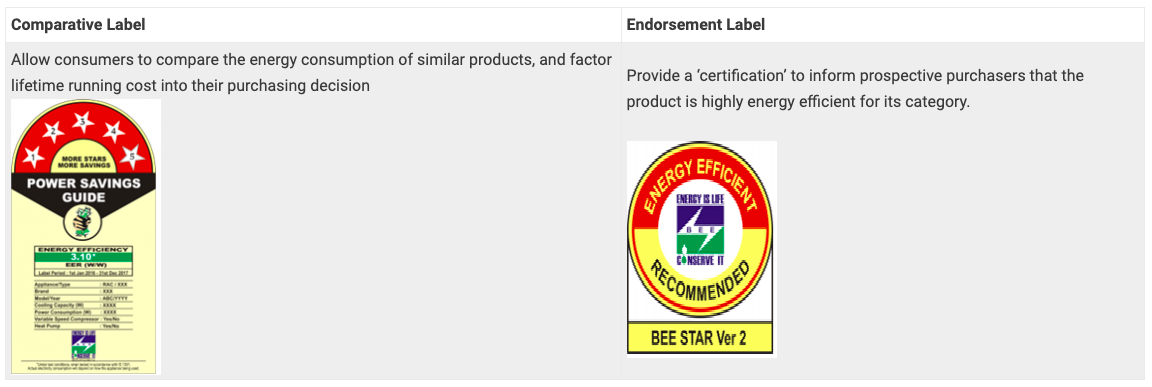
a) Comparative label : allow consumers to compare efficiency of all the models of a product in order to make an informed choice. It shows the relative energy use of a product compared to other models available in the market. 

b) Endorsement label : define a group of products as efficient when they meet minimum energy performance criteria specified in the respective product schedule/ regulation/statutory order.

BEE power saving lebel
Mandatory appliancesVoluntary appliances
Frost free refrigeratorSide by Side/Multi Door Refrigerator 
Stationary Storage Type Electric Water HeaterSolar water heater 
Colour TelevisionComputer
Room Air Conditioner (Variable Speed)Washing machines
Tabular fluorescent lampsMicro wave oven
LED lampsHi energy Li batteries
Deep freezersChillers 
Ultra high definition televisionsTyres
Room air conditionersDomestic gas stove
Ceiling fansPedestal fan, table/walled fan
Direct cool refrigeratorDiesel generator set
Distribution transformerSubmersible Pump Set
Diesel Engine Driven Monoset Pumps for Agricultural Purposes

Resource Efficiency Circular Economy Industry Coalition (RECEIC)

Context: The Union Minister of Environment, Forest, and Climate Change launched the Resource Efficiency Circular Economy Industry Coalition (RECEIC). As part of this, 39 multinational corporations (MNCs) from various sectors came together to pledge to adopt resource efficiency and circular economy principles. 

image 2

About RECEIC:

  • The Coalition, conceptualised by India’s G20 Presidency, is envisaged to be industry driven and a self-sustaining initiative continuing to function even beyond India’s G20 Presidency.
  • The mission is to facilitate and foster greater company-to-company collaboration, build advanced capabilities across sectors and value chains, bring learnings from diverse and global experiences of the coalition members, unlock on-ground private sector action to enhance resource efficiency, and accelerate the circular economy transition.
  • The coalition is structured around the three guiding pillars of partnerships for impact, technology cooperation, and finance for scale.
  • It also aims to contribute towards progress on key global goals and priorities set by the G20 and other international fora.

hmekvXphDnzlyiLI3UOdPLPZ XILmUE IZ1Jl3k

About Circular Economy

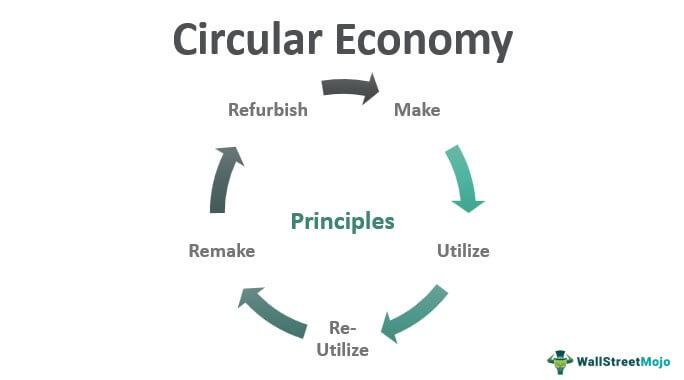
The circular economy is an economic model that aims to create a more sustainable and regenerative system by minimizing waste and resource consumption. It is a departure from the traditional linear economy, which follows a "take-make-dispose" pattern, leading to the depletion of natural resources and accumulation of waste.The focus is on keeping products, materials, and resources in use for as long as possible.

Benefits of Circular Economy

  • Protection of the environment: By lowering emissions, consuming fewer natural resources, and producing less trash.
  • Benefits for the local economy: By encouraging production models that rely on the reuse of nearby waste as raw material.
  • Drives employment growth: It fosters the development of a new, more inventive, and competitive industrial model, resulting in higher economic growth and more employment.
  • Promotes resource independence: Reusing local resources can reduce reliance on imported raw materials.

Government Initiative to Promote Circular Economy

  • The Government has been actively formulating policies and promoting projects to drive the country towards a circular economy. It has already notified various rules, such as the Plastic Waste Management Rules, e-Waste Management Rules, Construction and Demolition Waste Management Rules and Metals Recycling Policy
  • To promote the usage of fly ash and slag produced in the steel industry in other sectors by NITI Aayog. NITI organized an international conference on ‘Sustainable Growth through National Recycling’; prepared a strategy paper, along with the EU delegation to India, on ‘Resource Efficiency’, and four more on resource efficiency in the sectors of steel (with the Ministry of Steel), aluminium (with the Ministry of Mines), construction and demolition (with the Ministry of Housing and Urban Affairs) and e-waste (with the Ministry of Electronics and Information Technology).

T+1 Settlement System

Context: The Securities and Exchange Board of India (SEBI) is working to implement instantaneous settlements in secondary market trades, and is likely to complete the process next fiscal year.

image 107

What is a Settlement Process?

  • The settlement refers to the official transfer of shares from the seller's account to the buyer's account. 

Recent Developments

  • Indian capital market regulator SEBI (Securities and Exchange Board of India) announced on Monday to move to T+1 settlement cycle for all scripts from 1st October 2023. This means effective from first October 2023, all trades will be settled one day after the date of trade instead of the current T+2 settlement cycle. 
  • Earlier, India was following T+2 settlement and has now adopted T+1 settlement.
  • T+1 means that trade-related settlements must be done within one day of the transaction's completion. 
  • Trades on Indian stock exchanges are currently settled in two working days after the transaction is completed (T+2). For example, if you buy shares on Wednesday, they will be credited to your Demat account by the next day, which is Thursday.
  • Now, with the adoption of (T+1) settlement, the trade gets settled within one day. 

Significance

  • Most large stock markets, like in the US, Europe, Japan, still follow the T+2 settlement cycle of trade settlement. India has now become the second country after China to go for T+1 settlement.
  • The move is expected to increase volume in the cash segment as one would be able to move from one stock to another on the same date instead of waiting for settlement of one's trade after one day or two days.
  • Instant settlement would also mean that one won't be able to trade if they have no money available in their demat account. This is a positive development for the brokerages as their risk management to contain chances of fraud or default would go down after this move.