Prelims Nuggets

Is the SARSCoV2 XBB.1.16 lineage a cause for concern?

UPSC Syllabus: Awareness in the fields of IT, Space, Computers, robotics, nano-technology, bio-technology and issues relating to intellectual property rights.

Context: XBB.1.16, first detected in SARS-CoV-2 sequences from India, is a recombinant lineage of the corona virus. Preliminary data suggest that XBB.1.16 has a higher growth advantage over currently circulating SARS-CoV-2 lineages. The strain also has mutation associated with immune escape, or the ability of the virus to evade antibodies generated from previous infections or vaccines.

What are recombinants?

Co-infection of multiple lineages of a virus can lead to the exchange of genetic material between them through the process of recombination. Recombination is a process where genetic material from two different lineages of the same virus combines to form a new genome, which can give rise to chimeric genomes, or recombinants.

Recombinants may have the potential to create new lineages of the virus that possess better functional capabilities than either of the parent lineages. This is because the process of recombination allows for the combination of different genetic elements that may provide the virus with new functional advantages.

While most recombinations may not give rise to viable viruses, some rare recombinations could result in the creation of a new lineage of the virus. These new lineages may have improved pathogenicity, transmissibility, or other functional capabilities that make them more dangerous to human or animal health.

Why recombination happens so rapidly?

Since the replication of virus happens freely in the host cytoplasm, the process is completely unregulated. While the errors in DNA virus genomes can be corrected by the error-correcting function of cells in which they replicate, there are no enzymes in cells to correct RNA errors.

Therefore, RNA viruses, having a higher mutation rate than DNA viruses, tend to create recombinants rapidly. 

Unfortunately, the potency of a mutation to increase infectivity in a region can only be known retrospectively. 

Are all recombinants dangerous?

Most changes have little to no impact on the virus’ properties. However, some changes may affect the virus’s properties, such as how easily it spreads, the associated disease severity, or the performance of vaccines, therapeutic medicines, diagnostic tools, or other public health and social measures.

Why is XBB.1.16 a cause for concern?

  • Amid the ongoing increase in the number of seasonal influenza H3N2 cases, an uptick in COVID-19 cases is also being seen in India in the month of March, despite the low number of testing. 
  • The fast-spreading XBB.1.16 lineage is believed to be responsible for the recent spike in COVID-19 cases in India.
  • XBB.1.16 presently accounts for more than 30% of all the sequenced genomes in the month of March 2023, and its proportion has been seen to be increasing in the past few weeks. 

It is important to monitor for the emergence of recombinant viruses because they can have significant impacts on public health.

For example, the H1N1 influenza virus that caused the 2009 pandemic was a recombinant virus that combined genetic material from swine, avian, and human influenza viruses.

This new lineage of the virus was able to infect humans and rapidly spread around the world, resulting in significant morbidity and mortality.

Is XBB.1.16 more infectious?

Based on preliminary data, there is no evidence to suggest that infections with the XBB.1.16 lineage differ in clinical severity from those caused by other Omicron lineages although the higher growth advantage and immune escape could lead to a higher risk of reinfection with XBB.1.16 compared to other circulating Omicron lineages. Protecting the vulnerable through time-tested means could therefore significantly blunt the rise in infections.
PM to inaugurate ITU Area Office

Context: Prime Minister of India will inaugurate the new International Telecommunication Union (ITU) Area Office and Innovation Centre in India.

About International Telecommunication Union (ITU):

  • It is a specialized agency of the United Nations that focuses on information and communication technologies (ICTs). 
  • ITU was established in 1865 to enhance global connectivity in communication networks. 
  • The organization is responsible for managing the allocation of global radio spectrum and satellite orbits, as well as developing technical standards that enable seamless interconnectivity among networks and technologies. 
  • Membership of ITU is open to all member states of the United Nations. 
  • There are currently 193 member states of the ITU, including all UN member states except the Republic of Palau
  • Its headquarters is based in Geneva, Switzerland. 

Reports/Publications of ITU:

  • ICT Development Index
  • Global ICT Regulatory Outlook 2020
  • Global Cyber Security Index
  • Global e - Waste Monitor (along with United Nations University & International Solid Waste Association (ISWA)

India & ITU:

  • India has been an active member of the ITU since 1869, earnestly supporting the development and propagation of telecom in the global community of nations.  
  • The country has been a regular member of the ITU Council since 1952, and has played an important role in harmonizing the contributions of member States from the region, always respecting the principles of equality and consensus-building.  
  • India had been elected as a Member of the International Telecommunications Union (ITU) Council for 4-year term (2019-2022). 
  • India signed Host Country Agreement with the International Telecommunication Union for establishment of Area Office & Innovation Centre at New Delhi (March 2022). The Host Country Agreement provides the legal and financial framework for establishment and operations of the Area Office.
  • The Area Office and Innovation Centre of ITU at New Delhi is expected to serve South Asian  countries namely Afghanistan, Bangladesh, Bhutan, Iran, Maldives, Nepal, Sri Lanka and India.  

Give PDS beneficiaries the option to bundle millets with wheat, rice

Context: There is a news article in Indian express dated 22 march 2023 to allow millets under PDS, we will understand the various aspects of news in detail.

Who recommended millets in PDS?

To boost the consumption of millets, a Parliamentary panel has suggested that beneficiaries of different government schemes like PDS should be given the option to bundle millets along with wheat and rice.

Which parliamentary committee is related to PDS?

The Standing Committee on Consumer Affairs, Food and Public Distribution presented a demand for a grant report in the Lok Sabha on Tuesday for the department of food and public distribution. The report said that States are allowed to procure coarse grains/millets (Jowar, Bajra, Maize and Ragi etc.) from farmers at MSP under the central pool.

What is the procedure to procure and distribute millets under PDS?

This is subject to the prior approval of the Centre on the detailed procurement plan prepared by State Governments in consultation with FCI and also as per Guidelines for procurement, allocation, distribution and disposal of coarse grains/millets. 

Under which schemes Millets can be distributed by States?

The procured quantity should be distributed under TPDS (Targeted Public Distribution System)/OWS (Other welfare Schemes) in the State/UT. 

What are the new changes made in the guidelines?

  • Further, the report said that the Department has revised the guidelines for allocation, distribution and disposal of coarse grains procured by the State Agencies/FCI and
  • Enhanced the distribution period to 6-10 months from an earlier period of 3 months
  • Provision of advance for subsidy inter-state transportation of surplus millets through FCI is also incorporated. 

What is the role of the department of food and public distribution?

The Department also informed that the millet promotion is being done by the Agriculture Ministry in coordination with the Agriculture Departments of various States and the Department’s role is confined only to procuring them and distributing them for various schemes such as PDS, MDM (mid-day meal) scheme and Integrated Child Development Scheme (ICDS). 

What is millet at all?

Millets are a group of cereal grains that belong to the Poaceae family, commonly known as the grass family. Some of the millets are ragi, bajra, jawar etc. 

What is the importance of millet?

  • Millets have gained popularity in the West because they are gluten-free and boast high protein, fibre, and antioxidant content. 
  • Millets provide more essential amino acids than most other cereals. These compounds are the building blocks of protein  
  • What’s more, finger millet boasts the highest calcium content of all cereal grains. Calcium is necessary to ensure bone health, blood vessel and muscular contractions, and proper nerve function.
  • Millets are rich in fibre and non-starchy polysaccharides, two types of undigestible carbs that help control blood sugar levels. 
  • This cereal also has a low glycaemic index (GI), meaning that it’s unlikely to spike your blood sugar levels. Thus, millet is considered an ideal grain for people with diabetes.
  • Millets contain soluble fibre, which produces a viscous substance in your gut. In turn, this traps fats and helps in reducing cholesterol levels.
  • They’re also able to survive in harsh environments and less fertile soil. 
  • They have multiple advantages over other crops, including drought and pest resistance

Is there any downside to millet?

Despite millets’ multiple health benefits, they also contain antinutrients — compounds that block or reduce your body’s absorption of other nutrients and may lead to deficiencies.

One of these compounds — phytic acid — interferes with potassium, calcium, iron, zinc, and magnesium uptake. However, a person with a balanced diet isn’t likely to experience adverse effects.

Other antinutrients called goitrogenic polyphenols may impair thyroid function, causing goitre — an enlargement of your thyroid gland that results in neck swelling.

Nevertheless, this effect is associated only with excess polyphenol intake

What are the recommendations of the panel?

The panel recommended

  • Ministry should encourage the production and procurement of millets in all the States especially the States having significant tribal populations such as Rajasthan, MP and Chhattisgarh etc.
  • Ministry should provide all possible aid/assistance/bonuses to farmers opting to grow millets

Further, to encourage the consumption of millets, the Committee further suggest that the beneficiaries of different schemes should be given the option to bundle millets along with wheat and rice within their entitled quantity.

Dayanand Saraswati’s life is an inspiration for Modi government : Shah

Context: “The Prime Minister is working for national awakening, a concept originally based on the philosophy and teachings of Maharishi Dayanand Saraswati,” said Union Home Minister Amit Shah at the 148th Foundation Day celebrations of Arya Samaj.

Basic information about Dayanand Saraswati

  • Born in 1824 at Tankara, Gujarat. 
  • Associated Movement: Arya Samaj, Shuddhi Movement, Back to the Vedas
  • Relevant Publications: Satyarth Prakash (1875 & 1884); Sanskarvidhi (1877 & 1884); Yajurved Bhashyam (1878 to 1889)

Early Life and Education

As a Brahmin, he was taught religious rituals, piety and purity, importance of fasting from a very early age. 

Spiritual Indoctrination 

After his sister’s death, he began asking questions about life, death and the afterlife to his parents, to which they had no answers. 

On being asked to get married following societal traditions, Mool Shankar ran away from home. He wandered all over the country for the next 20 years. 

At last he arrived at Mathura where he met Swami Virajananda. Mool Shankar became his disciple and Swami Virajananda directed him to learn directly from the Vedas. He found all his questions regarding life, death and afterlife answered during his study of Vedas. 

His belief system

  • He was a believer in Hinduism just as the Vedas have outlined, devoid of any corruption and embellishments. 
  • Preserving the purity of the faith was of utmost important to him. 
  • He advocated the concepts of Dharma which he believed to be free from any partiality and as an embodiment of truthfulness. 
  • To him Adharma was anything that did not hold true, was not just or fair and was opposed to the teachings of the Vedas. 
  • He believed in reverence of human life irrespective of anything and condoned the practice of Ahimsa or non-violence. He advised people to direct their energy towards betterment of mankind as a whole and not waste away in unnecessary rituals. 
  • He revoked the practice of idol worship and considered them a contamination introduced by the priests. 
  • He was against other social evils like superstitions and caste segregation. 
  • He advocated the concept of Swarajya, meaning a country free of foreign influence, resplendent in the glory of fair and just participants.

Arya Samaj

  • When: On 7 April 1875 at Bombay. 
  • What: A Hindu reforms movement, meaning "society of the nobles". 
  • Objective: To move the Hindu religion away from fictitious beliefs. 
  • Moto of Samaj: 'Krinvan to Vishvam Aryam" meaning "Make this world noble". 

Views of Arya Samaj:

  • God is the efficient cause of all true knowledge.
  • God is existent, intelligent, blissful, formless, omniscient, just, merciful, unborn, endless, unchangeable, beginning-less, unequalled, the support of all, the master of all, omnipresent, immanent, un-aging, immortal, fearless, eternal and holy, and the maker of all. He alone is worthy of being worshiped.
  • The Vedas are the scriptures of all true knowledge. 
  • One should always accept truth and renounce untruth.
  • Every action should be based on Dharma.
  • Promote the physical, spiritual and social good of everyone.
  • Conduct should be guided by love, righteousness and justice.
  • We should dispel Avidya (ignorance) and promote Vidya (knowledge).
  • Condemn ritualistic practices like idol worship, pilgrimage and bathing in holy rivers, animal sacrifice, offering in temples, sponsoring priesthood etc.

Important contributions of Samaj:

  • Working to promote widow remarriage and women education
  • Launched programs to support widow remarriage in the 1880s. 
  • Maharishi Dayanand also underlined the importance of educating the girl child and opposed child marriage.

Shuddhi Movement

  • By: Maharishi Dayanand Saraswati
  • Meaning: Purification
  • Objective: to bring back the individuals to Hinduism who were either voluntarily or involuntarily converted to other religions like Islam or Christianity. 

Educational Reforms

  • Maharishi Dayanand set up a number of Gurukuls to teach his followers the knowledge of the Vedas and for them to spread the knowledge further. 
  • His disciples established the Dayanand Anglo Vedic College Trust and Management Society, after his death in 1883. 
  • The first DAV High School was established at Lahore on June 1, 1886 with Lala Hans Raj as its headmaster.

IPCC Synthesis report

Climate change is a threat to human wellbeing and planetary health and there is a rapidly closing window of opportunity to secure a liveable and sustainable future for all, the Intergovernmental Panel on Climate Change (IPCC) said in a report. 

The current report synthesises findings from three working groups. It also integrates evidence from three special reports during the sixth assessment cycle.

Key observations:

  • Human activities, principally through emissions of greenhouse gases, have unequivocally caused global warming, with global surface temperature reaching 1.1°C above 1850–1900 in 2011–2020. 
  • Global greenhouse gas emissions have continued to increase.
  • Adaptation planning and implementation has progressed across all sectors and regions, with documented benefits and varying effectiveness. Despite progress, adaptation gaps exist, and will continue to grow at current rates of implementation
  • Global GHG emissions in 2030 implied by nationally determined contributions (NDCs) announced by October 2021 make it likely that warming will exceed 1.5°C during the 21st century and make it harder to limit warming below 2°C.
  • Climatic and non-climatic risks will increasingly interact, creating compound and cascading risks that are more complex and difficult to manage.
  • The report, brings in to sharp focus the losses and damages we are already experiencing and will continue into the future, hitting the most vulnerable people and ecosystems especially hard.

About the IPCC

  • The Intergovernmental Panel on Climate Change (IPCC) is the United Nations body for assessing the science related to climate change. 
  • It was established by the United Nations Environmental Programme (UNEP) and the World Meteorological Organization (WMO) in 1988 to provide political leaders with periodic scientific assessments about climate change. 
  • The IPCC has 195 member states that are members of the UN or WMO.
  • The IPCC has three working groups:
    • Working Group I, which addresses with the physical science of climate change; 
    • Working Group II, which focuses on the impact, adaptation and vulnerability associated with climate change; and 
    • Working Group III, which deals with the mitigation of climate change. 
  • It also has a Task Force on Greenhouse Gas Inventories that develops methodologies for measuring emissions and removals.
  • IPCC assessments provide governments, at all levels, with scientific information they can use to develop climate policies. 
  • The UN panel does not itself undertake scientific assessments but only evaluates the state of scientific evidence on various aspects of climate change.

About the Sixth Assessment Cycle

The IPCC publishes comprehensive scientific assessments every six to seven years. The previous one, the Fifth Assessment Report, was completed in 2014 and provided the main scientific input to The Paris Agreement.

At its 41nd Session in February 2015, the IPCC decided to produce a Sixth Assessment Report (AR6).

ISRO’s LVM-3 to launch second fleet of 36 satellites

Context: In its second commercial launch, India’s heaviest launch vehicle LVM-3 will launch a fleet of 36 OneWeb satellites in the Low Earth Orbit, completing the first generation of the huge broadband constellation. 

OneWeb satellites:

  • OneWeb is a United Kingdom-based company, backed by the UK government and India’s Bharti, which plans to create a 588-satellite strong constellation to provide high-speed, low-latency global connectivity.
  • These satellites will be placed in 12 rings of 49 satellites each, with every satellite completing a full trip around the Earth in 109 minutes. The final launch by ISRO will enable the company to initiate global coverage.
    • This is the second OneWeb fleet that India is launching, with the first being carried out by the same vehicle in October 2022. 

Key Facts: 

  • In June 2020, the Indian government opened up the space sector to allow the participation of private firms in the entire gamut of space activities. As part of these reforms, the government set up:
    • New Space India Limited (NSIL) - the country's first public sector undertaking in the space sector.
    • Indian National Space Promotion and Authorization Centre (IN-SPACe) - the promoter and regulator of space activities in India by non-government and private entities.
  • India’s journey into the commercial heavy lift-off space was initiated after the launch of 36 OneWeb satellites in the Low Earth Orbit in October 2022. 
  • Despite being one of the major space-faring nations, India accounts for only about 2% of the commercial market
  • With the space sector opened up to private players in 2020, this is likely to increase, as more and more companies are developing their own small satellite launch capabilities. 
oH roOkfbyV9qxcCI7LXZv7puRcoW2897gg2XMowa8ZK1wG8UUpPnuN8E3iFKZ7AgCnSz9N8QIRuNyWSA6pI06lfQqNumXT0XUGYfQWLuG6oyfGbGSjHauEZMrmVS7jM YY4YgFqXAtYdDKfMeFosg

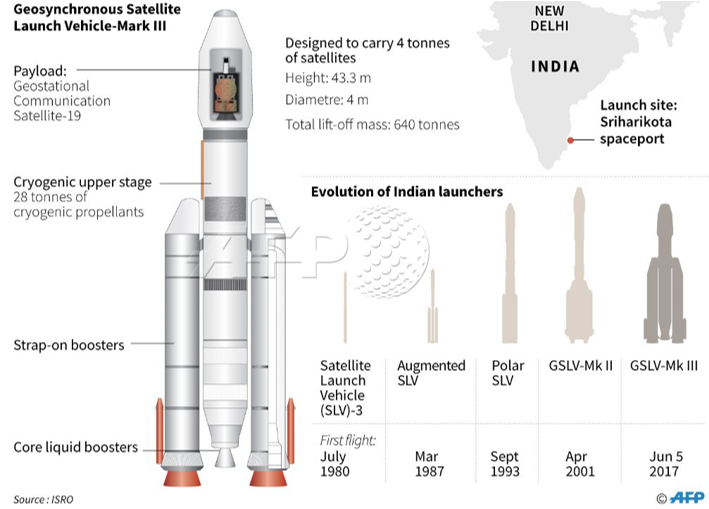
Launch Vehicle Mark-3:

  • The Launch Vehicle Mark-3 (LVM3) or Geosynchronous Satellite Launch Vehicle Mark III (GSLV Mk3) is a three-stage heavy-lift launch vehicle developed by the Indian Space Research Organisation (ISRO).
    • It has two solid strap-on motors, one liquid core stage and a high-thrust cryogenic upper stage.
  • Currently, the LVM3 rocket has the capacity to carry 4000 kg spacecraft launching capability to GTO (Geosynchronous Transfer Orbit) and 10000 tons to the Low Earth Orbit.
    • It is primarily designed to launch communication satellites.
    • It is also due to launch crewed missions under the Indian Human Spaceflight Programme (Gaganyaan).

A boost to the zoonoses theory

Undisclosed genetic data from a food market in Wuhan, China has been unearthed and is being used to support the zoonoses theory over the lab leak theory. These findings were presented to the Scientific Advisory Group for the Origins of Novel Pathogens, an expert body constituted by the WHO. 

Major Highlights:

  • Scientists discovered the data which consisted of genetic sequences posted by Chinese researchers in GISAID (a virology database).
  • A Chinese team had reportedly collected samples from the Huanan Seafood Wholesale Market, which showed that several samples from the market containing the virus also had human genetic material in them.
  • The main theoretical dualism that the world has contended with since the COVID-19 pandemic is the question of its origin — lab leak or zoonoses.
    • There is now a large body of peer-reviewed scientific research consistent with the zoonotic origin of this pandemic.
    • However, there is no credible, peer-reviewed research pointing to a lab leak. 
  • However, the critics of the animal transmission theory are demanding specifics and details on the zoonosis theory, while virologists say it would be impossible to get that level of data. 

Zoonotic diseases:

  • Zoonosis is an infectious disease that is naturally transmissible from vertebrate animals to humans. 

Zoonotic pathogens may be bacterial, viral, parasitic, or unconventional agents and can spread to humans through direct contact or food, water or the environment.

E.g., Salmonellosis, West Nile virus, Anthrax, Rabies, Bird flu, Malaria etc.

Matua Maha Sabha

Union Minister of Ports, Shipping & Waterways visited the auspicious “Matua Dharma Maha Mela” at the Shreedham Thakurnagar, Thakurbari, in West Bengal. 

The reason behind the event:

  • Mela is being organised to celebrate the 212th Birth Anniversary of Shri Shri Harichand Thakur ji. 
  • Mela showcases the vibrant culture of Matua Community. It is organised by the All India Matua Mahasangha. 

Matua Mahasangha:

  • Matua Mahasangha is a religious reformation movement that originated, around 1860 AD, in modern-day Bangladesh, with a considerable number of adherents both in Bangladesh and in West Bengal of India. 
  • Matua is a sect of depressed class AVARNA Hindus who are Namasudras, a Scheduled Caste group.
  • The movement was launched as a reformation by the followers of Harichand Thakur.

Harichand Thakur:

  • He worked among the untouchable people of Bengal Presidency. He formed the Matua sect of Hindus. 
  • He belongs to a Namashudra (or avarna) peasant family from Bangladesh. 
  • After experiencing atma darshan or self-revelation, he began to preach his own religious realization which is only based on Bhakti. According to his doctrine, all traditional rituals, except devotion to God, faith in mankind, and love for living beings, are meaningless and distortions from the real aim of attaining God. 
  • He organized downtrodden peoples of his own community under the banner of his new religious doctrine (known as Matua religion) and established Matua Mahasangha. They started considering him as God (Param Brahma) Harichand and as an avatar (incarnation) of Vishnu or Krishna. Thus, he became known as Sri Sri Harichand Thakur. 
  • His newly founded Matua religion is based on only three basic principles - Truth, Love, and Sanity. 

He gave twelve instructions to his followers.

These twelve instructions are: 

  1. Always speak the truth 
  2. Treat the woman as your mother-being; Respect the woman 
  3. Always respect your parents 
  4. Treat your neighbors and all earthly living beings with love, pity, and kindness 
  5. Never discriminate on racial grounds 
  6. Bring all the six passions of the mind under your control. These six passions of mind are - Lust, Anger, Greed, Infatuation, Pride, and Jealousy. 
  7. Remain liberal to all other religions and creeds 
  8. Become honest in mind and activities and avoid saintly dress to adorn yourself with 
  9. Perform your duties devotedly and utter the sacred Haribol and pray to God simultaneously 
  10. Build a temple of pure thoughts in your heart and soul and a temple of Shree Hariparameshwar at your dwelling place 
  11. Pray daily to God with devotion and sanctity 
  12. Sacrifice yourself to the cause of God.