Geography & Environment & Disaster management

Green Hydrogen Standard

Context: Ministry of New & Renewable Energy has notified the Green Hydrogen Standard which outlines the emission thresholds that must be met for hydrogen produced to be classified as 'Green', i.e., from renewable sources. This move is expected to bring a clarity to Green Hydrogen community in India and contribute to the progress of National Green Hydrogen Mission. India has become one of the first few countries in the world to announce a definition of Green Hydrogen.

Green Hydrogen Standard

  • Green Hydrogen shall mean Hydrogen produced using renewable energy, including production through electrolysis or conversion of biomass. Renewable energy also includes such electricity generated from renewable sources which is stored in an energy storage system or banked with grid in accordance with applicable regulations.
  • Green Hydrogen produced through electrolysis: Non-biogenic greenhouse gas emissions arising from water treatment, electrolysis, gas purification and drying and compression of hydrogen shall not be greater than 2 kg of CO2 equivalent per kg of Hydrogen, taken as an average over last 12 month period. 
  • Green Hydrogen produced through conversion of biomass: Non-biogenic greenhouse gas emissions arising from biomass processing, heat/steam generation, conversion of biomass to hydrogen, gas purification and drying and compression of hydrogen shall not be greater than 2 kg of CO2 equivalent per kg of Hydrogen taken as an average over last 12 month period.
  • Bureau of Energy Efficiency shall be the Nodal Authority for accreditation of agencies for monitoring, verification and certification of Green Hydrogen production projects. 
  • A detailed methodology for measurement, reporting, monitoring, on-site verification and certification of green hydrogen and its derivatives shall be specified by Ministry of New & Renewable Energy.

Irrigation in focus as India moves towards driest-ever August

Context: News reports and weather experts say that India might be facing its driest August in 100 years. As of Sunday, India had received 7% less rainfall cumulatively this monsoon compared to the long period average (LPA). This situation is expected to get worse. A recent report in Reuters quotes an India Meteorological Department official saying that. India is expected to receive an average of less than 180 mm of rainfall this August, which is the lowest since records began in 1901.

What is Irrigation?

The process of supplying water to crops by artificial means such as canals, wells, tube-wells, tanks, etc. from the sources of water such as rivers, tanks, ponds, or underground water is called irrigation.

Types of irrigation techniques

  1. Surface irrigation: Surface irrigation utilizes gravity flow to move water across land, wetting and infiltrating soil. It encompasses furrow, border strip, and basin irrigation, also known as flood irrigation.
  2. Localized irrigation: Localized irrigation involves the distribution of water through a network of pipes, utilizing low pressure, and delivering water in a predetermined pattern to each individual plant or in close proximity to it.
  3. Drip irrigation: The technique of delivering water drop by drop at or near the root zone of plants is known as drip irrigation or trickle irrigation. When managed properly, this method can be highly efficient in terms of water usage since it minimizes evaporation and runoff.
  4. Sprinkler irrigation: In sprinkler or overhead irrigation, water is piped to one or more central locations within the field and distributed by overhead high-pressure sprinklers or guns. 
  5. Sub-irrigation: Sub-surface irrigation also sometimes called seepage irrigation has been used for many years in field crops in areas with high water tables. It is a method of artificially raising water table to allow the soil to be moistened from below the plant root zone.
S.NO.Traditional Irrigation / Water Conservation methodsRegion
1.JhalaraJodhpur (Rajasthan)
2.Talab/BandhiBundelkhand 
3.BawariRajasthan
4.TankaThar Desert (Rajasthan)
5.Ahar PynesBihar
6.JohadsKarnataka, Odisha
7.Panam KeniWayanad (Kerala)
8.KhadinJaisalmer (Rajasthan)
9.KundRajasthan, Gujarat
10.BaoliRajasthan
11.Bhandara PhadMaharashtra 
12.ZingLadakh
13.KuhlsHimachal Pradesh

Why INDIA Needs Irrigation?

  • Uneven Rainfall Distribution: While some areas receive heavy rainfall during the monsoon season, others experience long dry periods. Irrigation helps to provide water to crops during dry spells, ensuring consistent and reliable water supply for agricultural activities.
  • Agricultural Productivity: Agriculture is a major contributor to India's economy, employing a significant portion of the population. Irrigation helps increase agricultural productivity by providing water when needed, which is crucial for crop growth, yield improvement, and food security
  • Drought Mitigation: Irrigation systems help mitigate the impacts of drought by providing water even in dry years.
  • Crop Diversification: Irrigation enables farmers to grow a wider variety of crops, including those that are not well-suited to rain-fed conditions. 
  • Stabilizing Farm Income: Irrigation helps stabilize farm income by reducing the vulnerability of farmers to the uncertainties of weather patterns. When rainfall is inadequate or erratic, farmers with irrigation systems can still produce crops and generate income.
  • Industrial and Economic Growth: Apart from agriculture, water from irrigation sources can be used for various industrial purposes, such as power generation, manufacturing, and other sectors. A stable water supply supports economic growth beyond just the agricultural sector.
  • Environmental Conservation: Efficient irrigation practices can help conserve water resources by reducing water wastage and promoting more responsible water use. Modern irrigation techniques such as drip irrigation and sprinkler systems minimize water runoff and evaporation.
  • Climate Change Resilience: As climate change brings about shifts in rainfall patterns and increased unpredictability, having a robust irrigation infrastructure becomes even more critical to adapt to changing conditions and ensure food security.

Sources of irrigation

  1. Tank irrigation: A tank consists of water storage which has been developed by constructing a small bund of earth or stones built across a stream. The water impounded by the bund is used for irrigation and for other purposes. The tank irrigation is practiced mainly in peninsular India due to the following reasons:
    • The undulating relief and hard rocks make it difficult to dig canals and wells.
    • There is little percolation of rainwater due to hard rock structure and ground water is not available in large quantity.
    • Most of the rivers of this region are seasonal and dry up in the summer season. Therefore, they cannot supply water to canals throughout the year.
    • There are several streams which become torrential during rainy season. The only way to make best use of this water is to impound it by constructing bunds and building tanks.
    • The scattered nature of population and agricultural fields also favors tank irrigation.
Merits of Tank irrigationDemerits of Tank irrigation
Most of the tanks are natural and do not involve heavy cost of their construction.Tanks are generally constructed on rocky bed and have long life span.Many tanks dry up during the dry season and fail to provide irrigation when it is needed the most.Silting of tank bed is a serious problem and it required desilting of the tank at regular intervals.Lifting of water from tanks and carrying it to the fields is a strenuous and costly exercise.
  1. Wells and Tube wells: A well is a hole dug in the ground to obtain the subsoil water. It is popular in areas where sufficient ground water is available. It accounts for about 16.6% of the net irrigated area in the country. A tube well is a deeper well from which water is lifted with the help of a pumping set operated by an electric motor or a diesel engine.
Merits of Well and Tube well irrigationDemerits of Well and Tube well irrigation
It is the simplest and cheapest source of irrigation.It is an independent source of irrigation and can be used as and when the necessity arises.A well can be dug at any convenient place.Only limited area can be irrigated.The well may dry up and may be rendered useless for irrigation if excessive water is taken out of it.In the event of a drought, the ground water level falls and water is not available in the well.Tube wells can draw a lot of groundwater from its neighboring areas and make the ground dry and unfit for agriculture.Well and tube well irrigation is not possible in areas of brackish groundwater. 
  1. Canals: Canals can be an effective source of irrigation in areas of low-level relief, deep fertile soils, perennial source of water and extensive command area. Canals in India are of two types, viz. (i) Inundation canals, which are taken out from the rivers without any regulating system like weirs. (ii) Perennial canals are those which are taken off from perennial rivers by constructing a barrage across the river. The percentage of canal irrigation in the country is about 23%.

Accelerated Irrigation Benefits Programme (AIBP) 

The programme was launched in 1996-97 to provide assistance to major/medium irrigation projects in the country, with the objective to accelerate implementation of such projects which were beyond resource capability of states or were in advanced stage of completion.

Pradhan Mantri Krishi Sinchayee Yojana (PMKSY)

It was launched in 2015-16 which aimed at enhancing physical access of water on farm and expand cultivable area under assured irrigation, improve on farm water use efficiency, introduce sustainable water conservation practices, etc. 

Objectives:

  • Achieve convergence of investments in irrigation at the field level.
  • Enhance the physical access of water on the farm and expand cultivable area under assured irrigation.
  • Enhance the adoption of precision – irrigation and other water saving technologies.
  • Enhance recharge of aquifers and introduce sustainable water conservation practices.
  • Ensure the integrated development of rainfed areas using the watershed approach towards soil and water conservation.
  • Promote extension activities relating to water harvesting, water management and crop alignment for farmers.
  • Attract greater private investments in precision irrigation.

IRRIGATION IN INDIA: 

IRRIGATION IN INDIA MAP
  • According to NITI Aayog, in 2022-23, of the 141 million hectares of gross sown area in the country, nearly 73 million hectares, or 52%, had irrigation access, up from 41% in 2016.
  • 8 out of 73 million hectares have the micro irrigation facility
  • 40% of the total irrigated area are watered through canal networks, the remaining through groundwater.
  • The total potential for micro-irrigation in the country is estimated to be 60 million hectares. 
  • Conventional surface irrigation provides only 60% efficiency but drip irrigation has nearly 90% efficiency.
  • The country can create irrigation potential in about 60% of its arable land and 40% of the cultivable area will remain dependent on rains because it is not possible to create irrigation networks in certain regions due to hydrological and geographical reasons.

Related concepts & definition:

  • Net Area Sown: This represents the total area sown with crops and orchards. Area sown more than once in the same year is counted only once. 
  • Gross Cropped Area: This represents the total area sown once and/or more than once in a particular year, i.e. the area is counted as many times as there are sowings in a year. This total area is also known as total cropped area or total area sown. 
  • Area Sown more than once: This represents the areas on which crops are cultivated more than once during the agricultural year. This is obtained by deducting Net Area Sown from Gross Cropped Area. 
  • Irrigated Area: The area is assumed to be irrigated for cultivation through such sources as canals (Govt. & Private), tanks, tube-wells, other wells and other sources. It is divided into two categories:
    • Net Irrigated Area: It is the area irrigated through any source once in a year for a particular crop. 
    • Total/Gross Irrigated Area: It is the total area under crops, irrigated once and/or more than once in a year. It is counted as many times as the number of times the areas are cropped and irrigated in a year. 
    • Cropping Intensity: It is the ratio of Net Area Sown to the Total Cropped Area.
image 98

Amazon Summit of ACTO Countries

Context: Amazon Summit under the aegis of the Amazon Cooperation Treaty Organisation (ACTO) came to an in the  Belem City of  Brazil. The Summit produced an outcome document known as Belem Declaration. This is only the fourth summit-level meeting under ACTO. 

Amazon Cooperation Treaty Organisation (ACTO)

  • Amazon Cooperation Treaty Organisation (ACTO) is an intergovernmental organisation formed by 8 Amazonian countries: Bolivia, Brazil, Colombia, Ecuador, Guyana, Peru, Suriname and Venezuela (8 countries). 
  • The above Eight nations decided to create ACTO to strengthen and implement under the Amazon Cooperation Treaty in 1995 to strengthen and implement the Amazon Cooperation Treaty objectives. 
  • Permanent Secretariat of ACTO was established in Brasilia in 2002 and permanently installed in 2003. Permanent Secretariat of ACTO is to facilitate the exchange, knowledge, cooperation and joint projection among ACTO Member Countries to fulfil the mandate of Amazon Cooperation Treaty. 
  • Amazon Cooperation Treaty was signed in 1978 to promote the harmonious development of Amazonian territories in a way that joint actions of Amazonian countries produce equitable and mutually beneficial results in achieving the sustainable development of Amazon region.

Objectives of Amazon Cooperation Treaty Organisation

  • Facilitate exchange and cooperation among Member countries, promoting strategic sustainable development and livelihoods with emphasis on vulnerable populations, indigenous people and other tribal communities.
  • Ensure that the interests and sovereignty of Member Countries are respected and promoted.
  • Facilitate actions to preserve, protect, conserve and sustainably use forests, biodiversity and water resources of the Amazon.
  • Promote the management of Amazonian resources in harmony with nature and the environment.
  • Promote and disseminate the culture of Amazon and foster respect and protection of ancestral and current wisdom.
  • Promote coordination of plans for Member Countries for the development of Amazonian populations.

About Amazon River and its Basin

  • Amazon region makes up more than half of the world's tropical rainforest and is the world's largest tropical forest. The region stretches over an area twice the size of India. Two-thirds of it lies in Brazil and the remaining is shared by other 7 countries and one territory (French Suriname). The region also has a significant presence of savanna-like biogeography.
  • Amazon River: Largest & longest river on Earth. It originates at 5597 metres in the Peruvian Andes on the slopes of the Quehuisha volcano. 
  • Important tributaries of Amazon: Putumayo, Japurá and Negro River (north slope), Juruá, Purús, Madeira, Tapajós and Xingú.
  • Rich in biodiversity: Amazon's tropical forest biome accounts for 50% of Earth's existing biodiversity and is the most extensive and biodiversity-rich jungle on the planet. 
  • Climatic significance of Amazon: Amazon has a great influence on heat & water vapour transportation to higher latitude regions.
    • Regulates regional climate 
    • Regulates carbon absorption contributing to mitigating climate change.
    • Regulates evapotranspiration process
  • Cultural significance: Amazon basin is home to about 40 million inhabitants and is home to 400 indigenous peoples who speak more than 300 languages. 

Challenges to Amazon Ecosystem

  • Deforestation and land use changes in Amazon Region.
  • Oil exploration in Amazon region and other mineral exploration.
  • Countries of the Amazon region aim for economic development.
  • Scientists believe when 20-25% of Amazon's rainforest is destroyed, rainfall will dramatically decline
  • Exploitation of rights of indigenous people in the Amazonian region.
  • Expansion of agricultural cultivation in Amazon region.
  • Organised crime and drug trafficking in Amazon region

Karnataka CM urges Centre to make amendments to drought manual

Context: Karnataka Chief Minister Siddaramaiah has written to the Union government to bring changes to the Manual for Drought Management, 2016 (updated in 2020) for the declaration of drought by the States. 

Rationale and objectives: Drought declaration’ signifies the beginning of Government response to conditions representing a drought situation.

Indices & Parameters

Five categories of indices are recommended for developing a monitoring matrix for drought. The five categories of indices are Rainfall, Vegetation, Water, Crop and others.

  • The first step is to look at two mandatory indicatorsrainfall deviation and dry spell. Depending on these, the manual specifies various situations that may or may not be considered a drought trigger.
  • The second step is to look at four impact indicatorsagriculture, vegetation indices based on remote sensing, soil moisture, and hydrology. The manual States that States may consider any three of the four types of the Impact Indicators for assessment of drought and make a judgement. If all three chosen indicators are in the ‘severe’ category, it amounts to severe drought; and if two of the three chosen impact indicators are in the ‘moderate’ or ‘severe’ class, it amounts to moderate drought.
  • The third step comes in after both previous triggers have been set off. In that event, “States will conduct sample survey for ground truthing in order to make a final determination of drought. The finding of field verification exercise will be the final basis for judging the intensity of drought as ‘severe’ or ‘moderate’.”
  • Once a drought is determined, the state government needs to issue a notification specifying the geographical extent. The notification is valid for six months, unless de-notified earlier.

Challenges in Drought declaration:

  • Strict parameters – Various experts have opined that the parameters are so strict that it becomes very difficult to implement them and declare droughts.
  • One size fits all approach – There indices do not take regional variations into account. It is important to develop region specific criteria that consider local ecological factors, water availability, and agricultural practices.
  • Traditional practices - Many States still continue to rely on the traditional practice such as the annewari/ paisewari/ girdawari systems of eye estimation and crop cutting experiments.
  • Time taken to declare droughts – To estimate the losses in crops one has to wiat till the season end. For e.g, estimates for kharif crops are generally available by December or after, whereas those for rabi crops are available not before March. This delays the timely intervention.
  • Support from centre - Moderate drought is no longer eligible for relief funds from the Centre. The 2016 manual makes it clear that only if the calamity is of “severe nature” can the state governments submit a memorandum for financial assistance under the National Disaster Response Fund. For mild and moderate droughts, the states have to shell out their own funds. 

Ukraine says its drones damaged a Russian warship, showing Kyiv’s growing naval capability

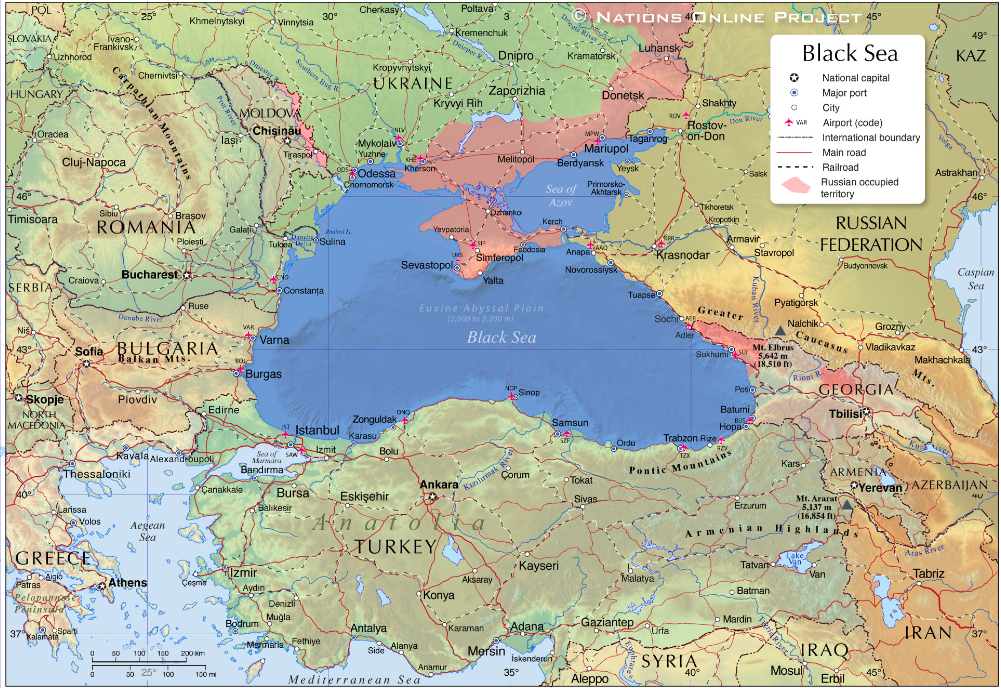
Context: Ukraine said its sea drones struck a major Russian port Friday and damaged a warship in an attack that underlined Kyiv’s growing capabilities as the Black Sea becomes an increasingly important battleground in the war.

Where is Black Sea Located?

Black Sea Located
  • It is a large inland sea situated at the south-eastern extremity of Europe. 
  • It is bordered by Ukraine to the north, Russia to the northeast, Georgia to the east, Turkey to the south, and Bulgaria and Romania to the west.
  • It is connected to the distant waters of the Atlantic Ocean by the Bosporus (which emerges from the sea’s southwestern corner), the Sea of Marmara, the Dardanelles, the Aegean Sea, and the Mediterranean Sea. 
  • The Crimean Peninsula thrusts into the Black Sea from the north, and just to its east the narrow Kerch Strait links the sea to the smaller Sea of Azov. 
  • Several large rivers flow into the Black Sea, such as the Danube, the Dnieper, the Dniester, the Southern Bug, the Russian Don and the Kuban rivers, Western Georgia's Rioni river, and the Turkish Kızılırmak and Sakarya rivers.
  • The Black Sea is connected to the North Sea via the Danube and the Rhine-Main-Danube Canal.

How Black Sea was formed?

  • Large-scale movements of the Earth's crust uplifted the mountain ranges that divided the ancient Tethys Ocean into several water basins, such as the Paratethys Ocean. The megalake of the late Miocene was probably the largest lake in Earth's history and extended from the region east of the Alps across Central Europe to Central Asia. Its remnants include the Black Sea, the Sea of Azov, the Caspian Sea and the Aral Sea.
  • During the last great ice age, which ended about 25,000 years ago, the Black Sea was a large freshwater lake. The Bosphorus, the connection to the Mediterranean Sea - and to saline water - was presumably formed about 6,500 to 7,500 years ago.

The Black Sea has experienced the worst environmental degradation of all of the world's oceans. The situation has become so severe that it has affected the health, well-being, and standard of living of the people in the immediate area

Can small modular nuclear reactors help India achieve net-zero?

Context: The world still depends on fossil fuels for 82% of its energy supply. The recent uptick in coal consumption in Europe, despite the increase in solar and wind power, suggests that reliable, 24/7 low-carbon electricity resources are critical to ensure the deep decarbonisation of power generation, along with grid stability and energy security. 

What are Small Modular Reactors (SMR)?

  • Small modular reactors (SMRs) are advanced nuclear reactors that have a power capacity of up to 300 MW(e) per unit, which is about one-third of the generating capacity of traditional nuclear power reactors. SMRs, which can produce a large amount of low-carbon electricity, are:
    • Small – physically a fraction of the size of a conventional nuclear power reactor.
    • Modular – making it possible for systems and components to be factory-assembled and transported as a unit to a location for installation.
    • Reactors – harnessing nuclear fission to generate heat to produce energy.
What are Small Modular Reactors

What are the benefits of SMR?

  • Due to smaller size, they can be sited on locations not suitable for larger nuclear power plants.
  • They have relatively lower carbon footprint as they have lower fuel requirements.
  • They are easy to manufacture, ship, transport and installed.
  • They offer savings in cost and construction time.
  • They can be deployed incrementally to match increasing energy demand. SMRs are designed to operate for 40-60 years with capacity factors exceeding 90%
  • They can be installed into an existing grid or remotely off-grid.
  • They are relatively safer as they operate on lower power and pressures and hence lower potential for the uncontrolled release of radioactive materials into the environment.
  • They require no human intervention or external power or force to shut down systems.

Hence, an efficient regulatory regime comparable to that in the civil aviation sector – which has more stringent safety requirements – is important if SMRs are to play a meaningful role in decarbonising the power sector. This can be achieved if all countries that accept nuclear energy direct their respective regulators to cooperate amongst themselves and with the International Atomic Energy Agency to harmonise their regulatory requirements and expedite statutory approvals for SMRs based on standard, universal designs.

What steps should be taken in India?

  • The Atomic Energy Act will need to be amended to allow the private sector to set up SMRs.
  • To ensure safety, security, and safeguards, control of nuclear fuel and radioactive waste must continue to lie with the Government of India.
  • The government will also have to enact a law to create an independent, empowered regulatory board with the expertise and capacity to oversee every stage of the nuclear power generation cycle, including design approval, site selection, construction, operations, certification of operators, and waste reprocessing.
  • The security around SMRs must remain under government control, while the Nuclear Power Corporation can operate privately-owned SMRs during the hand-holding process.
  • Indian government can negotiate with foreign suppliers to reprocess nuclear waste from all SMRs in a state-controlled facility under IAEA safeguards. The reprocessed material may also be suitable for use in other NPPs in India that use imported uranium. India can set up facility to reprocess spent fuel from SMRs.
  • Finally, the Department of Atomic Energy must improve the public perception of nuclear power in India by better disseminating comprehensive environmental and public health data of the civilian reactors, which are operating under international safeguards, in India.

Necessary intervention: On India’s conservation ethos

Context - The Wildlife Institute of India and the National Tiger Conservation Authority, who are responsible for the quadrennial ‘tiger census’ reports, recently updated their estimates for the animal’s numbers. Madhya Pradesh, for the second time in eight years, reported 785 tigers, or about a fifth of the national count. The State reported a 50% rise in tigers since the last census.

image 80

A Case Study : How Madhya Pradesh over the years has perfected the Tiger conservation approach:

It has focussed on balancing the predator – prey relationship: M.P. has reintroduced species such as barasingha (swamp deer) to new habitats such as Satpuda and Bandhavgarh, and the gaur to the Bandhavgarh and Sanjay-Dubri tiger reserves. Prey species such as chital (spotted deer) have been successfully supplemented in the Satpuda and Sanjay tiger reserves, Nauradehi, Kuno, and Gandhisagar wildlife sanctuaries through translocation from high-density Pench and Bandhavgarh.

These often involve tracking, darting and capturing animals, keeping them in temporary enclosures until they reach sufficient numbers and then releasing them into their new habitat. 
zfLSdHqmbNS0rkxogW9rn vmQdsnVWy8R2PaQPXQt1rHDJ1t5AVqOTig68i4WM53bpB6TJh8g9Wd7lpRS7yM wTcT ZTXGvb 4y8LGlNw VJxI7hJI3yXTUZ1KIUenP5auonaGV3jfNb EbJ2ylIg

Key facts:

  • The number of tigers in India has increased from 2,967 in 2018 to 3,682 in 2022, an annual rise of 6 per cent.
  • India has become home to approximately 75 per cent of the world’s tiger population.
  • Tiger census is held every four years in the country.
  • With a 50 per cent increase in the last four years, Madhya Pradesh has the maximum number (785) of tigers in the country, followed by Karnataka (563), Uttarakhand (560), and Maharashtra (444), according to the data.
  • The number of tigers “within the tiger reserve” is highest in Corbett (260), followed by Bandipur (150), Nagarhole (141), Bandhavgarh (135), Dudhwa (135), Mudumalai(114), Kanha (105), Kaziranga (104), Sundarbans (100), Tadoba (97), Sathyamangalam (85), and Pench-MP (77).
  • Arunachal Pradesh, Odisha, Telangana, Chhattisgarh and Jharkhand have recorded a dip in the number of majestic cats in the last few years.
  • The Western Ghats witnessed a decrease in tiger occupancy, except for a few areas like Kali (Anshi Dandeli), where the number of unique tigers remains stable. The report pointed to “increasing human footprint and development” as the primary reasons behind the declining tiger population in the Western Ghats

The distribution of major industries in India: A Comprehensive Overview

A robust industrial base is the backbone of any prosperous economy. In India, industries range from traditional village crafts to modern, highly sophisticated factories.

At Rau's IAS Study Circle, we believe a thorough understanding of the distribution of major industries in India is crucial for aspirants of the UPSC Civil Services Examination, primarily under the domains of Indian Economy and Indian Geography.

Major Industries in India

Metal Industries map

Iron and Steel Industry

Considered the backbone of the industrial sector, the Iron and Steel industry plays a pivotal role in the development process of any country. In India, major iron and steel plants are located in the peninsular region.

States like West Bengal (Durgapur, Burnpur, and Kulti), Jharkhand (Jamshedpur and Bokaro), Karnataka (Bhadravathi and Vijayanagar), Chhattisgarh (Bhilai), Odisha (Rourkela), and Tamil Nadu (Salem) are significant contributors.

Textile Industry

The Textile industry is one of the oldest and most widespread industries in India. Cotton textiles are predominantly concentrated in the cotton-growing regions, including Maharashtra (Mumbai), Gujarat (Ahmedabad), and Tamil Nadu (Coimbatore).

The woolen textile industry is mainly located in the northern states like Punjab (Ludhiana, Amritsar), Haryana (Panipat), and Uttar Pradesh (Kanpur). The silk industry is majorly seen in Karnataka, West Bengal, and Jammu & Kashmir.

Automobile Industry

The Automobile industry in India has witnessed exponential growth in the last few decades. Major automobile centers in India include Chennai (Tamil Nadu), often referred to as the 'Detroit of Asia,' Pune and Nasik in Maharashtra, Gurgaon and Manesar in Haryana, and Sanand in Gujarat.

Information Technology (IT) Industry

India's IT industry is a global leader in software services. Major IT hubs include Bengaluru (Karnataka), often referred to as the 'Silicon Valley of India,' Hyderabad (Telangana), known as 'Cyberabad,' Pune (Maharashtra), Chennai (Tamil Nadu), Noida (Uttar Pradesh), and Gurugram (Haryana).

Chemical Industry

The Chemical industry is widely dispersed across India due to the wide range of products it encompasses.

However, Mumbai (Maharashtra), Vadodara (Gujarat), and Kolkata (West Bengal) are known for major chemical industrial units.

Pharmaceutical Industry

Pharmaceutical Industry - major industry

Hyderabad in Telangana is known as the 'Bulk Drug Capital of India,' hosting many major pharmaceutical companies. Other significant centers include Bengaluru (Karnataka), Ahmedabad and Vadodara (Gujarat), and Visakhapatnam (Andhra Pradesh).

Conclusion

Understanding the distribution of Indian major industries is a key element in the UPSC Civil Services Exam preparation.

It allows aspirants to link various aspects of geography, economy, and current affairs, thereby enriching their answers and perspectives. Rau's IAS Study Circle continues to guide aspirants in comprehending these interlinkages and encourages a holistic approach to learning.

What are sponge cities ?

Context: China has been hit by devastating floods in July, inundating cities and causing deaths and infrastructural damage, as well as raising questions about the effectiveness of its 2015 sponge city initiative to reduce urban flood risks.

sponge cities

About Sponge Cities

  • It describes urban areas with abundant natural areas such as trees, lakes, and parks or other good designs intended to absorb rain and prevent flooding.
  • It can alleviate urban flooding, water resources shortage, and the urban heat island effect and improve the ecological environment and biodiversity by absorbing and capturing rainwater and utilizing it to reduce floods.
  • There are three main facets to developing such systems: protecting the original urban ecosystem, ecological restoration, and low-impact development.
  • It is part of a worldwide movement that goes by various names: green infrastructure in Europe, low-impact development in the United States, water-sensitive urban design in Australia, natural infrastructure in Peru, and nature-based solutions in Canada.
  • Associated techniques include permeable roads, rooftop gardens, rainwater harvesting, rain gardens, green space and blue space such as ponds and lakes. 

Need for Sponge Cities

  • A growing number of urban areas are experiencing devastating floods as climate change brings heavier rainfall and growing flood risk.
  • A recent Intergovernmental Panel on Climate Change (IPCC) report said 700 million people already live in areas where rainfall extremes have increased, a number expected to grow as global temperatures rise.
  • They can hold more water in rivers, greenery, and soil instead of losing it to evaporation, meaning they are more resilient to drought.
  • Natural ways to absorb urban water are about 50% more affordable than man-made solutions and are 28% more effective.

Significance of Sponge Cities

  • In the long run, it will reduce carbon emissions and help fight climate change. 
  • It can reduce the frequency and severity of floods and improve water quality.
  • Helps in preventing beach pollution by capturing stormwater
  • Associated strategies like green space can improve quality of life, improve air quality and reduce urban heat islands.

China's Sponge Cities

  • A sponge city is a new urban construction model for flood management, strengthening ecological infrastructure and drainage systems, proposed by Chinese researchers in early 2000 and accepted by the Chinese Communist Party (CCP) and the State Council as urbanism policy in 2014
  • The "sponge city initiative" undertaken by the Chinese government involves the construction of water-absorbent infrastructure in 30 different urban centers. This initiative aims to effectively manage and utilize 60% of the rainfall in these cities. 
  • The strategy includes creating ponds, wetlands, and installing permeable surfaces on roads and public areas, facilitating the natural infiltration of stormwater into the earth. 
  • China's goal is for 80% of its urban regions to have the capacity to absorb and recycle a minimum of 70% of rainwater by the year 2020.

With rapid urbanisation in India and increasing urban floods, it is time for India to move towards sponge cities.

List of Water Conservation Campaigns & Schemes

Welcome to Rau's IAS Study Circle blog – your one-stop solution for comprehensive and up-to-date knowledge. Today, we delve into an integral issue in the civil services examinations: water conservation campaigns and schemes, both at the national and international level. Our in-depth analysis ensures aspirants have a thorough understanding of this crucial topic.

National Water Conservation Campaigns & Schemes in India

Water Conservation Campaigns & Schemes

1. Jal Shakti Abhiyan

Launched in 2019 by the Indian government, the Jal Shakti Abhiyan aims to accelerate water conservation efforts across the country. This water conservation scheme's key strategies include water conservation, rainwater harvesting, renovation of traditional water bodies, and watershed development.

2. Atal Bhujal Yojana

The Atal Bhujal Yojana, an initiative by the Ministry of Jal Shakti, emphasizes sustainable groundwater management. The scheme is centered on participatory groundwater management, involving Panchayat Raj Institutions and local stakeholders.

3. National Water Mission

The National Water Mission, under the National Action Plan on Climate Change, targets comprehensive water management focusing on surface and groundwater resources, demand management, and governance structure.

International Water Conservation Campaigns

4. World Wildlife Fund (WWF) Water Conservation Campaigns

WWF is a significant global entity focused on nature conservation, including various water conservation campaigns. These initiatives aim to ensure healthy freshwater systems exist and endure for people and nature alike.

5. United Nations (UN) Water Conservation Initiatives

The UN leads numerous global campaigns for water conservation, such as the 'Water for Life Decade' (2005-2015) and World Water Day. The focus of these initiatives is to promote water conservation and improve water sanitation worldwide.

Understanding the mechanics of these water conservation campaigns and schemes is pivotal for civil service aspirants. It not only aids in tackling the prelims and mains but also in formulating practical solutions during the interview stage.

For more insights and strategic guidance on such vital topics, keep following Rau's IAS Study Circle blog. The key to cracking the civil services exam lies in comprehending the intricate details of such issues that directly impact the well-being of our planet and its inhabitants.

List of Major Important Dams in India [Map]

Dams play a vital role in a country's water management system, including irrigation, flood control, hydroelectric power generation, and water supply. A clear understanding of the important dams in India, their geographical location, and associated rivers is essential for the UPSC Civil Services Examination.

Important Dams in India

Important largest Dams in India on Map

Bhakra Nangal Dam

Located in Himachal Pradesh on the Sutlej River, Bhakra Nangal Dam is one of the highest gravity dams in the world. The dam's primary purposes include electricity generation and irrigation in Himachal Pradesh, Punjab, Haryana, and Rajasthan.

Hirakud Dam

Constructed across the Mahanadi River in Odisha, Hirakud Dam is one of the world's longest man-made dams. It is primarily used for irrigation, flood control, and power generation.

Tehri Dam

Tehri Dam, located on the Bhagirathi River in Uttarakhand, is the highest dam in India. It serves the dual purpose of hydroelectric power production and water supply for irrigation.

Sardar Sarovar Dam

Built on the Narmada River in Gujarat, Sardar Sarovar Dam is a part of the Narmada Valley Project. It provides irrigation facilities to Gujarat and Rajasthan, and electricity generation for four Indian states.

Nagarjuna Sagar Dam

Nagarjuna Sagar Dam, constructed on the Krishna River, lies between Telangana and Andhra Pradesh. The dam provides irrigation water to the Nalgonda, Prakasam, Khammam, and Guntur districts.

Indira Gandhi Canal

Although not a dam, it's crucial to mention the Indira Gandhi Canal, which originates from the Harike Barrage at the confluence of the Beas and Sutlej rivers in Punjab. This canal system is one of the largest in India and primarily provides irrigation in the Thar Desert region of Rajasthan.

Tungabhadra Dam

Tungabhadra Dam is built on the Tungabhadra River, a tributary of the Krishna River. Located in Karnataka, the dam provides irrigation and hydroelectricity to parts of Karnataka and Telangana.

DamLocation
Bhakra Nangal DamHimachal Pradesh
Hirakud DamOdisha
Tehri DamUttarakhand
Sardar Sarovar DamGujarat
Nagarjuna Sagar DamAndhra Pradesh & Telangana
Indira Gandhi CanalRajasthan
Tungabhadra DamKarnataka

What is the largest dam in India, and what are its key features?

The Tehri Dam, located in Uttarakhand, is the tallest dam in India. It serves multiple purposes, including electricity generation, irrigation, and flood control, with a significant capacity for hydroelectric power production.

How do dams contribute to India's electricity supply?

Dams contribute significantly to India's electricity supply by harnessing the potential of hydroelectric power, a renewable energy source that plays a crucial role in the nation's energy mix.

What role do dams play in flood control and irrigation in India?

Dams are instrumental in controlling floods by regulating river flow and providing a reliable water supply for irrigation, supporting agriculture in various regions.

Conclusion

Understanding the importance and geographical location of key dams in India forms a crucial part of the UPSC Civil Services Examination syllabus, primarily under Indian Geography. Aspirants should keep themselves updated with recent developments related to these dams, their significance, and the challenges associated with them.

This knowledge will enrich their answers and perspectives in both the Preliminary and Mains stages of the examination.

The Mines and Minerals (Development and Regulation) Amendment Bill, 2023

Context: India’s Parliament passed a law allowing the government to auction and mine its newly  discovered reserves of lithium, among other minerals, increasing the mining of the critical input for EV batteries. 

The Mines and Minerals (Development and Regulation) Amendment Bill, 2023 amends the Mines and Minerals (Development and Regulation) Act, 1957.  

  • The Act regulates the mining sector.  For regulation, the Act classifies mining-related activities into: 
  1. reconnaissance, which involves a preliminary survey to determine mineral resources.
  2. prospecting, which includes exploring, locating, or proving mineral deposits.
  3. mining, the commercial activity of extraction of minerals.

Key features of the amendment bill:

  1. Private sector involvement - It seeks grant of exploration licence to private sector players for deep-seated and critical minerals. 
  2. Reconnaissance to include sub-surface activities:  The Act defines reconnaissance operations as operations undertaken for preliminary prospecting and includes: (i) aerial surveys, (ii) geophysical, and (iii) geochemical surveys.  It also includes geological mapping.  The Act prohibits pitting, trenching, drilling, and sub-surface excavation as part of reconnaissance.  The Bill allows these prohibited activities.
  3. Exploration licence for specified minerals:  The Act provides for following types of concessions:

(i) a reconnaissance permit for reconnaissance, 

(ii) a prospecting licence for prospecting, 

(iii) mining lease for undertaking mining, and 

(iv) a composite licence, for prospecting and mining.  

The Bill introduces an exploration licence, which will be issued for 29 minerals specified in the Seventh Schedule.  

These include gold, silver, copper, cobalt, nickel, lead, potash, and rock phosphate.  

These also include six minerals classified as atomic minerals under the Act:

(i) beryl and beryllium, (ii) lithium, (iii) niobium, (iv) titanium, (v) tantallium, and (vi) zirconium.  

The Bill declassifies them as atomic minerals.  Unlike other minerals, the prospecting and mining of atomic minerals is reserved for government entities under the Act.

  1. Exclusive auction mining lease to centre - It empowers the central government to exclusively auction mining lease and composite licence for certain critical minerals.
  2. Time limits - Blocks explored by the exploration licence holder would be auctioned for mining lease within a prescribed timeline.

Merits:

  • Rationalization of minerals - Many of the minerals listed as atomic minerals have numerous non-atomic applications in space industry, electronics, technology and communications, energy sector, electric batteries etc. In most cases, the non-atomic uses of these minerals far outweigh their atomic use. Many such minerals are not fissile or radioactive in nature. 
  • Reduced financial burden on government - Deep-seated minerals such as gold, silver, copper, zinc, lead, nickel, cobalt, platinum group of minerals, and diamonds are difficult and expensive to explore and mine hence involving them may reduce the financial burden on government.
  • Geopolitical advantage – It may reduce the dependence of India over the imports of such minerals thereby reducing the relative geopolitical vulnerabilities.
  • Increase in efficiency - Only 19 blocks of minerals have been auctioned so far by the State Government viz. graphite, nickel and phosphate out of 107 blocks handed over to the various State Governments. As these critical minerals are vital for the growth of our economy, authorizing the Central Government to auction concession for these critical minerals would increase the pace of auction and early production of the minerals.
  • Innovation in mining - Private participation will improve the scope of mining and innovation in this sector. 
  • Improving revenue to states - Timebound auctioning will help state to have better revenues.
  • Boost to manufacturing- Reducing the government monopoly will eventually bring competition in this sector boosting the mining of such minerals which are very critical when it comes to E.V manufacturing, chip industries etc. 

Issues involved :

  1. Private participation may lead to misuse, irresponsible and excessive mining. This can have several detrimental socio-environmental implications.
  2. Already stressed Public sector undertakings may further take the backseat. 
  3. Issue of federalism because of exclusive right to centre to auction mining lease.
  4. The Bill also dispenses with cumbersome forest clearances for mine reconnaissance and prospecting operations. This may affect the ecology of the concerned region.