Context:Recently, United Nations World Tourism Organisation has included Dhordo village in the list of ‘Best Tourism Village’.
About Dhordo
Dhordo, located in the Banni region within the Rann of Kutch, stands as a symbol of Gujarat's progress and increasing pride.
The village's distinctive round houses, known as bhungas, have gained immense popularity among tourists.
Dhordo is renowned for hosting the three-month-long Rann Utsav, a cultural celebration that highlights the traditional art, music, and crafts of the region.
The Best Tourism Village is awarded to villages that are at the forefront of both nurturing rural areas and preserving the region's landscapes, cultural diversity, and culinary traditions.
About Best Tourism Villages initiative
Introduced in 2021, the UNWTO's Best Tourism Villages initiative is an integral component of the UNWTO Tourism for Rural Development Programme.
This program is dedicated to fostering development and inclusivity in rural regions, countering depopulation, promoting innovation, enhancing value chain integration through tourism, and advocating sustainable practices.
Villages are assessed across nine essential areas
Cultural and Natural Resources
Promotion and Preservation of Cultural Resources
Economic Viability
Social Viability
Environmental Sustainability
Tourism Advancement and Integration of Value Chains
Governance and Prioritization of Tourism
Infrastructure and Connectivity
Health, Safety, and Security
Initiative encompasses three key pillars
Best Tourism Villages by UNWTO: Acknowledges exceptional rural tourism destinations featuring accredited cultural and natural assets, a dedication to preserving community-based values, and a clear commitment to innovation and sustainability across economic, social, and environmental aspects.
Best Tourism Villages by UNWTO Upgrade Programme: Provides support to villages in their journey towards meeting recognition criteria, offering assistance in areas identified as gaps during evaluation.
Best Tourism Villages Network: Serves as a platform for sharing experiences and best practices, learning opportunities, and engagement with members, welcoming contributions from experts and public and private sector partners involved in the promotion of tourism as a catalyst for rural development.
About UNWTO
The United Nations World Tourism Organization (UNWTO) is a specialized agency of the United Nations dedicated to promoting responsible, sustainable, and universally accessible tourism.
Headquarters: Madrid, Spain.
It takes the lead in shaping tourism policies and offers support while serving as a global platform for tourism policy discussions and a valuable source of tourism research and knowledge.
UNWTO encourages the adoption of various initiatives, including the Global Code of Ethics for Tourism Development, Competitiveness, Innovation & Digital Transformation, Ethics, Culture & Social Responsibility.
Official languages: Arabic, Chinese, English, French, Russian, and Spanish.
Structure
General Assembly: It serves as the primary meeting of the World Tourism Organization, convening every two years to endorse the budget and work plan and to deliberate on significant issues pertaining to the tourism sector. It also elects a Secretary-General every four years. The World Committee on Tourism Ethics operates as a subsidiary body of the General Assembly.
Executive Council: UNWTO's governing board is the Executive Council, responsible for ensuring the Organization fulfills its mission and adheres to its financial plan. It convenes at least twice a year and consists of members chosen by the General Assembly.
Committees: Specialized committees comprised of UNWTO members provide guidance on management and program content. These include the Committee on Budget and Finance, the Sustainable Development of Tourism Committee, and others.
Secretariat: The Secretariat is responsible for executing UNWTO's work program and meeting the requirements of members and affiliate members. The Secretary-General leads this group.
Context: As the Israel-Palestine conflict is back in news, there is a focus on Jewish community among the Kukis. A section of Kukis community in Manipur and Mizoram identify themselves as Jews and have overtime emigrated to Israel.
About Bnei Menashe
Around 5,000 Kuki tribal people live in Israel as they emigrated under Israel's open-door policy for communities recognised as 'Lost Jewish Tribe' by Israel. Most of Kuki resettled in Israel live in small town of Sderot, close to Gaza.
The community is known as Bnei Menashe in Hebrew which translates as children of Manasseh. Menashe is the first son of Joseph, revered in Judaism as the first prophet.
Bnei Menashe claim descent from one of the Ten Lost Tribes of Israel, who were sent to exile by the Assyrian Empire 2700 years ago who wandered all through Asia to settle in the Northeastern India.
Kuki have integrated well and many of them are part of Israel Defence Forces.
Context:Narges Mohammadi, an Iranian activist, won the Nobel Peace Prize for her efforts towards women’s rights and democracy.
About Narges Mohammadi
She has won the Nobel Prize for her fight against the oppression of women in Iran and her fight to promote human rights and freedom for all.
She is the 19th Woman to win the Nobel Peace Prize and the second Iranian Woman, after Shirin Ebadi (won Nobel Peace Prize in 2003).
About Nobel Peace Prize
Itis one of the five Nobel Prizes established by the Alfred Nobel, along with the prizes in Chemistry, Physics, Physiology or Medicine and Literature.
It is awarded by a committee elected by the Norwegian Parliament (Stortinget).
It is awarded for the Outstanding contributions to peace: arms reduction, international cooperation, and organisations contributing to peace, and human rights contributions to peace.
It was first awarded in 1901. It was divided equally between Jean Henry Dunant "for his humanitarian efforts to help wounded soldiers and create international understanding" and Frédéric Passy "for his lifelong work for international peace conferences, diplomacy and arbitration".
Only two recipients have won multiple Prizes: the International Committee of the Red Cross has won three times (1917, 1944, and 1963) and the Office of the United Nations High Commissioner for Refugees has won twice (1954 and 1981).
Context:Recently, Union Cabinet Ministry, approved a tribal university for Telangana-‘the Sarakka Central Tribal University’. The Central Government announced the establishment of the university as a part of the Andhra Pradesh Reorganisation Act, 2014. The University is to be named after Sammakka-Sarakka, revered by the local tribal community.
Sammakka-Sarakka Jatara:
As per the legends, Sammakka was married to a feudal chief of the Kakatiyas dynasty (ruled over the Warangal region). Sarakka/Saralamma was the daughter of Sammakka.
Kakatiya dynasty ruler, Prataprudra imposed taxes on the Koya tribe and later declared battle on the tribe when the chief was not able to pay the taxes.
The Sammakka Sarakka Jathara/Medaram Jathara,a biennial festival is celebrated to commemorate this battle of the 13th-century, in which the mother-daughter duo participated against the local rulers in protest against the imposition of taxes.
Sammakka and Sarakka are worshipped as the protector of Koya tribe.
The festival shows no Vedic or Brahmanic influence.
The ritual of the festival includes taking holy dip in Jampanna Vagu (a stream), a tributary of River Godavari.
From Medaram, the Jathara begins and priests belonging to Koya tribe perform the rituals. Medaram is situated in the Eturnagaram Wildlife Sanctuary, a part of Dandakaranya forest.
Various tribal and non-tribal communities participate in the festival, from Andhra Pradesh, Madhya Pradesh, Chattishgarh, Odisha, Maharashtra, Karnataka and Jharkhand.
It is the second largest fair of India, and is often referred to as the Kumbh Mela of the tribals.
The festival is declared a state festival by the Telangana government.
Context: Jon Fosse from Norway, won the Nobel Prize in Literature. His plays are among the most widely staged playwright in the world.
About the news:
The writer is known for his innovative plays and prose, giving “voice to the unsayable”.
His works are written in Norwegian Nynorsk language, covering number of genres- Plays, novels, poetry collections, essays and children’s books.
Major works of Jon Fosse
Jon Fosse made his debut as an author in 1983 with the novel, ‘Red, Black’ (Raudt,Svart), which moves back and forth in time and between perspectives. The novel was emotionally raw broached the theme of suicide.
His works are minimalistic and rely on simple language, delivering messages through rhythm, melody and silence.
Boathouse and Melancholy I and II; Someone is Going to come; And We’ll Never be Parted.
His latest, Septology, is a semiautobiographical work and its third volume was shortlisted for the 2022 International Booker Prize.
In 2022, French Feminist Icon Annie Ernaux was awarded the Nobel Prize in Literature.
About Nobel Prize in Literature:
The Swedish Academy, Stockholm, Sweden awards the Prize.
It is one the Five Nobel Prizes established by the will of Alfred Nobel in 1895.
It is awarded annually, since 1901, to an author from any country in the field of literature, producing the most outstanding work in an idealistic direction.
Rabindranath Tagore was the first Indian, receiving the nation’s first Nobel Prize (in Literature) in 1913 for his collection ‘Gitanjali’ published in London in 1912. He was also the first non-westerner, to receive this prize.
Context: The Supreme Court issued an order maintaining the current state of affairs regarding the appointment of archakas (priests) in Agamic temples in Tamil Nadu. An association of archakas, had contested reforms introduced by the government, which were perceived as an attempt to alter the hereditary system of appointing archakas in Agama temples.
More about the news:
The petitioners sought the annulment of the state government's orders, which paved the way for individuals trained in Agama Sastra, regardless of caste and gender, to assume the role of priests.
The petitioners alleged that the state government was illicitly trying to appoint non-believers as archakas, which they argued violated religious rights safeguarded by the Constitution.
They contended that expertise in the Agamas, which are significant religious practices, could not be acquired through a one-year certificate course offered by the government but required years of rigorous training under knowledgeable Gurus.
It pointed out that prominent Shaivite and Vaishnavite temples in Tamil Nadu were built according to Agamas and worship therein is as per Agamas.
It is well settled that a secular Government does not have the power to interfere with essential religious practices, as such a right is well protected under the Constitution of India. Agamas undoubtedly pertains to an essential religious practice, which cannot be tampered with by the Government”.
About ‘Archakas’ and ‘Yajakas’:
The term "Yajaka" finds its origins in the Sanskrit word "yaja," which encompasses the concepts of sacrifice. Those who actively partake in worship or sacrificial rites, along with those who support them, are collectively referred to as "Yajis."
"Yajanam" signifies the act of worship, while "yajamana" denotes the individual who sponsors and hosts the ritual with their patronage.
The practice of yaja dates back to the Vedic era.
The Yajurveda has given sacrificial prayers or formula. It stands as the second most significant Veda after the Rigveda.Anyone who engages in ritualistic worship of God is considered a Yajaka.
An "archaka" is someone who worships an "arca," which signifies an image of God.
In traditional Vaishnavism, an "arca" represents a living incarnation of God in the form of an image. This image may be crafted from various materials such as stone, wood, clay, gemstones, gold, silver, bronze, or alloys, but it is treated as an embodiment of God.
To become an archaka, individuals typically receive initiation or "Deekshai" and undergo sacred rituals, often guided by their Guru or Acharya, who is often their fathers. This initiation occurs at a tender age, typically between five and seven years, and is followed by rigorous Vedic education spanning a minimum of three years.
Subsequently, they undergo further training, lasting three to five years, to perform Poojas (ritual worship) and Homams (sacrificial fire ceremonies).Only after this extensive training do they assume the role of archakas.
Role of Archakas or Yajakas:
In Vaishnavism, an archaka is unequivocally considered an incarnation of Hari (God). This perspective is mirrored in Saivism as well.
Archakas occupy a paramount role in society as they ensure the proper worship of deities in accordance with scriptural guidelines.
By keeping the Deities content, they prevent misfortunes and calamities, fostering peace, prosperity, and the well-being of communities in the towns and villages where temples are located.
Scriptures emphasize that when priests perform worship with pure intentions and utmost sincerity, it brings abundant blessings to all.
Worship in Hinduism:
In Hinduism, devotees have the option to engage in worship of their chosen deities through two distinct approaches: external worship (bahya) involving specific rituals, prayers, and offerings, or internal worship (antah), which relies on mental visualization and spiritual connection.
The practice of mental worship, known as "manasa puja," is often regarded as more potent and profound in its effects. It entails invoking the divine presence within one's consciousness and devotion.
External worship can be performed by a devotee directly, without any intermediary, or indirectly with the guidance and assistance of a trained priest.
Traditionally, the responsibility of conducting worship ceremonies in Hindu temples falls upon individuals known as priests. These priests go by different titles such as "archakas" and "yajakas," depending on their specific roles and responsibilities within the temple.
In Vaishnava temples, the participation of a priest is typically indispensable for the worship of deities. The intricate rituals and customs involved in Vaishnava worship necessitate the expertise of a trained priest to ensure their proper execution.
However, in Saiva temples, devotees have more flexibility. They can choose to worship the deity directly, engaging in rituals and prayers without the need for a priest's involvement, or they may opt to receive guidance and assistance from a temple priest, depending on their personal preferences and beliefs.
Agamas and Tantras:
The Agamas are a compilation of diverse Tantric texts and scriptures from various Hindu schools. The term "Agama" translates to tradition or passed-down knowledge.
The term "Agama" signifies "that which has come to us," reflecting its transmission across generations, and "Tantra" means "that which protects with detail."
The Agamic and Tantric texts fall into three primary categories: Vaishnava Agamas, Saiva Agamas, and Sakta Tantras, though this classification is not exhaustive. Vaishnava and Saiva texts are typically called Agamas, while Tantra is often associated with Sakta texts. However, technically, Tantra is an integral part of Agama, and these terms are often used interchangeably.
These Agama texts encompass a wide range of subjects, including cosmology, philosophy, meditation techniques, yoga, mantras, temple construction and deity worship.
They are available in both Tamil and Sanskrit languages.
Although Agamic traditions are often associated with Tantrism, the term "Tantra"specifically refers to Shakta Agamas.
The Agama literature is extensive, comprising 28 Shaiva Agamas, 64 Shakta Agamas (also known as Tantras), and 108 Vaishnava Agamas(also called Pancharatra Samhitas), along with numerous Upa-Agamas.
The origin and chronology of Agamas remain uncertain, with some possibly of Vedic origin and others not. While some scholars suggest they date back to over 1100 BCE, epigraphical and archaeological evidence indicates their existence during the Pallava dynasty era in the middle of the 1st millennium CE.
It's important to note that Hindu Agama texts contain passages challenging the authority of the Vedas while asserting that they reveal the Vedas' true essence.
Additionally, the Agamic literary genre can also be found in Sramaṇic traditions such as Buddhism and Jainism.
The Agamas outline three essential requirements for a place of pilgrimage:
Sthala (temple location),
Tirtha (temple water tank), and
Murti (deity image)
They provide detailed rules for Silpa, the art of sculpture, including quality standards for temple locations, types of images, materials, dimensions, proportions, air circulation, and lighting within the temple complex.
Daily worship rituals at temples follow Agama-set rules.
Agamas and Tantras are profound sources of wisdom that enrich and guide various aspects of Hindu spiritual and cultural life.
Context: A 108-foot statue of 8th century spiritual leader Adi Shankara was unveiled recently in Madhya Pradesh’s Omkareshwar. The statue of Openness depicts Shankaracharya as a 12-year old child when he is known to visit the Omkareshwar in Khandwa District.
Adi Shankara
He was also known as Shankaracharya.
Born in Kaladi, Kerala in 788 CE.
Propounded the Doctrine of Advaita (Monism) and wrote many commentaries on the Vedic canon (Upanishads, Brahma Sutras and Bhagavad Gita) in Sanskrit.
His major works included Brahmasutrabhasya (Bhashya or commentary on the Brahma Sutra), Bhajagovinda Stotra and Nirvana Shatakam.
He was responsible to revive Hindu philosophy at a time when Buddhism was gaining momentum in India.
He is said to have established four Mathas (Hindu Monastaries) at Shingeri, Puri, Dwaraka and
Badrinath– for propagation of Sanathana Dharma in four corners of India.
Adi Shankaracharya was opposed to Buddhist philosophers.
Philosophy of Adi Shankara is part of Vedanta (One of the six schools of Aastik Hindu Philosophy).
Advaita Philosophy
Advaita Vedanta refers to the non-dualistic school of Hindu philosophy, which is derived mostly from the Upanishads and elaborated in detail by eminent scholars like Gaudapada and Sri Adi Shankaracharya.
Dvaita means duality, and Advaita means nonduality. In simple terms, Advaita means absence of the duality between subject and object.
About Omkareshwar Temple:
Omkareshwar is a Hindu temple dedicated to Shiva. It is on an island called Mandhata, near Khandwa city in the Narmada river at Khandwa district in Madhya Pradesh, India. It is one of the 12 revered Jyotirlinga shrines of Shiva; the shape of the island is said to be like the Devanagari ॐ symbol.
There are two main temples of Shiva here, one to Omkareshwar (whose name means "Lord of Omkara or the Lord of the Om sound") located in the island and one to Mamleshwar (Amaleshwar) (whose name means "Immortal Lord" or "lord of the Immortals or Devas") located on the southern bank of the Narmada River on the mainland.
Madhya Pradesh has two Jyotirlingas, the second one, Mahakaleshwar Jyotirlinga, is situated about 140 km north of Omkareshwar Jyotirlinga.
Other Ten Jyotirlinga: are Somnath in Gujarat, Mallikarjuna at Srisailam in Andhra Pradesh, Kedarnath in Himalayas, in Uttrakhand state, Bhimashankar in Maharashtra, Viswanath at Varanasi in Uttar Pradesh, Triambakeshwar near Nashik in Maharashtra, Vaidyanath Temple, Vaidyanath in Jharkhand, Nageshwar at Dwarika in Gujarat, Rameshwar at Rameswaram in Tamil Nadu and Grishneshwar near Aurangabad, Maharashtra in Maharashtra.
Context:During the 45th session of the World Heritage Committee in Riyadh, Saudi Arabia, ‘the Sacred Ensembles of the Hoysalas,’ encompassing three temples located in Karnataka, have been added to UNESCO's World Heritage List.
More about the news:
The Hoysala Temples, now mark India's 42nd UNESCO World Heritage Site.
In addition to this, Rabindranath Tagore's Santiniketan, a university town in West Bengal, was also granted world heritage status.
The Archaeological Survey of India (ASI) revealed that India had submitted the nomination dossier for, ‘the Sacred Ensembles of the Hoysalas to the World Heritage Centre in January 2022,’ and the site had been on UNESCO's tentative list since 2014.
Hoysala Temples
The Hoysala Temples, constructed during the 12th and 13th centuries by the Hoysala kings, are dedicated to deities Shiva and Vishnu.
Chennakeshava temple, situated at the heart of Belur (Hassan district) within a traditional settlement surrounded by the remnants of a mud fort and a moat.
Hoysaleswara Temple is located on the banks of Dwarasamudra tank in Halebidu (Hassan district), a town featuring numerous protected and unprotected temples, archaeological ruins, and mounds.
Keshava Temple stands at the centre of Somanathapura village (Mysore district).
About Belur Chennakeshava Temple Complex:
Chennakeshava Temple Complex, is situated along the banks of the Yagachi River.
This remarkable complex is ingeniously designed within a rectangular layout.Encircled by four straight streets, this layout facilitates the traditional ritual circumambulation of the deity, offering devotees an immersive religious experience.
In a remarkable display of dedication and craftsmanship, construction of the Chennakeshava Temple commenced in the year 1117 AD.
The temple is dedicated to Lord Vishnu, a central deity in Hinduism. It serves as a sacred haven for devotees seeking solace and spiritual connection with the divine.
One of the most captivating features of the Chennakeshava Temple is its richly sculptured exterior. These intricate carvings narrate compelling stories from the life of Lord Vishnu, his divine incarnations, and the epic narratives of the Ramayana and Mahabharata.
Interestingly, among these depictions, there are also representations of Lord Shiva, showcasing a harmonious coexistence of deities within the Hindu pantheon.
Chennakeshava Temple has been a centre of uninterrupted worship since its establishment. It continues to thrive as a vibrant hub of devotion and remains a pilgrimage site for Vaishnavite devotes seeking spiritual fulfillment.
About Hoysaleshwar Temple of Halebid:
Halebid, formerly known as Dorasamudhra, emerged as the capital of the Hoysala empire at the zenith of its power. This transition marked a pivotal moment in the region's history, and at the heart of Halebid stands the Hoysaleshwara Temple.
Constructed in the year 1121 CE during the reign of King Vishnuvardhana Hoysaleshwara, this temple stands as a testament to the artistic prowess and devotion of the Hoysala dynasty.
The Hoysaleshwara Temple is dedicated to Lord Shiva, a principal deity in Hinduism. It serves as a place of worship and reverence for both locals and pilgrims, drawing them into its sacred embrace.
This architectural marvel was made possible through the collective efforts of the affluent citizens and merchants of Dorasamudra. Their patronage and financial support enabled the temple's construction, exemplifying the community's deep-rooted faith and commitment to their religious beliefs.
What truly sets the Hoysaleshwara Temple apart are the more than 240 exquisite wall sculptures that adorn its outer walls. These intricate carvings narrate captivating stories from Hindu mythology and historical events.
Halebid extends its cultural heritage beyond the Hoysaleshwara Temple. Within the walled complex, one can discover three Jaina basadi (temples) dating back to the Hoysala period. These temples serve as a testament to the religious diversity and harmonious coexistence of different faiths in the region. Additionally, a stepped well adds to the historical significance of the site, reflecting the ingenious engineering achievements of the time.
About Kesava Temple of Somnathpur:
The Kesava Temple is a veritable masterpiece, boasting a mesmerizing Trikuta architecture. It is dedicated to Lord Krishna in three distinct forms: Janardhana, Keshava, and Venugopala. This trifecta of deities embodies various facets of the divine and provides a multifaceted spiritual experience for visitors.
Each intricately carved figure and ornament is a testament to the devotion and craftsmanship of the artisans of that era.
The Hoysala Empire: A Comprehensive Overview:
The Hoysala Empire, a prominent Kannadiga dynasty originating from the Indian subcontinent, held dominion over a significant part of present-day Karnataka during the span of the 10th to the 14th centuries. This period was marked by remarkable achievements in art, architecture, and religion. In this elaboration, we delve into the various facets of the Hoysala Empire, from its geographic expansion to its cultural contributions.
1. Geographic Expansion
The Hoysala Empire was initially established in the landscapes of Malenadu, a region nestled within the Western Ghats.
However, the 12th century saw the Hoysalas capitalizing on the internal strife between the Western Chalukya Empire and the Kalachuris of Kalyani.
This opportunistic maneuver allowed them to annex territories in present-day Karnataka and the fertile regions north of the Kaveri delta, now part of Tamil Nadu
By the 13th century, their dominion extended to encompass most of Karnataka, substantial portions of northwestern Tamil Nadu, and segments of western Andhra Pradesh within the Deccan Plateau.
2. Political History:
Initially, the Hoysalas were vassals or feudatories of the Chalukyas of Kalyani.
Their capital was situated in Dwarasamudra (Halebeedu). The dynasty's inception was credited to Sala, and his successors included Vinayaditya and Balalla I.
However, the zenith of Hoysala power came under the reign of Vishnuvardhana, also known as Bittideva.
Vishnuvardhana's remarkable military acumen was highlighted by his decisive victory over the Cholas in the Battle of Talakadu, earning him the title "Talkadugonda."
In commemoration of this triumph, he commissioned the construction of the Kirtinarayana Temple in Talakadu and the Chennakesava Temple in Beluru.
3. Religious Patronage:
The Hoysalas were renowned patrons of Shaivism, Vaishnavism, and Jainism.
Vishnuvardhana himself converted to Srivaishnavism under the influence of Sri Ramanujacharya, who settled in Melukote, Karnataka.
4. Literary Contributions:
The Hoysala era witnessed a flourishing of literature in both Kannada and Sanskrit.
Notable literary works from this period include "Harihara" and "Raghavanka's Harishchandracharite" in Kannada, as well as "Nemichandra's Leelavati Prabhanda" in Sanskrit.
Evolution of Hoysala Architecture: From Inception to Flourishing Style:
The Vesara style, from its nascent stage under the patronage of the Badami Chalukyas in the 7th century, it matured during the Western Chalukya era in the 11th century.
However, it reached its zenith as an independent and distinct style during the reign of the Hoysalas in the 13th century.
1. The Temple-Centric Hoysalas
The Hoysala rulers were renowned for their prolific temple construction. Their architectural style is often described as "temple-centric," reflecting their deep devotion to Hindu deities such as Lord Shiva, Lord Vishnu, and various manifestations of the Goddess.
2. Star-Shaped Ground Plans
One of the hallmark features of Hoysala architecture is the star-shaped ground plan (known as Stellate plan) employed in many of their temples, although staggered square plans are sometimes observed.
The temples were erected on a raised platform called Jagati, which stood at approximately 1 meter in height.
These temples exhibit a symmetrical arrangement of multiple shrines and the walls and staircases of the temple followed a zigzag pattern.
3. Soapstone as the Primary Building Material
The Hoysalas favoured soapstone (chloritic schist) as their primary construction material.
This soft stone allowed for exquisite carving and intricate detailing, enabling the creation of the elaborate sculptures and motifs that adorn the temples.
4. Intricate Carvings
These intricate sculptures grace nearly every surface of the temples, depicting scenes from Hindu mythology, celestial beings, deities, animals, and intricate geometric patterns.
Prominently featured are various forms of Lord Vishnu, especially Chennakesava, and Lord Shiva.
Let us look at some of the distinctive architectural elements:
Makartorana: This feature leads to the mantapa of the temples, adorned with sculpted images of Makara in lintel form overhead.
Mantapa: Hoysala temples incorporate both open (outer mantapa) and closed mantapa (inner mantapa), with highly ornate ceilings bearing mythological figures and floral designs.
Pillars: Circular pillars in the mantapas of Hoysala temples are a common sight, each featuring four brackets at the top adorned with sculpted figures.
Cella (Vimana): Vimanas in Hoysala temples are plain on the inside but profusely elaborated on the outside.
Shrine: Hoysala temples are classified based on the number of shrines, such as ekakuta (one shrine) or dvikuta (two shrines).
Development of Kalasa: A characteristic feature of Hoysala temple towers is the vase-shaped water pot placed atop.
Salabhanjika: These mythical female figures, with stylized feminine attributes, are found in four brackets on top of the pillars and on each side of the makartorana.
Kirtimukh: The figure of kirtimukh often embellishes the vimana of certain Hoysala temples.
Mythical Presentation: Hoysala art excels in presenting Hindu mythology through sculpted and architectural forms. Scenes from the Ramayana, Mahabharata, and Puranas intricately adorn temple walls.
Erotica: Some temples feature erotic sculptures, influenced by the prevailing Sakta tradition.
Influence of Chola and Chalukya Art:
For instance, the "Sthambha buttalikas" pillar image in Hoysala art exhibits influences from Chola and Chalukya artistic traditions.
A notable example of Chola influence can be seen in the image of Mohini on one of the pillars in the Chennakeshava temple, seamlessly integrated into Hoysala artistry.
Hoysala architecture represents a captivating chapter in the history of Indian art and temple construction. Its evolution, from its nascent stages to the mature and distinctive style that emerged under Hoysala rule, showcases a profound commitment to temple-centric design, intricate carvings, and a fusion of artistic influences.
Context:The town of Santiniketan, founded by the renowned Nobel laureate Rabindranath Tagore, has now earned a place on the UNESCO World Heritage List. Located in West Bengal's Birbhum district, Santiniketan, which translates to "abode of peace," began its journey in 1901 and stands as the very place where Tagore laid the foundations of Visva-Bharati University.
More About the news:
The Culture Ministry, in its proposal to UNESCO for Santiniketan's inclusion on the World Heritage List, emphasized that this place represents a significant exchange of human values.
It has played a pivotal role in the development of architecture, technology, monumental arts, town planning, and landscape design within a cultural area of global importance.
Efforts to secure Santiniketan's place on the UNESCO World Heritage List have been ongoing since 2010.
The latest proposal for its nomination began in the financial year 2020-21.
ASI has been diligently working on the restoration of various structures in the vicinity of Santiniketan in recent years.
Exploring the Legacy of Santiniketan:
An Abode of Peace and Knowledge
Santiniketan was originally called Bhubandanga, after the name of the village where it was located.
The town of Santiniketan was founded by Maharshi Devendranath Tagore, the father of Rabindranath Tagore, who was a Bengali philosopher, polymath, and the first non-European to win the Nobel Prize in Literature.
Maharshi Devendranath Tagore was a follower of the Brahmo Samaj, a Hindu reform movement that emphasized the worship of one supreme God and the importance of education and social reform.
In 1863, Maharshi Devendranath Tagore purchased a large piece of land in Bhubandanga, which he renamed Santiniketan, meaning “abode of peace.” He established an ashram, or spiritual retreat, on the land and started to teach his students about the principles of the Brahmo Samaj, as well as the importance of nature and simplicity.
Debendranath built a 60-foot by 30-foot glass structure for Brahmo prayers, inspired by the Crystal Palace in London, under a chhatim tree where he used to meditate.
In 1888, Debendranath dedicated the property to establish a Brahmavidyalaya through a trust deed.
In 1901, Rabindranath started a Brahmacharyaashrama, which became known as Patha Bhavana in 1925.
In 1921, Rabindranath Tagore founded Visva Bharati. Visva-Bharati University was later expanded to include a wide range of disciplines, including arts, sciences, and humanities. It became a Central University and an Institution of National Importance in 1951, and is now one of the most prestigious universities in India.
Rabindranath Tagore also established several other cultural institutions in Santiniketan, including the Kala Bhavan, a school of fine arts, and the Sangit Bhavan, a music school.
Santiniketan became a hub of cultural and intellectual activity, attracting scholars and artists from around the world. It was also a centre of resistance during India’s struggle for independence, with many of its students and faculty participating in the freedom movement.
Why did Rabindranath Tagore establish Shantiniketan?
Vision: Creating an educational institution that would be in harmony with nature, allowing students to better understand the topics they were learning and to create a place of learning that transcended religious and regional barriers.
Principles:Ancient Indian Gurukul system, where education was provided in a natural setting, fostering a strong connection between students and their environment.
Santiniketan, derived from the Sanskrit words, “shanti” (meaning peace or tranquility) and “niketan” (meaning abode or residence), translates to “abode of peace.”
Phases of development:
Late 19th Century: 1895 Onwards:
The earliest phase of development at Santiniketan saw the construction of significant structures such as the Ashram, Santiniketan Griha, Upasana Mandir, and the Prayer Hall, which hold great historical value.
The site of Chhatimtala, where Maharishi Debendranath Tagore meditated under the chhatim trees, remains critical to the integrity and authenticity of this phase.
The structures have retained their originality and authenticity and have been restored recently by the Archaeological Survey of India.
Rabindranath Tagore: 1901-1941:
In 1901, Rabindranath Tagore established Santiniketan with a vision of promoting unity among people of different cultures worldwide.
Visva Bharti: Its multifaceted approach included providing education to children, nurturing a love for nature, using music and arts to foster emotional development, engaging in social work to help neighbouring villages, promoting rural development through Sriniketan, and conducting research on philosophy and cultures.The centre was established with the objective of eradicating not only poverty of the mind but also material poverty in India.
Tagore believed that learning could not be achieved by simply locking oneself up in a classroom. As an artist, he believed that freeing one’s mind was crucial to the learning process. Consequently, the concept of open-air classrooms emerged.
Tagore believed in the convergence of two distinct chains of thought, the traditional beliefs of the East and the progressive ideologies of the West. As a result, the university has welcomed many international faculty members who have contributed to fulfilling his vision.
Rathindranath Tagore: 1941-1952:
After the death of Gurudev Rabindranath Tagore, his son Rathindranath took over the mantle of his father at Santiniketan.
This period ends with the formulation of Visva Bharati as a national level university under an Act of Parliament.
Under Rathindranath, Santiniketan continued the four-fold vision of Rabindranath Tagore:
Rabindranath Tagore had envisaged a fourfold plan for the development of Santiniketan- Santiniketan School (1901); Integration of fine art and music to academics (Kala Bhavan and Sangeet Bhavan 1919-1920); Rural reconstruction experiment (1922 Sriniketan); Establish cultural relation between Hindvi cultures with other eastern cultures and relations between eastern and western cultures.
This fourfold plan has been adopted and implemented to date even after Santiniketan acquired the status of the University in 1951.
Santiniketan and Sriniketan both form a part of the Visva Bharti campus under the jurisdiction of the University which alone forms it governing body which still keeps intact its originally intended use and function. This authoritative body is responsible for maintenance and management of the site as well as heritage conservation and its related issues.
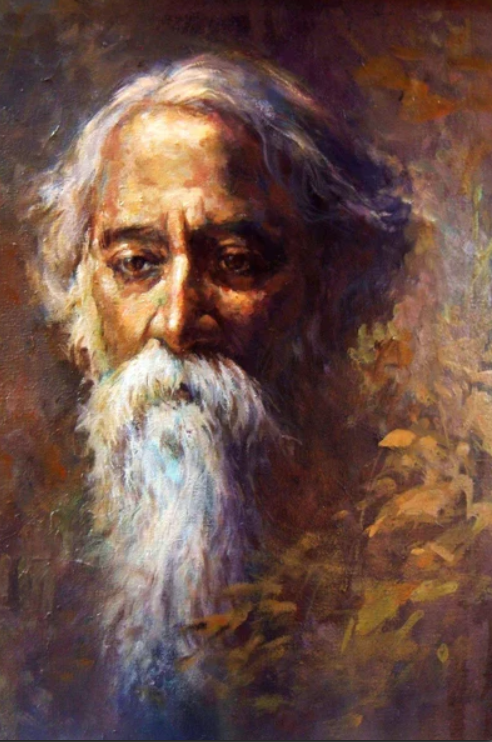
About Rabindranath Tagore:
Rabindranath Tagore’s diverse talents encompassed poetry, prose, music composition, and painting.
Within literary circles, he was celebrated under the titles "Bhanu Singha Thakur," while his admirers affectionately referred to him as 'Gurudev,' 'Kabiguru,' and 'Vishwakavi.'
Contributions to Literature and Art
Tagore's indelible mark on Bengali literature, music, and Indian art is undeniable. His artistic innovations reshaped these creative domains, breathing new life into them.
In a historic achievement, Tagore became the inaugural non-European laureate of the Nobel Prize in Literature in 1913, an accolade bestowed upon him for his literary masterpiece-Gitanjali.
Moreover, his literary prowess extended to composing the national anthems of both India and Bangladesh.
Educational Vision
Rejecting the conventional rote pedagogy of his time, Tagore harboured a visionary educational philosophy.
His ideals bore fruit in the form of Visva-Bharati University, an institution that stood as a testament to his innovative thinking. Building upon the foundation laid by his father at the Santiniketan Ashram, Tagore expanded this educational complex.
What set it apart was its distinct curriculum, designed to keep students well-informed about the evolving political, social, and environmental landscape of the nation.
Social Reform
Tagore harnessed the power of literature to galvanize people towards political and social reform.
His literary works served as potent instruments of protest against the prevailing Brahmanical social order, the caste system, narrow sectarianism, untouchability, and animal sacrifice.
Economic Endeavours
In 1921, Tagore joined forces with agricultural economist Leonard Elmhirst to establish the "Institute for Rural Reconstruction," later renamed.
He advocated vigorously for the expansion of small-scale cottage industries in rural areas, aiming to infuse vitality into the rural economy by leveraging local resources.
Influence on the Freedom Struggle and Partition of Bengal
His composition, "Banglar Mati Banglar Jol" (Soil of Bengal, Water of Bengal), served as a unifying anthem for the Bengali population.
Moreover, he initiated the Rakhi Utsav, a festival where individuals from Hindu and Muslim communities exchanged colourful threads as a symbol of unity and self-reliance against oppression.
A Powerful Protest: Jallianwala Bagh Massacre
In 1915 he was awarded knighthood by the British King George V. In 1919, following the Jallianwalla Bagh massacre, he renounced his Knighthood.
Vision on Nationalism:
He held a sceptical view, asserting that the term "nationalism" was inherently tied to the concept of the nation-state, which, in his eyes, was essentially an embodiment of Western ideals rooted in capitalism and mechanization.
According to Tagore, these ideals clashed fundamentally with the rich tapestry of Indian tradition, characterized by values such as self-autonomy, pluralism, and religious tolerance.
Central to his belief system was the notion that true nationalism should not transcend the broader scope of humanity itself.
Some historical myths have suggested that he composed the Indian national anthem, "Jan Gan Man," as a tribute to British Prince George V during the 1911 Delhi Durbar, hosted by Lord Hardinge II. These misconceptions have sometimes led to questions about his patriotism and commitment to Indian nationalism.
In reality, Tagore was an ardent patriot who cherished India's ancestral culture and philosophy. Although he pursued higher education in Britain, he returned home without completing his studies.
In national anthem, he aimed to emphasize that ultimate sovereignty rested with the people of India, as symbolized by "Jan Gana Man."
Tagore, while occasionally critical of Mahatma Gandhi, was the one who referred to him as "Mahatma." He demonstrated his love for Indian soil, particularly Bengal, while also holding a deep affection for its people.
He regarded nationalism as a psychological concept wherein all individuals bound by common principles constituted the elements of a nation. Consequently, nationalism had to coexist in harmony with humanism.
Like other utilitarian scholars of his time, Tagore denounced international warfare. He openly criticized forms of patriotism and nationalism that compromised human values, especially after the devastating First World War.
In the 20th century, when British policy sought to divide and rule by partitioning Bengal to quell emerging nationalism, Tagore vehemently opposed this move. He recognized that the primary objective of Bengal's partition was to instigate communal violence.
During the 1905 unrest, he actively worked to foster Hindu-Muslim unity through patriotic songs like "Banglar Maati Banglar Jol" (Earth of Bengal, Water of Bengal).
In a letter to his friend A. M. Bose, Tagore made it clear that patriotism should never be the ultimate goal or spiritual refuge.
He vowed not to compromise the priceless value of humanity for the sake of patriotism. Gandhi, who crossed paths with Tagore in 1921 in Calcutta, was cautioned by Tagore about the fine line separating nationalism from xenophobia.
Gandhi, in response to Tagore's criticism, acknowledged that the poet inhabited a world of his own creation, a world of ideas.
About UNESCO World Heritage Sites:
World Heritage Sites are exceptional cultural and/or natural locations recognized for their outstanding universal value, as designated by the World Heritage Committee.They stand as exemplars of the world's most significant cultural and natural heritage.
World Heritage Convention:
Recognizing the importance of certain places, UNESCO's General Conference adopted the World Heritage Convention in 1972. This convention harmoniously combines the preservation of both natural and cultural sites.
Nations adhering to this convention form an international community committed to safeguarding these unique sites.
In 1994, the World Heritage Committee adopted a Global Strategy to promote a balanced and representative World Heritage List, ensuring underrepresented regions and categories are included.
How Sites are Chosen:
Countries that sign the World Heritage Convention pledge to protect their cultural and natural treasures and become state parties.
State parties create a list of potential sites from which they nominate candidates for inclusion on the World Heritage List.
Nominations, accompanied by comprehensive conservation plans, are submitted to the UNESCO World Heritage Centre.
Outstanding Universal Value (OUV): OUV is a fundamental criterion for World Heritage Site status. Exceptional, unparalleled sites with global significance are deemed outstanding properties.
The Roles of UNESCO and Advisory Bodies UNESCO World Heritage Centre
The UNESCO World Heritage Centre offers support for the nomination process, including documentation and formatting.
After reviewing the submitted documents, it forwards them to advisory bodies.
Advisory Bodies: Technical Expertise:
Three advisory bodies provide technical input on nominations:
International Council on Monuments and Sites (ICOMOS)
World Conservation Union (IUCN)
International Centre for Study of The Preservation and Restoration of Cultural Property (ICCROM)
The Decision-Making Body: World Heritage Committee:
Comprising 21 members elected for six-year terms, the World Heritage Committee is chosen by the General Assembly.
The committee annually determines which sites will be inscribed on the World Heritage List.
Criteria for Outstanding Universal Value (OUV)
OUV must reflect a masterpiece of human creativity.
It should depict the exchange of cultural values across generations.
Testimony to unique traditions, cultures, or civilizations is crucial.
Architectural ensembles, landscapes, and other built elements may contribute.
Sites can illustrate the interaction between humans and the environment.
Areas of extraordinary natural beauty are eligible.
Sites can also testify to Earth's geological history.
The World Heritage Fund:
This fund offers financial support to state parties, drawing contributions from both private donors and state parties. It aids in:
Preparatory assistance for property nominations and management plans.
Training assistance for personnel.
Technical cooperation, providing expertise and material support.
Emergency assistance for damage caused by natural disasters or human activities.
Promotional and educational assistance to raise awareness.
Context: Replica of iconic Wheel of Konark Temple served as the cultural backdrop of meetings of foreign dignitaries in the G20 Summit meeting in the Bharat Mandapam in New Delhi.
Wheels of Konark Temple
The Wheels of Konark Temple are also known as Konark Chakra.
Konark temple was designed as a huge chariot drawn by 7 mighty horses in galloping mode on 12 pairs (total 24) of ornamented wheels made from stone and a central hub.
Horses were conceived in such a way that the Sun God (Surya) himself was driving the chariot from inside the garbhagriha.
Intricate design of Konark Wheels:
Although each of the 24 Konark wheels are similar, each one of them is decorated differently.
The spokes of the wheels are also sculpted in such a way that they broaden at the centre like that of a diamond and are thinner at the ends.
The spokes are minutely carved with motifs like scrollwork, floral motifs, creepers and foliate, beaded strings and stylised chaitya windows.
The central portion of the spokes which resemble a diamond is also relieved with various deities like Isana, Isani, Surya, Vishnu and his incarnations), erotic and amorous figures, kanyas in various poses, a nobleman with a man standing with folded hands, a princely cavalier, man playing on cymbals, a boar hunting scene, elephant riders, hunting scenes, etc.
The axle of the wheel also contains deities like a god with a goddess, Gajalakshmi, Krishna playing flute, gopis and cows, Narasimha, king on an elephant, etc.
Serves as a sundial:
Konark wheel is composed of 8 outer spokes and 8 inner spokes with a diameter of 3 metres.
The twelve pairs of wheels symbolise 12 months of the year while the 8 spokes symbolise the 8 pahars of the day (time divisions of a day). Pahar signifies three hours of a day.
The wheel at Konark Sun Temple is designed in a way that they can be used to gauge the time of the day by looking at the shadow cast on the spoke of the wheels by the Sun.
About Konark Sun Temple
Schematic of Konark Sun TemplePlan of Konark Sun Temple
Located in coastal town of Konark in Puri district of Odisha. It is dedicated to the Sun God.
Konark is an amalgamation of two words - Kona meaning corner and Arka meaning the Sun. Thus, Sun God worshipped in Ark Kshetra means Konark.
Konark Sun Temple is epitome of the Odisha Style of Temple Architecture (Also known as Kalinga Temple Architecture).
The temple has been built by carving Khondalite stones.
Built during the 13th century during the reign of Narasimhadeva-I, a distinguished ruler of Ganga dynasty.
European travellers called the Konark temple as 'Black Pagoda' due to the dark colour of the temple when seen from the coast.
The Temple has been included in the list of UNESCO's List of World Heritage Sites in 1984.
Main Temple Complex
The temple comprises of a sanctum with a lofty shikara which is no more in existence, a jagmohana and a detached nata-mandira (hall of dance) in the same axis.
According to Odia folklore, great architect Bishu Moharan and his son Dharmapada were responsible for the design and construction of the Konark Temple complex.
Deul (sanctum sanctorum or sanctuary): Deul of Konark temple is built in rekha deul style of Kalingan temple architecture with a curvilinear shikhara. However, it is no more in existence.
Jagmohana (frontal porch or mahamandapa, used as audience hall): It is built in the typical pidha deul style with receding pidhas resembling a pyramidal roof.
Natamandir (dance hall of hindu temple): The roof of the natamandir is no more in existence.
Temple Complex at Konark consists of main temple complex and several other shrines such as Mayadevi temple, Vaishnava Temple and intricate carvings.
Context:The Nataraja sculpture now on display at Bharat Mandapam, where the G20 Leaders' Summit took place, depicts Lord Shiva in a manner that originated in the fifth century AD but gained iconic status during the reign of the Great Cholas.
More about the news:
The 27-foot Nataraja is the world's tallest statue of Lord Shiva in his dancing form.
The remarkable sculpture is crafted from an ashtadhatu, an eight-metal alloy, skillfully fashioned by artisans from Swamimalai in the Thanjavur district of Tamil Nadu.
Srikanda Sthapathy collaborated with his brothers to create this masterpiece and the design of the statue draws its inspiration from three esteemed Nataraja idols:
Thillai Nataraja Temple in Chidambaram
Uma Maheswarar Temple in Konerirajapuram
Brihadeeswara Temple, an UNESCO World Heritage Site, located in Thanjavur.
The Cholas and the Nataraja Sculpture
The Cholas, a prominent dynasty that thrived during the 9th-11th centuries AD, ruled over a significant portion of peninsular India and are closely associated with the development of Nataraja art.
The Cholas, devout followers of Shaivism, constructed elaborate Shiva temples throughout their territories, including the iconic one in Thanjavur.
K A Nilakanta Sastri, a pioneering historian of South India, highlighted the prevalence of Shaiva figures in Chola sculpture in his book 'The Colas' (1937), stating that while Vaishnava and Jain images were present, Shaiva figures held the most significance.
Although the depiction of Shiva as Nataraja dates back to the fifth century AD, it was under the Cholas that this form achieved its present iconic status.
Sastri has also noted that Nataraja images, particularly in bronze, were highly regarded among Chola sculptures, and they continue to hold cultural significance to this day.
Shiva as the Lord of Dance
The worship of Shiva has evolved from the Vedic deity Rudra. Shiva is a multifaceted deity within the Puranic pantheon, characterized by complexity and depth.
A L Basham, a prominent Indologist, described Shiva as ‘death and time (Mahakala),’ a deity who both destroys all things and serves as a patron of ascetics in his work 'The Wonder that was India' (1954).
Shiva also embodies the persona of the 'Lord of Dance' or Nataraja, credited with inventing a diverse range of dances, from serene and gentle to fierce, orgiastic, and formidable.
In the classic portrayal of Nataraja, he is encircled by a flaming aureole or halo, symbolizing the circle of the world that he both encompasses and transcends.
His long dreadlocks flow outward, animated by the energy of his dance, and he strikes a rhythmic pose with his four arms.
In his upper right hand, he holds a damru (a hand drum), the sound of which draws all beings into his rhythmic motion.
In his upper left arm, he holds agni (fire), which he can wield to bring about the destruction of the universe.
Beneath one of Nataraja's feet, a dwarf-like figure lies crushed, symbolizing illusion, which misleads humanity.
However, amidst the symbolism of destruction, Nataraja also offers reassurance, depicting Shiva as the Protector.
With his front right hand, he makes the 'abhayamudra' (a gesture that allays fear), and with his raised feet, he points to his feet, urging his devotees to seek refuge there.
Remarkably, Nataraja is often depicted with a broad smile, signifying his simultaneous embrace of both life and death, joy and pain.
The Lost Wax Method (Cire-Perdue)
The ancient technique can be traced back at least 6,000 years, with evidence of its use found in a copper amulet from a neolithic site in Mehrgarh, Balochistan (present-day Pakistan), dating back to circa 4,000 BC.The famous Dancing Girl of Mohenjo Darowas also created using this method. For millennia, the lost-wax method stood as the foremost technique for producing intricate metallic sculptures, and the Cholas elevated this skill to its zenith.A molten metal is poured into a Mold that has been created by means of a wax model. Once the mold is made, the wax model is melted and drained away. A hollow core can be effected by the introduction of a heat-proof core that prevents the molten metal from totally filling the mold.
Bronze Sculptures during the Chola Period:
During the 10th century, evolving religious beliefs required Hindu deities to participate in various public roles akin to human monarchs.
Consequently, large bronze sculptures were crafted to be carried outside temples for daily rituals, processions, and festivals.
The iconic dancing depiction of Shiva as Nataraja was conceived and fully refined during the Chola Period, leading to the creation of numerous variations of this intricate bronze image.
The region of Thanjavur (Tanjore) in Tamil Nadu played a pivotal role in the evolution of a diverse range of Shiva iconography.
An exceptional example from the ninth century is the depiction of the Kalyanasundara murti, which ingeniously portrays the marriage ceremony through two separate statuettes.
Shiva, extending his right hand, symbolically accepts Parvati's right hand in this representation, with Parvati displaying a bashful expression as she takes a step forward.
The union of Shiva and Parvati is brilliantly captured in a single image through the Ardhanarisvara Murti, where the two halves merge to form a harmonious whole.
Independent figurines of Parvati have also been sculpted with grace, portraying her in the elegant tribhanga posture.
Bronze sculptures during the Chola period were meticulously crafted using the artistic technique known as Cire Perdue or Madhu Uchchishtta Vidhana, also called lost-wax casting.
The method involved mixing beeswax, a type of camphor called kungilium, and a small amount of oil, kneading this mixture, and using it to sculpt the figure and its intricate details.
The wax model was then coated with clay, dried, and placed in an oven to melt or evaporate the wax.
Subsequently, Pancha Loham, a bronze alloy, was melted and poured into the clay mold, filling every crevice and detail.
After cooling and solidifying, the clay mold was broken, leaving only the bronze sculpture.
The final steps included adding finer details, cleaning, removing any blemishes, and smoothing and polishing the sculpture before it was displayed, typically within a temple.
(Brihadishvara Temple)
Monumental Temples and Architectural Wonders
Throughout the Chola Dynasty, monumental temples and splendid works of art influenced by Hinduism were constructed across the empire.
These structures were not only immense but also carved from hard rock and granite, featuring intricate carvings and architectural designs that seemed to defy the capabilities of their time.
The architects of the Chola Dynasty drew inspiration from the preceding Pallava dynasty's style, refining it and elevating Chola art and architecture.
King Rajaraja Chola, during the Chola Dynasty, also constructed the grand Brihadishvara temple in Gangaikonda Cholapuram, renowned as the Tanjore temple, dedicated to Shiva.
It stands as one of the largest Hindu temples of its time and continues to astound engineers with its construction and architecture.
Prince Aditya Karikala built the golden palace for his father, King Sundara Chola.
Many of these buildings, constructed using timber and bricks, have not withstood the test of time.
(Map showing the greatest extent of the Chola empire c.1030 under Rajendra Chola I)
About Imperial Cholas:
The rich history of the Chola dynasty is illuminated by a plethora of diverse sources, providing insights into their governance, culture, and achievements. These sources can be categorized into inscriptions, literary works, and historical records.
Inscriptions:
Copper and Stone Engravings: Over 10,000 inscriptions etched on copper and stone surfaces constitute the primary sources for studying Chola history.
Temple Endowments: These inscriptions predominantly document the generous endowments and donations made by Chola rulers and individuals to temples.
Land Transactions and Taxes: Vital components of these inscriptions include land transactions and details about taxes, both collections and exemptions.
Copper Plates: Copper plates contain the official commands and decrees of Chola monarchs, offering a glimpse into their administrative authority. Alongside orders, these plates divulge information about genealogy, wars, conquests, administrative divisions, local governance, land rights, and various taxes imposed.
Uttaramerur Inscription: The ‘Uttaramerur Inscription’ issued by Prantaka Chola offers detailed information about the election processes of local self-governance bodies, shedding light on the political structure of the time.
Literary Sources:
The era saw a flourishing of Tamil literature, with the rise of bhakti saints and the compilation of hymns that reflect the socio-cultural features of the period.
Literary works like ‘Muvarula’ and ‘Kamba Ramayanam,’ the great epic, belong to this era, providing valuable cultural insights
Political History of the Cholas
Emergence under Vijayalaya (850–871 CE):
Conquest of Kaveri Delta: Vijayalaya's conquest of the Kaveri delta from the Muttaraiyar marked the re-emergence of the Chola dynasty.
Foundation of Thanjavur: He founded the city of Thanjavur and established the Chola kingdom in 850 CE.
Parantaka I (907–955 CE):
Parantaka Chola initiated territorial expansion and governance reforms, laying the foundation for future Chola glory.
Battle of Takkolam: He suffered a defeat at the hands of the Rashtrakutas in the famous Battle of Takkolam.
Rajaraja I (985 – 1014 A.D.):
Rajaraja I's reign witnessed significant military achievements and cultural contributions.
Naval Expeditions: Victorious naval expeditions along the West Coast, Sri Lanka, and the Maldives.
Northern Sri Lanka: His conquest led to the Chola authority's control over northern and eastern Sri Lanka.
Battle of Kandanur Salai: Defeat of the Cheras in this notable battle.
Construction of Rajarajeswara Temple: Completed the iconic Rajarajeswara temple in Tanjore in 1010 A.D.
Religious Devotion: A devout follower of Saivism, he earned titles like Mummidi Chola and Sivapadasekara.
Abdicated the throne in favor of his son Rajendra Chola I.
Rajendra Chola I (1012-1044 A.D.):
Military Exploits: Conducted remarkable military expeditions, including defeating Mahipala I of Bengal.
Gangaikondacholapuram: Established the city of Gangaikondacholapuram and constructed the renowned Rajesvaram temple.
Naval Expedition to Kadaram: Launched a naval expedition to Kadaram (Sri Vijaya, Indonesia), annexing Sri Lanka in the process.
Established educational institutions, earning the title ‘Pandita Chola’.
Legacy and Decline:
Kulathunga Chola I: Grandson of Rajendra Chola, he upheld the Chola legacy by abolishing taxes, fostering trade with China, and uniting the Vengi kingdom with the Chola Empire.
Rajendra III: The last Chola king, defeated by Jatavarman Sundarapandya II, marked the decline of the Chola empire.
With the fall of the Cholas, the Pandya and Hoysala kingdoms emerged on the stage of South Indian history, marking the end of an illustrious era.
Context: As many as 48 snakeboats participated in the annual water regatta, which was held in two batches. The event began with a ceremonial procession of 51 snakeboats.
About the Boat Race
It is staged as a mix of revelry and ritualistic tradition.
This event marks the anniversary of the idol installation at the Sree Parthasarathy temple.
It is the oldest river boat race in Kerala held during Onam (August–September).
It takes place at Aranmula Parthasarathytemple (dedicated to Lord Krishna and Arjuna) in the river Pampa.
Palliyodams: These are Aranmula’s unique snake boats (‘’Chundan Vallam’’).
Vanchipattu (song): The oarsmen sing traditional boat songs known as Vanchipattu while rowing the boat.
The oarsmen on board each palliyodam are selected from the village which owns the respective vessel.
During the race, they are also dressed identically in white dhoti and melmundu.
About Aranmula Parthasarathy temple
Sri Parthasarathy Temple is dedicated to Lord Sri Krishna. It is one of the 108 Divyadesams dedicated to Krishna, an avatar of Vishnu, who is worshipped as Parthasarathi.
Aranmula Parthasarathy Temple houses the Thiruvabharanam (the sacred jewels) of Lord Ayyappa, which are taken in procession to the Sabarimala temple every year.
The Aranmula Parthasarathi temple is a simple structure in Kerala style of architecture and the idol of Parthasarathi is six feet high. The walls of the temple are beautifully adorned with fine murals of the 18th century. The temple has four gopurams (towers) on four sides of its outer wall.