Mains Exhaustive

Saudi-Omani delegation to hold ceasefire talks with Yemen's Houthis in Sanaa

Context: A Saudi-Omani delegation is planning to travel to Yemen's capital Sanaa next week to hash out a permanent ceasefire deal with Houthi officials and end the country's eight-year-old conflict. The visit by Saudi officials to Sanaa is an indication of progress in Oman-mediated talks between the kingdom and the Iran-aligned Houthi movement, which run in parallel to U.N. peace efforts.

It is also a sign that regional rifts are easing after rivals Saudi Arabia and Iran agreed to restore relations last month after years of hostility and backing opposite sides in Middle Eastern conflicts, including Yemen.

The discussions are focused on a full reopening of Yemen's ports and airports, payment of wages for public servants, a rebuilding process and a political transition, they added.

History of Crisis in Yemen

What is the Internal division of Yemen?

  • Yemen has long struggled with religious and cultural differences between its north and south and the legacy of European colonialism. 
  • The modern Yemeni state was formed in 1990 with the unification of the U.S.- and Saudi-backed Yemeni Arab Republic in the north, and the Soviet-backed People’s Democratic Republic of Yemen, in the south. 
  • Ali Abdullah Saleh, a military officer who had ruled North Yemen since 1978, assumed leadership of the new country.

Crisis continues

  • Though just a few years after unification, southern separatists movement re-emerged in 2007 as the Southern Movement, which has continued to press for greater autonomy within Yemen.  Al-Qaeda in Arabian Peninsula (AQAP) an Islamist militant group, captured territory in the south and east. 
  • The Houthi movement on the other hand having base among the Zaydi Shiites of northern Yemen, rose up against Saleh’s government six times between 2004 and 2010.
  • It was alleged that Saleh ran a corrupt and autocratic government. As the popular protests of the 2011 Arab Spring spread to Yemen, the president’s political and military rivals jockeyed to oust him. While Yemeni security forces focused on putting down protests in urban areas, AQAP made gains in outlying regions.

Transfer of power

Under escalating domestic and International pressure, Saleh stepped aside in 2012 after receiving assurances of immunity from prosecution.

His vice president, Abd Rabbu Mansour Hadi, assumed office as interim president in a transition brokered by the Gulf Cooperation Council (GCC) and backed by the United States.

The crisis in 2014

The civil war began in Yemen began in 2014 when Houthi insurgents—Shiite rebels having links with Iran and a history of rising up against the Sunni government—took control of Yemen’s capital and largest city, Sana’a.

  1. Fuel price hikes: Under pressure from the International Monetary Fund, which had extended to Yemen a $550 million loan premised on promises of economic reforms, Hadi’s government lifted fuel subsidies in 2014. The Houthi movement, which had attracted support beyond its base with its criticisms of the UN transition, organized mass protests demanding lower fuel prices and a new government.
  2. Houthi takeover: The Houthis captured much of Sanaa by late 2014. Reneging on a UN peace deal, they consolidated control of the capital and continued their southward advance. Hadi’s government resigned under pressure in January 2015, and Hadi later fled to Saudi Arabia.
  3. Military division: Military units loyal to Saleh aligned themselves with the Houthis, contributing to their battlefield success. Other militias mobilized against the Houthi-Saleh forces, aligning with those in the military who had remained loyal to the Hadi government. Southern separatists ramped up their calls for secession.
  4. Failed negotiation: Despite of the rounds of negotiation, the negotiation failed and the rebels seized the presidential palace in 2015, leading President Abd Rabbu Mansour Hadi and his government to resign. But in the backdrop of popular support (from Saudi) Abd Rabbu Mansour Hadi  rescinded his resignation and returned to Aden in September 2015, and fighting has continued since. There was a UN effort to broker peace talks between allied Houthi rebels and the internationally recognized Yemeni government stalled. Hadi has reportedly been residing in exile in Saudi Arabia.
  5. Saudi intervention:  In 2015, keeping in mind the geostrategic calculus of the Middle East, a coalition of Gulf states led by Saudi Arabia launched a campaign of economic isolation and air strikes against the Houthi insurgents having support from U.S. logistical and intelligence support with aim to restore the Hadi administration to Sanaa.
  6. Iranian intervention: Iran is the Houthis’ primary international backer and has reportedly provided them with military support, including weapons. Hadi’s government has also accused Hezbollah Iran’s Lebanese ally, of aiding the Houthis. Saudi Arabia’s perception that the Houthis are an Iranian Proxy rather than an indigenous movement has driven Riyadh’s military intervention.

Impact of Civil War and missing peace

  • Around three-quarters of its population lives in the property. Yemen has long been the Arab world’s poorest country, and its humanitarian crisis has been called one of the worst in the world. Disease runs rampant; suspected cholera cases passed two hundred thousand.
  • Many countries cut back on critical aid to Yemen amid the crush of the pandemic, leading the United Nations to reduce food rations for some eight million Yemenis in Three out of four Yemenis require humanitarian aid and protection, and four million are internally displaced 
  • The UN Development Program estimates that more than 370000 people have died as a result of the war, with indirect causes such as lack of food, water, and health services causing almost 60 percent of deaths.
  • In addition, the United Nations has found  that both Houthi and coalition forces have knowingly attacked civilian targets in violation of international law. 

Cruelties of state

Context: The Assam Government recently launched a crackdown on child marriage, arresting over 3000 people involved in child marriage so far. The arrests have resulted in protests by women in the districts where they had taken place, as government action has left families separated and without a stable source of income.

Why crackdown

  • The crackdown was initiated in response to over 4,100 FIRs registered across the state, and a cabinet sub-committee has been formed to finalize a Rehabilitation Policy within 15 days for victims of child marriage. 
  • Child marriage is a persistent problem in India, with an estimated 27% of girls being married before turning 18, the legal age of women in India for marriage.

Laws involved in these arrests

  • The Protection of Children from Sexual Offences Act, 2012 (POSCO)
  • The Protection of Children from Sexual Offences Act, 2012 (PCMA)

Major provisions of POSCO

  • Sexual assault under POCSO is a non-bailable, cognizable offence.
  • Child marriage under 14 is presumed to be sexual assault. Nonpenetrative sexual assault carries a minimum imprisonment of 3 years, extendable up to 5 years with a fine.
  • Mandatory reporting obligation under POCSO Act requires reporting of sexual offences against children to the police or Special Juvenile Police Unit. Doctors must also report cases where minor girls seek medical assistance during pregnancies or for termination of pregnancies.

Major Provisions of PCMA

  • Child marriages are illegal but not void. They can, however, be voided at the option of the minor either through their guardian or by themselves once they attain adulthood.
  • The Act sets the minimum marriageable age at 18 years for women and 21 years for men.
  • Child marriage is punishable by rigorous imprisonment of up to 2 years, a fine of up to one lakh rupees or both.

Marriageable age under Muslim personal law

  • Under Muslim personal law, girls who attain puberty are considered to be of marriageable age. This is usually considered to be 15.
  • This incongruence between Muslim law and the PCMA has led to legal confusion and inconsistency.

Why this crackdown is being criticized

  • The arrests have taken place disproportionately in 10 Muslim-majority districts of Assam, which many believe is a targeted step. 
  • Several poor and single-income families have been left without a stable source of income and are more vulnerable through this recent slew of arrests.
  • The application of this law has been done retrospectively in many cases, where the wife is no longer a minor, and in some instances even above the age of 30. 
  • Child marriage is voidable at the option of the party who was minor at the time of marriage. On attaining adulthood, if an annulment is not filed for, then the marriage remains valid, and the State must not apply the Act retrospectively or interfere with the family unit.
  • The lack of access to schools in these districts due to severe flooding in the Monsoon, and generational poverty have been major factors contributing to the high number of child marriages. While detaining the breadwinners of the family will worsen the situation instead of curtailing it.
  • Government is misusing public health data to arrest the people instead of genuine FIR by the victims.
  • Under PCMA, no women can be imprisoned, but the Assam government is also detaining women.

Way forward

  • The law should not be used as a political weapon to target any community
  • The law should not be implemented retrospectively in case of attaining adulthood and the involved party is not filing an annulment.
  • Government should focus on availing of quality education.

A very different conception of ‘Ram Rajya’

Context: Shashi Tharoor (Member of Parliament), have talked in his books, ‘Why I Am a Hindu’ and ‘The Battle of Belonging’, the principles of Gandhiji and his ideas about ‘Ram Rajya’.

About the concept of ‘Ram Rajya’

Ram Rajya is a term that was popularized by Mahatma Gandhi. It's an ideal society that he envisioned, based on the rule of Lord Rama. The concept of Ram Rajya reflects the idea of an ideal society where everyone is equal, and justice prevails. 

The term represents the ideal king who ruled with wisdom, compassion, and justice. His rule was characterized by the following principles:

  • Equality: Gandhi emphasized the importance of equality in his concept of Ram Rajya. He believed that all individuals, regardless of their caste, creed, or gender, should have equal opportunities and rights.
  • Justice: Ram Rajya was a society where justice was served, and no one was above the law. Gandhi emphasized the importance of self-discipline and self-sufficiency in achieving justice. He believed that individuals should work to become self-sufficient, both economically and spiritually, in order to be better equipped to address injustices in society.
  • Non-Violence: Ram Rajya was a society where violence was shunned, and conflicts were resolved through peaceful means. Non-violence is the cornerstone of Gandhi's concept of Ram Rajya. He believed that violence only begets violence and that the use of force can never bring about lasting peace. Instead, he advocated the use of non-violent means such as satyagraha (civil disobedience), ahimsa (non-violence), and self-control to achieve one's goals.
  • Self-Rule: Ram Rajya was a society where people should be self-governing and should have the power to make decisions that affect their lives.
  • Prosperity: Ram Rajya was a society where everyone had access to the basic necessities of life and had the opportunity to pursue their dreams.
  • Moral and Spiritual Values: Gandhi's vision of Ram Rajya was not merely a political system but rather a society based on moral and spiritual values. He believed that society should be grounded in truth, love, compassion, and forgiveness. Individuals follow conscience to serve others, not self-interest.
  • Decentralization of Power: Gandhi believed that power should be decentralized and that decision-making should be made at the local level. He advocated for the establishment of Gram Sabhas, or village assemblies, where the people could come together to make decisions that affect their community.
  • Trusteeship: Gandhi believed that Trusteeship was essential for creating an equitable and just society. He argued that wealth was not an end in itself, but a means to serve the common good. In Ram Rajya, the wealthy and powerful would act as trustees, using their resources for the betterment of the poor and the needy.
    • Gandhi's idea of Trusteeship was based on the principle of non-violence and voluntary cooperation. He believed that the wealthy and powerful should voluntarily surrender their wealth for the betterment of society, rather than through force or coercion.
  • Economic Equality: Gandhi believed that economic inequality was one of the root causes of social unrest. He advocated for the abolition of the caste system and the establishment of a society based on economic equality.
  • Self-Sufficiency: Gandhi believed that self-sufficiency was crucial for the development of society. He advocated for the establishment of small-scale industries and the use of local resources to promote self-sufficiency.
  • Education: Gandhi believed that education was essential for the development of individuals and society. He emphasized the importance of holistic education, which includes both intellectual and moral development.

Other Theories Of Ideal Society

Several other philosophers and thinkers have envisioned ideal states and governance systems similar to Gandhiji's Ram Rajya:

  • Plato proposed an ideal just society in his book 'The Republic' where kings are philosophers and philosophers are kings. He envisioned a state built on reason, justice, courage and temperance. The rulers and guardians govern to maximize the welfare of citizens.
  • John Stuart Mill advocated a liberal form of governance in his work 'On Liberty' where individual liberty is balanced with social good. He proposed democratic self-government with representation of all citizens, free speech and protection of minorities. The state protects people's basic liberties and welfare.
  • Henry David Thoreau put forth the idea of a minimalist governance in his essay 'Civil Disobedience'. He believed that government is best which governs the least. Individual conscience is the moral guide. People govern themselves with self-restraint and don't need an overbearing state apparatus. Simple living and high thinking are valued.
  • Leo Tolstoy's vision of an ideal society in 'The Kingdom of God is Within You' renounced violence and preached universal love, truth, morality and service to others. He believed individuals can transform society through enlightenment and moral development, not political means. Ethical and spiritual uprising, not material progress, leads to human well-being. 
  • Aurobindo Ghose theorized the 'Rule of the Spirit' in his work where the inner moral and spiritual elements govern society, not outer political machinery. Truth, unity, harmony and a higher consciousness emerge from within individuals. There is a collective moral aspiration to realize the divine in each human being. 
  • Sarvepalli Radhakrishnan believed in the 'Rule of Spiritual Truth' where reason, morality and justice prevail; and education develops integral personalities. He envisioned a world federation of free individuals in free societies guided by the spiritual truth of oneness of humanity.
  • Dalai Lama advocates a 'spiritual democracy' where compassion, ethics and conscience shape society. There is no tyranny of the majority. Well-being of all humans including future generations is core. Outer liberal values emerge from inner morality and wisdom in each person.

Comparison Between Gandhian "Ram Rajya" And Plato's Just Society

ParametersGandhian "Ram Rajya"Plato's Just Society
JusticeSatya and dharma are the guiding principles. Means and ends should be moral.Knowledge of the Good guides rulers. Justice is harmony between reason, spirit and appetites.
Justice within the individualsGandhiji focused on spiritual self-sufficiency in order to be better equipped to address injustices in society.
Philosopher-KingsGandhian concept does not emphasize the role of rulers or philosopher-kings in governance.Plato's Just Society places great emphasis on the role of philosopher-kings, who possess wisdom and virtue, in governing society.
TrusteeshipLeaders act as trustees of citizens. Power is not concentrated but decentralized.Philosopher-kings rule for the benefit of all. No private advantage or privilege.
Non-violenceGandhian concept places great emphasis on non-violence, or ahimsa, as a means of achieving social change and justice. Conflicts are resolved through mutual understandingAuxiliaries enforce orders and defend the state
Simplicity in governanceGandhian concept emphasizes simplicity in governance, with a focus on decentralization and community participation in decision-making. Administration focuses on meeting. basic needs of allStrict control over luxuries and private property. Necessities provided by the state.
Representation in governanceAll sections participate in governance.Society divided into rational rulers, spirited auxiliaries and appetitive producers but share a sense of community.
Common good educationResources and facilities distributed equitably so none remain in wretched conditions.Though classes have different natures, they share a common interest in justice and welfare of the whole.
Social ClassesThe concept of social class was not relevant as he believed in equality and universal brotherhood.Rational rulers, spirited auxiliaries and appetitive producers
Women's equalityGandhian concept emphasizes women's equality and empowerment. He said, “To call woman the weaker sex is a libel; it is man's injustice to woman. If by strength is meant moral power, then woman is immeasurably man's superior.”Plato's Just Society does not necessarily prioritize women's equality. He however said that women could also become philosopher-kings if they had the necessary qualities and virtues.
Communal livingGandhian concept emphasizes communal living and the need for voluntary renunciation of personal property and wealth.Plato's Just Society does not emphasize communal living as a key concept.

If Governor withholds nod, it means Bill is dead

Context:  Recently, Tamil Nadu Governor said that if a Governor withholds assent to a Bill passed by the Assembly, it means the “Bill is dead”. 

More about the news:

The Supreme Court has defined withholding assent as the Bill falls through, the Bill is dead.

Under Article 200, once a Bill has been passed by the State Legislature, then the Governor has three options:

 1. Either he assents to the Bill; or

 2. He withholds assent therefrom; or 

 3. Reserves the Bill for the consideration of the President.

  •  The Governor as soon as possible shall return the Bill for the consideration of the House with his message as to what provisions of the Bill should be reconsidered by the Assembly. Now, the term “as soon as possible” has not been defined. 
  • Now, when the Bill is so returned, the Assembly shall reconsider the Bill and look into the suggestions or messages of the Governor regarding any specific provision. 
  • However, if the Bill is passed again by the House or Houses with or without amendment and presented to the Governor for assent, the Governor shall not withhold assent therefrom
  • The Governor does not have discretion on matters of the Assembly and is bound to follow the advice of his Council of Ministers even on matters where he/she might be withholding assent.
  • Provided further that the Governor shall not assent to, but shall reserve for the consideration of the President, any Bill which in the opinion of the Governor would, if it became law, so derogate from the powers of the High Court as to endanger the position which that Court is by this Constitution designed to fill. 
  • In the entire provision of Article 200, no time frame as such has been provided. So, if the Bill is even reserved for the President’s Assent, then he is not time bound to accept or reject the Bill.

Is the president bound to accept or reject the bill which is reserved for president under Article 201? 

Article 201- Bills reserved for President’s consideration 

  • When a Bill is reserved by a Governor for the consideration of the President, the President shall declare either that he assents to the Bill or that he withholds assent therefrom.
  • Provided that, where the Bill is not a Money Bill - the President may direct the Governor to return the Bill to the House or Houses of the Legislature of the State together with such a message as is mentioned in the first proviso to article 200. 
  • And when a Bill is so returned, the House or Houses shall reconsider it accordingly within a period of six months from the date of receipt of such message and, 
  • if it is again passed by the House or Houses with or without amendment, it shall be presented again to the President for his consideration. 

Note - Even under Article 201, no time limit has been provided under which the President has to assent or reject the Bill once the Governor reserve the Bill for President’s Assent.

The Article ends with the words that the Bill shall again be presented again to the President for his consideration. But what happens after the Bill is presented again has not been mentioned. So, technically, the President is not time bound to assent or reject the Bill which is sent again for his consideration and the Bill can be delayed.

The Supreme Court order in Shamser Singh vs State of Punjab (1975) that “the constitutional conclusion is that the Governor is but a shorthand expression for the State government and the President is an abbreviation of the Central government.”

Resumption of Oil Exports from Northern Iraq to Turkey after a Long-standing Dispute

Context: The article reports on the recent agreement between the Iraqi central government and officials from the semi-autonomous Kurdish region to resume oil exports from northern Iraq through a pipeline to Turkey. The dispute between Baghdad and Irbil over oil revenues has been a longstanding issue, and this deal marks a crucial step towards resolving the conflict.

The Importance of Oil for Iraq's Economy: 

  • Iraq is the second-largest oil producer in OPEC and one of the most oil-dependent economies in the world. 
  • Oil accounts for over 90% of the country's total exports and 60% of its GDP. 
  • While most of Iraq's oil reserves are located in the south, the Kurdish region heavily relies on exports from northern fields. 
  • Thus, halting oil exports from the region has been harming Iraq's revenues.

The Dispute over Oil Revenues: 

  • Iraq filed for arbitration against Turkey in 2014 after the Kurdish region began exporting crude oil through the neighbouring country, sidestepping Iraq's state-owned oil marketing company, SOMO (State Organization for Marketing of Oil (SOMO) is an Iraqi national company responsible for marketing Iraq's oil. It is headquartered in Baghdad, Iraq.).
  • Iraq claimed that all oil exports had to go through SOMO under a 1973 agreement with Turkey. 
  • The International Chamber of Commerce had ruled in favour of Iraq, leading to the halt of nearly half a million barrels of oil exports last month.

The Deal to Resume Oil Exports: 

  • The agreement reached will allow SOMO to market crude oil in coordination with Kurdish authorities. 
  • The Kurdish region will have full control over oil revenues, but the federal government can audit the account where the funds will be deposited. 
  • While the deal is temporary, it is a crucial step towards ending the long-standing dispute between Irbil and Baghdad and creating a positive and safe atmosphere to finally approve the national oil and gas law. 

Impact on India

  • Energy Security
    • As a major oil importer, India depends on a stable and affordable oil supply. Iraq accounts for over 10% of India's oil imports, so the deal allows for continued exports and supply security.
    • However, Iraq's overdependence on oil poses risks of supply shocks from geopolitical events. India should diversify oil sources and increase strategic reserves to hedge against disruptions.
  • Economic Impact
    • Fluctuating oil prices affect India's import bill, trade deficit and economy. The deal will support moderate oil prices and benefit India's economy.
    • However, Iraq's oil dependence makes its economy and government budget vulnerable to price changes which can weaken an important trade partner.
    • Diversifying Iraq's economy could benefit both countries.
    • According to OPEC, Iraq holds over 15% of the world's oil reserves. Oil comprises 65% of Iraq's GDP and over 90% of government revenue according to the IMF. Volatility can undermine Iraq's economic stability with ripple effects on India's interests.
  • Promoting the Rule of Law
    • The dispute resolution through arbitration showed Iraq's commitment to following due legal processes. This is important for India to expand trade and investments with partners like Iraq.
    • India should encourage Iraq to strengthen contract enforcement, independent judiciary and institutions to uphold rule of law. Reneging on contracts can discourage foreign companies from investing in Iraq's oil industry.
  • Geopolitical Stability
    • The Kurdish dispute highlights ethnic divisions that threaten Iraq's unity if mishandled. Resolving such issues through democratic processes is important for Iraq's stability.
    • A destabilized Iraq could undermine India's strategic and energy interests. India should support Iraq's federal government in maintaining stability by promoting inclusiveness and institution-building. 

In summary, while the oil deal benefits India and Iraq's economic interests, overreliance on oil and weak institutions threaten long-term stability and prosperity. Diversification, promoting rule of law, dialogue and democratic reforms are key to stability, growth and progress in India-Iraq relations. By cooperating with Iraq's knowledge exchanges in technology, governance and trade, India can advance its strategic priorities in the region.

The resumption of oil exports from northern Iraq through the pipeline to Turkey will benefit Iraq's economy and provide a source of revenue for the Kurdish region. The deal struck on Tuesday marks a crucial step towards resolving the conflict over oil revenues between Baghdad and Irbil.

International Chamber of Commerce

The International Chamber of Commerce or ICC is the world's largest business organization with over 45 million members in over 100 countries. It was founded in 1919 to promote international trade, responsible business conduct and a global approach to regulation.

Key roles and functions of ICC:

Rule Setting: ICC develops voluntary rules, standards and policy recommendations for global business. This includes Incoterms rules for global trade, the ICC Arbitration Rules, the ICC Guidelines for International Investment and the ICC Anti-corruption Compliance Toolkit.

Arbitration and Dispute Resolution: ICC administers over 25,000 international commercial arbitrations each year through the ICC International Court of Arbitration. ICC dispute resolution services aim to facilitate trade by providing appropriate tools for risk mitigation and dispute settlement.

Advocacy and Policy: ICC works with intergovernmental organizations like the UN, WTO and G20 to advocate business priorities and shape global trade policies. ICC also provides business input to governments and regulators on issues like trade facilitation, digital economy, sustainability, anti-corruption, etc.

Network and events: ICC organizes high-level events, forums and local network meetings around the world to enable business leaders and experts to exchange knowledge, strengthen relationships and promote cross-border trade.

Training and Certification: ICC offers online and in-person training in areas such as international arbitration, international commercial mediation, trade finance, and anti-corruption compliance. ICC also administers professional certifications to build expertise in international business regulation and policy.

Market intelligence: ICC provides research and analysis on policy developments, court rulings, and market trends on the environment, banking, digital economy, arbitration, trade, etc. through publications like the ICC Digital Economy Report, ICC Arbitration Bulletin, ICC Trade Register Report, etc.

ICC aims to facilitate cross-border trade and promote responsible international business policies and practices. It plays an important role in global governance by setting voluntary business standards, providing dispute resolution mechanisms, advocating priorities with policymakers and enabling business networks and knowledge exchange. ICC's activities and policy positions have implications for global trade, investments, regulation as well as sustainable development.

PM recalls the noble teachings of Bhagwan Mahavir on Mahavir Jayanti

Context: The Jain community celebrates Mahavir Jayanti, one of their most important festivals, throughout India. The celebration honours the birth of Lord Mahavira, the 24th Tirthankara of Jainism. 

History Of Mahavir Jayanti

  • Lord Mahavira was born in Kundalgrama, Bihar, in the Chaitra month, according to Jain traditions and religious writings. 
  • The cleansing of the Mahavir effigy with fragrant oil by the people symbolises the purity of the Lord.
  • People go to pilgrimage locations that are associated with the Jain community. 

Gomateshwara is a well-known place to visit during the festival.

Emergence of Heterodox Thinkers

  • In the sixth and fifth centuries BCE, North India had a remarkable awakening as a result of a number of heterodox philosophies challenging the pre-existing philosophy.
  • In order to reflect on the social and cultural climate of their times, philosophers like Gosala, Gautama Buddha, Mahavira, Ajita Kesakambalin, and others renounced the world and wandered across the Gangetic plains.

Causes of Intellectual Awakening

  • The rigidity of the Vedic religion and state creation limited people's freedom of thinking and behaviour. 
  • In heterodox sects, a revolt against the practise of accepting dogmas as truthwas articulated.
  • The process of socio-political and economic change was expedited by the creation of territorial identities.
  • Disenchanted with the existing order, the wealthy class (thriving in Magadha or the mid-gangetic plains) started to act in opposition to the Orthodox faiths. 
  • Since the Vedic religion was not yet fully organised, its influence on society was limited, making it easy for individuals to adhere to the newly forming religious sects.
  • New classes of merchants and bankers like sethis sought higher social status in line with their economic standing as a result of urbanisation and the rise of trade.
  • Kshatriyas were upset because the Vedic writings only allowed Brahmins to live a staged life in ashramas. 

Jainism

  • Vardhamana Mahavira's sect, which Buddhist writings refer to as Nigantha Nataputta
  • grew into the religion known as Jainism.
  • Before, it was known as Nirgranthas (free from bonds).
  • Risabha is credited as the sect's founder in Jaina mythology. 
  • He is regarded as the original   Tirthankara.  
  • Three of the Tirthankaras: Risabha, Ajitanatha, and Aristanemi, are mentioned in the Yajur veda. 
  • Mahavira, also known as Jina, the conqueror of the soul, organised his followers into secular and monastic groups. 

Life of Mahavira

  • About 540 BCE, Mahavir was born in Vajji, a democratic kingdom (Ganarajya)
  • where the ruler was chosen through popular vote. 
  • He was son of the King Siddharth of Kundagrama and Queen Trishala belonging to the Ikshvaku dynasty. 
  • Mahavir was given the name Vardhaman, which means "One who grows."
  • His mother was a princess of the Lichchavi and Chetaka's (chief of Lichchavi) sister. 
  • Mahavira was closely related to the rulers of Magadha, Anga, and Videha through his mother. 
  • At the age of 30, he left his home and spent 12 years wandering as a mendicant in search of the truth. 
  • He abandoned his clothes and engaged in strict penance.
  • He met Gosala while wandering, but they later parted ways because of their differences.  
  • Vardhamana gained Nirvana, or enlightenment, in the thirteenth year of his wandering,     when he was 42 years old. He attained Tirthankara status and came to be known as Jina or Mahavira (the Great Conqueror). 
  • He passed away at the age of 72 in Pavapuri, close to Rajgriha, around 468 BCE. He fasted unto death (Sallekhana) according to Jaina ideals.

Sects of Jainism 

  • A split in Jainism happened roughly 500 years after Mahavira's departure, in or around 79 or 82 CE. 
  • Because of the severe famine in Magadha.
  • some of Jaina monks under Bhadrabahu left for south to maintain their rigorous discipline.
  • They remained without garments and were known as ‘Digambaras’ (space-clad or naked).
  • Others who remained behind under Sthulabhadra's leadership, chose a white clothing, and came to be known as ‘Svetambaras’ (white-clad).
  • Jainism was weakened in Magadha as a result of the schism, but it flourished in Gujarat,       Rajasthan, Madhya Pradesh, Orissa, and Karnataka.

Jaina Councils

Jaina Council YearVenueChairmanPatron Result 
First 300 BCPatliputra SthulabhadraChandragupta MauryaCompilation of 12 Angas 
Second 512 ADVallabhiDevardhi-Kshmasramana---Final Compilation of 12 Angas and 12 Upangas 

Tenets of Jainism

  • Jainism places a strong emphasis on nonviolence.  
  • Jainism rejects the idea of a creator. Jainism did not initially worship any deities.
  • Mahavira disapproved of Vedic rule. 
  • It holds that there is no beginning or end to the world. 
  • Jainism promoted dualism:
    • According to which the universe is composed of everlasting souls (jivas) and substance (ajivas).
    • When jiva and ajiva combine, karma (action) is produced, which causes a never-ending cycle of birth and reincarnation. 
    • Severe penance and austerity must be practised in order to release oneself from karma.
    • As a result, only monks in Jainism were able to break free from the cycle of rebirth and birth.
  • It does not support any form of inequality based on birth. 
    • Birth does not determine one's social standing; rather, one's actions do. 
    • Birth-based status is regarded as a sin.
    • The monastic order accepted women.  
    • Nevertheless, a woman to find salvation need to be reborn as a man and then pursue redemption by accruing merit through good deeds.

Three Gems

Jains are required to follow three principles called Triratnas

(1) Right faith (samyag-darshana/samyak-shadha);

(2) Right knowledge (samyag-jnana); 

(3) Right conduct (samyag-mahavrata/ samyak-karma/samyak-acharana)

Five Great Vows/Pancha Mahavratas 

The monks have to undertake the five great vows

(1) Not to kill or injure (ahimsa); 

(2) Not to steal (asteya);  

(3) Not to lie (satya);

(4) Celibacy (brahmacharya); 

(5) Not to possess property (aparigraha)

The first four vows were laid down by Parshwanath and the fifth one was added by Mahavira.

Types of Knowledge

There are five types of Knowledge: 

(1) Mati jnana: Perception through activity of sense organs, including mind

(2) Shruta jnana: Knowledge revealed by scriptures

(3) Avadhi jnana: Clairvoyant perception

(4) Manahparyaya jnana: Telepathic knowledge

(5) Keval jnana: Temporal knowledge

Syadvada theory in Jainism

  • The "theory of perhaps" holds that all of our judgements must necessarily be conditional and relative.
  • Seven different types of prediction are conceivable, according to Syadvada (Saptabhangi      Nayavad). 
  • Both absolute affirmation and negation are incorrect. 
  • Anekantvada, or the philosophy of plurality, is another name for Syadvada.

Jaina Literature

  • The sacred literature of the Svetambaras is written in a type of Prakrit called Ardhamagadhi Prakrit (language of the common people) and can be classified as follows: 12 Angas, 12 upangas, 10 parikarnas, Chhedasutras, Mulasutras and Sutra-Granthas.
  • 14 purvas/parvas- It is the part of 12 Angas and the oldest text of Mahavira’s preachings. 
  • Besides this, the important Jain texts are:
    • Kalpasutra (Sanskrit)- Bhadrabahu
    • Parishishta Parvan (an appendix of Trishashthishalaka Purusha)- Hemachandra.

China Bhutan Border Talks

Context: Bhutan’s fifth King Jigme Khesar Namgyel Wangchuck is set to arrive in India at the invitation of President Droupadi Murmu, all eyes will be on his talks with Prime Minister Narendra Modi, and any possible discussions on the progress in Bhutan-China border talks.

This will be the first such high-level meeting between the two leaders since Bhutan and China’s talks on their boundary made rapid progress. Mr. Modi and Bhutan’s PM Lotay Tshering have spoken often on the phone, but last met for bilateral talks in Thimphu in August 2020.

The leaders were expected to discuss India’s support to Bhutan for its five year plans. At present, the Indian government’s assistance towards Bhutan’s 12th five year plan (2018-23) amounts to ₹4,500 crore.

Cause of concern

In October 2021, Bhutan and China signed a Memorandum of Understanding for a “three-step roadmap” to expedite border resolution talks.

The discussion centres on two valleys to Bhutan’s north and the Doklam area to the west of Bhutan, close to the trijunction with India, which was the site of a stand-off between Indian and Chinese forces in 2017.

India has been particularly watchful of any possibility of a “swap agreement” between the two countries that could affect its security at the trijunction.

In January 2023, Bhutan and China held talks in Kunming, and reached a “positive consensus” on how to move forward with the talks. 

Earlier Bhutanese PM has in an interview to a Belgian newspaper has explained that he hoped to complete boundary demarcation talks on disputed areas in the next “one or two more meetings” and that a visit by a Chinese “technical team” was expected shortly in Bhutan.

The Bhutanese PM’s comments on discussing the Doklam trijunction dispute “trilaterally”, with Bhutan, India and China as “equal” interlocutors, set off a storm in Delhi

Border Dispute between Bhutan and China

Disputed region between Bhutan and China

Like the Sino-Indian border, the entire 477-km Bhutan-China border is also disputed. Significant Chinese claims range from three areas in western Bhutan, including Doklam, three regions in the north

Border talks between the two sides(Bhutan and China) began in 1984, and from the seventh round in 1990,China has continued to push a “package proposal”, which would see it concede its northern claims with an area of 495 sq km, in exchange for Bhutan agreeing to China’s western claims, including 89 sq km of Doklam.

Why China is pushing for Package Deal

There were two reasons for this.

  • First, adding territory in the west would help enlarge the narrow and strategic Chumbi Valley.
  • Second, possession of Doklam would give it a military advantage over India. The Doklam area is not of particular strategic significance for Bhutan, but it is important for India since it gets the Chinese to the Zompelri (Jampheri) ridge, which gives them a commanding view of India’s Northeastern jugular, also known as the Siliguri Corridor.

Breakdown of Talks

  • The two sides were very near for the finalisation of deal during the 10th round of talks, however when the two sides met for their 11th round in November 1996, Bhutan backed off, and many believe that India played a role in this. So in 1998, China and Bhutan signed an agreement to freeze the border as of 1998, pending further talks
  • The problem for the tiny Himalayan kingdom is that, unlike, its neighbourhood, it is not very populous, with just some 750,000 people in an area of 38,000 sq km — a little smaller than Denmark but with one-seventh of its population. Its capacity to police its disputed borders is limited, as has been evident over the years that it has dealt with China.
  • In Asia, China sees Bhutan, where it does not yet have an embassy, as the last frontier. Having made inroads into Indian pre-eminence in Nepal, Sri Lanka and Bangladesh, Beijing would like to challenge New Delhi’s special relationship with Bhutan as well. Recent events, including Doklam and the revival of its claim in the eastern region, can be seen as systematic Chinese pressure to push the Bhutanese to comply with its demands.
  • Beijing's surprise move came during a virtual conservation meeting in June, when it laid claim for the first time to Sakteng Wildlife sanctuary, which spans about 740 sq km (285 sq miles) in eastern Bhutan. Chinese foreign ministry explained that "the boundary between China and Bhutan is yet to be demarcated, and the middle, eastern and western section of the border are disputed". The eastern section was an obvious reference to the Sakteng reserve.
  • Scholars believe that inclusion of Sakteng as a disputed territory by China, was an effort by the Chinese diplomacy to strong arm Bhutan, to bring it back on negotiation table and the diplomatic effort has yield a positive result for China.

The relationship between India and Bhutan

History of relationship between India and Bhutan

  • Ancient kingdom of Bhutan was originally the State of Monyul  and also as the country of Drukpas or the ‘land of thunder dragons’.
  • India’s relations with Bhutan go back to 747 AD when a Buddhist monk Padmasambhava went from India to Bhutan and led the Nyingmapa sect of Buddhism India contributed to the cultural growth of Buddhism in Bhutan. 
  • Among India’s South Asian neighbours, India’s relations with Bhutan remain a model worthy of emulation
  • The trust deficit shown by other South Asian neighbours is not visible in Bhutan’s attitude towards India.
  • Both have historically shared a very close relationship with each other.
  • A trusted partner: India Bhutan ties are governed by 1949 Friendship Treaty (amended in 2007)

1949 : India-Bhutan treaty of friendship & co-op : treaty’s origin can be traced to treaty of punakha.

  • When India became independent in 1947, Nehru went on a horseback to Bhutan to build relations and advised King J D Wangchuk to build relations with India.
  • Bhutan also preferred India over China as, in 1949, when China took over Tibet, it did create tensions and fears of annexation in Bhutan.
  • In 1949, India and Bhutan concluded a Treaty of Friendship.
  • Treaty stated Bhutan and India are natural partners with inseparable future.

The features of the treaty are :

  • Art. 1: India-Bhutan friendship is for all times to come.
  • Art. 2: Suggests that Indian government shall not interfere in the internal affairs of Bhutan, in return Bhutan gave an undertaking, that it would be guided by India in context of its external affairs.
  • Treaty provided for other special provisions like visa free travel, national treatment of goods etc.
  • states that both countries will ensure perpetual peace, friendship and protect each other’s national interests.
  • As per the precepts of national treatment, Indian citizens have same right for employment in Bhutan as Bhutani nationals do in India. The treaty has a special mention of a clause of extradition.

The 2007 Treaty : India’s Bhutan friendship treaty from a guiding role in Bhutan’s modernization, India & Bhutan moved forward now standing as “close friends” & the “equal partner” in the global arena.

  • Following Bhutan’s insistence, the 1949 treaty was revised. The article-2 of 1949 treaty was replaced. 

Article-2 of 2007 treaty : replaced art-2 of 1949 which had replaced Bhutan would be guided by India in context of its external affairs/foreign policy matters.

  • Now it states : India and Bhutan shall co-op closely with each other on issues relating to their national interests/security. Neither govt shall allow the use of its territory for activities harmful to the national security & interest of the other.

Significance of revision of treaty

The 2007 treaty addressed any fears among Bhutanese Elite, against the possibility of India unfairly holding people hostage for its own geopolitical interests.

India anyways had never invoked article 2 of 1949 treaty in the past. If anything, the clause had been a Burden, for if allowed Indian adversaries to Accuse it of having hegemonic and expansionist ambitions.

Changing Dynamics of relationship between India and Bhutan

  • Friendship under strain: Though the friendship treaty is the bedrock of relationship it is ironical that Bhutan takes it with the pinch of salt. India’s big brotherly attitude in its neighbourhood is not taken well even by Bhutan. Though Doklam was a diplomatic victory but some political analysts branded it as India’s self-image as a protectorate.
  • Also, the political meddling, regime management and economic arm twisting (blockade in 2013) increases Bhutan’s mistrust for India’s intention
  • Biased strategic approach: Bhutan has often accused India of India first approach rather than a bilateral one. Bhutan sees itself a sovereign and often India’s sovereignty comes first anytime when there is instability in the neighbourhood. E.g. To India the most immediate concern is Chinese increasing incursion in the trijunction area in general and its physical presence in Chumbi valley in particular. Chumbi valley is very close to the Siliguri corridor (Chicken neck) to which if China gets complete access from Bhutan and its contested territory settlement; it can give a strategic edge to China threatening Indian sovereignty once and for all. That is why India held its ground during Doklam.
  • Also, China is expanding through Belt Road Initiative (BRI) a mega connectivity project with strategic implication for India particularly. The western contested China-Bhutan territory is essential for the project i.e. for the railway line from Lhasa-Shigatse to Nepal and later to Bhutan. Therefore, China is keen to swap northern part for territories in western Bhutan.
  • India sees Bhutan from a Chinese prism, increasing sensitivities on the Bhutanese side. Doklam upstanding of India was seen by many to protect its own interest not the territorial interest of Bhutan. Bhutan has become sceptical of India protecting its national interest as China looms larger in the region due to its growing military and economic prowess.
  • Economic Drift: India Bhutan economic ties are stronger but Bhutan now sees itself as a self-reliant economy which is being thwarted due to one sided Indian commercial policy. According to Bhutanese analysts, Bhutan’s economy has become auxiliary to India’s economic intervention model. The study has found that over 60% of government expenditure goes into the import of goods from India. Further, 75 per cent of the country's external debt is accounted by hydropower loans and India accounts for 80 per cent of Bhutan's exports.
  • India’s stranglehold over Bhutan’s economy along with unfair business practices often leads to economic crisis such as the debt and rupee crunch. The fundamentals of economic dependency including the hydropower projects are becoming subjects of debate, with the unfair tariff rates, time runs and a jobless growth.
  • The remedy they see lies in diversifying its economy from a hydropower based economy to Multi-diverse one and China has a great role to play in this diversification being an economic powerhouse.

Current issues: Bhutan has raised with India at the highest level, several issues related to the hydropower projects. They are:

  • New projects finalised as joint-venture with India have stringent financing terms (high interest rates) i.e. a 70:30 loan grant ratio.
  • India has become a power surplus country and questions have been raised in Bhutan about the availability of India's market for Bhutan's power exports.
  • Delay in execution of projects, issues related to Settling tariff rates and impact of GST, all such concerns need to be addressed at the earliest.
  • The 1200 MW Punatshangchhu-I , the 1020 Punatshangchhu-2 and 720 MW Mangdechhu project need to be completed at the earliest.
  • The Indian side witnessed massive flooding in the downstream state of Assam in 2014. Bhutan alleges today that due to hydro cooperation with India, there is a dominance of Indian firms in Bhutan.
  • It feels that an overwhelming presence of Indian firms in Bhutan has restricted the space of growth for the Bhutanese corporate sector. 
  • The Indian firms end up recruiting cheap Bangladeshi labour, as a result of which Bhutanese don’t stand to benefit from the diplomacy.

Suggestions

  • Recalibrating the friendship: India should take Bhutan’s perspective of India’s dominant status in south Asia for a balanced approach in implementing the friendship treaty
  • It has to build Bhutan’s trust on India’s intention by following the treaty in letter and spirit and not on a chose and pick basis. The carrot and stick policy should be abandoned to rebuild the faith in the friendship treaty.
  • Strategic balancing: Bhutan and India, bilaterally should look at all matters of territorial incursions. India needs to develop a standalone Bhutan policy that is independent of Chinese lens.
  • Regional grouping: India-Bhutan should cooperate and coordinate their national interests. The BRI of China can have huge implication for sovereignty and security of both countries therefore both needs to connect by lessening the barriers.
  • The operationalisation of BBIN motor vehicle agreement (Bhutan Bangladesh India Nepal) can be good for starters.
  • Inclusive Economic ties: India has to make efforts to reduce Bhutan’s debt fears. Operationalisation of the pending projects can reduce the fears.
  • There is no harm in diversifying one’s economy and India should see it as a new opportunity to partner with Bhutan and help diversify its economy. It should transform its relation from an aid provider to an investment led developer. Skilling Bhutan’s youth, developing a bilateral tourism policy and increasing private investment can be helpful for both.

Way forward for India

  • Bhutan has supported the Indian stance on most issues except for a few affirmations of independent strategic policy making on a few occasions
  • Bhutanese politics, despite the transition to democracy, respect the monarchy heavily. For India, this is a major pivot to ensure continuity in India-Bhutan relations and mutually arrived at geopolitical stances
  • With our longstanding relationship with Bhutan, the Indian focus needs to be on contributing in areas that affect the populace more and in areas that are a priority for the man on the street
  • Such issues include education, healthcare, agriculture, development of the tourism industry
  • India already purchases hydropower from Bhutan and is committed to constructing additional hydropower projects in Bhutan
  • In fact, the sale of power to India is Bhutan’s biggest foreign exchange earner
  • India-Bhutan relationship has a huge ancient cultural linkage which needs to be leveraged. The revered Guru Padmasambhava associated with Vajrayana Buddhism that has a huge following in Bhutan was from India
  • The Indian approach to Bhutan has necessarily to be tailored while being sensitive to the growing Bhutanese aspirations of being considered as an equal.

India to become a $1-tn tourism economy by 2047

Context: Central Government at the second G-20 Tourism Working Group meeting in Siliguri, West Bengal has envisioned making India a $1 trillion tourism economy with 100 million international visitors by 2047.

  • The vision of the second G-20 TWG meeting was to project domestic tourism in a mission mode to maximise tourism potential in India. 

Tourism Sector in India

  • The tourism industry in India accounts for roughly 5% of the country's gross domestic product (GDP).
  • in the financial year 2019-2020, the travel and tourism sector in India employed nearly 80 million people and accounted for about 15.3% of overall jobs in the country. 
  • In 2021, India has ranked 54th in the World Economic Forum's (WEF) Travel and Tourism Development Index, down from 46th in 2019, but still, India remains at the top within South Asia.
CktlAQH 13pj9jVHVEsJBi0o1H0 dpcwdGeJ1k7LMdKXObTJ008UK4VFrnOyjq7H0ca j

Benefits of development of the Tourism Sector

  • Economic growth: Tourism can contribute significantly to the country's economic growth, as it generates earnings and creates employment opportunities for people in various sectors.
  • Increased foreign exchange earnings: Tourism can be a major source of foreign exchange earnings for India, as it attracts a large number of foreign tourists who spend money on accommodations, food, transportation, and other travel-related expenses.
  • Infrastructure development: Development of tourism sector can lead to the construction and improvement of infrastructure, such as roads, airports, and other transportation facilities, which can benefit other sectors as well.
  • Preservation of culture and heritage: Tourism can help preserve and promote the rich culture and heritage by encouraging the preservation of monuments, art, and traditions.
  • Improve standards of living: Lead to the development of local economies and improve the standard of living of the people. Also, it helps to renew the sense of pride and responsibility, especially among the local population.
  • Increased awareness and understanding: Help promote understanding and awareness of different cultures, traditions, and ways of life. 
  • International recognition: Help raise India's international profile and reputation, which can initiate a cultural exchange, increases soft power, promote cultural diplomacy and have positive effects on various other sectors of the economy. 

Types of Tourism in India

  • Religious and Cultural tourism: India offers a rich cultural heritage with religious and historical monuments. Prominent sites include- Ajanta & Ellora caves (Maharashtra), Mahabalipuram (TamilNadu), Hampi (Karnataka), Taj Mahal (Uttar Pradesh), Hawa Mahal (Rajasthan), Char Dham (Uttarakhand), Sanchi Stupa (Madhya Pradesh) etc.Various fairs and festivals include Pushkar fair (Rajasthan), Taj Mahotsav (Uttar Pradesh), and Suraj Kund mela (Haryana). 
  • Adventure tourism: It offers opportunities for exploration of remote areas and exotic locales and engaging in various activities. The activities may include- trekking, Skiing facilities in the Himalayas, Paragliding, Ropeway, etc. 
  • Beach Tourism: India’s vast coastline and islands provide ample opportunities for beach tourism. E.g., Blue flag beaches of Odisha, the backwaters of Kerala, Water sports in Goa, Scuba-diving in Andaman & Nicobar Islands and coral watching in Lakshadweep islands etc.
  • Eco-tourism: India has the potential to become a competitive ecotourism destination due to its abundant natural wealth (vast variety of flora & fauna) and wetlands. E.g., Thenamala (Kerala), Kaziranga National Park (Assam), Sundarbans. 
  • This would ensure the socio-economic development of local communities while also entails the sustainable preservation of a naturally endowed area and its biodiversity.
  • Wildlife tourism: India has a rich forest cover and exotic species of wildlife which can boost wildlife tourism in India. E.g., Sariska Wildlife Sanctuary (Rajasthan), Corbett National Park (Uttarakhand).
  • Medical tourism: India avails cost-effective but superior-quality healthcare in terms of surgical procedures, general medication and Ayurvedic treatment and Yoga. E.g., Chennai (Tamil Nadu) attracts around 45% of medical tourists from foreign countries, Rishikesh (Yoga capital of World)
  • Rural Tourism: India offers a vast potential for rural tourism that focuses on exploring and experiencing the rural lifestyle and culture and participating in various activities such as farming, handicrafts, farm tourism and village walks etc.

Challenges of the Tourism Sector in India

  • Infrastructure: Inadequate infrastructure and connectivity in terms of transportation, accommodation, and tourist facilities is a major challenge for India's tourism industry, especially for remote destinations and hilly areas. E.g., Absence of basic amenities like clean drinking water, clean toilets, first aid and good public transport facilities. 
  • Seasonality: India's tourism sector is highly seasonal, with most tourists visiting the country between October and March. This seasonal nature of tourism creates a challenge for the industry to maintain stable employment throughout the year.
  • Lack of skilled workforce: India's tourism sector faces a shortage of skilled workers, particularly in areas such as hospitality and tourism management which hampers quality service delivery to tourists.
  • Safety and security: Tourists may face risks of theft, harassment, and racial attacks in some parts of the country. 
  • Environmental sustainability: Rapid growth of tourism in India has put significant pressure on the country's natural resources and environment. Lack of sustainable practices in the tourism industry has led to pollution (like plastic pollution in mountains), overuse of water resources, and damage to natural habitats. 
  • Cultural sensitivity: India's diverse cultural heritage is one of its greatest attractions for tourists. However, the lack of sensitivity and understanding of cultural differences among tourists can lead to misunderstandings and conflicts.
  • Bureaucratic hurdles: Bureaucratic processes involved in obtaining permits, licenses, and other necessary paperwork can be time-consuming and challenging. E.g., Despite the introduction of the e-visa facility, visitors find the process for application cumbersome.

GOI has taken some critical steps to develop the Indian tourism industry

In the Union Budget 2023, for the promotion of tourism into mission mode, the Ministry of Tourism was allocated Rs 2,400 crore and a slew of measures were announced.

  • Focus on promoting domestic tourism: Initiatives like 'Dekho Apna Desh,' 'Swadesh Darshan Scheme,' and 'Vibrant Villages Programme - to encourage tourism in border villages' are launched to promote tourism within the country. These schemes focus on encouraging middle-class citizens to travel within the country instead of going overseas. 

Also, under these schemes, the government aims to develop theme-based tourist circuits and better tourism infrastructure in remote parts of India.

  • Visit India Year 2023: The government has launched Visit India Year 2023 as India is heading G20 in 2023. It is a programme which invites the world to explore India and gives impetus to the tourism sector. Under the initiative, more than one lakh foreign delegates who will visit India in 2023 will be showcased the entire gamut of India's Culture, including monuments and festivals.
  • Boost to Adventure Tourism: To achieve the target of 1 trillion tourism economy, the focus is being put on various government-led initiatives under Public-Private Partnership (PPP) mode. Major push is being given to make India an ideal destination for sustainable adventure tourism

Priority is given to green tourism, digitalisation, skilling, tourism MSMEs and destination management. The Ministry is working with States and industries for the development of the two mega-adventure tourism trails that would be launched in the Himalayas and the Ganga in 2023. These trails would be followed by others like the Narmada trail from Amarkantak in Madhya Pradesh to the Arabian sea, the Cauvery river trail, the West Coast trail from Kutch to Kanyakumari, and the East Coast trail from West Bengal to Kanyakumari. 

  • Develop 50 new tourist destinations: Government would develop 50 new tourist destinations to attract more tourists across India. The new destinations will be selected through 'challenge mode' considering critical factors like connectivity to the destination, tourists' security, etc., and the focus will be on developing a complete package keeping in mind the needs of Indian and foreign tourists.
  • Promote eco-tourism: A new scheme, 'Amrit Dharohar,' has been announced to enhance biodiversity and support the optimum use of wetlands.
  • Starting Unity Malls: Apart from promoting domestic tourism, to promote local handicraft products, all the states are encouraged to build 'Unity Malls' at all prominent locations. These malls will act as a place to display and sell the state's local speciality products manufactured and made by local artisans.
  • Building new airports and improving railway connectivity: To promote and develop the Indian tourism industry further, Budget 2023 announced that India would develop 50 new airports, water aerodromes, and heliports to improve connectivity within the cities and smaller towns. Also, a budget has been allocated to develop railways in India. 

Way Forward

  • Unlocking India’s immense tourism potential requires a comprehensive strategy that addresses the six key pillars of planning, place, people, policy, process, and promotion. The “6Ps” cover destination planning and management, infrastructure development, sustainability and safety, development of human capital, policy and process interventions to align the Centre and states as well as promoting the narrative of Indian tourism. 
  • Presently, Tourism is a state subject. The central tourism department has been batting for it to be moved to the concurrent list, which can allow policy-making both at the Central and the State level. 
  • Granting tourism infrastructure status will provide further impetus to the growth of the sector. Some Indian states have already provided industry status to tourism, a key demand of the sector for decades now. 
  • Artificial Reality/Virtual Reality can help travellers explore destinations before they even arrive, providing virtual tours and simulations of famous landmarks, historical sites, and cultural experiences. AI-powered chatbots and digital assistants can help travellers plan their trips, recommend personalised activities, and offer real-time assistance while travelling.

Govt. to expand definition of ‘political risk’ under export guarantee scheme

Context: The Foreign Trade Policy (FTP) of 2023 allows exporters to get insurance coverage for losses caused by sudden trade barriers, and addresses grievances of exporters through a ministerial panel. 

More on news

The new Foreign Trade Policy (FTP) for India in 2023 intends to broaden the scope of "political risk" covered under the export guarantee scheme, enabling exporters to receive insurance coverage for losses incurred due to the sudden imposition of non-tariff barriers by importing nations after the shipment has left India.

The policy also proposes the establishment of a ministerial panel to address the concerns of small exporters and an inter-ministerial committee to investigate trade-related grievances of micro, small, and medium enterprises (MSMEs).

This is expected to provide greater support to Indian exporters and improve their ability to navigate challenges posed by trade barriers.

Export Credit Guarantee Scheme

  1. It is a scheme to provide enhanced export credit risk insurance cover to the extent of 90% to support small exporters under the Export Credit Insurance for Banks Whole Turnover Packaging Credit and Post Shipment (ECIB- WTPC & PS).  
  2. It is expected to benefit a number of small-scale exporters availing of export credit with banks which hold the ECGC WT-ECIB covers. 
  3. This will also enable the small exporters to explore new markets/new buyers and diversify their existing product portfolio competitively.
  4. Enhanced Cover to Banks 
    • The enhanced cover shall be available for manufacturer- exporters availing fund-based export credit working capital limit up to ₹ 20 crore (i.e., total Packaging Credit and Post Shipment limit per exporter/exporter-group) excluding the Gems,  Jewellery & Diamond sector and merchant exporters/traders.
    • This new scheme will enable the banks holding ECGC’s WT-ECIB cover to explore the possibility of reducing interest rates further so that all the stakeholders are benefitted. 

Export Credit Guarantee Corporation (ECGC)

  • Established in 1957 and fully owned by the government of India, the Export Credit Guarantee Corporation of India Ltd. (ECGC) was created to boost exports from the country by offering credit risk insurance and associated services for exports. 
  • ECGC manages the National Export Insurance Account (NEIA) Trust, which caters to project exports of national and strategic importance. 
  • ECGC provides (i) a range of insurance covers to Indian exporters against the risk of non-realization of export proceeds due to commercial or political risks (ii) different types of credit insurance covers to banks and other financial institutions to enable them to extend credit facilities to exporters and (iii) Export Factoring facility for MSME sector which is a package of financial products consisting of working capital financing, credit risk protection, maintenance of sales ledger and collection of export receivables from the buyer located in overseas country.

India needs a national programme on autism

Context: World Autism Awareness Day was celebrated on 2nd April Which highlights the fact that more than one crore Indians are affected with autism which requires the intervention of the government.

What is autism? 

Autism is a developmental disorder with symptoms that appear within the first three years of life. Its formal diagnostic name is autism spectrum disorder (ASD). The word “spectrum” indicates that autism appears in different forms with varying levels of severity. That means that each individual with autism experiences their own unique strengths, symptoms, and challenges.

How autism spectrum disorders are described?

Psychiatrists and other clinicians rely on the fifth edition of the Diagnostic and Statistical Manual of Mental Disorders (DSM-5) to define autism and its symptoms. The DSM-5 definition recognizes two main symptom areas: 

  • Deficits in social communication and interaction Restricted, 
  • Repetitive behaviours, interests, or activities.

These symptoms appear early in a child’s development—although diagnosis may occur later. Autism is diagnosed when symptoms cause developmental challenges that are not better explained by other conditions. 

Autism symptoms and behaviours 

Individuals with autism may present a range of symptoms, such as: 

  • Reduced eye contact 
  • Differences in body language 
  • Lack of facial expressions 
  • Not engaging in imaginative play 
  • Repeating gestures or sounds 
  • Closely focused interests 
  • Indifference to temperature extremes 

These are just a few examples of the symptoms an individual with autism may experience. Any individual could have some, all, or none of these symptoms. 

Keep in mind that having these symptoms does not necessarily mean a person has autism. Only a qualified medical professional can diagnose autism spectrum disorder. 

Each person with autism has their own strengths, likes, dislikes, interests, challenges, and skills, just like you do. 

How autism is diagnosed? 

There is no known biological marker for autism. That means that no blood or genetic test can diagnose the disorder. Instead, clinicians rely on observation, medical histories, and questionnaires to determine whether an individual has autism. Physicians and specialists may use one or several of the following screening tools: 

  • Modified Checklist for Autism in Toddlers, Revised (M-CHAT), a 20-question test designed for toddlers between 16 and 30 months old. 
  • The Ages and Stages Questionnaire (ASQ), a general developmental screening tool with sections targeting specific ages used to identify any developmental challenges a child may have. 
  • Screening Tool for Autism in Toddlers and Young Children (STAT), an interactive screening tool, comprising 12 activities that assess play, communication, and imitation. 
  • Parents’ Evaluation of Developmental Status (PEDS) is a general developmental parent interview form that identifies areas of concern by asking parents questions. 

In rare cases, individuals with autism reach adulthood before receiving a diagnosis. However, most individuals receive an autism diagnosis before the age of 8. 

Autism Prognosis 

Autism is a lifelong condition, and a wide variety of treatments can help support people with ASD. The symptoms and comorbidities—conditions occurring in the same individual—are treatable. 

  • Early intervention delivers the best results. Parents and caregivers should seek out the advice of a qualified medical professional before starting any autism treatment. 
  • Advances in understanding autism, its symptoms, and comorbidities have improved outcomes for individuals with autism. 

Co-occurring conditions 

When a person has more than two or more disorders, these conditions are known as comorbidities. Several comorbidities are common in people with autism. These include: 

  • Anxiety 
  • Depression 
  • Epilepsy 
  • Gastrointestinal and immune function disorders 
  • Metabolic disorders 
  • Sleep disorders 

Identifying co-occurring conditions can sometimes be a challenge because their symptoms may be mimicked or masked by autism symptoms. However, diagnosing and identifying these conditions can help avoid complications and improve the quality of life for individuals with autism. 

Why India needs a national programme on autism?

  • Cultural differences and diagnosis: The majority of children with an autism spectrum diagnosis within the United States and the United Kingdom are likely to be verbal, with average or higher than average IQ, and attend mainstream schools. In contrast, a significant majority of children in India who get a clinical diagnosis of autism often also have an intellectual disability and limited verbal ability. 

Autism is assessed behaviourally, and behavioural assessment tools (i.e., questionnaires or interviews with professionals) are the starting point for all research and clinical work on autism. Yet, most of the widely used autism assessment tools have limited availability in Indian languages.

  • Poor supply of specialists in India: According to the latest estimates, India has less than 10,000 psychiatrists, a majority of whom are concentrated in big cities. 

While the number of mental health professionals continues to grow, the current gap between demand and supply cannot be met directly by the specialists alone. 

This gap is not relevant for behavioural assessments alone but also for providing psychological interventions. Parallel efforts to widen the reach of diagnostic and intervention services by involving non-specialists (e.g., Accredited Social Health Activist (ASHA)/Anganwadi workers, parents/caregivers) and the appropriate digital technology (e.g., apps, smartphones) that can capture both self/caregiver report as well as observational data.

What should be the components of the all-India programme on autism?

A national programme on autism should aim at:

  • linking researchers, clinicians, and service providers to the end-users in the autism community in India. 
  • Assessment, 
  • Intervention, and 
  • Awareness. 
  • Promoting R&D in the Autism
  • Expansion of clinical and support service workforce by training non-specialists such that a stepped-care model can be rolled out effectively across the nation. 
  • Consultation with different stakeholders

FTP moots setting up e-com export hubs

Context: Union Minister of Commerce and Industry  has  launched the Foreign Trade Policy 2023 saying that it is dynamic and has been kept open ended to accommodate the emerging needs of the time.

More on news:

India's Foreign Trade Policy expands export benefits to e - commerce overseas shipments, with the aim to increase exports to $200 - $300 billion annually by 2030. There is a plan to create hubs for exports with designated zones for warehousing. These hubs will help e-commerce aggregators to undertake everything from stocking to customs clearances and processing of returned orders. These hubs would also include a processing facility for last mile activities like labelling, testing and repackaging. 

Foreign Trade Policy (FTP) 2023

  • It aims at process re-engineering and automation to facilitate ease of doing business for exporters. 
  • It also focuses on emerging areas like dual use high end technology items under SCOMET (Special Chemicals, Organism, Materials, Equipment and Technologies), facilitating e-commerce export, collaborating with States and Districts for export promotion.
  • It is introducing a one-time Amnesty Scheme for exporters to close the old pending authorizations and start afresh. 
  • It encourages recognition of new towns through “Towns of Export Excellence Scheme” and exporters through “Status Holder Scheme”. 
  • It will facilitate exports by streamlining the popular Advance Authorization and Export Promotion Capital Goods (EPCG) schemes, and enabling merchanting trade from India.
  • To develop India into a merchanting trade hub, it has introduced provisions for merchanting trade. Merchanting trade of restricted and prohibited items under export policy would now be possible. (Merchanting trade involves shipment of goods from one foreign country to another foreign country without touching Indian ports, involving an Indian intermediary). 

Key pillars of FTP 2023

  1. Incentive to Remission
  2. Export promotion through collaboration - Exporters, States, Districts, Indian Missions
  3. Ease of doing business, reduction in transaction cost and e-initiatives
  4. Emerging Areas – E - Commerce Developing Districts as Export Hubs and streamlining SCOMET policy

Status of exports in India

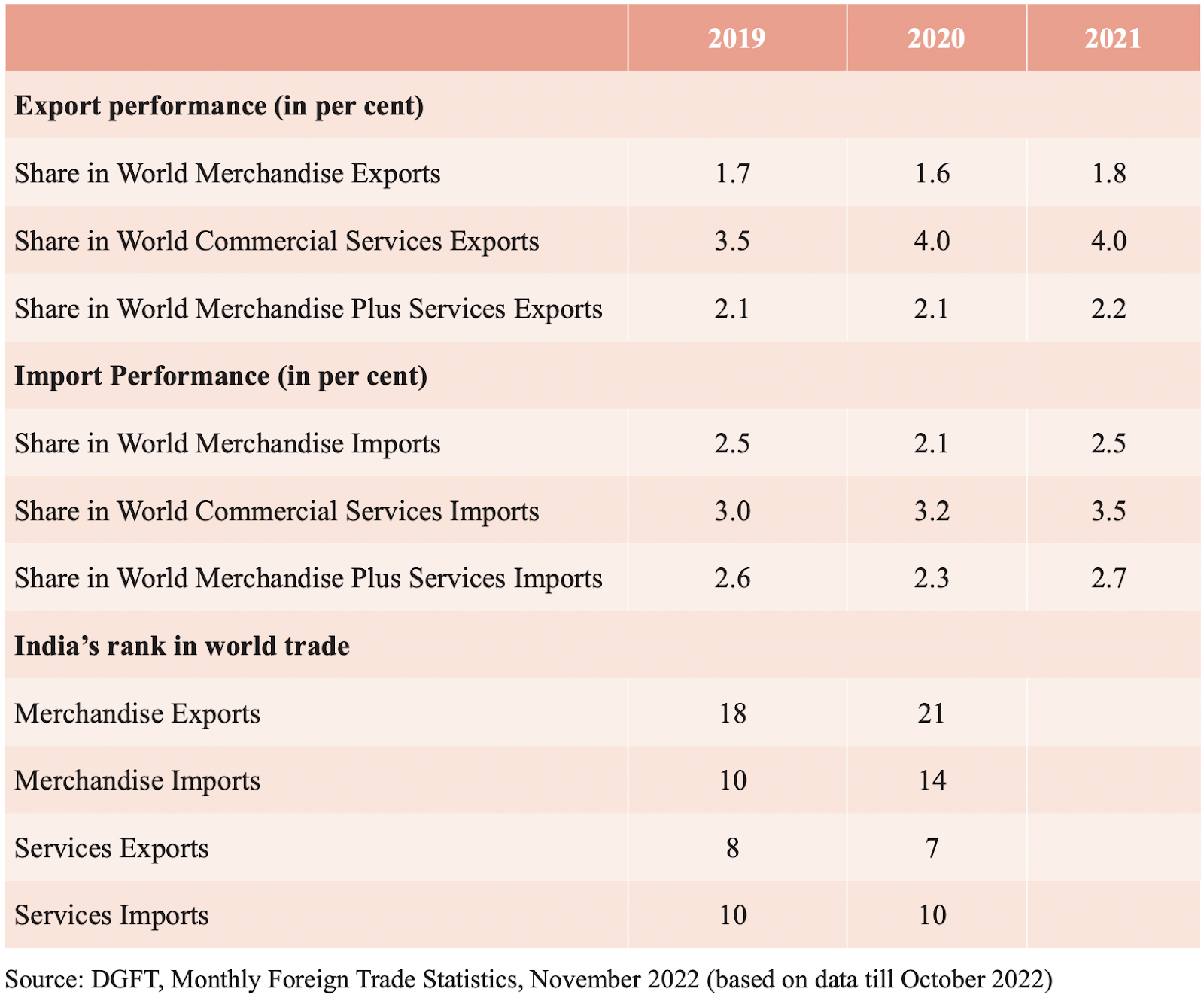
Bk98AQLEsDAku0tgKVPlj3OJGStr8O 8T3A3sztr k2DMqB kf0LHtqyiktwUi4iw4cFaje23 O0lxHNlsuA OUob4UygTmzgDBybcUqvb3cY e3nL91DQN1jDwcmGtZsAtwcLG4kjEJOebzFDP6A

India’s Exporters

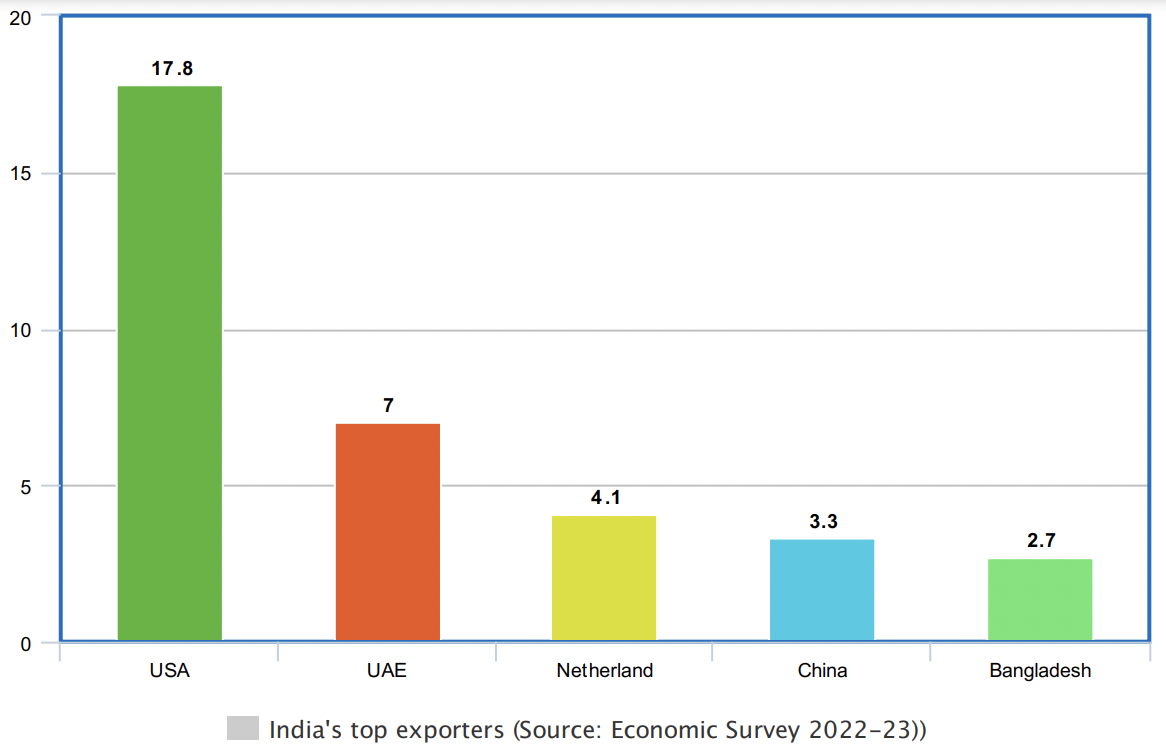
2KB5lBG7ZLSP4N

The Punjab crisis

Context: After the Punjab police launched a coordinated crackdown against the Dubai-returned radical preacher, Amritpal Singh, and his associates on March 18, there is growing concern about a revival of the Khalistan movement in Punjab.

Earlier thousands of Sikhs protested on Thursday for the release of Lovepreet Toofan, a close associate of Sikh leader Amritpal Singh. Later, the same peaceful protest turned violent when police used force to disperse the protesters.

The resurgence of Khalistan Demand

The book Blood for Blood: Fifty Years of the Global Khalistan Project, Canadian journalist Terry Milewski wrote how the Khalistan movement in Canada, the United Kingdom and India has been sustained for decades by Pakistan. The demand have always had a fringe but it has existed peacefully with the mainstream and performs a function of democracy

Recent issues

  • Punjab is an agrarian powerhouse, but its intense wheat-paddy agriculture cycle has depleted the ground water levels. Once the “breadbasket of the nation”, Punjab is fast becoming a desert. 
  • Heavy use of chemicals has turned the State into a cancer belt. Mafias dominate every revenue source, from sand to gravel to transport.
  • Punjab being a border State, the Centre has always been reluctant to install big industry here. Small- and medium-scale industry is dying out because of a huge electricity crisis and the labour exodus. 
  • Education levels have dropped, health facilities are dismal. Once the country’s number one State, Punjab has now moved to a middling 16th position in GDP ranking. 
  • The State’s loan burden is over Rs.3 lakh crore. The average individual farmer loan exceeds Rs.2 lakh. In the last two decades, about 20,000 farmers and labourers have died by suicide
  • A study conducted by the Post Graduate Institute of Medical Education and Research (PGIMER), revealed that in the state of 30 million people, 15% of the population are consuming drugs.
  • The 2021 economic survey reported that Punjab has an unemployment rate of 7.4%, one of the highest in India. Even though both drugs and unemployment have consistently ranked high as issues in political polls, politicians have yet to provide results.
  • A maverick separatist leader like Amritpal Singh becomes so quickly popular because rural Punjab is desperately seeking a hero to deliver it from its present penury.
  • The growing influence of the Deras and conversions to Christianity in Punjab and the thorny issue of Centre-State relations.
  • Incidents of storming and the lack of action taken against the mob will only “embolden radical elements“. It equally raises questions about police Intelligence.
  • Further as discussed a section of the diaspora sitting abroad  as well as the ISI (Pakistan’s Inter-Services Intelligence) have been continuing their nefarious activities to create trouble in Punjab.

History of the crisis

  • During the 1980s, Punjab was engulfed by a separatist movement which was transformed into a campaign of terror and which has been aptly described by some as a low-intensity war and a dangerous crisis for the Indian nation. 
  • The genesis of the problem lay in the growth of communalism in Punjab in the course of the twentieth century and, in particular, since 1947, and which erupted into extremism, separatism and terrorism after 1980 
  • Before 1947, communalism in Punjab was a triad with Muslim, Hindu and Sikh communalisms, opposing one another, and the latter two often joining forces against the first. After August 1947, Muslim communalism having disappeared from the Punjab, Hindu and Sikh communalisms were pitted against each other. The Akali leadership adopted certain communal themes which became the constitutive elements of Sikh communalism in all its phases. 
  • The Akalis asserted that religion and politics could not be separated as the two were essentially combined in Sikhism. They also claimed that the Akali Dal was the sole representative of the Sikh Panth which was defined as a combination of the Sikh religion and the political and other secular interests of all Sikhs. 
  • Akalis highlighted that Sikhs were being continuously subjected to discrimination, oppression, persecution, humiliation and victimization, and that there were all sorts of conspiracies against them. There was also constant anti Hindu rhetoric. Hindus were accused of designs to dominate Sikhs, of imposing Brahminical tyranny over them, and of threatening their ‘Sikh identity’. Akalis raised the cry of Sikh religion in danger. 
  • A commission appointed by Nehru in 1961. The  political scientist Baldev Raj Nayar was to point out in 1966 that though Sikhs ‘are less than 2 per cent of the Indian population, they constitute about 20 per cent of the Indian army , have double their proportionate share in the Indian administrative services, and that in the Punjab their share in the services, as also in the legislature, the cabinet, and the Congress Party organisation, is higher than their proportion in the population 
  • The use and manipulation of the institutions and symbols of the Sikh religion in order to harness religious sentiments and fervour to communal appeal. Nehru adopted three basic rules for dealing with militant agitations and their demands: no negotiations or political transactions with the leaders of a movement or acceptance of their demands if they had secessionist tendencies, if they took recourse to violence, or based their movement or demands on religion or communalism. Nehru was more than aware of the fascist character of extreme communalism, including its Akali variety under Master Tara Singh’s leadership. 
  • At the same time, Nehru, being very sensitive to the feelings of the minorities, tried to conciliate the Akalis by accommodating, as far as possible, their secular demands. This approach led him to sign pacts with the Akali Dal twice in 1948 and 1956 when it agreed to shed its communal character 
  • The accommodative strategy failed, however, to stem the growth of communalism in Punjab. New leaders soon emerged and resurrected the Akali Dal on a more extreme ideological and political basis, formulating and putting forward new lists of demands and grievances. Simultaneously , the Congress accommodation of the Akalis strengthened Hindu communal forces. 

Communalism

  1. The first issue was that of state language: to decide what was to be the language of administration and schooling in bilingual Punjab. The Hindu communalists wanted this status for Hindi and the Sikh communalists for Punjabi in the Gurmukhi script The issue was given a strong communal complexion by both the Sikh and Hindu communalists. 
  2. The second issue—that of the Punjabi Suba—proved to be more emotive and divisive. After the SRC was set up in 1955, the Akali Dal, the CPI, many Congressmen and Punjabi intellectuals put before it a demand for the reorganization of the state on linguistic lines, which would lead to the creation of Punjabi-speaking Punjab and Hindi-speaking Haryana. Though PEPSU was organised in 1956 but later Akali Dal under the leadership of Master Tara Singh soon organized a powerful agitation around the demand for the formation of a Punjabi Suba. Giving the demand a blatantly communal character, the Akali Dal alleged that the non-acceptance of the demand was an act of discrimination against Sikhs. 
  3. The Harijan Sikhs, known as Mazhabi Sikhs, who were mostly landless agricultural labourers, also opposed the demand for a Punjabi Suba because they were afraid that the new state would be dominated by their class opponents, the rich peasants, who as Jat Sikhs were the main supporters of the Akali Dal. 

The Akali Problem

  • After the formation of Punjab state, the Akali Dal failed to secure a majority in the 1967 and later elections. For one, the population arithmetic did not favour it as the Sikhs constituted less than 60 per cent of Punjab’s population 
  • Second, the Scheduled Caste Sikhs, constituting 25 to 30 per cent of the Sikh population, had, as agricultural labourers, a basic class contradiction with the rich and middle peasants, who were the main social base of the Akali Dal. They , therefore, voted for the Congress and the Communists till 1980. 
  • Third, and most important of all, Sikhs did not vote exclusively along communal lines. Most often, a good majority of Sikhs voted for the Congress and the Communists. 
  • In fact, from 1952 to 1980, the Akali votes hovered between 35 and 45 per cent of the Sikh votes. In the 1980 elections to the Punjab assembly , just before launching its most militant and communal movement, the Akali Dal secured only 26.9 per cent of the total vote. This meant that less than 50 per cent of Sikhs voted for it and that the majority of Sikhs rejected the Akali politics and ideology . 
  • Having lost the elections in 1980 and in order to widen their support base among Sikhs, the Akalis began to intensify the communal content of their politics and to continuously escalate their demands 
  • Akali Dal, headed by Sant Longowal, submitted to the prime minister a memorandum of forty- five religious, political, economic and social demands and grievances, including the issue of the sharing of Punjab’s river waters between Punjab, Haryana and Rajasthan and the question of the transfer of Chandigarh to Punjab, and launched a virulent campaign around them. Very soon, implementation of the Anandpur Sahib Resolution (ASR), adopted in 1973, became the most prominent demand. 

Terrorism

  • Terrorism made its appearance in Punjab in 1981 as a partial culmination of communal politics since 1947 and the policy of appeasement towards communalism followed by the Punjab Congress leadership, especially since the early 1970s. 
  • The initiator of terrorism was Sant Jarnail Singh Bhindranwale, who emerged in the late 1970s as a strong campaigner of Sikh orthodoxy . In this campaign he received the tacit support of the Punjab Congress led by Giani Zail Singh, who hoped to use him to undercut the Akalis. He was, however, to soon become a Frankenstein and turn against his erstwhile patrons. 
  • The terrorist campaign by Bhindranwale and the All India Sikh Students Federation, headed by AmrikSingh, began on 24 April 1980 with the assassination of the head of the Nirankari sect. This was followed by the killing of many Nirankaris, dissident Akalis and Congress workers. 
  • Bhindranwale was shielded from government action by Giani Zail Singh who had in 1980 become the home minister at the Centre. Bhindranwale moved in July 1982 to the sanctuary of Guru NanakNiwas, a building within the Golden Temple complex from where he directed the campaign of terrorism in Punjab. 
  • Bhindranwale was, however, since 1981, carrying on a verbal campaign of hatred against Hindus and ‘fallen’ Sikhs, that is, members of reformist Sikh sects, and inciting violence against them, especially through widely circulated audio cassettes. Later he started targeting Hindus on an increasing scale, and indiscriminate killing of Hindus began; this could be done with relative impunity as the Punjab administration and police were in a run-down condition and the Government of India was hesitant to take action against terrorism. 
  • He organized the looting of local banks, jewellery shops and home guard armouries, the killing of Nirankaris and government officials and random bomb explosions Bhindranwale also gave a call for a separation from and an armed struggle against the Indian state, emphasizing the separateness and sovereignty of Sikhs. 
  • Fearing arrest, in December 1983, Bhindranwale moved into the safe haven of the Akal Takht within the Golden Temple and made it his headquarters and armoury , and a sanctuary for his terrorist followers, many of whom were criminals and smugglers. He smuggled on a large scale light machine-guns and other sophisticated arms into the temple, and set up workshops there for fabricating Sten-guns, hand grenades and other arms . A large number of other gurudwaras were also used as sanctuaries and bases for terrorist activities. 
  • Bhindranwale hoped to gradually transform terrorism into a general insurgency and an armed uprising. They were fighting for political and ideological hegemony over the people of Punjab. All their activities were designed to prove that the Indian state was not capable of ruling in Punjab and, therefore, separation from India was a realizable objective 

Response of Akalis

  1. There was no open stand against the terrorists or unequivocal condemnation of their activities or the senseless killings or the vitriolic propaganda of Bhindranwale. Instead, even the moderate Akali leaders defended, directly or indirectly , those accused of terrorist acts. They condemned every concrete action of the police against the terrorists. They objected to any government action against Bhindranwale. 
  2. It was on rare occasions, the Akali leaders did condemn violence and individual killings, they put the blame on the government and the Congress, accusing them of organizing the violence and killings in order to tarnish the Sikh image. 
  3. The feeling that their leadership of the Sikh masses was in danger, they tried to keep up with Bhindranwale. As they lost ground to the latter, they took up more and more extreme positions, competing with him in demands and aggressive political and ideological posturing. 
  4. Akali leaders found it difficult oppose Bhindranwale was the fact that they shared a common political ideology with him and the extremists, even though they had tactical and strategic political differences. The Akalis equally whipped up communal feelings; and the public manifestations of the Akali ideology were indistinguishable from those of Bhindranwale and the extremists and, in fact, echoed them 

Response of Indira Gandhi

  • Instead of boldly confronting the communal and separatist challenge to the Indian polity , Indira Gandhi gave way to indecisiveness; her response, uncharacteristic of her political style, was to dither and vacillate between a policy of appeasement and tactical manoeuvring and firmness. 
  • Indira Gandhi carried on endless negotiations with G.S. Tohra, Parkash Singh Badal and H.S. Longowal. Knuckling under the Akali and terrorist threats, she failed to evolve what the situation demanded, namely, a strategy of combating communalism, secessionism and terrorism. 
  • K.P.S. Gill, former director- general of police in Punjab who directed the successful phase of the antiterrorist campaign there, has pointed out: ‘Nothing encourages the terrorists to greater audacity than the spectacle of weakness in the political leadership, and of confusion in the security forces 
  • An increasingly dangerous feature of the situation was Pakistan’s growing involvement in Punjab affairs. As a part of its strategy of waging low-intensity warfare against India, Pakistan had started providing training, weapons, ideological indoctrination, safe areas for hiding, and military guidance to terrorist organizations. Certain extremist Sikh groups abroad were also giving increasing encouragement to the secessionists and helping them with money and weapons. 

Operation Blue Star

  • By June 1984, the situation had reached an explosive point as terrorist activity escalated. There was in Punjab and in the country as a whole an intense feeling of danger to the peace and unity of the country. Fear and panic were spreading among Hindus in Punjab with an increasing number leaving the state. 
  • One of the most worrisome features of the situation was the increasing Hindu–Sikh divide in Punjab and the spread of Hindu communalism in the rest of the country , especially in North India. A warning came from Haryana when anti-Sikh rioting broke out in February.
  • The Government of India undertook military action, code-named Operation Blue Star. While there was no alternative to military action once the situation had worsened to the extent it had, there is no doubt, as later events were to show, that the operation was hastily conceived, undertaken without adequate information and proper planning and poorly executed, with the result that its political and emotional cost proved to be far higher than its planners had anticipated. 
  • The military operation turned into a full-scale battle, with the army having to deploy tanks in the end. What was worse, over a thousand devotees and temple staff were trapped inside the temple and many of them died in the crossfire. Moreover, the buildings in the temple complex were severely damaged, with the Akal Takht being virtually razed to the ground. Harmandir Sahib, the most hallowed of the Sikh shrines, was riddled with bullet marks, even though the army had taken special care at the cost of the lives of its soldiers not to damage it. 
  • Operation Blue Star produced a deep sense of anger and outrage among Sikhs all over the country . It was seen by most of them as a sacrilege and an affront to the community rather than as a necessary though unpleasant effort to deal with Bhindranwale and the terrorists.
  • Operation Blue Star had certain positive features. It established that the Indian state was strong enough to deal with secession and terrorism; it put an end to the charismatic Bhindranwale and his gang; and it created that minimum of law and order which enabled secular parties such as the Congress, CPI and CPM to move among the angry people and counter communal politics by explaining to them that the real responsibility for the Punjab situation lay with Bhindranwale, the terrorists, and the Akali communalists. 
  • Following Operation Blue Star, the terrorists vowed vengeance against Indira Gandhi and her family for having desecrated the Golden Temple. In October 1984, Indira Gandhi was assassinated by two Sikh members of her security guard. Earlier she had rejected her security chief’s suggestion that all Sikhs be removed from her security staff .
  • The assassination of the popular prime minister, in an atmosphere of heightened communalization in North India during 1981–84, led to a wave of horror, fear, anger and communal outrage among people all over the country , especially among the poor. This anger took an ugly and communal form in Delhi and some other parts of North India, where anti-Sikh riots broke out as soon as the news of the assassination was announced.

Response of Rajiv Gandhi

  • Rajiv Gandhi succeeded Indira Gandhi as prime minister in November 1984. He moved quickly after the general elections in December 1984 to tackle the Punjab problem. In January 1985, the major jailed leaders, including the Akali Dal president, H.S. Longowal, were released. A month later Rajiv Gandhi ordered an independent judicial enquiry into the November riots. 
  • Rajiv Gandhi soon initiated negotiations with the Akali leaders in the belief that a settlement with them would provide a lasting solution to the Punjab problem. 
  • Rajiv Gandhi and Longowal signed the Punjab Accord. The government conceded the major Akali demands and promised to have others reviewed. In particular, it was agreed that Chandigarh would be transferred to Punjab, a commission would determine which Hindi-speaking territories would be transferred from Punjab to Haryana, and the river water dispute would be adjudicated by an independent tribunal. 
  • The Akali government, headed by Surjit Singh Barnala, was, however, from the beginning riven with factionalism and, consequently , immobilized. The militant groups soon regrouped taking advantage of the soft policies of the Barnala government. There was, over time, a resurgence in terrorist activities, and the state government, riven with factionalism, was unable to contain them. Consequently, the central government dismissed the Barnala ministry and imposed President’s Rule in Punjab 
  • The fact is that the Akali Dal and an Akali government, sharing the ideological wavelength of the extremists and the terrorists, were incapable of confronting or fighting communalism and separatism. It was, therefore, a strategic error on the part of the Rajiv Gandhi government to stake all on Barnala and his supporters. Also despite President’s Rule, terrorism in Punjab went on growing, going through phases of waning and resurgence, especially as after 1985 it had begun to be openly funded, supported and even directed by Pakistan. 
  • Most of the terrorist gangs took to extortion, robbery, smuggling, drugs, abduction and rape, land grabbing, murder of innocents, and a lavish lifestyle. From 1987, they also began a systematic campaign to acquire political and ideological hegemony over the people. Their ban on meat, liquor, tobacco, and the use of sarees by women, their effort to determine the dress of schoolchildren, their restrictions on marriage rites and practices, their hoisting of the Khalistani flag on public buildings, their collection of parallel taxes, were all designed to convince the people that they were the rulers of tomorrow. 
  • The Rajiv Gandhi government several times came near getting an upper hand over the terrorists, but it lacked the determination to run the full course. It, thus, lost the advantage gained by strong state action, and inevitably led to higher levels of state violence against terrorism every time. The policy of ‘solving’ the Punjab problem through negotiations with and appeasement of the terrorists and extreme communalists was followed even more vigorously by the governments of V.P. Singh and Chandra Shekhar during 1990 and 199 1
  • The state did finally take strong action. A preview of such action was Operation Black Thunder,  undertaken by the Punjab police and paramilitary forces in May 1988, which succeeded in flushing out the terrorists from the Golden Temple. 
  • A hard policy towards terrorism was followed from mid-1991 onwards by the Narasimha Rao government at the Centre and after the February 1992 elections by the Congress government led by Beant Singh in Punjab. As a result of the approach by 1993, Punjab had been virtually freed of terrorism. 

Way forward

  1. There are certain elements who are trying to and have been trying to indulge in various activities, and surface time and again; but the people of Punjab, whatever the community, whatever their affiliations might be, everybody had suffered during the 1980s and none of them are ready to go back to that time.
  2. There is need for political mobilisation. All political parties, irrespective of whatever differences they may have on other issues, must ensure that on this particular issue an overwhelming part of the population, which is already in the democratic mainstream, continues to remain in that mainstream.
  3. The police should have all kinds of intelligence set-ups, they should ensure that they have prior information and have the identification of the specific person.