Mains Exhaustive

Women Not In Job Market? It’s A Myth

Context: The 30 years of employment data in India collected by the National Sample Survey Office (NSSO) and the Periodic Labour Force Survey (PLFS) is analyzed to discuss a prevalent misconception about the Indian economy: the low participation rate of women in the labor force (FLFPR), especially compared to Bangladesh and Sri Lanka.

Status of Women Employment in India

  • Agriculture census 2015-16: share of female operational holders has increased from 12.79 per cent in 2010-11 to 13.87 per cent in 2015-16 and 40.67% Agri labourers are women.
  • Periodic Labour Force Survey (2019-20): Women workers 28.8% of total workforce in India.
  • Centre for Monitoring Indian Economy (CMIE) 2022: Female Labour Force Participation dips to 9.2% from 15%.
  • International Labour Organization (ILO): 95% of working women are in informal sector.

Reasons for less FLFPR

  1. Societal norms and cultural expectations: In India, traditional gender roles dictate that women should focus on household duties and raising children, while men are the primary breadwinners. 
  2. Lack of access to education: Girls are often denied access to education, or they drop out of school early due to poverty or familial responsibilities. This lack of education and skill development limits their employment opportunities and earning potential. 
  3. Limited job opportunities: Women often face discrimination in the job market, and there are fewer job opportunities available to them compared to men. For example, technology and finance sector. 
  4. Safety concerns: Women in India often face safety concerns and harassment in the workplace and while commuting to and from work. It discourage them from seeking employment outside of the home. 
  5. Unpaid care work: Women in India often have to bear the burden of unpaid care work, such as taking care of children, elderly family members, and household chores. It is often undervalued and not recognized as work, which limits women's ability to participate in paid employment. 
  6. Lack of supportive policies: India lacks supportive policies, such as parental leave, flexible work arrangements, and affordable childcare, which can enable women to balance work and family responsibilities.

Initiatives taken to improve FLFPR in India

  1. Mahila Shakti Kendra Scheme: Empowers rural women through community participation. 
  2. Rashtriya Mahila Kosh: Provides micro-credit at concessional terms to poor women for various livelihood and income generating activities.
  3. Prime Minister’s Employment Generation Programme (PMEGP): Under the scheme, women entrepreneurs are provided 25 per cent and 35 per cent subsidies for the project set up in urban and rural areas respectively.
  4. Deendayal Antyodaya Yojana- National Rural Livelihoods Mission (DAY-NRLM): seeks to reach out to 8-9 crore rural poor households and organize one woman member from each household into affinity-based women SHGs and federations at village and at higher levels.
  5. Female Entrepreneurship: To promote female entrepreneurship, the Government has initiated schemes like MUDRA, Stand Up India and Mahila e-Haat.

Increasing women's participation in the labor force market in India is a crucial step towards achieving gender equality and promoting economic growth. Efforts to increase women's participation in the labor force should focus on providing access to education and training, affordable childcare services, flexible working hours, and addressing gender-based discrimination and promoting equal opportunities for women in all sectors of the economy. 
Proposed FCA changes to offset SC's forest order

Context: The Forest (Conservation) Amendment Bill, introduced in the Indian Parliament, proposes changes that will undermine the landmark Godavarman judgment of 1996, which has provided the basis for forest conservation in India for over 27 years.

Proposed changes to Forest Conservation Act

  • The proposed amendments seek to limit the applicability of the Forest Conservation Act, potentially allowing non-forest activities on over one-third of Aravalis in Gurgaon and Faridabad districts. 
  • It would also exempt certain land parcels from prior approval requirements for non-forest use, including linear rail and road networks and land parcels not recorded as forest in government records.
  • The proposal suggests exempting specific types of lands from the Act in order to expedite the implementation of national strategic and security-related projects.
  • It also empowers the central government to specify, by order, the terms and conditions subject to which any survey, such as, reconnaissance, prospecting, investigation or exploration including seismic survey, shall not be treated as non-forest purpose.

Godavarman Judgement 1996

  • Supreme Court passed an interim order directing that tree-felling and non-forestry activity in forests across the country be stopped. 
  • The path-breaking order re-defined the meaning of forests and extended protection to all areas with natural forests irrespective of their ownership. 
  • It laid down that ‘forests’ will be understood by its dictionary meaning, and the provisions of the Forest (Conservation) Act 1980, shall apply to all thickly wooded areas. 
  • States were directed to form expert committees to identify forests as defined and file reports. 

Forest Conservation Act 1980

  • It was passed in India in 1980 to protect forests and wildlife. 
  • The act regulates the use of forest land for non-forestry purposes, such as mining, industry, and construction. 
  • Any diversion of forest land for non-forestry purposes requires prior approval from the central government. 
  • The act establishes a National Committee for the Protection of Forests and Wildlife to advise the government on forest conservation and wildlife protection. 
  • The act provides guidelines for compensatory afforestation, meaning that if any forest land is diverted for non-forestry purposes, an equivalent area of land should be reforested. 

Forest in India

  • Forest Survey of India (FSI), Dehradun, an organization under the Ministry carries out the assessment of forest cover of the country biennially since 1987 and the findings are published in India State of Forest Report (ISFR). 
  • The forest cover assessment is a wall – to – wall  mapping exercise based on remote sensing supported by intensive ground verification and field data from National Forest Inventory. 
  • As per latest ISFR 2021, the total forest cover of the country is 7,13,789 square kilometre which is 21.71% of the geographical area of the country. 
  • The current assessment shows that the total forest cover of the country has increased by 1540 square kilometre, tree cover has increased by 721 square kilometre and total forest and tree cover has increased by 2261 square kilometre at the national level as compared to the previous assessment i.e. ISFR 2019.

Efforts to increase forest cover

National Mission for Green India (GIM)

  • To increase the forest cover in the country, afforestation programmes are taken up under various Centrally Sponsored Schemes of the Ministry such as National Mission for a Green India (GIM).
  • It is one of the eight Missions outlined under the National Action Plan on Climate Change. 
  • It aims at protecting, restoring and enhancing India’s forest cover and responding to Climate Change by undertaking plantation activities in the forest and non- forest areas. 

Nagar Van Yojana (NVY) 

  • The Ministry of Environment, Forests & Climate Change is implementing NVY since the year 2020 which envisages developing 400 Nagar Vans and 200 Nagar Vatika in the country during the period of 2020-21 to 2024-25. 
  • Its objective is to significantly enhance the tree outside forests and green cover, enhancement of biodiversity and ecological benefits to the urban and peri-urban areas apart from improving quality of life of city dwellers with the funds under the National Fund of the Compensatory Afforestation Fund Management and Planning Authority (CAMPA).

Afforestation activities are also taken up under various programmes/funding sources such as Mahatma Gandhi National Rural Employment Guarantee Scheme, Compensatory Afforestation Funds under Compensatory Afforestation Fund Management and Planning Authority (CAMPA). In addition, plantations are also done by various departments, Non-Government Organizations, Civil Society, Corporate bodies etc.

FCRA regulation

Context: Recently the Supreme Court ordered 6,000 non-governmental organisations (NGOs) to go back to the government for the satisfaction of their grievances over the non-renewal of their Foreign Contribution Regulation Act (FCRA) registration. About 5,900 NGOs' FCRA registrations expired on December 31, 2021, either because the NGOs failed to apply for renewal before the deadline or because the MHA refused to renew them for suspected violations of the Act.

What is the FCRA? 

  • Foreign Contribution Regulation Act (FCRA) was enacted in 1976 to regulate foreign donations, which ensures that they do not jeopardise national security
  • It was updated in 2010 to include a raft of new regulations governing foreign donations. 

Who needs to comply with FCRA?

All associations, groups, and non-governmental organisations (NGOs) who want to receive foreign donations must comply with the FCRA.

Major provisions of FCRA

  • Registration under the FCRA is required of all such NGOs. 
  • The registration is valid for five years at first, after which it can be renewed if all requirements are met. 
  • Foreign contributions for social, educational, religious, economic, and cultural reasons are permitted for registered organisations. 
  • Annual returns, similar to those filed with the Internal Revenue Service, are required to be filed.

New guidelines under FCRA

In 2015, the Ministry of Home Affairs (MHA) issued new guidelines requiring NGOs 

  • To certify that accepting foreign funding will not jeopardise India's sovereignty and integrity, have a negative influence on friendly relations with other countries, or undermine communal harmony.
  • It further stated that all such NGOs would be required to have accounts in either nationalised or private banks with core banking services in order to provide security agencies with real-time access.

Who is ineligible to receive foreign donations? 

  • Originally Foreign contributions are illegal for members of the legislature and political parties, as well as government officials, judges, and journalists. 
  • However, the MHA in 2017 allowed political parties to receive contributions from a foreign firm's Indian affiliate or a foreign company in which an Indian owns 50% or more shares.

What other options are there for obtaining foreign funding? 

  • The alternative option is to request prior authorisation to receive foreign contributions. It is given in exchange for receiving a specified amount from a specific donor in order to carry out certain activities or initiatives. 
  • However, statutes such as the Societies Registration Act of 1860, the Indian Trusts Act of 1882, or Section 25 of the Companies Act of 1956 should be used to register the association. A letter of commitment from the overseas donor is also necessary, outlining the amount and purpose.

What happens if a registration is cancelled or suspended? 

  • The MHA can temporarily revoke an association's FCRA registration after inspecting its books and obtaining any negative feedback about its operations. Until a decision is made, the association is unable to accept new donations or use more than 25% of the funds in the designated bank account without approval from the MHA.
  • The MHA has the authority to cancel an organisation's registration, after which it will be ineligible for registration or granting of 'prior authorization' for three years. 
  • When an audit uncovers problems in an NGO's finances, such as misappropriation of foreign cash, registrations are also revoked. 
  • According to the FCRA, no certificate cancellation order can be granted until the person or NGO in question has had a reasonable opportunity to be heard. An NGO's registration is cancelled after three years, and it is not eligible for re-registration.
  • The government can also suspend an NGO's registration for 180 days while an investigation is conducted, as well as freeze its funds. 
  • The government's instructions can be overturned in the High Court. 
  • The majority of those whose registrations have been cancelled have been suspected of financial issues or "political activities." 
  • Following an inquiry into Amnesty's financial practices by the Enforcement Directorate in 2018, the organisation was forced to close its operations in India in 2020. 

Coastal Vulnerability Index

Context: Indian National Centre for Ocean Information Services (INCOIS) has carried out coastal vulnerability assessment for entire Indian coast at states level to prepare a Coastal Vulnerability Index (CVI).

Coastal Ecosystem

  • The highly productive coastal zone, intermediate between land and sea, is very vulnerable to coastal hazards because of its dynamic nature.
  • The coastal ecosystem provides various ecosystem goods and services for human well-being and the livelihood of coastal communities. 
  • Due to their productivity, coastal zones are also crucial for long-term global sustainability and economic development. 

What is coastal vulnerability?

  • It is the identification of coastal resources at risk due to coastal hazards.
  • A coastal hazard is defined as the occurrence of a phenomenon (e.g., a tropical storm/Sea level rise/Tsunami etc.), which has the potential for causing damage to, or loss of, natural ecosystems, buildings, and infrastructures.
  • Climate change poses a serious threat to the physical, economic, and social systems of the coastal environment.
  • Unprecedented pressure from population growth and development activities has had a negative impact on natural coastal phenomena.
  • In tropical countries, the coastal zone is constantly affected by cyclonic activities and storm surges, resulting in coastal erosion, inundation, and seawater intrusion, which has greatly increased the vulnerability of the coastal environments.
  • Environmental degradation, loss of mangroves, land conversion for shrimp farming, and other developmental activities have also increased coastal vulnerability to natural and anthropogenic hazards. 
  • Short term vulnerability: Due to Cyclone / Storm surge/ Tsunami / Flash rain Flooding / Earthquake in the coastal area etc. 
  • Long term vulnerability: Due to Sea level rise (SLR) / Ocean acidification / Coastal land subsidence etc.

Vulnerability of the Indian coastline

  • India has a 7500-km-long coastline with nine states and four union territories are highly susceptible to climate change. 
  • About 35% of the Indian Population live within 100 km from the shoreline.
  • Most of the coastal areas are low lying and vulnerable to Oceanogenic disasters such as Tsunamis, Storm Surges, Sea-level rise.
  • Dec 26, 2004, Tsunami resulted in a loss of 18,045 deaths and 6,47,599 persons displaced.
  • Increased frequency and intensity of the disasters (Uttarakhand flood 2013, Phailin Cyclone 2013.

About Coastal Vulnerability Index

  • It is a quantitative tool that combines physical and socioeconomic indicators to evaluate how vulnerable coastal areas are to the effects of climate change, including but not limited to sea level rise, storm surges, and erosion. 
  • INCOIS has prepared the Coastal Vulnerability Index (CVI) maps for the entire coastline of India to assess the probable implications of sea-level rise along the Indian coast.
  • Parameters: shoreline change rate, sea-level change rate, coastal elevation, coastal slope, coastal geomorphology, significant wave height and tidal range. 

INCOIS

  • It was established as an autonomous body in 1999 under the Ministry of Earth Sciences (MoES) and is a unit of the Earth System Science Organisation (ESSO).
  • It is mandated to provide the best possible ocean information and advisory services to society, industry, government agencies and the scientific community through sustained ocean observations.
  • Its mission it to provide ocean data, information and advisory services to society, industry, the government and the scientific community through systematic and focused research in information management and ocean modelling.
  • Its headquarters is situated at Hyderabad.

How to manage India’s solar PV waste problem?

Context - In the last few years, there has been a concerted push from policymakers in India to transition to a circular economy and to, among other things, enable effective waste management. But waste management in the solar photovoltaic (PV) sector still lacks clear directives.

What is PV waste?

  • It is the electronic waste (e-waste) generated by discarded solar panels and Photo-voltaic (PV) devices.
  • Photovoltaic (PV) devices contain semiconducting materials that convert sunlight into electrical energy. 
  • A single PV device is known as a cell, and these cells are connected together in chains to form larger units known as modules or panels. 
  • Although up to 90% of the components are recyclable, many PV modules contain heavy metals such as cadmium, copper, lead, antimony or selenium, and when they are taken out of service or broken, they may be classified as hazardous waste.

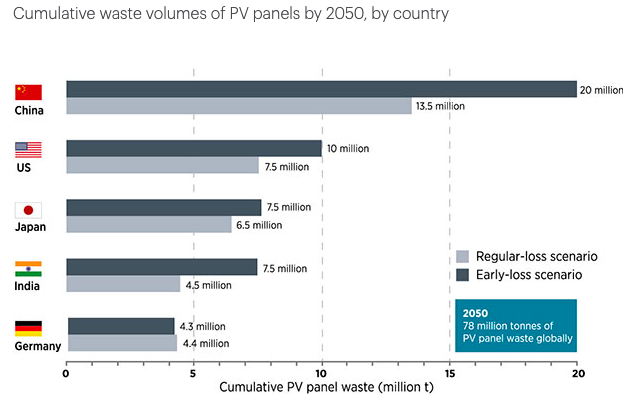
While photovoltaics generate only about 3 percent of global electricity, they consume 40 percent of the world’s tellurium, 15 percent of the world’s silver, a substantial chunk of semiconductor-grade quartz and lesser amounts of indium, zinc, tin and gallium. A report, prepared jointly by the International Renewable Energy Agency (IRENA) and the International Energy Agency Photovoltaic Power Systems Programme (IEA-PVPS) highlights that recycling or repurposing solar PV panels at the end of their roughly 30-year lifetime can unlock an estimated stock of 78 million tonnes of raw materials and other valuable components globally by 2050. If fully injected back into the economy, the value of the recovered material could exceed USD 15 billion by 2050.

Present status of Solar PV waste in India

  • According to a report prepared by the National Solar Energy Federation of India, India could generate over 34,600 tonnes of cumulative solar waste in India by 2030. 
  • India currently considers solar waste a part of electronic waste and does not account for it separately. Moreover, there is no commercial raw material recovery facility for solar e-waste operational in India.
  • A committee had been constituted under the chairmanship of the Ministry’s Secretary to propose an action plan to evolve a “circular economy” in solar panel, through reuse/recycling of waste generated.
Iyqd qWoT G5zyajf94X5OfuAE69RxAmgTMM9hbdlLADZLrjwRW9yRgl7cMEInfZi4rOcOx64bpmon724UwVxmhVG0fQ1Gu9dlaoheZ8Eh3YTl0tet6QP

Challenges in India

  • Informal handling - Only about 20% of the waste is recovered in general; the rest is treated informally. As a result, the waste often accumulates at landfills, which pollute the surroundings. Incinerating the encapsulant also releases sulphur dioxide, hydrogen fluoride, and hydrogen cyanide into the atmosphere.
  • No segregation – PV waste is clubbed with e-waste in India generally. 
  • High cost of recycling - Recycling a solar panel cost between $20 and $30, according to the National Renewable Energy Laboratory; sending it to a landfill costs $1-2.
  • Lack of incentives - The market to repurpose or reuse recycled PV waste is minuscule in India due to a lack of suitable incentives and schemes in which businesses can invest.

What can we do about them?

  • Promote recycling - According to a 2021 report, approximately 50% of the total materials can be recovered. The domestic development of PV waste recycling technologies must be promoted through appropriate infrastructure facilities and adequate funding. New business models, incentives or issues of green certificates to be provided to encourage the recycling industry to participate more.
  • Environmental disposal and recycling of solar waste could be part of the power purchase agreement SECI / DISCOMS / government signs with project developers.
  • Dedicated Policy formulation - India should formulate and implement provisions specific to PV waste treatment within the ambit of the e-waste guidelines. EPR for the manufacturer and developers to take responsibility for end-of-life the solar panel. 
  • Ban on Landfills: Solar panel waste is harmful to the environment as it contains toxic metals and minerals that may seep in the ground.
  • Central insurance or a regulatory body should be set up to protect against financial losses incurred in waste collection and treatment. 
  • Research and Development: Innovation in design may have an impact on the type of waste they generate; technology advancements will be significant in reducing the impact of renewable energy waste. New panels, for example, use less silicon and produce less waste during the manufacturing process.
  • Awareness drives - Pan India sensitisation drives and awareness programmes on PV waste management will be beneficial.

Global best practices

Europe - EU imposes responsibility for the disposal of waste on the manufacturers or distributors who introduce or install such equipment for the first time.UK - PV producers will need to register and submit data related to products used for the residential solar market (B2C) and non-residential market.

Australia - announced a $2 million grant as part of the National Product Stewardship Investment Fund to develop and implement an industry-led product stewardship scheme for PV systems.

CEC in Assam: Delimitation, NRC can be simultaneous processes

Context: Various political parties in Assam had submitted to Election commission of India (ECI) to hold the delimitation exercise, till the conclusion of National Register of Citizen (NRC) process. In response to this chief election commissioner said that delimitation and NRC are “different issues” and there is no legal bar on carrying them out separately.

Delimitation Commission

The Delimitation Commission is established by Parliament under Article 82 to determine allocation of seats in the House of the People to the States based on 1971 Census and divide states into territorial constituencies based 2001 Census.

Delimitation means the act or process of fixing limits or boundaries of territorial constituencies in a country or a province having a legislative body. In India, the job of delimitation has been assigned to a high power body known as Delimitation Commission or Boundary Commission.

Four Delimitation Commission have been constituted since independence

1952 – under Delimitation Commission Act, 1952

1963 -  under Delimitation Commission Act, 1962

1973 - under Delimitation Commission Act, 1972

2002 - under Delimitation Commission Act, 2002

Orders of Delimitation Commission cannot be called in question before any Court of law. 

The copies of its orders are laid before the House of People and the State Legislative Assembly concerned, but no modifications are permissible therein by them. 

The Central Government shall constitute a Commission to be called the Delimitation Commission which shall consist of three members as follows: 

(a) one member, who shall be a person who is or has been a Judge of the Supreme Court, to be appointed by the Central Government who shall be the Chairperson of the Commission; 

(b) the Chief Election Commissioner or an Election Commissioner nominated by the Chief Election Commissioner, ex officio: 

(c) the State Election Commissioner of concerned State, ex officio. 

The Commission shall determine its own procedure and shall, in the performance of its functions, have all the powers of a civil court under the Code of Civil Procedure. 

Role played by delimitation commission 

  • Balance of representation to achieve the ideals of ‘One Vote One Value’ 
  • Ensure adequate representation to vulnerable sections including SC/ST. 
  • Fair division of geographical areas for adequate representation of diverse communities. 

Challenges 

  • Delimitation exercise is restricted by Constitution 84th and 87th Amendment. 
  • This has frozen the seats in Lok Sabha and State Assemblies till 2026. 
  • Seats reserved for SC and ST population also remains frozen and increasing population of vulnerable section is not accounted for. 

Thus the need of the hour is to develop a National consensus exercise for undertaking delimitation along with 2031 census to ensure adequate representation of states and vulnerable sections of India. 

National Register of Population (NRC)

  • The National Register of Citizens (NRC) is the register containing names of Indian citizens. The only time that a National Register of Citizens (NRC) was prepared was in 1951 when after conduct of the Census of 1951, the NRC was prepared by recording particulars of all the persons enumerated during that Census.
  • It was only done by the state of Assam , though it was mandated for all the states. However, recently Home Ministry has expressed, that it is planning to do this process for entire country.
  • Citizenship being a subject of the Union List, policy decisions, guidelines and funds for NRC updation are provided by the Central Government but its implementation is done through the State Government machinery under the guidance of the Registrar General of India who functions as the Registrar General of Citizen Registration under Rule 15 of Citizenship Rules, 2003 as amended in 2009 and 2010.
  • The provisions governing NRC updation are The Citizenship Act, 1955, and The Citizenship (Registration of Citizens and Issue of National Identity cards) Rules, 2003 (prepared under The Citizenship Act, 1955).

Union Home Minister unveiled the statues of Lord Basaveshwara and Nadaprabhu Kempegowda in Bengaluru, Karnataka

Context: The statues of two legendary figures from Karnataka, Basavanna and Kempegowda, have been unveiled. The messages of social justice, democracy, sound governance, and progress shall be promoted.

Life History of Basaveshwara [ 1105-1167]

  • Born in Bijapur district, Karnataka in 1105 CE.
  • He was an Indian statesman, poet in the Kannada language, and social reformer who lived in Karnataka during the time of King Bijjala I of the Kalachuri dynasty.
  • As the Kalachuri kingdom's chief minister, he established new public institutions including the Anubhava Mantapa, also known as the "hall of spiritual experience," which attracted people from all socio-economic classes. 
  • He launched social reforms and a religious movement centred on resurrecting Shaivism using the public treasury, recognising and promoting ascetics known as Jangamas.
  • The Basavarajadevara Ragale, written by the Kannada poet Harihara (about 1180), is the earliest account of the social reformer's life. It is significant since the author was a near contemporary of the Basavanna.
  • The Vachana Sahitya in Kannada is one of the literary works of the Basavanna. 
  • Basava is credited as the founder of Lingayats' tradition in hagiographic writings. However, modern scholars, based on Kalachuri inscriptions assert that Basava revived and improved a previously existent tradition. 

Philosophy

  • He developed a new devotional movement named Veerashaivism. 
  • In his poetry, Basava discussed about gender equality, community spirit and refraining from wars for any cause.
  • He said that the true god is "one with himself, self-born," challenging rituals, dualism, and externalisation of god. 
  • Basava opposed rituals, but he supported icons and symbols such as wearing an Istalinga (necklace with a personal linga) and applying Vibhuti (sacred ash on the forehead) as a constant reminder of one's devotion and religious principles.
  • In order to eliminate the need for elite translation and interpretation of spiritual concepts and to ensure that everyone can grasp them, he advocated for the use of the vernacular language, Kannada, in all spiritual conversations. 
  • His holy trinity included a guru (teacher), a linga (a lingam that belonged to Shiva), and jangama (constantly moving and learning).
  • In the 12th century, Basava built the Anubhava Mantapa, a place where anyone from either gender might assemble and debate spiritual concepts. Here, ardent followers of Shiva would share their accomplishments and spiritual poems written in the vernacular language.

Social Reforms

  • Basava believed that all people were created equal, regardless of caste, and that all manual effort had an equal value. According to the Basava, a true saint and Shaiva bhakta was determined by behaviour rather than by birth.
  • Anti-caste movement: In the 12th century A.D.  Basaveshwara started one of the earliest known anti-caste campaigns in Karnataka. 
  • In order to replace patriarchy, caste, and the brahmanic religion with an equitable system, they were carefully scrutinised, painstakingly rejected, and replaced. 
  • Saints from the untouchable caste like Channiah and Kakkaih, as well as famous figures like Akkamahadevi and Allama Prabhu, participated in the collaborative effort known as the Anubhava Mantapa. 
  • He organised an inter-caste marriage between an untouchable groom and a Brahmin bride as one of his extreme actions. The inter-caste marriage arranged by Basavanna is still regarded as a notable accomplishment in the history of the social reform movement.
  • He stayed away from wearing the sacred thread, which is a sign of caste superiority, in order to distance himself from his caste.

As compared to other Bhakti movements, the social reform movement by Basava stands out as unique. The movement had a political as well as a social impact on society. He promoted the idea of political representation for the voiceless. The followers of Basavanna currently identify as Lingayats and are one of the most powerful castes in Karnataka.

Lingayatism

  • Lingayatism emphasizes qualified monism (Vishishtadvaita), with philosophical foundations similar to those of the 11th–12th-century South Indian philosopher Ramanuja.
  • Lingayatism rejects any form of social discrimination including the caste system and authority of Vedas and Puranas.
  • According to a tradition which developed after Basava’s time, Lingayatism was transmitted by five Panchacharyas, namely Renukacharya, Darukacharya, Ekorama, Panditharadhya, and Vishweswara. 
  • The scripture of Lingayatism Basava Purana was completed in 1369 during the reign of Vijayanagara ruler Bukka Raya I.

About Nadaprabhu Kempegowda (Also mentioned in news)

He was 16th century chieftain of Vijayanagar Empire.He is credited to have built around 1000 lakes throughout the city.
He belonged to the dominant agriculture Vokkaliga community. ContributionFoundation of Bengaluru city: In 1526, Kempe Gowda conquered the Sivaganga principality and later Domlur.With imperial permission of the Vijayanagar Emperor Achyutharaya (an inscription at Dasarahalli records the decree date as 1532), he built Bangalore Fort and the town in 1537, and moved his capital from Yelahanka to the new Bengaluru Pete, the foundation of present-day Bangalore city.

Source: PIB

What’s the Missing Block in Building Institute of Excellence?

Context: Times of India dated 27 march 2023 has a news article highlighting the issues associated with the Institute of excellence.

What is the institute of Excellence?

Institutions of Eminence scheme has been to help higher education institutions to become world-class teaching and research institutions. Ten public and ten private institutions are to be identified to emerge as world-class Teaching and Research Institutions. This will enhance affordable access to high-quality education for ordinary Indians.

Objectives of the scheme – institutions of eminence

  • To provide for higher education leading to excellence and innovations in such branches of knowledge as may be deemed fit at post-graduate, graduate and research degree levels and award degrees, diplomas and other academic distinctions; 
  • To provide for high-quality teaching and research and the advancement of knowledge and its dissemination through various research programmes undertaken in-house by a substantial number of full-time faculty and research scholars in diverse disciplines etc.

Expectations from the institutions of eminence

  • Highly qualified faculty, with the freedom to hire from across the world; 
  • Existence of academic, administrative and financial autonomy; 
  • Excellence in research; 
  • High Quality of teaching etc.

 Challenges

  • The multiplicity of regulatory agencies and the lack of coordination among them is a major challenge in the emergence of institutes of eminence in India.
  • The multiplicity of regulatory agencies and the lack of coordination among them is a major challenge in the emergence of institutes of eminence in India.
  • Limited Funding compared to other countries like China which have provided more extensive funding to their elite universities.
  • Limited coverage of universities in the IOE scheme, as only three public-funded and three private-funded universities have been selected, and the selection has excluded some notable institutions.
  • Limited financial autonomy in fund utilization, with strict compliance with Government Financial Rules (GFR) and the fear of the Comptroller and Auditor General of India audit. Delays in receiving funds from sponsoring organizations.
  • Challenging procurement procedures such as purchase and procurement through Government e-Marketplace portal.
  • Delays in the purchase period for equipment having foreign components due to too many clearances.
  • The current Public Financial Management System hampers the purchase where a commitment is made without completing the final transaction.
  • Difficulty in compliance with laws relating to visa, registration, opening a bank account, residence permit, exit permit, etc., for foreign students.
  • Existing high fees in IITs with little scope for raising the fees to attract more foreign students, as higher fees contradict the equity objective of a public-funded university.
  • Difficulty in recruiting international faculty due to various bottlenecks, such as political clearances, complex taxation laws, and other bureaucratic hurdles.

What is the way forward?

  • The proposed HECI should set its priorities right and bring out regulations based on evidence-based inputs.
  • HECI should refrain from bringing out regulations in areas requiring no regulation.
  • HECI should asses how the regulations will impact the functioning of higher education institutes.
  • A stakeholder-based approach should be adopted to formulate regulations so that the inputs and feedback of all stakeholders can be incorporated.
  • There is a need to create an interconnected web of regulatory functions.

ICMR releases ethical guidelines for AI usage in healthcare

Context: The Indian Council of Medical Research (ICMR) has released the country’s first ‘Ethical Guidelines for Application of Artificial Intelligence in Biomedical Research and Healthcare’, aimed at creating “an ethics framework which can assist in the development, deployment, and adoption of AI-based solutions” in the fields specified.

Ethical Principles for AI Technology in Healthcare

The implementation and advancement of AI technology in healthcare should be guided by ethical values and principles followed by all relevant stakeholders.

AI technology employs diverse data sets and algorithms including supervised, semi-supervised, and unsupervised learning. Although AI holds promise in healthcare, its complex and machine-driven analytical processes warrant vigilance among healthcare professionals and researchers.

Unlike other AI fields, AI for Health has a direct impact on human life and may have significant implications on patients' well-being.

Thus, an ethical and prudent approach is essential before integrating these algorithms into routine healthcare practices. Additionally, safety and confidentiality issues pertaining to patients' health data must be cautiously addressed during all phases of AI for Health development and deployment.

MVAggM7SP0IEnzTF lCkGp1pcZEfJjaUEexdYRqbgDYno7X2Y SnlSNeFEpWlyAgFYRCEuBeMxXhbYE9kMVOS8A5L8DO17ezESyA4

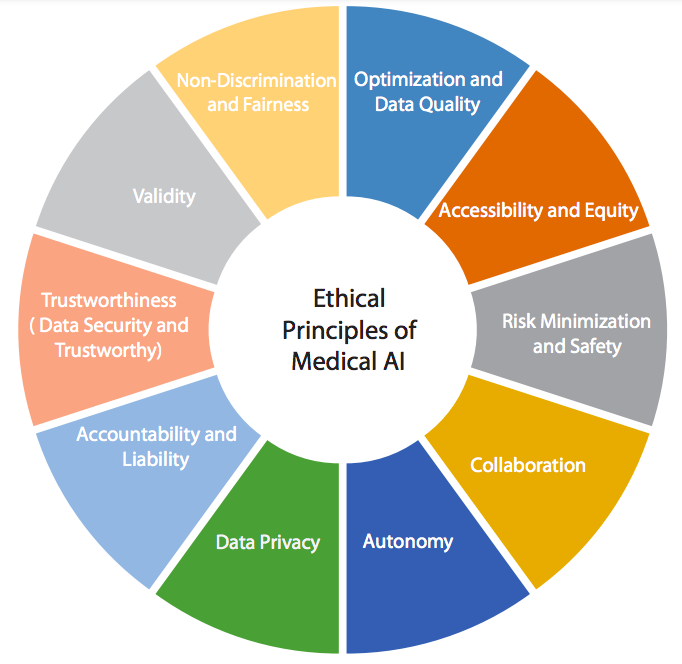
The ten ethical principles in the above figure addresses issues specific to AI for health. These principles are patient-centric and are expected to guide all the stakeholders in the development and deployment of responsible and reliable AI for health. These principles are as follows –

  1. Autonomy – The use of AI in healthcare raises concerns about the potential for the system to operate independently and compromise human autonomy. Incorporating AI into healthcare may result in machines taking over the responsibility of decision-making. It is essential that humans maintain full control over AI-based healthcare systems and medical decision-making. Under no circumstances should AI technology interfere with patient autonomy.
  1. Safety and Risk Minimization – Before widespread implementation, it is necessary to ensure that any AI technology-based system will operate safely and reliably. All stakeholders involved in the development and deployment of the technology bear the responsibility of ensuring participant safety. Patient dignity, rights, safety, and well-being must be the highest priority. Risk levels associated with deploying AI technology in clinical research or patient care depend on the use case and deployment methodology. For instance, unsupervised models run the risk of being more hazardous than those supervised by AI researchers and healthcare professionals. Similarly, the deployment of AI-enabled tools in high-risk patient care areas is riskier than their deployment in other areas.
  1. Trustworthiness – Trustworthiness is the most desirable quality of any diagnostic or prognostic tool to be used in AI healthcare. Clinicians need to build confidence in the tools that they use and the same applies to AI technologies. In order to effectively use AI, clinicians and healthcare providers need to have a simple, systematic and trustworthy way to test the validity and reliability of AI technologies.
  1. Data Privacy – AI-based technology should ensure privacy and personal data protection at all stages of development and deployment. Maintaining the trust of all the stakeholders including the recipient of healthcare over the safe and secure Ethical Guidelines for Application of Artificial Intelligence in Biomedical Research and Healthcare 19 use of their data is of prime importance to the successful and widespread deployment of AI. Data privacy must aim to prevent unauthorized access, modification, and/ or loss of personal data. The application of AI to personal data must not unreasonably curtail people’s real or perceived liberty.
  1. Accountability and Liability – The concept of accountability entails that an individual or organization is responsible for their actions and should be transparent about their activities. When it comes to AI technologies for healthcare, it is crucial that they are subject to scrutiny by relevant authorities at any given time. Regular internal and external audits must be conducted to ensure that the AI technologies are functioning effectively. The results of these audits should be made available to the public.
  1. Optimization of Data Quality – The performance of AI technology heavily relies on the data utilized for training and testing purposes, making it a data-driven technology. In the healthcare sector, the quality and size of the dataset are critical as a skewed or insufficient dataset can result in issues such as data bias, errors, and discrimination. Data bias is regarded as the most significant risk to data-driven technologies like AI in healthcare. It is crucial to exercise due diligence to ensure that the training data is unbiased and represents a substantial portion of the target population.
  1. Accessibility, Equity and Inclusiveness – The use of computers for development as well as the deployment of AI technologies in healthcare presupposes wider availability of infrastructure. The digital divide is known to exist in almost all countries and is more prominent in low- and middle-income countries (LMICs). The heavy reliance on technology may therefore interfere with the wider application of promising tools in areas where it is expected to make a greater difference. 
  1. Collaboration –  In the field of AI for health, having a large and well-curated dataset is crucial for effective utilization of AI. This can only be achieved through fostering collaboration at all levels. With the rapidly changing landscape of AI technology, it is essential to collaborate among AI experts during research and development to ensure the most appropriate techniques and algorithms are used to address healthcare issues. Collaboration between AI researchers and healthcare professionals throughout the development and adoption of AI-based solutions is expected to enhance the benefits of this promising technology.
  1. Non Discrimination and Fairness Principles: In order to refrain from biases and inaccuracies in the algorithms and ensure quality, the following principles should be followed:
    • The data set used for the training algorithm must be accurate and representative of the population in which it is used. The researcher has the responsibility to ensure data quality.
    • Inaccuracy and biases can cause suboptimal or malfunctioning of AI technologies external independent algorithmic audits and continuous end-user feedback analysis should be performed to minimize inaccuracies and biases. The AI developers/researchers must acknowledge any biases involved and should take the necessary steps to rectify it.
    • AI should never be used as a tool for exclusion. Special attention must be given to under-represented and vulnerable groups like children, ethnic minorities, persons with disabilities, etc. The AI developers should promote the active inclusion of women and minority groups.
    • Developers should give special attention to promoting and protecting the equality of individuals. Freedom, rights and dignity, should be treated with equality and justice.
    • AI technologies should be designed for universal usage. Discrimination of individuals or groups on the grounds of race, age, caste, religion, social status is unethical.
    • The reversibility of decisions made by the AI technology should be considered; if harm has occurred to any patient/ participant. Before implementing the technology, the option for reversibility of decision must be integrated with the AI design.
    • In case of any unfortunate events arise from the malfunctioning of the AI technology occurs, then there should be an appropriate redressal mechanism for the victim. The manufacturer must ensure that there is a provision for proper grievance redressal.
    • There must be a safe mechanism to raise concerns pertaining to the AI technology the issues can be technical, functional, ethical, or misuse of technology. There should be a proper mechanism for protecting the whistleblower.
  1. Validity – AI technology applied in healthcare must undergo rigorous validation in both clinical and field settings to ensure its safety and efficacy for patients or participants. Differences in datasets used for training AI algorithms can amplify the divergence of AI-based algorithms. This discordance in diagnostic abilities among different AI solutions may cause confusion for end-users, including health professionals and patients. It is essential to have an internal mechanism to monitor such issues and provide appropriate feedback to developers while considering the clinical context. An efficient feedback mechanism is also crucial for necessary updates when AI technology affects individuals or healthcare systems. The application of AI-based decisions in clinical settings can lead to potential health hazards or mismanagement.

Why transgender female athletes can’t compete in female events

Context: Transgender women have been barred from competing in the female category by World Athletics (WA), the international governing body for track and field, following a vote on Thursday. WA has followed the path of FINA, the international swimming federation, which enforced a similar ban in June last year.

What does the ban mean?

Transgender women who have experienced male puberty will not be able to compete in the female competition after March 31 this year. However, the World Athletics Council has set up a working group to conduct research “to further consider the issue of transgender inclusion”. We are not saying ‘no’ forever,” WA president Sebastian Coe said.  

The former double Olympic gold medallist in the 1,500 metres emphasised “fair and meaningful” female competition. “Decisions are always difficult when they involve conflicting needs and rights between different groups, but we continue to take the view that we must maintain fairness for female athletes above all other considerations,” Coe said.

Why have transgender women been barred?

In its ‘Eligibility Regulations for Transgender Athletes’, WA focuses on the physical advantages men have over women post-puberty. “The substantial sex difference in sports performance that emerges from puberty onwards means that the only way to achieve the objectives set out…is to maintain separate classifications (competition categories) for male and female athletes,” WA states.

The debate has raged since New Zealand weightlifter Laurel Hubbard competed in the women’s 87-kg class at the Tokyo Olympics, although she had participated in the men’s category earlier.

NCAA swimmer Lia Thomas used hormone replacement therapy and moved from the men’s category to the women’s category. She started breaking records in the IVY League competition before FINA stepped in.

What were the rules for transgender women before WA’s ban?

Under the previous rules, there was no blanket ban, but transgender women had to reduce the amount of blood testosterone to 5 nanomoles per litre (nmol/L) and maintain this level for 12 months to participate.

What had WA initially proposed?

In January, WA had come up with the ‘preferred option’ for transgender women. Instead of a complete ban, WA said it would allow transgender women to compete in the female category but would reduce the blood testosterone limit to below 2.5nmol/L for two years —cutting it down by half, and doubling the period before they become eligible to compete

So how did WA justify the change to a ban?

On Thursday, after its council meeting, WA said that the ‘preferred option’ did not have any takers. During January and February, WA said, it had consulted member federations, Global Athletics Coaches Academy, the Athletes’ Commission, the International Olympic Council, “as well as representative transgender and human rights groups”.

“It became apparent that there was little support within the sport for the option that was first presented to stakeholders,” WA said in its statement.

Which other sports have banned transgender female athletes?

The International Olympic Committee’s Framework on Fairness released in November 2021 stated that “athletes are not excluded solely based on their transgender identity or sex variations”.

But the IOC had put the onus on sports federations to put in place rules. FINA implemented a ban last year.

However, it was World Rugby in 2020 which became the first international sports federation to bar transgender women from female competition. Following this, Rugby Football League and Rugby Football Union also banned transgender women from female competition.

Last year, British Triathlon implemented a similar ban.

Have any famous sporting names weighed in?

Tennis great and gay rights activist Martina Navratilova took FINA’s side in an interview with The Australian. “It’s been such a topsy-turvy situation…with the momentum totally on the side of the transgender athletes. When it comes to sports, biology is the biggest divider… So, FINA, it’s the first big organisation that has gone all in for fairness and maybe it will try to include as many people as possible, as is fair. But fairness has to be first,” Navratilova had said.

She also criticised the IOC for leaving the decision-making on the eligibility of transgender athletes to sports federations.

Did WA also change other rules?

DSD (Differences in Sex Development) athletes — those who have genes that are generally associated with one sex but whose reproductive organs may not be atypical — will now have to keep their testosterone below 2.5 nmol/L for 24 months to participate in the female category across events.

Earlier, DSD athletes were not required to maintain a testosterone limit unless they wanted to participate in restricted events — 400 metres to a mile. For restricted events, DSD athletes had to keep their testosterone below 5 nmol/L for six months before being eligible to participate.

AFSPA removed from 3 police station limits in Nagaland

Context: According to a notification, The Ministry of Home Affairs (MHA) has further removed the Armed Forces (Special Powers) Act (AFSPA) from the jurisdiction of three police stations in Wokha and Zunheboto districts of Nagaland, while one more police station in Arunachal Pradesh has been declared as a “disturbed area” under the Act. 

The Armed Forces (Special Powers) Act, 1958

Powers to declare areas to be disturbed areas (Section 3) – If, in relation to any state or Union Territory to which this act extends, the Governor of that State or the administrator of that Union Territory or the Central Government, in either case, if of the opinion that the whole or any part of such State of Union territory, as the case may be, is in such a disturbed or dangerous condition that the use of armed forces in aid of the civil power is necessary, the Governor of that State or the Administrator of that Union Territory or the Central Government, as the case may be, may by notification in the Official Gazette, declare the whole or such part of such State or Union territory to be a disturbed area.

Application of AFSPA

  • The ASPA was first applied to the Seven Sister States of North East India, including Assam, Manipur, Tripura, Meghalaya, Arunachal Pradesh, Mizoram and Nagaland, on 1 September, 1958, to stop the North Eastern States seceding from the Indian Union. 
  • Later Punjab and Chandigarh also came within the purview of this act, which was later withdrawn in 1997. 
  • AFSPA was then applied to the state of Jammu and Kashmir in 1990 and has been in force since then.   

Special powers of the armed forces 

Any commissioned officer, warrant officer, non-commissioned officer or any other person of equivalent rank in the armed forces may, in a disturbed area:

  • For the maintenance of public order, after giving such due warning as he may consider necessary, fire upon or otherwise use force, even to the causing of death, against any person who is acting in contravention of any law or order.     
  • They can prohibit assembly of five or more persons or the carrying of weapons or of things capable of being used as weapons or of fire-arms, ammunition or explosive substances in the disturbed area. 
  • They can destroy any arms dump, prepared or fortified position or shelter or any structure used as a training camp for armed volunteers or utilised as a hide-out by armed gangs or absconders wanted for any offence.
  • Enter and search any premises without warrant and make any arrest or recover any person who are believed to be wrongfully restrained. 
  • No prosecution, suit or other legal proceeding shall be instituted, except with the previous sanction of the Central Government, against any person regarding anything done or purported to be done in exercise of the powers conferred under the Act. 

Arguments in favour of AFSPA

  • Needed to maintain morale of the force.
  • Insurgents will gain upper hand in absence of it.
  • Troops need such powers because the army is only deployed when national security is at serious risk from armed combatants.
  • Provides legal backing for the Armed Forces to act in domestic civilian areas. Currently, the armed forces act enables them to only act against enemies.

Arguments against AFSPA

  • Provision for immunity of security forces urges them to act more brutally.
  • Seen as a reason for increasing radicalization in insurgency ridden areas because of the little accountability for the excesses committed in discharge of power given by the act.
  • Instances of abuse and extra-judicial killings in Manipur have been upheld by even Supreme court in 2016. The Supreme Court in this case ruled that the armed forces cannot escape investigation for excesses during the discharge of their duty even in “disturbed areas.”
  • Though there are many violent insurrections in India which must be handled militarily but in the short run. Even after so many years, if the situation in these states has not changed, this points to some flaws in the law itself.

Checks and balances to stop misuse of AFSPA

  1. SC in 1998 on constitutionality of AFSPA: Upheld constitutional Validity of AFSPA. However, it suggested some measures that should be followed.
    • A Suo-motto declaration can be made by the Central Government; however, it is desirable that the state government should be consulted by the Central Government before making the declaration.
    • AFSPA does not confer arbitrary powers to declare an area as a 'disturbed area.
    • Declaration must be for a limited duration and there should be a periodic review of the declaration 6 months have expired.
    • While exercising the powers conferred upon him by AFSPA, the authorized officer should use minimal force necessary for effective action.
  2. Santosh hedge commission on Manipur encounter
    • FSPA was an impediment to achieving peace in regions such as J&K and the Northeast.
    • The law needs to be reviewed every six months to see whether its implementation is necessary in states where it is being enforced.
    • AFSPA does not provide blanket Immunity to the officers. Suggested fixing a period of three months for the central government to decide whether to prosecute security personnel engaged in extrajudicial killings or unruly behaviour in insurgency-hit regions.
    • Action can be taken but with prior sanction of the Central Government.
  3. BP Jeevan Reddy Commission in 2004
    • AFSPA should be repealed, and appropriate provisions should be inserted in the Unlawful Activities (Prevention) Act, 1967.
    • Unlawful Activities (UAPA) Act should be modified to clearly specify the powers of the armed forces and paramilitary forces.
    • Grievance redressal cells should be set up in each district where the armed forces are deployed.
  4. Second Administrative Reforms Commission
    • Recommended to repeal of AFSPA, 1958. Its scrapping would remove sentiments of discrimination and alienation among the people of the Northeast India.
    • Amend the Unlawful Activities (Prevention) Act, 1967 inserting a new chapter to deploy the armed forces of the Union in the North-eastern States.
    • Supported a new doctrine of policing & criminal justice inherent in an inclusive approach to governance.

Way Forward

Army must be completely transparent in investigating allegations of violations of human rights and bringing the violators to speedy justice. Exemplary punishment must be meted out where the charges are proved.   

Semiconductors Manufacturing

Context: The Union Government has disbursed around ₹1,645 crore in performance-linked incentives (PLI) for electronics manufacturers so far, as part of its efforts to bring in more of the electronics supply chain to India. More and more nations are trying to turn away from China’s dominance in the space, following geopolitical pressures to de-leverage themselves from supply chain vulnerabilities.

What are semiconductors?

A semiconductor is a material that allows electrical conductivity between a conductor and an insulator. Semiconductors are made from pure elements like silicon or germanium, or compounds such as gallium arsenide. Sometimes their conductivity is changed through doping.

In a pure semiconductor, such as silicon or germanium, there are few free electrons or holes (missing electrons) available for conduction.

However, when impurities are intentionally introduced into the semiconductor, a process called doping, the number of free electrons or holes can be increased.

They are used to make electronic devices such as transistors, diodes, and integrated circuits (ICs). Transistors, which are used to amplify and switch electronic signals, are made by combining multiple p-n junctions.

Integrated circuits (ICs) are made by creating complex arrangements of transistors and other components on a single piece of semiconductor material. Semiconductors chips are the thumbnail-sized building blocks of almost every modern electronic device from smartphones to connected devices in the Internet of Things (IoT).

Semiconductors have revolutionized the electronics industry and are essential components in nearly all electronic devices, from smartphones to computers to automobiles. Semiconductors make the devices more compact, less expensive, and more powerful.

For instance, mobile phones weighed about 2 lbs, cost around $4,000, and held a charge for only about 30 minutes of talk time during their initial phase. However today an individual can buy a smartphone for 5000 rupees that would give a 1-day charge.

Semiconductor manufacturing in India

The semiconductor chip-making process is complex and highly exact, having multiple steps in the supply chain such as designing software for chips and patenting them through core Intellectual Property (IP) rights. They help give computational power to devices. The global semiconductor industry is currently valued at $500-$600 billion.

The chip-making industry is a highly-concentrated one, with the big players being Taiwan, South Korea and the U.S. among others. In fact, according to a New York Times estimate, 90% of 5nm (nanometre) chips are mass-produced in Taiwan, by the Taiwan Semiconductor Manufacturing Company (TSMC).

Globally, the entire value chain has seeped in the interdependence between a handful of countries like the USA, Taiwan, Japan, China, and some European nations. 

  • India has done well in design and verification for the semiconductor industry. Most of the global semiconductor companies having an R&D footprint in India.
  • However, 100% of our chips, memory, and display are imported into the country, 37% coming from China.
  • Chips import bill is estimated to touch $100 billion by 2025 from $24 billion now. 
  • Although India has two fabs — SITAR, a unit of the Defence Research and Development Organisation (DRDO) in Bengaluru, and a semiconductor laboratory in Chandigarh. These build silicon chips for strategic purposes like defense and space and not for commercial use.

Why is the government encouraging semiconductor manufacturing?

  • National Security: Semiconductors are essential components in many critical industries, including defense, telecommunications, power transmission etc that have implications for national security. Chips made locally will be designated as “trusted sources” and can be used in products ranging from CCTV cameras to 5G equipment. 
  • Strategic competition with China: Countries have spotted strategic value in cornering segments of the value chain for fabs, even as the sophistication and capital needed to run them have climbed to historic highs. China pulled ahead of Taiwan last year, in terms of share of global sales from fabs, according to a report by the Semiconductor Industry Association (SIA).
    • It’s not just India that is wary of this dominance. The U.S. passed the CHIPS Act last August, providing upwards of $280 billion in subsidies and investments to manufacturers opening fabs and making semiconductors in the U.S. This has been combined with restrictions on the Chinese semiconductor industry.
  • Geopolitical Benefits:  driven by data and the digital revolution. Further self-sufficiency will decrease reliance on Chinese chip imports especially during hard times like the recent Galwan Valley border clash.
  • Economic Growth
    • Development of the semiconductor and display ecosystem will have a multiplier effect across different sectors of the economy with deeper integration to the global value chain.
    • Indigenous manufacturing of chips will build its smartphone assembly industry and strengthen its electronics supply chain. 
    • According to the Electronics and IT Ministry, semiconductor demand in India would increase to $70-$80 billion by 2026 with the growing demand for digital devices and electronic products. 
    • This will create numerous employment opportunities for the Indian youth.
    • Indigenous capacity would attract local taxes and boost the export potential. 
    • Further, India would be required to import fewer semiconductor chips which would decrease the import bill.
  • Technological Leadership: Semiconductors are the building blocks of today’s technology. Semiconductor chips are widely used in (a) Computers and laptops; (b) Phones, mobile devices and other electronic gadgets; (c) Automobiles; (d) Aviation; (e) Medical devices especially diagnostics; (f) Military equipment among others.

These semiconductor chips are the drivers for ICT (Information and Communication Technologies). Semiconductors and displays are the foundation of modern electronics driving the next phase of digital transformation under Industry 4.0.

  • Supply Chain Resilience: The COVID-19 pandemic highlighted the vulnerabilities of global supply chains, including those in the semiconductor industry. Governments are encouraging domestic semiconductor manufacturing to increase supply chain resilience and reduce dependence on foreign suppliers. The pandemic and the subsequent lockdowns impacted the supply of chips to India. Automobile manufacturers like Mahindra & Mahindra and Tata group were compelled to reduce their production due to the shortage.
  • Environmental Concerns: The semiconductor manufacturing process can be energy-intensive and can produce hazardous waste. Governments are encouraging domestic semiconductor manufacturing to promote more sustainable and environmentally friendly practices.
  • Changing work and employment pattern 
    • Experts estimate that around 50 crore people will join the internet in the next decade thereby demanding more phones and laptops. 
    • Work from home culture warrants an enhanced demand for servers, internet connectivity, and cloud usage.

Initiatives taken to promote indigenous Semiconductor capacity

  • National Policy on Electronics 2019: It envisions positioning India as a global hub for Electronics System Design and Manufacturing (ESDM) sector. It aims to encourage the development of core components, including chipsets. 
  • Scheme for Promotion of Manufacturing of Electronic Components and Semiconductors (SPECS):
    • The government will provide a financial incentive of 25% on capital expenditure for a list of products that constitute the supply chain of electronic products. This includes products such as electronic components, semiconductors, and specialized sub-assemblies.
    • India would be offering more than $1 billion in cash to each semiconductor company that sets up manufacturing units in the country.
  • Modified Electronics Manufacturing Clusters (EMC 2.0) Scheme: Under this, the government will provide support for the setting up of Electronics Manufacturing Clusters (EMCs) and Common Facility Centres(CFCs).
  • Production Linked Incentive Scheme(PLI): Under this, the government will provide an incentive of 4% to 6% on goods manufactured in India and covered under target segments to eligible companies for a period of five years.
  • Incentive to all nodes of semiconductors: The new changes have been announced to harmonise government incentives for all technology nodes of semiconductors. In the previous version of the scheme, the Centre was offering to fund 30% of the project cost for 45nm to 65nm chip production, 40% for 28nm to 45nm, and 50% or half of the funding for chips 28nm or below. The modified scheme provides uniform 50% fiscal support for all nodes. Besides, it will provide 50% of capital expenditure for other steps of the process as well (chip design and ATMP).
  • Foreign Direct Investment: The Government of India has allowed 100 percent (FDI) under the automatic route in the Electronics Systems Design & Manufacturing sector.  

What are the challenges in front of India?

  • High Cost of establishment: Fabs are highly capital-intensive undertakings, costing billions of dollars for large facilities. As per a government estimate, it would cost roughly $5-$7 billion to set up a chip fabrication unit in India.  
  • Low Ease of doing business: The process of establishing an indigenous semiconductor facility requires clearances and approvals from multiple government departments. 
  • Technological Constraint: The indigenous manufacturing of semiconductors requires the use of high-end technologies. These technologies are licensed from patent holders at a very high price.
  • Lack of Fabrication Capacities: India has a decent chip design talent but it never built up chip fab capacity. The ISRO and the DRDO have their respective fab foundries but they are primarily for their own requirements and are also not as sophisticated as the latest in the world.
  • Structural constraint: FDI in electronics is less than 1% of the total FDI inflow because of the dearth of skilled labor, delays in land acquisition, and the uncertain tax regime.
  • Unstable power supply: The smooth production of semiconductors requires the availability of an uninterrupted 24*7 power supply. they require highly reliable and high-quality supply of water, electricity, and insulation from the elements, reflecting the high degree of precision, cost and capital needed to make the sophisticated circuits.
  • Resource Inefficient Sector: Chip fabs are also very thirsty units requiring millions of litres of clean water, an extremely stable power supply, a lot of land and a highly skilled workforce.

Suggestions

  • Augmenting Research and Development Potential: For instance, IIT Madras developed a microprocessor named ‘Moushik’ with funding support from the Ministry of Electronics and Information Technology.
  • Fiscal Support for All Elements of Chip-Making Chain: Considering India’s considerable talent and experience, it may be best if the new mission focuses fiscal support, at least for now, on other parts of the chip-making chain including design centres, testing facilities, packaging, etc.
  • Establishment of Sovereign Patent Fund (SPF): The proposed Sovereign Patent Fund under National Policy on electronics should be established expeditiously. It is a wholly or partly Government-backed entity that aims to bolster domestic businesses through the acquisition and licensing of patented technology.
  • Push for Quad Supply Chain Resilience Fund: India needs to push for a Quad Supply Chain Resilience Fund to immunise the supply chain from geopolitical and geographic risks.
  • Research ecosystem: government must focus on emerging technologies like LiDAR and Phased Array in which incumbents do not have a disproportionate advantage and the entry barrier is low.
  • Focus on Manufacturers' Assurance of Domestic Procurement – The manufacturers need to be given an assurance of minimum domestic procurement by the government and the private sector. The focus should be on manufacturing economical and technically viable options like 28nm chips.
  • Support for Acquisition of Semiconductor Manufacturing Units: The government should also support businesses in the acquisition of semiconductor manufacturing units in other countries. This is easier than setting up a domestic facility and can be done swiftly for ensuring a continuous supply of chips.
  • Free-Trade Agreement Negotiations: India and Taiwan have started negotiations for a free-trade agreement and setting up a semiconductor manufacturing hub in an Indian city, signalling their resolve to further expand the two-way economic engagement.