Mains Exhaustive

A New Form of Untouchability

Context: Recently, a video, purportedly showing villagers from the Surguja district of Chhattisgarh taking an oath to implement an economic boycott of Muslims, went viral on social media. This was not a spontaneous reaction of the villagers to a brawl in the village but was allegedly orchestrated by a Hindutva outfit. The Vishva Hindu Parishad (VHP) is known to distribute pamphlets calling for the economic boycott of those it labels “anti-national, anti-Hindu, love jihadists” — all convenient epithets to convey a communal message.

Why it is a new form of Untouchability?

  • These acts are not merely ‘expressions of hate’; they can be characterised as the emergence of a new form of untouchability guided by the political imperatives of Hindutva rather than the religious dictates of Hinduism.
  • A progressive re-articulation of the concept of untouchability or a re-reading of the anti-discrimination legislation is required to end this abomination.
  • The hierarchical caste-based Hindu social order was governed by the ideology of purity and pollution. The primary function of the ideology was to maintain the ritual hierarchy.
  • Untouchability was a mechanism through which power was exercised over the Dalits and the hierarchy was reinforced.
  • One of the most common forms of untouchability was the imposition of social and economic boycotts on Dalits if they dared to transgress social norms or exercise their rights.
  • In Ambedkar’s opinion, the method of boycotting was more effective than even open violence.
  • Collective discrimination, marginalisation and disempowerment were justified as the right of the individual to choose freely in a marketplace.
  • He argued that the boycott was effective for two reasons – one, the Dalits constituted a minority within the village; and two, they were economically weaker and hence, dependent on the ‘upper’ castes. Therefore, it was of paramount importance to outlaw this ‘tyranny of the majority’ for their uplift.

Limits of anti-boycott laws

  • During the freedom struggle, the struggle to eradicate untouchability gained momentum. This struggle found its highest expression in the fundamental rights enshrined in the Constitution under Articles 14, 15 and 17. However, although untouchability was abolished, its definition remained vague.
  • Even during the Constituent Assembly debates, it was argued that the scope of untouchability should be restricted to practices related to religion and caste, lest it be left open to unwarranted tinkering; however, the Assembly voted against such a circumscribed definition.
  • Therefore, the limits of untouchability under Article 17 have been contested.
  • While the conservatives restrict it to caste-based discrimination, the progressives argue that it includes other forms of untouchability as well.
  • However, there is a consensus that only those acts which are motivated by the ideology of purity and pollution are considered within the ambit of untouchability. These include social and economic boycotts.
  • In India, mere provision of rights has proved to be insufficient to prevent marginalisation owing to the practice of untouchability. Hence, the legislature and the judiciary have had to make and interpret special laws to that effect.
  • Two laws that explicitly make social and economic boycotts punishable are The Scheduled Castes and the Scheduled Tribes (Prevention of Atrocities) Act, 1989, and the Maharashtra Protection of People from Social Boycott (Prevention, Prohibition and Redressal) Act, 2016.
  • However, the scope of both is restricted to criminalising caste-based discrimination and boycotts.
  • The tethering of anti-boycott or untouchability laws to the tenets of purity and pollution and restricting their scope to caste-centric boycotts make them ineffective in countering the calls for the economic boycott of Muslims.
  • Hindutva is using pre-constitutional methods to disempower a community.
  • It is not driven by the motive of maintaining ritual hierarchy but by the political imperatives of exclusion. Its ultimate objective is to ethnicise the Hindu identity. Such public calls for boycotts are a means of constructing such an identity.
  • The act of collectively resolving to boycott Muslims reinforces their ‘othering’ and re-emphasises the VHP’s idea of ‘Hinduness’; reconstituting Hinduism, based on caste hierarchy, into a unified, ethnic whole, where the figure of the Dalit is replaced by the Muslim as the significant ‘other’.

Way forward

  • These grave new developments need to be taken into cognisance and an urgent politico-legal response to such public calls for a Muslim economic boycott is required as they militate against the principle of fraternity enshrined in the Constitution.
  • This can be done by a progressive redefinition of untouchability or by expanding the scope of the anti-boycott laws to include discrimination against religious communities.
  • Other than these legal measures there is an urgent need to ensure socio-economic upliftment of the Muslim community.
  • Civil society should come forward to raise voices against such boycott calls.
The Mines and Minerals (Development and Regulation) Amendment Bill, 2023

Context: India’s Parliament passed a law allowing the government to auction and mine its newly  discovered reserves of lithium, among other minerals, increasing the mining of the critical input for EV batteries. 

The Mines and Minerals (Development and Regulation) Amendment Bill, 2023 amends the Mines and Minerals (Development and Regulation) Act, 1957.  

  • The Act regulates the mining sector.  For regulation, the Act classifies mining-related activities into: 
  1. reconnaissance, which involves a preliminary survey to determine mineral resources.
  2. prospecting, which includes exploring, locating, or proving mineral deposits.
  3. mining, the commercial activity of extraction of minerals.

Key features of the amendment bill:

  1. Private sector involvement - It seeks grant of exploration licence to private sector players for deep-seated and critical minerals. 
  2. Reconnaissance to include sub-surface activities:  The Act defines reconnaissance operations as operations undertaken for preliminary prospecting and includes: (i) aerial surveys, (ii) geophysical, and (iii) geochemical surveys.  It also includes geological mapping.  The Act prohibits pitting, trenching, drilling, and sub-surface excavation as part of reconnaissance.  The Bill allows these prohibited activities.
  3. Exploration licence for specified minerals:  The Act provides for following types of concessions:

(i) a reconnaissance permit for reconnaissance, 

(ii) a prospecting licence for prospecting, 

(iii) mining lease for undertaking mining, and 

(iv) a composite licence, for prospecting and mining.  

The Bill introduces an exploration licence, which will be issued for 29 minerals specified in the Seventh Schedule.  

These include gold, silver, copper, cobalt, nickel, lead, potash, and rock phosphate.  

These also include six minerals classified as atomic minerals under the Act:

(i) beryl and beryllium, (ii) lithium, (iii) niobium, (iv) titanium, (v) tantallium, and (vi) zirconium.  

The Bill declassifies them as atomic minerals.  Unlike other minerals, the prospecting and mining of atomic minerals is reserved for government entities under the Act.

  1. Exclusive auction mining lease to centre - It empowers the central government to exclusively auction mining lease and composite licence for certain critical minerals.
  2. Time limits - Blocks explored by the exploration licence holder would be auctioned for mining lease within a prescribed timeline.

Merits:

  • Rationalization of minerals - Many of the minerals listed as atomic minerals have numerous non-atomic applications in space industry, electronics, technology and communications, energy sector, electric batteries etc. In most cases, the non-atomic uses of these minerals far outweigh their atomic use. Many such minerals are not fissile or radioactive in nature. 
  • Reduced financial burden on government - Deep-seated minerals such as gold, silver, copper, zinc, lead, nickel, cobalt, platinum group of minerals, and diamonds are difficult and expensive to explore and mine hence involving them may reduce the financial burden on government.
  • Geopolitical advantage – It may reduce the dependence of India over the imports of such minerals thereby reducing the relative geopolitical vulnerabilities.
  • Increase in efficiency - Only 19 blocks of minerals have been auctioned so far by the State Government viz. graphite, nickel and phosphate out of 107 blocks handed over to the various State Governments. As these critical minerals are vital for the growth of our economy, authorizing the Central Government to auction concession for these critical minerals would increase the pace of auction and early production of the minerals.
  • Innovation in mining - Private participation will improve the scope of mining and innovation in this sector. 
  • Improving revenue to states - Timebound auctioning will help state to have better revenues.
  • Boost to manufacturing- Reducing the government monopoly will eventually bring competition in this sector boosting the mining of such minerals which are very critical when it comes to E.V manufacturing, chip industries etc. 

Issues involved :

  1. Private participation may lead to misuse, irresponsible and excessive mining. This can have several detrimental socio-environmental implications.
  2. Already stressed Public sector undertakings may further take the backseat. 
  3. Issue of federalism because of exclusive right to centre to auction mining lease.
  4. The Bill also dispenses with cumbersome forest clearances for mine reconnaissance and prospecting operations. This may affect the ecology of the concerned region. 

Climate finance adds another layer of inequity to climate change

Context: In the last few years, climate Justice activists have been campaigning for the world’s economically developed countries to raise their investments in climate adaptation and mitigation, including paying for other countries’ abilities to deal with the effects of climate change

Background:

According to the United Nations Framework Convention on Climate Change (UNFCCC) Standing Committee on Finance, climate finance is "finance that aims at reducing emissions and improving greenhouse gas sinks, as well as reducing vulnerability of, and maintaining and increasing the resilience of, human and ecological systems to negative climate change impacts."

The term has been used in a narrow sense to refer to transfers of public resources from developed to developing countries, considering their UN Climate Convention obligations to provide "new and additional financial resources", and in a wider sense to refer to all financial flows relating to climate change mitigation and adaptation.

UNFCCC, Kyoto Protocol and Paris Agreement call for financial assistance. In accordance with the principle of “common but differentiated responsibility and respective capabilities” set out in the Convention, developed country Parties are to provide financial resources to assist developing country Parties in implementing the objectives of the UNFCCC. The Convention has created Financial Mechanisms to offer cash to developing nation Parties to help with this. 

  • Since the Convention's entrance into force in 1994, the Global Environment Facility (GEF) has acted as the financial mechanism's operating institution. 
  • Copenhagen Accord: Parties agreed for a "goal" for the world to raise $100 billion per year by 2020, from "a wide variety of sources", to help developing countries cut carbon emissions (mitigation). 
  • COP 16 (2010): Parties established the Green Climate Fund (GCF) and in 2011 (COP 17) also designated it as an operating entity of the financial mechanism. 
  • Establishment of special funds: Special Climate Change Fund (SCCF), the Least Developed Countries Fund (LDCF), both managed by the GEF; and the Adaptation Fund (AF) under the Kyoto Protocol in 2001. 

Performance till Date:

  • According to UNFCCC standing committee report, the $100b targets have not been met yet. 
  • Even the effort to move finances through private players have also met with comprehensive failure. 
  • There is a huge variation in estimates. For eg- OECD reports that around $83b have been moved but Oxfam claims it to be just around $21 b - $24b
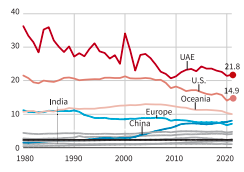
A graph showing the global economy

Description automatically generated with medium confidenceChart shows the carbon dioxide emissions per capita emitted in 1980­2021 by various geographical Regions. It also shows (as a fixed black line) a baseline target of carbon dioxide emissions (2.3 tonnes per capita) needed to limit global warming to 1.5° Celsius. The global average emissions per capita is currently double this target, and has stayed above 4.7 tonnes per capita since 2010, whereas Africa and India have both been consistently under. China crossed the global average in 2004.
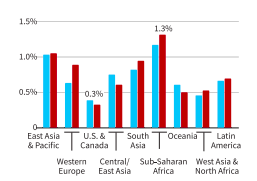
A graph of different colored bars

Description automatically generated with medium confidenceIt shows the total investment in climate ­related activities as a fraction of that region’s total GDP in 2019 and 2020. This includespublic and private investment. In both years, Sub ­ Saharan Africa had the highest investment fraction in climate finance (1.3% ofits GDP), followed by East Asia and the Pacific (1%) and South Asia (0.9%). The U.S. and Canada had the lowest proportionate investment, at only 0.3% of their GDP.
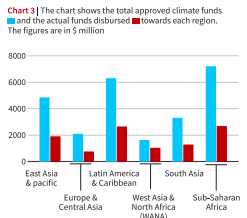
A graph of different colored bars

Description automatically generated with medium confidenceIt shows the total approved funds and theactual funds disbursed towards each region. Since 2003, for example, $3.3 billion was approved to be disbursed to South Asia, but only $1.3 billion was actually disbursed. Most regions received only 40% of the approved funding for that region, on average.

CHALLENGES IN CLIMATE FINANCE 

  • Definitions & reporting of climate finance: Even 10 years after COP 15, there is no general agreement on what form of funding can be counted as climate finance under the GCF in support of the Copenhagen pledge. Even 7 years after the Paris Climate Deal, there is no agreement regarding definition of climate finance. 
  • Insufficient Amounts: For instance, global annual fossil fuel subsidies together with their externalities cost about $5.3 trillion. Experts have suggested that even $100b/year pledge is not sufficient to tackle the issue. 
  • Climate Finance Governance: Equally challenging is how international climate change funding should be effectively governed and delivered to developing countries. 
  • Reporting and Verification: Currently there is a lack of mandatory verification mechanism in reporting. Reporting requirements around the projected financing provisions remain weak. 

Conclusion

Countries in Sub ­ Saharan Africa, Latin America, and South Asia have historically contributed the least to global warming; yet, they are bearing the bigger brunt of climate disasters – both in the form of extreme natural phenomena and debt distress. On the other hand, countries in North America and Europe have contributed and continue to contribute the most, and are also the creditors of the debt crisis.

Forest Conservation Amendment Bill 2023

Context: Lok Sabha has passed the Forest Conservation (Amendment) Bill without any changes from the first version introduced on March 29. The contentious Bill was introduced to amend the Forest Conservation Act, 1980.

What is Forest conservation amendment bill 2023?

  • The Bill amends the Forest (Conservation) Act, 1980 to make it applicable to certain types of land. These include land notified as a forest under the Indian Forest Act, 1927 or in government records after 
  • the 1980 Act came into effect.  The Act will not be applicable for land converted to non-forest use before December 12, 1996.

Forest Conservation Act 1980 is a unique piece of legislation and regulatory mechanism that reflects the collective will of the nation to protect its rich forests, biodiversity and natural heritage and resources. The act permits only unavoidable use of forest land for various development purposes. It embodies the firm commitment of the Government and the Department to balance the conservation of forests with the sustainable developmental need of the society contributing to better environment, health and economy. This act is regulatory in nature and not prohibitory.

Key features of the bill:

  • Exemptions - It exempts certain types of land, for e.g. land within 100 km of India’s border needed for national security projects, small roadside amenities, and public roads leading to a habitation.
  • Approval from centre - The state government requires prior approval of the central
    government to assign any forest land to a private entity.  The Bill extends this to all entities, and allows the assignment to be made on terms and conditions specified by the central government.
  • Activities in forests - The Act specifies some activities that can be carried out in forests, such as establishing check posts, fencing, and bridges.  The Bill also allows running zoos, safaris and eco-tourism facilities.
  • Power to issue directions:  The Bill adds that the central government may issue directions for the implementation of the Act to any authority/organisation under or recognised by the centre, state, or union territory (UT).

Key Issues and Analysis:

  • The Bill excludes two categories of land from the purview of the Act: land recorded as forest before October 25, 1980 but not notified as a forest, and land which changed from forest-use to non-forest-use before December 12, 1996.  This provision may go against a 1996 Supreme Court judgement on preventing deforestation.
  • Exempting land near border areas for national security projects may adversely impact the forest cover and wildlife in north-eastern states. 
  • A blanket exemption for projects like zoos may adversely affect forest land and wildlife. The Supreme Court (2023) has remarked that they do not appreciate the necessity of having a zoo inside tiger reserves or national parks.
  • Activities like silvicultural operations, safaris, and eco-tourism facilities may help in economic development, and may even contribute to national priorities such as energy security and industrial growth.  However, there may be a need to balance economic benefits of such activities with that of conserving forests.  It is not clear why the requirement of a case-by-case examination by the central government to determine such balance is being replaced by a blanket exemption.

Gurjara Pratihara Dynasty

Context: Following the unveiling of the statue of 9th-century king Mihir Bhoja as 'Gurjar Pratihar Samrat Mihir Bhoja' by district party leaders, leaders in Haryana's Kaithal expressed their protest by offering to resign. The controversy surrounding Mihir Bhoja's lineage has arisen before in Bihar and Uttar Pradesh, with both Gurjaras and Rajputs laying claim to his belonging in their respective communities.

Gurjara Pratihara Dynasty

About Mihir Bhoja 

  • Mihir Bhoja (836 to 885 CE), was a highly successful and ambitious ruler in ninth-century India. At that time, the Gurjara-Pratiharas held dominion over a vast empire, stretching from Kashmir to Gujarat.
  • Mihir Bhoj ascended to power after succeeding his father, Ramabhadra. He also expanded his influence by conquering regions in the Deccan and Malwa.
  • Tripartite Struggle:
    • During the ninth century, a major political struggle centered around gaining control of Kannauj, as it was believed that whoever ruled there would become the emperor of the country.
    • This led to a tripartite conflict among the powerful entities of the time—the Gurjara-Pratihara, the Rashtrakutas of Deccan, and the Palas of Bengal. Among them, Mihir Bhoj emerged as the most successful.
    • He secured territories of Gujarat and Malwa from the Gujarat-Rashtrakutas and further expanded his realm by conquering areas of Gorakhpur from the Palas of Bengal.
  • He was a devout follower of Vishnu and used the title of Adivaraha, which was inscribed on some of his coins.
  • His rule spanned a vast territory, from the foothills of the Himalayas to the Narmada River, which included the present district of Etawah in Uttar Pradesh. Kannauj, which served as his capital during his reign, was known as Panchala. 
  • Mihir Bhoja was a staunch adversary of the Arab invaders and maintained a formidable army, particularly renowned for its skilled cavalry. Following his rule, his son Mahendrapala I succeeded him.
  • Lineage:
    • Originally, the Gurjars were a nomadic tribe in ancient India, initially spread across the regions of Rajasthan and Gujarat, and it is believed that Mihir Bhoja belonged to this tribe.
    • However, historical records also suggest that he asserted Kshatriya status for himself. It was a common practice in ancient India for kings to claim Kshatriya lineage, as it was considered that only a Kshatriya (warrior) could rightfully ascend to the throne. 
    • The controversy surrounding the castes of ancient rulers in recent times is primarily a product of modern-day politics and does not have any direct bearing on historical accuracy.
    • It is essential to approach these historical accounts with a critical perspective, considering the societal context and the evolution of social identities over time.

Military Career

  • Mihira Bhoja first consolidated his territories by crushing the rebellious feudatories in Rajasthan, before turning his attention against the old enemies the Palas and Rastrakutas.
  • He invaded the Pala Empire of Bengal but was defeated by Devapala. He then launched a campaign to conquer the territories to the south of his empire and was successful, thus Malwa, Deccan, and Gujarat were conquered.
  • The Pratiharas were defeated in a large battle in Ujjain by Rastrakutas of Gujarat however, retribution followed on the part of the Pratiharas, and by the end of his reign, Bhoja had successfully destroyed the Gujarat Rashtrakuta dynasty.
  • Bhoja's feudatory, the‌ Guhilas chief named Harsha of Chatsu, is described as defeating the northern rulers with the help of the mighty elephant force, and loyally presenting to Bhoja the special ‘Shrivamsha’ breed of horses, which could easily cross seas of sand.
  • Besides being a conqueror, Bhoja was a great diplomat. The Kingdoms which were conquered and acknowledged his suzerainty include Travani, Valla, Mada, Arya, Gujaratra, Lata Parvarta, and Chandelas of Bundelkhand.
  • Bhoja's Daulatpura-Dausa Inscription, confirms his rule in the Dausa region. Another inscription states that ‘Bhoja's territories extended to the east of the Sutlej River.’
  • Kalhana's Rajatarangini states that the territories of Bhoja extended to Kashmir in the north, and Bhoja conquered Punjab by defeating the ruling ‘Thakkiyaka’ dynasty.
Coins of Mihira Bhoja 

Coins of Mihira Bhoja 

  • Mihira Bhoja was commonly known by the epithet ‘Srimad-Adivaraha’, which refers to the fortunate primeval boar incarnation of Vishnu.
  • These coins feature a depiction of Adivaraha on the obverse side, where the God holds a solar wheel with spokes in his right hand, while in his left hand, there are other emblems such as a mace, lotus flower, and conch shell.
  • Additionally, under the feet of God, there is likely a two-headed serpent. According to Alexander Cunningham, these types of coins are found in both silver and copper.
  • It is believed that copper coins were originally coated with silver to circulate as silver coins. The presence of Adivaraha coins was noted by Thakkar Pheru in the 13th-century text ‘Dravya-Pariksha,’ who served as a mint master under Alauddin Khilji.

Gurjara-Pratihara Empire

  • The Gurjara-Pratiharas, also known simply as the Pratiharas, ruled over western and northern India from the 8th century CE to the 11th century CE.
  • This dynasty witnessed a significant rise in its fortunes under the rule of Nagabhata I (730–760 CE), who successfully repelled Arab invaders.
  • The Pratiharas were particularly known for their generous patronage of art, sculpture, and temple construction.

NITI Aayog report says 13.5-cr. people lifted out of multidimensional poverty

Context: India has registered a significant decline of 9.89 percentage points in the number of multidimensionally poor, from 24.85% in 2015-16 to 14.96% in 2019-2021, says the “National multidimensional poverty index: a progress review, 2023”, released by NITI Aayog recently.

Findings of the report

oZcB Q4uoabZhnPMATWmvRO40HyYXPWZyZz6XK2XnS ZjdZvBzQ5zTE E IzS eEJtd5xI96rnHpcAzcC5baa49DrHPKrLn0tVrTpHiwp3fcD6uvVzZl9l q9lvztg6YV5VyYrQ4AKY3M40n92utHEE
  • The study says nearly 13.5 crore people came out of multidimensional poverty during the period, assessed by identifying “acute deprivations in health, education and standard of living” using United Nations-approved parameters.
  • The report said rural areas witnessed the fastest decline in poverty from 32.59% to 19.28%, mainly due to a decrease in the number of multi-dimensionally poor in States such as Bihar, Uttar Pradesh, Madhya Pradesh, Odisha, and Rajasthan.
  • Delhi, Kerala, Goa, and Tamil Nadu have the least number of people facing multidimensional poverty, along with the Union Territories.
  • Bihar, Jharkhand, Meghalaya, Uttar Pradesh, and Madhya Pradesh top the chart where the percentage of the population which is multidimensionally poor is high.
  • Multidimensional poverty in urban areas, during the same period, saw a decrease from 8.65% to 5.27%.
  • Uttar Pradesh registered the largest decline in the number of poor with 3.43 crore people escaping multidimensional poverty.

About National Multidimensional Poverty Index (MPI)

  • The report has been prepared based on the latest National Family Heath Survey of 2019-21 and is the second edition of the National Multidimensional Poverty Index (MPI).
  • The broad methodology followed is in consonance with the global methodology.
  • It said 12 parameters of health, education, and standard of living are examined in the report.

How the Performance Grading Index assesses states in school education

Context: The Education Ministry released Sunday's latest Performance Grading Index (PGI) edition. This relatively new index measures the performance of states in school education.

How is PGI worked out?

  • It assesses states’ performance in school education based on data drawn from several sources, including the Unified District Information System for Education Plus, National Achievement Survey, and Mid-Day Meal.
  • States are scored on a total of 1,000 points across 70 parameters, which are grouped under five broad categories:
  1. Access (e.g. enrolment ratio, transition rate and retention rate);
  2. Governance and management;
  3. Infrastructure;
  4. Equity (difference in performance between scheduled caste students and general category students) and
  5. Learning outcomes (average score in mathematics, science, languages and social science).
  • States are graded and not ranked to discourage the practice of one improving only at the cost of others, “thereby casting a stigma of underperformance on the latter”.
  • According to the government, the objective is to help the states prioritise areas for intervention in school education.
  • The Education Ministry released the first PGI in 2019 for the reference year 2017-18.

What does the grading system reflect?

  • The PGI grading system has 10 levels.
  • Level 1 indicates top-notch performance and a score between 951 and 1,000 points.
  • Level II, or Grade 1++, indicates a score between 901 and 950.
  • Those with Grade 1+ (or Level III) have scored between 851 and 900.
  • The lowest is Grade VII, which means a score between 0 and 550 points.
PGI report card 2019-20

How have states performed this time?

  • In PGI 2019-20, no state or Union Territory could achieve the highest grade, that is Level I.
  • Even in the 2017-18 and 2018-19 editions, no state had reached Level 1 and Grade 1++.
  • Chandigarh, Punjab, Tamil Nadu, Andaman, Nicobar, and Kerala scored more than 90% and obtained Grade 1++ (or Level II), making them the best-performing states.
  • This is the first time that any state has reached Level II.
  • The top-performing states of Gujarat, Chandigarh, and Kerala in 2018-19 were given Grade 1+ (or Level III), which is a score between 851 and 900 points.
  • Only the UT of Ladakh has been placed in the lowest grade, Grade VII, but that’s because it was the first time it was assessed after it was carved out of Jammu and Kashmir in 2019.

What are the areas where the states still have to improve?

  • According to the report, states and UTs mainly need to improve their performance in terms of governance processes.
  • This domain carries several parameters, including teacher availability, teachers’ training, regular inspection, and availability of finances.
  • In the domain of Governance Processes, there are 24 States/UTs which have scored less than 288 (80% of the maximum possible score). It implies that this is the area many States and UTs must focus on.
  • The PGI too accords the highest importance to this Domain because compliance with the indicators here will lead to critical structural reforms in areas ranging from monitoring the attendance of teachers to ensuring transparent recruitment of teachers and principals.
  • The second area that requires attention is the Domain for Infrastructure and Facilities, where twenty States/UTs have scored less than 120 (80% of the maximum possible score in this domain).
  • Two States, Bihar (81) and Meghalaya (87) recorded the lowest scores in this domain.
  • This is a cause for concern as a proper school building with adequate facilities is a must to improve the overall quality of school education.

India and Shanghai Cooperation Organisation

Context: Prime Minister Narendra Modi hosted the Shanghai Cooperation Organisation Council of Heads of State meeting, marking India's inaugural chairmanship of the summit.

Rationale behind India's SCO Membership

  • India joined the SCO in 2017, emphasizing the group's significance as its member countries collectively contribute to a substantial portion of global GDP, trade, oil reserves, and natural gas reserves.
  • The SCO's focus on regional security and connectivity aligns with India's growth priorities and addresses challenges such as terrorism in Pakistan and Chinese aggressions, including the Belt and Road Initiative.

Importance of Inclusion within the SCO

India's membership in the SCO provides it with a platform for engagement, especially considering Pakistan's membership. Joint exercises under the SCO Regional Anti-Terrorist Structure are conducted, and India gains access to Central Asian markets and resources.

  • SCO Membership and India's Strategic Ambitions: 
    • Joining the SCO aligns with India's goals of "multi-alignment" and "strategic autonomy," positioning itself as a balancing power in the global arena. India's simultaneous entry into the revived Quad with the United States, Japan, and Australia in 2017 reflects its strategic intent.
  • Economic Necessity and Neutrality on Ukraine Conflict:
    • India's decision -to remain neutral in the Ukraine conflict has made its engagement with the SCO economically essential, benefiting from fuel and fertilizer purchases from Russia.
  • Expectations for India's Chairmanship of the SCO Summit: 
    • India's turn to chair the SCO summit was anticipated to be a significant event, potentially revitalising the importance of the G-20 meeting. Given Russia and China's obstruction of the G-20 joint communiqué, India saw the SCO summit as an opportunity for Prime Minister Modi to negotiate resolutions with his counterparts.
  • Economic Cooperation and Energy Security:
    • The SCO provides a platform for India to enhance economic cooperation with resource-rich Central Asian countries. India aims to diversify its economic partnerships and tap into Central Asia's oil and gas reserves for energy security.
  • Cultural Cooperation and Tourism:
    • India benefits from cultural cooperation within the SCO, with initiatives such as designating Varanasi as the first cultural capital. The organization's cultural heritage includes numerous UNESCO World Heritage Sites.
  • Counterterrorism Efforts:
    • India, as a victim of terrorism, can benefit from the SCO's focus on counterterrorism cooperation. The organization's collective efforts can help combat terrorism in the region, providing security benefits for India.
  • Significance of Iran's Induction: Iran has been an observer in the SCO since 2005, and almost after 15 years, its bid for full and permanent membership in the organisation was approved at the 2021 Summit in Dushanbe. A formal Memorandum of Understanding (MoU) with Iran was signed last year at the 2022 Summit held at Samarkand, Uzbekistan. 
    • The SCO's recent focus has shifted towards regional connectivity, making Iran's induction crucial.
    • India, with its connectivity strategy through Iran's Chabahar port and the International North South Transport Corridor, sees Iran's inclusion as a significant milestone.
    • Iran's presence supports India's efforts to bypass land-based trade through Pakistan, which has impeded transit trade for India. 
    • The potential for double land-locked Central Asian states (Uzbekistan and Iran) to establish a multimodal trade route via Afghanistan to ports in Pakistan and Iran.
    • Moreover, Iran's inclusion allows India to engage in regional trade while avoiding China's Belt and Road Initiative.
    • Additionally, Iran's historical partnership with India and its shared struggle against terrorism originating from Pakistan and Afghanistan strengthens India's stance against terror safe havens.

Diminishing Returns and Challenges for India

With the conclusion of India's chairpersonship of the SCO, the government may be experiencing the law of diminishing returns regarding its engagement with the organization. This situation could potentially complicate India's task of hosting the G-20 meeting.

  • Limited Consensus and Unendorsed Agreements
    • While the SCO members achieved consensus on the New Delhi declaration and joint statements on radicalization and digital transformation, India, as the Chair, was unable to forge agreement on other matters.
    • These included formalizing English as an SCO language and endorsing a road map on economic cooperation, likely due to concerns about China's influence.
  • Membership and Conflicts Among Member Countries
    • There are conflicts between member countries, including the border issues between India and China, state-sponsored terrorism causing tensions between India and Pakistan, border issues between Kyrgyzstan and Tajikistan, and instability in the border area between Taliban-led Afghanistan and Pakistan.
  • China's Rise and External Pressures
    • China's increasing influence in inner Asia has led to external pressures from regional powers, such as the United States, seeking to contain China's rise. This puts additional pressure on the SCO.
  • Limited Institutional Mechanisms and Divergent Interests:
    • The SCO lacks formal decision-making and enforcement powers, limiting its governance effectiveness. Member states with different political systems, economic models, and strategic priorities can lead to internal conflicts and disagreements.
  • Geographical Scope and Western Criticism:
    • The SCO's focus on Eurasia and neighbouring regions restricts its ability to engage with global issues. Western countries criticize the organization for its lack of democratic credentials, support for authoritarian regimes, and internal conflicts.
  • Challenges with the induction of Iran for India: While Iran's induction into the SCO aligns with India's interests, there are potential challenges. 
    • The SCO is increasingly seen as an "anti-West" forum, and both Iran and Russia face severe sanctions.
    • The US has accused Iran of supplying weapons to Russia, further contributing to this perception.
    • The expected inclusion of Belarus next year will reinforce the SCO's image, contrasting with India's strengthening ties with the Quad.
    • This situation presents a delicate balancing act for India in managing its relationships.

Way forward

  • Enhancing Connectivity with Central Asia:
    • India should focus on improving connectivity with Central Asia by utilizing the Chabahar port and becoming a part of the Ashgabat agreement. This will help strengthen India's presence in Eurasia.
    • Additionally, emphasis should be placed on utilizing the International North-South Corridor (INSTC) for enhanced regional connectivity.
    • This can be used to enhance relations with Pakistan and persuade them to remove obstacles blocking India's access to Eurasia. It is important to prioritize initiatives that facilitate cooperation, such as infrastructure projects.
  • Peaceful Coexistence of India and China: For the Asian century to be truly realized, India and China must coexist peacefully. Both nations should work towards maintaining harmonious relations and fostering cooperation for mutual benefit.
  • Strengthening the Fight against Terrorism: Efforts should be made to enhance the effectiveness of the Regional Anti-Terrorist Structure, enabling better collaboration in combating terrorism.

Iran to Join Shanghai Cooperation Organisation

Context: The recent virtual summit of the Shanghai Cooperation Organisation (SCO) witnessed the announcement of a "more representative" and multipolar world order. This article highlights the key agreements signed at the summit, India's stance on certain issues, and the cooperative efforts of SCO member states.

Key Points:

  • Iran's Induction: SCO welcomed Iran as its ninth member, signifying its commitment to inclusivity and expanding its regional influence.
  • India's Dissent: India abstained from endorsing paragraphs related to China's Belt and Road Initiative (BRI) in the joint statement, indicating a lack of consensus within the grouping. India also expressed concerns over cross-border terrorism by Pakistan and China's connectivity projects that infringe on sovereign boundaries.
  • New Delhi Declaration: The summit witnessed the signing of the New Delhi Declaration, which outlines areas of cooperation among SCO member countries.
    • Opposition to Militarization of ICTs: SCO member states collectively oppose the militarization of information and communication technologies, emphasizing the need for universal rules and responsible behaviour in this domain.
    • Criticism of Non-UN Sanctions: The SCO members voiced their disapproval of non-UN sanctions, deeming them incompatible with international law and detrimental to other countries.
    • Exploration of National Currencies: SCO member countries agreed to explore the use of national currencies for intra-group payments, aiming to reduce dependence on international dollar-based transactions.
    • Commitment to Peace and Cooperation: SCO member states reaffirmed their commitment to peace, joint development, and equal relations based on mutual respect, friendship, and good neighbourliness.
    • Combating Illicit Drug Trafficking: The countries agreed to continue implementing the SCO Anti-Drug Strategy and conduct joint anti-drug operations regularly.
    • Environmental Protection and Climate Change: Member states recognized the importance of cooperation in environmental protection, ecological security, and mitigating the consequences of climate change.
    • Strengthening the WTO: SCO member states emphasized the need for a more effective World Trade Organization (WTO) as a platform for discussing the international trade agenda and adopting multilateral trading regulations.
    • Multilateral Arms Control: The member states emphasized the use of political and diplomatic means to address global and regional security challenges, actively promoting multilateral arms control, disarmament, and non-proliferation processes.

Neolithic-era celt found in Tamil Nadu

Context: In Poothinatham village, Tamil Nadu, the Department of Archaeology made a noteworthy discovery from the Neolithic period. This find is an ancient celt, crafted from Doloraid stone, which had a dual purpose as both a plough and an axe. This discovery holds great significance in shedding light on the practices and tools used during that time.

Neolithic-era celt found in Tamil Nadu

What is a Neolithic celt?

  • A celt, composed of stone, is an age-old instrument utilized for cutting and shaping. This adaptable tool served as an axe, chisel, or adze, 
  • Application: Widespread uses throughout the Neolithic era in different fields such as woodworking, agriculture, and building.
  • A specific variation of the celt, referred to as a shoe-last celt, was a polished stone tool extensively employed during the early European Neolithic period. Its primary purpose revolved around the felling of trees and engaging in woodworking tasks.
neolithic cultures

Early Neolithic Cultures and the Beginning of Agriculture

  • The advent of agriculture and animal domestication during the Neolithic period marked a significant phase in Indian history. 
  • The crucial era witnessed the emergence of Neolithic culture in various regions such as the Fertile Crescent in Egypt and Mesopotamia, the Indus region, the Ganges Valley in India, and China.
  • Surplus food production: 
    • Between 10,000 BCE and 5000 BCE, agriculture sprouted in these areas, leading to numerous cultural advancements.
    • The domestication of animals and plants introduced a plentiful supply of grains and animal food.
    • The fertile soil deposited by rivers contributed to agricultural growth, resulting in surplus grain production.
    • The surplus food production played a pivotal role in the rise of early civilizations, as large villages were established, pottery developed, and permanent residences were constructed.
    • Consequently, the cultural advancements of this era are commonly referred to as the Neolithic revolution. 

The Neolithic Culture of North-Western India 

  • The earliest evidence of plant and animal domestication in India can be traced back to the Neolithic culture in northwestern India.
  • Important Sites: Mehrgarh and Sarai Kala, which are presently located in Pakistan. 
  • Mehrgarh:
    • It has provided evidence of early Neolithic practices dating back to around 7000 BCE. 
    • During this time, the cultivation of wheat and barley was practiced, and sheep, goats, and cattle were domesticated. Mehrgar culture predates the Indus Civilization.
    • Phase I: The first cultural period of the Neolithic age at Mehrgarh spans from approximately 7000 to 5500 BCE. The people of this period did not employ pottery, but they cultivated six-row barley, wheat, and dates. These were semi-nomadic pastoral groups who constructed houses using mud and practiced the burial of the deceased.
    • Phase II and III: The second period at Mehrgarh covers the time from about 5500 to 4800 BCE followed by the third period from 4800 to 3500 BCE. Pottery evidence is present during these periods, and terracotta figurines and glazed faience beads have been discovered. Long-distance trade was practiced, as indicated by the presence of Lapis Lazuli, a stone that is exclusively found in Badakshan. The abandonment of the town occurred after the rise of the mature phase of the Indus Civilization.
Excavation at Mehrgarh

Significance of Mehrgarh

  • Mehrgarh stands out as an important site due to its provision of the earliest and most extensive evidence of cattle, sheep, goat, wheat, and barley domestication, a comprehensive combination of evidence unmatched elsewhere in the world.
  • Dentistry:
    • In addition to agricultural and domestication practices, the inhabitants of Mehrgarh demonstrated knowledge of medicinal herbs and their use for health maintenance, an essential survival skill since prehistoric times.
    • During the Neolithic period, people began consuming ground grain and cooked food, which gave rise to dental and other health issues.
    • Notably, the earliest evidence of drilling a human tooth (belonging to a living person) has been discovered at Mehrgarh, offering a glimpse into early dental practices, which can be considered a precursor to dentistry.

Neolithic Culture of South India 

  • The Neolithic cultures of South India primarily existed in Andhra Pradesh and Karnataka, as well as the north-western part of Tamil Nadu. These sites exhibit a distinct feature of having ash mounds at their centers, surrounded by settlements.
  • Locations: Often situated near granite hills with access to water sources. They can be found in the river valleys of Godavari, Krishna, Pennaru, Tungabhadra, and Kaveri. 
  • Some of the prominent Neolithic sites in South India include Brahmagiri, Maski, Piklihal, and Hallur in Karnataka; Nagarjunakonda in Andhra Pradesh and Paiyyampalli in Tamil Nadu. 
  • Certain early Neolithic sites also exhibit the presence of ash mounds, such as Utnur and Palvoy in Andhra Pradesh. These sites showcase layers of soft ash and decomposed cow dung. 

Social Organisation 

  • Due to limited evidence, understanding the social organization of Neolithic people poses challenges. However, they transitioned to living in settled or semi-sedentary communities.
  • It is possible that they organized themselves into tribes or similar social units.
  • The presence of small houses suggests the presence of nuclear families within these settlements.
  • The development of ceramics and beads indicates advancements in material cultural production.
  • Burials within houses were practiced, and in some cases, animal burials have also been discovered, suggesting the adoption of rituals and reverence for the deceased.
  • It is possible that they worshipped natural forces.
  • The evidence for art objects is limited, but the existence of terracotta images depicting cattle implies the presence of a fertility cult or similar beliefs.
Neolithic artifact from North-east India

Pottery of the Neolithic period

  • The early phases of the Neolithic era are referred to as A-ceramic or Pre-Pottery Neolithic due to the absence of pottery vessels.
  • Containers were crafted using unfired clay, leather, wood, stone, straw, and other materials. Traces of these unfired vases are challenging to find.
  • The earliest instances of hand-made pottery, which are considered visually appealing, can be traced back to the Early Neolithic period. These pottery pieces were typically burnished or monochromatic, featuring painted, incised, or impressed decorations.
  • The most elaborate examples of painted ornamentation are observed in the Middle Neolithic period.
  • Archaeologists speculate that the emergence of agriculture also gave rise to the need for durable and sturdy objects for water transport in irrigation systems, although the development of farming and pottery did not always occur simultaneously.
  • Moreover, the accumulation of grain surpluses such as sorghum, rice, and wheat would have been essential for the sustenance of larger civilizations, with pottery playing a crucial role in storing these surplus crops.

Veto by silence

Context: Centre seems to be forcing Collegium to recall its recommendations by inaction. I n recalling its recommendation to appoint Justice S. Muralidhar as Chief Justice of the Madras High Court, the Supreme Court collegium has let the Union government, which did not act on the decision for eight months, have its way.

  • Collegium system in appointment of judges 
    • The Collegium System is one where the CJI and a forum of four senior-most judges of the Supreme Court recommend appointment and transfer of judges of higher judiciary. 
    • The collegium system evolved through three different judgments which are collectively known as the Three Judges Cases. 
  • First Judges Case - S.P. Gupta vs Union of India (1982) - (In favour of Executive)
    • SC held - opinions of Chief Justice of India (CJI) and Chief Justice of respective High Courts were merely “consultative” and the power of appointment resides solely and exclusively with the Central Government. 
    • Central government “could” override the opinions given by the Judges. Thus, the opinion of Chief Justice of India in matters of appointment was not given primacy in matters of judicial appointments under Article 217(1). 
  • Second Judges case - S.C advocates on record association vs Union of India (1993) - (Primacy of Judiciary) - (Decided by nine judge constitution bench)
    • The Court considered the question of “Primacy of opinion of CJI in regard to appointment of Supreme Court Judges”. 
    • Referring to ‘Consultative Process’ as envisaged in Article 124(2), SC emphasized that Government does NOT enjoy primacy or absolute discretion in matters of appointment of Supreme Court judges. 
    • Court said that provision for consultation with Chief Justice was introduced as CJI is best equipped to know and assess the worth and suitability of a candidate and it was also necessary to eliminate political influence. 
    • SC held that initiation of the proposal for appointment of a Supreme Court Judge must be by the Chief Justice. 
  • Third Judges case - RE: Presidential reference (Emergence of collegium system)

Supreme Court on a reference made by the President under Article 143 has laid down the following proposition with respect to appointment of Supreme Court judges: 

  • While making recommendation, CJI shall consult four senior most Judges of Supreme Court. This led to the emergence of present Collegium System. 
  • The opinion of all members of collegium regarding their recommendation shall be in writing. 
  • The views of the senior-most Supreme Court Judge who hails from the High Court from where the person recommended comes must be obtained in writing for Collegium’s consideration. 
  • If majority of the Collegium is against the appointment of a particular person, that person shall not be appointed. 
  • Even if two of the judges have reservation against appointment of a particular Judge, CJI would not press for such appointment. 
  • A High Court Judge of outstanding merit can be appointed as Supreme Court Judge regardless of his standing in the seniority list. 
  • Supreme Court opined that in case of the appointment of high court judges, the chief justice of India should consult a collegium of two senior-most judges of the Supreme Court. 
Merits of Collegium SystemDemerits Of Collegium System
* Ensures Independence of Judiciary as mandated in Article 50 – from interference of the Executive.* Lack of transparency and Accountability in the appointment process – The decisions of the Collegium is published on website of Supreme Court but does not reveal:
* Views of SC & HC Judges taken in writing.* methodology or reasons provided for transfer or promotion of judges;
* Prevalence Majority favours process appointment.* ground to select senior lawyers for appointment as Judges of SC or HC.
* Reservations of even two Judges of Collegium taken seriously and halts appointment process for doubtful candidates.* Lack of Consensus among members of Collegium results in delay or even reversal of decisions at times.
* Allows talented lawyers from the bar to be appointed as Judges of HC/SC.* Nepotism – Accusations of favouritism and preferential treatment to members from judicial fraternity.
* Nepotism impacting Quality of Judgment - especially in High Courts.
* Politicization of judiciary: Lack of transparency in selection criteria especially for High Courts leads to politically motivated appointments.
* Absence of Permanent Commission: Law Commission’s 121st Report proposed to set up a National Judicial Service Commission for appointment of Judges. Even NCRWC in its 2002 Report highlighted the need for National Judicial Commission for the purpose of appointments to higher judiciary.
* SC declaring NJAC Act and Constitution 99th Amendment as unconstitutional.
  • NJAC Act declared as unconstitutional
    • Violation of Basic Structure - Five Judge Bench of Supreme Court [4:1] declared the Constitution 99th Amendment Act and the National Judicial Appointment Commission Act, 2014 as unconstitutional as it violated the Basic Structure of the Indian Constitution.  
    • Inclusion of Members of Executive - Constitution 99th Amendment introduced Article 124A which provided for the constitution and composition of the National Judicial Appointments Commission (NJAC) which apart from members of Judiciary also included Union Minister of Law & Justice and two Eminent Persons to be appointed by the Central Government. 
    • Violation of Independence of Judiciary - SC held that Article 124A was insufficient to preserve the primacy of the judiciary, in the matter of selection and appointment of Judges to the higher judiciary as inclusion of members of executed violated independence of judiciary and the aspect of separation of powers. Accordingly, Article 124A (a) to (d) was set aside by the Constitution Bench as being ultra vires. 
    • Collegium System to Continue - The judgment officially allowed Collegium System for appointment and transfer to continue. 

Way forward

Till the time government comes up with legislation for National Judicial Appointment Commission, appointment through Collegium system must be reformed by providing criteria for appointment of judges in the public domain. This will help to improve transparency and accountability in the system of Collegium based appointment for Judges. 

Melting of glaciers and its impact

Context: The United Nations has reported that the world's glaciers melted at an alarming rate last year, and saving them from further destruction is virtually impossible due to climate change.

More on news

The last eight years have been the warmest on record, with greenhouse gas concentrations hitting new peaks, and sea levels rising at an unprecedented rate. Antarctic sea ice reached a new low, and some European glaciers melted at an alarming rate. The oceans also experienced record high temperatures due to greenhouse gases. Despite the Paris Agreement's pledge to limit global warming, the outlook for glaciers and the environment is grim.

image 40

Impact of melting of Glaciers

  • Increase in sea level: As glaciers melt, the water they release adds to the global sea level, which can lead to flooding and erosion of coastal areas.
  • Changes in weather patterns: The melting glaciers are causing a significant concern as they are adding a considerable amount of freshwater into the ocean. This increase in freshwater has the potential to disturb the Atlantic Meridional Overturning Circulation (AMOC), which is a crucial system of ocean currents responsible for shaping the Earth's climate and weather patterns. 
  • Scarcity of freshwater: The fresh water available for human consumption is limited to only 2% of the total water on Earth, with over 70% of it locked in the form of glaciers and snow. Although glaciers are a primary source of fresh water in many regions of the world, the ever-growing population and the decreasing mass of glaciers pose a severe threat of water scarcity in the future.
  • Impact on Biodiversity: Melting glaciers can affect the habitats and migration patterns of many animal species, which can have cascading effects on entire ecosystems. E.g., In the Arctic, as sea ice melts, wildlife like walrus are losing their home and polar bears are spending more time on land, causing higher rates of conflict between people and bears.
  • Increased risk of natural disasters: The retreat of glaciers can increase the risk of natural disasters such as landslides, rockfalls, and glacial lake outburst floods. 
  • Loss of cultural heritage: Glaciers are often important cultural sites and have significant spiritual and symbolic value to indigenous communities, and their loss can result in the loss of cultural heritage.
  • Economic impacts: The melting of glaciers can have significant economic impacts, particularly in regions where tourism and recreation are dependent on glacier-fed rivers and lakes. E.g., Himalayan region.
  • Increasing global warming: Due to the shrinking of high-albedo glaciers and sea ice, more solar radiation is being absorbed by the Earth, which creates a dangerous feedback loop, leading to a more rapid cycle of warming and melting.