Indian Geography

Byadagi chilli

Context: In Central Karnataka, farmers rampaged through the APMC market yard due to a crash in the prices of the Byadagi chili.

About Byadagi chili

Byadagi chilli
  • It is a variety of chilli mainly grown in the Indian state of Karnataka. It is named after the town of Byadgi which is located in the Haveri district of Karnataka.
  • It has the second-largest turnover among all chilli varieties of India.
  • It is also known for its deep red colour.
  • The chilli pods are harvested from January to May.
  • It is less spicy and is used in many food preparations. It is also used in an oil, oleoresin, extracted from these chillies is used in the preparation of nail polish and lipstick.
  • It has been accorded Geographical Indication (GI) in 2011. 
  • There are two types of Byadagi chili: dabbi and kaddi. 
    • Byadagi dabbi, which is small and plump, is more popular for its colour, flavour and taste. Though it has more seeds, it is less spicy compared to the kaddi variety. This variety is best suited for masala preparation and oleoresin extraction. 
    • The kaddi type is gnarled, thin, long and has fewer seeds.

Petroleum traps & Sedimentary basins

Context: Mumbai high turns 50. This makes one wonder, why no other discovery has earned such repute — despite discoveries being announced by various players.

What are the issues involved?

image 25

What ere the unique properties of Mumbai High which increased its prospects?

  • Mumbai High is a large anticlinal structural — that is, an arch-like fold in the rock that has its oldest beds at its core.
  • Structural traps of hydrocarbon deposits were considered easy oil as these are easily interpreted. 
  • Such structural features have been discovered in other basins also, but the size has not been comparable to Mumbai High.
  • In the deeper parts of the basins, stratigraphic traps are more likely to be present with significant hydrocarbon (oil + gas) deposits. However, these are difficult to identify on classical seismic interpretation as well as difficulty in drilling deeper wells with high temperature-high pressure conditions.

Understanding the petroleum traps:

eXttUMilSzDOjd UwkeMi0JIApGPnbjgtqm8DeZtxkyUNz3mN7MCswEECWXD6DEbVz UwpB

  • Petroleum trap is an underground rock formation that blocks the movement of petroleum and causes it to accumulate in a reservoir that can be exploited.
  • The oil is accompanied always by water and often by natural gas; all are confined in a porous and permeable reservoir rock, which is usually composed of sedimentary rock such as sandstones, arkoses, and fissured limestones and dolomites. 
  • The natural gas, being lightest, occupies the top of the trap and is underlain by the oil and then the water. 
  • A layer of impermeable rock, called the cap rock, prevents the upward or lateral escape of the petroleum. 
  • That part of the trap actually occupied by the oil and gas is called the petroleum reservoir.

Many systems have been proposed for the classification of traps; one simple system divides them into structural traps and stratigraphic traps

  • Structural traps are formed by tectonic events, such as folding or faulting of rock units. It forms as a result of changes in the structure of the subsurface. These changes block the upward migration of hydrocarbons and can lead to the formation of a petroleum reservoir.
  • The most common type of structural trap is formed by an anticline, a structure with a concave (as viewed from below) roof caused by the local deformation of the reservoir rock and the impermeable cap rock.

TtQjjAkVEIS0rSMbEN3a9aPdnGDXuIhZkJqr5pQxNfmUvnqvH4JYObDMHxhSIjnTd0D RU4Uj5Dw4EY1WCSIWGSiy2LKOvNG6V0Lbr2fcks0dcnA6qn4l7mOCMdq4FwyKKosbiO dQScUAiQpBcbfw

  • Stratigraphic traps are related to sediment deposition or erosion and is bounded on one or more sides by zones of low permeability. 

Note: Structural trap is formed by the tectonic processes AFTER deposition of the reservoir beds involved while stratigraphic traps are formed during the depositions of the reservoir beds.

Sedimentary basins in India:

There are 26 sedimentary basins in India, covering a total area of 3.4 million square kilometer. The area is spread across onland, shallow water up to 400 meter water depth and deepwater farther up to Exclusive Economic Zone (EEZ). Of the total sedimentary area, 49% of total area is located onland, 12% in shallow water and 39% in the deepwater area. There are 16 onland basins, 7 located both onland and offshore and 3 completely offshore.

These basins are divided into three categories based on maturity of hydrocarbon resources as under:

  • Category-I (30% of total basinal area): Basins, which have reserves and already producing.
  • Category-II (23% of total basinal area): Basins, which have contingent resources pending commercial production
  • Category-III (47% of total basinal area) Basins, which have prospective resources awaiting discovery
Sedimentary basins in India MAP
kKyZvTKXlxXVbr MdXipbFlaTTd
A screenshot of a computer

Description automatically generated
VXS1M kQKhHFcWZ8Iczz KtsFwX3ibstIe32e1BIKRNA34ZkAKlYuydNrx tNEu9qMnO8X7lUwBscybsZ5SC3Cgg6Ff9qQW6PstXCPUr8OSnQZ 0kkd5YWyHt PpS0Gm

Traditional Paddy of Tamil Nadu

Context: Traditional paddy to be cultivated on 10k acres in Tamil Nadu. 

Traditional Paddy

Aruvadham Kuruvai: -This rice is believed to increase bone strength and prevent bone related ailments. It contains antioxidants equivalent to blue berries. It cures the problem of loss of appetite in children and also rectifies nutritional deficiencies.

image 21

Karunkuruvai arisi : -It is believed to control Diabetes and Cholesterol levels and is also a Blood Pressure regulator. It also improves the strength of the body.

image 22

Poonkar: - Poongar rice is found to contain Zinc, Magnesium, and Molebidinum, which is essential for everyday well-being. Apart from the above-mentioned minerals, it also contains Iron, which is essential for good blood count and heart health.

image 23

 Thooyamalli: - With its high nutritional content, including carbohydrates, fiber, and essential minerals, Thooyamalli parboiled rice is considered a healthy choice, especially for those with gluten intolerance, as it is gluten-free.

image 24

Seeraga Samba: - It is a rich source of carbohydrates, dietary fiber, and essential minerals such as magnesium, potassium, and zinc. It is also low in fat and gluten-free, making it a healthier option compared to other varieties of rice. Seeraga samba rice is commonly used in the preparation of biryanis, pulao, and other rice dishes.

image 25

Mappillai Samba: -This Rice variety increases stamina, provides energy especially for school going/studying children.  It specifically aids helps build a healthy body and an alert mind.

image 26

 Karuppu Kavuni: - Packed with antioxidants, vitamins, and minerals, this forbidden rice offers a nutritional punch that sets black rice apart from its counterparts. Black rice supports heart health, aids in blood sugar regulation, enhances skin health, promotes weight management, and provides antioxidant protection.

image 27

GULMARG AVALANCHE

Context: The group was skiing in the higher reaches known as Army Ridge in the tourist town in Baramulla; one injured skier hospitalized; the avalanche was triggered by heavy snowfall in the region; Khelo Games participants safe.

GULMARG

  • Gulmarg literally means “Meadow of flowers”. It is located in Baramulla district of Jammu and Kashmir.
  • One of the main attractions in Gulmarg is the Gulmarg Gondola, the Highest Cable Car in the world. 
  • Tourists can enjoy horse Riding and can go riding to the magnificent “Strawberry Valley”, Leopards Valley and ride up to “Kongdori” to see the frozen lake of “Al- Pathar”. 
  • Gulmarg in winter is a magnificent experience, fully covered in a white blanket of Snow which turns it into a skier paradise.
image 19

Avalanche

image 20
  • Avalanche, a mass of material moving rapidly down a slope. 
  • An avalanche is typically triggered when material on a slope breaks loose from its surroundings; this material then quickly collects and carries additional material down the slope.
  • There are various kinds of avalanches, including rock avalanches (which consist of large segments of shattered rock), ice avalanches (which typically occur in the vicinity of a glacier), and debris avalanches (which contain a variety of unconsolidated materials, such as loose stones and soil).
  • Snow avalanches constitute a relatively common phenomenon in many mountainous areas.

Conditions

  • The occurrence of an avalanche depends on the interaction of mountainous terrain, weather conditions, snowpack conditions, and a trigger. 
  • Slab avalanches typically occur on slopes of 30 to 50 degrees.
  • The probability of avalanches may be increased or decreased by several other terrain features, such as slope shape, a slope’s exposure to sun and wind, and elevation.

Prediction and Forecasting

  • Forecasting combines the historical knowledge of past conditions with their knowledge of the affected terrain, current weather, and current snowpack conditions to predict when and where avalanches are most likely to occur.

India

  • An avalanche monitoring radar, the first of its kind in India, has been installed in North Sikkim by the Army and Defense Geoinformatics and Research Establishment (DGRE). 
  • It has the capability to detect avalanches within three seconds of its trigger and will assist in saving lives of troops and reducing damage to property in super high-altitude areas.

Famous Places of Skiing

  • Skiing in India is an activity that mostly takes place in the northern states of India, where the Himalayas are situated. 
  • Skiing is administered by the Indian Mountaineering Foundation in India.
  • The Himalayas provide excellent skiing experience owing to their great height which makes for long descents. Heliskiing is also gaining popularity in places like Manali and Gulmarg.
  • However, skiing in India suffers from lack of infrastructure. 
  • There are also security concerns in Gulmarg which is 20 km (12 mi) from the Line of Control, however since 2002, it has been peaceful, which has led to an increase in skiing activity in the region.
  •  Some of the most popular skiing locations in India are Gulmarg in Jammu and Kashmir, Solang in Himachal Pradesh, and Auli in Uttarakhand
  • The skiing season in India is from January to March.

Vadhavan Port: Rs 76,000 Crore Mega Container Port

Context: The Environment Ministry has cleared the ₹76,000 crore odd Vadhavan deep-sea port project, off Mumbai.

Vadhavan Port

  • The proposed Vadhvan Port is located near Dahanu, in the northern boundary of Maharashtra, Palghar District.
  • Vadhavan will be constructed by the joint venture in which Jawaharlal Nehru Port Authority (JNPA) will have 74 per cent stake and Maharashtra Maritime Board (MMB) at 26 per cent.
  • It has a natural draft of 20 meters depth at a distance of 5 km.

Deep Draught Port: The term “deep draft” is a term to describe ports that can accommodate large vessels such as big cargo ships.

image 11
  • It has a potential to cater the vast hinterland region covering states of: Maharashtra, Gujarat, Western parts of Madhya Pradesh and North Indian states.

Salient Features

  • Development of a Port at Vadhvan has been conceived under Sagarmala Programe an initiative of the Govt. Of India to augment Port Led Development and Development of Coastlines to contribute to India ‘s growth.
  • The objective is to augment and develop Green Field Port to handle growing traffic demand from Major Ports on the West Coast.
  • The new Port at Vadhvan will be developed as a deep draught Port to cater to large containers, bulk, and crude vessels.
  • No capital dredging required in navigational channel & harbor area as draft of 18 m is naturally available.
image 81

Read also:

Adani PortsLandlord Model of Ports
Ancient Indian PortsMajor important ports in India

Multani Mitti - explained

Context: During farmers protest, farmers were seen applying a thick layer of toothpaste while others took to a mix of Multani mitti (mud pack) and water to ease the burning sensation caused by tear gas.

Multani Mitti

  • Multani Mitti, also known as Fuller’s Earth, is a crucial natural beauty ingredient that can be found in many Indian households.
  • Originates from Multan in Pakistan.

Compositions

Its primary constituents include:

  • Aluminum Silicate: This mineral compound gives Multani Mitti its absorbent properties, allowing it to draw out impurities, excess oil, and toxins from the skin.
  • Magnesium Chloride: Magnesium chloride contributes to the mineral content of Multani Mitti. It aids in replenishing the skin and promoting overall skin health.
  • Calcium Chloride: Calcium chloride is another mineral present in Multani Mitti. It assists in tightening the skin and can help reduce the appearance of pores.
  • Iron Oxides: These natural pigments are responsible for the various colors of Multani Mitti, such as brown and green. Iron oxides may also provide some antioxidant benefits to the skin.
  • Water Content: Multani Mitti contains a significant amount of water, which helps in making pastes and masks when mixed with other liquids like rose water, yogurt, or milk.

Properties of Multani mitti

  • Acne Property: Multani Mitti is renowned for its ability to combat acne. Its natural absorbent properties help in removing excess oil and impurities from the skin, preventing breakouts.
  • Anti-Inflammatory Property: It exhibits anti-inflammatory characteristics, making it effective in soothing and calming irritated or inflamed skin. This property can help reduce redness and swelling.
  • Astringent Activity: Multani Mitti acts as an astringent, tightening and toning the skin. It can help minimize the appearance of pores and enhance skin texture.
  • Absorbent Property: One of its prominent qualities is its absorbent nature. Multani Mitti readily absorbs excess sebum, leaving the skin feeling fresh and oil-free.
  • Antimicrobial Property: It possesses natural antimicrobial properties, which can assist in preventing bacterial growth on the skin. This is particularly beneficial for acne-prone skin.
  • Skin Brightening Property: Regular use of Multani Mitti can promote a brighter and more radiant complexion. It helps in removing dead skin cells and impurities, revealing fresher-looking skin.

Coal Mines in Hasdeo-Arand area of Chhattisgarh

Context: Opposition uproar over coal mine project in Chhattisgarh.

Hasdeo-Arand area

sl5z2y kUDRivuFyXHOar99UP5dXLn4oMnyuOVZUFwbUBITb5oIHRU8OyolD36L F6uDVCkYhmW8M0MsSy3c8zEWt

  • The Hasdeo Arand coalfield is spread over an area of 1,879.6 km2 and comprises 23 coal blocks.
  • Hasdeo Arand is a large coalfield with 1.369 billion tons of proven coal reserves and 5.179 billion estimated coal reserves.

Ecology 

  • The forest is home to 82 species of birds, 167 varieties of vegetation out of which 18 are considered threatened, and endangered butterfly species. 
  • The forest is a habitat and a major migratory corridor for elephants and has had confirmed sightings of tigers. 
  • Indian Council of Forestry Research and Education has described it as "the largest un-fragmented forest in Central India consisting of pristine Sal and teak forests." 
  • The forest also acts as the water catchment area for the Hasdeo river, thus maintaining its perennial flow. 

Hasdeo river

  • Hasdeo River is the largest tributary of Mahanadi River.
  •  The river flows in the state of Chhattisgarh. 
  • It joins Mahanadi River near Shiladehi (Birra).
  •  Hasdeo Bango Dam is constructed across this river. The river originates in a place about 10.0 km (6.2 miles) from Sonhat in Koriya district. 
  • The major tributary of Hasdeo River is Gej River.
  • The river flows through the Hasdeo Arand forest.
image 42

Development so far

  • The coalfield was recommended to be mined in by the Chhattisgarh government in 2010 by diverting 1,898.393 hectares of forest to the Parsa East and Kanta Bavan (PEKB) coalfields which would be allotted to RRVUNL, a state-owned power utility of Rajasthan.
  • This was challenged in the National Green Tribunal (NGT) which suspended the mining work in 2014, but the order was stayed by the Supreme Court, where the matter remains pending.
  • In 2013 Adani Enterprises announced that its subsidiary Adani Mines would become the mine developer and operator for the PEKB coalfields under a contract with RRVUNL, giving it access to the 450 million tons of coal reserves of the mine.
  • Coal mining was halted in the PEKB coalfields by mid-August 2022 following widespread protests against the phase 2 extension of it led by local villages that would've been displaced or affected by it.

Adam’s Bridge or Ram Setu

Context: The Prime Minister, Shri Narendra Modi visited Arichal Munai, the starting point of the Ram Setu.

About Ram Setu

image 111
  • Adam's Bridge also known as Rama's Bridge or Rama Setu, is a chain of natural limestone shoals between Pamban Island (Rameswaram Island) of Tamil Nadu, and Mannar Island of Sri Lanka.
  • The feature is 48 km long and separates the Gulf of Mannar from the Palk.
  •  Some regions of the bridge are dry, and the sea in the area rarely exceeds 1 meter in depth, making it quite difficult for boats to pass over it.

Etymology

  • The ancient Sanskrit epic Ramayana (8th century BCE–3rd century CE) mentions a bridge constructed by the god Rama to reach the island Lanka and rescue his wife Sita from Ravana. 
  • In popular belief, Lanka is equated to present-day Sri Lanka and the bridge is described as "Rama's Setu".

Geological Evolution

  • The lack of comprehensive field studies explains many of the uncertainties regarding the nature and origin of Adam's Bridge. 
  • It mostly consists of a series of parallel ledges of sandstone and conglomerates that are hard at the surface and grow coarse and soft as they descend to sandy banks.
  • The Marine and Water Resources Group of the Space Applications Centre (SAC) of the Indian Space Research Organization (ISRO) concludes that Adam's Bridge comprises 103 small patch reefs.
  • One study tentatively concludes that there is insufficient evidence to indicate eustatic emergence and that the raised reef in southern India probably results from a local uplift.

Transport Corridor

  • Due to shallow waters, Adam's Bridge presents a formidable hindrance to navigation through the Palk Strait.
  • In 2005, the government of India approved a multi-million-dollar Sethusamudram Shipping Canal Project. 
    • This project aims to create a ship channel across the Palk Strait by dredging the shallow ocean floor near Dhanush Kodi.
    •  The channel is expected to cut over 400 km (nearly 30 hours of shipping time) off the voyage around the island of Sri Lanka. 
    • This proposed channel's current alignment requires dredging through Adam's Bridge.
  • Various organisations oppose dredging through the shoal on religious grounds.
  • Some organizations oppose this project on economic and environmental grounds and claim that proper scientific studies were not conducted before undertaking this project.

Atal Setu

Context: PM inaugurated the country’s longest bridge over the sea, the 22km Mumbai Trans Harbour link, officially the Atal Setu Nhava Sheva Sea Link.

Atal Setu (Atal Setu Nhava Sheva Sea Link)

  • It is the longest sea bridge in India.
  • It is a 22km long twin carriage way six lane bridge over the Thane Creek in the Arabian Sea.
  • It is a 16.5-km-long sea bridge, and a 5.5-km-long elevated road on land.
  • It will connect Sewri in the island city of Mumbai to Chirle in Raigad district on the mainland.
  • The project is collaboration between MMRDA (Mumbai Metropolitan Region Development Authority) and Japan International Cooperation Agency (JICA), which agreed to fund 80 per cent of the project cost, with the rest being borne by the state and central governments.
image 53

Significance of Atal Setu

  • Bring down the average travel time between Sewri and Chirle from 61 minutes currently to less than 16 minutes.
  • Facilitate greater economic integration of Navi Mumbai with Mumbai with benefits extended to adjoining areas and also address the limits of growth of the Greater Mumbai Area.
  • Significantly improve connectivity between South Mumbai and the under-construction Navi Mumbai International Airport, the Mumbai Pune Expressway, the Mumbai-Goa Highway, and the main hinterland in general.
  • Provide improved access to Jawaharlal Nehru Port.
  • A consistent increase in business opportunities and economic growth will be  one of the  positive outcomes of the Atal Setu.
image 54

Concern with Atul Setu Project

  • Traditional fishing communities will have to pay a heavy price for all the development projects being carried out in fishing zones without their consent.
  • The deposition of sediments in these zones has wreaked havoc on the ecology of these areas, leading to hundreds of hectares of rich fishing zones being transformed into thick mangrove cover, which impacts biodiversity as well as the thousands of traditional fishers.

Way Ahead

  • Government agencies should consult the fishing community before announcing such projects that have an impact on their livelihood.

Krishnarajasagara Dam

Context: Due to heavy rain in the catchment areas, the Krishnaraja Sagar (KRS) dam's water release will be increased to over one lakh cusecs from the current 70,000 cusecs. This adjustment, the highest in two years, is due to the dam reaching full capacity with ongoing high inflows. Authorities have issued a flood warning and advised residents in low-lying areas and downstream to evacuate.

About judgment

  • The Karnataka High Court said that the ban will apply even for those mining activities within a 20-km radius for which permissions/licences were already granted by the authorities, or already operating in the area, or were permitted on the orders of the court in earlier rounds of litigation.
  • The court also said that the ban will be in force till the completion of a study by experts and the decision taken by the State Committee on Dam Safety, set up as per the provisions of the Dam Safety Act, 2021.

About Krishnarajasagara Dam

Krishnarajasagara dam Image
  • Krishna Raja Sagar Dam is also known as KRS Dam. It is one of the famous dams in South India.
  • Built over Cauvery (Kaveri) River near confluence of Cauvery, Hemavathi and Lakshmana Tirtha.
  • Named after Krishnaraja Wodeyar IV of Mysore. Built during the rule of Wodeyar's in 1932.
  • It is a major source of drinking water for Mysore and Bangalore city, KRS dam is also one of the main sources of irrigation water for Mandya and Mysore. Along with this, its major purpose is to ensure power supply to the Shivanasamudra hydroelectric power station.
  • With a length of 3 km, this dam also boasts of being the first irrigation dam of India.
  • It is the creation of one of the greatest engineers that India had produced Sir M. Vishweshwaraiah. Often referred as the ‘architect of modern Mysore’ or ‘father of planning in India’, Sir Vishweshwaraiah did create something ahead of his time with such precision and excellence, that it is a popular sightseeing place of Mysore even today. In order to honour his vast contribution in the development of India and to acknowledge the greatness of his work, the entire India celebrates 15 September as Engineer's Day.
image 35

Read also: Dam Safety Act, 2021

Coking Coal: Explained

Context: India plans to form a consortium of state-owned companies to facilitate coking coal imports to help domestic steel companies tide over shortages.

Coking Coal

  • Coking coal (or metallurgical coal) is a bituminous coal with a suitable quality that allows the production of metallurgical coke, or simply named coke. 
  • Coking coal has a higher carbon content than steam coal, as well as a lower level of sulphur, phosphorous and alkalis (World Coal Institute 2009). 
  • Coke is the main product of the high-temperature carbonisation of coking coal. 
  • Coke is an essential input material in steelmaking as it is used to produce pig iron in blast furnaces acting as the reducing agent of iron ore and as the support of the furnace charge. 
  • By-products of coke production such as tar, benzole, ammonia sulphate and sulphur are used for the manufacture of chemicals, as well as coke oven gas used for heat and power generation.
  • 70% of the steel produced today uses coal.
  •  Around 0.6 tonnes (600 kg) of coke produces 1 tonne (1000 kg) of steel, which means that around 770 kg of coal are used to produce 1 tonne of steel through this production route.

Coking Coal Mission

  • The Coal Ministry launched Mission Coking Coal to address the growing domestic demand for coking coal as projected in the National Steel Policy 2017.
  •  The mission envisions significantly reducing coking coal imports through a transformative measure under the Aatmnirbhar Bharat initiative. 
  • These measures encompass exploration, enhanced production, technological adoption, private sector involvement in coking coal blocks, the establishment of new washeries, increased research and development activities, and quality enhancement.

The mission has been launched to enhance production of coking coal with the following objectives:

  • Enhancing coking coal production from 52 million Tonne (MT) in FY 2022 to 140 MT in FY 2030.
  • Enhancing coking coal washing capacity from 23 MT in FY 2022 to 61 MT in FY 2023.

Imports of Coking Coal

  • The import of coking coal rose 5.44 per cent to 54.46 MT over 51.65 MT in FY22.
  • Australia remains the leading coking coal supplier to India.

Production of Coking Coal

image 7

Cyclone Michaung

Context: Cyclone Michaung is the first cyclone to cross the Andhra Pradesh coast after cyclone Gulab which developed in September 2021.

About Cyclone Michaung

  • Cyclone over South-West Bay of Bengal.
  • Michaung is named after a suggestion given by Myanmar. It means strength and resilience. 
  • Upon formation, cyclone Michuang will become the fourth Bay of Bengal cyclonic storm and the sixth cyclone formed in the Indian Ocean in 2023.
Cyclone Michaung on map

Naming of cyclone:

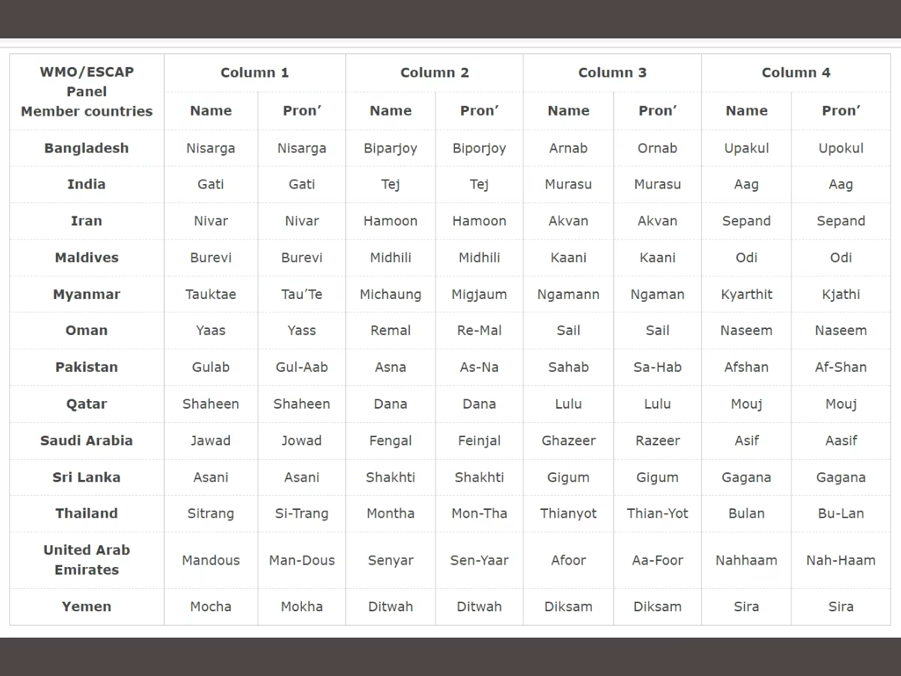
  • The World Meteorological Organization (WMO) oversees the management of rotating name lists tailored for each tropical cyclone basin. 
  • Cyclones arising in various ocean basins globally receive their names from regional specialized meteorological centers (RSMCs) and Tropical Cyclone Warning Centers (TCWCs) within those areas. 
  • There are a total of six RSMCs across the world.
  • Member nations of the RSMCs propose the names for tropical cyclones. For instance, the Indian RSMC, comprising 13 nations, puts forward 13 names each for cyclones formed in the region.
  • In the earlier practice, before the official adoption of naming conventions, tropical cyclones were named based on locations, objects, or the feast days of saints on which they occurred. 
  • The names will be used sequentially column wise. The first name will start from the first row of column one and continue sequentially to the last row in the column thirteen.
  • The names of tropical cyclones over the north Indian Ocean will not be repeated, once used it will cease to be used again. 
  • The name of a tropical cyclone from south China Sea which crosses Thailand and emerge into the Bay of Bengal as a Tropical cyclone will not be changed. 

Guidelines to adopt names of cyclones

  • The proposed name should be neutral to (a) politics and political figures (b) religious believes, (c) cultures and (d) gender.
  • Cyclone Biparjoy Tropical Cyclones Naming System Nomenclature Science  Behind Formation
  • Name should be chosen in such a way that it does not hurt the sentiments of any group of population over the globe
  • It should not be very rude and cruel in nature
  • It should be short, easy to pronounce and should not be offensive to any member
  • The maximum length of the name will be eight letters.
  • The proposed name should be provided with its pronunciation and voice over.
  • The names of tropical cyclones over the north Indian Ocean will not be repeated. Once used, it will cease to be used again. Thus, the name should be new.