Geography & Environment & Disaster management

Jamrani Dam: Multipurpose Project under PMKSY

Context: Cabinet committee on Economic Affairs approved central support to Uttarakhand for the proposed Jamrani dam project in Nainital district.

Jamrani Dam

  • The project envisages the construction of a dam near Jamrani village across river Gola, a tributary of the Ram Ganga, in Nainital district.
  • This project included under Pradhan Mantri Krishi Sinchayee Yojana-Accelerated Irrigation Benefit Programme.
  • The dam will feed the existing Gola barrage through its canal.
  • The multipurpose project is scheduled to be completed by 2028.
  • The project will provide drinking water to Haldwani. 
  • Hydroelectricity power generation of 63.9 million units housing a 14 MW power plant.
  • It will provide water for irrigation across 57000 hectares of land in Nainital, Udham Singh Nagar, Bareilly, and Rampur district.

About Ramganga and River Gola

image 72
  • The Ramganga River originates in the southern slopes of Dudhatoli Hill in Chamoli district of the Indian state of Uttarakhand.
  • It flows through the Dun valley of the Corbett National Park and joins the Ganga near Kannauj in Uttar Pradesh.
    • River Gola: - It originates in the Paharpani Village of Uttarakhand state, and flows south and finally joining the Ramganga River about 15 km (9.3 mi) northwest of Bareilly in Uttar Pradesh, Ramganga in turn is a tributary of the river Ganges.
    •  It is mainly a spring fed river; this river is source of water for Haldwani and Kathgodam. 
    • A beautiful dam exists over this river in Kathgodam.

Ganga river system: Tributaries & River valley projects

  • It originates from Gangotri glacier near Gaumukh in Uttarkashi district in Uttarakhand. It forms various prayags (confluence of two rivers) as shown below:
  • Alaknanda + Dhauliganga = Vishnuprayag
  • Alaknanda + Pindar = Karnaprayag
  • Alaknanda + Mandakinin = Rudraprayag
  • Alaknanda + Bhagirathi = Devaprayag

When Ganga reaches West Bengal, it gets divided into two distributaries called Bhagirathi and Hugli. Damodar river is the tributary of Hugli. The main river goes into Bangladesh where it is first called Meghna and then Padma which then enters Bay of Bengal. 

Major tributary of River Ganga

image 73
  • Yamuna, Karmanasa, Punpun, Son. (Right)
  • Ramganga, Gomti, Ghagra, Kosi, Mahananda. (left)

River Valley Projects On Ganga River System

Tehri projectConstructed at confluence of Bhilangana and Bhagirathi.
Region is prone to earthquake (Zone V).
Ramganga projectOn river Ramganga
Tanakpur projectOn river Kali
Rihand projectConstructed in Sonebhadra district of U. P
The reservoir is named Govind Ballabh Pant Sagar.
Bansagar project On son river in Sahdol, MP.
Matatila projectOn river Betwa Joint project of UP & MP.
Chambal projectJoint project of Rajasthan and M.P Three dams are built:
Gandhi Sagar at Chaurasigarh,
M. P Rana Pratap Sagar at Rawatbhata,
Rajasthan Jawahar Sagar at Kota, Rajasthan
Damodar valley projectMultipurpose project Main dam is built on Panchet hills.
Mayurkashi projectIn Jharkhand also known as Canada dam

North Koel Reservoir Project

Context: Cabinet Committee on Economic Affairs has given approval to the proposal of Ministry of Jal Shakti to complete the balance works of North Koel Reservoir Project at a revised cost of Rs 2,430 crores.

About the North Koel Reservoir Project

  • North Koel Reservoir Project is an inter-state major irrigation project with command area lying in the States of Bihar & Jharkhand.
  • The project comprises a dam on North Koel River near Kutku Village (Latehar District, Jharkhand) and a barrage 96 km downstream of dam (Palamu district, Jharkhand), Right Main Canal and Left  Main Canal taking off water from the barrage.
  • The dam was first propose in 1927 and construction was started in 1972. However, the fear that the water from the dam would threaten the Betla National Park and Palamu Tiger Reserve. 
image 67

About North Koel River

  • North Koel River is the second largest right bank tributary of River Sone. 
  • The North Koel river originates in the Ranchi Plateau and enters Palamau division, below Netarhat near Rud.
  • North Koel River meets the Sone River in Haidargarh, Palamu district, Jharkhand.
  • Important tributaries of North Koel River: Auranga, Amanat and Burha Rivers.
  • North Koel River forms the northern boundary of Betla National Park.

About Betla National Park and Palamu Tiger Reserve

  • Betla National Park is the only national park in the Jharkhand State.
  • It is located on the western park of the Chhotanagpur plateau. 
  • A part of Betla National Park, was declared as the Palamu Tiger Reserve. (Included in the first 9 Tiger Reserves declared in 1974).
  • Only Tiger Reserve in the Jharkhand.
  • River Koel along with its tributaries meanders through the northern part of the Betla national park.
  • Flora of Betla National Park: Betla National Park has a mix of tropical wet evergreen in the lower reaches and mixed deciduous forests in middle to temperate alpine forests in high altitude areas. Sal and Bamboo forests cover a major portion of the national park.
  • Fauna of Betla National Park: Elephant, leopard, panther, monkey, Indian civet, chital, bison, sloth bear, sambhar, nilgai, langur, mouse deer, porcupine and chinkara etc.
  • Indian Grey Wolf: The Betla National Park and Palamu Tiger Reserve have a thriving population of Indian Grey Wolf. Only wildlife sanctuary dedicated for the conservation for India Grey Wolf 
  • Interestingly the first ever tiger census by way of pug mark count, was undertaken within these forests in 1934. 
  • Famous hill station of Netarhat is located on the southern edge of the Betla National Park/Palamu Tiger Reserve.
  • Palamu Tiger Reserve has forts built by Chero dynasty. Cheros were also known as Chyavana dynasty that ruled over the region of Bihar, UP and Jharkhand after the fall of Pala dynasty from the 12th to 19th century. 

Effectiveness of suppressants to control dust

Context: In response to deteriorating air quality in Delhi, the Government has boosted public transport and used suppressants to control dust.

About Dust Suppressants

  • Dust suppressants are substances that are used to control dust emissions from various sources such as construction sites and roads.
  •  They can be salts of calcium or magnesium that can absorb moisture, or other chemical mixtures.

Types of Dust Control measures

  • Water: Water is one of the most common and effective dust suppressants. It can be applied as a fine mist, spray, or through irrigation systems to dampen surfaces and keep dust particles from becoming airborne. Water is environmentally friendly and readily available.
  • Chemical Dust Suppressants: Chemical dust suppressants are substances that are applied to surfaces to control dust. Common chemical suppressants include:
  • Calcium Chloride: It is often used on roads and construction sites to control dust. It attracts moisture from the air, keeping the road or area damp and dust-free.
  • Magnesium Chloride: Like calcium chloride, magnesium chloride is used for dust control on roads and surfaces. It is less corrosive to metals than calcium chloride.
  • Lignin Sulfonate: Lignin sulfonate is a natural biopolymer that can be used as a dust suppressant, particularly in areas where ecological concerns are a priority.
  • Synthetic Polymers: Synthetic polymers, like polyvinyl acetate or polyvinyl alcohol, can be applied to the surface to create a dust-retaining film.
  • Soil Stabilizers: They are used to bind the soil particles together and prevent them from becoming airborne.
  • Dust Control Equipment: Dust control equipment, such as dust collectors, electrostatic precipitators, and baghouses, are used in industrial settings to capture and collect dust particles before they can escape into the air.
  • Vegetation: Planting vegetation in and around dusty areas can help reduce dust by stabilizing the soil and acting as a natural dust suppressant.
  • Windbreaks: Installing windbreaks, such as walls or fences, can help reduce the movement of windborne dust by blocking the wind's force.

Effectiveness of Dust Suppressants

  • According to the Central Pollution control board, the use of dust suppressants along with water is relatively more effective in controlling pollution than conventional methods of dust control i.e., water spraying. 
  • With the use of dust suppressants, there is about a 30% reduction in dust concentration (PM 10, PM 2.5, and PM 1) within the first six hours on both construction sites and roads.
  • Dust suppressants with bio-additives help to reduce dust for 5-6 hours as compared to plain water which lasts for 15-30 minutes.
  • According to the Centre for Science and Environment, the duration of effectiveness of mixed dust suppressants is uncertain, and it is still unknown whether they have long-term effects.

Factory fishing in Antarctica for krill targets the cornerstone of a fragile ecosystem

Context: Antarctic krill (Euphausia suberba) fishing is banned in U.S. waters due to concerns that exploitation of Antarctic Krill could impact whales, seals and other animals that feed on the shrimp-like creatures. Krill fishing has been taking place for decades in Antarctica, where krill are most abundant. 

About Antarctic Krill

image 15
  • Antarctic Krill are shrimp like crustaceans living the Southern Ocean.
  • It’s estimated that there are over 700 trillion adult individuals of Antarctic Krill.
  • Adult krill can live anywhere in the Southern Ocean – from the very surface layer to the seafloor, and from inshore areas to the deep open ocean.
  • Antarctic krill grow up to 6cm in length and can weigh 1 gram.
  • Antarctic krill (and other krill species) are bioluminescent, meaning they produce light. They are frequently found in such abundance that they colour the sea a reddish-brown. They may be small individually, but there is an estimated 400 million tonnes of Antarctic krill in the Southern Ocean.
  • Antarctic krill aggregate in schools or swarms, where the density of the animal can be as high as 30,000 individuals per cubic metre.
  • Antarctic krill are a key species, supporting populations of penguins, seals, whales and other marine life.
  • Antarctic krill feed on phytoplankton (single celled marine plants), which absorb carbon dioxide. Krill then egests this carbon through their faecal pellets and by shedding their exoskeletons, which then both sink to the sea floor where some of the carbon gets stored away.
  • It is one of the most common species in its range and it is not at risk of endangerment or extinction.
  • IUCN Status: Least Concern

Central Pollution Control Board (CPCB) and Vapour Recovery system

Context: As much as 80% of the environment protection charge and environmental compensation collected by the Central Pollution Control board remains unspent, a report the board submitted before the National Green Tribunal.

Central Pollution Control Board

  • The Central Pollution Control Board (CPCB) is a statutory organization which was constituted in 1974 under the Water (Prevention and Control of Pollution) Act, 1974.
  • Further, CPCB was entrusted with the powers and functions under the Air (Prevention and Control of Pollution) Act, 1981.

Functions

  • Advise the Central Government on any matter concerning prevention and control of water and air pollution and improvement of the quality of air.
  • Plan and cause to be executed a nation-wide programme for the prevention, control or abatement of water and air pollution.
  • Co-ordinate the activities of the State Board and resolve disputes among them.
  • Provide technical assistance and guidance to the State Boards, carry out and sponsor investigation and research relating to problems of water and air pollution, and for their prevention, control, or abatement.
  • Plan and organise training of persons engaged in programme on the prevention, control or abatement of water and air pollution.
  • Organise through mass media, a comprehensive mass awareness programme on the prevention, control or abatement of water and air pollution.
  • Collect, compile, and publish technical and statistical data relating to water and air pollution and the measures devised for their effective prevention, control or abatement.
  • Prepare manuals, codes and guidelines relating to treatment and disposal of sewage and trade effluents as well as for stack gas cleaning devices, stacks and ducts.
  • Disseminate information in respect of matters relating to water and air pollution and their prevention and control.
  • Lay down, modify, or annul, in consultation with the State Governments concerned, the standards for stream or well, and lay down standards for the quality of air; and Perform such other function as may be prescribed by the Government of India.

Powers of Central Pollution Control Board

The following are the powers of the Central Pollution Control Board:

  • Section 18 of the Water (Prevention & Control of Pollution) Act gives the CPCB the authority to order the SPCB.
  • If one of its directives is not followed, the Central Pollution Control Board does have the authority to carry out all the duties of a State Pollution Control Board.
  • According to section 33A of the Water (Prevention & Control of Pollution) Act, the CPCB has the authority to issue directives that may restrict, close, or regulate any activity, business, or procedure or that may regulate the provision of power, fresh water, or other services.

Environmental Compensation

  • Environmental compensation is a policy instrument for the protection of the environment which works on the Polluter Pay Principal. 
  • The Hon’ble National Green Tribunal through its various judgments has empowered the Central Pollution Control Board to lay down the methodology to assess and recover compensation for damage to the environment and utilize such amount in terms of an action plan for protection of the environment.

Vapor recovery system

  • Vapor recovery is the process of removing harmful vapor and fluid contaminants from crude products to improve the purity and prevent the release of toxic pollutants into the environment. 
  • Vapor removal is also done in chemical processing industries to recover unwanted vapors from storage units to keep the chemicals pure and safe for use and transport.

The typical VRU (Vapor recovery unit) consists of four principal components:

  • Gas Compressor
  • Scrubber
  • Variable Frequency Drives (VFDs)
  • Switching device

Working of VRU

The primary function of a VRU system is to remove the vapors that collect inside sealed hydrocarbon tanks. The machine does this by gas compression and suction.

  • The vapor recovery procedure involves the following steps:
    • The rotary screw gas compressor sucks liquid molecules into the scrubber.
    • The scrubber removes the water vapor, debris, and unwanted fluids from the tank.
    • The recovered vapor is pumped into gas lines while the trapped liquids are channelled to the pipelines.
image 16

Tej now extremely severe cyclone over the Arabian Sea; yellow alert issued for eight districts in Kerala

Context: Cyclone 'Tej', brewing over the Arabian Sea, is expected to transform into a Very Severe Cyclonic Storm reported by India Meteorological Department (IMD).

Cyclone Tez

  • The very severe cyclone, Tej, formed over the Arabian sea intensified into extremely severe cyclone.
  • It is moving north-westwards, is likely to cross the Yemen coast close to Al Ghaidah as severe cyclonic storm with wind speed of 125-135 kmph gusting to 150 kmph.  

Impact on India and development of Depression in Bay of Bengal

  • Kerala is likely to receive isolated heavy rainfall triggered by the weather system over the Arabian Sea and the Bay of Bengal.
  • A yellow alert has been issued for eight districts from Kollam to Palakkad, warning of isolated heavy rains.
  • The typical northeast monsoon rain will be absent at least for the next few days as the present weather system over the Bay of Bengal is likely to upset the flow of north-easterlies.
  • The depression formed over the Bay of Bengal is likely to intensify into deep depression and subsequently into cyclonic storms.
  • IMD predicted that the cyclonic storm likely to move towards the Andhra Coast and then recurve and move north-eastwards towards Bangladesh and adjoining the West Bengal coast. 

Color Coding of Cyclone

  • To strengthen the early warning system and reduce potential damage due to cyclonic winds, IMD follows a special matrix to decide the color of weather situations.
  • It is based on the probability of occurrence of the event as well as its impact assessment. The decision of the color also depends on the meteorological factors, hydrological factors, geophysical factors that indicate the risk.
image 13
Colour codeMeaning
Green• All is well.
• No adverse weather conditions.
• No advisory issued.
Yellow• Be aware.
• Severely bad weather may span across several days
• Warning of affecting daily activities.
Orange• Be prepared.
• Warning of extreme damage to communication disruptions.
• Sign for evacuation and keeping the basic necessities ready for families.
Red• Take action.
• Threat to life with the worst weather conditions.
• Measures are taken to handle the situation along with the help of disaster management response teams

Classification of Tropical cyclone based on Speed

The classification of tropical cyclones based on their speed can vary slightly depending on the region, but they generally follow a pattern related to the sustained wind speeds.

image 14

Firecracker industry in Sivakasi, Tamil Nadu

Context: The firecracker industry, which was concentrated in Sivakasi, is much more dispersed in Tamil Nadu now with small units, both legal and illegal, coming up across districts. Many of these units’ function with little supervision, monitoring, or official inspections, which has led to a spate of tragedies in recent months.

Fireworks industry in Sivakasi

  • Sivakasi located in the Virudhnagar district of Tamil Nadu is known as the fireworks capital of India.
  • The foundation of the fireworks industry in Tamil Nadu was laid down by two Nadar brothers, who were trained in match stick making. Over time, the fireworks industry grew and came to account for 90% of fireworks production in India.
  • According to the industry association, there are around over one thousand units engaged in firework production in and around Sivakasi providing employment to 8 lakh people. 
  • However, in recent years the fireworks industry in Sivakasi has become dispersed with smaller units (both legal and illegal) coming up all over Tamil Nadu. 
  • Reasons for this trend: High profit margins in the fireworks industry is inducing smaller players and workers engaged in Sivakasi firework plants starting their own plants across Tamil Nadu. 
  • The trend towards smaller firms has resulted in lots of accidents in fireworks industry because of:
    • These smaller units operate under the radar with little supervision, monitoring, or official inspections.
    • Smaller units have less focus on safety resulting in many accidents due to overstocking of explosive chemicals above the permissible limits, employment of workers without training and sub-leasing of larger firework firms to smaller firework firms which have little or no focus on safety.
    • Safety processes such as automation of the dangerous mixing process of chemicals costs about Rs 20-25 lakhs which smaller factories find difficult to invest.
    • Petroleum & Explosive Safety Organisation (PESO) which is the licensing and regulating authority for large firework units is short-staffed. 
    • PESO licenses are only issued to firms which handle between 15 to 2000 kg of fireworks. 

About Petroleum and Explosive Safety Organization (PESO)

  • The Petroleum and Explosives Safety Organization (PESO), formerly known as Department of Explosives, since its inception on 05/09/1898, has been serving the nation as a nodal agency for regulating safety of hazardous substances such as explosives, compressed gases, and petroleum. 
  • PESO has its Headquarters at Nagpur in Maharashtra and serves through nine Circle Offices viz Agra, Bhopal, Chennai, Faridabad, Guwahati, Hyderabad, Kolkata, Mumbai, Vadodara, and their subordinate Sub-Circle offices across the country.
  • It works under the Department for Promotion of Industry and Internal Trade under the Ministry of Commerce and Industry.
  • Functions of PESO
  • PESO’s major work is to administer the responsibilities delegated under the Explosives Act 1884 and Petroleum Act 1934 and the Rules made there under the motto "Safety First."
  • Administration of following rules under Explosives Act, 1884: Explosives Rules, 2008; Gas Cylinders Rules, 2004; Static & Mobile Pressure Vessels (unfired) rules, 1981; Ammonium nitrate rules, 2012; Acetylene notification of 1983.
  • Administration of following rules under Petroleum Act, 1934: Petroleum Rules, 2002; Calcium carbide rules, 1987; Cinematographic Film rules, 1948; Inflammable Substance Act, 1952.
  • Ensure public safety in areas of manufacture, transport, storage, handling etc. of Explosives, Petroleum, Carbide of Calcium, Inflammable substances and Compressed Gases.
  • Framing National Standards concerning public safety and harmonizing Indian standards with international standards.
  • Evaluation of new technologies finding applications in hazardous areas for adoption in indigenous conditions within the purview of Explosives Act 1884 and Petroleum Act 1934.
  • It is licensing and regulating authority for large fireworks units.
  • Providing operational and technical advice and assistance to Central and State governments, Local bodies, Law Enforcement Agencies, Industry, Trade and end users of these products.
  • Develop alert, innovative and well-trained workforce.
  • Scrutiny and approval of site, layout and construction plans for explosive manufacturing & storage, fireworks manufacturing & storage, manufacture of explosives in Bulk mixing and delivery vehicles; Petroleum, Gas cylinder, LPG and CNG storage & filling stations; Petroleum refineries; Petroleum tank lorries; Petroleum & Gas pipelines; Flame proof equipment and calcium carbide storage premises.

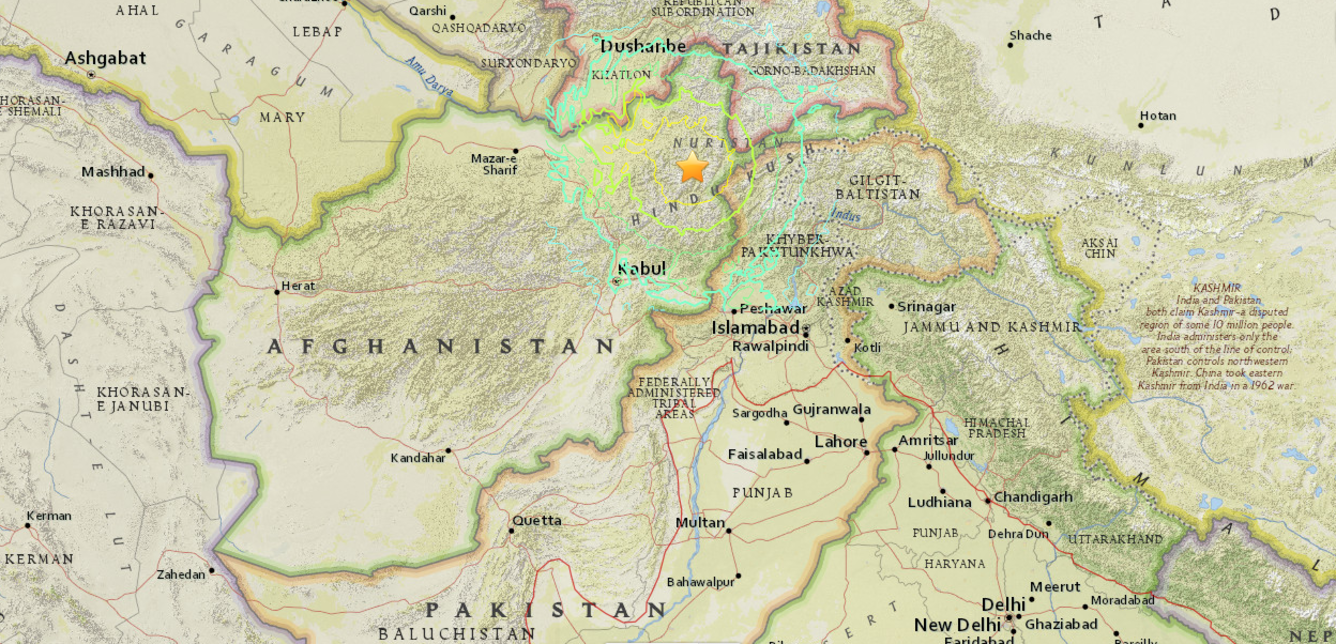
Increased Frequency of Earthquakes in Afghanistan

Context: Recent years have seen a series of minor and major earthquake in Afghanistan and adjoining areas. This tries to explain the reasons for the increased seismicity in Afghanistan region.

A map of asia with a location pin

What is Earthquake?

Earthquake, any sudden shaking of the ground caused by the passage of seismic waves through Earth’s rocks.

Earthquake waves or seismic waves are vibrations generated by an earthquake, explosion, or similar energetic source and propagated within Earth or along its surface. Earthquakes generate four principal types of elastic waves; two, known as body waves (P and S), travel within Earth, whereas the other two, called surface waves (Love and Rayleigh), travel along its surface.

P Waves: It causes the ground to compress and expand, that is, to move back and forth, in the direction of travel. 

  • They are called primary waves because they are the first type of wave to arrive at seismic recording stations. 
  • P waves can travel through solids, liquids, and even gases.

S Waves: It shakes the ground in a shearing, or crosswise, motion that is perpendicular to the direction of travel. 

  • These are the shake waves that move the ground up and down or from side to side. 
  • S waves are called secondary waves because they always arrive after P waves at seismic recording stations.
  •  Unlike P waves, S waves can travel only through solid materials.

L Waves: Love waves have a horizontal motion that moves the surface from side to side perpendicular to the direction the wave is traveling.

Rayleigh Waves: It travels along the free surface of an elastic solid such as the Earth. Their motion is a combination of longitudinal compression and dilation that results in an elliptical motion of points on the surface.

image 64

Causes of earthquake

Major causes of earthquake are natural and occur mostly around the plate boundaries due to continuous interaction of plates.

Natural causes

1.Tectonics: tectonic movements associated with plate boundaries are ruptures and faults along the constructive plate boundaries, folding and faulting along the destructive plate boundaries ,this sort of disequilibrium caused due to different types of plate movement and consequently earthquakes of varying degree are caused.

2.Volcanic: Explosive violent gases during process of vulcanicity try to escape upwards and hence they push the crustal surface from below with great force and thus is caused severe earth tremor of high magnitude. Example-Krakatoa volcano of Indonesia caused intense earthquakes.

Anthropogenic causes

Earthquakes are induced by human activities causes earth tremors of serious consequences.

  • Fracking: Injection of fluids into deep wells (Fracking)- can lubricate existing faults and crack rocks, triggering earthquakes.
  • Underground nuclear explosions: Detonation of large underground nuclear explosions-will accentuate the fault lines leads to earthquakes. Case study- North Korea’s 2017 nuclear bomb test set off aftershocks that lasted for about eight months after the explosion. The bomb was set off near a previously unmapped fault line, and a first produced a 6.3 earthquake, followed by a magnitude 4 quake just minutes later.
  • Mining: rocks and other materials are being removed from the Earth that instability in the ground is occurring, which is triggering earthquakes.
  • Reservoir induced earthquake: Earthquake triggered by the impoundment of water behind the dam of enormous  quantity causes isostatic disequilibrium of already adjusted rocks or further augment the already isostatically adjusted rocks below the reservoir or further augment the already fragile structures due to faults and fractures underneath. Examples Koyna dam in India, Hoover dam in USA.
image 63
DISTRIBUTION OF MAJOR EARTHQUAKE REGIONS ALONG THE PLATE BOUNDARIES

Impact of Earthquake

Geomorphological impact-slope instability and failures leading to landslides, mudflows, and changes river courses.

Structural impact-Failure of roads, bridges, dams, pipelines, railways and embankment, subsidence of lands.

Economic impact-Loss of life and property, cost in rehabilitation and disaster risk reduction.

Tsunami- earthquake on ocean floor leads to Tsunami.

Why Afghanistan and adjoining Himalayan regions witnessing frequent earthquakes.

image 12
  • Afghanistan is located over multiple fault lines in the region where the Indian and Eurasian tectonic plates meet and collides often causing tectonic activity like earthquakes, folding and faulting.
  • Afghanistan is located on Eurasian plate, towards its west, Arabian plate move northwards and subducts under Eurasian plate whereas towards its east, Indian plates move northward to subduct under Eurasian plate. In southern Afghanistan, Indian and Arabian plate adjoins and both subducts northward under Eurasian Plate. 
  • The collision and convergence of the Indian plate and the Eurasian plate result in the folding and faulting of the Earth’s crust.
  • The ongoing northward movement of the Indian plate towards the Eurasian plate results in compression, leading to uplift of Himalayas and the transmission of tectonic stress across the entire region, including Afghanistan.
  • These compression causes the crust to deform and creates faults and fractures that can slip and generate earthquakes.
  • Afghanistan is also crisscrossed by various active fault systems like the Chaman fault, and the main Pamir thrust. These faults are the source of many earthquakes in the region.

China to curb 'Graphite' exports

Context- China has recently announced that it will require export permits for certain graphite products in a bid to protect national security. This decision is seen as China's latest effort to regulate the supply of essential minerals, particularly in light of challenges to its global manufacturing dominance.

Graphite

Graphite is a naturally occurring form of crystalline carbon. It is a soft, black to grey, lustrous mineral that conducts electricity.

key properties and characteristics of graphite

  • Allotrope of Carbon: 
    • Graphite is one of the allotropes of carbon, the other well-known allotropes being diamond and amorphous carbon. 
    • While diamond has a tetrahedral structure where each carbon atom is bonded to four other carbon atoms, graphite has a planar hexagonal structure.
  • Structure: 
    • In graphite, each carbon atom is bonded to three other carbon atoms in a flat, 2-dimensional plane that resembles a honeycomb lattice. 
    • These planes are stacked on top of each other, and the weak van der Waals forces between the planes allow them to slide over each other easily. This gives graphite its slippery feel and makes it useful as a lubricant.
  • Conductivity: 
    • Graphite is a good conductor of electricity due to the presence of free electrons in its structure. 
    • This property is utilized in various applications, such as in the manufacture of electrodes.
  • Occurrence:
    • Graphite is found in metamorphic and igneous rocks and can be mined from natural deposits. It can also be produced synthetically.
  • Hardness:
    • On the Mohs scale of mineral hardness, graphite is relatively soft, with a hardness of 1-2.
  • Thermal Stability:
    • Graphite has a high melting point and is stable at high temperatures, making it suitable for high-temperature applications.

Type of Natural Graphite

image 58

Applications of Graphite

  • Lubrication: Effective in high-temperature and high-pressure conditions.
  • Electrodes: Used in batteries, fuel cells, and arc furnaces due to its electrical conductivity.
  • Pencil Leads: Graphite mixed with clay forms pencil "lead."
  • Refractory Materials: Utilized in high-temperature applications like furnaces.
  • Carbon Brushes: Transfer electrical current in motors and generators.
  • Graphene Production: Processed from graphite, graphene has various potential applications.
  • Nuclear Reactors: Serves as a neutron moderator.
  • Gasket and Sealing Material: Withstands high temperatures and corrosive chemicals.
  • Brake Linings: Used in vehicles for its heat dissipation properties.
  • Foundry Facing: Provides protective coating on molds and cores.
  • Peek Composites: Graphite fibers reinforce peek composites for structural applications.
  • Additive Manufacturing: Used in 3D printing due to its thermal and electrical conductivity.

Synthetic Graphite Vs Natural Graphite

Property/AspectSynthetic GraphiteNatural Graphite
OriginArtificially produced (typically from petroleum coke and pitch cokes).Mined from the earth (naturally occurring form of crystalline carbon).
PurityVery high (often 99% or more carbon) due to controlled production.Varies; requires more processing to achieve high purity levels.
Structure & PropertiesUniform structure and consistent properties. Particle size, shape, and distribution can be controlled.Varies based on type (flake, amorphous, vein) and source.
CostGenerally more expensive (energy-intensive production).Typically less expensive, but varies based on quality and source.
ApplicationsElectrodes for electric arc furnaces, lithium-ion batteries, aerospace, nuclear applications.Pencils, lubricants, brake linings, lithium-ion batteries, nuclear reactors.
Environmental ImpactEnergy-intensive production; relies on non-renewable resources.Mining impacts; potentially lower carbon footprint than synthetic graphite.
Supply ChainMore controlled (industrial production).Influenced by geopolitical factors, mining regulations, availability of deposits.

Carbon footprint of Graphite

image 59

Global status of Graphite producing countries

image 60

The global distribution of graphite is somewhat concentrated, with certain countries playing significant roles in its production and reserve holdings:

  • Production:
    • China is the leading producer of graphite, accounting for about 67% of the global supplies of natural graphite​.
    • China's dominance in graphite production was noted, with 65.5% of the total global production of graphite located in this country​​.
    • Other countries contributing to increased graphite production include Mozambique, Madagascar, and Brazil, especially with the commencement of the Montepuez Central Graphite project​​.
  • Reserves:
    • Turkey held the largest reserves of natural graphite, with approximately 90 million metric tons​​.
    • 27.3% of the global reserves of graphite were located in Turkey, followed by Brazil with the second-largest global graphite reserves​.

Graphite in India

  • Graphite Reserves Distribution:
    • Arunachal Pradesh: Holds the largest share of graphite reserves in India, with about 43% of the total graphite found in the country.
    • Jammu and Kashmir: Follows with a significant portion of graphite reserves, accounting for about 37% of the country's total.
    • Other states with notable graphite reserves include Jharkhand (6%), Tamil Nadu (5%), and Odisha (3%)​​.
  • Graphite Production Concentration:
    • Tamil Nadu (37%), Jharkhand (30%), and Odisha (29%) are the states where most of the graphite production is concentrated​​.
  • Active Mining Centers:
    • Jharkhand: Notable districts for graphite mining include Latehar & Palamu.
    • Odisha: Graphite mining is active in Bargarh, Nuapada, Rayagada & Balangir districts.
    • Tamil Nadu: The districts of Madurai & Sivagangai are known for graphite mining​.
image 11

Implications of China ban on Graphite

  • Increased Prices:
    • With China being a major supplier of graphite, a ban on exports could lead to a shortage in supply, thereby driving up prices globally. 
    • This could make graphite and graphite-based products more expensive in India.
  • Battery and Electric Vehicle (EV) Industry:
    • India's burgeoning EV industry could face challenges due to the higher costs and potential scarcity of graphite, which is a key component in lithium-ion batteries.
  • Sourcing Challenges:
    • Indian industries reliant on graphite may need to seek alternative sources or invest in domestic production to meet their needs, which could involve additional costs and time.
  • Potential for Domestic Production:
    • On a positive note, this situation might provide an impetus for India to develop its own graphite mining and processing industry further, leveraging its domestic reserves of graphite.
  • Trade Dynamics:
    • The export controls could also affect trade dynamics between India and China, potentially prompting discussions on trade agreements or policies to ensure the availability of critical materials.

Bauxite Mining and Issues

Context: The red-brown soil of the bauxite belt in southern Odisha’s Eastern Ghats is seeing an escalation of interest in mining, with the government auctioning sites to private companies processing it into Aluminum. 

About Bauxite

  • Bauxite is a sedimentary rock with a relatively high aluminum content. 
  • Bauxite is basically an aluminous rock that contains hydrated aluminium oxide as main constituent and iron oxide, silica & titania as minor constituents present in varying proportions
  • It is the world's main source of aluminum and is typically found in tropical and subtropical regions
  • India accounts for 6% of global production, with the largest producers being Australia, the Republic of Guinea, China and Brazil.
  • Bauxite is the main source of the rare metal gallium.
  • During the processing of bauxite to alumina in the Bayer process, gallium accumulates in the sodium hydroxide liquor.

Bauxite in India

  • The country has 3,896 million tonnes of resources of bauxite which is sufficient to meet both domestic and export demands.
  • By States, Odisha alone accounts for 51% of country's resources of bauxite followed by Andhra Pradesh (16%), Gujarat (9%), Jharkhand (6%), Maharashtra (5%) and Madhya Pradesh & Chhattisgarh (4% each)
  • Odisha emerged as the leading producing State accounting for about 49% of the total production followed by Gujarat (24%), Jharkhand (9%), Chhattisgarh and Maharashtra (8% each). The remaining was produced by Madhya Pradesh, Goa, Karnataka and Tamil Nadu.
  • During 2016-17, exports of bauxite were 2,502 thousand tons. Exports of bauxite increased drastically to 8,914 thousand tonnes in 2015-16 from 6,808 thousand tonnes in 2014-15. Exports were mainly to China (96%), UAE (2%) and Kuwait (1%).

Bauxite Distribution in India

bauxite mines MAP

When tigers and jackals get the same protection

Context: Many ecologists are incensed that an inordinate number of species have been included in the new schedules of the Wildlife Protection (Amendment) Act, 2022, without an objective or replicable process. In brief, Schedule 1, which confers the highest protection, contains about 600 species of vertebrates and hundreds of invertebrates, while Schedule 2 contains about 2,000 species (with 1,134 species of birds alone).

Wildlife protection amendment Act 2022 – The amendment is primarily aimed at revising four aspects of the law: allowing delegation of functions of the State Boards for Wildlife (SBWLs) to a select set of people (“standing committee”) as is currently the case with the National Board for Wildlife (NBWL); a rework of the schedules that list species according to the levels of protection they need in view of the threats they face; providing for the implementation of the Convention on International Trade in Endangered Species of Wild Fauna and Flora (CITES); and an exception to the requirement to obtain permission from the Chief Wildlife Warden for the transfer and transport of captive elephants for religious or other purposes.

Positive Key features:

  • Holistic approach and widened scope - In the long title of the Wild Life (Protection) Act, 1972, for the words "protection of wild animals, birds and plants", the words "conservation, protection and management of wild life" is substituted which points towards the change of focus towards the holistic approach.
  • Addition of new schedule: a new schedule has been added for specimens listed in the Appendices under CITES (scheduled specimens).
  • Invasive alien species - It empowers the central government to regulate or prohibit the import, trade, possession or proliferation of invasive alien species.  The central government may authorise an officer to seize and dispose the invasive species.
  • Management Authority : it will be appointed by the central government for the issuance of permits and certificates for trade in scheduled specimens in accordance with the CITES. Until now, CITES provisions were enforced through the Customs Act and not the Wildlife (Protection) Act, which was a major lacunae.
  • Decentralized management: For sanctuaries falling under special areas, the management plan must be prepared after due consultation with the concerned Gram Sabha.
  • Declaring conservation reserves by Centre: It empowers both Central and State governments to declare areas adjacent to national parks and sanctuaries as conservation reserve, Earlier only the state government had this power. 
  • Surrender of captive animals: Any person having a certificate of ownership can voluntarily surrender any captive animals or animal products to the Chief Wildlife Warden.   

Issues remaining

  • Reduction of schedules has led to huge number of species falling in the same list which creates confusion as it is unclear where resources should be allocated on the basis of this list. The same level of protection is offered to tigers and jackals, to the great Indian bustard and common barn owls, to the king cobra and rat snakes. 
  • Unscientific classification for e.g. the presence of the spotted deer (chital) in Schedule 1. Common throughout India, these are invasive in the Andaman Islands and have caused untold harm to the vegetation and herpetofauna. But they cannot be legally culled or removed because of the WLPA.
  • Commercial trade: It leaves the door open for commercial trade in elephants. There is concern that the amendments have not defined what purposes elephants can be used for and have perhaps made it easier for the animals to be transported across the country.
  • Dilution of federal framework: It has also been criticized for diluting the federal framework by seeking to displace the State Boards of Wildlife, which are chaired by the Chief Minister, with a Standing Committee headed by the union Forest minister. 
  • Using animals for religious purpose: In Section 43, elephants, Schedule I animal, are permitted to be used for ‘religious or any other purpose’. Experts have also criticized the term ‘other purpose’
  • Lack of ownership: There are 2,675 captive elephants in India and only 1,251 have ownership certificates. Experts believe that this unclear ownership was an issue and the provisions that are “weak and indeterminate which can cause problems.
  • Hampering research: Experts believe that listing so many species in schedule 1 will impact research as paperwork involved in getting permits for research is tedious and time consuming.

Ecomark Certification Rule, 2023

Context: Ministry of Environment, Forest & Climate Change (MOEFCC) has notified an updation of Scheme on labelling of environment friendly products - 'Ecomark' aiming nudge individual choices and behaviors towards sustainability, in line with the philosophy of LiFE (Lifestyle of Environment). This will make consumers able to make choices among products and opt for products that are eco-friendly in their design, process etc.

About Ecomark Certification

ecomark Logo
  • Ecomark Certification Rules is for labelling of products which will have lesser adverse impacts on environment to encourage consumers to adopt such products and manufacturers for transitioning to production of Ecomark certified products for promoting sustainability. 
  • Ecomark certification rules have been notified under Environment (Protection) Act, 1986.

Benefits of Ecomark Certification

  • Provide accreditation and labelling for household and other consumer products which meet certain environmental criteria.
  • Promote environmentally friendly products.
  • Promote resource efficiency & circular economy.
  • Preventing misleading information on environmental aspects of products
  • Enables industry to implement environment-friendly processes or production methods.

Application of Ecomark certification

  • Apply to any product which is produced or supplied for distribution or use in the market.

Criteria for Ecomark labelling:

  • Environmental criteria for each product/product category under Ecomark Rules shall be notified by Central Government.
  • Certification of Standards Body (national or international) for quality and safety or mandate of Quality Control Orders is a pre-requisite for Ecomark. 
  • Products will be examined in terms of environmental impacts will include:
    • Have substantially less potential for pollution, environmental impact, minimise or eliminate generation of waste and environmental emissions, than other comparable products.
    • Recyclable and/or made from recycled products where comparable products are not.
    • Make significant contribution to saving.
    • Build consumer awareness on environmental issues and implication of their choices.
    • Encourage manufacturers for transitioning to production of Ecomark certified products.
    • Prevent misleading and deceptive information with respect to fraudulent use of Ecomark label.
  • Product primary criteria will include:
    • Production or process including source of raw material.
    • Use of natural resources
    • Likely impact on environment
    • Effect & extent of emissions/waste arising from production process.
    • Disposal of product and its packaging
    • Compliance to Extended Producer Responsibility regulations
    • Utilisation of waste and recycled materials
    • Suitability of recycling.
    • Substitution of hazardous substances with safer ones.

Implementation mechanism of Ecomark rules

Governance of Ecomark Rules is vested with a Steering Committee which comprises representatives from concerned ministries/departments, domain experts, representatives from industry associations, consumer groups and other relevant stakeholders. Functions of Steering Committee are:

  1. Grant approvals for:
    • Framework for institutionalising Ecomark Rules.
    • Initiatives to incentivise Ecomark certified business operators.
    • Notify product/product categories to be included in Ecomark Rules on recommendations of Ecomark Administrator.
    • Recognition of domestic and international voluntary ecolabelling programs.
    • Activities related creation of mass awareness for promotion of Ecomark Rules.
    • Strategies for promotion and future development of Ecomark Rules.
  1. Make recommendations to Central Government
    • Determine product/product category to be included in Ecomark Rules.
    • Inclusion of Ecomark products in public procurement under GeM portal.
    • Allocation of resources for implementation of Ecomark Rules.
    • Measures for adoption of Ecomark
  1. Review and monitoring of implementation of Eco

Ecomark Administrator: 

Central Pollution Control Board (CPCB) is responsible for implementation of the Ecomark Rules. Responsibilities of Ecomark Administrator are:

  1. Develop guidelines for:
    • Framework for institutionalising Ecomark Rules.
    • Development of Ecomark Web portal and Knowledge/Database platform
    • Designation of Ecomark Verifiers
    • Appointing third parties for carrying out market surveillance activities.
    • For appointing third parties for carrying out market surveillance activities.
    • For fixing fees to be charged by Designated Ecomark Verifiers.
  1. Identify products to be covered under Ecomark Rules
  2. Constitute technical committees for different products under Ecomark Rules, develop specific criteria that a product shall comply to certified under Ecomark Rules.
  3. Review existing state of knowledge and environmental criteria being followed domestically/in other countries.
  4. Develop initiatives to incentivize Ecomark certified entities for adoption of Ecomark.
  5. Register and empanel Designated Ecomark Verifiers, third party for market surveillance, audit and third party on Ecomark web portal.
  6. Issue Ecomark certificate based on verification authorizing a person or a body of persons to mark its product with Ecomark or recognised eco label.
  7. Review, suspend, or cancel a Ecomark certificate.
  8. Review Ecomark criteria as per technology development and market evolution.
  9. Compile annual reports submitted by all the Ecomark or other recognised eco label entities.
  10. Assess domestic or international voluntary ecolabelling program, for recognition under Ecomark rules.
  11. Assess international ecolabelling programs, for mutual recognition.
  12. Direct Ecomark Certificate holders to pay compensation in case of non-compliance.

Designated Ecomark Verifiers

  • Administrator (CPCB) or Designated Ecomark verifiers will verify compliance with ecolabelling criteria for the award/renewal of certificate to products under Ecomark Rules. 
  • Designated Ecomark Verifiers shall be accredited entities. 
  • Undertake conformity assessment including visiting factory, drawing samples, audit of factory, recommending for award/renewal of certification.