Geography & Environment & Disaster management

Ethanol Blending in Petrol

Context: As more than 100 countries at COP28 in Dubai pledged the tripling of global renewable energy capacity by 2030, India faces a tightrope walk with regard to its ethanol blending target. While ethanol blended petrol (EBP) increased from 1.6% in 2013-14 to 11.8% in 2022-23, the 20% target by 2025 has run into trouble with low sugar stocks in 2022-23 and the impending shortfall in sugarcane production this year. 

Ethanol blending:

  • Ethanol blending in petrol refers to the practice of mixing ethanol, a type of alcohol/biofuel, with petrol to create a blended fuel.
    • E10, is the most common blend, which consists of 10% ethanol and 90% petrol. 
    • E20, is a higher ethanol blend, which has 20% ethanol and 80% petrol. 
  • Ethanol is naturally produced by the fermentation of sugars by yeasts or via petrochemical processes such as ethylene hydration.
image 135

Ethanol blending target:

  • India launched its ethanol blending programme (EBP) in 2003. It is aimed at reducing the country’s dependence on crude oil imports, cutting carbon emissions and boosting farmers’ incomes.
  • The National Policy of Biofuels 2018 provided indicative targets of 20% ethanol blending in petrol and 5% biodiesel blending in diesel by 2030. 
  • Encouraged by the past 7 years performance under the Ethanol Blending Programme, the Government has advanced the targets of 20% ethanol blending in petrol from 2030 to Ethanol Supply Year (ESY) 2025-26.
    • In 2022, India’s blending programme achieved the significant milestone of 10 per cent ethanol blending in petrol.
  • In India, biofuels are primarily associated with first-generation (1G) ethanol, which is sourced from food crops like sugarcane and foodgrains.

Benefits:

  • Reduce dependence on non-renewable fossil fuels: Ethanol is often produced from renewable sources such as corn, sugarcane, or other biomass. Blending ethanol with petrol helps reduce dependence on non-renewable fossil fuels.
    • India's net import of petroleum was 185 million tonnes in 2020-21 costing USD 551 billion. 
  • Reduced Greenhouse Gas Emissions: Ethanol contains oxygen, which can improve the combustion of fuel, leading to more complete burning and lower emissions of certain pollutants like Carbon dioxide and carbon monoxide. 
  • Efficiency: Ethanol has a higher octane rating than petrol, which means it can improve the octane level of the blended fuel. Higher octane levels can contribute to better engine performance and efficiency. 
  • Farmer’s income: Ethanol produced from farm residue will boost farmers' income and also minimise air pollution by reducing stubble burning. 

Challenges:

  • Food security:
    • Lowering sugar stocks: 
      • Industry body Indian Sugar Mills Association (ISMA) has projected a 9 per cent fall in gross sugar production at 337 lakh tonnes for the 2023-24 marketing year starting (October-September). It has not estimated the diversion of sugar for ethanol production.
      • Cane growing districts in Maharashtra and Karnataka received as little as 56% of normal rainfall in 2023, as this year the monsoon was the weakest since 2018.
      • In what would be a major reversal after 2017, the growing pressures that could force India, which supplies 12% of globally traded sugar, to become a net importer from as early as the first half of 2025.
    • Grain-based ethanol: Government is looking at a major transition towards grains-based ethanol for meeting the target particularly by developing an organised maize-feed supply chain for ethanol. This risks food security as more area under the food grains can be diverted for growing food grains for ethanol production. 
image 136
  • Environmental concerns:
    • Water-intensive agriculture: Growing sugar cane and using food grains for ethanol production have significant implications for groundwater depletion. 
    • Agriculture’s GHG Emissions: Diverting crops towards fuel production increases greenhouse gas (GHG) emissions from the agriculture sector, counteracting the goal of reducing emissions in the transport sector.
    • No reduction in NOX emissions: Ethanol lessens emissions such as carbon monoxide. However, there is no reduction in nitrous oxides which is one of the major environmental pollutants.
  • Challenge of Scaling up: Balancing economies of scale with energy needs and costs for biomass collection and transport remains a challenge. 
  • Storage: The ethanol production capacity in India has increased from 423 crore litres in 2019-20 to 947 crore litres in 2022-23. As in 2023, India might need an additional 8-10 billion litres of ethanol production capacity to achieve the 20% petrol-ethanol blending requirement.
  • Ethanol Movement between states: The non-implementation of the amended provisions of the Industries (Development & Regulation) Act, 1951, by all states poses a significant challenge to ethanol blending in India due to restrictions on inter-state movement of ethanol. 

Way Forward:

  • Sustainable Biofuels: Sustainable biofuels, produced from crop residues and other low-impact sources, have a lower water and GHG footprint. Global Biofuels Alliance initiative aims to develop these sustainable alternatives and promote ethanol use. 
image 137
  • Invest in public infrastructure: Government needs more investment in public infrastructure and transportation facilities to facilitate their use.
  • Alternative energy sources: For emissions reduction, alternative mechanisms should be adopted like- improved infrastructure for Electric Vehicles like charging infrastructure, low cost batteries, and additional renewable generation capacity, green hydrogen mission. 

Indian Tent Turtles

Context: Directorate of Revenue Intelligence has seized 436 baby Indian Tent Turtles in Varanasi from a person illegal transporting them from Kanpur to West Bengal.

image 127
Image of Indian Tent Turtle
image 128
Locations where Indian Tent Turtles are found

About Indian Tent Turtles

  • Indian Tent Turtle is a species of riverine freshwater turtle native to India, Nepal and Bangladesh.
  • Males are smaller than females in size and have longer and thicker tails.
  • The size of the carapace ranges from 20 cm to 26.5 cm depending upon the subspecies.
  • Due to attractive appearance of the species, they are illegally traded in the pet market.
  • Habitat: Still water pools on river side and slow running water near the river banks.
  • These are active swimmers and are mainly herbivorous.
  • Indian Tent Turtles have three sub-species:
    • Pangshura tentoria: Occurs in peninsular India and is recorded in Odisha, Maharashtra, Andhra Pradesh, Assam and Madhya Pradesh.
    • Pangshura circumdata: Occurs in western tributaries of Ganga and the rivers of Gujarat. Thus, found in Rajasthan, MP, UP and Gujarat.
    • Pangshura flaviventer: Occurs in northern tributaries of Ganga and is recorded from UP, Bihar, West Bengal and Assam.
  • IUCN Status: Least Concern

Global River Cities Alliance launched at COP 28

Context: A nine-country ‘Global River Cities Alliance’ (GRCA) inspired by India’s River Cities Alliance was launched at the Indian Pavilion, Dubai on the sidelines of the ongoing COP28 on Sunday.

Global River Cities Alliance (GRCA)

  • The GRCA is modeled on the lines of India’s River Cities Alliance established by the National Mission for Clean Ganga (NMCG) under the Ministry of Jal Shakti and the National Institute of Urban Affairs under the Ministry of Housing and Urban Affairs in November 2021.
  • The National Mission for Clean Ganga, under the Jal Shakti ministry and Housing and Urban Affairs ministry’s National Institute for Urban Affairs (NIUA), will take on the role of the Secretariat of the GRCA.
  • The nine nations are India, Denmark, Cambodia, Japan, Bhutan, Australia, Netherlands, Egypt, and Ghana.
  • Multi-lateral funding agencies such as the World Bank, Asian Development Bank and Asian Infrastructure Investment Bank have also pledged their support for the initiative.
image 40

Focus area of work

  • It focuses on capacity building and knowledge exchange in integrated river management to address climate change impacts on the ecosystem. 
  • The collaboration includes a comprehensive water monitoring program, sharing best practices for renaturing urban areas, and restoring aquatic ecosystems for sustainable urban development.
  •  Initiatives extend to restoring urban forests and lakes connected to rivers, emphasizing the importance of green spaces. 
  • The proposed collaboration emphasizes collective action for safeguarding environmental flows and acknowledges the role of floods in maintaining river ecosystem health, showcasing a commitment to proactive environmental stewardship and innovative solutions for sustainable river management.

River city Alliance

  • River Cities Alliance is a platform for river cities in India to ideate, discuss, and exchange information for the sustainable management of urban rivers. 
  • The Jal Shakti Ministry and Housing & Urban Affairs Ministry has partnered for the initiative.
  •  The National Institute for Urban Affairs (NIUA) and the National Mission for Clean Ganga (NMCG) have collaborated for launching the River Cities Alliance. 
  • The Secretariat of the River Cities Alliance will be set up at the National Institute for Urban Affairs (NIUA) with the support of the National Mission for Clean Ganga (NMCG).
  • The River Cities Alliance will focus on three themes: Networking, Technical Support, and Capacity Building.

Objectives

  • The primary objective of the River Cities Alliance is to aid the participating cities with a platform for discussing and exchanging information on aspects that are vital for the sustainable management of urban rivers.
  • These aspects include reducing impacts on river and water bodies, minimizing their water footprint, capitalizing on natural, intangible architectural heritage, and developing self-sufficient, self-sustainable water resources through the reuse & recycle strategy.
  • The participating cities of the River Cities Alliance will work to adopt and localize national policies and instruments with key river-related directions, develop city-specific sectoral strategies for sustainable urban river management, and prepare their Urban River Management Plans.

Current Developments

  • The River Cities Alliance currently has 142 river cities in India and serves as a dedicated platform for members to discuss aspects related to enhancing the state of urban rivers within their administrative boundaries.
  • Recently, the National Mission for Clean Ganga signed a Memorandum of Common Purpose (MoCP) with the Mississippi River Cities and Towns Initiative (MRCTI), representing 124 cities/towns situated along the banks of the Mississippi River, USA. on the sidelines of COP28. 
  • As part of the collaboration, a comprehensive water monitoring program, sharing best practices for renaturing urban areas, and restoring aquatic ecosystems for sustainable urban development initiatives will be discussed.

Success of conservation of Kiwis in New Zealand

Context: Conservationists have registered the first wild birth of two brown kiwi chicks in New Zealand in 150 years. This is being noted as a major success of conservation efforts.

About KIWIS

  • Kiwis are flightless bird’s endemic to New Zealand. They are national bird of New Zealand.
  • Kiwis are chiefly nocturnal animals and commonly forest dwellers.
  • The name is a Maori word referring to the shrill call of the male.
  • Approximately the size of a domestic chicken, kiwi are the smallest ratites (which also include ostriches, emus, rheas, cassowaries and the extinct elephant birds and moas).
  • Kiwi eggs are one of the largest in proportion to body size (up to 20% of the female's weight) of any order of bird in the world.
  • The closest relatives to today’s kiwi are the extinct elephant birds from Madagascar. They are also related to emus and cassowaries of Australia, and the extinct moa of New Zealand.
  • There are five species of kiwi and their IUCN status.
    • Brown kiwi (Vulnerable)
    • Great spotted kiwi/roroa (Vulnerable)
    • Little spotted kiwi (Near Threatened)
    • Rowi (Vulnerable)
    • Tokoeka (Vulnerable)
  • Kiwi can live for between 25 and 50 years. Chicks hatch fully feathered. 
  • They emerge from the nest to feed at about five days old and are never fed by their parents
  • Juveniles grow slowly, taking three to five years to reach adult size.

Distribution of Kiwis

image

Threats to Kiwis

  • The biggest threat to kiwi chicks is stoats, and to adult kiwi it's dogs
  • Cats also kill kiwi chicks, and ferrets frequently kill adult kiwi.

Climate Vulnerable Forum

Context: Former Maldives president Mohamed Nasheed has said that Indian companies must invest in clean energy projects in ‘climate vulnerable’ countries.

What is Climate vulnerable forum? 

  • The Climate Vulnerable Forum (CVF) is an international partnership of countries highly vulnerable to a warming planet.
  • It is Composed of 58 members from Africa, Asia, the Caribbean, Latin America and the Pacific. 
  • It serves as a South-South cooperation platform for participating governments to act together to deal with global climate change.
  • The Forum is led by a rotating chair for an ordinary period of two years.
  • Current chair:  Ghana for the period 2022-2024. (Ghana is the second African nation to lead the CVF after Ethiopia).

Establishment:

  • The CVF first met near Male’, Maldives in November 2009.
  • At the CVF High-Level Meeting held during the UNFCCC (COP21), the Manila-Paris Declaration and the 2016-2018 Roadmap of the CVF was adopted. 
  • At UNFCCC COP22 Forum members committed to ambitious climate action, striving, among others, to achieve maximal resilience and to meet 100% domestic renewable energy production as rapidly as possible.

Members:

African & West Asian region:

image 7

Asian & Pacific region

image 8

Latin America & Caribbean region

image 9
  • The UNDP Multi-Partner Trust Fund Office is the Administrative Agent of the Climate Vulnerable Forum Trust Fund.
  • Four intergovernmental agencies are participating partners in the implementation of the CVF Trust Fund:
    • International Organisation for Migration (IOM)
    • United Nations Development Progamme (UNDP)
    • United Nations Office for Disaster Risk Reduction (UNISDR)
    • World Meteorological Organization (WMO)

Global shield initiative:

Vulnerable Twenty Group (V20) together with the Group of Seven (G7) and other supporting countries launched the Global Shield against Climate Risks. The aim of the Global Shield is to provide and facilitate more and better pre-arranged protection against climate and disaster related risks for vulnerable people and countries. It was launched at COP 27, Sharm-el-sheikh.

Cyclone Michaung

Context: Cyclone Michaung is the first cyclone to cross the Andhra Pradesh coast after cyclone Gulab which developed in September 2021.

About Cyclone Michaung

  • Cyclone over South-West Bay of Bengal.
  • Michaung is named after a suggestion given by Myanmar. It means strength and resilience. 
  • Upon formation, cyclone Michuang will become the fourth Bay of Bengal cyclonic storm and the sixth cyclone formed in the Indian Ocean in 2023.
Cyclone Michaung on map

Naming of cyclone:

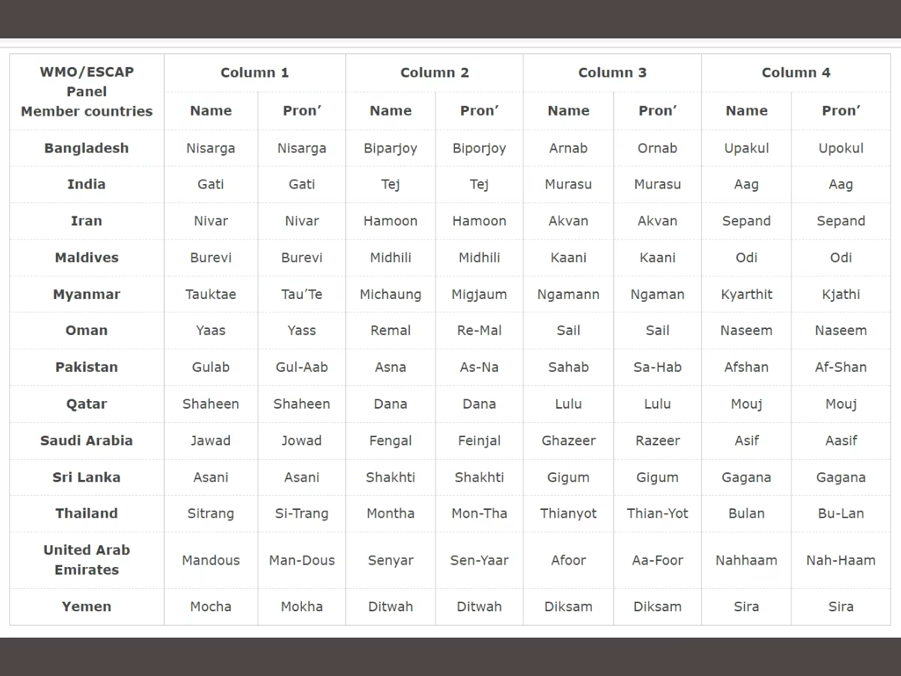
  • The World Meteorological Organization (WMO) oversees the management of rotating name lists tailored for each tropical cyclone basin. 
  • Cyclones arising in various ocean basins globally receive their names from regional specialized meteorological centers (RSMCs) and Tropical Cyclone Warning Centers (TCWCs) within those areas. 
  • There are a total of six RSMCs across the world.
  • Member nations of the RSMCs propose the names for tropical cyclones. For instance, the Indian RSMC, comprising 13 nations, puts forward 13 names each for cyclones formed in the region.
  • In the earlier practice, before the official adoption of naming conventions, tropical cyclones were named based on locations, objects, or the feast days of saints on which they occurred. 
  • The names will be used sequentially column wise. The first name will start from the first row of column one and continue sequentially to the last row in the column thirteen.
  • The names of tropical cyclones over the north Indian Ocean will not be repeated, once used it will cease to be used again. 
  • The name of a tropical cyclone from south China Sea which crosses Thailand and emerge into the Bay of Bengal as a Tropical cyclone will not be changed. 

Guidelines to adopt names of cyclones

  • The proposed name should be neutral to (a) politics and political figures (b) religious believes, (c) cultures and (d) gender.
  • Cyclone Biparjoy Tropical Cyclones Naming System Nomenclature Science  Behind Formation
  • Name should be chosen in such a way that it does not hurt the sentiments of any group of population over the globe
  • It should not be very rude and cruel in nature
  • It should be short, easy to pronounce and should not be offensive to any member
  • The maximum length of the name will be eight letters.
  • The proposed name should be provided with its pronunciation and voice over.
  • The names of tropical cyclones over the north Indian Ocean will not be repeated. Once used, it will cease to be used again. Thus, the name should be new.

Indonesia's Marapi volcano erupts

Context: Indonesia's Marapi volcano in West Sumatra erupted on Sunday, spewing volcanic ash as high as 3,000 m into the air. 

VOLCANISM & VOLCANICITY

  • A volcano on Earth is a vent or fissure in the crust through which lava, ash, rock and gases erupt.
  • Sometimes they can be preceded by emissions of steam and gas from small vents in the ground.
  • Nuée ardente, or pyroclastic flow is a fluidized mixture of hot gas and incandescent particles that sweeps down a volcano’s flanks, incinerating everything in its path.

VOLCANO ANATOMY

image

When volcanoes erupt, magma moves upward from a magma chamber and into a vent or conduit. It flows out from a crater at the top, or sometimes emerges at a secondary site on the side of the volcano resulting in a flank eruption. Erupted materials accumulate around the vent forming a volcanic mountain.

The accumulated material might consist of layers of solidified lava, called lava flows, but it might also include fragments of various sizes that have been thrown from the volcano.

MECHANISM & CAUSES OF VULCANISM

Mechanism of volcanism is closely associated with several interconnected processes.

  • Average increase of temperature with increasing depth at the rate of 25-32 degree Celsius per km.
  • Origin of magma due to lowering of melting point caused by reduction in the pressure of overlying super incumbent load.
  • Origin of gases and vapour due to heating of water which reaches underground through percolation.
  • Ascent of magma forced by enormous volume of gases and vapour.
  • Occurrence of volcanic eruptions.
Why Indonesian region experience so many volcanos?

5jjecxzw9pp5q1v 5fr2cv2iNqc9VZU9z 7iyWJeTFhmiln7voNPyF6F4ZqSvQPfdW 4F4F5B3 JYR ef8 tmZKCpnUFUEuVnZ5wBRpTHonM7 CNrBbv9NTmBzZT4RkAqbXmzEqzNOvUhggPMOt Cg

The region is located on one of the most volatile regions of the world experiencing intense tectonic convergence and subduction.
As the world's largest archipelago — spread across 17,500 islands — Indonesia sits between the world's most active seismic region — the notorious Pacific Ring of Fire — and the world's second most active region — the Alpide belt.
Being sandwiched between such seismicity has meant the islands experience some of the strongest earthquakes and most powerful volcanic eruptions. 

Asola Bhatti wildlife sanctuary

Context: Hearing a plea concerning encroachment and non-forest activities in the southern ridge forest, the Delhi High court was told by amicus curiae appointed in the matter that Delhi’s government’s forest department is going to organize a “cyclothon and walkathon” inside Asola wildlife sanctuary.

About Asola Bhatti Wildlife Sanctuary

Asola Bhatti Wildlife Sanctuary map
  • Asola-Bhatti Wildlife Sanctuary located on the south-eastern boundary of Delhi. 
  • It is the only protected area representing the northeastern, rolling outliers as a landform of the country’s oldest hill ranges, the Aravallis. Thus, it geographically represents a landform not earlier represented in the national Protected Area Network. 
  • This urban sanctuary could be a role model for all the conservation work undertaken by the Department of Forests & Wildlife GNCT of Delhi.
  • Note: Asola Bhatti Wildlife Sanctuary is the only wildlife sanctuary in Delhi. There are no national parks in Delhi. 

Climate

  • The climate of the sanctuary is mainly influenced by its remote inland position and prevalence of air of continental character, which is characterized by extreme summer heat alternating with great winter cold. 
  • Such a type of climate is unfavorable for the growth of luxuriant vegetation.
  • The climate is of semiarid nature due to marked diurnal differences of temperatures, high saturation deficit and moderately low rainfall.

Vegetation

  • The vegetation of Asola Bhatti is semi-arid thorny scrub and falls under Northern Tropical Thorn Forests type (Champion & Seth).
  • The native vegetation can be broadly classified into four forest (vegetation) types namely Dhau (Anogeissus pendula) Forest, Kumtha (Senegalia senegal) Forest, Palash (Butea monosperma) Forest and Grasslands representing native vegetation found on slopes of hills, degraded forests, forest in the valleys and savannah landscape in open areas respectively.
  • Keekar (Prosopis juliflora), which is native to Mexico, appears to have been established in barren, degraded areas, and areas near human settlements. Large thickets of Prosopis juliflora forms the main vegetal cover in the wildlife sanctuary.

Faunal Diversity

  • Mammals: Recorded 25 species of mammals including Leopard, Striped Hyena, Nilgai Golden Jackal, Jungle Cat, Ruddy Mongoose and Fruit Bat.
  • Birds: This wildlife sanctuary revealed the presence of 250 species and 2 subspecies, the presence of critically endangered Red-headed Vulture, endangered Egyptian Vulture, Steppe Eagle, vulnerable Greater Spotted Eagle and Indian Spotted Eagle.
  • Reptiles: 24 reptile species were recorded in our surveys including Indian Cobra, Saw-scaled Viper, Rock Python, Bengal Monitor Lizard (Varanus bengalensis), Leopard Gecko and Red Sand Boa.

Historical and Cultural Significance

  • Historical places around sanctuary are Surajkund and Anangpur Dam (both in Haryana), Tughlaqabad Fort and Adilabad ruins (both in Delhi), Chhatarpur Temple (in Delhi). 
  • There are several dozen lakes formed in the abandoned open pit mines in and around the sanctuary. 
  • It is contiguous to the seasonal waterfalls in Pali-Dhuaj-Kot villages of Faridabad and the sacred Mangar Bani.

Masai Mara

  • Maasai Mara, also sometimes spelled Masai Mara and locally known simply as The Mara, is a large national game reserve in Narok, Kenya, contiguous with the Serengeti National Park in Tanzania. 
  • It is named in honor of the Maasai people, the ancestral inhabitants of the area, who migrated to the area from the Nile Basin. 
  • Their description of the area when looked at from afar: "Mara" means "spotted" in the local Maasai language, due to the many short bushy trees which dot the landscape.
  • Maasai Mara is one of the wildlife conservation and wilderness areas in Africa, with its populations of lion, leopard, cheetah, and African bush elephant. 
  • It also hosts the Great Migration, which secured it as one of the Seven Natural Wonders of Africa, and as one of the ten Wonders of the World.

Serengeti National Park

  • Location: Eastern Mara Region and northeastern Simiyu Region and contains virgin savanna in northern Tanzania.
  • Serengeti is well known for largest annual animal migration in the world of over 1.5 million blue wildebeest and 250,000 zebras along with smaller herds of Thomson's gazelle and eland.
  • This national park is also home to the largest lion population in Africa. 
  • It is under threat from deforestation, population growth and ranching.

‘Ghol Fish’ - State Fish of Gujarat

Context: The black-spotted croaker, or the ghol fish — considered a fisherman’s lottery — was declared the state fish of Gujarat.

Why Declare a State Fish?

  • Every state can declare a state fish. 
  • Reasons for Gujarat:
    • Uniqueness of the fish species. This fish is not easily available. Catches that are reported are far and few between. 
    • The second factor is the economic value of the fish.
    • The government felt the need to conserve it and prevent it from over-exploitation.

About the Ghol Fish

Ghol Fish
  • IUCN Conservation Status: Near Threatened
  • Importance of Ghol Fish: 
    • Considered a delicacy in many countries. Hence it is in high demand in international markets. The meat of the fish is exported as frozen fillet or whole fish to European and Middle Eastern countries.
    • It is a marine fish
    • It’s air bladder - is mainly exported to China, Hong Kong and other Asian countries where it is in high demand for its medicinal values.
  • Distribution & Habitat
    • The blackspotted croaker has a wide Indo-Pacific distribution from the Persian Gulf east into the Pacific Ocean where it extends north to Japan and south to northern Australia. 
    • It is found in coastal waters, usually no deeper than 60 m (200 ft), over mud substrates. It occasionally enters estuaries and the tidal reaches of rivers.

CoP28 turns attention to potent Methane emissions

Context: Climate talks often revolve around reducing the most dangerous greenhouse gas, carbon dioxide (CO2). In the CoP28 meeting to be held in Dubai next week, along with CO2, the likely attention will be diverted to powerful heat-trapping emissions by Methane. 

About Methane:

  • Methane (CH4) is a colourless, odourless, flammable gas that is the main component of natural gas. Atmospheric methane (CH4) occurs abundantly in nature as the primary component of natural gas. 
  • It is a powerful greenhouse gas i.e., it traps heat in the atmosphere and contributes to global warming. It is the second largest contributor to climate change, accounting for around 16% of the warming effect.
  • Methane remains in the atmosphere for only about 12 years, but has a much more powerful warming impact than CO2.
  • Methane is about 21 times more potent than carbon dioxide (CO2) at trapping heat in the atmosphere over a 100 year timescale. This means that one tonne of methane emitted into the atmosphere has the same warming effect as 21 tonnes of CO2.
image 36

Sources:

  • There has been a steady increase of methane in the atmosphere, with concentrations currently over two-and-a-half times greater than pre-industrial levels.
  • Around 60% of methane emissions are linked to human activity, while most of the remainder is from wetlands.
  • Agriculture is the biggest emitter, responsible for roughly a quarter of emissions. Most of that is from livestock (cows and sheep release methane during digestion and in their manure) and rice cultivation, where flooded fields create ideal conditions for methane-emitting bacteria.
  • Energy sector - coal, oil, and gas - is the second largest source of human caused methane emissions. Methane leaks from energy infrastructure, such as gas pipelines, and from deliberate releases during maintenance.
  • Discarded household waste also releases large quantities of methane when it decomposes, if left to rot in landfills.
image 37

Way Forward:

  • A recent International Energy Agency report estimates that rapid cuts in methane emissions linked to the fossil fuel sector could prevent up to 0.1 degrees Celsius of warming by mid-century.
  • It could be achieved by repairing leaky infrastructure and eliminating routine flaring and venting during maintenance.
  • For rice fields, changes to water management are the “most promising” way to reduce emissions.

The Klyuchevskoy volcano

Context: The Klyuchevskoy volcano, one of the highest active volcanoes in the world, erupts in Russia’s northern Kamchatka Peninsula.

About The Klyuchevskoy volcano 

  • Klyuchevskaya Volcano, is an active volcano on the Kamchatka Peninsula, in far eastern Russia. 
  • Klyuchevskoy is one of the most active stratovolcanoes in Russia.
image 26
  • It is one of the highest active volcanoes (tallest active volcano in Eurasia) in the world, rising to a height of 15,584 feet (4,750 meters), the highest point on the peninsula. 

Stratovolcano

Stratovolcanoes have relatively steep sides and are more cone-shaped than shield volcanoes ( Shield Volcanoes - Where a volcano produces low viscosity, runny lava, it spreads far from the source and forms a volcano with gentle slopes) They are formed from viscous, sticky lava that does not flow easily. The lava therefore builds up around the vent forming a volcano with steep sides.

Stratovolcanoes are more likely to produce explosive eruptions due to gas building up in the viscous magma. Andesite (named after the Andes Mountains), is the most common rock type of stratovolcanoes, but stratovolcanoes also erupt a wide range of different rocks in different tectonic settings.

Kamchatka Peninsula

Location: It is located in far eastern Russia. It is bordered by the Sea of Okhotsk on the west and the Pacific Ocean and Bering Sea on the east. 

image 24

Mountain ranges: Two mountain ranges, the Sredinny (“Central”) and Vostochny (“Eastern”) extend along the peninsula. 

River: The trough between these mountain chains is occupied for much of its length by the Kamchatka River. 

Climate: The climate of the Kamchatka Peninsula is severe, with prolonged, cold, and snowy winters and wet, cool summers. Most of Kamchatka is tundra supporting mosses and lichens.

Economic Activity: Fishing is the only important economic activity, especially crabbing, around the coasts. There is limited agricultural activity and some cattle and reindeer are kept. The main centre is the city and port of Petropavlovsk-Kamchatsky, which is located on the southeastern coast of the peninsula. 

Inhabitants: Most of the inhabitants are Russian, with indigenous Koryak, Chukchi, and Kamchadal.

Pacific Ring of Fire: The Kamchatka Peninsula is the northern link in the 2000 km Kuril-Kamchatka island arc. This region contains 68 active volcanoes, over 10 percent of the total found on land anywhere on Earth. This arc is part of the "Ring of Fire," a string of volcanoes that encircles the Pacific Ocean.

image 25

Composite Water Management Index 

Context: As per reports NITI Aayog is planning to discontinue its key report i.e. ‘Composite Water Management Index’. In place, it is mooting the idea to bring some new indexes with wider coverage.

What is Composite Water Management Index?

  • The National Institution for Transforming India (NITI) Aayog has developed the Composite Water Management Index (CWMI) to enable effective water management in Indian states.
  • This coordinated exercise was led by the Water Resources Vertical within NITI Aayog and the data was then reviewed and verified by an Independent Validation Agency (IVA)—IPE Global.
  • The index was published in 2018. The Index uses water data from both central and state sources for three years—the base year FY 2015-16, FY 2016-2017, and the FY 17-18.

Aim

  • It represents a major step towards creating a culture of data-based decision-making for water in India, which can encourage “competitive and cooperative federalism” in the country’s water governance and management.

Indicator themes and weights

image 11

Key Findings

  • States are displaying progress in water management, but the overall performance remains well below what is required to adequately tackle India’s water challenges - ~80% of the states assessed on the Index have improved their water management scores. But worryingly, 16 out of the 27 states still score less than 50 points on the Index (out of 100), and fall in the low-performing category. 
  • High-performers continue to demonstrate strong water management practices, but low-performers are struggling to cope up - Top performers such as Gujarat, Andhra Pradesh, Madhya Pradesh, and Himachal Pradesh have further increased their scores. States like Jharkhand, Uttar Pradesh, Odisha, Bihar, Nagaland, and Meghalaya still score less than 40 points.
  • Large economic contributors have low water management scores - States like Uttar Pradesh, Rajasthan, Delhi and Kerala, who contribute majorly to the economic output of the country have low score. This highlights conflict between economic growth and conservation.
  • Food security is also at risk, given that large agricultural producers are struggling to manage their water resources effectively - None of the top 10 agricultural producers in India, except Gujarat and Madhya Pradesh, score more than 60 points on the CWMI.

Successful Case Studies

  • JAKHNI VILLAGE, BUNDELKHAND, UTTAR PRADESH - Jakhni village of Banda district in the Bundelkhand region was one of the most water-scarce regions of India. The area was witnessing heavy outgoing migration in search of water and better livelihood opportunities. But over the course of 5 years, villagers have drastically changed their water situation by putting rigorous efforts in water conservation such as construction of farm ponds, restoration /rejuvenation of water bodies, collection and utilization of grey water, raising of farm bunds, and intensive plantation of trees. The most inspiring fact is that the farmers of Jakhni undertook the entire work end-to-end without any external funding, machinery, or resources. Now, Jakhni village has developed to become a water self-sufficient village and is reaping the benefits of improved agricultural production. Once a drought prone village, now produces nearly 23,000 quintals of Basmati rice, and production of other crops has also increased many folds. Jakhani village serves as an excellent example for village water-budgeting modeled around collection and storage of rainwater within the village boundaries and utilizing it for life protection and economic development.
  • MUKHYA MANTRI JAL SWAVLAMBHAN ABHIYAN (MJSA), RAJASTHAN - Rajasthan’s Mukhya Mantri Jal Swavlambhan Abhiyan, launched in 2016, is a multi-stakeholder programme which aims to make villages self-sufficient in water through a participatory water management approach. After first phase there was 56% reduction in water supply through tankers and an average rise in the groundwater table by 4.66 feet in 21 non-desert districts of the states. 50,000 hectares of additional land had been made fit for cultivation in the districts and 64% of the installed hand-pumps had been rejuvenated.
  • NEERU-CHETTU PROGRAMME, ANDHRA PRADESH - The Andhra Pradesh government has launched the Neeru-Chettu programme as a part of its mission to make Andhra Pradesh a drought-proof state and reduce economic inequalities through better water conversation and management practices. The state has repaired about 7,000 farm ponds and over 22,000 check dams under the programme. Additionally, 102 lift irrigation schemes have been commissioned or revived by the state. Efforts under the Neeru-Chettu programme have enabled irrigation access to nearly 2,10,000 acres of land in the state. 
  • JALYUKT SHIVAR ABHIYAN, MAHARASHTRA - The Maharashtra government launched the Jalyukt Shivar Abhiyaan in 2015-16 with the mission to make Maharashtra drought-free by 2019, and an aim of making 5000 villages water scarcity free, every year. Programme initiatives have led to an increase in groundwater levels of 1.5 - 2 metres. Additionally, 11,000 villages have been declared drought-free and agricultural productivity has increased by 30-50%.
  • MISSION KAKATIYA, TELANGANA- Telangana’s flagship Mission Kakatiya programme, launched in 2014, aims to restore over 46,000 tanks across the state and bring over 20 lakh acres land under cultivation. The initiative has helped boost the water storage capacity of water bodies and enhance on-farm moisture retention capacity in the region. As per reports, Mission Kakatiya has also led to an increase in the gross area irrigated under tank ayacut by 51.5% compared to the base year.
  • SUJALAM SUFALAM YOJANA, GUJARAT- The Sujalam Sufalam Yojana is a water conservation scheme by the Gujarat government which focuses on deepening of water bodies before monsoons and increasing water storage for rainwater collection. After the programme’s success in 2018, the second edition was launched in 2019 in which the state increased its financial contribution to 60% for programme activities, requiring private entities to pay only the remaining 40%.
  • KAPIL DHARA YOJANA, MADHYA PRADESH - The Kapil Dhara Yojana by the state of Madhya Pradesh is a unique scheme under the MGNREGA programme to develop irrigation facilities on private land of small and marginal farmers, through the construction of dug wells, farm ponds, check dams, etc. The programme focuses on providing financial support to landholders without access to irrigation facilities and prioritizes marginalized communities to maximize impact. The programme has contributed to improved productivity, intensity, and diversity of crop production in the region and generated livelihood sources.
  • PANI BACHAO PAISE KAMAO, PUNJAB - The state of Punjab has introduced an innovative programme to break the water-energy nexus, under which farmers are being provided with a fixed electricity quota and receiving INR 4 per kilowatt hour for every unit of electricity saved through direct benefit transfers (DBTs). It provides a unique solution to the widespread problem of electricity and water wastage by farmers by encouraging them to be efficient in resource utilization through supplementary income upon being water efficient.