Mains Exhaustive

Asian Development Bank

Context: India inked a policy-based loan agreement with the Asian Development Bank (ADB), securing $400 million. The funds are earmarked to facilitate the development of high-quality urban infrastructure, enhance service delivery, and advance efficient governance systems, as outlined in a statement from the finance ministry.

More about the news: 

  • Sub-programme 1, sanctioned in 2021 with a budget of $350 million, laid the groundwork for national-level policies and guidelines aimed at enhancing urban services.
  • In parallel, the more recent sub-programme 2 is dedicated to supporting investment planning and reform initiatives at both the state and urban local body (ULB) levels. 
  • Specifically, sub-programme 2 aligns with the ongoing reforms led by states and ULBs to implement the national flagship program, Atal Mission for Rejuvenation and Urban Transformation (AMRUT) 2.0, which targets universal access to water supply and sanitation.
  • Urban Local Bodies will play a pivotal role in advancing modernization efforts, including building bylaw updates, land pooling, urban agglomeration, and comprehensive urban mobility planning with a focus on transit-oriented development.
  • These integrated planning processes incorporate climate and disaster resilience, promote nature-based solutions, enhance the urban environment, and boost cities' financial sustainability by generating additional revenues.
  • Cities will be incentivized to enhance their creditworthiness through reforms targeting increased revenues, such as property taxes and user charges, coupled with efficiency improvements and streamlined expenditures.
  • This strategic approach aims to empower cities to explore innovative financing avenues, including commercial borrowings, municipal bonds issuance, sub-sovereign debts, and public–private partnerships, thereby addressing significant deficits in urban infrastructure investments.

About Asian Development Bank:

  • Founded in December 1966, the Asian Development Bank (ADB) is a regional development bank with its headquarters situated in Mandaluyong, Manila, Philippines.
  • The bank extends its membership to countries within the UN Economic and Social Commission for Asia and the Pacific, as well as non-regional developed nations.
  • Drawing inspiration from the World Bank, the ADB closely mirrors its structure, featuring a comparable weighted voting system that aligns with the capital subscriptions of its members. 
  • This system ensures proportional representation in decision-making processes.
  • Furthermore, the ADB holds the distinction of being recognized as an official United Nations Observer.

Governance: 

  • At the apex of the bank's decision-making structure is the Board of Governors, comprising a representative from each member state.
  • From this assembly, the twelve members of the Board of Directors and their deputies are elected, with the Board of Governors themselves partaking in this selection.
  • Out of these twelve, eight are chosen from regional members in the Asia-Pacific area, while the remaining four are selected from non-regional members.
  • The Board of Governors is also responsible for the election of the bank's president, who serves as the chairperson of the Board of Directors and oversees the management of the ADB.
  • The president's term spans five years and is eligible for re-election.

Objectives and activities: 

The Asian Development Bank (ADB) characterizes itself as a social development organization committed to alleviating poverty in Asia and the Pacific through the promotion of inclusive economic growth, environmentally sustainable practices, and regional integration.

Key operational areas include:

  • Education: While there has been significant progress in primary education enrolment rates in many developing countries in Asia and the Pacific, persistent challenges threaten economic and social growth. The ADB focuses on addressing these challenges.
  • Environment, Climate Change, and Disaster Risk Management: Recognizing that environmental sustainability is fundamental to economic growth and poverty reduction in the region, the ADB actively engages in initiatives related to overall environmental conservation.
  • Finance Sector Development: This involves initiatives such as capital market development, support for microfinance, small and medium-sized enterprises, and regulatory reforms to benefit the most vulnerable populations.
  • Infrastructure: A critical focus area encompasses infrastructure development, spanning transport, communications, energy, water supply, sanitation, and urban development. 
  • Regional Cooperation and Integration: Introduced in 2004, regional cooperation and integration (RCI) is regarded as a longstanding priority. This process fosters stronger connections between national economies.

Financings:

  • The Asian Development Bank (ADB) extends ‘hard’ loans on commercial terms, primarily directed at middle-income countries in Asia.
  • It offers ‘soft’ loans to economically disadvantaged countries in the region, characterized by lower interest rates.
  • The ADB's Private Sector Department (PSOD) possesses the flexibility to provide a diverse array of financial instruments beyond commercial loans, including guarantees, equity, and mezzanine finance, which combines elements of both debt and equity.
  • Funding for ADB's operations is secured through various channels, notably by issuing bonds on the global capital markets.
  • Additionally, it relies on financial contributions from member countries, earnings retained from lending activities, and the repayment of loans.

Voting rights:

The Asian Development Bank's top 10 countries, ranked by their significant capital contributions and corresponding voting rights, are as follows:

  1. Japan (100.00)
  2. United States (12.751)
  3. China (12.751)
  4. India (5.437)
  5. Australia (4.913)
  6. Indonesia (4.641)
  7. Canada (4.469)
  8. South Korea (4.315)
  9. Germany (3.747)
  10. Malaysia (2.468)
image 22

ADB Strategy 2030:

  • Within this framework, the ADB commits to sustaining efforts to eliminate extreme poverty while expanding its vision to realize a prosperous, inclusive, resilient, and sustainable Asia and the Pacific.
  • Aligned with major global commitments, the ADB will play a pivotal role in advancing the global infrastructure development agenda, recognizing it as a catalyst for worldwide economic growth.
  • ADB will broaden its interventions in social sectors such as education, health, and social protection. The institution aims to integrate its expertise across diverse sectors and themes to effectively address complex development challenges.
  • As a trusted development partner, the ADB will enhance the value it provides to its developing member countries (DMCs) by combining financial support, knowledge dissemination, and fostering partnerships.
  • It will maintain its role as a reliable financier and catalyst for financial mobilization.
image 23

The Asian Development Bank's (ADB) support, encompassing public and private sector operations, advisory services, and knowledge initiatives, will be strategically focused on the following key operational priorities:

  1. Addressing Remaining Poverty and Reducing Inequalities: ADB will intensify efforts in human development and social inclusion, addressing non-income dimensions of poverty. Emphasis will be placed on facilitating quality job creation, particularly by small and medium-sized enterprises and inclusive businesses.
  2. Accelerating Progress in Gender Equality: ADB is committed to supporting operations that empower women and girls, actively mainstreaming gender considerations to narrow existing gaps. The goal is for at least 75% of ADB's committed operations to promote gender equality by 2030.
  3. Tackling Climate Change, Building Resilience, and Enhancing Environmental Sustainability: ADB aims to ensure that 75% of its committed operations actively contribute to climate change mitigation and adaptation by 2030.
  4. Making Cities More Liveable: ADB will undertake crosscutting projects to enhance urban health, mobility, gender equality, and environmental sustainability. This involves exploring new funding sources for cities, fostering inclusive urban planning, and integrating climate resilience and disaster risk management.
  5. Promoting Rural Development and Food Security: ADB will support efforts to improve market connectivity and agricultural value chain linkages, boosting both farm and nonfarm incomes. This includes promoting advanced technologies and climate-smart agricultural practices.
  6. Strengthening Governance and Institutional Capacity: ADB will assist in public management reforms to enhance governance, creating an environment conducive to sustainable growth. This involves building resilience, responding to economic shocks, improving service delivery, and enhancing capacity and standards, all while adhering to fiduciary standards and implementing anticorruption measures.
  7. Fostering Regional Cooperation and Integration: ADB will increase support for regional public goods and collective actions to mitigate cross-border risks. This includes strengthening subregional initiatives, enhancing financial sector cooperation, and facilitating knowledge sharing and collaboration.

Implementation: 

  • To implement this strategy effectively, ADB will develop operational plans for each of the seven priority areas, outlining specific engagement approaches and skill requirements. 
  • Country partnership strategies will further refine priorities at the country level.
  • The work program and budget framework process will be enhanced to align the annual work plan and resourcing with operational priorities.
  • A new corporate results framework will be established to monitor and measure implementation progress.
  • A "One ADB" approach will be instituted, consolidating knowledge and expertise across the organization to streamline the implementation of Strategy 2030.

Women & Judiciary

Context: A study of over 4 lakh FIRs in Haryana has found that not only are cases of violence against women, in which women are the primary complainants, less likely to be registered and more likely to be dismissed in court or result in acquittals. This is attributed to the limited presence of women in the legal process.

Key findings of the study

  • The study matched over 2.5 lakh FIRs with judicial records found on the e-courts website and found that women’s complaints are less likely to go from the police station to the judiciary.
  • There are fewer convictions about 5% for women and 17.9% for male complainants.
  • The study also found that women complaining of violence (VAW cases) wait longer at the police station before an FIR can be registered. While this wait has been pegged at 7 hours for all complainants, for women complaining of violence, the wait is 9 hours.
  • The study also found that on an average, women take more time to register an FIR.

Women’s participation in judiciary

  • At global level: According to the International Bar Association, women lawyers make up 51% of the profession but only occupy 32% of senior roles. In the judiciary, women make up 43% of all judges and hold 26% of all senior positions.
  • In India: According to India Justice Report (IJR) 2022, women make up approximately 35% of the total number of judges at the district court level, and around 13 at the high court level.

Importance of Women in the judiciary

  • Female judges often bring a heightened sensitivity to gender-related cases, including those involving domestic violence, sexual harassment, and discrimination. Their presence can lead to fairer and more informed decisions in such cases.
  • Women judges serve as role models for aspiring female lawyers and judges. They inspire and encourage more women to pursue legal careers and work towards breaking down gender barriers in the profession.
  • Bringing different perspectives and diverse reasoning on the bench creates greater public trust and confidence because it is more reflective of the composition of society
  • Women judges bring their unique life experiences and perspectives to the table. It integrates varied social contexts and experiences that need to be included, recognized and, most importantly, valued.

Reason for low participation of women in Judiciary

  • Gender bias and stereotypes: Deep-rooted gender bias and stereotypes persist in many societies, which can influence perceptions of women's abilities and roles. These biases may lead to skepticism about women's competence and suitability for judicial roles.
  • Lack of representation: When there are few women in leadership positions within the judiciary, it can be discouraging for women considering such careers. The absence of role models can make it difficult for women to envision themselves succeeding in these roles.
  • Gendered division of labor: Cultural and societal expectations often place a heavier burden on women for caregiving and domestic responsibilities. This can make it challenging for women to pursue demanding legal careers.
  • Discrimination and harassment: Some women in the legal profession may experience discrimination and sexual harassment, which can create a hostile work environment and deter them from pursuing judicial careers.
  • Gender-blind policies: Policies fail to consider the unique challenges women face, such as work-life balance, and implicit bias in hiring and promotion, that do not provide the necessary support, training, and resources to address these issues, resulting in the underrepresentation of women in the judiciary.
  • Lack of Women's Reservation:  While some states like Telangana, and Odisha etc. have implemented reservation policies to promote women's representation in the lower judiciary, there is no such provision in the High Courts and Supreme Court. 
  • Inadequate judicial infrastructure: Like the absence of restroom facilities, and the lack of childcare services, overcrowded and cramped small courtrooms serves as a hindrance to women.

Recommendations

  • Provide women lawyers with the tools and support they need to succeed in leadership roles, including:
    • creating a positive work environment
    • investing in measures directed at redistributing their care roles
    • taking steps to dispel common myths and stereotypes based on grounds of sex, gender, and race
  • Create formal processes and mechanisms to eliminate discrimination, violence, and harassment in the world of work such as: 
    • conducting audits to identify the prevalence of sexism and gendered violence and its risk factors
    • introducing legal protections and measures to support victims of domestic violence at work
    • creating formal reporting mechanisms
    • preventing reprisals against those who report such incidents  

Net Neutrality

Context: Net neutrality in India has been a subject of discussion, regulatory action, and public concern for several years. Content and service providers in India, including major technology companies, have been vocal supporters of net neutrality. On the other hand, Telecom Companies have been very vocal regarding the implementation of network usage fees depending on the consumption of bandwidth. 

Stakeholders in the Internet Space

  • There are four different kinds of stakeholders in the Internet space which include:
    • Consumers of any Internet service. 
    • Telecom Service Providers (TSPs/Telcos) or Internet Service Providers (ISPs), which provide connectivity to the Internet and charge subscribers for it.
    • Over-The-Top (OTT) service providers are streaming services that distribute content over the internet.
    • Government, which may regulate and define relationships between these players. Telecom Regulatory Authority of India (TRAI) is an independent regulator in the telecom sector, which mainly regulates TSPs and their licensing conditions, etc.

What is the demand of the Telecom companies (Telcos)?

  • Cost compensation:
    • Telcos have seen revenue from traditional streams such as voice calls and Short Message Service (SMS) come under pressure, as competing OTT services are often free.
    • Telcos have had to invest heavily in upgrading their infrastructure to handle increased data traffic, without necessarily seeing an equivalent rise in revenue.
  • OTT services are not subject to the same level of taxation and licensing fees, leading to an uneven playing field.
  • The Telecom companies have demanded that OTT content providers such as Netflix, Amazon Prime, and Disney+ Hotstar share in the costs of bandwidth. They argue that streaming platforms are free riders, benefiting from the infrastructure built and maintained by the telecom companies. 

However, this argument is fundamentally flawed and sets a dangerous precedent that undermines the principle of net neutrality.

What is Net Neutrality?

  • Net Neutrality is the principle that Internet access providers (ISPs) must treat all traffic originating from and terminating to the Internet equally without discrimination.
    • The modern articulation of the idea may be largely credited to Columbia Law School professor Tim Wu, who coined the term “net neutrality” in 2003 to promote an even playing field on the Internet.

Key principles and concepts of net neutrality:

  • Equal Access: All Internet users should have equal access to all lawful content, applications, and services on the Internet without any blocking or throttling of specific websites or services.
  • Non-Discrimination: ISPs should not discriminate against or favour particular internet traffic, services, or content based on factors like their source, ownership, or the type of data being transmitted. This means that ISPs should not give preferential treatment to their own services or those of affiliated companies.
  • No Paid Prioritization: Net neutrality opposes the practice of paid prioritisation, where ISPs would charge content providers or consumers for faster or better access to certain websites or online services. All internet traffic should be treated equally, regardless of whether extra fees are paid.
  • Open Internet: The concept of an open Internet is closely tied to net neutrality. An open internet is one where users can access and communicate with any lawful content or service, and where innovation and competition can thrive without artificial barriers.

Flawed arguments of Telcos that affect Net Neutrality: 

  • Telecom companies do not own the Internet; rather, they provide access to it. Consumers pay the telcos for access services by purchasing data plans. 
  • By offering services that consumers desire, OTT platforms generate demand for Internet access. The use of OTT services has led to a surge in data consumption, which is a growing revenue stream for telecom companies.
  • In the marketplace for Internet access, consumers are free to choose the provider that offers them the highest bandwidth, data volume, and reliability at an affordable price.
    • Telecom companies are at liberty to increase their prices which should go towards maintaining and upgrading their infrastructure. 
    • These are distinct markets because services from one are not substitutable for services in the other. Therefore, it is logical to maintain a separation of costs between these two markets.

Hence, the attempt of telcos to double dip by charging both consumers and content providers undermines net neutrality.

How Internet would be in the absence of Net Neutrality?

  • Monopolize Internet: In the absence of net neutrality, ISPs could exert greater control over internet traffic, allowing them to monetize specific online services. This would enable them to charge companies like YouTube and Netflix extra fees for their data-intensive content, in contrast to ordinary websites.
  • Cost passed on to consumers: If OTT platforms subscribe to the demands of the telcos, the incurred costs would trickle down to subscribers, either through increased subscription fees or degraded service quality for those platforms unwilling or unable to pay the charge. This outcome can only be detrimental to consumers who have come to rely on OTT services for entertainment, education, and professional pursuits.
  • Stifle Innovation: The absence of net neutrality could stifle web innovation. Startups would face a significant disadvantage compared to well-established corporations with the financial means to secure faster internet access. This might lead to a web dominated by a select few major players, hindering the development of an open and diverse online ecosystem.

Is there a law which enforces Net Neutrality in India? 

  • There are no laws enforcing net neutrality in India. Although TRAI guidelines for the Unified Access Service License promote net neutrality, it does not enforce it.
    • Indian telcos are bound by their license conditions to ensure net neutrality. 
  • The Information Technology Act 2000 also does not prohibit companies from throttling their service. 
  • In 2016, TRAI released a set of regulations known as the "Prohibition of Discriminatory Tariffs for Data Services Regulations" to uphold the principles of net neutrality.
    • Net neutrality formed the basis of TRAI’s regulation on the prohibition of discriminatory tariffs for data services brought out on February 8, 2016. The regulator’s action forced the withdrawal of Facebook’s Free Basics platform and some other offerings in India. 
    • Later, on November 28, 2017, TRAI released its comprehensive recommendations, which have largely guided the adoption of this principle in India.
  • The Body of European Regulators for Electronic Communications (BEREC) and TRAI adopted a Joint Statement for an Open Internet on June 14, 2018, later reaffirmed in 2020. The two organisations agreed through this memorandum of understanding to cooperate in developing technological and policy initiatives for net neutrality.

Way Forward

  • Increase prices of services by telcos if needed: Telcos may consider adjusting their pricing models to accommodate increased operational costs while still offering competitive services to consumers.
  • Advocate towards Open Internet: Upholding the principles of net neutrality is not merely about preserving the ethos of an open internet but is also intrinsic to fostering a conducive environment for innovation, competition, and consumer welfare, especially in countries such as India where the internet is going to be the carrier of all Digital Public Infrastructure (DPI). Promoting an open internet is essential for ensuring that everyone, including marginalised communities, has equal access to the benefits of the digital age. 
  • Devise a legal framework: Establishing a legal framework for net neutrality is crucial to provide a clear set of rules and guidelines that govern how ISPs and telcos should treat internet traffic. Legislation can help prevent discrimination, blocking, or throttling of certain content or services while allowing for reasonable network management practices. This framework should also outline penalties and enforcement mechanisms to deter violations.
  • Proactive approach by consumers: Consumers can play an active role in safeguarding net neutrality. They should be encouraged to report any instances of net neutrality violations, such as the blocking or throttling of specific websites or services by their ISPs. Consumer complaints and feedback can help regulatory authorities take action against violators and ensure compliance with net neutrality principles.

Antimicrobial Resistance (AMR)

Context: India is at the centre of the hidden epidemic of Antimicrobial resistance (AMR). There are over 1.2 million (12 lakhs) deaths globally and over 3 lakhs in India alone, due to drug-resistant infections and superbugs. 

What is Antimicrobial Resistance (AMR)?

  • Antimicrobial resistance is the resistance acquired by any microorganism (bacteria, viruses, fungi, parasite, etc.) against antimicrobial drugs (such as antibiotics, antifungals, antivirals, antimalarials) that are used to treat infections. 
  • As a result, standard treatments become ineffective, infections persist and may spread to others. Microorganisms that develop antimicrobial resistance are sometimes referred to as superbugs.
  • The World Health Organisation (WHO) has identified antimicrobial resistance (AMR) as one of the top threats to public health. 
image 63

What are the factors contributing to AMR?

  • Misuse of antibiotics by buying over-the-counter/wrong prescriptions. Widespread use of antibiotics over the last years due to COVID-19. 
  • Rampant use of antibiotics in agriculture and farming sector. E.g., Streptomycin used for treating Tuberculosis is used indiscriminately to grow fruits & vegetables, Colistin is mixed in poultry feed to make chickens grow faster.  
  • Untreated waste from pharmaceutical manufacturing sites and hospitals releases large amounts of active antimicrobials into the environment.
  • Incomplete courses of antimicrobial drugs may develop drug resistance. E.g., MDR-Tuberculosis. 
  • Lack of hygiene and sanitation, infrastructural standards such as quality of drinking water and sanitation levels also contribute to AMR. 
image 64

Govt. Initiatives to prevent AMR: 

1. Prevent counter-sale of Antibiotics: 

  • Antibiotics are included in Schedule H and H1 of the Drugs and Cosmetics Rules, 1945. These drugs have specific caution labelling requirements and are sold by retail only under the prescription of a Registered Medical Practitioner.
    • The supply of a drug specified in Schedule H1 is recorded in a separate register at the time of the supply and such records are maintained for three years and are open for inspection. 
    • Central Drugs Standard Control Organisation (CDSCO) has placed 24 hi-end antimicrobials under schedule H1 by issuing notification.

2. National Action Plan for containment of Antimicrobial Resistance: 

  • National Action Plan on containment of Antimicrobial Resistance (NAP-AMR) focusing on One Health Approach was launched in April 2017 involving various stakeholder ministries/departments. 
  • Delhi Declaration on AMR– an inter-ministerial consensus was signed by the ministers of the concerned ministries pledging their support in AMR containment.

3. Red Line Campaign:  

  • Launched in 2016 by the Ministry of Health and Family Welfare to create awareness among the public on AMR and avoid self-medication.
  • A red line is put on the packaging of two dozen antibiotics and antimicrobials identified by the Ministry, such that these should not be sold over the counter without prescription of a medical practitioner. 

4.  National Centre for Disease Control: 

  • Designated as the national coordinating centre for AMR activities in India.
  • Provides technical assistance to states and stakeholders in implementing the NAP-AMR, and monitors progress and impact of AMR interventions.

5. AMR Surveillance Network: 

  • Established by the Indian Council of Medical Research. 
  • Comprises a network of laboratories across the country to monitor trends and patterns of drug-resistant infections.

Conclusion: AMR is a global emergency that requires urgent, multi-sectoral intervention. Governments must enforce stricter regulation on antibiotic sales and distribution, in human medicine and agriculture. Countries must collaborate to share data, create unified strategies, and implement global responses to AMR.

Ghiyas-ud-din Balban (1216-1287)

Context: The Lieutenant Governor of Delhi unveiled six renovations in Mehrauli's Archaeological Park, with one of the monuments being the restoration of the 13th-century tomb of Balban.

About Ghiyas-ud-din Balban

Introduction:

image 6
  • Ghiyas-ud-din Balban, the ninth sultan of the Mamluk dynasty of Delhi and an Ilbari Turk, reigned from 1266 AD to 1287 AD.
  • Balban's journey to power began when he was initially sold as a slave to the then-ruler Iltumish in 1232 CE, only to be later freed by him.
  • During his rule, Ghiyas achieved various conquests, including subduing the troublesome inhabitants of Mewat, reclaiming Bengal, and successfully defending against the Mongol threat, though it came at the cost of his son's life.

Early Life: 

  • Initially, he served as the Sultan's personal attendant or Khasdar and swiftly became one of the most distinguished members of the Chalissa, a group of forty Turkic nobles in Delhi.
  • During Razia Sultan's reign, he held the significant position of Amir-i-Shikar, responsible for both military and political duties. 
  • Balban played a pivotal role in the overthrow of Alaud-din Masud and the installation of Nasiruddin Mahmud as Sultan, subsequently serving as the Wazir from 1246 to 1265.
  • During Nasiruddin Mahmud's reign, he was granted the titles of Amiri-Hajib and Naib-i-Mamlakat, signifying his significant role in the administration.

Military Campaigns: 

  • Balban relied on the Turkish nobility for support but also raised a massive army of 2 lakh troops, encompassing individuals from various castes.
  • He identified four main problem areas: the vicinity of Delhi, the Ganga-Yamuna doab, trade routes, especially the one to Awadh, and rebellions in Rohilkhand.

Balban achieved several military feats:

  • He successfully lifted the Mongol siege of Uch under Masud Shah in 1246.
  • When the governor of Bengal, Tughral Khan, challenged Delhi's authority in 1275, Balban initially dispatched the governor of Awadh and later a second army, both of which failed. Balban personally led a third army, ultimately reclaiming the region and eliminating Tughral and his followers, with the assistance of his son, Nasiruddin Bughra Khan. Subsequently, Balban appointed his second son, Bughra Khan, as the governor, who declared independence after Balban's death, maintaining it for four decades. 
  • Balban's military campaign against the Meo people of Mewat stands out as a significant endeavour. These raiders had been terrorizing the residents of Delhi, even in broad daylight. To quell this threat, Balban implemented his ‘Blood and Iron’ strategy. This involved a year-long effort to subdue the Meos, during which forests were cleared to eliminate their hiding spots, leading to a substantial reduction in their numbers. To further secure the region, Balban oversaw the construction of forts in the affected areas and granted control to iqtedar holders.

Reign as Sultan:

  • During Balban's reign, his governance was marked by the establishment of an unwavering ‘Fear of the governing power,’ which he considered the fundamental basis for effective rule. 
  • To ensure unwavering loyalty to the crown, he implemented an efficient espionage system, modelled after the Umayyad Barid. This included the use of spies or barids to monitor his officials, who were placed under independent authority and answered solely to the Sultan.
  • Balban imposed severe punishments for any mishaps, even towards his nobles, and did not spare their own slaves. For instance, Malik Baqbaq, the governor of Budaun, was disciplined for ordering a slave to be beaten to death while intoxicated.
  • Balban also addressed the threat of the Mongols by reorganizing the military and restructuring the revenues of Iqtedar holders, discontinuing them for older Muqtas who could not serve as military commanders.
  • Balban was openly vocal about his concept of kingship, referring to himself as the representative of God on Earth and adopting the title 'Zillullah' or 'shadow of God.' His theory of kingship was based on the notion that a king's power emanated solely from God, making his actions beyond public scrutiny.
  • Balban maintained a notable distance from the common masses, forgoing public drinking and never appearing in court without his full regalia.
  • He introduced the Persian festival of Nowruz and enforced customs like 'Sijda' and 'Paibos' in his court to instil a sense of wonder among ordinary people.
  • Balban took a stern approach to rule, breaking up the 'Chahalgani,' a group of the forty most influential nobles in the court. He promoted junior Turkish officers to positions of equality with the members of the Chalisa Dal. 

After his Death:

  • Ghiyas ud din Balban served as Sultan from 1265 until his demise in 1287.
  • Balban's elder son, Prince Muhammad Khan, lost his life in a battle against the Mongols.
  • Balban selected his grandson, Kaikhasrau, the son of Prince Muhammad, as his designated heir.
  • However, after Balban's passing, his nobles instead nominated Qaiqubad as the new Sultan. 
  • Qaiqubad's reign lasted from 1287 to 1290, during which Bughra Khan asserted his independence in Bengal.
  • After Qaiqubad’s death, leadership was passed to his three-year-old son, Shamsuddin Kayumar. However, Shamsuddin Kayumars was later deposed by his guardian, Jalal-ud din Firoz Khalji, in 1290, marking the end of the Slave dynasty.
image 7

Tomb of Balban

  • Balban's Tomb is housed within the archaeological park, and it was originally constructed by the Sultan himself, known as the Dar-ul-Amaan or the Haven of Safety.
  • This tomb is historically significant as it represents the earliest example of Indo-Islamic architectural style in India, although its existence was only unearthed in the mid-20th century.
  • Near Balban's tomb lies the resting place of his son, Khan Shahid or Mahmud, who died in 1285 AD while battling the Mongols. Mahmud's tomb is adorned with exquisite Persian calligraphy.
  • Balban's tomb is noteworthy for being the first structure in India to feature true arches, constructed using a circular arrangement of stones.
    • This architectural innovation was novel in Indian architecture at the time. 
  • The tomb was built using rubble masonry and it also demonstrates a fusion of Hindu and Islamic art in its construction.

India-Qatar Relations

Context: The recent death sentence for eight Indian individuals accused of espionage in Qatar has deeply shocked the Ministry of External Affairs. This situation is a significant test for the government's diplomatic skills. The trial was highly secretive, with limited information on charges and evidence. Indian officials' efforts to seek leniency and transparency have been ineffective. Strained ties resulting from this sentencing would harm both nations. The Indian government must act swiftly to provide strong support during the appeals process for these citizens.

India-Qatar Relations

About Indian and Qatar relations

  • Throughout the 20th century, India's interactions with Qatar were primarily centred around a modest yet thriving pearl import trade and the export of spices.
  • The turning point for Qatar came with the discovery of onshore Dukhan oil field in 1940, followed by the country's first offshore oil field two decades later, coinciding with a substantial increase in global oil prices.

Economic Ties

  • In recent years, the trade volume between India and Qatar has experienced noticeable fluctuations
  •  During the fiscal year 2015-2016, trade exchange between the State of Qatar and the Republic of India saw impressive growth, reaching a remarkable $10 billion.
  • However, in the past few years, there has been a noticeable decline in the trade volume between the two countries due to the decreasing rates of gas and oil in the international market.

Trade Statistics and Import Dependence

  • In the fiscal year 2022-23, India's total imports from Qatar amounted to $16.81 billion.
  • India's major imports from Qatar are related to fossil fuels, including liquefied petroleum gas (LPG), plastics, and petrochemical products.
  • In contrast, India's exports to Qatar were valued at just $1.97 billion during the same fiscal year, encompassing items such as cereals, copper articles, iron and steel products, vegetables, fruits, spices, and processed food items.

Investment Interests and Collaborative Projects

  • Qatari authorities, including the Qatar Investment Authority, have expressed their interest in making investments in India, particularly in infrastructure development, encompassing roads, highways, economic corridors, in addition to projects related to gas and fertilizers.
  • In return, India is keen on direct investments in the manufacturing and production of liquefied natural gas and associated chemical industries, with a special focus on fertilizer production, urea, petrochemicals, and infrastructure projects related to the natural gas industry, oil drilling, minerals, and power.

India's Growing Energy Needs

  • Given India's economic development and the tangible growth experienced in recent years, the nation's demand for energy sources is on the rise.
  • India has adopted an ‘Energy Security’ policy, relying on politically and socially stable countries to provide energy sources.
  • The energy partnership traces back to an agreement signed by both nations in 1990, wherein India committed to purchasing 7.5 million tonnes of LNG annually over a 25-year period.
  • Subsequently, in December 2015, both parties further solidified their collaboration by agreeing that Qatar would augment its LNG supply to India by an additional one million tonnes annually.

Collaboration in Defence Affairs

  • India's engagement in defence collaboration with Qatar has predominantly focused on training, participation in each other's conferences and events, as well as visits by Indian Navy and Coast Guard vessels.
  • A notable instance of this collaboration is evident in the naval exercise termed ‘Zair-Al-Bahr’ (Roar of the Sea), which signifies a significant joint effort between the Indian and Qatari Navies.
  • Both India and Qatar have expressed a mutual commitment to working together in combatting the financing of terrorism.

Cultural Interaction

  • Indian Cultural Centre (ICC) functions as the leading organization overseeing Indian community associations, operating under the auspices of the Embassy of India in Doha and benefiting from support by private sponsors.
  • India places immense significance on Qatar's role as a co-sponsor of a United Nations General Assembly Resolution, a historic unanimous resolution backed by 177 co-sponsors, which designates June 21 as the International Day of Yoga (IDY).

Indian Diaspora in Qatar

  • The Indian community in Qatar constitutes the largest expatriate group, estimated to be approximately 700,000 strong.
  • Their contributions span various sectors, with notable involvement in projects related to the preparation of the Qatar 2022 FIFA World Cup.
  • The remittances sent by the Indian expatriate community in Qatar to India are estimated to be approximately 750 million dollars annually.

Irreplaceable Role of Qatar as an LNG Supplier

The linchpin of this bilateral trade relationship remains liquefied natural gas (LNG), with Qatar supplying 80% of India's LNG needs. This critical energy connection underscores the importance of India's economic ties with Qatar, even if the overall value of bilateral trade may appear modest in comparison to the United Arab Emirates (UAE).

1.Trade Imbalance:

In the case of India and Qatar, trade significantly favours Qatar. This trade imbalance is predominantly attributed to the prominence of natural gas, particularly LNG. LNG not only constitutes a substantial portion of India's imports from Qatar but also represents nearly 50% of India's total imports in terms of value from the country.

2. India's Increasing Reliance:

The Indian government is actively promoting increased natural gas consumption, this reliance is expected to grow in the coming years, even with a potential increase in domestic natural gas production. India's largest LNG importer, the government-owned Petronet LNG, has a substantial long-term contract with Qatar for LNG imports. As India aims to raise the share of natural gas in its primary energy mix to 15% by 2030, it's inevitable that LNG imports will see a substantial increase.

3. Cleaner Energy Alternative:

Natural gas is regarded as a cleaner and more cost-effective alternative to traditional petroleum fuels like diesel and petrol. Given India's high dependency on crude oil imports (over 85%), natural gas not only offers a cleaner energy source but also aligns with India's energy transition objectives. Consequently, the case of the Indian naval personnel facing the death penalty in Qatar presents a delicate diplomatic challenge, as the secure supply of natural gas is pivotal to India's energy security.

4. Qatar's Dominance:

India imported a total of 19.85 million tonnes of LNG in the fiscal year 2022-23, with approximately 54% of this LNG. This significant reliance on Qatar, both through long-term contracts and spot purchases, underscores the challenge of diversifying India's sources of LNG.

5. Qatar's Strength in the Global LNG Market:

In the global LNG market, Qatar holds a unique position of strength, particularly in the wake of Russia's invasion of Ukraine and the subsequent disruption in Russian natural gas supplies to Europe. This geopolitical situation has increased price volatility in LNG spot cargoes, making long-term contracts more attractive for securing stable supplies. Qatar, as the world's largest LNG exporter, has capitalized on this trend by entering into numerous long-term LNG supply agreements with various countries.

India, recognizing the need for energy security and price stability, is actively pursuing long-term LNG contracts with major suppliers, with Qatar being a prominent choice. Despite the possibility of the global LNG market transitioning into a buyer's market due to upcoming export projects, India's continued dependence on Qatar is expected to persist for several years.

Leveraging Opportunities for Enhanced Relations

  • Protection of Indian Expatriate Workers: India should prioritize negotiations to safeguard the rights and well-being of its expatriate workers in Qatar, many of whom have faced labor-related challenges.
  • Collaboration on Environmental Sustainability: India and Qatar can work together to develop a cleaner and more energy-efficient environment.
  • Cultural Exchange and Soft Power: Given the popularity of Bollywood among Qataris, India should explore additional avenues for cultural exchange to bolster its soft power influence.
  • Education Sector Cooperation: The presence of Western universities in Qatar offers an opportunity for Indian students to receive quality education abroad without the usual long distances and high living costs. Strengthening cooperation in the education sector could further enhance the India-Qatar relationship, which has demonstrated resilience throughout the seemingly intractable diplomatic crisis.

Primary Health Centre (PHC)

Context: This editorial emphasize on ‘Ayushman Bharat Scheme’. The launch of this  flagship health program i.e. Ayushman Bharat, in 2018, the Indian government has consistently emphasized the importance of enhancing medical accessibility, particularly in rural areas. This initiative aims to transform 150,000 public health centers (PHCs) into health and wellness centers (HWCs) to "bring healthcare closer to people's homes." It was evident from the beginning that achieving this goal would necessitate addressing the chronic shortages of doctors, frontline medical professionals, and healthcare infrastructure.

Given that healthcare falls under the purview of individual states in India, the central government's commitment to this endeavour necessitates a corresponding commitment from state governments. Unfortunately, most states that have traditionally lagged behind on welfare indicators have not adequately risen to this challenge.

The latest edition of the Centre’s Rural Health Statistics shows that the medical system outside urban areas continues to be plagued by a shortfall of doctors and infrastructure. Barely 45 per cent PHCs adhere to their mandate of functioning 24×7.A study published in The Lancet in February placed UP among the five states where district hospitals offer only 1 per cent of the basic services.

About Primary Health Centre (PHC)

  • PHCs are the cornerstone of rural health services- a first port of call to a qualified doctor of the public sector in rural areas for the sick and those who directly report or are referred from Sub-Centres for curative, preventive and promotive health care
  • The concept of Primary Health Centre (PHC) is not new to India. The Bhore Committee in 1946 gave the concept of PHC as a basic health unit to provide as close to the people as possible, an integrated curative and preventive health care to the rural population with emphasis on preventive and promotive aspects of health care.
  • The Government of India's initiative to create and expand the presences of Primary Health Centres throughout the country is consistent with the eight elements of primary health care outlined in the Alma-Ata declaration. 

Examples of primary health care services include routine check-ups, immunizations, screening tests, chronic disease management, and referrals to specialists when needed. Primary health care providers can include general practitioners, nurse practitioners, midwives, and community health workers.

Why primary health care is so important

  • Promotes preventative care: Primary health care helps prevent illness and disease by promoting healthy living, encouraging vaccinations, and providing regular check-ups and screenings.
  • Increases accessibility: Primary health care is often the most accessible form of healthcare, as it is typically delivered in local clinics or health centers that are close to where people live and work.

The share of primary healthcare in Current Government Health Expenditure (CGHE) has increased from 51.3% in 2014-15 to 55.9% in 2019-20. The increased focus on primary healthcare reinforces the government’s decisions to prioritize primary healthcare in the country.

image 79
Figure: Share of Primary Health Care in Current Government Health Expenditure (%)
  • Reduces healthcare costs: Early detection and management of illnesses through primary health care can reduce the need for more expensive and specialized care, ultimately saving individuals and healthcare systems money.( It reduces the need for expensive secondary and tertiary healthcare.)
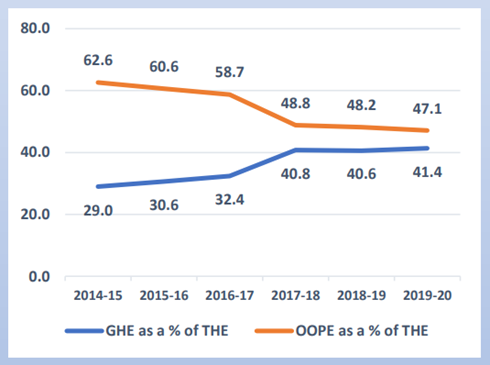
    • Acc to  National Health Accounts Estimates for India (2019-20)- Strengthening the PHC and focusing on preventive care will reduce the Out-of-Pocket Expenditure. The share of Out-of-Pocket Expenditure (OOPE) in total Health Expenditure (THE) declined from 62.6% to 47.1%. The continuous decline in the OOPE in the overall health spending show progress towards ensuring financial protection and Universal Health Coverage for citizens.

lLgAHDJMST2dss3HtvL1S1Q83tXZuTJfXuAXh2FTLTNbcXxUzzqP5TxmV8EE8e KKNj0HFshipwQWRyMAiqMXAVCOfQ6GZpeS y1 cZ9 Xc8nyw5NYb2aZQp9zX692lEsXR6FPWImTOAAkhBu1PwIQ

Figure 2: Government Health Expenditure and Out-of-pocket expenditure as % of Total Health Expenditure (%)

  • Improves overall health outcomes: By providing comprehensive and continuous care, primary health care can help manage chronic conditions and improve overall health outcomes, including reducing mortality rates.
  • Addresses health inequalities: Primary health care can help address health inequalities by providing equitable access to healthcare services regardless of income, race, gender, or location.
  • Primary health related to Climate Change: Primary health care has an important role in responding to the climate change related threats to human health like injuries related to extreme weather events like storms, fires and floods; infectious disease outbreaks due to changing patterns of vector borne diseases; poor nutrition from reduced food availability because of drought; the psychological impact due to displacement of communities.  
  • Primary healthcare in developed nations: The majority of developed countries' federal healthcare budgets go towards primary care, including the UK, Australia, Canada, the Netherlands, and Sweden.

Problems of PHC in India

  • Limited in scope- The existing primary healthcare model in the country covers only 15% of the health issues people seek care for, primarily related to pregnancy, limited childcare, and national health programs. Expanding its scope is essential for comprehensive healthcare coverage.
  • Funding: The funding for general healthcare is quite low, leaving insufficient funds for primary healthcare.
The central and state governments’ budgeted expenditure on healthcare touched 2.1 % of GDP in FY23 which was substantially lower that other BRICS countries (Brazil: 3.8%, China: 3.1%, Russia: 3.7%, South Africa: 4.2%)
  • Inadequate Infrastructure: According to the National Health Profile 2019 report, 22% of primary health centers do not have a separate room for immunization and family planning services.
In Rajasthan, the population is often so dispersed (especially in hilly areas in the south and in the desert in the west) that a family may need to travel 10-20 km to reach the nearest PHC according to an analysis by the Centre for Economic and International.
  • Shortage of Healthcare Professionals: The delivery of quality health services is hampered by supply shortages, inadequate management, and the absence of proper training and supervision for healthcare workers. These issues can lead to interruptions in care, inefficiency, and outdated practices, all of which impact patient well-being.
The rural healthcare infrastructure is three-tiered and includes a sub-center, primary health center (PHC) and CHC. Indian PHCs are short of more than 3,000 doctors, with the shortage up by 200% over the last 10 years to 27,421, as IndiaSpend reported in 2016.

Lack of Access to Medicines:

The high cost of medicines is a significant barrier to healthcare access in India, with many people unable to afford even basic medications.

The government's free medicines program, which provides essential medicines to patients for free, has been plagued by shortages and supply chain issues.

The lack of access to medicines has led to many patients turning to unlicensed and unregulated pharmacies, which may sell substandard or counterfeit drugs.

Poor Quality of Care:

A study published in the Lancet found that around 50% of patients in India do not receive the appropriate care for their health conditions.

The lack of quality healthcare services is due to a range of factors, including a shortage of qualified healthcare professionals, inadequate infrastructure, and poor regulation of healthcare providers.

In addition, many patients in India lack awareness about their health conditions and may not seek timely medical treatment, leading to complications and poor health outcomes.

An analysis by the Centre for Economic and International - India has a large network of primary health centres (PHCs), each supposed to serve a population of 25,000. In many poor states, such as Madhya Pradesh, Bihar and Jharkhand, however, a PHC covers as many as 45,000, 49,000 and 76,000 people.
  • Under-investment in primary healthcare : also means that PHCs continue to remain under-equipped and lacking supplies and drugs to provide comprehensive primary care. 
For example, of the 709 PHCs surveyed in 2009 by the International Institute for Population Sciences, Mumbai, about 24% did not have an electricity connection and 63% did not have piped water supply.

At the same time, PHCs are expected to deliver centrally designed, targeted vertical programs, alienating them further from communities. As a result, even those families that can access PHCs continue to look elsewhere for their critical healthcare needs.

  • Urban Neglect in Indian Healthcare System: The primary healthcare system in India has historically overlooked the growing urban population, as its focus has mainly been on rural areas. This neglect stems from historical policies and infrastructure designed for rural regions, despite the increasing urban population. 

Way Forward

  • Srinath Reddy committee recommendation: The High-Level Expert Group (HLEG) on Universal Health Coverage (UHC) headed by K. Srinath Reddy recommended that expenditures on primary health care, including general health information and promotion, curative services at the primary level, screening for risk factors at the population level, and cost-effective treatment, targeted toward specific risk factors, should account for at least 70% of all health care expenditures. 
  • Ayushman Bharat scheme seeks to upgrade more than 1.5 lakh health facilities like Sub Centres and Primary Health Centres to health and wellness Centres (HWC).  These centres would deliver Comprehensive Primary Health Care (CPHC) bringing healthcare closer to the homes of people. This has to be implemented properly. 
  • Telemedicine: Telemedicine provides patients remote access to medical consultations and treatments via telecommunications technology. In turn, this contributes to closing the gaps in healthcare access, particularly in rural and remote areas. Telemedicine has proven to be a boon for Indians during the uncertain times of lockdowns, and it has the potential to make remote, optimized healthcare accessible to every corner of India in the future.
  • Health Information Exchange (HIE): HIE systems enable the seamless sharing of patient health information between various healthcare providers, enhancing care coordination and substantially reducing medical errors.
  • Mobile Health (mHealth): mHealth is an emerging concept involving the utilization of mobile devices and technology for health services, such as appointment scheduling, remote monitoring, and medication reminders. It can significantly improve patient access to care and treatment plan adherence.
  • Government must increase budgetary allocations to healthcare to at least 3-4% of GDP so that public expenditure on healthcare is at least 70% of total health expenditure.

Enhancing India's Higher Education Ecosystem: The Need for Reformed Student Visa Policies

Why is it necessary to focus on attracting international students to India?

Annually, around 7.5 lakh Indian students seek education abroad, leading to a surge in private universities aiming to meet this demand. While these institutions have succeeded in attracting foreign faculty, they face challenges in bringing in international students. This limits the cross-cultural exposure essential in modern education. To address this gap, India's National Education Policy 2020 focuses on internationalization. It advocates curricular improvements, campuses open to foreign scholars and students, and joint degree programs with foreign institutions. These changes aim to enhance the competitiveness and inclusiveness of Indian higher education.

Further, Strategies to enhance attraction of International Students in India:

  • Fostering Post-Education Opportunities: One drawback for international students studying in India is that, despite the country's thriving corporate and start-up sectors, they are unable to obtain work experience while pursuing their degrees. This is a significant obstacle for many such students. It is necessary to change India's "S" Visa or student policy in order to address this.
  • Creating a Talent Ecosystem : Many Indian organisations are multinationals or aspire to be multinationals, thus they need staff that understands Indian markets, business etiquette, rules, and culture in-depth. These enterprises can create a network of international talent that acts as a cultural bridge by hiring foreign talent from Indian campuses and employing Indian graduates who are returning home.

For Eg- The big three US tech companies — Google, Meta, and Microsoft — are all headed by Indian alumni of US universities. Former Afghan President Hamid Karzai who studied in India kept bilateral relations warm through difficult times.

  • Addressing Workforce Challenges : Concerns that foreign students may take jobs away from Indian students are unfounded. India’s population growth has dipped below the replacement rate of 2.1 per cent, and the country will begin ageing soon, like China, according to the UN Population Fund. India's declining population growth and impending aging population mean that a dwindling working-age population will soon become a reality. Sustaining growth under these circumstances requires innovative solutions.
  • Learning from Global Practices : Countries like the US, UK, Australia, New Zealand, and Canada have successfully addressed workforce challenges by offering post-study student work visas. Europe, on the other hand, has focused on migration, bringing about political implications. India has the opportunity to learn from these diverse approaches.
  • Expansion of Student Work Visas: An expanded provision of student work visas can unlock several advantages, including accommodating the 4,000 scholarships offered to foreigners annually under various Indian programs. It can also facilitate field experience for foreign students in areas like mining and agriculture.
  • Strategies for Advancing Higher Education as an Export Industry in India:

Prime Minister Narendra Modi has identified higher education as a key export sector.

So, to unlock the full potential of internationalization in higher education, India must amend its student visa policies. This involves multi-ministry coordination, encompassing the Ministry of Home Affairs, Ministry of Finance, Ministry of Education, and active involvement from Indian multinational companies and business chambers.

In conclusion, reformed student visa policies will not only boost India's higher education but also create a sustainable talent ecosystem that benefits the nation's economic and cultural exchange.

Cannot legalise same-sex marriage: SC

Context: A five-judge Constitution Bench of the Supreme Court headed by Chief Justice of India (CJI) refused to grant legal status to same-sex marriages. 

Four key issues: 

The judgement revolved around the four key questions: 

  1. Whether there is a fundamental right to marriage in India?
  2. Whether the words in the Special Marriage Act 1954 could be given a gender-neutral meaning?
  3. The question over queer couples’ right to adopt a child. 
  4. Whether a civil union be realised under Indian law?

Evolution of Rights for Homo-sexuals:

Some key milestones:

  • 2014: National Legal Services Authority vs. Union of India: A significant development occurred with the Supreme Court of India recognizing transgender people as a third gender. This landmark judgment acknowledged their rights and provided legal recognition and protection to the transgender community.
  • 2017: Justice K. S. Puttaswamy vs. Union Of India: Another important step was taken in 2017 when the Supreme Court of India ruled that privacy is a fundamental right. This decision had far-reaching implications for the LGBTQ+ community as it paved the way for greater recognition and protection of their rights to privacy and personal autonomy.
  • 2018: Navtej Singh Johar vs. Union of India: In a historic verdict, the Supreme Court of India struck down the colonial-era law known as Section 377 of the Indian Penal Code. This law criminalized consensual same-sex relationships, and its decriminalization was a crucial step towards ensuring equality and dignity for homosexual individuals. The judgment emphasized that sexual orientation is an inherent aspect of an individual's identity and discrimination based on it is a violation of fundamental rights.
  • 2022: Supreme Court noted that all types of atypical family units (single parents, transgenders, same-sex couples) are also entitled to legal recognition and protection under various social welfare legislation like typical heterosexual family units.

Key issues

1. Right to Marry:

  • Petition: The petitioners had argued that there exists a fundamental right to marry a person of one’s own choice under the Constitution and that the court must address the denial of that right. If the court recognised this as a fundamental right (like it did in the case of privacy in the 2017 Aadhaar ruling), then it would cast an obligation on the state to protect this right.
  • The majority view upheld that the right to marriage is not a fundamental right. SC has underlined that the issue of same-sex marriage can only be resolved through the legislative route. However, the right to enter into a union/relationship is unrelated to sexual orientation and is a feature of fundamental rights in Articles 19 and 21.
    • Present status: Govt. has already acknowledged the right to love, the right to cohabit, the right to choose one’s partner, right to one’s sexual orientation as fundamental rights under Artice 21.

2. Interpretation of Special Marriage Act 1954:

  • Petition: The SMA was enacted in 1954 to enable marriage between inter-faith or inter-caste couples without them giving up their religious identity or resorting to conversion. The petitioners had asked the SC to recognise same-sex marriage by allowing a gender-neutral interpretation of the legislation that governs a civil marriage, in which the state rather than religion, sanctions the marriage. The petitioners had asked the SC to interpret the word marriage as between “spouses” instead of “man and woman”. Alternatively, the petitioners had asked for striking down provisions of the SMA that are gender-restrictive.
  • The majority ruling stated that the court could not interpret the SMA to include same-sex couples since the objective of the legislation is not to include same-sex couples within the realm of marriage. The provisions and the objects of the SMA clearly point to the circumstance that Parliament intended only one kind of couples, i.e., heterosexual couples belonging to different faiths, to be given the facility of a civil marriage.
image 53

3. Queer couples’ right to adopt a child:

  • Petition: The petitioners had argued that the guidelines of the Central Adoption Resource Authority (CARA), which does not allow unmarried couples to jointly adopt children, are discriminatory against queer couples who cannot legally marry.
    • The guidelines allow only a couple who have been in at least two years of a stable marital relationship to be eligible to adopt.
    • Individually, queer persons can adopt as single people. However, a single male is not eligible to adopt a girl child — even though a single female is eligible to adopt a child of any gender.
  • The majority view largely agreed with the discriminatory aspects of preventing queer couples from adopting children, and that couples tied together in marriage are not a ‘morally superior choice’, or per se make better parents. But the majority view said that this change cannot be “achieved by the judicial pen”, rather the remedy is to be provided by legislature. 
    • The fact that Parliament has made the legislative choice of including only ‘married’ couples for joint adoption (i.e., where two parents are legally responsible), arises from the reality of all other laws wherein protections and entitlements flow from the institution of marriage. 

4. Civil unions for queer couples:

  • Petition: Before full marriage rights were recognised for same-sex couples by the US Supreme Court, several states had allowed civil unions. However, the petitioners argued that civil unions are not an equal alternative to the legal and social institution of marriage, and relegating non-heterosexual relationships to civil unions would send the queer community a message that their relationships were inferior to those of heterosexual couples.
  • The majority view disagreed that the court can prescribe a choice of civil unions to queer people. It is difficult to create the right to civil union through a judicial diktat. 

Positives of the judgement:

The Supreme Court of India has issued directives to both the Union government and state governments to prevent discrimination against the queer community based on their sexual orientation. Here are the key directives:

  1. Non-Discrimination: The government must ensure that there is no discrimination against the queer community in terms of access to goods and services.
  2. Public Awareness: Efforts should be made to sensitize the public about the rights of the queer community. (including that it is natural and not a mental disorder)
  3. Helpline for Queer Community: A dedicated helpline should be established to provide support and assistance to the queer community which they can contact when they face harassment and violence in any form.
  4. Safe Houses: Safe houses (Garima grehs) should be created in each district to offer protection/shelter to queer couples who may face threats or harassment.
  5. Forced operations of Inter-Sex Children: Treatments offered by doctors or other persons, which aim to change gender identity or sexual orientation, cease with immediate effect. Inter-sex children are not forced to undergo operations with regard only to their sex, especially at an age at which they are unable to fully comprehend and consent to such operations.
  6. Formation of Committee: The SC recorded the statement of the Solicitor General that the Union government will constitute a committee to decide the rights and entitlements of persons in queer unions. The issues before the committee will be mentioning queer couples as family in ration cards, allowing queer couples to nominate for joint bank account, allowing them all the rights that from from pension, gratuity, etc.

The Supreme Court has also issued specific directions to the police:

  1. No Harassment: Police should not harass queer couples by summoning them to police stations or visiting their residences solely to inquire about their gender identity or sexual orientation.
  2. Freedom of Choice: Queer individuals should not be forced to return to their families if they do not wish to do so.
  3. Protection of Freedom: When queer individuals file complaints alleging that their family is inhibiting their freedom of movement, the police should verify the genuineness of the complaint and ensure their freedom is not curtailed.
  4. Protection against Violence: If a complaint is filed apprehending violence from the family due to the complainant's queer identity or relationship, the police should verify the genuineness of the complaint and provide appropriate protection.
  5. Preliminary Enquiry: Before registering an FIR against a queer couple or an individual in a queer relationship, the police should conduct a preliminary enquiry to determine if the complaint discloses a cognizable offence, following the guidelines set in the Lalita Kumari vs Government of UP case.

India needs a separate anti-discrimination law which inter alia prohibits discrimination based on sexual orientation. Presently, several laws have an anti-discrimination aspect to them but they are fragmented and may fail to capture the multitudinous forms of discrimination.  

When tigers and jackals get the same protection

Context: Many ecologists are incensed that an inordinate number of species have been included in the new schedules of the Wildlife Protection (Amendment) Act, 2022, without an objective or replicable process. In brief, Schedule 1, which confers the highest protection, contains about 600 species of vertebrates and hundreds of invertebrates, while Schedule 2 contains about 2,000 species (with 1,134 species of birds alone).

Wildlife protection amendment Act 2022 – The amendment is primarily aimed at revising four aspects of the law: allowing delegation of functions of the State Boards for Wildlife (SBWLs) to a select set of people (“standing committee”) as is currently the case with the National Board for Wildlife (NBWL); a rework of the schedules that list species according to the levels of protection they need in view of the threats they face; providing for the implementation of the Convention on International Trade in Endangered Species of Wild Fauna and Flora (CITES); and an exception to the requirement to obtain permission from the Chief Wildlife Warden for the transfer and transport of captive elephants for religious or other purposes.

Positive Key features:

  • Holistic approach and widened scope - In the long title of the Wild Life (Protection) Act, 1972, for the words "protection of wild animals, birds and plants", the words "conservation, protection and management of wild life" is substituted which points towards the change of focus towards the holistic approach.
  • Addition of new schedule: a new schedule has been added for specimens listed in the Appendices under CITES (scheduled specimens).
  • Invasive alien species - It empowers the central government to regulate or prohibit the import, trade, possession or proliferation of invasive alien species.  The central government may authorise an officer to seize and dispose the invasive species.
  • Management Authority : it will be appointed by the central government for the issuance of permits and certificates for trade in scheduled specimens in accordance with the CITES. Until now, CITES provisions were enforced through the Customs Act and not the Wildlife (Protection) Act, which was a major lacunae.
  • Decentralized management: For sanctuaries falling under special areas, the management plan must be prepared after due consultation with the concerned Gram Sabha.
  • Declaring conservation reserves by Centre: It empowers both Central and State governments to declare areas adjacent to national parks and sanctuaries as conservation reserve, Earlier only the state government had this power. 
  • Surrender of captive animals: Any person having a certificate of ownership can voluntarily surrender any captive animals or animal products to the Chief Wildlife Warden.   

Issues remaining

  • Reduction of schedules has led to huge number of species falling in the same list which creates confusion as it is unclear where resources should be allocated on the basis of this list. The same level of protection is offered to tigers and jackals, to the great Indian bustard and common barn owls, to the king cobra and rat snakes. 
  • Unscientific classification for e.g. the presence of the spotted deer (chital) in Schedule 1. Common throughout India, these are invasive in the Andaman Islands and have caused untold harm to the vegetation and herpetofauna. But they cannot be legally culled or removed because of the WLPA.
  • Commercial trade: It leaves the door open for commercial trade in elephants. There is concern that the amendments have not defined what purposes elephants can be used for and have perhaps made it easier for the animals to be transported across the country.
  • Dilution of federal framework: It has also been criticized for diluting the federal framework by seeking to displace the State Boards of Wildlife, which are chaired by the Chief Minister, with a Standing Committee headed by the union Forest minister. 
  • Using animals for religious purpose: In Section 43, elephants, Schedule I animal, are permitted to be used for ‘religious or any other purpose’. Experts have also criticized the term ‘other purpose’
  • Lack of ownership: There are 2,675 captive elephants in India and only 1,251 have ownership certificates. Experts believe that this unclear ownership was an issue and the provisions that are “weak and indeterminate which can cause problems.
  • Hampering research: Experts believe that listing so many species in schedule 1 will impact research as paperwork involved in getting permits for research is tedious and time consuming.

Gender wage gap

Context: Prof. Claudia Goldin received the economics Nobel Prize(2023)  for her study of women's earnings and employment. Goldin was able to demonstrate that variations in education and occupation historically accounted for a large portion of the gender wage gap after studying more than 200 years' worth of US data.

What is gender wage gap?

The gender pay gap - a woman being paid less than a man even when both are performing the same role in a company - may sound like an exception.

But it's so prevalent that it's rather a norm across the world. 

Gender wage gap

Facts:

  • India has climbed eight places in the annual Gender Gap Report, 2023, and is ranked 127 out of 146 countries in terms of gender parity, from 135 last year. 
  • As of 2023, an International Labour Organization (ILO) report reveals a 27% gender pay gap in India. On average, women earn 73% of men's earnings for the same job. In specific industries like technology, this gap widens further, with women earning only 60% of men's income. 
  • According to the National Sample Survey, women spend 299 minutes a day on unpaid domestic services for which men spend only 97 minutes. Only 22% of women aged 15-59 years were engaged in paid work in comparison to nearly 71% of men. When factoring in unpaid work, the gender pay gap widens even more.

The gender pay gap in the Indian workforce is a multifaceted issue with deep-rooted social, economic, and cultural factors:

  1. Occupational Segregation: Women tend to be concentrated in lower-paying, traditionally female-dominated professions, perpetuating the pay gap.
    • Female-dominated fields like teaching and nursing typically offer lower salaries compared to male-dominated sectors like engineering and IT.
  1. Motherhood Penalty: The transition to motherhood often leads to a pay gap due to limited access to maternity leave, inadequate childcare support, and societal expectations.
  2. Gender Discrimination:  Deep-seated gender biases and stereotypes result in unequal pay, even when educational qualifications and experience are similar.
    • According to Mercer's recent remuneration trends survey(2023), India's gender pay parity in February was 1.8%. At the para-professional level, the gap is 1.4%, while at the executive level, it widens to 2.5%. This translates to a male executive earning Rs 50 lakh annually, while a female executive at the same level earns Rs 48.75 lakh.
  1. Lack of Representation in Leadership: The underrepresentation of women in leadership roles limits their ability to negotiate for equal pay and address workplace biases.
    • The IIM-A study(2022) shows that women’s representation in the top and senior management of companies in India is significantly lower than the percentage of women on the board of directors.
  1. Cultural Norms and Expectations:  Societal norms that dictate women's roles in the family and workplace can hinder career growth and earning potential.
    • Traditional expectations of women to prioritize family life over their careers can result in reduced opportunities for professional advancement.
  1. Glass Ceiling Effect: A glass ceiling hampers women's upward mobility in organizations, preventing them from accessing senior roles with higher salaries.
  2. Educational Disparities: Disparities in access to quality education can limit women's entry into high-paying sectors.
  3. Intersectionality:  Women belonging to marginalized communities face compounded disadvantages due to both gender and social disparities.
    • Dalit women in India often experience higher levels of discrimination and wage gaps due to their intersecting identities.

To address the gender pay gap in India, several steps can be taken:

  1. Equal Pay for Equal Work: Enforce laws that mandate equal pay for equal work, regardless of gender. The Equal Remuneration Act of 1976 in India prohibits wage discrimination based on gender. It serves as a legal foundation for ensuring gender pay equality.

In 2018, Iceland enacted a law mandating that organizations with over 25 employees demonstrate equal pay for equal work between men and women. Non-compliant companies face daily fines and certification revocation.

  1. Wage Transparency: Encourage organizations to be transparent about wages and benefits to reduce pay disparities.
    • Example: Australia recently enacted a law mandating companies with over 100 employees to disclose their gender pay gap, aiming to encourage corporate action to eliminate disparities.
    • The BCCI recently announced equal match fees for both men and women among its centrally contracted players, marking a significant and commendable equity pay policy.
  2. Promote Gender Diversity in Leadership: Encourage organizations to appoint more women to leadership positions.
  3. Address Bias in Performance Evaluation: Implement unconscious bias training and ensure objective performance evaluations.
  4. Family-Friendly Policies: UNICEF advocates for family-friendly workplace policies, including paid leave for both parents to meet their children's needs. This encompasses paid maternity, paternity, and parental leave, as well as leave for caring for sick young children.
    • The Maternity Benefit Act 2017 amended the 1961 Act, extending paid maternity leave from 12 to 26 weeks, providing mothers with more time and financial support during motherhood.
  1. Equal Access to Education and Skill Development: Improve access to quality education and skill development for women.
    • The "Beti Bachao, Beti Padhao" campaign in India aims to improve the educational and skill development opportunities for girls, potentially narrowing the gender pay gap.
  1. Support Women Entrepreneurs: Facilitate entrepreneurship opportunities for women through loans and mentorship programs. Ex- Skill India Mission
  1. Gender Sensitization and Inclusive Work Culture:  Promote gender sensitization and inclusive work culture through training programs.
  2. Advocacy and Awareness: Encourage advocacy and awareness campaigns to raise public consciousness about the gender pay gap.
    • The "Equal Pay International Coalition" initiative, supported by UN Women, promotes equal pay for work of equal value, leading to global awareness about pay equality issues.

Achieving UN Sustainable Development Goal 8, which emphasizes full and productive employment, decent work, and equal pay for all, by 2030 is not just a matter of social justice for working women, but it is also pivotal for fostering overall economic growth and gender equality within a nation.

Closing the gender pay gap is a vital step towards realizing these goals and building a more equitable and prosperous future for all.

CDSCO approves CAR-T cell therapy to treat blood cancer 

Context: The Indian firm ImmunoACT has received approval from the Central Drugs Standard Control Organization for its CAR-T cell therapy NexCAR19. The therapy is the first of its kind to be developed in India and will be used to treat certain types of cancers like B-cell lymphomas and leukaemia (blood cancer). 

CAR-T cell therapy:

  • Chimeric antigen receptor (CAR) T-cell therapy is a type of cell-based gene therapy which involves altering the genes inside T cells (a type of white blood cell) to help them attack cancer cells.
    • In the therapy, T-cells are harvested from the patient’s blood. 
    • Researchers modify these cells in the laboratory so that they express specific proteins on their surface known as chimeric antigen receptors (CAR).
    • These cells are then grown and multiplied in the laboratory and then inserted back into the patient. 
    • This genetic modification allows CAR T-cells to effectively bind to the cancer cells and destroy them.
image 36

CAR T therapy vs other cancer treatments:

Three major forms of treatment for any cancer are:

  1. Surgery (removing cancer)
  2. Radiotherapy (delivering ionising radiation to the tumour)
  3. Systemic therapy (administering medicines that act on the tumour, E.g., Chemotherapy, Immunotherapy) 
  • Conventional chemotherapy or immunotherapy comprises molecules that bind to the tumour or block chemical pathways that allow the tumour to grow or multiply – but do not directly affect the immune system. However, when there are abnormalities in the immune system or when the tumour finds a way to evade it, cancer resists these drugs.
  • But, In CAR T-cell therapy, the immune system is activated when the modified T-cells are reintroduced into the body, which allows a gradual and sustained tumour kill as these cells multiply. As these cells are even more specific than targeted agents and directly activate the patient’s immune system against cancer, it makes the treatment more clinically effective. 

Uses:

  • CAR T-cell therapy has been approved for leukaemia (cancers arising from the cells that produce white blood cells) and lymphomas (arising from the lymphatic system).
    • In certain kinds of leukaemia and lymphomas, the efficacy is as high as 90%, whereas, in other types of cancers, it is significantly lower.
  • It is also used among patients with cancers that have returned after initially successful treatment or who have not responded to previous combinations of chemotherapy or immunotherapy. 

Concerns:

  • Potential side effects are also significant, associated with:
    • Cytokine release syndrome (a widespread activation of the immune system and collateral damage to the body’s normal cells), and 
    • Neurological symptoms (severe confusion, seizures, and speech impairment).
  • The complexity of preparing CAR T-cells has been a major barrier to their use. Also, the therapy involves considerable cost and skilled technical and human resources for its administration.