Current Affairs

Is the Collegium System Evolving?

Context: Supreme Court of India under D.Y. Chandrachud has taken many initiatives to streamline the collegium system.

Constitutional Provision for Appointment of Judiciary 

Art 124(2)

Every Judge of the Supreme Court shall be appointed by the President by warrant executed under his hand and seal, after consultation with such judges of the Supreme Court and the High Courts of the States as the President may deem necessary for the purpose and shall hold office until he attains the age of 65 years.

History of Collegium System 

The procedure was evolved through three Supreme Court (SC) judgments that are popularly known as the “Three Judges Cases”. 

  • S.P Gupta Case or First Judges case:
    • The Supreme Court discussed 2 major points during the proceedings of this case whether the word “consultation” in the constitutional article 124 mean “concurrence”; Supreme court denied this, saying that Consultation does not mean concurrence under Art 124. 
    • The President was not bound to appoint a candidate based on the consultation of the Supreme Court. 
  • Supreme Court Advocates-on-Record Association v Union of India (1993) or Second Judge Case:
    • In this case, the Supreme court overruled its earlier verdict and changed the meaning of consultation to concurrence. 
    • Thus, binding the President of India with the consultations of the Chief justice of India. This resulted in the birth of the Collegium System. 
  • Third Judges Case or In re Special Reference No. 1 of 1998: 
    • In the year 1998, the presidential reference to the Supreme court was issued questioning the meaning of the word consultation in articles 124, 217, and 222 of the Constitution. 
    • The chief justice won’t be the only one as a part of the consultation process. Consultation would include, a plurality of judges, a collegium of 4 senior-most judges of the Supreme court and CJI.
    • Even if 2 of the judges are against the opinion, the CJI will not recommend it to the government. 

Memorandum of Procedure (MOP)


The MoP is the list of rules and procedures for the appointment of judges to the Supreme Court and the high courts. It is a document framed by the government and the judiciary together.

After the three judgments, it was framed on 30 June 1999. It contains the following: 

  • All appointments of judges to the Supreme Court must be recommended by the Collegium, composed of the Chief Justice of India and the four senior-most judges of the Supreme Court. 
  • CJI would take into consideration the views of the senior-most Supreme Court judge who comes from the same high court as the recommended person. 
  • The recommendation is then sent to the central government. The law minister will forward it to the prime minister, who is to advise the President on the appointment.
  • The Government can send back the name of the judge recommended by the collegium for reconsideration only once. If the collegium again sends it back the government has to appoint, the recommended candidate.
  • Fair representation shall be given to various High Courts for the selection of Chief Justices. The consideration for appointment of Chief Justices shall be based on the criterion of seniority subject to merit and integrity.

Criticism of the Collegium System

  • The informal manner in which the Supreme Court Collegium conducts its business, which allows for biases of nepotism and favouritism to creep in.  
  • The informality and non-transparency in its dealings, and the non-recording (or non-publication) of minutes of the meetings leads to bias being reflected in the collegium’s recommendations.  
  • The issue of judges from smaller high courts rarely getting the opportunity to serve at the Supreme Court. As the collegium lacks the representation from these high courts.
  • The collegium does not appear to be inclined to ensure diversity of thought and different viewpoints.  
  • Many critics argued that collegium system deteriorated the balance of Separation of Powers, as Judiciary is appointing himself rather than executive as mentioned in the constitution.

Improvements made in Collegium System 

To maintain the transparency and effectiveness of the collegium system, while recommending appointments to the Supreme Court the Collegium has taken into consideration the following aspects: 

  • The seniority of Chief Justices and senior puisne Judges in their respective parent High Courts as well as overall seniority of the High Court Judges.
  • The merit, performance and integrity of the judges under consideration.
    • The judgments of the candidate are circulated among the members of the Collegium. 
    • The Centre for Research & Planning of the Supreme Court also prepares a compilation of “relevant background material to assist the Collegium”.
    • The Judgment Evaluation Committee goes through the judicial work of the candidates. 
    • The judgments are graded, with the very best receiving an “outstanding” grade.
  • The need to ensure diversity and inclusion in the Supreme Court.
    • The Collegium further explained that “diversity and inclusion” referred to 
  • The representation of High Courts, which are not represented or are inadequately represented, in the Supreme Court.
  • Appointment of persons from marginalised and backward segments of society.
  • Gender diversity.
  • Representation of minorities.

Global Cases 

United Kingdom 

  • The Judicial Appointments Commission, an independent organisation in the United Kingdom, is in charge of selecting judges for courts and tribunals. 
  • Three of its 15 members come from the community of judges, while the remaining members, including the chairman, are chosen through an open recruitment process

United States 

  • In the United States, the President appoints judges to the federal courts with the Senate’s advice and consent. 

South Africa

  • In South Africa, the Judicial Service Commission advises the President to choose judges.

National Judicial Appointment Commission (NJAC)  

Parliament enacted the 99th Constitutional amendment act to the constitution of India which provide for a National Judicial Appointments Commission (NJAC). The act said that the appointment of judges in Supreme Court and High Courts would be done under the provisions of the NJAC instead of the collegium. A provision was made to make a commission of six people members:

  • Chief Justice of India
  • Union Law Minister
  • The two senior-most justices of the Supreme Court; and
  • Two experts
    • The selection of the two experts was to be done by a three-member panel consisting of the Prime Minister, the Leader of the Opposition, and the Chief Justice of the Supreme Court.  

In October 2015, the Supreme Court struck down the NJAC Act, terming it a “violation of the basic structure of the Constitution” and compromising the independence of the Judiciary.

Jharkhand Governor sets his sights on Tribes Advisory Council

Context: Jharkhand has seen tensions escalate between the Governor and the State government over the TAC on the question of Governor’s power of constituting and making rules for the Tribal Advisory Council (TAC) under the Fifth Schedule being discretionary. 

image 56

Constitutional Provision

Art 244(1) of Part X: The provisions of the Fifth Schedule shall apply to the administration and control of the Scheduled Areas and Scheduled Tribes in any State other than the States of Assam, Meghalaya, Tripura and Mizoram.

Part B of Fifth Schedule deals with “Administration and Control of the Scheduled Areas and Scheduled Tribes” provides for the following:

“There shall be established in each State having Scheduled Areas therein and, if the President so directs, also in any State having Scheduled Tribes but not Scheduled Areas therein, a Tribes Advisory Council consisting of not more than twenty members of whom, as nearly as may be, three-fourths shall be the representatives of the Scheduled Tribes in the Legislative Assembly of the State. Provided that if the number of representatives of the Scheduled Tribes in the Legislative Assembly of the State is less than the number of seats in the Tribes Advisory Council to be filled by such representatives, the remaining seats shall be filled by other members of those tribes.”

Tribal Advisory Council (TAC)

  • Each state which has scheduled areas should constitute a TAC.
  • States which have schedule tribe but not the schedule areas can also constitute TCA after President's direction.
  • TCA can have at most 20 people of which 3/4th members (at most 15) should be the representatives of schedule tribe in state legislative assembly.
  • If the number of representatives in legislative assembly is less than required, then the remaining seats should be filled by the other member of the tribal community.

Function of TAC

It shall be the duty of the Tribes Advisory Council to advise on such matters pertaining to the welfare and advancement of the Scheduled Tribes in the State as may be referred to them by the Governor .

Part C of Fifth Schedule deals with “Schedule Area” provide that 

“The President is empowered to declare an area to be a scheduled area. He can also increase or decrease its area, alter its boundary lines, rescind such designation or make fresh orders for such redesignation on an area in consultation with the governor of the state concerned.”

Part B of Fifth schedule also says that, 

The Governor may make rules prescribing or regulating, as the case may be,

  • The number of members of the Council, the mode of their appointment and the appointment of the Chairman of the Council and of the officers and servants thereof.
  • The conduct of its meetings and its procedure in general.
  • All other incidental matters.

Role of Governor with respect to TAC

  • Fifth Schedule grants extensive powers to the Governor who, by public notification, may direct that a law enacted by the Parliament or the State Legislative Assembly shall not apply to a Scheduled Area, or may apply subject to certain amendments or restrictions as he/she specifies. 
  • The Governor may only make such regulations on consultation with the concerned Tribes Advisory Council and subject to the final assent of the President.

Under this Jharkhand government has notified the Jharkhand Tribes Advisory Councils Rule, 2021 which contains the provision of Composition of the TAC

  • TAC will be an 18-member body.
  • Chief Minister of the state Jharkhand is the ex-officio chairman and member of the council
  • The Minister of Scheduled Tribes Welfare, shall be Ex-officio Vice Chairman and member of the council.

Contemporary Challenges faced by TAC

  • Despite mandate of the Constitution there was a delay in establishing the TACs, which led to potential encroachment in their area of governance by other bodies.
  • As both the cabinet and the TAC are headed by the same person, it becomes very difficult for the TAC to overturn a decision taken by the cabinet, even if it was not in the best interest of tribal communities in scheduled areas.
  • There is a near complete usurpation of TACs by the political parties in power, as observed by Xaxa Committee.
  • Due to the presence of high forest coverage and rich mineral sources, Schedule areas have a very high business potential which make them vulnerable to the pressure politics of corporate lobby which decrease TAC’s influence in policy making.
    • Governments of eight states, where most of the Fifth Schedule areas are located, are unwilling to touch the subject which hurts big business interests.
  • The Bhuria Commission Report (2002-04) mentioned that the State Government do not put any important matters to the Council for advice.
    • In all these years of its functioning, the TACs have rarely made any significant policy proposals or recommendations on tribal and developmental issues.
  • Even when issues are taken up by the TAC, it has been noted that there is rarely any sustained and consistent engagement with the matter in the form of follow-ups and field visits.
  • As per the minutes TAC’s meetings, none of the TACs discussed the issue of land alienation among tribals effectively.
  • The concerned departments do not always submit Action Taken Reports to the TAC and therefore, the earlier decisions and recommendations of the TACs, even when implemented, are not revisited in subsequent meetings.

Constitutional Provision regarding office of Governor 

  • Art 154(1): The executive power of the State shall be vested in the Governor and shall be exercised by him either directly or through officers subordinate to him in accordance with this Constitution
  • Art 163(1): There shall be a council of Ministers with the chief Minister at the head to aid and advise the Governor in the exercise of his functions, except in so far as he is by or under this constitution required to exercise his functions or any of them in his discretion.

Court Cases

B.K. Manish & Others v/s State of Chhattisgarh & Others

In this case, Chhattisgarh High Court held that the Governor could not exercise his discretion as a matter of discretion for constituting and making rules for the TAC under the Fifth Schedule. Which was later upheld by the Supreme Court.

Way Forward

  • Political interference in the functioning of the TACs should be minimise and they should be provided with the adequate resources to sustain the grass-root governance.
  • The economic development in the region should be balanced with the tribal interest for which TAC can be used to promote sustainable development in the schedule areas.

Genetically Modified Mustard at the Supreme Court

Context: A long drawn PIL has prevented Centre from permitting Genetically Modified mustard to be cultivated commercially.

image 55

GM Mustard

It is an Herbicide Tolerant (HT) mustard variety that has undergone genetic modification. It has two alien genes —"barnase" and "barstar"; isolated from a soil bacterium called Bacillus, amyloliquefaciens. It enables the breeding of high-yielding commercial mustard hybrids.

  • The first gene (‘barnase’) codes for a protein that impairs pollen production and renders the plant into which it is incorporated male-sterile. 
  • This plant is then crossed with a fertile parental line containing, in turn, the second ‘barstar’ gene that blocks the action of the barnase gene. 
  • The resultant F1 progeny is both high-yielding and also capable of producing seed/ grain, due to the barstar gene in the second fertile line.
Science behind DMH-11

Genetically Modified Crops

GM is a technology that involves inserting DNA into the genome of an organism. To produce a GM plant, new DNA is transferred into plant cells. Usually, the cells are then grown in tissue culture where they develop into plants. The seeds produced by these plants will inherit the new DNA.

  • Biotechnologists insert select genes at a location in the DNA of a plant to develop a GM crop. 
  • The insertion makes a GM crop express traits that it ordinarily would not. 
  • For instance, GM mustard has been altered to withstand the broad-spectrum plant-killer or herbicide Glufosinate. 
LnKlg2gYPmQUWHH9aL MKKYojnVut4k2W SDVOP5Lb9TS9KjEegtx62ekDp9RSqW4vGGNuplQMRUMkY10vgxFl1iBgT7ocEITfsVv

Some methods used in Genetic Modification

pcBW9WkDF7pKy8AZQ5BSe7T FmHPC ajTkxp6fa5bqw22dDPRw77ffS6 WOJr HgtED9q0WUR44jDPtd FSPCOxV5Tx9p

Conventional Breeding Vs Genetic Modification 

Conventional Breeding Vs Genetic Modification 

Benefits of GM Crops 

  • GM crops have reduced chemical pesticide use by 37%, increased crop yields by 22%, and increased farmer profits by 68% (As per Klumper and Qaim, 2014). 
  • GM crops have also reduced Carbon dioxide emissions (mostly through no-till farming practices) by 24.5 million kg per annum (As per the study by Graham Brookes and Peter Barfoot, 2020).
  • As per FAO study done in 2022, The long and safe track record of GM crop cultivation and consumption of foods derived from them over the past 28 years (1994 to 2022) attest the safety of GM foods to Humankind. 
  • Global cultivation of GM Crops which shows the benefit of the GM crops
    • GM crops are cultivated in 29 countries in an area of 190 million hectares
    • Forty-three countries import foods, oils and feed derived from GM crops. 
    • Nine non-food GM crops and twenty-two GM food and feed crops are cultivated and consumed globally.
  • India commercialized insect pest-resistant Bt-cotton in 2002 that brought about a significantly positive change in cotton production, export and textile industry.
    • It has greatly reduced the use of toxic pesticides
    • As a result of the adoption of Bt cotton, India is now the largest cotton producer in the world.
  • Food and nutritional security can be ensured in growing population of India.

Concerns over GM crops in India

  • Long-term research suggests that Bt cotton has provided only fleeting benefits to farmers, while enormously increasing their costs of cultivation and risk.
  • Use of Termination technology which shuts off the reproductive abilities of seeds, making second generation seeds sterile. 
  • Due to the royalty charges to multinational corporations, genetically modified seeds are expensive.
  • Technical Expert Committee (TEC) appointed by Supreme Court found HT crops completely unsuitable in the Indian context and warned of serious harm to the environment, rural livelihoods and sustainable agriculture if they were released.
  • A Parliamentary standing committee report exposes gaps in which government ignores several things like biosafety, biodiversity and food and seed sovereignty and farmers livelihoods.
  • According to activists and farmers, GM mustard is an herbicide-tolerant crop and toxic chemicals sprayed on the plant would impact the health of the people consuming it.  
  • According to critics GM Crops are environmentally unsustainable and does not suit Indian agricultural conditions.  
  • There are no separate regulatory guidelines and protocols for HT crops.  
  • The parliamentary standing committees unanimously highlighted major weaknesses in the regulatory system.
    • The committee found that GM crops have an impact on health and environment and these aspects were overlooked while approving Bt Brinjal trials in India. 
  • Excessive production of genetically engineered crops will eventually render them useless as the pest will generate immunity to the toxin.

Mechanism to get approval for Genetically Modified Crops in India

  • There is a well-established regulatory framework for approval of Genetically Modified (GM) crops as per “Rules for the Manufacture/Use/Import/Export and Storage of Hazardous Microorganisms, Genetically Engineered Organisms or Cells, 1989” under the Environment (Protection) Act, 1986 in the Country.
  • Evaluation of each application of GM crop is done mandatorily on a case-to-case basis after a thorough examination of health, environment, food and feed safety assessment studies undertaken in a systematic and scientific manner as per prescribed guidelines, manuals and standard operating procedures stipulated by various regulatory agencies under the Rules, 1989 from time to time. 
  • The data generated by the applicants is reviewed at every step in the development process of GM crops by various Statutory Committees under the Rules, 1989 such as Institutional Biosafety Committee, Review Committee on Genetic Manipulation and Genetic Engineering Appraisal Committee.
  • Ministry of Environment, Forests and Climate Change is the final authority to pass the GM crop for cultivation and use.

Way Forward 

  • A rapidly developing country like India with a burgeoning population cannot afford to ignore sustainable technologies like GM crops for drought tolerance, nutrient use efficiency, especially that of nitrogen, and thermotolerance.
  • The concerns about the development of antibiotic resistance, horizontal gene transfer, “terminator gene”, adverse effects on health etc., should be dispelled convincingly by various global scientific committees and experts and accordingly the crops should be introduced.  
  • The GMO regulatory System in India formulated well-defined protocols and procedures to subject a GM organism to a plethora of tests that often takes several years. The procedure should be made more effective using technological improvements with separate regulations for HT crops.

There is an urgent need of GM labelling laws in India as mentioned by the parliamentary standing committee.

India reports record 93% DPT3 immunisation coverage in 2022: WHO

Context: Recently, World Health Organisation (WHO) and United Nations International Children's Emergency Fund (UNICEF) have released estimates for National Immunisation Coverage for 2022 for its 195 member states. 

image 54

Each year WHO and UNICEF jointly review reports submitted by Member States to both agencies regarding national immunisation coverage.

Major Highlights of the Estimates:

  • The coverage rate for DPT3, the third dose of diphtheria, pertussis and tetanus vaccines, in India rose to an all-time 93% in 2022. It has surpassed the previous pre-pandemic best of 91% recorded in 2019. It has also marked a sharp increase from the 85% recorded in 2021.
    • DPT vaccine is a class of combination vaccines against three infectious diseases- diphtheria, pertussis, and tetanus. This vaccine is administered to children in 3 doses for children below 7 years of age.
  • The South-East Asia Region had the best immunisation recoveries among all the WHO regions which can be majorly attributed to the efforts being made by India and Indonesia. In the region, the coverage rate for DPT3 recovered to the pre-pandemic level of 91%, a sharp increase from the 82% recorded in 2021. The region also witnessed a 6% improvement in the coverage of the measles vaccine, rising to 92% in 2022 from 86% in 2021.
  • Concerns: Despite achieving 93% coverage for its 22.5 million infants in 2022, India still accounts for 1.6 million unvaccinated and under-vaccinated children for DPT-3. The inequities in immunisation coverage can lead to accumulation of pockets of unvaccinated children, and may pose the risk of outbreaks of measles, diphtheria, and other vaccine-preventable diseases.
zaCfGdZOaLJYZBkKsZLsoJpg6jaYe7ET0ZxyakqAgpt ZVvSa hQHPC zj8HR7AAAwLVIpW1

Universal Immunization Programme (UIP): 

  • Launched as Expanded programme on Immunization in 1978, it was renamed a Universal Immunization programme in 1985 when it was expanded beyond urban areas. Since the launch of National Rural Health Mission in 2005, Universal Immunization Programme has always been an integral part of it.
  • Universal Immunization Programme (UIP) is one of the largest public health programmes targeting close of 2.67 crore newborns and 2.9 crore pregnant women annually.
  • Under UIP, immunization is provided free of cost against 12 vaccine-preventable diseases:
    • Nationally against 11 diseases - Diphtheria, Pertussis, Tetanus, Polio, Measles, Rubella, severe form of Childhood Tuberculosis, Rotavirus diarrhea, Hepatitis B, Meningitis & Pneumonia caused by Hemophilus Influenza type B and Pneumococcal Pneumonia. 
    • Sub-nationally against 1 disease - Japanese Encephalitis (JE vaccine is provided only in endemic districts)
  • Milestones: It is largely responsible for reduction of vaccine preventable diseases and, thus, contributing to decrease in India’s Under 5 mortality rate from 45 per 1000 live births in 2014 to 35 per 1000 live births in 2019. The two major milestones of UIP have been the elimination of polio in 2014 and maternal and neonatal tetanus elimination in 2015.

Mission Indradhanush: 

  • In 2014, the central government launched another major health mission called Mission Indradhanush which aims to cover all those children who are either unvaccinated or are partially vaccinated against vaccine-preventable diseases. Focus is given to pockets of low immunization coverage and hard-to-reach areas where the proportion of unvaccinated and partially vaccinated children is highest.
  • Initiative of: Ministry of Health and Family Welfare
  • The scheme seeks to drive towards 90% full immunisation coverage in India. Vaccination is being provided against eight vaccine-preventable diseases nationally, i.e. Diphtheria, Whooping Cough, Tetanus, Polio, Measles, severe form of Childhood Tuberculosis and Hepatitis B and Meningitis & Pneumonia caused by Haemophilus influenza type B; and against Rotavirus Diarrhea and Japanese Encephalitis in selected states and districts. 

In 2017, the government introduced the Intensified Mission Indradhanush to significantly enhance the immunization campaign. A total of six phases of Mission Indradhanush have been completed covering 554 districts across the country.

Dispute Settlement between India and USA

Context: One of the significant outcomes of Prime Minister Narendra Modi’s official state visit to the U.S. was the decision of the two countries to end six long-standing trade disputes at the World Trade Organization (WTO). In view of the continuing impasse in the appointment of ‘judges’ to hear appeals at the Appellate Body, a meaningful resolution of these disputes was almost out of sight. Three cases settled as part of the deal are before the defunct Appellate Body, while the rest could have potentially been ‘appealed into the void’.

image 53

Major Points of Dispute Settlement between India and the USA

  • The settled disputes involved a challenge of the domestic content requirements under India’s National Solar Mission. India too challenged certain sub-federal programmes implemented in the U.S. in the renewable energy sector and won the case.
  • India and US also settled disputes involving some of its foreign trade policy schemes, including the special economic zone (SEZ) and export-oriented unit schemes. In particular, certain corporate tax deductions provided under the SEZ scheme faced an uncertain future
  • The most major of the dispute that was stelled involved a challenge by India against the controversial Section 232 tariffs imposed under the U.S. Trade Expansion Act, 1962. The U.S. had imposed an additional duty of 25% on steel and 10% on aluminium, triggering a series of WTO challenges and unilateral trade responses. India considered these as safeguard measures and imposed retaliatory measures.
  • Against that backdrop, settling disputes in all six cases shows a pragmatic approach on the part of two strong trading partners. They have accepted each other’s domestic challenges in dispute compliance and realised the importance of burying differences.

Dispute Settlement Mechanism:

Resolving trade disputes is one of the core activities of the WTO. A dispute arises when a member government believes another member government is violating an agreement or a commitment that it has made in the WTO.

  • Settling disputes is the responsibility of the Dispute Settlement Body (the General Council in another guise), which consists of all WTO members. 
  • The Dispute Settlement Body has the sole authority to establish “panels” of experts to consider the case, and to accept or reject the panels’ findings or the results of an appeal. 
  • It monitors the implementation of the rulings and recommendations, and has the power to authorize retaliation when a country does not comply with a ruling.

First stage: Consultation (up to 60 days). Before taking any other actions the countries in dispute have to talk to each other to see if they can settle their differences by themselves. If that fails, they can also ask the WTO director-general to mediate or try to help in any other way.

Second stage: The panel (up to 45 days for a panel to be appointed, plus 6 months for the panel to conclude). If consultations fail, the complaining country can ask for a panel to be appointed

Appeals

  • Either side can appeal a panel’s ruling. Sometimes both sides do so. Appeals have to be based on points of law such as legal interpretation — they cannot re-examine existing evidence or examine new issues.
  • Each appeal is heard by three members of a permanent seven-member Appellate Body set up by the Dispute Settlement Body and broadly representing the range of WTO membership. 
  • The appeal can uphold, modify or reverse the panel’s legal findings and conclusions. Normally appeals should not last more than 60 days, with an absolute maximum of 90 days.
  • The Dispute Settlement Body has to accept or reject the appeals report within 30 days and rejection is only possible by consensus.

Read in: Hindi

Rupee-Dirham Settlement System

Context: The Reserve Bank of India (RBI) and the Central Bank of the UAE have agreed to establish a framework for enabling the use of the two countries’ local currencies for cross-border transactions.

About the Rupee-Dirham Agreement

  • The MoU on establishing a framework for the use of local currencies for transactions between India and the UAE. This MoU aims to put in place a Local Currency Settlement System (LCSS) to promote the use of INR (Indian Rupee) and AED (UAE Dirham) bilateral. 
  • The creation of the LCSS would enable exporters and importers to invoice and pay in their respective domestic currencies.
  • Further, the MoU covers all current account transactions and permitted capital account transactions.

Benefits

  • Optimise Transaction Costs: The use of local currencies would optimise transaction costs and settlement time for transactions, including for remittances from Indians residing in UAE.
  • Reduces Dependence on Dollar: The move towards permitting payments in the Indian rupee and the UAE dirham is aimed at promoting their use bilaterally, thus reducing the dependence on a third country’s currency such as the U.S. dollar as an intermediary for settling transactions. 
  • Development of a Rupee-Dirham Foreign Exchange Market: An immediate beneficial consequence of the establishment of the settlement mechanism would be the development of a rupee-dirham foreign exchange market that would help in pricing the two currencies independent of their exchange rates with other currencies such as the dollar and the euro. 
  • Hedge Exchange Rate Risks: Indian and Emirati businesses would not need to factor in exchange rate risks when quoting to supply goods or services to buyers in the other country, improving the ease of doing business and boosting trade.
  • Promote Internationalisation of Rupee: The India-UAE local currency settlement system could also potentially serve as a precursor for other bilateral currency accords which could act as an important first step for the internationalisation of the rupee. 
  • Investments in Indian Markets: Emirati businesses may see remunerative avenues to deploy the potential rupee flows in case they opt to receive payments in the Indian currency. This may result in stepped up investment by UAE-based firms. 
  • Serve as Currency Entrepot: UAE may emerge as a currency entrepôt. This will enable Indian businesses to deal with suppliers from other countries e.g. Russia, to use the West Asian country and dirham as a gateway for such transactions.

National Multidimensional Poverty Index-Progress Report 2023 by NITI Aayog

Context: India aims to reduce poverty in all its forms by at least half by 2030 (SDG target 1.2). To measure India's progress in this respect, NITI Aayog has developed an indigenised index to monitor and address multidimensional poverty. The baseline edition of national multidimensional poverty index was launched in 2021. This present second edition of National MPI has been developed based on National Family Health Survey-5 (NFHS-5).

Indicators and weights used in MPI

MPI is measured based on three broad indicators of deprivations in health, education and standard of living each having equal weights:

image 50

Indicators and theirs weights

  • Headcount Ratio: Proportion of multidimensionally poor in the population, which is arrived at by dividing number of multidimensionally poor reasons by total population.
  • Intensity of Poverty: Average proportion of deprivations which is experienced by multidimensionally poor individuals. To compute intensity, the weighted deprivation scores of all poor people are summed and then divided by the total number of poor people. 
  • MPI value is arrived at by multiplying the headcount ratio (H) and intensity of poverty (A), reflecting both the share of people in poverty and the degree to which they are deprived. 

MPI = H X A

Methodology of India's National MPI: Alkire Foster Methodology

MPI is computed using the Alkire-Foster Methodology which is a globally accepted general framework for measuring multidimensional poverty that poor people on a dual-cutoff counting method.

Significance of multidimensional poverty

  • MPI has been developed by UNDP & Oxford Poverty & Human Development Initiative (OPHI). The statistics from this metric is used by UNDP to measure levels of poverty across the globe in its Human Development Report.
  • Multidimensional Poverty is qualitative measure of poverty and it used non-monetary metrics to measure poverty in the world by measuring overlapping deprivations in access to health, education and living standards.
  • MPI captures additional information not measured by monetary measures of poverty such as broader qualitative aspects of life, child mortality, housing conditions and other basic services such as water and sanitation.
  • Monetary measures of poverty based on poverty lines only give headcount ratios i.e., number of people who are poor. However, these measures fail to measure depth of poverty. It is possible that while the overall number of poor individuals reduce, while at the same time the poorest get more poor. Also, gains in quality of life may be completely missed unless the poor cross the poverty line or exit poverty. 
  • Thus, MPI provides insights not just into the distribution of poverty within a country but also indicates contribution of each indicator to multidimensional poverty. 
  • Using MPI, it has been possible to device schemes which target specific deprivations. 

MPI Progress Report 2023

MPI Progress Report 2023

Steep decline in Poverty Headcount Ratio from 24.85% in 2015-15 to 14.96% in 2019-21. This indicates that India is well on course to achieve the SDG target 1.2 much ahead of 2030. At the same time, the Intensity of Poverty, which measures the average deprivation among the people living in multidimensional poverty also reduced from 47.14% to 44.39%.

image 52

Regional/State-wise distribution of Multidimensional Poverty Index

Regional/State-wise distribution of Multidimensional Poverty Index

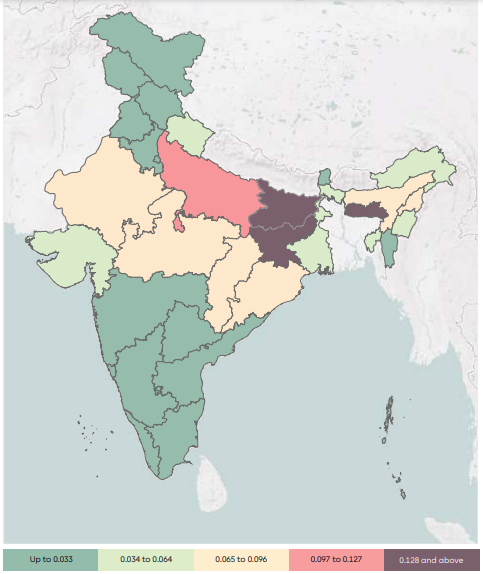
Analysis: Bihar, Jharkhand and Meghalaya fare the worst on the Multi-dimensional poverty index. Southern states of Maharashtra, Telangana, Andhra Pradesh, Tamil Nadu, Kerala, Karnataka, Punjab, Haryana & Himachal Pradesh.

Bihar, the state with the highest MPI value in NFHS-4 (2015-16), saw the fastest reduction in MPI value in absolute terms with the proportion of multidimensional poor reducing from 51.89% to 33.76% in 2019-21. The next fastest reduction in the MPI value was seen in Madhya Pradesh and Uttar Pradesh

Dispute Settlement between India and USA

Context: One of the significant outcomes of Prime Minister Narendra Modi’s official state visit to the U.S. was the decision of the two countries to end six long-standing trade disputes at the World Trade Organization (WTO). In view of the continuing impasse in the appointment of ‘judges’ to hear appeals at the Appellate Body, a meaningful resolution of these disputes was almost out of sight. Three cases settled as part of the deal are before the defunct Appellate Body, while the rest could have potentially been ‘appealed into the void’.

  • The settled disputes involved a challenge of the domestic content requirements under India’s National Solar Mission. India too challenged certain sub-federal programmes implemented in the U.S. in the renewable energy sector and won the case.
  • India and US also settled disputes involving some of its foreign trade policy schemes, including the special economic zone (SEZ) and export-oriented unit schemes. In particular, certain corporate tax deductions provided under the SEZ scheme faced an uncertain future
  • The most major of the dispute that was stelled involved a challenge by India against the controversial Section 232 tariffs imposed under the U.S. Trade Expansion Act, 1962. The U.S. had imposed an additional duty of 25% on steel and 10% on aluminium, triggering a series of WTO challenges and unilateral trade responses. India considered these as safeguard measures and imposed retaliatory measures.
  • Against that backdrop, settling disputes in all six cases shows a pragmatic approach on the part of two strong trading partners. They have accepted each other’s domestic challenges in dispute compliance and realised the importance of burying differences.

Dispute Settlement Mechanism:

Resolving trade disputes is one of the core activities of the WTO. A dispute arises when a member government believes another member government is violating an agreement or a commitment that it has made in the WTO.

  • Settling disputes is the responsibility of the Dispute Settlement Body (the General Council in another guise), which consists of all WTO members. 
  • The Dispute Settlement Body has the sole authority to establish “panels” of experts to consider the case, and to accept or reject the panels’ findings or the results of an appeal. 
  • It monitors the implementation of the rulings and recommendations, and has the power to authorize retaliation when a country does not comply with a ruling.

First stage: Consultation (up to 60 days). Before taking any other actions the countries in dispute have to talk to each other to see if they can settle their differences by themselves. If that fails, they can also ask the WTO director-general to mediate or try to help in any other way.

Second stage: The panel (up to 45 days for a panel to be appointed, plus 6 months for the panel to conclude). If consultations fail, the complaining country can ask for a panel to be appointed

Appeals

  • Either side can appeal a panel’s ruling. Sometimes both sides do so. Appeals have to be based on points of law such as legal interpretation — they cannot re-examine existing evidence or examine new issues.
  • Each appeal is heard by three members of a permanent seven-member Appellate Body set up by the Dispute Settlement Body and broadly representing the range of WTO membership. 
  • The appeal can uphold, modify or reverse the panel’s legal findings and conclusions. Normally appeals should not last more than 60 days, with an absolute maximum of 90 days.
  • The Dispute Settlement Body has to accept or reject the appeals report within 30 days and rejection is only possible by consensus.

NITI Aayog report says 13.5-cr. people lifted out of multidimensional poverty

Context: India has registered a significant decline of 9.89 percentage points in the number of multidimensionally poor, from 24.85% in 2015-16 to 14.96% in 2019-2021, says the “National multidimensional poverty index: a progress review, 2023”, released by NITI Aayog recently.

Findings of the report

oZcB Q4uoabZhnPMATWmvRO40HyYXPWZyZz6XK2XnS ZjdZvBzQ5zTE E IzS eEJtd5xI96rnHpcAzcC5baa49DrHPKrLn0tVrTpHiwp3fcD6uvVzZl9l q9lvztg6YV5VyYrQ4AKY3M40n92utHEE
  • The study says nearly 13.5 crore people came out of multidimensional poverty during the period, assessed by identifying “acute deprivations in health, education and standard of living” using United Nations-approved parameters.
  • The report said rural areas witnessed the fastest decline in poverty from 32.59% to 19.28%, mainly due to a decrease in the number of multi-dimensionally poor in States such as Bihar, Uttar Pradesh, Madhya Pradesh, Odisha, and Rajasthan.
  • Delhi, Kerala, Goa, and Tamil Nadu have the least number of people facing multidimensional poverty, along with the Union Territories.
  • Bihar, Jharkhand, Meghalaya, Uttar Pradesh, and Madhya Pradesh top the chart where the percentage of the population which is multidimensionally poor is high.
  • Multidimensional poverty in urban areas, during the same period, saw a decrease from 8.65% to 5.27%.
  • Uttar Pradesh registered the largest decline in the number of poor with 3.43 crore people escaping multidimensional poverty.

About National Multidimensional Poverty Index (MPI)

  • The report has been prepared based on the latest National Family Heath Survey of 2019-21 and is the second edition of the National Multidimensional Poverty Index (MPI).
  • The broad methodology followed is in consonance with the global methodology.
  • It said 12 parameters of health, education, and standard of living are examined in the report.

Coral bleaching

Context: Across the globe, unprecedented heatwaves have plunged both animals and humans into challenging circumstances. Among the affected creatures, corals stand out as exceptionally vulnerable.

image 49

Corals Reefs:

  • They are most biologically diverse ecosystems of the planet. They are formed when Coral Polyps, the animals primarily responsible for building reefs, develop a symbiotic relationship with photosynthetic algae called zooxanthellae, which live in its tissues.
  • Coral reefs are critically important ecosystems that underpin ocean sustainability and the economic, social and cultural security of hundreds of millions of people around the world. Despite their immense value, they are uniquely vulnerable to the increasing global threat of climate change, as well as other anthropogenic impacts.

Symbiotic Relationship:

It is defined as a close, prolonged association between two or more different biological species, where both parties involved benefit from the interaction.

Favourable Conditions for the formation of Corals:

  • Optimal Sunlight Exposure: Corals thrive in shallow water where ample sunlight penetrates to support their symbiotic relationship with zooxanthellae (algae). These microscopic algae residing within the coral provide vital oxygen and other essential nutrients, relying on sunlight for their survival. Consequently, corals, too, depend on sunlight to flourish. 
  • Translucent Water Conditions: Clear and unpolluted water is crucial for corals as it allows sunlight to permeate through the depths. The clarity of water determines the amount of sunlight that reaches the corals, thereby ensuring their sustenance and vitality. 
  • Optimal Water Temperature: Corals exhibit a remarkable adaptability to a narrow temperature range, typically thriving in water temperatures between 20–32°C. The temperature within this specific range is essential for their growth and survival. 
  • Salinity Requirements: Corals necessitate a specific balance in the salt-to-water ratio to thrive. As a consequence, they cannot survive in areas where freshwater from rivers flows into the ocean, as the altered salinity in these estuaries is unsuitable for coral growth. Instead, corals are restricted to habitats with the appropriate saltwater conditions.

Distribution of Corals in the world:

Ecosystem services provided by Corals:

  • Human health and wellbeing: 70% of the protein in the diets of Pacific Islanders comes from reef-associated fisheries (SDGs 2, 3, 6, 9 & 14; Aichi Biodiversity Targets 13, 14, 16).
  • Shoreline protection: A healthy coral reef can reduce coastal wave energy by up to 97%. Globally, USD6 billions of built capital is protected from flooding by coral reefs (SDGs 1, 8, 11, 13, 14).
  • Food security and livelihoods: Coral reef fisheries support as many as six million people and are worth USD6.8 billion per year, providing an average annual seafood yield of 1.42 million tonnes (SDGs 2, 4, 5, 8, 12, 13, 14, 16).
  • Tourism: Coral reef tourism contributes USD36 billion to the global tourism industry annually (SDGs 2, 4, 5, 6, 8, 9, 12, 14).
  • Biodiversity: Coral reefs support approximately 4,000 species of fish and 800 species of hard corals, Globally, about 830,000 species of multicellular plants and animals are estimated to occur on coral reefs, of which an estimated 13% are unnamed and 74% are yet to be discovered. Most of these species are cryptic, small and relatively rare.
  • Medicines: Coral reefs are the medicine chests of the 21st century, with more than half of all new cancer drug research focusing on marine organisms.

What is Coral Bleaching?

When corals are stressed by changes in conditions such as temperature, light, or nutrients, they expel the symbiotic algae living in their tissues, causing them to turn completely white.

Ocean acidification which is caused by CO2 absorption in oceans, lowers pH levels of ocean water and affects calcium carbonate minerals. The combination of acidification and ocean warming poses a significant threat to coral reefs’ ability to form skeletons. 

Status of Corals in the world at present:

The 2019 global assessment report on biodiversity and ecosystem services of the Intergovernmental Science-Policy Platform on Biodiversity and Ecosystem Service (IPBES), and the Intergovernmental Panel on Climate Change (IPCC) Special Report on the Ocean and Cryosphere in a Changing Climate, warn that:

  • Over half of the world’s coral reefs have been lost;
  • At warming of 1.5oC, 70-90% of the world’s coral reefs are expected to be lost. At 2oC degrees, this increases to >99% loss of coral reefs.

Global Initiatives for protection of Coral reefs:

The International Coral Reef Initiative (ICRI) is the only international partnership, between nations and organizations, focussing solely on the protection of coral reefs and related ecosystems worldwide.

The Initiative was founded in 1994 by Australia, France, Japan, Jamaica, the Philippines, Sweden, the United Kingdom, and the United States of America. It was announced at the First Conference of the Parties of the Convention on Biological Diversity (CBD) in December 1994.

India’s efforts for Coral Restoration:

The Zoological Survey of India (ZSI), with help from Gujarat’s forest department, is attempting for the first time a process to restore coral reefs using biorock or mineral accretion technology. Biorock is the name given to the substance formed by electro accumulation of minerals dissolved in seawater on steel structures that are lowered onto the sea bed and are connected to a power source, in this case solar panels that float on the surface. The technology works by passing a small amount of electrical current through electrodes in the water.

When a positively charged anode and negatively charged cathode are placed on the sea floor, with an electric current flowing between them, calcium ions combine with carbonate ions and adhere to the structure (cathode). This results in calcium carbonate formation. Coral larvae adhere to the CaCO3 and grow quickly.

Steps need to be taken for protection of corals:

  • Safeguarding Coral Reefs: Government should regulate nearshore fishing to ensure sustainable practices that do not harm the reef. This involves managing fishing activities around coral reefs and prohibiting harmful practices such as dynamite and cyanide fishing, as well as the harvesting of live coral. 
  • Marine Protected Areas(MPAs): MPAs define specific rules and guidelines to protect reef life while also allowing sustainable human use. By designating specific zones for protection and regulated use, MPAs offer a practical approach to safeguarding coral reefs and their invaluable ecosystems. 
  • Combating Land-based pollution: To protect coral reefs from land-based pollution and runoff, it is imperative to implement measures that reduce pollution sources and preserve critical coastal ecosystems. This includes sustainable land-use practices, responsible waste management, and protecting and restoring vital coastal habitats. 
  • Effective Monitoring and Enforcement: Engaging stakeholders in monitoring and enforcing regulations empowers communities to take ownership of their coral reef resources, fostering a sense of responsibility and stewardship. However, in areas with limited resources, community-based management efforts can play a crucial role.
  • Education and Outreach: It should target stakeholders, community members, and even school children, enlightening them about the importance of coral reefs and their interconnectedness with human well-being. By empowering people with knowledge, communities can foster a deeper sense of appreciation and encourage positive actions to safeguard coral reefs. Education can also prompt individuals to adopt sustainable practices in their daily lives, further contributing to the conservation efforts for these invaluable ecosystems.

Horizon 2047: Vision for India-France Strategic Partnership

Context: During the recent visit of PM Modi to France a variety of agreements chief among the agreements was the strategic road map for the next 25 years “Horizon 2047” which includes cooperation in defence, space, nuclear energy, climate change and green transitions as well as education and people-to-people ties. 

image 48

The document Horizon 2047, reflects a vision of the two leaders, of Prime Minister Modi and President Macron, on where the relationship should be in 2047 when India would celebrate 100th year of its independence and we will be celebrating 50 years of our Strategic Partnership. It has 63 specific outcomes that are divided among multiple pillars.

Major pointers of document Horizon 2047

  1. Partnership for Security and Sovereignty: A comprehensive approach to security and sovereignty cooperation between the two countries.
  2. India-France Partnership in the Indo-Pacific: Focused on providing solutions for security, strategic, and economic challenges.
  3. Cooperation in the Fight Against Terrorism: Joint efforts to combat terrorism and ensure global security.
  4. Renewed and Effective Multilateralism: Shared commitment to promoting multilateral cooperation.
  5. Science, Technology, and Academic Cooperation: Collaboration between research institutions in scientific, critical technologies, health, cyber, digital regulatory frameworks, and digital technologies.
  6. People-to-People Ties: Enhancing mobility partnership and skill-set cooperation to foster academic collaboration and meet the needs of skill development.
  7. Defence Cooperation: Roadmap for further cooperation in the Indo-Pacific, including military and naval exchanges and a trilateral development fund.
  8. Defence Procurement: Approval for the purchase of 26 Rafale-M fighter jets for the Indian Navy, three additional Scorpene submarines, and an agreement for helicopter engines.

The France-India strategic relationship is built on respect for each other's strategic autonomy, with France refraining from commenting on India's internal affairs or foreign policy choices.

China event raises concern over India’s only ape

Context: The conservation status of India’s only ape (hoolock gibbon) was a cause for concern at a global event on gibbons held a week ago in China.

More about the news:

  • Gibbons, the smallest and fastest of all apes, live in tropical and subtropical forests in the south eastern part of Asia. 
  • The hoolock gibbon, unique to India’s northeast, is one of 20 species of gibbons on Earth.
  • Over the decades, zoologists thought the northeast housed two species of the ape — the eastern hoolock gibbon (Hoolock leuconedys) found in a specific region of Arunachal Pradesh and the western hoolock gibbon (Hoolock hoolock) distributed elsewhere in the northeast. 
  • A study led by Hyderabad-based Centre for Cellular and Molecular Biology (CCMB) in 2021 proved through genetic analysis that there is only one species of ape in India. It debunked earlier research that the eastern hoolock gibbon was a separate species based on the colour of its coat. 
  • The CCMB study concluded that two populations of the western hoolock gibbon and the assumed eastern hoolock gibbon split 1.48 million years ago. It also estimated that the gibbon divergence from a common ancestor occurred 8.38 million years ago.

The Western Hoolock Gibbon 

RNPXyrwvE1i7P3gdYAJTtzxQc319A v9KfpCRubscSSjLITvJhFJokizD7ZGkdfYs9v4V ZGMuibkt2ikPq6Ha gsO1NzHnxi0B8nTKMtljsD1202MCWETvpnkHhJw2T08eyXS4sOb1B 2 HG3 WQ

Description

  • It is an ape found in the tropical forest canopy in India, Bangladesh and Myanmar.
  • Tailless like other apes, they are nonetheless set apart by their long arms and dense hair.
  • The loud and musical calls of Western Hoolock Gibbons can be heard from far away in the forest. Males and females often sing in unison, a series of duet calls that helps the pair to mark their territory.
  • Behaviour
    • These gibbons are arboreal and only come to the ground in exceptional circumstances.
    • They are omnivorous, consuming over 100 species of plants and some invertebrates and birds’ eggs, with a diet that can greatly vary based on location.
    • Western Hoolock Gibbons form small, monogamous family groups and usually give birth to a single offspring. Babies typically spend their first months of life tightly clung around the mother’s waist, followed by gradual weaning over two years. The young gibbon will then stay with his parents until sexual maturity.
  • Threats and Conservation
    • They are one of Asia’s most endangered primates(ER), with populations expected by the IUCN to at least halve over three generations (2001-2015, 2016-2030 and 2031-2045). 
    • Threats such as hunting for food and medicine and habitat loss have put this species at risk, and habitat protection is critical for their survival.

The Eastern Hoolock Gibbon

  • It is one of two species of Hoolock Gibbon.  
  • This species is found particularly east of the Chindwin River in Myanmar and in southwest Yunnan (China).  
  • Indian records of the species likely to actually represent the Western Hoolock.
HL6yyoOmeyG4MP6jvI5AJ9o5SWVzoPsQAlDYC DDhYvpAAJygoegjBPCtN1xeHTuketrOpA ofIYVDyjrtKihrWvdhzvo3dZdu84iFEpaomAbNFr08S8V5sfR9JbYebf629MSZKNFQ8ek1ZeofU0 w

Difference between Eastern and Western Hoolock

  • Both Hoolock Gibbon species are separated by the Chindwin River in western Myanmar, which flows into the Irrawaddy
  • The two species differ in their fur coloration and DNA sequences, and may have diverged about 1.42 million years ago.
  • The Red List maintained by the International Union for Conservation of Nature categorises the eastern hoolock gibbon as vulnerable.