Geography & Environment & Disaster management

Carbon Capture, Utilisation & Storage (CCUS)

They are a group of technologies for capturing of CO2 from large and stationary CO2 emitting sources, such as fossil fuel-based powerplants and other industries. CCUS also involves the transport of the captured CO2 to sites, either for utilisation in different applications or injection into geological formations or depleted Oil & Gas fields for permanent storage and trapping of CO2.

Neef for Carbon Capture (CCUS) Technologies

  1. Necessary to decarbonise hard to electrify sectors: CCUS offers only known technology for decarbonising the hard to electrify and CO2 intensive sectors such as steel, cement, oil & gas, petrochemicals & chemicals and fertilisers.
  2. Hydrogen economy: CCUS is expected to play a critical role in enabling hydrogen economy through production of blue hydrogen (i.e., coal gasification based hydrogen production with CCUS) based on India’s rich coal endowments.
  3. Sustenance of existing emitters: Nearly two-thirds of India’s 144 mtpa crude steel capacity and 210 GW of coal-based power capacity have an age of less than 15 years and cannot be wished away or stranded and need to be made sustainable by retrofitting with CO2 capture and disposition infrastructure. 

Carbon Capture Technologies

There are three broad categories of technologies for Capturing CO2:

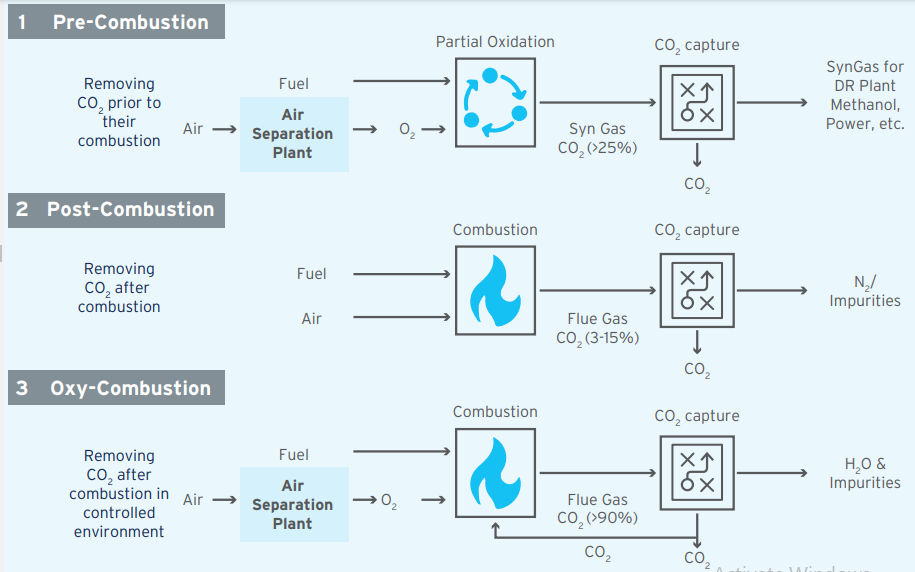
  1. Post-combustion technologies: CO2 is separated from the flue gas after combustion. Fossil fuels like coal, oil, natural gas etc. are burnt in the presence of air. Hence, the flue gas is rich in N2 and the CO2 percentage typically varies between 3-15%. Since the partial pressure in CO2 in the flue gas is quite low, very high-volume chemical solvent (amine) circulation is required for CO2 capture. This makes post-combustion technologies energy and cost intensive.
  2. Pre-combustion technologies: This involve removing CO2 through upstream treatment of fossil fuels before combustion. Major difference between pre-combustion & post-combustion is that the former is favoured in cases where the gas stream has a higher partial pressure of CO2, such as in gasification of fossil fuels, natural gas based H2 production or sour gas processing. Since no chemical bonds need to be broken for solvent regeneration, the thermal energy penalty is much lower. The regeneration of physical solvent is primarily achieved by reducing pressure.
  3. Oxy-fuel combustion technologies: While post & pre-combustion carbon capture technologies have been commercially established, oxy-fuel combustion technologies are still in the development stage. Oxy-fuel combustion represents an emerging novel approach to near zero-emission. It is accomplished by burning the fuel in pure oxygen (O2) instead of air (O2 & N2). The flue gas stream would be primarily composed of water & CO2, rather than N2. High-purity CO2 can be recovered by condensation of water.

Direct Air Capture (DAC): DAC directly captures dilute CO2 (at 415 ppm) from the air and may also emerge as a form of carbon capture that has wide applicability, as it is independent of the source and concentration of the emission stream.

However, DAC is still in early stages and the economics and scale of operations are yet to be established.
a S4lT5UyfG6ni58lbbMX11afYdySzKM1RXYnwKseUvrRxU7TivLUqsO P0KvGWVG uHux3TxR4rrePvOIinQw0OYWKRDbh 9FafuFoLAUg9kNhxb6tTNg dTl43qZ9cak97KJf1mT4RIoTO 28H1A

CO2 Capture technologies

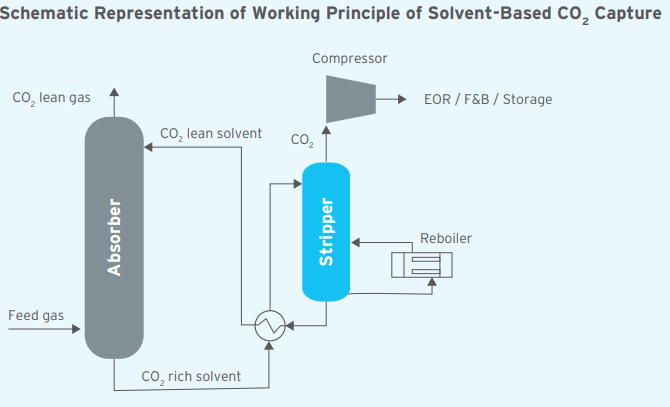
Solvent-based absorption: Solvent based CO2 capture processes have been used for processing natural (sour) gas, combustion flue gas and Fischer-Tropsch (FT) synthesis products. The fundamental principle on which solvent-based CO2 capture technologies work is selective absorption of CO2 over other gaseous constituents.  

The CO2  present in the feed/process gas is first selectively absorbed in an absorber using a solvent (physical  or chemical), the CO2 lean gas exits the absorber. The CO2 rich solvent is sent to a stripper type configuration where CO2 is released from the solvent and the lean solvent is regenerated for reuse. 

Solvent based CO2 capture technologies are classified into:
Diagram

Description automatically generated
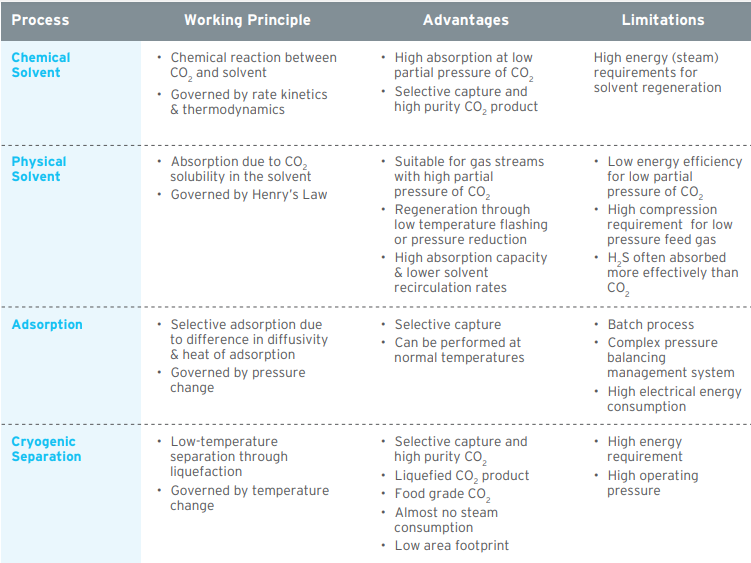
  1. Physical solvent-based absorption: CO2 gets physically dissolved in the solvent. This method performs well at higher partial pressure of CO2. Ex. Higher gas stream pressure and CO2 concentration in Syngas of gasifiers and SMRs make physical absorption-based capture more suitable. 
  2. Chemical solvent-based absorption: CO2 reacts with solvent chemically. This method is better suited for gas-streams having low concentration and partial pressure of CO2 due to the high chemical affinity to CO2 to amine/carbonate based chemical solvents and faster rate kinetics.  Ex. In Low CO2 partial pressures in the flue gas of coal-fired power plants make amine based chemical absorption preferred technique. Common solvents used as: Amine based solvents, Non-Aqueous Solvents, Carbonate-based solvents etc. While primary and secondary amines (such as MEA, DGA, AEE, DEA) have higher reaction rates and lower CO2 carrying capacities, tertiary, and polyamines (such as MDEA and piperazine) have lower reaction kinetics and higher CO2 carrying capacities. 
  3. Adsorption: In this process, CO2 molecules selectively adhere to the surface of adsorbent material and form a film due to difference in diffusivities and heat of absorption values for feed gas stream components. This method is suitable for gas streams with moderate to high pressure and moderate CO2 concentration such as SMR flue gas or BF gas.
  4. Cryogenic separation: This process like conventional distillation process, except that it involves separation of components from a gaseous mixture (instead of liquid) based on the difference in their boiling points. This technology is preferred in cases where cost of power is low. This technology provides a unique advantage by generating additional hydrogen without increasing the amount of feedstock (natural gas)/producing the same quantity of hydrogen with lower natural gas consumption. 
  5. Microalgae based carbon capture: Microalgae utilise the sparsely concentrated CO2 from atmosphere via Carbon Concentrating Mechanism (CCM) and thus are well-qualified for CO2 capture from a more concentrated stream of flue gas. Microalgae use CO2 as a nutrient for cultivation of microalgae. Microalgae can be cultivated in saline water systems as well and do not compete with food crops for arable land for cultivation. Due to faster growth cycle of microalgae, they can typically entrap 10-50 times more CO2 compared to terrestrial plants. They can also deacidify the seawater or wastewater used for their cultivation. This technology is, however, in its nascent stage.
McxDF6Fnc Lzu5od3xS fMEmV1 Z6e0P3w3mpTmp8LahgF2IK8xAFlWJs1VsM4tBUwlduwXQZU5loU woyoZwINJDlOBEUXiD jmXZcGvwrOwg 0RKFyHfoWF2ItWXqQNnvi 9hjlc WtRyaoUoMog

End use of captured CO2 can be either utilisation or permanent storage. 

CO2 UTILISATION TECHNOLOGIES

Rising interest in CCUS as a decarbonisation solution across industries, there is an also a need to look at CO2 utilisation pathways and technologies that are most appropriate for India. Some proven technologies for utilisation of captured CO2 are:

  1. Enhanced Oil Recovery (EOR): CO2 is used in EOR to produce low-carbon oil from maturing oil fields. EOR can help India towards residual oil extraction that is environmentally sustainable and economically feasible.
  2. Green Urea: Urea production from green ammonia can utilise a significant part of CO2. India’s production of ammonia is primarily based on imported LNG. 
  3. F&B applications: CO2 can be utilised in applications such as carbonated drinks, dry ice and modified atmosphere packing. However, scales are quite small compared to the volume of CO2 generation.
  4. Building Materials (Concrete & Aggregates): Utilising CO2 for producing building materials (aggregates & concretes) is likely to be the most attractive and feasible option. CO2 can be used both during concrete curing & aggregate formation. 
  5. Chemicals (Methanol & Ethanol): CO2 can be used production of chemicals such as methanol and ethanol at commercial scales. 

Methanol is a low carbon hydrogen carrier that can support applications like fuel substitution and act as intermediate to produce various speciality chemicals like acetic acid, MTBE, DME and formaldehyde producing products like adhesives, foams, plywood subfloors etc. CO2 hydrogenation process is used to convert captured CO2 into methanol.

Ethanol can be produced by ethylene hydration or biological processes using H2, CO and CO2 by biological gas fermentation process. Ethanol can be blended with Petrol to reduce fuel import bill.

  1. Polymers: CO2 can be converted into various polymers such as polyether carbonates, polycarbonates, diphenyl carbonate, cyclic carbonates etc. A polymer product of CO2 named AirCarbon has found multiple applications (Laptop packaging, cell phone casings, furniture etc.)

CO2 Storage Options

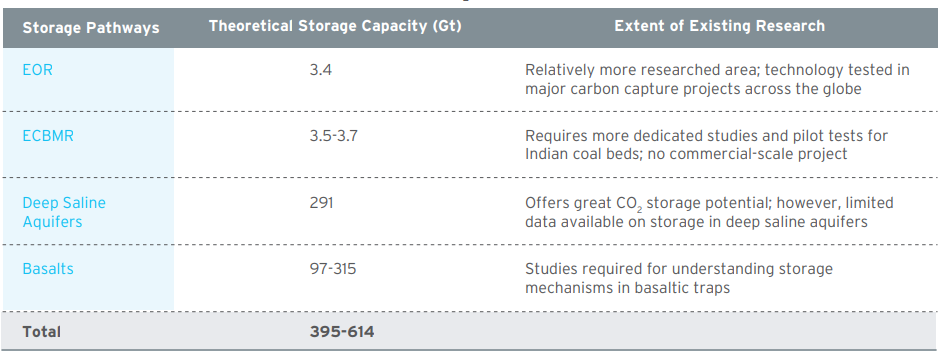
  1. Enhanced Oil Recovery (EOR): Ex. In India, Mumbai High, Assam shelf, Krishna Godavari basin & Cambay basins are prominent sites for storage of CO2. In CO2 EOR, compressed CO2 is injected into the reservoir. At high densities, CO2 is readily miscible with oil. It swells the oil and reduces its viscosity, thereby driving it away from rock formations and towards the production wells. It is estimated that 3.4 Gt of storage is available in India for CO2 storage. 
  2. Enhanced Coal Bed Methane Recovery (ECBMR): In this method, CO2 is injected into unmineable coal seams under supercritical conditions. The CO2 injected is accumulated in the coal cleats in a dense gas phase. This CO2 is adsorbed and absorbed in the coal. Since CO2 has a higher affinity for coal than CBM, it pushes the coal bed methane towards production wells, thus enhancing its primary recovery. Similar to CO2 EOR, ECBMR can help in permanently storing CO2 and the recovered methane can also help offset the cost of carbon captureThe potential for ECBMR is localized in the eastern region due to the presence of major coalfields. These can be storage clusters for industries that are close to the coalfields, such as steel and power plants.
  3. CO2 storage in Deep Saline Aquifers: Captured CO2 can be permanently stored in deep saline aquifers. Deep saline aquifers consist of porous rock formation that contains high quantities of unusable saltwater. Salt/mineral content is very high in this water rendering it unusable for human use. Brine water is called formation liquid and it is trapped by an impermeable rock called caprock. However, compared to EOR or ECBMR, injection of CO2 in deep saline aquifers has no economic benefit.  
  4. CO2 storage in Basalts: Basaltic rocks constitutes divalent cations of Ca, Mg and Fe. They can react with CO2 dissolved in water to form stable carbonate minerals and thus can offer a safe CO2 sequestration method. Compared to saline aquifers, basalt rocks offer faster reaction kinetics due to abundance of iron, calcium and magnesium oxides. Abundance of basalts on Earth’s surface is the reason interest in CO2 storage R&D programs in basalts. 
Table

Description automatically generated with medium confidence

Lithium Reserves in India

About 5.9 Million Tonnes of Lithium Reserves have been discovered in the Union Territory of Jammu and Kashmir (First in India). It is discovered in the Salal-Haimana area of Reasi District.    

Lithium Distribution:

  • Although lithium is widely distributed on Earth, it does not naturally occur in elemental form due to its high reactivity.
  • According to the US Geological Survey (USGS), there are around 80 million tonnes of identified reserves globally as of 2019.
image 31
  • Argentina, Bolivia, and Chile make up the “lithium triangle.” The three countries, along with Peru, contain about 67% of proven lithium reserves and produce about half of the global supply, according to the U.S. Geological Survey.
  • The Salar de Uyuni salt flat in Bolivia is the world's single-largest lithium resource, and is visible from space

Physical and Chemical properties of Lithium (atomic number 3)

  • It belongs to an alkali metal group, lightest of the solid elements (can float on water). It is soft, white and lustrous.
  • It has the lowest density of any metal.
  • It has high specific heat which is the calorific capacity. Other properties are its enormous temperature interval in the liquid state, high thermal conductivity.
  • It is also found in brine deposits and as salts in mineral springs. 
  • It constitutes about 0.002 percent of Earth’s crust.
  • It is produced by electrolysis of a fused mixture of lithium and potassium chlorides. 

Uses and application of Lithium:

  • Among minerals, lithium offers one of the highest energy-to-weight performance—a lithium-ion battery’s energy density is 260-270 Wh/kg, compared to a lead-acid battery’s 50-100 Wh/kg.
  • Used as a scavenger (remover of impurities) in the refining of such metals as iron, nickel, copper, and zinc and their alloys.
  • Used as an initiator of polymerization in the production of synthetic rubber.
  • It is also extensively used in the production of other organic chemicals, especially pharmaceuticals
  • Lightweight lithium-magnesium alloys and tough lithium-aluminium alloys, harder than aluminium alone, have structural applications in the aerospace and other industries.
  • Most extensive use of Lithium is in rechargeable batteries (cell phones, laptops, e-mobility etc).

Note:  lithium-ion batteries are rechargeable while lithium batteries are single-use.

Benefits of such discovery to India;

  • Decrease imports: As of now, India is importing all its lithium requirements (95% coming from Hong Kong > China > Indonesia > Singapore > Korea).
  • Save foreign exchange: In the near future imports would fall further (saving foreign exchange).In last three years, imports of Lithium and Lithium ion has reduced by 8-10%.
  • Employment: Mining and exploration would further enhance the job creation in the reserve areas.
  • Industrial hub: It would developed battery industry (a sunrise sector) in India.
  • Exports: With development of battery industry, India could enter the global supply of lithium ion batteries (export promotion). It would help India in gaining faster momentum in the electronics and digital devices market globally.
  • Reduce production cost: Replacing expensive imports of lithium with domestic cheaper alternatives would reduce the cost of production in battery industry and make it more competitive.

Potential of Lithium in India:

  • Expected reserves in: Union Territory of Jammu and Kashmir, Mandya and Yadgir districts of Karnataka, Bihar, Chhattisgarh, Himachal Pradesh, Jharkhand, Madhya Pradesh, Arunachal Pradesh, Meghalaya and Rajasthan.
  • India has emerged as one of the largest producer, consumer and exporter of mobiles phones (second largest producer in 2021). Lithium ion batteries are the backbone of mobile phone industries. Domestic lithium would push India further ahead in this race.
  • Government in 2021 approved the Production Linked Incentive (PLI) Scheme for manufacturing of Advance Chemistry Cell (ACC) in the country. The scheme envisages establishing a competitive ACC battery manufacturing set-up in the country (50 Giga Watt hour-GWh). This PLI scheme will facilitate reduction of import dependence of ACC battery.
  • Vikram Sarabhai Space Centre (VSSC) has decided to transfer its own in-house lithium ion (Li ion) cell technology to successful Indian industries and start-ups.
  • The government has allowed 100 percent foreign direct investment (FDI) in electric mobility and encouraged domestic manufacturing of battery packs. Due to this measure, LiB technology has overtaken lead-acid batteries in mobile and stationary applications.

Why is India lagging behind in Lithium?

  • Natural availability of Lithium in India is the least (almost insignificant)
  • Research and exploration in the lithium is at nascent stage. 
  • India has very limited participation in the exploration of lithium. Most of the current exploration of Lithium is conducted as per the Geological survey of India. 
  • Till 2021, i.e. rolling out of production linked incentive, there was no dedicated policy for lithium battery development in India.

Way-forward:

  • Creation of additional demand in the automobile sector.
  • Opening the exploration and mining for the private sector under regulatory framework.
  • Ease of exports of Lithium-ion batteries.

Plastic Rocks on Island Off Brazil

Rocks made of plastic debris have been discovered on the volcanic Trindade Island of Brazil.

What are Plastic rocks?

  • Technically they are called as plastiglomerate.
image 27
  • It is formed when plastic trash melts and fuses together with natural materials such as basaltic lava fragments, sand, shells, wood and coral, resulting in a plastic-rock hybrid.
  • When the plastic melts, it cements rock fragments, sand, and shell debris together, or the plastic can flow into larger rocks and fill in cracks and bubbles.
image 28
  • Researchers say the new material is likely to last a very long time, possibly becoming a permanent marker in Earth’s geologic record.

About Trindade Islands:Location – It is located 1140 Km from Southeastern state of Espirito Santo of Brazil in South Atlantic Ocean.

image 29
  • Ecological significance: Trindade Island is one of the world’s most important conservation spots for green turtles, or Chelonia mydas, with thousands arriving each year to lay their eggs. The only human inhabitants on Trindade are members of the Brazilian navy, which maintains a base on the island and protects the nesting turtles.
  • Plastic threat: It mainly comes from fishing nets, which is very common debris on Trinidade Island’s beaches. The (nets) are dragged by the marine currents and accumulate on the beach. When the temperature rises, this plastic melts and becomes embedded with the beach’s natural material.

What is Plastisphere?

  • The plastisphere consists of ecosystems that have evolved to live in human-made plastic environments.
  • The Plastisphere is a diverse microbial community living on bits of plastic floating in the ocean. These communities are distinct from the surrounding water, suggesting that plastic serves as its own habitat in the ocean.
  • It’s like a biofilm—a sticky material that traps all sorts of microorganisms, protozoa and fungi. They can multiply and create a unique biome around the plastics.


What is Marine snow?

  • Marine snow is a term popularized by scientific explorer and diver William Beebe in the 1930s. It’s made up of nutrient-rich, organic material that falls like snow from the ocean’s surface to the sea floor.
image 30
  • The marine snow phenomenon explains why there’s life at the bottom of the ocean.
  • Also, how carbon can move from top to bottom in the ocean can also be partly explained through marine snow.

Vulture population in India

Recently, as many as 246 vultures were spotted in the first­ever synchronised survey conducted along the borders of Tamil Nadu, Kerala and Karnataka.

  • The estimation was carried out in the Mudumalai Tiger Reserve (MTR) and the adjoining landscape consisting of the Sathyamangalam Tiger Reserve (STR) in Tamil Nadu, the Wayanad Wildlife Sanctuary (WWS) in Kerala, the Bandipur Tiger Reserve (BTR) and the Nager hole Tiger Reserve (NTR) in Karnataka.
  • A total of 98 vultures were seen in MTR, two in STR, 52 in WWS, 73 in BTR, and 23 in NTR.

About Vultures

Varieties of vultures found in India: 

India is home to 9 species of Vulture namely

Vultures        IUCN Status  
Oriental white-backed VultureCritically endangered
Long-billed VultureCritically endangered
Slender-billed VultureCritically endangered
Himalayan griffon vultureNearly threatened
Red-headed VultureCritically endangered
Egyptian vultureEndangered
Bearded vultureNearly threatened
Cinereous vultureNearly threatened
Eurasian GriffonLeast concerned

ECOLOGICAL SIGNIFICANCE

• They act an important function as nature’s garbage collectors and help to keep the environment clean of waste.

• Vultures also play a valuable role in keeping wildlife diseases in check.

THREAT

• Diclofenac is a common anti-inflammatory drug administered to livestock and is used to treat the symptoms of inflammation, fevers and/or pain associated with disease or wounds. • Diclofenac leads to renal failure in vultures damaging their excretory system (direct inhibition of uric acid secretion in vultures).

CONSERVATION: The Ministry for Environment, Forests and Climate Change launched a Vulture Action Plan 2020- 25 for the conservation of vultures in the country. To upscaling conservation four rescue centres will be opened like Pinjore in the north, Bhopal in central India, Guwahati in Northeast and Hyderabad in South India.

Pumped Storage Projects

Presently, Pumped Storage Projects (PSP) and Battery Energy Storage Systems (BESS) are the major feasible options to store Renewable Energy. Recently, the Ministry of Power has issued draft guidelines to promote the development of Pump Storage Projects (PSP) in the country.

Under the draft guidelines, the ministry has asked the states to:

  • Consider exempting stamp duty and registration fees for the land for PSP projects.
  • Give government land at concessional rates for such projects.
  • Avoid double taxation, and provide relief in the State Goods and Services Tax (SGST).

Pumped Storage Projects (PSP):

  • Pumped storage projects (PSPs), often called ‘giant batteries,’ is a type of hydroelectric energy storage system. The internationally accepted technology is conventionally used to stabilise the grid and maintain peak power.
  • These projects store appreciable amounts of energy and release it when required. The present installed capacity of PSPs in the country is 4745 MW and another 1500 MW capacity is under active construction.
  • Some of the operational PSP plants exist in Telangana (Nagarjuna Sagar, Srisailam), Tamil Nadu (Kadamparai), Maharashtra (Bhira, Ghatgar), and Purulia in West Bengal.

Mechanism:

  • The PSPs comprise two water reservoirs connected through a tunnel or underground pipe at different heights.
  • When there is more electricity production and less demand, these projects pump water from the downward reservoir to the upward reservoir.
  • When more energy is needed, water is pushed from the uphill to the downhill via a turbine to produce the required power instantly.
image 22

Advantages:

  • PSPs are clean, megawatt-scale, domestically available, time-tested, and internationally accepted.
  • PSPs are clean, green, safe, and non-explosive as they do not produce any poisonous/ harmful by-products or pose disposal problems.

Concerns:

  • Several issues have halted the growth of PSPs in India including, higher upfront costs, the high tariff of power used to pump water uphill, and the long gestation period of such projects due to several approvals like environmental clearance and other formalities.

PSPs vs BESS:

  • Currently, the price of batteries is rising and stands around Rs. 8-10 per unit (1 kilowatt-hour), and their price is dynamic depending on changing geopolitics and other reasons. Although the upfront cost of PSPs is higher, its operational cost per KwH is lower than that of battery storage systems.
  • PSPs lose around 20-30% of the energy in their storage process but have a longer duration supply than battery systems. While the lead acid batteries can work up to 2-6 hours, PSPs can supply energy ranging from six to 20 hours.
  • PSPs have a long gestation period, and their capacity is dependent on location, however, they have a longer life. BESS have a short gestation period, and are non-dependent on location (mobile) but limited by the availability of minerals and technology.

Way Forward:

  • To improve the uptake of PSPs in the grid, differential pricing should be explored (instead of a flat energy charge) that will increase PSP profitability, and generation-based incentives should be provided.  
  • The government could consider allowing Foreign Direct Investment (FDI) for PSPs as they are available for other renewable projects.

Intergovernmental Panel on Climate Change (IPCC)

The Intergovernmental Panel on Climate Change (IPCC) is meeting in Switzerland this week to finalise the last report of its sixth assessment cycle, which is expected to set up the tempo for a string of climate change-focused discussions over the next fortnight.

About Intergovernmental Panel on Climate Change (IPCC)

  • It was set up in 1988 by the World Meteorological Organisation (WMO) and the UN Environment Programme (UNEP). 
  • It has a secretariat in Geneva, Switzerland, hosted by the WMO, and is governed by 195 member states.
  • Its main activity is to prepare Assessment Reports, special reports, and methodology reports assessing the state of knowledge of climate change.
  • It is  a scientific body whose periodic assessments of climate science form the basis of global climate action, is set to finalise what is known as the Synthesis Report, incorporating the findings of the five reports that it has released in the sixth assessment cycle since 2018.
  • However, the IPCC does not itself engage in scientific research.
  • Instead, it asks scientists from around the world to go through all the relevant scientific literature related to climate change and draw up the logical conclusions.

About Assessment Reports

  • The IPCC’s Assessment Reports (ARs), form the basis for government policies to tackle climate change, and provide the scientific foundation for the international climate change negotiations.
  • Six Assessment Reports have been published so far, the sixth report (AR6) coming in three parts — the first in August 2021, the second in February 2022, and the third to be finished in March 2023.

About Synthesis Report

  • It is the last of the Sixth Assessment reports.
  • It is supposed to be a relatively non-technical summary of the previous reports, aimed largely at policymakers around the world.
  • It is meant to address a wide range of policy-relevant scientific questions related to climate change, but, like all IPCC reports, in a non-prescriptive manner.

What previous reports have said

  • The first Assessment Report (1990)  formed the basis for the negotiation of the UN Framework Convention on Climate Change (UNFCCC) in 1992, known as the Rio Summit.
  • The second Assessment Report (1995) -AR2 was the scientific underpinning for the Kyoto Protocol of 1997.
  • The third Assessment Report (2001) presented new and stronger evidence to show global warming was mostly attributable to human activities.
  • The fourth Assessment Report (2007) won the 2007 Nobel Peace Prize for IPCC. It was the scientific input for the 2009 Copenhagen climate meeting.
  • The fifth Assessment Report (2014) -AR5 formed the scientific basis for negotiations of the Paris Agreement in 2015.

Waste Management Technologies (SHESHA & RAPID COMPOSTING)

A Start-up Entrepreneurship Workshop was organized by Atal Incubation Centre (AIC) – BARC, DAE Convention Centre.

  • AIC-BARC is established under the ambit of the Atal Innovation Mission (AIM), NITI Aayog to create a start-up eco-system based on spin-off technologies of the Department of Atomic Energy (DAE).
  • AIC-BARC has been set up in line with the “Aatma Nirbhar Bharat”
  • In the workshop, two technologies namely SHESHA (for wet waste management) and Rapid Bio-composting (for dry waste management) were introduced by BARC scientific experts.

SHESHA TECHNOLOGY:

  • SHESHA is a novel, compact helical-shaped waste converter aimed to manage the biodegradable waste generated in small housing societies, restaurants, etc. in-situ, thus allowing decentralized processing of the biodegradable waste. 
  • The system has tremendous potential to process the waste as well as the generation of good quality fuel and manure required for soil applications. 
  • The name Shesha has been given on the basis of the serpentine shape of the digester (its resemblance to the snake Shesha) as well as the Sanskrit name of waste.

Ra0a3lxxdB95GA

fP ntXvw 5 mYRwBBtdSsXYi0o FAYMRZrnxZSRyMXfzW7BgwMx5ozkE umm4gLrrdiJCut7nvRg muawMQZN85UjOtXMwVthm8U9RBQhxzXIHIRpYNRo6NmaHjDX1Pt0 U5AJB8Mpk4N2dgQfvGmg

Advantages:

  • Helical-shaped digester made from low-cost PVC pipes.
  • Saving major costs of construction and MS dome required for conventional designs.
  • Suitable for skid mounting on vehicles or wheels required for processing waste from smaller societies/residential complexes.
  • Have inbuilt suitability for biogas recycling for methane enrichment.
  • Suitable for online monitoring of process parameters.

RAPID COMPOSTING TECHNOLOGY

  • ICAR -IISS (Indian Institute of Soil Science) developed this technique in collaboration with ICAR-CIAE, Bhopal and ICAR-NBAIM, Mau.
  • It is based on cellulolytic fungi named Trichoderma koningiopsis isolated from tree bark. 
  • It is safe for the environment and for human handling. 
  • The formulation is capable of composting kitchen waste, agricultural waste, garden waste (dry leaves including coconut leaves) and temple waste. 
  • This method, being completely aerobic in nature, is devoid of foul odour and hence has greater acceptability in society.

STEPS FOR BIO COMPOSTING

  • Collection of biowaste materials
  • Segregation of non-biodegradable materials
  • Waste materials mixed with fresh cow-dung
  • Inoculation with a consortium of organisms
  • All materials mixed together and fed to rapo-compost bioreactor
  • After one month the humified organic manure was allowed for curing
  • Sieved (4 mm sieves) and stored at 25% moisture condition

C2MiWleneK5RR4 IV5d0mWWpqe7DgG1HOumJ6Z6f zDIfe W7DFTLY1ZtRqobgDFyMr40kzWKgMNUq8bmRXLxA7wW6QjNTefl4TUXExDSmR Aixj5EhfqJW5lpn

Climate Insurance

Every year, an estimated 26 million people are pushed into poverty by natural disasters which cause an average of $300 billion in economic losses. 

Quick-disbursing financial protection instruments, such as contingent credit and insurance, can reduce humanitarian impacts and save money by enabling rapid crisis response and relief efforts. In Ethiopia, for example, every $1 secured ahead of time for early drought response can save up to $5 in future costs.  

Over the past 10 years, 26 countries in three regions—Africa, the Pacific, and the Caribbean and Central America—have joined sovereign catastrophe risk pools.

What is climate risk insurance?

Climate risk insurance is a type of insurance designed to mitigate the financial and other risk associated with climate change, especially phenomena like extreme weather.

Merits:

  • Insurance solutions can help bolster early action in the face of a disaster, and speed up recovery to restore livelihoods and rebuild critical infrastructure so that people, communities and economies can rebound.
  • Climate risk insurance can help protect individuals, small businesses or entire countries from permanent damage caused by the impact of extreme weather events.
  • Allows countries which are affected by climate change to become more independent; rather than waiting for months, or even longer for international aid to arrive.
  • High-premiums in high risk areas experiencing increased climate threats, would discourage settlement in those areas.

Global example: In 2015, for example, thanks to the insurance policy it purchased through the Pacific Catastrophe Risk Assessment and Financing Initiative (PCRAFI), another World Bank-supported risk finance instrument, Vanuatu received $2 million to support recovery just seven days after cyclone Pam devastated the country. While it may not seem like much, the payout was eight times larger than the government’s emergency budget

Issues:

  • Critics of the insurance, say that such insurance places the bulk of the economic burden on communities responsible for the least amount of carbon emissions.
  • For low-income countries, these insurance programmes can be expensive due to the high start-up costs and infrastructure requirements for the data collection.
  • A considerable problem on a micro-level is that weather-related disasters usually affect whole regions or communities at the same time, resulting in a large number of claims simultaneously.

Way ahead?

  • No one size fits all approach: Localized assessments are imperative in order to understand the needs of vulnerable communities and identify how they can be best prepared in the event of a shock like a natural disaster.
  • Climate risk insurance is no stand-alone solution: It must also always be closely linked with preventive risk management strategies, ensuring losses and damages caused by a natural disaster are kept to a minimum.
  • Affordability: To make insurance affordable, the product can be partly – or fully – subsidized by governments or other donors. Regional risk pools can be created.

Transparency about how money is paid out, collaboration with organizations that have deep roots in the communities, alongside ensuring the participation and inclusion of women must be focussed.

Net zero waste from buildings

All upcoming housing societies and commercial complexes in the country will soon have to mandatorily ensure net­ zero waste and have their liquid discharge treated, as part of the Union government’s push for reforming and modernising the sewage disposal system. 

What is the concept of Net Zero Waste?

  • According to ICBC, a Net Zero Waste for Buildings & Built Environment is one which eliminates the diversion of waste being sent to landfills, by a multi-pronged approach - nature-centric design, reducing debris during construction, responsibly handling waste during operation, reusing the waste as much as possible and recycling the remaining waste.
  • A building or a built environment has to demonstrate that the total quantity of waste generated during construction and operation is equal to the quantity of waste reused within the premises and the quantity of waste recycled, so that the net quantity of waste sent to the landfill is ‘Zero’.
image 2

How can we achieve Net Zero?

Step 1. Reducing: Efforts should be made to reduce the waste generation to the maximum extent possible in all the three stages of construction of buildings.

Step 2. Reusing: Various options for reusing the waste as a resource within the building can be explored. Step 3: Recycling: The remaining waste need to be responsibly handled and handed over to authorized recyclers for recycling or disposed in an environment friendly manner

image 3

Key benefits of adopting Net Zero Waste Rating System are as below:

• Increased use of green products & materials, thereby improving resource efficiency and health benefits.

• Reduction in material consumption and thereby reduction in cost of construction.

• Increase in reuse of waste resulting in reduction in procurement of additional materials.

• Reduction in cost associated with waste handling and disposal.

• Opportunity to convert waste to energy or other value-added products.

• Brand image of being environmentally conscious

NAMASTE:

  • National Action for Mechanised Sanitation Ecosystem
  • Namaste is a Central Sector Scheme of the Ministry of Social Justice and Empowerment (MoSJE) as a joint initiative of the MoSJE and the Ministry of Housing and Urban Affairs (MoHUA).
  • NAMASTE envisages safety and dignity of sanitation workers in urban India by creating an enabling ecosystem that recognizes sanitation workers as one of the key contributors in operations and maintenance of sanitation infrastructure thereby providing sustainable livelihood and enhancing their occupational safety through capacity building and improved access to safety gear and machines.
  • Five hundred cities (converging with AMRUT cities) will be taken up under this phase of NAMASTE. For providing a safety net to identified SSWs and their families they will be covered under the Ayushyaman Bharat- Pradhan Mantri Jan Arogya Yojana (AB-PMJAY). The premium for AB-PMJAY for those identified SSWs families who are not covered earlier shall be borne under NAMASTE.

NAMASTE aims to achieve the following outcomes:

  • Zero fatalities in sanitation work in India
  • All sanitation work is performed by skilled workers
  • No sanitation workers come in direct contact with human faecal matter
  • Sanitation workers are collectivized into SHGs and are empowered to run sanitation enterprises
  • All Sewer and Septic tank sanitation workers (SSWs) have access to alternative livelihoods
  • Strengthened supervisory and monitoring systems at national, state and ULB levels to ensure enforcement and monitoring of safe sanitation work
  • Increased awareness amongst sanitation services seekers (individuals and institutions) to seek services from registered and skilled sanitation workers

Note: In case the workers decide to adopt an alternate livelihood of their choice, skilling support will be provided to these workers. The workers may start a new livelihood project as an individual or as a group interested in same option. However it will not be free and rate of interest will be chargeable on self employment projects including sanitation related projects.

Environment, Social and Governance (ESG) Regulations

The Securities and Exchange Board of India (SEBI), responding to the increase in ESG investing and the demand by investors for information on ESG risks, substantially revised the annual Business Responsibility and Sustainability Report (BRSR) required by the 1,000 largest listed companies in India. 

What are E.S.G regulations?

ESG regulation is any set of requirements on an organization to publicly disclose information about their performance in environmental, social, or governance topics.

How ESG differs from CSR?

India has a robust corporate social responsibility (CSR) policy that mandates that corporations engage in initiatives that contribute to the welfare of society. This mandate was codified into law with the passage of the 2014 and 2021 amendments to the Companies Act of 2013. 

The amendments require companies with a net worth of ₹500 crore or a minimum turnover of ₹1,000 crore or a net profit of ₹5 crore in any given financial year spend at least 2% of their net profit over the preceding three years on CSR activities. The list of qualifying CSR activities is intentionally broad, ranging from supporting the protection of historically important sites to promoting safe drinking water.
 
ESG regulations, on the other hand, differ in process and impact. The U.K. Modern Slavery Act, for example, requires companies with business in the U.K. and with annual sales of more than £36 million to publish the efforts they have taken to identify and analyse the risks of human trafficking, child labour and debt bondage in their supply chain.


ESG disclosures are highly relevant for all stakeholders involved in a business process:

  • Business: ESG disclosures allow companies to identify potential transition risks, self-assess its ability to sustain in the future, and undertake necessary steps to adapt to the likely future changes. At the same time, ESG disclosures help companies in identifying certain opportunities for innovation that might yield high results in the future. They also help companies in reassuring their stakeholders about their values and respect towards responsible business.
  • Investors: ESG disclosures are highly consequential for investors to include climate-related considerations in asset valuation and finance allocation processes; determine the environmental and social impact of a company’s business processes; and assess how climate change could affect a company’s financial stability in the future.
  • Consumers: ESG disclosures aid consumers in identifying responsible businesses.

Evolution of ESG Disclosures in India:

  • The Companies Act, 2013 introduced one of the first ESG disclosure requirements for companies. Section 134(m) mandates companies to include a report by their Board of Directors on conservation of energy, along with annual financial statement. 
  • This requirement is further detailed under Rule 8(3)(A) of the Companies (Accounts) Rules, 2014, which mandates the board to provide information regarding conservation of energy.
  • In 2017, SEBI issued a circular on ‘Disclosure Requirements for Issuance and Listing of Green Debt Securities’, to introduce the regulatory framework for issuance of green debt securities in India and enhance investor confidence. These additional disclosure requirements have been prescribed in order to attract the finance reserved for ESG-compliant projects, such as renewable and sustainable energy, clean transportation, sustainable water management, climate change adaption, energy efficiency, sustainable waste management, sustainable land use, and biodiversity conservation.
  • Indian Banks’ Association (IBA) has also released the National Voluntary Guidelines for Responsible Financing, laying down broad and general principles towards ‘integrating ESG risk management into Financial Institution’s (FIs) business strategy, decision-making process and operations.’ 
  • In May 2021, SEBI introduced a new framework; Business Responsibility and Sustainability Report (BRSR): It is aligned with nine principles of National Guidelines for Responsible Business Conduct (“NGBRC”) and it will be mandatory for the top 1,000 listed companies to annually disclose ESG-related information from financial year 2022-23.

Way forward

In the end, it can be said that India is gradually moving towards developing regulations around ESG. With the introduction of the BRSR framework, SEBI has joined the group of countries and international organization to have released comprehensive sustainability reporting frameworks.

Though the reporting mandate is presently restricted to the top 1,000 listed companies by market capitalization, the experience with BRR only indicates that a wider range of companies would soon be covered under the BRSR framework.

Renewable Energy in India

As the world’s fastest-growing major economy with rising energy needs, India will account for approximately 25 per cent of the global energy demand growth between 2020-2040, as per BP energy outlook and IEA estimates.

Ensuring energy access, availability and affordability for large population is imperative.

Energy Sector

Energy Sector

The energy sector is fundamental to growth and development. Availability of electricity, petrol, diesel and gas at competitive prices is essential for the efficient functioning of energy user sectors, which include households, transportation, industry, agriculture and the government and comprise nearly the entire economy.

Objectives

  • The government’s on-going energy sector policies aim “to provide access to affordable, reliable, sustainable and modern energy”.
  • Reduce imports of oil and gas by 10 per cent by 2022-23.
  • Continue to reduce emission intensity of GDP in a manner that will help India achieve the intended nationally determined contribution (INDC) target of 2030.

The energy sector in India faces a number of challenges, including:

  1. Subsidies and Taxes: A variety of subsidies and taxes distort the energy market and promote the use of inefficient over efficient fuels. They also make Indian exports and domestic production uncompetitive as energy taxes are not under GST and hence, no input credit is given.
  2. Limited domestic energy resources: India is heavily reliant on imports to meet its energy needs. The country has limited domestic reserves of coal, oil, and natural gas, which makes it vulnerable to price fluctuations and supply disruptions.

 For Example, Coal:

  • Demand-supply mismatch in coal leading to imports (25% of domestic requirements).
  • Most of the thermal power plants are operating below their capacity- Plant Load Factor (PLF) is hardly around 56% in 2019-20.
  • Delays in Land acquisition for new mines exploration.
  • outdated technology in mining.

3. Power Generation, Transmission and Distribution

  • Old inefficient plants continue to operate whereas more efficient plants are underutilized.
  • Although legally independent, Regulatory Commissions are unable to fully regulate discoms and fix rational tariffs.
  • State power utilities are not able to invest in system improvements due to their poor financial health.
  • High aggregate technical and commercial (AT&C) losses
  • Unmetered power supply to agriculture provides no incentive to farmers to use electricity efficiently
  • High industrial/commercial tariff and the cross- subsidy regime have affected the competitiveness of the industrial and commercial sectors.

4. Financing constraints: The energy sector in India requires significant investments to modernize its infrastructure and develop new sources of energy. However, financing constraints and a lack of private sector participation have hindered the growth of the sector.

5. Renewable Energy: High energy costs result in reneging on old power purchase agreements (PPAs) and erode their sanctity. This leads to uncertainty regarding power off take and consequently endangers further investments.

6. Policy and regulatory issues: India's energy sector is heavily regulated, and policies and regulations can often be complex and inconsistent. This has led to a lack of clarity and transparency in the sector, which can deter investment and hinder growth.

India has taken several steps to address the challenges faced by the energy sector and promote sustainable energy development.

Steps for sustainable energy development

  1. Renewable energy targets: By 2030, India wants to have 450 GW of renewable energy capacity, including 5 GW of small hydropower, 10 GW of bioenergy, 280 GW of solar, and 140 GW of wind. With 38% of India's total installed capacity being made up of renewable energy as of 2021, the nation has already made significant strides towards achieving this goal.
  2. Energy efficiency initiatives: India has implemented several energy efficiency initiatives, including the National Programme for LED-based Home and Street Lighting, the Perform, Achieve and Trade scheme for energy-intensive industries. These initiatives have helped to reduce energy consumption and greenhouse gas emissions.
  3. Coal sector reforms: India has implemented several reforms in the coal sector, including the commercialization of coal mining, the introduction of revenue sharing and production-linked incentives, and the liberalization of the coal sector to allow for greater private sector participation. These reforms are aimed at increasing coal production and reducing India's dependence on imports.
  4. Rural electrification: India has made significant progress in rural electrification, with the Deen Dayal Upadhyaya Gram Jyoti Yojana and the Saubhagya scheme aimed at providing electricity connections to all households in rural areas.
  5. International cooperation: India has engaged in international cooperation to promote sustainable energy development, including through initiatives such as the International Solar Alliance, the International Energy Agency's Clean Energy Transitions Programme, and the US-India Strategic Energy Partnership. These steps have helped India to make significant progress in addressing the challenges faced by the energy sector and promote sustainable energy development.

However, there is still much work to be done to become a $ 26 trillion economy by 2047, ensuring energy security and achieving energy independence.

Purple Revolution

Lavender farmers in Jammu and Kashmir are bringing ‘Purple Revolution’

About ‘Purple Revolution’:

  • Doda in Jammu and Kashmir is the birthplace of India’s Purple Revolution. 
  • The Purple Revolution or Lavender Revolution, launched by the Ministry of Science & Technology, aims to promote the indigenous aromatic crop-based agro-economy through the ‘aroma mission’ of the Council of Scientific and Industrial Research (CSIR).
  • The mission aims to increase the income of the farmers and promote lavender cultivation on commercial scale. Lavender oil, which sells for, at least, Rs. 10,000 per litre, is the main commodity.
  • Other popular products include medicines, incense sticks, soaps, and air fresheners.
  • Lavender has been designated by the central government as a "Doda brand product" to promote the rare aromatic plant and boost the morale of farmers, entrepreneurs, and agribusinesses involved in its cultivation as part of this Aroma Mission.
  • Jammu and Kashmir’s climatic conditions are conducive to lavender cultivation since the aromatic plant can withstand both chilly winters and pleasant summers.

Benefits of Purple Revolution:

  • The market for lavender oil in India will expand at a CAGR (Compound Annual Growth Rate) of 5.5 percent, while trade is expected to touch $1 billion per year. 
  • The cultivation of lavender is very cost-effective as it yields revenue immediately. It is a low maintenance crop, which can be used from its second year of plantation and blossoms for fifteen years.
  • In its entirety, lavender production gives better returns when compared to other traditional crops. 
  • Modernised farming: value addition to lavender, Oil from lavender flowers and manufacturing of aromatic products thereby givens an opportunity for starting a startup and sparking entrepreneurship. This will help in creating additional employment.
  • The “purple revolution” has also helped women's empowerment in a big way- For example (Jammu and Kashmir): After harvesting season of traditional crops, they used to remain without work for five months during winters, but lavender farming has given them a new lease of life and they get round the year work in lavender fields.

About Aroma Mission:

About Aroma Mission
  • The CSIR Aroma Mission is envisaged to bring transformative change in the aroma sector through desired interventions in the areas of agriculture, processing and product development for fuelling the growth of the aroma industry and rural employment.
  • Aroma Mission is drawing entrepreneurs and farmers from all across the country. CSIR assisted in the cultivation of 6000 hectares of land in 46 Aspirational districts across the country during Phase I. In addition, almost 44,000 employees were trained.
  • The CSIR has started Phase-II of the Aroma Mission, which will include over 45,000 skilled human resources and help over 75,000 farming families.
  • An additional 700 tonnes of essential oil is expected to be produced annually for perfumery, cosmetics and pharmaceutical industries, and use of these oils in value addition and herbal products would generate a business of at least 200 crores.
  • The activities of the Mission will improve the availability of quality material on a sustainable basis for a boom in the herbal industry based on essential oils.
  • The income of the farmers through such cultivation is expected to increase by Rs. 30,000 to 60,000/ha/year. About 45,000 skilled human resources capable of multiplying quality planting material, distillation, fractionation and value addition will be developed.
  • More than 25,000 farming families would be directly benefitted and employment of more than 10-15 lakh mandays will be generated in rural areas.
  • The scientific interventions made under the mission project would provide assured benefits to the growers of Vidarbha, Bundelkhand, Gujarat, Marathwada, Rajasthan, Andhra Pradesh, Odisha and other states where farmers are exposed to frequent episodes of weather extremes and account for maximum suicides.
  • The mission will put a mechanism in place for timely agro-advisory, ensuring optimal productivity and fair price of the produce to the farmers and reducing the import of essential oils and enabling India to become a leading exporter of at least some essential oils.