Geography & Environment & Disaster management

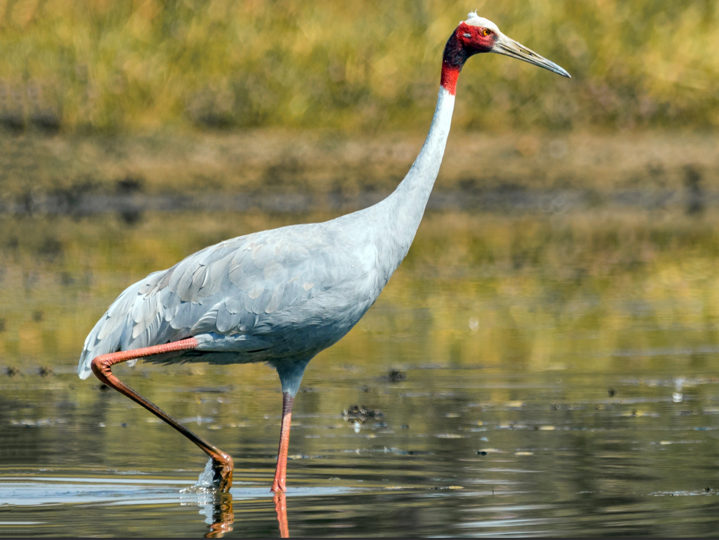
Arif and his Saras: The special bond between crane and Indian farmer

Saras Crane

6jGOvuVu5 udKatQBA9rw2fIMX6vo2sq7d7JDSYAw7j jE8wmydxSE6DZITaVT9yx2MxayWGgHYadi7OX
  • It is the tallest flying bird in the world standing 152-156 cm tall with a wingspan of 240cm. It is a large nonmigratory crane.
  • Scientific name: Grus Antigone
  • It is a social creature, found mostly in pairs or small groups of three or four.
  • Known to mate for life with a single partner, its breeding season coincides with heavy rainfall in monsoon.
  • It has three disjunct populations in the Indian sub-continent, south-east Asia, and northern Australia with an estimated global population of 25,000-37,000 individuals. 
  • In the Indian subcontinent, it is found in northern and central India, Terai Nepal, and Pakistan. 
  • It was once a common site in the paddy fields of Uttar Pradesh, Bihar, Rajasthan, West Bengal, Gujarat, Madhya Pradesh, and Assam. 
  • The Sarus crane is known for its ability to live in association with humans, inhabiting open, cultivated, well-watered plains, marshlands and jheels. 
  • IUCN status: Vulnerable
  • It is listed under schedule IV of Wildlife Protection Act, 1972.

Major Threats

  • Loss and degradation of wetlands, as a result of drainage and conversion to agriculture. 
  • Ingestion of pesticides. 
  • The hunting of adults and collection of eggs and chicks for trade, food, medicinal purposes and, in certain areas, to help prevent damage to crops. 
  • Collision with power lines poses a significant threat in parts of its range.

50 years of Project Tiger & Tiger translocation

Context:

  • Project Tiger is in its 50th year since its launch in 1973, in India. 
  • In its 50th year, India has signed an MOU with Cambodia for reintroducing tigers (species: Panthera tigris) there through translocation. 
  • In Cambodia the species have become extinct.
  • So far, India has only translocated tigers within the country, not internationally. This will be the first time India will do so.
  • In 2022, African Cheetahs were successfully translocated from Namibia to India. It was the first wild to wild intercontinental translocation.

About Project Tiger

Background

  • It was launched in 1973 from Jim Corbett National Park, Uttarakhand to save the declining tigers population. It is a major wildlife conservation project in India.
  • At that time, Project Tiger included 9 tiger reserves spread over 18,278 sq km. 
  • It is governed by the Wildlife Act of 1972.
  • The initiative is funded by the Union Govt. of India and administrated under the Ministry of Environment, Forests and Climate Change.
  • National Tiger Conservation Authority (NTCA) is the immediate supervising agency.

Objectives

  • To identify factors causing a reduction in tiger habitats and mitigate them through suitable management practices. 
  • To maintain a viable tiger population for their economic, ecological, cultural, and aesthetic significance. 

Present Status

  • Currently, there are 53 tiger reserves covering more than 75,000 sq km (approximately 2.4% of the country’s geographical area) across India. 
  • With the current population of about 3,000 tigers, India harbours more than 70% of global wild tiger population, which is increasing at an annual rate of 6%.
  • India has the largest number of CAT-accredited tiger reserves in the world at 17.
  • Compensation for voluntary village relocation has also been enhanced from Rs 10 lakh per family to Rs 15 lakh in order to aid tiger conservation.

Conservation Status

  • Indian Wildlife (Protection) Act, 1972 - Schedule 1
  • International Union for Conservation of Nature (IUCN) Red List: Endangered.
  • Convention on International Trade in Endangered Species of Wild Fauna and Flora (CITES): Appendix I.

Interventions under ARTH GANGA project

Context: Recently, a number of initiatives have been taken by the National Mission for Clean Ganga (NMCG) under Arth-Ganga concept, in co-ordination with many Ministries/ Departments of Central and state governments and even NGOs. 

What is Arth Ganga project?

  • Arth Ganga is a sustainable viable economic model conceptualized under "Namami-Gange" program to integrate people in the basin with Ganga Rejuvenation. 
  • It focuses on the sustainable development of the Ganga and its surrounding areas, by focusing on economic activities related to the river.
  • At its core, the Arth Ganga model seeks to use economics to bridge people with the river.
  • Prime Minister of India first introduced the concept during the first National Ganga Council meeting in 2019, where he urged for a shift from Namami Gange, the Union Government’s flagship project to clean the Ganga, to the model of Arth Ganga.

There are six key verticals of intervention in the model, namely

  1. Promotion of Zero Budget Natural Farming (ZBNF), which includes promotion of Natural Farming in Ganga Basin.
  2. Monetization and reuse of treated wastewater and sludge. It refers to reuse of treated wastewater by ULBs for generation of revenue and conversion of sludge into usable products such as manure, pavers and bricks for revenue generation as well as safe disposal of sludge.
  3. Development of Livelihood generation opportunities through activities like ‘Ghat Main Haat’ for sale of local products of Ganga cities/towns along riverbanks; self-sustaining of Ghats and capacity building trainings of Ganga Praharis etc. Jalaj units for income generation activities for Ganga Praharis have been set up in many locations.
  4. Encouragement of Public Participation through organizing regular events such as Ganga Aartis, cleanliness drives, Ganga Guide Trainings, Yoga on Ghat, Ghat Pe Haat etc. in coordination with District Ganga Committees.
  5. Promotion of Cultural heritage and tourism by development of small local tourism and cultural circuits; introduction of boat tourism through community jetties; promotion of yoga and wellness, medical tourism, adventure tourism, eco-tourism, enhancement of cultural connection with the river through aartis & Ganga trails;
  6. Institution Building through setting up of decentralized monitoring and governance units like District Ganga Committees (DGCs); enhancement of the capacities of DGCs and other local administration institutions for better water governance and sustenance of the projects, post asset handover.

Namami Gange Programme

It is an Integrated Conservation Mission, approved as ‘Flagship Programme’ by the Union Government in 2014, to accomplish the twin objectives of effective abatement of pollution, conservation and rejuvenation of National River Ganga.

TPNRrG 6KxyKhu1dkD2fJqzNYlInJit8WXO4Sa8SW1o sTTk5xv8PqmHKfbsVc1KQBEJyRH5lOfSO9yUcsAoc1u2K0p3v1 GwvX2zg3C9M0OjgKbfU Mn7auUwu vdCT6sXem7B OruUwIzrde5d0g

National Mission for Clean Ganga (NMCG)

  • It was registered as a society under the Societies Registration Act 1860.
  • It acted as implementation arm of National Ganga River Basin Authority(NGRBA) which was constituted under the provisions of the Environment (Protection) Act (EPA),1986. 
  • The Act envisages five tier structure at national, state and district level to take measures for prevention, control and abatement of environmental pollution in river Ganga and to ensure continuous adequate flow of water so as to rejuvenate the river Ganga.
  • National Ganga Council under chairmanship of Hon’ble Prime Minister of India.

Aims and objectives of NMCG

  • To ensure effective abatement of pollution and rejuvenation of the river Ganga by adopting a river basin approach to promote inter-sectoral co-ordination for comprehensive planning and management.
  • To maintain minimum ecological flows in the river Ganga with the aim of ensuring water quality and environmentally sustainable development.

River Ganga

  • It rises in the Gangotri glacier near Gaumukh (3,900 m) in the Uttarkashi district of Uttarakhand. Here, it is known as the Bhagirathi.
  • At Devprayag, the Bhagirathi meets the Alaknanda; hereafter, it is known as the Ganga. 
  • The Alaknanda has its source in the Satopanth glacier above Badrinath.
  • The river has a length of 2,525 km. 
  • It is shared by Uttarakhand (110 km) and Uttar Pradesh (1,450 km), Bihar (445 km) and West Bengal (520 km). 
  • The Ganga river system is the largest in India having a number of perennial and non-perennial rivers originating in the Himalayas in the north and the Peninsula in the south, respectively. 
  • Right bank tributaries: Son , Yamuna, Tamsa (also called Tons), Karamnasa, Punpun, Ajoy, Damodar, Rupnarayan.
  • Left bank tributaries: Ramganga, Gomati, Ghaghara, Gandak, Kosi and Mahananda. 
  • The river finally discharges itself into the Bay of Bengal near the Sagar Island.

Why is India’s CAMPA at odds with new IPCC report?

Context - Synthesis Report of the Intergovernmental Panel on Climate Change (IPCC), a U.N. expert body, states that not degrading existing ecosystems in the first place will do more to lower the impact of the climate crisis than restoring ecosystems that have been destroyed — a finding that speaks to an increasingly contested policy in India that has allowed forests in one part of the country to be cut down and ‘replaced’ with those elsewhere.

Background - To compensate the loss of forest area and to maintain the sustainability, the Government of India came up with a well-defined Act, known as CAMPA (Compensatory Afforestation Fund Management and Planning Authority).

Key features of the CAMPA Act

  1. To compensate the loss of forest area and to maintain the sustainability, the Government of India came up with a well-defined Act, known as CAMPA (Compensatory Afforestation Fund Management and Planning Authority).
  2. The law establishes the National Compensatory Afforestation Fund under the Public Account of India, and a State Compensatory Afforestation Fund under the Public Account of each state.
  3. These Funds will receive payments for: (i) compensatory afforestation, (ii) net present value of forest (NPV), and (iii) other project specific payments. 
  4. The National Fund will receive 10% of these funds, and the State Funds will receive the remaining 90%.
  5. According to the Act’s provision, a company diverting forest land must provide alternative land to take up compensatory afforestation.
  6. For afforestation, the company should pay to plant new trees in the alternative land provided to the state.
In 2002, the Supreme Court had observed that collected funds for afforestation were under-utilised by the states and it ordered for centrally pooling of funds under ad hoc Compensatory Afforestation Fund.
The court had set up the ad hoc National Compensatory Afforestation Fund Management and Planning Authority (CAMPA) to manage the fund. In 2009, states had also set up state CAMPAs that received 10 per cent of funds from the national CAMPA to use for afforestation and forest conservation.

NET PRESENT VALUE- ANALYSIS

Under the Forest Conservation Act, 1980 (FCA), developers who use forest land for their projects are required to pay a one-time monetary valuation, called Net Present Value (NPV), to the government in lieu of cutting down forests.

It depends on factors such as the quality and type of forests. Since 2009, the government has been charging between Rs. 438,000 and Rs. 1.04 million as the NPV for diverting every hectare of forest.According to a 2008 Supreme Court order, the NPV was supposed to be revised by the Indian government in three years.

But it failed to do so despite recommendations from several committees.In January 2021, the Union Ministry of Environment, Forest and Climate Change (MoEFCC) proposed to hike the NPV by 1.51 times which was based on the Wholesale Price Index (WPI).

However, while doing so, it set aside the recommendation of a four-time increase in the NPV by another expert group the ministry had constituted earlier in 2014.

Existing Issues

  • Against Ecological principles – The act allows afforestation activities to be taken place in some other areas. New forests cannot replace the age old natural forests. For e.g. Creating single species plantations in, say, Haryana does not really come close to a natural sal forest lost to a development project in, say, Central Indian forests in terms of biodiversity, local livelihoods, hydrological services, and sequestered carbon,
  • Methodology – Experts feel that the NPV is miscalculated and is undervalued as it does not take ecosystem services into account while calculating the value. 
  • Non revision - According to a 2008 Supreme Court order, the NPV was supposed to be revised by the Indian government in three years. But it failed to do so despite recommendations from several committees.
  • Underutilization of funds - The FSI collected data on total money allocated by the central government to the state government and forest cover in India between 2009-10 and 2016-17Its analysis showed that funding by the central government increased at a rate of 84.67 per cent in the period, but the forest cover increased by only 2.42 per cent. So, increase in CAMPA funding by the central government has clearly not resulted in significant increase in forest cover.
  • Misutilization of funds - Several state governments are not utilising it properly. An amount of Rs 86 lakh from CAMPA funds meant for afforestation was reportedly spent on litigation work in Punjab.
  • Lack of focus on species specific plantation - At several places, the loss of natural species is compensated with plantation of non-native species in the name of the artificial plantation. It serves as a threat to even the existing ecosystem.

Way ahead?

The central government should adopt the concept of outcome budgeting for allocation of funds to the state government in which funding will be done on instalment basis by checking the outcome of previous funds. Then, state governments should restore the existing forests rather than creating new ones.

Understanding Waste to Energy Plants

Context - The Kerala government recently announced the State’s first waste to energy project in Kozhikode. The planned facility is expected to be built in two years and generate about 6 MW of power.

What is it? 

  • Waste to energy projects use nonrecyclable dry waste to generate electricity
  • Waste-to-Energy is a technologically advanced means of waste disposal that is widely recognized for reducing greenhouse gases—particularly methane—by eliminating emissions from landfills.


Why Waste to Energy?

  • High CO2 emissions: Almost all the carbon content in the waste that is burned for WtE is emitted as carbon dioxide, which is one of the most notable greenhouse gases.
  • Urban waste generation ~ 62 million tonnes every year. Municipal solid waste to energy market is growing at ~ 9.5%. 
  • FAO estimates that more than 40% of food produced is wasted in India. Organic waste has significant portion in overall waste generation in industrial/urban/ agricultural sector and therefore it can be used for energy generation.
  • Avoids landfilling.
  • Resource recovery  : Another benefit of waste-to-energy over landfilling is the opportunity to recover valuable resources such as metals post-incineration.
  • Renewable source of energy - The total estimated energy generation potential from urban and industrial organic waste in India is approximately 5690 MW.
  • New business opportunity with appropriate technology and government incentive. 
  • International expansion possibilities for Indian companies, especially expansion into other Asian countries.
  • Success in municipal solid waste management will lead to opportunities in sewage waste, industrial waste and hazardous waste by development of new technology. 

According to the Ministry of New and Renewable Energy, there exists a potential of about:1700 MW from urban waste 1300 MW from industrial waste.

As per Centre for Science and Environment nearly half of India’s waste-to-energy (WTE) plants are defunct.

Problems of WTE Plants

  • Inefficiency – Municipal solid waste (MSW) in India
    • Has low calorific value and high moisture content. 
    • Are unsegregated having high inert content. 
  • Pollution –  Carcinogenic chemicals are released due to chlorinated hydrocarbons like PVC.
  • High cost of electricity generated by waste. WTE ~ Rs 7/kWh; coal ~ Rs 3-4 per kWh
  • Technologies like bio-methanation are imported.
  • Protest and criticism – e.g: against the Okhla WTE plant in Delhi for polluting the environment.

Way Forward 

  • Compliance of Municipal Solid Wastes (Management & Handling) Rules, 2000– to ensure segregated solid waste. 
  • Compliance of Waste Management rules 2022 to phase out Polyvinyl Chloride (PVC) 
  • Strengthening Municipal Corporations – financial and human resource. 
  • PPP model for WTE plants as recommended by Task force on WtE headed by K Kasturirangan.
  • Spreading awareness - Protection and improvement of our environment as envisaged in Article 51 A(g) of our Constitution.

14 guidelines for Human-Wildlife Conflict Mitigation

More about news: Recently, Union Minister for Environment, Forest and Climate Change released 14 guidelines to address Human-Wildlife Conflict (HWC), which aim to facilitate a common understanding among key stakeholders, on what constitutes effective and efficient mitigation of HWC in India. 

  • The guidelines are advisory in nature, and will facilitate in further development of site-specific HWC mitigation measures. 
  • These guidelines are developed under the Indo-German cooperation project.
  • A review of these guidelines is planned to take place every five years from 2023 onwards.

The 14 guidelines released include

10 species-specific guidelines

Guidelines for Mitigating Human -Elephant, -Gaur, -Leopard, -Snake, -Crocodile, -Rhesus Macaque, -Wild Pig, -Bear, -Blue Bull and -Blackbuck Conflict; and

4 guidelines on cross-cutting issues

  • Guidelines for Cooperation between the Forest and Media sector in India: Towards effective communication on Human-Wildlife Conflict Mitigation
  • Occupational Health and Safety in the Context of Human–Wildlife Conflict Mitigation
  • Crowd Management in Human-Wildlife Conflict Related Situations
  • Addressing Health Emergencies and Potential Health Risks Arising Out of Human—Wildlife Conflict Situations: Taking a One Health Approach.

More about guidelines

  • The development and intended implementation of these guidelines is driven by a harmonious-coexistence approach to ensure that both humans and wild animals.
  • These guidelines are strongly driven by field experiences, and take into consideration the existing guidelines and advisories issued by various agencies and state forest departments, as well as their good practices, and build on them.
  • The guidelines provide a framework to take a holistic approach, viz., not only addressing the emergency situations arising due to immediate HWC situations but also addressing the drivers and pressures that lead to HWC, guidance on establishing and managing prevention methods, and reducing the impact of conflict both on humans and wild animals.
  • The preparation of the guidelines followed a participatory, inclusive, and integrated approach involving key relevant stakeholders and sectors including agriculture, veterinary, disaster management, district administration, rural development and Panchayati Raj Institutions, NGOs, and media. 
  • This set of guidelines is not a static document; rather, it is a living document, where feedback from field practitioners and other wildlife experts is planned to be analysed to assess the specific elements and sections that need to undergo changes. 

International Day of Forests

  • The United Nations General Assembly proclaimed 21 March the International Day of Forests in 2012 to celebrate and raise awareness of the importance of all types of forests. 
  • The organizers are the United Nations Forum on Forests and the Food and Agriculture Organization of the United Nations (FAO), in collaboration with Governments, the Collaborative Partnership on Forests and other relevant organizations in the field.
  • The theme for this year’s International Forest Day, “Forests and Health”, highlights the ecosystem services provided by forests like purification of water and air, carbon capture to fight climate change, and supply of life-saving medicines.

3 States chip in to stop illegal sand mining in Chambal sanctuary Conservation

Context: Three States have commenced joint action to stop illegal sand mining in National Chambal Sanctaury.

About National Chambal Sanctuary

  • National Chambal Sanctuary, also called the National Chambal Gharial Wildlife Sanctuary.
  • It is located on the Chambal River near the tripoint of Rajasthan, Madhya Pradesh and Uttar Pradesh.
  • It was first declared in Madhya Pradesh in 1978, and now constitutes a long narrow eco-reserve co-administered by the three states.
  • It is listed as an important bird area (IBA) and is a proposed Ramsar site.
  • Fauna: It is a protected area for the protection of the Critically Endangered gharial, the red-crowned roof turtle and the Endangered Ganges river dolphin. Other large threatened inhabitants of the sanctuary include mugger crocodile, smooth-coated otter, striped hyena and Indian wolf. Chambal supports 8 of the 26 rare turtle species found in India, including Indian narrow-headed softshell turtle, three-striped roof turtle and crowned river turtle. 
  • Flora: Common plants in the sanctuary include khair, palash, Indian elm tree, Indian plum etc. It is part of the Khathiar-Gir dry deciduous forests ecoregion.

About Chambal River

  • It rises in the Vindhya Range just south of Mhow, western Madhya Pradesh state. 
  • It is a second biggest tributary of the Yamuna River in Central and Northern India, and thus forms part of the drainage system of the Ganges.
  • The river flows through Madhya Pradesh, Rajasthan and Uttar Pradesh. It also forms part of the Rajasthan-Madhya Pradesh boundary.
  • The main tributaries of Chambal include the Banas and Mej rivers on the left and the Parbati, Kali Sindh and Shipra rivers on the right. 
  • The Chambal’s lower course is lined by belt of badland gullies resulting from accelerated soil erosion.

The High Seas Treaty

Context: Two weeks ago, negotiators from almost every country in the world finalised a new global treaty meant for the conservation and sustainable use of biological resources in the high seas.

Once the treaty becomes international law after ratification by member countries, it will regulate all human activities in the high seas with the objective of ensuring that ocean resources, including biodiversity, are utilised in a sustainable manner, and their benefits are shared equitably among countries.

About High Seas

  • High seas are open ocean areas that are outside the jurisdiction of any country — the reason why the treaty is commonly known as the agreement on “biodiversity beyond national jurisdictions(BBNJ)”.
  • According to the Deep Ocean Stewardship Initiative (DOSI), a network of global experts on oceans, high seas comprise 64 per cent of the ocean surface, and about 43 per cent of the Earth. 

Other legal framework to govern the activities in the oceans

  • United Nations Convention on the Laws of the Sea (UNCLOS) a 1982 agreement defined the rights and duties of countries in the oceans, the extent of ocean areas over which countries could claim sovereignty, and the legal status of marine resources. 
  • It also specified a set of general rules for a range of activities in the oceans including navigation, scientific research, and deep-sea mining.

About High Seas Treaty

  • It will work as an implementation agreement under the UNCLOS, much like the Paris Agreement works under the UN Framework Convention on Climate Change (UNFCCC).
  • The treaty established exclusive economic zones (EEZ), ocean areas up to 200 nautical miles (370 km) from the coastline, where a country would have exclusive rights overall economic resources such as fish, oil, minerals, and gas. 
  • The high seas are the areas beyond the EEZ of any country.

The High Seas Treaty has four main objectives

  • Demarcation of marine protected areas (MPAs), rather like there are protected forests or wildlife areas
  • Sustainable use of marine genetic resources and equitable sharing of benefits arising from them
  • Initiation of the practice of environmental impact assessments for all major activities in the oceans
  • Capacity building and technology transfer

 Marine Protected Areas(MPAs): Activities in these areas will be highly regulated, and conservation efforts similar to what happens in forest or wildlife zones, will be undertaken. 

About Marine Protected Areas(MPAs)
MPAs are where ocean systems, including biodiversity, are under stress, either due to human activities or climate change. These can be called the national parks or wildlife reserves of the oceans. Only about 1.44 per cent of high seas are currently protected, according to the International Union for Conservation of Nature (IUCN).

Marine Genetic Resources: Oceans host very diverse life forms, many of which can be useful for human beings in areas like drug development. Genetic information from these organisms is already being extracted, and their benefits are being investigated. The treaty seeks to ensure that any benefits arising out of such efforts, including monetary gains, are free from strong intellectual property rights controls, and are equitably shared amongst all. The knowledge generated from such expeditions are also supposed to remain openly accessible to all.

Environment Impact Assessments: Under the provisions of the new treaty, commercial or other activities that can have significant impact on the marine ecosystem, or can cause large-scale pollution in the oceans, would require an environmental impact assessment to be done, and the results of this exercise have to be shared with the international community.

Capacity Building and Technology Transfer: The treaty lays a lot of emphasis on this, mainly because a large number of countries, especially small island states and landlocked nations, do not have the resources or the expertise to meaningfully participate in the conservation efforts, or to take benefits from the useful exploitation of marine resources. At the same time, the obligations put on them by the Treaty, to carry out environmental impact assessments for example, can be an additional burden.

How will the High Seas Treaty protect marine life?

  • The key measure is put the world's international waters into protected areas (MPAs) - which will help achieve the global goal of protecting 30% of the world's oceans by 2030, which was agreed at the 2022 UN biodiversity conference.
  • Activity can occur in these areas but only "provided it is consistent with the conservation objectives" - meaning it doesn't damage marine life. This could mean limiting fishing activities, shipping routes and exploration activities like deep-sea mining.

Draw backs of the Treaty

  • The treaty falls short of addressing some key threats that affect ocean biodiversity, notably fishing and industrial expansion, such as deep-seabed mining. 
  • Access- and benefit-sharing has always been a highly negotiated principle within any treaty, and this treaty requires fair and equitable sharing of genetic resources. However, it stops short of discussing the sharing of any other type of resource.
  • The treaty failed to address is to identify a suitable international enforcement agency that could monitor and enforce the regulations laid out by the treaty. Such an enforcement body would also require a financial commitment – another issue that has not been negotiated or included.
  • The process of ratification is not expected to be easy. It took UNCLOS 12 years to become international law because the necessary number of ratifications was not reached. The Kyoto Protocol, the precursor to the Paris Agreement, also took eight years to come into effect.

Clearly, the new ‘High Seas Treaty’ is just the beginning of a long and tedious process of regulating various aspects of human use in international oceans. Despite these challenges, there is growing momentum behind the treaty.

When will the treaty take effect?

  • Countries will need to meet again to formally adopt the agreement and then have plenty of work to do before the treaty can be implemented.
  • It will only enter” into force" once 60 countries have signed up and legally passed the legislation in their own countries.

India joins AIM for Climate (AIM4C) Initiative

Context: India has joined AIM for Climate Initiative.

About AIM for Climate

  • AIM for Climate stands for Agriculture Innovation Mission for Climate launched at COP 26 of UNFCCC at Glasgow.
  • It is a joint initiative of USA and UAE to address climate change and global hunger by uniting participants to significantly increase investment in and providing other support for climate smart agriculture and food systems innovation over five years (2021-2025).

Objectives of AIM for Climate

  • Demonstrate collective commitment to significantly increase investment in agricultural innovation for climate smart agriculture and food systems over five years (2021-25).
  • Support frameworks and structures to enable technical discussions and promotion of expertise, knowledge and priorities across international and national levels of innovation to amplify the impact of participants' investments.
  • Establish appropriate structures for exchanges between Ministers and chief scientists as key focal points and champions for cooperation on climate related agricultural innovation. 

Innovation Sprints

  • An innovation sprint is an increase in aggregate self-financed investment from NGOs partners to achieve an outcome/output in agriculture innovation and for climate smart agriculture and food systems to be completed in an expedited timeframe. 
  • Focus areas of AIM for Climate Innovation sprints are: (i) Smallholder Farmers in Low & Middle Income Countries (ii) Methane Reduction (iii) Emerging Technologies (iv) Agroecological Research. 

Members of AIM for Climate

There are three avenues for participation in AIM for Climate coalition.

  1. Government partner: Governments who announce an increase in aggregate public investment in agricultural innovation for climate smart agriculture and food systems over the next 5 years. 45 countries have joined as Government partners. India is also a government partner in this initiative.
  2. Innovation sprint partner: Non-government participants who announce an increase in aggregate self-financed investment in agricultural innovation for climate-smart agriculture and food systems over the next five years (2021-2025) to enable investment for bold ideas to foster innovation in an expedited timeframe.
  3. Knowledge partner: They are non-government participants who intend to participate in activities of AIM for Climate and announce to amplify agricultural innovation through: insight sharing, innovation collaboration, coordination, demonstration and deployment etc.

What is the IPCC synthesis report and what does it say?

Context: Climate change is a threat to human wellbeing and planetary health and there is a rapidly closing window of opportunity to secure a liveable and sustainable future for all, the Intergovernmental Panel on Climate Change (IPCC) said in a report. 

The current report synthesises findings from three working groups. It also integrates evidence from three special reports during the sixth assessment cycle.

Key observations

  • Human activities, principally through emissions of greenhouse gases, have unequivocally caused global warming, with global surface temperature reaching 1.1°C above 1850–1900 in 2011–2020. 
  • Global greenhouse gas emissions have continued to increase.
  • Adaptation planning and implementation has progressed across all sectors and regions, with documented benefits and varying effectiveness. Despite progress, adaptation gaps exist, and will continue to grow at current rates of implementation
  • Global GHG emissions in 2030 implied by nationally determined contributions (NDCs) announced by October 2021 make it likely that warming will exceed 1.5°C during the 21st century and make it harder to limit warming below 2°C.
  • Climatic and non-climatic risks will increasingly interact, creating compound and cascading risks that are more complex and difficult to manage.
  • The report, brings in to sharp focus the losses and damages we are already experiencing and will continue into the future, hitting the most vulnerable people and ecosystems especially hard.
Global greenhouse gas emissions have continued to increase IPCC

Implications for India

  • India’s priority should be to minimise loss and damage in terms of lives, livelihood and biodiversity, and accelerate equitable action and adaptation. 
  • It proposes an approach emphasising ‘climate resilient development’.
  • As a developing country, India can lower its per capita emissions through energy efficiency policies already being implemented in almost every sector.
  • It can also decarbonise the energy sector by using cleaner options like solar and renewable energy, she added.
Implications for India IPCC

About the IPCC

  • The Intergovernmental Panel on Climate Change (IPCC) is the United Nations body for assessing the science related to climate change. 
  • It was established by the United Nations Environmental Programme (UNEP) and the World Meteorological Organization (WMO) in 1988 to provide political leaders with periodic scientific assessments about climate change. 
  • The IPCC has 195 member states that are members of the UN or WMO.
  • The IPCC has three working groups:
    • Working Group I, which addresses with the physical science of climate change; 
    • Working Group II, which focuses on the impact, adaptation and vulnerability associated with climate change; and 
    • Working Group III, which deals with the mitigation of climate change. 
  • It also has a Task Force on Greenhouse Gas Inventories that develops methodologies for measuring emissions and removals.
  • IPCC assessments provide governments, at all levels, with scientific information they can use to develop climate policies. 
  • The UN panel does not itself undertake scientific assessments but only evaluates the state of scientific evidence on various aspects of climate change.

About the Sixth Assessment Cycle

The IPCC publishes comprehensive scientific assessments every six to seven years. The previous one, the Fifth Assessment Report, was completed in 2014 and provided the main scientific input to The Paris Agreement.

At its 41nd Session in February 2015, the IPCC decided to produce a Sixth Assessment Report (AR6).

Initiatives for sustainable development in the aviation sector and reduce carbon emissions at airports

Context: India's aviation sector has experienced rapid growth in recent years, leading to an increase in carbon emissions from airports. Ministry of Civil Aviation has taken a number of initiatives to promote sustainable development in the aviation sector and reduce carbon emissions at airports.

Emissions from Airports

Airport greenhouse gas emissions fall into three categories: Scope 1 (from sources owned/controlled by airport), Scope 2 (indirect emissions from purchased energy), and Scope 3 (indirect emissions beyond airport's control). Scope 1 accounts for 5% and Scope 2 for 95% of emissions. This has led to increased efforts to make airports more eco-friendly and green.

What is Green Airport?

A green airport refers to an airport that adopts sustainable measures to mitigate its ecological impact and encourage sustainable growth. These airports strive to curtail their carbon footprint, preserve natural resources such as energy and water, and cut down on waste and emissions.

Initiatives by MoCA taken for reduction of Green House Gases(GHG) in airspace

  • Flexible Use of Airspace (FUA): Due to Flexible Use of Airspace, cumulative reduction in carbon emission of approx. 90,000 tCO2 in addition to cumulative saving of approx. 
  • Implementation of Central Air Traffic Flow Management (C-ATFM): This management technique is helping to manage air traffic flows strategically in the Indian sky. It has helped to ensure reduced delays & holding and optimisation of capacity, leading to reduction in fuel consumption and GHG emissions. India became the 7th country in the world (after USA, Europe, Australia, South Africa, Japan and Brazil) to implement the Air Traffic Flow Control Measures across the country. 

Airports Council International - Global Framework

The Airports Council International (ACI) has launched the Airport Carbon Accreditation program, which is a globally recognised carbon management certification program for airports of all sizes, including general aviation and freight-focused airports. 

The program helps airports to assess their carbon emissions, develop a carbon management plan, and reduce their carbon footprint. It offers six levels of certification that acknowledge airports' different stages of carbon management and uses internationally recognised methodologies.

The program provides measurable goals, flexibility to account for national or local requirements and helps airports benefit from increased efficiency and lowered energy consumption. 

About International Civil Aviation Organization

  • It is a specialized agency of the United Nations that coordinates the principles and techniques of international air navigation, and fosters the planning and development of international air transport to ensure safe and orderly growth. 
  • Its core function is to maintain an administrative and expert bureaucracy to research new air transport policy and standardization innovations. 
  • It defines the protocols for air accident investigation that are followed by transport safety authorities in countries signatory to the Chicago Convention on International Civil Aviation. 
  • Its headquarters are located in the Quartier International of Montreal, Quebec, Canada.

ICAO’s CORSIA initiative

  • It is the first global market-based measure for any sector and represents a cooperative approach that moves away from a “patchwork” of national or regional regulatory initiatives. 
  • It offers a harmonized way to reduce emissions from international aviation, minimizing market distortion, while respecting the special circumstances and respective capabilities of ICAO Member States.
  • CORSIA complements the other elements of the basket of measures by offsetting the amount of CO2 emissions that cannot be reduced through the use of technological improvements, operational improvements, and sustainable aviation fuels with emissions units from the carbon market.

Steps taken by the MoCA for encouraging usage of Sustainable Aviation Fuel (SAF)

  • Airlines can either use Sustainable Aviation Fuel (SAF) or offset their emissions by purchasing carbon credits from ICAO approved Emissions Unit Programmes.
  • To realize the goals of decarbonization of Aviation Sector, Ministry of Petroleum & Natural Gas constituted a Bio-Aviation Turbine Fuel (ATF) Programme Committee to take forward the Bio-ATF programme in the country to promote use of clean fuels.
  • SpiceJet, a private Indian carrier, had conducted a demonstration flight with Bombardier Q400 aircraft in August 2018 using bio-fuel blended with ATF (in the ratio of 25:75) in one engine.
  • As on date, Airbus and Boeing aircraft are capable of flying with up to a 50% blend of SAF. Both the manufacturers aim to enable 100% SAF capability by 2030.
  • Clean Skies for Tomorrow (CST) is an initiative of World Economic Forum to help the aviation sector move towards net-zero emissions by accelerating the use of sustainable aviation fuels. 

Achievements by India

  • Delhi and Mumbai airports, the top two major airports in the country, have achieved the highest Level 4+ Carbon Accreditation of ACI. 
  • Hyderabad and Bengaluru have also achieved the status of being Carbon Neutral (Level 3+).
  • Cochin Airport is the first green airport in the world, fully powered by solar energy. (Prelims 2022)
  • Almost all the major airports have Sewage Treatment Plants (STPs) installed at their sites and at remaining airports the STPs are being installed.

Targets

  • Most of the Airports have given the target of achieving 100% use of Green Energy by 2024 and Net Zero by 2030.
  • AAI has given targets to achieve 100% Green Energy at its remaining operational airports by 2024. 

Conclusion

Tackling carbon emissions from airports requires a coordinated and collaborative effort from all stakeholders, including technological innovation, policy and regulatory frameworks.

With concerted efforts, it is possible to mitigate the environmental impact of air travel while continuing to enjoy its many benefits.