Prelims Nuggets

Monetary Policy Committee (MPC) Meeting of October 2023

Context: The RBI’s Monetary Policy Committee (MPC) has kept the policy rates unchanged at 6.5% in its recent meeting. 

Decision of MPC

No change in Policy Rate (Repo Rate) 

Policy Stance: Withdrawal of Accommodation

  • An accommodative stance means the central bank is prepared to expand the money supply to boost economic growth. 
  • Withdrawal of accommodation will mean reducing the money supply in the system which will rein in inflation further. 

Reasons for Status Quo

  • Incomplete Monetary Policy Transmission: RBI slashed the Repo rate by 250 basis points since May 2022. However, these policy signals are not adequately reflected by corresponding reduction in interest rates by the banks.
  • Uncertainty Around Inflation: Headline inflation is still above the statutorily mandated rates due to uneven monsoon and its impact on kharif crops, rising consumption demand amid high food inflation and rising crude oil prices.
  • Surplus Liquidity in the Banking System: Improvement in systemic liquidity due to deposit of Rs. 2000 currency notes.

Other Developmental and Regulatory Decisions

  • Extension of Payments Infrastructure Development Fund (PIDF) Scheme:
    • PIDF was operationalised with an objective to incentivise the deployment of payment acceptance infrastructure in less developed areas. 
    • With extending this scheme by two years and expanding the ambit by including beneficiaries of PM Vishwakarma Scheme, the decision will provide fillip to the RBI’s efforts towards promoting digital transactions at the grassroots level. 
  • Introduction of New Channels for Card-on-File Tokenization: 
    • Tokenization has improved transaction security and transaction approval rate and it can only be created through a merchant's application or webpage. 
    • By enabling CoF token creation facilities directly at the issuer bank level, this measure will enhance convenience for cardholders to get tokens created and linked to their existing accounts with various e-commerce applications. 

Phonotaxis - Explained

Phonotaxis is a behaviour exhibited by certain organisms in response to sound stimuli. It refers to their capacity to detect and move towards or away from a specific sound or a signal.

image 19

There are two types of phonotaxis: 

  • Positive phonotaxis: Its purpose is attraction, and it usually happens when the females of a particular species (crickets, moths, frogs etc.) are attracted to the sounds made by the males, for mating purposes. 
  • Negative phonotaxis: Serves to repel or warn, it is a survival mechanism that helps organisms avoid potentially dangerous situations or stimuli in their environment. E.g., If a particular frequency or pattern of sound is associated with a predator, prey animals might exhibit negative phonotaxis by moving away from the source of the sound to seek safety. 

Rastriya Vigyan Puraskar (RVP)

Context: The Ministry of Science and Technology has instituted the Rastriya Vigyan Puraskar (RVP)—56 annual awards to honour scientists and innovators. The new RVP will replace the long-running Shanti Swarup Bhatnagar (SSB) prizes given by CSIR since the 1960s. However, unlike SSB awards that carried prize money, the new RVP awards will have no monetary component, like the Padma awards. 

This move by the government comes nearly a year after it decided to reduce the number of annual science prizes given by its ministries. While RVP aims to felicitate scientists and technologists, the lack of prize money marks a shift from the decades old SSB awards.

Rastriya Vigyan Puraskar

  • The Government of India has established the "Rastriya Vigyan Puraskar," a prestigious set of national accolades bestowed to individuals in recognition of their outstanding contributions to the domains of science, technology, and innovation.
  • The Rastriya Vigyan Puraskar (RVP) is set to become a prestigious accolade within the realm of science, technology, and innovation in India.
  • Invitations for nominations in this category of awards will be sent annually on the 14th of January. The period for submitting nominations will continue until the 28th of February, which coincides with National Science Day.
  • The announcement of these prizes is scheduled to take place annually on the 11th of May, coinciding with National Technology Day.
  • The presentation for all categories of prizes is scheduled to take place on August 23rd, which coincides with National Space Day.
  • In addition to the accolades, recipients of these honours will also get a diploma and a medal.
  • National Technology Day (11th May): This day marks India’s second nuclear test in 1998 in Pokhran. 
  • National Space Day (23rd August): This day marks successful landing of Chandrayaan-3 near the South Pole of Moon. (Shiv Shakti Point was the site of the landing of Chandrayaan-3).
  • National Science Day (28 February): This day marks the discovery of Raman effect by Nobel Laureate Dr. C. V. Raman. 

Objective

  • The primary aim of the Recognizing Valuable Contributions Program (RVP) is to bring attention to the exceptional and motivating achievements accomplished by scientists, technologists, and innovators either individually or together in many areas of science, technology, and innovation.

Eligibility criteria

  • Individuals who have made significant contributions in terms of groundbreaking research, innovation, or discovery in any field of science, technology, or technology-led innovation and are employed in government, private sector organizations, or working independently are eligible for the awards.
  • The eligibility criteria for the new awards will extend to People of Indian origin (PIOs). 
  • However, it is important to note that only one PIO will be eligible for the Vigyan Ratna award, while three PIOs may be picked for both the Vigyan Shri and the VY-SSB prizes. However, PIOs will not meet the eligibility criteria for the Vigyan Team prizes.

Categories

The awards shall be given in following four categories:

  • Vigyan Ratna (VR)awards achievements and& contributions made in any field of science and technology.
  • Vigyan Shri (VS) award will recognize distinguished contributions in any field of science and technology.
  • Vigyan Yuva-Shanti Swarup Bhatnagar (VY-SSB) award will recognize and encourage young scientists up to the age of 45 years have made an exceptional contribution in any field of science and technology.
  • Vigyan Team (VT) award is to be given to a team comprising three or more scientists, researchers, or innovators who have made an exceptional contribution working in a team in any field of science and technology.

Awarded in various fields

  • The Rastriya Vigyan Puraskar will be awarded across 13 distinct disciplines, including Physics, Chemistry, Biological Sciences, Mathematics and Computer Science, Earth Sciences, Medicine, Engineering Sciences, Agricultural Sciences, Environmental Sciences, Technology and Innovation, Atomic Energy, Space Science and Technology, and other related fields.
  • This prize will strive to guarantee participation from diverse fields of employment, with a focus on promoting gender equality.

Rastriya Vigyan Puraskar Committee (RVPC)

  • The Principal Scientific Advisor (PSA) to the Government of India will preside over the Rastriya Vigyan Puraskar Committee (RVPC), which will receive the nominations submitted for the award.
  • The RVPC will comprise secretaries of Science Departments, individuals from Science and Engineering Academies, as well as distinguished scientists and technicians representing many domains within the realm of Science and Technology.
  • The RVPC alone will make the final decision to award the Rastriya Vigyan Puraskar.

Dhole: Asiatic wild dog tiger coexistence

Context: A new study has found that overlapping prey availability or habitat suitability could dictate a positive association between dholes and tigers, facilitating coexistence or even cooperative behaviours between the two species of carnivores.

Dhole (Cuon alpinus)

Dholes, also called Asiatic wild dogs, whistling dogs, red dogs etc. are social carnivores of the dog family (Canidae). 

image 16
  • Natural Habitat: They inhabit forests of central, south and southeast Asia. Habitat typically includes Tropical dry forests, Tropical wet forests, Temperate Forests and Production agroforests.
image 17
  • They are naturally found in India and are mostly found in areas ranging from the foothills of Shivaliks, Northeastern India, Eastern parts of the Deccan plateau, and the Eastern Ghats along with the Western Ghats.
image 18
  • Social behaviour - They live in clans rather than packs, as the pack refers to a group of animals that always hunt together. In contrast, dhole clans frequently break into small packs of three to five animals, particularly during the spring season.
  • IUCN Status - Endangered 

Organisation of the Petroleum Exporting Countries (OPEC)

Context: Recently, production cuts by major oil producers’ cartel OPEC (Organisation of the Petroleum has led to the rise in crude oil price. The Petroleum Minister of India, has highlighted its adverse impact on major consuming nations and urged OPEC to bring balance and affordability in the oil markets. 

More about the news: 

  • India ranks as the third-largest consumer of crude oil globally, with a substantial 85% of its oil needs being supplied by imports.
  • Heavy reliance on imports exposes the Indian economy to significant fluctuations in oil prices. 
  • For instance: Price volatility can trigger inflationary pressures, disrupt the trade balance, deplete foreign exchange reserves, and pose threats to the post-pandemic recovery. 

m2OnNXbMGXWeDoUEDdZTsLvZxXNv3M9ve 2nFDwYfCmvJIThQ2B0zmWJ8q0L2XlZag7qvomF cPnpm6vS91c1TOOhSQv7MzNZ0wjF

About OPEC

  • Organization of the Petroleum Exporting Countries (OPEC) is a coalition of major oil-producing nations that collaborate to collectively influence the global oil market. 
  • Establishment: 1960 in Baghdad.
  • Five Founding members: Iran, Iraq, Kuwait, Saudi Arabia, and Venezuela.
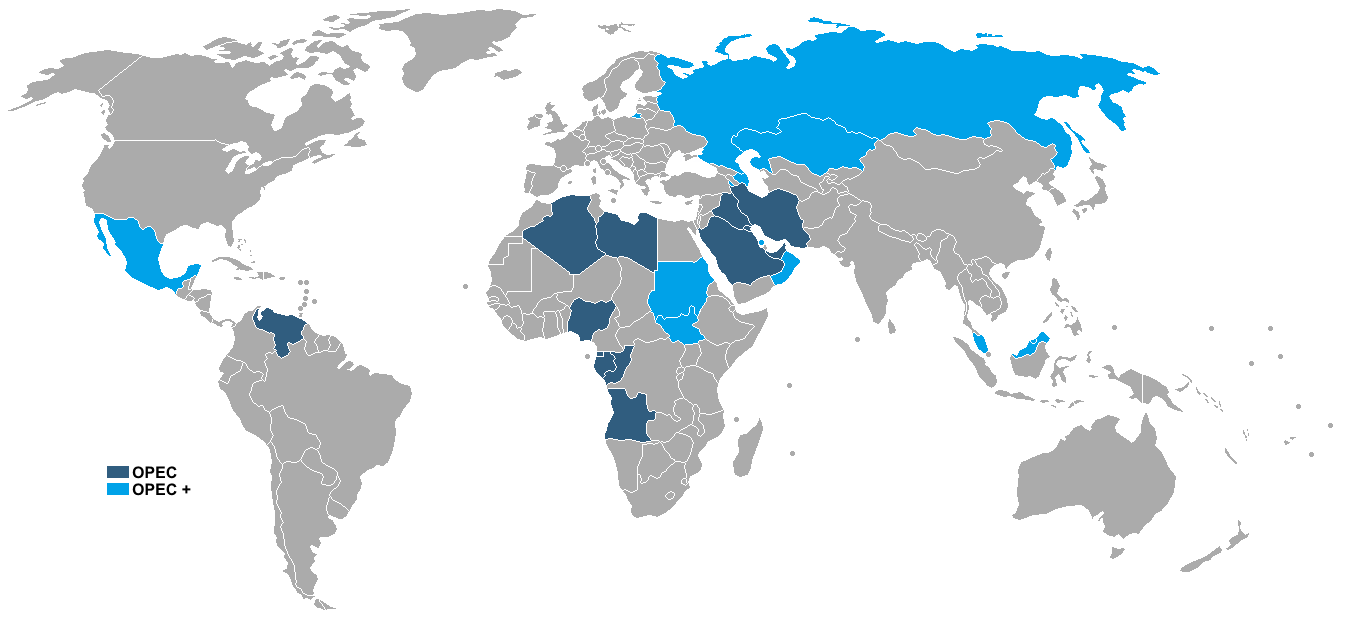
  • Present Member Countries: Islamic Republic of Iran, Iraq, Kuwait, Saudi Arabia, Venezuela, Algeria, Angola, Congo, Equatorial Guinea, Gabon, Libya, Nigeria, United Arab Emirates. 
  • According to the U.S. Energy Information Administration (EIA), OPEC's combined oil production rate (including gas condensate) represented 44% of the world's total in 2016, and OPEC held 81.5% of the world's "proven" oil reserves.
  • During the 1960s and 1970s, OPEC underwent a series of restructuring steps that shifting global oil production landscape in favour of oil-producing countries, diminishing the dominance of Anglo-American oil corporations known as the "Seven Sisters."
  • The admission of a new member nation necessitates the agreement of three-quarters of OPEC's existing members, including all five of the founding countries. Sudan submitted an application to join in October 2015, it has not yet become a member.

Organisation and Structure

  • Before OPEC's formation, individual oil-producing states faced punitive measures when attempting to alter the governance of oil production within their borders.
  • The fundamental principle underlying OPEC is that its members collectively benefit from limiting global oil supply to drive up prices.
  • Decision-making within OPEC follows these principles:
    • OPEC Conference, led by delegations, headed by member countries' oil ministers, serves as the organization's highest authority.
    • OPEC secretary general functions as the organization's chief executive.
    • Conference typically convenes at the Vienna headquarters at least twice a year. 
    • It generally operates on the basis of unanimity and "one member, one vote," with each country contributing an equal membership fee to the annual budget.
    • Given, Saudi Arabia's status as the world's largest and most profitable oil exporter, capable of acting as the traditional swing producer to balance the global market, it effectively serves as the de facto leader of OPEC.

OPEC+

  • In response to the steep drop in oil prices, primarily driven by substantial increases in U.S. shale oil production, OPEC entered into an agreement with ten other oil-producing nations in 2016, forming what is now recognized as OPEC+.
  • This informal coalition of nations, collectively referred to as OPEC+, comprises Azerbaijan, Bahrain, Brunei, Kazakhstan, Malaysia, Mexico, Oman, Russia, South Sudan, and Sudan.
  • Among these ten nations was Russia, the world's third-largest oil producer as of 2022, responsible for 13% of the global oil output.

Publications and Reports

  • The OPEC Secretariat produces a wide range of publications with the aim of keeping the public informed about the Organization's activities and disseminating data and insights related to OPEC Member Countries and the global oil industry.
  • Monthly Oil Market Report, which delves into critical issues confronting the worldwide oil market.
  • World Oil Outlook, known as WOO, presents OPEC's medium- to long-term perspective on the global oil market.

Nobel Peace Prize 2023: Narges Mohammadi

Context: Narges Mohammadi, an Iranian activist, won the Nobel Peace Prize for her efforts towards women’s rights and democracy.

About Narges Mohammadi

  • She has won the Nobel Prize for her fight against the oppression of women in Iran and her fight to promote human rights and freedom for all.
  • She is the 19th Woman to win the Nobel Peace Prize and the second Iranian Woman, after Shirin Ebadi (won Nobel Peace Prize in 2003).
image 15

About Nobel Peace Prize

  • It is one of the five Nobel Prizes established by the Alfred Nobel, along with the prizes in Chemistry, Physics, Physiology or Medicine and Literature.
  • It is awarded by a committee elected by the Norwegian Parliament (Stortinget).
  • It is awarded for the Outstanding contributions to peace: arms reduction, international cooperation, and organisations contributing to peace, and human rights contributions to peace.
  • It was first awarded in 1901. It was divided equally between Jean Henry Dunant "for his humanitarian efforts to help wounded soldiers and create international understanding" and Frédéric Passy "for his lifelong work for international peace conferences, diplomacy and arbitration".
  • Only two recipients have won multiple Prizes: the International Committee of the Red Cross has won three times (1917, 1944, and 1963) and the Office of the United Nations High Commissioner for Refugees has won twice (1954 and 1981).

Legend of Sammakka-Sarakka

Context: Recently, Union Cabinet Ministry, approved a tribal university for Telangana-‘the Sarakka Central Tribal University’. The Central Government announced the establishment of the university as a part of the Andhra Pradesh Reorganisation Act, 2014. The University is to be named after Sammakka-Sarakka, revered by the local tribal community. 

Sammakka-Sarakka Jatara:

  • As per the legends, Sammakka was married to a feudal chief of the Kakatiyas dynasty (ruled over the Warangal region). Sarakka/Saralamma was the daughter of Sammakka. 
  • Kakatiya dynasty ruler, Prataprudra imposed taxes on the Koya tribe and later declared battle on the tribe when the chief was not able to pay the taxes. 
    • The Sammakka Sarakka Jathara/Medaram Jathara, a biennial festival is celebrated to commemorate this battle of the 13th-century, in which the mother-daughter duo participated against the local rulers in protest against the imposition of taxes.
    • Sammakka and Sarakka are worshipped as the protector of Koya tribe. 
    • The festival shows no Vedic or Brahmanic influence.
    • The ritual of the festival includes taking holy dip in Jampanna Vagu (a stream), a tributary of River Godavari. 
    • From Medaram, the Jathara begins and priests belonging to Koya tribe perform the rituals. Medaram is situated in the Eturnagaram Wildlife Sanctuary, a part of Dandakaranya forest. 
    • Various tribal and non-tribal communities participate in the festival, from Andhra Pradesh, Madhya Pradesh, Chattishgarh, Odisha, Maharashtra, Karnataka and Jharkhand. 
    • It is the second largest fair of India, and is often referred to as the Kumbh Mela of the tribals. 
    • The festival is declared a state festival by the Telangana government.

Govt notifies bankruptcy code changes to make aircraft recovery easier

Context: The Ministry of Corporate Affairs has issued a notification stating that certain provisions of the Insolvency and Bankruptcy Code (IBC) will no longer apply to aircraft, their engines, airframes, and helicopters. 

Background: 

When Go First airlines filed for voluntary insolvency in the month of May (2023), the companies (lessors) who had leased aircrafts to the airline applied to DGCA to deregister those aircrafts from the airlines and repossess them. But DGCA didn’t approve their requests and kept their applications in abeyance.

Reason: Under section 14 of India’s Insolvency and Bankruptcy Code (IBC), the admission of an insolvency plea by the National Company Law Tribunal (NCLT) results in an immediate and complete moratorium on recovery of assets leased to the debtor (Go First in this case).

Concerns:

Inability of the lessors to take back their aircrafts results in:

  • Violation of Cape town convention: India is a signatory to the Convention on International Interests in Mobile Equipment and the related protocol, commonly known as the Cape Town Convention (CTC), as per which lessors can seek deregistration and export of aircraft without consent of the airline when lease payments are defaulted. 
  • Impacts aviation market: It impacts the reputation of India’s aviation market and may increase risk premiums for other Indian carriers. This may increase cost of operations for Indian airlines which are already reeling under the pressure of volatile fuel prices and cut throat competition. 

Thus, the recent changes to the IBC to exempt leased aircrafts under the protection given to debtors, came as a relief to the aviation sector.  

National Investment and Infrastructure Fund

Context: India's National Investment and Infrastructure Fund (NIIF) and Japan Bank for International Cooperation (JBIC) jointly launched a $600 million fund on Wednesday for climate and environment projects. 

Why NIIF?

Infrastructure projects frequently exhibit long-gestation periods, creating challenge for financial institutions to manage their short-term liabilities with these long-term cash-flow profiles.

To avoid these Asset-liabilities mismatch faced by the banks in funding infrastructure projects, Government has constituted National Investment and Infrastructure Fund (NIIF) with an authorised capital of 20,000 crores, to provide long-term institutional investment support to infra projects in India. 

What is NIIF?

The National Investment and Infrastructure Fund (NIIF) is a state-owned fund created by the GoI in 2015 to support infrastructural development in India, by gathering capital from domestic and international investors.  It has three components under it:

  • Master fund: This fund primarily invests in infra-related projects such as roads, ports, airports, and power. It invests in both green field(new) as well as brownfield(operating) projects. 
  • Fund of Funds: This fund invests in other funds managed by the renowned fund managers having a good track record in funding successful infrastructure projects. That means, this fund acts as an anchor investor to other private funds. 
  • Strategic Opportunities Fund (SOF): SOF targets to invest in companies belonging to sectors that have good growth potential. 

Freedom on the Net 2023: The Repressive Power of Artificial Intelligence

Context: The report, titled “Freedom on the Net 2023: The Repressive Power of Artificial Intelligence”, has raised the issue of increasing use of artificial intelligence by governments for censorship and spread of disinformation. 

Freedom on the Net 2023 Report  

The report is an annual study of human rights online conducted by Freedom House, a non-profit organisation. It evaluates Internet freedom in 70 countries on a range of 1 to 100, where ‘100’ represents the highest digital freedom. 

Evaluation Criterion  

The report evaluates countries on five censorship methods: 

  • Internet connectivity restrictions.  
  • Blocks on social media platforms. 
  • Blocks on websites.  
  • Blocks on VPNs. 
  • Forced removal of content. 

Freedom House Organisation  

Freedom House is a Washington based non-profit organisation. It was founded in 1941 to rally policymakers and a broadly isolationist American public around the fight against Nazi Germany, and to raise awareness of the fascist threat to American security and values.  Since then, it has established itself through its advocacy, programs, and research as the leading American organisation devoted to the support and defence of democracy around the world. 

Global Finding  

image 11

India Specific Findings

  • India's Internet freedom is ranked at 50 on a scale of 1 to 100. In contrast, Iceland has the highest Internet freedom score of 94. 
  • According to a report India is found to engage in all the methods used for censorship except VPN blocking.  
  • The report said that AI-enabled digital repression in India has incorporated censorship, including the use of automated systems, into the country’s legal framework. 
  • For example, The Information Technology (Intermediary Guidelines and Digital Media Ethics Code) Rules require large social media platforms to use AI-based moderation tools for broadly defined types of content.  
  • India also figured among the list of countries that blocked websites hosting political, social, or religious content and conducted technical attacks against human rights organisations. 

The Censoring Power of Artificial Intelligence 

Advances in artificial intelligence (AI) are amplifying a crisis for human rights online. AI has allowed governments to enhance and refine their online censorship. 

  • AI-based tools that can generate text, audio, and images have quickly grown more sophisticated, accessible, and easy to use, leading to escalation of disinformation tactics. 
  • AI can serve as an amplifier of digital repression, making censorship, surveillance, and the creation and spread of disinformation easier, faster, cheaper, and more effective. 
  • Automated systems have enabled governments to conduct more precise and subtle forms of online censorship.  
  • Suppliers of disinformation are employing AI-generated images, audio, and text, making the truth easier to distort and harder to discern.  
  • Sophisticated surveillance systems using AI rapidly trawl social media for signs of dissent, and massive datasets are paired with facial scans to identify and track pro-democracy protesters.  
  • AIs uptake has increased the scale, speed, and efficiency of digital repression. 
image 12

Way Forward:

  • To protect the free and open internet, democratic policymakers working side by side with civil society experts from around the world should establish strong human rights-based standards for both state and nonstate actors that develop or deploy AI tools. 
  • To protect internet freedom, democracy’s supporters must adapt the lessons learned from past internet governance challenges and apply them to AI.  
  • Democratic policymakers should establish a positive regulatory vision for the design and deployment of AI tools that is grounded in human rights standards, transparency, and accountability.  
  • AI carries a significant potential for harm, but it can also be made to play a protective role if the democratic community learns the right lessons from the past decade of internet regulation. 

China to double the size of Tiangong Space Station

Context: China plans to expand its space station to six modules from three in coming years, offering astronauts from other nations an alternative platform for near-Earth missions as the NASA-led International Space Station nears the end of its lifespan.

Tiangong Space Station (TSS)

  • TSS is a permanently crewed space station constructed by China and operated by China Manned Space Agency.
  • Placed in: Low Earth orbit between 340 and 450 km above the Earth's surface.
  • Operational lifetime: More than 15 years. 
  • It has been fully operational since late 2022, hosting a maximum of three astronauts.
  • TSS will weigh 180 metric tons after its expansion to six modules.

International Space Station (ISS)

  • ISS is a modular space station (habitable artificial satellite) and the single largest man-made structure in the low Earth orbit.
  • Launched in 1998, it is a multinational collaborative project involving five participating space agencies:
    • NASA (United States)
    • Roscosmos (Russia)
    • JAXA (Japan)
    • ESA (Europe)
    • CSA (Canada) 
  • The ownership and use of the space station are established by intergovernmental treaties and agreements. 
  • It circles the Earth in roughly 92 minutes and completes 15.5 orbits per day, hosting a maximum of seven astronauts.
  • It serves as a microgravity and space environment research laboratory in which scientific research is conducted in astrobiology, astronomy, meteorology, physics, and other fields.
  • NASA intends to keep operating the ISS until the end of 2030, after which the ISS would be crashed into Point Nemo over the South Pacific Oceanic Uninhabited Area (SPOUA).

Norwegian Author Jon Fosse Wins Nobel Prize for Literature 2023

Context: Jon Fosse from Norway, won the Nobel Prize in Literature. His plays are among the most widely staged playwright in the world.

image 10

About the news: 

  • The writer is known for his innovative plays and prose, giving “voice to the unsayable”. 
  • His works are written in Norwegian Nynorsk language, covering number of genres- Plays, novels, poetry collections, essays and children’s books. 

Major works of Jon Fosse

  • Jon Fosse made his debut as an author in 1983 with the novel, ‘Red, Black’ (Raudt,Svart), which moves back and forth in time and between perspectives. The novel was emotionally raw broached the theme of suicide.
  • His works are minimalistic and rely on simple language, delivering messages through rhythm, melody and silence. 
  • Boathouse and  Melancholy I and II; Someone is Going to come; And We’ll Never be Parted. 
  • His latest, Septology, is a semiautobiographical work and its third volume was shortlisted for the 2022 International Booker Prize. 
  • In 2022, French Feminist Icon Annie Ernaux was awarded the Nobel Prize in Literature. 

About Nobel Prize in Literature: 

  • The Swedish Academy, Stockholm, Sweden awards the Prize. 
  • It is one the Five Nobel Prizes established by the will of Alfred Nobel in 1895. 
  • It is awarded annually, since 1901, to an author from any country in the field of literature, producing the most outstanding work in an idealistic direction. 

Rabindranath Tagore was the first Indian, receiving the nation’s first Nobel Prize (in Literature) in 1913 for his collection ‘Gitanjali’ published in London in 1912. He was also the first non-westerner, to receive this prize. 

Read also: