Environment

Reroute rail track through gibbon sanctuary

Context: The Hollongapar Gibbon Sanctuary has been split in two by a railway track running through it. The presence of the railway track splits the gibbons' habitat and impedes their ability to move freely throughout the sanctuary area.

Canopy Bridge Proposal

  • The proposal put out by the Wildlife Institute of India (WII) suggests the development of an artificial canopy bridge with the aim of enabling the migration of hoolock gibbons over the railway track located inside the sanctuary.
  • The primary objective of this canopy bridge is to reestablish connectivity inside the fragmented habitat, facilitating unrestricted movement for the gibbons between the two distinct sections of the sanctuary.

Gibbon Habitat and Population

  • The Hollongapar Gibbon Sanctuary, situated in the Jorhat region of Assam, has a total land area of 21 square kilometers.
  • The sanctuary now houses around 125 hoolock gibbons, which represent the only ape species found in India.

Fragmentation and Threat to Habitat

  • The article emphasizes that, similar to the other 19 gibbon species worldwide, the hoolock gibbons residing in this sanctuary are also facing the threat of endangerment as a result of habitat loss and fragmentation.
  • The sanctuary has seen a loss of connectedness with the surrounding forest patches, resulting in the formation of a distinct ecological entity known as a "forest island."
  • Gibbons, being arboreal creatures that inhabit the top canopy of forested areas, exhibit sensitivity towards canopy gaps, hence making habitat fragmentation a matter of particular concern.

Gene isolation and survival

  • The presence of the railway track has resulted in the segregation of gibbon families on each side, so reducing their genetic diversity.
  • The genetic isolation of hoolock gibbons inside the sanctuary poses an additional risk to their survival, compounding the other vulnerabilities they currently face.

Hollongapar Gibbon Sanctuary

  • The establishment of the Hollongapar Gibbon Sanctuary in 1997 was largely motivated by the objective of conserving the Hoolock Gibbon species and its natural environment.
  • The Hollongapar Gibbon Sanctuary is located in the Jorhat district of Assam, in close proximity to the town of Mariani.
  • The geographical extent of the region is roughly 20.98 square kilometers (8.11 square miles).
  • The sanctuary exhibits distinct features of semi-evergreen and mixed deciduous forest, hence providing a wide array of habitats that support a broad variety of plant and animal species.
  • Bio-diversity
    • The sanctuary is well recognized for its significant contribution to the preservation efforts of the Western Hoolock Gibbon (Hoolock hoolock), a species that has been classified as Endangered according to the IUCN Red List.
    • In addition to gibbons, the sanctuary accommodates a diverse array of primate species, such as the Stump-tailed Macaque and Capped Langur.
    • The avian richness in the area is notable, showcasing a wide array of bird species like the Great Hornbill, Green Imperial Pigeon, and White-cheeked Partridge.
  • Vegetation
    • The sanctuary's flora comprises of semi-evergreen and mixed deciduous woods, characterized by a diverse array of tree species such as Holong (Dipterocarpus macrocarpus), which lends its name to the sanctuary.
    • The presence of various forest types plays a crucial role in providing essential habitats for both permanent and migratory species.

Western Hoolock Gibbon

Western Hoolock Gibbon
  • Hoolock hoolock, a member of the family Hylobatidae, is a primate species that is widely recognized as gibbons in the scientific community.
  • These organisms are distributed over several regions of South Asia, with a primary presence seen in India, Bangladesh, and Myanmar.
  • The current estimated population size of hoolock gibbons is around 12,000 individuals.
  • The Western Hoolock Gibbon is classified as one of the two distinct species of hoolock gibbons, with the other species being the Eastern Hoolock Gibbon (Hoolock leuconedys).
  • Hoolock gibbons, classified as "lesser apes," are little primates, distinct from the bigger "great apes" such as chimpanzees, gorillas, orangutans, and humans.
  • The Western Hoolock Gibbons have a distinctive physical appearance characterized by a fur coat that is black or dark brown in color, accompanied by a white facial ring and prominent eyebrows.
  • Both males and females exhibit comparable physical characteristics, however males tend to possess somewhat greater dimensions in comparison to females.
  • Their elongated appendages are highly specialized for the locomotive behavior of brachiation, enabling them to proficiently traverse from one tree branch to another.
  • Western Hoolock Gibbons inhabit many forest ecosystems, include tropical rainforests, subtropical woods, and mixed deciduous forests.
  • These organisms reside inside the uppermost levels of the tree canopy and have a strong preference for arboreal habitats, with seldom terrestrial activity.
  • The geographical distribution of the Western Hoolock Gibbon encompasses several regions in northeastern India, northern and western Myanmar (Burma), as well as southern China.
  • The range of this species in India encompasses many states, including Assam, Arunachal Pradesh, and Nagaland.
  • Gibbons are renowned for their noteworthy vocalizations, which serve as vital mechanisms for demarcating territory and fostering social unity among their groups. It is well recognized that they have the ability to generate musical compositions that possess the capacity to propagate audibly over considerable distances.
  • The gibbons have a mostly frugivorous diet, including a diverse range of fruits, leaves, and sometimes, insects.
  • The individuals live inside compact familial units including a monogamous dyad consisting of a male and female, with their progeny. Typically, these groups are comprised of two to four persons.
  • The social organization of this species is centered on strong pair ties established between males and females, often engaging in duets as a component of their territorial conduct.
  • The Western Hoolock Gibbon has been classified as an Endangered species according to the Red List of the International Union for Conservation of Nature (IUCN).
  • According to the International Union for Conservation of Nature (IUCN) Red List, the Eastern Hoolock Gibbon is classified as Vulnerable.
  • Both species are classified under Schedule 1 of the Indian (Wildlife) Protection Act 1972, therefore granting them the highest degree of legal protection in India.

Global Biodiversity Framework Fund

Context: Representatives from 185 countries have officially agreed to launch a new fund to bolster investments in nations during the Seventh Assembly of the Global Environment Facility in Vancouver, Canada.

Introduction to the Global Biodiversity Framework Fund (GBFF):

  • The GBFF is devised to mobilize and accelerate investments in the conservation and sustainability of wild species and ecosystems.
  • The GBFF is exclusively dedicated to supporting the implementation of the goals and targets outlined in the Kunming-Montreal Global Biodiversity Framework.
  • GBFF is established as a new trust fund under the umbrella of the Global Environment Facility.
  • The fund offers an opportunity to secure funding from diverse sources and facilitate rapid disbursement through streamlined procedures, with an emphasis on providing enhanced access for indigenous peoples and local communities, in accordance with their own priorities.
  • The GBFF also presents an avenue for significantly increased involvement of Multilateral Development Banks and Development Finance Institutes, thereby aiding the mainstreaming of biodiversity, which is essential for effective implementation of the Framework.
  • This new fund will mobilize and distribute new and additional resources from public, private, and philanthropic sources, with a distinct focus on promoting the sustainability of biodiversity and ecosystems.
  • Indigenous peoples will be accorded priority: Approximately twenty percent (20%) of the GBFF's resources will be directed towards supporting initiatives led by indigenous communities aimed at protecting and conserving biodiversity.
  • Priority for Small Island Developing Countries and Least Developed Countries: One third of the resources of GBFF will be allocated to supporting Small Island Developing States and Least Developed Countries. 
  • Initial contributors: The United Kingdom and Canada have made initial contributions to the GBFF to initiate its capitalization.

Governance Structure of the Global Biodiversity Framework Fund (GBFF):

  • The GBFF Fund Council will be inclusive of representation from the following members, with a greater representation from developing countries as compared to developed ones:
    • 16 members from developing countries
    • 14 members from developed countries
    • 2 members from countries in central and eastern Europe and the former USSR.
  • Decisions of the GBFF Fund Council will be made through consensus, following the model of the GEF instrument.

Financial Management of the Global Biodiversity Framework Fund (GBFF):

  • The World Bank will serve as the Trustee of the GBFF Fund.

Protecting the Biodiversity of Northeast 

Context: In the recent case of Re: Cleanliness of Umiam Lake versus State of Meghalaya (2023), the division Bench in its order, stated that “In the absence of any other employment opportunities and in the name of promoting tourism, the natural beauty of the State should not be destroyed”.

image 107

About 

  • The Northeast India comprises of eight states namely Assam, Arunachal Pradesh, Meghalaya, Manipur, Mizoram, Nagaland, Sikkim and Tripura.
  • The region shares its international border with Bhutan in the north, Myanmar in the east and Bangladesh in the west.
  • The region is the transition zone between Indo-Malayan and Indo-Chinese geographical regions and a meeting point of the Himalayan Mountains and Peninsular India. 
  • The Northeast Zone receives one of the highest rainfalls in the world and is a top humid region of the country which makes this biogeographic region rich in flora and fauna with unique features and endemism.
  • Most of the states in the Northeast has an indigenous ethnic group and depends very much on forest resources for life sustenance. Food, shelter, and medicine are mostly acquired from the forests.
  • The altitudinal variations and climate variability determine the pattern of vegetation in the region
  • The major forest types in the region are Tropical Evergreen Forests, Tropical Semi-Evergreen Forests, Tropical Moist Deciduous Forests.

Biodiversity Hotspot To qualify as a biodiversity hotspot, a region must meet two strict criteria: Endemism: It must have at least 1,500 vascular plants as endemics — which is to say, it must have a high percentage of plant life found nowhere else on the planet. A hotspot, in other words, is irreplaceable. Threatened: It must have 30% or less of its original natural vegetation. In other words, it must be threatened.

Northeast a Biodiversity Hotspot

image 108

North-eastern India (except Brahmaputra Valley) along with Andaman group of Islands is a part of Indo Burma biodiversity hotspot along with three more such biodiversity hotspots in India, i.e., Indian Himalaya (excluding Trans Himalaya) in the Himalayan biodiversity hotspot.

Challenges to Conservation of Biodiversity in Northeast 

  • Land tenure issues: Land tenure systems vary widely among different North-Eastern states. The complexity in land ownership and tenurial rights makes it difficult for survey, demarcation and consolidation of land. Therefore, cadastral survey and land demarcation are completely absent in the hill areas of northeast.
  • Dichotomy in Forest Administration:
    • Forests in Arunachal Pradesh, Manipur, Meghalaya, and Nagaland mainly belong to private individuals, communities, and clans. 
    • Their ownership is safeguarded by the sixth schedule of the Indian Constitution, making state and national regulations inapplicable.
    • Due to inadequate enforcement personnel, district council acts have limited efficacy. 
    • Consequently, many northeast community forests lack management and law enforcement. 
  • Equity issues in natural resources and diversity management: Unequal distribution of land resources is responsible for increasing dependence on forests by certain sections of society leading to degradation of biodiversity in the region. 
  • Inter-departmental coordination: lack of a comprehensive and holistic approach which addresses the interdependent threats to biodiversity. E.g., use of diclofenac leading to death of Vultures.
  • Smuggling across the international border: The illicit felling of trees and timber smuggling across the international borders has been the most important cause of forest degradation in border areas of northeast.
  • Shifting cultivation: Unregulated shifting cultivation by the local tribal populations has been a major threat to sustainable diversity management.
  • Inter-state border dispute: Most of the border areas in northeast are forest lands and because of boundary disputes, such lands are often declared as ‘no man’s land’ and hence, do not come under any form of management. This leads to the degradation of diversity in such areas.
  • Insurgency: The long insurgency problem in some states such as Assam and Tripura have considerable impact on diversity conservation. 
  • Deforestation and Degradation: Cutting down trees is the primary issue faced by various wildlife resources. With deforestation, the forest cover is disappearing gradually.
  • Encroachment: Encroachment of forestland for the developmental purposes and creation of infrastructure e.g., tourism infrastructure is a serious threat to forests and their conservation. This is not only leading to the loss of the forest areas, but also of wildlife.
  • Forest Fire: Forest fires are now common and have a terrible impact on the forest cover of the Northeast. Wildlife is also affected negatively by this issue.
  • Commercial Plantation: This is leading to the homogenisation of biodiversity landscape.
  • Human-Wildlife Conflict: Natural corridors of movement for the animals are not well made and protected which leads to regular encounters and conflict between humans and wildlife.
  • Replacement of Indigenous Species with Exotic Species: Due to increasing demand of food and other products exotic species are bought in. These species give high yield thus eradicate the use of local species. E.g., in Tripura more than 280 plants have been introduced to increase the yield, In Mizoram exotic fish species have been introduced.
  • Bad Policy Making in Infrastructure Development: Due to lack of proper information, coordination and planning the construction of infrastructure has become a great threat to biodiversity.
    • Mining in these areas for coal, minerals and oils has also caused a reduction of the species richness.
    • e.g.,
      • In Arunachal Pradesh a species called Sapria himalayana has become extinct due to the development of roads. 
      • Construction near Eagle nest foothill is causing the extinction of some species of plants. A rare species of epiphytic plant called Agapetes is also in danger.
  • Immigration and Unintended Consequences: Immigrants from outside are changing the beliefs and customs of the native people. E.g., The sacred grooves of Meghalaya and Manipur are decreasing due to the reducing beliefs of people

Initiatives taken for Conservation 

  • Protected areas: Under the Wildlife Protection Act, 1972 government has made provision for national parks, wildlife sanctuaries, and other types of reserve, through which many parks and sanctuaries have been established in Northeast region. E.g., Kaziranga National Park.
  • International Cooperation: India has signed or became part of many international initiative that conserve the biodiversity in northeast region e.g., UN Convention on Biodiversity.
  • Role Ministry of Home Affairs (MHA): MHA has taken many initiatives to resolve the border dispute between the state and reduce the insurgency in the region which in turn created the available space for the conservation of biodiversity. E.g., resolution of dispute between Assam and Mizoram.
  • Role of Non-Government Organisations (NGOs): Many NGOs in northeastern region has promoted the conservation of biodiversity in the region e.g., “Hargila army”, a group of rural women in the Indian state of Assam worked for the protection of the greater adjutant (Leptoptilos dubius) locally known as Hargila.
  • Promotion of Organic: States like Sikkim which became completely organic by reducing the use of chemicals in agriculture have also decreased the associated negative effects on biodiversity. 
  • Institutional Measures: Botanical Survey of India, Zoological Survey of India, Indian Council of Agricultural Research, National Bureau of Plant Genetic Resources and many other central government organizations are directly involved in inventorization, conservation and propagation of biodiversity.
  • Role of Judiciary: Judiciary in many cases took the initiative for the conservation of biodiversity e.g., National Green Tribunal (NGT), took cognizance of the environmental degradation caused by coal mining in Meghalaya and issued several orders to address the issue.
  • Community Efforts: Sacred forests of Meghalaya i.e., Law Lyngdoh, Law Niam and Law Kyntang and sacred groves of Manipur, including Nag Vans are the examples of forest management practices based on the traditional religious beliefs. 
  • Notified Forest Areas: The government owned forests have been classified into Reserved Forests (RF), Protected Forests (PF) and Proposed Reserve Forests (PRF) to protect and control their management and rational exploitation. Activities harmful to forest flora and fauna have been prohibited in these areas.
  • Policies and Legislation: 
    • For forest areas, the National Forest Policy of 1988 has been adopted in the region. To ensure policy implementation, appropriate forest legislation and instructions have been brought in. 
    • The central legislations such as Indian Forest Act, 1927; the Wildlife (Protection) Act, 1972; the Forest (Conservation) Act, 1980; and the Environment (Protection) Act, 1972 have been enacted in the region. 
    • Besides, many state legislations are in force in each state for regulation of forest extraction.
  • Education for Biodiversity Conservation: Apart from in-situ conservation efforts, each state has tried for ex-situ conservation such as Captive breeding programme on selected animals such as leopard cat, binturong, spotted deer and primates.
  • Conservation Hot Spots: Many projects with specific objectives of biodiversity survey and conservation were undertaken in different north-eastern states to survey and identify biodiversity rich locations referred as “Conservation Hot Spots (CHS)” in the region with funding support from WWF – India and other funding agencies.  
  • Joint Forest Management (JFM): The programme of JFM has been adopted in 7 states (except Meghalaya) of the ecoregion to regenerate, protect and manage the degraded forest lands with the involvement of local communities with or without the help of NGOs.
  • Afforestation Programmes: There are state specific programmes for bringing the vacant and Jhum fallow lands belonging to small and marginal farmers under vegetation cover. E.g., the “Apna van scheme” in Arunachal Pradesh and “Angan Ban Prakalpa” in Tripura.

The Northeastern biodiversity hotspot, rich in species diversity, draws significant tourism due to its natural beauty, boosting the economy. However, human activities are rapidly depleting this precious area's biodiversity. Without conservation efforts, this natural treasure will vanish quickly. So, the government, while increasing the development efforts in these areas, should also consider conservation of biodiversity leading to sustainable development in the region. 

Green Hydrogen Standard

Context: Ministry of New & Renewable Energy has notified the Green Hydrogen Standard which outlines the emission thresholds that must be met for hydrogen produced to be classified as 'Green', i.e., from renewable sources. This move is expected to bring a clarity to Green Hydrogen community in India and contribute to the progress of National Green Hydrogen Mission. India has become one of the first few countries in the world to announce a definition of Green Hydrogen.

Green Hydrogen Standard

  • Green Hydrogen shall mean Hydrogen produced using renewable energy, including production through electrolysis or conversion of biomass. Renewable energy also includes such electricity generated from renewable sources which is stored in an energy storage system or banked with grid in accordance with applicable regulations.
  • Green Hydrogen produced through electrolysis: Non-biogenic greenhouse gas emissions arising from water treatment, electrolysis, gas purification and drying and compression of hydrogen shall not be greater than 2 kg of CO2 equivalent per kg of Hydrogen, taken as an average over last 12 month period. 
  • Green Hydrogen produced through conversion of biomass: Non-biogenic greenhouse gas emissions arising from biomass processing, heat/steam generation, conversion of biomass to hydrogen, gas purification and drying and compression of hydrogen shall not be greater than 2 kg of CO2 equivalent per kg of Hydrogen taken as an average over last 12 month period.
  • Bureau of Energy Efficiency shall be the Nodal Authority for accreditation of agencies for monitoring, verification and certification of Green Hydrogen production projects. 
  • A detailed methodology for measurement, reporting, monitoring, on-site verification and certification of green hydrogen and its derivatives shall be specified by Ministry of New & Renewable Energy.

Amazon Summit of ACTO Countries

Context: Amazon Summit under the aegis of the Amazon Cooperation Treaty Organisation (ACTO) came to an in the  Belem City of  Brazil. The Summit produced an outcome document known as Belem Declaration. This is only the fourth summit-level meeting under ACTO. 

Amazon Cooperation Treaty Organisation (ACTO)

  • Amazon Cooperation Treaty Organisation (ACTO) is an intergovernmental organisation formed by 8 Amazonian countries: Bolivia, Brazil, Colombia, Ecuador, Guyana, Peru, Suriname and Venezuela (8 countries). 
  • The above Eight nations decided to create ACTO to strengthen and implement under the Amazon Cooperation Treaty in 1995 to strengthen and implement the Amazon Cooperation Treaty objectives. 
  • Permanent Secretariat of ACTO was established in Brasilia in 2002 and permanently installed in 2003. Permanent Secretariat of ACTO is to facilitate the exchange, knowledge, cooperation and joint projection among ACTO Member Countries to fulfil the mandate of Amazon Cooperation Treaty. 
  • Amazon Cooperation Treaty was signed in 1978 to promote the harmonious development of Amazonian territories in a way that joint actions of Amazonian countries produce equitable and mutually beneficial results in achieving the sustainable development of Amazon region.

Objectives of Amazon Cooperation Treaty Organisation

  • Facilitate exchange and cooperation among Member countries, promoting strategic sustainable development and livelihoods with emphasis on vulnerable populations, indigenous people and other tribal communities.
  • Ensure that the interests and sovereignty of Member Countries are respected and promoted.
  • Facilitate actions to preserve, protect, conserve and sustainably use forests, biodiversity and water resources of the Amazon.
  • Promote the management of Amazonian resources in harmony with nature and the environment.
  • Promote and disseminate the culture of Amazon and foster respect and protection of ancestral and current wisdom.
  • Promote coordination of plans for Member Countries for the development of Amazonian populations.

About Amazon River and its Basin

  • Amazon region makes up more than half of the world's tropical rainforest and is the world's largest tropical forest. The region stretches over an area twice the size of India. Two-thirds of it lies in Brazil and the remaining is shared by other 7 countries and one territory (French Suriname). The region also has a significant presence of savanna-like biogeography.
  • Amazon River: Largest & longest river on Earth. It originates at 5597 metres in the Peruvian Andes on the slopes of the Quehuisha volcano. 
  • Important tributaries of Amazon: Putumayo, Japurá and Negro River (north slope), Juruá, Purús, Madeira, Tapajós and Xingú.
  • Rich in biodiversity: Amazon's tropical forest biome accounts for 50% of Earth's existing biodiversity and is the most extensive and biodiversity-rich jungle on the planet. 
  • Climatic significance of Amazon: Amazon has a great influence on heat & water vapour transportation to higher latitude regions.
    • Regulates regional climate 
    • Regulates carbon absorption contributing to mitigating climate change.
    • Regulates evapotranspiration process
  • Cultural significance: Amazon basin is home to about 40 million inhabitants and is home to 400 indigenous peoples who speak more than 300 languages. 

Challenges to Amazon Ecosystem

  • Deforestation and land use changes in Amazon Region.
  • Oil exploration in Amazon region and other mineral exploration.
  • Countries of the Amazon region aim for economic development.
  • Scientists believe when 20-25% of Amazon's rainforest is destroyed, rainfall will dramatically decline
  • Exploitation of rights of indigenous people in the Amazonian region.
  • Expansion of agricultural cultivation in Amazon region.
  • Organised crime and drug trafficking in Amazon region

Necessary intervention: On India’s conservation ethos

Context - The Wildlife Institute of India and the National Tiger Conservation Authority, who are responsible for the quadrennial ‘tiger census’ reports, recently updated their estimates for the animal’s numbers. Madhya Pradesh, for the second time in eight years, reported 785 tigers, or about a fifth of the national count. The State reported a 50% rise in tigers since the last census.

image 80

A Case Study : How Madhya Pradesh over the years has perfected the Tiger conservation approach:

It has focussed on balancing the predator – prey relationship: M.P. has reintroduced species such as barasingha (swamp deer) to new habitats such as Satpuda and Bandhavgarh, and the gaur to the Bandhavgarh and Sanjay-Dubri tiger reserves. Prey species such as chital (spotted deer) have been successfully supplemented in the Satpuda and Sanjay tiger reserves, Nauradehi, Kuno, and Gandhisagar wildlife sanctuaries through translocation from high-density Pench and Bandhavgarh.

These often involve tracking, darting and capturing animals, keeping them in temporary enclosures until they reach sufficient numbers and then releasing them into their new habitat. 
zfLSdHqmbNS0rkxogW9rn vmQdsnVWy8R2PaQPXQt1rHDJ1t5AVqOTig68i4WM53bpB6TJh8g9Wd7lpRS7yM wTcT ZTXGvb 4y8LGlNw VJxI7hJI3yXTUZ1KIUenP5auonaGV3jfNb EbJ2ylIg

Key facts:

  • The number of tigers in India has increased from 2,967 in 2018 to 3,682 in 2022, an annual rise of 6 per cent.
  • India has become home to approximately 75 per cent of the world’s tiger population.
  • Tiger census is held every four years in the country.
  • With a 50 per cent increase in the last four years, Madhya Pradesh has the maximum number (785) of tigers in the country, followed by Karnataka (563), Uttarakhand (560), and Maharashtra (444), according to the data.
  • The number of tigers “within the tiger reserve” is highest in Corbett (260), followed by Bandipur (150), Nagarhole (141), Bandhavgarh (135), Dudhwa (135), Mudumalai(114), Kanha (105), Kaziranga (104), Sundarbans (100), Tadoba (97), Sathyamangalam (85), and Pench-MP (77).
  • Arunachal Pradesh, Odisha, Telangana, Chhattisgarh and Jharkhand have recorded a dip in the number of majestic cats in the last few years.
  • The Western Ghats witnessed a decrease in tiger occupancy, except for a few areas like Kali (Anshi Dandeli), where the number of unique tigers remains stable. The report pointed to “increasing human footprint and development” as the primary reasons behind the declining tiger population in the Western Ghats

Climate finance adds another layer of inequity to climate change

Context: In the last few years, climate Justice activists have been campaigning for the world’s economically developed countries to raise their investments in climate adaptation and mitigation, including paying for other countries’ abilities to deal with the effects of climate change

Background:

According to the United Nations Framework Convention on Climate Change (UNFCCC) Standing Committee on Finance, climate finance is "finance that aims at reducing emissions and improving greenhouse gas sinks, as well as reducing vulnerability of, and maintaining and increasing the resilience of, human and ecological systems to negative climate change impacts."

The term has been used in a narrow sense to refer to transfers of public resources from developed to developing countries, considering their UN Climate Convention obligations to provide "new and additional financial resources", and in a wider sense to refer to all financial flows relating to climate change mitigation and adaptation.

UNFCCC, Kyoto Protocol and Paris Agreement call for financial assistance. In accordance with the principle of “common but differentiated responsibility and respective capabilities” set out in the Convention, developed country Parties are to provide financial resources to assist developing country Parties in implementing the objectives of the UNFCCC. The Convention has created Financial Mechanisms to offer cash to developing nation Parties to help with this. 

  • Since the Convention's entrance into force in 1994, the Global Environment Facility (GEF) has acted as the financial mechanism's operating institution. 
  • Copenhagen Accord: Parties agreed for a "goal" for the world to raise $100 billion per year by 2020, from "a wide variety of sources", to help developing countries cut carbon emissions (mitigation). 
  • COP 16 (2010): Parties established the Green Climate Fund (GCF) and in 2011 (COP 17) also designated it as an operating entity of the financial mechanism. 
  • Establishment of special funds: Special Climate Change Fund (SCCF), the Least Developed Countries Fund (LDCF), both managed by the GEF; and the Adaptation Fund (AF) under the Kyoto Protocol in 2001. 

Performance till Date:

  • According to UNFCCC standing committee report, the $100b targets have not been met yet. 
  • Even the effort to move finances through private players have also met with comprehensive failure. 
  • There is a huge variation in estimates. For eg- OECD reports that around $83b have been moved but Oxfam claims it to be just around $21 b - $24b
A graph showing the global economy

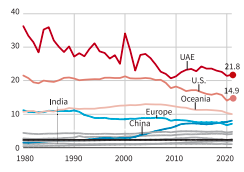
Description automatically generated with medium confidenceChart shows the carbon dioxide emissions per capita emitted in 1980­2021 by various geographical Regions. It also shows (as a fixed black line) a baseline target of carbon dioxide emissions (2.3 tonnes per capita) needed to limit global warming to 1.5° Celsius. The global average emissions per capita is currently double this target, and has stayed above 4.7 tonnes per capita since 2010, whereas Africa and India have both been consistently under. China crossed the global average in 2004.
A graph of different colored bars

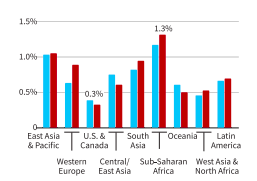
Description automatically generated with medium confidenceIt shows the total investment in climate ­related activities as a fraction of that region’s total GDP in 2019 and 2020. This includespublic and private investment. In both years, Sub ­ Saharan Africa had the highest investment fraction in climate finance (1.3% ofits GDP), followed by East Asia and the Pacific (1%) and South Asia (0.9%). The U.S. and Canada had the lowest proportionate investment, at only 0.3% of their GDP.
A graph of different colored bars

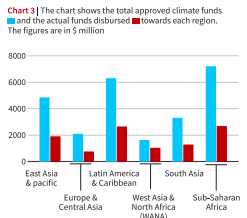
Description automatically generated with medium confidenceIt shows the total approved funds and theactual funds disbursed towards each region. Since 2003, for example, $3.3 billion was approved to be disbursed to South Asia, but only $1.3 billion was actually disbursed. Most regions received only 40% of the approved funding for that region, on average.

CHALLENGES IN CLIMATE FINANCE 

  • Definitions & reporting of climate finance: Even 10 years after COP 15, there is no general agreement on what form of funding can be counted as climate finance under the GCF in support of the Copenhagen pledge. Even 7 years after the Paris Climate Deal, there is no agreement regarding definition of climate finance. 
  • Insufficient Amounts: For instance, global annual fossil fuel subsidies together with their externalities cost about $5.3 trillion. Experts have suggested that even $100b/year pledge is not sufficient to tackle the issue. 
  • Climate Finance Governance: Equally challenging is how international climate change funding should be effectively governed and delivered to developing countries. 
  • Reporting and Verification: Currently there is a lack of mandatory verification mechanism in reporting. Reporting requirements around the projected financing provisions remain weak. 

Conclusion

Countries in Sub ­ Saharan Africa, Latin America, and South Asia have historically contributed the least to global warming; yet, they are bearing the bigger brunt of climate disasters – both in the form of extreme natural phenomena and debt distress. On the other hand, countries in North America and Europe have contributed and continue to contribute the most, and are also the creditors of the debt crisis.

Forest Conservation Amendment Bill 2023

Context: Lok Sabha has passed the Forest Conservation (Amendment) Bill without any changes from the first version introduced on March 29. The contentious Bill was introduced to amend the Forest Conservation Act, 1980.

What is Forest conservation amendment bill 2023?

  • The Bill amends the Forest (Conservation) Act, 1980 to make it applicable to certain types of land. These include land notified as a forest under the Indian Forest Act, 1927 or in government records after 
  • the 1980 Act came into effect.  The Act will not be applicable for land converted to non-forest use before December 12, 1996.

Forest Conservation Act 1980 is a unique piece of legislation and regulatory mechanism that reflects the collective will of the nation to protect its rich forests, biodiversity and natural heritage and resources. The act permits only unavoidable use of forest land for various development purposes. It embodies the firm commitment of the Government and the Department to balance the conservation of forests with the sustainable developmental need of the society contributing to better environment, health and economy. This act is regulatory in nature and not prohibitory.

Key features of the bill:

  • Exemptions - It exempts certain types of land, for e.g. land within 100 km of India’s border needed for national security projects, small roadside amenities, and public roads leading to a habitation.
  • Approval from centre - The state government requires prior approval of the central
    government to assign any forest land to a private entity.  The Bill extends this to all entities, and allows the assignment to be made on terms and conditions specified by the central government.
  • Activities in forests - The Act specifies some activities that can be carried out in forests, such as establishing check posts, fencing, and bridges.  The Bill also allows running zoos, safaris and eco-tourism facilities.
  • Power to issue directions:  The Bill adds that the central government may issue directions for the implementation of the Act to any authority/organisation under or recognised by the centre, state, or union territory (UT).

Key Issues and Analysis:

  • The Bill excludes two categories of land from the purview of the Act: land recorded as forest before October 25, 1980 but not notified as a forest, and land which changed from forest-use to non-forest-use before December 12, 1996.  This provision may go against a 1996 Supreme Court judgement on preventing deforestation.
  • Exempting land near border areas for national security projects may adversely impact the forest cover and wildlife in north-eastern states. 
  • A blanket exemption for projects like zoos may adversely affect forest land and wildlife. The Supreme Court (2023) has remarked that they do not appreciate the necessity of having a zoo inside tiger reserves or national parks.
  • Activities like silvicultural operations, safaris, and eco-tourism facilities may help in economic development, and may even contribute to national priorities such as energy security and industrial growth.  However, there may be a need to balance economic benefits of such activities with that of conserving forests.  It is not clear why the requirement of a case-by-case examination by the central government to determine such balance is being replaced by a blanket exemption.

Genetically Modified Mustard at the Supreme Court

Context: A long drawn PIL has prevented Centre from permitting Genetically Modified mustard to be cultivated commercially.

image 55

GM Mustard

It is an Herbicide Tolerant (HT) mustard variety that has undergone genetic modification. It has two alien genes —"barnase" and "barstar"; isolated from a soil bacterium called Bacillus, amyloliquefaciens. It enables the breeding of high-yielding commercial mustard hybrids.

  • The first gene (‘barnase’) codes for a protein that impairs pollen production and renders the plant into which it is incorporated male-sterile. 
  • This plant is then crossed with a fertile parental line containing, in turn, the second ‘barstar’ gene that blocks the action of the barnase gene. 
  • The resultant F1 progeny is both high-yielding and also capable of producing seed/ grain, due to the barstar gene in the second fertile line.
Science behind DMH-11

Genetically Modified Crops

GM is a technology that involves inserting DNA into the genome of an organism. To produce a GM plant, new DNA is transferred into plant cells. Usually, the cells are then grown in tissue culture where they develop into plants. The seeds produced by these plants will inherit the new DNA.

  • Biotechnologists insert select genes at a location in the DNA of a plant to develop a GM crop. 
  • The insertion makes a GM crop express traits that it ordinarily would not. 
  • For instance, GM mustard has been altered to withstand the broad-spectrum plant-killer or herbicide Glufosinate. 
LnKlg2gYPmQUWHH9aL MKKYojnVut4k2W SDVOP5Lb9TS9KjEegtx62ekDp9RSqW4vGGNuplQMRUMkY10vgxFl1iBgT7ocEITfsVv

Some methods used in Genetic Modification

pcBW9WkDF7pKy8AZQ5BSe7T FmHPC ajTkxp6fa5bqw22dDPRw77ffS6 WOJr HgtED9q0WUR44jDPtd FSPCOxV5Tx9p

Conventional Breeding Vs Genetic Modification 

Conventional Breeding Vs Genetic Modification 

Benefits of GM Crops 

  • GM crops have reduced chemical pesticide use by 37%, increased crop yields by 22%, and increased farmer profits by 68% (As per Klumper and Qaim, 2014). 
  • GM crops have also reduced Carbon dioxide emissions (mostly through no-till farming practices) by 24.5 million kg per annum (As per the study by Graham Brookes and Peter Barfoot, 2020).
  • As per FAO study done in 2022, The long and safe track record of GM crop cultivation and consumption of foods derived from them over the past 28 years (1994 to 2022) attest the safety of GM foods to Humankind. 
  • Global cultivation of GM Crops which shows the benefit of the GM crops
    • GM crops are cultivated in 29 countries in an area of 190 million hectares
    • Forty-three countries import foods, oils and feed derived from GM crops. 
    • Nine non-food GM crops and twenty-two GM food and feed crops are cultivated and consumed globally.
  • India commercialized insect pest-resistant Bt-cotton in 2002 that brought about a significantly positive change in cotton production, export and textile industry.
    • It has greatly reduced the use of toxic pesticides
    • As a result of the adoption of Bt cotton, India is now the largest cotton producer in the world.
  • Food and nutritional security can be ensured in growing population of India.

Concerns over GM crops in India

  • Long-term research suggests that Bt cotton has provided only fleeting benefits to farmers, while enormously increasing their costs of cultivation and risk.
  • Use of Termination technology which shuts off the reproductive abilities of seeds, making second generation seeds sterile. 
  • Due to the royalty charges to multinational corporations, genetically modified seeds are expensive.
  • Technical Expert Committee (TEC) appointed by Supreme Court found HT crops completely unsuitable in the Indian context and warned of serious harm to the environment, rural livelihoods and sustainable agriculture if they were released.
  • A Parliamentary standing committee report exposes gaps in which government ignores several things like biosafety, biodiversity and food and seed sovereignty and farmers livelihoods.
  • According to activists and farmers, GM mustard is an herbicide-tolerant crop and toxic chemicals sprayed on the plant would impact the health of the people consuming it.  
  • According to critics GM Crops are environmentally unsustainable and does not suit Indian agricultural conditions.  
  • There are no separate regulatory guidelines and protocols for HT crops.  
  • The parliamentary standing committees unanimously highlighted major weaknesses in the regulatory system.
    • The committee found that GM crops have an impact on health and environment and these aspects were overlooked while approving Bt Brinjal trials in India. 
  • Excessive production of genetically engineered crops will eventually render them useless as the pest will generate immunity to the toxin.

Mechanism to get approval for Genetically Modified Crops in India

  • There is a well-established regulatory framework for approval of Genetically Modified (GM) crops as per “Rules for the Manufacture/Use/Import/Export and Storage of Hazardous Microorganisms, Genetically Engineered Organisms or Cells, 1989” under the Environment (Protection) Act, 1986 in the Country.
  • Evaluation of each application of GM crop is done mandatorily on a case-to-case basis after a thorough examination of health, environment, food and feed safety assessment studies undertaken in a systematic and scientific manner as per prescribed guidelines, manuals and standard operating procedures stipulated by various regulatory agencies under the Rules, 1989 from time to time. 
  • The data generated by the applicants is reviewed at every step in the development process of GM crops by various Statutory Committees under the Rules, 1989 such as Institutional Biosafety Committee, Review Committee on Genetic Manipulation and Genetic Engineering Appraisal Committee.
  • Ministry of Environment, Forests and Climate Change is the final authority to pass the GM crop for cultivation and use.

Way Forward 

  • A rapidly developing country like India with a burgeoning population cannot afford to ignore sustainable technologies like GM crops for drought tolerance, nutrient use efficiency, especially that of nitrogen, and thermotolerance.
  • The concerns about the development of antibiotic resistance, horizontal gene transfer, “terminator gene”, adverse effects on health etc., should be dispelled convincingly by various global scientific committees and experts and accordingly the crops should be introduced.  
  • The GMO regulatory System in India formulated well-defined protocols and procedures to subject a GM organism to a plethora of tests that often takes several years. The procedure should be made more effective using technological improvements with separate regulations for HT crops.

There is an urgent need of GM labelling laws in India as mentioned by the parliamentary standing committee.

Coral bleaching

Context: Across the globe, unprecedented heatwaves have plunged both animals and humans into challenging circumstances. Among the affected creatures, corals stand out as exceptionally vulnerable.

image 49

Corals Reefs:

  • They are most biologically diverse ecosystems of the planet. They are formed when Coral Polyps, the animals primarily responsible for building reefs, develop a symbiotic relationship with photosynthetic algae called zooxanthellae, which live in its tissues.
  • Coral reefs are critically important ecosystems that underpin ocean sustainability and the economic, social and cultural security of hundreds of millions of people around the world. Despite their immense value, they are uniquely vulnerable to the increasing global threat of climate change, as well as other anthropogenic impacts.

Symbiotic Relationship:

It is defined as a close, prolonged association between two or more different biological species, where both parties involved benefit from the interaction.

Favourable Conditions for the formation of Corals:

  • Optimal Sunlight Exposure: Corals thrive in shallow water where ample sunlight penetrates to support their symbiotic relationship with zooxanthellae (algae). These microscopic algae residing within the coral provide vital oxygen and other essential nutrients, relying on sunlight for their survival. Consequently, corals, too, depend on sunlight to flourish. 
  • Translucent Water Conditions: Clear and unpolluted water is crucial for corals as it allows sunlight to permeate through the depths. The clarity of water determines the amount of sunlight that reaches the corals, thereby ensuring their sustenance and vitality. 
  • Optimal Water Temperature: Corals exhibit a remarkable adaptability to a narrow temperature range, typically thriving in water temperatures between 20–32°C. The temperature within this specific range is essential for their growth and survival. 
  • Salinity Requirements: Corals necessitate a specific balance in the salt-to-water ratio to thrive. As a consequence, they cannot survive in areas where freshwater from rivers flows into the ocean, as the altered salinity in these estuaries is unsuitable for coral growth. Instead, corals are restricted to habitats with the appropriate saltwater conditions.

Distribution of Corals in the world:

Ecosystem services provided by Corals:

  • Human health and wellbeing: 70% of the protein in the diets of Pacific Islanders comes from reef-associated fisheries (SDGs 2, 3, 6, 9 & 14; Aichi Biodiversity Targets 13, 14, 16).
  • Shoreline protection: A healthy coral reef can reduce coastal wave energy by up to 97%. Globally, USD6 billions of built capital is protected from flooding by coral reefs (SDGs 1, 8, 11, 13, 14).
  • Food security and livelihoods: Coral reef fisheries support as many as six million people and are worth USD6.8 billion per year, providing an average annual seafood yield of 1.42 million tonnes (SDGs 2, 4, 5, 8, 12, 13, 14, 16).
  • Tourism: Coral reef tourism contributes USD36 billion to the global tourism industry annually (SDGs 2, 4, 5, 6, 8, 9, 12, 14).
  • Biodiversity: Coral reefs support approximately 4,000 species of fish and 800 species of hard corals, Globally, about 830,000 species of multicellular plants and animals are estimated to occur on coral reefs, of which an estimated 13% are unnamed and 74% are yet to be discovered. Most of these species are cryptic, small and relatively rare.
  • Medicines: Coral reefs are the medicine chests of the 21st century, with more than half of all new cancer drug research focusing on marine organisms.

What is Coral Bleaching?

When corals are stressed by changes in conditions such as temperature, light, or nutrients, they expel the symbiotic algae living in their tissues, causing them to turn completely white.

Ocean acidification which is caused by CO2 absorption in oceans, lowers pH levels of ocean water and affects calcium carbonate minerals. The combination of acidification and ocean warming poses a significant threat to coral reefs’ ability to form skeletons. 

Status of Corals in the world at present:

The 2019 global assessment report on biodiversity and ecosystem services of the Intergovernmental Science-Policy Platform on Biodiversity and Ecosystem Service (IPBES), and the Intergovernmental Panel on Climate Change (IPCC) Special Report on the Ocean and Cryosphere in a Changing Climate, warn that:

  • Over half of the world’s coral reefs have been lost;
  • At warming of 1.5oC, 70-90% of the world’s coral reefs are expected to be lost. At 2oC degrees, this increases to >99% loss of coral reefs.

Global Initiatives for protection of Coral reefs:

The International Coral Reef Initiative (ICRI) is the only international partnership, between nations and organizations, focussing solely on the protection of coral reefs and related ecosystems worldwide.

The Initiative was founded in 1994 by Australia, France, Japan, Jamaica, the Philippines, Sweden, the United Kingdom, and the United States of America. It was announced at the First Conference of the Parties of the Convention on Biological Diversity (CBD) in December 1994.

India’s efforts for Coral Restoration:

The Zoological Survey of India (ZSI), with help from Gujarat’s forest department, is attempting for the first time a process to restore coral reefs using biorock or mineral accretion technology. Biorock is the name given to the substance formed by electro accumulation of minerals dissolved in seawater on steel structures that are lowered onto the sea bed and are connected to a power source, in this case solar panels that float on the surface. The technology works by passing a small amount of electrical current through electrodes in the water.

When a positively charged anode and negatively charged cathode are placed on the sea floor, with an electric current flowing between them, calcium ions combine with carbonate ions and adhere to the structure (cathode). This results in calcium carbonate formation. Coral larvae adhere to the CaCO3 and grow quickly.

Steps need to be taken for protection of corals:

  • Safeguarding Coral Reefs: Government should regulate nearshore fishing to ensure sustainable practices that do not harm the reef. This involves managing fishing activities around coral reefs and prohibiting harmful practices such as dynamite and cyanide fishing, as well as the harvesting of live coral. 
  • Marine Protected Areas(MPAs): MPAs define specific rules and guidelines to protect reef life while also allowing sustainable human use. By designating specific zones for protection and regulated use, MPAs offer a practical approach to safeguarding coral reefs and their invaluable ecosystems. 
  • Combating Land-based pollution: To protect coral reefs from land-based pollution and runoff, it is imperative to implement measures that reduce pollution sources and preserve critical coastal ecosystems. This includes sustainable land-use practices, responsible waste management, and protecting and restoring vital coastal habitats. 
  • Effective Monitoring and Enforcement: Engaging stakeholders in monitoring and enforcing regulations empowers communities to take ownership of their coral reef resources, fostering a sense of responsibility and stewardship. However, in areas with limited resources, community-based management efforts can play a crucial role.
  • Education and Outreach: It should target stakeholders, community members, and even school children, enlightening them about the importance of coral reefs and their interconnectedness with human well-being. By empowering people with knowledge, communities can foster a deeper sense of appreciation and encourage positive actions to safeguard coral reefs. Education can also prompt individuals to adopt sustainable practices in their daily lives, further contributing to the conservation efforts for these invaluable ecosystems.

China event raises concern over India’s only ape

Context: The conservation status of India’s only ape (hoolock gibbon) was a cause for concern at a global event on gibbons held a week ago in China.

More about the news:

  • Gibbons, the smallest and fastest of all apes, live in tropical and subtropical forests in the south eastern part of Asia. 
  • The hoolock gibbon, unique to India’s northeast, is one of 20 species of gibbons on Earth.
  • Over the decades, zoologists thought the northeast housed two species of the ape — the eastern hoolock gibbon (Hoolock leuconedys) found in a specific region of Arunachal Pradesh and the western hoolock gibbon (Hoolock hoolock) distributed elsewhere in the northeast. 
  • A study led by Hyderabad-based Centre for Cellular and Molecular Biology (CCMB) in 2021 proved through genetic analysis that there is only one species of ape in India. It debunked earlier research that the eastern hoolock gibbon was a separate species based on the colour of its coat. 
  • The CCMB study concluded that two populations of the western hoolock gibbon and the assumed eastern hoolock gibbon split 1.48 million years ago. It also estimated that the gibbon divergence from a common ancestor occurred 8.38 million years ago.

The Western Hoolock Gibbon 

RNPXyrwvE1i7P3gdYAJTtzxQc319A v9KfpCRubscSSjLITvJhFJokizD7ZGkdfYs9v4V ZGMuibkt2ikPq6Ha gsO1NzHnxi0B8nTKMtljsD1202MCWETvpnkHhJw2T08eyXS4sOb1B 2 HG3 WQ

Description

  • It is an ape found in the tropical forest canopy in India, Bangladesh and Myanmar.
  • Tailless like other apes, they are nonetheless set apart by their long arms and dense hair.
  • The loud and musical calls of Western Hoolock Gibbons can be heard from far away in the forest. Males and females often sing in unison, a series of duet calls that helps the pair to mark their territory.
  • Behaviour
    • These gibbons are arboreal and only come to the ground in exceptional circumstances.
    • They are omnivorous, consuming over 100 species of plants and some invertebrates and birds’ eggs, with a diet that can greatly vary based on location.
    • Western Hoolock Gibbons form small, monogamous family groups and usually give birth to a single offspring. Babies typically spend their first months of life tightly clung around the mother’s waist, followed by gradual weaning over two years. The young gibbon will then stay with his parents until sexual maturity.
  • Threats and Conservation
    • They are one of Asia’s most endangered primates(ER), with populations expected by the IUCN to at least halve over three generations (2001-2015, 2016-2030 and 2031-2045). 
    • Threats such as hunting for food and medicine and habitat loss have put this species at risk, and habitat protection is critical for their survival.

The Eastern Hoolock Gibbon

  • It is one of two species of Hoolock Gibbon.  
  • This species is found particularly east of the Chindwin River in Myanmar and in southwest Yunnan (China).  
  • Indian records of the species likely to actually represent the Western Hoolock.
HL6yyoOmeyG4MP6jvI5AJ9o5SWVzoPsQAlDYC DDhYvpAAJygoegjBPCtN1xeHTuketrOpA ofIYVDyjrtKihrWvdhzvo3dZdu84iFEpaomAbNFr08S8V5sfR9JbYebf629MSZKNFQ8ek1ZeofU0 w

Difference between Eastern and Western Hoolock

  • Both Hoolock Gibbon species are separated by the Chindwin River in western Myanmar, which flows into the Irrawaddy
  • The two species differ in their fur coloration and DNA sequences, and may have diverged about 1.42 million years ago.
  • The Red List maintained by the International Union for Conservation of Nature categorises the eastern hoolock gibbon as vulnerable.

Global tropical primary forest cover continued to decline unabated in 2022

Context: Tropical areas lost 4.1 million hectares of forest cover – equivalent to losing an area of 11 football fields per minute – in 2022, new research quoted by the World Resources Institute’s (WRI) Global Forest Watch has said.  

Importance of Forest 

Forests are critical ecosystems for fighting climate change, supporting livelihoods and protecting biodiversity.

  • Climate:
    • As the world faces a “final warning” on the climate crisis, reducing deforestation is one of the most cost-effective land-based measures to mitigate climate change
    • Forests are both a source and a sink for carbon.
  • Human well-being: 
    • Some 1.6 billion people, including nearly 70 million Indigenous Peoples, rely on forest resources for their livelihoods. 
    • Deforestation, especially in the tropics, also impacts local temperatures and rainfall which compounds the local effects of global climate change, with consequences for human health and agricultural productivity.
  • Biodiversity:
    • Forests harbor the most biodiversity of any ecosystem on Earth. 

Primary Forests

Primary forests are forests that are: 

  1. Largely undisturbed by industrial-scale land uses and infrastructure such as logging, mining and dams and roads.
  2. The result of ecological and evolutionary processes including the full range of successional stages over time and with natural disturbance processes operating within historic bounds.
  3. More likely to possess the full complement of their evolved, characteristic plant and animal species with few if any exotics.
  4. Dominated by a largely continuous tree canopy cover and have unpolluted soil and water.

Primary forests are some of the densest, wildest and most ecologically significant forests on Earth. They span the globe, from the snow-locked boreal region to the steamy tropics, though 75% of them can be found in just seven countries (Brazil, Bolivia, DRC, Ghana etc.).  According to the University of Maryland, primary forest cover loss in tropical areas in 2022 was 10% more than in 2021.

image

Benefits of Primary Forests 

  • These forests are major strongholds for biodiversity and include the planet's most biodiverse terrestrial ecosystems.
  • They provide essential climate change mitigation and adaptation, freshwater, and other ecosystem service benefits. 
  • They are also critically important for livelihoods and for cultural and spiritual reasons and are home for many Indigenous Peoples and local communities. 

Tropic Primary Forest vs intact forest landscapes (IFLs)

Both terms indicate a forest with no significant disturbances in recent record due to human activity.But while primary forests refer to areas of forest having reached the final stage of succession, IFLs encompass a broader patchwork of undisturbed areas. Within the boundary of an IFL you might find younger forests, clearings and areas of rock or ice in addition to primary forests. However, these younger patches must have been caused by natural disturbance patterns like floods or wildfire, Human-caused clearings fragment and degrade IFLs.

image 21

Need to protect Primary Forest 

  • Primary forests are incredibly carbon rich. It is estimated that tropical primary forests alone store over 141 billion tonnes of carbon.
    • Once a forest reaches primary status it can continue to sequester carbon for centuries
    • Clearing these forests releases the stored carbon and also reduces the capacity of them to sequester more carbon in the future.
  • The later successional stages also tend to have higher levels of biodiversity.
    • The lack of human interference allows for ecological niches to flourish naturally, creating endemic species forming complex species interactions
  • Preserving these forests also preserves cultural diversity, ensuring that traditional, indigenous ways of life are not disrupted.
  • Primary forest loss is almost irreversible in nature: even if the green cover regrows, a secondary forest is unlikely to match the extent of biodiversity and carbon sequestering capabilities of a primary forest.
  • Primary forests can take decades and even centuries to return to their undisturbed state, whatever we lose now, we may not see again in this century. 
  • Loss of primary forest will have an adverse impact on the global climate e.g.,
    • Forest loss in the Amazon basin not only affects carbon cycle but also regional rainfall. If tipping point is crossed, the variation can convert most of the ecosystem into a savanna.
    • Deforestation in the Amazon region can disrupt rainfall patterns downwind and may be linked to the drought and fire in Bolivia. Deforestation also affects the climate in ways other than through the global carbon cycle.
  • Areas of mature rainforest are important for biodiversity, carbon storage and regulating regional and local climate effects.
image 22

Gobal Efforts

Global Pledge at COP-26

  • During the COP26 climate summit in Glasgow in 2021, heads of 145 countries pledged to increase the efforts to combat deforestation with a goal to halt and reverse forest loss by 2030.
  • A $500 million agreement was signed at the United Nations Climate Change Conference in 2021, in Glasgow, to protect the Democratic Republic of Congo’s forests, but it is yet to have an impact on the deforestation rate in the country.

Global Forest Watch 

WRI measures progress on two goals – 

  • Ending deforestation by 2030
  • Restoring 350 million hectares (Mha) of lost and degraded forests by 2030 – that represents multiple global forest pledges.

REED and REED+

REDD+ is a climate change mitigation solution developed by Parties to the United Nations Framework Convention on Climate Change (UNFCCC). 

  • REDD+ goes beyond simply deforestation and forest degradation and includes the role of conservation, sustainable management of forests and enhancement of forest carbon stocks
  • The framework is commonly referred to as the Warsaw Framework for REDD+ (WFR) adopted at COP 19 in Warsaw and provides the complete methodological and financing guidance for the implementation of REDD+ activities. 
  • REDD+ is also recognized in Article 5 of the Paris Agreement.

Current Status of Primary Forest 

image 23

Global Forest Watch, which is backed by the nonprofit World Resources Institute (WRI) and draws on forest data collected by the University of Maryland, revealed that about 41,000 sq km (16,000 sq miles) of tropical rainforest was lost in 2022.

  • Brazil and the Democratic Republic of Congo are the two countries with the most tropical forest cover, and both registered losses of this resource in 2022.
    • The Democratic Republic of Congo lost more than half a million hectares of primary forest cover in 2022.
  • Ghana and Bolivia also rapidly lost their primary forest cover. 
  • Indonesia and Malaysia managed to keep their primary forest cover loss to record-low levels in 2022.
  • In 2022, the global deforestation rate was 3.1% lower than the baseline from 2018-2020, it was still over one million hectares above the level needed. This puts the world off track to meet the 2030 goal.

Despite registering some gains, the overall change in tree cover in the last 20 years was a net loss of 100 Mha. This means that we are still losing forests and not restoring them at the required rate.

Current status in India 

  • According to Global Forest Watch, India lost 43.9 thousand hectares of humid primary forest between 2021 and 2022, which accounts of 17% of the country’s total tree cover loss in the period. The total tree cover loss in India between 2021 and 2022 was 255 thousand hectares.
image 24

Reasons for loss of Primary Forest 

  • As the population of the country grows, there is more demand for food, which in turn is leading to an expansion of area under agriculture and encroachment of land hosting primary forests
  • Primary forests are burned for short-term cultivation and then left fallow for regeneration of soil nutrients. However, increased demand for food has shortened the fallow periods, destroying more forests.

Global Initiatives 

  • To curb deforestation in Malaysia and Indonesia a logging moratorium, efforts to restore peatlands, and corporate commitments to exclude palm oil suppliers linked to deforestation appear to be effective.
  • The European Union this year delivered a push in the right direction, adopting a law that bans the import of a series of products that contribute to deforestation in tropical countries. 
  • China, the world’s largest importer of many agricultural commodities, has recently committed to cracking down on illegal deforestation linked to its trade with Brazil.

Steps taken by India 

  • Forest Rights Act of 2006, for instance, enables recognition of Community Forest Resource rights for conserving, protecting, regenerating and sustainably utilizing forest resources.
  • Estimates by WRI India show that between 2011 and 2016, India allocated more than 16 billion USD to improving forest and tree cover through public financing.
  • As a measure to balance environment and development demands on forest lands, Indian law requires a compensatory afforestation payment when forest lands are diverted to development projects.

What can be done 

  • To meet the target of restoring 350 Mha of forests globally by 2030, the world needs to increase tree cover by 22 Mha per year, between 2021 and 2030. 
  • To achieve zero deforestation by 2030, global deforestation had to be reduced by 10% each year.
  • Protected areas, indigenous, and community conservation are effective mechanisms for maintaining primary forests. National and international forest policies should prioritize the conservation of our planet's remaining primary forests.