Context: Gangster-turned-politician Atiq Ahmed’s son Asad and his aide Ghulam, both wanted in connection with the Umesh Pal murder case, were killed in an encounter on Thursday at Jhansi. On these extra-judicial killings, popularly known as “encounters”, the National Human Rights Commission (NHRC) and subsequently, the Supreme Court have laid down proper guidelines and procedures to be followed to prevent any misuse of power by the law enforcement agencies.
Extra Judicial Killing
Extrajudicial killing is an illegal execution. It is a disregard for basic human rights which is the right to life. Though there is no legal definition of extrajudicial killing it is usually described as an unlawful killing of a person by any government authority or individual without any approval of legal proceedings or government order.
Humans are entitled to basic civil, political, economic, social, and cultural rights. Article 20(1) of the Indian constitution provides the citizens with protection in respect of conviction for offenses and Article 21 with protection of life. Extrajudicial or unlawful killing on the other right is a clear violation of these human rights.
Apart from this such killings also violates the fundamental rights of the citizens as enshrined under Article 14 (the right to equality) as well as Article 22 (the right to be protected against arrest and detention) .
NHRC Guidelines
In March 1997, former CJI Justice M N Venkatachaliah wrote to all Chief Ministers saying that the NHRC was receiving complaints from the general public and NGOs that instances of fake encounters by the police were on the rise, and that the police kills accused(s) instead of subjecting them to the due process of law.
The following directions were issued in that case:
Register FIR:
when in charge of Police Station receive information about the death in an encounter, he shall record the information in the appropriate register.
Investigation:
Received information shall be regarded as sufficient to suspect and immediate steps must be undertaken to investigate the relevant facts and circumstances leading to the death so as to ascertain if any offence was committed and by whom.
Compensation:
It is generally granted to the dependent of the deceased when police officers are prosecuted on the basis of result of investigation.
Independent Agency:
When the police officer of certain police station are member of encounter party, it is appropriate that the case for investigation are referred to some sorts independent agency such as state CID.
In 2010 NHRC realized that most of the states are not following the guidelines, so it further suggested:
Magistrate Probe:
A magisterial enquiry must be held in all cases of death which occurs in the course of police action, as expeditiously as possible, preferably within three months.
Reporting commission:
All death in police station shall be recorded to Commission by Senior Superintendent of Police within 48 hours of such death and second report must be sent to Commission within 48 hours by providing information like post mortem report, finding the magistrate enquiry by senior officers etc.
Submission of report
It also made it mandatory for submission of post mortem report, inquest report, and findings of magisterial enquiry after every such death.
On September 23, 2014, a bench of then CJI RM Lodha and Rohinton Fali Nariman issued detailed guidelines enumerating 16 points to be followed “in the matters of investigating police encounters in the cases of death as the standard procedure for thorough, effective and independent investigation.” The guidelines came in the case “People’s Union for Civil Liberties v State of Maharashtra”
Whenever the police is in receipt of any intelligence or tip-off regarding criminal movements or activities pertaining to the commission of grave criminal offence, it shall be reduced into writing in some form (preferably into case diary) or in some electronic form.
If pursuant to the tip-off or receipt of any intelligence, as above, encounter takes place and firearm is used by the police party and as a result of that, death occurs, an FIR to that effect shall be registered and the same shall be forwarded to the court without any delay.
An independent investigation into the incident/encounter shall be conducted by the CID or police team of another police station under the supervision of a senior officer (at least a level above the head of the police party engaged in the encounter).
A Magisterial inquiry must invariably be held in all cases of death which occur in the course of police firing and a report thereof must be sent to Judicial Magistrate having jurisdiction.
The involvement of NHRC is not necessary unless there is serious doubt about independent and impartial investigation. However, the information of the incident without any delay must be sent to NHRC or the State Human Rights Commission, as the case may be.
The injured criminal/victim should be provided medical aid and his/her statement recorded by the Magistrate or Medical Officer with certificate of fitness.
It should be ensured that there is no delay in sending FIR, diary entries, panchnamas, sketch, etc., to the concerned Court.
After full investigation into the incident, the report should be sent to the competent court . The trial, pursuant to the chargesheet submitted by the Investigating Officer, must be concluded expeditiously.
In the event of death, the next of kin of the alleged criminal/victim must be informed at the earliest.
Six monthly statements of all cases where deaths have occurred in police firing must be sent to NHRC by DGPs. It must be ensured that the six monthly statements reach to NHRC by 15th day of January and July, respectively.
If on the conclusion of investigation the materials/evidence having come on record show that death had occurred by use of firearm amounting to offence under the IPC, disciplinary action against such officer must be promptly initiated and he be placed under suspension.
As regards compensation to be granted to the dependants of the victim who suffered death in a police encounter, the scheme provided under Section 357-A of the Code (Code of Criminal Procedure, 1973) must be applied.
The police officer(s) concerned must surrender his/her weapons for forensic and ballistic analysis, including any other material, as required by the investigating team, subject to the rights under Article 20 of the Constitution.
An intimation about the incident must also be sent to the police officer’s family and should the family need services of a lawyer / counselling, same must be offered.
No out-of-turn promotion or instant gallantry rewards shall be bestowed on the concerned officers soon after the occurrence. It must be ensured at all costs that such rewards are given/recommended only when the gallantry of the concerned officers is established beyond doubt.
If the family of the victim finds that the above procedure has not been followed or there exists a pattern of abuse or lack of independent investigation or impartiality by any of the functionaries as above mentioned, it may make a complaint to the Sessions Judge having territorial jurisdiction over the place of incident.
Way forward
Encounter killings must be investigated independently as they affect the credibility of rule of law. There is a need to ensure that there exists a rule of law in the society that needs to be adhered to by every State authority and the masses. Ensuring proper physical custody of the accused in order to prevent any attack by them on the police personnel. Further, there is a dire need for complete overhauling of the criminal justice system and bringing out required police reforms.
Context: Advocate Prashant Bhushan argued that instead of implementing the new recruitment scheme, the government should complete the old process and cited the doctrine of promissory estoppel.
What was the case?
Advocate Prashant Bhushan who appeared for some of these candidates told the apex court that their names appeared in a provisional list for recruitment to Air Force but the recruitment process was cancelled when the Agnipath scheme was notified.
He argued that the government must be directed to complete the old process citing the doctrine of promissory estoppel.
Bhushan argued that there was a written exam, physical test, and medical exam conducted under the old recruitment process after which a provisional selection list was published with the ranks.
Thereafter for more than one year, every three months they kept saying that appointment letters were going to be issued, however, they were postponed due to Covid-19, etc.
In the meantime, they did recruitment rallies for the same posts claiming it was for fast-track recruitments to address the demographic imbalance to recruit tribal people, etc.
He added that these candidates had got jobs in BSF and other paramilitary organisations, but had refused as they were told that Air Force recruitment letters will be issued.
What is the doctrine of promissory estoppel?
Promissory estoppel is a concept developed in contractual laws.
A valid contract under law requires an agreement to be made with sufficient consideration.
A claim of the doctrine of promissory estoppel essentially prevents a “promisor” from backing out of an agreement because there is no “consideration.”
The doctrine is invoked in court by a plaintiff (the party moving court in a civil action) against the defendant to ensure the execution of a contract or seek compensation for failure to perform the contract.
In a 1981 decision in Chhaganlal Keshavalal Mehta v. Patel Narandas Haribhai, the SC lists out a checklist for when the doctrine can be applied.
First, there must be an unambiguous promise.
Second, the plaintiff must have acted relying reasonably on that promise.
Third, the plaintiff must have suffered a loss.
How does it relate to the Agnipath case?
Bhushan’s argument invoking the doctrine essentially means that the government’s actions of putting up a shortlist etc would be a “promise” made by it.
The other party here — the candidates acted based on that promise — they refused other jobs in CRPF, BSF etc and now must be compensated for their loss.
However, the judges quickly refused this argument. CJI DY Chandrachud pointed out that “promissory estoppel is always subject to the overarching public interest”.
Justice PS Narasimha added that “this is not a contract matter where promissory estoppel in public law was applied, it is a public employment” and that “the question of applying this principle will not arise in this case”.
Parliament has the primary responsibility of making laws and holding the government responsible for its actions. As representatives of citizens, MPs pass laws, oversee the working of the government and the efficient allocation of public funds. Parliamentary Committees act as a mechanism that helps in improving the effectiveness of Parliament.
Over the years, responsibilities of the government have increased significantly. Government expenditure and legislation have become technical and complex in nature. While a significant amount of Parliament’s work gets done on the floor of the House, it is difficult for Parliament to scrutinise all government activities in the House in a limited time.
Thus, Parliamentary Committees were constituted to examine proposed legislation, government policies and expenditure in detail. They also examine petitions from the public, check whether rules framed by the government are in consonance with Acts of Parliament, and help manage the administration of Parliament. Deliberations in Committees present several advantages.
Committees can get inputs from experts and stakeholders on various matters. Their ability to devote more time on each item allows them to examine matters in greater detail. They also help parties reach consensus on various issues.
However, there are several areas where Committees need strengthening. For example, all Bills are not referred to Committees. They are thinly staffed and do not have full-time technical expert support. Some Committees may not seek evidence from experts on important Bills. Further, attendance of MPs in Committee meetings is about 50%, which is lower than the 84% attendance seen during the Parliament sittings.
General Studies- II: Governance, Constitution, Polity, Social Justice and International relations.
Parliament and State legislatures—structure, functioning, conduct of business, powers & privileges and issues arising out of these.
So we will cover the following aspects:
Why are parliamentary committees needed?
Types of committees.
How is the Functioning of the Committees?
How to improve committees in India?
Why are parliamentary committees needed?
Parliamentary committees are an integral part of the legislative process in India, and they serve several important functions. Here are some key reasons why parliamentary committees are needed in India:
Detailed examination of bills: and other matters referred to them by the Parliament. This allows for a thorough review of legislation, including its various aspects such as legal, technical, financial, and policy implications. The committees can also seek inputs from experts and stakeholders, which helps in making informed decisions about the proposed legislation.
Oversight of executive actions: They review the policies, programs, and actions of government departments and agencies to ensure that they are being implemented effectively and efficiently, and to hold the government accountable for its actions. This helps in ensuring transparency and accountability in the functioning of the government.
Examination of budgetary allocations: They examine the estimates of expenditure, proposals for new spending, and the outcomes of past spending to ensure that public funds are being utilized efficiently and effectively. This helps in ensuring that taxpayer money is being spent wisely and in the best interests of the public.
Public participation: They often invite inputs from the public, civil society organizations, and other stakeholders, and conduct public hearings on important issues. This allows for a diverse range of perspectives to be taken into account in the decision-making process and promotes participatory democracy.
Expertise and specialization: This allows for in-depth examination of complex issues, as the committees can draw on the knowledge and experience of their members. It also helps in bridging the gap between legislation and implementation, as the committees can provide valuable insights and recommendations for effective implementation of laws.
Efficient and specialized functioning: Parliamentary committees are smaller and more focused than the full Parliament, which allows for more efficient and specialized functioning. Committees can delve into issues in detail, conduct hearings, and interact with stakeholders, which may not be possible in the larger forum of Parliament. This leads to a more comprehensive and informed decision-making process.
Overall, parliamentary committees play a crucial role in the Indian legislative process by providing a platform for detailed examination, oversight, public participation, and specialized expertise. They contribute to the effective functioning of democracy by ensuring that legislation is thoroughly reviewed, government actions are scrutinized, and public interests are represented.
Types of committees
There are various types of Parliamentary Committees in India which look at matters such as government expenditure, legislation, government policies and schemes, and administration of Parliament.
They can be categorised into Departmentally Related Standing Committees, financial committees, administrative committees, accountability committees, and ad hoc committees.
Departmentally Related Standing Committees (DRSCs)
DRSCs were constituted in 1993 to assist Parliament in scrutinising funds allocated to Ministries. They also examine Bills referred to them by Parliament and analyse other relevant policy issues.
There are 24 DRSCs that oversee the working of a Ministry or group of Ministries.
They are composed of 31 members: 21 from Lok Sabha and 10 from Rajya Sabha. These DRSCs are constituted for a period of one year. Financial Committees Parliament regulates government expenditure to ensure that public finances are used efficiently.
Such financial oversight is a complex and technical task. Financial committees facilitate this task for Parliament.
They are the:
Committee on Public Accounts, Committee on Public Undertakings, and Estimates Committee.
The Committee on Public Undertakings and Public Accounts consist of 22 members: 15 from Lok Sabha and seven members from Rajya Sabha.
The Estimates Committee is composed entirely of Lok Sabha MPs. It has 30 members who are elected by the House. Members are elected for a period of one year.
Financial Committees
Name of the Committee
No. of Members
Tenure
Members Nominated or Elected
Estimates Committee
30
1 year
Elected by the Lok Sabha
Public Accounts Committee
22(15LS+7RS)
1 year
Elected by the two House(s)
Committee on Public Undertakings
22(15LS+7RS)
1 year
Elected by the two House(s)
Administrative Committees
Both Houses of Parliament also require significant administrative support for their day-to-day functioning. The Houses have set up different Committees, such as the Business Advisory Committee which helps decide the daily agenda of Parliament. Table 1 provides a list of administrative Committees in Parliament.
Committees
Functions
Business Advisory Committee
Recommends time to be allocated for the discussion of Bills and other business
Committee on Private Members' Bills and Resolutions
Examines all Private Members’ Bills after their introduction.
Committee on Government Assurances
Scrutinises the assurances, promises, and undertakings given by Ministers.
Rules Committee
Considers matters of procedure and conduct of business in the House
Committee of Privileges
Examines questions involving breach of rights, privileges, and immunities enjoyed by MPs
Committee on Ethics
Oversees the moral and ethical conduct of MPs
Committee on Absence of Members from the Sittings of the House
Examines leave applications of MPs.
Joint Committee on Offices of Profit
Examines the composition of other committees and recommends what offices may disqualify a person from becoming an MP.
Joint Committee on Salaries and Allowances of MPs
Examines salaries and allowances of MPs.
Committee on the Welfare of SCs and STs
Examines measures taken by the government to improve the status of Scheduled Castes and Tribes
Committee on Empowerment of Women
Recommends measures to improve the status and conditions women.
Library Committee
Advises on the improvement of Parliamentary library.
House Committee
Advises on matters related to residential accommodation of MPs.
General Purposes Committee
Advises on matters concerning the affairs of the House referred to it by the Chairperson.
Accountability Committees
Apart from financial Committees and DRSCs, three other Committees ensure government accountability towards Parliament and citizens. These are the Committee on Government Assurances, the Committee on Subordinate Legislation, and the Committee on Petitions.
Ad Hoc Committees
Ad Hoc Committees are appointed by either House or the presiding officers from time-to-time for a specific purpose. They cease to exist when they finish the task assigned to them and submit a report. Some Ad Hoc Committees include: the Railway Convention Committee, and Select Committees formed to examine specific Bills.
How is the Functioning of the Committees ?
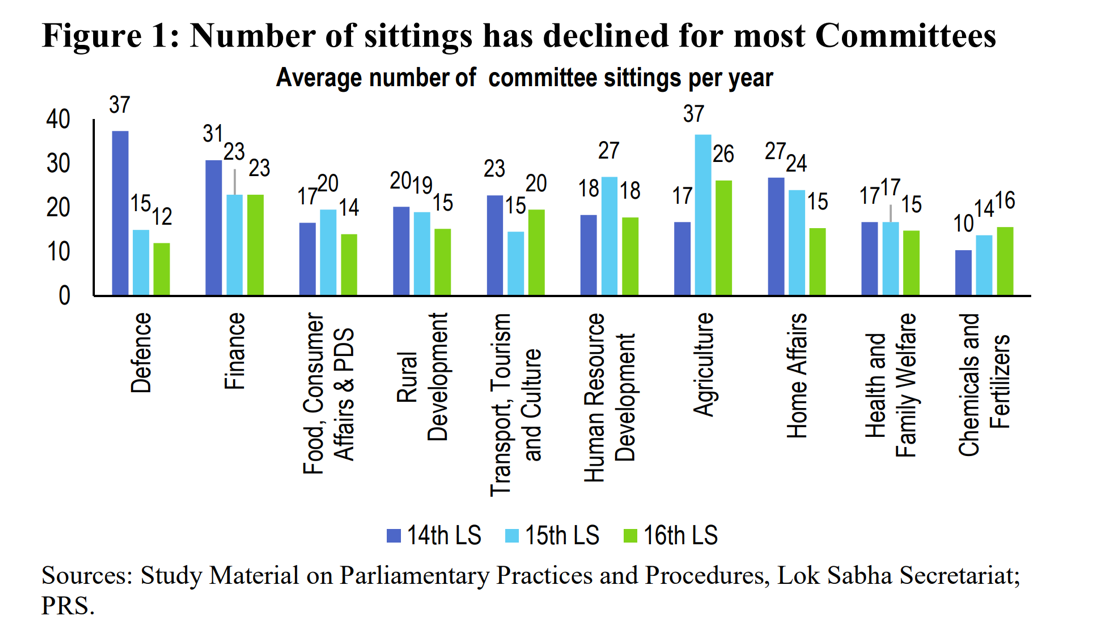
Departmentally Related Standing Committees Departmentally Related Standing Committees (DRSCs) meet to examine the expenditure of all Ministries, Bills referred to them, and policies or issues selected by them. These meetings are conducted while Parliament is in session or during inter-session periods. While it is difficult to analyse the quality of deliberations in these sittings, the number of sittings held by various DRSCs can be used as an indicator to measure the quantity of work done by them. Figure 1 shows the average number of sittings for 10 Committees which examine the largest (by expenditure) Ministries/Departments.
Note that the Committees on Defence, Finance, and Home Affairs have seen a decrease in average number of sittings from the 14th to the 16th Lok Sabha, whereas the Committee on Chemicals and Fertilizers has seen an increase.
Examining Demands for Grants
After the Budget is presented, the DRSCs examine the Demands for Grants of all Ministries under its purview. Demands for Grants refer to the detailed estimates of expenditure of each Ministry. DRSCs study allocations to schemes and programmes, spending by the Ministry, and the policy priorities of the Ministry.
After this examination, the Committee compiles its recommendations in the form of a Report which is laid in both Houses of Parliament. These recommendations help MPs understand the implications of financial allocations. They also allow for a more informed debate and analysis of Demands for Grants in Lok Sabha.
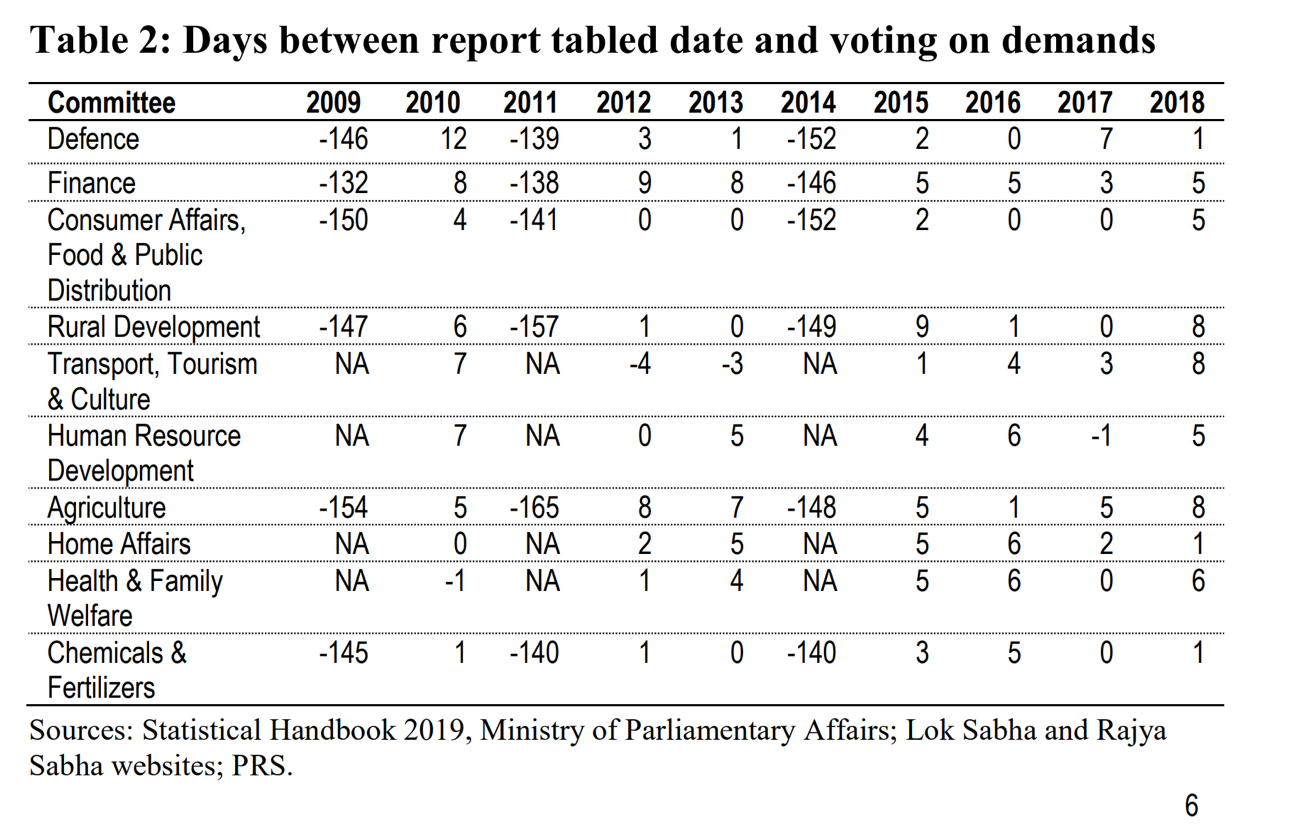
Negative numbers suggest that the report was presented after the Demand for Grants were voted upon. In 2009 and 2014, all reports on the Demands were presented a few months after they were voted in the House. Note that these were election years, and in these years the budget presented by the new government was passed in the month of July.
The new DRSCs were not formed by then. The primary objective of reports on Demands for Grants is to help MPs examine government expenditure better. Therefore, it is necessary for MPs to have sufficient time to study these reports before the discussion in the House. The data suggests that in many cases MPs do not have sufficient time to study these reports.
Examining Bills
Once a Bill has been introduced in Parliament, it may be referred to a DRSC for detailed scrutiny. The Bill can be referred to a Committee either by the Speaker of Lok Sabha, or the Chairperson of Rajya Sabha. It is sent to the DRSC that reviews the working of the Ministry under which the Bill is introduced. After concluding its examination, the DRSC lays its report in Parliament. The recommendations of the DRSC on the Bill may also be discussed in the House.
Note that a Bill passed by one House can still be referred to a Committee by the other House. For instance, in the 16th Lok Sabha, the Motor Vehicles (Amendment) Bill, 2016, and the Real Estate (Regulation and Development) Bill, 2013 were referred to a DRSC as well as a Select Committee.
DRSCs were given the responsibility of scrutinising Bills because Parliament does not have the time and expertise to analyse each Bill in detail, on the floor of the House. However, the trend shows that fewer Bills are being referred to Committees as compared to previous Lok Sabha.
Examination of Issues
Every year, DRSCs select subjects for detailed examination. These subjects could be on existing or potential issues that could come up in the sectors that the DRSC looks at, or implementation of programmes by the relevant Ministry. For example, some of the subjects identified for examination by DRSCs constituted for 2019-20 include: state of the Indian economy, implementation of the Ayushman Bharat Yojana, and digital payment and online security measures for data protection.
Reports submitted by DRSCs
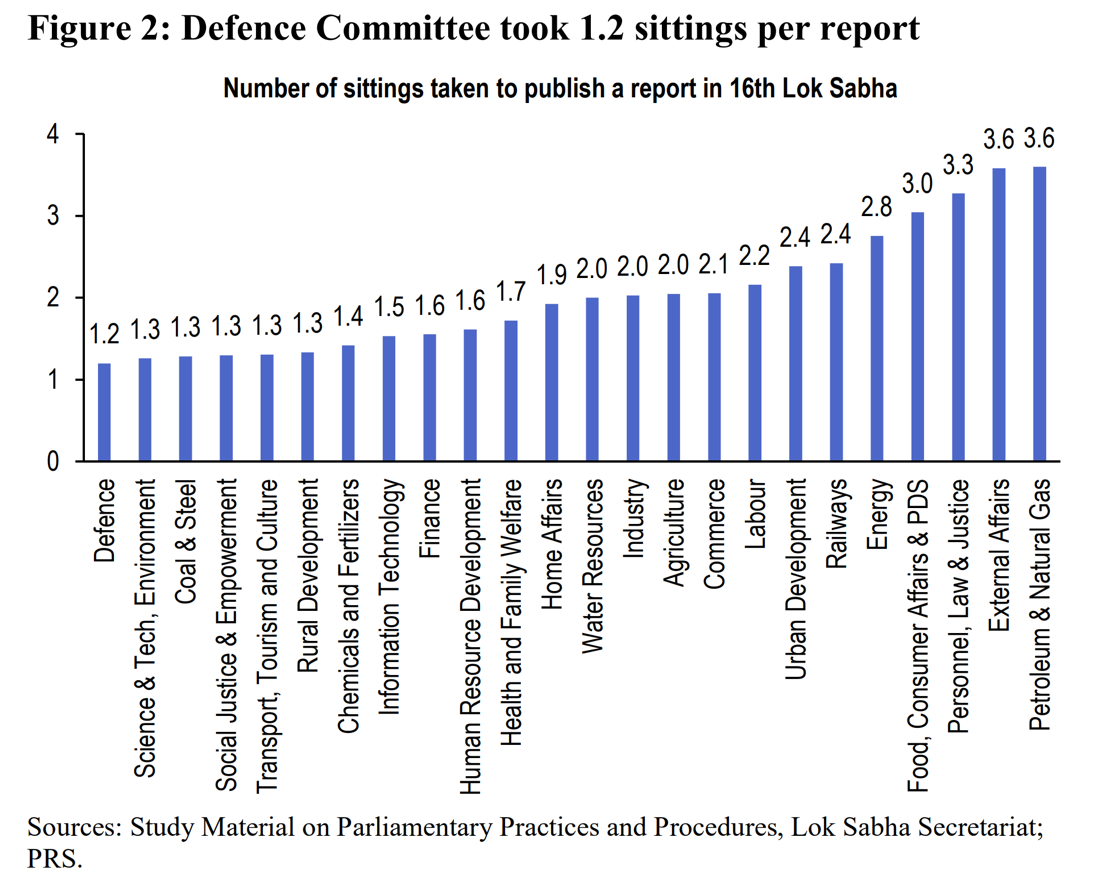
After examining Bills, Demands for Grants, and issues, DRSCs prepare reports and table them in Parliament. Subsequently, the DRSCs also submit Action Taken Reports which show the recommendations accepted by the government, and the progress made on them. The acceptance rate varies across Committees. During the 16th Lok Sabha, 2,038 sittings were held by DRSCs and they submitted 1,111 reports. On average, DRSCs published one report in 1.8 sittings. Average sittings taken to publish one report vary across DRSCs. However, it is difficult to evaluate quality of these deliberations without analysing each report.
Expert witnesses and research support
To aid in their study, members of DRSCs can consult with expert witnesses, stakeholders, and government officials. Engaging with experts and stakeholders enables Committee members to better understand the details of complicated issues, and the potential impact of a policy or legislation.
Note that Committees invite witnesses to testify before them at their own discretion.
For instance, the DRSC that examined the Right to Education Bill, 2008, which guarantees free education to all children ages six to 14, did not invite any expert witnesses.
Apart from consulting experts, Committees can also invite comments from the wider public.
For example, the Committee on Labour and Employment published a press release inviting public comments on the Occupational, Safety, Health and Working Conditions Bill, 2019. Public comments help Committees consider the wider implications of a Bill or policy.
However, it is up to the discretion of the Committee whether or not they chose to invite public comments.
Currently, the technical support available to Parliamentary Committees is limited to a secretariat that helps with matters such as scheduling meetings and note taking.
The National Commission to Review the Working of the Constitution (2002) had highlighted the lack of research support and specialist advisors with the DRSCs.4 It recommended that funds should be secured to assist these Committees in conducting inquiries, holding public hearings, and collecting data. Note that Committees in other countries such as the UK, USA, and Canada can retain specialist advisors (such as lawyers, economists, and statisticians) to assist in specific inquires.
Attendance of Members
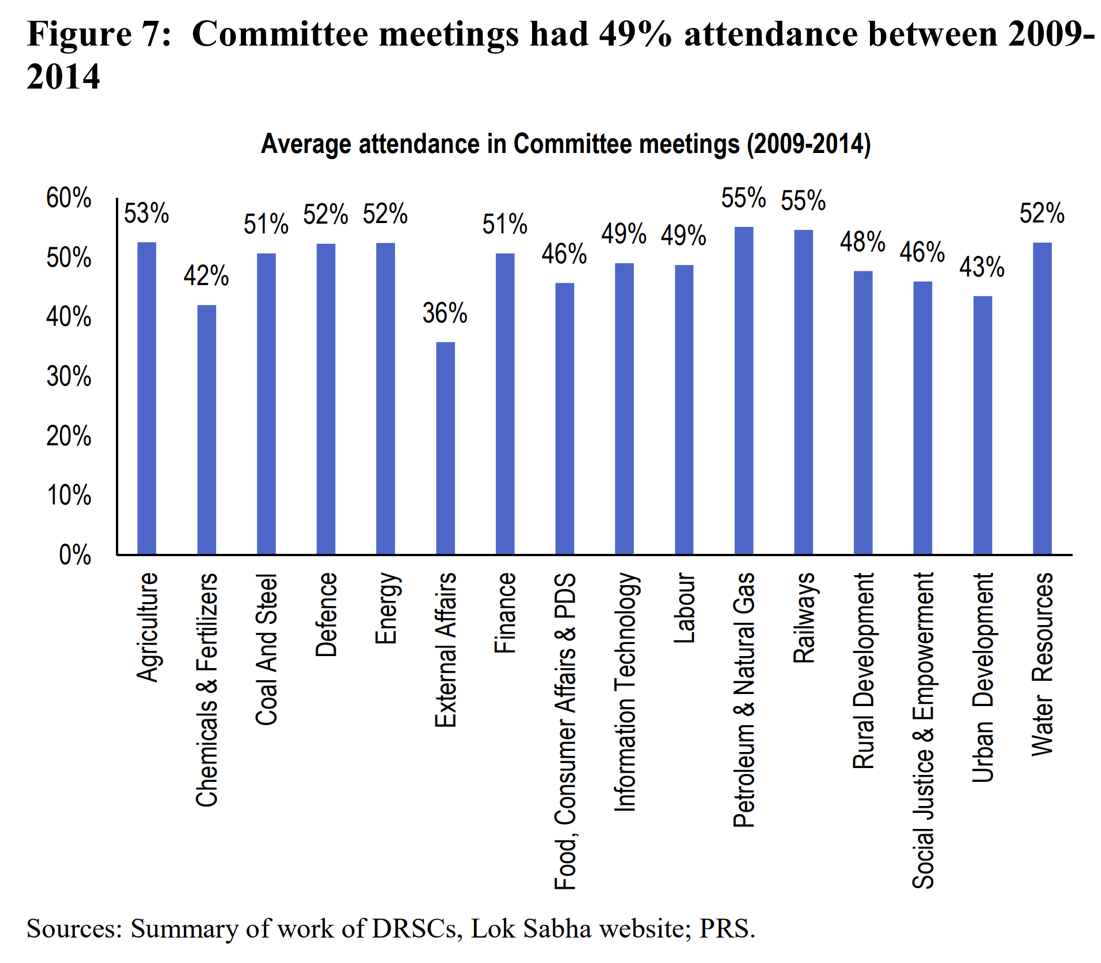
Parliamentary Committees hold several meetings to conduct in-depth analysis of various issues through extensive deliberations among Members. Success of the Committee system depends on the participation of Members in these meetings. Though Committee meetings are conducted in a closed-door environment, Lok Sabha publishes the attendance of Members in these meetings. Sixteen of the 24 DRSCs are administered by Lok Sabha and other eight by Rajya Sabha. Figure 7 shows the attendance of members during 2009-14 for the 16 DRSCs serviced by Lok Sabha. On average, 49% members were present for meetings of these Committees between this period.
Way Forward
Committees in India, like any other organization or system, can be improved through various measures.
Here are some suggestions:
Diverse and Competent Membership: which brings a wide range of expertise and perspectives. This ensures that the committee is able to effectively address the issues at hand and make informed decisions.
Transparent and Inclusive Processes: including clear rules of procedure, open meetings, and opportunities for public input. This promotes accountability, fairness, and wider stakeholder engagement.
Adequate Resources and Support: including budgetary allocations, administrative assistance, and access to relevant information and data. This enables committees to function effectively and efficiently.
Timely Completion of Work: Committees should have a defined timeline for completing their work and submitting their recommendations or reports. This prevents undue delays and ensures that the committee's work is timely and relevant.
Implementation of Recommendations: should be seriously considered and implemented by the relevant authorities. This helps ensure that the committee's efforts result in tangible outcomes and real impact.
Regular Monitoring and Evaluation: Committees' performance should be regularly monitored and evaluated to assess their effectiveness and identify areas for improvement. This helps in continuously enhancing the functioning of committees and making necessary adjustments.
Capacity Building and Training: to enhance their skills, knowledge, and understanding of the committee's mandate and processes. This helps in improving their performance and overall effectiveness.
Review and Revision of Committee Structures: Periodic review and revision of committee structures, mandates, and processes can help identify gaps and areas for improvement. This may involve restructuring or redefining committees to align with changing needs and priorities.
Utilization of Technology: Committees can leverage technology for better communication, coordination, and documentation. This may include the use of online platforms for meetings, document sharing, and data analysis, which can streamline committee processes and enhance efficiency.
By implementing these measures, committees in India can be improved to function more effectively and contribute positively to decision-making and policy formulation processes.
Context: The Centre has tightened the fund flow rulebook on Centrally Sponsored Schemes (CSS) even further and for the first time has also brought in a ‘penal interest’ clause for delays in fund transfers by states.
New rules
States have been asked to ensure that their share of funds are transferred to the Single Nodal Agency (SNA) for CSS scheme within 30 days of receiving central funding instead of 40 days, as allowed earlier.
Any delay beyond 30 days would attract a ‘penal interest’ of 7% per annum. This ‘penal interest’ by a state that delays prescribed fund flow will be transferred to the Consolidated Fund of India.
Centrally sponsored scheme
The Union government supports several developmental initiatives at the state level. The category of centrally sponsored schemes comprises programmes that have a national character or a regional character. Earlier, there were nearly 67 centrally sponsored schemes, but many of them were phased out after the suggestions of the 14th Finance Commission were implemented.
Centrally Sponsored Scheme Vs Central Sector Scheme
The central welfare schemes at the state level fall into two broad categories.
The first category is centrally sponsored schemes, and the second is the central sector schemes.
While the Union government fully funds the central sector schemes, centrally sponsored schemes are jointly funded by the Centre and states.
While centrally sponsored scheme are implemented by states, central sector schemes are implemented by centre directly.
The Centre Sector Schemes are mainly formulated to cover subjects which are under the Union List or the Concurrent List whereas centrally sponsored schemes covers items that are listed in state list.
Funding pattern of Centrally Sponsored Scheme
There are several models of funding of centrally sponsored schemes, but a large part of the funding comes from the Centre.
In most of the cases, the Union government and the states fund these schemes at a 60:40 ratio.
Ratio of funding could vary , the funding ratio could be 50:50, 60:40, 70:30 or 75:25. In the case of north-eastern states, 90 per cent of the funds come from the central government.
Union government spends nearly 12% of its annual budget on centrally sponsored schemes.
Categorisation of Centrally Sponsored Scheme
i) Core of the Core Schemes: Those schemes which are for social protection and social inclusion should form the core of core and be the first charge on available funds for the National Development Agenda.
The six core of the core schemes are:
MGNREGA or the Mahatma Gandhi National Rural Employment Guarantee Act
Umbrella Scheme for Development of Scheduled Castes
Umbrella Programme for Development of Scheduled Tribes
Umbrella Scheme for Development of Minorities
Umbrella Scheme for Development of Other Vulnerable Groups
ii) Core schemes: Focus of CSSs should be on schemes that comprise the National Development Agenda where the Centre and States will work together in the spirit of Team India.
iii)Optional Schemes: The Schemes where States would be free to choose the ones they wish to implement. Funds for these schemes would be allocated to States by the Ministry of Finance as a lump sum.
Context: The 17th Lok Sabha, which is entering its final year, has functioned for 230 sitting days so far. Of all the Lok Sabhas that completed the full five-year term, the 16th Lok Sabha had the lowest number of sitting days (331). With one more year remaining, and 58 average sitting days a year, the 17th Lok Sabha is unlikely to sit for more than 331 days. This could make it the shortest full-term Lok Sabha since 1952.
The declining productivity of the Indian Parliament has been a cause for concern in recent years. As the 17th Lok Sabha, the current term of India's lower house of parliament, enters its final year with only 230 sitting days so far, it is likely to have one of the shortest full-term durations since 1952. This article discusses the importance of parliamentary productivity, how it can be measured, the factors contributing to its decline, and the way forward. The roles of Parliament in India, including lawmaking, scrutiny of government, budgetary control, oversight of the executive, electoral functions, and constitutional functions, are vital for maintaining the democratic system of the country.
However, indicators such as the number of bills passed, disruptions during Question Hour, and declining participation in private members' bills suggest a decline in parliamentary productivity. Factors such as increasing polarization, lack of preparation and deliberation, weak committee system, and lack of diversity have contributed to this decline. The article emphasizes the need for addressing these issues to ensure effective governance and strengthen the democratic process in India. Various measures, such as promoting constructive debates, enhancing committee system, ensuring diversity, and promoting transparency, are suggested as a way forward to improve parliamentary productivity and uphold the democratic principles of the country.
So in this regard, we are going to discuss the following to do complete justice with the topics:
Why is productivity of the parliament important?
How do we know that the productivity is declining?
What is causing such a decline?
Way forward
Why is productivity of the parliament important?
The Parliament of India is the supreme legislative body in the country and is responsible for enacting laws and overseeing the functioning of the government. The roles of Parliament in India include:
Law making: The primary function of Parliament is to make laws. Bills are introduced in either house of Parliament, debated and discussed, and finally passed as Acts of Parliament.
Scrutiny of Government: Parliament has the power to hold the government accountable by asking questions, seeking clarifications, and conducting debates on government policies and actions.
Budgetary Control: Parliament has the power to approve or reject the government's budget proposals and to scrutinize government spending.
Oversight of Executive: Parliament has the power to investigate and examine the functioning of the executive branch of the government and its various agencies.
Electoral Functions: Parliament has the power to decide on the qualifications and disqualifications of members, conduct elections to fill vacancies, and determine the electoral boundaries.
Constitutional Functions: Parliament has the power to amend the Constitution, approve the proclamation of emergency, and to impeach the President, Vice-President, and other high officials.
Overall, the roles of Parliament in India are essential for maintaining the democratic system of the country and ensuring that the government is accountable to the people.
How do we know that the productivity is declining?
There are a few possible indicators that have been used to suggest that parliamentary productivity is declining in India. Here are a few examples:
Number of bills passed: According to data from the PRS Legislative Research, the number of bills passed by the Lok Sabha (the lower house of India's parliament) has declined in recent years. In the 16th Lok Sabha (2014-2019), a total of 205 bills were passed, compared to 248 bills in the previous Lok Sabha (2009-2014). In the current 17th Lok Sabha (2019-present), only 17 bills have been passed so far.
Question Hour: One important aspect of parliamentary productivity is the ability of MPs to ask questions of the government during Question Hour. However, Question Hour has been disrupted in recent years, with MPs often protesting and preventing the House from functioning. According to an analysis by IndiaSpend, the 16th Lok Sabha lost 29% of its scheduled time due to disruptions, while the current 17th Lok Sabha has lost 48% of its scheduled time so far.
Private Members' Bills: Private Members' Bills are bills introduced by MPs who are not part of the government. They are often seen as a way for backbenchers to contribute to the legislative process. However, the number of Private Members' Bills being introduced and passed in parliament has declined in recent years. According to data from PRS Legislative Research, only two Private Members' Bills were passed in the 16th Lok Sabha, compared to 14 in the previous Lok Sabha.
It should be noted that these statistics are just a few possible indicators of parliamentary productivity, and there may be other factors at play as well. Additionally, it is important to consider the context in which these numbers are being presented, as well as any potential biases in the data sources used.
What is causing such a decline?
There are several reasons behind the declining parliamentary productivity in India.
One of the primary factors is the increasing polarization and confrontational politics, leading to frequent disruptions in the House. MPs often engage in protests, sloganeering, and walkouts, which prevent the smooth functioning of parliament. This has resulted in the loss of valuable time and resources, hindering the legislative process.
Another reason is the lack of adequate preparation and deliberation before introducing bills in parliament. The government often rushes to pass bills without thorough discussions, leading to inadequate scrutiny and oversight. This has resulted in poorly drafted legislation, causing delays, and controversies, ultimately reducing the productivity of parliament.
Moreover, the absence of a robust committee system has also contributed to the declining productivity of parliament. Committees play a crucial role in scrutinizing bills, conducting in-depth research, and engaging in consultations with stakeholders, which help in drafting effective legislation. However, the committee system in India is weak, resulting in the bypassing of committees and inadequate scrutiny of bills.
Furthermore, the Indian parliament lacks diversity, with a significant underrepresentation of marginalized groups, including women and religious minorities. This has resulted in the exclusion of diverse voices and perspectives, leading to the passing of legislation that does not reflect the needs and aspirations of all sections of society.
In conclusion, several factors contribute to the declining parliamentary productivity in India, including political polarization, lack of adequate preparation, weak committee system, and lack of diversity. Addressing these issues is crucial to ensure effective governance and strengthen the democratic process in India.
Way forward:
There are several ways to increase parliamentary productivity in India.
There needs to be a greater focus on constructive and consensus-based politics, where members from different parties work together towards common goals. This would reduce disruptions in the House and allow parliament to function more efficiently.
There needs to be better preparation and scrutiny of bills before they are introduced in parliament. This can be achieved by establishing a robust committee system that engages in in-depth research and consultations with stakeholders. Such a system would ensure that bills are well-drafted, scrutinized thoroughly, and adequately debated in parliament, leading to more effective legislation.
The Indian parliament needs to focus on increasing diversity and representation, particularly of marginalized groups such as women, Dalits, and religious minorities. This would ensure that the voices of all sections of society are heard, and legislation reflects their needs and aspirations.
Moreover, parliament should leverage technology to improve productivity, such as using electronic voting systems, enabling remote attendance for members, and enhancing digital communication channels. This would enable parliament to function more efficiently, reduce disruptions, and save valuable time and resources.
Finally, there should be a focus on capacity-building and training for parliamentarians, particularly in areas such as legislative drafting, public speaking, and committee work. This would enable MPs to be more effective in their roles, contributing to better legislative outcomes and increased productivity.
In conclusion, increasing parliamentary productivity in India requires a multi-faceted approach, including constructive and consensus-based politics, better preparation and scrutiny of bills, greater diversity and representation, leveraging technology, and capacity-building for parliamentarians. By adopting these measures, India can strengthen its democratic institutions and ensure effective governance for all its citizens.
Context: The Union Minister of Education and Skill Development & Entrepreneurship (MSDE), unveiled the digital version of the Employability Skills curriculum for students enrolled in India’s Industrial Training Institutes (ITIs) at the Future Skills Forum in New Delhi.
About The Future Skills Forum
It is an initiative of the Future Right Skills Network (FRSN) a collaborative effort by QUEST Alliance, Accenture, Cisco, and J.P. Morgan.
It brings together government skills training institutions, civil society organisations, industry and corporate social responsibility partners to help young people acquire critical skills for the future.
About Employability Skills (ES)Curriculum
ES curriculum which was launched by the MSDE in September 2022.
Aimed at fulfilling the need for anytime, anywhere learning, these modules will be accessible to more than 2.5 million learners through the Government of India’s Bharat Skills Portal as well as other platforms.
Developed with active industry contribution, the curriculum includes 12 modules in a bite-sized, gamified format and each lesson is followed by assessments that are designed to help learners assess the depth of their learning.
The storytelling approach followed in the modules provides learners with relatable scenarios that they can apply to real-world situations.
The constructive feedback system ensures that learners receive feedback that is specific, timely, and actionable thus enabling improved learning outcomes.
The digital lessons will be instrumental in introducing innovative pedagogical models like blended learning in Industrial Training Institutes (ITI), which will empower educators to create and lead 21st-century classrooms.
The digital lessons include modules on financial and digital literacy, diversity and inclusion, career development, goal setting and entrepreneurship.
Context: Recently the Bombay High Court directed the Ministry of Electronics and Information Technology to file its response in a plea by Kunal Kamra, political satirist and stand-up artist, challenging the constitutional validity of the Information Technology Amendment Rules, 2023.
Information Technology (Intermediary Guidelines and Digital Media Ethics Code) Amendment Rules, 2023 (IT Amendment Rules, 2023)
As per the Rules notified on April 06, 2023, the Ministry will notify several self-regulatory bodies tasked with determining the permissibility of online games [Rule 4A(1)].
Further, a fact check unit notified, based solely on the discretion of the Union Government, will be empowered to identify fake or false or misleading online content related to the government [Rule 3(1)(b)(v)].
The inclusion of the latter under Rule 3 makes taking action against content identified by such a fact-check unit a due diligence requirement for intermediaries.
In an event where any intermediaries, including social media intermediaries (Facebook, Twitter etc.), Internet Service Providers (ISPs) (Airtel, ACT, Jio etc.), or other service providers, fail to/ decide against taking action on content identified as “fake” or “false” by the notified fact check unit, they will risk losing their safe harbour protections.
Why new rules are being Questioned?
Assigning any unit of the government such arbitrary, overbroad powers to determine the authenticity of online content bypasses the principles of natural justice, thus making it an unconstitutional exercise.
The notification of these amended rules cements the chilling effect on the fundamental right to speech and expression, particularly on news publishers, journalists, activists, etc.
The fact check unit, notified by the Executive, could effectively issue a takedown order to social media platforms and even other intermediaries across the internet stack, potentially bypassing the process statutorily prescribed under Section 69A of the IT Act, 2000.
In addition to circumventing the parliamentary procedures required to expand the scope of the parent legislation, i.e., the IT Act.
These notified amendments are also in gross violation of the Hon’ble Supreme Court ruling in Shreya Singhal vs. Union of India (2013) which laid down strict procedures for blocking content.
Finally, the vagueness of the undefined terms such as “fake”, “false”, and “misleading” make such overbroad powers further susceptible to misuse.
Context: The 17th Lok Sabha, which is entering its final year, has functioned for 230 sitting days so far. Of all the Lok Sabhas that completed the full five-year term, the 16th Lok Sabha had the lowest number of sitting days (331). With one more year remaining, and 58 average sitting days a year, the 17th Lok Sabha is unlikely to sit for more than 331 days. This could make it the shortest full-term Lok Sabha since 1952.
Poor Functioning of 17th Lok Sabha
The latest session (Budget session) held from January 31, 2023, to April 6, 2023, with a recess from February 14 to March 12 saw limited legislative activity, and minimal discussion on the Budget amidst continuous disruptions.
In this session, the Lok Sabha functioned for 33% of its scheduled time (46 hours) and the Rajya Sabha functioned for 24% (32 hours).
In the 15 days of the second part of the session, the Lok Sabha worked for 5% of its scheduled time and the Rajya Sabha for 6%, with most of the time spent on the procedural work of tabling papers.
In this Lok Sabha, so far, 150 Bills have been introduced and 131 Bills have been passed (excluding Finance and Appropriation Bills).
The latest Budget session was the sixth shortest Budget session since 1952.
The Lok Sabha spent 18 hours on financial business, of which 16 hours were spent on the general discussion of the Budget.
The Motion of Thanks on the President’s Address was the only item discussed in the latest session.
The latest session also saw the least amount of time spent on questions in the current Lok Sabha. Question Hour functioned for 19% of the scheduled time in the Lok Sabha and 9% of the scheduled time in the Rajya Sabha.
About 7% of starred questions were answered in each House.
No Private Member Bills were introduced or discussed in this session.
Each House discussed one Private Member Resolution only.
Context: Election commission using its power under The Election Symbols (Reservation And Allotment) Order, 1968 withdrew the National Party Status of Trinamool congress (TMC), Nationalist congress party (NCP) and Communist party of India (CPI). However, It also accorded the status of national party to the Aam Admi Party (APP).
The Election Symbols (Reservation And Allotment) Order, 1968
Para 6A deals with Conditions for recognition as a State Party ;
Para 6B deals with the Conditions for recognition as a National Party
Para 6C delas with Conditions for continued recognition as a National or State party.
As per the Election Commission of India’s latest review, at present, there are Six political parties which are the status of recognised National Parties.
A political party shall be eligible for recognition as a State party in a State, if, and only if, any of the following conditions is fulfilled
At the last general election to the Legislative Assembly of the State, the candidates set up by the party have secured not less than six percent of the total valid votes polled in the State; and, in addition, the party has returned at least two members to the Legislative Assembly of that State at such general election; or
At the last general election to the House of the People from that State, the candidates set up by the party have secured not less than six percent of the total valid votes polled in the State; and, in addition, the party has returned at least one member to the House of the People from that State at such general election; or
At the last general election to the Legislative Assembly of the State, the party has won at least three percent of the total number of seats in the Legislative Assembly, or at least three seats in the Assembly, whichever is more; or
At the last general election to the House of the People from the State, the party has returned at least one member to the House of the People for every 25 members or any fraction thereof allotted to that State;] or
At the last general election to the House of the People from the State, or at the last general election to the Legislative Assembly of the State, the candidates set up by the Party have secured not less than eight percent of the total valid votes polled in the State.
Conditions for recognition as a National Party (6B)
A political party shall be eligible to be recognized as National party, if, and only if, any of the following conditions is fulfilled
The candidates set up by the party, in any four or more States, at the last general election to the House of the People, or to the Legislative Assembly of the State concerned, have secured not less than six percent of the total valid votes polled in each of those States at that general election; and, in addition, it has returned at least four members to the House of the People at the aforesaid last general election from any State or States; or
At the last general election to the House of the People, the party has won at least two percent of the total number of seats in the House of the People, and the party’s candidates have been elected to that House from not less than three States; or
The party is recognized as State party in at least four States.
Conditions for continued recognition as a National or State party (6C)
If a political party is recognised as a State party under paragraph 6A, or as a National party under paragraph 6B, the question whether it shall continue to be so recognised after any subsequent general election to the House of the People or, as the case may be, to the Legislative Assembly of the State concerned, shall be dependent upon the fulfilment by it of the conditions specified in the said paragraphs on the results of that general election.
Significance of being recognised as National or State Parties
Apart from those recognised as state or national party , the other parties are simply declared as registered-unrecognised parties.
RPA allows political parties to accept contributions voluntarily offered to it by any person or company other than a government company.
Candidates of registered parties get preference in allotment of election symbols. Other Candidates are identified as independents and do not get preference in symbol allocation.
If a party is recognised as a State Party’, it is entitled for exclusive allotment of its reserved symbol to the candidates set up by it in the State in which it is so recognised.
If a party is recognised as a `National Party’ it is entitled for exclusive allotment of its reserved symbol to the candidates set up by it throughout India.
Recognised `State’ and `National’ parties need only one proposerfor filing the nomination and are also entitled for two sets of electoral rolls free of cost at the time of revision of rolls and their candidates get one copy of electoral roll free of cost during General Elections.
They get broadcast/telecast facilities over Akashvani/Doordarshan during general elections.
A recognized National or State party can have a maximum of 40 “Star campaigners” and a registered un-recognised party can nominate a maximum of 20 ‘Star Campaigners”. The travel expenses of star campaigners are not to be accounted for in the election expense accounts of candidates of their party.
Context: The Supreme Court on April 10 orally observed how can the Lieutenant Governor (L-G) act “without aid and advice” of the Council of Ministers in nominating 10 members to the Municipal Corporation of Delhi. This article discusses the need for full statehood for Delhi, the capital city of India. Delhi's government has limited powers despite being one of the most populous cities in India. There is a need to view Delhi from the prism of the interests of the entire country, given that it is the national capital.
So we will cover the following aspects in this article:
Some Historical perspective on administration of Delhi
Why Delhi should be provided with statehood
Reasons against granting statehood to Delhi
Way forward
Supreme Court Verdict on Delhi-Centre Power Tussle
General Studies- II: Governance, Constitution, Polity, Social Justice and International relations
Functions and responsibilities of the Union and the States, issues and challenges pertaining to the federal structure, devolution of powers and finances up to local levels and challenges therein.
Some Historical perspective on administration of Delhi
Till 1992, except for a brief interlude, Delhi was a union territory under the complete control of the Government of India.
Delhi was allowed its ‘statehood’ early in the 1990s, with a Chief Minister and a popularly elected unicameral legislature though the ‘State’ remained truncated in its powers.
But It remained in substance a union territory and in form a State, with the Lt. Governor retained as its chief executive.
The Chief Minister and his Cabinet made a late entry into space where Lt Governor and several municipal corporations already existed which created friction.
Many departments of the Centre, State, scores of parastatals and five ULBs (urban local bodies) providing bits of governance in the city.
It could safely be asserted that Delhi has more government and less governance than any other city or state in the country
Why Delhi should be provided with statehood:
Massive increment in population of Delhi
In 1991, the 69th Amendment to the Constitution created the Legislative Assembly of Delhi, at a time when the city's population was much smaller. However, as of today, the city has nearly two crore people, making it one of the most populous cities in India. This growth in population has led to a demand for more representation and self-governance.
Limited powers of the Delhi Government:
Nowhere in any democracy are two crore people represented by a government with restricted powers. Despite being one of the most populous cities in India, Delhi's government has limited powers because it is not a full state.
The Delhi government struggled to fight the COVID-19 pandemic because it did not have complete control over its healthcare system. The Central government controls some aspects of Delhi's healthcare, making it difficult for the state government to take timely and effective measures to control the spread of the virus.
The original idea behind Union Territories was just transitional:
When the Union Territories were first created, the idea was to provide a flexible yet transitional status to several territories that joined India. The territories were given a certain degree of autonomy, but they were also expected to eventually transition to statehood.
Goa, Manipur, Himachal Pradesh, and Tripura were initially Union Territories but were granted statehood as they developed economically and politically. This shows that the Union Territory status was meant to be temporary, and statehood was the ultimate goal.
Equal rights for representation and self-governance
Providing equal rights for representation and self-governance was one of the primary reasons for the creation of the Legislative Assembly of Delhi. As the city's population grows, the demand for more representation and self-governance becomes even more critical.
The Delhi government has been advocating for full statehood for years, arguing that it would give the city's residents more say in matters of governance. The lack of full statehood has led to several conflicts between the Delhi government and the Central government over issues like land, law and order, and the police.
The need for full statehood
The time has come to enter the second and final stage to create the full state of Delhi. This would give the city an elected government with greater powers and more say in matters of governance, such as law and order and land management.
If Delhi becomes a full state, it would have complete control over its police force, which is currently under the Central government's control. This would allow the city's elected government to take timely and effective measures to maintain law and order and ensure the safety of its citizens.
UN report on Delhi's population
According to a United Nations report, Delhi's urban agglomeration will make it the most populous city in the world by 2028. This highlights the urgency of granting full statehood to Delhi, as the city's population continues to grow.
With a population of nearly two crore people, Delhi is already struggling with issues like traffic congestion, pollution, and water scarcity. As its population grows, the city's infrastructure and governance will come under even more strain, making the need for full statehood even more urgent.
Reasons against granting statehood to Delhi:
Local political ambition:
The demand for statehood has primarily been driven by the political ambitions of the local government, rather than a national compulsion. The Aam Aadmi Party (AAP) has been advocating for full statehood for Delhi since it came to power in 2015.
National capital interests:
Delhi, being the national capital, must be viewed from the prism of the interests of the entire country, and not just those of the city.
The central government has the responsibility to ensure that the security of vital institutions such as the President's estate, Parliament, and foreign embassies is maintained.
Special security cover:
These institutions require special security cover and close coordination with centrally administered agencies such as RAW and IB, which cannot be provided by a state government.
In 2020, there were protests in front of the Chinese embassy in Delhi, and the Delhi Police had to coordinate with the central government to ensure the safety of the embassy and its staff.
Central government responsibility:
The institutions in Delhi are the sole responsibility of the Union government, and not of any particular state legislative assembly.
The Delhi Police, which is responsible for maintaining law and order in the city, comes under the Ministry of Home Affairs, which is a part of the Union government.
Control over territory:
The Indian government must have some territory under its control and cannot be an occupant or a tenant of a state government.
The central government owns the land on which the President's estate and Parliament are located.
Reservation from regional parties:
Many regional parties have expressed their strong reservation towards granting full statehood to Delhi, as they believe that the national capital belongs to every citizen of the country and not just those who reside in the city.
The Shiromani Akali Dal, a regional party in Punjab, has opposed the demand for full statehood for Delhi.
Loss of advantages:
Statehood would deprive Delhi of the many advantages it gets as the national capital, such as the entire burden of policing being borne by the federal government.
The Delhi Police force has a strength of around 80,000 personnel and is responsible for maintaining law and order in the city, along with providing security to the vital institutions.
Way forward
Supreme Court Verdict on Delhi-Centre Power Tussle
The Supreme Court judgement in the Government of NCT Delhi vs Union of India case, overturned the August 2016 judgment of the Delhi high court, which had ruled that since Delhi was a Union territory all powers lay with the central government, not the elected Delhi government.
Resolving the dispute over the demarcation of powers between the Union Government and the Government of Delhi, the Supreme Court laid down a few key principles:
Delhi government has power in all areas except land, police and public order and the LG is bound by the aid and advice of the government in areas other than those exempted
The only exception to this rule, it said, was a proviso to Article 239-AA, which allowed the LG to refer to the President any issue on which there was a difference of opinion with the council of ministers. In such a case, the LG would be bound by the President’s decision.
Delhi Lieutenant Governor cannot act independently and must take the aid and advice of the Council of Ministers because national capital enjoys special status and is not a full state. Hence, the role of the L-G is different than that of a Governor.
It observed that neither the state nor the L-G should feel lionized, but realize that they are serving Constitutional obligations and there is no space for absolutism or anarchy in our Constitution.
Context: The research paper by Ruben B Mathisen compares the influence of the affluent on policy-making in Norway and the United States. The clear result of the study is that in a social democracy like Norway, the link between money and politics was much weaker than in the U.S.
A comparison of the democracy of Norway and the U.S
Comparison Factors
Norway
United States
Policy-making process
Targeted schemes: ‘Targeted schemes’ like the ones we have in India which only benefit the so-called ‘needy’ and tend to provoke resentment among the ‘non-needy’ about how their tax money is being frittered away in ‘freebies’.
Public policy decidedly favoured the preferences of the affluent, at the expense of the poor and the middle classes
Economic inequality
Low levels of income inequality
High levels of income inequality
Universal welfare schemes
‘Universal’ welfare measures: ones that benefit every citizen such as free education and free public healthcare. universality of social benefits has the effect of ensuring their legitimacy and endorsement across classes, including the affluent.
‘Universal’ welfare measures: ones that benefit every citizen such as free education and free public healthcare. the universality of social benefits has the effect of ensuring their legitimacy and endorsement across classes, including the affluent.
Wealth redistribution
Norway has one of the lowest levels of income inequality in the world, which essentially means “less of a resource advantage for the affluent to be used (in whichever way possible) to influence politics
Low levels of wealth redistribution
Political party funding
Parties get two-thirds of their financing from state subsidies and political advertising on television is banned
Historically strong trade unions have been able to influence economic and social policy
Political advertising on television is banned in Norway, making the entire campaign process less vulnerable to private wealth
Television advertising is a huge campaign expense in American elections
Trade unions
Trade unions are no longer as politically powerful as they once were
Trade unions are no longer politically powerful as they once were
Energy reserves
Vast reserves of oil and natural gas have made it possible for the government to maintain generous welfare transfers while imposing lower tax rates
No such significant reserves of natural resources
Wealth of politicians
The country’s political class is not particularly wealthy. The median wealth among Norwegian MPs is zero, according to tax records, which means that it is unlikely for policies to be biased in favour of the rich just because the politicians are themselves rich.
There are laws requiring proportionate representation of women in government institutions. Since women on average have lower incomes than men, their higher levels of representation resulted in greater political influence for women, which, in turn, got translated into greater political influence for lower-income citizens.
Gender inclusiveness
There are laws requiring proportionate representation of women in government institutions. Since women on average have lower income than men, their higher levels of representation resulted in greater political influence for women, which, in turn, got translated into greater political influence for lower-income citizens.
No such institutional mechanism to engender the governance process.
The Norway example demonstrated two things
one, in a welfarist social democracy with low inequality, education was a stronger predictor of responsiveness than income;
and two, restricting how money can be used to influence elections, and strengthening countervailing forces (such as trade unions) might change the balance of power.
The authors however remark, that initiating such changes would be most difficult in precisely those democracies that need them the most, because it is in those countries that the affluent already wield the greatest influence on policy.
Learnings for a constitutional democracy all over the world based on the above study
Strong social welfare programs can lead to greater social equality and a higher standard of living for citizens.
A decentralized political system with strong state-level autonomy can lead to greater responsiveness to local needs and concerns.
A robust system of checks and balances between the executive, legislative, and judicial branches of government can prevent the concentration of power in any one branch.
A high degree of political transparency and accountability can help to maintain public trust in government institutions.
Political polarization and a lack of willingness to compromise can impede progress on important policy issues.
A commitment to protecting individual rights, such as freedom of speech and the press, is essential for a healthy democracy.
Economic policies that prioritize the interests of corporations and the wealthy can exacerbate inequality and undermine democratic values.
The presence of a strong civil society, including active NGOs and citizen advocacy groups, can help to hold politicians accountable and ensure that the needs of all citizens are represented.
A well-functioning electoral system, including fair and accessible voting procedures, can help to ensure that the voices of all citizens are heard.
A culture of civic engagement and political participation can strengthen democracy and promote a more informed and engaged citizenry.
Context: The Uttar Pradesh State Election Commission on Sunday announced that the Urban Local Body (ULB) polls will be held in two phases on May 4 and 11, and the counting of votes will be taken up on May 13.
In the first phase, 37 districts under nine administrative divisions of Agra, Jhansi, Saharanpur, Moradabad, Prayagraj, Lucknow, Varanasi, Devipatan and Gorakhpur will go to the polls on May 4, while on May 11 voting will be held in Chitrakoot, Ayodhya, Basti, Azamgarh, Meerut, Bareilly, Aligarh, Kanpur and Mirzapur administrative divisions, said State Election Commissioner Manoj Kumar in Lucknow.
General Studies- II: Governance, Constitution, Polity, Social Justice and International relations.
Devolution of powers and finances up to local levels and challenges therein.
Urban local government institutions/municipalities are constituted for the maintenance and planned development of urban areas. The objective is to ensure that suitable levels of infrastructure and services are available to the citizens.
In many parts of India, the quality of life in urban areas is miserable and the citizens lead a difficult life. To overcome this problem, a series of reforms have been initiated by the Indian government to strengthen local-level governance.
In this line, we will be covering the topic in following ways:
Constitution of Municipalities (namely, Municipal Corporation, Municipal Council, and Nagar Panchayat) in every Indian State;
Constitution of Wards Committees within the territorial area of a municipality, to ensure people’s participation in civic affairs at the grass-roots level;
Regular and fair conduct of municipal Elections by statutorily constituted State Election Commissions; no provision for supersession of municipal governments for more than 6 months;
Adequate representation of weaker sections (i.e., Scheduled Caste, Scheduled Tribe, Backward Class) of the society and women in municipal governments through reservation of seats;
Specification by law, through the State Legislatures, of the powers (including financial) and functional responsibilities to be entrusted to municipalities and wards committees;
Constitution of State Finance Commissions, once in every 5 years, to review the financial position of municipalities and to make recommendations on the measures needed to improve their financial position;
Constitution of a District Planning Committee at the district level and a Metropolitan Planning Committee in metropolitan areas of every State, for the preparation and consolidation of development plans.
Brief Characteristics
Before 1992
After 1992
Municipal Corporation
Established in metropolitan areas or big cities Wider functions and larger powers than councils, enjoy more autonomy and have larger revenue resources Separation of deliberative from executive functions and vesting of all executive powers in an appointed authority who is independent of the elected body
Constituted in “large urban areas
Municipal Committee/Council
Most popular form of local government in urban areas Set up in cities and large townsExtent of State control is relatively larger than corporations
Constituted in “small urban areas”*
Nagar Panchayat
Constituted after 1992
Constituted in “areas in transition from rural to urban”*
Notified Area Committee
Abolished
Town Area Committee
Abolished
Powers, Authority and Responsibilities of Municipalities (Article 243 – W)
Subject to the provisions of this Constitution, the Legislature of a State may, by law, endow –
the Municipalities with such powers and authority as may be necessary to enable them to function as institutions of self-government and such law may contain provisions for the devolution of powers and responsibilities upon Municipalities, subject to such conditions as may be specified therein, with respect to:
the preparation of plans for economic development and social justice;
the performance of functions and the implementation of schemes as may be entrusted to them including those in relation to the matters listed in the Twelfth Schedule;
the Committees with such powers and authority as may be necessary to enable them to carry out the responsibilities conferred upon them including those in relation to the matters listed in the Twelfth Schedule.
Twelfth Schedule 1. Urban planning, including town planning; 2. Regulation of land-use and construction of buildings; 3. Planning for economic and social development; 4. Roads and bridges; 5. Water supply for domestic, industrial and commercial purposes; 6. Public health, sanitation, conservancy and solid waste management; 7. Fire services; 8. Urban forestry, protection of the environment and promotion of ecological aspects; 9. Safeguarding the interests of weaker sections of society, including the handicapped & mentally retarded; 10. Slum improvement and upgradation; 11. Urban poverty alleviation; 12. Provision of urban amenities and facilities, such as parks, gardens, playgrounds; 13. Promotion of cultural, educational and aesthetic aspects; 14. Burials and burial grounds; cremations, cremation grounds and electric crematoriums; 15. Cattle pounds; prevention of cruelty to animals; 16. Vital statistics, including registration of births and deaths; 17. Public amenities, including street lighting, parking lots, bus stops and public conveniences; and 18. Regulation of slaughterhouses and tanneries.
Composition of Urban Local Governments
Category
Type of Municipality
Elected Members
Municipal Corporation
Municipal Council/Nagar Panchayat
Ex-officio Members
Mayor; Deputy Mayor Councillors/Elected Ward Representatives
Reservation of Seats in Municipalities (Article 243 – T)
Seats shall be reserved for the SCs and STs in every Municipality and the number of seats so reserved shall bear, as nearly as may be, the same proportion to the total number of seats to be filled by direct election in that Municipality as the population of the SCs in the Municipal area or of the STs in the Municipal area bears to the total population of that area and such seats may be allotted by rotation to different constituencies in a Municipality. Not less than one-third of the total number of seats reserved under clause (1) shall be reserved for women belonging to the SCs or as the case may be, the STs. Not less than one-third (including the number of seats reserved for women belonging to the SCs and the STs) of the total number of seats to be filled by direct election in every Municipality shall be reserved for women and such seats may be allotted by rotation to different constituencies in a Municipality.The offices of Chairpersons in the Municipalities shall be reserved for the SCs, the STs and women in such manner as the Legislature of a State may, by law, provide. The reservation of seats under clauses (1) and (2) and the reservation of offices of Chairpersons (other than the reservation for women) under clause (4) shall cease to have effect on the expiration of the period specified in Article 334. Nothing in this Part shall prevent the Legislature of a State from making any provision for reservation of seats in any Municipality or offices of Chairpersons in the Municipalities in favour of backward class of citizens.
Challenges faced by urban local bodies in accessing finance
Party politics exists at the municipal level.
The members affiliated to the largest political parties strongly influence decisions during the meetings of the local government.
Furthermore, it is mentioned that the appointed authorities often work under pressure created by the municipal members. In the past, several authorities have been transferred to other areas because of not cooperating with the decisions taken by the local political leaders
Ineffective Women’s Participation in Decision-making
This group is unable to make a meaningful contribution on municipal matters discussed in the meetings
Yet another reason for ineffective participation by the women members in the decision-making process is the presence of their husbands in municipal meetings.
Attitude of state goverments:
While State governments had devolved only a limited number of taxes to the ULBs to begin with, in several states, most local taxes, other than property tax, have been taken over by the state governments over the years.
Poor cost recovery of services by urban local governments:
In India user charges and service provision seem to be caught in a vicious circle with poor quality of services leading to a lack of willingness to pay for these and hence poor collection of user charges and fees.
Improper Maintenance of Accounts:
CAG reports on local governments point out several lacunae in the preparation of municipal accounts related to lack of budget preparation etc.
Shortcomings of State Finance Commissions:
Inefficient functioning of SFCs has affected their ability and that of CFCs to augment financial resources of ULBs.
Inability to borrow from market sources:
Most municipal bodies require the state governments’ permission to borrow from market sources. Growth in market financial instruments such as Municipal bonds has largely been inadequate.
Impact of GST:
Introduction of the GST has taken away critical sources of tax revenue such as octroi, local body tax, entry tax and advertisement tax for urban local governments.
Hidden Urbanization due to unplanned urbanization in India and a large number of settlements becoming part of urban agglomerations beyond the municipal boundaries.
Steps taken to improve urban local bodies finances
Recommendations of 15th finance commission: The total grants recommended for urban local bodies for 2020-21 were enhanced to Rs 29,250 crore against Rs 26,665 crore recommended for the year 2019-20 by the 14th FC.
Performance based grants: Successive FCs have put in conditionalities on the disbursement of grants for improving fiscal position of ULBs.
National Municipal Accounts Manual (NMAM): The Manual comprehensively provide details to all States/UTs in relation to the accounting policies, procedures and guidelines to ensure correct, complete timely recording of municipal transactions produce accurate relevant financial reports.
Allocation of funds through Schemes: Several schemes of Ministry of Housing and Urban Affairs provide financial support to ULBs for undertaking projects for development of urban infrastructure and services etc. E.g. Atal Mission for Rejuvenation and Urban Transformation (AMRUT), Smart City Mission.
Promotion of Municipal Bonds: In 2015, Securities and Exchange Board of India (SEBI) had released the Issue and Listing of Debt Securities by Municipalities (ILDM) Regulations and since then seven municipalities have raised nearly Rs 1,400 crore by issuing their debt securities (commonly known as 'muni bonds').