Constitution & Polity of India

Ladakh Autonomous Hill Development Council

Context: Amidst sub-zero temperatures, people are protesting to bring attention to Ladakh's susceptibility to climate change and its connection to the Sixth Schedule rights. With the looming threat of climate change, the ongoing demonstrations aimed at preserving Ladakh's identity under the Sixth Schedule take on even greater significance and urgency.

More on the news:

The Ladakh region is highly vulnerable to climate change, with retreating glaciers and villages forced to relocate due to lack of water.

People in Ladakh has been protesting in freezing temperatures to highlight this vulnerability and advocate for the implementation of the Sixth Schedule of the Constitution, which empowers autonomous councils to administer rights over land, forest, sanitation, and employment to safeguard cultural and indigenous identities. 

About Ladakh Autonomous Hill Development Council:

The Ladakh Autonomous Hill Development Council Act 1995 was enacted in response to the demands of the Ladakhi people who sought to create a separate Indian Union Territory due to their distinct religious and cultural identity, which differed from the rest of Jammu and Kashmir.

The creation of the Autonomous Hill Councils in Ladakh represented an important step towards recognizing the unique identity and aspirations of the region's people.

The council provided a platform for participatory democracy, enabling the people to take charge of their own development and governance while also ensuring that their distinctive cultural and religious identity is preserved.

Composition of council:

The total number of seats, in the Council to be filled by persons chosen by direct election on the basis of adult suffrage from territorial constituencies shall be twenty-six.

The Governor may nominate not more than four persons from amongst the principal religious minorities and women in the district to be members of the Council.

The members of the Council shall at its first meeting after a general election elect from amongst the elected members one member to be the Chairman.

The Executive council:

There shall be an Executive Council consisting of – (a) the Chairman who shall be the Chief Executive Councillor; and (b) four members to be nominated by the Chief Executive Councillor from amongst the members of the Council: Provided that at least one member shall be nominated from amongst the principal religious minorities in the district. The Executive Council shall be collectively responsible to the Council.

Powers and Functions of Council:

Subject to the provisions of 1995 Act the Council shall have executive powers in the district in relation to:

  1. Allotment, use and occupation of land vested in the Council by the Government under this Act.
  2. Formulation of development programme for the district in respect of District Component Schemes as notified by the Government and Centrally Sponsored Schemes and indicate priorities for various schemes and consider issues relating to the speedy development and economic upliftment of the district.
  3. Laying down guidelines for implementation of schemes at gross root level and Promotion of co-operative institutions.
  4. Special measures for employment generation and the alleviation of poverty and Management of undemarcated forests.
  5. Supervision and constitution of notified area committees and Formulation of periodical and annual plans for the district.
  6. Promotion of languages and culture of the area, Tourism, Vocational training, Education, Fisheries.
  7. Public health and sanitation, hospitals and dispensaries and Construction and maintenance of roads except highways.
  8. Preservation, protection and improvement of livestock and prevention of animal diseases.
  9. To collect within the district such taxes payable under any law as may be prescribed by the Government and credit the same to the Consolidated Fund.

What is the Sixth Schedule?

The Sixth Schedule, outlined in Article 244, allows for the establishment of self-governing administrative entities known as Autonomous District Councils (ADCs) within a state.

These councils possess some legislative, judicial, and administrative powers and can operate autonomously in certain areas. ADCs consist of up to 30 members who serve a five-year term and have the authority to create laws, regulations, and policies concerning various matters, such as land, forest, water, agriculture, village councils, health, sanitation, policing at the village and town level, inheritance, marriage and divorce, social customs, and mining.

The Sixth Schedule is applicable to the north-eastern states of Assam, Meghalaya, Mizoram (with three councils each), and Tripura (with one council).

Why Ladakh is demanding sixth schedule?

The creation of the Union Territory of Ladakh, which had initially been met with enthusiasm in the Buddhist-dominated region, has soured due to the absence of a legislative assembly and concerns over changes in the domicile policy in Jammu and Kashmir. While there are two Hill councils in Leh and Kargil, their powers are limited and the administration of the region is completely in the hands of bureaucrats. Due to the limited powers conferred on the councils, there is growing demand for inclusion into the sixth schedule. Ladakh's inclusion under the Sixth Schedule, which would enable the preservation of its distinct culture and the restriction of land acquisition by outsiders, has been recommended by the National Commission for Scheduled Tribes.

Government’s response to Ladakh’s demand for sixth schedule:

Home Ministry official has stated that the Constitution only permits the Sixth Schedule for the Northeast, and the Fifth Schedule applies to tribal areas in the rest of the country. The government has the option to amend the Constitution to allow for Ladakh's inclusion.

Benefits of inclusion into sixth schedule:

  1. The district and regional councils have jurisdiction over specific areas and can create laws regarding topics such as land, forests, canal water, village administration, inheritance of property, marriage and divorce, social customs, and shifting cultivation. 
  2. Within their territories, the district and regional councils can establish village councils or courts to adjudicate disputes between tribes and hear appeals. 
  3. The district council can manage primary schools, dispensaries, markets, ferries, fisheries, and roads within its district. It can also regulate money lending and trading by non-tribals. 
  4. The district and regional councils have the authority to collect land revenue and impose specified taxes. 
  5. Acts of Parliament or state legislature do not apply to autonomous districts and regions, or they may apply with modifications and exceptions. 
  6. The Governor has the power to appoint a commission to investigate matters related to the administration of autonomous districts or regions. He can also dissolve a district or regional council based on the commission's recommendation.

Way Forward:

It is essential to engage in constructive dialogue with people of Ladakh and take into account the interests and aspirations of all stakeholders, while also ensuring the region's sustainable and equitable development.

Reverse the hostility

Prelims: Position of Speaker in Britain, Role of the Speaker in India.

Mains: Importance of Speaker, Issues associated with the speaker.

Adversarial relations between the ruling party and the Opposition are inevitable in a democracy and, in a way, such relations that bring strong differences of opinion and contentious views to the fore are critical. Democracy flourishes when there is reconciliation through legislative debate. Yet, adversarial relations resulting in confrontation following the lack of discourse over differences on issues of public import, speak poorly of legislative conduct.

This holds true of Kerala, where legislative business has come to a standstill after a severe deterioration in relations between the ruling coalition and the Opposition.

What began as an issue of the Speaker repeatedly disallowing discussion on Rule 50 notices by the Opposition United Democratic Front last week has grown into a full-blown confrontation, with legal cases being filed against legislators after incidents that resulted in a ruckus in the Assembly. 

Securing the neutrality of the Speaker is a question that experts in India have been grappling with for 60-plus years. A watchful Parliament forms the foundation of a well-functioning democracy. The presiding officers of Parliament are the key to securing the effectiveness of this institution. The MPs look to them to facilitate debate, protect their rights and uphold the dignity of Parliament. 

The primary challenge before any Speaker is to conduct the proceedings of the Lok Sabha free from disruptions.

To do so, the Speaker will have to earn the trust of the Members of Parliament: One way to earn the trust of MPs will be by being neutral, both in practice and perception while running the House. Securing the neutrality of the Speaker is a question that experts in India have been grappling with for 60-plus years.

Why is the role of speaker so important? 

  • Securing the neutrality of the Speaker is a question that experts in India have been grappling with for 60-plus years.  A watchful Parliament forms the foundation of a well-functioning democracy. The presiding officers of Parliament are the key to securing the effectiveness of this institution. The MPs look to them to facilitate debate, protect their rights and uphold the dignity of Parliament. 
  • The primary challenge before the any Speaker is to conduct the proceedings of the Lok Sabha free from disruptions. To do so, the Speaker will have to earn the trust of the Members of Parliament: One way to earn the trust of MPs will be by being neutral, both in practice and perception while running the House.
  • Securing the neutrality of the Speaker is a question that experts in India have been grappling with for 60-plus years.

How is the position of Speaker in Britain?

  • In Britain, the promise of continuity in office for many terms is used to ensure the Speaker’s impartiality.
  • By convention, political parties (usually) do not field a candidate against the Speaker at the time of general elections. And the Speaker can continue in office, until deciding otherwise. By convention, the Speaker also gives up the membership of his/her political party.

What is the role of the Speaker in India?

In India, the Speaker of the Lok Sabha (lower house of parliament) holds several powers like: 

  • Presiding Officer: The Speaker presides over the meetings of the Lok Sabha, maintains order and decorum in the House, and ensures that the proceedings are conducted in accordance with the rules and procedures.
  • Decision-making: The Speaker decides on the admissibility of questions, motions, and amendments, and also decides on the allocation of time for discussions and debates.
  • Committee Formation: The Speaker appoints the members and chairpersons of various parliamentary committees, such as the Committee on Public Accounts, the Committee on Estimates, and the Committee on Privileges.
  • Casting Vote: In case of a tie during a voting, the Speaker has the power to cast the deciding vote.
  • Disqualification of members: The Speaker has the power to disqualify a member of the Lok Sabha on the grounds of defection, misconduct, or violation of parliamentary rules.
  • Maintenance of Order: The Speaker has the power to suspend or expel a member who violates the rules of the House or behaves in a disorderly manner.
  • Parliamentary Affairs: The Speaker is responsible for the administration of the Lok Sabha, including the preparation of the annual budget, allocation of funds, and the recruitment of staff.

Hence we can see that the Speaker of the Lok Sabha plays a crucial role in ensuring the smooth functioning of the parliament and maintaining the integrity of the democratic process in India.

What are the mechanisms to ensure the neutrality of Speaker in India?

  • His salaries and allowances are fixed by Parliament. They are charged on the Consolidated Fund of India 
  • His work and conduct cannot be discussed and criticised in the Lok Sabha except on a substantive motion.
  • Powers of regulating procedure or conducting business or maintaining order in the House are not subject to the jurisdiction of any Court. 
  • Only exercise a casting vote in the event of a tie. This makes the position of Speaker impartial. 
  • He is given a very high position in the order of precedence. He is placed at seventh rank, along with the Chief Justice of India

Issues associated with speaker 

  • With no security in the continuity of office, the Speaker is dependent on his or her political party for re-election.
  • This makes the Speaker susceptible to pulls and pressures from her/his political party in the conduct of the proceedings of the house. 
  • The persistence of allegations of prejudice can be attributed to the issue of partisanship resulting from the way the Speaker is appointed and the duration of their tenure.
    • There has been a tradition of appointing the Speaker from the majority party and the Deputy Speaker from the opposition side, which has led to structural problems.
  • There is no convention of Speakers relinquishing their party membership and hence they are often perceived as being partisan. 
  • It is common for Indian Speakers to have occupied ministerial roles shortly before or after their term. As a result, even if there is no evidence to substantiate such allegations, it is not unexpected for Speakers in India to be accused of partisanship.
  • The challenge posed by coalitions is twofold.
    • Firstly, the growing number of parties has led to a reduction in the amount of time each party has to articulate its interests during discussions. 
    • Secondly, there has been a decline in the frequency of annual sittings of Parliament/Legislatures.
    • Rise in the number of political parties and varied political interest has made it harder for the Speaker to find consensus between members on use of disciplinary powers 
  • Unparliamentary conduct: Members seek to use unparliamentary means such as disruptions etc. for attaining the indulgence of the Speaker.
  • The Anti-Defection Law assigns the responsibility of deciding whether a member should be disqualified to the Speaker, who has significant discretion. However, this discretion has often been exploited by the ruling party to eliminate dissenting voices.
  • Determination of money bill: It has been criticised for certifying bills such as Aadhaar Bill etc. as Money Bill, though it may not have met the strict criteria laid out in the Constitution.

Way forward

  • The responsibility of the Speaker in dealing with defections, splits, and mergers should be assigned to an impartial entity such as the Election Commission or a neutral body outside the legislature.
  • To ensure a smooth and uncontested re-election process, it is recommended to establish a tradition of re-electing the Speaker without any opposition.
  • During parliamentary discussions and question hour, efforts should be made to allocate time to members based on party strength and also to accommodate those who wish to express diverse concerns or viewpoints.
  • In order to enhance trust in the Speaker's decision-making process, it is advisable to increase transparency by making the Speaker's decisions publicly available.
  • The reluctance of Speakers to take action against disorderly members could be mitigated if the media plays a constructive role in highlighting instances of misconduct and their negative impact on the House's performance.

Maharashtra, U.P. among  7 States to get textile parks

Centre has selected sites to set up new textile parks, a year and a half after the PM Mega Integrated Textile Regions and Apparel (PM MITRA) scheme was announced.

More about News:

The Indian government has selected sites in seven states to establish new textile parks under the PM Mega Integrated Textile Regions and Apparel scheme. The parks will offer state-of-the-art infrastructure for the textile sector and generate investment and jobs. The initiative will be a model of the government's 'Make in India' and 'Make for the World' policies, and is expected to attract INR70,000 crore ($9.3bn) of investment and provide jobs for 20 lakh (2 million) people. The parks will offer a complete textiles value chain, from spinning to garment manufacturing, all in one location. To provide extra benefits to the master developer and investor units, the facilitation of convergence with other Government of India schemes will also be ensured.

About PM MITRA Scheme:

  • PM MITRA (Mega Integrated Textile Region and Apparel) Scheme was launched in 2021 by Ministry of Textiles to strengthen the Indian textile industry with a total outlay of ₹4,445 crore for five years.
  • The aim is to develop integrated large scale and modern industrial infrastructure facility for entire value-chain of the textile industry.
  • It is inspired by 5F Vision i.e. Farm to fibre; fibre to factory; factory to fashion; fashion to foreign.
  • Scope: Setup 7 (PM MITRA) Parks in Greenfield/Brownfield sites in partnership with the willing State Governments.
  • Incentives to MITRA Parks:
  • For a Greenfield PM MITRA park, Development Capital Support will be 30% of the Project Cost, with a cap of ₹500 Cr.
  • For Brownfield sites, Development Capital Support @30% of project cost of balance infrastructure with a cap of Rs. 200 Crore.
  • A Competitive Incentive Support (CIS) up to ₹300 crore per park to the units in PM MITRA Park shall also be provided to incentivise speedy implementation.
  • PM MITRA park will be developed by a Special Purpose Vehicle which will be owned by State Government and Government of India in a Public Private Partnership (PPP) Mode. SPV will focus on expanding the PM MITRA Park, Skill Development of workers and other Welfare measures.

Significance of PM MITRA Scheme:

  • It will enhance the competitiveness of the textiles industry, by helping it in achieving economies of scale and will create huge job opportunities for millions of people and it will help Indian companies to emerge as Global Champions.
  • It will further help in reducing the logistics cost by developing large scale integrated value chain.
  • World-class industrial infrastructure would attract cutting age technology and boost FDI and local investment in the textiles sector.
  • It is envisaged to help India in achieving the United Nations Sustainable Development Goal 9 (“Build resilient infrastructure, promote sustainable industrialization and foster innovation”).

The PM MITRA will serve as a unique model to foster collaboration between the Central and State governments to enhance investment, encourage innovation, generate employment prospects, and ultimately establish India as a global hub for textile manufacturing and exports.

Pennaiyar River water dispute between Tamil Nadu and Karnataka

The time limit fixed by the Supreme Court to constitute an Inter-state river water dispute tribunal for the dispute over Pennaiyar River has expired. The settlement could not be achieved through talks.

Context

  • The Supreme Court's deadline for setting up a tribunal to hear the Inter-State River water dispute over the Pennaiyar River has passed. Negotiations were unsuccessful in reaching a settlement.
  • Tamil Nadu filed a lawsuit in 2018 against Karnataka's construction of check dams on the river.
  • The Karnataka government is intending to build a dam on the Markandeya River, which is the major tributary of Pennaiyar River.
  • Tamil Nadu has thus called for the creation of an Inter-State River Dispute Tribunal.

About Pennaiyar/ Ponnaiyar River

  • Pennaiyar River is also known as Thenpannai.
  • Origin: Originates on the eastern slope of Nandidurg Mountain which is located in the Chennakaseva Hills of Karnataka and then it flows through Karnataka to enter Tamil Nadu to finally enter the Bay of Bengal.
  • As per the Central Water Commission’s Basin Report, Pennaiyar Basin is the second largest interstate East flowing river basin among the 12 basins lying between Pennar and Cauvery basins.
  • 77% drainage basin of the river lies in Tamil Nadu.
  • Bounded By: Basin of the river is bounded on the North-West and South by various ranges of the Eastern Ghats like the Velikonda Range, the Nagari hills, the Javadu hills, the Shevaroy hills, the Chitteri hills and the Kalrayan hills.
  • Rocks found in the river Basin:
  • Archaean rocks- Pyroxene granulites, Quartzite, Ferruginous Quartzite, Amphibolites, Gneiss and Hornblende biotite gneiss with younger intrusive of Pegmatite and Dolerite in the central and western parts.
  • Cretaceous formations- argillaceous, calcareous sandstone with clay and limestone.
  • Tertiary formation- sandstones and the formation of river alluvium and coastal alluvium.
  • Soil types found in its basin: Inceptisols, Alfisols, Entisols and Vertisols.
  • Pennaiyar river basin lies within the tropical monsoon zone: 1) Monsoon period- June to December and 2) Non-monsoon period- from January to May.
  • Some tributaries of the river:  Markandanadhi, Kambainallur, Pambar, Vaniyar, Kallar, Valayar Odai, Pambanar, Aliyar, Musukundanadhi and Thurinjalar.

Concerns of Tamil Nadu

  • No exclusive ownership: The flowing water from an Inter-State River is a national asset. Tamil Nadu informed the Supreme Court that Karnataka had no right to exclusively decide on how to use the Pennaiyar's waters.
  • Karnataka moved forward with the project in a sou-motu manner without disclosing the specifics of its new schemes or projects or obtaining the lower riparian state's consent, which constitutes an infringement on the rights of inhabitants. Any constructions by Karnataka will block natural flows to downstream.
  • A river also contains its tributaries and streams: The 1892 agreement governs and controls the Markandeyanadhi, which has catchment areas in both Tamil Nadu and Karnataka.
  • Inter-State Water Disputes Act Violation:Building reservoirs in one of the tributaries of the Pennaiyar River is a breach of the Act. 

Arguments by Karnataka:

  • Karnataka has questioned the maintainability of the suit as well as Tamil Nadu's application. At a cost of Rs 240 crores, Karnataka has been granted permission to construct the dam over the Markandeya River in order to hold 500 million cubic metres of water.
  • It argued that since 75–80% of the project had already been finished, it should be permitted to finish the remaining 20%. The Karnataka government argued that neither the conditions of the 1892 nor 1933 accords had been broken.
    • According to the 1933 agreement, Tamil Nadu does not need to provide its permission before building a dam to supply drinking water.
    • If there would be no irrigation under the agreement of 1892, the Madras Government's approval will not be necessary for the building of any anicut.
  • According to the Karnataka Government, Tamil Nadu makes up 75% of the river basin's catchment area, hence the dam built over the Markandeya River won't have much impact on the lower riparian State-Tamil Nadu.
  • Since drinking water is given the greatest priority under the National Water Policy of 2002, the Karnataka government argued that it should be permitted to proceed with the project.

Inter State River Water Dispute Act

Constitutional Provisions on adjudicating river water disputes

  • Article 262 of Constitution provides for adjudication of inter-state water disputes. It makes two provisions:
  • Parliament may by law provide for the adjudication of any dispute with respect to the use, distribution and control of waters of any inter-state river.
  • Parliament may also provide that neither the Supreme Court nor any other court is to exercise jurisdiction in respect of any such disputes.

Water under constitution

  • Water is included in Entry 17 of State List under 7thSchedule. It can be subject to Centre’s arbitration if, and only if, it involves a clear case of conflict or dispute as mentioned under Entry 56 of Union List. 
  • Entry 56 of Union List relates to regulation and development of Inter-state rivers and river valleys to the extent to which such regulation and development under control of the Union is declared by Parliament by law.
  • Based on Article 262, Parliament has enacted Inter-State River Water Disputes Act (1956) & River Boards Act (1956).

Salient Features

  • Interstate River Water Disputes Act, 1956 to resolve water dispute through (adjudication by the Tribunal) that would arise in use, control and distribution of an interstate river or river valley. The Award of the tribunal is final and binding after its publication in the official gazette of central government with having same force as the order or decree of the Supreme Court.
  • Constitution of Tribunal: When any request under section 3 is received from any State Government in respect of any water dispute and the Central Government is of opinion that the water dispute cannot be settled by negotiations, the Central Government shall, within a period not exceeding one year from the date of receipt of such request, by notification in the Official Gazette, constitute a Water Disputes Tribunal for the adjudication of the water dispute
  • Scheme based on Tribunal’s Decisions: Central Government may by notification in Official Gazette, frame a scheme to give effect to decision of Tribunal.

Current River Water Dispute

  • Mahadayi river- Goa, Maharashtra and Karnataka.
  • Mahanadi river- Odisha and Chhattisgarh
  • Vansadhara Water dispute- Andhra Pradesh and Odisha.
  • Krishna Water Disputes- Telangana, Karnataka and Andhra Pradesh.
  • Sutlej-Yamuna Link Canal Project- Haryana and Punjab

Related PYQ:

Gandikota canyon of South India was created by which one of the following rivers?
  • A Cauvery
  • B Manjira
  • C Pennar
  • D Tungabhadra

Show Answer
The correct answer is C.

Calcutta HC Sets Aside Reappointment Of Vice-Chancellors

In the case of Anupam Bera v State of West Bengal, Division Bench of Calcutta High Court has set aside the West Bengal Education Department’s decision to appoint or re-appoint Vice-Chancellors from 24 state universities based on the amendments made in the West Bengal Universities Act in 2012 and 2014. The High Court held that the appointments made were “unsustainable and without the authority of law. Let us understand the laws pertaining to appointment of Vice-Chancellors by the Governor, whether Governor’s power of appointing Vice-Chancellors are discretionary power and also important recommendations of Sarkaria and Punchhi Commission’s Report.

PIL Filed by College Teachers

  • Public Interest Litigation (PIL) was filed by a forum of college teachers alleging that appointments were made in violation of University Grants Commission Regulations 2018 and the appointment were not approved by the then Governor of West Bengal who is also the Chancellor of State Universities according to the State University legislations.
  • The controversy regarding appointment of Vice-Chancellors are not new and have also been witnessed in the state of Kerala and Tamil Nadu.    
  • It was because of the constrained relation between Governor and Chief Minister in West- Bengal, the government earlier decided to make its Chief Minister the chancellor of its state-run universities by amending the State Universities Act.

Decision of the Calcutta High Court

  • Appointment Made Without Governor’s Approval - The Court further held that the appointments were made without the approval of the Governor who is the ex-officio Chancellor of the State-aided universities as per the State Universities Act of West Bengal. The appointments were done during the regime of former West Bengal Governor Jagdeep Dhankhar who had not given his approval to the order of the state higher education department for appointment of Vice-Chancellors. 
  • Power Cannot be Usurped by State - Once the power to reappoint or extend the tenure is vested with the Chancellor (who is the Governor), it cannot be usurped by the State. And if the state government extends the tenure of VCs, it has to show the laws under which it is doing so.
  • The provisions of UGC Regulations, 2018 will prevail over the conflicting provisions of the concerned State Universities Act, relating to appointment of Vice-Chancellor. Some of the Vice-Chancellors did not fulfill the minimum eligibility criteria of 10 years’ experience as professor in the university or 10 years’ experience in a reputed research and/or academic administrative organisation, as prescribed in the UGC regulation.
  • Search Committee not formed as per UGC Regulations 2018 - Search Committee formed by the state government for selection of Vice Chancellors of State/Private Universities did not have one member nominated by the Chairman of University Grants Commission. This violated the UGC Regulations of 2018.
  • Directions to State - Amendments made in the West Bengal Universities Act in 2012 and 2014 to the extent they are repugnant to the UGC Regulations, 2018 relating to appointment of Vice-Chancellor cannot be sustained and the State is directed to consider making suitable amendments in the concerned Acts to bring them in conformity with the UGC Regulations, 2018 preferably within a period of six months.   

  University Grants Commission has been constituted under The University Grants Commission Act, 1956. The UGC has the unique distinction of being the only grant-giving agency in the country which has been vested with two responsibilities: that of providing funds and that of coordination, determination and maintenance of standards in institutions of higher education.   UGC Mandate includes: Promoting and coordinating university education. Determining and maintaining standards of teaching, examination and research in universities. Framing regulations on minimum standards of education. Monitoring developments in the field of collegiate and university education; disbursing grants to the universities and colleges. Serving as a vital link between the Union and state governments and institutions of higher learning. Advising the Central and State governments on the measures necessary for improvement of university education.

State Universities Act

  • Constitution of India is silent on the role of Governor as Chancellors of State Universities.
  • State Universities Act passed by respective state governments generally appoints Governor as the Chancellor of state universities by virtue of Governor’s office.
  • For example, Uttar Pradesh State Universities Act, 1973 or West Bengal State Universities Act, 2007 appoints Governor as the Chancellors of all state universities.
  • Thus, Chancellors hold statutory powers.

The Chancellor, by virtue of his office is a Head of the University and vested with the following powers:

  • Appoints the Vice-Chancellors.
  • Presides over the Convocation of the State Universities.
  • Appoints nominees on various bodies like Senate, Syndicate, Board of Management, Selection Committee or Academic Council of the State Universities. 
  • Grant leave or institute disciplinary action and award penalties.
  • Power to hear representation of the employees and students.
  • Power to take final decisions on election disputes with regard to the representation in different bodies of the universities and managing committees of its colleges.
  • Power to nominate experts in the appointment of teachers of various categories in the  university.
  • Convenes review meetings of Vice-Chancellors and concerned ministries.

Reasons to Replace Governor as Chancellor of all State Universities

  • Governor while acting as Chancellor of State Universities takes decision without the aid and advise of Council of Minister. This discretionary based decision has become one of the major reasons of dispute.
  • Continuous disputes on the appointment of Vice-Chancellors of state universities.
  • Such disputes have resulted in strained relations between the appointed Governor and elected Chief Minister.
  • The dispute has politicized the appointment of vice-chancellors across state universities.

Concern Expressed by Sarkaria Commission’s Report

  • State University Acts generally provide that the Governor by virtue of his office, shall be the Chancellor or head of the University concerned and endowed with various powers such as appointment of vice-Chancellor.
  • The question is whether the Governor's functions as Chancellor of a University fall within the purview of Article 163(1).
  • This would imply that a Governor is bound to act on the aid and advice of his Council of Ministers in the discharge of his functions as Chancellor except in so far as he is required by the statute to exercise any of the functions in his discretion.
  • There have been instances where, in selecting Vice-Chancellors, Governors as Chancellors have acted in their discretion, over-ruling the advice of the Council of Ministers.
  • First Instance -The question first arose when the Governor of Bombay had to nominate members of the Senate of the University of Poona in consultation with the Vice-Chancellor. The Attorney-General for India reportedly held that, as Chancellor, the Governor was not bound to act on the aid and advice of his Ministers. The position was later accepted by Pandit G.B. Pant as Chief Minister of Uttar Pradesh when a question arose about the role of the Governor as Chancellor of Universities in that States.
  • Different Views of State Governments –According to one, Chancellor of a University (the Governor) is not bound to accept the advice of his Ministry. Yet another State Government has sought to make a distinction between the statutory functions of the Governor as Chancellor which can be challenged in a court of law, while the action taken by him in his capacity as Governor, which cannot be so challenged.
  • First ARC’s View -In its report on “State Administration” First ARC recommended that the functions assigned to a Governor by statute (e.g. those of Chancellor of the University) should be exercised by him in his discretion. The Governor may consult the Chief Minister if he so wishes, but he should not be bound by the latter's advice. The Commission surmised that the idea underlying the assignment of certain functions to the Governors by statute was to insulate them from political influence.

CONSTITUTIONAL PROVISIONS Article 154 - Executive power of State—(1) The executive power of the State shall be vested in the Governor and shall be exercised by him either directly or through officers subordinate to him in accordance with this Constitution.   Article163 - Council of Ministers to aid and advise Governor—(1) There shall be a Council of Ministers with the Chief Minister at the head to aid and advise the Governor in the exercise of his functions, except in so far as he is by or under this Constitution required to exercise his functions or any of them in his discretion.   Article 361 - Protection of President and Governors and Rajpramukhs—(1) The President, or the Governor or Rajpramukh of a State, shall not be answerable to any court for the exercise and performance of the powers and duties of his office or for any act done or purporting to be done by him in the exercise and performance of those powers and duties.

Reasons for Sarkaria Commission’s Recommendations:

The Commission bifurcated Governor’s Role, Powers & Duties into two categories:

  1. Powers & Functions conferred on the Governor in his capacity as Governor constitute one such category. Such functions pertain to the office of the Governor, as provided for in Article 154(1) and are to be exercised by him on ministerial advice in accordance with Article 163(1). Further, by virtue of Article 361(1), the Governor enjoys personal immunity from answerability to any court for the exercise by him of such functions.
  2. The other category of functions are those which a statute may confer on the Governor, not in his capacity as Governor but in a different capacity such as, for instance, the Chancellor of a University. Here, the Governor functions in pursuance of a statute in relation to the affairs of the University—not as Governor but as Chancellor, (irrespective of the fact that he holds the office in the University in an ex-officio capacity). Even though the governor is the chancellor by virtue of his office and would cease to be the Chancellor on ceasing to be Governor, it does not necessarily follow that the functions assigned to him as Chancellor of the University are to be performed by him in his capacity as the Governor. It has been held that the immunity given to the Governor, under Article 361(1) does not extend to the exercise of powers and duties falling under this category.

  • The statutory functions of the Chancellor do not fall within the purview of Article 154(1) and cannot be regarded as 'business of the Government of the State' under Article 166(3), the reason being that the office of Chancellor is distinct from that of the Governor.
  • The office of Chancellor, even though held by the Governor under a statute in an ex-officio capacity cannot be equated with the state. The former, being an officer of the University, is not obliged to seek the advice of the State Government in the matter of exercise of his functions such as the appointment of Vice-Chancellor under Article 163(1).The same view has been taken by the Andhra Pradesh High Court in M. Kiran Babu Vs. Government of Andhra Pradesh.
  • Governor as Chancellor must act based on the state law -The Governor, in his capacity as Chancellor of a University, may possibly be required by the University's statute (e.g. the Calcutta and the Burdwan University Acts) to consult a Minister mentioned in such statute on specified matters. In such cases, the Governor may be well advised to consult the Minister on other important matters also. In either case, there is no legal obligation for him to necessarily act on any advice received by him.

Punchhi Commission’s View

  • The Governor should not be burdened with positions and powers which are not envisaged by the Constitution and which may expose the office to controversies or public criticism.
  • This will allow the Governor to discharge the Constitutional obligations fairly and impartially.
  • Conferring statutory powers on the Governor by State Legislatures have that potential and should be avoided.
  • Making the Governor the Chancellor of the Universities and thereby conferring powers on him which may have had some relevance historically, has ceased with change of times and circumstances.
  • The Council of Ministers will naturally be interested in regulating University education and there is no need to perpetuate a situation where there would be a clash of functions and powers.
  • The Commission recommended that the Governor should not be assigned functions casually under any Statute and his role should be confined to the Constitutional provisions only.

Productivity of Parliament

Why is productivity of the parliament important?

The Parliament of India is the supreme legislative body in the country and is responsible for enacting laws and overseeing the functioning of the government. The roles of Parliament in India include:

  • Law making: The primary function of Parliament is to make laws. Bills are introduced in either house of Parliament, debated and discussed, and finally passed as Acts of Parliament.
  • Scrutiny of Government: Parliament has the power to hold the government accountable by asking questions, seeking clarifications, and conducting debates on government policies and actions.
  • Budgetary Control: Parliament has the power to approve or reject the government's budget proposals and to scrutinize government spending.
  • Oversight of Executive: Parliament has the power to investigate and examine the functioning of the executive branch of the government and its various agencies.
  • Electoral Functions: Parliament has the power to decide on the qualifications and disqualifications of members, conduct elections to fill vacancies, and determine the electoral boundaries.
  • Constitutional Functions: Parliament has the power to amend the Constitution, approve the proclamation of emergency, and to impeach the President, Vice-President, and other high officials.

Overall, the roles of Parliament in India are essential for maintaining the democratic system of the country and ensuring that the government is accountable to the people.

How do we know that the productivity is declining?

There are a few possible indicators that have been used to suggest that parliamentary productivity is declining in India. Here are a few examples:

  • Number of bills passed: According to data from the PRS Legislative Research, the number of bills passed by the Lok Sabha (the lower house of India's parliament) has declined in recent years. In the 16th Lok Sabha (2014-2019), a total of 205 bills were passed, compared to 248 bills in the previous Lok Sabha (2009-2014). In the current 17th Lok Sabha (2019-present), only 17 bills have been passed so far.
  • Question Hour: One important aspect of parliamentary productivity is the ability of MPs to ask questions of the government during Question Hour. However, Question Hour has been disrupted in recent years, with MPs often protesting and preventing the House from functioning. According to an analysis by IndiaSpend, the 16th Lok Sabha lost 29% of its scheduled time due to disruptions, while the current 17th Lok Sabha has lost 48% of its scheduled time so far.
  • Private Members' Bills: Private Members' Bills are bills introduced by MPs who are not part of the government. They are often seen as a way for backbenchers to contribute to the legislative process. However, the number of Private Members' Bills being introduced and passed in parliament has declined in recent years. According to data from PRS Legislative Research, only two Private Members' Bills were passed in the 16th Lok Sabha, compared to 14 in the previous Lok Sabha.

It should be noted that these statistics are just a few possible indicators of parliamentary productivity, and there may be other factors at play as well. Additionally, it is important to consider the context in which these numbers are being presented, as well as any potential biases in the data sources used.

image 46

image 47
Parliament has been sitting for lesser number of day and passing lesser bills

What is causing such a decline?

There are several reasons behind the declining parliamentary productivity in India.

  • One of the primary factors is the increasing polarization and confrontational politics, leading to frequent disruptions in the House. MPs often engage in protests, sloganeering, and walkouts, which prevent the smooth functioning of parliament. This has resulted in the loss of valuable time and resources, hindering the legislative process.
  • Another reason is the lack of adequate preparation and deliberation before introducing bills in parliament. The government often rushes to pass bills without thorough discussions, leading to inadequate scrutiny and oversight. This has resulted in poorly drafted legislation, causing delays, and controversies, ultimately reducing the productivity of parliament.
  • Moreover, the absence of a robust committee system has also contributed to the declining productivity of parliament. Committees play a crucial role in scrutinizing bills, conducting in-depth research, and engaging in consultations with stakeholders, which help in drafting effective legislation. However, the committee system in India is weak, resulting in the bypassing of committees and inadequate scrutiny of bills.
  • Furthermore, the Indian parliament lacks diversity, with a significant underrepresentation of marginalized groups, including women and religious minorities. This has resulted in the exclusion of diverse voices and perspectives, leading to the passing of legislation that does not reflect the needs and aspirations of all sections of society.

In conclusion, several factors contribute to the declining parliamentary productivity in India, including political polarization, lack of adequate preparation, weak committee system, and lack of diversity. Addressing these issues is crucial to ensure effective governance and strengthen the democratic process in India.

Way forward:

  • There are several ways to increase parliamentary productivity in India. Firstly, there needs to be a greater focus on constructive and consensus-based politics, where members from different parties work together towards common goals. This would reduce disruptions in the House and allow parliament to function more efficiently.
  • Secondly, there needs to be better preparation and scrutiny of bills before they are introduced in parliament. This can be achieved by establishing a robust committee system that engages in in-depth research and consultations with stakeholders. Such a system would ensure that bills are well-drafted, scrutinized thoroughly, and adequately debated in parliament, leading to more effective legislation.
  • Thirdly, the Indian parliament needs to focus on increasing diversity and representation, particularly of marginalized groups such as women, Dalits, and religious minorities. This would ensure that the voices of all sections of society are heard, and legislation reflects their needs and aspirations.
  • Moreover, parliament should leverage technology to improve productivity, such as using electronic voting systems, enabling remote attendance for members, and enhancing digital communication channels. This would enable parliament to function more efficiently, reduce disruptions, and save valuable time and resources.
  • Finally, there should be a focus on capacity-building and training for parliamentarians, particularly in areas such as legislative drafting, public speaking, and committee work. This would enable MPs to be more effective in their roles, contributing to better legislative outcomes and increased productivity.

In conclusion, increasing parliamentary productivity in India requires a multi-faceted approach, including constructive and consensus-based politics, better preparation and scrutiny of bills, greater diversity and representation, leveraging technology, and capacity-building for parliamentarians. By adopting these measures, India can strengthen its democratic institutions and ensure effective governance for all its citizens.

Mission Sahbhagita

  • The Ministry of Environment, Forest and Climate Change (MoEFCC) launched Mission Sahbhagita in 2022 with a mission of ‘a healthy and effectively managed network of 75 wetlands of national and international significance.
  • Mission Sahbhagita aims to enable a society ownership approach for participatory conservation and wise use of Wetlands.

SC on designation of lawyers as senior advocates

The Supreme Court has reserved its judgment on petitions to "fine-tune" a 2017 verdict which laid down guidelines for designation of lawyers as senior advocates.

Constitutional courts bestow 'senior advocate' status to lawyers as a recognition of their distinct ability in or specialised knowledge of law. This designation is however is not constitutional.  It has been provided in Senior Advocates Act, 1961

Senior Advocates Act, 1961

  • The Act provides that there shall be two classes of advocates, namely, senior advocates and other advocates. An advocate may, with his consent, be designated as senior advocate if the Supreme Court or a High Court is of opinion that by virtue of his ability, standing at the Bar or special knowledge or experience in law, he is deserving of such distinction.
  • Senior advocates shall, in the matter of their practice, be subject to such restrictions as the Bar Council of India may, in the interest of legal profession, prescribe. An advocate of the Supreme Court Who was a senior advocate of that Court immediately before the appointed day shall, for this purpose be deemed to be a senior advocate.

Later on in an important judgement of High Court of Delhi Designation of Senior Advocate Rules, 2018, Supreme court laid down detailed guidelines for the selection  of lawyers for such designations.

Election Commission in Talks with MEA to Ensure voting by overseas voters

The Election Commission (EC) has proposed to change the rules pertaining to the conduct of elections to facilitate the Electronically Transmitted Postal Ballot System (ETPBS) for overseas Indian voters. For this purpose, EC is in discussion with the Ministry of External Affairs to iron out logistical challenges in implementing the same.

There are three categories of Electors in India: 1. General Electors, 2. Overseas (NRI) Electors and 3. Service Electors or Voters. Union Law Minister stated that the total number of overseas voters on January 1 stood at over 1.15 lakh.

Who can Enroll as Overseas Elector/NRI Voter? A citizen of India, absent from the country owing to employment, education etc. who has not acquired citizenship of any other country and are otherwise eligible to be registered as a voter in the address mentioned in your passport.

Manner and procedure of registration of overseas electors It has been prescribed by the Registration of Electors (Amendment) Rules, 2011, notified by the Ministry of Law and Justice, Legislative Department, Government of India. According to Rule 8A of Registration of Electors Rules, 1960 application for registration as Overseas Electors has to be made to Election Registration Officers in Form 6A.

Constitution of India

  • Article 326 declares that elections to the House of the People and to the Legislative Assemblies of States shall be on the basis of adult suffrage and every person who is a citizen of India and who is not less than 18 years of age on a prescribed date and is not otherwise disqualified under this Constitution or any law made by the appropriate Legislature on the ground of non-residence, unsoundness of mind, crime or corrupt or illegal practice, shall be entitled to be registered as a voter at any such election. 
  • Further Section 62 of Representation of People Act, 1951 provides for the process of right to vote.

Important highlights - Section 62 - Right to vote (RPA-1952)

  1. Only such persons shall be entitled to vote whose name is registered in a constituency.
  2. A person shall not vote if he/she is disqualified under Section 16, RPA-1950.
  3. If any person votes in more than one constituency, then their votes in every constituency shall be void. 
  4. Voting more than once in the same constituency will also result in making the votes void.
  5. If a person is confined in a prison, whether under a sentence of imprisonment or transportation or otherwise, or is in the lawful custody of the police – then such person cannot vote. However, a person in preventive detention can vote including voting in the Presidential elections.
  6. However, a person can vote as proxy for another candidate and such proxy vote shall not be declared as void.

Prior to 2010

  • An Indian citizen who was an eligible voter and was residing abroad for more than six months owing to employment, education or otherwise was not allowed to vote.
  • This was because the NRI’s name was deleted from electoral rolls if he or she stayed outside the country for more than six months at a stretch.  

Post 2010

  • The Representation of the People (Amendment) Act, 2010 - eligible NRIs who had stayed abroad beyond six months were allowed to vote, but only in person at the polling station where they have been enrolled as an overseas elector.  (Section 20A) 
  • Overseas Indian citizens like other Indian citizens are therefore allowed to vote but have to be physically present.    
  • In the case of overseas voters, their address mentioned in the passport is taken as the place of ordinary residence and chosen as the constituency for the overseas voter for enrollment.    

THE REPRESENTATION OF THE PEOPLE ACT, 1950

Section 20A -  Special provisions for citizens of India residing outside India –

(1) Notwithstanding anything contained in this Act, every citizen of India— 

  • whose name in not included in the electoral roll; 
  • who has not acquired the citizenship of any other country; and 
  • who is absenting from his place of ordinary residence in India owing to his employment, education or otherwise outside India (whether temporarily or not), 

shall be entitled to have his name registered in the electoral roll in the constituency in which his place of residence in India as mentioned in his passport is located. 

(2) The time within which the name of persons referred to in sub-section (1) shall be registered in the electoral roll and the manner and procedure for registering of a person in the electoral roll under sub-section (1) shall be such as may be prescribed. 

(3) Every person registered under this section shall, if otherwise eligible to exercise his franchise, be allowed to vote at an election in the constituency. 

Service Voters

Service voter is a voter having service qualification. According to Section 20 (8) of Representation of People Act, 1950, service qualification means:

  • Being a member of the armed Forces of the Union; or
  • Being a member of a force to which provisions of the Army Act, 1950 (46 of 1950), have been made applicable whether with or without modification;
  • Being a member of an Armed Police Force of a State, and serving outside that state; or
  • Being a person who is employed under the Government of India, in a post outside India.
  • Election Commission during the Lok Sabha Elections of 2019 allowed voting through Electronically Transmitted Postal Ballot System (ETPBS).
  • The service voters were sent postal ballots electronically one way to save processing time, resources and avoid human errors.

Electronically transmitted postal ballot system (ETPBS)

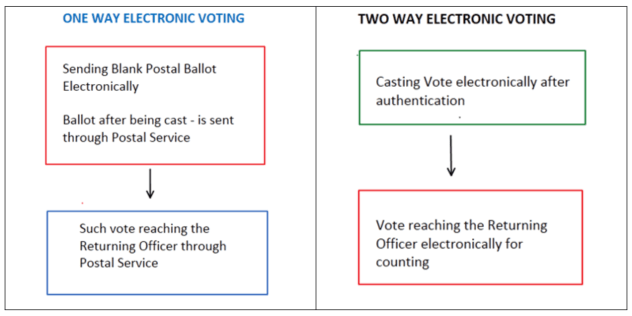
  • Electronically Transmitted Postal Ballot System (ETPBS) is the one-way electronic transmission of the Postal ballots to the Service Voters.
  • The Service Voter then cast their vote and send it to the respective returning officer via Post. The complete process is secured by way of multiple checks and transmission protocol to ensure safe transmission.
  • Upon receipt of the postal ballot at the counting centres, the returning officer validates the receipt by a series of QR codes with that of the transmitted system.

Functionality of ETPBS

  • Returning Officer generates ballot paper electronically by a specific desktop application. This ballot then gets encrypted in the system is ready to be sent.
  • The first functionality is the ability to generate the postal ballot online for transmitting through ETPBS.
  • Through ETPBS system, the ballots are automatically assigned to Service Voters based upon their constituency and get then gets transmitted.
  • The unit officer downloads the Postal ballots on behalf of the service voter. These downloaded ballots will be password protected.
  • The downloaded Postal Ballot can now be e-transmitted / hand-delivered using their secured network/infrastructure to the individual service voters.
  • The PIN will be transmitted/ dispatched to the individual service voters by the Record Officer to ensure that the downloaded Postal Ballot is opened by the concerned service voter only.
  • Thus ETPBS transmits the Postal ballot from the returning officer to the service voters electronically by a series of security protocol.       

Two way electronic voting

  • Two-way electronic transmission of vote envisages that - a registered voter from any location in India, once his identity is proved, will be able to cast his vote electronically through a secure encrypted system and the same will reach the designated returning officer for counting.  
  • EC is currently experimenting by using blockchain technology to facilitate two way electronic voting. 

Two way electronic voting

Providing Overseas Voters the Right to Vote
BENEFITS
CONCERNS
It will increase voter participation. Logistical Challenge to conduct voting either at Indian Embassies abroad or some other place which needs to be sanitized for voting.
It will cater to the vast Indian diaspora living abroad. It may impact several rights (employment, residence etc.) of such NRIs who intend to settle permanently in foreign countries.
Remove compulsions on part of Indians to travel to India especially for voting purpose.
It will fulfill the mandate of Article 326 and Section 62 of RPA, 1951 – which provides for right to vote for every citizen registered in the electoral roll.

Key Concerns on Online Voting using Blockchain Technology

Despite the benefits, security concerns have been raised by experts on the following grounds: 

  • Hacking of Blockchain Technology may result in:
  • Impersonation of voters
  • Transfer of votes for rival candidates
  • Cloning of biometric authentication
  • Denial-of-service attack might disallow citizens to register and vote
  • Disenfranchise a group or community of citizens
  • Decrypting votes casted 
  • Open to misuse by foreign intelligence & corporates     
  • Voting Preference and Pattern may become Public which is opposed to secret ballot   

What Needs to be Done to Allow Online Voting for  NRIS – Way Forward

  • If online voting is to be allowed by the government, then Section 20A of Representation of People Act, 1950 along with the Registration of Electors Rules, 1960 needs to be amended to allow online voting by NRIs even from outside India. 
  • Aspects related to logistics must be sorted out with the help of Ministry of External Affairs to allow smooth voting process for the overseas voters.
  • Two Way Electronic Voting can also be considered by the Election Commission by plugging the loopholes of online voting for the overseas voters.    

E-Justice: Can it help governance?

Despite the government’s successful implementation of successive e-governance tools such as Crime and Criminal Tracking Network & Systems CCTNS, Inter-Operable Criminal Justice which also includes integration of e-Courts and e-Prisons, it will not automatically improve governance especially with respect to the way criminal justice system operates in India. Even after implementation of such e-governance technology, success rates for investigation, lodging of First Information Report (FIR), filing charge-sheet by police before the Court, prosecution and successful conviction will vary for different states.

Crime and Criminal Tracking Network & Systems (CCTNS)

  • Crime and Criminal Tracking Network & Systems (CCTNS) is a plan scheme conceived in the light of experience of a non-plan scheme namely - Common Integrated Police Application (CIPA).
  • CCTNS is a Mission Mode Project under the National e-Governance Plan (NeGP) of Govt. of India.
  • CCTNS aims at creating a comprehensive and integrated system for enhancing the efficiency and effectiveness of policing through adopting of principle of e-Governance.
  • CCTNS also aims at creation of a nationwide networking infrastructure for evolution of IT-enabled-state-of-the-art tracking system around 'Investigation of crime and detection of criminals'.  
  • CCTNS connects police stations and digitises registration of FIR, investigation and charge sheets.  

The objectives of the Scheme can broadly be listed as follows:

  1. Make the Police functioning citizen friendly and more transparent by automating the functioning of Police Stations.
  2. Improve delivery of citizen-centric services through effective usage of ICT.
  3. Provide the Investigating Officers of the Civil Police with tools, technology and information to facilitate investigation of crime and detection of criminals.
  4. Improve Police functioning in various other areas such as Law and Order, Traffic Management etc.
  5. Facilitate Interaction and sharing of Information among Police Stations, Districts, State/UT headquarters and other Police Agencies.
  6. Assist senior Police Officers in better management of Police Force
  7. Keep track of the progress of Cases, including in Courts
  8. Reduce manual and redundant Records keeping

Implementation Framework – CCTNS

  • CCTNS has been implemented in alignment with the National e-Governance Plan principle of "centralized planning and de-centralized implementation".
  • Ministry of Home Affairs (MHA) and National Crime Records Bureau (NCRB) are playing a key role in planning the program in collaboration with the Police leadership within States, in the development of a few core components and in monitoring and reviewing the program.   
  • It is the States and Union Territories (UT) that drives the planning and implementation at the State and UT level.
  • The role of the Centre (MHA and NCRB) focuses primarily around planning, providing the Core Application Software (CAS) (to be configured, customized, enhanced and deployed in States.
  • Whereas the States and UTs drives the implementation at the state level and have continued to own the system after deployment.
  • The central feature of CCTNS implementation at the State level is the "bundling of services" concept. According to this, each States selected one System Integrator (SI) who is the single point of contact for the State for all the components of CCTNS.
  • These components include the application (the changes made to the core application provided by MHA), hardware, communications infrastructure, associated services such as Capacity Building and Handholding, etc. 

Expected Benefits for Various Stakeholders

A. Benefits to Police Department

  1. Enhanced tools for investigation.
  2. Centralized crime and criminal information repository along with the criminal images and fingerprints with advanced search capabilities.
  3. Enhanced ability to analyze crime patterns and/ or modus operandi
  4. Enhanced ability to analyze road incidents and other accidents.
  5. Faster turnaround time for the analysis results (criminal and traffic) to reach the officers on the field.
  6. Reduced workload for the police stations back-office activities such as preparation of regular and ad-hoc reports and station records management.
  7. A collaborative knowledge-oriented environment where knowledge is shared across different regions and units.
  8. Better co-ordination and communication with external stakeholders through implementation of electronic information exchange systems.

B. Benefits to Ministry of Home Affairs (NCRB)

  1. Standardized means of capturing the crime and criminal data across the police stations in the country.
  2. Faster and easier access to crime and criminal information across the country in a manner amenable for trend and pattern analysis.
  3. Enhanced ability to detect crime patterns through modus operandi across the States/UTs and communicate to the state police departments for aiding in crime prevention.
  4. The ability to respond faster and with greater accuracy to inquiries from the parliament, citizens and citizens groups; and to RTI queries.
  5. Easy and low-cost scalability of crime and criminal systems in the future.

C. Benefits to Citizens

  1. Multiple channels to access services from police.
  2. Simplified process for registering petitions.
  3. Simplified process for accessing general services such as requests for certificates, verifications, and permissions.
  4. Simplified process and accurate means of tracking the progress of the case during trials.
  5. Simplified and accurate access to view/report unclaimed/recovered vehicles and property.
  6. Simplified process and channel for grievance registration.
  7. Improved relationship management for victims and witnesses
  8. Faster and assured response from police to any emergency calls for assistance.

D. Benefits to external departments

  1. Seamless integration with police systems for better citizen service delivery and improved law enforcement.
  2. Quick exchange of accurate information with the police department.

Inter-operable Criminal Justice System

  • Inter-operable Criminal Justice System (ICJS) aims to integrate the Crime and Criminals Tracking Network and Systems (CCTNS) project with the e-courts and e-prisons databases, as well as with other pillars of the criminal justice system such as Forensics, Prosecution, and Juvenile homes in a phased manner.
  • ICJS is thus a common platform for information exchange and analytics of all the pillars of the criminal justice system comprising of Police, Forensics, Prosecution, Courts& Prisons.
  • Invested under the CCTNS project of the MHA, the ICJS enables a nationwide search on police, prisons & courts databases across all States/ UTs in the country.

e-Courts Project

  • The eCourts Project was conceptualized on the basis of the “National Policy and Action Plan for Implementation of Information and Communication Technology (ICT) in the Indian Judiciary – 2005” submitted by e-Committee, Supreme Court of India with a vision to transform the Indian Judiciary by ICT enablement of Courts.
  • E-committee is a body constituted by the Government of India in pursuance of a proposal received from Hon'ble the Chief Justice of India to constitute an e-Committee to assist him in formulating a National policy on computerization of Indian Judiciary and advise on technological communication and management related changes.
  • The e-Courts Mission Mode Project, is a Pan-India Project, monitored and funded by Department of Justice, Ministry of Law and Justice, Government of India for the District Courts across the country.
  • The E-Courts Mission Mode Project (Phase I 2010-15; Phase II 2015-19) is a national e - Governance project for ICT enablement of district and subordinate courts of the country. The major objectives of the Project are –   
  • To make whole judicial system ICT enabled by putting in place adequate and modern hardware and connectivity;
  • Automation of workflow management in all courts;
  • Electronic movement of records from taluka/trial to appeal courts;
  • Installation of video conferencing (VC) facility and recording of witness through Video Conferencing; connecting all courts in the country to the National Judicial Data Grid (NJDG) through WAN and additional redundant connectivity;
  • Citizen centric facilities such as electronic filing, e-payment and use of mobile applications in all courts; 
  • Touch screen based kiosks in each court complex, full computerisation of State and district level judicial and service academies and centres.    

The e-Court Project Envisages

  • To provide efficient & time-bound citizen centric services delivery as detailed in eCourt Project Litigant's Charter.
  • To develop, install & implement decision support systems in courts.
  • To automate the processes to provide transparency in accessibility of information to its stakeholders.
  • To enhance judicial productivity, both qualitatively & quantitatively, to make the justice delivery system affordable, accessible, cost effective, predictable, reliable and transparent.

E-PRISON PROJECT

  • e-Prisons have been operationalised across all states and Union Territories by the Ministry of Home Affairs. The e-prison data has been integrated with Police and court system under the Inter-Operable Criminal Justice System.
  • The system can be accessed through the secure National Informatics Centre (NIC) network, exclusively by authorising officials of law enforcement agencies and prisons through inter-operable Criminal Justice System.
  • e-Prisons Application Suite, developed by National Informatics Centre (NIC), is cloud-based product designed with easy to use GUI and embedded with comprehensive security features. It can be easily adopted by any State Prisons Department with minimum customization efforts since all the possible customization features are parameterized and can be configured by the users.

e-prison application

  • The e-Prisons application suite integrates all the activities related to prison and prisoner management.
  • It provides vital information about the inmates lodged in the prisons in a real-time environment to the courts, prison officials and other entities, involved in the Criminal Justice System.
  • It facilitates online visit requests and grievance redressal.

About e-Prison Project

  • The e-Prisons Project of Ministry of Home Affairs aims at computerization of the functioning of prisons in the country including digitisation and availability of prisoner’s data (convicts, under-trials, detenues etc.) in an electric platform which will be accessible to designated authorities of central and state governments.  
  • e-Prisons Project will help in creating centralised standard information database. 
  • e-Prisons uses data maintained by the States and Union Territories on the National Prisons Information Portal as per protocols notified for e-Prisons.

Components of e-Prison Project

image 39

  • E-Prisons Management Information System (MIS) – Management Information System used at the prisons for their day to day regular activities. The major modules of e-Prisons MIS are:
  • Prisoner Information Management System (PIMS);
  • Visitor Management System (e-Visitor);
  • Hospital Management System (e-Hospital);
  • Legal Aid Management System;
  • Inventory Management System;
  • Prison Management System (PMS);
  • Police Intelligence System;
  • Court Monitoring; and
  • Kiosk Information.
  • National Prisons Information Portal (NPIP) – It is a citizen-centric portal that displays statistical data from the country’s numerous prisons. 
  • Visitors can use this portal to schedule visits with their wards inside the prison;
  • Grievances about their wards can also be submitted using the portal;
  • This portal also provides with inmate tracking facilities in a secured way to various investigating agencies.
  • Kara Bazaar – Portal for showing and selling things made by convicts in various jails across the country. All of the state prison departments now have access to the necessary technology for on boarding.

Concerns in Implementation of e-Governance Tools to improve Criminal Justice System

  • Implementation of CCTNS across police stations with respect to steps towards digitisation of police records and its sharing with other police stations is not uniform.
  • Thus, 97 per cent of police stations may have been connected to CCTNS, but the figure is 77 per cent for West Bengal (as of January 2022).
  • Investigation Rates vary across states and in general for crimes under Indian Penal Code, it is only 65 per cent. This leaves the question about the remaining 35 per cent and also the fact that investigation need not lead to lodging of FIR.
  • Under-staffed police stations is another reason for non-uniformity in implementation of CCTNS across police stations in different states.
  • Police and Prisons are in the State List of Seventh Schedule and accordingly it is upto the respective state governments to implement the Model Prison Manual brought by MHA in 2016. So, states having antiquated prison manuals will not achieve much with new e-prison norms.
  • Even the functioning of Police based on the old and archaic Police Act of 1861 will not achieve much unless Model Police Act, 2015 is adopted by respected state governments as suggested by the The Police Act Drafting Committee or Soli Sorabjee Committee.

Way Forward – With the above stated shortcomings, it will be difficult to achieve the principles of “one country”, “one police” and “one prison”. Thus, in order for the e-governance tools such as CCTNS, e-Prison, e-Courts etc. to become successfully operable in India, differences in the functioning of police in different states needs to be resolved and also needs to be harmonised.  

Border dispute between Karnataka & Maharashtra

Karnataka Chief Minister Basavaraj Bommai on Wednesday said he would take steps to stop the Maharashtra government from implementing its flagship health insurance scheme in all 865 dispute border villages in Karnataka.

Background of this dispute

  • Maharashtra and Karnataka have sparred over the inclusion of some towns and villages along the state border ever since the passage of State Reorganisation Act of 1956, which in turn was based on the findings of the Justice Fazal Ali Commission, which was appointed in 1953.
  • In 1956, Mysore state (later renamed Karnataka) was formed, and differences between the state and the neighbouring Bombay state (later Maharashtra) erupted.
  • Since its creation in 1960, Maharashtra has claimed that 865 villages, including Belagavi (then Belgaum), Carvar and Nipani, should be merged into Maharashtra (these areas are predominantly Marathi-speaking). Karnataka, however, has refused to part with its territory.

Centres response

  • The Mahajan Commission (led by former Chief Justice of India Mehr Chand Mahajan) was set up by the Government of India in October 1966 to look into the border dispute.
  • It submitted its report in 1967, where it recommended that 264 villages should be transferred to Maharashtra, and that Belgaum and 247 villages should remain with Karnataka.
  • Maharashtra rejected the report, calling it biased and illogical. Despite demands from Karnataka, the Centre never implemented the report.

Exploiting public sentiments, Karnataka changed the name of Belgaum to Belagavi and made it the second capital of the state.In 2007, Karnataka started building the Suvarna Vidhana Soudha (Legislative Assembly) in Belagavi to assert its control over the region (winter legislature sessions are held here annually).  

What is the status of the border dispute now?

  • In 2004, the Maharashtra government filed a petition in the Supreme Court, staking claim over Marathi-speaking villages in Karnataka. However, the border row has been pending before the Supreme Court since 2004.
  • In 2010, the Centre in its affidavit had stated that the transfer of certain areas to then Mysore (now Karnataka) was neither arbitrary nor wrong.

Anticipatory or pre-arrest bail

Karnataka BJP MLA Madal Virupakshappa has been granted pre-arrest bail (subjected to cooperate in investigation) by the High Court, a decision challenged in Supreme Court by the state Lokayukta.

Previously, Virupakshappa approached a civil court in Bengaluru and obtained a temporary injunction against defamatory media reporting in the corruption case against 45 media outlets.

What is pre-arrest bail?

  • Bail is a process of procuring the release of a person from legal custody, by undertaking that he shall appear at the time and place designated and submit himself to the jurisdiction and judgment of the court.”

  • Although “bail” has not been expressly defined in Indian statutes, the Code of Criminal Procedure (CrPC) differentiates between “bailable” and “non-bailable” offenses. It also defines three kinds of bail that can be granted —
  • regular bail under Sections 437 and 439;
  • interim bail or short-term bail which is given when regular or anticipatory bail application is pending before the court;
  • anticipatory or pre-arrest bail.

  • The provision for “anticipatory bail” was introduced under Section 438 of the CrPC after the 41st Law Commission Report in 1969 recommended the need for a measure that protects against arbitrary violation of one’s personal liberty, such as when politicians detain their opponents in false cases.

When can anticipatory bail be granted?

  • When “any person has reason to believe that he may be arrested on an accusation of having committed a non-bailable offence”.
  • Granted by the High Court or the Court of Session, under this section, for non-bailable offenses for which one anticipates arrest, even if the actual arrest has not happened or the FIR has not been registered.
  • Non-bailable offenses are more serious offenses, punishable with at least three years imprisonment and above.
  • Amendment in 2005, following which it laid down principles for consideration for the grant of anticipatory bail under subsection such as whether the accused is likely to flee, is a habitual offender, or is likely to tamper with evidence along with his antecedents, such as previously being arrested for a cognizable offense.