Current Affairs

SC Bench seeks data on alternatives to hanging

  • The Supreme Court on March 21 asked the Centre to provide data which may point to a more dignified, less painful and socially acceptable method of executing prisoners other than death by hanging.
  • A Bench of Chief Justice of India D.Y. Chandrachud and Justice P.S. Narasimha even mooted the setting up of an expert committee to relook at India's method of putting to death its criminals.
  • The Chief Justice said such a committee would have experts from the national law universities, professors of law, doctors and scientific persons.
  • The Court indicated to the Centre, represented by Attorney General R. Venkataramani, that it needed some underlying data based on which it could examine if there was a more "humane" method of execution which would render death by hanging unconstitutional.

    Death penalty has been one of the most contentious issues of India’s constitutional debate. Every time a death penalty has to be executed, it leads to a fierce public debate.

    Hence, we have to understand the following dimensions of this issue:

    • What is Death Penalty?
    • What is the method to be adopted while executing the death sentence in India? 
    • Issues involved in Death penalty. 
    • Important Supreme Court Judgments
    • Death penalty methods and failure rates
    • Alternatives to the death penalty
    • Global Trends

    What is Death Penalty?

    • Capital Punishment, also known as the death penalty, is the act of the state executing an individual as punishment for a crime. It has been a part of India's judicial system since the British era and is still a legally recognized form of punishment. 
    • While 109 countries have abolished the death penalty, 55 countries, including India, Pakistan, China, the USA, and Japan, continue to retain it for certain crimes.
    • Some countries do not practice the death penalty but still have provisions for it in their legal systems.
    • In India, under the Code of Criminal Procedure of 1898, the punishment for murder was the death penalty. Despite ongoing debates about its validity, the 35th Law Commission recommended in 1967 that the death penalty should be retained because it acts as a deterrent and creates fear among criminals.
    • The Constitutional validity of Death Penalty has been challenged from time to time and after the re-enactment of the Code of Civil Procedure in 1973, there have been certain changes in the concept of Death Penalty.
      • Under the 1973 Act, under section 354(3) special reasons have to be given for awarding the death penalty not life imprisonment.

    What is the method to be adopted while executing the death sentence in India? 

    • Art. 21 of the Constitution, which guarantees to every citizen the fundamental right to life, also expressly states, “no person shall be deprived of his life or personal liberty except according to procedure established by law." This means that under no circumstances your right to live will be taken away from you except by the due procedure established by law, that is the state can take away your life through the given process of law if it deems fit. Not all offences are punishable by death, in fact, most of the agencies do not elicit capital punishment; instead, it is only reserved for the most heinous of crimes.

    Hanging

    • Section 354(5) of the CrPC specifies that hanging is the method of execution in the civilian court system and that it is the only method permitted in India for the execution of a civilian person.
    Text

Description automatically generated

    Shooting

    • Another execution method used in India is shooting. A firing squad member may execute a convict who has been given the death penalty. The only organisations capable of executing the death penalty in this manner are the Army, Air Force, and Navy. According to the Army Act of 1950, the army court-martial system recognises both hanging and shooting as legitimate methods of execution.

    But as all of us can understand that death penalty is a highly controversial and divisive topic. While some argue that it is a justifiable form of punishment for heinous crimes, others believe that it is ethically and morally wrong. Here are some of the main ethical issues associated with the death penalty:

    1. Human rights violations: Many argue that the death penalty violates the basic human right to life. The state taking a person's life, even if they have committed a serious crime, is seen as a violation of their human dignity.
    2. Possibility of wrongful convictions: There have been numerous cases where innocent people have been sentenced to death. This raises serious concerns about the reliability of the justice system and the risk of executing an innocent person.
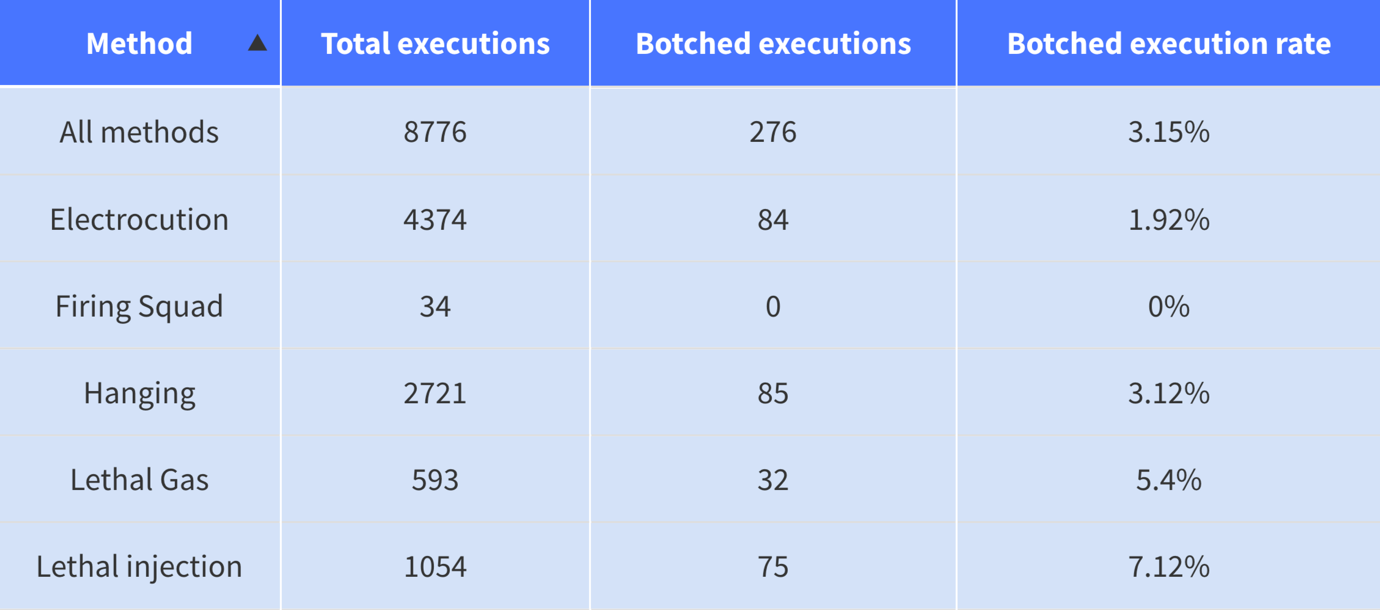
    3. Botched executions: 'Botched executions' are those that did not go as planned, resulting in unnecessary pain for the person charged with death penalty.
    4. Inequities in application: The application of the death penalty is not uniform and can be influenced by factors such as race, gender, and socioeconomic status. This raises concerns about the fairness and impartiality of the justice system.
    5. Retribution vs. rehabilitation: The death penalty is often seen as a form of retribution rather than rehabilitation. This raises ethical questions about whether the state should be seeking revenge or working towards the rehabilitation of offenders.
    6. Cost: The death penalty is often more expensive than life imprisonment. This raises ethical questions about the allocation of resources and whether society should be spending money on a form of punishment that is not proven to be more effective than alternatives.

    Overall, the ethical issues associated with the death penalty are complex and multifaceted. While some argue that it is necessary for justice to be served, others believe that it is a violation of human rights and that alternative forms of punishment should be explored.

    Important Supreme Court Judgments

    • Bachan Singh v. State of Punjab, 1980: Consider aggravating and mitigating factors of crime and the accused. Use Death Penalty only in 'rarest of rare cases'.
    • Machhi Singh v. State of Punjab, 1983: Identify the way the crime was committed, motive, the anti-social nature of the crime, the magnitude of the crime, and the personality of the victim.
    • Shatrughan Chauhan v. Union of India, 2014: Undue, inordinate and unreasonable delay in death penalty execution amounts to torture and a ground for commutation of sentence. 

    Death penalty methods and failure rates

    • The table shows the proportion of botched executions for each method. Data includes only executions in the U.S. from 1890 to 2010.
    ZWq4D12c iGP0rGv9WraJRMW6yVTpypEKhmzR0W jf wJe0DqNOvbUq9Q Lgykj98sArumpARSc0SiBDnggi47L7zFfdyHDrbNYmvApk2HvhOeJsmKrJBcWxu20t LngDQZIp5DF

    There are several alternatives to the death penalty that are used by various countries and jurisdictions around the world.

    Here are a few examples:

    • Life imprisonment without the possibility of parole: This is a sentence in which the offender is kept in prison for the rest of their life, with no chance of release. This is a common alternative to the death penalty in many countries.
    • Restorative justice: This is a process in which the offender is required to make amends for their crime, usually through community service or financial restitution to the victim. This approach focuses on repairing harm rather than punishment.
    • Rehabilitation programs: This involves providing offenders with education, job training, counseling, and other services that can help them reintegrate into society and avoid future criminal behavior.
    • Community service: This is a sentence in which the offender is required to perform a certain amount of community service as a form of punishment.
    • Fines and other monetary penalties: This involve imposing a financial penalty on the offender, which can range from a small fine to a substantial sum of money.
    • Suspended sentence: This is a sentence in which the offender is found guilty but not actually sent to prison. Instead, the sentence is "suspended," which means that the offender is released but must adhere to certain conditions, such as regular check-ins with a probation officer or avoiding further criminal activity.
    • Capital punishment moratorium: This is a temporary or indefinite suspension of the death penalty, which allows time for review and reform of the justice system.

    Overall, there are many alternatives to the death penalty that can be effective in deterring crime, protecting society, and rehabilitating offenders.

    Global Trends

    The use of the death penalty varies greatly around the world. While some countries have abolished it entirely, others continue to use it as a form of punishment for certain crimes. Here are some global practices with regard to the death penalty:

    • Abolitionist countries: As of 2021, 109 countries have completely abolished the death penalty. These countries include Canada, most of Europe, Australia, New Zealand, and many Latin American and African countries.
    • There are still 55 countries that retain the death penalty in law and/or in practice, including the United States, China, Iran, Saudi Arabia, and Vietnam.
    • Some countries that have not abolished the death penalty have imposed a moratorium on executions. This means that while the death penalty is still legal, no executions are being carried out. For example, India has not executed anyone since 2015.
    • The methods used to carry out the death penalty also vary around the world. In some countries, such as the United States, lethal injection is the most common method, while in others, such as Saudi Arabia, beheading is used.
    • The crimes that can result in the death penalty also vary by country. In some countries, such as Iran and Saudi Arabia, crimes such as drug trafficking and apostasy can result in the death penalty, while in others, such as the United States, only certain types of murder can result in the death penalty.

    The ethical implementation of the death penalty requires adherence to certain principles, such as ensuring that the justice system is free of flaws and that laws are properly enforced. To avoid any failures or miscarriages of justice, the criminal justice system must be improved.

    In addition, the judiciary must maintain a consistent approach that takes into account the restorative and rehabilitative aspects of justice in order to avoid any negative consequences that could arise from imposing the death penalty.

    Furthermore, there must be compelling justifications for the imposition of the death penalty in order to avoid excessive punishment and maintain respect for the value of life.

    Finally, the mercy petition must be treated as the final bulwark against any miscarriage of justice, with a time-bound disposal of such petitions to ensure that justice is served.
    Is the SARSCoV2 XBB.1.16 lineage a cause for concern?

    UPSC Syllabus: Awareness in the fields of IT, Space, Computers, robotics, nano-technology, bio-technology and issues relating to intellectual property rights.

    Context: XBB.1.16, first detected in SARS-CoV-2 sequences from India, is a recombinant lineage of the corona virus. Preliminary data suggest that XBB.1.16 has a higher growth advantage over currently circulating SARS-CoV-2 lineages. The strain also has mutation associated with immune escape, or the ability of the virus to evade antibodies generated from previous infections or vaccines.

    What are recombinants?

    Co-infection of multiple lineages of a virus can lead to the exchange of genetic material between them through the process of recombination. Recombination is a process where genetic material from two different lineages of the same virus combines to form a new genome, which can give rise to chimeric genomes, or recombinants.

    Recombinants may have the potential to create new lineages of the virus that possess better functional capabilities than either of the parent lineages. This is because the process of recombination allows for the combination of different genetic elements that may provide the virus with new functional advantages.

    While most recombinations may not give rise to viable viruses, some rare recombinations could result in the creation of a new lineage of the virus. These new lineages may have improved pathogenicity, transmissibility, or other functional capabilities that make them more dangerous to human or animal health.

    Why recombination happens so rapidly?

    Since the replication of virus happens freely in the host cytoplasm, the process is completely unregulated. While the errors in DNA virus genomes can be corrected by the error-correcting function of cells in which they replicate, there are no enzymes in cells to correct RNA errors.

    Therefore, RNA viruses, having a higher mutation rate than DNA viruses, tend to create recombinants rapidly. 

    Unfortunately, the potency of a mutation to increase infectivity in a region can only be known retrospectively. 

    Are all recombinants dangerous?

    Most changes have little to no impact on the virus’ properties. However, some changes may affect the virus’s properties, such as how easily it spreads, the associated disease severity, or the performance of vaccines, therapeutic medicines, diagnostic tools, or other public health and social measures.

    Why is XBB.1.16 a cause for concern?

    • Amid the ongoing increase in the number of seasonal influenza H3N2 cases, an uptick in COVID-19 cases is also being seen in India in the month of March, despite the low number of testing. 
    • The fast-spreading XBB.1.16 lineage is believed to be responsible for the recent spike in COVID-19 cases in India.
    • XBB.1.16 presently accounts for more than 30% of all the sequenced genomes in the month of March 2023, and its proportion has been seen to be increasing in the past few weeks. 

    It is important to monitor for the emergence of recombinant viruses because they can have significant impacts on public health.

    For example, the H1N1 influenza virus that caused the 2009 pandemic was a recombinant virus that combined genetic material from swine, avian, and human influenza viruses.

    This new lineage of the virus was able to infect humans and rapidly spread around the world, resulting in significant morbidity and mortality.

    Is XBB.1.16 more infectious?

    Based on preliminary data, there is no evidence to suggest that infections with the XBB.1.16 lineage differ in clinical severity from those caused by other Omicron lineages although the higher growth advantage and immune escape could lead to a higher risk of reinfection with XBB.1.16 compared to other circulating Omicron lineages. Protecting the vulnerable through time-tested means could therefore significantly blunt the rise in infections.

    PM to inaugurate ITU Area Office

    Context: Prime Minister of India will inaugurate the new International Telecommunication Union (ITU) Area Office and Innovation Centre in India.

    About International Telecommunication Union (ITU):

    • It is a specialized agency of the United Nations that focuses on information and communication technologies (ICTs). 
    • ITU was established in 1865 to enhance global connectivity in communication networks. 
    • The organization is responsible for managing the allocation of global radio spectrum and satellite orbits, as well as developing technical standards that enable seamless interconnectivity among networks and technologies. 
    • Membership of ITU is open to all member states of the United Nations. 
    • There are currently 193 member states of the ITU, including all UN member states except the Republic of Palau
    • Its headquarters is based in Geneva, Switzerland. 

    Reports/Publications of ITU:

    • ICT Development Index
    • Global ICT Regulatory Outlook 2020
    • Global Cyber Security Index
    • Global e - Waste Monitor (along with United Nations University & International Solid Waste Association (ISWA)

    India & ITU:

    • India has been an active member of the ITU since 1869, earnestly supporting the development and propagation of telecom in the global community of nations.  
    • The country has been a regular member of the ITU Council since 1952, and has played an important role in harmonizing the contributions of member States from the region, always respecting the principles of equality and consensus-building.  
    • India had been elected as a Member of the International Telecommunications Union (ITU) Council for 4-year term (2019-2022). 
    • India signed Host Country Agreement with the International Telecommunication Union for establishment of Area Office & Innovation Centre at New Delhi (March 2022). The Host Country Agreement provides the legal and financial framework for establishment and operations of the Area Office.
    • The Area Office and Innovation Centre of ITU at New Delhi is expected to serve South Asian  countries namely Afghanistan, Bangladesh, Bhutan, Iran, Maldives, Nepal, Sri Lanka and India.  

    Give PDS beneficiaries the option to bundle millets with wheat, rice

    Context: There is a news article in Indian express dated 22 march 2023 to allow millets under PDS, we will understand the various aspects of news in detail.

    Who recommended millets in PDS?

    To boost the consumption of millets, a Parliamentary panel has suggested that beneficiaries of different government schemes like PDS should be given the option to bundle millets along with wheat and rice.

    Which parliamentary committee is related to PDS?

    The Standing Committee on Consumer Affairs, Food and Public Distribution presented a demand for a grant report in the Lok Sabha on Tuesday for the department of food and public distribution. The report said that States are allowed to procure coarse grains/millets (Jowar, Bajra, Maize and Ragi etc.) from farmers at MSP under the central pool.

    What is the procedure to procure and distribute millets under PDS?

    This is subject to the prior approval of the Centre on the detailed procurement plan prepared by State Governments in consultation with FCI and also as per Guidelines for procurement, allocation, distribution and disposal of coarse grains/millets. 

    Under which schemes Millets can be distributed by States?

    The procured quantity should be distributed under TPDS (Targeted Public Distribution System)/OWS (Other welfare Schemes) in the State/UT. 

    What are the new changes made in the guidelines?

    • Further, the report said that the Department has revised the guidelines for allocation, distribution and disposal of coarse grains procured by the State Agencies/FCI and
    • Enhanced the distribution period to 6-10 months from an earlier period of 3 months
    • Provision of advance for subsidy inter-state transportation of surplus millets through FCI is also incorporated. 

    What is the role of the department of food and public distribution?

    The Department also informed that the millet promotion is being done by the Agriculture Ministry in coordination with the Agriculture Departments of various States and the Department’s role is confined only to procuring them and distributing them for various schemes such as PDS, MDM (mid-day meal) scheme and Integrated Child Development Scheme (ICDS). 

    What is millet at all?

    Millets are a group of cereal grains that belong to the Poaceae family, commonly known as the grass family. Some of the millets are ragi, bajra, jawar etc. 

    What is the importance of millet?

    • Millets have gained popularity in the West because they are gluten-free and boast high protein, fibre, and antioxidant content. 
    • Millets provide more essential amino acids than most other cereals. These compounds are the building blocks of protein  
    • What’s more, finger millet boasts the highest calcium content of all cereal grains. Calcium is necessary to ensure bone health, blood vessel and muscular contractions, and proper nerve function.
    • Millets are rich in fibre and non-starchy polysaccharides, two types of undigestible carbs that help control blood sugar levels. 
    • This cereal also has a low glycaemic index (GI), meaning that it’s unlikely to spike your blood sugar levels. Thus, millet is considered an ideal grain for people with diabetes.
    • Millets contain soluble fibre, which produces a viscous substance in your gut. In turn, this traps fats and helps in reducing cholesterol levels.
    • They’re also able to survive in harsh environments and less fertile soil. 
    • They have multiple advantages over other crops, including drought and pest resistance

    Is there any downside to millet?

    Despite millets’ multiple health benefits, they also contain antinutrients — compounds that block or reduce your body’s absorption of other nutrients and may lead to deficiencies.

    One of these compounds — phytic acid — interferes with potassium, calcium, iron, zinc, and magnesium uptake. However, a person with a balanced diet isn’t likely to experience adverse effects.

    Other antinutrients called goitrogenic polyphenols may impair thyroid function, causing goitre — an enlargement of your thyroid gland that results in neck swelling.

    Nevertheless, this effect is associated only with excess polyphenol intake

    What are the recommendations of the panel?

    The panel recommended

    • Ministry should encourage the production and procurement of millets in all the States especially the States having significant tribal populations such as Rajasthan, MP and Chhattisgarh etc.
    • Ministry should provide all possible aid/assistance/bonuses to farmers opting to grow millets

    Further, to encourage the consumption of millets, the Committee further suggest that the beneficiaries of different schemes should be given the option to bundle millets along with wheat and rice within their entitled quantity.

    Dayanand Saraswati’s life is an inspiration for Modi government : Shah

    Context: “The Prime Minister is working for national awakening, a concept originally based on the philosophy and teachings of Maharishi Dayanand Saraswati,” said Union Home Minister Amit Shah at the 148th Foundation Day celebrations of Arya Samaj.

    Basic information about Dayanand Saraswati

    • Born in 1824 at Tankara, Gujarat. 
    • Associated Movement: Arya Samaj, Shuddhi Movement, Back to the Vedas
    • Relevant Publications: Satyarth Prakash (1875 & 1884); Sanskarvidhi (1877 & 1884); Yajurved Bhashyam (1878 to 1889)

    Early Life and Education

    As a Brahmin, he was taught religious rituals, piety and purity, importance of fasting from a very early age. 

    Spiritual Indoctrination 

    After his sister’s death, he began asking questions about life, death and the afterlife to his parents, to which they had no answers. 

    On being asked to get married following societal traditions, Mool Shankar ran away from home. He wandered all over the country for the next 20 years. 

    At last he arrived at Mathura where he met Swami Virajananda. Mool Shankar became his disciple and Swami Virajananda directed him to learn directly from the Vedas. He found all his questions regarding life, death and afterlife answered during his study of Vedas. 

    His belief system

    • He was a believer in Hinduism just as the Vedas have outlined, devoid of any corruption and embellishments. 
    • Preserving the purity of the faith was of utmost important to him. 
    • He advocated the concepts of Dharma which he believed to be free from any partiality and as an embodiment of truthfulness. 
    • To him Adharma was anything that did not hold true, was not just or fair and was opposed to the teachings of the Vedas. 
    • He believed in reverence of human life irrespective of anything and condoned the practice of Ahimsa or non-violence. He advised people to direct their energy towards betterment of mankind as a whole and not waste away in unnecessary rituals. 
    • He revoked the practice of idol worship and considered them a contamination introduced by the priests. 
    • He was against other social evils like superstitions and caste segregation. 
    • He advocated the concept of Swarajya, meaning a country free of foreign influence, resplendent in the glory of fair and just participants.

    Arya Samaj

    • When: On 7 April 1875 at Bombay. 
    • What: A Hindu reforms movement, meaning "society of the nobles". 
    • Objective: To move the Hindu religion away from fictitious beliefs. 
    • Moto of Samaj: 'Krinvan to Vishvam Aryam" meaning "Make this world noble". 

    Views of Arya Samaj:

    • God is the efficient cause of all true knowledge.
    • God is existent, intelligent, blissful, formless, omniscient, just, merciful, unborn, endless, unchangeable, beginning-less, unequalled, the support of all, the master of all, omnipresent, immanent, un-aging, immortal, fearless, eternal and holy, and the maker of all. He alone is worthy of being worshiped.
    • The Vedas are the scriptures of all true knowledge. 
    • One should always accept truth and renounce untruth.
    • Every action should be based on Dharma.
    • Promote the physical, spiritual and social good of everyone.
    • Conduct should be guided by love, righteousness and justice.
    • We should dispel Avidya (ignorance) and promote Vidya (knowledge).
    • Condemn ritualistic practices like idol worship, pilgrimage and bathing in holy rivers, animal sacrifice, offering in temples, sponsoring priesthood etc.

    Important contributions of Samaj:

    • Working to promote widow remarriage and women education
    • Launched programs to support widow remarriage in the 1880s. 
    • Maharishi Dayanand also underlined the importance of educating the girl child and opposed child marriage.

    Shuddhi Movement

    • By: Maharishi Dayanand Saraswati
    • Meaning: Purification
    • Objective: to bring back the individuals to Hinduism who were either voluntarily or involuntarily converted to other religions like Islam or Christianity. 

    Educational Reforms

    • Maharishi Dayanand set up a number of Gurukuls to teach his followers the knowledge of the Vedas and for them to spread the knowledge further. 
    • His disciples established the Dayanand Anglo Vedic College Trust and Management Society, after his death in 1883. 
    • The first DAV High School was established at Lahore on June 1, 1886 with Lala Hans Raj as its headmaster.

    Ladakh Autonomous Hill Development Council

    Context: Amidst sub-zero temperatures, people are protesting to bring attention to Ladakh's susceptibility to climate change and its connection to the Sixth Schedule rights. With the looming threat of climate change, the ongoing demonstrations aimed at preserving Ladakh's identity under the Sixth Schedule take on even greater significance and urgency.

    More on the news:

    The Ladakh region is highly vulnerable to climate change, with retreating glaciers and villages forced to relocate due to lack of water.

    People in Ladakh has been protesting in freezing temperatures to highlight this vulnerability and advocate for the implementation of the Sixth Schedule of the Constitution, which empowers autonomous councils to administer rights over land, forest, sanitation, and employment to safeguard cultural and indigenous identities. 

    About Ladakh Autonomous Hill Development Council:

    The Ladakh Autonomous Hill Development Council Act 1995 was enacted in response to the demands of the Ladakhi people who sought to create a separate Indian Union Territory due to their distinct religious and cultural identity, which differed from the rest of Jammu and Kashmir.

    The creation of the Autonomous Hill Councils in Ladakh represented an important step towards recognizing the unique identity and aspirations of the region's people.

    The council provided a platform for participatory democracy, enabling the people to take charge of their own development and governance while also ensuring that their distinctive cultural and religious identity is preserved.

    Composition of council:

    The total number of seats, in the Council to be filled by persons chosen by direct election on the basis of adult suffrage from territorial constituencies shall be twenty-six.

    The Governor may nominate not more than four persons from amongst the principal religious minorities and women in the district to be members of the Council.

    The members of the Council shall at its first meeting after a general election elect from amongst the elected members one member to be the Chairman.

    The Executive council:

    There shall be an Executive Council consisting of – (a) the Chairman who shall be the Chief Executive Councillor; and (b) four members to be nominated by the Chief Executive Councillor from amongst the members of the Council: Provided that at least one member shall be nominated from amongst the principal religious minorities in the district. The Executive Council shall be collectively responsible to the Council.

    Powers and Functions of Council:

    Subject to the provisions of 1995 Act the Council shall have executive powers in the district in relation to:

    1. Allotment, use and occupation of land vested in the Council by the Government under this Act.
    2. Formulation of development programme for the district in respect of District Component Schemes as notified by the Government and Centrally Sponsored Schemes and indicate priorities for various schemes and consider issues relating to the speedy development and economic upliftment of the district.
    3. Laying down guidelines for implementation of schemes at gross root level and Promotion of co-operative institutions.
    4. Special measures for employment generation and the alleviation of poverty and Management of undemarcated forests.
    5. Supervision and constitution of notified area committees and Formulation of periodical and annual plans for the district.
    6. Promotion of languages and culture of the area, Tourism, Vocational training, Education, Fisheries.
    7. Public health and sanitation, hospitals and dispensaries and Construction and maintenance of roads except highways.
    8. Preservation, protection and improvement of livestock and prevention of animal diseases.
    9. To collect within the district such taxes payable under any law as may be prescribed by the Government and credit the same to the Consolidated Fund.

    What is the Sixth Schedule?

    The Sixth Schedule, outlined in Article 244, allows for the establishment of self-governing administrative entities known as Autonomous District Councils (ADCs) within a state.

    These councils possess some legislative, judicial, and administrative powers and can operate autonomously in certain areas. ADCs consist of up to 30 members who serve a five-year term and have the authority to create laws, regulations, and policies concerning various matters, such as land, forest, water, agriculture, village councils, health, sanitation, policing at the village and town level, inheritance, marriage and divorce, social customs, and mining.

    The Sixth Schedule is applicable to the north-eastern states of Assam, Meghalaya, Mizoram (with three councils each), and Tripura (with one council).

    Why Ladakh is demanding sixth schedule?

    The creation of the Union Territory of Ladakh, which had initially been met with enthusiasm in the Buddhist-dominated region, has soured due to the absence of a legislative assembly and concerns over changes in the domicile policy in Jammu and Kashmir. While there are two Hill councils in Leh and Kargil, their powers are limited and the administration of the region is completely in the hands of bureaucrats. Due to the limited powers conferred on the councils, there is growing demand for inclusion into the sixth schedule. Ladakh's inclusion under the Sixth Schedule, which would enable the preservation of its distinct culture and the restriction of land acquisition by outsiders, has been recommended by the National Commission for Scheduled Tribes.

    Government’s response to Ladakh’s demand for sixth schedule:

    Home Ministry official has stated that the Constitution only permits the Sixth Schedule for the Northeast, and the Fifth Schedule applies to tribal areas in the rest of the country. The government has the option to amend the Constitution to allow for Ladakh's inclusion.

    Benefits of inclusion into sixth schedule:

    1. The district and regional councils have jurisdiction over specific areas and can create laws regarding topics such as land, forests, canal water, village administration, inheritance of property, marriage and divorce, social customs, and shifting cultivation. 
    2. Within their territories, the district and regional councils can establish village councils or courts to adjudicate disputes between tribes and hear appeals. 
    3. The district council can manage primary schools, dispensaries, markets, ferries, fisheries, and roads within its district. It can also regulate money lending and trading by non-tribals. 
    4. The district and regional councils have the authority to collect land revenue and impose specified taxes. 
    5. Acts of Parliament or state legislature do not apply to autonomous districts and regions, or they may apply with modifications and exceptions. 
    6. The Governor has the power to appoint a commission to investigate matters related to the administration of autonomous districts or regions. He can also dissolve a district or regional council based on the commission's recommendation.

    Way Forward:

    It is essential to engage in constructive dialogue with people of Ladakh and take into account the interests and aspirations of all stakeholders, while also ensuring the region's sustainable and equitable development.

    NSA Invoked Against Amritpal and Company

    National Security Act (NSA), 1980 which is a preventive detention law as per Article 22(3) of the Indian Constitution has been invoked against Amritpal Singh and his associates for preaching radical anti-India ideals.

    Constitutional Protection on Arrests and Exceptions – Article 22

    • Article 22(1) states that every person who is arrested shall be informed about the grounds of arrest and shall not be denied the right to consult, and to be defended by, a legal practitioner of his choice.
    • Article 22(2) states that Every person who is arrested and detained in custody shall be produced before the nearest magistrate within a period of twenty-four hours of such arrest. 
    • Article 22(3) states that the above mentioned provisions provided under Article 22(1) and Article 22(2) shall not be available to any person:
    1. who for the time being is an enemy alien or 
    2. who is arrested or detained under any law providing for preventive detention. 
    • Thus, police can arrest such persons under preventive detention laws such as National Security Act without formal charge and need not present the accused before the magistrate within 24 hours. 
    • Article 22(4) further states that - No law providing for preventive detention shall authorise the detention of a person for a longer period than three months unless— An Advisory Board (constituted under the Preventive Detention Law) suggests otherwise.   
    • Article 22(5) states that grounds of arrest shall be disclosed to the person arrested under preventive detention law and also provide the person the earliest opportunity of making a representation against the order.   
    • Article 22(6) states that authority making arrest under preventive detention law can withhold disclosure of certain facts regarding grounds of arrest if the authority considers to be against public interest. 
    • Article 22(7) states that Parliament may by law prescribe the circumstances under which, and the class or classes of cases in which, a person may be detained for a period longer than three months under any law providing for preventive detention without obtaining the opinion of an Advisory Board. 
    • Parliament may also prescribe the maximum period for which any person may be detained under such preventive detention law.

    Thus, Article 22 has provided elaborate details and contours for invoking preventive detention laws against persons and accordingly the Parliament has enacted the National Security Act, 1980. 

    Grounds on which National Security Act can be invoked  

    • The Central or State Government can issue detaining order under Section 3 of NSA if is satisfied that: 
      • It is necessary to prevent any person from acting in any manner prejudicial to the defence of India, the relations of India with foreign powers, or the security of India
      • With respect to any foreigner, it is necessary to regulate his/her continued presence in India or with a view to making arrangements for his/her expulsion from India.
    • If according to the Central or State Government, it is necessary to prevent a person from acting in any manner prejudicial to the: 
      • security of the State
      • maintenance of Public order or
      • maintenance of supplies and services essential to the community
      • then central or state government can issue detention orders under NSA. 
    • The District Magistrate or Commissioner of Police can issue arrest warrant under NSA if they are satisfied that situation exists which may affect national security, public order or disrupt essential supplies.

    Constitution of Advisory Board under NSA

    • The Central Government and each State Government shall, whenever necessary, constitute one or more Advisory Boards for the purposes of this Act. 
    • Each Advisory Board shall consist of three persons who are, or have been, or are qualified to be appointed as, Judges of a High Court, and such persons shall be appointed by the appropriate Government. 
    • Among the three members, one of them shall be appointed as the Chairman by the government. 

    Procedure to be Adopted by the Advisory Board 

    • The Advisory Board shall consider the materials placed before it but can also ask for other information from the government which it thinks necessary. 
    • The Board shall hear the accused in person but without any legal representation. 
    • The Board shall submit its report to the appropriate government and in a separate part specify whether or not further detention is needed.
    • When there is a difference of opinion among the members, the opinion of the majority of such members shall be deemed to be the opinion of the Board.
    • The proceedings of the Advisory Board and its report, except that part of the report in which the opinion of the Advisory Board is specified, shall be confidential.  

     Maximum Period of Detention – NSA

    • The maximum period for which any person may be detained in pursuance of any detention order which has been confirmed shall be twelve months from the date of detention.
    • However, the central or state government may revoke or modify the detention order at any earlier time.  

    Concerns – Application of Preventive Detention Laws like NSA

    • Under preventive detention laws, there is no need to inform the accused immediately of grounds of arrest. 
    • The authorities may withhold disclosure of grounds of arrests
    • Arrested person need not be produced before Court within 24 hours as per normal norms. 
    • For cases referred to  Advisory Boards under NSA
      • there is no public hearing involved and no guaranteed oral hearing for the person detained. 
      • The accused cannot be represented through a lawyer of their choice
    • Preventive Detention laws can be used to suppress freedom of expression of journalists, political opponents, RTI activists etc. especially voicing concerns against policies or legislations of the government. 
    • At times, preventive detention laws are used to cover normal crimes as this largely reduces the legal assistance of detainees.      

    Way Forward 

    If any person is arrested under NSA, then the only recourse available lies in filing writ petitions in High Court or Supreme Court for release of such person.

    Thus, procedural fairness should be incorporated under NSA and other preventive detention laws because under the present system, the balance always tilts in favour of the government in such cases.

    IPCC Synthesis report

    Climate change is a threat to human wellbeing and planetary health and there is a rapidly closing window of opportunity to secure a liveable and sustainable future for all, the Intergovernmental Panel on Climate Change (IPCC) said in a report. 

    The current report synthesises findings from three working groups. It also integrates evidence from three special reports during the sixth assessment cycle.

    Key observations:

    • Human activities, principally through emissions of greenhouse gases, have unequivocally caused global warming, with global surface temperature reaching 1.1°C above 1850–1900 in 2011–2020. 
    • Global greenhouse gas emissions have continued to increase.
    • Adaptation planning and implementation has progressed across all sectors and regions, with documented benefits and varying effectiveness. Despite progress, adaptation gaps exist, and will continue to grow at current rates of implementation
    • Global GHG emissions in 2030 implied by nationally determined contributions (NDCs) announced by October 2021 make it likely that warming will exceed 1.5°C during the 21st century and make it harder to limit warming below 2°C.
    • Climatic and non-climatic risks will increasingly interact, creating compound and cascading risks that are more complex and difficult to manage.
    • The report, brings in to sharp focus the losses and damages we are already experiencing and will continue into the future, hitting the most vulnerable people and ecosystems especially hard.

    About the IPCC

    • The Intergovernmental Panel on Climate Change (IPCC) is the United Nations body for assessing the science related to climate change. 
    • It was established by the United Nations Environmental Programme (UNEP) and the World Meteorological Organization (WMO) in 1988 to provide political leaders with periodic scientific assessments about climate change. 
    • The IPCC has 195 member states that are members of the UN or WMO.
    • The IPCC has three working groups:
      • Working Group I, which addresses with the physical science of climate change; 
      • Working Group II, which focuses on the impact, adaptation and vulnerability associated with climate change; and 
      • Working Group III, which deals with the mitigation of climate change. 
    • It also has a Task Force on Greenhouse Gas Inventories that develops methodologies for measuring emissions and removals.
    • IPCC assessments provide governments, at all levels, with scientific information they can use to develop climate policies. 
    • The UN panel does not itself undertake scientific assessments but only evaluates the state of scientific evidence on various aspects of climate change.

    About the Sixth Assessment Cycle

    The IPCC publishes comprehensive scientific assessments every six to seven years. The previous one, the Fifth Assessment Report, was completed in 2014 and provided the main scientific input to The Paris Agreement.

    At its 41nd Session in February 2015, the IPCC decided to produce a Sixth Assessment Report (AR6).

    ISRO’s LVM-3 to launch second fleet of 36 satellites

    Context: In its second commercial launch, India’s heaviest launch vehicle LVM-3 will launch a fleet of 36 OneWeb satellites in the Low Earth Orbit, completing the first generation of the huge broadband constellation. 

    OneWeb satellites:

    • OneWeb is a United Kingdom-based company, backed by the UK government and India’s Bharti, which plans to create a 588-satellite strong constellation to provide high-speed, low-latency global connectivity.
    • These satellites will be placed in 12 rings of 49 satellites each, with every satellite completing a full trip around the Earth in 109 minutes. The final launch by ISRO will enable the company to initiate global coverage.
      • This is the second OneWeb fleet that India is launching, with the first being carried out by the same vehicle in October 2022. 

    Key Facts: 

    • In June 2020, the Indian government opened up the space sector to allow the participation of private firms in the entire gamut of space activities. As part of these reforms, the government set up:
      • New Space India Limited (NSIL) - the country's first public sector undertaking in the space sector.
      • Indian National Space Promotion and Authorization Centre (IN-SPACe) - the promoter and regulator of space activities in India by non-government and private entities.
    • India’s journey into the commercial heavy lift-off space was initiated after the launch of 36 OneWeb satellites in the Low Earth Orbit in October 2022. 
    • Despite being one of the major space-faring nations, India accounts for only about 2% of the commercial market
    • With the space sector opened up to private players in 2020, this is likely to increase, as more and more companies are developing their own small satellite launch capabilities. 
    oH roOkfbyV9qxcCI7LXZv7puRcoW2897gg2XMowa8ZK1wG8UUpPnuN8E3iFKZ7AgCnSz9N8QIRuNyWSA6pI06lfQqNumXT0XUGYfQWLuG6oyfGbGSjHauEZMrmVS7jM YY4YgFqXAtYdDKfMeFosg

    Launch Vehicle Mark-3:

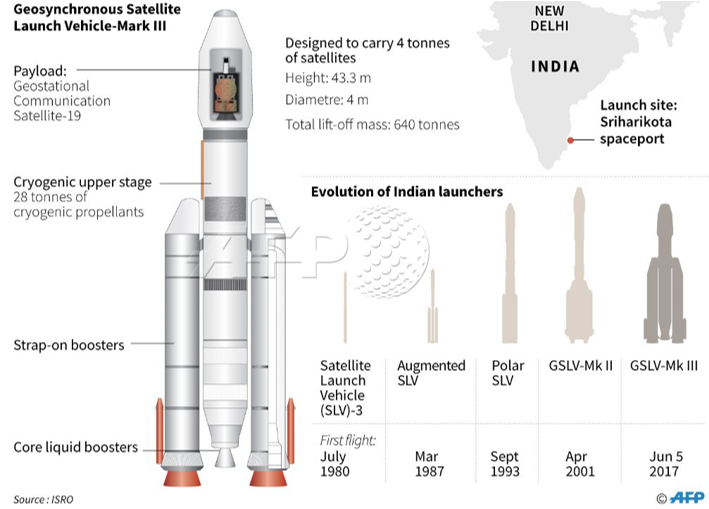
    • The Launch Vehicle Mark-3 (LVM3) or Geosynchronous Satellite Launch Vehicle Mark III (GSLV Mk3) is a three-stage heavy-lift launch vehicle developed by the Indian Space Research Organisation (ISRO).
      • It has two solid strap-on motors, one liquid core stage and a high-thrust cryogenic upper stage.
    • Currently, the LVM3 rocket has the capacity to carry 4000 kg spacecraft launching capability to GTO (Geosynchronous Transfer Orbit) and 10000 tons to the Low Earth Orbit.
      • It is primarily designed to launch communication satellites.
      • It is also due to launch crewed missions under the Indian Human Spaceflight Programme (Gaganyaan).

    A boost to the zoonoses theory

    Undisclosed genetic data from a food market in Wuhan, China has been unearthed and is being used to support the zoonoses theory over the lab leak theory. These findings were presented to the Scientific Advisory Group for the Origins of Novel Pathogens, an expert body constituted by the WHO. 

    Major Highlights:

    • Scientists discovered the data which consisted of genetic sequences posted by Chinese researchers in GISAID (a virology database).
    • A Chinese team had reportedly collected samples from the Huanan Seafood Wholesale Market, which showed that several samples from the market containing the virus also had human genetic material in them.
    • The main theoretical dualism that the world has contended with since the COVID-19 pandemic is the question of its origin — lab leak or zoonoses.
      • There is now a large body of peer-reviewed scientific research consistent with the zoonotic origin of this pandemic.
      • However, there is no credible, peer-reviewed research pointing to a lab leak. 
    • However, the critics of the animal transmission theory are demanding specifics and details on the zoonosis theory, while virologists say it would be impossible to get that level of data. 

    Zoonotic diseases:

    • Zoonosis is an infectious disease that is naturally transmissible from vertebrate animals to humans. 

    Zoonotic pathogens may be bacterial, viral, parasitic, or unconventional agents and can spread to humans through direct contact or food, water or the environment.

    E.g., Salmonellosis, West Nile virus, Anthrax, Rabies, Bird flu, Malaria etc.

    Cereal solution

    Context: The United Nations has declared 2023 as the International Year of Millets, and Finance Minister Nirmala Sitharaman has singled them out as the "best among grains." With rising demand for sustainable agriculture, India is looking to market millet as a global panacea.

    Prime Minister of India has recently inaugurated a global conference on millets, Millets have been recognized by the government as a potential ally against climate change and malnutrition, and the United Nations has declared 2023 as the International Year of Millets. Promoting millets as a superior crop to rice and wheat ignores the economics of production and could have negative consequences for marginal farmers. 

    Millets:

    Millets, a group of small-grained cereal crops, are highly resilient to extreme weather conditions and can be grown with minimal chemical inputs such as fertilizers and pesticides. Millets are a versatile and healthy grain alternative, as they are both gluten-free and non-allergenic. They are nutri-cereals which are highly nutritious and are known to have high nutrient content which includes protein, essential fatty acids, dietary fibre, B-Vitamins, minerals such as calcium, iron, zinc, potassium, and magnesium. 

    Significance & Benefits of Millets:

    1. Nutritionally rich: Millet grains are an excellent choice for meeting your nutritional needs due to their abundance of nutrients such as carbohydrates, protein, dietary fibre, and good-quality fat. They also possess a variety of phytochemicals, known for their therapeutic properties, which can offer anti-inflammatory and anti-oxidative benefits. 
    2. Health benefits: They contain high amounts of antioxidants which are known to effectively reduce both LDL (low-density lipoprotein) and total cholesterol levels while promoting healthy blood vessels, ultimately lowering the risk of heart disease and stroke. Furthermore, millets are beneficial in managing health concerns such as obesity, diabetes, etc.
    3. Climate Resilient: Millets are an essential component of dry land agriculture, serving as hardy and resilient crops with minimal carbon and water footprint. These "miracle grains" or "crops of the future" possess the ability to endure high temperatures and grow in poor soil conditions, requiring minimal external inputs. 
    4. Ecologically Sustainable: Millet production is not dependent on the use of chemical fertilizers. These crops do not attract pests, and a majority of the millets are not affected by storage pests. 

    Millets are categorized as Major or Minor Millets based on grain size.

    Major Millets:

    1. Sorghum (Jowar)
    • Rich in potassium, phosphorous, calcium with sufficient amount of iron, zinc, and sodium.
    1. Pearl Millet (Bajra)
    • Contains considerably high proportion of proteins as well as lipids.
    • It is also rich in calcium and unsaturated fats.
    1. Finger Millet (Ragi)
    • Richest source of calcium & it has highest mineral content.
    • It has high antioxidant activity.

    Minor Millets:

    1. Foxtail Millet (Kakum)
    • Rich in carbohydrates and has double quantity of protein content compared to rice.
    • It contains minerals such as copper and iron.
    1. Kodo Millet (Kodon)
    • It has high protein content, low fat, and very high fibre content.
    • It contains high amount of lecithin and is an excellent for strengthening the nervous system.
    1. Barnyard Millet (Sanwa)
    • It is the richest source of crude fibre and iron.
    1. Little Millet (Kutki/Shavan)
    • It is high in iron content.
    • It has high antioxidant properties.
    1. Proso Millet (Chenna/Barri)
    • It contains highest amount of protein.
    • It is cheaper source of manganese as compared to other conventional source like spices and nuts.

    Pseudo Millets: 

    Two prominent pseudo-millets are: 

    1. Amaranth (Ramdana/Rajgira)
    • High protein & fibre content
    • A rich dietary source of phytosterols, with cholesterol lowering properties.
    1. Buckwheat (Kuttu) Amaranth (Ramdana/Rajgira) 
    • It is rich in carbohydrates (mainly starch).
    • Contains Vitamin B1, C and E.

    Efforts to promote Millets by India:

    1. India celebrated 2018 as “The National Year of Millets” to promote the production and consumption of millets in the country. 
    2. Recognizing the importance of millets, and creating a domestic and global demand along with providing nutritious food to the people, the Government of India, spearheaded the United Nations General Assembly (UNGA) resolution for declaring the year 2023 as International Year of Millets.
    3. The Government, under the Sub Mission on National Food Security Mission (NFSM) -Nutri-cereals, is creating awareness among farmers for Nutri Cereals (Millets) such as ragi, sorghum, bajra and small millets through demonstration and training.
    4. Indian Institute of Millets Research in Hyderabad will be promoted as centre of excellence for millets.
    5. The Agricultural and Processed Food Products Export Development Authority (APEDA) and Agriculture Ministry participated in a trade show in Belgium (in January 2023) wherein a multi-stakeholder delegation showcased the diversity of Indian millets.

    Status of Millets Production in India:

    OspFu04uFLE9E205lmBcgDdITzz DZemtydMw9JqrASnUAEzyThvwYCYQZdVjjxGXjypykTi0luRVsbWwW5j6 T99YVkLgn8Cw epoiwSg4usEzC1qd5Em2XjXWMB9LsqiuFSoPkt3Kwcz8ab Qg
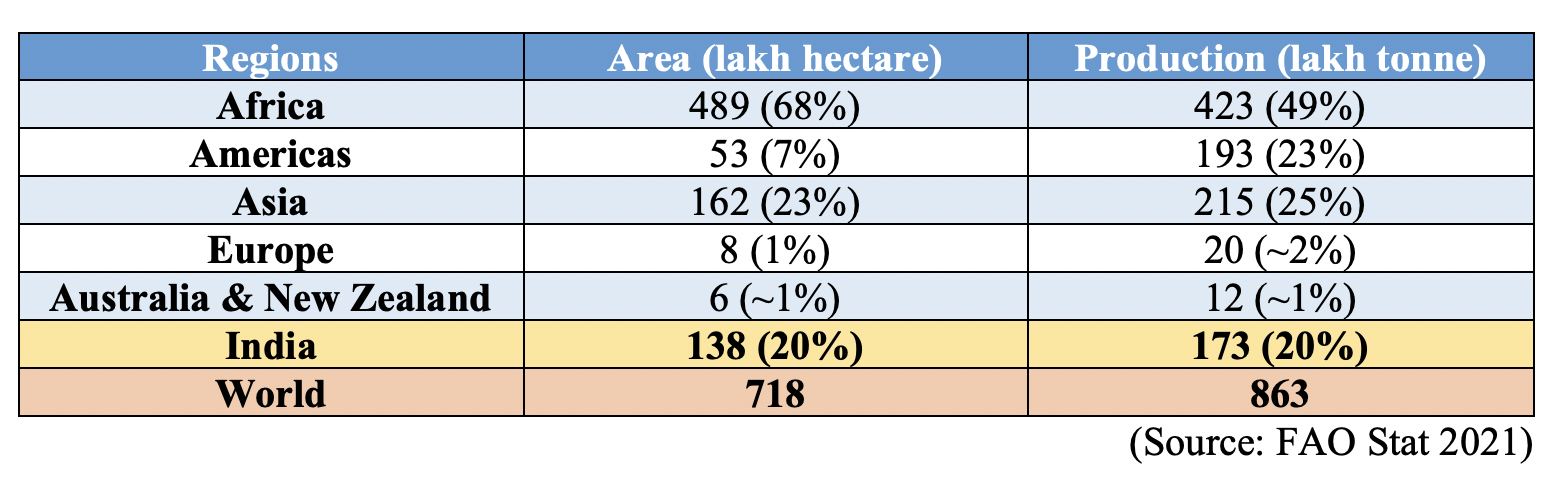
    1. India produces more than 170 lakh tonnes of millet, which is 80 per cent of Asia’s and 20 per cent of global production.
    2. India produces all the nine commonly known millets and is the largest producer and fifth-largest exporter of millets in the world.
    3. India recorded 27 per cent growth in millet production in 2021-22 as compared to millet production in the previous year was 15.92 MMT.
    4. Pearl millet (60%) followed by Sorghum (27%), and Finger millet (11%) are the major millets produced in India (as per the 4th Advance estimate 2021- 22).
    5. The major millets producing states in India are Rajasthan, Uttar Pradesh, Haryana, Gujarat, Madhya Pradesh, Maharashtra, Karnataka, Tamil Nadu, Andhra Pradesh, and Telangana.
    6. India exported millets products worth of USD 34.32 million during 2021-22. In 2020- 21, India exported millets worth USD 26.97 million against USD 28.5 million in 2019-20.

    The UN General Assembly's declaration of 2023 as 'The International Year of Millets' has paved the way for a global increase in the cultivation of millet. India, being the world's largest producer of millet, is taking comprehensive measures to capitalize on this opportunity.

    However, the success of this movement depends on striking a balance between promoting the advantages of millets, supporting the livelihoods of all farmers, and ensuring food security for all.

    ESMA to penalise but let EU banks deal with India CCPs

    European Union's financial market regulator, European Securities and Markets Authority (ESMA) has proposed derecognising 6 Indian counterparty clearing corporations (CCPs) from April 30, 2023. However, now ESMA has said that it will allow European banks to deal with Indian Central Counterparties (CCPs), even after its April 30 deadline, by imposing a penal capital charge.

    Six Central Counterparties to be Derecognised by ESMA are:

    1. Clearing Corporation of India.
    2. Indian Clearing Corporation Limited
    3. NSE Clearing Limited.
    4. India International Clearing Corporation Limited
    5. Multi-Commodity Exchange Clearing Corporation Limited
    6. NSE IFSC Clearing Corporation.

    Reasons for Derecognition

    • European Market Infrastructure Regulation (EMIR) which regulates the recognition of third country central counterparties by ESMA mandates that:
    • ESMA enter into agreement with regulators of other national jurisdictions and mandates conditions such as audits and counterparties in other countries. 
    • Regulators in India have not agreed to external audits and supervise by ESMA and want ESMA to have faith in Indian regulators.

    Impact of Derecognition

    • As per the decisions these Third Country-CCPs will not be able to provide services to the clearing members and trading venues established in European Union.
    • Some of the Major Banks dealing in the domestic forex, forward, swap and equities and commodities markets include Societe Generale, Deutsche Bank and BNP Paribas (European Banks).
    • The de-recognition will impact these lenders as they will not be able to provide clearing and settlement facilities to their clients.
    • They will also have to set aside additional capital to trade in the domestic market, reports suggest. Of the total foreign portfolio investors (FPI) registered in India, close to 20 per cent are from Europe,
    • Banks would be able to continue doing business but would face increased capital costs as they would only be able to do bilateral trades and not go through the clearing houses.
    • Well India has earlier also faced such controversies wherein Europe has tried to tighten its standards across all types of markets from carbon credit, green hydrogen , which has led to improvements in Indian standards .

    Central Counterparties (CCPs)

    • They are system providers who interpose between counterparties to contracts traded, becoming the buyer to every seller and the seller to every buyer. 
    • CCPs perform two main functions as the intermediary in a transaction - Clearing and Settlement – Guarantee the terms of trade.
    • Facilitates trading and works towards efficiency and stability in the financial markets. 
    • Reduces risk related to the counterparty and other risks like operational, settlement, market and legal risks.
    • Counterparty Clearing house or CCP is important in the trading world as it collects money from both the trading parties including the buyers and sellers which ensures that both parties will follow through the said agreement.
    • The money collected is enough to cover the potential losses in case any party fails to follow through the contract.
    • A CCP is authorised by RBI to operate in India under Payment & Settlement Act, 2007.
    • Clearing Corporation of India, Indian Clearing Corporation, NSE Clearing, Multi Commodity Exchange Clearing, India International Clearing Corporation and NSE IFSC Clearing Corporation. 

    Clearing Corporation of India

    • Clearing Corporation of India has established in 2001 to provide guaranteed clearing and settlement functions for transactions in Money, G-Secs, Foreign Exchange and Derivative Markets. 
    • Clearing Corporation of India acts as central counterparty for all trades in G-Sec markets, Forex markets, 
    • Promoters: Commercial banks (SBI, IDBI, ICICI Bank, Bank of Baroda and HDFC Bank) have 66%, Financial Institutions etc. holding others.