Current Affairs

Defence Acquisition Council approves purchase of weapons worth over Rs. 70,000 crores

The Defence Acquisition Council (DAC), chaired by Defence Minister Rajnath Singh, on Thursday accorded Acceptance of Necessity (AoN) for capital acquisition proposals estimated at ₹70,500 crore

The AoN has been accorded for capital acquisitions under ‘Buy Indian-IDDM’ (Indigenously Designed, Developed and Manufactured)

Note: An Acceptance of Necessity is accorded by the Defence Ministry for a particular weapon system or equipment at the beginning of the procurement process.  

Out of the total proposals, Indian Navy proposals constitute more than ₹56,000 crore, which largely includes indigenous BrahMos cruise missiles, Shakti Electronic Warfare (EW) systems, Utility Helicopters-Maritime among others.

 A Long Range Stand-Off Weapon (LRSOW) for the Indian Air Force (IAF) to be designed and developed indigenously and integrated on SU-30 MKI fighters

The indigenous 155mm/52-Calibre Advanced Towed Artillery Gun System (ATAGS) along with High Mobility Vehicles (HMVs) and Gun Towing Vehicles (GTVs) for the Army.

Buy Indian-IDDM’ (Indigenously Designed, Developed and Manufactured)

It has been introduced in DPP-2016 (Defence Procurement Policy) to promote indigenous design and development of defence equipment. This category has been accorded top most priority for procurement of capital equipment. Besides this, preference is being given to ‘Buy (Indian)’ and ‘Buy and Make (Indian)’ categories of capital acquisition over ‘Buy (Global)’ & ‘Buy & Make (Global)’ categories.

Buy (Indian-IDDM) 'Buy (Indian-IDDM)' category refers to the procurement of products from an Indian vendor meeting one of the two conditions:

  1. Products that have been indigenously designed, developed and manufactured with a minimum of 40% Indigenous Content (IC) on cost basis of the total contract value
  2.  Products having 60% IC on cost basis of the total contract value, which may not have been designed and developed indigenously.

ABOUT DEFENCE ACQUISITION COUNCIL

It was formed after the recommendations were made by Group of Ministers  on Reforming the national Security system in 2001, which was setup post Kargil war.

DEFENCE ACQUISITIONS COUNCIL (DAC)

A Defence Acquisitions Council has been created as an overarching structure with the following composition:-

Chairman: Defence Minister

Members: Minister of state for defence

Chief of Defence Staff (CDS)

Chief of Army Staff (COAS)

Chief of Naval Staff (CNS)

Chief of Air Staff (CAS)

Defence Secretary

Secretary of Defence Production

Secretary Defence R and D

Director of General Acquisition

FUNCTIONS The DAC will perform the following functions:

(a) Give ‘in principle’ approval to Capital acquisitions in the Long Term Perspective Plan (LTPP) covering a 15-year time span at the beginning of a Five Year Plan period.

(b) Give ‘in principle’ acceptance of necessity to each Capital acquisition project for incorporation in the forthcoming Five Year Plan

The approval will involve the identification of Either –

  • ‘Buy’ Projects (outright purchase)
  •  ‘Buy and Make’ projects (purchase followed by licensed production/ indigenous development)
  • ‘Make’ Projects (indigenous production and R&D)

(c) Monitor the progress of major projects on a feedback from the Defence Procurement Board.

The approval in principle should be seen as first step in the process of ‘acceptance of necessity’ by the concerned Administrative Wing in Ministry of Defence.

Reaper drone down in Black Sea

The Biden administration released a video  of a Russian fighter jet dumping fuel on a US Airforce surveillance drone as the US sought to hold Russia responsible for the collision that led to the drone’s crash into the Black Sea without escalating already fraught tensions with the Kremlin.

What is the MQ-9 Reaper?

The MQ-9 Reaper is a large unmanned aircraft manufactured by military contractor, General Atomics. It is remotely operated by a two-person team, consisting of a pilot and an aircrew member who operates sensors and guides weapons.

The primary use is as “an intelligence-collection asset”, while also highlighting its “unique capability to perform” precision strikes against “high-value and time-sensitive targets”

Which countries use Reaper drones?

The US is by far the largest purchaser of Reaper drones. UK has accelerated its use of Reaper drones over the last decade.

France, Italy, Spain, India, Japan and the Netherlands all also operate Reaper drones.

Elephant Whisperers & Kattunayakan Tribe

  • The Movie Elephant Whisperers tells the story of a couple (Bomman & Bellie) who adopts two orphan elephant babies and rears them. The mother of the elephant babies died after being electrocuted.
  • The couple live in the Tamil Nadu's Mudumalai Tiger Reserve and National Park.
  • Theppakadu Elephant Camp in Mudumalai Tiger Reserve is the oldest elephant camp in Asia and was established 105 years back.
  • Situated on the banks of river Moyar, it presently has 28 elephants. A dedicated bunch of Mahouts is providing training and care to these elephants.
  • Both Bomman and Bellie come from Kattunayakan tribe, the traditional forest dwellers of Mudumalai forests.

About Kattunayakan Tribe

  • Kattunayakan tribe also known as Jennu Kurumbas are scheduled tribes found in south Indian states of Tamil Nadu, Karnataka, Kerala & Andhra Pradesh.
  • Kattunayakan means king of jungles in Tamil and Malayalam.
  • They are considered to be one of the earliest inhabitants of Western Ghats and are engaged in the collection and gathering of forest produce, mainly wild honey and wax.
  • They are classified as Particularly Vulnerable Tribal Groups in Tamil Nadu & Kerala.

About Mudumalai Tiger Reserve

  • Mudumalai National Park is a national park and tiger reserve located in Nilgiri Mountains in Tamil Nadu. This national park is part of Nilgiri Biosphere Reserve.
  • Moyar river passes through this national park.
  • The Reserve has tall grasses, commonly referred to as “Elephant Grass”, Bamboo of the giant variety, valuable timber species like Teak, Rosewood, etc,.
  • There are several species of endemic flora. Such a varied habitat is inhabited by a variety of animals which include Tiger, Elephant, Indian Gaur, Panther, Sambar, Spotted Deer, Barking Deer, Mouse Deer, Common Langur, Malabar Giant Squirrel, Wild Dog, Mangoose, Jungle Cat, Hyena, among others.

Productivity of Parliament

Why is productivity of the parliament important?

The Parliament of India is the supreme legislative body in the country and is responsible for enacting laws and overseeing the functioning of the government. The roles of Parliament in India include:

  • Law making: The primary function of Parliament is to make laws. Bills are introduced in either house of Parliament, debated and discussed, and finally passed as Acts of Parliament.
  • Scrutiny of Government: Parliament has the power to hold the government accountable by asking questions, seeking clarifications, and conducting debates on government policies and actions.
  • Budgetary Control: Parliament has the power to approve or reject the government's budget proposals and to scrutinize government spending.
  • Oversight of Executive: Parliament has the power to investigate and examine the functioning of the executive branch of the government and its various agencies.
  • Electoral Functions: Parliament has the power to decide on the qualifications and disqualifications of members, conduct elections to fill vacancies, and determine the electoral boundaries.
  • Constitutional Functions: Parliament has the power to amend the Constitution, approve the proclamation of emergency, and to impeach the President, Vice-President, and other high officials.

Overall, the roles of Parliament in India are essential for maintaining the democratic system of the country and ensuring that the government is accountable to the people.

How do we know that the productivity is declining?

There are a few possible indicators that have been used to suggest that parliamentary productivity is declining in India. Here are a few examples:

  • Number of bills passed: According to data from the PRS Legislative Research, the number of bills passed by the Lok Sabha (the lower house of India's parliament) has declined in recent years. In the 16th Lok Sabha (2014-2019), a total of 205 bills were passed, compared to 248 bills in the previous Lok Sabha (2009-2014). In the current 17th Lok Sabha (2019-present), only 17 bills have been passed so far.
  • Question Hour: One important aspect of parliamentary productivity is the ability of MPs to ask questions of the government during Question Hour. However, Question Hour has been disrupted in recent years, with MPs often protesting and preventing the House from functioning. According to an analysis by IndiaSpend, the 16th Lok Sabha lost 29% of its scheduled time due to disruptions, while the current 17th Lok Sabha has lost 48% of its scheduled time so far.
  • Private Members' Bills: Private Members' Bills are bills introduced by MPs who are not part of the government. They are often seen as a way for backbenchers to contribute to the legislative process. However, the number of Private Members' Bills being introduced and passed in parliament has declined in recent years. According to data from PRS Legislative Research, only two Private Members' Bills were passed in the 16th Lok Sabha, compared to 14 in the previous Lok Sabha.

It should be noted that these statistics are just a few possible indicators of parliamentary productivity, and there may be other factors at play as well. Additionally, it is important to consider the context in which these numbers are being presented, as well as any potential biases in the data sources used.

image 46
image 47
Parliament has been sitting for lesser number of day and passing lesser bills

What is causing such a decline?

There are several reasons behind the declining parliamentary productivity in India.

  • One of the primary factors is the increasing polarization and confrontational politics, leading to frequent disruptions in the House. MPs often engage in protests, sloganeering, and walkouts, which prevent the smooth functioning of parliament. This has resulted in the loss of valuable time and resources, hindering the legislative process.
  • Another reason is the lack of adequate preparation and deliberation before introducing bills in parliament. The government often rushes to pass bills without thorough discussions, leading to inadequate scrutiny and oversight. This has resulted in poorly drafted legislation, causing delays, and controversies, ultimately reducing the productivity of parliament.
  • Moreover, the absence of a robust committee system has also contributed to the declining productivity of parliament. Committees play a crucial role in scrutinizing bills, conducting in-depth research, and engaging in consultations with stakeholders, which help in drafting effective legislation. However, the committee system in India is weak, resulting in the bypassing of committees and inadequate scrutiny of bills.
  • Furthermore, the Indian parliament lacks diversity, with a significant underrepresentation of marginalized groups, including women and religious minorities. This has resulted in the exclusion of diverse voices and perspectives, leading to the passing of legislation that does not reflect the needs and aspirations of all sections of society.

In conclusion, several factors contribute to the declining parliamentary productivity in India, including political polarization, lack of adequate preparation, weak committee system, and lack of diversity. Addressing these issues is crucial to ensure effective governance and strengthen the democratic process in India.

Way forward:

  • There are several ways to increase parliamentary productivity in India. Firstly, there needs to be a greater focus on constructive and consensus-based politics, where members from different parties work together towards common goals. This would reduce disruptions in the House and allow parliament to function more efficiently.
  • Secondly, there needs to be better preparation and scrutiny of bills before they are introduced in parliament. This can be achieved by establishing a robust committee system that engages in in-depth research and consultations with stakeholders. Such a system would ensure that bills are well-drafted, scrutinized thoroughly, and adequately debated in parliament, leading to more effective legislation.
  • Thirdly, the Indian parliament needs to focus on increasing diversity and representation, particularly of marginalized groups such as women, Dalits, and religious minorities. This would ensure that the voices of all sections of society are heard, and legislation reflects their needs and aspirations.
  • Moreover, parliament should leverage technology to improve productivity, such as using electronic voting systems, enabling remote attendance for members, and enhancing digital communication channels. This would enable parliament to function more efficiently, reduce disruptions, and save valuable time and resources.
  • Finally, there should be a focus on capacity-building and training for parliamentarians, particularly in areas such as legislative drafting, public speaking, and committee work. This would enable MPs to be more effective in their roles, contributing to better legislative outcomes and increased productivity.

In conclusion, increasing parliamentary productivity in India requires a multi-faceted approach, including constructive and consensus-based politics, better preparation and scrutiny of bills, greater diversity and representation, leveraging technology, and capacity-building for parliamentarians. By adopting these measures, India can strengthen its democratic institutions and ensure effective governance for all its citizens.

Electronic-Negotiable Warehouse Receipts

About Warehousing Development & Regulatory Authority (WDRA)

  • WDRA is a statutory body created under the Warehousing (Development & Regulation) Act, 2007 and shall have the duty to regulate and ensure implementation of WDRA, 2007 and promote orderly growth of warehousing business.
  • It is headed by a Chairman and two full-time members.
  • WDRA aims to ensure that interests of farmers are protected through
    • Growth and development in warehousing sector.
    • Improve fiduciary trust of depositors and banks.
    • Increase in liquidity in rural areas.
    • Encourage scientific warehousing of goods.
    • Lower cost of financing.
    • Promote shorter and efficient supply chains.
    • Enhance reward for grading and quality.
    • Ensure better price risk management.
  • Only Warehouses registered with the WDRA can issue negotiable warehouse receipts.
  • Requirements for warehouses for registration with WDRA:
    • Warehouse should be constructed as per BIS/CWC/FCI standards and is storage worthy.
    • Has all safety and security arrangements for stock and premises.
    • Has got requisite manpower with adequate experience in warehousing.
    • Availability of requisite infrastructure in weighing, grading and preservation.
    • Warehouse should have its own Standard Operating Procedures (SOPs) or adopts model SOP of WDRA.
    • Adequate insurance is taken for stock against fire, theft, burglary, misappropriation, riots, strikes or terrorism.
    • Financial network and security deposit for securing negotiable warehouse receipts issued.
  • Commodities covered against which NWRs can be issued by WDRA: Currently, 136 agricultural commodities including cereals, pulses, oilseeds, spices, rubber, tobacco, coffee etc. are notified under the WDRA Act for issuing negotiable warehouse receipts. Also, 24 horticultural commodities for cold storage and 9 non-agricultural commodities have been notified. 

About Negotiable Warehouse Receipts (NWRs):

  • NWRs issued by WDRA will help farmers to seek loans from banks against the NWRs to avoid distress sales of agricultural produce during the peak marketing season and to avoid the post-harvest storage loss. WDRA Act allows issue of NWRs in writing form or electronic form.
  • Benefits of NWRs
    • Increased liquidity in rural areas.
    • Encouragement of scientific storage of goods and thereby reducing post-harvest losses.
    • Lower cost of financing
    • Shorter and more efficient supply chains
    • Enhanced rewards for standard section, grading and quality.
    • Better price risk management
    • Better returns to farmers and better services (Quality of Goods) to consumers.

About Electronic Negotiable Warehouse Receipt (e-NWRs):

  • According to Amendment to Warehousing (Development & Regulation) Registration of Warehouses Rules, 2017, no registered warehouses under the WDRA act will issue NWRs in physical form and shall register with one or more repositories registered with WDRA for issuing negotiable warehouse receipts has migrated to system of launching electronic Negotiable Warehouse Receipt in 2018 which is a IT based eNWR ecosystem.
  • Repositories for eNWRs: Two repositories have been notified for issuing eNWRs: National E-Repository and CDSL Commodity Repository.
  • Benefits of eNWR
    • Avoidance of forgery/loss/tamper/mutilation of a physical NWR.
    • Avoidance of multiple financing against the same NWR.
    • Reduction of monitoring costs and building credibility amongst market participants.
    • Market participants to have secured accessible to view and manage their warehouse receipts via online portal.
    • Easy access to finance by enabling multiple transfers without physical movement of goods.
    • Splitting of NWRs for partial sale/pledge/withdrawal.

Steps for Mainstreaming of eNWRs

  • RBI’s Priority Sector Lending Guidelines prescribes for loan against pledge/hypothecation of agricultural produce. Thus, loans up to Rs 75 lakhs can be given against eNWRs.
  • Integration of e-NWRs with e-NAM Platforms: farmers/holders of an e-NWR issued by a registered warehouse can sell their underlying stocks on e-NAM platform and have better price discovery. The registered warehouse is required to be declared as a market sub-yard by the state authority for trade on e-NAM APMC market.

Challenges restricting expansion of NWR ecosystem:

  • Warehousing sector has been mostly un-organised and highly fragmented.
  • Registration of warehouses is voluntary and hence scope for increase in the number of registered warehouses is limited.
  • There is inadequate regulatory framework under the Act.
  • Registration system and issuance of NWRs had been paper based.
  • Monitoring & surveillance system of registered warehouses had been inadequate.

Way Forward

  • Easier registration of warehouses with WDRA.
  • Making it mandatory for newer warehouses getting assistance under government schemes to register with WDRA.
  • Training and capacity building of warehousemen.
  • Awareness among farmers about benefits and access of Negotiable Warehouse Receipts.

Mission Sahbhagita

  • The Ministry of Environment, Forest and Climate Change (MoEFCC) launched Mission Sahbhagita in 2022 with a mission of ‘a healthy and effectively managed network of 75 wetlands of national and international significance.
  • Mission Sahbhagita aims to enable a society ownership approach for participatory conservation and wise use of Wetlands.

SC on designation of lawyers as senior advocates

The Supreme Court has reserved its judgment on petitions to "fine-tune" a 2017 verdict which laid down guidelines for designation of lawyers as senior advocates.

Constitutional courts bestow 'senior advocate' status to lawyers as a recognition of their distinct ability in or specialised knowledge of law. This designation is however is not constitutional.  It has been provided in Senior Advocates Act, 1961

Senior Advocates Act, 1961

  • The Act provides that there shall be two classes of advocates, namely, senior advocates and other advocates. An advocate may, with his consent, be designated as senior advocate if the Supreme Court or a High Court is of opinion that by virtue of his ability, standing at the Bar or special knowledge or experience in law, he is deserving of such distinction.
  • Senior advocates shall, in the matter of their practice, be subject to such restrictions as the Bar Council of India may, in the interest of legal profession, prescribe. An advocate of the Supreme Court Who was a senior advocate of that Court immediately before the appointed day shall, for this purpose be deemed to be a senior advocate.

Later on in an important judgement of High Court of Delhi Designation of Senior Advocate Rules, 2018, Supreme court laid down detailed guidelines for the selection  of lawyers for such designations.

ChatGPT and Open AI

In the artificial intelligence (AI) field, there has been a lot of talk about a significant statement made by OpenAI. The company recently released GPT-4, a sizable multimodal model that can handle both text and visual inputs. This new language model is an improvement on its predecessor, GPT-3, which was already revolutionary in and of itself.

GPT-4 and its features

  • Large-scale multimodal model GPT-4 was developed by OpenAI.
  • Text is just one component of multimodal models; GPT-4 also takes picture input. GPT-3 and GPT-3.5, on the other hand, only supported text as a mode of operation, which limited users to typing out queries.
  • Moreover, GPT-4 "displays human-level performance on numerous academic and professional criteria."
  • The language model's stronger general knowledge and problem-solving skills enable it to pass a mock bar exam with a score in the top 10% of test takers and to solve challenging questions more accurately.
  • It may, for instance, "address tax-related queries, arrange a meeting for three busy individuals, or determine a user's creative writing style."
  • A more comprehensive range of use cases, including lengthy discussions, document search and analysis, and long-form content production, is now possible because of GPT-4's ability to handle texts longer than 25,000 words.

How is GPT-4 different from GPT-3?

Here are some of the major differences:

GPT-4 can ‘see’ images now

  • The most obvious modification to GPT-4 is that it is multimodal, enabling it to comprehend input from several informational modalities.
  • GPT-3 and ChatGPT's GPT-3.5 could only read and write text, hence they were restricted to text input and output. GPT-4, however, may be instructed to produce data in response to pictures that are supplied to it.
  • It makes sense if this makes you think of Google Lens. Lens, however, only looks for data that is relevant to a picture.
  • GPT-4 is far more sophisticated in that it can comprehend and analyse images.
  • An illustration of an outrageously huge iPhone connection with the language model explaining the humour was supplied by OpenAI. The main drawback is that picture inputs are currently at the research preview stage and are not accessible to the general public.

GPT-4 is harder to trick

  • The tendency of generative models like ChatGPT and Bing to periodically go off course and provide suggestions that raise questions or, worse, outright scare users is one of their major shortcomings.
  • They may also mess up the facts and spread false information.
  • The company's "best-ever results on factuality, steerability, and refusing to stray outside of guardrails" were achieved, according to OpenAI, after 6 months of training GPT-4 using lessons from its "adversarial testing programme" and ChatGPT.

GPT-4 can process a lot more information at a time

  • Despite having been trained on trillions of parameters and infinite quantities of data, there are limitations to how much information Large Language Models (LLMs) can handle during a conversation.
  • The GPT-3.5 model of ChatGPT was capable of handling 4,096 tokens, or around 8,000 words, while GPT-4 increases those capacities to 32,768 tokens or over 64,000 words.
  • This improvement implies that, unlike ChatGPT, which could only process 8,000 words at a time before losing track of things, GPT-4 can continue to function properly for far longer talks.
  • Moreover, it can handle longer documents and produce long-form material, which was much more restricted on GPT-3.5.

GPT-4 has an improved accuracy

  • OpenAI acknowledges that GPT-4 still lacks complete reliability and commits reasoning gaffes, much as earlier iterations.
  • Nonetheless, "GPT-4 dramatically lowers hallucinations compared to earlier models" and receives a factuality assessment score 40% higher than GPT-3.5.
  • It will be far more difficult to persuade GPT-4 to generate undesired outputs like hate speech and false information.

GPT-4 is better at understanding languages that are not English

  • Training LLMs in other languages might be difficult since machine learning data and most of the content on the internet nowadays are primarily in English.
  • Yet, OpenAI has shown that it beats GPT-3.5 and other LLMs by correctly answering thousands of multiple-choice questions across 26 languages, whereas GPT-4 is more multilingual.
  • With an accuracy rate of 85.5%, it clearly handles English the best, although Indian languages like Telugu aren't far behind at 71.4%.
  • This implies that consumers will be able to utilise chatbots built on GPT-4 to provide outputs in their local languages that are more accurate and clear.

Variety of risks that can arise out of GPT-4

  • GPT-4 is still susceptible to manipulation by cyber hackers who want to create harmful programmes.
  • It entails utilising the C++ programming language to create malware that can gather sensitive Portable Document Format (PDF) files and send them to distant servers through a covert file transfer mechanism.
  • Additional risks that Check Point's researchers may utilise include the "PHP Reverse Shell" technique, which hackers use to access a device and its data remotely, writing Java code to download malware remotely, and developing phishing draughts by pretending to be bank and employee emails.
  • With advancements in technologies like GPT-4, people in outlying towns and cities may now launch more complex social engineering assaults, which can produce a significant amount of cyber threats.
  • With one of the numerous generative AI tools, a significantly greater number of users who would not have been proficient at writing realistic phishing and spam letters can easily produce social engineering draughts, such as posing as an employee or a corporation, to target new customers.

Is GPT-4 available for the public right now?

  • For various reasons, GPT-4 has already been included in services like Duolingo, Stripe, and Khan Academy.
  • Even though it hasn't yet been made freely accessible to everyone, a $20 per month ChatGPT Plus membership may get you to access right now. Although this is going on, GPT-3.5 continues to form the foundation of ChatGPT's free tier.
  • There is, however, an "unofficial" option to start utilising GPT-4 right away if you don't want to pay.
  • According to Microsoft, the new Bing search interface is now powered by GPT-4, and you can use it right now at bing.com/chat.

Election Commission in Talks with MEA to Ensure voting by overseas voters

The Election Commission (EC) has proposed to change the rules pertaining to the conduct of elections to facilitate the Electronically Transmitted Postal Ballot System (ETPBS) for overseas Indian voters. For this purpose, EC is in discussion with the Ministry of External Affairs to iron out logistical challenges in implementing the same.

There are three categories of Electors in India: 1. General Electors, 2. Overseas (NRI) Electors and 3. Service Electors or Voters. Union Law Minister stated that the total number of overseas voters on January 1 stood at over 1.15 lakh.

Who can Enroll as Overseas Elector/NRI Voter? A citizen of India, absent from the country owing to employment, education etc. who has not acquired citizenship of any other country and are otherwise eligible to be registered as a voter in the address mentioned in your passport.

Manner and procedure of registration of overseas electors It has been prescribed by the Registration of Electors (Amendment) Rules, 2011, notified by the Ministry of Law and Justice, Legislative Department, Government of India. According to Rule 8A of Registration of Electors Rules, 1960 application for registration as Overseas Electors has to be made to Election Registration Officers in Form 6A.

Constitution of India

  • Article 326 declares that elections to the House of the People and to the Legislative Assemblies of States shall be on the basis of adult suffrage and every person who is a citizen of India and who is not less than 18 years of age on a prescribed date and is not otherwise disqualified under this Constitution or any law made by the appropriate Legislature on the ground of non-residence, unsoundness of mind, crime or corrupt or illegal practice, shall be entitled to be registered as a voter at any such election. 
  • Further Section 62 of Representation of People Act, 1951 provides for the process of right to vote.

Important highlights - Section 62 - Right to vote (RPA-1952)

  1. Only such persons shall be entitled to vote whose name is registered in a constituency.
  2. A person shall not vote if he/she is disqualified under Section 16, RPA-1950.
  3. If any person votes in more than one constituency, then their votes in every constituency shall be void. 
  4. Voting more than once in the same constituency will also result in making the votes void.
  5. If a person is confined in a prison, whether under a sentence of imprisonment or transportation or otherwise, or is in the lawful custody of the police – then such person cannot vote. However, a person in preventive detention can vote including voting in the Presidential elections.
  6. However, a person can vote as proxy for another candidate and such proxy vote shall not be declared as void.

Prior to 2010

  • An Indian citizen who was an eligible voter and was residing abroad for more than six months owing to employment, education or otherwise was not allowed to vote.
  • This was because the NRI’s name was deleted from electoral rolls if he or she stayed outside the country for more than six months at a stretch.  

Post 2010

  • The Representation of the People (Amendment) Act, 2010 - eligible NRIs who had stayed abroad beyond six months were allowed to vote, but only in person at the polling station where they have been enrolled as an overseas elector.  (Section 20A) 
  • Overseas Indian citizens like other Indian citizens are therefore allowed to vote but have to be physically present.    
  • In the case of overseas voters, their address mentioned in the passport is taken as the place of ordinary residence and chosen as the constituency for the overseas voter for enrollment.    

THE REPRESENTATION OF THE PEOPLE ACT, 1950

Section 20A -  Special provisions for citizens of India residing outside India –

(1) Notwithstanding anything contained in this Act, every citizen of India— 

  • whose name in not included in the electoral roll; 
  • who has not acquired the citizenship of any other country; and 
  • who is absenting from his place of ordinary residence in India owing to his employment, education or otherwise outside India (whether temporarily or not), 

shall be entitled to have his name registered in the electoral roll in the constituency in which his place of residence in India as mentioned in his passport is located. 

(2) The time within which the name of persons referred to in sub-section (1) shall be registered in the electoral roll and the manner and procedure for registering of a person in the electoral roll under sub-section (1) shall be such as may be prescribed. 

(3) Every person registered under this section shall, if otherwise eligible to exercise his franchise, be allowed to vote at an election in the constituency. 

Service Voters

Service voter is a voter having service qualification. According to Section 20 (8) of Representation of People Act, 1950, service qualification means:

  • Being a member of the armed Forces of the Union; or
  • Being a member of a force to which provisions of the Army Act, 1950 (46 of 1950), have been made applicable whether with or without modification;
  • Being a member of an Armed Police Force of a State, and serving outside that state; or
  • Being a person who is employed under the Government of India, in a post outside India.
  • Election Commission during the Lok Sabha Elections of 2019 allowed voting through Electronically Transmitted Postal Ballot System (ETPBS).
  • The service voters were sent postal ballots electronically one way to save processing time, resources and avoid human errors.

Electronically transmitted postal ballot system (ETPBS)

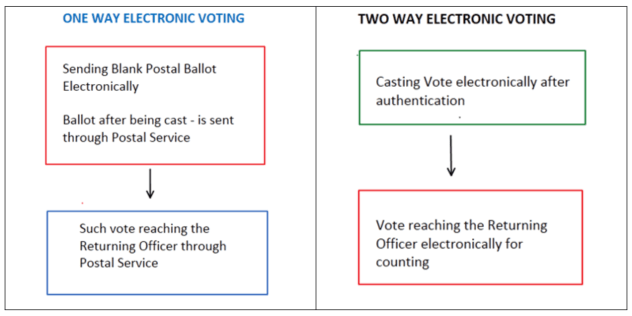
  • Electronically Transmitted Postal Ballot System (ETPBS) is the one-way electronic transmission of the Postal ballots to the Service Voters.
  • The Service Voter then cast their vote and send it to the respective returning officer via Post. The complete process is secured by way of multiple checks and transmission protocol to ensure safe transmission.
  • Upon receipt of the postal ballot at the counting centres, the returning officer validates the receipt by a series of QR codes with that of the transmitted system.

Functionality of ETPBS

  • Returning Officer generates ballot paper electronically by a specific desktop application. This ballot then gets encrypted in the system is ready to be sent.
  • The first functionality is the ability to generate the postal ballot online for transmitting through ETPBS.
  • Through ETPBS system, the ballots are automatically assigned to Service Voters based upon their constituency and get then gets transmitted.
  • The unit officer downloads the Postal ballots on behalf of the service voter. These downloaded ballots will be password protected.
  • The downloaded Postal Ballot can now be e-transmitted / hand-delivered using their secured network/infrastructure to the individual service voters.
  • The PIN will be transmitted/ dispatched to the individual service voters by the Record Officer to ensure that the downloaded Postal Ballot is opened by the concerned service voter only.
  • Thus ETPBS transmits the Postal ballot from the returning officer to the service voters electronically by a series of security protocol.       

Two way electronic voting

  • Two-way electronic transmission of vote envisages that - a registered voter from any location in India, once his identity is proved, will be able to cast his vote electronically through a secure encrypted system and the same will reach the designated returning officer for counting.  
  • EC is currently experimenting by using blockchain technology to facilitate two way electronic voting. 
Two way electronic voting
Providing Overseas Voters the Right to Vote
BENEFITS
CONCERNS
It will increase voter participation.Logistical Challenge to conduct voting either at Indian Embassies abroad or some other place which needs to be sanitized for voting.
It will cater to the vast Indian diaspora living abroad.It may impact several rights (employment, residence etc.) of such NRIs who intend to settle permanently in foreign countries.
Remove compulsions on part of Indians to travel to India especially for voting purpose.
It will fulfill the mandate of Article 326 and Section 62 of RPA, 1951 – which provides for right to vote for every citizen registered in the electoral roll.

Key Concerns on Online Voting using Blockchain Technology

Despite the benefits, security concerns have been raised by experts on the following grounds: 

  • Hacking of Blockchain Technology may result in:
  • Impersonation of voters
  • Transfer of votes for rival candidates
  • Cloning of biometric authentication
  • Denial-of-service attack might disallow citizens to register and vote
  • Disenfranchise a group or community of citizens
  • Decrypting votes casted 
  • Open to misuse by foreign intelligence & corporates     
  • Voting Preference and Pattern may become Public which is opposed to secret ballot   

What Needs to be Done to Allow Online Voting for  NRIS – Way Forward

  • If online voting is to be allowed by the government, then Section 20A of Representation of People Act, 1950 along with the Registration of Electors Rules, 1960 needs to be amended to allow online voting by NRIs even from outside India. 
  • Aspects related to logistics must be sorted out with the help of Ministry of External Affairs to allow smooth voting process for the overseas voters.
  • Two Way Electronic Voting can also be considered by the Election Commission by plugging the loopholes of online voting for the overseas voters.    

Are educated women likely to marry later?

National Family Health Survey (NFHS) data show that higher education levels could play a greater role than wealth in delaying a woman’s marriage.

Laws that prescribe minimum age for marriage in India:

  1. The Hindu marriage act (1955), Indian Christian marriages act (1872) and special marriages act (1954) prescribed the minimum age of marriage as 18 years for the bride and 21 years for the groom.
  2.  Prohibition of Child Marriage Act, 2006 prohibits marriage below 18 years for women and 21 years for men.

Child Marriages

Child marriage refers to a marriage to which either of the contracting parties is a child (if a male, has not completed 21 years of age, and if a female, has not completed 18 years of age). In India, it is estimated that there are over 24 million child brides. According to the National Family Health Survey, 40% of the World’s 60 million child marriages take place in India. According to NFHS-5 data, the share of women aged 20-24 who married before turning 18 is around 23%. Child marriage is far more prevalent amongst girls and this highlighted the gender dimension of the problem.

Causes

  1. Poverty: Poor families resort to child marriages to avoid all sorts of burden of a female child, like expenditure on education, dowry etc.
  2. Patriarchy: Girl in our patriarchal(patrilocal) set up is believed to be somebody’s property and are considered to be a liability as they are not seen as individuals who can contribute productively to the family. These beliefs lead parents to marry the girl child.
  3. Social mobility: The institution of marriage is often used to strengthen economic and social ties between different families and a young girl may be offered to a family in order to improve the financial and social standing of the girl’s family.
  4. Insecurity: To secure from offences like assaults, eve teasing against unmarried girls, their parents are in a hurry to marry their daughters soon after she attains puberty or even before that.
  5. Avoiding share in Ancestral Property: Early marriage is a way of denying share of ancestral property to females.
  6. Dropout of school: Dropout of teenage girls from school due to lack of basic amenities like toilets or for helping in the household work when both the parents go out for work, is one of the reasons for early marriage of girls. 
  7. Legal conundrum: Prohibition of child marriage act prohibits marriage of any women before the age of 18 but Muslim personal law mentions puberty or age of 15 years as minimum age of marriage for women.

Age of Marriage

Rationale behind raising the minimum age of Marriage for women:

  1. The Constitution guarantees gender equality as part of the fundamental rights and also guarantees prohibition of discrimination on the grounds of sex. The existing law do not adequately secure the Constitutional mandate of gender equality in marriageable age among men and women.
  2. Incidence of early marriage and childbearing are amongst the important causes of undernutrition in India. Children born to teenage mothers are more likely to be undernourished than children of adult mothers. India is home to more stunted children than any other country and is one of the ten countries with the largest burden of teenage pregnancy.
  3. It is important to bring down the incidence of teenage pregnancies, which are not only harmful for women's overall health but also result in more miscarriages and stillbirths.
  4. Early marriage often reduces the women labour force participation and increasing the legal limit of minimum age will give more chance for women to work.
  5. Early marriages reduces the educational and employment opportunities for women and make them financially dependent on men, which eventually results in skewed division of labour in domestic sphere.
  6. Age of marriage of females is a key factor that influences fertility. Demographic studies have revealed the apparent link between early marriage and increasing fertility rates.

Arguments against

  1. Restriction on choice of marriage: It can be used by parents to punish their daughters who marry against their wishes or elope to evade forced marriages, domestic abuse and housework.
  2. Legal limits are not successful: According to NFHS-5 (2019-2021), 23.3% of women aged 20-24 years married before the age of 18, which shows that the Prohibition of Child Marriage Act (PCMA), 2006, has not been successful in preventing child marriages.
  3. Depriving legal protection: Increasing the legal age at marriage for girls will expand the number of persons deemed underage and render them without legal protection.
  4. Declining fertility rates: India’s fertility rates have already been declining to well below replacement levels in many States, including those with higher levels of child marriage.
  5. Poverty is the underlying reason: Poverty and lack of higher education are major underlying reasons for early marriages. According to an analysis of NFHS-4 (2015-2016) data, 56% girls were married below the age of 21 and this figure was as high as 75% among the poorest category of population.

Way forward

Instead of focusing on age of marriage, following steps may eventually reduce the age of marriage

  1. Conditional cash transfer schemes to improve the attendance of girls in schools and skill training.
  2. Providing Increased access to contraceptives.
  3. Ensuring a safe environment to women free from the constant threat of rape and sexual assault which is why girls are married off early.

National Institute of Ocean Technology (NIOT) - Desalination Plant In Lakshadweep

Stepping up from its ongoing initiative of providing potable water in six islands of Lakshadweep using Low Temperature Thermal Desalination (LTTD) technology, the Chennai-based National Institute of Ocean Technology (NIOT) is working at making this process free of emissions.

What is Low Temperature Thermal Desalination (LTTD) technology?

  • It is based on Ocean Thermal Energy Conversion (OTEC) principle.
  • It is one process that uses the availability of a temperature gradient between two water bodies or flows to evaporate the warmer water at low pressure and condense the resultant vapour with the colder water to obtain freshwater.
  • While ocean, with its temperature variation across its depth, presents one such scenario of two water bodies, a coast based thermal power plant discharging huge amounts of condenser reject water into the nearby ocean represents an alternate scenario.

Note: Near Lakshwadeep there is a difference of about 15 - 20 degree Celsius between sea surface water and deep sea water.

image 40
  • Warm surface sea water is flash evaporated at low pressure and the vapour is condensed with cold deep sea water.
  • LTTD exploits the difference in temperature (nearly 15°C) in ocean water at the surface and at depths of about 600 feet.
  • This cold water condenses water at the surface, that is warmer but whose pressure has been lowered using vacuum pumps.
  • Such de-pressurised water can evaporate even at ambient temperatures and this resulting vapour when condensed is free of salts and contaminants and fit to consume.

Note: Sea water is salty. When water evaporates, it leaves the salts behind. Those vapours when get condensed, are transformed into pure fresh water.

image 41
  • The LTTD technology does not require any chemical pre and post-treatment of seawater and thus the pollution problems are minimal and suitable for island territories.
  • Since no effluent treatment is required, it gives less operational maintenance problems compared to other desalination processes.
  • The LTTD technology is completely indigenous, robust and environment friendly.
  • The cost per liter of desalination would depend on the technology used and cost of electricity which varies from place to place.

Existing issue: Currently the desalination plants, each of which provides at least 100,000 litres of potable water everyday, are powered by diesel generator sets — there being no other source of power in the islands. However, the need for diesel power to reduce the water pressure means that the process is not fossil-fuel free and also consumes diesel, a precious commodity in the islands that has to be shipped from the mainland critical for powering the electric grid.  

International Grains Council

About International Grains Council

  • International Wheat Council as established by the International Wheat Agreement, 1949 was renamed as International Grains Council by the Grains Trade Convention, in 1995. It is located in London.
  • International Grains Council is an inter-governmental organisation that administers the Grains Trade Convention.
  • Scope: Food Items Covered under the definition of Grains are Rice (added later), Pulses (added later), barley, maize, oats, rye, sorghum,  triticale and wheat and their products.
  • Functions of International Grains Council:
    • Further international cooperation in grain trade.
    • Promote expansion, openness and fairness in grains sector.
    • Contribute to grain market stability and enhance world food security.
    • Forum for exchange of information and discussion of members regarding trade in grains
  • International Grains Council has been formed under the Grains Trade Convention, 1995 and also administers the GTC.
  • Membership: Membership of IGC consists of all parties to the Grain Trade Convention, 1995 with 30 countries as members. Each member is designated as an importer or exporter based on its average trade in grains, rice and oilseeds. India is a member of this organisation. Department of Food & Public Distribution under Ministry of Consumer Affairs, Food & Public Distribution Acts as the nodal agency on behalf of government of India in International Grains Council. 
  • Chairperson and Vice-Chairperson of this council are elected annually by the council.
  • IGC holds two regular Council Sessions each year, either in London or by invitation in member countries.
  • IGC also acts as the secretariat of Food Assistance Convention, 2013. (Food Assistance Convention aims to reduce hunger, improve food security and improve nutritional status of the most vulnerable populations. India is not a party to this convention).

Initiatives of the International Grains Council

  • Grains & Oilseeds Index: An index developed by International Grains Council which provides daily updates on variation of prices of commodities covered by International Grains Council.
  • Grain Market Report: It is a monthly publication that reviews the situation and outlook for wheat (including durum), maize (corn), barley, sorghum, oats, rye, rice, soybeans, soy meal and rapeseed/canola markets.
  • Agricultural Market Information System (AMIS): International Grains Council joined the Secretariat of Agricultural Market Information System (AMIS) in 2012. AMIS was established at the request of Agriculture Ministers of G20. It covers four crops (Wheat, Maize, Rice and Soyabeans). AMIS aims to promote food market transparency and coordination of policy action in response to market uncertainty.

Grains Trade Convention, 1995 (GTC)

  • GTC is the only international treaty covering trade in grains, rice and oilseeds trade.
  • Scope: Food Items Covered under the definition of Grains are Rice (added later), Pulses (added later), barley, maize, oats, rye, sorghum,  triticale and wheat and their products.
  • Recently, Egypt which is one of the largest importers of Wheat in the world, withdrew from the Grains Trade Convention, 1995.