Current Affairs

Government will attempt to open corridor to Sharda Peeth in PoK for devotees: Shah

Context: In line with the Kartarpur Corridor, the government intends to establish a corridor to Sharda Peeth in Pakistan-occupied Kashmir (POK).

About Sharda Peeth

  • Location: Mount Harmukh, Neelum Valley in Jammu and Kashmir's Kupwara District.
  • As a centre of education
    • It was one of the most prestigious temple-educational institutions on the India-n subcontinent between the sixth and the twelfth century CE.  
    • Scholars travelled great distances for the texts since it was well renowned for its library.
    • It was crucial to the growth of the Sharada script in North India.
  • As a pilgrimage site
    • It is one of the Maha Shakti Peethas. 
    • Together with the Martand Sun Temple and the Amarnath Temple, it is one of the three holiest locations for Hindu pilgrims. 
    • It is also known for rise of Shaktism. 
  • Lalitaditya Muktapida (724 CE–760 CE) of the Karkota dynasty most likely commissioned it.
  • Historical traces of the temple
    • Al-Biruni first described the location as a venerated shrine with a wooden picture of Sharda, but this description is based only on hearsay as he had never visited Kashmir. 
    • Both the intellectual and spiritual components of Sharada Peeth are described by the Kashmiri poet Bilhana, who lived in the 11th century. He says that Sharada Peeth is the place that gave Kashmir its status as a centre of education.
    • Sharada Peeth is also mentioned in Kalhana's epic Rajatarangini (12th century).
    • Abu'l-Fazl has also described Sharada Peeth as a stone temple in the 16th century.
  • Architecture
    • The red sandstone temple was constructed in the Kashmiri architectural style. The compound is perched on a hill and is accessed from the west by a grand stone stairway. The temple is erected upon a plinth.
    • The temple is covered with a low single roof, even though Kashmiri architecture is most often characterised by a pyramidal stone roof.
    • Two Ancient Linga could be observed in a tiny opening on the north side of the wall.

Sharda Script

  • Almost 1200 years ago, it developed from the Western branch of Brahmi.
  • Between the 8th and 12th centuries, the script was widely used to write Kashmiri and Sanskrit in Kashmir and the surrounding territories of the Indian Subcontinent.
  • Its name comes from the goddess Sarada or Saraswati, the patron goddess of learning. It is a native script of Kashmir.
  • An early version of the Sharada script is used in the Bakhshali manuscript.
  • Regional variations in the Sharada script emerged in 10th century in Kashmir, the Hill States (which included parts of Himachal Pradesh), and Punjab.

No slander please, they are our freedom fighters first

Context: Writer has called for the due respect that should be given to all the unsung freedom fighters of modern Indian History.

Here is the list of four important freedom fighters that were mentioned in the editorial. 

1. V D SAVARKAR

x80NBdbbAqqZobIYfMBfBhYB1RSoffrSSupFNsxATcKvtxtoj1VUTgQOrTIZdGgVg9o DPWaDWarKp61zOvYHisrsGQhtZybhyXrRIT6 6F9UGE2Mui 9CZf7ORISQHiZVJLEFPacAi34M0o6RpDBw
  • Born in 1883 at Nashik in Maharashtra.
  • Founded Abhinav Bharat Society (initially as Mitra Mela, 1899) along with brother G D Damodar in 1904. It was a secret society which also had connections with London.  
  • He was involved with India House (founded by Shyamji Krishna Varma in London to promote nationalist ideas among youth).
  • Savarkar went to London in 1906. He soon founded the Free India Society, along with Madam Bhikaji Cama based on the thoughts of the Italian nationalist Giuseppe Mazzini 
  • Functioned as president of Hindu Mahasabha from 1937 to 1943. He called against Quit India Movement.
  • Savarkar was convicted and sentenced to 50-years imprisonment also known as Kala Pani and transported in 1911 to the Cellular Jail in the Andaman and Nicobar Islands. Released in 1924.
  • He later joined Tilak’s Swaraj Party.
  • He advocated for the use of Hindi as a national language. He also fought against untouchability and caste-based discrimination.

Literary works of Savarkar

  • The History of the War of Indian Independence (on revolt of 1857)
  • ‘Hindutva: who is Hindu?’

2. Dr. Chembakaraman Pillai

q0sFakTvJRFZJp6iaqEgnJQiPE vM7gEAiZX7n4
  • Born in Thiruvananthapuram in 15 September 1891. 
  • He started his struggle for freedom by protesting the Partition of Bengal in 1905. 
  • He joined with Bala Gangadhara Tilak in his resistance against the Partition of Bengal. When the British police tried to arrest him because of his revolutionary speeches against the Travancore State government, he escaped to Germany in 1908 with the help of his friend Sir Walter Williams Strickland.
  • At Berlin University, he formed International Pro-Indian Committee to gather the support of the German people for India’s freedom struggle.
  • He came in touch with many revolutionary Indian leaders in Germany like Hardayal, Raja Mahendra Pratap, Dr. Prabhakar, and A. C. Nambiar. 
  • He started a newspaper called Pro-India to spread the message of the Indian freedom movement. 
  • He participated in the First World War on the German side to defeat the British.
  • Armed with an engineering degree he joined the German navy as an officer in the cruiser Emden which attacked British ships and shelled several places in India.
  • Madras was shelled on 22 September 1914 after a fierce sea battle with British ships.
  • He met Mahatma Gandhi in South Africa. He was the Foreign Minister when a temporary Free Government of India was established in Afghanistan on 1 December 1915.
  • He met Subhash Chandra Bose in Vienna in 1919. Though he joined in the German army, he criticized even Adolf Hitler, when he humiliated India in his speech. 
  • Dr. Chidambaram Pillai died on 26 May 1934 in Germany under mysterious circumstances.

3. Vanchinathan Iyer

  • Vanchinatha Iyer or Vanchinathan was born in Shenkottai. Vanchinathan alias Sankara Iyer was the son of Shri Raghupathy Iyer. 
  • He had studied upto primary standard and joined the Forest Department thereafter. 
  • He participated in revolutionary activities against the Britsh.
  • On 17 June 1911, Vanchi who was 25, assassinated Robert Ashe, the district collector of Tirunelveli, who was also known as Collector Dorai.
  • He shot Ashe at point-blank range when Ashe's train had stopped at the Maniyachi Station, enroute to Madras. He committed suicide thereafter. The railway station has since been renamed Vanchi Maniyachi.
  • The mastermind behind the assassination was Nilakanta Brahmachari who went around the Madras presidency in 1910 recruiting cadres and hatching plots against the British. In this venture, he was accompanied by Shankar Krishna Iyer, Vanchinathan's brother-in-law, who introduced the men to each other. 
  • Along with a few other men, Nilakanta Bramhachari, Vaanchinathan, and Shankar Krishna Aiyar found an organisation called Bharatha Matha Sangam which plots the assassination of influential British men.

4. Thillaiaadi Valliammai

akjSf6brESvjSPd Gp KDQ6Oqr1cpIF YAkS1VaBUFKJk0rw0ygTwQQrjoiCoPcTitHLfynKZN fnqhpWw bg80DN89HSyD 0qpk0b P3Q9Px74x0ougN02K
  • She was a South African Tamil girl who worked with Mahatma Gandhi in her early years when she developed her nonviolent methods in South Africa fighting its apartheid regime.
  • She joined her mother in the march by women from Transvaal to Natal – which was not legally permitted without passes.
  • They were protesting against the judgement given by Justice Searle which made all marriages invalid if not registered under the registrar office or not performed according to the Christian rituals. 
  • She was imprisoned for the protest against the South African government. She was imprisoned for three months, but due to severe illness she died at the age of 16 soon after the release. 

Semiconductors Manufacturing

Context: The Union Government has disbursed around ₹1,645 crore in performance-linked incentives (PLI) for electronics manufacturers so far, as part of its efforts to bring in more of the electronics supply chain to India. More and more nations are trying to turn away from China’s dominance in the space, following geopolitical pressures to de-leverage themselves from supply chain vulnerabilities.

What are semiconductors?

A semiconductor is a material that allows electrical conductivity between a conductor and an insulator. Semiconductors are made from pure elements like silicon or germanium, or compounds such as gallium arsenide. Sometimes their conductivity is changed through doping.

In a pure semiconductor, such as silicon or germanium, there are few free electrons or holes (missing electrons) available for conduction.

However, when impurities are intentionally introduced into the semiconductor, a process called doping, the number of free electrons or holes can be increased.

They are used to make electronic devices such as transistors, diodes, and integrated circuits (ICs). Transistors, which are used to amplify and switch electronic signals, are made by combining multiple p-n junctions.

Integrated circuits (ICs) are made by creating complex arrangements of transistors and other components on a single piece of semiconductor material. Semiconductors chips are the thumbnail-sized building blocks of almost every modern electronic device from smartphones to connected devices in the Internet of Things (IoT).

Semiconductors have revolutionized the electronics industry and are essential components in nearly all electronic devices, from smartphones to computers to automobiles. Semiconductors make the devices more compact, less expensive, and more powerful.

For instance, mobile phones weighed about 2 lbs, cost around $4,000, and held a charge for only about 30 minutes of talk time during their initial phase. However today an individual can buy a smartphone for 5000 rupees that would give a 1-day charge.

Semiconductor manufacturing in India

The semiconductor chip-making process is complex and highly exact, having multiple steps in the supply chain such as designing software for chips and patenting them through core Intellectual Property (IP) rights. They help give computational power to devices. The global semiconductor industry is currently valued at $500-$600 billion.

The chip-making industry is a highly-concentrated one, with the big players being Taiwan, South Korea and the U.S. among others. In fact, according to a New York Times estimate, 90% of 5nm (nanometre) chips are mass-produced in Taiwan, by the Taiwan Semiconductor Manufacturing Company (TSMC).

Globally, the entire value chain has seeped in the interdependence between a handful of countries like the USA, Taiwan, Japan, China, and some European nations. 

  • India has done well in design and verification for the semiconductor industry. Most of the global semiconductor companies having an R&D footprint in India.
  • However, 100% of our chips, memory, and display are imported into the country, 37% coming from China.
  • Chips import bill is estimated to touch $100 billion by 2025 from $24 billion now. 
  • Although India has two fabs — SITAR, a unit of the Defence Research and Development Organisation (DRDO) in Bengaluru, and a semiconductor laboratory in Chandigarh. These build silicon chips for strategic purposes like defense and space and not for commercial use.

Why is the government encouraging semiconductor manufacturing?

  • National Security: Semiconductors are essential components in many critical industries, including defense, telecommunications, power transmission etc that have implications for national security. Chips made locally will be designated as “trusted sources” and can be used in products ranging from CCTV cameras to 5G equipment. 
  • Strategic competition with China: Countries have spotted strategic value in cornering segments of the value chain for fabs, even as the sophistication and capital needed to run them have climbed to historic highs. China pulled ahead of Taiwan last year, in terms of share of global sales from fabs, according to a report by the Semiconductor Industry Association (SIA).
    • It’s not just India that is wary of this dominance. The U.S. passed the CHIPS Act last August, providing upwards of $280 billion in subsidies and investments to manufacturers opening fabs and making semiconductors in the U.S. This has been combined with restrictions on the Chinese semiconductor industry.
  • Geopolitical Benefits:  driven by data and the digital revolution. Further self-sufficiency will decrease reliance on Chinese chip imports especially during hard times like the recent Galwan Valley border clash.
  • Economic Growth
    • Development of the semiconductor and display ecosystem will have a multiplier effect across different sectors of the economy with deeper integration to the global value chain.
    • Indigenous manufacturing of chips will build its smartphone assembly industry and strengthen its electronics supply chain. 
    • According to the Electronics and IT Ministry, semiconductor demand in India would increase to $70-$80 billion by 2026 with the growing demand for digital devices and electronic products. 
    • This will create numerous employment opportunities for the Indian youth.
    • Indigenous capacity would attract local taxes and boost the export potential. 
    • Further, India would be required to import fewer semiconductor chips which would decrease the import bill.
  • Technological Leadership: Semiconductors are the building blocks of today’s technology. Semiconductor chips are widely used in (a) Computers and laptops; (b) Phones, mobile devices and other electronic gadgets; (c) Automobiles; (d) Aviation; (e) Medical devices especially diagnostics; (f) Military equipment among others.

These semiconductor chips are the drivers for ICT (Information and Communication Technologies). Semiconductors and displays are the foundation of modern electronics driving the next phase of digital transformation under Industry 4.0.

  • Supply Chain Resilience: The COVID-19 pandemic highlighted the vulnerabilities of global supply chains, including those in the semiconductor industry. Governments are encouraging domestic semiconductor manufacturing to increase supply chain resilience and reduce dependence on foreign suppliers. The pandemic and the subsequent lockdowns impacted the supply of chips to India. Automobile manufacturers like Mahindra & Mahindra and Tata group were compelled to reduce their production due to the shortage.
  • Environmental Concerns: The semiconductor manufacturing process can be energy-intensive and can produce hazardous waste. Governments are encouraging domestic semiconductor manufacturing to promote more sustainable and environmentally friendly practices.
  • Changing work and employment pattern 
    • Experts estimate that around 50 crore people will join the internet in the next decade thereby demanding more phones and laptops. 
    • Work from home culture warrants an enhanced demand for servers, internet connectivity, and cloud usage.

Initiatives taken to promote indigenous Semiconductor capacity

  • National Policy on Electronics 2019: It envisions positioning India as a global hub for Electronics System Design and Manufacturing (ESDM) sector. It aims to encourage the development of core components, including chipsets. 
  • Scheme for Promotion of Manufacturing of Electronic Components and Semiconductors (SPECS):
    • The government will provide a financial incentive of 25% on capital expenditure for a list of products that constitute the supply chain of electronic products. This includes products such as electronic components, semiconductors, and specialized sub-assemblies.
    • India would be offering more than $1 billion in cash to each semiconductor company that sets up manufacturing units in the country.
  • Modified Electronics Manufacturing Clusters (EMC 2.0) Scheme: Under this, the government will provide support for the setting up of Electronics Manufacturing Clusters (EMCs) and Common Facility Centres(CFCs).
  • Production Linked Incentive Scheme(PLI): Under this, the government will provide an incentive of 4% to 6% on goods manufactured in India and covered under target segments to eligible companies for a period of five years.
  • Incentive to all nodes of semiconductors: The new changes have been announced to harmonise government incentives for all technology nodes of semiconductors. In the previous version of the scheme, the Centre was offering to fund 30% of the project cost for 45nm to 65nm chip production, 40% for 28nm to 45nm, and 50% or half of the funding for chips 28nm or below. The modified scheme provides uniform 50% fiscal support for all nodes. Besides, it will provide 50% of capital expenditure for other steps of the process as well (chip design and ATMP).
  • Foreign Direct Investment: The Government of India has allowed 100 percent (FDI) under the automatic route in the Electronics Systems Design & Manufacturing sector.  

What are the challenges in front of India?

  • High Cost of establishment: Fabs are highly capital-intensive undertakings, costing billions of dollars for large facilities. As per a government estimate, it would cost roughly $5-$7 billion to set up a chip fabrication unit in India.  
  • Low Ease of doing business: The process of establishing an indigenous semiconductor facility requires clearances and approvals from multiple government departments. 
  • Technological Constraint: The indigenous manufacturing of semiconductors requires the use of high-end technologies. These technologies are licensed from patent holders at a very high price.
  • Lack of Fabrication Capacities: India has a decent chip design talent but it never built up chip fab capacity. The ISRO and the DRDO have their respective fab foundries but they are primarily for their own requirements and are also not as sophisticated as the latest in the world.
  • Structural constraint: FDI in electronics is less than 1% of the total FDI inflow because of the dearth of skilled labor, delays in land acquisition, and the uncertain tax regime.
  • Unstable power supply: The smooth production of semiconductors requires the availability of an uninterrupted 24*7 power supply. they require highly reliable and high-quality supply of water, electricity, and insulation from the elements, reflecting the high degree of precision, cost and capital needed to make the sophisticated circuits.
  • Resource Inefficient Sector: Chip fabs are also very thirsty units requiring millions of litres of clean water, an extremely stable power supply, a lot of land and a highly skilled workforce.

Suggestions

  • Augmenting Research and Development Potential: For instance, IIT Madras developed a microprocessor named ‘Moushik’ with funding support from the Ministry of Electronics and Information Technology.
  • Fiscal Support for All Elements of Chip-Making Chain: Considering India’s considerable talent and experience, it may be best if the new mission focuses fiscal support, at least for now, on other parts of the chip-making chain including design centres, testing facilities, packaging, etc.
  • Establishment of Sovereign Patent Fund (SPF): The proposed Sovereign Patent Fund under National Policy on electronics should be established expeditiously. It is a wholly or partly Government-backed entity that aims to bolster domestic businesses through the acquisition and licensing of patented technology.
  • Push for Quad Supply Chain Resilience Fund: India needs to push for a Quad Supply Chain Resilience Fund to immunise the supply chain from geopolitical and geographic risks.
  • Research ecosystem: government must focus on emerging technologies like LiDAR and Phased Array in which incumbents do not have a disproportionate advantage and the entry barrier is low.
  • Focus on Manufacturers' Assurance of Domestic Procurement – The manufacturers need to be given an assurance of minimum domestic procurement by the government and the private sector. The focus should be on manufacturing economical and technically viable options like 28nm chips.
  • Support for Acquisition of Semiconductor Manufacturing Units: The government should also support businesses in the acquisition of semiconductor manufacturing units in other countries. This is easier than setting up a domestic facility and can be done swiftly for ensuring a continuous supply of chips.
  • Free-Trade Agreement Negotiations: India and Taiwan have started negotiations for a free-trade agreement and setting up a semiconductor manufacturing hub in an Indian city, signalling their resolve to further expand the two-way economic engagement.

Lab Grown Diamonds

Context: Budget 2023-24 has introduced incentives for lab grown diamonds.

About Lab Grown Diamonds (LGDs)

  • Lab grown diamonds (also known as lab created diamonds, manmade diamonds, engineered diamonds, and cultured diamonds) are grown in highly controlled laboratory environments using advanced technological processes that duplicate the conditions under which diamonds naturally develop when they form in the mantle, beneath the Earth’s crust. 
  • These manmade diamonds consist of actual carbon atoms arranged in the characteristic diamond crystal structure. Since they are made of the same material as natural diamonds, they exhibit the same optical and chemical properties.
  • Lab Grown Diamonds is a technologically and innovation driven emerging sector with high employment potential. These environment friendly diamonds which have optically and chemically the same properties as natural diamonds. 

Reasons for interest in Lab Grown Diamonds

  • Mining Free: These diamonds are produced in laboratories. Hence, they are an environmentally responsible choice as a no mining is required.
  • Quality: Lab Grown Diamonds have same physical, chemical and optical properties as mined diamonds.
  • Value for Money & Affordable: Lab grown diamonds offer excellent value. They are more cost-effective than natural diamonds of comparable size and quality.
  • Scarcity of diamonds: As natural diamonds become scarce due to depleting reserves and escalating costs. 
  • Strengthening India’s Gems & Jewellery Industry: India is a global leader in cutting and polishing of natural diamonds, contributing about 3/4th of global turnover by value. With the depletion of natural diamonds, the industry is moving towards Lab Grown Diamonds. 

Process of making Lab-Grown Diamonds

  • Lab Grown diamonds are made in laboratories with a seed of natural diamonds, which is a slice of another diamond - on which the LGD is created. It takes less than month to make a distinctively shaped crystal of Lab Grown Diamond. 
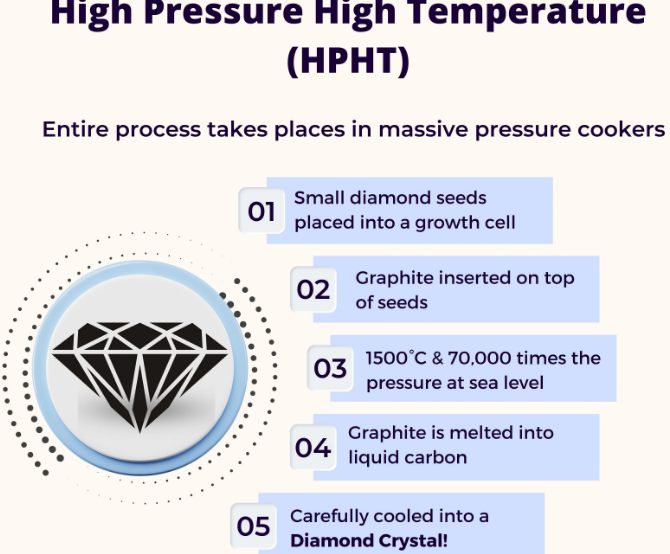
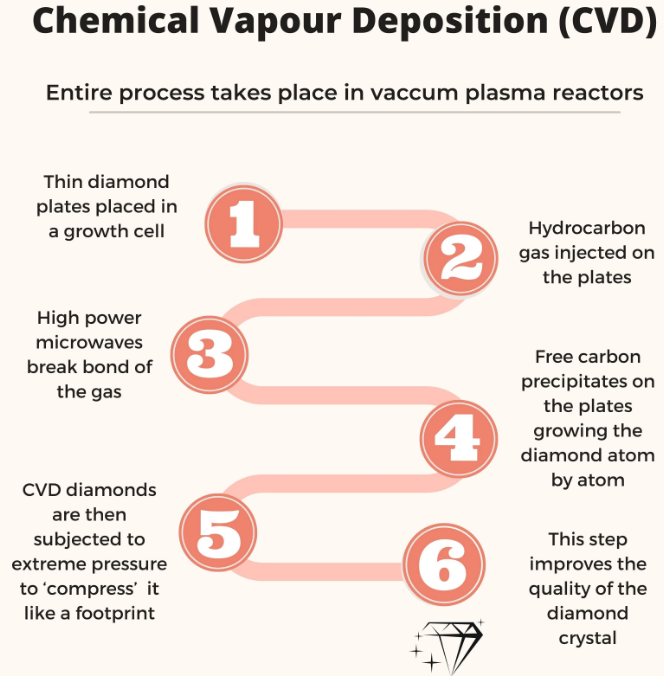
  • There are two methods by which LGDs are created: (i) Chemical Vapour Deposition (CVD) method (ii) High Pressure, High Temperature (HPHT) method.
  • High Pressure, High Temperature (HPHT) method: This process mimics the high-pressure, high-temperature conditions that occur under the Earth to form a natural diamond. The seed and graphite carbons are exposed to extreme temperatures (1,500oC) and with extremely high pressures to make LGDs. This method can also enhance the colour of diamonds making them colourless, pink, green, blue or yellow. Diamonds produced by this method may have some impurities of Boron or Nitrogen. This method is popular in China. 
high pressure high temp
  • Chemical Vapour Deposition (CVD) method: It is a chemical process in which the seed is heated up to 800oC in a sealed chamber filled with molecules of carbon-rich gas such as methane. These gas molecules are broken down into carbon and hydrogen atoms, which get deposited on the seed giving it a shape of square, tabular diamond crystal. This process also requires heat or irradiation to give the crystal a colour effect. Diamonds produced by this method most chemically pure diamonds i.e., free from impurities of nitrogen and boron. CVD method is more popular in India. 
chemical vapour deposition

Identification of Laboratory Grown Diamonds

  • Laboratory grown diamonds require advanced testing in a gemmological laboratory to be identified with certainty. 

Proposals in Union Budget 2023-24 for Lab Grown Diamonds

  • Grant for R&D: To encourage indigenous production of LGD seeds and machines and to reduce import dependency, a R&D grant will be provided to one of the IITs (IIT Madras) for five years.
  • Relief in Customs duty: Budget 2023-24 has abolished customs duty on imports of seeds used for manufacturing of rough lab-grown diamonds. This will boost domestic manufacturing of LGDs and reduce imports of LGDs. 
  • Implications of Fiscal support: Fiscal support provided for LGDs is aimed at boosting exports of LGDs from India and to reduce dependence of imports for key inputs i.e., seeds and equipments. 
  • LGDs in India: In India, share of LGDs in overall diamond business is just 2-3% with LGDs being used majorly for jewelleries and exports. About 80% of cut and polished LGDs are exported, while only 20% are consumed globally. 
  • Trends in LGD trade: India imported rough LGDs worth Rs 7,656 crore in April-December 2022 and exported 10,587 crores of LGDs in the same period. US & Europe are key markets for India’s CVD labs grown diamonds. With further government support, LGD industry will become competitive globally. 

Diamond Simulants

  • Diamond stimulants, such as cubic zirconia and moissanite, look like diamonds but are not true carbon crystals. Simulants do not have the same chemical and physical properties as natural diamonds and therefore sell at much lower prices than lab created diamonds. 
  • Moissanite is a gemstone born from stars and was first discovered in a crater created by a meteorite in Arizona, USA. They are composed of crystal of silicon carbide and not of carbon as diamonds. However, they appear like Diamonds. 
  • Natural Moissanite is incredibly rare on Earth. Hence, most moissanite available today is laboratory created. Moissanite, referred to as a diamond simulant, is engineered to give the illusion of similarity to diamonds, but is compositionally and visually quite different from a real diamond. 

Why is India’s CAMPA at odds with new IPCC report?

Context - Synthesis Report of the Intergovernmental Panel on Climate Change (IPCC), a U.N. expert body, states that not degrading existing ecosystems in the first place will do more to lower the impact of the climate crisis than restoring ecosystems that have been destroyed — a finding that speaks to an increasingly contested policy in India that has allowed forests in one part of the country to be cut down and ‘replaced’ with those elsewhere.

Background - To compensate the loss of forest area and to maintain the sustainability, the Government of India came up with a well-defined Act, known as CAMPA (Compensatory Afforestation Fund Management and Planning Authority).

Key features of the CAMPA Act

  1. To compensate the loss of forest area and to maintain the sustainability, the Government of India came up with a well-defined Act, known as CAMPA (Compensatory Afforestation Fund Management and Planning Authority).
  2. The law establishes the National Compensatory Afforestation Fund under the Public Account of India, and a State Compensatory Afforestation Fund under the Public Account of each state.
  3. These Funds will receive payments for: (i) compensatory afforestation, (ii) net present value of forest (NPV), and (iii) other project specific payments. 
  4. The National Fund will receive 10% of these funds, and the State Funds will receive the remaining 90%.
  5. According to the Act’s provision, a company diverting forest land must provide alternative land to take up compensatory afforestation.
  6. For afforestation, the company should pay to plant new trees in the alternative land provided to the state.
In 2002, the Supreme Court had observed that collected funds for afforestation were under-utilised by the states and it ordered for centrally pooling of funds under ad hoc Compensatory Afforestation Fund.
The court had set up the ad hoc National Compensatory Afforestation Fund Management and Planning Authority (CAMPA) to manage the fund. In 2009, states had also set up state CAMPAs that received 10 per cent of funds from the national CAMPA to use for afforestation and forest conservation.

NET PRESENT VALUE- ANALYSIS

Under the Forest Conservation Act, 1980 (FCA), developers who use forest land for their projects are required to pay a one-time monetary valuation, called Net Present Value (NPV), to the government in lieu of cutting down forests.

It depends on factors such as the quality and type of forests. Since 2009, the government has been charging between Rs. 438,000 and Rs. 1.04 million as the NPV for diverting every hectare of forest.According to a 2008 Supreme Court order, the NPV was supposed to be revised by the Indian government in three years.

But it failed to do so despite recommendations from several committees.In January 2021, the Union Ministry of Environment, Forest and Climate Change (MoEFCC) proposed to hike the NPV by 1.51 times which was based on the Wholesale Price Index (WPI).

However, while doing so, it set aside the recommendation of a four-time increase in the NPV by another expert group the ministry had constituted earlier in 2014.

Existing Issues

  • Against Ecological principles – The act allows afforestation activities to be taken place in some other areas. New forests cannot replace the age old natural forests. For e.g. Creating single species plantations in, say, Haryana does not really come close to a natural sal forest lost to a development project in, say, Central Indian forests in terms of biodiversity, local livelihoods, hydrological services, and sequestered carbon,
  • Methodology – Experts feel that the NPV is miscalculated and is undervalued as it does not take ecosystem services into account while calculating the value. 
  • Non revision - According to a 2008 Supreme Court order, the NPV was supposed to be revised by the Indian government in three years. But it failed to do so despite recommendations from several committees.
  • Underutilization of funds - The FSI collected data on total money allocated by the central government to the state government and forest cover in India between 2009-10 and 2016-17Its analysis showed that funding by the central government increased at a rate of 84.67 per cent in the period, but the forest cover increased by only 2.42 per cent. So, increase in CAMPA funding by the central government has clearly not resulted in significant increase in forest cover.
  • Misutilization of funds - Several state governments are not utilising it properly. An amount of Rs 86 lakh from CAMPA funds meant for afforestation was reportedly spent on litigation work in Punjab.
  • Lack of focus on species specific plantation - At several places, the loss of natural species is compensated with plantation of non-native species in the name of the artificial plantation. It serves as a threat to even the existing ecosystem.

Way ahead?

The central government should adopt the concept of outcome budgeting for allocation of funds to the state government in which funding will be done on instalment basis by checking the outcome of previous funds. Then, state governments should restore the existing forests rather than creating new ones.

The Rehabilitation Council of India

What is The Rehabilitation Council of India? 

The Rehabilitation Council of India (RCI) was set up as a registered society in 1986.

Statutory status of RCI

On September 1992 the RCI Act was enacted by Parliament and it became a Statutory Body on 22 June 1993. The Act was amended by Parliament in 2000 to make it more broad-based. 

What is the Mandate of RCI?

  • The mandate given to RCI is to regulate and monitor services given to persons with disability, 
  • to standardise syllabi and to maintain a Central Rehabilitation Register of all qualified professionals and personnel working in the field of Rehabilitation and 
  • Special Education.
  • The Act also prescribes punitive action against unqualified persons delivering services to persons with disability.

Other Policies for Rehabilitation in India?

Directive Principles of State Policy remarks that the State should deliver every possible help in case of:

  • Old age
  • Sickness
  • Disablement
  • Unemployment

Laws in India to deal with disabilities

To empower people with disabilities, the Government of India has enacted the following legislation over the years:

What are the statutory rights of the people who need medical rehabilitation?

  • Service by a qualified and trained rehab professional who has been registered by the Council.
  • Maintenance of a certain standard of professional conduct by the rehabilitation providers. If not met, then the professionals face disciplinary action and even removal from RCI.
  • Guarantee that all rehabilitation professionals are under the regulation of a statutory council, which comes under the preview of the central government.

Issues associated with rehabilitation in India

  • Non-compliance with standards. 
  • Limited access to assistive devices. For example, hearing aid distributors found that the current production level of hearing aids only meets 10% of the worldwide need. In developing countries, that number is reduced to 3%! Of all the people who require hearing aid in countries like India and Africa, only 3% get them. Limited access to assistive devices leads to:
  • Deterioration in health
  • Restricted activity
  • Constraint with Participation
  • Increased dependency
  • Reduced quality of life
  • Rehab centres are limited to urban areas like Chennai. This centralisation and concentration of medical rehabilitation have left tier 2 and 3 cities with inadequate access to services.
  • Another issue in India is the insufficient rehabilitation personnel with appropriate training and experience. The lack of proper physiatrists is a significant hurdle physical medicine and rehabilitation have to overcome.

What is the Way forward?

  • More investment and financing are required so that every person in the nation can get easy access to rehab facilities.
  • The supply and capacity of personnel need to be amplified. For this, education and training are a must; followed by recruitment and retention.
  • The delivery of rehabilitation services must be integrated with the current healthcare system. For example, by coordinating with a hospital in Chennai, we are able to deliver crucial help to dozens of patients each year. It ensures early intervention which leads to more recovered patients.
  • The last but not least step required to make the lives of those who live with disability better is assistive technology. More local manufacturing, reduction in taxes and good follow-up can make a world of difference.

NISAR Satellite

Context: National Aeronautics and Space Administration (NASA) and the Indian Space Research Organization (ISRO) have jointly manufactured an earth science satellite named, NISAR (NASA-ISRO Synthetic Aperture Radar) at a cost of about Rs 470 crore.

About NISAR

  • It is an Earth-observation satellite expected to be launched in January 2024 from Satish Dhawan Space Centre in Andhra Pradesh into a near-polar orbit.
Overview | Observatory – NASA-ISRO SAR Mission (NISAR)

Features

  • The 2,800 kilograms satellite consists of both L-band and S-band synthetic aperture radar (SAR) instruments, which makes it a dual-frequencyimaging radar satellite. SAR is capable of penetrating clouds and can collect data day and night regardless of the weather conditions.
    • L-band SAR operates at a frequency of around 1 to 2 GHz. The lower frequency (higher wavelength) of L-band SAR allows it to penetrate through vegetation and soil, making it useful for monitoring changes in forest cover, soil moisture etc.
    • S-band SAR operates at a frequency of around 2 to 4 GHz. S-band SAR has a higher resolution than L-band SAR and is typically used for applications where higher detail is required, such as monitoring changes in urban areas or coastal zones. 
  • It has a large 39-foot stationary antenna reflector made of a gold-plated wire mesh which will be used to focus the radar signals emitted and received by the upward-facing feed on the instrument structure.
  • The spacecraft will orbit the Earth in a sun-synchronous orbit of 747 Km with an inclination of 98.4 degrees for a 12-day repeat cycle.

Utility

  • Study Earth’s dynamic land and ice surfaces in greater detail and observe subtle changes in Earth’s surfaces. E.g., Track flow rates of glaciers and ice sheets, landslide-prone areas and changes in the coastline etc.
  • Spot warning signs of natural disasters, such as volcanic eruptions, earthquakes and landslides. 
  • Measure groundwater levels, agricultural mapping, natural resource mapping and monitor Earth’s forest and agricultural regions to improve understanding of carbon exchange.

Guillotine, in Parliament

Context: Lok Sabha passed the Demands for Grants for Budget 2023-24 and the Appropriation Bill by a voice vote without any discussion. Speaker applied guillotine and put demands for grants of all ministries to vote.

Guillotine in the context of Indian legislature

  • Discussion on a matter of general public importance can take place only when motion made with the consent of the presiding officer.
  • Guillotine is a type of motion which falls under the category of closure motion.

Closure Motion 

It is a motion moved by a member to cut short the debate on a matter before the House. If the motion is approved by the House, debate is stopped forthwith and the matter is put to vote. 

Types of closure motions  

(a)Simple Closure: It is one when a member moves that the ‘matter having been sufficiently discussed be now put to vote’. 

(b)Closure by Compartments: In this case, the clauses of a bill or a lengthy resolution are grouped into parts before the commencement of the debate. The debate covers the part as a whole and the entire part is put to vote. 

(c)Kangaroo Closure: Under this type, only important clauses are taken up for debate and voting and the intervening clauses are skipped over and taken as passed. 

(d)Guillotine Closure: It is one when the undiscussed clauses of a bill or a resolution are also put to vote along with the discussed ones due to want of time (as the time allotted for the discussion is over). 

In legislative parlance, to “guillotine” means to bunch together and fast-track the passage of financial business. It is a common procedural exercise in Lok Sabha during the Budget Session.

Procedure 

  • Parliament goes into recess of three weeks after the presentation of the budget. This recess allows Standing committees of the house to examine the demands for grants and presenting its report for the same.
  • After the reassembly of the Parliament , Business Advisory committee (BAC) prepares a schedule for the discussion on demands for grant , but due to paucity of time BAC picks up few selected ministries for the discussion.
  • Once the House is done with these debates, the Speaker applies the “guillotine”, and all outstanding demands for grants are put to vote at once. This usually happens on the last day earmarked for the discussion on the Budget. The intention is to ensure timely passage of the Finance Bill, marking the completion of the legislative exercise with regard to the Budget.

Understanding Waste to Energy Plants

Context - The Kerala government recently announced the State’s first waste to energy project in Kozhikode. The planned facility is expected to be built in two years and generate about 6 MW of power.

What is it? 

  • Waste to energy projects use nonrecyclable dry waste to generate electricity
  • Waste-to-Energy is a technologically advanced means of waste disposal that is widely recognized for reducing greenhouse gasesparticularly methane—by eliminating emissions from landfills.


Why Waste to Energy?

  • High CO2 emissions: Almost all the carbon content in the waste that is burned for WtE is emitted as carbon dioxide, which is one of the most notable greenhouse gases.
  • Urban waste generation ~ 62 million tonnes every year. Municipal solid waste to energy market is growing at ~ 9.5%. 
  • FAO estimates that more than 40% of food produced is wasted in India. Organic waste has significant portion in overall waste generation in industrial/urban/ agricultural sector and therefore it can be used for energy generation.
  • Avoids landfilling.
  • Resource recovery  : Another benefit of waste-to-energy over landfilling is the opportunity to recover valuable resources such as metals post-incineration.
  • Renewable source of energy - The total estimated energy generation potential from urban and industrial organic waste in India is approximately 5690 MW.
  • New business opportunity with appropriate technology and government incentive. 
  • International expansion possibilities for Indian companies, especially expansion into other Asian countries.
  • Success in municipal solid waste management will lead to opportunities in sewage waste, industrial waste and hazardous waste by development of new technology. 

According to the Ministry of New and Renewable Energy, there exists a potential of about:1700 MW from urban waste 1300 MW from industrial waste.

As per Centre for Science and Environment nearly half of India’s waste-to-energy (WTE) plants are defunct.

Problems of WTE Plants

  • Inefficiency – Municipal solid waste (MSW) in India
    • Has low calorific value and high moisture content
    • Are unsegregated having high inert content. 
  • Pollution –  Carcinogenic chemicals are released due to chlorinated hydrocarbons like PVC.
  • High cost of electricity generated by waste. WTE ~ Rs 7/kWh; coal ~ Rs 3-4 per kWh
  • Technologies like bio-methanation are imported.
  • Protest and criticism – e.g: against the Okhla WTE plant in Delhi for polluting the environment.

Way Forward 

  • Compliance of Municipal Solid Wastes (Management & Handling) Rules, 2000– to ensure segregated solid waste. 
  • Compliance of Waste Management rules 2022 to phase out Polyvinyl Chloride (PVC) 
  • Strengthening Municipal Corporations – financial and human resource. 
  • PPP model for WTE plants as recommended by Task force on WtE headed by K Kasturirangan.
  • Spreading awareness - Protection and improvement of our environment as envisaged in Article 51 A(g) of our Constitution.

14 guidelines for Human-Wildlife Conflict Mitigation

More about news: Recently, Union Minister for Environment, Forest and Climate Change released 14 guidelines to address Human-Wildlife Conflict (HWC), which aim to facilitate a common understanding among key stakeholders, on what constitutes effective and efficient mitigation of HWC in India. 

  • The guidelines are advisory in nature, and will facilitate in further development of site-specific HWC mitigation measures. 
  • These guidelines are developed under the Indo-German cooperation project.
  • A review of these guidelines is planned to take place every five years from 2023 onwards.

The 14 guidelines released include

10 species-specific guidelines

Guidelines for Mitigating Human -Elephant, -Gaur, -Leopard, -Snake, -Crocodile, -Rhesus Macaque, -Wild Pig, -Bear, -Blue Bull and -Blackbuck Conflict; and

4 guidelines on cross-cutting issues

  • Guidelines for Cooperation between the Forest and Media sector in India: Towards effective communication on Human-Wildlife Conflict Mitigation
  • Occupational Health and Safety in the Context of Human–Wildlife Conflict Mitigation
  • Crowd Management in Human-Wildlife Conflict Related Situations
  • Addressing Health Emergencies and Potential Health Risks Arising Out of Human—Wildlife Conflict Situations: Taking a One Health Approach.

More about guidelines

  • The development and intended implementation of these guidelines is driven by a harmonious-coexistence approach to ensure that both humans and wild animals.
  • These guidelines are strongly driven by field experiences, and take into consideration the existing guidelines and advisories issued by various agencies and state forest departments, as well as their good practices, and build on them.
  • The guidelines provide a framework to take a holistic approach, viz., not only addressing the emergency situations arising due to immediate HWC situations but also addressing the drivers and pressures that lead to HWC, guidance on establishing and managing prevention methods, and reducing the impact of conflict both on humans and wild animals.
  • The preparation of the guidelines followed a participatory, inclusive, and integrated approach involving key relevant stakeholders and sectors including agriculture, veterinary, disaster management, district administration, rural development and Panchayati Raj Institutions, NGOs, and media. 
  • This set of guidelines is not a static document; rather, it is a living document, where feedback from field practitioners and other wildlife experts is planned to be analysed to assess the specific elements and sections that need to undergo changes. 

International Day of Forests

  • The United Nations General Assembly proclaimed 21 March the International Day of Forests in 2012 to celebrate and raise awareness of the importance of all types of forests. 
  • The organizers are the United Nations Forum on Forests and the Food and Agriculture Organization of the United Nations (FAO), in collaboration with Governments, the Collaborative Partnership on Forests and other relevant organizations in the field.
  • The theme for this year’s International Forest Day, “Forests and Health”, highlights the ecosystem services provided by forests like purification of water and air, carbon capture to fight climate change, and supply of life-saving medicines.

3 States chip in to stop illegal sand mining in Chambal sanctuary Conservation

Context: Three States have commenced joint action to stop illegal sand mining in National Chambal Sanctaury.

About National Chambal Sanctuary

  • National Chambal Sanctuary, also called the National Chambal Gharial Wildlife Sanctuary.
  • It is located on the Chambal River near the tripoint of Rajasthan, Madhya Pradesh and Uttar Pradesh.
  • It was first declared in Madhya Pradesh in 1978, and now constitutes a long narrow eco-reserve co-administered by the three states.
  • It is listed as an important bird area (IBA) and is a proposed Ramsar site.
  • Fauna: It is a protected area for the protection of the Critically Endangered gharial, the red-crowned roof turtle and the Endangered Ganges river dolphin. Other large threatened inhabitants of the sanctuary include mugger crocodile, smooth-coated otter, striped hyena and Indian wolf. Chambal supports 8 of the 26 rare turtle species found in India, including Indian narrow-headed softshell turtle, three-striped roof turtle and crowned river turtle. 
  • Flora: Common plants in the sanctuary include khair, palash, Indian elm tree, Indian plum etc. It is part of the Khathiar-Gir dry deciduous forests ecoregion.

About Chambal River

  • It rises in the Vindhya Range just south of Mhow, western Madhya Pradesh state. 
  • It is a second biggest tributary of the Yamuna River in Central and Northern India, and thus forms part of the drainage system of the Ganges.
  • The river flows through Madhya Pradesh, Rajasthan and Uttar Pradesh. It also forms part of the Rajasthan-Madhya Pradesh boundary.
  • The main tributaries of Chambal include the Banas and Mej rivers on the left and the Parbati, Kali Sindh and Shipra rivers on the right. 
  • The Chambal’s lower course is lined by belt of badland gullies resulting from accelerated soil erosion.