Current Affairs

Organisation of the Petroleum Exporting Countries (OPEC)

Context: Recently, production cuts by major oil producers’ cartel OPEC (Organisation of the Petroleum has led to the rise in crude oil price. The Petroleum Minister of India, has highlighted its adverse impact on major consuming nations and urged OPEC to bring balance and affordability in the oil markets. 

More about the news: 

  • India ranks as the third-largest consumer of crude oil globally, with a substantial 85% of its oil needs being supplied by imports.
  • Heavy reliance on imports exposes the Indian economy to significant fluctuations in oil prices. 
  • For instance: Price volatility can trigger inflationary pressures, disrupt the trade balance, deplete foreign exchange reserves, and pose threats to the post-pandemic recovery. 
m2OnNXbMGXWeDoUEDdZTsLvZxXNv3M9ve 2nFDwYfCmvJIThQ2B0zmWJ8q0L2XlZag7qvomF cPnpm6vS91c1TOOhSQv7MzNZ0wjF

About OPEC

  • Organization of the Petroleum Exporting Countries (OPEC) is a coalition of major oil-producing nations that collaborate to collectively influence the global oil market. 
  • Establishment: 1960 in Baghdad.
  • Five Founding members: Iran, Iraq, Kuwait, Saudi Arabia, and Venezuela.
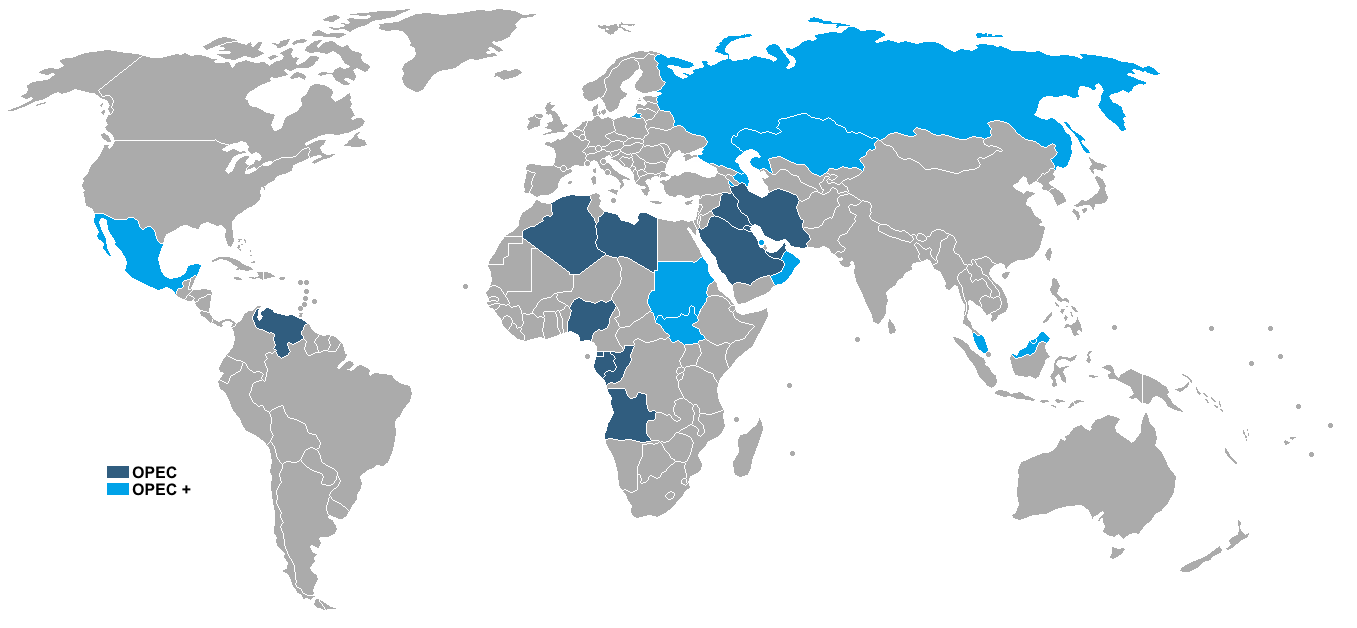
  • Present Member Countries: Islamic Republic of Iran, Iraq, Kuwait, Saudi Arabia, Venezuela, Algeria, Angola, Congo, Equatorial Guinea, Gabon, Libya, Nigeria, United Arab Emirates. 
  • According to the U.S. Energy Information Administration (EIA), OPEC's combined oil production rate (including gas condensate) represented 44% of the world's total in 2016, and OPEC held 81.5% of the world's "proven" oil reserves.
  • During the 1960s and 1970s, OPEC underwent a series of restructuring steps that shifting global oil production landscape in favour of oil-producing countries, diminishing the dominance of Anglo-American oil corporations known as the "Seven Sisters."
  • The admission of a new member nation necessitates the agreement of three-quarters of OPEC's existing members, including all five of the founding countries. Sudan submitted an application to join in October 2015, it has not yet become a member.

Organisation and Structure

  • Before OPEC's formation, individual oil-producing states faced punitive measures when attempting to alter the governance of oil production within their borders.
  • The fundamental principle underlying OPEC is that its members collectively benefit from limiting global oil supply to drive up prices.
  • Decision-making within OPEC follows these principles:
    • OPEC Conference, led by delegations, headed by member countries' oil ministers, serves as the organization's highest authority.
    • OPEC secretary general functions as the organization's chief executive.
    • Conference typically convenes at the Vienna headquarters at least twice a year. 
    • It generally operates on the basis of unanimity and "one member, one vote," with each country contributing an equal membership fee to the annual budget.
    • Given, Saudi Arabia's status as the world's largest and most profitable oil exporter, capable of acting as the traditional swing producer to balance the global market, it effectively serves as the de facto leader of OPEC.

OPEC+

  • In response to the steep drop in oil prices, primarily driven by substantial increases in U.S. shale oil production, OPEC entered into an agreement with ten other oil-producing nations in 2016, forming what is now recognized as OPEC+.
  • This informal coalition of nations, collectively referred to as OPEC+, comprises Azerbaijan, Bahrain, Brunei, Kazakhstan, Malaysia, Mexico, Oman, Russia, South Sudan, and Sudan.
  • Among these ten nations was Russia, the world's third-largest oil producer as of 2022, responsible for 13% of the global oil output.

Publications and Reports

  • The OPEC Secretariat produces a wide range of publications with the aim of keeping the public informed about the Organization's activities and disseminating data and insights related to OPEC Member Countries and the global oil industry.
  • Monthly Oil Market Report, which delves into critical issues confronting the worldwide oil market.
  • World Oil Outlook, known as WOO, presents OPEC's medium- to long-term perspective on the global oil market.

Nobel Peace Prize 2023: Narges Mohammadi

Context: Narges Mohammadi, an Iranian activist, won the Nobel Peace Prize for her efforts towards women’s rights and democracy.

About Narges Mohammadi

  • She has won the Nobel Prize for her fight against the oppression of women in Iran and her fight to promote human rights and freedom for all.
  • She is the 19th Woman to win the Nobel Peace Prize and the second Iranian Woman, after Shirin Ebadi (won Nobel Peace Prize in 2003).
image 15

About Nobel Peace Prize

  • It is one of the five Nobel Prizes established by the Alfred Nobel, along with the prizes in Chemistry, Physics, Physiology or Medicine and Literature.
  • It is awarded by a committee elected by the Norwegian Parliament (Stortinget).
  • It is awarded for the Outstanding contributions to peace: arms reduction, international cooperation, and organisations contributing to peace, and human rights contributions to peace.
  • It was first awarded in 1901. It was divided equally between Jean Henry Dunant "for his humanitarian efforts to help wounded soldiers and create international understanding" and Frédéric Passy "for his lifelong work for international peace conferences, diplomacy and arbitration".
  • Only two recipients have won multiple Prizes: the International Committee of the Red Cross has won three times (1917, 1944, and 1963) and the Office of the United Nations High Commissioner for Refugees has won twice (1954 and 1981).

Legend of Sammakka-Sarakka

Context: Recently, Union Cabinet Ministry, approved a tribal university for Telangana-‘the Sarakka Central Tribal University’. The Central Government announced the establishment of the university as a part of the Andhra Pradesh Reorganisation Act, 2014. The University is to be named after Sammakka-Sarakka, revered by the local tribal community. 

Sammakka-Sarakka Jatara:

  • As per the legends, Sammakka was married to a feudal chief of the Kakatiyas dynasty (ruled over the Warangal region). Sarakka/Saralamma was the daughter of Sammakka. 
  • Kakatiya dynasty ruler, Prataprudra imposed taxes on the Koya tribe and later declared battle on the tribe when the chief was not able to pay the taxes. 
    • The Sammakka Sarakka Jathara/Medaram Jathara, a biennial festival is celebrated to commemorate this battle of the 13th-century, in which the mother-daughter duo participated against the local rulers in protest against the imposition of taxes.
    • Sammakka and Sarakka are worshipped as the protector of Koya tribe. 
    • The festival shows no Vedic or Brahmanic influence.
    • The ritual of the festival includes taking holy dip in Jampanna Vagu (a stream), a tributary of River Godavari. 
    • From Medaram, the Jathara begins and priests belonging to Koya tribe perform the rituals. Medaram is situated in the Eturnagaram Wildlife Sanctuary, a part of Dandakaranya forest. 
    • Various tribal and non-tribal communities participate in the festival, from Andhra Pradesh, Madhya Pradesh, Chattishgarh, Odisha, Maharashtra, Karnataka and Jharkhand. 
    • It is the second largest fair of India, and is often referred to as the Kumbh Mela of the tribals. 
    • The festival is declared a state festival by the Telangana government.

Empowering Women: Unpaid Care Work's Influence on Labor Force Engagement

Context: The Female Labour Force Participation Rate (FLFPR) has long been a central focus in discussions around women's empowerment. While India's FLFPR has improved from 23.3% in 2017-18 to 37% in 2022-23, it still falls short compared to the world average of 47.8% (2022). Moreover, a significant portion of this participation comprises unpaid helpers in household enterprises, highlighting the persistent issue of unpaid labor among women

This article explores -

  • what is Unpaid care work
  • Need for recognition of unpaid care work
  • several challenges while Calculating unpaid care work 
  • Potential solutions to create a more inclusive and equitable workforce.

About Unpaid care work

According to OECD, refers to all unpaid services provided within a household for its members, including care of persons, housework and voluntary community work. These activities are considered work because theoretically, one could pay a third person to perform them.

  • Unpaid = the individual performing this activity is not remunerated 
  • Care = the activity provides what is necessary for the health, well-being, maintenance, and protection of someone or something
  •  Work = the activity involves mental or physical effort and is costly in terms of time resources

Need for recognition of unpaid care work

  • Mis-estimation of Economic activity: Non-inclusion of unpaid care work in national accounting statistics like GDP grossly misestimates the level of economic activity.
    • If unpaid care work were assigned a monetary value, it would constitute 9% of the global GDP.
  • Female Labour Participation:  Unpaid care work is a significant barrier preventing women from entering and staying in the workforce, as highlighted by the International Labour Organization (ILO). This burden creates "time poverty," restricting women's ability to engage in paid employment and acquire the skills necessary for better job opportunities. This challenge is not unique to India; globally, in 2016, 46.7% of women cited domestic duties as the reason for their absence from the workforce, compared to only 6.3% of men.
  • Wage Gap: often domestic care work by women is treated as unproductive and it is reflected in low wages for women in the labour market when compared to men.
  • Need for a Care Economy: India's demographic landscape is expected to change between 2020 to 2050, necessitating more elderly care alongside continuing levels of childcare.
    • By 2050, the proportion of elderly persons is expected to increase to 20.8% of the population, i.e. about 347 million persons. Moreover, even as the proportion of children reduces marginally to 18%, the number of children will still be close to 300 million.

Calculating unpaid care work presents several challenges, as outlined below with examples:

  • Perception of "Work": Unpaid care work is often not considered 'work' in the traditional sense. For instance, a mother caring for her children or a spouse looking after an elderly partner may not view these responsibilities as 'work' despite the significant time and effort involved. Consequently, when surveys ask about 'work,' respondents may exclude care activities from their responses, leading to underreporting.
  • Subjectivity and Variation: The nature of care work varies widely and can be highly subjective. Consider the task of cooking meals: one person might cook three meals a day from scratch, while another might use pre-packaged foods, making it challenging to standardize measurements. Additionally, caregiving responsibilities change over time – caring for a toddler differs from caring for a teenager, making it difficult to capture the full spectrum of care work.
  • Invisible Labor: Much of care work is invisible. Emotional support, mental labor (like planning and organizing), and managing family dynamics are essential components of caregiving but often go unnoticed. For example, a caregiver may spend hours coordinating doctor's appointments and managing medications, which are critical aspects of care but not easily quantifiable.
  • Seasonality: Care work can vary seasonally. Consider holiday preparations – the workload for cooking, decorating, and gift-giving increases significantly during certain times of the year. These fluctuations make it challenging to capture the consistent level of care work throughout the year.
  • Cultural Differences: Cultural norms significantly impact how care work is perceived and distributed within households. For example, in some cultures, extended family members often share caregiving responsibilities, while in others, it may fall primarily on women. These cultural variations complicate efforts to standardize measurement across diverse societies.
  • Data Collection Methods: Traditional data collection methods like surveys may not fully capture care work. Respondents may forget or underestimate the time spent on caregiving, especially if it's a continuous, fragmented task. They may also not recognize certain caregiving activities as 'work,' leading to inaccuracies in reporting.
  • Valuation of Care Work: Assigning a monetary value to care work is complex. For example, estimating the economic value of a stay-at-home parent's contributions involves considering factors like the cost of hiring childcare, cooking, cleaning, and emotional support. These intangible contributions are challenging to quantify accurately.

Key Takeaways from Article

  • Addressing Childcare Needs: Some State governments have focused on building support services through the Anganwadi network.
    • The 2024-25 Budget increased the Ministry of Women and Child Development's budget for the Saksham Anganwadi and Poshan 2.0 scheme by 3%.
  • Community-Based Creches: Various models of community-based creches are operational in parts of some States, in partnership with government and non-government bodies. There is a need to review these models for replicability, financial sustainability, and scalability.
  • Demand for Hired Caregivers: Rising demand for hired caregivers in urban and peri-urban areas but this sector lacks regulation, leaving domestic workers who double as caregivers without training, protection, or standards. Bodies like the Domestic Workers Sector Skill Council and the Healthcare Sector Skill Council are responsible for skilling but need more support.
  • Policy Framework: A comprehensive policy is needed to define the care ecosystem from a life course perspective.
    • A multi-ministerial committee involving the Ministries of Women and Child Development, Health and Family Welfare, Labour and Employment, Social Justice and Empowerment, and Skill Development and Entrepreneurship should be initiated.

Way Forward

  • Adequate Investment in care infrastructure such as Pre-Primary Education, Health, Electricity, drinking water, LPG connection etc. For example, A 2017 analysis by the Women’s Budget Group found that if an additional 2 percent of the GDP were invested in the Indian health and care sector, the country could generate 11 million additional jobs, nearly one-third of which would go to women. 
  • Social Protection Policies
    • Allow tax deductions of care-related expenses by the households for formalisation of domestic workers.
    • Provide for the cash transfer to women so that they can purchase childcare services from domestic workers.
  • Promote active labour market policies:
    • Paid maternity leave and Paternity leave to care for the children.
    • Efficient implementation of Public Works Programme such as MGNREGA
    • Enhance skill set through vocational training and retraining to enhance employability.
    • Provide Gender-sensitive work environments such as reduced or flexible working hours. 
    • Facilitate entry of women into Gig Economy
    • Nurture and promote women led SHGs.
    • Redistribute: Support NGOs and Private sector to care for the children and Elderly Ex: Old age homes, Pre-Primary Schools etc.

The above-mentioned strategies can contribute to meeting goals of SDG 1 (end poverty); SDG 3 (ensure healthy lives); SDG 4 (ensure inclusive and equitable quality education); SDG 5 (achieve gender equality); SDG 6 (ensure availability and sustainable management of water and sanitation) etc.

Conclusion: Increasing women’s participation in the labor force requires addressing the entire spectrum of care responsibilities. Creating a supportive care ecosystem will help reduce gender inequality and empower women economically, benefiting both society and the economy as a whole as highlighted by The World Economic Forum’s report on the ‘Future of Care Economy’ which highlights three perspectives: economic productivity, business opportunity, and human rights (gender equality and disability inclusion).

Freebies: Political Dimension 

Context: Supreme Court sought a response from the States of Madhya Pradesh and Rajasthan on a plea that public funds are being misused to offer irrational freebies ahead of elections. 

Freebies 

The dictionary meaning of the word freebie is something that you’re given free. But in practice, there is no precise definition of freebies.

The services or provisions provided by the state or union government, such as free electricity, free water, free public transportation, waiver of pending utility bills, and farm loan waivers, etc., straining their resources in the hope of electoral benefits, can be regarded as freebies. 

It is important to distinguish them from public-merit goods, expenditure on which brings economic benefits, such as the public distribution system, employment guarantee schemes, states’ support for education and health. 

Issues Associated with Freebies  

  • Election Commission observed that the distribution of freebies undoubtedly by influencing the decision of electorate shakes the root of free and fair elections. 
  • Governments resort to the freebie culture to cover up their failure in providing adequate jobs or skilling or ensuring decent livelihood to citizen. 
  • Critics argue that freebies disrupt state finances and throw governments into a debt spiral. 
  • It undermines credit culture and promotes rent seeking behavior among citizens.  
  • It distorts prices through cross-subsidisation eroding incentives for private investment. 
  • It disincentivise work at the current market wage rate leading to a drop in labour force participation
  • The widespread practice of offering freebies by politicians, across party lines and for electoral benefits, drains public finances that can be used instead for more concrete policy initiatives. 
  • For example, Punjab’s electricity subsidy and its rising cost to the state exchequer is over 16 per cent of total revenues. 

Section 126 of the RP Act

It prohibits displaying any election matter by means, inter alia, of television or similar apparatus, during the period of 48 hours before the hour fixed for conclusion of poll in a constituency. 

Steps Taken

Guideline Issued by Election Commission Regarding Manifesto and Freebies 

The Commission, in the interest of free and fair elections directed that Political Parties and Candidates while releasing election manifestos for any election to the Parliament or State Legislatures, shall adhere to the following guidelines:  

Provision 
“The election manifesto shall not contain anything repugnant to the ideals and principles enshrined in the Constitution and further that it shall be consistent with the letter and spirit of other provisions of the Model Code of Conduct.” 
“Provides that political parties should avoid making those promises which are likely to vitiate the purity of the election process or exert undue influence on the voters in exercising their franchise.”  
“In the interest of transparency, level playing field and credibility of promises, it is expected that manifestos also reflect the rationale for the promises and broadly indicate the ways and means to meet the financial requirements for it. Trust of voters should be sought only on those promises which are possible to be fulfilled.” 
In the case of single-phase election, manifesto shall not be released during the prohibitory period, as prescribed under Section 126 of the Representation of the People Act, 1951. 
In case of multi-phase elections, manifesto shall not be released during the prohibitory periods, as prescribed under Section 126 of the Representation of the People Act, 1951, of all the phases of those elections.” 

Supreme Court Cases

  • Indira Nehru Gandhi v. Raj Narain (1975)
    • In this case the Supreme Court held “free and fair elections” to be a basic structure of the Constitution.  
  • S. Subraminam Balaji v. State of Tamil Nadu & Others (2013)
    • In this case, the Supreme Court ordered the Election Commission to develop election manifesto guidelines after discussing with all recognised political parties.  
    • In light of this, the Election Commission created the rules and included them in the Model Code of Conduct.  
    • The court determined that while the promises made in the election manifestos cannot be considered “corrupt practices” under Section 123 of the Representation of People’s Act, 1951, it is unavoidable that the giving away of freebies of any kind impacts voters. 
  • Ashwini K Upadhyay v. Government of National Territory of Delhi (2021)
    • In this case, the Apex Court observed that a poll manifesto does not have statutory backing and, hence, its enforceability is not within the purview of the courts. 
    • So, the court cannot give directions to any Government to pass or provide anything that is promised by political parties in their party manifesto. 

Way Forward:

  • The Election Commission has said the issue of freebies should be left to voters as it cannot regulate state policies and decisions which may be taken by the winning party when they form the government. Such an action, without enabling provisions in the law, would be an overreach of powers, the commission has said. 
  • For a country with high poverty rates and persistent economic disparities, welfare schemes are a lifeline for huge populations that demand that a clear definition of freebies differentiating them from the welfare programmes should be arrived at. 
  • The democratic forum such as inter-governmental institutions can frame the freebies debate and build a political consensus. 
  • The parliament, as a representative body, can debate on the freebies and legislate policies to regulate them.  
  • It is essential that political consensus are built, involving the Centre as well as states, to arrest the misuse of welfare schemes and the resultant adverse impacts on the country’s fiscal health. 

The promises of welfare made by political parties to their electorates are part of the key process of bargaining in a democracy where the voter’s judgement is paramount. The interference perceived or real, of non-elected institutions can distort the dynamics of electoral democracy.

It also belittles the electorate’s agency and sense of judgement undermining the basic principle of democracy. So, while regulation of freebies is a necessary evil, political education should be promoted among citizens at the same time.

Considering Green Drought for Drought Assessment

Context: The Karnataka government has requested the inter-ministerial central team to consider the ‘green drought’ prevailing in the state and urged that the assessment be made based on factors like crop growth and yield. 

What is a Green Drought?

  • Green drought is when the vegetation may appear green on the top, but there is stunted growth and soil moisture stress for more than a month impacting yield drastically
  • This phenomenon is particularly problematic because it can be challenging to detect and monitor.

Other Types of Drought

  • Meteorological Drought is the simple absence/deficit of rainfall from the normal. It is the least severe form of drought and is often identified by sunny days and hot weather.
  • Hydrological Drought leads to reduction of natural stream flows or ground water levels, plus stored water supplies. Main impact is on water resource systems.
  • Agricultural Drought occurs when moisture level in soil is insufficient to maintain average crop yields. Initial consequences are in the reduced seasonal output of crops and other related production. An extreme agriculture drought can lead to a famine, which is a prolonged shortage of food in a restricted region causing widespread disease and death from starvation.

Why is Drought Assessment a Challenging Task?

  • Issues in Assessment and Early Warning: The absence of accurate and dependable water-related data is a prevailing problem. Additionally, wherever data is available, it is compartmentalised. This limits sharing horizontally and vertically along the entire data chain. 
  • Drought is different from other natural disasters like cyclones, floods, earthquakes and tsunamis due to several factors:
    • No Universal Definition: There isn't a universally accepted definition that can adequately capture its intricate nature. 
    • Identifying Start and End of a Drought Episode: Identifying the onset and conclusion of a drought episode is challenging due to its gradual emergence, quiet progression, and slow dissipation. In India, it's generally linked with the monsoon season
    • Absence of Parameters: No indicator or index exists that can reliably predict the arrival and severity of a drought event or foresee its potential consequences. 
    • Wide Geographical Expanse: Droughts often cover extensive geographical areas, surpassing the scope of many other natural calamities, making effective response considerably more difficult. 
    • Quantification of Impact: The impacts of droughts are mainly non-structural and tough to quantify. These include ecological damage, disruption of socio-economic foundations within communities, and long-term health effects due to malnutrition, among others. 

Read: Drought management & Flash droughts

M.S. Swaminathan- Architect of India’s Green Revolution

Context: Renowned agricultural scientist Dr. M.S. Swaminathan passed away on September 28 at the age of 98.

About Dr. M.S. Swaminathan:

  • Dr. M.S. Swaminathan was born on 7 August 1925 in Kerala. 
  • A plant geneticist by training, he made a stellar contribution to the agricultural renaissance in the country and is popularly known as the Father of the Green Revolution in India.
image 14

Contributions of Dr. Swaminathan:

1. Increase in wheat production:

  • He played a pivotal role in introducing semi-dwarf Mexican wheat strains, Sonora 64 and Lerma Rojo 64 to Indian fields. 
  • He along with experts at the erstwhile Planning Commission put together a policy to subsidize fertilizers and power while expanding irrigation cover to promote the dwarf wheat variety, utilizing British-era water canals in Punjab and Haryana.
  • This led to a significant increase in wheat production, thus turning India from being dependent on humiliating food donations to feed its population to being a self-sufficient nation. 
    • In the early 1960s, India’s wheat and rice production was just 10-12 million tonnes (MT) and 35-36 MT, respectively, forcing massive grain imports that crossed 10 MT in 1966-67.
    • India had signed off on an agreement with the US called the “Public Law 480” to qualify for food aid. This food assistance was a political hazard because the aid came tied with conditions.
    • Following the successful green revolution, by the end of the 1960s, India’s wheat production crossed 20 MT. 

2. Increase in Rice production:

  • He introduced the fertiliser-responding high-yielding VARIETY of “Indica” rice from the Philippines-based International Rice Research Institute.
    • He worked in the indica-japonica rice hybridization programme for transferring genes from the relatively non-lodging and fertiliser-responsive ‘Japonica’ rice varieties to indigenous ‘Indica’ races. 
  • He pioneered the development of popular basmati rice varieties — culminating in the Pusa Basmati variety in 1989, which was the world's first semi-dwarf, high-yielding basmati variety.

3. Sustainable agriculture:

  • He consistently advocated for sustainable agriculture, emphasising the delicate balance between human advancement and ecological sustainability.
  • He had forewarned farmers in 1968 not to treat the productivity leap as an “evergreen revolution” by overusing subsidised agricultural chemicals which would ruin soil health.

4. Advocacy for Farmers' welfare:

  • As the chairman of the National Commission on Farmers in 2004, he advocated for fair minimum support prices for crops. He recommended that MSP for crops be at least 50% more than the weighted average cost of production, ensuring fair compensation to farmers.
  • He played a pivotal role in developing the Protection of Plant Varieties and Farmers' Rights Act 2001. 

5. Mainstreaming gender considerations in Agriculture: 

  • He advocated the empowerment of farm women in the areas of land and water rights, access to technology, credit and insurance and the ability to market their produce at a remunerative price. 
  • His efforts to empower women farmers helped shape India’s Mahila Sashaktikaran Yojana.

Awards:

  • S.S. Bhatnagar Award for his contribution to biological sciences (1961)
  • Ramon Magsaysay Award for Community Leadership (1971)
  • Albert Einstein World Science Award (1986)
  • First World Food Prize (1987)
  • Padma Vibhushan (1989)
  • Indira Gandhi Prize for Peace, Disarmament and Development (2000)
  • Mahatma Gandhi Prize of UNESCO (2000)

Sutlej Yamuna Link (SYL) Canal

Context: The Supreme Court has ordered the government of Punjab to complete the construction of the SYL project.

What is a Sutlej Yamuna Link (SYL) Canal?

  • Sutlej Yamuna Link (SYL) Canal running about 121 km in Punjab and 90 km in Haryana aims to provide 3.45 MAF out of 3.5 MAF of Haryana’s average annual share of surplus Ravi-Beas waters (as per 1981 agreement). 
  • It will irrigate an area of 4.46 lakh ha. in Haryana and also benefit Punjab in terms of irrigation to an area of 1.28 lakh ha, and in terms of power, a total of 50 MW of power generation at two power houses.

Brief Background on the Issue

  • The issue dates back to 1966 at the time of reorganisation of Punjab and formation of Haryana. Punjab was opposed to sharing the waters of the two rivers with Haryana, citing riparian principles.
  • In 2020, the Supreme Court (SC) asked the Central Government to mediate between CMs of Punjab and Haryana to find an amicable solution to SYL Canal dispute.
  • In 2023, Centre told SC that talks between the two states have failed as Punjab refused to construct its part of the canal.
image 13

About Satluj River

  • The Satluj originates in the ‘Rakshas tal’ near Mansarovar at an altitude of 4,555 m in Tibet where it is known as Langchen Khambab. 
  • It flows almost parallel to the Indus for about 400 km before entering India, and comes out of a gorge at Rupar. 
  • It passes through the Shipki La on the Himalayan ranges and enters the Punjab plains. 
  • It is an antecedent river. It is a very important tributary as it feeds the canal system of the Bhakra Nangal project.

About Ravi River

  • The Ravi is another important tributary of the Indus. 
  • It rises west of the Rohtang pass in the Kullu hills of Himachal Pradesh and flows through the Chamba valley of the state. 
  • Before entering Pakistan and joining the Chenab near Sarai Sidhu, it drains the area lying between the southeastern part of the Pir Panjal and the Dhauladhar ranges.

About Beas River

  • The Beas is another important tributary of the Indus, originating from the Beas Kund near the Rohtang Pass at an elevation of 4,000 m above the mean sea level.
  • The river flows through the Kullu valley and forms gorges at Kati and Largi in the Dhauladhar range. 
  • It enters the Punjab plains where it meets the Satluj near Harike.

About Yamuna River

  • It is the western most and the longest tributary of the Ganga, and has its source in the Yamunotri glacier on the western slopes of Bandarpunch range
  • It joins the Ganga at Prayag (Allahabad). 
  • It is joined by the Chambal, the Sind, the Betwa and the Ken on its right bank which originates from the Peninsular plateau while the Hindan, the Rind, the Sengar, the Varuna, etc. join it on its left bank. 
  • Much of its water feeds the western and eastern Yamuna and the Agra canals for irrigation purposes.

Comparison of Speaker of Lok Sabha with Speaker of House of representative

Context: A handful of Republicans in the US House of Representatives on Tuesday ousted Republican Speaker Kevin McCarthy, as party infighting plunged Congress into further chaos just days after it narrowly averted a government shutdown.

The syllabus of GS Paper II contains “comparison of Indian constitution with those of other countries”.  This makes it important for us to understand the comparison of the positions of the speaker of Lok Sabha and the Speaker of House of representatives.

ParameterSpeaker of Lok Sabha (India)Speaker of House of Representatives (USA)
Appointment ProcessElected by Lok Sabha membersElected by House members
Political AffiliationExpected to be impartialProminent member of majority party
Term of OfficeRenewable; typically 5 yearsElected at the beginning of each Congress (2 years)
Removal ProcessCan be removed by a majority vote of Lok Sabha membersCan be removed by a majority vote of House members
Powers and InfluencePrimarily procedural and ceremonial; limited influence over legislative agendaSignificant influence over legislative agenda; controls committee assignments; shapes legislative priorities
Role in Legislative ProcessEnsures orderly proceedings, impartiality, and represents Lok Sabha to the PresidentActively participates in legislative process, determines which bills are considered, and influences legislative priorities
Voting on LegislationTypically does not vote except in the case of a tieCan vote on legislation, but typically refrains from doing so
Party PoliticsExpected to resign from political party upon assuming officeProminent member of their political party, actively involved in party politics
Representation to PresidentRepresents Lok Sabha to the President of IndiaRepresents the House of Representatives to the President of the United States
Succession to PresidencyNot in the line of succession to the presidencyIn the line of succession to the presidency after the Vice President
Privileges and PerksEnjoys certain privileges such as a residence (official bungalow) and securityEnjoys privileges such as a spacious office, staff support, and security
NeutralityExpected to maintain impartiality and neutralityCan be openly partisan due to their role in party politics

Money Bill and Speaker's discretion

Context: In response to challenges against the Centre's use of the money bill route to pass significant legislations, Chief Justice of India DY Chandrachud has announced the formation of a seven-judge bench. Money bills, as defined by Article 110 of the Constitution, encompass provisions related to taxation, borrowing of money, fund custody, appropriation, expenditure declarations, and more. They hold a unique status in India's parliamentary process, with a special procedure for their passage. Only the Lok Sabha can introduce money bills, which require the President's recommendation and the Speaker's certification.

The Rajya Sabha can offer recommendations but cannot amend or reject them. This distinction between money bills and ordinary bills, along with the Speaker's crucial role, has been a subject of judicial review, with the Supreme Court providing guidelines on when and how the Speaker's decisions can be challenged, ensuring the constitutional checks and balances are upheld.

What is a Money Bills?

Article 110 of the Constitution deals with the definition of money bills. It states that a bill is deemed to be a money bill if it contains ‘only’ provisions dealing with all or any of the following matters:

  1. The imposition, abolition, remission, alteration or regulation of any tax;
  2. The regulation of the borrowing of money by the Union government;
  3. The custody of the Consolidated Fund of India or the contingency fund of India, the payment of moneys into or the withdrawal of money from any such fund;
  4. The appropriation of money out of the Consolidated Fund of India;
  5. Declaration of any expenditure charged on the Consolidated Fund of India or increasing the amount of any such expenditure;
  6. The receipt of money on account of the Consolidated Fund of India or the public account of India or the custody or issue of such money, or the audit of the accounts of the Union or of a state; or
  7. Any matter incidental to any of the matters specified above.

However, a bill is not to be deemed to be a money bill by reason only that it provides for:

  1. the imposition of fines or other pecuniary penalties, or
  2. the demand or payment of fees for licenses or fees for services rendered; or
  3. the imposition, abolition, remission, alteration or regulation of any tax by any local authority or body for local purposes.

If any question arises whether a bill is a money bill or not, the decision of the Speaker of the Lok Sabha is final. His decision in this regard cannot be questioned in any court of law or in the either House of Parliament or even the president. When a money bill is transmitted to the Rajya Sabha for recommendation and presented to the president for assent, the Speaker endorses it as a money bill.

What is the procedure for passing of money bill in parliament?

  • The Constitution lays down a special procedure for the passing of money bills in the Parliament. A money bill can only be introduced in the Lok Sabha and that too on the recommendation of the president. Every such bill is considered to be a government bill and can be introduced only by a minister.
  • It cannot reject or amend a money bill. It can only make the recommendations. It must return the bill to the Lok Sabha within 14 days, whether with or without recommendations. The Lok Sabha can either accept or reject all or any of the recommendations of the Rajya Sabha.
  • If the Lok Sabha accepts any recommendation, the bill is then deemed to have been passed by both the Houses in the modified form. If the Lok Sabha does not accept any recommendation, the bill is then deemed to have passed by both the Houses in the form originally passed by the Lok Sabha without any change.
  • If the Rajya Sabha does not return the bill to the Lok Sabha within 14 days, the bill is deemed to have been passed by both the Houses in the form originally passed by the Lok Sabha. Thus, the Lok Sabha has more powers than Rajya Sabha with regard to a money bill. On the other hand, both the Houses have equal powers with regard to an ordinary bill.

Finally, when a money bill is presented to the president, he may either give his assent to the bill or withhold his assent to the bill but cannot return the bill for reconsideration of the Houses. Normally, the president gives his assent to a money bill as it is introduced in the Parliament with his prior permission.

Difference between Money Bill and Ordinary Bill

S.N.Money BillOrdinary Bill
1.It can be introduced in the Lok Sabha only not in the Rajya SabhaIt can be introduced in either house of parliament.
2.It can be intruded in the Lok Sabha only by a minister.It can be introduced either by a minister or by a private member
3.It can be introduced only of the recommendation of the president.Recommendation of president is not required.
4.It can’t be amended or rejected by the Rajya Sabha. The Rajya Sabha should return the bill with or without recommendations, which may be rejected or accepted by the Lok Sabha.It can be amended or rejected by the Rajya  Sabha.
5.It can be detained by the Rajya Sabha for a maximum of 14 days only.Rajya Sabha can detain it for a maximum of 6 months.
6.It requires the certification of Lok Sabha speaker when transmitted to Rajya Sabha.If it is originated in the Lok Sabha, it does not require approval of speaker when transmitted to Rajya Sabha.
7.It is sent for approval of president even if it approved by the Lok Sabha only. There is no provision of joint sitting of both houses in this regard.It is sent to the president only when it is passed by the both houses of parliament. In case of deadlock between two houses, a joint sitting of both the houses can be called by the president.
8.If this bill is defeated in the Lok Sabha, then the entire council of ministers has to resign.Its defeat in the Lok Sabha may lead to the resignation of the government if it is introduced by a member.
9.It can be rejected or accepted but can’t be returned for reconsideration by the president (because earlier permission is taken from him).It can be rejected, accepted or returned for reconsideration by the president.

Role of the Speaker

  • The speaker plays a powerful role in the matter of the money bill. If any question arises whether a bill introduced in Lok Sabha is a money bill or not then in such circumstances, the Speaker of Lok Sabha has the authority to declare and certify the bill as money bill before transmitting it to Rajya Sabha.
  • The speaker is under no obligation to seek advice in this regard from anyone before arriving at any decision and his decision thereupon is final which cannot be further challenged. The purpose of certification of Money Bill is to ensure that the upper house cannot amend it by adding anything which is beyond the provisions of Article 110(1). If the speaker does not certify the bill as money bill then it will be considered just as a financial bill only.

Role of the Higher Judiciary in reviewing the Speaker’s decision:

  • Article 122 explicitly bars courts from inquiring into the proceedings of Parliament. As the text of clause (1) suggests, this bar applies to any question on the ground of “irregularity of procedure”. The Supreme Court has, on several occasions, opined on the contours of this restriction.

So what has been the precedent of the Supreme Court?

  • Keshav Singh’s case: It held that while legislative bodies are not subject to judicial control as far as their internal procedures are concerned, there are certain caveats to such a proposition. It was held that a court of law may question legislative procedure if the impugned action rests not on mere irregularity, but from an ‘illegality’ or ‘unconstitutionality’ of procedure.
  • Ramdas Athavale v. Union of India: the Supreme Court extended that standard to article 122, as it pertains to procedural actions of Parliament.
  • Raja Ram Pal v. Speaker, Lok Sabha: the Court had applied this standard to article 105 (3), which sought to import those privileges, powers, and immunities enjoyed by the House of Commons into the Indian scheme (as an interim measure, until the Indian Parliament itself legislates on those matters). This case dealt with the expulsion of certain members of Parliament, by the Speaker. A plain reading of this clause and Parliamentary practices in the House of Commons might suggest a finality to procedural decision of the Speaker in confirming the expulsion, in terms that are analogous to article 110. The Speaker’s decision was held to be open to judicial scrutiny, and the expelled members were reinstated by the Court.

Govt notifies bankruptcy code changes to make aircraft recovery easier

Context: The Ministry of Corporate Affairs has issued a notification stating that certain provisions of the Insolvency and Bankruptcy Code (IBC) will no longer apply to aircraft, their engines, airframes, and helicopters. 

Background: 

When Go First airlines filed for voluntary insolvency in the month of May (2023), the companies (lessors) who had leased aircrafts to the airline applied to DGCA to deregister those aircrafts from the airlines and repossess them. But DGCA didn’t approve their requests and kept their applications in abeyance.

Reason: Under section 14 of India’s Insolvency and Bankruptcy Code (IBC), the admission of an insolvency plea by the National Company Law Tribunal (NCLT) results in an immediate and complete moratorium on recovery of assets leased to the debtor (Go First in this case).

Concerns:

Inability of the lessors to take back their aircrafts results in:

  • Violation of Cape town convention: India is a signatory to the Convention on International Interests in Mobile Equipment and the related protocol, commonly known as the Cape Town Convention (CTC), as per which lessors can seek deregistration and export of aircraft without consent of the airline when lease payments are defaulted. 
  • Impacts aviation market: It impacts the reputation of India’s aviation market and may increase risk premiums for other Indian carriers. This may increase cost of operations for Indian airlines which are already reeling under the pressure of volatile fuel prices and cut throat competition. 

Thus, the recent changes to the IBC to exempt leased aircrafts under the protection given to debtors, came as a relief to the aviation sector.  

National Investment and Infrastructure Fund

Context: India's National Investment and Infrastructure Fund (NIIF) and Japan Bank for International Cooperation (JBIC) jointly launched a $600 million fund on Wednesday for climate and environment projects. 

Why NIIF?

Infrastructure projects frequently exhibit long-gestation periods, creating challenge for financial institutions to manage their short-term liabilities with these long-term cash-flow profiles.

To avoid these Asset-liabilities mismatch faced by the banks in funding infrastructure projects, Government has constituted National Investment and Infrastructure Fund (NIIF) with an authorised capital of 20,000 crores, to provide long-term institutional investment support to infra projects in India. 

What is NIIF?

The National Investment and Infrastructure Fund (NIIF) is a state-owned fund created by the GoI in 2015 to support infrastructural development in India, by gathering capital from domestic and international investors.  It has three components under it:

  • Master fund: This fund primarily invests in infra-related projects such as roads, ports, airports, and power. It invests in both green field(new) as well as brownfield(operating) projects. 
  • Fund of Funds: This fund invests in other funds managed by the renowned fund managers having a good track record in funding successful infrastructure projects. That means, this fund acts as an anchor investor to other private funds. 
  • Strategic Opportunities Fund (SOF): SOF targets to invest in companies belonging to sectors that have good growth potential.