Context: In the last week of July, researchers in South Korea said they had discovered that a material called LK-99 is a room-temperature superconductor. Independent researchers will have to check whether LK-99 is really a room-temperature superconductor before it is accepted as a legitimate claim.
What are Superconductors?
Superconductors are materials that when cooled to temperatures ranging from near absolute zero (0 degrees Kelvin, -273 degrees Celsius) have zero resistance or do not resist the flow of current.
The temperature at which electrical resistance is zero is called the critical temperature (Tc) and this temperature is a characteristic of the material.
E.g., Aluminium, niobium, magnesium diboride, yttrium barium copper oxide etc.
However, every superconductor made so far has required extraordinarily high pressures (millions of Pascal), and very low temperatures. E.g., Aluminium becomes superconducting at temperatures less than (minus) –250° C.
Hence, scientists have been looking for such materials for decades which can remain superconductors at room temperature.
Important properties of Superconductors:
Electronic effect (Infinite conductivity with Zero resistance) - The material will transport an electric current with zero resistance.
(When the temperature of superconductors is reduced below a critical temperature, its resistance suddenly reduces to zero and thus it offers infinite conductivity). E.g., Mercury becomes a superconductor below 4 kelvin.
Magnetic effect (Complete expulsion of Magnetic field) - Superconductors are diamagnetic i.e., they oppose the magnetic field or do not allow the magnetic field lines to penetrate them. (This phenomenon is called Meissner effect)
However, there is a certain value of the magnetic field (critical magnetic field) beyond which the superconductors lose superconductivity and convert into conductors.
Applications:
Elimination of the loss of energy: Superconductorscan be used to make longer-lasting batteries and more-efficient power grids.
Need: Presently, a portion of the electricity generated at every power plant is lost during transmission because the wires and cables that carry the current have electrical resistance.
Significance of Superconductors: Once an electric current passes over a superconducting material, it can continue to flow without receiving power from any source as none of the energy involved is lost as heat.
Potential applications include- Magnetic-energy storage systems, magnetic levitation trains, superconducting magnetic refrigerators, etc.
Huge potential for revolutionary technologies, including efficient quantum computers, as superconductors can exhibit quantum phenomena.
Context: Government has set a deadline for mandatory implementation of the Good Manufacturing Practices (GMP) following the incidents of deaths allegedly linked to “contaminated” India-manufactured drugs.
Global Issues
More than 60 children in Gambia died after kidney complications, allegedly caused by cough syrups made by the Haryana-based Maiden Pharmaceuticals.
A cold remedy, manufactured by Marion Biotech in Noida, was blamed for the deaths of 19 children in Uzbekistan.
A batch of cough medicines produced by an Indore-based firm was blamed for at least 12 fatalities in Cameroon.
Data on Regulation of Drug Mfg. Companies
According to health ministry data, less than 20% pharma units in the country have WHO certification.
In India only 2,000 of the 10,500 manufacturing units have been found to be compliant with the global WHO- Good Manufacturing Practices (GMP) standards.
Provisions for Regulations of Drug Mfg. Companies
Central Drugs Standard Control Organization (CDSCO), Ministry of Health & Family Welfare, provides general information about drug regulatory requirements in India.
The Drugs & Cosmetics Act, 1940 regulates the import, manufacture, distribution and sale of drugs in India.
Schedule M of the Drugs and Cosmetics Act, 1940 specifies requirements for factory premises and materials, plant and equipment and minimum recommended areas for basic installation for certain categories of drugs.
Issues with the Current Regulations
Outsourcing of Production: Studies have shown that the major companies outsource their production to MSME outfits, where quality is often compromised for cost.
Regulatory Issue
Poorly staffed and under-resourced state regulatory bodies find it hard to deal with the ways of these firms whose supply chains regularly involve fly-by-night operators.
Drug inspectors are often tasked with administrative work related to the cancellation and renewal and inspection of licenses. Scrutiny of drugs for safety and efficacy suffers as a result.
Lack of laboratories: The country has 29 state government-run and two Central drug testing laboratories, which are not enough for a country size of India.
Supply-Chain Issues:
Incoming raw materials are not being tested before using it to make the drugs.
The final product quality is not being reviewed properly.
There is an absence of regular quality-failure investigation.
There are infrastructural deficiencies to prevent cross-contamination of the product.
Faulty design of manufacturing and testing areas amplifies the already present problems.
Lack of qualified professionals which results in sub-standard drug formulation.
There is poor documentation of the test, result and their review.
The WHO has flagged concerns about the quality of Indian generics and has found toxic content in seven Indian-made cough syrups.
There is no database on inspections and violations that alerts regulatory authorities, healthcare institutions and doctors.
Lack of information in the public domain about the procedures followed during the investigations that create the trust deficit.
Govt Steps to Address the Lacunae
The government asked drug manufacturing companies for mandatory implementation of the Good Manufacturing Practices (GMP) bringing them on par with World Health Organisation (WHO) standards.
Larger companies with a turnover of over Rs 250 crore have been asked to implement the changes within six months.
Medium and small-scale enterprises with turnover of less than Rs 250 crore have been asked to do so within a year.
Companies who do not comply with the direction will face suspension of license and/ or penalty.
WHO Good Manufacturing Practices
Good manufacturing practice (GMP) is that part of a quality management system to ensure that products are consistently produced and controlled to the quality standards appropriate to their intended use and as required by the marketing authorization.
GMP is aimed primarily at diminishing the risks inherent in any pharmaceutical production, it may broadly be categorized into two groups: Cross-contamination/mix-upsFalse labelling Above all, manufacturers must not place patients at risk due to inadequate safety, quality or efficacy.
GMP Guidelines
The revised GMP guidelines focus on quality control measures, proper documentation, and IT backing to maintain quality of medicines produced.
GMP Computerised System
It will be designed to automatically record all the steps followed and checks done and ensure that all the processes are followed and prevent unauthorised access and changes to the data.
In case sensitive data is entered manually to the system, there will be additional checks to validate the accuracy of the data.
Backups would also be created to ensure there is no loss of data.
Stability Studies: it says companies must conduct stability studies as per the climate conditions, keep the drugs in a stability chamber, set the proper temperature and humidity, and carry out an accelerated stability test as well.
Quality Control: it introduces pharmaceutical quality system, quality risk management, product quality review, and validation of equipment.
Revised schedule M: It lists the requirements for additional types of products, including biological products, agents with radioactive ingredients, or plant-derived products.
Benefits of Effective Regulation for India
Instituting the same quality across the industry will give confidence to regulators from other countries
This is a very welcome step by the government as it will ensure that all the manufacturing units in the country are at par with global standards, reducing the need for repeated inspections by different regulators.
It will make India a quality pharmaceutical hub of the world. In addition, it will ensure that our citizens also receive export-quality medicines.
A star exists in a delicate equilibrium between opposing forces:
Outward energy and pressure resulting from nuclear fusion
Gravitational pull inward due to its considerable mass.
As long as a star can sustain nuclear fusion, releasing more energy than needed for the fusion process, it remains stable.
However, when this balance tips and the star's fusion can no longer counteract the force of gravity, a pivotal shift occurs.
Gravity gains the upper hand, causing the star to collapse rapidly, leading to a sudden explosion of its outer layers - an event known as a core-collapse supernova.
A substantial amount of energy, radiation, and elemental matter is ejected into the surrounding space during the supernova event.
Characterized by the explosive demise of a massive supergiant star, a supernova can release a staggering energy output of up to 10^44 joules, comparable to the Sun's cumulative energy emission over its 10-billion-year lifespan.
This cataclysmic process generally leads to the fusion of iron within the star's core, reaching the point where the binding energy of the iron group elements is the highest. Consequently, no further energy can be extracted from nuclear fusion.
Where Do Supernovas Occur?
Supernovas frequently occur in distant galaxies, but their observation within Milky Way galaxy is hindered by obstructive dust.
Back in 1604, Johannes Kepler made a notable discovery, identifying the most recent observed supernova within the Milky Way.
Notably, NASA's Chandra telescope has since uncovered the remnants of a more recent Milky Way supernova that erupted over a century ago.
Variants of Supernovae:
The first variant of a supernova is observed in binary star systems.
Within these systems, two stars orbit a shared point. Specifically, a carbon-oxygen white dwarf, one of the binary stars, siphons matter from its companion.
Over time, this white dwarf accumulates an excess of matter, leading to an eventual explosive demise and the birth of a supernova.
The second class of supernova transpires as a single star concludes its life cycle.
As nuclear fuel depletes, a portion of the star's mass streams into its core.
Gradually, the core's immense weight becomes untenable against its own gravitational pull.
Consequently, the core undergoes a catastrophic collapse, giving rise to a monumental supernova explosion.
It's important to note that while our sun is a lone star, its mass is insufficient to trigger a supernova event.
Significance:
One variety of supernova has yielded crucial insights for scientists, underscoring the concept of an expanding universe that perpetually accelerates its growth.
Moreover, researchers have deduced that supernovas play a pivotal role in the universal dispersion of elements.
When a star undergoes explosion, it propels elemental matter and debris into space.
The heavy metals present in Earth's crust, including valuable elements like gold and uranium, owe their origins to the intense conditions within certain supernovae, which occurred eons ago.
The importance of millets in India cannot be overstated. These are primarily rainfed crops, making them highly suitable for areas with erratic rainfall patterns or water scarcity. They have high nutritional content and are beneficial for both human health and the environment.
This article offers an insight into the varieties of millets in India, their regional distribution, and their significance for the Indian economy and food security, all important aspects for the UPSC Civil Services Examination.
Millets: A Brief Overview
Millets are small-seeded grasses, drought-resistant and are capable of growing well in less fertile and marginal soils. The consumption of millets is an integral part of the food culture in many parts of India.
There are several types of millets, including Pearl Millet (Bajra), Finger Millet (Ragi), Foxtail Millet (Kangni), Proso Millet (Chena), Kodo Millet (Kodon), Little Millet (Kutki), and Barnyard Millet (Sanwa). Each of these millets has unique benefits, both nutritionally and environmentally.
Distribution and Production of Millets in India
Image Source: News18 & Lok Sabha
India is the largest producer of millets globally. Millet cultivation is widespread, although it varies in terms of concentration across states.
Pearl Millet: It is the most widely grown millet in India and constitutes a significant part of the diet in the states of Rajasthan, Gujarat, and Haryana.
Finger Millet: This is primarily cultivated in the dry regions of Karnataka, Andhra Pradesh, Tamil Nadu, Odisha, and Maharashtra.
Foxtail, Proso, Kodo, Little, and Barnyard Millets: These are predominantly grown in the central and eastern regions of India, in states like Madhya Pradesh, Uttar Pradesh, and Bihar.
Types of millets in India
There are several types of millets grown across different regions of India, known for their nutritional benefits and adaptability to diverse climatic conditions.
Here are the primary types of millets and some insights into their cultivation and nutritional profile:
Pearl Millet (Bajra):
Primarily grown in Rajasthan, Maharashtra, Gujarat, and Uttar Pradesh.
High in protein, fiber, and essential micronutrients like iron, zinc, and B vitamins.
Finger Millet (Ragi):
Majorly cultivated in Karnataka, Tamil Nadu, Andhra Pradesh, and Maharashtra.
Rich in calcium, iron, and amino acids, it's often recommended for bone health and diabetes management.
Foxtail Millet (Kangni):
Cultivated across Andhra Pradesh, Tamil Nadu, and Karnataka.
Known for its carbohydrate content, it also provides a good amount of dietary fiber, minerals, and essential fatty acids.
Barnyard Millet (Jhangora):
Grown in Uttarakhand, Maharashtra, and Madhya Pradesh.
It's a good source of protein and is rich in dietary fiber.
Kodo Millet (Kodon):
Cultivated in the central and southern regions of India.
Contains high amounts of polyphenols, an antioxidant that benefits general health.
Little Millet (Kutki):
Grown in Karnataka, Tamil Nadu, Andhra Pradesh, and West Bengal.
High in magnesium, which can help improve heart health.
Proso Millet (Chena):
Cultivated in regions of Maharashtra, Madhya Pradesh, and Tamil Nadu.
Known for its high protein content and the absence of gluten.
Sorghum Millet (Jowar):
Primarily cultivated in Maharashtra, Karnataka, and Andhra Pradesh.
Packed with nutrients including protein, fiber, and B vitamins.
Significance of Millets
Nutritional Value: Millets are rich in dietary fiber, iron, calcium, and B vitamins, providing a myriad of health benefits. For instance, Finger Millet is a remarkable source of calcium, while Pearl Millet is packed with protein.
Climate Resilient: Millets are climate-resilient crops and are typically grown in the semi-arid tropics of Asia and Africa, making them perfect for regions with harsh weather conditions and poor soil quality.
Food Security: The ability of millets to grow in difficult environmental conditions makes them a crucial crop for ensuring food security in the face of climate change.
Economic Significance: Millets play a significant role in rural economies, providing both food and fodder. They also contribute to the livelihood of small and marginal farmers.
Millets and Indian Government Initiatives
Recognizing the significance of millets, the Indian government has launched various initiatives to promote its cultivation and consumption. The government declared 2018 as the 'National Year of Millets' to boost the millet sector.
The 'Initiative for Nutritional Security through Intensive Millet Promotion (INSIMP)' scheme aims to increase millet production and awareness about their health benefits.
Additionally, millets have been incorporated into the Public Distribution System (PDS) and the Mid-Day Meal scheme to improve their accessibility and consumption.
Conclusion
Understanding the varieties of millets, their distribution in India, their nutritional and economic significance, as well as the government's initiatives to promote their cultivation and consumption is crucial from the UPSC Civil Services Examination perspective.
Millets are not just agricultural commodities; they are part of the solution for various socio-economic and environmental issues such as malnutrition, poverty, climate change, and sustainable development.
Thus, candidates must have a comprehensive understanding of this topic, as it intersects with various aspects of the IAS syllabus, including geography, economics, and issues related to health and the environment.
Are millets good for health?
Yes, millets are good for health. They are a good source of protein, fiber, key vitamins, and minerals.
What is National Millets Mission?
The National Millets Mission (NMM) is a government of India initiative launched in 2007 to promote the production and consumption of millets. The mission aims to increase the area under millet cultivation, improve the productivity of millet crops, and develop new millet-based products.
What is Shree Anna?
‘Shree’ means divine grace and ‘Anna’ means food grain, especially rice, So Shree Anna means a food grain with divine grace. In Union Budget 2023-24, Finance Minister named Millets as Shree Anna.
Context: The UAPA grants State agencies extensive powers, reducing judicial oversight effectiveness and undermining personal liberty within its broad scope as an "anti-terrorism law".
Unlawful Activities Prevention Act
The act was enacted to make powers available for dealing with activities directed against the integrity and sovereignty of India and to protect India from anti-social, radical elements. This law has been amended seven times 1969, 1972, 1986, 2004, 2008, 2013 and 2019.
Provisions
Unlawful Association
If the Central Government is of the opinion that any association is, or has become, an unlawful association, it may, by notification in the Official Gazette, declare such association to be unlawful subject to the confirmation by the tribunalconstituted under the act.
Membership
A person, who associates himself, or professes to be associated, with a terrorist organisation with intention to further its activities, commits an offence relating to membership of a terrorist organisation.
Unlawful activity (Section 2)
if an individual commits an act that is against the unity, integrity and sovereignty of the nation through words whether these words are spoken or written or even through pictorial representation.
Terrorist Activity (Section 15)
if an individual is acting against the unity, integrity and sovereignty of the nation through firearms or through ammunition or through weapons or through landmines and because of these acts it is leading to deaths of individuals or it is leading to injuries to individuals or it is leading to the destruction of any property.
Section 38 of UAPA
Defines Offence relating to membership of a terrorist organisation like gaining membership or professing the principle of banned organistation etc.
Section 39 of UAPA
DefineOffence relating to support given to a terrorist organisation such as further the activity of a terrorist organisation etc.
Section 16
It provides punishment of 5 years to life-imprisonment for unlawful or terrorist activities, in case it results in causing death it shall be punishable with death or imprisonment for life and shall also be liable to fine.
Amendments of 2019
UAPA
Amendment made in 2019
Only an organization could have been declared as an unlawful or a terrorist organization.
An individual can also be declared as a terrorist.
There was no such provision.
if the central government believes that an individual a is a terrorist such individual's name will be added to the fourth schedule to UAPA and ultimately this person shall be designated as a terrorist.
An officer of National Investigation Agency (NIA), a principal investigating agency which deals with terrorist activities and acts of crime related to terrorism have to conduct a raid in any state such officer has to take the permission of the Director-General of Police of that particular state.
An investigating officer of NIA in matter of conducting a raid must seek the permission of the Director-General of NIA.
All the cases of terrorism shall be investigated by an officer of the rank of Deputy Superintendent of Police.
Even an inspector of NIA is authorized to investigate in any terror-related case which is investigated by NIA.
Issue
Increasing ambit: In addition to the categorisation of organisations or groups as terrorist organisations, it extends the power to include an individual as terrorists within its extent.
Lack of substantive and procedural process
A member can be designated as a terrorist just by the addition of his name by the central government without following any due process.
The problem of excessive breadth to “membership clauses”, in which even possession of the material related to the banned organistaion is resulting in establishing membership.
Violation of Principle of Equality
Reasonable classification of a person on suspicion or central government’s subjective interpretation violates the principle non-arbitrariness.
Violation of freedom of speech
Central Government has been given unparallel powers which can result in curbing dissent.
Fear of getting arrested resulting in Chilling effect.
Court Cases
The People’s Union for Civil Liberties v. Union of India (2004)
The Court had decreed that if human rights are violated in combating terrorism, it will be self-defeating.
Union of India v. K A Najeeb (2021)
Supreme Court said that notwithstanding restrictions on bail under the UAPA, constitutional courts can still allow bail if they perceive that the accused’s fundamental rights have been violated.
Bail Issue of UAPA
Section 43(D)(5) of this Act, prevents the release of any accused person on bail if, on a perusal of the case diary, or the report made under Section 173 of the Code of Criminal Procedure, the court is of the opinion that “there are reasonable grounds for believing that the accusation against such person is prima facie true”.
Section 43D (5) of UAPA highlights that person accused under Chapter IV (Punishment for Terrorist Activities) or under Chapter VI (Terrorist Organisations and Individuals) of UAPA – SHALL NOT BE RELEASED ON BAIL – If the Court after going through the investigation report or case diary prepared by the Police - is of the opinion that there are reasonable grounds for believing that the accusation against such person is prima facie true.
Inconsistencies in Judicial Pronouncements on Granting Bail under UAPA
Supreme Court in National Investigation Agency vs Zahoor Ahmad Shah Watali (2019) has provided a narrow and strict interpretation of Section 43(D)(5) of UAPA which made it difficult to get bail for accused charged under UAPA.
Later in the case of Thwaha Fasal vs Union of India court made it easier to get bail for accused charged under sections of UAPA.
Case
Judgement
Impact of judgement
National Investigation Agency vs Zahoor Ahmad Shah Watali (2019)
Burden is on the accused to show that the charges framed by the state under UAPA are not prima facie true.
Courts were prohibited a thorough and deeper examination or investigation into materials and evidence - as per Section 43(D)(5)
Due to such a narrow interpretation of Section 43(D)(5) by Courts - bail pleas were rejected even when evidence was short. Many people including Sudha Bharadwaj, Siddique Kappan and even Stan Swamy were denied bail based on a narrow interpretation of the bail provision as done in Zahoor Ahmad Shah Watali judgment.
Thwaha Fasal vs Union of India
SC said that mere association with a terrorist organisation is not sufficient to attract the offences alleged. Unless and until the association and the support were “with intention of furthering the activities of a terrorist organisation”, offence under Section 38 or Section 39 is not made out. Mere possession of documents or books by the accused at a formative young age, or even their fascination for an ideology, does not ipso facto or ipso jure make out an offence.
The Court held that even the stringent provisions under Section 43D (5) do not curtail the power of the constitutional court to grant bail on the ground of violation of fundamental rights. Thwaha Fasal judgment has asserted the primacy of judicial process over the text of the enactment, by way of interpretation by also keeping the aspects of human rights in mind.
MANDATORY BAIL OR STATUTORY BAIL
Under Section 167, magistrate can either allow for police custody or judicial custody.
Magistrate may allow for police custody for a period of 15 days.
However, the accused can also be sent to judicial custody for a period of 90 days or 60 days.
Crime for which an accused can be sent to judicial custody of 90 days - crime which entails a punishment of death, life imprisonment or period of imprisonment exceeding 10 years and 60 days.
Crime for which an accused can be sent to judicial custody of 60 days - all other crimes.
Section 167(2) further provides that if at the end of the period (60 or 90 days) of judicial custody, if the investigation is not completed by the police, the court shall release the person “if he fulfill bail conditions”.
According to law or a statute (section 167 of CRPC) a magistrate cannot authorise a person’s judicial remand beyond the 60-or 90-day limit.
The stipulated period within which the charge sheet must be filed begins from the day the accused is remanded for the first time. It includes days undergone in both police and judicial custody, but not days spent in house-arrest.
Way Forward
Applying the utilitarianism principle, the greater good is securing national security by combating terrorism, at the cost of the liberty of individuals.
But in the case of UAPA, as criticisms indicate that prevention of terrorism is not effectively achieved, the act instead is being misused to a huge extent to suppress political dissent.
If liberty is sacrificed to some extent for the greater good, then it is acceptable because almost all rights come with reasonable restriction mainly for the greater good, that is social interest.
But if liberties are sacrificed not for national security but for political security, then such liberty becomes the greater good that must be protected at the cost of political security.
Context: In the last few years, climate Justice activists have been campaigning for the world’s economically developed countries to raise their investments in climate adaptation and mitigation, including paying for other countries’ abilities to deal with the effects of climate change
Background:
According to the United Nations Framework Convention on Climate Change (UNFCCC) Standing Committee on Finance, climate finance is "finance that aims at reducing emissions and improving greenhouse gas sinks, as well as reducing vulnerability of, and maintaining and increasing the resilience of, human and ecological systems to negative climate change impacts."
The term has been used in a narrow sense to refer to transfers of public resources from developed to developing countries, considering their UN Climate Convention obligations to provide "new and additional financial resources", and in a wider sense to refer to all financial flows relating to climate change mitigation and adaptation.
UNFCCC, Kyoto Protocol and Paris Agreement call for financial assistance. In accordance with the principle of “common but differentiated responsibility and respective capabilities” set out in the Convention, developed country Parties are to provide financial resources to assist developing country Parties in implementing the objectives of the UNFCCC. The Convention has created Financial Mechanisms to offer cash to developing nation Parties to help with this.
Since the Convention's entrance into force in 1994, the Global Environment Facility (GEF) has acted as the financial mechanism's operating institution.
Copenhagen Accord: Parties agreed for a "goal" for the world to raise $100 billion per year by 2020, from "a wide variety of sources", to help developing countries cut carbon emissions (mitigation).
COP 16 (2010): Parties established the Green Climate Fund (GCF) and in 2011 (COP 17) also designated it as an operating entity of the financial mechanism.
Establishment of special funds: Special Climate Change Fund (SCCF), the Least Developed Countries Fund (LDCF), both managed by the GEF; and the Adaptation Fund (AF) under the Kyoto Protocol in 2001.
Performance till Date:
According to UNFCCC standing committee report, the $100b targets have not been met yet.
Even the effort to move finances through private players have also met with comprehensive failure.
There is a huge variation in estimates. For eg- OECD reports that around $83b have been moved but Oxfam claims it to be just around $21 b - $24b
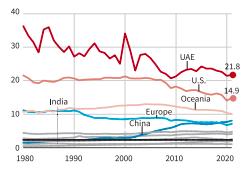
Chart shows the carbon dioxide emissions per capita emitted in 19802021 by various geographical Regions. It also shows (as a fixed black line) a baseline target of carbon dioxide emissions (2.3 tonnes per capita) needed to limit global warming to 1.5° Celsius. The global average emissions per capita is currently double this target, and has stayed above 4.7 tonnes per capita since 2010, whereas Africa and India have both been consistently under. China crossed the global average in 2004.
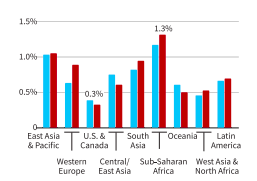
It shows the total investment in climate related activities as a fraction of that region’s total GDP in 2019 and 2020. This includespublic and private investment. In both years, Sub Saharan Africa had the highest investment fraction in climate finance (1.3% ofits GDP), followed by East Asia and the Pacific (1%) and South Asia (0.9%). The U.S. and Canada had the lowest proportionate investment, at only 0.3% of their GDP.
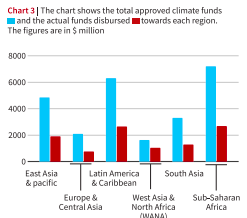
It shows the total approved funds and theactual funds disbursed towards each region. Since 2003, for example, $3.3 billion was approved to be disbursed to South Asia, but only $1.3 billion was actually disbursed. Most regions received only 40% of the approved funding for that region, on average.
CHALLENGES IN CLIMATE FINANCE
Definitions & reporting of climate finance: Even 10 years after COP 15, there is no general agreement on what form of funding can be counted as climate finance under the GCF in support of the Copenhagen pledge. Even 7 years after the Paris Climate Deal, there is no agreement regarding definition of climate finance.
Insufficient Amounts: For instance, global annual fossil fuel subsidies together with their externalities cost about $5.3 trillion. Experts have suggested that even $100b/year pledge is not sufficient to tackle the issue.
Climate Finance Governance: Equally challenging is how international climate change funding should be effectively governed and delivered to developing countries.
Reporting and Verification: Currently there is a lack of mandatory verification mechanism in reporting. Reporting requirements around the projected financing provisions remain weak.
Conclusion
Countries in Sub Saharan Africa, Latin America, and South Asia have historically contributed the least to global warming; yet, they are bearing the bigger brunt of climate disasters – both in the form of extreme natural phenomena and debt distress. On the other hand, countries in North America and Europe have contributed and continue to contribute the most, and are also the creditors of the debt crisis.
Context: India's Computer Emergency Response Team issued an alert for ransomware called Akira. The ransomware, found to target both Windows and Linux devices, steals and encrypts data, forcing victims to pay double ransom for decryption and recovery.
About Ransomware
It is a type of malicious software (malware) designed to block access to a computer system or data until a ransom is paid to the attacker.
Its attacks can target individuals, businesses, or even government organizations. It has quickly become the most prominent and visible type of malware.
It is typically spread through spear phishing emails that contain malicious attachments in the form of archived content (zip/rar) files.
Other methods used to infect devices include drive-by-download, a cyber-attack that unintentionally downloads malicious code onto a device, and specially crafted web links in emails, clicking on which downloads malicious code.
It also spreads through insecure Remote Desktop connections.
About Akira Ransomware:
It is designed to encrypt data, create a ransomware note and delete Windows Shadow Volume copies on affected devices.
The ransomware gets its name due to its ability to modify the filenames of all encrypted files by appending them with the akira extension.
The ransomware is designed to close processes or shut down Windows services that may keep it from encrypting files on the affected system.
It uses Virtual Private Network (VPN) services, especially when users have not enabled two-factor authentication, to trick users into downloading malicious files.
Mechanism of Akira ransomware
The ransomware deletes the Windows Shadow Volume copies on the affected device. These files are instrumental in ensuring that organisations can back up data used in their applications for day-to-day functioning.
Volume Shadow Copy Service (VSS) facilitates communication between different components without the need to take them offline, thereby ensuring data is backed up while it is also available for other functions. Once the ransomware deletes the VSS files it proceeds to encrypt files with the pre-defined the akira extension.
The ransomware also terminates active Windows services using the Windows Restart Manager API, preventing any interference with the encryption process. It is designed to not encrypt Program Data, Recycle Bin, Boot, System Volume information, and other folders instrumental in system stability. It also avoids modifying Windows system files with extensions like .syn. .msl and .exe.
Once sensitive data is stolen and encrypted, the ransomware leaves behind a note named akira_readme.txt which includes information about the attack and the link to Akira’s leak and negotiation site.
Each victim is given a unique negotiation password to be entered into the threat actor’s Tor site. Unlike other ransomware operations, this negotiation site just includes a chat system that the victim can use to communicate with the ransomware gang.\
Prevention measures against Akira Ransomware
CERT-In has advised users to follow basic internet hygiene and protection protocols to ensure their security against ransomware. These include:
Maintaining up-to-date offline backups of critical data, to prevent data loss in the event of an attack.
Update all operating systems and networks regularly, with virtual patching for legacy systems and networks.
Companies must establish Domain-based Message Authentication, Reporting, and Conformance, Domain Keys Identified Mail (DKIM), and Sender policy for organizational email validation, which prevents spam by detecting email spoofing.
Strong password policies and multi-factor authentication (MFA) must be enforced.
There should also be a strict external device usage policy in place and data-at-rest and data-in-transit encryption along with blocking attachment file types like .exe, .pif, or .url to avoid downloading malicious code.
Periodic security audits of critical networks/systems, especially database servers.
Context: The digital payments system in India has grown significantly in recent years. From June 2021 to April 2023, UPI payments grew at an average monthly rate of 6%. The corresponding figures for NEFT, IMPS, and debit card payments were 3%, 3%, and 1.5%, respectively. This indicates that the popularity of UPI increased at a faster rate than all other modes of payment.
Gaps in Financial Inclusion
Number of Inactive-Account: India has the highest share of inactive accounts in the world compared to all the other countries in the database. Of those with bank accounts, 38% have inactive accounts. This might be an outcome of the push for Jan Dhan accounts. Zero-balance accounts were opened to meet official targets, but have been lying dormant since then.
Rural- Urban Divide:
While there is no urban-rural divide or income group divide in the possession of bank accounts, differences are evident when we consider the share of inactive accounts. While 31% of the population in rural areas have an inactive account, the share in urban areas is 23%.
If we look at the rural-urban gap in digital payments, India again stands out with only 30% of Indians in rural areas made or received any digital payment in 2021 as opposed to 40% in urban areas.
This again indicates that a substantial share of the population has been bypassed.
Rich-Poor Divide: Similarly, if we consider the poorest 40% of Indians, 35% of them have inactive bank accounts, whereas the corresponding figure for the richest 60% of the population is 22%.
% of Population Carrying Digital Transactions: While the popularity of UPI has increased substantially in recent years, only 35% of the population reported carrying out any digital transaction (making or receiving a payment) in 2021. While this was an improvement from previous years (22% in 2014 and 29% in 2017), India’s figures are unimpressive when compared to the average of 57% for all developing countries and the world average of 64%.
Gender Divide: Although digital transactions have grown in value and volume, their growth has not been equal. There is a sharp gender gap in digital transactions. While 41% of the male population carried out any digital transaction in 2021, the corresponding figure among women was only 28%. Also, more women have inactive accounts as compared to men (32% versus 23%). India’s figures are also lower overall compared to the figures in Brazil and Kenya, which are at comparable levels of development.
Further Initiatives Required to Improve Digital Payments Ecosystem
Awareness and Education: Many consumers are still wary about using digital payments and technology; hence companies need to educate their customers on the security advantages of digital payments in a more traditional manner.
Internet Penetration & Mobile Phone Accessibility: Currently, internet and mobile phones accessibility at rural and remote areas is poor, hence government and stakeholders involved need to take initiatives in improving internet penetration.
Incentives and Rewards: More consumers will switch to digital payments if they receive higher rewards and redeeming rewards with simplicity and faster
Conclusion
Therefore, while India has made big strides, it still has a long way to go in becoming ‘Digital India’.
Context: In July, Sam Altman, CEO of OpenAI, formally re-introduce Worldcoin, a project of his that was eclipsed by the popularity of ChatGPT.
About Worldcoin project
It is a crypto project that aims to create a global identity and financial network for everyone. It is an initiative to create a digital network in which everyone can claim some kind of stake, and join the digital economy.
It uses a device called an orb, Worldcoin volunteers known as ‘Orb operators’ that scan a person’s iris pattern to collect their biometric data and help them get a World ID through the World app.
With the app, scanned participants can collect a cryptocurrency called Worldcoin (WLD) at regular intervals or make transactions with their World ID where possible. This process is called proof of personhood and makes sure that people do not sign themselves up multiple times in exchange for crypto.
It was co-founded by Altman and Alex Blania in 2019 to provide every human being on Earth with a share of its digital token.
It uses a technology known as zero-knowledge proofs (ZKPs) to maintain user's privacy and user data was encrypted.
Individuals who want to receive a World ID are not required to share their name, phone number, email address, or home address.
Images collected by the Orb are used to generate a unique iris code. By default, these images are immediately deleted once the iris code is created, unless the user opts into Data Custody.
Working of Worldcoin
Users need to be willing to scan irises and/or get their own irises scanned. Volunteers sign up to be “Orb operators” in their locality and receive basic training and a biometric device with which to scan irises.
The scan is converted into a string of numbers known as a hash in such a way that it’s impossible to recreate the scanned image even if the hash is compromised.
The Orb sends the iris hash and a hash of the user’s public key to Worldcoin servers. If the person hasn’t signed up before, the hashes are added to the database and the company’s Ethereum blockchain.
Challenges to Worldcoin
Concerns exist about the privacy and security of biometric data and potential misuse for other purposes because it might be shared with third parties such as vendors, service providers like banks, or even the police and government when necessary.
Recently, according to a TechCrunch report, hackers installed password-stealing malware on the devices of multiple Worldcoin Orb operators, granting them complete control over the operators’ dashboards. This raises concerns about the security and privacy of the iris-scanning technology.
Questions arise about the feasibility and scalability of reaching unbanked or underbanked populations.
Doubt on the value and utility of the Worldcoin token, and whether it can compete with other cryptocurrencies or fiat currencies.
Global expansion of Worldcoin
During its initial rollout phase, the Worldcoin project plans to offer its services in 35 cities spanning 20 countries, showcasing its dedication to providing inclusive digital identities to people worldwide.
India has taken a significant step forward in embracing Worldcoin's identity verification technology. With 18 locations already equipped with the Orb device for sign-up, the country serves as a prominent and crucial testing ground for this innovative endeavor.
Context: According to latest data from the Bureau of Energy Efficiency (BEE), Ministry of Power, inverter ACs accounted for less than 1 per cent of the overall room AC (RAC) market of 4.7 million units in the financial year 2015-16 (FY16). As of FY23, the share has increased to 77 per cent, while the fixed-speed RACs went down to 23 per cent.
What is Energy conservation act 2001?
Government of India enacted the Energy Conservation (EC) Act, 2001 to realize the benefits of energy efficiency through reduced energy consumption.
The Act provides the legal framework, institutional arrangement and regulatory mechanism to embark upon an energy efficiency drive in the country.
Energy efficiency institutional practices and programs in India are being guided through various voluntary and mandatory provisions of the Act.
The Government of India set up Bureau of Energy Efficiency (BEE), also referred to as 'BEE' or 'Bureau' on 1st March 2002 under the provisions of the EC Act, 2001.
The mission of the Bureau is to assist in developing policies and strategies with a thrust on self-regulation and market principles, within the overall framework of the EC Act, 2001 with the primary objective of reducing energy intensity of the Indian economy.
What is Standards & Labeling Program?
The objective of the S&L program is to help consumers make an informed choice about various energy-consuming appliances, in terms of energy savings, that would result based on each appliance’s energy efficiency performance.
This scheme also helps the consumer determine the cost-saving potential of the marketed household and other equipment.
The broad objective of the scheme is:
To reduce the end-use energy consumption of appliances without diminishing the service levels.
To create awareness amongst the consumers, to make an informed decision considering the cost-effectiveness & energy performance while purchasing appliances.
To monitor and verify energy savings that incur annually through the sale of energy-efficient appliances
The scheme was launched by the Hon'ble Minister of Power in May 2006 and is currently invoked for 30 appliances/equipment.
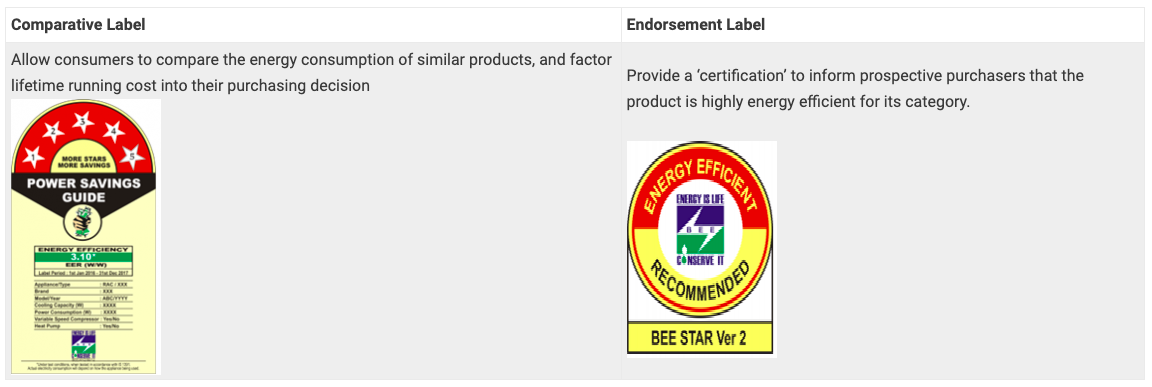
A star rating, ranging from 1 to 5 in the ascending order of energy efficiency is provided to products registered with the Bureau. An endorsement label is also provided for some products.
What is a label?
Describes energy performance (in the form of energy use, efficiency or energy cost)
“Labels” mainly give consumers the necessary information to make informed purchase.
There are two types of labels:
a) Comparative label : allow consumers to compare efficiency of all the models of a product in order to make an informed choice. It shows the relative energy use of a product compared to other models available in the market.
b) Endorsement label : define a group of products as efficient when they meet minimum energy performance criteria specified in the respective product schedule/ regulation/statutory order.
Mandatory appliances
Voluntary appliances
Frost free refrigerator
Side by Side/Multi Door Refrigerator
Stationary Storage Type Electric Water Heater
Solar water heater
Colour Television
Computer
Room Air Conditioner (Variable Speed)
Washing machines
Tabular fluorescent lamps
Micro wave oven
LED lamps
Hi energy Li batteries
Deep freezers
Chillers
Ultra high definition televisions
Tyres
Room air conditioners
Domestic gas stove
Ceiling fans
Pedestal fan, table/walled fan
Direct cool refrigerator
Diesel generator set
Distribution transformer
Submersible Pump Set
Diesel Engine Driven Monoset Pumps for Agricultural Purposes
Context: The Union Minister of Environment, Forest, and Climate Change launched the Resource Efficiency Circular Economy Industry Coalition (RECEIC). As part of this, 39 multinational corporations (MNCs) from various sectors came together to pledge to adopt resource efficiency and circular economy principles.
About RECEIC:
The Coalition, conceptualised by India’s G20 Presidency, is envisaged to be industry driven and a self-sustaining initiative continuing to function even beyond India’s G20 Presidency.
The mission is to facilitate and foster greater company-to-company collaboration, build advanced capabilities across sectors and value chains, bring learnings from diverse and global experiences of the coalition members, unlock on-ground private sector action to enhance resource efficiency, and accelerate the circular economy transition.
The coalition is structured around the three guiding pillars of partnerships for impact, technology cooperation, and finance for scale.
It also aims to contribute towards progress on key global goals and priorities set by the G20 and other international fora.
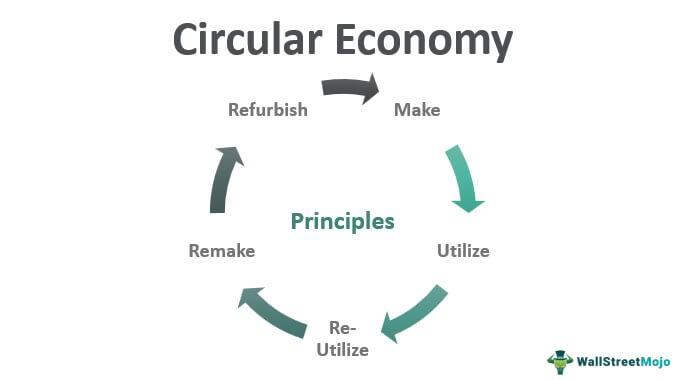
About Circular Economy
The circular economy is an economic model that aims to create a more sustainable and regenerative system by minimizing waste and resource consumption. It is a departure from the traditional linear economy, which follows a "take-make-dispose" pattern, leading to the depletion of natural resources and accumulation of waste.The focus is on keeping products, materials, and resources in use for as long as possible.
Benefits of Circular Economy
Protection of the environment: By lowering emissions, consuming fewer natural resources, and producing less trash.
Benefits for the local economy: By encouraging production models that rely on the reuse of nearby waste as raw material.
Drives employment growth: It fosters the development of a new, more inventive, and competitive industrial model, resulting in higher economic growth and more employment.
Promotes resource independence: Reusing local resources can reduce reliance on imported raw materials.
Government Initiative to Promote Circular Economy
The Government has been actively formulating policies and promoting projects to drive the country towards a circular economy. It has already notified various rules, such as the Plastic Waste Management Rules, e-Waste Management Rules, Construction and Demolition Waste Management Rules and Metals Recycling Policy
To promote the usage of fly ash and slag produced in the steel industry in other sectors by NITI Aayog. NITI organized an international conference on ‘Sustainable Growth through National Recycling’; prepared a strategy paper, along with the EU delegation to India, on ‘Resource Efficiency’, and four more on resource efficiency in the sectors of steel (with the Ministry of Steel), aluminium (with the Ministry of Mines), construction and demolition (with the Ministry of Housing and Urban Affairs) and e-waste (with the Ministry of Electronics and Information Technology).
Context: The elevated levels of India’s fiscal deficit and public debt have been a matter of concern for a long time in India. Even before the COVID-19 pandemic, debt levels were among the highest in the developing world and emerging market economies. The pandemic pushed the envelope further and relative to GDP, the fiscal deficit in 2020-21 increased to 13.3% and the aggregate public debt to 89.6%.
Consequences of Large Fiscal Debt
Crowding out of Capital Expenditure: On an average, interest payments constitute over 5% of GDP and 25% of the revenue receipts. As a result, large interest payments crowd out the much-needed expenditures on physical infrastructure and human development and emerging priorities to make the green transition.
Reduced Ability of Government in Responding to Shocks: High levels of debt make it difficult to calibrate counter-cyclical fiscal policy and constrain the ability of the government to respond to shocks.
Curtailed Lending to Manufacturing Sector: The debt market in India is largely captive with mainly the commercial banks and insurance companies participating in it to meet statutory liquidity ratio (SLR) requirements. With a cash reserve ratio (CRR) of 4.5% and SLR of 18% of net demand and time liabilities, and 40% of the credit by the commercial banks earmarked for the priority sector, the resources available for lending to the manufacturing sector gets squeezed, driving up the cost of borrowing of the sector.
Rising Costs of External Borrowings: The rating agencies keep the sovereign rating low when deficits and debt are higher, and this increases the cost of external commercial borrowing.
Negatively Affects Intergenerational Parity: The burden of large deficits and debt will have to be borne by the next generation through higher tax liabilities.
Increasing Revenue Receipts: By a means of improved tax administration and compliance, the aggregate tax-GDP ratio may be increased by 1.5 percentage to 2 percentage points in the medium term.
Rethinking the Role of the State: This requires disinvestment of fiscally laggard corporations such as Bharat Sanchar Nigam Limited.
Check on Fiscal Populism: At the State level, it is important to guard against the return to the old pension scheme and indulge in large-scale giveaways for electoral reasons. Redistribution is a legitimate government activity, and it should be done through cash transfers rather than subsidising commodities and services.