Exit from business is as integral to ease of doing business as is an entry. Earlier frameworks for resolution, such as the Debt Recovery Tribunals, the Lok Adalats and even the Securitisation and Reconstruction of Financial Assets and Enforcement of Securities Interest Act (SARFAESI Act) of 2002, which sought to ease the process of resolution or liquidation failed to do the task effectively. It was in this context that the government decided to frame and enact the Insolvency and Bankruptcy Code (IBC) of 2016.
Objective: The IBC, which came into existence in 2016, aimed to create a single, comprehensive framework that would provide a time-bound and cost-effective process for resolving insolvency and bankruptcy.
Institutional framework:
Process:
The IBC seeks to achieve the stated objectives through a well-defined process that includes various stages, including initiation of insolvency, appointment of an insolvency professional, resolution plan, and liquidation.
In case the application is admitted by the adjudicating authority, a moratorium is declared on all the legal proceedings against the debtor until the completion of the CIRP.
If either the Resolution plan is rejected by the CoC or failed to be approved by it with in 330 days, the process of liquidation kicks in automatically.
A resolution professional is appointed by the NCLT who supersede the board of directors of the debtor company and supervises its assets.
The proceeds of liquidation are distributed among secured creditors, unsecured creditors, Govt dues, Preferential share holders etc. in the respective order of priority.
The Resolution Professional would help in chalking out a resolution plan and get it approved by the committee of creditors (CoC) with a majority of 66%.
Performance:
The apprehension of losing the business to the resolution applicant in the event of a successful CIRP or the eventual liquidation has instilled a sense of fear in the minds of the Corporate Debtors. This has resulted in improvement in the corporate repayment culture of the bank loans and resultant reduction in the nonperforming assets (NPAs) of the banks in the recent years despite the adverse impact of COVID-19 pandemic on the trade and economy of the country.
Successful examples:
In Essar Steel resolution, the creditors managed to recover 925 of ₹49,000 crore of debt outstanding.
In Bhushan Steel case, 64% of ₹56,022 crore outstanding was retrieved, whereas Binani Cements in whose case all of the ₹6,469 crore outstanding was recovered.
However,
Out of the 4,376 cases for which the Corporate Insolvency Resolution Process (CIRP) had commenced till now, only 2,653 have been closed, with just 348 (or 13.1 per cent) of those closed being disposed after approval of a debt resolution plan.
If we consider the proportion of outstanding credit recovered from defaulters through the resolution process, the figure stands at 39.26% even for the minority of cases resolved through the CIRP, which is not very much higher than the 26 per cent registered for cases dealt with under the SARFAESI Act. The argument that the IBC would be a game changer is yet to be validated.
Challenges:
Backlog of cases in the NCLT, which has led to delays in the resolution process. The proportion of NCLT benches to the high number of cases are imbalanced.
Another challenge is the lack of infrastructure and trained professionals to manage the insolvency process. At present, there are less than 100 registered insolvency professionals.
Due to the lack of need for minimum experience in handling and managing a company, one might question the ability of the resolution professional.
The time limit of 330 days to complete CRIP is proving to be very difficult. For companies having a large number of creditors, will have hindrances in the smooth functioning of the creditor’s committee.
No strict liability of directors for wilfully delaying /concealing insolvency of company
To address these challenges, the government has taken several measures, including increasing the number of NCLT benches, increasing the number of insolvency professionals, and amending the IBC to address practical challenges.
Way forward:
The process of mediation be institutionalised and appropriately integrated in the CIRP Regulations with adequate provision to exclude the time taken in the mediation process while reckoning the completion of CIRP within the stipulated timeframe of 180, 270, or 330 days.
Setting up of additional benches of NCLT and National Company Law Appellate Tribunal may be taken on priority to bring down the pendency and adhering to the stipulated timelines.
Despite certain challenges faced so far, it deserves to be recognised that the IBC has significantly contributed to consistent improvement in India’s ranking in the World Bank’s erstwhile ‘Ease of Doing Business’ over the years. Timely changes/modifications of the existing legislation and expanding to new areas (group insolvency, pre-pack process for all assets, cross-border insolvency regime) would facilitate overall improvement in the insolvency resolution regime of the country.
Context:Incidents of bank frauds, without two factor authentication, have been reported across India, with cybercriminals using silicone thumbs to operate biometric ATMs and POS devices.
What is AePS?
AePS, or Aadhaar enabled Payment System, is a payment system that enables customers to carry out financial transactions through Aadhaar-based authentication at Point of Sale (PoS) devices and micro ATMs.
Aadhaar is a unique identification number containing demographic and biometric data issued to Indian residents.
With the help of biometric authentication methods like fingerprint or iris scans, customers can use their Aadhaar number to access various banking services, including cash withdrawals, balance inquiries, fund transfers, and other banking transactions.
The National Payments Corporation of India (NPCI) introduced the AePS system to promote financial inclusion and make banking services accessible to all, particularly those living in remote and rural areas.
Benefits of AePS:
Financial inclusion: AePS enables individuals who do not have access to traditional banking services to carry out financial transactions. This promotes financial inclusion and ensures that everyone has access to basic banking services.
Streamlining Government Entitlements: Aadhaar enabled Payment System facilitate disbursements of Government entitlements like NREGA, Social Security pension, Handicapped Old Age Pension etc. of any Central or State Government bodies using Aadhaar authentication.
Convenience: AePS allows users to carry out financial transactions using their Aadhaar number and biometric authentication. It eliminates the need for carrying cash or a physical debit card, making transactions more convenient and hassle-free.
Security: Since transactions on AePS are authenticated using biometric authentication, it is more secure than traditional banking services that rely on passwords and PINs. It ensures that transactions are safe and secure.
Low-cost transactions: AePS transactions are low-cost, making it an affordable option for individuals who want to carry out financial transactions.
Easy to use: AePS is easy to use and does not require any special training or knowledge. Users can carry out transactions using their Aadhaar number and biometric authentication, which is a simple and straightforward process.
Inter-operability: Aadhaar enabled Payment System facilitates inter-operability across banks in a safe and secured manner.
Reaching the unreached: The model enable banks to extend financial services to the unreached clients beyond their branch network as beneficiaries of the Business Correspondents (BCs) are mostly located at unbanked and underbanked areas.
Context: The Reserve Bank of India’s switch/conversion auction of government securities (G-secs) of Rs 20,000 crore remained undersubscribed. as liquidity remained tight and banks demanded higher yields.
Why this trend?
The overall liquidity (cash) in the system is stable at a lower level of just about Rs 50,000 crore. There is clearly a strain in the market in terms of liquidity not being evenly distributed and there are shortfalls in the liquidity of some banks.
Switches and conversions have been used to defer payments due in the next couple of years, with the maturities being stretched. This reduces pressure on the market in terms of fresh borrowings being needed.
Liquidity (cash) demand of the banking sector was around 1.5 lakh crore, however, it was narrowed down to 80,000 crore. Lower cash with the banking sector left overnight call money rates being pushed above the benchmark level. This led to tightening of liquidity.
About Government Securities
A Government Security (G-Sec) is a tradable instrument issued by Central or State governments. It acknowledges the Government's debt obligation.
RBI As Debt Manager:
RBI Act mandates RBI to undertake receipts and payments of Central Government and carry out banking and management of public debt of Union.
State Government transactions are carried out by RBI in terms of an agreement entered by RBI and State Governments under RBI Act. As of now, such agreements exist between RBI and all State Governments except Sikkim.
Thus, RBI is banker and debt manager of government.
RBI issues both, treasury bills and bonds or dated securities on behalf of Central Government while the State Governments issue only bonds or dated securities, which are called the State Development Loans (SDLs).
Types Of Government Securities:
Short Term Government Securities(maturity less than 1 year)
Treasury bills: Money market instruments issued by GoI. Presently, issued in three tenors of 91 days, 182 days and 364 days.
Cash Management bills: Issued by GoI to meet temporary mismatches in cash flow of GoI. They are like T-bills but are issued for maturities less than 91 days.
Long Term Government Securities (Maturity more than 1 year):
Dated G-Secs: They are securities which carry a fixed or floating coupon (interest rate) which is paid on face value, on a half-yearly basis. Tenor ranges between 5 to 40 years.
Fixed Rate Bonds: These are bonds on which the coupon rate is fixed for the entire life (i.e., till maturity) of the bond. Most Government bonds in India are issued as fixed rate bonds.
Floating Rate Bonds: FRBs are securities which do not have a fixed coupon rate. Instead, it has a variable coupon rate which is re-set at pre-announced intervals (say, every six months or one year).
Auction Of Government Securities
G-Secs are issued through auctions conducted by RBI. Auctions are conducted on the electronic platform called the E-Kuber, the Core Banking Solution of RBI.
Members of e-KUBER: Commercial Banks, Scheduled Urban Cooperative Banks, Primary Dealers, Insurance Companies and Provident Funds, who maintain funds account (Current Account) and securities account (Subsidiary General Ledger account) with RBI.
All members of E-Kuber can place their bids in the auction through this electronic platform.
Types Of Auctions
Rate of interest (coupon rate) gets fixed through amarket-based price discovery process.
Yield Based Auction: is generally conducted when a new G-Sec is issued. Investors bid in yield terms. Bids are arranged in ascending order and cut-off yield is arrived at the yield corresponding to the notified amount of the auction. The cut-off yield is then fixed as the coupon rate for the security. Successful bidders are those who have bid at or below the cut-off yield.
Price Based Auction: is conducted when G-Sec which has already been issued is being reissued. Bidders quote in terms of price per Rs 100 of face of the security. Bids are arranged in descending order of price offered and the successful bidders are those who have bid at or above the cut-off price.
Allocation Of Government Securities
Depending upon the method of allocation to successful bidders, auction may be conducted on Uniform Price basis or Multiple Price basis:
Uniform Price Method: All the successful bidders are required to pay for the allotted quantity of securities at the same rate, i.e., at the auction cut-off rate, irrespective of the rate quoted by them.
Multiple Price Method: Successful bidders are required to pay for the allotted quantity of securities at the respective price/yield at which they have bid.
Types Of Bidding
Competitive Bidding: In a competitive bidding, an investor bids at a specific price/yield and is allotted securities if the price/yield quoted is within the cut-off price/yield. Competitive bids are made by well-informed institutional investors such as banks, financial institutions, primary dealers, mutual funds and insurance companies. Multiple bidding is also allowed, i.e., an investor may put in multiple bids at various prices/yield levels.
Non-Competitive Bidding: To encourage wider participation and retail holding of Government
securities, retail investors are allowed participation on ‘non-competitive’ basis in select auctions of dated G-Secs and Treasury bills (5% of notified amount). Retail investor is any person including individuals, firms, companies, corporate bodies, institutions, provident funds, trusts and any other entity as prescribed by RBI.
RBI’s Retail Direct Scheme:
It is a comprehensive scheme which provides a one-stop solution to facilitate investment in Government Securities by individual & retail investors through an online portal. It aims to provide a safe, direct and secured platform to investors.
Under this scheme, retail individual investors will be able to open a Gilt Securities Account - Retail Direct Gilt (RDG) Account with RBI, using an online portal (rbiretaildirect.org.in).
Using the Retail Direct Platform, individual investors can participate in
T-Bills
Dated G-Sec
State Development Loans (SDLs)
Sovereign Gold Bonds (SGB)
Investments can be made using following routes:
Primary issuance of government securities: Investors can place bid as per the non-competitive scheme for participation in primary auction of government securities and procedural guidelines for sovereign gold bond issuance.
Secondary market: Investors can buy and sell government securities on NDS-OM.
Using the RDG account, individuals can buy Government Securities in primary market (auctions) and buy/sell in secondary market.
Context: Researchers at IIT-Madras have developed an improved flow battery technology using a new type of organic electrolyte, pyrylium.
About Flow Batteries
Flow batteries are a type of rechargeable electrochemical batteries in which electrolyte flows through one or more electrochemical cells from one or more tanks.
Simply speaking, energy is stored in two liquid electrolytes in separate tanks in flow batteries.
Mechanism: When we charge, the energy supplied urges electrons from the electron poor side to move to the electron rich side, creating a potential difference. During discharge, the reverse happens i.e., electrons flow from the electron rich side to the electron poor side.
Conversion of energy from chemical to electrical energy happens in a cell, which is split into two-halves by a membrane.
Electrolytes used:
Vanadium is used as an electrolyte as it is capable of existing in four ionic species – with two, three, four or five (positively charged) protons.
Zinc-bromine (ZNBR): they use zinc and bromine ions to store electrical energy.
Iron-Chromium electrolytes
Proton exchange membrane (PEM): Use a proton-conducting membrane to separate positive cathode and negative anode electrodes.
Organic electrolytes
Advantages of flow batteries
Long-lasting: Do not show performance degradation for 25-30 years.
Modular & scalable: Capable of being sized according to energy storage needs with limited investment. Energy storage capacity can be increased by simply raising the volume of electrolyte tanks. Also, if we want to store more power, one can just add more cells in the cell stack.
Low cost: Battery can be constructed using low cost & readily available materials such as thermoplastics and carbon-based materials.
Suitable for grid-scale storage: Flow batteries can come handy in large storage applications, especially in maintaining grid stability and can come handy in increasing renewable energy penetration.
Slow discharge: Flow batteries can store power for long durations. This is significant for storing seasonal renewable energy such as wind.
Safety: Low flammability and low environmental impact.
Robust: Overcharging & fully discharging does not usually cause permanent damage to the electrode or electrolytes.
Electrolytes can be used as a heat management strategy for the battery which reduces the need for complex heating or cooling of battery system.
Full recycling of electrolytes.
Challenges associated with flow batteries
High cost of vanadium
Low-energy density
Low charge and discharge rates
Lower energy efficiency
Cross-over: This is a phenomenon when a positive electrolyte travels through the membrane separator and travels into the negative electrolyte. This leads to automatic discharge.
Improved Flow Battery Technology Developed by IIT-Madras
Researchers at Indian Institute of Technology Madras have developed a ‘non-aqueous all-organic redox flow battery (NORFB)’ which leads to improved performance by flow batteries.
Conventional flow batteries employ aqueous (water-based) electrolytes like hydrochloric acid, sulphuric acid and alkali metal hydroxides.
Water based electrolytes leads to following issues:
Water interferes with undergoing electrolysis reducing operating voltage limit and energy density (amount of energy per unit volume or gram).
Water based electrolytes corrode battery components.
Pyrylium electrolytes: To address the situation scientists have been looking for non-aqueous and organic electrolytes. In this respect, researchers at IIT-Madras have developed a new-type of electrolyte using ‘pyrylium salts’ (a class of organic compounds). Pyrylium allows high-voltage operations allowing more flow batteries to store more energy and more current density.
Context: A Memorandum of Agreement (MoA) was signed between the Indian Council of Medical Research (ICMR) and the Ministry of AYUSH for collaboration and cooperation in health research in the field of Integrated Medicine.
Integrated Medicine:
Integrated medicine in India refers to the practice of combining traditional Indian medicine systems, such as Ayurveda, Yoga, Unani, Siddha, and Homeopathy (AYUSH), with modern medicine.
The aim is to provide patients with a holistic approach to healthcare that takes into account physical, mental, emotional, and spiritual aspects of health. By combining different therapies, healthcare providers can tailor treatment plans to individual patients and provide more effective care.
In India, the government has established the Department of Ayurveda, Yoga and Naturopathy, Unani, Siddha, and Homoeopathy (AYUSH) to promote the integration of traditional Indian medicine with modern medicine.
Major Highlights:
Ministry of AYUSH and ICMR have joined hands to undertake quality human clinical trials to generate evidence on the benefits of using ayurveda along with modern medicine (evidence-based medicine) in treating certain disease conditions of national importance.
ICMR will design and conduct these trials as it holds decades of experience in conducting human clinical trials.
In the initial phase, the collaboration will be restricted to Ayurveda. The other systems of AYUSH — Yoga, Unani, Siddha and Homoeopathy — may be included in future, and each system will be tested together with modern medicine when the central councils of the respective AYUSH systems are ready to work with the ICMR.
An expert committee will soon decide the area/disease conditions to be included for detailed clinical testing using both Ayurveda and modern medicine.
Significance:
Scientific validation of superior outcomes of combined therapy using Ayurveda and modern medicine and aid the development of integrated medicine.
The initiative may right away not provide scientific validation of Ayurveda interventions in treating disease conditions, but it is the first major step in an evidence-based approach to validate medical interventions.
Encouraging trial outcomes might probably serve as a starting point to undertake further trials using Ayurveda interventions alone to evaluate their effectiveness and understand the mechanism of action.
Strengthen the country's health infrastructure by integrating and mainstreaming AYUSH.
Reasons for non-development of alternate medicine in India:
Lack of scientific validation: Alternative medicine is often not based on scientific evidence or rigorous testing. Without proper scientific validation, it can be difficult for alternative medicine to gain acceptance in the medical community and among the general public.
Limited government support: While India has a rich tradition of alternative medicine, government support for research and development in this field, in the past has been limited, which has hindered the growth of alternative medicine.
E.g., Lack of dedicated funding mechanism for research and development of alternative medicine.
Competition from conventional medicine: Conventional medicine, including modern pharmaceuticals, is highly developed and widely accepted in India. This has made it difficult for alternative medicine to gain a foothold and compete in the marketplace.
Lack of standardization: Unlike conventional medicine, which is highly standardized and regulated, alternative medicine often lacks standardization. This can lead to inconsistencies in the quality and efficacy of alternative treatments, which can undermine public confidence in these therapies.
Skepticism among medical professionals: Some medical professionals remain skeptical about the efficacy of alternative medicine, particularly when it comes to treating serious or life-threatening conditions.
Significance of revival and fusion of traditional Indian medicine system with modern medicine:
The collaboration with the ICMR is, therefore, a step in the right direction. The recent COVID-19 Pandemic has underscored the importance of AYUSH thus calling for its revival and fusion with modern medicine for building a holistic health system, which can:
Holistic approach: Traditional Indian medicine, such as Ayurveda, focuses on a holistic approach to health and wellness. This means that it considers the individual as a whole, including physical, mental, and emotional factors. By combining this approach with modern medicine, patients can receive more comprehensive and personalized care.
Accessibility: Traditional Indian medicine is often more accessible and affordable than modern medicine. By incorporating these therapies into modern healthcare systems, it reduces out-of-pocket expenditure.
Innovation: By combining traditional Indian medicine with modern medicine, new and innovative treatments can be developed, which can lead to better healthcare outcomes for patients and advances in medical research.
Overcome the challenge of doctors’ shortage: The existing doctor-patient ratio in India is 1:1700 and the ratio improves to around 1:800 (below the WHO’s mandate of 1:1000) with the integration of the AYUSH practitioners.
Help tackle multidrug-resistant diseases such as tuberculosis, lifestyle disordersand long-term diseases. It can reduce the growing burden of non-communicable diseasessuch as cardiovascular diseases- WHO Report highlights that non-communicable diseases account for 63% of deaths in India.
Reduces the pollution in the manufacturing and waste management of allopathic medicine.
Steps to build a holistic health system:
Co-locate AYUSH facilities in hospitals and primary health centres.
Introduce bridge courses for AYUSH practitioners and health professionals for interdisciplinary learning.
Invest in research and development of AYUSH for integration with modern medicine.
Update curriculum in medical courses to integrate traditional Indian medicine system with modern medicine.
Build awareness in the Public about the benefits and limitations of integrated medicine through public health campaigns, community outreach programs, and partnerships with traditional healers and practitioners.
Context: The World Health Organisation (WHO), after the recommendation of the organisation’s emergency committee, has announced that Mpox is no longer a global health emergency.
About Monkeypox:
Mpox (monkeypox) is a viral zoonotic disease caused by the mpox virus, a member of the Orthopoxvirus genus.
Mpox is characterized by rash or skin lesions that are usually concentrated on the face, palms of the hands, and soles of the feet.
It is mainly spread to people from animals, primarily rodents and monkeys, and human-to-human transmission can occur through contact with bodily fluids, respiratory droplets, or contaminated objects.
There is currently no specific treatment for mpox, it may be treated with some antiviral drugs used to treat smallpox. Also, monkeypox is self-limiting, which means it can get better without treatment.
Context: Indigenous development of supercomputers touches new highs in India but the country still greatly lags behind global peers.
Development of supercomputers in India:
The indigenous development of supercomputers in India began in 1980 with the involvement of organisations such as BARC, C-DAC and C-DOT, among others.
The launch of the National Supercomputing Mission (NSM) in 2015 has accelerated the efforts.
Under the NSM scheme, C-DAC is aiming to install 70 supercomputers pan India.
Presently, India has 23 supercomputers — powerful computers that are primarily used for scientific and engineering work that demands ultra-high-speed computations.
The Indian government has initiated efforts to develop indigenous exascale computing capabilities through NSM by 2024.
Param-Shankh, India’s new indigenous exascale supercomputing monster from C-DAC, is set to launch in 2024.
India has developed an indigenous server, Rudra, which can meet the high-performance computing needs of government bodies and public sector undertakings.
Challenges:
In terms of supercomputing capacity, India has made commendable progress, though it still lags behind other leading nations.
As of June 2022, China boasted a staggering 173 of the world’s 500 most powerful supercomputers, while the US had 128. From India, only three systems — Param Siddhi AI (ranked 111), Pratyush (132), and Mihir (249) — made it to the list.
While exascale computing is evolving rapidly, India has no exascale supercomputers yet. India is still looking at petaflops, while India should be looking at exaflops.
Petaflops is a unit of measurement used to quantify the computational speed of a computer system. It represents the number of floating-point operations (flop) a computer can perform in one second.
One petaflop is equal to one quadrillion (10^15) floating-point operations per second.
One exaflop represents one quintillion (10^18) floating-point operations per second.
The use of supercomputers in India is currently limited to research institutions. Beyond research and academia, supercomputers have found limited adoption in the industry.
India currently lacks the infrastructure to produce the semiconductor devices required for the development of supercomputers.
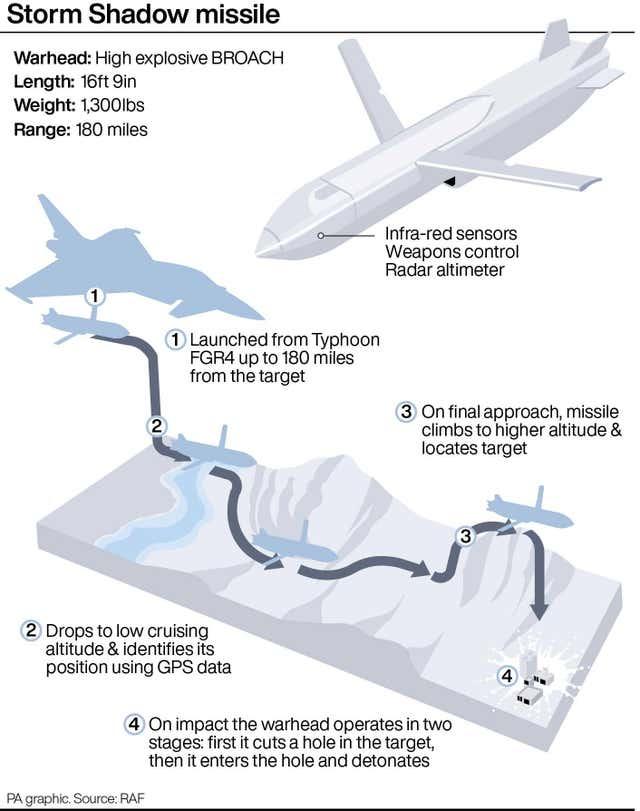
Context: The United Kingdom will provide long-range Storm Shadow cruise missiles to Ukraine which could bolster the country’s counter-offensive capabilities.
Storm Shadow Cruise missile:
Storm Shadow is a long-ranged, air-launched, conventionally armed, deep-strike supersonic missile, which is manufactured by the France-based MBDA Missile Systems.
Range: More than 250 km
It is capable of being operated day and night in all weathers and is designed to destroy high-valued stationary targets such as airbases, radar installations, communications hubs and port facilities.
It is equipped with fire-and-forget technology and offers high-precision deep strike capability as it features a sophisticated navigation system that includes inertial navigation (INS), a global positioning system (GPS) and terrain reference navigation for better control over the path.
The missile features the BROACH (Bomb Royal Ordnance Augmented CHarge) warhead — a high-technology warhead, which first cuts the surface of the target, penetrates into it and then explodes.
Context: The Central Equipment Identity Register (CEIR) system is scheduled for a pan-India launch on May 17. The Centre for Department of Telematics (CDoT) has been running the pilot project of the CEIR system in some of the telecom circles, including Delhi, Maharashtra, Karnataka, and the Northeast region.
Central Equipment Identity Register system:
CEIR is the citizen-centric portal of the Department of Telecommunications for tracing lost/stolen mobile devices.
This also facilitates for blocking of lost/stolen mobile devices in the network of all telecom operators so that lost/stolen devices can not be used in India. If anyone tries to use the blocked mobile phone, its traceability is generated. Once a mobile phone is found it may be unblocked on the portal for its normal use by the citizens.
Significance: Mobile users will be able to block and track their lost or stolen cell phones across India with the rollout of the tracking system.
Context: A baby was born in the U.K. using three persons’ DNA through a process called Mitochondrial donation treatment.
The baby, technically, has three parents- genetic material (DNA) from two biological parents and mitochondria from one donor parent (female donor). The technology was used to prevent the child from inheriting the mother’s mitochondrial disease.
What is Mitochondria?
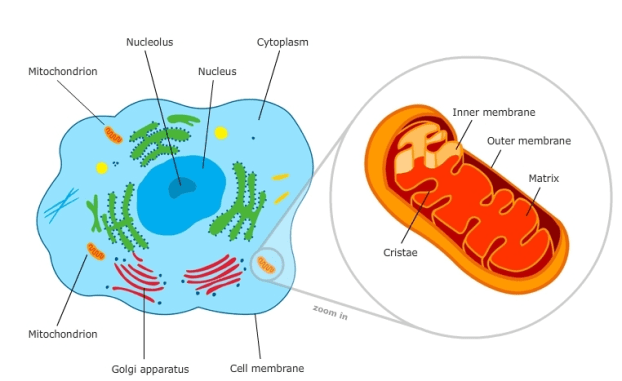
Mitochondria are tiny organelles inside cells that are often referred to as the powerhouses of the cell.
Mitochondria occur in large numbers in most of our cells, except for red blood cells.
It converts the energy molecules which we get from food to usable energy molecules called ATP (Adenosine triphosphate) through a process known as cellular respiration.
Mitochondrial disease:
Mitochondria generate energy and thus are responsible for cell function in the human body. However, when the mitochondria are impaired they do not produce sufficient energy which affects how organs function.
Faulty mitochondria can cause inherited conditions such as fatal heart problems, liver failure, brain disorders, blindness and muscular dystrophy. The diseases that arise out of such mitochondrial mutations are called mitochondrial diseases.
Mitochondrial diseases are only passed on by the mother.
The symptoms get more pronounced as a child grows, and there is no cure for mitochondrial DNA disease at present.
Some estimates put the incidence of mitochondrial diseases as one in 5,000 people.
Mitochondrial Donation Treatment:
Mitochondrial donation involves replacing unhealthy mitochondria in the mother with healthy mitochondria from a donor during the in vitro fertilisation (IVF) process.
Mitochondria have their own DNA, distinct from that in a cell's nucleus. It does not influence appearance, personality or other human characteristics.
The process:
Through the IVF technique, the baby’s biological father’s sperm was used to fertilise the eggs from the biological mother, who has mitochondrial disease, and a third, female donor with clear mitochondria, separately.
Then, the nuclear genetic material from the donor’s egg was removed and replaced with the genetic material from the biological parents.
The final product — the egg — which has the genetic material (DNA) from the parents, and the mitochondria from the female donor, is implanted in the uterus and carried to full term to yield a baby who will be free from the mother’s mitochondrial disease. This process is termed Mitochondrial Donation Treatment (MDT).
With this process, the final cytoplasm (which holds the genetic material and mitochondria) has healthy mitochondria while the genetic material belongs to the biological parents.
Side effects: While largely helpful, the procedure has some minimal risks that sometimes a small amount of the maternal mitochondria with errors may get passed on during the procedure.
Context: India’s goods exports for 2022-23 scaled up significantly from earlier estimates to almost $451 billion, indicating a 6.9% year-on-year growth. Similarly, the import bill as per the May 1 statement was pegged at $711.85 billion.
Experts have flagged petroleum shipments as the main driver for the high revisions of recent export data.
Source: PIB
Major exports from India:
Export trends in India show that the episodes of export growth accelerations are not new. India’s exports are characterized by a high rate of volatility making the growth path episodic with discrete shifts from periods of low growth to periods of high growth and vice versa. The switch between highs and lows is accompanied by dramatic changes in growth rates
India’s exports benefited majorly from the surge in global growth after two years of repressed demand owing to the pandemic. Several PLI schemes in diverse sectors, such as mobile manufacturing, electronic and textile products, automobile, and auto components have boosted domestic manufacturing and exports by helping India gain competitiveness in the global markets. Though these incentives take a few years to show their full effect, early signs of their positive impact are already visible.
Source: Ministry of Commerce and Industry
Major sector-wise exports of India include:
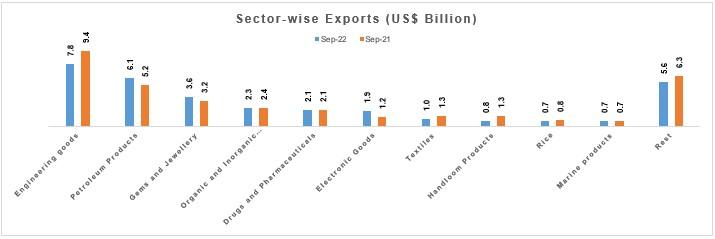
Engineering Goods: It registered exports at US$ 7.8 billion. This is primarily due to the benefits that the sector enjoys owing to the various trade agreements India has with other countries. Currently, all pumps, tools, carbides, air compressors, engines, and generators manufacturing MNC companies in India are trading at all-time highs with increased prospects of shifting production to India. It is expected to continue its upward trajectory in steel, auto components, and medical devices and India's push for Make in India.
Petroleum Products: Petroleum products have contributed in a major way to Indian export growth. They registered a growth of US$ 6.1 billion. Factors leading to the growth are rising crude oil prices which got aggravated by the post-pandemic world, demand spiking for oil, and the recent geopolitical tension.
Gems and Jewellery: Gems and jewellery made up US$ 3.6 billion of India's exports. This sector was one of the key focus areas of Indian exports and is expected to flourish more with the reduction of import duty on cut and polished diamonds and the Extension of the Emergency Credit Line Guarantee Scheme (ECLGS) for MSMEs, which make up 90% of the sector. The largest exports of gems and jewellery from India are to the United States of America (USA), United Arab Emirates (UAE) followed by the United Kingdom (UK), Germany, Singapore, the Netherlands, and many more.
Agriculture Exports:Agricultural exports were elated by the government’s push to meet the global demand for food amid the pandemic. India exported rice worth US$ 0.7 billion, the highest among agricultural commodities. The rise in the export of agricultural and processed food products has been largely due to the various initiatives taken by the government through the Agricultural and Processed Food Products Export Development Authority (APEDA) such as organizing B2B exhibitions in different countries, exploring new potential markets through product specific and general marketing campaigns by the active involvement of Indian Embassies.
Organic and Inorganic Chemicals:With strong demand from developed markets, organic and inorganic chemicals registered exports worth US$ 2.3 billion further contributing to the rise in Indian exports. The export growth of organic and inorganic chemicals has been achieved because of a surge in shipments of organic, and inorganic chemicals, agrochemicals, dyes, dye intermediates, and specialty chemicals. China is a major importer of dyes, dye intermediates, and organic chemicals from India. The USA remained the largest importer of essential oils, and inorganic chemicals while Brazil was the top importer of agrochemicals from India.
Electronic Goods: Electronic goods have also contributed massively to the export surge from India. The exports of electronic goods amounted to US$ 1.9 billion. The segment benefitted from several PLI schemes, such as the Scheme for Large Scale Electronics Manufacturing and the Scheme for the Promotion of Manufacturing of Electronic Components and Semiconductors (SPECS). As per the Union Budget economy survey of 2019-20 the integration of ‘Assemble in India for the World’ into ‘Make in India’, India can raise its export market share to about 3.5% by 2025 and 6% by 2030.
Textile and Apparel:India is among the top garment manufacturing countries in the world. India’s textile exports amounted to US$ 1 billion in September 2022. The government introduced various schemes such as the Scheme for Integrated Textile Parks (SITP), Technology Upgradation Fund Scheme (TUFS), and Mega Integrated Textile Region and Apparel (MITRA) Park scheme. In addition, Amazon India signed an MoU with the Manipur Handloom & Handicrafts Development Corporation Limited (MHHDCL). The sustainable Textiles for Sustainable Development (SusTex) project by the United Nations Climate Change will increase artisans’ engagement from Asia and especially India in the coming decade.
Drugs and Pharmaceuticals: India’s drugs and pharmaceuticals export amounted to US$ 2.1 billion, and it is the largest provider of generic medicines globally. Currently, the country has a share of 20% in the global supply volume and contributes to around 60% of the global vaccines. The USA, the UK, and Russia are among the largest importers from India with a share of 29%, 3%, and 2.4%, respectively during 2021-22. The Strengthening of Pharmaceutical Industry (SPI) scheme focuses on bolstering the existing infrastructure facility, with a total financial outlay of US$ 60 million (Rs. 500 crores).
Marine Products: India’s exports for marine products in September 2022 amounted to US$ 0.7 billion whereinIndia shipped 1,369,264 MT of seafood. Frozen shrimp remained the major export item in terms of quantity and value. The overall export of frozen shrimps during 2021-22 totalled up to 728,123 MT. The USA was the largest market for imported frozen shrimp, followed by China, European Union, South East Asia, Japan, and the Middle East.
Export Promotion Scheme
Foreign Trade Policy 2015-20 and other schemes provide promotional measures to boost India’s exports with the objective to offset infrastructural inefficiencies and associated costs involved to provide exporters a level playing field. Brief of these measures are as under:
1.1 Exports from India Scheme
i. Merchandise Exports from India Scheme (MEIS)
Under this scheme, exports of notified goods/ products to notified markets as listed in Appendix 3B of Handbook of Procedures, are granted freely transferable duty credit scrips on realized FOB value of exports in free foreign exchange at specified rate. Such duty credit scrips can be used for payment of basic custom duties for import of inputs or goods.
Exports of notified goods of FOB value upto Rs 5,00,000 per consignment, through courier or foreign post office using e-commerce shall be entitled for MEIS benefit. List of eligible category under MEIS if exported through using e-commerce platform is available in Appendix 3C.
MEIS has since been withdrawn w.e.f. 1st January, 2021. A new Scheme called Remission of Duties and Taxes on Exported Products (RoDTEP) has been introduced which shall refund the embedded duties suffered in export goods.
ii. Service Exports from India Scheme (SEIS)
Service providers of notified services as per Appendix 3D are eligible for freely transferable duty credit scrip @ 5% of net foreign exchange earned.
2. Duty Exemption & Remission Schemes
These schemes enable duty free import of inputs for export production with export obligation. These scheme consists of:-
2.1 Advance Authorization Scheme
Under this scheme, duty free import of inputs are allowed, that are physically incorporated in the export product (after making normal allowance for wastage) with minimum 15% value addition. Advance Authorization (AA) is issued for inputs in relation to resultant products as per SION or on the basis of self declaration, as per procedures of FTP. AA normally have a validity period of 12 months for the purpose of making imports and a period of 18 months for fulfillment of Export Obligation (EO) from the date of issue. AA is issued either to a manufacturer exporter or merchant exporter tied to a supporting manufacturer(s).
2.2 Advance Authorization for annual requirement
Exporters having past export performance (in at least preceding two financial years) shall be entitled for Advance Authorization for Annual requirement. This shall only be issued for items having SION.
2.3 Duty Free Import Authorization (DFIA) Scheme
DFIA is issued to allow duty free import of inputs, with a minimum value addition requirement of 20%. DFIA shall be exempted only from the payment of basic customs duty. DFIA shall be issued on post export basis for products for which SION has been notified. Separate schemes exist for gems and jewellery sector for which FTP may be referred.
2.4 Duty Drawback of Customs
The scheme is administered by Department of Revenue. Under this scheme products made out of duty paid inputs are first exported and thereafter refund of duty is claimed in two ways:
i) All Industry Rates : As per Schedule
ii) Brand Rate : As per application on the basis of data/documents
2.5 Interest Equalisation Scheme (IES)
The Government announced the Interest Equalisation Scheme @ 3% per annum for Pre and Post Shipment Rupee Export Credit with effect from 1st April, 2015 for 5 years available to all exports under 416 tariff lines [at ITC (HS) code of 4 digit] and exports made by Micro, Small & Medium Enterprises (MSMEs) across all ITC(HS) codes. With effect from November 2, 2018, the rate of Interest Equalisation for MSME has been increased to 5%. The Scheme has also been extended to Merchant Exporters who will now avail the benefit @ 3% for all exports under 416 tariff lines w.e.f. January 2, 2019.
3. EPCG SCHEME
3.1 Zero duty EPCG scheme
Under this scheme import of capital goods at zero custom duty is allowed for producing quality goods and services to enhance India’s export competitiveness. Import under EPCG shall be subject to export obligation equivalent to six times of duty saved in six years. Scheme also allows indigenous sourcing of capital goods with 25% less export obligation.
3.2 Post Export EPCG Duty Credit Scrip Scheme
A Post Export EPCG Duty Credit Scrip Scheme shall be available for exporters who intend to import capital goods on full payment of applicable duty in cash.
4. EOU/EHTP/STP & BTP SCHEMES
Units undertaking to export their entire production of goods and services may be set up under this scheme for import/ procurement domestically without payment of duties. For details of the scheme and benefits available therein FTP may be required.
5. OTHER SCHEMES
5.1 Towns of Export Excellence (TEE)
Selected towns producing goods of Rs. 750 crores or more are notified as TEE on potential for growth in exports and provide financial assistance under MAI Scheme to recognized Associations.
5.2 Market Access Initiative (MAI) Scheme
Under the Scheme, financial assistance is provided for export promotion activities on focus country, focus product basis to EPCs, Industry & Trade Associations, etc. The activities are like market studies/surveys, setting up showroom/warehouse, participation in international trade fairs, publicity campaigns, brand promotion, reimbursement of registration charges for pharmaceuticals, testing charges for engineering products abroad, etc.
5.3 Status Holder Scheme
Upon achieving prescribed export performance, status recognition as one star Export House, two Star Export House, three star export house, four star export house and five star export house is accorded to the eligible applicants as per their export performance. Such Status Holders are eligible for various non-fiscal privileges as prescribed in the Foreign Trade Policy.
In addition to the above schemes, facilities like 24X7 customs clearance, single window in customs, self-assessment of customs duty, prior filing facility of shipping bills etc are available to facilitate exports.
5.4 Gold Card Scheme
The Gold Card Scheme was introduced by the RBI in the year 2004. The Scheme provides for a credit limit for three years, automatic renewal of credit limit, additional 20% limit to meet sudden need of exports on account of additional orders, priority in PCFC, lower charge schedule and fee structure in respect of services provided by Banks, relaxed norms for security and collateral etc,. A Gold Card under the Scheme may be issued to all eligible exporters including those in the small and medium sectors who satisfy the pre-requisite conditions laid by individual Banks.
Apart from the above points, Government has recently unveiled new Trade Policy, link to which has been provided below:
Context: Hyderabad-based Grene Robotics has completed the successful acquisition of the C4ISRT platform from Apogee C4I LLP.
C4ISRT platform:
C4ISRT stands for Command, Control, Communications, Computers, Intelligence, Surveillance, Reconnaissance, and Targeting.
C4ISRT platform is typically equipped with advanced sensors and communication systems that enables it to gather and process large amounts of data from various sources, such as satellites, radar systems, and ground-based sensors.
This data is then analysed to provide situational awareness and decision-making support to military commanders to make informed decisions in real-time.
Indrajaal:
Indrajaal is India’s first indigenous drone defence dome designed and developed by Hyderabad-based technology R&D firm Grene Robotics.
The drone defence dome has the capability to autonomously protect vast areas of up to 4000 sq. km per system against aerial threats by assessing and acting on aerial threats such as Unmanned Aerial Vehicles (UAVs), loitering munitions, and Low- Radar Cross Section (RCS) targets, smart bombs, rocket showers, nano and micro drones, swarm drones etc.
ANTI-UAV systems will not only provide protection to defence bases but will be beneficial for linear infrastructures like international borders against advanced weaponry.
Salient features of Indrajaal:
Real-time situational awareness
Integrated and Intelligent meshed network
Integrated all current weapons suite and infrastructure
Honeycombed cell structure for seamlessly built
Synergic combination of 9-10 technologies
24×7 persistent and autonomous monitoring, action and tracking.
Significance:
By leveraging C4I’s deep-tech capabilities, Indrajaal will be able to detect and classify drones in real-time, provide unparalleled situational awareness and enable proactive air defence measures.