The Hindu

Ethanol Blending in Petrol

Context: As more than 100 countries at COP28 in Dubai pledged the tripling of global renewable energy capacity by 2030, India faces a tightrope walk with regard to its ethanol blending target. While ethanol blended petrol (EBP) increased from 1.6% in 2013-14 to 11.8% in 2022-23, the 20% target by 2025 has run into trouble with low sugar stocks in 2022-23 and the impending shortfall in sugarcane production this year. 

Ethanol blending:

  • Ethanol blending in petrol refers to the practice of mixing ethanol, a type of alcohol/biofuel, with petrol to create a blended fuel.
    • E10, is the most common blend, which consists of 10% ethanol and 90% petrol. 
    • E20, is a higher ethanol blend, which has 20% ethanol and 80% petrol. 
  • Ethanol is naturally produced by the fermentation of sugars by yeasts or via petrochemical processes such as ethylene hydration.
image 135

Ethanol blending target:

  • India launched its ethanol blending programme (EBP) in 2003. It is aimed at reducing the country’s dependence on crude oil imports, cutting carbon emissions and boosting farmers’ incomes.
  • The National Policy of Biofuels 2018 provided indicative targets of 20% ethanol blending in petrol and 5% biodiesel blending in diesel by 2030. 
  • Encouraged by the past 7 years performance under the Ethanol Blending Programme, the Government has advanced the targets of 20% ethanol blending in petrol from 2030 to Ethanol Supply Year (ESY) 2025-26.
    • In 2022, India’s blending programme achieved the significant milestone of 10 per cent ethanol blending in petrol.
  • In India, biofuels are primarily associated with first-generation (1G) ethanol, which is sourced from food crops like sugarcane and foodgrains.

Benefits:

  • Reduce dependence on non-renewable fossil fuels: Ethanol is often produced from renewable sources such as corn, sugarcane, or other biomass. Blending ethanol with petrol helps reduce dependence on non-renewable fossil fuels.
    • India's net import of petroleum was 185 million tonnes in 2020-21 costing USD 551 billion. 
  • Reduced Greenhouse Gas Emissions: Ethanol contains oxygen, which can improve the combustion of fuel, leading to more complete burning and lower emissions of certain pollutants like Carbon dioxide and carbon monoxide. 
  • Efficiency: Ethanol has a higher octane rating than petrol, which means it can improve the octane level of the blended fuel. Higher octane levels can contribute to better engine performance and efficiency. 
  • Farmer’s income: Ethanol produced from farm residue will boost farmers' income and also minimise air pollution by reducing stubble burning. 

Challenges:

  • Food security:
    • Lowering sugar stocks: 
      • Industry body Indian Sugar Mills Association (ISMA) has projected a 9 per cent fall in gross sugar production at 337 lakh tonnes for the 2023-24 marketing year starting (October-September). It has not estimated the diversion of sugar for ethanol production.
      • Cane growing districts in Maharashtra and Karnataka received as little as 56% of normal rainfall in 2023, as this year the monsoon was the weakest since 2018.
      • In what would be a major reversal after 2017, the growing pressures that could force India, which supplies 12% of globally traded sugar, to become a net importer from as early as the first half of 2025.
    • Grain-based ethanol: Government is looking at a major transition towards grains-based ethanol for meeting the target particularly by developing an organised maize-feed supply chain for ethanol. This risks food security as more area under the food grains can be diverted for growing food grains for ethanol production. 
image 136
  • Environmental concerns:
    • Water-intensive agriculture: Growing sugar cane and using food grains for ethanol production have significant implications for groundwater depletion. 
    • Agriculture’s GHG Emissions: Diverting crops towards fuel production increases greenhouse gas (GHG) emissions from the agriculture sector, counteracting the goal of reducing emissions in the transport sector.
    • No reduction in NOX emissions: Ethanol lessens emissions such as carbon monoxide. However, there is no reduction in nitrous oxides which is one of the major environmental pollutants.
  • Challenge of Scaling up: Balancing economies of scale with energy needs and costs for biomass collection and transport remains a challenge. 
  • Storage: The ethanol production capacity in India has increased from 423 crore litres in 2019-20 to 947 crore litres in 2022-23. As in 2023, India might need an additional 8-10 billion litres of ethanol production capacity to achieve the 20% petrol-ethanol blending requirement.
  • Ethanol Movement between states: The non-implementation of the amended provisions of the Industries (Development & Regulation) Act, 1951, by all states poses a significant challenge to ethanol blending in India due to restrictions on inter-state movement of ethanol. 

Way Forward:

  • Sustainable Biofuels: Sustainable biofuels, produced from crop residues and other low-impact sources, have a lower water and GHG footprint. Global Biofuels Alliance initiative aims to develop these sustainable alternatives and promote ethanol use. 
image 137
  • Invest in public infrastructure: Government needs more investment in public infrastructure and transportation facilities to facilitate their use.
  • Alternative energy sources: For emissions reduction, alternative mechanisms should be adopted like- improved infrastructure for Electric Vehicles like charging infrastructure, low cost batteries, and additional renewable generation capacity, green hydrogen mission. 

Barracuda-India’s fastest Solar Electric Boat

Context: In a move towards eco-friendly maritime transportation, the Barracuda, India’s fastest solar-electric boat, was ceremoniously launched at the Navgathi Panavally Yard in Alappuzha, Kerala.

About Barracuda

  • This cutting-edge vessel was jointly developed by Mazagon Dock Shipbuilders and Navalt.
  • The Barracuda, named after the swift long fish, was designed by Navalt for workboat purposes.
  • Mazgaon Dock, the owner of the electric boat, will launch this boat at the Mazgaon dock.
image 35

Features

  • Top speed of 12.5 knots (23 kmph).
  • Range of seven hours on a single charge.
  • It has twin 50 kW electric motors, a marine-grade LFP battery, and 6 kW solar power.
  • Capacity: It can ferry up to 12 passengers and cargo.
  • Dimension: 14-metre-long, 4.4-metre-wide vessel.

About Navalt Solar and electric boats

  • It won the world’s best start-up award in the mobility and transportation category at the Berlin Start-up Energy Transition Awards 2023
  • The firm that operates from Kochi has also received various prestigious awards, including the Gustave Trouve Awards twice.

Global Partnership on AI

Context: India is hosting the fourth annual Global Partnership on AI (GPAI) Summit, a three-day event from 12th to 14th December 2023, in New Delhi. 

Global Partnership on Artificial Intelligence

  • Global Partnership on AI is a multi-stakeholder initiative to promote responsible development and use of AI. 
  • Aim:
    • To bridge the gap between theory and practice on AI by supporting cutting-edge research and applied activities on AI-related priorities.
    • To foster international collaboration and cooperation on AI.
    • To facilitate the adoption of best practices and guide AI policy development.
  • Launched: June 2020. India is a founding member of GPAI.
  • Members: Presently, GPAI has 29 members including Argentina, Australia, Belgium, Brazil, Canada, Czech Republic, Denmark, France, Germany, India, Ireland, Israel, Italy, Japan, Mexico, the Netherlands, New Zealand, Poland, the Republic of Korea, Senegal, Serbia, Singapore, Slovenia, Spain, Sweden, Turkey, the United Kingdom, the United States, and the European Union.
  • GPAI has a Council and a Steering Committee, supported by a Secretariat hosted by the Organisation for Economic Co-operation and Development (OECD), and two Centres of Expertise (in Montreal and Paris). 
  • GPAI has four working groups on the themes of Responsible AI, Data Governance, the Future of Work, and Innovation and Commercialisation.

India’s alarming ‘fixed dose combination’ problem

Context: A new study reveals that a huge volume of unapproved and even banned fixed dose combinations (FDC) of antibiotics are being sold in India.

In 2020, 60.5% FDCs of antibiotics were unapproved and another 9.9% were being sold despite being banned in India.

What are FDCs?

  • Fixed Dose Combinations (FDCs) of drugs refer to pharmaceutical formulations that contain two or more active ingredients in fixed proportions in a single dosage form. 
  • These combinations can include drugs from the same therapeutic class or from different classes. 
  • Benefits: FDCs can be useful in the treatment of some diseases since the combination can improve patient compliance. 
    • For instance, if a patient has to take three different medications for a particular treatment, she may forget to take one. But if all three medications are combined into one tablet or one syrup, the chance of her forgetting to take one or two of the drugs is reduced. 
    • For diseases such as AIDS, it is well documented that FDCs have proven to be very useful in improving patient compliance, which at the end of day improves treatment outcomes.

Issues with FDCs:

  • Increased Antimicrobial Resistance: Inappropriate use of FDCs can contribute to the development of antibiotic-resistant bacteria. This is because the fixed ratio may not be appropriate for all patients, and it may lead to the overuse of one or both antibiotics.
  • Potential Side Effects: All drugs have side effects and when formulated together, there is a possibility that the active ingredient or even the excipients (inactive ingredients) may affect the way that each drug functions.
    • E.g., The drugs may interact in a way to reduce the therapeutic efficacy of each active ingredient, or the drugs may interact with each other to create a more toxic element, often called metabolites.
  • Regulatory Challenges: Pharmaceutical companies in India use FDCs to escape liability under multiple laws without much concern for public health.
    • Government fixes the prices of individual drugs under the Drugs (Prices Control) Order (DPCO). Since drug combinations are traditionally not covered under the DPCO, it gives the pharmaceutical industry an easy way to escape the remit of the DPCO. As a result, the Indian market consists of various superfluous combinations of FDCs which are not found elsewhere, further being sold at high prices.
    • Lack of specific FDC regulations and the sheer volume of FDCs available in the market can make it challenging to effectively ensure quality across the board.
      • While there are no specific standards for FDC testing outlined in the Drugs & Cosmetics Act, 1940, the law empowers the Central Drugs Standard Control Organisation (CDSCO) to formulate guidelines and regulations for the manufacturing, testing, and quality control of all drugs, including FDCs. 
      • The CDSCO has established certain guidelines for FDC quality control, but these may not be as comprehensive or specific as those for individual drugs. 

Consular access

Context: Indian Ambassador received consular access to the eight Indian prisoners who are held in Qatar.

What is Consular access?

  • It is the ability of foreign nationals to have access to consulate or embassy officials of their country in the host nation.
  • It is granted under the rules of Vienna Convention on Consular Relations of 1963.
  • Article 36 of the Vienna Convention states that foreign nationals who are arrested or detained be given notice without delay of their right to have their embassy or consulate notified of that arrest.

Caustic Soda (NaOH) - Properties & Uses

Caustic soda, also known as sodium hydroxide (NaOH), is a corrosive white crystalline solid. 

It is strongly alkaline, meaning it readily dissolves in water and releases hydroxide ions (OH-), giving it a pH of around 14.

It is primarily produced through electrolysis. This process involves passing an electric current through a brine solution (sodium chloride dissolved in water) to separate the sodium and chloride ions.

image 23

Uses: 

  • Cleansing agent: Unblocking drains, drain pipe cleaner, removes built up grease from ovens.
  • Soap and detergent production: Key ingredient in the production of soap and detergents. 
  • Chemical manufacturing: Used in the production of a variety of chemicals, including chlorine, rayon, and paper.
  • Aluminium production: Used in Bayer process to extract aluminium from aluminium ore.
  • Textile processing: Used in processing of textiles, such as mercerizing cotton and finishing fabrics.
  • Food processing: Used in food industry as an acidity regulator and an anti-caking agent. 
  • Oil refining: Used to remove sulphur impurities from crude oil.
  • Water treatment: Used to adjust the pH of water and remove certain contaminants.
  • Biodiesel production: Used as a catalyst in the production of biodiesel. [Biodiesel is made by reacting vegetable oil or animal fat with an alcohol (methanol or ethanol) and a catalyst (sodium hydroxide or potassium hydroxide)].

Climate change is making the world sick

Context – For the first time ever at COP 28, the impacts climate change on health has been discussed. 

Recently IPCC report for the first time ever has noted that climate change has adversely affected the physical and mental health of people globally.

  • Climate change has harmful impacts on human health, ranging from mortality from extreme events, morbidity from increasing temperatures and heat waves, malnutrition and disease susceptibility.
  • World Health Organization predicts an estimated 250,000 additional deaths per year from heat stress, malnutrition, dengue, malaria, and other vector-borne diseases between 2030 and 2050. 
  • Floods in Pakistan last year, for example, led to a 400%increase in malaria cases in the country, the report said. The disease has also spread into the highlands of Africa that previously had been cold for mosquitoes. 
  • In 2022, 44 countries reported cholera cases, a 25% increase over 2021, according to the WHO, which noted the role played by cyclones, floods, and drought in cutting off access to clean water and helping bacteria to thrive.
  • Similarly, people are losing their homes and loved ones as conflicts flare over scarce resources in places like the Lake Chad Basin, and they are redlining on stress as we deal with the prolonged impacts of COVID-19 and the spectre of other zoonotic pathogens that will rise as heat and environmental damage push animals out of their traditional zones.

What can we do?

  • Develop treatments for climate-sensitive diseases like vector-borne diseases, including leishmaniasis, sleeping sickness, Chagas and dengue. 
  • Increase sustainable R&D and manufacturing to explore more sustainable manufacturing processes that lower waste and the use or generation of hazardous substances, with the goal of reducing the negative impact of drug discovery, development, and production on human health and the environment.
  • More focus on the neglected patients like poor and marginalized people living in low- and middle-income countries. These are the same communities being disproportionately impacted by climate change.
  • Reduce our carbon emissions and environmental footprint.

Exercise MILAN

Context: India Navy is looking up to host its largest multilateral exercise early next year at Vishakhapatnam. 

About Exercise MILAN

  • MILAN is a biennial multilateral naval exercise, which was incepted by the Indian Navy in 1995. 
  • Milan exercises were originally conceived to boost India’s ‘Look East Policy’ and have been significantly expanded under the present ‘Act East Policy’. 
  • Multiple countries participate in this exercise such as Singapore, Thailand, Sri Lanka, Indonesia etc.
  • Over 39 friendly foreign countries participated in the Milan Exercise in the 2022 edition. Participation is expected to increase to more than 50 countries in 2024 edition of Milan Exercises. 

How Global Positioning System (GPS) work?

GPS, which stands for Global Positioning System, is a satellite-based navigation system.

It is a network of satellites and receiving devices that allows users to determine their precise location (in latitude, longitude, and altitude) and obtain accurate time information anywhere on Earth.

The original GPS system began as a project of the U.S. military. The first experimental satellite for it was launched in 1978. 

Components of GPS system: 

The GPS system consists of three main components: satellites, ground control stations, and GPS receivers.

  • Satellites: The space segment consists of 24 satellites which orbit 20,200 km above the earth. These satellites constantly transmit radio signals that contain information about their location, time, and other data. The satellites are arranged in such a way that at least four of them are visible from any point on the Earth's surface at any given time.
  • Ground Control Stations: The ground control stations are responsible for monitoring and controlling the GPS satellites. They ensure that the satellites are functioning correctly and maintain their precise orbits. 
  • GPS Receivers: GPS receivers are the devices used by users to receive signals from the GPS satellites. These receivers are commonly found in smartphones, navigation devices, and other GPS-enabled devices. The receiver uses a process called trilateration to determine the user's location.
image 11

How does GPS work?

  • The GPS receiver picks up signals from multiple GPS satellites that are in view of the receiver's location.
  • Each satellite sends out radio signals at the speed of light that includes information about the satellite's location and the precise time the signal was transmitted.
  • The GPS receiver measures the time it takes for the signals to reach it from each satellite.
  • Using the known locations of the satellites and the time it took for the signals to travel, the GPS receiver can calculate the distance between itself and each satellite.
  • With the distance measurements from at least four satellites, the GPS receiver can determine the precise three-dimensional position (latitude, longitude, and altitude) using a process called trilateration.
  • The GPS receiver can also provide additional information such as speed, direction, and time by continuously updating its position based on the signals received from the satellites.

Why multiple satellites (Trilateration)?

  • Using multiple satellites makes the GPS data more accurate. If a GPS receiver calculates its distance from only one satellite, it could be that exact distance from the satellite in any direction.
  • Think of the satellite as a flashlight. When you shine it on the ground, you get a circle of light. With one satellite, the GPS receiver could be anywhere in that circle of light. With two more satellites, there are two more circles. These three circles intersect, or cross, in only one place. That is the location of the GPS receiver. This method of determining location is called trilateration.
image 12

Satellite navigation systems of other countries:

  • Presently, there are four global satellite-based navigation systems.
    • United States: Global Position System (GPS)
    • Russia: Global Navigation Satellite System (GLONASS)
    • China: BeiDou Navigation Satellite System (BDS)
    • European Union: Galileo
  • Japan has a four-satellite regional navigation system (Quasi-Zenith Satellite System).
  • India has its own Indian Regional Navigation Satellite System NavIC (Navigation with Indian Constellation). Its space segment consists of seven satellites: three in geostationary orbits and four in geosynchronous orbits. 

Applications: 

  • Terrestrial, aerial, and marine navigation E.g., Location-based services in mobile devices, visual and voice navigation for drivers.
  • Vehicle tracking and supply chain management
  • Mapping, survey and geodetic measurements E.g., mapping of terrains, creating digital maps, and conducting land surveys
  • Terrestrial navigation aid for hikers and travellers
  • Disaster management
  • Precision agriculture E.g., yield monitoring, variable rate application of fertilisers and pesticides. 
  • Meteorology E.g., GPS receivers on weather balloons and satellites provide data on atmospheric conditions to monitor and predict weather patterns more accurately.
  • Seismology- To monitor ground movements and tectonic plate activity. E.g., GPS stations can detect and measure ground displacements, aiding in earthquake research and early warning systems.
  • Military Operations- GPS for navigation, target tracking, and coordination of operations. 

Cyclone Michaung

Context: Cyclone Michaung is the first cyclone to cross the Andhra Pradesh coast after cyclone Gulab which developed in September 2021.

About Cyclone Michaung

  • Cyclone over South-West Bay of Bengal.
  • Michaung is named after a suggestion given by Myanmar. It means strength and resilience. 
  • Upon formation, cyclone Michuang will become the fourth Bay of Bengal cyclonic storm and the sixth cyclone formed in the Indian Ocean in 2023.
Cyclone Michaung on map

Naming of cyclone:

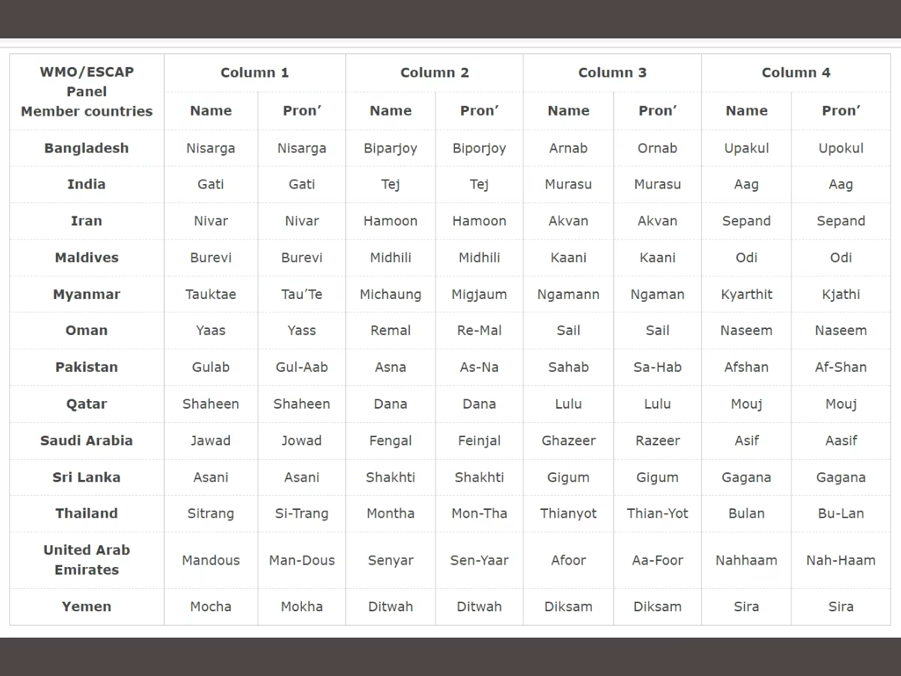
  • The World Meteorological Organization (WMO) oversees the management of rotating name lists tailored for each tropical cyclone basin. 
  • Cyclones arising in various ocean basins globally receive their names from regional specialized meteorological centers (RSMCs) and Tropical Cyclone Warning Centers (TCWCs) within those areas. 
  • There are a total of six RSMCs across the world.
  • Member nations of the RSMCs propose the names for tropical cyclones. For instance, the Indian RSMC, comprising 13 nations, puts forward 13 names each for cyclones formed in the region.
  • In the earlier practice, before the official adoption of naming conventions, tropical cyclones were named based on locations, objects, or the feast days of saints on which they occurred. 
  • The names will be used sequentially column wise. The first name will start from the first row of column one and continue sequentially to the last row in the column thirteen.
  • The names of tropical cyclones over the north Indian Ocean will not be repeated, once used it will cease to be used again. 
  • The name of a tropical cyclone from south China Sea which crosses Thailand and emerge into the Bay of Bengal as a Tropical cyclone will not be changed. 

Guidelines to adopt names of cyclones

  • The proposed name should be neutral to (a) politics and political figures (b) religious believes, (c) cultures and (d) gender.
  • Cyclone Biparjoy Tropical Cyclones Naming System Nomenclature Science  Behind Formation
  • Name should be chosen in such a way that it does not hurt the sentiments of any group of population over the globe
  • It should not be very rude and cruel in nature
  • It should be short, easy to pronounce and should not be offensive to any member
  • The maximum length of the name will be eight letters.
  • The proposed name should be provided with its pronunciation and voice over.
  • The names of tropical cyclones over the north Indian Ocean will not be repeated. Once used, it will cease to be used again. Thus, the name should be new.

Kolkali Art

Context: The mothers’ grouping of the Thrissur Archdiocese performed ‘Kolkali, a folk art’, on the Lour des Metropolitan Cathedral premises in remembrance of St. Thomas’ arrival in India.

image 4

About Kolkali Art:

  • Having a historical lineage of approximately two centuries, Kolkali emerged as a folk art performed in the North Malabar region of Kerala, with influences drawn from Kalaripayattu, a martial art tradition prevalent in both Kerala and Tamil Nadu.
  • In the realm of Kolkali, each participant holds a stick, executing circular movements, striking a rhythmic chord that resonates with the accompanying music.
  • Typically, a group of 12 to 24 dancers move rhythmically in a circle around a ceremonial lamp named ‘Nilavilakkua,’ synchronizing foot taps with the manipulation of lengthy wooden sticks in their hands.
  • On occasions, this dance unfolds on a specially constructed on a wooden stage, thus it is also called, ‘Thattinmelkalia.’
  • The songs interwoven into Kolkali performance narrate devotional stories depicting regional deities, with the primary musical accompaniment emanating from the rhythmic sounds of the sticks.
  • The dance is enhanced by musical instruments such as Chenda, Elathalam, Mathalam, and Chengala.
  • Traditionally an annual post-harvest celebration, Kolkali united villagers across caste and creed. However, in contemporary times, the dance has transcended its seasonal roots, finding a place in various tribal festivals and celebratory events, including wedding ceremonies.
  • The influence of Kolkali extends beyond Kerala's borders, influencing folk dance forms in Bengal, Gujarat, Punjab, and Maharashtra. In Tamil Nadu, it is recognized as Kolattam, while in Andhra Pradesh, it goes by the name Kolamu.
  • Currently, Kolkali enjoys widespread popularity and has become a prominent feature in the Kerala School Youth Festival, lauded as one of the largest cultural events in Asia.
  • This evolution underscores the enduring allure and cultural resonance that Kolkali brings to the forefront of artistic expression in the region.

Arrival of St. Thomas in India:

  • During his initial mission, St. Thomas arrived at the capital of Parthian King Gondophares (c. 19 – c. 46), who governed the regions of Afghanistan and Punjab, with Takshasila as the capital.
  • Accompanying him was the trader Abbanes. On his subsequent mission, St. Thomas journeyed to a kingdom in South India, ruled by a dynasty from the 1st Century.
  • According to tradition, St. Thomas preached in this region before crossing over to the Coromandel Coast in Southeast India.
  • Unfortunately, he was killed while fulfilling his mission at Mylapore near Madras.

Pradhan Mantri Janjati Adivasi Nyaya Maha Abhiyan (PM-JANMAN)

Context: The Union Cabinet has approved Pradhan Mantri Janjati Adivasi Nyaya Maha Abhiyan (PM JANMAN) scheme.

About PM-JANMAN

PM janman scheme
  • Announced in: Budget 2023-24
  • Launched in: 2023
  • Outlay: 24,104-crore
    • Centre’s share: Rs 15,336 crore 
    • States share: Rs 8,768 crore.
  • Aim: To provide a number of facilities to Particularly Vulnerable Tribal Groups (PVTGs).
  • Features of the scheme: This scheme comprising Central Sector and Centrally Sponsored Schemes to focus on 11 critical interventions through 9 Ministries including Ministry of Tribal Affairs. 
  • Interventions are: provision of pucca houses, road and telecom connectivity, drinking water and sanitation, access to education and health, construction of Anganwadi Centers and Multipurpose Centers.
  • The Ministry of Ayush will set up Ayush Wellness Centre to PVTG habitations through mobile medical units.
  • The Ministry of Skill Development and Entrepreneurship will facilitate skill and vocational training in PVTG habitations, multi-purpose centres and hostels as per suitable skills of these communities.

About PVTG: 

  • It is a classification used in India to identify certain tribes or communities that are considered to be at a particularly high risk of extinction or facing extreme socio-economic marginalization
  • Tribal communities are often identified by some specific signs such as primitive traits, distinctive culture, geographical isolation, shyness to contact with the community at large and backwardness.
  • In 1973, the Dhebar Commission created Primitive Tribal Groups (PTGs) as a separate category, which are less developed among the tribal groups.
  • In 2006, the Government of India renamed the PTGs as Particularly Vulnerable Tribal Groups (PVTGs)

Criteria for identification of PVTGs

  • Pre-agricultural level of technology  
  • Low level of literacy 
  • Economic backwardness   
  • A declining or stagnant population accordingly.
  • India has ST population of 10.45 crore as per 2011 census, out of which 75 communities located in 18 States and the Union Territory of Andaman and Nicobar Islands have been categorized as PVTGs. 
  • Among the 75 listed PVTGs the highest number are found in Odisha (13), followed by Andhra Pradesh (12).