Society & Social justice

Primary Health Centre (PHC)

Context: This editorial emphasize on ‘Ayushman Bharat Scheme’. The launch of this  flagship health program i.e. Ayushman Bharat, in 2018, the Indian government has consistently emphasized the importance of enhancing medical accessibility, particularly in rural areas. This initiative aims to transform 150,000 public health centers (PHCs) into health and wellness centers (HWCs) to "bring healthcare closer to people's homes." It was evident from the beginning that achieving this goal would necessitate addressing the chronic shortages of doctors, frontline medical professionals, and healthcare infrastructure.

Given that healthcare falls under the purview of individual states in India, the central government's commitment to this endeavour necessitates a corresponding commitment from state governments. Unfortunately, most states that have traditionally lagged behind on welfare indicators have not adequately risen to this challenge.

The latest edition of the Centre’s Rural Health Statistics shows that the medical system outside urban areas continues to be plagued by a shortfall of doctors and infrastructure. Barely 45 per cent PHCs adhere to their mandate of functioning 24×7.A study published in The Lancet in February placed UP among the five states where district hospitals offer only 1 per cent of the basic services.

About Primary Health Centre (PHC)

  • PHCs are the cornerstone of rural health services- a first port of call to a qualified doctor of the public sector in rural areas for the sick and those who directly report or are referred from Sub-Centres for curative, preventive and promotive health care
  • The concept of Primary Health Centre (PHC) is not new to India. The Bhore Committee in 1946 gave the concept of PHC as a basic health unit to provide as close to the people as possible, an integrated curative and preventive health care to the rural population with emphasis on preventive and promotive aspects of health care.
  • The Government of India's initiative to create and expand the presences of Primary Health Centres throughout the country is consistent with the eight elements of primary health care outlined in the Alma-Ata declaration. 

Examples of primary health care services include routine check-ups, immunizations, screening tests, chronic disease management, and referrals to specialists when needed. Primary health care providers can include general practitioners, nurse practitioners, midwives, and community health workers.

Why primary health care is so important

  • Promotes preventative care: Primary health care helps prevent illness and disease by promoting healthy living, encouraging vaccinations, and providing regular check-ups and screenings.
  • Increases accessibility: Primary health care is often the most accessible form of healthcare, as it is typically delivered in local clinics or health centers that are close to where people live and work.

The share of primary healthcare in Current Government Health Expenditure (CGHE) has increased from 51.3% in 2014-15 to 55.9% in 2019-20. The increased focus on primary healthcare reinforces the government’s decisions to prioritize primary healthcare in the country.

image 79
Figure: Share of Primary Health Care in Current Government Health Expenditure (%)
  • Reduces healthcare costs: Early detection and management of illnesses through primary health care can reduce the need for more expensive and specialized care, ultimately saving individuals and healthcare systems money.( It reduces the need for expensive secondary and tertiary healthcare.)
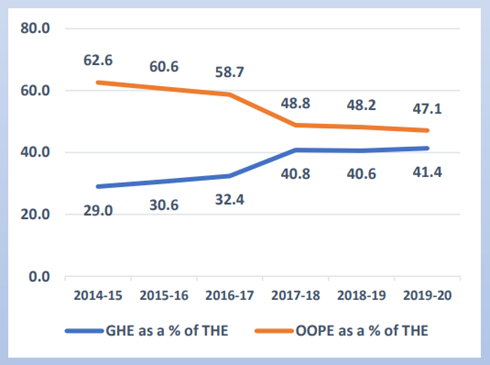
    • Acc to  National Health Accounts Estimates for India (2019-20)- Strengthening the PHC and focusing on preventive care will reduce the Out-of-Pocket Expenditure. The share of Out-of-Pocket Expenditure (OOPE) in total Health Expenditure (THE) declined from 62.6% to 47.1%. The continuous decline in the OOPE in the overall health spending show progress towards ensuring financial protection and Universal Health Coverage for citizens.
lLgAHDJMST2dss3HtvL1S1Q83tXZuTJfXuAXh2FTLTNbcXxUzzqP5TxmV8EE8e KKNj0HFshipwQWRyMAiqMXAVCOfQ6GZpeS y1 cZ9 Xc8nyw5NYb2aZQp9zX692lEsXR6FPWImTOAAkhBu1PwIQ

Figure 2: Government Health Expenditure and Out-of-pocket expenditure as % of Total Health Expenditure (%)

  • Improves overall health outcomes: By providing comprehensive and continuous care, primary health care can help manage chronic conditions and improve overall health outcomes, including reducing mortality rates.
  • Addresses health inequalities: Primary health care can help address health inequalities by providing equitable access to healthcare services regardless of income, race, gender, or location.
  • Primary health related to Climate Change: Primary health care has an important role in responding to the climate change related threats to human health like injuries related to extreme weather events like storms, fires and floods; infectious disease outbreaks due to changing patterns of vector borne diseases; poor nutrition from reduced food availability because of drought; the psychological impact due to displacement of communities.  
  • Primary healthcare in developed nations: The majority of developed countries' federal healthcare budgets go towards primary care, including the UK, Australia, Canada, the Netherlands, and Sweden.

Problems of PHC in India

  • Limited in scope- The existing primary healthcare model in the country covers only 15% of the health issues people seek care for, primarily related to pregnancy, limited childcare, and national health programs. Expanding its scope is essential for comprehensive healthcare coverage.
  • Funding: The funding for general healthcare is quite low, leaving insufficient funds for primary healthcare.
The central and state governments’ budgeted expenditure on healthcare touched 2.1 % of GDP in FY23 which was substantially lower that other BRICS countries (Brazil: 3.8%, China: 3.1%, Russia: 3.7%, South Africa: 4.2%)
  • Inadequate Infrastructure: According to the National Health Profile 2019 report, 22% of primary health centers do not have a separate room for immunization and family planning services.
In Rajasthan, the population is often so dispersed (especially in hilly areas in the south and in the desert in the west) that a family may need to travel 10-20 km to reach the nearest PHC according to an analysis by the Centre for Economic and International.
  • Shortage of Healthcare Professionals: The delivery of quality health services is hampered by supply shortages, inadequate management, and the absence of proper training and supervision for healthcare workers. These issues can lead to interruptions in care, inefficiency, and outdated practices, all of which impact patient well-being.
The rural healthcare infrastructure is three-tiered and includes a sub-center, primary health center (PHC) and CHC. Indian PHCs are short of more than 3,000 doctors, with the shortage up by 200% over the last 10 years to 27,421, as IndiaSpend reported in 2016.

Lack of Access to Medicines:

The high cost of medicines is a significant barrier to healthcare access in India, with many people unable to afford even basic medications.

The government's free medicines program, which provides essential medicines to patients for free, has been plagued by shortages and supply chain issues.

The lack of access to medicines has led to many patients turning to unlicensed and unregulated pharmacies, which may sell substandard or counterfeit drugs.

Poor Quality of Care:

A study published in the Lancet found that around 50% of patients in India do not receive the appropriate care for their health conditions.

The lack of quality healthcare services is due to a range of factors, including a shortage of qualified healthcare professionals, inadequate infrastructure, and poor regulation of healthcare providers.

In addition, many patients in India lack awareness about their health conditions and may not seek timely medical treatment, leading to complications and poor health outcomes.

An analysis by the Centre for Economic and International - India has a large network of primary health centres (PHCs), each supposed to serve a population of 25,000. In many poor states, such as Madhya Pradesh, Bihar and Jharkhand, however, a PHC covers as many as 45,000, 49,000 and 76,000 people.
  • Under-investment in primary healthcare : also means that PHCs continue to remain under-equipped and lacking supplies and drugs to provide comprehensive primary care. 
For example, of the 709 PHCs surveyed in 2009 by the International Institute for Population Sciences, Mumbai, about 24% did not have an electricity connection and 63% did not have piped water supply.

At the same time, PHCs are expected to deliver centrally designed, targeted vertical programs, alienating them further from communities. As a result, even those families that can access PHCs continue to look elsewhere for their critical healthcare needs.

  • Urban Neglect in Indian Healthcare System: The primary healthcare system in India has historically overlooked the growing urban population, as its focus has mainly been on rural areas. This neglect stems from historical policies and infrastructure designed for rural regions, despite the increasing urban population. 

Way Forward

  • Srinath Reddy committee recommendation: The High-Level Expert Group (HLEG) on Universal Health Coverage (UHC) headed by K. Srinath Reddy recommended that expenditures on primary health care, including general health information and promotion, curative services at the primary level, screening for risk factors at the population level, and cost-effective treatment, targeted toward specific risk factors, should account for at least 70% of all health care expenditures. 
  • Ayushman Bharat scheme seeks to upgrade more than 1.5 lakh health facilities like Sub Centres and Primary Health Centres to health and wellness Centres (HWC).  These centres would deliver Comprehensive Primary Health Care (CPHC) bringing healthcare closer to the homes of people. This has to be implemented properly. 
  • Telemedicine: Telemedicine provides patients remote access to medical consultations and treatments via telecommunications technology. In turn, this contributes to closing the gaps in healthcare access, particularly in rural and remote areas. Telemedicine has proven to be a boon for Indians during the uncertain times of lockdowns, and it has the potential to make remote, optimized healthcare accessible to every corner of India in the future.
  • Health Information Exchange (HIE): HIE systems enable the seamless sharing of patient health information between various healthcare providers, enhancing care coordination and substantially reducing medical errors.
  • Mobile Health (mHealth): mHealth is an emerging concept involving the utilization of mobile devices and technology for health services, such as appointment scheduling, remote monitoring, and medication reminders. It can significantly improve patient access to care and treatment plan adherence.
  • Government must increase budgetary allocations to healthcare to at least 3-4% of GDP so that public expenditure on healthcare is at least 70% of total health expenditure.

QR Code on Food Labels to help visually disabled

Context: The Food Safety and Standards Authority of India (FSSAI) has recommended the inclusion of QR code on food products for accessibility by visually impaired individuals under its Food Safety and Standards (Labelling and Display) Regulations 2020.

About QR Code on Food Labels to help visually disabled

image 78
  • The information on food labels includes product name, shelf life, nutrition facts, vegetarian/non-vegetarian logos, ingredient lists, allergen warnings, and other product specific labelling requirements. 
  • This information aims to help consumers make informed food choices and ensure safe food access for all, including individuals with special needs like the visually impaired.
  • It will also provide inclusive access to information, guaranteed by Article 19 as a fundamental right of citizens.
  • Furthermore, this will complement The Rights of Persons with Disabilities Act 2016, which acknowledges the needs and rights of people with disabilities and places a strong emphasis on accessibility and the promotion of their health.

About Food Safety and Standards (Labelling and Display) Regulations 2020

  • The regulations prescribe the labelling requirements of pre-packed foods and display essential information about premises where food is manufactured, processed, served, and stored.
  • The non-veg symbol shall consist of a brown colour-filled triangle inside a square with a brown outline having sides not less than the minimum size specified in the regulation.
  • Recommended Dietary Allowance (RDA) is mandatory to be displayed on the label.
  • Mandatory declaration of allergen information.
  • Some new logos were established to identify foods with different categories, such as for Fortified Foods, organic foods.
  • E-commerce platforms are required to provide for mandatory labelling of food products offered for sale through their platform with certain exceptions.
  • Also included restaurant operators with large networks of chains within its scope.

About FSSAI

Body: Statutory body under the Food Safety and Standards Act 2006.

Nodal Ministry: Ministry of Health & Family Welfare.

Headquarters: Delhi

Replaced various acts: Prevention of Food Adulteration Act, 1954, Fruit Products Order, 1955, Meat Food Products Order, 1973, Vegetable Oil Products (Control) Order, 1947, Edible Oils Packaging (Regulation)Order 1988, Solvent Extracted Oil, De- Oiled Meal and Edible Flour (Control) Order, 1967, Milk and Milk Products Order, 1992 etc. were repealed after commencement of FSS Act, 2006. 

Appointment of chairperson and CEO: By Government of India. 

Objective: Responsible for protecting and promoting public health through the regulation and supervision of food safety.

Enhancing India's Higher Education Ecosystem: The Need for Reformed Student Visa Policies

Why is it necessary to focus on attracting international students to India?

Annually, around 7.5 lakh Indian students seek education abroad, leading to a surge in private universities aiming to meet this demand. While these institutions have succeeded in attracting foreign faculty, they face challenges in bringing in international students. This limits the cross-cultural exposure essential in modern education. To address this gap, India's National Education Policy 2020 focuses on internationalization. It advocates curricular improvements, campuses open to foreign scholars and students, and joint degree programs with foreign institutions. These changes aim to enhance the competitiveness and inclusiveness of Indian higher education.

Further, Strategies to enhance attraction of International Students in India:

  • Fostering Post-Education Opportunities: One drawback for international students studying in India is that, despite the country's thriving corporate and start-up sectors, they are unable to obtain work experience while pursuing their degrees. This is a significant obstacle for many such students. It is necessary to change India's "S" Visa or student policy in order to address this.
  • Creating a Talent Ecosystem : Many Indian organisations are multinationals or aspire to be multinationals, thus they need staff that understands Indian markets, business etiquette, rules, and culture in-depth. These enterprises can create a network of international talent that acts as a cultural bridge by hiring foreign talent from Indian campuses and employing Indian graduates who are returning home.

For Eg- The big three US tech companies — Google, Meta, and Microsoft — are all headed by Indian alumni of US universities. Former Afghan President Hamid Karzai who studied in India kept bilateral relations warm through difficult times.

  • Addressing Workforce Challenges : Concerns that foreign students may take jobs away from Indian students are unfounded. India’s population growth has dipped below the replacement rate of 2.1 per cent, and the country will begin ageing soon, like China, according to the UN Population Fund. India's declining population growth and impending aging population mean that a dwindling working-age population will soon become a reality. Sustaining growth under these circumstances requires innovative solutions.
  • Learning from Global Practices : Countries like the US, UK, Australia, New Zealand, and Canada have successfully addressed workforce challenges by offering post-study student work visas. Europe, on the other hand, has focused on migration, bringing about political implications. India has the opportunity to learn from these diverse approaches.
  • Expansion of Student Work Visas: An expanded provision of student work visas can unlock several advantages, including accommodating the 4,000 scholarships offered to foreigners annually under various Indian programs. It can also facilitate field experience for foreign students in areas like mining and agriculture.
  • Strategies for Advancing Higher Education as an Export Industry in India:

Prime Minister Narendra Modi has identified higher education as a key export sector.

So, to unlock the full potential of internationalization in higher education, India must amend its student visa policies. This involves multi-ministry coordination, encompassing the Ministry of Home Affairs, Ministry of Finance, Ministry of Education, and active involvement from Indian multinational companies and business chambers.

In conclusion, reformed student visa policies will not only boost India's higher education but also create a sustainable talent ecosystem that benefits the nation's economic and cultural exchange.

Indian Sign Language

Context: Sarah Sunny becoming the first deaf advocate to use Indian Sign Language (ISL) to argue a case in the Supreme Court.

About Indian Sign Language

image 55
  • It is the primary sign language used by the deaf and hard of hearing community in India. It is a visual-gestural language that employs a combination of handshapes, facial expressions, and body movements to convey meaning. 
  • It is not only a means of communication for the hearing-impaired, but a is a symbol of their pride and identity. 
  • The Rights of Persons with Disabilities (RPwD) Act 2016 recognises sign language as a means of communication which is especially useful for communication with persons with hearing disability. 
  • The Act further mandates governments to promote use of sign language to enable persons with hearing disability to participate and contribute to their community and society.

Initiatives to promote sign language

  • UN's International Day of Sign Languages: Celebrated annually on September 23, this day is dedicated to raising awareness about the importance of sign languages and promoting their use in various spheres of society. To protect the linguistic identity and cultural diversity of all deaf people and other sign language users.
    • In 2018, as part of the International Week of the Deaf, the International Day of Sign Languages was observed for the first time.
    • September 23 was picked to celebrate the World Federation of the Deaf (WFD) established in 1951.
    • Theme of 2023: A World Where Deaf People Can Sign Anywhere.
  • The Billion Readers (BIRD) initiative: To ensure daily and lifelong reading practice for a billion people in India by adding Same Language Subtitling (SLS) on mainstream entertainment content on television and streaming platforms. 
    • SLS is the idea of subtitling audio-visual (AV) content in the ‘same’ language as the audio to serve one vision “Every Indian, a fluent reader”.
    • SLS was conceived for mass reading in 1996 at the Indian Institute of Management, Ahmedabad (IIMA). 
  • Indian Sign Language Dictionary: To remove communications barriers between the deaf and hearing communities as it is focused on providing more information in Indian sign language. 
    • Its aim is to give Deaf people the constitutional right as well as the opportunity of freedom of expression and also bringing them into the main stream of the society. 
    • Developed by Indian Sign Language Research & Training Centre (ISLR&TC).
    • The ISL dictionary consists of words of many categories like everyday terms, legal terms, academic terms, medical terms, and technical terms.
    • 1st edition of the ISL Dictionary programme launched in 2018, 2nd edition in 2019 and 3rd edition in 2021.

About ISLRTC

  • To promote the use of Indian Sign Language as educational mode for deaf students at primary, secondary and higher education levels.
    • To carry out research through collaboration with universities and other educational institution in India and abroad to promote, propagate and upgrade Indian Sign Language.
  • It was established under the 11th Five Year Plan (2007-2012). Earlier, it existed as an autonomous center of the Indira Gandhi National Open University (IGNOU), Delhi.
  • Later, in 2015, it became a society under the Department of Empowerment of Persons with Disabilities under Ministry of Social Justice and Empowerment.

Drug abuse in Punjab

Context: Punjab Chief Minister Bhagwant Mann led a large prayer gathering of schoolchildren, in which they pledged to reject the scourge of drugs.

  • Punjab continues to grapple with the menace that has plagued it for over a decade. Seasoned police officers describe it as narco-terrorism, propagated by an unfriendly neighbour.
  • The Director-General of Police regularly updates the public on drug seizures, citing an alarming annual tally of 12,000 to 14,000 cases filed under the NDPS Act, alongside a record seizure of 1,100 kg of heroin in 2023.
  • Drug overdose deaths continue — as per the government’s own report, 266 persons have died of drugs between April 2020 and March 2023.
  • Earlier it was also reported that the problem of drug abuse is likely to explode in the next decade as the usage in now reaching the adolescents. It was also observed that impact of drug abuse has increased both in rural and Urban India.
  • There has been also an increase in drug-abuse particularly post the corona pandemic.

What is Drug or Substance Addiction?

Drug addiction occurs when its abuse affects a person’s work and normal family life. It creates a ripple effect in the lives of the user and his immediate circle of family, friends, co-workers, neighbours and acquaintances. 

Why Punjab remains a problem?

Geographic Location:

The state’s vulnerable geography makes it a hotspot for smuggling of heroin and other opioids across the border.

Declining Agricultural Wealth

Agriculture, which brought the state its wealth, is stagnating and with little industrialisation there is high unemployment present today in Punjab, which makes it a ideal breeding ground for drug industry to make inroads.

Reminiscent of Khalistan movement

In the 1980s, Punjab was in the grip of a violent separatist militancy which has now ebbed but has left its scars. Though Punjab got rid of the secessionist movement only for it to be replaced with narcotics-terrorism thus highlighting the linkages between organised crime and terrorism.

Functional challenges

The small quantity of the drugs seized by the police are clubbed under personal consumption and not as aggregators or peddlers, and this lapse is being utilised by the drug cartels which now engage small time and part time drug peddlers not only making it difficult for police to crack but also multiplying the spread.

Ludhiana as the Drug capital

As Drug usage is also directly proportional to availability of money, Ludhiana being a business hub and with the large population has led to its emergence as Drug capital in Punjab. 

Further the presence of strong diaspora abroad and the remittances contributed by them increases the paying capacity of people also in rural areas.

REASONS FOR DRUG ABUSE IN INDIA

GEOGRAPHIC LOCATION: India is located between the Golden Crescent (IRAN, PAKISTAN and AFGHANISTAN)  and the Golden Triangle (Myanmar, Laos, Thailand and Vietnam) which are the largest opium producing region globally.

LOW INCOME GROUP: Population belonging to the lower strata of the society are particularly exposed to drug abuse in India, and use these as a form of relaxation agent.

SOCIETAL PRESSURE: Most of the youth who get addicted to drug abuse is due to the fact that they start it under the peer pressure or even due to the isolation suffered at the adolescent level at the hands of parents and friends. Apart from this performance pressure, growing emptiness and changing socio-economic conditions are having a toll on the age group.

HEALTH CONDITIONS: It can also be due to mental health disorders such as anxiety and depression or even due to the high levels of stress.

POOR LAW ENFORCEMENT: Corruption among the local enforcement agencies (police) and the loopholes at the border levels have been successfully exploited by the drug cartels. There is also a shortage of staff and equipment to tackle the illicit traffic of drugs.

CURRENT ECONOMIC DOWNTURN: The economic downturn due to covid pandemic and the global recession that is following will certainly increase the trend of drug abuse in India.

GLAMOURISATION:

There has been also glamourisation of intoxication and addictive substance via social media and OTT platforms through web series. 

Steps taken by Punjab to counter

  • Many villages have formed their own anti-drug committees.
  • Some police districts have introduced gully cricket, while others have instructed constables to mentor addicts.
  • Police personnel’s are also harnessing the power of social media, with district police chiefs often leading these initiatives.
  • The prayer gathering at the Golden Temple was an attempt in this direction such that the tenets of religion can be also utilised as a tool of moral suasion.

 Indian Government Efforts To Fight Drug Abuse

  • Narcotics Control Bureau (NCB): NCB is primary agency responsible for curbing trade in illicit drugs & precursor chemicals. NCB shares intelligence with other agencies like Directorate of Revenue Intelligence (DRI), Central Board of Excise and Customs (CBEC), and Central Reserve Police Force (CRPF) for better coordination. 
  • NCB also take required actions to control drug trafficking under the Narcotics Drugs and Psychotropic Substances Act of 1985. India has entered into 26 bilateral agreements to tackle the threat of drug trade.
  • Narco-Coordination Centre was established in 2016.
  •  A mechanism under the NCB which was restructured in 2019 into a four-tier district-level scheme.
  • Seizure Information Management System (SIMS) was also launched in 2019 under Narcotics Drugs and Psychotropic Substances Act, for better coordination of all drug law enforcement agencies.
  • Constitution of National Fund for Control of Drug Abuse
  • Project SUNRISE was launched specially for the Northeast region to tackle rising HIV prevalence, especially among the people injecting drugs.
  • NASHA MUKT BHARAT campaign was also launched.
  • India’s NCB works with several international agencies like SAARC Drug Offences Monitoring Desk, BRICS, Colombo Plan Drug Advisory Program, ASEAN Senior Officials on Drug Matters, BIMSTEC, United Nations Office on Drugs and Crime (UNODC), and International Narcotics Control Board (INCB), among others, to combat the illicit trade of drugs.
  • India is also a signatory to UN Convention on NARCOTIC DRUGS (1961), UN Convention on PSYCHOTROPIC Substances (1971), UN Convention on TRANSNATIONAL ORGANIZED CRIME.

Draft Menstrual Hygiene Policy

Context: A draft menstrual hygiene policy is out by Ministry of Health and Family Welfare.

Need for Menstrual Hygiene Policy policy

  • Health and Hygiene: Poor menstrual hygiene can lead to various health issues, including infections and discomfort. According to 5th NHFS (2019-2021): 
    • Women aged 15-24 years who use a hygienic method of protection during their menstrual cycle is 78%. Among these women, 64% use sanitary napkins, 50% use cloth, and 15% use locally prepared napkins. 
    • Only 73% of rural women while 90% of urban women use a hygienic method of menstrual protection respectively.
    • However, a few States continue to have lower than average access to use of a hygienic method of menstrual protection by women and girls. 
  • Dignity and empowerment: Access to proper menstrual hygiene products and facilities is a matter of dignity and basic human rights. It is essential to ensure that individuals can manage their menstruation with dignity, without feeling ashamed.
  • Gender equality: Menstruation is associated with stigma and discrimination, leading to gender inequality. A menstrual hygiene policy can help challenge these social norms and promote gender equality by addressing issues related to menstruation.
  • Accessibility and affordability: A policy can promote the availability and affordability of menstrual hygiene products.
  • Promote work participation: By creating a more inclusive and supportive environment like, may include flexible working hours, access to sanitary products, and menstrual leave. It will reduce absenteeism and increase productivity and higher work participation rates.
  • Access to education: By providing essential menstrual hygiene products and support, schools and institutions can help remove barriers that might otherwise prevent girls from attending classes. 

About draft Menstrual Hygiene Policy

  • Menstrual hygiene is the practice of maintaining cleanliness and managing menstruation in a safe and healthy way. It is important for the well-being and dignity of individuals who menstruate. Proper menstrual hygiene management helps prevent infections, discomfort, and allows individuals to continue their daily activities without disruption.
  • Ministry of Health and Family Welfare(MoHFW) is the Nodal Ministry for the Menstrual hygiene policy.
  • The policy recognizes menstruation as a natural bodily process for all who menstruate including girls and women of reproductive age and addresses the long-standing challenges associated with menstruation in our country. 
  • By adopting a life cycle approach, the policy ensures comprehensive support through the entire menstrual journey, recognizing the unique needs of individuals from menarche to menopause.
  • Specific focus on prioritising underserved and vulnerable populations, ensuring equitable access to menstrual hygiene resources and addressing their specific needs. 
  • This policy aligns with India’s commitment to achieving the Sustainable Development Goals (SDGs), particularly in relation to Goal 3 on good health and well-being, Goal 4 on quality education, Goal 5 on gender equality, and Goal 6 on clean water and sanitation. 
  • The policy will serve as a catalyst to raise awareness, challenge societal norms and foster a society that embraces menstrual hygiene as a natural and normal part of life.

Vision

  • All women, girls and persons who menstruate are able to experience menstruation in a manner that is safe, healthy and free from stigma. 

Goal

  • Each girl, woman and person who menstruates across India can access safe and dignified menstrual hygiene resources in order to improve their quality of life and thereby realize their full potential in health and wellbeing, education, economic and other aspects of life. 

Target

  • The policy caters to the needs of and covers all who menstruate in rural, urban and tribal areas, as well as in educational institutions, workplaces, healthcare settings and other public places. 

Objectives

  • To ensure that women, girls and persons who menstruate have access to safe, hygienic and quality menstrual products and sanitation facilities. 
  • To create an enabling environment for people including women, girls, men and boys so that they have access to correct information on menstruation, and to address myths, stigma and gender issues around menstruation.
  • To provide a coordination mechanism among different Central Government Ministries, States/ UTs and relevant stakeholders and sectors.
  • To create a ‘menstrual friendly environment’ in all settings including homes, schools/ educational institutions, workplaces and public spaces.
  • To foster innovative practices with social entrepreneurs and the private sector.
  • To strengthen environmentally sustainable menstrual waste disposal.

Policy strategy

  • Ensure access to affordable and safe menstrual hygiene products: To ensure affordable and accessible menstrual products such as disposable or reusable sanitary pads, menstrual cups, tampons or reusable cloth pads, etc are available to all who menstruate, especially those in low-income communities and marginalized groups.
  • Promote quality standards and regulatory framework: Develop and implement comprehensive quality standards for different types of menstrual hygiene products available in the market to ensure their safety, efficacy and reliability.
  • Availability of clean and dignified menstrual hygiene facilities: Promote the development and improvement of menstrual-friendly infrastructure in homes, educational institutions, workplaces and public spaces to include safe, clean and private toilets, proper waste disposal systems and handwashing facilities with soap and clean water.
  • Promotion of education and awareness on menstrual hygiene: Awareness campaigns targeting menstruators to provide accurate information including options of products available, debunk myths and misconceptions and address social and gender-related challenges associated with menstruation.
  • Collaboration with Non-government sector/engagement with private sector: Support research and development initiatives that explore new technologies, materials and product designs which improve menstrual hygiene management, while considering accessibility, ease of use, affordability and environmental sustainability.
  • Foster research and innovation in menstrual hygiene management: Encourage research institutes and academia to contribute to evidence-based policymaking, promote innovation and improve the overall understanding and implementation of menstrual hygiene practices.

International Institute for Population Sciences (IIPS)

Context: The Union government has revoked the suspension order of International Institute for Population Sciences (IIPS) director K.S. James.

About IIPS

  • It is a prominent institution dedicated to population studies and training. It serves as a regional Institute for Training and Research in Population Studies for the Economic and Social Commission for Asia and the Pacific (ESCAP) region. ESCAP is one of the five regional commissions under the jurisdiction of the United Nations Economic and Social Council.
  • Started in 1956 under the joint sponsorship of Sir Dorabji Tata Trust, the Government of India and the United Nations.
  • It is an autonomous organisation of the Ministry of Health and Family Welfare.
  • Situated in Mumbai.
  • Earlier it was known as the Demographic Training and Research Centre (DTRC).

Objectives of the Institute

  • To train persons from India and other countries in demography and related fields, including demographic aspects of family planning.
  • To undertake scientific research on population problems which are of special importance to India and other countries in the ESCAP region.
  • To collect, organize and disseminate demographic information about the population of India and other countries of the world.
  • To provide services of research, evaluation, training, consultation and guidance related to demographic problems to government departments, public corporations or private establishments as deemed desirable in pursuance of the objective of the Society.
  • To undertake, organize and facilitate study courses, conferences, lectures, seminars and the like to promote the aforesaid objectives.
  • To undertake and provide for publication of journals and research papers, books and to establish, maintain libraries and information service in furtherance of the objectives of the Society.

Gender wage gap

Context: Prof. Claudia Goldin received the economics Nobel Prize(2023)  for her study of women's earnings and employment. Goldin was able to demonstrate that variations in education and occupation historically accounted for a large portion of the gender wage gap after studying more than 200 years' worth of US data.

What is gender wage gap?

The gender pay gap - a woman being paid less than a man even when both are performing the same role in a company - may sound like an exception.

But it's so prevalent that it's rather a norm across the world. 

Gender wage gap

Facts:

  • India has climbed eight places in the annual Gender Gap Report, 2023, and is ranked 127 out of 146 countries in terms of gender parity, from 135 last year. 
  • As of 2023, an International Labour Organization (ILO) report reveals a 27% gender pay gap in India. On average, women earn 73% of men's earnings for the same job. In specific industries like technology, this gap widens further, with women earning only 60% of men's income. 
  • According to the National Sample Survey, women spend 299 minutes a day on unpaid domestic services for which men spend only 97 minutes. Only 22% of women aged 15-59 years were engaged in paid work in comparison to nearly 71% of men. When factoring in unpaid work, the gender pay gap widens even more.

The gender pay gap in the Indian workforce is a multifaceted issue with deep-rooted social, economic, and cultural factors:

  1. Occupational Segregation: Women tend to be concentrated in lower-paying, traditionally female-dominated professions, perpetuating the pay gap.
    • Female-dominated fields like teaching and nursing typically offer lower salaries compared to male-dominated sectors like engineering and IT.
  1. Motherhood Penalty: The transition to motherhood often leads to a pay gap due to limited access to maternity leave, inadequate childcare support, and societal expectations.
  2. Gender Discrimination:  Deep-seated gender biases and stereotypes result in unequal pay, even when educational qualifications and experience are similar.
    • According to Mercer's recent remuneration trends survey(2023), India's gender pay parity in February was 1.8%. At the para-professional level, the gap is 1.4%, while at the executive level, it widens to 2.5%. This translates to a male executive earning Rs 50 lakh annually, while a female executive at the same level earns Rs 48.75 lakh.
  1. Lack of Representation in Leadership: The underrepresentation of women in leadership roles limits their ability to negotiate for equal pay and address workplace biases.
    • The IIM-A study(2022) shows that women’s representation in the top and senior management of companies in India is significantly lower than the percentage of women on the board of directors.
  1. Cultural Norms and Expectations:  Societal norms that dictate women's roles in the family and workplace can hinder career growth and earning potential.
    • Traditional expectations of women to prioritize family life over their careers can result in reduced opportunities for professional advancement.
  1. Glass Ceiling Effect: A glass ceiling hampers women's upward mobility in organizations, preventing them from accessing senior roles with higher salaries.
  2. Educational Disparities: Disparities in access to quality education can limit women's entry into high-paying sectors.
  3. Intersectionality:  Women belonging to marginalized communities face compounded disadvantages due to both gender and social disparities.
    • Dalit women in India often experience higher levels of discrimination and wage gaps due to their intersecting identities.

To address the gender pay gap in India, several steps can be taken:

  1. Equal Pay for Equal Work: Enforce laws that mandate equal pay for equal work, regardless of gender. The Equal Remuneration Act of 1976 in India prohibits wage discrimination based on gender. It serves as a legal foundation for ensuring gender pay equality.

In 2018, Iceland enacted a law mandating that organizations with over 25 employees demonstrate equal pay for equal work between men and women. Non-compliant companies face daily fines and certification revocation.

  1. Wage Transparency: Encourage organizations to be transparent about wages and benefits to reduce pay disparities.
    • Example: Australia recently enacted a law mandating companies with over 100 employees to disclose their gender pay gap, aiming to encourage corporate action to eliminate disparities.
    • The BCCI recently announced equal match fees for both men and women among its centrally contracted players, marking a significant and commendable equity pay policy.
  2. Promote Gender Diversity in Leadership: Encourage organizations to appoint more women to leadership positions.
  3. Address Bias in Performance Evaluation: Implement unconscious bias training and ensure objective performance evaluations.
  4. Family-Friendly Policies: UNICEF advocates for family-friendly workplace policies, including paid leave for both parents to meet their children's needs. This encompasses paid maternity, paternity, and parental leave, as well as leave for caring for sick young children.
    • The Maternity Benefit Act 2017 amended the 1961 Act, extending paid maternity leave from 12 to 26 weeks, providing mothers with more time and financial support during motherhood.
  1. Equal Access to Education and Skill Development: Improve access to quality education and skill development for women.
    • The "Beti Bachao, Beti Padhao" campaign in India aims to improve the educational and skill development opportunities for girls, potentially narrowing the gender pay gap.
  1. Support Women Entrepreneurs: Facilitate entrepreneurship opportunities for women through loans and mentorship programs. Ex- Skill India Mission
  1. Gender Sensitization and Inclusive Work Culture:  Promote gender sensitization and inclusive work culture through training programs.
  2. Advocacy and Awareness: Encourage advocacy and awareness campaigns to raise public consciousness about the gender pay gap.
    • The "Equal Pay International Coalition" initiative, supported by UN Women, promotes equal pay for work of equal value, leading to global awareness about pay equality issues.

Achieving UN Sustainable Development Goal 8, which emphasizes full and productive employment, decent work, and equal pay for all, by 2030 is not just a matter of social justice for working women, but it is also pivotal for fostering overall economic growth and gender equality within a nation.

Closing the gender pay gap is a vital step towards realizing these goals and building a more equitable and prosperous future for all.

UNICEF's Passport to Earning Initiative

Context: Department of School Education & Literacy organised an online program on 11th October 2023 to commemorate the milestone of one million certifications of its Passport to Earning (P2E) Program.

About UNICEF's Passport to Earning (P2E) Initiative 

  • Passport to Earning (P2E) is a digital platform that aims to provide young people between 15-24 years of age with free, certified, world class and job-relevant skills training and position them for employment opportunities.
  • This initiative has been launched under Generation Unlimited Partnership program of UNICEF.
  • P2E is built on the Microsoft Community Training platform and offers digitised content provided by a range of public and private sector partners. 
  • Platform will offer online and offline digitalised curricula and supplemental content curated at the national level.
  • In its initial three years, P2E initiative aims to skill 10 million young people and help 10,000 young people gain decent employment - targeting at least 50% young women in both cases.
  • Young people using the platform will be able to use the certifications gained to support future employment and entrepreneurship opportunities.
  • P2E mission aims to maximize impact with young people, focusing on the most disadvantaged by:
    • Building government capacity to provide sustainable skilling and employment pathways in digital economy.
    • Enabling access to job-relevant skilling platform, state of art curriculum and certifications and ultimately jobs.

Passport to Earning (P2E) Initiative in India

  • In India, P2E initiative provides free access to certificate courses in digital productivity, financial literacy, employability skills and other in demand, job ready skills. P2E also offers provisions for online, hybrid and offline learning models.
  • P2E aims to deliver long-term sustainable skilling to 5 million youth in the age group of 14-29 in India by 2024 and then connect them to opportunities in job, self-employment, and entrepreneurship to be financially independent.
  • Passport to Earning initiative has skilled and certified more than one million young people in India in area of financial literacy and digital productivity.
  • 62% of all young learners who benefitted from P2E courses in India are adolescent girls and young women.

SC urges woman to rethink plea to end 26-week pregnancy

Context: Recently, a three-judge bench of Supreme Court has urged a married woman to reconsider her decision to abort her pregnancy which has crossed twenty-six weeks.

  • Medical termination of pregnancy in India is governed by Medical Termination of Pregnancy Act 1971.
  • Section 3 of MTP Act deals with the termination clause, the pregnancy can be terminated if:
  •  Length of pregnancy does not exceed twenty weeks (requires opinion of one practitioner) or
  • Twenty to twenty-four weeks (requires opinion of at least two practitioners) provided that:
    • Continuance of pregnancy would involve life risk for the pregnant woman or of grave injury to her physical or mental health.
    • Or if the child were born, it would suffer from serious physical or mental abnormalities.
  • Beyond 24 weeks if the termination is recommended by a Medical Board after diagnosis of substantial fetal abnormalities.

Issues with respect to the time frame

(twenty-six weeks) for termination of pregnancy:

  • Women’s right to reproductive choices is part of ‘personal liberty’ under Article 21 of Constitution  as observed in Suchita Srivastava vs Chandigarh administration case.
  • Socio-economic and mental health condition: In XYZ v. Maharashtra, a minor was allowed to terminate her pregnancy in 26th week after considering her socio-economic and mental health condition.
  • Right to privacy: In KS Puttaswami case, SC held that right to privacy enables individual to retain and exercise autonomy over body and mind.
  • Laws in over 60 countries allow women to get an abortion on request at any point in the gestation period.
  • Rights of unborn child: State also has to think about the rights of unborn child, there is an ethical dilemma to strike a balance between the rights of mother and rights of unborn child.

Critical appraisal

  • Unsafe and illegal abortions: As per a lancet study in 2018, there are around 16 million abortions accessed in India, 73% of which were medicated abortions accessed outside health facilities.
  • Shortage of doctors: MoH&FW 2019-20 report on Rural Health Statistics indicates that there is a 70% shortage of obstetrician-gynecologists in rural India, pushing women for illegal abortions and high maternal mortality.
  • Since law does not permit abortion at will, it pushes women towards illicit and unsafe conditions.
  • Lack of comprehensive sex education: In India, lack of sex education contributes to unplanned pregnancies, and the MTP Act alone is not enough to address this issue.
  • Sex-selective abortions: There is need to strike a balance between female reproductive rights keeping in mind that the rights do not lead to increased female feticide.

Supreme Court Judgement in X vs Union of India

In this case, a women pleaded the court to abort her fetus after 26-weeks of pregnancy. 

CJI has opined that women cannot claim an absolute, overriding right to abort as reports from AIIMS have confirmed that the pregnancy is not a cause of immediate danger to her life or that of fetus.

Reasoning given by S.C.:

  • S.C. went into Section 5 of MTP Act which provides exception to Section 3 and 4 of the MTP Act.
  • Section 5 says that Section 3 and 4 shall not apply when termination of such pregnancy is necessary to save the life of pregnant woman.
  • Court opined that, the term ‘life’ in Section 5 cannot be equated to the broader meaning in which ‘life’ is used in Article 21 of the constitution.
  • While life in Article 21 deals with right to dignified, meaningful life, Section 5 of MTP act uses ‘life’ in context of life and death situations.
  • Section 5 allows abortion only if pregnancy poses actual, physical, and immediate risk to woman’s life and health.
  • Court also raised concerns towards the rights and well-being of unborn child.

Rights of unborn child:

  • In international law, there is no “right of the fetus” or “right of the unborn child.”
  • UDHR also explicitly bases human rights on birth.
  • However, Indian legal scenario is unclear on whether fetus is a living being or not.
  • Pro-choice discourse is not conducive: Absolute pro-choice discourse is not conducive to the values of Indian society.
  • The test of “fetal viability” as a limit to allow abortions (developed in Roe v Wade) is gaining grounds in India. (Fetal viability is the time after which a fetus can survive outside the womb.)
  • In the instant case, court has remarked that there are rights of unborn child too and should be balanced with women’s autonomy.

Way forward

  • In India, where sex selective abortions are prevalent, the state needs to be watchful of anything that might be adversarial for efforts against female feticide.
  • There is a need for increasing awareness and information dissemination with respect to responsible sexual conduct and reducing unwanted pregnancies.
  • State must ensure that all parts of society are able to access contraceptives to avoid unintended pregnancies.
  • Medical facilities and Registered Medical Practitioners must be present in each district and are affordable to all.
  • Treatment must not be denied based on one’s caste or other socio-economic factors.

Pradhan Mantri Awaas Yojana - Gramin

Context: According to surveys done in 2022, more than 80 per cent of Pradhan Mantri Awaas Yojana-Gramin beneficiaries spent over Rs 1.50 lakh to construct houses under the scheme, higher than the allocated Rs 1.20 lakh for rural areas in plains and Rs 1.30 lakh in hills, 

About PMAY-G

  • Background: Indira Awaas yojana (IAY) has been restructured into PMAY-G.
  • Launched in: 2016.
  • Type of scheme: Centrally Sponsored Scheme.
  • Nodal ministry: Ministry of Rural Development.
  • Budgetary allocation: 13,000-crore.
  • Objective: To ensure the provision of pucca housing for all individuals who are homeless or living in dilapidated houses in rural areas except Delhi and Chandigarh by 2024, instead of the previous goal of 2022.
  • Target: Construction of 2.95 crore houses by March 2024.
  • Funding pattern: Shared between Central and State Governments in the ratio 60:40 in plain areas and 90: 10 for North Eastern and Himalayan States.
  • Eligible Beneficiaries: All the houseless households living in zero, one, or two-room houses with kutcha walls and kutcha roofs. Criteria for Automatic/Compulsory Inclusion
    • Households without shelter
    • Destitute/ living on alms
    • Manual scavengers
    • Primitive Tribal Groups
    • Legally released bonded labourer.
  • Selection of Beneficiaries: Through a three stage validation - Socio Economic Caste Census 2011, Gram Sabha, and geo-tagging.
  • Benefits: Financial Assistance of ₹ 1,20,000 per unit for plain areas, and ₹ 1,30,000 per unit for hilly areas, difficult areas, and Integrated Action Plan districts.
    • Can avail of institutional finance (loan) of up to ₹ 70,000 at 3% lower interest rate.
    • The minimum size of the house shall be is 25 sq m including a dedicated area for hygienic cooking.
    • In convergence with Swachh Bharat Mission-Gramin (SBM-G), get financial assistance of up to ₹ 12,000 for the construction of toilets.
    • In convergence with MGNREGA, the beneficiary is entitled to employment as unskilled labour at ₹ 90.95 per day for 95 days.
    • In convergence with Pradhan Mantri Ujjwala Yojana, one LPG connection per house is provided.
    • Payments are made electronically directly to bank accounts or post office accounts that are linked to Aadhaar.
  • Exclusion: Candidates that have: 
  • motorised two wheeler, three-wheeler, four-wheeler and agriculture equipment or fishing boat, Kisan Credit Card (KCC) with a limit greater or equal to Rs.50,000, at least one member that is employed with the government or earning more than Rs. 10,000 per month, that pays Income Tax, professional tax or owns a refrigerator or landline phone connection.

Adult literacy

Context: In 2018, Karthyayani Amma, who became the oldest learner at the age of 96, passed away.

About adult literacy

  • It is a type of education system that educates mature students that have already taken part in the workforce.
  • The 2011 Census the adult literacy rate for women in rural areas at 50.6 per cent as compared to 76.9 per cent in urban areas, whereas for men, the same in rural areas is pegged at 74.1 per cent as compared to 88.3 per cent in urban areas.
  • To extend educational options to adults who have lost the opportunity for formal education and have crossed the age of traditional schooling. These individuals now feel a need for various types of learning, including literacy, basic education equivalency, skill development (vocational education), and continuing education.

Advantages to adult education

  • Gaining education after secondary school as a mature-aged student helps and allows adults to gain valuable skills to increase career prospects and expand their professional knowledge.
  • It helps individuals understand their fundamental rights and also take corrective measures against crimes like domestic violence and child marriage.
  • It can sharpen critical thinking, problem-solving abilities and decision making, in professional as well as personal life.
  • It helps people adapt to rapidly evolving technologies, which is crucial in the modern workplace.
  • Research suggests that continuing education can have positive effects on mental health, reducing the risk of cognitive decline.

Reason for adult illiteracy

  • Limited access to education: Due lack of schools, lack of literacy programs, books, and educational materials or being forced to work at a young age, can lead to lifelong illiteracy. Almost 8% of India’s schools have only one teacher. Some of the most populous states also have the most one-teacher schools.  
  • Early school dropout: Due to family obligations, economic necessity, or personal challenges.
  • Learning disabilities: Some adults may have undiagnosed or untreated learning disabilities like dyslexia, dyscalculia etc. that hinder their ability to acquire literacy skills.
  • Cultural and social barriers: Societal norms, customs, and beliefs can discourage certain groups, particularly women, from receiving an education. Discrimination and gender inequality can contribute to high rates of illiteracy among adults.
  • Language barriers: Migrants move to a new place may face language barriers that make it difficult for them to learn the language and acquire literacy skills.

Government initiatives

  • National Literacy Mission (NLM): Launched in 1988 to impart functional literacy to non-literates in the age group of 15-35 years in a time bound manner. By the end of the 10th Plan period, it had made 127.45 million persons literate of which 60% were females 23% belonged to Scheduled Castes (SCs) and 12% to Scheduled Tribes (STs).
  • Saakshar Bharat: Implemented during 2009-10 to 2017-18 to raise literacy rate to 80%, reduce gender gap to 10% and minimize regional and social disparities, with focus on Women, SCs, STs, Minorities and other disadvantaged groups. 
  • National Literacy Mission Authority (NLMA): It is responsible to design, develop and implement Adult Education Programme in the country. It formulates and exercises policy and planning, developmental and promotional activities, operational functions, technology demonstration, leadership training, resource development, research & development, monitoring & evaluation in the country. 
  • Padhna Likhna Abhiyan (PLA) – A centrally sponsored scheme of Adult Education, was launched in 2020. To impart Functional Literacy to 57 lakh non-literates of 15 years and above age group.
  • New India Literacy Programme(NILP): To impart foundational literacy and numeracy for FYs 2022-27 is 5 crore learners at one crore per year and also to cover all the aspects of Adult Education to align with National Education Policy 2020 has been approved.
    • Critical life skills (including financial literacy, digital literacy, commercial skills, health care and awareness, child care and education, and family welfare),
    • Vocational skills development (with a view towards obtaining local employment),
    • Basic education (including preparatory, middle, and secondary stage equivalency); and 
    • Continuing education (including engaging holistic adult education courses in arts, sciences, technology, culture, sports, and recreation, as well as other topics of interest or use to local learners, such as more advanced material on critical life skills).
  • National Digital Literacy Mission: To empower at least one person per household with crucial digital literacy skills.

To enhance adult education, it is crucial to establish accessible and flexible learning opportunities. This can be achieved through a combination of initiatives such as expanding online courses and resources, offering financial incentives or subsidies for adult learners, developing targeted outreach programs, and collaborating with employers to support skill development and lifelong learning.