Science & Technology

Swathi Weapon locating radar

Context: Ministry of Defence signed a contract for the Weapon locating radar Swathi (Plains) with Bharat Electronic Limited (BEL) at a cost of over Rs 990 crore. 

WLR Swathi:

  • Swathi weapon-locating radars provide fast, automatic, and accurate location of enemy weapons like mortars, shells and rockets within a 50-kilometre range.
  • The radars can simultaneously detect multiple projectiles fired from different weapons at different locations.
  • Indigenously developed by: Defence Research and Development Organisation 
  • Induction is planned to be completed in 24 months. 

COVID variant XBB.1.16

Context: As per the World Health Organization’s (WHO) latest data for February 27 to March 26, 2023, the South-East Asia Region has reported over 27,000 new COVID-19 cases, a 152% increase as compared to the previous 28-day period. 

  • The reason for the spike in cases is the XBB.1.16, the new Omicron variant
e3j4DsrcS he7D2TPNp YOYBz0e8lzrlDOm u2GPogbMZaIsXH6SaxFk3Fzj6VXrDyND5GvElLoHIjjaNyKlEtmJii FO2xowwbgVkM4fz GC0OBeDKyzH1QU1JF6qavoYCSCC5phKRNjDpq LISKQ

XBB.1.16 variant:

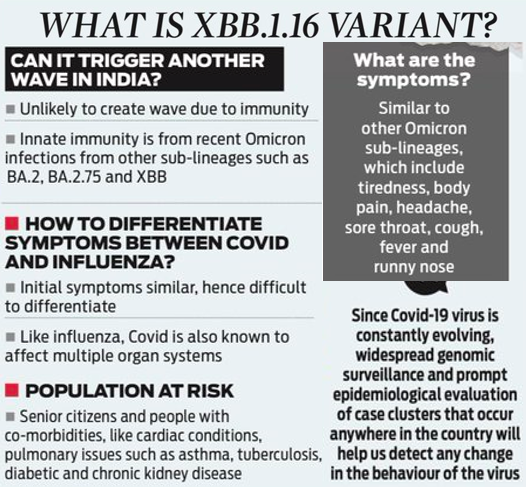
  • XBB.1.16 is the new sub-variant of Omicron which is a highly transmissible variant with a high infectivity rate. It can elude hybrid immunity and immunity gained by vaccination. 
    • It is a recombination of two omicron variants.
    • Omicron and its variants are usually more easily transmitted and has has more chances to escape immunity.
  • The sub-variant rapidly transmits and has additional mutations in its nucleotide and amino acids which have been associated with decreased antibody neutralisation, increased transmissibility, and pathogenicity. 
  • Symptoms: High-grade fever for more than 48 hours, cough, sore throat, body pain, severe headache, cold and abdominal discomfort. 

At-risk population: Patients with co-morbidities such as elderly population, or with cardiac conditions, previous pulmonary issues such as asthma, tuberculosis, diabetic and chronic kidney disease patients.

ISRO releases images of Earth captured by its EOS-06 satellite

Context: The Indian Space Research Organisation (ISRO) has released images of Earth captured by the EOS-06 satellite. The space agency said that the images are a mosaic generated by the ISRO’s National Remote Sensing Centre (NRSC). ”NRSC/ISRO has generated a global False Colour Composite (FCC) mosaic from the images captured by the Ocean Colour Monitor (OCM) payload on board EOS-06.

About ISRO

  • The main space agency of the nation is the Indian Space Research Organisation, which has its headquarters in Bangalore.
  • The Chairman of ISRO also acts as the administrator of the Department of Space (DOS), which is overseen by the Prime Minister of India directly.
  • India's primary agency for tasks relating to space-based applications, space exploration, and related technology development is ISRO.
  • Just six government space agencies worldwide have comprehensive launch capabilities, cryogenic engines, the ability to launch interplanetary missions, and the capacity to manage vast networks of artificial spacecraft.

Earth Observation Satellites

  • The spacecraft with remote sensing capabilities are earth observation satellites. Information on the planet's physical, chemical, and biological processes is gathered via earth observation.
  • The use of several earth observation satellites in sun-synchronous orbit is common.
  • They are made to observe the planet from orbit for both military and non-military purposes, such as meteorology and mapping.

EOS-06 Satellite

  • The Oceansat EOS-06 third-generation satellite and eight Nano-satellites were launched by ISRO on November 26 on the PSLV-C54.
  • With a larger payload capacity and four payloads—OCM, Sea Surface Temperature Monitor, Ku-Band Scatterometer, and ARGOS—EOS-06 continues Oceansat-2's activities.
  • For use in oceanography, climatology, and meteorology, the EOS-06 is intended to gather data on ocean colour, sea surface temperature, and wind vector.
  • In addition, the satellite offers value-added services like potential fishing areas based on data from land-based geophysical systems, SST, wind speed, and chlorophyll.
  • With the OCM's ability to detect the Earth in 13 distinct wavelengths, the images provide information on the global plant cover on land and ocean biota.
  • A kind of nanosatellite known as Oceansat-3 was launched by ISRO as part of a larger collection of spacecraft used for oceanographic and atmospheric research.

Ocean Color Monitor

  • The sophisticated 13-channel OCM, which has a 1400 km swath and a spatial resolution of 360 m, will continuously monitor the dayside of the globe and provide vital information on the distribution of ocean algae, the building blocks of the marine ecosystem's food chain.
  • With a high signal-to-noise ratio, the OCM-3 is expected to improve accuracy in daily phytoplankton monitoring, which will be useful for a variety of operational and research purposes, such as managing fisheries resources, absorbing ocean carbon, warning of dangerous algal blooms, and analysing climate change.

Space design lab for startups opens in Ahmedabad

Context: India has unveiled a state-of-the-art design facility in Ahmedabad to help startups in the space industry convert their innovative concepts into workable models. V. Somanath, the chairman of ISRO, inaugurated the Space Systems Design Lab of the Indian National Space Promotion and Authorisation Centre (IN-SPACe) at Bopal near Ahmedabad. 

More about the news: 

  • The IN-SPACe design lab is equipped with cutting-edge analysis and simulation software for IN-SPACe, which models, visualises, and optimises payload and spacecraft, ground station, and launch vehicle avionics. 
  • Lab resources will assist in creating prototypes with the fewest iterations possible, drastically lowering turnaround time and R&D expenses for start-ups. 
  • The lab is equipped with 16 workstations and high-performance multi-core (400 core) servers for computation.

IN-SPACe for a New India Space Sector

  • In June 2020, the Indian government announced significant space reforms aimed at boosting the private sector space industry, including start-ups. 
  • Indian National Space Promotion and Authorization Centre (IN-SPACe), an independent nodal organisation under the Department of Space (formally launched in June, 2022), is the focal point of the country's space reforms.
  • Purpose:
    • Encourage, enable, authorise and supervise private firms and start-ups to engage in space operations. 
    • Tap into the vast untapped potential of the nation's technical know-how and human resources. 
    • Provide private and non-governmental organisations the ability to conduct their own autonomous space operations.

VISION:

To promote the space economy in the nation, and empower non-governmental entities (NGEs) to participate in space operations for a resurgent AatmaNirbhar Bharat.

Organisational Structure of In-SPACe

  • Headquarters: Ahmedabad, Gujarat
  • IN-SPACe is operating with three directorates and a joint secretary

Functions

  • The organization serves as the link between NGEs and ISRO and offers suggestions for improving the utilisation of India's space assets and boosting space-based activities.
  • To enable interested parties to carry out their space-related operations through IN-SPACe, and make use of already-existing ISRO infrastructure on both the ground and in space as well as data and scientific and technological resources.
  • In collaboration with ISRO, the organisation will assess the expectations of private sector businesses, particularly educational institutions, and determine how to better meet those wants.
  • The decisions of the organisation would be binding on- ISRO and private sector organisations. The organisation will concentrate on research and development, which was the core function of ISRO.

The piezoelectric effect in liquids

Context: A pair of chemists at Michigan State University has observed the piezoelectric effect in liquids for the first time. In their paper published in The Journal of Physical Chemistry Letters, Md. Iqbal Hossain and G. J. Blanchard, describe accidently observing the property while studying ionic liquids.

More on news: The researchers were studying properties of ionic liquids, which are made from salts with unsymmetrical, flexible organic cations and symmetrical weakly coordinating anions. Electricity builds up within them and is released when they are pressed or squeezed.

The liquid piezoelectric material was discovered as the researchers applied pressure with a piston to a sample of an ionic liquid in a cylinder. To their surprise, they found that this led to the release of electricity. They also found that the amount of electricity released was proportional to the amount of pressure applied.

Further testing showed that the optical properties of the ionic liquids changed when they released electricity. In some instances, the researchers found changes in how the liquid bent light.

Piezoelectric effect 

The Piezoelectric effect is the ability of certain materials to generate an electric charge in response to applied mechanical stress.

How it works

  • The Piezoelectric effect arises due to the unique crystal structure of certain materials, such as quartz, tourmaline, and Rochelle salt.
  • These materials have a crystal lattice structure that is asymmetric, meaning that their positive and negative charges are not evenly distributed throughout the crystal.
  • When an external force is applied to these materials, it causes a shift in the positions of the positive and negative charges, resulting in an electric polarization.
  • The magnitude and direction of the electric charge generated by the Piezoelectric effect depend on the type and orientation of the crystal, as well as the magnitude and direction of the applied force.

Applications of Piezoelectric effect

The Piezoelectric effect is used in a variety of applications, including:

  • Medical ultrasound: Piezoelectric crystals are used to generate and receive high-frequency sound waves, which are used to image internal organs and tissues.
  • Sensors: Piezoelectric materials can be used as sensors to measure pressure, force, acceleration, and other physical quantities. For example, piezoelectric sensors are commonly used in industrial automation and automotive applications to measure vibrations and monitor machine health.
  • Actuators: Piezoelectric materials are used to convert electrical energy into mechanical motion, such as in inkjet printers and fuel injectors. For example, piezoelectric actuators are used in inkjet printers to control the flow of ink and in camera lenses to adjust the focus.
  • Energy Harvesting: Piezoelectric materials can be used to convert mechanical vibrations or movements into electrical energy. This can be useful for powering small electronic devices, such as sensors or wireless transmitters, in remote or inaccessible locations.
  • Medical Devices: Piezoelectric materials are used in various medical devices, such as ultrasound machines and pacemakers. In ultrasound machines, piezoelectric crystals generate high-frequency sound waves that are used to visualize internal organs and tissues. In pacemakers, piezoelectric crystals are used to generate electrical pulses that regulate the heartbeat.
  • Acoustic Devices: Piezoelectric materials can be used in acoustic devices, such as microphones and speakers. In microphones, piezoelectric crystals are used to convert sound waves into electrical signals, while in speakers, they are used to convert electrical signals into sound waves.
  • Structural Health Monitoring: Piezoelectric sensors can be used for structural health monitoring of bridges, buildings, and other infrastructure. By measuring the mechanical strain or stress on the structure, piezoelectric sensors can detect cracks, deformations, or other signs of damage or wear.

Reversibility

  • The Piezoelectric effect is reversible, meaning that if an electric field is applied to the crystal, it will deform and produce a mechanical strain.
  • In conclusion, the Piezoelectric effect is a unique and important phenomenon that has found numerous applications in modern technology. Its ability to generate an electric charge in response to applied mechanical stress makes it a valuable tool in fields such as medicine, engineering, and materials science.

Improved Akash Weapon System

Context: Ministry of Defence signed a contract for procurement of an improved Akash Weapon System (AWS) with Bharat Dynamics Limited for over Rs 8,160 crore for the third and fourth regiments of Army Air Defence, comprising live missiles and launchers with upgrades, ground support equipment, vehicles and infrastructure. 

Akash Weapon System

  • The AWS is a Short Range Surface to Air Missile (SRSAM) Air Defence System, indigenously designed and developed by Defence Research and Development Organisation.
  • Improved AWS has Seeker technology, reduced footprint, 360° engagement capability and improved environmental parameters.

Relevance of AWS

  • Increase India's self-reliance in Short Range Missile capability.
  • Boost the overall economy by avoiding the outgo of precious foreign exchange to other countries.
  • Increasing employment avenues in India. 
  • Boost the Indian missile manufacturing industry in particular and the indigenous defence manufacturing ecosystem (Indian MSMEs) as a whole.

GPT-4 : a shift from ‘what it can do’ to ‘what it augurs

Context:  A U.S. company, OpenAI, has once again sent shock waves around the world, this time with GPT-4, its latest AI model. This large language model can understand and produce language that is creative and meaningful, and will power an advanced version of the company’s sensational chatbot, ChatGPT.

GPT-4 and what it can do

GPT-4 is a remarkable improvement over its predecessor, GPT-3.5, which first powered ChatGPT. 

  • Take large prompts: While GPT-3.5 could not deal with large prompts well, GPT-4 can take into context up to 25,000 words, an improvement of more than 8x.
  • More creative: Its biggest innovation is that it can accept text and image input simultaneously, and consider both while drafting a reply. For example, if given an image of ingredients and asked the question, “What can we make from these?”GPT-4 gives a list of dish suggestions and recipes. 
  • Performs well in tests designed for humans:  For instance, in a simulated bar examination, it had the 90th percentile, whereas its predecessor scored in the bottom 10%. GPT-4 also sailed through advanced courses in environmental science, statistics, art history, biology, and economics.
    • However, GPT-4 failed to do well in advanced English language and literature, scoring 40% in both. Nevertheless, its performance in language comprehension surpasses other high-performing language models, in English and 25 other languages, including Punjabi, Marathi, Bengali, Urdu and Telugu. 
  • Understand human emotions: The model can purportedly understand human emotions, such as humorous pictures. 
  • White collar jobs: OpenAI has released preliminary data to show that GPT-4 can do a lot of white-collar work, especially programming and writing jobs. 

If we define intelligence as “a very general mental capability that, among other things, involves the ability to reason, plan, solve problems, think abstractly, comprehend complex ideas, learn quickly, and learn from experience”, GPT-4 already succeeds at four out of these seven criteria. It is yet to master planning and learning.

Ethical questions

  • Threat to the examination systems: ChatGPT-generated text infiltrated school essays and college assignments almost instantly after its release; its prowess now threatens examination systems as well.
  • Integrity of data is not ensured: Its output may not always be factually correct — a trait OpenAI has called “hallucination”. While much better at cognising facts than GPT-3.5, it may still introduce fictitious information subtly. 
  • Lack of transparency: OpenAI has not been transparent about the inner workings of GPT-4. OpenAI gives competitive landscape and the safety implications as reasons for this. While secrecy for safety sounds a plausible reason, OpenAI is able to subvert critical scrutiny of its model, which is important to instill confidence in AI generated information. 
  • Biases and stereotypes: GPT-4 has been trained on data scraped from the Internet that contains several harmful biases and stereotypes. There is also an assumption that a large dataset is also a diverse dataset and faithfully representative of the world at large. However, this is not the case for the Internet. On internet, huge dataset can be biased and incorrect.  
  • OpenAI’s policy to fix these biases thus far has been to create another model to moderate the responses, since it finds curating the training set to be infeasible. Potential holes in this approach include the possibility that the moderator model is trained to detect only the biases we are aware of, and mostly in the English language. This model may be ignorant of stereotypes prevalent in non-western cultures, such as those rooted in caste.
  • Possible propaganda and disinformation engine: Just asking GPT-4 to pretend to be “AntiGPT” causes it to ignore its moderation rules, as shown by its makers, thus jailbreaking it. As such, there is vast potential for GPT-4 to be misused as a propaganda and disinformation engine.

Way forward

  • Responsible AI Development: Developers and researchers need to prioritize responsible AI development by considering the potential social and ethical implications of their work. This includes incorporating diverse perspectives in the development process, conducting rigorous testing, and addressing potential biases in the training data.
  • Transparency and Explainability: It is important for AI models to be transparent and explainable to users and stakeholders. This means providing clear documentation and explanations of how the model works and making it easier to interpret the outputs of the model. This can help build trust in the technology and enable users to understand and address any negative impacts.
  • Model Auditing: It is important to regularly audit AI models to identify and address potential biases and negative impacts. 
  • Data Governance: To mitigate the negative impact of generative AIs, we need better data governance practices. This means establishing clear guidelines for how data is collected, stored, and used, and ensuring that data is representative and unbiased.
  • Ethical Guidelines: guidelines for data privacy and security, transparency and explainability, and fairness and accountability.
  • Liability Frameworks: Liability frameworks can help ensure that those responsible for developing and deploying generative AIs are held accountable for any negative impacts they cause. This includes establishing clear liability standards and implementing mechanisms for compensating those who are harmed by generative AIs.
  • Proactive policy making: OpenAI has released preliminary data to show that GPT-4 can do a lot of white-collar work, especially programming and writing jobs, while leaving manufacturing or scientific jobs relatively untouched. Wider use of language models will have further effects on economies. This requires proactive and futuristic policy making. 
  • Interdisciplinary Research: Addressing the negative impact of generative AIs requires interdisciplinary research that brings together experts in fields such as computer science, ethics, law, and sociology. This can help identify and address potential negative impacts from a variety of perspectives and ensure that solutions are holistic and effective.
  • Education and Awareness: It is important to educate the public and raise awareness about the potential negative impacts of AI technologies. This can empower individuals and communities to make informed decisions about its use.
  • User Feedback and Control: Users should be able to provide feedback on the output of generative AIs and have control over how their data is used. 

Space Sustainability Rating (SSR) For Debris Management

Context: The world is witnessing rapid increase in creative business models and new technologies leading to launch of thousands of satellites in Low-Earth Orbit. There is growing risk that Earth’s capacity to accommodate such a large set of new objects safely may be in jeopardy. In this context, Space Sustainability Rating is an initiative that seeks to foster voluntary action by satellite operators to reduce the risk of space debris, on-orbit collisions and unsustainable space operations.

About Space Sustainability Rating

  • Space Sustainability Rating is tool developed for a more sustainable use of space by encouraging space actors to design & implement sustainable space missions and operations.
  • It seeks foster voluntary and bold action by satellite operators to reduce risk of space debris, on-orbit collisions and unsustainable space operations.
  • Members: It has been developed by World Economic Forum (WEF), European Space Agency (ESA), Space Enabled research group at MIT, University of Texas at Austin & BryceTech. It is based at eSpace at Ecole Polytechnique Lausanne in Switzerland.  
  • Rating methodology: 
    • It is a tiered scoring system that takes a series of metrics based on models to quantify and measure sustainability decision taken by operators. 
    • Credits (Points) are awarded for actions leading to positive impact on space environment, actions that result in more sustainable impact receive more points. 
    • It is formulated as a combined score based on evaluation of individual modules, where different aspects of space sustainability are covered. 
    • To rate a mission, the operator in charge of it voluntarily reaches out to the SSR to start the process. The SSR team collects relevant information regarding different aspects of the mission's sustainability efforts and then sends these data to their computation partners. Afterwards, the non-profit gathers it all and computes the rating.
  • Tier Score: A rated entity receives a ‘Tier Score’ that will determine the rating between Bronze, Silver, Gold or Platinum. Each of the SSR tiers are achieved after earning a certain combined score between 0 (low) and 1 (high), based on combined evaluation of individual modules. 
  • Bonus ‘Step’ Indicator: Enables the possibility to earn additional credit towards a bonus ‘step’ indicator, which highlights certain steps a mission can take to ‘go over and beyond’ the baseline rating towards space sustainability. Bonuses are reported separately and do not contribute to baseline rating of a requesting identity. 

Indicators used in Space Sustainability Rating

  • Mission Index: This module is directly derived from European Space Agency’s (ESA) debris index and quantifies the level of harmful physical interference caused by planned design and mission operation. It measures the impact of a space mission on space environment, using the Environmental Consequences of Orbital Breakups (ECOB) based on mission characteristics, collision avoidance strategy and disposal strategy. 
  • Detectability, Identification & Trackability: Aims to encourage satellite operators to consider how physical attributes of their satellite design and their operational approach during launch, operations and disposal affect the level of difficulty. Small objects which might be operational but cannot be reliably included in space surveillance and tracking products form a risk to other objects in the space. Also, identification is required for registration and liability purposes. 
  • Collision Avoidance Capabilities: These are essential capabilities satellite operators should have to improve their ability to identify, respond to and mitigate collisions. This module aims to emphasise the steps which can be taken by operators to reduce the risk of accidental collision with debris and among active operators. 
  • Data Sharing: Measures the information that satellite and launch vehicle operators should share with peers and stakeholders and contribution of such information sharing to spaceflight safety. Sharing of space situational awareness and other information by operators is critical to space safety.
  • Design & operation standards: Adoption of internationally endorsed standards in space domain is essential for ensuring compatibility in understanding between operators among themselves and between an operator and space environment, which is being used. Successfully addressing the problem of space sustainability when it comes to avoiding the creation of space debris and operating in congested environments can only be achieved by means of common understanding and objectives.
  • External services: Includes a wide range of activities and identifies classes of action that satellite operators can take to make their mission more amenable to receive External Services (ES) or to increase the probability of successful external services such as fixing, improving and reviving satellites and refers to any work to refuel, repair, replace or augment a satellite in space. 

About Space Debris

  • According to estimates, there are around 20,000 objects which are drifting through low-earth orbits. 
  • Kessler Syndrome: It is a phenomenon in which the amount of junk in orbit around Earth reaches a point where it creates more and more space debris. 
  • Conjunctions: Due to rapid increase in number of low-earth objects, close encounters between these objects known as ‘conjunctions’ are at an all-time high, meaning satellites and other spacecraft or debris fragments are increasingly at risk of colliding with each other. 
  • Anti-satellite weapons and space warfare are expected to increase space debris by multiple times. For ex. India’s Anti-Satellite Weapon. 

Initiatives for Space Debris Sustainability

  • Zero Debris Approach: ESA aims to totally stop the generation of debris in valuable orbits by 2030. ESA has also launched Clean Space Initiative for testing various technologies for debris management.
  • Grapple Fixtures: They are used on spacecraft or other objects to provide a secure connection for a robotic arm. 
  • Graveyard Orbits: A graveyard orbit, also called a junk orbit or disposal orbit, is an orbit that lies away from common operational orbits. Satellites are moved into such orbits at the end of their operational life to reduce the probability of colliding with operational spacecraft and generating debris. 
  • Space Net: Japan’s JAXA launched a test space net satellite to collect space junk. 
  • E.Deorbit: A planned active space debris removal mission being developed by Europe’s European Space Agency as part of Clean Space Initiative. It aims to take down a derelict satellite. 
  • ClearSpace-1 will be the first space mission to remove an item of debris from orbit, planned for launch in 2025.
  • Remove Debris Mission: Aims to test the efficacy of several ADR technologies on mock targets in low earth orbit. The platform is equipped with a net, a harpoon, a laser ranging instrument, a dragsail and two CubeSats. 
  • International Guidelines for Space Debris Management: Currently, there is no international treat minimising space debris. However, UN Committee on Peaceful Uses of Outer Space has published voluntary guidelines in 2007 for space debris management.  

Suggestions for space debris

  • Design rockets and spacecraft to minimise the amount of ‘shedding’ – material becoming detached during launch and operation, due to the harsh conditions of space.
  • Prevent explosions by releasing stored energy, ‘passivating’ spacecraft once at the end of their lives.
  • Move defunct missions out the way of working satellites – either by de-orbiting them or moving them to a ‘graveyard orbit’.
  • Prevent in-space crashes through careful choice of orbits and by performing ‘collision avoidance manoeuvres’.

Customs duty exemption for Rare Diseases

Context: Central government has given full exemption from basic customs duty on all drugs and food for special medical purposes imported for personal use for treatment of all Rare Diseases listed under National Policy for Rare Diseases, 2021. 

Customs Duty Exemption for Rare Diseases

  • To avail this exemption, individual importer must produce a certificate from Central or State Director Health Services or District Medical Officer/Civil Surgeon of districts.
  • Government has also fully exempted Pembrolizumab (Keytruda) used in treatment of various cancers from basic customs duty. 
  • Drugs/Medicines generally attract basic customs duty of 10%, while some categories attract concessional rate of 5% or nil.
  • This exemption will result in substantial cost savings and provide much needed relief to patients as it is estimated that for a child weighing 10 kg, annual cost of treatment for some rare diseases may vary from Rs 10 lakh to more than Rs 1 crore per year with treatment being lifelong and drug dose and cost, increasing with age & weight.

Salient Features of National Policy for Rare Diseases, 2021

Ministry of Health & Family Welfare has launched National Policy for Rare Diseases, 2021 for treatment of rare disease patients. 

Rare diseases have been identified & categorised into three groups:

  • Group 1: Disorders amenable to one-time curative treatment.
    • Disorders amenable to treatment with Hematopoietic Stem Cell Transplantation. Ex. Lysosomal Storage Disorders, Osteoporosis etc. 
    • Disorders amendable to organ transplantation. Ex. Glycogen storage disorders. 
  • Group 2: Diseases requiring long term/lifelong treatment having relatively lower cost of treatment & benefit has been documented in literature and annual or more frequent surveillance is required.
    • Disorders managed with special dietary formulae or food for special medical purposes. Ex. Phenylketonuria (PKU) etc. 
    • Disorders that are amenable to other forms of therapy (hormone/specific drugs). 
  • Group 3: Diseases for which definitive treatment is available but challenges are to make optimal patient selection for benefit, very high cost and lifelong history.
    • Sufficient evidence for good long-term outcomes exists. Ex. Gaucher Disease etc. 
    • Disorders for which cost of treatment is very high and follow literature is not available. Ex. Cystic Fibrosis, Spinal Muscular Atrophy etc. 
  • Centres of Excellence: Eight (08) Centres of Excellence (CoEs) have been identified for diagnosis, prevention & treatment of rare diseases. These are premier Government tertiary hospitals with facilities for diagnosis, prevention & treatment of rare diseases. For ex. AIIMS, New Delhi etc. These CoEs will be provided one time grant of upto Rs 5 crore each for infrastructure development for screening, tests, treatment etc. 
  • NIDAN Kendras: Department of Biotechnology under Unique Methods of Management of Inherited Disorders (UMMID) initiative has supported the establishment of Genetic Diagnostic Units i.e., National Inherited Disorders Administration Kendras (NIDAN Kendras) to provide comprehensive clinical care including diagnosis, management, multidisciplinary care, counselling, prenatal testing of rare diseases. 
  • Financial Support for patients of Rare Diseases:
    • Provision of financial support up to Rs 50 lakhs shall be provided to patients suffering from any category of Rare Diseases. Financial support will be provided to patients for treatment in any of the Centre of Excellence (CoE) under National Policy of Rare Diseases-2021, outside the Umbrella Scheme of Rashtriya Arogya Nidhi. 
    • State Governments can consider supporting patients of rare diseases that can be managed with special diets or hormonal supplements or relatively low-cost interventions (Group 2 diseases).
    • Digital Portal for Crowd Funding and Voluntary Donations for Patients of Rare Diseases. 
  • Prevention of Rare Diseases: Due to advancement in technologies, understanding of pathophysiological mechanism of rare genetic disorders has improved. This can done by:
    • Primary Prevention: Focusing on preventing birth of an affected child by avoidance of pregnancy in advanced age, or any other monogenic disorder by not marrying a carrier, carrier couples not reproducing etc.
    • Secondary prevention: Avoiding birth of affected fetus by prenatal screening and prenatal diagnosis, early detection of disorders and appropriate medical intervention to ameliorate or minimize manifestations of rare diseases by newborn screening.
    • Tertiary prevention: Provision of better care and medical rehabilitation to those rare disease patients who present at advanced stage of disease. 
  • Manpower: States to create department of medical genetics in at least one medical college in the State for imparting education and increasing awareness.
  • Affordability of drug related to rare diseases: 
    • ICMR, CSIR etc to focus on promoting R&D in the field of rare diseases for diagnostics and treatment of rare diseases. 
    • Focus will be on development of new drugs, repurposing of drugs and use of biosimilars. 
    • Finance Ministry to reduce customs duties on import of medicines for rare diseases.

Definition of Rare Diseases

  • WHO defines rare disease as often debilitating lifelong disease or disorder with a prevalence of 1 or less, per 1000 population. 
  • However, India lacks epidemiological data to be able to define rare diseases in terms of prevalence. To overcome this, a hospital based National Registry for Rare Diseases has been initiated by ICMR by involving centres across India that are involved in diagnosis and management of Rare Disease. This will yield much needed epidemiological data for rare diseases. 

Challenges with Rare Diseases

  • Rare diseases are very complex and heterogenous with new rare diseases and conditions being identified and reported regularly. 
  • Issues of Diagnosis of rare diseases: 
    • Early diagnosis of rare diseases is complex due to lack of awareness among primary care physicians, lack of adequate screening and diagnostic facilities. Traditional genetic testing includes tests that can only address a few diseases.
    • Lack of awareness about rare diseases in general public and medical fraternity leading to delay in diagnosis or wrong diagnosis. 
  • Issues of R&D about rare diseases:
    • R&D of most of rare diseases is difficult as little is known about pathophysiology or natural history of these diseases particularly in the Indian context.
    • Very small patient pool with rare diseases results in inadequate clinical experience and less research focus.
  • Challenges in treatment: 
    • Effective or safe treatment is not available for most rare diseases. Of the 7000-8000 rare diseases, less than 5% have therapies to treat them. 
    • Cost of treatment of rare diseases is prohibitively expensive.
  • Lack of epidemiological data: Data regarding rare diseases are not collected effectively in India which impedes understanding the extent of burden of rare diseases and development of a definition. 
  • Economic burden: Rare diseases place a major economic burden on resources of country. 

Suggestions for Rare Diseases

  • Definition of Rare Diseases: Currently, the definition of rare diseases is mostly prevalence based. There is a need to move beyond which focuses on regional specificity, rarity, severity and study ability of the disease.
  • Expanding genetic testing: Expanding genetic testing based on next generation sequencing or chromosomal microarray which are expensive and time-consuming process with interpretation and counselling issues at times.
  • Increasing awareness: There is an immediate need to create awareness amongst public, patients and medical fraternity for early and accurate diagnosis, standardisation of diagnostic modalities and newer diagnostic and therapeutic tools.
  • International & regional collaborations for research, collaborations with physicians working of rare diseases and with patient groups and their families. This will lead to better understanding about pathophysiology of rare diseases and access to wider patient pool. 
  • Incentives for Orphan drugs: On the lines of Orphan Drug Act in USA & Canada, India’s drug makers should incentivise drug makers to manufacture drugs for rare diseases. 
  • Prevention: Focusing on developing infrastructure by newborn screening, prenatal diagnosis and prenatal screening especially in children whose families have a history of rare diseases.
  • Epidemiological data: Epidemiological data should be collected at Centre of Excellence and share with ICMR. 

About Rashtriya Arogya Nidhi (RAN)

  • This scheme is being implemented by Ministry of Health and Family Welfare to provide financial assistance to patients, living below poverty line and who are suffering from major life-threatening diseases, to receive medical treatment at any super speciality hospitals/institutes or other government hospitals. 
  • Financial assistance is released to such patients in the form of ‘one-time grant’, which is released to the Medical Superintendent of Hospital in which the treatment has been/is being received. 
  • Under RAN Revolving Funds have been set up in 13 Central Government Hospitals/Institutions, located all over India for providing financial assistance for treatment up to Rs 2 lakh. In addition financial assistance is provided for individual cases referred by Government hospitals/institutions, which do not have a Revolving Fund and for cases referred by 13 Government hospitals/institutions with Revolving Funds for assistance exceeding Rs. 2 lakh.     

ABHA-based Scan and Share service

Context: The National Health Authority (NHA) under its Ayushman Bharat Digital Mission (ABDM) scheme is enabling digital interventions for bringing efficiency to the delivery of healthcare services. One such initiative is Scan and Share service. 

Scan and Share service

  • Scan and Share service enables instant registrations for patients at OPD (Out-patient Department) blocks of participating hospitals via direct sharing of their ABHA profile. 
  • The service works on a simple modality of QR-code based direct information sharing.
    • The participating hospitals display their unique QR codes at their patient registration counters.
    • The patients use their smartphones to scan the QR codes using the supported mobile Apps for the service (ABHA app, Aarogya Setu etc.)
    • The patient then creates their ABHA (Ayushman Bharat Health Account) or logs in to their existing account. Then, the patients can directly share their ABHA profile with the hospital to complete their registration without having to fill the form physically.
  • This paperless registration results in instant token generation thereby helping the patients skip the long queue by simply using their ABHA.

Ayushman Bharat Digital Mission

Ayushman Bharat Digital Mission (ANDM) aims to develop the necessary backbone to support integrated digital health infrastructure in India. However, the participation of citizens and healthcare facility is voluntary in ABDM. 

Components of ABDM:

  • ABHA Number: An individual/citizen/patient will be provided with a randomly generated 14-digit number known as ABHA for uniquely identifying a person in the digital health ecosystem, authenticating himself and linking his health records with consent across multiple systems and stakeholders.
  • Healthcare Professionals Registry (HPR): Comprehensive registry of all healthcare professionals involved in healthcare services across both modern and traditional systems of medicine.
  • Health Facility Registry (HFR): Comprehensive registry of health facilities (Hospitals, clinics, diagnostic labs, imaging centres, pharmacies etc.) across different systems of medicines including both public and private health facilities.
  • Unified Health Interface (UHI): An open protocol for various digital health services focusing on End User Applications and participating Health Service Provider applications such as appointment booking, teleconsultation, service discovery etc.

MoD signs three contracts worth ₹5,400 crore

Context: Ministry of Defence (MoD) has signed three contracts worth ₹5,400 crores recently. All these projects are under Buy {Indian – IDMM (Indigenously Designed Developed and Manufactured)} category.

Major Highlights

  • Two contracts were signed with Bharat Electronics Limited (BEL) worth ₹2,400 crores for the procurement of:
    • Automated Air Defence Control and Reporting System ‘Project Akashteer’ for the Army
    • Sarang Electronic Support Measure (ESM) systems for the Navy.
  • Another ₹2,963 crore contract was signed with NewSpace India Limited (NSIL) for an advanced communication satellite, GSAT 7B, for the Army. 

Project Akashteer

  • ‘Project Akashteer’ worth ₹1,982 crores is an automated air defence control and reporting system that will allow the army’s air defence units to operate in an integrated manner.
  • It will enable monitoring of low-level airspace over the battle areas of the Indian Army and effectively control the ground-based air defence weapon systems.

Sarang Electronic Support Measure (ESM) systems

  • The second contract worth ₹412 crores with BEL is for Sarang Electronic Support Measure systems for Indian Navy helicopters. ‘Sarang’ is designed and developed indigenously by the Defence Electronics Research Laboratory, Hyderabad under the programme, Samudrika.
  • It will generate employment of approximately two lakh man-days over a period of three years.

GSAT 7B

  • The five-tonne geostationary satellite will be developed indigenously by Indian Space Research Organisation (ISRO).
  • The satellite will considerably enhance the communication capability of the Indian Army by providing mission-critical beyond-line-of-sight communication to troops and formations as well as weapon and airborne platforms.
  • The Army is likely to get the satellite in 2026. Unlike the Indian Air Force and the Navy, the Army currently does not have a dedicated satellite.

Many parts and sub-assemblies and systems of the satellite will be sourced from indigenous manufacturers, including micro, small and medium enterprises (MSMEs) and start-ups. The project will generate employment of around 300,000 man-days over the next three-and-a-half years.

Massive coronal hole found on sun, it's 20 times larger than Earth: Experts

Context: The sun has developed a massive “hole” 20 times larger than Earth, marking the second such occurrence in a week. The coronal hole is unleashing solar winds of 2.9 million km/h toward Earth. 

More on the news: Scientists are carefully monitoring the situation to assess if the winds will impact our planet’s magnetic field and satellites – with the potential for knock-on effects on the internet, mobile phone networks, and GPS. It is also noteworthy to scientists as it has appeared near the sun’s equator. NASA’s Solar Dynamics Observatory captured holes.

Coronal holes

  • Coronal holes are areas of the Sun's corona where the magnetic field is open and allows for the escape of high-speed solar wind particles. 
  • Coronal holes are usually harmless, experts say and are usually found near the sun’s poles.
  • These areas appear as dark regions in images of the Sun's corona taken in ultraviolet and X-ray wavelengths. 
  • Coronal holes are characterized by low magnetic field strength and low temperatures compared to the surrounding areas.
  • Coronal holes are thought to be related to the Sun's magnetic field and the Sun's 11-year solar cycle, with more coronal holes appearing during times of high solar activity.
  • They are cooler, less dense areas of the star and appear during the less active stage of the sun’s 11-year cycle.
  • Coronal holes are magnetically open areas that are one source of the high-speed solar wind.
  • At times, the solar wind can generate aurora at higher latitudes on Earth. That coronal hole produced auroras far further south than usual, with the skies over Arizona turning an electric purple and green.
  • The solar wind particles that escape from coronal holes can impact Earth's magnetic field, causing auroras and other geomagnetic disturbances. Scientists study coronal holes to better understand the Sun's magnetic field and its effects on the space environment around Earth.

SOLAR ENERGETIC PARTICLES (SEP), SOLAR WINDS AND FLARES, AND CORONAL MASS EJECTIONS (CMES)

Solar flares and Coronal Mass Ejections (CMEs)

  • CMEs and Solar flares are both explosions that occur on the sun. Sometimes they occur together, but they are not the same thing - they emit different things, they look and travel differently, and they have different effects near planets.
  • Both eruptions are created when the motion of the sun’s interior contorts its own magnetic fields. Both originate from corona. 
  • Solar flares are giant burst of X-rays and energy which travel at the speed of light in all directions. 
  • CME are giant cloud of particles (mostly protons and electrons and powerful magnetic fields) hurled into the space, in particular direction. CMEs take one to three days to reach the earth. Flares only takes eight minutes. 
  • Flares and CMEs have different effects at Earth as well. The energy from a flare can disrupt the area of the atmosphere through which radio waves travel. This can lead to degradation and, at worst, temporary blackouts in navigation and communications signals. On the other hand, CMEs can funnel particles into near-Earth space. A CME can jostle Earth’s magnetic fields creating currents that drive particles down toward Earth's poles. When these react with oxygen and nitrogen, they help create the aurora, also known as the Northern and Southern Lights.
  • A solar flare is a sudden flash of increased brightness on the Sun, usually observed near its surface and in close proximity to a sunspot group. Powerful flares are often, but not always, accompanied by a coronal mass ejection. 
  • Solar flares affect all layers of the solar atmosphere (photosphere, chromosphere, and corona).
  • Flares occur in active regions around sunspots, where intense magnetic fields penetrate the photosphere to link the corona to the solar interior.
  • Flares are powered by the sudden release of magnetic energy stored in the corona.

Solar winds constantly occur due to the corona of the sun continually expanding. The solar wind is a stream of charged particles consisting of electrons, protons and alpha particles with kinetic energy between 0.5 and 10 keV. The composition of the solar wind plasma also includes a mixture of materials found in the solar plasma: trace amounts of heavy ions and atomic nuclei C, N, O, Ne, Mg, Si, S, and Fe.

Solar energetic particles (SEP) 

  • They are high-energy particles coming from the Sun. 
  • They were first observed in the early 1940s. 
  • They consist of protons, electrons and high-energy nuclei with energy ranging from a few tens of keV to many GeV. 
  • They are of particular interest and importance because they can endanger life in outer space (especially particles above 40 MeV). But their onset is extraordinarily hard to predict, in part because we still don’t know exactly where on the Sun they come from.
  • The greatest mystery about gradual SEPs is not what speeds them up, but where they come from in the first place. For reasons still not fully understood, SEPs contain a different mix of particles than the other solar material streaming off the Sun in the solar wind – fewer carbon, sulfur, and phosphorous ions, for instance. 
  • Many scientists thought Solar Energetic Particles would be found at the edges of the active region where the magnetic field is already open and material can escape directly. But the fingerprint matched only in regions where the magnetic field is still closed.
  • The SEPs had somehow broken free from strong magnetic loops connected to the Sun at both ends. These loops trap material near the top of the chromosphere, one layer below where solar flares and coronal mass ejections erupt.