Polity

An Analysis of The Jan Vishwas Act

Context: The controversial Jan Vishwas Act, 2022 which was recently enacted into law by Parliament, has been touted by the government as a landmark piece of legislation aimed at improving “ease of doing business” in India by either decriminalising or making “compoundable” offences across 42 legislations.

In a significant move, the contentious Jan Vishwas Act of 2022, recently ratified by the Indian Parliament, stands as a consequential piece of legislation. Championed by the government, this act aims at revolutionizing the "ease of doing business" in India by either decriminalizing or classifying offences as "compoundable" across an extensive array of 42 legislative provisions.

So in the following article we are going to cover: 

  • Need for such a legislation
  • Key Features of the legislation 
  • Major challenges facing the Act
  • Way Forward

Need for such a legislation: 

  • The rankings of Ease of Doing Business encompass multiple dimensions of business operations, including aspects like contract enforcement and tax adherence. India's position in these rankings displayed improvement over time, prompted by advice from various expert committees advocating for reforms aimed at mitigating barriers to business activities. One notable concern highlighted by the Company Law Committee was the imposition of criminal liability for technical or procedural violations, which was perceived as inhibitive.
  • Consequently, the Companies Act of 2013 underwent revisions in 2019 and 2020, aimed at reclassifying transgressions as civil violations that could be sanctioned by government officials. The Jan Vishwas (Amendment of Provisions) Bill of 2022 was presented in the Lok Sabha on December 22, 2022, with the goal of declassifying specific offenses, alleviating compliance burdens on individuals and enterprises, and fostering a more conducive business environment. The bill was subjected to scrutiny by a Joint Parliamentary Committee led by Mr. P.P. Chaudhary, whose findings were submitted on March 17, 2023.
  • The committee's recommendations encompassed adjustments to the severity of penalties for certain breaches. For example, under the existing Merchant Shipping Act of 1958, failing to notify a designated authority about a ship's involvement in an accident carries a potential punishment of imprisonment for up to one year, a fine of up to Rs 10,000, or both. The proposed amendment in the bill suggests revising this penalty to a monetary fine of five lakh rupees. Nevertheless, environmental concerns led the committee to propose omitting this amendment. In cases such as the Boilers Act of 1923, which the bill seeks to decriminalize, the committee also advised introducing amendments to establish Adjudicating Officers and higher-level appellate authorities.

Key Features of the legislation 

  • The Act amends 42 Acts which include: the Indian Post Office Act, 1898, the Environment (Protection) Act, 1986, the Public Liability Insurance Act, 1991, and the Information Technology Act, 2000.
  • Decriminalising certain offences: Under the Act, several offences with an imprisonment term in certain Acts have been decriminalised by imposing only a monetary penalty.  For example, under the Information Technology Act, 2000, disclosing personal information in breach of a lawful contract is punishable with imprisonment of up to three years, or a fine of up to five lakh rupees, or both.  The Bill replaces this with a penalty of up to Rs 25 lakh.  In certain Acts, offences have been decriminalised by imposing a penalty instead of a fine.  For instance, under the Patents Act, 1970, a person selling a falsely represented article as patented in India is subject to a fine of up to one lakh rupees.  The Bill replaces the fine with a penalty, which may be up to ten lakh rupees.
  • Removal of offences: The Bill removes certain offences.  These include all offences under the Indian Post Office Act, 1898.
  • Revision of fines and penalties: The Bill increases the fines and penalties for various offences in the specified Acts.  The fines and penalties will be increased by 10% of the minimum amount every three years.
  • Adjudicating Officers: The central government may appoint one or more Adjudicating Officers for determining penalties.  These Officers may summon individuals for evidence and conduct inquiries into violations of the respective Acts.  These Acts include the Agricultural Produce (Grading and Marking) Act, 1937 and the Public Liability Insurance Act, 1991.  The Bill also specifies the appellate mechanisms for the orders passed by these Officers.  For instance, in the Environment (Protection) Act, 1986, appeals against the Adjudicating Officer’s orders may be filed with the National Green Tribunal within 60 days.

Major challenges facing the Act

  • Omission of offences under the Indian Post Office Act, 1898: The Act removes all offences and penalties under the Indian Post Office Act, 1898.
    • This raises two issues.
      • Omission of offences under the Act may not be relevant to legislative intent
      • Omission of offences under the Act may lead to privacy issues
  • Competence of Adjudicating Officers added under environmental laws
    • The Bill amends the adjudication process under the Air (Prevention and Control of Pollution) Act, 1981 (Air Act) and the Environment (Protection) Act, 1986 (EP Act).  Currently, contraventions of both laws are prosecuted in court only upon a complaint by specified authorities, or by any person who has given these authorities. 
    • This new process of adjudication raises a few issues.
      • Independence of Adjudicating Officers
      • Judicial and technical competence of Adjudicating Officers
      • Further, there is significant technical input involved in legal proceedings for offences under the Air Act.  
  • Relationship between Adjudicating Officers and the judiciary
    • Under the Bill, the Adjudicating Officer will be responsible for receiving and hearing complaints against contraventions under the EP Act.  Their decisions can be appealed to the National Green Tribunal, whose decisions are appealed to the Supreme Court.  The Bill also empowers the Adjudicating Officer to file complaints in court for offences under the EP Act.  The question is whether there is a need for a parallel process in which the Adjudicating Officer can also file a complaint in court.  This may be conflating the role of an adjudicatory body with that of the prosecution.
  • Functional overlap between proposed and existing Funds
    • The Bill adds an Environmental Protection Fund under the EP Act.  The Fund will be used for education, awareness, and research for environmental protection, as well as the expenses of implementing these Acts.  Other funds exist which fulfil a similar purpose, hence the question is whether this new Fund is necessary.

The way forward involves a comprehensive approach to ensure that the Jan Vishwas Act, 2022, effectively achieves its intended goals of promoting ease of doing business while addressing the challenges and concerns that have emerged. Here are some potential strategies:

  • Engage with businesses, legal experts, environmentalists, and other relevant stakeholders to gather diverse perspectives on the implementation of the Act. This could help identify potential gaps, refine provisions, and ensure that the legislation strikes a balance between business facilitation and environmental protection.
  • Review the omitted offences under the Indian Post Office Act, 1898, and other Acts to ensure that the removal aligns with the legislative intent of promoting ease of doing business. Address concerns regarding the relevance of such omissions and potential privacy implications.
  • Develop training programs for Adjudicating Officers to equip them with the necessary judicial, technical, and environmental expertise. This would ensure fair and informed decisions, particularly in complex cases related to environmental violations.
  • Establish an independent oversight mechanism to monitor the actions of Adjudicating Officers, ensuring their impartiality and adherence to due process. This can help mitigate concerns about potential conflicts of interest or biased decision-making.

By adopting a holistic and collaborative approach, India can navigate the challenges posed by the Jan Vishwas Act while realizing its potential to foster a conducive business environment and sustainable development.

Rule of The Houses And Censure Motions  

Context: Manipur discussion not allowed in Rajya Sabha under Rule 267

The adjournment motion is a form of censure of the government which has its origin in the House of Commons in the United Kingdom.

In India under the rules of the pre-independent bicameral legislature established under the Government of India Act of 1919 provide for the adjournment.

  • The central assembly and legislative council members could move the adjournment motion in their Houses.
  • Presiding officers of these Houses allowed adjournment motions because members did not have other procedural devices for raising urgent matters. 
  • The British administration was not under the legislature’s control, it was one of the few procedural measures for members to express their concerns over a particular serious matter.

After the passage of the Indian Constitution, two changes came about to it:

  • The Council of Ministers became collectively responsible to Lok Sabha. 
  • In 1952, the adjournment motion was placed in the Lok Sabha Rule Book. Therefore, it was left out of Rajya Sabha.
  • The Speaker to decide whether to allow the Member of Parliament to move the motion.  

Rules of Procedure and Conduct of Business in the Lok Sabha 

Rule 56 states that 

“Subject to the provisions of these rules, a motion for an adjournment of the business of the House for the purpose of discussing a definite matter of urgent public importance may be made with the consent of the Speaker

Restriction on adjournment motion (Rule 58) 

  • Not more than one such motion shall be made at the same sitting
  • Not more than one matter shall be discussed on the same motion
  • The motion shall not raise a question of privilege;
  • The motion shall not revive discussion on a matter which has been discussed in the same session
  • The motion shall not anticipate a matter which has been previously appointed for consideration. 
  • the motion shall not deal with any matter which is under adjudication by a court of law having jurisdiction in any part of India;
  • The motion shall not raise any question which under the Constitution or these rules can only be raised on a distinct motion by a notice given in writing to the Secretary-General.

Very exceptional device

  • Rajya Sabha cannot use it. 
  • Availability of other devices like question hours, zero hours, calling attention motion etc. 
  • Rarely granted by the speaker as it put normal legislative business at halt. 
  • As an urgent public matter is the prerequisite for acceptance of the motion.

Rules of Procedure and Conduct of Business in the Rajya Sabha 

Rule 267 titled as the suspension of rules states that 

Any member, may, with the consent of the Chairman, move that any rule may be suspended in its application to a motion related to the business listed before the Council of that day and if the motion is carried, the rule in question shall be suspended for the time being: Provided further that this rule shall not apply where specific provision already exists for suspension of a rule under a particular chapter of the Rules.

It should be noted that Rule 267 only suspends a Rule, only to take up matters that are already on the list of business.

Jan Vishwas Bill passed in Rajya Sabha

Jan Vishwas Bill

The bill seeks to amend 183 provisions across 42 Acts administered by 19 Ministries to reduce the compliance burden on individuals and businesses with the twin objectives of ease of doing business and ease of living for the citizens.

Jan Vishwas Bill

Provisions 

  • Decriminalise certain offences: It aims to decriminalize certain offenses by replacing imprisonment with monetary penalties. 
    • Under Cinematograph Act, failure to notify film details could result in a fine of five lakh rupees instead of imprisonment.
    • Under Agricultural Produce Act, counterfeiting grade marks could lead to a penalty of eight lakh rupees instead of imprisonment and a fine
  • Fine and Penalty differentiated: In some Acts, offenses are now decriminalized, and fines are replaced with penalties.
    • For example, under the Patents Act, selling a falsely represented patented article may lead to a penalty of up to ten lakh rupees, with an additional one thousand rupees per day for continuing contravention.
  • Revision of fines and penalties: It suggests raising fines and penalties for certain offenses mentioned in the Schedule. Additionally, it proposes a ten percent increase in fines and penalties every three years from the commencement of the proposed Act.
  • Appointing Adjudicating Officers: Under the Bill Indian government can appoint adjudicating officers to determine penalties. These officers have the authority to summon individuals for evidence and conduct inquiries into violations of the relevant Acts.
  • Appellate Mechanism: The Bill also outlines the appellate mechanisms for individuals aggrieved by an order from an adjudicating officer/authority.
  • The Bill introduces an Environmental Protection Fund under the EP Act. The Fund will support environmental education, awareness, research, and the expenses of implementing these Acts.
Jan Vishwas Bill details

Benefits of the Bill

  • The Bill aims to boost businesses by removing criminal provisions for minor, technical, and procedural defaults. This fosters ease of doing business, ease of living, and supports an 'Atmanirbhar Bharat'.
  • Effective, understandable rules are crucial for entrepreneurs, particularly those starting small and medium enterprises. 
  • Eliminating unnecessary red tape will promote financial gains, reduce corruption, and encourage the growth of these businesses.
  • Criminalizing small procedural lapses and minor defaults burden the judiciary and may delay major offense adjudication. Proposed amendments introduce suitable adjudication mechanisms for minor offenses, reducing the burden on courts and ensuring efficient justice dispensation.
  • Criminalizing minor acts can wrongly be used by the executive for a show of strength rather than punishing wrongful conduct.
  • Several of these Acts originated during the British era, indicating a historical lack of trust in citizens. Addressing this issue of "overcriminalization" necessitates justifying penalties in the law and introducing more flexibility.
  • Regulatory burden deters investors due to discrepancies and contradictions in existing laws. Proposed amendments aim to attract more investment by streamlining processes and speeding up decisions.

Issues with the bill

  • Certain offenses committed by post office officers, such as theft, dishonest misappropriation, and fraud with postal marks, are being removed. The reason for their removal is unclear since they may not be relevant to the Bill's objective of decriminalizing offenses to promote ease of living and doing business.
  • The Bill removes provisions from Post Office Act penalizes post office officers for illegal opening of postal articles, and others for opening a mail bag, raising privacy questions.
  • The Bill provides for Adjudicating Officers to decide penalties and to file complaints in court the concern is whether government officers would be impartial enough to serve as adjudicating authorities.
  • With the broad range of penalties and discretion involved, adjudicating cases becomes a quasi-judicial function. The competence of the Adjudicating Officer is questionable in deciding these penalties.
  • The Bill empowers the Adjudicating Officer to file complaints in court for certain offenses. This parallel process potentially conflates the roles of an adjudicatory body and prosecution.
  • As per a 2017 report of the Comptroller and Auditor General, the CPCB and SPCBs have sufficient funds, but lack the personnel and infrastructure to utilise them fully. Similar issues may persist with the new Fund.
  • The Bill amends the Drugs and Cosmetics Act, 1940 providing the manufacturing of substandard drug a compoundable offence, by which companies can get away with a fine for production of substandard drugs.

Way forward

Pursuing the spirit of ‘Minimum Government Maximum Governance’, India needs to get rid of the vintage laws that were adversely affecting the development of the country. But doing so government should stick to the objective it wants to achieve by this bill, should make the adjudication process independent and impartial, and balance the reducing compliance burden with deterrence effect of the law. 

See also: Indian Polity Notes by Rau's IAS

Article 370 of the Indian Constitution

Context: The Supreme Court will decide the constitutionality of the Presidential Orders that removed Jammu and Kashmir’s special constitutional status under Article 370.

Article 370

Article 370

Article 370 was inserted in the twenty-first part of the constitution that proclaimed it to be Temporary, Transitional and Special Provision.

  • It provided for a special status to Jammu and Kashmir, which was granted to it through the Presidential Order of 1954.  
  • According to it Jammu and Kashmir have a constitution of their own
  • The Centre must take the concurrence of the state's constituent assembly before passing any legislation or an act on the state. 
  • The boundary of the state and name cannot be altered under Article 3 of the Indian Constitution.
  • The President is empowered to make an order to amend or abrogate the article, but he can only do this with consent of the state's constituent assembly.
  • The amendment concerning Article 368 will only be applicable when it is applied by the President's order
  • In Article 370(3), the President may declare Article 370 to be inoperative but for this he requires the consent of the constituent assembly of the state. 

On 5 August 2019, the Government of India issued a Presidential Order superseding the 1954 order and making all the provisions of the Indian constitution applicable to Jammu and Kashmir. 

The order was based on the resolution passed in both houses of India's parliament. A further order made all the clauses of Article 370 except clause 1 to be inoperative.

Issue with abrogation 

  • State of J&K historically represented a unique relationship unlike princely states like Hyderabad, Junagarh etc. which integrated into the Union.
  • Article 370 cannot be revoked, as concurrence of constituent assembly was necessary according to the constitution of India.
  • The Governor took on the role of the ‘State government’ after keeping the State Legislative Assembly in suspended animation who lack the representation of state.
  • There is a fear that this will threaten the local culture of the state by increasing the inflow from the other states. 

Arguments in favour of abrogation 

  • The Constituent assembly is not a permanent body like parliament so the provision making the Constituent Assembly’s ‘recommendation’ necessary before abrogation has no application at present.
  • Article 370 was mentioned in the Constitution only as a “temporary” provision and not with other permanent features.
  • This abrogation will realise the true spirit of unity and lead to the economic benefits and development of the J&K state.
  • This may decrease the separatism and terrorism tendencies prevailing in the state.

Court cases 

Sampat Prakash v. Jammu & Kashmir (1968)

The Supreme Court said:

  • Article 370 will only dissolve upon the recommendation of the Constituent Assembly under Article 370(3).
  • The power to issue orders includes the power to add, amend, vary or rescind them.

SBI v. Santosh Gupta (2016)

  • The Supreme Court overturned the J&K high court judgment, holding that Parliament had legislative competence to enact the provisions because India’s Constitution is superior to Jammu & Kashmir’s.
  • The court held that Article 370(1)(b) does not limit Parliament’s power because the Constitution of India is applicable to Jammu & Kashmir via the 1954 Presidential Order.

What is the North-South Divide?

Context: Coming delimitation exercise can increase the already present North-south divide of India.

North-South Divide

DimensionsSouthern state Northern state 
Medium of Instruction (As per NSSO education survey of 2018)English is the medium of teaching till Class 12 in a high percentage of schools in south India63% in Telangana, 60.7% in Kerala, 59% in Andhra Pradesh, 44% in Tamil Nadu, 35% in Karnataka etc.In contrast, in Bihar it is 6% and for UP, it is 14%.
Gross Enrollment Ratio (As per the All-India Survey on Higher Education (AISHE) 2020–21Nearly 50% of the youth in the age-group 18–23 years are enrolled in a higher education institution which is higher than all-India average which is 27%.Bihar with a GER of 16% and UP with 23% are the poorest performers in terms of GER.
Public Libraries Three-fourths of the 27,682 public libraries in India are in the southern states.These states have less than 1/4th of the public libraries.
Inequality of income The per capita incomes of these states are higher e.g., Andhra Pradesh (Rs. 1,14,324), Karnataka (1,54,123), Maharashtra (1,33,356), Kerala (1,34,878) and Tamil Nadu (1,45,528)Per capita incomes of these states are on the lower side e.g., Bihar (28,127), Chhattisgarh (72,236), Madhya Pradesh (58,334), Rajasthan (74,009) and Uttar Pradesh (39,371)
Population shareThe share of the southern states in India’s population has drastically come down from 24.8% in 1971 to 19.9% in 2021 In these states, for example in UP and Bihar, the population has gone up from 23 per cent to 26 per cent.
Poverty In 2009-10, average (weighted) poverty rate (combined for rural and urban areas) in the southern states was 19 per cent.It was higher (38%) in the northern states.
GovernanceThe decreased poverty, decreasing population, increasing literacy shows the improved governance in these states  Counter to southern states their governance parameters remained on the lower side.
what % of people in each state are poor- North-South Divide

Implication delimitation on North-South divide:

  • Political Implication 
    • Controlled population growth and emphasis on women’s education has contributed to a fall in the total fertility rates and put the south in the zone of less than replacement rate. 
    • Less population means less seat in Parliament so, the exercise of delimitation could reduce the political clout of the southern states.
  • Political marginalisation of southern states: Uttar Pradesh is likely to get more seats while Kerala’s representation will remain unchanged and that of Tamil Nadu will increase only by a margin. This political marginalisation of the south for demographic reasons could create tensions.
  • Reducing fund availability for southern states: Use of new population data by Finance Commission will decrease the devolution of taxes from the central government to the states in south. 
  • Issue with the migration 
    • Differences in standard of living will lead to interstate migrations, largely from northern states to the more prosperous southern states which combined with cultural threat and xenophobia can lead to eruption of many conflicts in the region.

Way Forward 

Regional balance of power in a federal structure is essential and if not maintained it may lead to conflict between the federal units which in turn threatens the sovereignty, security and integrity of India. 

  • Indian can adopt USA model in which she has given the same number of seats to all the units in one chamber of their parliament. 
  • A new yardstick which has multiple factors like literacy level, government efforts to control population etc. can be deliberated to such that the issue of southern states can be addressed while northern states try to improve on the same.

Draft National Deep Tech Startup Policy (NDTSP)

Context: The draft National Deep Tech Startup Policy released by the office of the principal scientific advisor to the government, has sought comments from the public.

Draft National Deep Tech Startup Policy (NDTSP) 

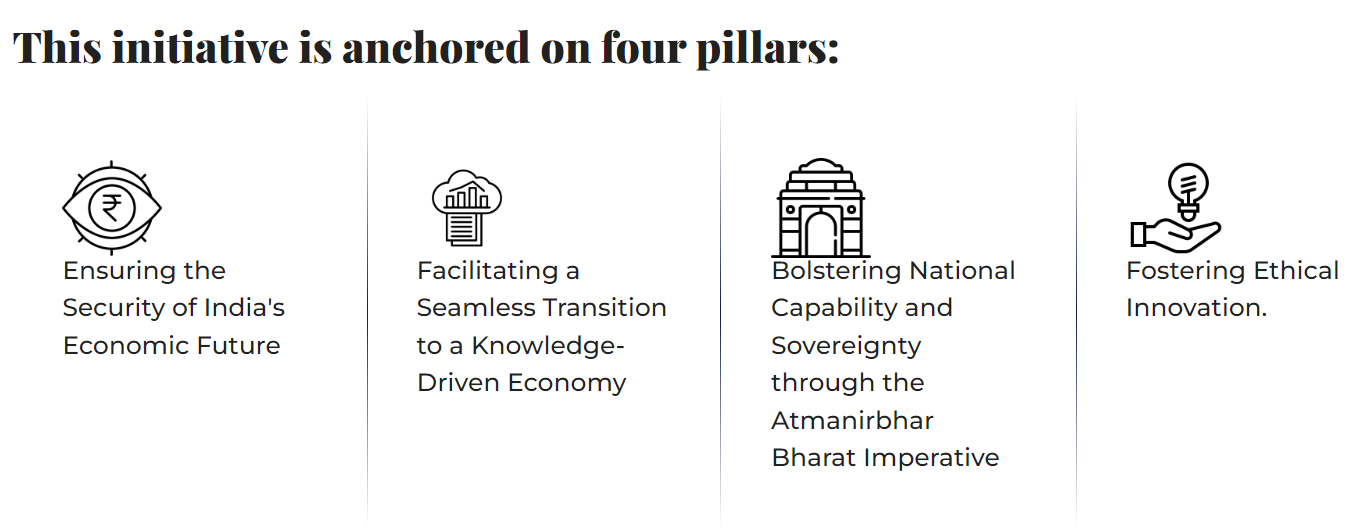
four pillars of Draft National Deep Tech Startup Policy

Objective 

  • To “ensure India’s position in the global deep tech value chain,” in areas such as semiconductors, Artificial Intelligence (AI) and space technology.
  • To bolster R&D in deep tech start-ups working on fundamental and technical problems.
  • To find approaches to provide financing to deep tech start-ups at critical moments.
  • To significantly strengthen India's capabilities and enhance global competitiveness.
  • To stimulate innovation, spur economic growth, and promote societal development through the effective utilization of deep tech research-driven innovations.
  • To solidify India's financial stability and stimulating the transition towards a knowledge-centric economy, consequently augmenting India’s overall productivity.
  • To stimulate ripple effects throughout the economy and lay the groundwork for deep tech industry creation.
  • To address the challenges confronting deep tech startups through definitive policy interventions to create a conducive ecosystem.
  • To simplify the intellectual property regime for deep tech start-ups, ease regulatory requirements, and propose measures to promote these firms. 

Provisions of Draft NDTSP 

  • It proposes an organisation “The Centre for Deep Tech Translation” to assess Indian research (publications, patents, etc.) for potential commercialisation.
  • It suggests creation of Export Promotion Board to ease barriers of entry for Indian deep tech start-ups into foreign markets.
  • It promotes setting up an Open Science and Data Sharing Platform for encouraging collaboration and knowledge sharing among the stakeholders to promote deep tech innovations.
  • It suggests establishing a Single Window Platform that enables a Unified IP Framework, customised for deep tech startups.
  • It suggests creating a thematically focused Fund of Funds (FoF) dedicated to deep tech investments; 
  • It suggests the use of Technology Impact Bonds to invite investment from the public and philanthropic entities.
  • The policy insists on expanding skill enhancement grants, and incentivising venture capitalists to invest in female-led deep tech startups.

Priorities Under The Policy 

Priority- 01 R&D innovation Strengthen the Research and Innovation ecosystem leading to scientific breakthroughs and technological advancements, boosting India’s knowledge-driven economy.
Priority- 02Intellectual property Bolster the Indian Intellectual Property regime and make it competitive for international deep tech startups to establish and operate their entities in India.
Priority- 03Funding Facilitate access to diverse sources of capital via specialized funding programs, increased venture capital investments and tailored government financial support avenues.
Priority- 04Infrastructure Enable Infrastructure and resource sharing with academic institutions, R&D laboratories, and large manufacturing corporations for faster product development.
Priority- 05Standards and certification Create a conducive regulatory environment for innovation to thrive by using streamlined frameworks, laying out clear regulatory requirements and introducing exemptions and incentives.
Priority- 06Diversity and capacity building Attract and retain the finest human capital for sustained superior deep tech innovations keeping equity, diversity and inclusion as the core tenets.
Priority- 07Adoption Promote public and private adoption of indigenous deep technologies through favourable procurement rules and innovative adoption mechanisms and tap into global markets for Indian deep tech products.
Priority- 08Policy interlinkages Interlink with the priorities of existing national policies and missions to ensure India’s position in the global deep tech value chain.
Priority- 09Sustenance Facilitate the sustenance of deep tech startups by helping them overcome the Valley of Death (VoD) phase through targeted solutions addressing funding limitations, resource constraints, limited business knowledge, and risk management.

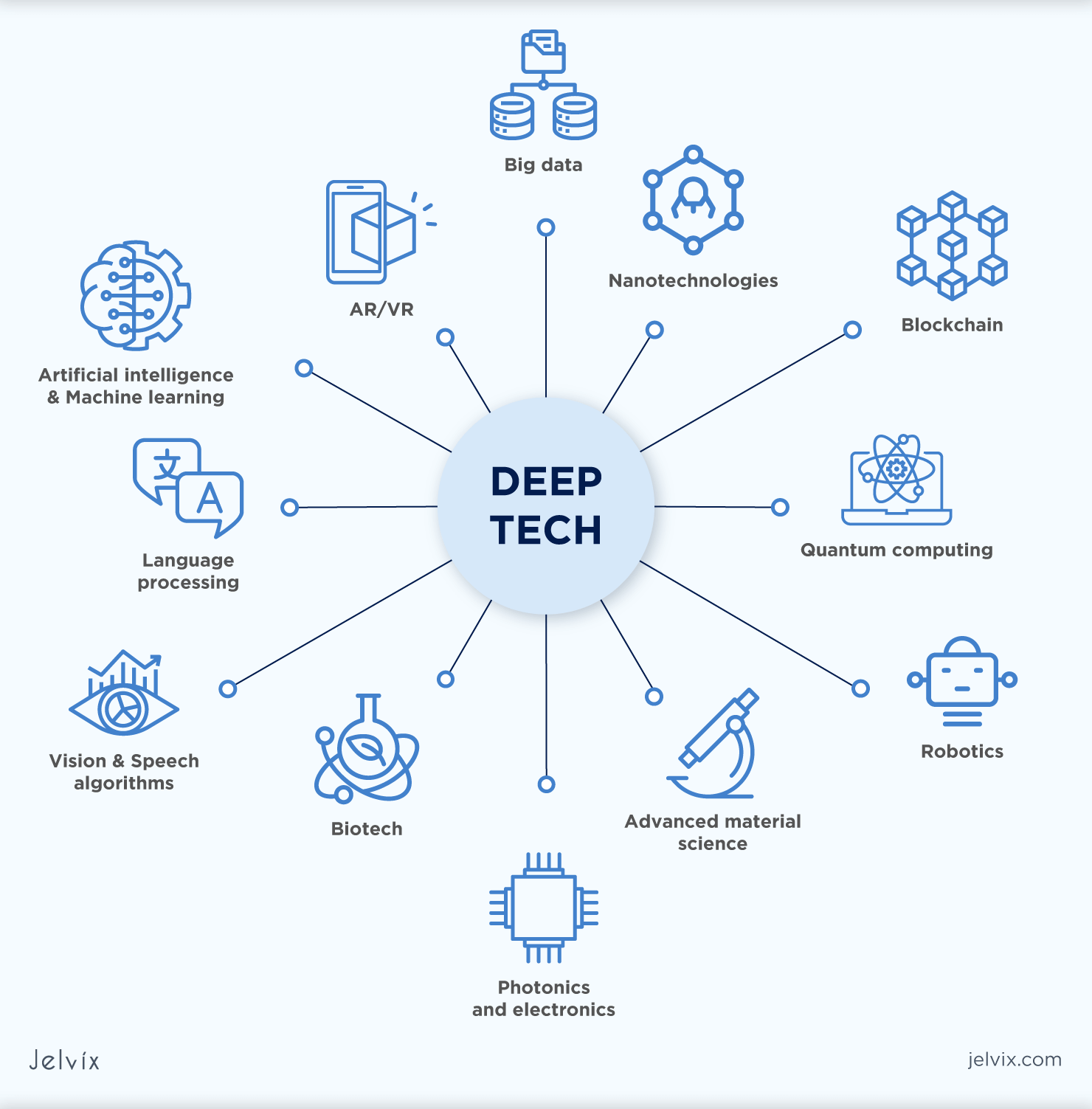
Deep Technology 

Deep Technology refers to innovations founded on advanced scientific and technological breakthroughs. It is a classification of organization, or more typically startup company, with the expressed objective of providing technology solutions based on substantial scientific or engineering challenges. 

Due to their disruptive nature, they have the potential to solve India’s most pressing societal issues.  

According to the BCG research, the overall investment in deep tech starting from 2015 increased by 300% to more than $60 million in 2020.  

Components of Deep Tech

Characteristics

  • Deep tech typically needs large investments over a longer term and profound research of a certain problem.
  • The commercial success of this type of project will also take more time to achieve due to the disruptive technologies it creates, unlike in general-tech and high-tech scopes.  

Some Examples Of Deep Tech  

BorderPass (Malaysia)An intelligent management project that leverages biometric data to enable automated and secure solutions for airports (check-in, boarding, etc.). 
ViSenze (Singapore)Smart product discovery platform that empowers visual search and image processing tools for online retailers across diverse fields.   
Beit (EU)  It is developing and implementing novel quantum algorithms to create versatile and powerful software solutions for quantum computers.  
Helix (US)It enables healthcare organizations to accelerate the integration of genomic data into patient care and public health decision-making.  
Fundbox (US)An AI-powered financial platform for small and mid-sized businesses that offer fast and intuitive access to business credit up to $150,000.  

Prime Minister's Science, Technology and Innovation Advisory Council (PM-STIAC)

The PM-STIAC is an overarching Council that facilitates the Office of the Principal Scientific Adviser to the Government of India (O/o PSA) to assess the status in specific science and technology domains, comprehend challenges in hand, formulate specific interventions, develop a futuristic roadmap and advise the Prime Minister accordingly. 

O/o PSA also oversees the implementation of such interventions by concerned S&T Departments, agencies and other government Ministries.

Missions under PM-STIAC

  • Natural Language Translation Mission
  • Quantum Frontier Mission
  • Artificial Intelligence Mission 
  • National Biodiversity Mission
  • Electric Vehicles Mission 
  • Bioscience for Human Health Mission
  • Waste To Wealth Mission
  • Deep Ocean Exploration Mission 
  • AGNIi (Accelerating Growth of New India's Innovations) Mission

Tahseen Poonawala Case

Context: The Supreme Court has asked the Ministry of Home Affairs and the governments of six States to respond to a petition by the National Federation of Indian Women seeking an explanation for their failure in the past five years to act against lynching and mob violence.

Tehseen Poonawala vs Union of India

Supreme Court in this case suggested guidelines for preventive, remedial and punitive measures to be taken by government in instances of mob lynching. 

The Court also asked Parliament to categorise “lynching” as a separate offence and provide adequate punishment for the same.  

Guidelines by the Supreme Court

Preventive Measures
Nodal Officer not below the rank of SPTo prevent incidents of mob violence and lynching State Governments shall designate, a senior police officer, not below the rank of Superintendent of Police, as Nodal Officer in each district. Who shall be assisted by one of the DSP rank officers in the district for taking measures.
Special Task Force to procure intelligence on cases of mob lynchingA special task force, to procure intelligence reports, shall be constituted by State Government to check hate speeches, provocative statements and fake news.
Identifying Vulnerable AreasThe State Governments shall forthwith identify Districts, Sub-Divisions and/or Villages where instances of lynching and mob violence have been reported in the recent past.
Nodal Officer to hold regular meetings with the local intelligence units in the district along with all Station House Officers of the districtTo identify the existence of the tendencies of vigilantism, mob violence or lynching in the district and take steps to prohibit instances of dissemination of offensive material through different social media platforms or any other means for inciting such tendencies.
Identify and Eradicate Hostile Environment in the vulnerable AreaThe Nodal Officer shall also make efforts to eradicate hostile environment against any community or caste which is targeted in such incidents.
DGP of State to take stock of situation from District OfficialsThe Director General of Police/the Secretary, Home Department of the concerned States shall hold regular review meetings (at least once a quarter) with all the Nodal Officers and State Police Intelligence heads. The Director General of Police shall issue a circular to the Superintendents of Police regarding police patrolling in sensitive areas.
Home Ministry to Co-ordinate with State Government to sensitize the law enforcement agenciesBy involving all the stake holders to identify the measures for prevention of mob violence and lynching against any caste or community and to implement the constitutional goal of social justice and the Rule of Law.
Create Awareness Against the Evil of Mob LynchingThe Central and the State Governments should broadcast on radio and television and other media platforms including the official websites of the Home Department and Police of the States that lynching and mob violence of any kind shall invite serious consequence under the law.
Remedial Measures
Filing FIR without delay by the Police to register crimeIn incidents of lynching or mob violence, the jurisdictional police station shall immediately cause to lodge an FIR, without any undue delay, under the relevant provisions of IPC and/or other provisions of law.
Intimating Nodal Officer about Investigation StagesThe Station House Officer shall intimate the Nodal Officer who shall be duty bound to ensure that the investigation is carried out effectively and the Report of police officer on completion of investigation (charge sheet) in such cases is filed without undue delay from the date of registration of the FIR or arrest of the accused.    
State must provide Compensation To compute compensation, the State Governments shall give due regard to the nature of bodily injury, psychological injury and loss of earnings including loss of opportunities of employment and education and expenses incurred on account of legal and medical expenses.
Cases of Mob Lynching to be tried by Fast Track CourtThe cases of lynching and mob violence shall be specifically tried by designated court/Fast Track Courts earmarked for that purpose in each district. Such courts shall hold trials of the case on a day-to-day basis. The trial shall preferably be concluded within six months from the date of taking cognizance.
Awarding Maximum SentenceTo ensure deterrence and to set an example, the trial court must ordinarily award maximum sentence as provided for various offences under the provisions of the IPC.   
Safety Measures to protect VictimsThe Court must take appropriate measures for the safety of such victims for protection and for concealing the identity and address of the witness.
Victims to receive Legal Aid through NALSAThe victims or the next of kin of the deceased in cases of mob violence and lynching shall receive free legal aid if he or she so chooses and engage any advocate of his/her choice from amongst those enrolled in the legal aid panel under the Legal Services Authorities Act, 1987.    
Punitive Measures 
Act of deliberate Negligence or Misconduct on failure to protect victimsWherever it is found that a police officer or an officer of the district administration has failed to comply with the aforesaid directions in order to prevent and/or investigate and/or facilitate expeditious trial of any crime of mob violence and lynching, the same shall be considered as an act of deliberate negligence or misconduct for which appropriate action must be taken against such officer.  
State to take Disciplinary Action against Erring OfficialsAs per Supreme Court judgment in Arumugam Servai v. State of Tamil Nadu, the States are directed to take disciplinary action against the concerned officials if it is found that such official or group of officials did not prevent the incident, despite having prior knowledge of it, or where the incident has already occurred, such official(s) did not promptly apprehend and institute criminal proceedings against the culprits.

Mob Lynching (ML)

The term Mob lynching means “unlawfully hanging or otherwise killing a person by mob action”. One of the major causes of mob lynching is hate speech.

  • Lynching involves injury or murder of a person who is criminal or accused of a crime against the community or a society.
  • Most of the victims of mob violence in India have been the minority groups of Muslims, Dalits and few racially tortured African tourists.
  • The lynching has been carried out in cases of witch-hunting, caste-based atrocities and most commonly bovine slaughter especially cows.

History of Lynching The concept of taking law into one’s hand to punish a criminal said to have originated during the American Revolution phrased as ‘Lynch Law’ which is a punishment without trial.During 1800’s in America, lynching used to be a form of punishment for presumed criminal offences by self-appointed ‘mobs of justice’.

Causes of ML

  • Creation of fear in the minds of the people through various means e.g., fake news, hate speechs etc.
  • Absence of belief in justice delivery system and police administration.
    • The loss of people’s faith in the Rule of Law. 
    • People have started believing in the principle of Justice delayed, justice denied.  
  • Role of social media: The increasing number of smart phones and internet access has increased and has strengthened the effect of online hate speech, fake news etc.
  • Rumours which Instigate people and ultimately lead to mob lynching.    
  • Indian Penal provisions neither defined lynching nor considered as a crime.

Legal Mechanism  

Indian Legal System neither defines lynching nor provides punishment for it. But it has been dealt with different legal mechanism in India: 

Indian Constitution

  • Rule of Law (Art 14) is the cornerstone of Indian Democracy. According to this Rule of Law, a person shall not be punished without the authority of law.
  • Article 21 provides for Right to life and personal liberty which shall not be infringed.

Indian Penal Code (IPC) 

  • Such cases are covered under Section 302 (murder), 307 (attempt to murder), 323 (causing voluntary hurt), 147 (rioting), 148 (rioting armed with deadly weapons) and 149 (unlawful assembly)

Code Of Criminal Procedure (CrPC)

  • Section 223(a) of CrPC contains the provision for persons being charged jointly for the same offence committed during the same transaction. 
  • Section 144 of the code empowers the Executive Magistrate to prohibit an assembly of more than four persons in an area. 

Suggestion 

Anti-Discrimination and Equality Bill

The draft Bill prohibits discrimination based on caste, race, ethnicity, descent, sex, gender identity, pregnancy, sexual orientation, religious identity, tribe, disability, linguistic identity, HIV-status, nationality, marital status, dietary preference, skin tone, physical appearance, place of residence, place of birth and age.

Right to life is a fundamental right guaranteed to every citizen. The act of taking life through the vehicle of mobocracy is murder of democracy. It is to be noted that the top priority of a democratic government should be the safety and security of its citizens.

Issues before 16th Finance Commission

Context: Government is scheduled to constitute the 16th Finance Commission towards the end of this year. This article looks at the issues that the next finance commission needs to handle.

About Finance Commission

Finance Commission is a constitutional body (Article 280) at the expiration of every fifth year or at such earlier the President considers necessary by order.

Finance Commission consists of a Chairman and four other members to be appointed by the President.

Parliament may by law determine qualifications for appointment as members of Finance Commission. 

It is entrusted with the responsibility of recommending transfer of 

  • Distribution between Union and States of net proceeds of taxes to be divided between them.
  • Principles which should govern grants-in-aid of the revenue of States out of Consolidated Fund of India
  • Measures needed to augment Consolidated Fund of State to supplement resources of Panchayats and ULBs.
  • Any other matter referred to the Commission by the President. 

Finance Commission (Miscellaneous Provisions) Act, 1951

Chairman of Finance Commission shall be selected from among persons who have had experience in public affairs and four other members shall be elected from among persons who:

  • Qualified or are or have been judges of High Court.
  • Have special knowledge of finances and accounts of Government.
  • Have wide experience in financial matters and in administration
  • Have special knowledge of economics.

15th Finance Commission

The 15th Finance Commission has come out for special report on federal fiscal transfers for the period 2020-21. The report for the rest of the period 2021 to 2026 will be spelt in a different report.

Vertical Devolution (Between Centre and States)

1. For the year 2020-21, 15th FC recommended the same vertical devolution as was recommended by 14th FC. However, considering that the State of Jammu & Kashmir has been broken into two UTs of J&K and UT of Ladakh. Thus, the aggregate share of States was reduced by 1 % point to 41% of the divisible pool. (14th FC recommended States to have 42% of the divisible pool).

Horizontal Devolution (Sharing of Resources within States)

Aims of Horizontal Devolution are:

  • Considerations of fiscal need, equity and incentivising performance. 
  • Addressing fiscal disabilities and fiscal discipline
  • Enable States to provide basic public goods and services with equivalent tax effort
  • Filling up vertical fiscal gap of the States
  • Providing horizontal equity (higher share to poorer regions)
  • Equalising fiscal capacities of States (revenue equalisation)
  • Providing for cost differentials in States for basic public service (expenditure equalisation)
  • Ensure that States have enough incentives to mobilise own revenue and spend them appropriately in an efficient manner. 

Salient Features of 15th Finance Commission Recommendation:

  • 15th FC uses population data from 2011 census. Earlier FCs have used population data of 1971. 
  • Forest and ecology criteria is for rewarding for ecological services provided by the State's forest cover to the country as a whole and overcoming disabilities arising from areas dedicated to dense forests. (Share of dense forest for each state in the aggregate dense forest of all the States).
  • Income distance: This criteria makes the devolution formula more equalising and progressive and provides higher devolution to States with lower per capita income. Income distance is computed by taking a three year average of per capita GSDP of all States and measuring the taking the distance from the State having highest per capita GSDP.
  • To incentivise States which have controlled population growth, Demographic Performance criteriahas been introduced by 15th FC. It uses a measure of Total Fertility Rate data for all States. This criterion has been computed by using the reciprocal of TFR of each State, scaled by the population data of Census 1971. States which have achieved lower TFR will be scored higher on demographic performance whereas States with higher TFR will be scored lower. 
  • Tax Effort: This criteria was used by 10th, 11th FC, 12th FC however, not used by 13th and 14th FC. The inclusion of this criteria by 15th FC will reward States with higher tax collection efficiency and encourage all States to be  more tax efficient.

Formula suggested by 15th Finance Commission for Horizontal Devolution

CriteriaWeight (15th Finance Commission)
Population (2011)15%
Area15%
Forest and Ecology10%
Income Distance45%
Demographic Performance12.5%
Tax Effort (New criteria introduced by 15th FC, not used by 14th FC)2.5%

Formula suggested by 14th FC

Population (1971)17.5%
Population (2011)10%
Area15%
Forest Cover7.5%
Income distance50%

Structural Issues with Finance Commission

  • Appointment of Members: Members of Finance Commission are unilaterally appointed by the Centre with no say from the states. States contend that this makes Finance Commission biased towards Centre. Ideally, the membership of Finance Commission should be appointed with the consent of both Centre or States or some members by Centre and some by States.
  • Terms of Reference: Terms of Reference of Finance Commission are fixed by the Centre. Over the years, apart from constitutional mandate of making recommendations for vertical and horizontal distribution between Centre & States, Central Government gives some additional considerations and parameters. States feel that these additional considerations are often loaded in the favour of Centre. There is a demand from the States that the TOR of Finance Commissions should be fixed jointly by Centre and States. A Forum like GST Council or Inter-State Council can be explored for this.
  • Temporary Nature of Finance Commission: Increasing geopolitical challenges and flux in economic circumstances often makes the 5-yearly award of Finance Commissions not sustainable to operate. This was very evident in case of the Covid-19 pandemic. There has been a demand to make Finance Commission a permanent body which can tweak it's award to suit the varying economic context. 
  • Based on past data:  The 5 yearly award of Finance Commission is based on past revenue trends and not on forward indicators. However, for maintaining sustainable fiscal situation, future performance matters more.

Other Issues

  1. Issue of cesses and surcharges:
  • The revenue collected by centre as cess and surcharge do not form the part of divisible pool of central taxes. There has been steep increase in the share of cess and surcharge from 12.8% during 2015-16 to about 18.5% during 2023-24. 
  • The impact of increasing reliance on cess and surcharges has reduced states effective share in Centre's Gross Tax Revenue. Thus, during 2020-21 to 2023-24, the effective share of States in Centre's gross tax revenue has averaged 31%, which is significantly lower than 35% during 2015-16 to 2019-20. The increase in cesses is particularly visible in the case of cess on Petroleum products.
  • Centre has sharply reduced corporate income tax rate which has impacted the divisible pool of Gross Tax Revenue with States.
  1. Horizontal devolution formula: Currently, the horizontal devolution among states gives highest weightage to income distance (45%). Income distance measures distance of a State's per capita income from a benchmark (usually average per capita income of top three States). This results in relatively higher share for lower income states. Richer states have argued against such high weightage to income distance however this results in progressiveness in devolution and equity in developmental outcomes for poorer states. The poorer states also house most of India's demographic dividend. 
  1. Debt levels: Debt-GDP ratio combined for central and state governments peaked at around 90% in 2020-21 with Centre accounting for 58.7% and States accounting for 31%. However, Fiscal Responsibility & Budget Management Act mandates debt-GDP ratio of 40% for Central Government and 20% for State Governments. In view of the large departure of Central and State government debts with the prescribed norms, these norms need to be revisited. 
  1. Revenue Deficit Grants: All Finance Commissions have provided revenue deficit grants to states in need of assistance under Article 275 of the Constitution. The revenue deficit grants accounts for gap in revenue accounts for the States post devolution. However, many States feel that the gap filling approach through revenue deficit disincentivises prudential expenditure and taxation measures by states. However, the demand of equity and handicap faced by mountain states necessitates these grants. However, weightage should also involve education and health outcome gaps between states to came developmental outcomes uniform across states.
  1. Finance Commission and GST Council: GST Council has been constituted as a constitutional body and takes important decisions regarding administration of GST. The GST Council and Finance Commission often deal with issues of revenue and this can result in conflict between them.
  1. Transfer to Local bodies: State's often fail to constitute State Finance Commissions and implement them. Finance Commission should incentivise states to form State Finance Commission. Often the grants given by Finance Commission are with conditions for example implementing certain schemes etc.  

Way Forward:

  • Consultation with states: The membership and terms of reference of Finance Commissions should be fixed in a consultative manner between Centre and States utilising forums such as Inter-State Council and GST Council.
  • Data collection: The focus should be capacity building and data collection and processing in the Finance Commission Division in the Ministry of Finance and develop forward looking indicators by future Finance Commissions.
  • Managing cess & surcharge:  Finance Commission should recommend a limit on the amount of cess & surcharge the centre could levy up to maximum 10% of overall gross tax revenue. If the centre breaches this limit the shareable pool of revenues to states should increase.
  • Independent Fiscal Council: It is a permanent agency with statutory mandate to assess publicly and independently government's fiscal policies, plans and performance against macro-economic objectives related to the long-term sustainability of public finances. 
  • Revenue Deficit Grants: In place of a gap filling approach to revenue deficit grants and normative principle that balances handicaps faced by states and also takes care of not incentivising inadequate revenue effort or excessive expenditures.
  • Formula of devolution: Apart from income distance, outcome gaps in health and education should be also given due weightage for equity in developmental outcomes. 

Rajya Sabha passed the Cinematograph (Amendment) Bill, 2023

Cinematograph (Amendment) Bill, 2023  

Provision of the Bill

Provision for Anti-piracy

  • Section 6AA: To prohibit the unauthorised recording of films and prohibit the recording of any part of the film for the sole usage of the same device.
  • Section 6AB: To prohibit the exhibition of unauthorisedly recorded films. 
  • Piracy a punishable offence: The above offences will be punishable with imprisonment between 3 months and 3 years, and a fine between Rs. 3 Lakh and 5% of the audited gross production cost.
  • Recording or helping a person record any film that is being exhibited at a cinema theatre using audio-visual devices has been prohibited under the Bill.

Provision related to certification

  • Expansion of Certificate Categories: It introduces three certifications under the ‘UA’ category, UA 7+, UA 13+ and UA 16+, which means that children younger than the given age limits can access such movies with parental guidance.
  • Revisional Power of centre: it clarifies that the Centre will not have any revisional powers over Center Board of Film Certification certificates.
  • Validity of Certificate: it proposes to replace the current 10-year-old validity period for film certification with perpetual validity.
  • Separate Certification: It empowers CBFC to sanction the film with a separate certificate for its exhibition on television and other media.

Need for amendment 

Cinematograph Act, 1952 needed to be amended due to several reasons 

  • To harmonise the law with various executive orders, Supreme Court judgements, and other legislations; 
  • To improve the procedure for licensing films for public exhibition by the CBFC
  • To expand the scope of categorisations for certification. 
  • To meet the demand of the film industry for addressing the menace of piracy, which is causing them huge losses.

Expected Benefits of the Bill

  • Address the issue of loss of revenue 
    • The film industry is facing a loss of Rs 20,000 crore annually because of piracy as per Union Information and Broadcasting Minister. 
  • It will harmonise the Cinematograph Act with the existing laws that address piracy, the Copyright Act, 1957, the Information Technology Act (IT) 2000 and judgement given by Supreme court and high courts.
  • It will address the issue of film piracy by transmission of unauthorised copies on the internet.
  • It will improve the procedure for certification of films for public exhibition by the CBFC.
  • It also improves the categorisation of the certification of the films.
  • Institutes for the animation, visual effects, gaming and comics (AVGC) sector expected to provide skilled manpower to the fast-growing field and bill will create a fertile ground for them.

Issue with the bill 

  • The bill still does not create objective criteria for certification and the issue of CBFC not treating every film equally is not addressed.
  • Clause for public participation in taking the decision of cuts was not included in the bill which makes it less participative.
  • The ever expanding and changing nature of the internet doesn’t find a place in the bill which makes combating piracy a difficult task e.g., use of blockchain, end to end encryption etc.

Certification 

Objective 

  • To ensure that the medium of film remains responsible and sensitive to the values and standards of society.
  • To make sure artistic expression and creative freedom are not unduly curbed and should be regulated through due process.
  • To ensure that Certification is responsive to social change.
  • To make sure that the medium of film provides clean and healthy entertainment.
  • To make sure that the film is of aesthetic value and cinematically of a good standard and improve social capital.

Cinematograph Act, 1952

Important Provisions

  • Section 3 of the Act states that the Central Government has the authority to constitute a Board of Film Certification consisting of a Chairman and other members.
  • Section 4 of the Act states the procedure to examine the films by the Board before the release. T
  • Section 5 of the Act provides the Central Government with the power to establish advisory panels at regional centres to assist the Board in the discharge of their duties.
  • Section 5A of the Act provides the method of certification of the films after examination in the prescribed manner.
  • Section 5B of the Act states the powers of the Board or any other authority issuing the certificate to the film
  • Section 5D of the act provides for the establishment of Film Certification Appellate Tribunal (FACT).

Central Board of Film Certification (CBFC)

CBFC is to require cuts in films and clear them for exhibition in cinemas and on television

  • The main CBFC Board consists of a chairman and other members 12 to 25 in the number who are appointed by the Central Government.
  • There are no prescribed minimum qualifications required to be a member of the CBFC as under the Cinematograph Act.
  • The chairman holds office for a period of 3 years.
  • The Central Government can terminate tenure of members whenever possible on reasonable grounds.

Current practice of 'U', 'A', and 'UA' certification 

  • A "U" certification is for unrestricted public exhibition 
  • "A" certification is restricted to adult audiences. 
  • "UA" certification is for unrestricted public exhibition, subject to parental guidance for children under the age of 12.

Film Certification Appellate Tribunal (FACT)

It is a statutory body headed by a chairperson assisted by four members. 

  • Any applicant for a Certificate in respect of a film who is aggrieved by an order of the Central Board of Film Certification (CBFC), can file an Appeal directly to tribunal.
  • The Tribunal hears the appeals filed under Section 5C of the Cinematography Act.

Court cases 

K.A. Abbas v. Union of India

Supreme Court held that film censorship, comprising pre-censorship in India was legal because it is a reasonable restriction under Art 19(2).

Secretary, Ministry of Information and Broadcasting v. Bengal Cricket Association

Supreme Court declared that freedom of speech comprises the “right to hold the knowledge and impart the same to the citizens.” As a result, Article 19(1)(a) comprises the right of spectators.

F.A. Picture International v. Central Board of Film Certification

High Court of Bombay opined that “In a free and open society censorship can be regarded within the strictest plausible boundaries and stringently within the confines which are envisaged in democratic institutions.”

Bobby Art International v. Om Pal Singh Hoon

Supreme court opined that “The film must be assessed in its totality. When the film’s purpose is to denounce female exploitation, violence, and rape, depictions of nudity and rape, as well as the use of expletives, are acceptable to further the film’s purpose by evoking disgust against the offenders and sympathy for the victim.”

Pratibha Naitthani v Union of India

  • Bombay High Court held that the restriction upon cable operators and cable service providers that no programme should be transmitted that is not suitable for unrestricted public exhibition did not violate their right to carry on trade and business. 
  • The Court further held that only films sanctioned by the CBFC, under the Cinematograph Act and Rules, as suitable for “unrestricted public exhibition” could be telecast or transmitted on Cable TV.

Union of India v KM Shankarappa

  • High Court of Karnataka in Union of India v KM Shankarappa held that the government cannot exercise the revising power in respect of films that have already been certified by the board. 
  • The judgment was later upheld by the Supreme Court.

“No-Confidence Motion” Matters 

Context: Member of Parliament Gaurav Gogoi submitted the no-confidence motion against the government, which was accepted by the speaker.

Need of No Confidence Motion (NCM) 

In India’s cabinet form of government, the Council of Ministers is collectively responsible to Lok Sabha. The rules of Lok Sabha provide for the mechanism of a no-confidence motion 

Need for NCM 

  • To test whether the Council of Ministers continues to enjoy the confidence of Lok Sabha.
  • NCM is used by Opposition parties essentially to hold the government accountable.
  • Even if it may not lead to the fall of government it will result in productive debate in parliament about government policies and program. 
  • It reflects the discontent prevailing in the masses through their representative and may lead to government taking cognisance of it.
  • According to Nehru it is good for governments to be tested from time to time, It is a sign of healthy democracy.

Issue With NCM 

  • Rajya Sabha does not have this special device to make government accountable. 
  • After the passing of the Anti-defection law whips became binding on the member and if ruling party enjoys majority, it is impossible to pass a NCM in the house.  
  • Partisan role of speaker in accepting NCM.
  • Frequent use of this exceptional device may lead to disruption in the normal functioning of the house and can cause political instability in the nation.

Non-confidence motion 

  • The motion can be moved only in the Lok Sabha. It cannot be moved in the Rajya Sabha. 
  • Any member of the Lok Sabha can move a no-confidence motion. 
  • But the motion must be supported by at least 50 members of the House.

Constitutional Provision

Article 75(3) of the Indian constitution states that:

  • The Council of Ministers shall be responsible to the House of the People.

Rule 198 of the Rules of Procedure and Conduct of Lok Sabha says that 

  • A member must move a written notice before 10 am, which will be read out by the speaker within 10 days (about 1 and a half weeks) of the written motion being submitted. 
  • Once the speaker reads out the motion in the House and a minimum of 50 members have supported it, the speaker gives a date or dates for discussion of the motion.

History of Non-confidence motion in India 

Time Prime Ministers and Motions 
1963The first no-confidence motion was moved against the Jawaharlal Nehru government in 1963 by Acharya J.B. Kripalani over the prime minister’s China policy, immediately after the 1962 war.
1964-65Lal Bahadur Shastri government faced two non-confidence motions in 1964-1965, N C Chatterjee said while moving NCM“There is a crisis in every sphere. Honestly, there is a crisis in social, political, economic and other spheres and for all this I hold this government mainly responsible.”  
1966-75Indira Gandhi government faced the greatest number of no-confidence motions in the history of independent India, with 12 motions during her tenure from 1966-75.
1978-79Morarji Desai government faced two no-confidence motions. While he won the first one, the discussion on the second remained inconclusive but led to the fall of his government.
1981-82Indira Gandhi government faced three NCM in her second tenure.
1987Rajiv Gandhi government faced NCM once. 
1992-1993PV Narshima Rao government faced three no-confidence motions and defeated all of them.
2003Atal Bihari Vajpayee government faced a no-confidence motion and defeated the motion.
2018Narendra Modi government defeated his first no-confidence motion.

Jharkhand issues PESA draft rules for consultations

Context: Jharkhand government published draft rules for wide-ranging public consultation for implementing The Provisions of the Panchayats (Extension to Scheduled Areas) Act.

Draft Jharkhand Panchayat Provisions (Extension to the Scheduled Areas) Rules, 2022

  • Gram Sabhas (GS) will have responsibility of maintaining peace and order in their area of jurisdiction, keeping in view the Constitution, and the rules framed by the government.
  • Dispute Resolution: The GS will be able to hear the issues mentioned in Parishisht-1 (Appendix) of the Indian Penal Code, 1860.
    • In view of “serious crime-related issues”, GS will immediately inform the nearest police station in-charge.
    • GS will resolve traditional and family disputes.
  • Standing committees: Rules mandated eight standing committees, including for Education and Social Justice, to be working under the GS.
    • which will have at least 50% women and a minimum of 40% people from Scheduled Tribe (ST) communities.
    • Some of which will work for Scheduled Castes, ST as well as weaker sections of society such as specially abled and primitive tribes, providing protection from social injustice.
  • Tradition and Customs: GS shall maintain the customary law, social and religious practices of the ST communities residing in its area and will take necessary steps for the protection of the same.
  • Limitation on state government: State Government rules issued in relation to the rights and responsibilities of the Panchayats will be in accordance with the social, religious and traditional management practices of the STs.
  • Sand Ghat: The GS concerned will be the operator of the “sand ghat” (where sand is mined) or can use it for local needs at its own level.

Issues with the rules 

  • It is not clear from the draft rules what the issues under relevant IPC sections are that the GS may or may not hear.
  • The rules consider ‘tribals’ as a homogeneous entity but Jharkhand has many tribal groups with different political systems.
    • ‘Parha Raja System’ in Munda and Oraon tribe dominated in Chhota Nagpur region
    • ‘Munda Manki System’ in Ho tribe dominated in Kolhan region
  • Maintaining peace and order will be challenging as GS is not given significant financial and administrative authority in the rules.  
  • The Rules do not provide for any mechanism to resolve conflicts arising out of the sand mafia and Gram Sabha. 
  • The formation of standing committees and increasing their ambit of operation to other sections may dilute PESA’s effectiveness in addressing tribal issues.

Panchayats (Extension to Scheduled Areas) Act, 1996 (PESA)

The Provisions of the Panchayats (Extension to Scheduled Areas) Act or PESA, enacted in 1996 on the recommendation of Bhuria Committee to ensure self-governance through gram sabhas for people living in Scheduled Areas. It proclaims to establish self-governance, participatory democracy and empowerment of the local community.

Power and Function of Gram Sabha

  • Protection of traditional belief, the culture of the tribal communities
  • Resolution of the local disputes
  • Prevention of land alienation
  • Management and protection of the common properties based on their traditions
  • Management of village markets
  • Right to control production, distillation, and prohibition of liquor
  • Exercise of control over moneylending
  • Any other rights involving the Scheduled Tribes.

Multi-State Cooperative Societies (Amendment) Bill, 2023

Context: Multi-State Cooperative Bill passed by Lok Sabha

Multi-State Cooperative Societies (Amendment) Bill, 2023 (MSCS Bill)

Objective 

  • To strengthen cooperatives by making them transparent and introduces a system of regular elections.
  • To facilitate the voluntary formation and democratic functioning of co-operatives as people's institutions based on self-help and mutual aid
  • To consolidate and amend the law relating to co-operative societies, with objects not confined to one State and serving the interests of members in more than one State
  • To enable them to promote their economic and social betterment
  • To provide functional autonomy as being felt necessary by the various cooperative societies, and federation of various cooperative societies as well as by the Government.

Comparison  

ProvisionMSCS Act, 2002MSCS (Amendment) Bill, 2023
Election of board members Elections to the board of a MSC are conducted by its existing board.The bill provides for a Co-operative Election Authority to Conduct such electionsSupervise, direct, and control the preparation of electoral rollsPerform other prescribed functions
Amalgamation of co-operative societiesBy passing a resolution at a general meeting with at least two-thirds of the members, present and voting MSCs can amalgamate.   The Bill allows state co-operative societies to merge into an existing multi-state co-operative society, subject to the respective state laws.
Sick Cooperative Societies NO Provision The Bill establishes the Co-operative Rehabilitation, Reconstruction and Development Fund for revival of sick multi-state co-operative societies.
Restriction on redemption of government shareholdingThe Act provides that the shares held in a multi-state co-operative society by certain government authorities can be redeemed based on the byelaws of the society.The Bill amends this to provide that any shares held by the central and state governments cannot be redeemed without their prior approval.
Redressal of complaintsNO ProvisionAs per the Bill, the central government will appoint one or more Co-operative Ombudsman with territorial jurisdiction.

Issue with the Amendment Bill

  • The Bill is imposing a cost on well-functioning co-operatives to bail out poorly functioning ones.
    • Revival of a Sick multi-state co-operative societies will be done by a Fund that will be financed through contributions by profitable multi-state co-operative societies.
  • Co-operative principles of autonomy and independence may be compromised as the shareholding of governments cannot be redeemed without the consent of government.
  • Appointment of the election authority by the central government may put the question on the independence of the authority.

Constitutional Provision with Respect to Co-operatives

Schedule 7
Entry 43 of Union list states thatIncorporation, regulation and winding up of trading corporations, including banking, insurance and financial corporations, but not including co-operative societies.
Entry 32 of State List states that Incorporation, regulation and winding up of corporations, other than those specified in List I, and universities; unincorporated trading, literary, scientific, religious and other societies and associations; co-operative societies.

In 2011, by 97th Constitutional Amendment Act, the Constitution was amended adding 

  • Co-operative societies to fundamental right to form association under Article 19(1)(c)
  • Article 43 in Part IV which put a duty on state for Promotion of co-operative societies 
  • Part IXB

 And specify guidelines for running co-operative societies.  

These guidelines provide for:

  • Composition of the boards of co-operatives 
  • Election of members of the board
  • Audit of accounts of co-operative societies
  • Supersession of the board

The Ministry of Cooperation was created by transferring the existing entries related to cooperation and cooperative in the business of the erstwhile Ministry of Agriculture, Cooperation and Farmers Welfare vide Cabinet Secretariat’s Gazette Notification.

In Union of India versus Rajendra N Shah and Anr.

The Supreme Court held that Part IXB will only be applicable to multi-state co-operative societies, as states have the jurisdiction to legislate over state co-operative societies.

Issues with the functioning of the Co-operative societies 

  • Inadequacies in governance
  • Politicisation and excessive role of the government 
  • Inability to ensure active membership
  • Lack of speedy exit of non-user members
  • Lack of member communication and awareness building measures
  • Lack of recognition of cooperatives as economic institutions both amongst the policy makers and public at large
  • Lack of efforts for capital formation
  • Inability to attract and retain competent professionals
  • Elections to co-operative boards have been postponed indefinitely
  • Lack of cost competitiveness arising out of issues such as overstaffing a general top-down approach in forming cooperatives 

Suggestions

  • For enhancing member participation: Definition of ‘Active members’ should be introduced in cooperative legislations, right to vote and contest should be given only to active members and enabling provision for speedy exit of nonuser members. 
  • Effectiveness of Boards: Cooperative legislations should clearly define the role and responsibilities of cooperative board vis-à-vis that of paid executives/managers.
  • Enhancing Professionalism: Cooperatives should be enabled for co-option of experts, subject matter experts. Also, any person elected as a Director on the Board should undergo a set of prescribed training programs. 
  • Checking Politicization: Cooperatives law should provide for rotational retirement of Board members and restriction on contribution to political and religious organizations. form joint ventures, partnerships etc. with cooperatives and other corporates and have flexibility in business decisions, mobilizing funds etc. 
  • State Governments should put in place a policy framework for facilitating the functioning of cooperatives with free and fair means. States should refrain from deputing officers to occupy key positions in cooperatives. 
  • The office of registrar of cooperatives should be restructured as a developmental office which handholds and guides cooperatives.