Polity

Differing views emerge on MP disqualification

Context: Congress leader Rahul Gandhi’s conviction and sentencing in a 2019 defamation case by a court in Gujarat has put a question mark over his continuation as a Lok Sabha MP. Experts have differing views on whether the conviction and sentencing means immediate disqualification or the Wayanad MP gets time if he appeals.

So this particular raises two issues which are extremely pertinent in Indian context: 

  • Disqualification of elected members of the houses. 
  • Criminal Defamation and its utility in democratic India. 

So the following discussion will have two components: 

  • Disqualification
    • Disqualification and Its importance
    • Constitutional provisions 
    • Lily Thomas Case 
  • Defamation
    • What is defamation all about?
    • Defamation is an exception to the Right to Freedom of Speech
    • Why is defamation a crime? 
    • Why defamation should remain a criminal offence?

Disqualification and Its importance: 

  • The disqualification procedure in India is an important mechanism for maintaining the integrity of the electoral process and ensuring that elected representatives meet certain standards of conduct and eligibility.
  • Under the Constitution of India, certain criteria have been laid down (See below) for the eligibility of candidates contesting elections to the Lok Sabha (lower house of parliament) and the state legislative assemblies. These criteria include age, citizenship, and lack of criminal convictions, among others. If a person is found to be ineligible based on these criteria, they can be disqualified from holding elected office.
  • Similarly, if an elected representative violates certain rules or engages in behavior that is deemed unethical or illegal, they can be disqualified from their position.
    • For example, under the Representation of the People Act, an elected representative can be disqualified for offenses such as corrupt practices, electoral malpractices, or holding an office of profit.
  • The disqualification procedure is important because it ensures that those who are elected to public office are held to high standards of conduct and behavior. It also helps to prevent individuals who are ineligible or have engaged in unethical or illegal activities from holding elected office and making important decisions on behalf of the people.
  • Overall, the disqualification procedure in India plays a crucial role in maintaining the integrity of the electoral process and ensuring that elected representatives are held accountable for their actions.

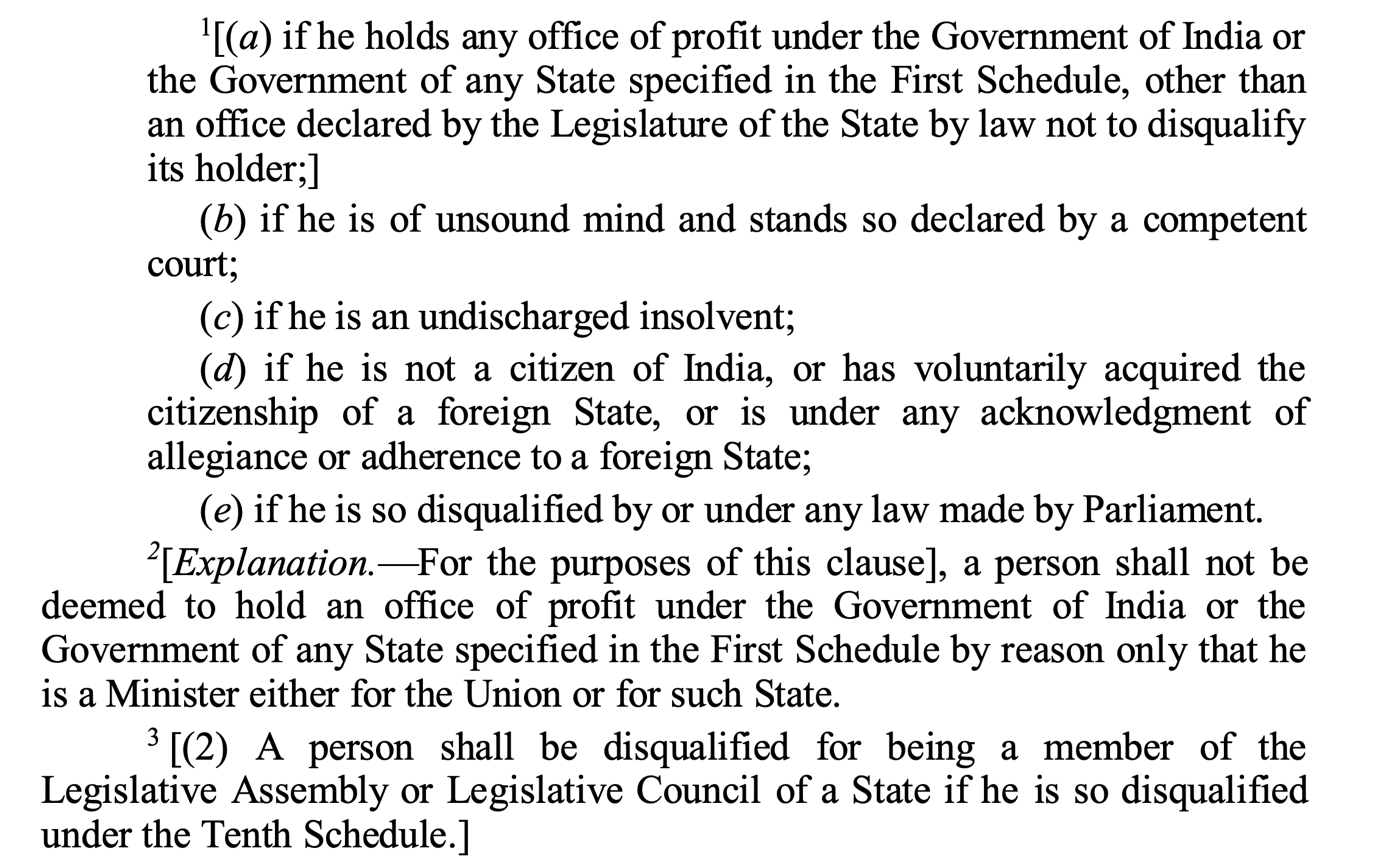
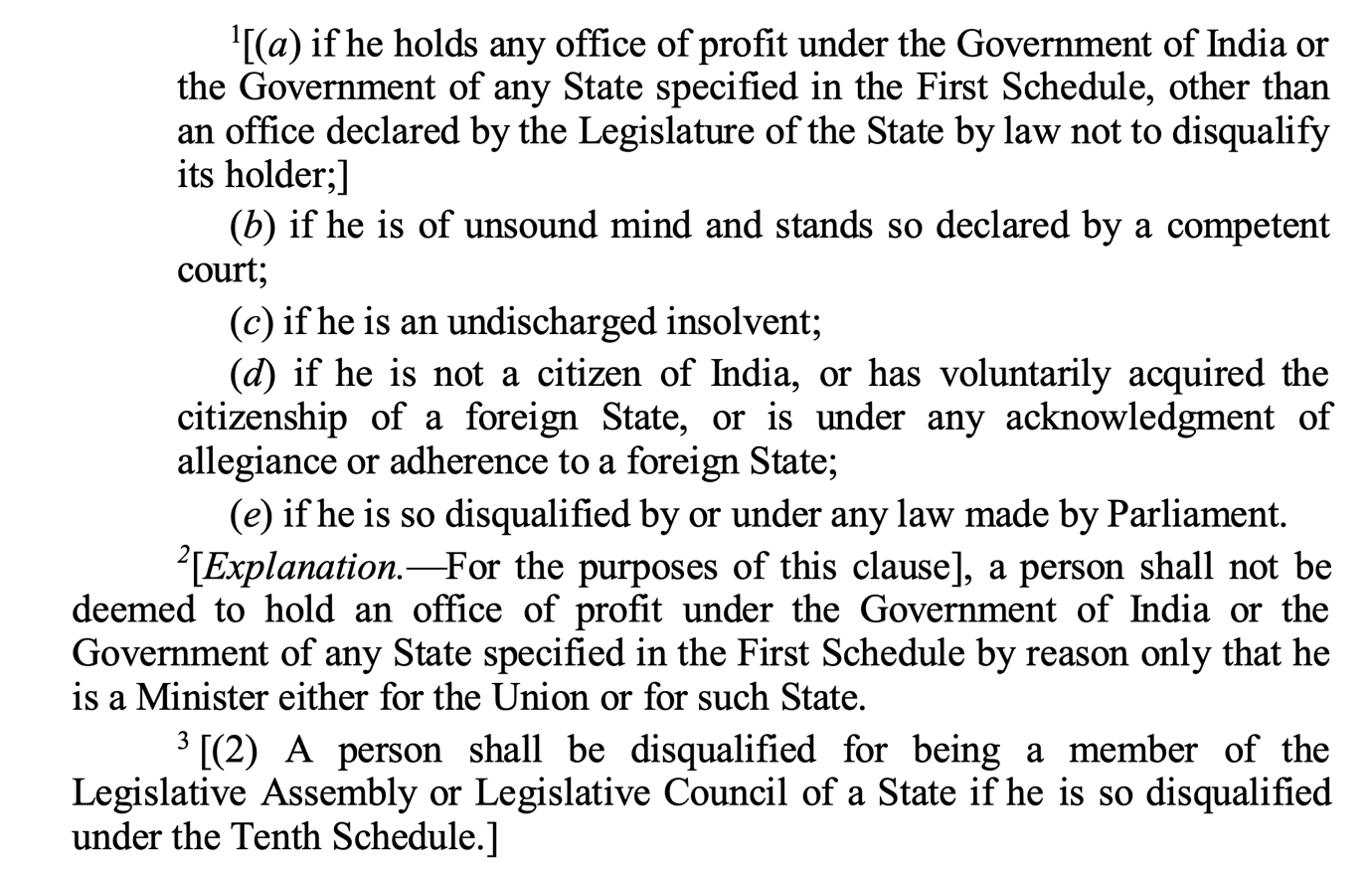
Disqualifications specified in the Constitution of India for Members of Parliament: 
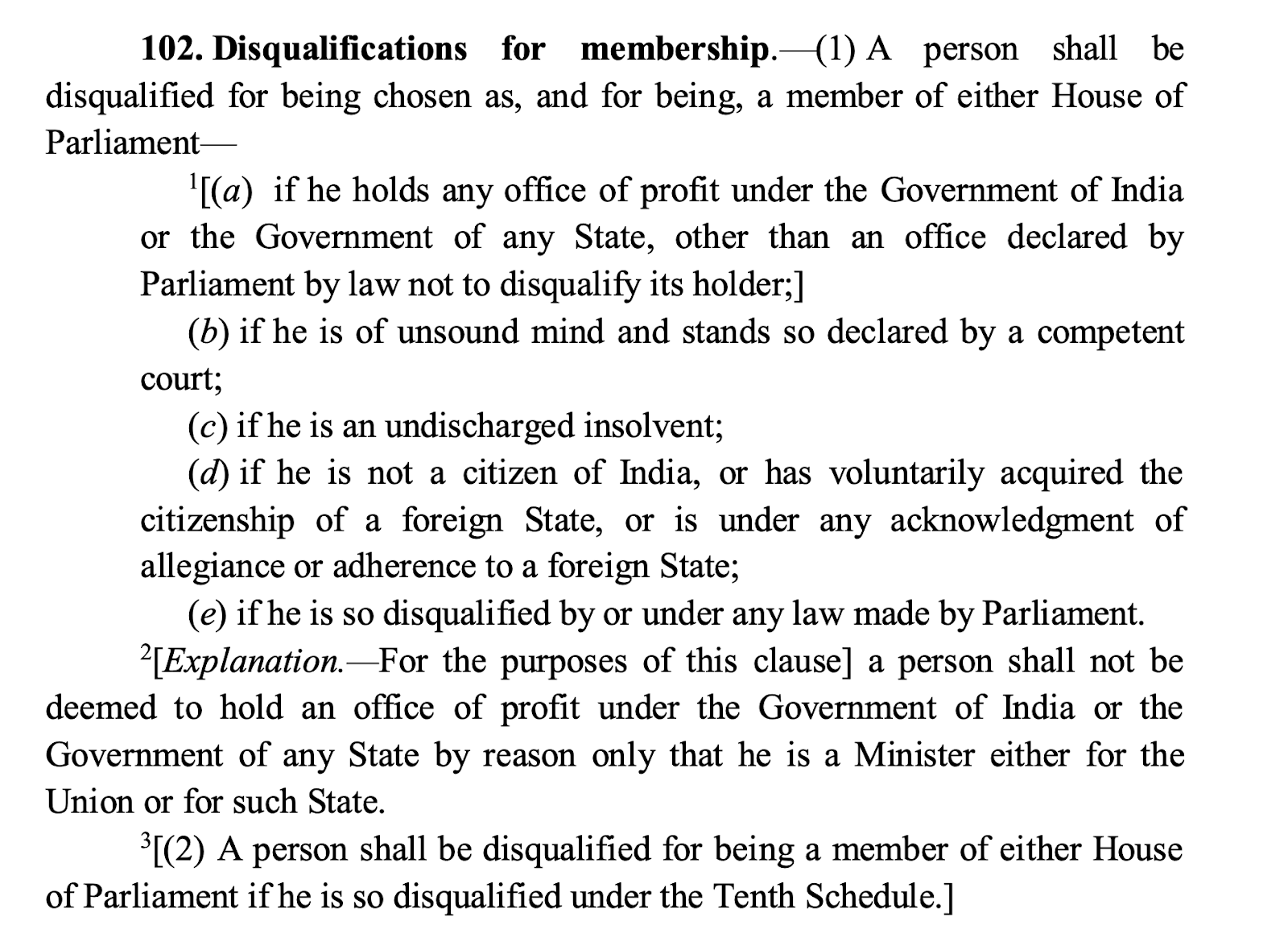
Text, letter

Description automatically generated
Text, letter

Description automatically generated

Disqualifications specified in the Constitution of India for Members of Legislative Assembly: 

Text

Description automatically generated
xJSSWl k4jFLXuwTaBA69aGmLjrt09qUcgbx98Kt1cCmC0FhqZ blYUNOLoI3NFa2N3CQc9bla mZ2RAAgeW

(Lily Thomas Case 2013) Immediate Disqualification of Convicted MPs and MLAs 

  • In 2013, the Supreme Court held that charge sheeted Members of Parliament and MLAs, on conviction for offences, will be immediately disqualified from holding membership of the House without being given three months’ time for appeal, as was the case before.
  • The concerned Bench of the Court struck down as unconstitutional Section 8 (4) of the Representation of the People Act (1951) that allows convicted lawmakers a three-month period for filing appeal to the higher court and to get a stay of the conviction and sentence. The Bench, however, made it clear that the ruling will be prospective and those who had already filed appeals in various High Courts or the Supreme Court against their convictions would be exempt from it.
  • The Bench said: “A reading of the two provisions in Articles 102 and 191 of the Constitution would make it abundantly clear that Parliament is to make one law for a person to be disqualified for being chosen as, and for being, a Member of either House of Parliament or Legislative Assembly or Legislative Council of the State. Parliament thus does not have the power under Articles 102 and 191 of the Constitution to make different laws for a person to be disqualified for being chosen as a member and for a person to be disqualified for continuing as a Member of Parliament or the State Legislature.”
  • The Bench said: “Section 8 (4) of the Act which carves out a saving in the case of sitting members of Parliament or State Legislature from the disqualifications under the Act or which defers the date on which the disqualification will take effect in the case of a sitting member of Parliament or a State Legislature is beyond the powers conferred on Parliament by the Constitution.”
  • The Bench held: “Looking at the affirmative terms of Articles 102 and 191 of the Constitution, we hold that Parliament has been vested with the powers to make law laying down the same disqualifications for person to be chosen as a member of Parliament or a State Legislature and for a sitting member of a House of Parliament or a House of a State Legislature. We also hold that the provisions of Article 101 and 190 of the Constitution expressly prohibit Parliament to defer the date from which the disqualification will come into effect in case of a sitting member of Parliament or a State Legislature. Parliament, therefore, has exceeded its powers conferred by the Constitution in enacting sub-section (4) of Section 8 of the Act and accordingly sub-section (4) of Section 8 of the Act is ultra vires the Constitution.”

In order to nullify the above ruling of the Supreme Court, the Representation of the People (Second Amendment and Validation) Bill, 2013 was introduced in the Parliament. However, the Bill was later withdrawn by the Government.

BASED ON HIGH COURT OR SUPREME COURT’S ORDER

When Disqualification ContinuesWhen Disqualification Ends
If the Higher Court on appeal stays the operation of only the execution of sentence of imprisonment passed by the trial Court >>> then such stay on the execution of sentence given by the Higher Courts will not have any effect on the person’s disqualification --- So, the disqualification continues.Disqualification will be suspended where the Higher Court stays both the conviction and the operation of sentence.  

Defamation:

So this has again brought the limelight on defamation issue. 

  • What is defamation all about?
  • Defamation is an exception to the Right to Freedom of Speech
  • Why is defamation a crime? 
  • Why defamation should remain a criminal offence?

What is defamation all about?

  • Defamation is the general term for a legal claim involving injury to one's reputation caused by a false statement of fact and includes both libel (defamation in written or fixed form) and slander (spoken defamation). The crux of a defamation claim is falsity. Truthful statements that harm another's reputation will not create liability for defamation (although they may open you up to other forms of liability if the information you publish is of a personal or highly private nature).
  • Defamation refers to the act of publication of defamatory content that lowers the reputation of an individual or an entity when observed through the perspective of an ordinary man. If defamation occurs in spoken words or gestures (or other such transitory form) then it is termed as slander and the same if in written or printed form is libel. Defamation in India is both a civil and a criminal offence.

Defamation is an exception to the Right to Freedom of Speech

  • Article 19 of the Constitution grants various freedoms to its citizens.
  • However, Article 19(2) has imposed reasonable exemption to freedom of speech and expression granted under Article 19(1) (a). Contempt of court, defamation and incitement to an offence are some exceptions.

Legal Provisions 

  • Sections 499 and 500 OF IPC
    • Sections 499 and 500 in the IPC deal with criminal defamation. While the former defines the offence of defamation, the latter defines the punishment for it.
    • Section 499: Whoever, by words either spoken or intended to be read, or by signs or by visible representations, makes or publishes any imputation concerning any person intending to harm, or knowing or having reason to believe that such imputation will harm, the reputation of such person, is said, except in the cases hereinafter expected, to defame that person.
  • Section 500:
    • Whoever defames another shall be punished with simple imprisonment for a term which may extend to two years, or with fine, or with both.

Why is defamation a crime? 

  • Reputation is an asset to each and every one. Any damage to such asset can be legally dealt with. Defamation laws have been enacted to prevent person maliciously using their right to freedom of speech and expression. The Indian law has rightly not made any distinction between libel and slander. Otherwise there could have been chances for committing slander and escaping from the laws that there is no written publication of matter.

Why defamation should remain a criminal offence?

Arguments ‘In favor’:

  • Income inequality
    • Defamation should remain a penal offence in India as the defamer may be too poor to compensate the victim in some cases.
  • Anonymity provided by Internet
    • Since there is no mechanism to censor the Internet from within, online defamation could only be adequately countered by retaining defamation as a criminal offence.
  • Article 21
    • Also, criminalization of defamation is part of the state’s “compelling interest” to protect the right to dignity and good reputation of its citizens.
  • Changes have been made from time to time
    • Sections 499 and 500 have 10 exceptions. 
    • These exceptions clearly exclude from its ambit any speech that is truthful, made in good faith and/or is for public good.

Arguments ‘Against’:

  • Against the global trend
    • Many countries worldwide are in favor of treating defamation as a civil wrong, not as a criminal offence. 
    • Also, in 2011, the Human Rights Committee of the International Covenant on Civil and Political Rights called upon states to abolish criminal defamation, noting that it intimidates citizens and makes them shy away from exposing wrongdoing.
  • Misuse by “Influential”
    • The misuse of law as an instrument of harassment is also pervasive in India. 
    • Often, the prosecutor’s complaint is taken at face value by courts, which send out routine notices for the appearance of defendants without any preliminary examination whether the offending comments or reports come under one of the exceptions spelt out in Section 499. 
    • Thus, the process itself becomes the punishment.
      • Criminal defamation has a pernicious effect on society: for instance, the state uses it as a means to coerce the media and political opponents into adopting self-censorship and unwarranted self-restraint.
      • The law can also be used by groups or sections claiming to have been hurt or insulted and abuse the process by initiating multiple proceedings in different places.
  • Public order concerns taken care by other sections
    • Defamatory acts that may harm public order are covered by Sections 124, 153 and 153A, and so criminal defamation does not serve any overarching public interest. Even though Section 499 provides safeguards by means of exceptions, the threat of criminal prosecution is in itself unreasonable and excessive.

Guillotine, in Parliament

Context: Lok Sabha passed the Demands for Grants for Budget 2023-24 and the Appropriation Bill by a voice vote without any discussion. Speaker applied guillotine and put demands for grants of all ministries to vote.

Guillotine in the context of Indian legislature

  • Discussion on a matter of general public importance can take place only when motion made with the consent of the presiding officer.
  • Guillotine is a type of motion which falls under the category of closure motion.

Closure Motion 

It is a motion moved by a member to cut short the debate on a matter before the House. If the motion is approved by the House, debate is stopped forthwith and the matter is put to vote. 

Types of closure motions  

(a)Simple Closure: It is one when a member moves that the ‘matter having been sufficiently discussed be now put to vote’. 

(b)Closure by Compartments: In this case, the clauses of a bill or a lengthy resolution are grouped into parts before the commencement of the debate. The debate covers the part as a whole and the entire part is put to vote. 

(c)Kangaroo Closure: Under this type, only important clauses are taken up for debate and voting and the intervening clauses are skipped over and taken as passed. 

(d)Guillotine Closure: It is one when the undiscussed clauses of a bill or a resolution are also put to vote along with the discussed ones due to want of time (as the time allotted for the discussion is over). 

In legislative parlance, to “guillotine” means to bunch together and fast-track the passage of financial business. It is a common procedural exercise in Lok Sabha during the Budget Session.

Procedure 

  • Parliament goes into recess of three weeks after the presentation of the budget. This recess allows Standing committees of the house to examine the demands for grants and presenting its report for the same.
  • After the reassembly of the Parliament , Business Advisory committee (BAC) prepares a schedule for the discussion on demands for grant , but due to paucity of time BAC picks up few selected ministries for the discussion.
  • Once the House is done with these debates, the Speaker applies the “guillotine”, and all outstanding demands for grants are put to vote at once. This usually happens on the last day earmarked for the discussion on the Budget. The intention is to ensure timely passage of the Finance Bill, marking the completion of the legislative exercise with regard to the Budget.

The forecast after a fake news campaign in Tamil Nadu

Recently India witnessed an incidence of spread of fake news and subsequent law and order situation in the state of Tamilnadu. As most of the information in India is consumed through social media sources , fake news and its propagation poses biggest threat to democracy as well as internal security of India. 

Regulations abroad

  • The European Union (EU) – It has come up with the Code of Practice on Disinformation 2022. Some of the strengthened initiatives of the EU Code include transparency in political advertising, empowerment of fact­checkers and researchers, tools to flag disinformation, and measures to reduce manipulative behaviour. 
  • The United Kingdom - It has proposed enacting an Online Safety Bill which will expect social media platforms (intermediaries) to actively monitor problematic content. 
  • China - China has some of the strictest laws in the world when it comes to misinformation.
  • France – It passed a legislation in November 2018; this legislation provides for definition of “Fake News”. The legislation gives authorities the power to remove fake content spread via social media and even block the sites that publish it.
  • Germany - It Has a law, titled  (NetzDG), which forces online platforms to remove “obviously illegal” posts within 24 hours or risk fines of up to €50 million.

Regulations in India

  • India does not have a robust and exclusive framework for curbing the menace of the fake news.
  • However government by the use of Section 69A of the Information technology Act, 2000, has granted itself greater power to strike down any unpalatable content. 
  • Government has come up with the Information Technology (Intermediary Guidelines and Digital Media Ethics Code) Rules, 2021 , or IT Rules, 2021 to regulate content by online publishers of news and social media intermediaries.
  • The recent draft amendments to the IT Rules, 2021, empowers the Press Information Bureau, which functions under the Union Ministry of Information and Broadcasting to ‘flag inaccurate and fake news related to government bodies on social media platforms’ amounts to disinformation.

Supreme Court judgement
In Tehseen S. Poonawalla vs Union of India (2018)  case, Supreme Court held that it is duty of central and state governments to take steps for curbing the dissemination of fake/ objectionable content.

INFORMATION TECHNOLOGY (INTERMEDIARY GUIDELINES AND DIGITAL MEDIA ETHICS) RULES, 2021

Ministry of Electronics and Information Technology (MEITY) has notified the Information Technology (Intermediary Guidelines and Digital Media Ethics) Rules, 2021 to regulate IT intermediaries such as Twitter, Facebook and digital media outlets. While many IT intermediaries have complied to these rules Twitter has failed to comply with them.

NEED FOR REGULATING IT INTERMEDIARIES

  • IT intermediaries and social media sites have come to play a prominent role in the globalised era as it provides a forum for citizens across the globe to share information and ideas in real time.
  • IT intermediaries contend that the information posted by users on them is by citizens and they do not have any liability as the information posted is so large pool of people and from across the globe.
  • Communications Decency Act of USA gives immunity to social media platforms for content posted on them. In India, the IT (Intermediary Guidelines) Rules, 2011 gave this immunity to social media platforms.
  • The present rules update the earlier rules and introduce a soft touch self-regulatory mechanism for use of the social media.

This is justified since:

(a) Similar protection is not available for newspapers, magazines or websites. Social media companies have argued that they do not have editorial control to regulate control. However, social media companies have increasingly carrying out interventions to regulate content. E.g., Banning posts of President Trump of USA.

(b) Freedom of speech under the constitution is subject to reasonable restriction Article 19(2). Thus, social media platforms too can be regulated under the Constitutional scheme.

(c) Due to growing importance of social media platforms, they can be considered as a public utility serving a public function. Hence, some sort RIGHTS & RESERVATIONS of regulation is necessary from security point of view.

(d) To check the misuse and protection of citizens.

(e) Right of the sovereign to regulate communications.

CONCERNS HIGHLIGHTED ON IT RULES

  • Privacy versus National Security - The rules only make superficial attempts at balancing privacy and security interests as security interests are being given primacy over both civil liberty interests as well as economic interests.
  • Breaking End-to-end Encryption - The traceability obligation in the new rules is problematic as it would amount to breaking end-to-end encryption provided for all users on platforms such as WhatsApp. This will give greater powers of surveillance to state over personal affairs of citizens and tantamount to interference in right to privacy.
  • Data Theft & Hacking - Breaking of end-to-end encryption will increase chances of data theft and hacking.
  • Traceability clause capable of misuse - The rule as it’s currently drafted is vague and this allows the government to use traceability power in a broad way and therefore open to misuse. Thus, to use traceability powers, court must clarify the grounds and circumstances for its use by state authorities.
  • Guidelines against law on Subordinate Legislation - Ability to issue rules under a statute or law, to frame subordinate legislation, is by its nature a limited and constrained power. The current rules go beyond the realm of Information Technology Act, and thus in the garb of rulemaking, government has rather come up with primary set of legislation.
  • Rules have created new term in the Parent Act: Executive has created new term “significant social media intermediaries” which has not been defined in the Information Technology Act, 2000.
  • Limited Purview of IT Act - Regarding digital news and media portals, the purview of the Information Technology Act, 2000, is limited. It only extends to the blocking of websites and intermediary liabilities framework but does not extend to content authors and creators.
  • Rules have added New Chapter on Registration of Digital News Sites before the Ministry of Information and Broadcasting. Such provisions are absent in the parent Act.Pressure on Tech Companies - Platforms can also be arm-twisted into building in what’s called weakness by design into their product.

Anticipatory or pre-arrest bail

Karnataka BJP MLA Madal Virupakshappa has been granted pre-arrest bail (subjected to cooperate in investigation) by the High Court, a decision challenged in Supreme Court by the state Lokayukta.

Previously, Virupakshappa approached a civil court in Bengaluru and obtained a temporary injunction against defamatory media reporting in the corruption case against 45 media outlets.

What is pre-arrest bail?

  • Bail is a process of procuring the release of a person from legal custody, by undertaking that he shall appear at the time and place designated and submit himself to the jurisdiction and judgment of the court.”
  • Although “bail” has not been expressly defined in Indian statutes, the Code of Criminal Procedure (CrPC) differentiates between “bailable” and “non-bailable” offenses. It also defines three kinds of bail that can be granted —
  • regular bail under Sections 437 and 439;
  • interim bail or short-term bail which is given when regular or anticipatory bail application is pending before the court;
  • anticipatory or pre-arrest bail.
  • The provision for “anticipatory bail” was introduced under Section 438 of the CrPC after the 41st Law Commission Report in 1969 recommended the need for a measure that protects against arbitrary violation of one’s personal liberty, such as when politicians detain their opponents in false cases.

When can anticipatory bail be granted?

  • When “any person has reason to believe that he may be arrested on an accusation of having committed a non-bailable offence”.
  • Granted by the High Court or the Court of Session, under this section, for non-bailable offenses for which one anticipates arrest, even if the actual arrest has not happened or the FIR has not been registered.
  • Non-bailable offenses are more serious offenses, punishable with at least three years imprisonment and above.
  • Amendment in 2005, following which it laid down principles for consideration for the grant of anticipatory bail under subsection such as whether the accused is likely to flee, is a habitual offender, or is likely to tamper with evidence along with his antecedents, such as previously being arrested for a cognizable offense.

Members of Parliament Local Area Development Scheme (MPLAD)

The Government has retracted change in the guidelines for use of MPLADS (Members of Parliament Local Area Development Scheme) funds.

More about the news:

  • Changed guidelines made the provision for allocation to SC/ST areas advisory in nature.
  • Concerns expressed: This could result in a drop in funds for these areas, and change the "inclusive and egalitarian nature" deed of MPLADS.
  • The earlier guidelines, in place of since 2016:
  • provided flexibility in spending funds on either SCs or STS depending on their population in a constituency. They also had a provision to spend the stipulated amount in any other part per of the state provided there was not a sizeable SC/ST population in a MP's constituency.
  • This meant that of the Rs 25 crore MP could spend over five years, at least Rs 3.75 crore had to be set aside for SCs and Rs 1.87 OV ethe crore for SI's.
  • The government has now reinstated these old provisions.

MP Local Area Development (MPLAD) Scheme

  • MPLAD is under MOSPI. The scheme is funded and administered through the Union Ministry of Statistics and Programme Implementation (MOSPI). 
  • Amount allotted - MPLADS allot Rs. 5 crore per year to each Member of Parliament (MP) to be spent on projects of their choice in their constituency. Under the scheme, each MP can suggest to the District Collector for work to be done under the scheme.
  • Role of District Authorities - Sanction of the eligible works and implementation of the sanctioned works in accordance with State Government’s financial, technical and administrative rules.
  • Nodal District - If a Lok Sabha Constituency is spread over more than one District, the Member of Parliament can choose any one of the Districts as Nodal District in his/her constituency. The Rajya Sabha MP can choose any District in his/her State of Election as Nodal District.
  • SC/ST Areas -MPs are to recommend every year, works costing at least 15% of the MPLADS entitlement for the year for areas inhabited by Scheduled Caste population and 7.5% for areas inhabited by S.T. population.    
  • Creating Community Assets - In case there is insufficient tribal population in the area of Lok Sabha Member, they may recommend this amount for the creation of community assets in tribal areas outside of their constituency but within their State of election. In case a State does not have S.T. inhabited areas, this amount may be utilized in S.C. inhabited areas and vice-versa.    
  • Areas prone to calamities - MPLADS works can also be implemented in the areas prone to or affected by the calamities like floods, cyclone, Tsunami, earthquake, hailstorm, avalanche, cloud burst, pest attack, landslides, tornado, drought, fire, chemical, biological and radiological hazards.        
  • MGNREGA - Funds from Member of Parliament Local Area Development Scheme (MPLADS) can be converged with MGNREGA with the objective of creating more durable assets.
  • Khelo India - Funds from Member of Parliament Local Area Development Scheme (MPLADS) can be converged with Khelo India.
  • Amount released in two Instalments - The annual entitlement of Rs 5 crore shall be released, in two equal instalments of Rs 2.5 crore each directly to the District Authority of the Nodal District of the Member of Parliament concerned.        

Conditions for Second Instalment - The second installment of the MPLADS funds will be released subject to the fulfilment of the following eligibility criteria –

(i) the unsanctioned balance amount available in the account of the District Authority after taking into account the cost of all the work sanctioned is less than Rs.1 crore;

(ii) the unspent balance of fund of the MP Concerned is less than Rs. 2.5 crore; and

(iii) Utilization Certificate and Audit Certificate of the immediately concluded financial year ending 31st March have been furnished by District Authority.  

MPLADS Fund Non-Lapsable -  It means that funds sanctioned under MPLADS can be carried forward for utilization for subsequent year.

Further, the funds not released by the Government of India in a year will be carried forward for making releases in the subsequent years.   

Judicial Activism & Overreach

The Supreme Court’s decision to refer to a Constitution Bench the issue of granting legal recognition to same-sex marriages can be seen as an important step towards ensuring gender equality, despite apprehension that it is encroaching on the legislative domain.

Judicial legislation / Judicial Activism

  • Higher judiciary has given several prominent decisions which have raised the eyebrows of constitutional experts regarding the breach of separation of power in India.
  • There are several instances where legislature has delayed the anticipated or warranted actions. Such legislative inaction on burning social issues legitimises and invite judicial intervention.

Instances of Judicial legislation

  • Placing limitations on the President rule through S.R. Bommai Judgement in 1994.
  • The much needed sexual harassment at work place guidelines through Vishaka Guidelines.
  • Supreme Court in  M.C. Mehta vs Union Of India (2018); ruled that  no   motor   vehicle conforming   to   the   emission   standard   Bharat   Stage IV shall be sold or registered in the entire country with effect from 1st April 2020.
  • Supreme Court of India in a landmark case of Laxmi Kant Pandey Vs. Union of India (1984) laid down few principles governing the rules for Inter-Country adoption.

What exactly is Judicial Activism?

  • Judicial activism in India refers to the proactive role played by the judiciary in interpreting the Constitution and laws to promote social justice and protect fundamental rights. The Supreme Court of India has been particularly active in shaping public policy and addressing issues that affect the lives of millions of people in India. Judicial activism has been seen as a positive force for change in India, particularly in cases where the legislature or executive has failed to take action on important issues. However, there have also been concerns about judicial overreach, where the courts are perceived to have gone beyond their constitutional role and interfered with the functioning of the other branches of government.
  • One of the most famous examples of judicial activism in India is the case of Kesavanada Bharati v. State of Kerala, which established the principle of "basic structure" of the Constitution. The Court held that certain fundamental features of the Constitution, such as democracy, secularism, and the rule of law, are essential and cannot be amended by the Parliament.
  • While judicial activism can be seen as a positive force for change, critics argue that it can also undermine the democratic process and encroach on the role of the legislature and executive. Nevertheless, the Supreme Court of India continues to be an active participant in shaping the country's legal and political landscape.
 Judicial Activism  Judicial Overreach
What is it?Judicial activism is manifested when the Supreme Court (or High Court) becomes an activist and compels the authority to act and sometimes also direct the government, government policies and administration.  It is an extreme form of judicial activism where arbitrary and unreasonable interventions are made by the judiciary into the domain of the legislature or executive. The court encroaches upon the role of the legislature by making laws.
Instances:Directing the Centre to create a new policy to handle drought.   Directing the Centre to set up a bad loans panel.   Reforming Board for the Control of Cricket in India (a private body).Directing the govt to constitute collegium to appoint EC.   Instituting collegiums (an extra-constitutional body)   Invalidating the National Judicial Accountability Commission Act, 2014 seeking to ensure transparency and accountability in higher judiciary

Causes of Judicial activism and Judicial Overreach:

  • Asymmetry of power: Supreme Court is the most powerful branch of governance. It’s every judgment is binding on the other two branches (legislature and executive) and it can strike down their actions as well as their laws.
  • Public Interest Litigation (PIL): PIL permitted any member of the society to file a case for appropriate directions against any injustice. Consequently, the expectations of the public went high for judicial intervention to improve the administration.
  • Lackadaisical approach of other organs: Lax functioning of the legislature and executive may result in corruption, delay, non-responsiveness, or inefficiency in the governance. These things create a vacuum in governance. Most of the time such vacuums are filled by the judiciary.
  • Other factors: Growing consciousness of people for their rights, globalization, active media and civil society organizations, concerns for the environment among others are also considered important reasons for judicial activism and judicial overreach.

Concerns over Judicial overreach in India

While judicial activism has been seen as a positive force for change in India, there have also been concerns about judicial overreach, where the courts are perceived to have gone beyond their constitutional role and interfered with the functioning of the other branches of government.

  • Undermines the separation of powers between the judiciary, legislature, and executive. Critics argue that by making policy decisions, the judiciary is encroaching on the domain of the elected representatives and upsetting the delicate balance of power between the branches of government.
  • Lack of accountability towards people: Judiciary as an institution is not accountable to the people in the same way as the legislature and the executive. Further, the judiciary also has the power to punish for ‘Contempt of court.’ This way the judiciary may evade public criticism for many of its actions.
  • Creates a sense of uncertainty and instability, as policies that have been enacted through the democratic process can be challenged in court. This can lead to a situation where the courts are perceived as overriding the will of the people and the democratic process.
  • There have been instances where the Supreme Court of India has been accused of judicial overreach. For example, the Court has been criticized for interfering in matters of executive decision-making, such as the appointment of government officials, the regulation of environmental policies, and the management of religious sites.

How to address the Judicial Activism?

To address these concerns, there have been calls for greater judicial restraint and for the courts to limit their interventions in matters that are primarily the responsibility of the other branches of government.

  • Encourage Judicial Restraint: Judicial restraint refers to the idea that judges should limit their role to interpreting laws rather than creating them. To ensure that judicial activism does not undermine the democratic process, it is important to encourage judges to practice restraint and only intervene when necessary to protect fundamental rights or address clear injustices.
  • Foster Public Education: One of the criticisms of judicial activism is that it can be perceived as anti-democratic or elitist. To address this, it is important to foster public education on the role of the judiciary and the benefits of judicial activism. This can help citizens understand why judges sometimes need to use their power to protect the interests of marginalized groups or uphold constitutional values.
  • Promote Transparency and Accountability: To ensure that judicial activism is not abused, it is important to promote transparency and accountability in the judicial process. This can include measures such as public access to court proceedings and records, clear guidelines for judicial decision-making, and oversight mechanisms to ensure that judges are held accountable for their actions.
  • Foster Judicial Diversity: To promote fair and just decision-making, it is important to foster judicial diversity. This can include increasing the representation of women, minorities, and other marginalized groups on the bench, as well as promoting judicial education on issues related to social justice and human rights.
  • Encourage Dialogue and Debate: Finally, it is important to encourage dialogue and debate on the role of the judiciary and the use of judicial activism. This can include public forums, academic conferences, and other platforms for discussing the benefits and drawbacks of judicial activism and how it can be used in a way that is consistent with democratic principles.

By adopting these approaches, we can ensure that judicial activism is used in a way that upholds the principles of democracy, rule of law, and justice, and helps to promote a more just and equitable society.

Why is WhatsApp threatening to leave U.K.?

During a recent visit to the UK, WhatsApp's head Will Cathcart stated that the company would not comply with the proposed Online Safety Bill, which would effectively ban end-to-end encryption.

What is end-to-end encryption?

The concept of end-to-end (E2E) encryption provides a high level of security for communication by ensuring that only the intended recipient can access the message. Each message is encrypted using a unique decryption key that is specific to both the sender-recipient pair and the message itself. As a result, even the messaging service provider is unable to decrypt the message, providing complete privacy and security. E2E encryption has gained significant traction in recent years, and several popular messaging platforms like WhatsApp, Signal, Apple's iMessage and FaceTime have already adopted it as the default security measure.

What is United Kingdom’s Online Safety Bill?

The proposed British Online Safety Bill aims to improve online safety by placing "duty of care" obligations on online platforms. Clause 110 of OSB, allows the regulator to issue notices to internet service providers to identify and take down terrorism and Child Sex Exploitation and Abuse content communicated "publicly or privately." This would require messaging apps to scan messages and potentially break end-to-end encryption.

Criticism of Online Safety Bill:

  •  The provisions of the bill would erode the benefits of encryption in private communications, reduce internet safety for UK citizens and businesses, and compromise freedom of speech.
  • Matthew Hodgson, co-founder of Element, argues that the idea of effectively requiring backdoors into private content such as encrypted messaging is controversial and would be used by bad actors.
  • Concerns have been raised about how some of the provisions in the bill will be enforced and whether the government will prosecute vulnerable individuals, such as teenagers, for posting their own self-harm images online.

What if the platforms don’t comply?

They may face penalties up to £18 million or 10% of the platforms global revenue of the preceding accounting year.

Similar law in India:

Information Technology (Intermediary Guidelines and Digital Media Ethics Code) Rules 2021:  It is made mandatory for messaging platforms with more than 5 million users in India to “enable the identification of the first originator” of a message (also called traceability). This does not involve scanning and flagging of all encrypted content, but rather aims to locate the initial source of a message that has been forwarded multiple times.

Conclusion:

Social media platforms need careful regulation and content moderation to address the spread of harmful content, while preserving benefits. Balancing regulation with freedom of expression and respecting individuals' rights is crucial. Collaboration between governments, tech companies, civil society organizations, and users is needed to create a responsible online environment.

TELANGANA GOVT. MOVES SC AGAINST GOVERNOR

Delaying of Bills by the Governors has become a recent flashpoint especially in opposition ruled states. On this premise, State Government of Telangana has filed a writ petition before the Supreme Court under its extraordinary jurisdiction under Article 32 of the Indian Constitution against Telangana Governor for her refusal to approve ten bills passed by state assembly. Providing assent to Bills passed by the State Legislature has been provided under Article 200 of the Indian Constitution.

Relation of Extraordinary Jurisdiction with PILs

  • Supreme Court has started entertaining matters in which interest of the public at large is involved.
  • Such petitions can be moved by any individual or group of persons either by filing a Writ Petition at the Filing Counter of the Court or
  • by addressing a letter to Hon'ble the Chief Justice of India highlighting the question of public importance for invoking this jurisdiction.
  • Such concept is popularly known as 'Public Interest Litigation' and several matters of public importance have become landmark cases.
  • This concept is unique to the Supreme Court of India only and perhaps no other Court in the world has been exercising this extraordinary jurisdiction.
  • A Writ Petition filed is dealt with like any other Writ Petition and processed as such.
  • In case of a letter addressed to Hon'ble the Chief Justice of India the same is dealt with in accordance with the guidelines framed for the purpose.

Writ Petition Filed by Telangana Govt. Against Governor

  • Bench of Supreme Court led by Chief Justice of India agreed to hear a petition filed by the Telangana government against Governor for creating a “constitutional impasse” by refusing to act on several Bills passed by the State legislature.   
  • Arguments by the State Government
  • The state government highlighted that ten Bills have been pending awaiting the assent of the Governor since September 2022.
  • The Governor may or may not give assent to the Bill but should not delay the legislations by pocketing the Bill indefinitely.
  • Any refusal on the part of the Governor, including delay, will defeat parliamentary democracy and will of the people.
  • In a parliamentary democracy, the Governor has no discretion to delay necessary assent as required on the Bills.       
  • The State urged the court to declare that the inaction, omission and failure to comply with the constitutional mandate i.e. assent of the Bills by the Governor as highly irregular, illegal.   
  • The state also suggested that under Article, 163 the Governor is not “expected to act independently”.

Understanding the Powers of Governor to give Assent to Bills

  • Article 200 of the Indian Constitution empowers the Governor to declare either that he assents to the Bill or that he withholds assent therefrom or that he reserves the Bill for the consideration of the President.
  • Thus, a Bill passed by the Assembly or both houses in case of Bicameral Legislature, is presented to the Governor who has the following alternatives:
  • He/she may give assent to the Bill; or
  • He/She may withhold assent therefrom; or
  • He/She may return the Bill to the Legislature for reconsideration; or
  • He/She may reserve it for the consideration of the President.
  • When the Bill is so returned as per the third scenario, the House or Houses shall reconsider the Bill accordingly. And if the Bill is passed again by the House or Houses with or without amendment and presented to the Governor for assent
  • The Governor shall not withhold assent therefrom (so it becomes mandatory for the Governor to give assent to the Bill if the Bill is passed by the House the second time with or without changes as suggested by the Governor).
  • Another proviso clause under Article 200 states that the Governor shall not provide assent to the Bill and reserve the same for the consideration of the President if the bill intends to take away powers of High Court.   

ARTICLE 201 - Bills reserved for President’s consideration

Understanding Article 201 - Bills reserved for consideration

  • When a Bill is reserved by a Governor for the consideration of the President, the President shall declare either that he assents to the Bill or that he withholds assent therefrom.
  • Provided that, where the Bill is not a Money Bill - the President may direct the Governor to return the Bill to the House or Houses of the Legislature of the State together with such a message as is mentioned in the first proviso to article 200.
  • And when a Bill is so returned, the House or Houses shall reconsider it accordingly within a period of six months from the date of receipt of such message and, 
  • if it is again passed by the House or Houses with or without amendment, it shall be presented again to the President for his consideration.

No Time Limit Imposed Under Article 200 or 201

Article 200

  • The Constitution does not impose any time limit within which the Governor needs to make decisions under Article 200 regarding providing assent to Bills.
  • There is no means to compel the Governor to make him/her provide his/her assent if the Governor decides to keep the Bills pending.
  • Further, a bill pending the assent of Governor under Article 200 does not lapse as a result of dissolution of state assembly.

Article 201

  • Even under Article 201, no time limit has been provided under which the President has to assent or reject the Bill once the Governor reserve the Bill for President’s Assent.
  • The Article ends with the words that the Bill shall again be presented again to the President for his consideration.
  • But what happens after the Bill is presented again has not been mentioned. So, technically, the President is not time bound to assent or reject the Bill which is sent again for his consideration and the Bill can be delayed.

Article 163

  • Another constitutional provision of importance is Article 163 which states that there shall be a Council of Ministers with the Chief Minister at the head to aid and advise the Governor in the exercise of his functions, except in so far as he is by or under this Constitution required to exercise his functions or any of them in his discretion.  
  • However, the discretionary powers of the Governors have not been explicitly defined in the constitution and can only be ascertained by going through certain constitutional provisions.

Governor’s Discretionary Powers

  • Article 163 of the Indian Constitution empowers the council of minister to aid and advise the Governor in the exercise of his functions along with certain discretionary powers. This acts as mechanism of checks and balance against any unconstitutional decisions taken by the state government.   
  • Governor functions both and head of the state and as an agent of the centre and accordingly has been bestowed with the following discretionary powers:
  • Reserve any Bill for the consideration of the President - Article 201.
  • Appoint Chief Minister of State - Article 164(1), inviting leader of the single largest party in to prove majority in case of hung assembly. 
  • Dismiss the ministry as the CM and his ministers holds office during the pleasure of the Governor - Article 164(1) 
  • Sending report to the President under Article 356 - failure of Constitutional machinery in States. 
  • Governor’s responsibility for administration of Tribal Areas and responsibilities placed on the Governor under Article 371A (Nagaland), 371C (Manipur), 371H (Arunachal Pradesh). 

Important Supreme Court Judgments on Powers of Governor

  • Shamsher Singh v. State of Punjab (1974) - Supreme Court said: “The Governor has no right to refuse to act on the advice of the Council of Ministries. Such a position is antithetical to the concept of ‘responsible government’.”     
  • B.P. Singhal v. Union of India (2010)
  • Five Judge Bench of Supreme on removal of governors mentioned about the dual role of governor: 1. Agent of the Centre & 2. Head of the state.
  • SC also held that there may be instances of conflict between Centre and states where the governor has to act neutrally.
  • Nabam Rebia and Bamang Felix v Deputy Speaker
  • Supreme Court decided that Governor can summon, prorogue and dissolve the House, only on the aid and advice of the Council of Ministers with the Chief Minister as the head and not at his own.
  • The Court gave its decision based on discussion in Constituent Assembly debates whereby it was finalised not to give discretionary power to Governor under Article 174. 

Need for Politically Neutral Governor – Sarkaria Commission’s Recommendation

  • Sarkaria Commission on Centre-State Relations, the National Commission to Review the Working of the Constitution and Punchhi Commission has reiterated the need for politically neutral governor.
  • Neutrality of governor is best displayed when he uses his discretionary powers as per the constitution. However, the use of discretionary power by the Governor also leaves certain space for its misutilisation.
  • Sarkaria Commission has recommended the following criteria which must be considered while appointing Governors of state:
  • He should be eminent in some walk of life.
  • He should be a person from outside the State.
  • He should be a detached figure and not too intimately connected with the local politics of the State; and
  • He should be a person who has not taken too great a part in politics generally and particularly in the recent past.  
  • In selecting a Governor in accordance with the above criteria, persons belonging to the minority groups should continue to be given a chance.

Way Forward –

Let us wait for the Supreme Court’s order on the aspect of time limit under which Governor needs to provide assent under Article 200 of the Indian Constitution.

Data Governance Architecture in India

India is making strides in the digital arena and this has also improved economic pace and improved life of citizens. Development in the field of digital technologies and its increasing usage among public has resulted in explosion of datas which can be used as a future resource. As the country evolves digitally, there is also a need to evolve inclusive, transparent, secure and sustainable strategies for data governance for the future. On this note, let us go through the different strategies suggested by the government towards data governance architecture along with their concerns.    

The Draft National Data Governance Framework Policy

  • Non-personal Data and Anonymized Data from Government and Private entities are safely accessible by Research and Innovation eco-system.
  • Provide an institutional framework for data/datasets/metadata rules, standards, guidelines and protocols for sharing of non-personal data sets while ensuring privacy, security and trust.
  • Ministry of Electronics & Information Technology has initiated a National Program on Artificial Intelligence (AI) and one of the components of the program is setting up the "India Data Management Office (IDMO)"
  • The proposed IDMO aims to improve access, quality, and use of public sector data to catalyze data-driven governance, decision-making and create an ecosystem for data-based Innovation and research.    
  • The Ministry of Electronics and Information Technology has released the Draft National Data Governance Framework Policy in May 2022 for public consultation.                 

The primary objectives envisioned for IDMO are the following:

  • Data Governance:
  • Designing data standards, data quality metrics, and associated tools and frameworks to leverage data for innovation
  • Institute mechanisms for data sharing and access that can enable an ecosystem of data-driven governance, research, and innovation.
  • It will enable and build the India Datasets Platform that will process requests and provide access to non- personal and anonymized datasets to Indian / India-based AI- and Data-led researchers and Startups.
  • Building Data Capacity: To build and augment the capacity of data functionaries within government entities working on data consolidation, management, and sharing activities through sensitization and training.

Benefits of Proposed India Data Management Office (IDMO)

  • Ensure Mechanism for Data Sharing and Data Governance - by coordinate closely with line Ministries, State Governments, and other schematic programs to standardize data management by building up capacity and capabilities in each Ministry.
  • Accelerate inclusion of non-personal datasets housed within ministries and private companies into the India Datasets program.  
  • Promote data sovereignty (data converted and stored in India are subject to national laws) by coordinating India’s digital strategies and data governance framework and to ensure they are aligned with national values and priorities.
  • IDMO will Promote Open-Source Solutions – promotion, development and implementation of open-source solutions (which can be modified and shared and is publicly accessible) will ensure data architectures as social public good which can become accessible and affordable for all.       
  • Opportunity to develop solutions that can be adopted and adapted in other countries - Open source and open innovation models can be important alternatives to proprietary solutions that are governed by big tech companies.

India Stack & Its Objectives

  • India Stack is a set of Application Programming Interface (APIs) that allows governments, businesses, startups and developers to utilise an unique digital Infrastructure to solve India’s hard problems towards presence-less, paperless, and cashless service delivery.
  • India Stack aim to unlock the economic primitives of identity, data, and payments at population scale.
  • Foundations of the India Stack includes
  • Identity Layer – Giving every resident a unique (Aadhaar, e-KYC, e-Sign)
  • Payments Layer – Allowing anyone to pay everyone (UPI, Aadhaar Payments Bridge, Aadhaar Enabled Payment Service)
  • Data Empowerment – Enable Secure sharing of Data (Consent Artefact, DigiLocker, Account Aggregator)

Data Empowerment & Protection Architecture  

NITI Aayog has released “Draft Document on Data Empowerment And Protection Architecture” which aims to promote greater user control on data sharing.

Need for Such an Architecture  

  • According to NITI Aayog, millions of Indians are creating electronic transaction histories and becoming ‘data-rich’ at historic rates, even before becoming economically rich or even financially stable.      
  • Personal data helps people inform and build trust with key institutions providing life-altering services, such as hospitals, banks, or future employers.
  • Thus, based on these examples, government believes that individuals themselves are the best judges of correct uses of their personal data, rather than competing institutional interests.
  • DEPA accordingly has been designed as an evolvable and agile framework for good data governance considering the rapid change in data technology. Accordingly, DEPA seeks to provide a foundation of three key building blocks:     
  • 1. Enabling Regulations
  • 2. Cutting Edge Technology Standards
  • 3. New types of public and private organisations with incentives closely aligned to those of individuals     
  • In a nutshell, DEPA aims to empower people to seamlessly and securely access their data and share it with third party institutions for their own benefit.

Consent Infrastructure

DEPA’s technology architecture is a first of its kind interoperable, secure, and privacy preserving digital framework for data sharing through the following:

  1. The Consent Artefact - is a technology Standard for programmable consent to replace the all-permissive terms and conditions forms. The consent individuals provide is designed on principles acronymed ORGANS:
  2. Open standards (ensuring all institutions use the same approach interoperably)
  3. Revocable (by individuals)
  4. Granular (provided for each time you share data, stipulates how long data can be accessed, etc.)
  5. Auditable (in machine readable logs of consent provided)
  6. provide Notice to all parties, and Secure by design
  7. Open Application Programming Interface (APIs) for Data Sharing - allow many new Consent Managers to ‘plug in’ to a common sharing system rather than having to build bilateral relationships with information providers to access data.  API is a software intermediary that allows two applications to talk to each other.
  8. Financial Information Standards - allow a data recipient to quickly interpret and understand information from a new institution.  

Proposed Usage of DEPA Framework

image 12

Proposed Benefits of DEPA

  • Solve Credit Crunch faced by MSMEs - Sharing of past financial data like past turnover, GST Bills etc. (with the consent of owner) will especially help people in the MSME Sector to get credit without submitting any collateral. Thus, as per NITI Aayog, DEPA will prove useful to solve 20-25 trillion Rupees credit gap faced by MSMEs.
  • Better Financial Management - Using DEPA, individuals and small businesses can use their digital footprints to access not just affordable loans, but also insurance, savings, and better financial management products.         
  • Building Trust based on previous Digital History - Digital transaction used by small shop owners, farmers, traders, MSME entrepreneurs, rural Self Help Groups and gig economy workers are increasingly generating a digital transaction history that could be use to inform and build trust with financial institutions.  
  • Solve the problem of Data Access – Different type of datas are stored across sectors and in different formats which makes access to data very difficult. Thus, in India there is an issue of Data Fragmentation as Datas are not inter-connected or linked with each other on any given platform. So, DEPA will not only help in solving the issue of inaccessibility of one’s own data but will also help to link scattered data lying across sectors in different formats in an organised way. 
  • Need to harmonise regulations on Data Sharing - There is also a lack of harmonisation around the regulations for data sharing of citizens within and across sectors. Thus DEPA will ensure that data of citizens are not misused without individuals’ knowledge and consent. This organisation of data of individuals will help such citizens who urgently require such data to access better services.      
  • Need for evolvable, interoperable and secure data sharing framework - There is a need to have an evolvable, interoperable and secure data sharing framework to use newly generated data by Indians.      
  • Benefit for citizens through Data Management – Personal data management will help individuals and small businesses with the practical means to access, control, and selectively share personal data that they have stored across multiple institutional datasets. This will also help to maximise the benefits of data sharing for individual empowerment whilst minimising privacy risks and data misuse. Thus, overall, Personal data management will help to transform the current organisation-centric data sharing system to an individual centric approach that promotes user control on data sharing for empowerment or access to various financial, health or educational services.     
  • Create New Institutions – Account Aggregators & Consent Managers - DEPA’s Institutional Architecture will involve the creation of new market players whose incentives align more closely with individuals - user Consent Managers. These Consent Managers in the financial sector will be known as Account Aggregators. A non-profit collective or alliance of these players will be created called the DigiSahamati Foundation.
  • Benefits in Health & Agriculture Sectors - The use of digital technologies can enhance access to health-care services, particularly in rural and remote areas, while in agriculture they can empower farmers and enhance their incomes.  

Concerns – DEPA  

  • Privacy Risk on Sharing Information in Important Sectors – Sharing of personal data can cause security or privacy risk particularly regarding sensitive information.
  • Health Sector - there is a risk that sensitive medical information could be misused or exploited for commercial purposes,
  • Agriculture - there is a risk that market information could be manipulated for the benefit of certain enterprises.
  • Ownership and Governance of data generated and collected in health and agriculture.
  • Misuse or Misappropriation - If the consent management tool is not properly implemented or managed, there is a risk that personal information could be misused or misappropriated.
  • Inconsistent Implementation across Sectors - implementation of DEPA may be inconsistent across different sectors and jurisdictions, which could undermine its effectiveness and create confusion among citizens.
  • To implement DEPA tool in a transparent, consistent and secure manner, what is needed is a close collaboration between the government, private sector, civil society, and other stakeholders and the development of clear and effective regulations and standards.
  • Whether Digital Inclusion in Health and Agriculture will be successfully implemented like Financial Sector Not Certain.
  • Concerns on infrastructure, connectivity and the availability of a skilled human workforce to achieve the goal of digital governance.

Need to Find Balance

  • While devising a strategy for data framework and governance, India needs to balance:
  • Between data sovereignty and limitless data flow
  • interests of all stakeholders - including governments, businesses, and citizens for the goal of sustainable development
  • Between developing clear, transparent and accountable data governance policies & regulations and investment in the necessary digital infrastructure and skills to ensure that data is collected, stored, and used in a responsible, secure and accountable manner

Way Forward

The challenges of digital infrastructure, privacy protection, data security, and responsible data governance must be addressed before the advancements made in digital governance can be fully realised in other sectors.  Further, India Stack must be designed and developed in sync with India’s broader development strategies. This will allow data governance to be aligned with the India’s core values and priorities which will ultimately promotes development of a secure, more egalitarian, and trustworthy digital future for all.

Budgetary Grants

In addition to the budget that contains the ordinary estimates of income and expenditure for one financial year, various other grants are made by the Parliament under extraordinary or special circumstances:

  • Supplementary Grants: It is granted when the amount authorised by the Parliament through the appropriation act for a particular service for the current financial year is found to be insufficient for that year.
  • Additional Grant: It is granted when a need has arisen during the current financial year for additional expenditure upon some new service not contemplated in the budget for that year.
  • Excess Grant: It is granted when money has been spent on any service during a financial year in excess of the amount granted for that service in the budget for that year. It is voted by the Lok Sabha after the financial year. Before the demands for excess grants are submitted to the Lok Sabha for voting, they must be approved by the Public Accounts Committee of Parliament.
  • Vote of Credit: It is granted for meeting an unexpected demand upon the resources of India, when on account of the magnitude or the indefinite character of the service, the demand cannot be stated with the details ordinarily given in a budget. Hence, it is like a blank cheque given to the Executive by the Lok Sabha.
  • Exceptional Grant: It is granted for a special purpose and forms no part of the current service of any financial year.
  • Token Grant: It is granted when funds to meet the proposed expenditure on a new service can be made available by reappropriation. A demand for the grant of a token sum (of Re 1) is submitted to the vote of the Lok Sabha and if assented, funds are made available. Reappropriation involves transfer of funds from one head to another. It does not involve any additional expenditure.

Supplementary, additional, excess and exceptional grants and vote of credit are regulated by the same procedure which is applicable in the case of a regular budget.

What are e-courts and what reforms are needed?

The E-Court project of India is an ambitious initiative conceived in 2005 and launched in 2006 by the Government of India to computerize the Indian judiciary and make the justice delivery system more efficient, transparent, and accessible to the people.

Under this project, all the courts in the country are being equipped with modern technology, including computers, scanners, printers, and high-speed internet connectivity. The objective is to automate the entire process of case filing, case management, and delivery of judgments.

The E-Court project is being implemented in a phased manner across the country, and as of 2021, over 18,000 courts have been computerized, covering more than 80% of the country's districts. The project has also resulted in the creation of a centralized database of all court cases, which can be accessed by litigants, lawyers, and judges from anywhere in the country.

Recently, the Union budget for 2022-23 has a generous outlay of ₹7,000 crore for the third phase of the e-courts project administered by the e-committee of India’s Supreme Court in partnership with the ministry of law and justice. The Chief Justice, as the chairperson of the e-committee, has acknowledged that these funds will improve the Indian legal system’s efficiency.

Benefits of E-Court project:

  • Easy access to justice: The project enables litigants to file cases and check the status of their cases online, eliminating the need to visit courts physically. This makes the justice delivery system more accessible and saves time and money for litigants.
  • Improved efficiency: The project has streamlined the process of case filing, management, and delivery of judgments, reduced delays and improving the efficiency of the justice delivery system.
  • Transparency: The E-Court project has made the judiciary more transparent by providing litigants with access to real-time information about the progress of their cases and the status of court orders.

Challenges to E-Courts in India

Despite significant progress made in recent years, several challenges still exist. Some of the current challenges to e-courts in India include:

  • Digital Infrastructure: The digital infrastructure in many parts of the country, especially in rural areas, is inadequate to support e-courts. Many areas still lack access to reliable internet connectivity, which is essential for e-filing, video conferencing, and other digital activities.
  • Digital Divide: There is a significant digital divide in the country, with a large section of the population not having access to smartphones, computers, or other digital devices. This makes it challenging for them to access e-courts and participate in digital hearings.
  • Resistance to Change: Many judges and lawyers are resistant to adopting technology in their work, preferring to rely on traditional methods. This can slow down the adoption of e-courts and impede the process of digital transformation.
  • Cybersecurity: With the increase in the use of technology, the risk of cyberattacks and data breaches is also increasing. E-courts need to ensure that they have robust cybersecurity measures in place to protect the sensitive data that is being handled.
  • Accessibility: While e-courts have the potential to make the justice system more accessible, there is still a need to ensure that the technology is accessible to people with disabilities. This includes providing assistive technology and making sure that digital platforms are designed with accessibility in mind.
  • Training and Capacity Building: There is a need for continuous training and capacity building for judges, lawyers, and court staff to ensure that they are familiar with the technology and can use it effectively. This will require a significant investment in training programs and infrastructure.

Reforms needed for E-Courts in India

While the E-Court project in India has made significant progress in modernizing the judiciary and making justice more accessible to the people, there are several reforms that can be implemented to make it more people-friendly. Some of these reforms are:

  • Simplification of legal procedures: While the E-Court project has made it easier to file cases online, the legal procedures in India are still complex and can be intimidating for the common people. Simplification of legal procedures, including the use of plain language and simpler forms, can make the justice delivery system more user-friendly.
  • Training of judges and court staff: Many judges and court staff in India are not adequately trained in the use of technology. Providing them with the necessary training and support can improve their efficiency and help them serve the people better.
  • Expansion of internet connectivity: While the E-Court project requires high-speed internet connectivity, many parts of India still do not have access to reliable internet connectivity. Expanding internet connectivity to remote areas can ensure that people in these areas can access the E-Court services.
  • Provision of legal aid: Many people in India, especially the marginalized sections of society, cannot afford legal representation. Provision of legal aid, including legal assistance and advice, can help these people access justice.
  • Streamlining of the E-Court system: The E-Court system can be further streamlined to make it more user-friendly. This can include the use of mobile applications, chatbots, and other technologies to make the process of filing cases and tracking their status more accessible and efficient.

Overall, the implementation of these reforms can make the E-Court system more people-friendly and ensure that justice is accessible to all, irrespective of their social and economic status.

Adultery and court martial proceedings

Constitution Bench of the Supreme Court has observed that Joseph Sine Judgment (2018) which declared provisions related to adultery as unconstitutional will not impact court martial proceedings initiated against personnel serving the armed forces for adulterous conduct. Based on this observation, the Union of India has sought clarifications from the Court on the application of special legislation for armed forces made under Article 33 of the Indian Constitution which governs their conduct of service.

Article 33 – fundamental rights

Article 33 - Power of Parliament to modify the rights conferred by this Part in their application to Forces, etc. - Parliament may, by law, determine to what extent any of the rights conferred by this Part shall, in their application to,— the members of the Armed Forces; or the members of the Forces charged with the maintenance of public order; or persons employed in any bureau or other organisation established by the State for purposes of intelligence or counter intelligence; or person employed in, or in connection with, the telecommunication systems set up for the purposes of any Force, bureau or organisation referred to in clauses (a) to (c), be restricted or abrogated so as to ensure the proper discharge of their duties and the maintenance of discipline among them.    

Provisions on Adultery    

Section 497 of Indian Penal Code defines Adultery Whoever has sexual intercourse with a person who is and whom he knows or has reason to believe to be the wife of another man, without the consent or connivance of that man, such sexual intercourse not amounting to the offence of rape, is guilty of the offence of adultery, and shall be punished with imprisonment of either description for a term which may extend to five years, or with fine, or with both. In such case the wife shall not be punishable as an abettor.
Screenshot 2023 03 13 at 3.55.50 PM
As per Section 198 (2) of Code of Criminal Procedure, only the aggrieved husband could file the case of Adultery against another man who had sexual intercourse with his wife without his consent.       

Recommendations of Committees on adultery    

  • 42nd Law Commission Report and Justice Malimath Committee had suggested that offence of adultery be amended to include wife liable for the offence of adultery.    
  • This will not only remove the arbitrariness but
  • would also make the law gender neutral      

as same punishment shall be given to both the man and woman for the offence of adultery.   

  • However, Madhav Menon Committee and National Commission of Women had suggested for the removal of adultery from criminal offence and make it a social wrong.            

constitution bench judgment -  Joseph Shine v Union of India – 2018

  • The petition challenged the constitutionality of the offence of adultery under Section 497 of the IPC read with Section 198(2) of the Criminal Procedure Code, 1973 and also pleaded to make the provision gender neutral.
  • The Supreme Court struck down Section 497 of the IPC on the grounds that it violated Articles 14, 15 and 21 of the Constitution.
  • The Court held that Section 497 pertaining to Adultery was archaic, arbitrary and paternalistic and infringed upon a woman’s autonomy, dignity, and privacy.
  • The Court held that adultery can be ground for civil issues including dissolution of marriage but it cannot be a criminal offence.     
  • Section 198(2) of the Cr.PC which allowed only a husband to bring a prosecution under Section 497 of the IPC was also struck down as unconstitutional.
  • This decision overruled the Court’s previous decisions in Yusuf Abdul Aziz vs. State of Bombay (1954 SCR 930), Sowmithri Vishnu vs. Union of India ((1985) Supp SCC 137) and Vishnu Revathi vs. Union of India ((1988) 2 SCC 72) where the constitutional validity of Section 497 was upheld.   

questions posed before the supreme court  on  regulating the conduct and behaviour of armed force personnels

  • Department of Military Affairs under Ministry of Defence has sought clarifications from the Supreme Court on the following issues:
  • Should persons subject to Army Laws made under Article 33 being a distinct class of persons be subjected to provisions of adultery under Section 497 of IPC?  
  • Can an exception in regard to application of Section 497 of the IPC for persons subject to Army Act be made?
  • Whether the adulterous acts be allowed to be governed by the provisions of Army Act, Navy Act or Air Force Act irrespective of the 2018 Joseph Shine Judgment by treating it as an abrogation of Fundamental Rights under Article 33.
  • In view of Article 33 of the Constitution, whether the 2018 judgment would prevent the Armed Forces from proceeding against a person subject to the Army Act, who is guilty of what would in effect be an adulterous act.
  • Whether an adulterous relationship by a male or a female in the army, navy or airforce be initiated under special laws (made under Article 33) considering the requirements of discipline and proper discharge of their duty?
  • Armed Forced do not differentiate between man and woman - Government argued that unlike Section 497 of IPC, the Armed Forces do not make a difference between a man and a woman, who is subject to the Army Act, if they are guilty of an offence.
  • Reasons to restrict Fundamental Rights under Article 33 - There was a reason why the framers of the Constitution had authorised Parliament to restrict or abrogate certain FR in their application to armed forces to ensure proper discharge of duties and maintenance of discipline.  

Supreme Court’s Observation

  • Joseph Shrine Not Concerned with Article 33 - On the issue of applicability of Joseph Shine case o Armed Forces, Supreme Court observed that Joseph Sine was not concerned with the provisions of Armed Forces Acts legislated under Article 33 of the Indian Constitution.
  • Exemptions can be provided under Article 33 - The bench further noted that as per Article 33 of the Constitution, the legislations governing armed forces can provide exemptions from the applicability of fundamental rights.
  • The Constitution Bench has reserved its judgment dated 31-01-2023 on the issue pertaining to an application filed by the Department of Military Affairs seeking clarification of the Constitution Bench judgment dated 27-09-2018 Joseph Shine v. Union of India.

Disciplinary Proceedings Must Have Direct Nexus with Performance of Duties

In various cases post Joseph Shine Judgment in 2018, the constitutional courts have tried to differentiate personal and public activities including cases of promiscuity or adultery.

  • Mahesh Chand Sharma versus State of Rajasthan and Others (2019) - Rajasthan High Court set aside the departmental proceedings against the petitioner serving as an inspector in Rajasthan Police for illicit relation with one woman constable and had also ‘begotten a child from illicit relations’.   
  • Moral Policing Not Allowed by Employer - No employer can be allowed to do moral policing on its employees which goes beyond the domain of his public life.
  • Personal choices and selections (to have sexual intercourse) cannot be a subject matter of departmental proceedings under the Service Conduct Rules.    
  • Maheshbhai Bhurjibhai Damor versus State of Gujarat -Gujarat High Court quashed and set aside the dismissal order of an armed police constable arising from allegations that he had developed illicit relations with a widow which amounted to misconduct
  • Allegations Must have Direct Nexus with Duties Performed – The Court held that in order to prove misconduct, allegations must have some nexus, direct or indirect, with the duties to be performed by the government servant. 
  • Affair not misconduct under Conduct Rules - alleged act was a private affair and not a result of any coercive pressure. Hence, the act of the petitioner at the most could be considered as an immoral act and cannot be considered as misconduct under the Service Rules.

Way Forward

As of now the Supreme Court has reserved the judgment on the application of adultery provisions as misconduct under specific legislations. However, considering the High Courts judgments post Joseph Shine judgment, it has maintained strict separation between public and private affairs and misconduct proceedings can only be initiated if the alleged act has a direct nexus with the duties to be performed by the public servant.