Polity

Freebies: Political Dimension 

Context: Supreme Court sought a response from the States of Madhya Pradesh and Rajasthan on a plea that public funds are being misused to offer irrational freebies ahead of elections. 

Freebies 

The dictionary meaning of the word freebie is something that you’re given free. But in practice, there is no precise definition of freebies.

The services or provisions provided by the state or union government, such as free electricity, free water, free public transportation, waiver of pending utility bills, and farm loan waivers, etc., straining their resources in the hope of electoral benefits, can be regarded as freebies. 

It is important to distinguish them from public-merit goods, expenditure on which brings economic benefits, such as the public distribution system, employment guarantee schemes, states’ support for education and health. 

Issues Associated with Freebies  

  • Election Commission observed that the distribution of freebies undoubtedly by influencing the decision of electorate shakes the root of free and fair elections. 
  • Governments resort to the freebie culture to cover up their failure in providing adequate jobs or skilling or ensuring decent livelihood to citizen. 
  • Critics argue that freebies disrupt state finances and throw governments into a debt spiral. 
  • It undermines credit culture and promotes rent seeking behavior among citizens.  
  • It distorts prices through cross-subsidisation eroding incentives for private investment. 
  • It disincentivise work at the current market wage rate leading to a drop in labour force participation
  • The widespread practice of offering freebies by politicians, across party lines and for electoral benefits, drains public finances that can be used instead for more concrete policy initiatives. 
  • For example, Punjab’s electricity subsidy and its rising cost to the state exchequer is over 16 per cent of total revenues. 

Section 126 of the RP Act

It prohibits displaying any election matter by means, inter alia, of television or similar apparatus, during the period of 48 hours before the hour fixed for conclusion of poll in a constituency. 

Steps Taken

Guideline Issued by Election Commission Regarding Manifesto and Freebies 

The Commission, in the interest of free and fair elections directed that Political Parties and Candidates while releasing election manifestos for any election to the Parliament or State Legislatures, shall adhere to the following guidelines:  

Provision 
“The election manifesto shall not contain anything repugnant to the ideals and principles enshrined in the Constitution and further that it shall be consistent with the letter and spirit of other provisions of the Model Code of Conduct.” 
“Provides that political parties should avoid making those promises which are likely to vitiate the purity of the election process or exert undue influence on the voters in exercising their franchise.”  
“In the interest of transparency, level playing field and credibility of promises, it is expected that manifestos also reflect the rationale for the promises and broadly indicate the ways and means to meet the financial requirements for it. Trust of voters should be sought only on those promises which are possible to be fulfilled.” 
In the case of single-phase election, manifesto shall not be released during the prohibitory period, as prescribed under Section 126 of the Representation of the People Act, 1951. 
In case of multi-phase elections, manifesto shall not be released during the prohibitory periods, as prescribed under Section 126 of the Representation of the People Act, 1951, of all the phases of those elections.” 

Supreme Court Cases

  • Indira Nehru Gandhi v. Raj Narain (1975)
    • In this case the Supreme Court held “free and fair elections” to be a basic structure of the Constitution.  
  • S. Subraminam Balaji v. State of Tamil Nadu & Others (2013)
    • In this case, the Supreme Court ordered the Election Commission to develop election manifesto guidelines after discussing with all recognised political parties.  
    • In light of this, the Election Commission created the rules and included them in the Model Code of Conduct.  
    • The court determined that while the promises made in the election manifestos cannot be considered “corrupt practices” under Section 123 of the Representation of People’s Act, 1951, it is unavoidable that the giving away of freebies of any kind impacts voters. 
  • Ashwini K Upadhyay v. Government of National Territory of Delhi (2021)
    • In this case, the Apex Court observed that a poll manifesto does not have statutory backing and, hence, its enforceability is not within the purview of the courts. 
    • So, the court cannot give directions to any Government to pass or provide anything that is promised by political parties in their party manifesto. 

Way Forward:

  • The Election Commission has said the issue of freebies should be left to voters as it cannot regulate state policies and decisions which may be taken by the winning party when they form the government. Such an action, without enabling provisions in the law, would be an overreach of powers, the commission has said. 
  • For a country with high poverty rates and persistent economic disparities, welfare schemes are a lifeline for huge populations that demand that a clear definition of freebies differentiating them from the welfare programmes should be arrived at. 
  • The democratic forum such as inter-governmental institutions can frame the freebies debate and build a political consensus. 
  • The parliament, as a representative body, can debate on the freebies and legislate policies to regulate them.  
  • It is essential that political consensus are built, involving the Centre as well as states, to arrest the misuse of welfare schemes and the resultant adverse impacts on the country’s fiscal health. 

The promises of welfare made by political parties to their electorates are part of the key process of bargaining in a democracy where the voter’s judgement is paramount. The interference perceived or real, of non-elected institutions can distort the dynamics of electoral democracy.

It also belittles the electorate’s agency and sense of judgement undermining the basic principle of democracy. So, while regulation of freebies is a necessary evil, political education should be promoted among citizens at the same time.

Sutlej Yamuna Link (SYL) Canal

Context: The Supreme Court has ordered the government of Punjab to complete the construction of the SYL project.

What is a Sutlej Yamuna Link (SYL) Canal?

  • Sutlej Yamuna Link (SYL) Canal running about 121 km in Punjab and 90 km in Haryana aims to provide 3.45 MAF out of 3.5 MAF of Haryana’s average annual share of surplus Ravi-Beas waters (as per 1981 agreement). 
  • It will irrigate an area of 4.46 lakh ha. in Haryana and also benefit Punjab in terms of irrigation to an area of 1.28 lakh ha, and in terms of power, a total of 50 MW of power generation at two power houses.

Brief Background on the Issue

  • The issue dates back to 1966 at the time of reorganisation of Punjab and formation of Haryana. Punjab was opposed to sharing the waters of the two rivers with Haryana, citing riparian principles.
  • In 2020, the Supreme Court (SC) asked the Central Government to mediate between CMs of Punjab and Haryana to find an amicable solution to SYL Canal dispute.
  • In 2023, Centre told SC that talks between the two states have failed as Punjab refused to construct its part of the canal.
image 13

About Satluj River

  • The Satluj originates in the ‘Rakshas tal’ near Mansarovar at an altitude of 4,555 m in Tibet where it is known as Langchen Khambab. 
  • It flows almost parallel to the Indus for about 400 km before entering India, and comes out of a gorge at Rupar. 
  • It passes through the Shipki La on the Himalayan ranges and enters the Punjab plains. 
  • It is an antecedent river. It is a very important tributary as it feeds the canal system of the Bhakra Nangal project.

About Ravi River

  • The Ravi is another important tributary of the Indus. 
  • It rises west of the Rohtang pass in the Kullu hills of Himachal Pradesh and flows through the Chamba valley of the state. 
  • Before entering Pakistan and joining the Chenab near Sarai Sidhu, it drains the area lying between the southeastern part of the Pir Panjal and the Dhauladhar ranges.

About Beas River

  • The Beas is another important tributary of the Indus, originating from the Beas Kund near the Rohtang Pass at an elevation of 4,000 m above the mean sea level.
  • The river flows through the Kullu valley and forms gorges at Kati and Largi in the Dhauladhar range. 
  • It enters the Punjab plains where it meets the Satluj near Harike.

About Yamuna River

  • It is the western most and the longest tributary of the Ganga, and has its source in the Yamunotri glacier on the western slopes of Bandarpunch range
  • It joins the Ganga at Prayag (Allahabad). 
  • It is joined by the Chambal, the Sind, the Betwa and the Ken on its right bank which originates from the Peninsular plateau while the Hindan, the Rind, the Sengar, the Varuna, etc. join it on its left bank. 
  • Much of its water feeds the western and eastern Yamuna and the Agra canals for irrigation purposes.

Comparison of Speaker of Lok Sabha with Speaker of House of representative

Context: A handful of Republicans in the US House of Representatives on Tuesday ousted Republican Speaker Kevin McCarthy, as party infighting plunged Congress into further chaos just days after it narrowly averted a government shutdown.

The syllabus of GS Paper II contains “comparison of Indian constitution with those of other countries”.  This makes it important for us to understand the comparison of the positions of the speaker of Lok Sabha and the Speaker of House of representatives.

ParameterSpeaker of Lok Sabha (India)Speaker of House of Representatives (USA)
Appointment ProcessElected by Lok Sabha membersElected by House members
Political AffiliationExpected to be impartialProminent member of majority party
Term of OfficeRenewable; typically 5 yearsElected at the beginning of each Congress (2 years)
Removal ProcessCan be removed by a majority vote of Lok Sabha membersCan be removed by a majority vote of House members
Powers and InfluencePrimarily procedural and ceremonial; limited influence over legislative agendaSignificant influence over legislative agenda; controls committee assignments; shapes legislative priorities
Role in Legislative ProcessEnsures orderly proceedings, impartiality, and represents Lok Sabha to the PresidentActively participates in legislative process, determines which bills are considered, and influences legislative priorities
Voting on LegislationTypically does not vote except in the case of a tieCan vote on legislation, but typically refrains from doing so
Party PoliticsExpected to resign from political party upon assuming officeProminent member of their political party, actively involved in party politics
Representation to PresidentRepresents Lok Sabha to the President of IndiaRepresents the House of Representatives to the President of the United States
Succession to PresidencyNot in the line of succession to the presidencyIn the line of succession to the presidency after the Vice President
Privileges and PerksEnjoys certain privileges such as a residence (official bungalow) and securityEnjoys privileges such as a spacious office, staff support, and security
NeutralityExpected to maintain impartiality and neutralityCan be openly partisan due to their role in party politics

Money Bill and Speaker's discretion

Context: In response to challenges against the Centre's use of the money bill route to pass significant legislations, Chief Justice of India DY Chandrachud has announced the formation of a seven-judge bench. Money bills, as defined by Article 110 of the Constitution, encompass provisions related to taxation, borrowing of money, fund custody, appropriation, expenditure declarations, and more. They hold a unique status in India's parliamentary process, with a special procedure for their passage. Only the Lok Sabha can introduce money bills, which require the President's recommendation and the Speaker's certification.

The Rajya Sabha can offer recommendations but cannot amend or reject them. This distinction between money bills and ordinary bills, along with the Speaker's crucial role, has been a subject of judicial review, with the Supreme Court providing guidelines on when and how the Speaker's decisions can be challenged, ensuring the constitutional checks and balances are upheld.

What is a Money Bills?

Article 110 of the Constitution deals with the definition of money bills. It states that a bill is deemed to be a money bill if it contains ‘only’ provisions dealing with all or any of the following matters:

  1. The imposition, abolition, remission, alteration or regulation of any tax;
  2. The regulation of the borrowing of money by the Union government;
  3. The custody of the Consolidated Fund of India or the contingency fund of India, the payment of moneys into or the withdrawal of money from any such fund;
  4. The appropriation of money out of the Consolidated Fund of India;
  5. Declaration of any expenditure charged on the Consolidated Fund of India or increasing the amount of any such expenditure;
  6. The receipt of money on account of the Consolidated Fund of India or the public account of India or the custody or issue of such money, or the audit of the accounts of the Union or of a state; or
  7. Any matter incidental to any of the matters specified above.

However, a bill is not to be deemed to be a money bill by reason only that it provides for:

  1. the imposition of fines or other pecuniary penalties, or
  2. the demand or payment of fees for licenses or fees for services rendered; or
  3. the imposition, abolition, remission, alteration or regulation of any tax by any local authority or body for local purposes.

If any question arises whether a bill is a money bill or not, the decision of the Speaker of the Lok Sabha is final. His decision in this regard cannot be questioned in any court of law or in the either House of Parliament or even the president. When a money bill is transmitted to the Rajya Sabha for recommendation and presented to the president for assent, the Speaker endorses it as a money bill.

What is the procedure for passing of money bill in parliament?

  • The Constitution lays down a special procedure for the passing of money bills in the Parliament. A money bill can only be introduced in the Lok Sabha and that too on the recommendation of the president. Every such bill is considered to be a government bill and can be introduced only by a minister.
  • It cannot reject or amend a money bill. It can only make the recommendations. It must return the bill to the Lok Sabha within 14 days, whether with or without recommendations. The Lok Sabha can either accept or reject all or any of the recommendations of the Rajya Sabha.
  • If the Lok Sabha accepts any recommendation, the bill is then deemed to have been passed by both the Houses in the modified form. If the Lok Sabha does not accept any recommendation, the bill is then deemed to have passed by both the Houses in the form originally passed by the Lok Sabha without any change.
  • If the Rajya Sabha does not return the bill to the Lok Sabha within 14 days, the bill is deemed to have been passed by both the Houses in the form originally passed by the Lok Sabha. Thus, the Lok Sabha has more powers than Rajya Sabha with regard to a money bill. On the other hand, both the Houses have equal powers with regard to an ordinary bill.

Finally, when a money bill is presented to the president, he may either give his assent to the bill or withhold his assent to the bill but cannot return the bill for reconsideration of the Houses. Normally, the president gives his assent to a money bill as it is introduced in the Parliament with his prior permission.

Difference between Money Bill and Ordinary Bill

S.N.Money BillOrdinary Bill
1.It can be introduced in the Lok Sabha only not in the Rajya SabhaIt can be introduced in either house of parliament.
2.It can be intruded in the Lok Sabha only by a minister.It can be introduced either by a minister or by a private member
3.It can be introduced only of the recommendation of the president.Recommendation of president is not required.
4.It can’t be amended or rejected by the Rajya Sabha. The Rajya Sabha should return the bill with or without recommendations, which may be rejected or accepted by the Lok Sabha.It can be amended or rejected by the Rajya  Sabha.
5.It can be detained by the Rajya Sabha for a maximum of 14 days only.Rajya Sabha can detain it for a maximum of 6 months.
6.It requires the certification of Lok Sabha speaker when transmitted to Rajya Sabha.If it is originated in the Lok Sabha, it does not require approval of speaker when transmitted to Rajya Sabha.
7.It is sent for approval of president even if it approved by the Lok Sabha only. There is no provision of joint sitting of both houses in this regard.It is sent to the president only when it is passed by the both houses of parliament. In case of deadlock between two houses, a joint sitting of both the houses can be called by the president.
8.If this bill is defeated in the Lok Sabha, then the entire council of ministers has to resign.Its defeat in the Lok Sabha may lead to the resignation of the government if it is introduced by a member.
9.It can be rejected or accepted but can’t be returned for reconsideration by the president (because earlier permission is taken from him).It can be rejected, accepted or returned for reconsideration by the president.

Role of the Speaker

  • The speaker plays a powerful role in the matter of the money bill. If any question arises whether a bill introduced in Lok Sabha is a money bill or not then in such circumstances, the Speaker of Lok Sabha has the authority to declare and certify the bill as money bill before transmitting it to Rajya Sabha.
  • The speaker is under no obligation to seek advice in this regard from anyone before arriving at any decision and his decision thereupon is final which cannot be further challenged. The purpose of certification of Money Bill is to ensure that the upper house cannot amend it by adding anything which is beyond the provisions of Article 110(1). If the speaker does not certify the bill as money bill then it will be considered just as a financial bill only.

Role of the Higher Judiciary in reviewing the Speaker’s decision:

  • Article 122 explicitly bars courts from inquiring into the proceedings of Parliament. As the text of clause (1) suggests, this bar applies to any question on the ground of “irregularity of procedure”. The Supreme Court has, on several occasions, opined on the contours of this restriction.

So what has been the precedent of the Supreme Court?

  • Keshav Singh’s case: It held that while legislative bodies are not subject to judicial control as far as their internal procedures are concerned, there are certain caveats to such a proposition. It was held that a court of law may question legislative procedure if the impugned action rests not on mere irregularity, but from an ‘illegality’ or ‘unconstitutionality’ of procedure.
  • Ramdas Athavale v. Union of India: the Supreme Court extended that standard to article 122, as it pertains to procedural actions of Parliament.
  • Raja Ram Pal v. Speaker, Lok Sabha: the Court had applied this standard to article 105 (3), which sought to import those privileges, powers, and immunities enjoyed by the House of Commons into the Indian scheme (as an interim measure, until the Indian Parliament itself legislates on those matters). This case dealt with the expulsion of certain members of Parliament, by the Speaker. A plain reading of this clause and Parliamentary practices in the House of Commons might suggest a finality to procedural decision of the Speaker in confirming the expulsion, in terms that are analogous to article 110. The Speaker’s decision was held to be open to judicial scrutiny, and the expelled members were reinstated by the Court.

Freedom on the Net 2023: The Repressive Power of Artificial Intelligence

Context: The report, titled “Freedom on the Net 2023: The Repressive Power of Artificial Intelligence”, has raised the issue of increasing use of artificial intelligence by governments for censorship and spread of disinformation. 

Freedom on the Net 2023 Report  

The report is an annual study of human rights online conducted by Freedom House, a non-profit organisation. It evaluates Internet freedom in 70 countries on a range of 1 to 100, where ‘100’ represents the highest digital freedom. 

Evaluation Criterion  

The report evaluates countries on five censorship methods: 

  • Internet connectivity restrictions.  
  • Blocks on social media platforms. 
  • Blocks on websites.  
  • Blocks on VPNs. 
  • Forced removal of content. 

Freedom House Organisation  

Freedom House is a Washington based non-profit organisation. It was founded in 1941 to rally policymakers and a broadly isolationist American public around the fight against Nazi Germany, and to raise awareness of the fascist threat to American security and values.  Since then, it has established itself through its advocacy, programs, and research as the leading American organisation devoted to the support and defence of democracy around the world. 

Global Finding  

image 11

India Specific Findings

  • India's Internet freedom is ranked at 50 on a scale of 1 to 100. In contrast, Iceland has the highest Internet freedom score of 94. 
  • According to a report India is found to engage in all the methods used for censorship except VPN blocking.  
  • The report said that AI-enabled digital repression in India has incorporated censorship, including the use of automated systems, into the country’s legal framework. 
  • For example, The Information Technology (Intermediary Guidelines and Digital Media Ethics Code) Rules require large social media platforms to use AI-based moderation tools for broadly defined types of content.  
  • India also figured among the list of countries that blocked websites hosting political, social, or religious content and conducted technical attacks against human rights organisations. 

The Censoring Power of Artificial Intelligence 

Advances in artificial intelligence (AI) are amplifying a crisis for human rights online. AI has allowed governments to enhance and refine their online censorship. 

  • AI-based tools that can generate text, audio, and images have quickly grown more sophisticated, accessible, and easy to use, leading to escalation of disinformation tactics. 
  • AI can serve as an amplifier of digital repression, making censorship, surveillance, and the creation and spread of disinformation easier, faster, cheaper, and more effective. 
  • Automated systems have enabled governments to conduct more precise and subtle forms of online censorship.  
  • Suppliers of disinformation are employing AI-generated images, audio, and text, making the truth easier to distort and harder to discern.  
  • Sophisticated surveillance systems using AI rapidly trawl social media for signs of dissent, and massive datasets are paired with facial scans to identify and track pro-democracy protesters.  
  • AIs uptake has increased the scale, speed, and efficiency of digital repression. 
image 12

Way Forward:

  • To protect the free and open internet, democratic policymakers working side by side with civil society experts from around the world should establish strong human rights-based standards for both state and nonstate actors that develop or deploy AI tools. 
  • To protect internet freedom, democracy’s supporters must adapt the lessons learned from past internet governance challenges and apply them to AI.  
  • Democratic policymakers should establish a positive regulatory vision for the design and deployment of AI tools that is grounded in human rights standards, transparency, and accountability.  
  • AI carries a significant potential for harm, but it can also be made to play a protective role if the democratic community learns the right lessons from the past decade of internet regulation. 

Institutional Responses for Mitigating Inter-State River Water Disputes

Context: Resolution of dispute between Karnataka and Tamil Nadu can pave the way for addressing interstate river water conflicts.

Background

  • There exists a water dispute regarding the Inter-State river Cauvery and the river valley among the States of Karnataka, Kerala, Tamil Nadu and Union territory of Puducherry.
  • To adjudicate upon this issue, the Central Government had constituted the Cauvery Water Disputes Tribunal (CWDT) under Section 4 of the Inter-State River Water Disputes (IRWD) Act, 1956.
  • The CWDT investigated the matters referred to it and forwarded its report to the Central Government. 
  • The party States filed Special Leave Petitions in the Supreme Court against this report.
  • The Supreme Court pronounced its judgement and directed the Central Government to frame a scheme to implement the CWDT Award as modified by the Supreme Court in 2018.

Cauvery Water Management Scheme

  • The Central Government notified the Cauvery Water Management Scheme under Section 6A of the IRWD Act, 1956.
  • This scheme provided for establishment of two institutions :
    • Cauvery Water Management Authority (CWMA) 
    • Cauvery Water Regulation Committee (CWRC) 
  • These bodies help implement the decision of the CWDT as modified by the Supreme Court.

Impact of Cauvery Water Management Scheme

  • The ongoing Cauvery issue highlights the episodic nature of escalation among states over river water disputes.
  • Hence, there is a need to supplement legal adjudication with institutional responses that sustain cooperation and mitigate conflict.
  • Here, the CWMA acts as a dedicated institutional avenue for objective exchange and deliberation
  • This existence of a formal inter-state coordination mechanism helped in reducing the scale and intensity of escalation.

Way Forward

  • There is a need to introspect on how institutions like the CWMA can be improved
  • There are other models like the Narmada Control Authority that evolved out of consensus as against the CWMA which was created on Supreme Court directives. 
  • Hence, a renewed emphasis on consensus building may be needed.

About Cauvery Water Management Authority (CWMA)

  • Membership: It consists of a Chairman, two whole-time members, two part-time members (all of whom are appointed by the Central Government) and four part-time members from Party states (Nominated by the State Governments and UT administration).
  • Functions: It exercises power for securing compliance and implementation of the Award throughStorage, apportionment, regulation and control of Cauvery waters;Supervision of operation of reservoirs and regulation of water releases Regulating release of water by Karnataka from an inter-state contact point located on the common border of Karnataka and Tamil Nadu.

About Cauvery Water Regulation Committee (CWRC)

  • Membership: It consists of a Chairman, one representative for each Party state and UT, one representative of the Indian Meteorological Department, one representative of Central Water Commission, one representative of the Ministry of Agriculture & Farmers’ Welfare and a Member Secretary.
  • Functions of the Committee include collecting daily water levels, inflows and storage position of reservoirs; collecting data and ensuring the timely release of water. 

Population in Indian Polity

Population has been an important aspect of governance. It impacts representation, resource allocation, economic development, social services, infrastructure and political influence. If you look at the Indian political system and federation, population has been the key determinant of the state policy in terms of political representation in Lok Sabha and distribution of resources among the states. As the population evolves, these dimensions change as well. And that is where the conflicts happen because the change is reflected in change in the number of seats and finances allocated to states.

So in this article, we are going to understand population in political representation and role of population in fiscal transfers. 

Population in political representation

Article 81 of the Indian Constitution stipulates that Lok Sabha constituencies in the country should be equal by the size of population. For the purpose of holding direct elections to the Lok Sabha, each state is divided into territorial constituencies. 

In this respect, the Constitution makes the following two provisions

  • Each state is allotted a number of seats in the Lok Sabha in such a manner that the ratio between that number and its population is the same for all states. This provision does not apply to a state having a population of less than six millions.
  • Each state is divided into territorial constituencies in such a manner that the ratio between the population of each constituency and the number of seats allotted to it is the same throughout the state.

In brief, the Constitution ensures that there is uniformity of representation in two respects

  • between the different states
  • between the different constituencies in the same state. 

The expression ‘population’ means the population as ascertained at the preceding census of which the relevant figures have been published. The 42nd Amendment Act of 1976 froze the allocation of seats in the Lok Sabha to the states and the division of each state into territorial constituencies till the year 2000 at the 1971 level. 87th Amendment Act of 2003 provided for the delimitation of constituencies on the basis of 2001 census. 

The problem however is that the population growth rates differ between the non-Hindi speaking southern States and the Hindi-speaking northern States. 

  • Between 1971 and 2011, the proportion of the population of Bihar, Chhattisgarh, Gujarat, Jharkhand, Madhya Pradesh, Rajasthan, Uttarakhand and Uttar Pradesh increased from 44% to 48.2%
  • Whereas the proportion of population of the five southern States (Andhra Pradesh, Karnataka, Kerala, Tamil Nadu, Telangana) declined from 24.9% to 21.1%. 

If equal size of Lok Sabha constituencies by population is enforced today as in the population projections of 2023, the five southern States will lose 23 seats, while the northern States will gain 37

Why does this matter? Let’s understand it through an example

The attempt to equalise the size of constituencies by population is based on the principle of, “One Person, One Vote, one value”. To give a perspective, from the 2019 election numbers, a Member of Parliament from the northern States of Bihar, Chhattisgarh, Gujarat, Jharkhand, Madhya Pradesh, Rajasthan, Uttarakhand, and Uttar Pradesh represent around 18 lakh registered electors, while the five southern State Member of Parliament represents 16 lakh registered electors. The real meaning of ‘one person, one vote’ is lost in this system

How census-based delimitation for Lok Sabha seats could shake up politics &  disadvantage south

When India's governments aim to control the population through family planning, states that successfully reduce their population should not face reduced political representation in the future. Population control isn't just about family planning programs; it's also driven by societal changes promoted by leaders. Southern states in India have achieved this.

So, decreasing the political representation of these states in the national Parliament isn't fair. It might even discourage other states from taking population control and societal change seriously. To solve this, we should keep the distribution of seats among states frozen as it was in 1971 until all states stabilize their populations.

Role of population in fiscal transfers

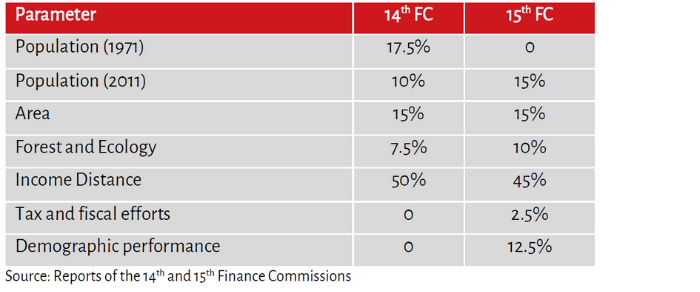
Once in five years the Union government constitutes a Finance Commission to recommend, among other things, the share of each State in the assigned tax revenue of the Union government. Every Finance Commission recommends a formula for the horizontal distribution of the Union government’s tax revenue among the States. 


Let’s look at the criterion to determine the distribution:The 15th Finance Commission and Changes in the Devolution Formula: Which  States Stand to Lose? - Accountability Initiative: Responsive Governance
We can see that under 15th Finance Commission report, population appears at three places (Population 2011, Income distance and Demographic performance) as population of a State is a measure of demand for public expenditure. Therefore, it is an important variable in the distribution formula.

The per capita income of a State is considered as a proxy for its ability to raise its own revenue. The higher the per capita income of a State, the lower its share in the Union tax revenue. Lower per capita income of a State may be due to higher population for a given Gross State Domestic Product. Therefore, the higher the current population of a State, the higher its share in the Union tax revenue. It is important to note that usually the per capita income is assigned larger weight in the distribution formula favouring the northern States. 

The terms of reference of the Fifteenth Finance Commission openly declared taking the 2011 population in the distribution formula. With this, the southern States lost the advantage of getting some financial rewards for population control. Therefore, the southern States have already started facing reduced financial transfers from the Union government as a reward for controlling population growth.

In this complex landscape, the challenge lies in striking a balance between representation, demographic realities, and financial equity. Ensuring fairness in political representation and resource allocation while acknowledging the diverse population dynamics across states is crucial for effective governance and the well-being of all citizens.

Moreover, addressing these issues requires a nuanced and equitable approach that considers both the historical context and the evolving demographic trends within India.

CDSCO Report Uncovers Alarming Levels of Contaminants in Indian Cough Syrups

Context: According to a report released by the Central Drugs Standard Control Organisation (CDSCO), the nation's top drug regulator, at least five batches of cough and allergic rhinitis syrups from two Indian manufacturers have been found to contain higher than permissible levels of contaminants - diethylene glycol and ethylene glycol.

About Ethylene glycol and Di Ethylene Glycol (DEG)

Ethylene glycol and Di Ethylene Glycol (DEG) are colourless, odourless, sweetish-tasting substances that are mostly used for industrial purposes ranging from antifreeze formulations to brake fluids, paints, plastics etc. The pharmaceutical grade can be used for medicines and consumer products in the quantity that is recommended.

Note: According to the WHO, the accepted safety level for ethylene glycol and diethylene glycol is no more than 0.10%.
** The two contaminants are known to be toxic in humans and can cause abdominal pain, vomiting, diarrhoea, inability to pass urine, and acute kidney injury that may result in death especially in children.

About Central Drugs Standard Control Organisation(CDSCO)

Established: 2005

Work under: Directorate General of Health Services, Ministry of Health & Family Welfare, Government of India.

Headquarter:  New Delhi

Functions:

  • It is assigned duties under Drugs and Cosmetics Act, 1940.
  • Under the Drugs and Cosmetics Act, CDSCO is responsible for approval of Drugs, Conduct of Clinical Trials, laying down the standards for Drugs, control over the quality of imported Drugs in the country and coordination of the activities of State Drug Control Organizations by providing expert advice with a view of bring about the uniformity in the enforcement of the Drugs and Cosmetics Act.
  • Further CDSCO along with state regulators, is jointly responsible for grant of licenses of certain specialized categories of critical Drugs such as blood and blood products, I. V. Fluids, Vaccine and Sera.

Note: The National Pharmaceutical Pricing Authority (NPPA) is a government regulatory agency that controls the prices of pharmaceutical drugs in India. 

Implications of caste census on reservation in India

Context: Arguments employed by the Supreme Court in its majority verdict to uphold the 10% economically weaker sections (EWS) quota among forward castes can become a stimulus for the backward classes to seek reservation over and above the 50% ceiling limit based on the data published after the Bihar caste-based survey.

This article explores the 2022 Supreme Court judgment in the case "Economically Weaker Sections (EWS) Judgement: Janhit Abhiyan v Union of India," which centers on the 103rd Constitutional Amendment in India. This amendment introduced reservations based solely on economic criteria in higher education and public employment, amending Articles 15 and 16 of the Constitution.

Key points covered include:

  • Reservations for economically weaker sections in educational institutions, with a 10% cap, independent of existing reservations.
  • Provisions for reservations in appointments, with a 10% ceiling.

We will also delve into the Court's arguments, such as the use of economic criteria for reservations and the right to equality. The Supreme Court's judgment, upholding EWS reservations, is discussed, along with the reasoning for excluding SCs/STs/OBCs and the breach of the 50% reservation limit. 

Economically Weaker Sections (EWS) Judgement:

Janhit Abhiyan v Union of India, 2022

Parliament of India enacted the Constitution (One Hundred and Third Amendment) Act, 2019 and provided for the following:

  • It amended Articles 15 and 16 of the Constitution by inserting 15(6) and 16(6).
  • It enabled the State to make reservations in higher education and matters of public employment based on economic criteria alone. 

Article 15(6) enables the State to make special provisions for the advancement of any economically weaker section of citizens, including reservations in educational institutions. 
It states that such reservations can be made in any educational institution, including both aided and unaided private institutions, except minority educational institutions covered under Article 30(1). The upper limit of EWS reservations will be 10% This 10% ceiling is independent of ceilings on existing reservations.

Article 16(6) enables the State to make provisions for reservations in appointments.These provisions will be subject to a 10% ceiling, in addition to the existing reservations.

Arguments faced by the Court 

  • With respect to Indra Sawhney v. Union of India (1992) Judgement 
    • Can reservations be based solely on economic criteria as opposed to the judgement?
    • The Amendment introduces reservations that exceed the 50% ceiling-limit on reservations as fixed in the judgement.
  • With respect to Right to equality  
    • Can SCs/STs and OBCs be excluded from economic reservations violating right to equality.
    • Imposing reservations on educational institutions that do not receive State aid violates the fundamental right to equality.

Judgement by the Supreme Court on EWS Reservation 

In a 3-2 majority, the Supreme Court upheld the 103rd Constitutional Amendment providing EWS reservation, and Court extended the net of reservation benefits to include solely economic backwardness. In this judgement court observed the following: 

Sole Economic Criteria Can be Used to Give Reservation 

  • Economic empowerment of weaker sections ensures equality of the status as envisioned in the constitution. 
  • The Directive Principles place an obligation on the State to address economic inequalities.
  • This action of providing reservation in favour of the weak or disadvantaged people by reasonable classification is an affirmative action by the state.
  • Nothing in the constitution prevents the State from creating a new criterion for affirmative action through a Constitutional Amendment. 

Right to Equality is Ensured in Giving EWS Reservation

  • The amendment creates a separate class of economic weaker sections of society without affecting the reservations provided to the SCs, STs and OBCs. 
  • Their exclusion does not violate the equality code.
  • EWS reservations ensure that a reasonably classified group of people, those below a certain income level, are given access to education and employment opportunities. 
  • It is designed to promote directive principle of state policy including Article 46, and thus upholds constitutional goals, even if it does not adhere to a formal understanding of equality.

Exclusion of SCs/STs/OBCs is Justified 

  • Special provisions already exist in the constitution for SCs/STs/OBCs reservation. 
  • People belonging to EWS form a separate category and are different from the general category. So, there is no active exclusion of SCs/STs/OBCs. 
  • The legislature, in their wisdom, decided to include a specific group of people in the reservation matrix. 

Breach of 50% Limit in Giving Reservation is Justified 

  • The 50% ceiling limits has only been recognised in the reservations of SC/STs and OBCs. 
  • The limit cannot be extended to an entirely separate class like Economically Weaker Sections.

UAPA (The law & Analayis)

Context: Arrests and questioning of individuals associated with NewsClick, a news portal, have highlighted concerns about the potential misuse of the Unlawful Activities (Prevention) Act (UAPA) of 1967 and its implications for freedom of speech and expression.

UAPA, although originally designed to combat terrorism with a focus on national security, has evolved over the years into a tool criticized for suppressing dissent. It faces criticism for its vague definitions and the extensive discretionary powers it grants to the government in designating individuals as terrorists.

In this article, we will delve into the details of the UAPA, its amendments, and the significance of this law in contemporary India, as well as the challenges it poses to fundamental rights and civil liberties."

Historical background

  • UAPA was first introduced, during the British era, in the form of the Criminal Law Amendment Act of 1908, aimed at curbing dissent against the Crown.
  • Post-independence, it remained in place, and in 1967, after wars with Pakistan and China, it was expanded to grant extensive powers for identifying unlawful associations and penalizing those involved in activities supporting India's secession.
  • Amendments in 2004 introduced a chapter on 'terrorist activities,' while post the 2008 Bombay attacks, further amendments allowed for prolonged detention based on personal information, restricted anticipatory bail, and permitted the categorization of individuals as 'terrorists' in the 2019 amendment. 

About The Unlawful Activities (Prevention) Act, 1967 (Act)

  • Act defines “Unlawful activity” as “any action taken by individual or association that leads to cession of a part of the territory of India, questions the sovereignty of India or disrupt the integrity of India etc.
  • Powers with the government: Under the Act, Central government can declare a person or an organization as a terrorist/ terrorist organisation, if it/ he:
    • commits or participates in acts of terrorism, prepares for terrorism, promotes terrorism, or is otherwise involved in terrorism.
    • Government can impose all-India bans on associations which are declared ‘unlawful’ under the Act.
    • Both Indian nationals and foreign nationals can be charged under the Act.
    • Also, Act holds offenders accountable in the same manner if crime is committed on foreign land outside India.
  • Investigating powers: Cases can be investigated by both State police and National Investigation Agency (NIA).
  • Appeal mechanism: It provides for tribunal to review or to hear an appeal against the ban.

Amendments to UAPA 

  • Amendments in 2004: Criminalized indirectly supporting a terrorist organisation by raising of funds for a terrorist act or membership of a terrorist organization etc. 
  • Amendments in 2008: Broadened the scope of the provision of “funds” to ensure a wider coverage of the financing of terrorism offences.
  • Amendments in 2012: Expanded the definition of “terrorist act” to include offences that threaten the country’s economic security.
  • Amendments in 2019:
    • Government is empowered to designate individuals as terrorists. Earlier, only organisations could be designated as terrorist organisations.
    • If an investigation is conducted by an officer of the National Investigation Agency (NIA), approval of the Director General of NIA would be required for seizure of property connected with terrorism. (Earlier, approval of the Director General of Police was required).
    • Empowered officers of NIA, of rank of Inspector or above, to investigate cases.
    • Added International Convention for Suppression of Acts of Nuclear Terrorism (2005) to the Schedule under the Act.

Significance of UAPA law in the contemporary times for India 

  • To uproot terrorism from India: Terrorists and insurgents continue to receive material support and funds.
  • Focus on individuals: Not designating individuals as terrorists, would give them an opportunity to circumvent the law and they would simply gather under a different name and keep up their terror activities.
    • This is also important in the context of lone wolf attacks, which do not belong to any organisation.
  • Quickens process of justice delivery by empowering officers in the rank of Inspector to investigate cases and investigation has to be completed within 90 days.
  • Reduces delay in attaching proceeds: Act allows seizure of property connected with terrorism without taking approval of Director General of Police in case investigation is conducted by an officer of National Investigation Agency (NIA). 

Challenges Posed by the UAPA Act, 2019:

  • Erosion of Fundamental Rights, including Article 14, 19(1)(a), 21: The Act denies individuals labeled as terrorists the opportunity to present their case before arrest, allowing detention for up to 180 days without a formal charge sheet, thus significantly infringing upon their fundamental rights.
  • Contrary to the Principle of 'Innocent Until Proven Guilty': The Act contradicts universally recognized principles by not upholding the right to be considered innocent until proven guilty, which is a fundamental tenet of justice.
  • Excessive Discretionary Authority: There is a lack of objective criteria for classifying individuals as terrorists grants the government almost unchecked authority to designate anyone as a terrorist, posing a significant risk of misuse of power.
  • Ambiguous and Unclear Definitions: Vagueness in definitions of terms like "terrorism" and its broad definition of 'unlawful activity' create confusion and leave room for differing interpretations, impacting the Act's effectiveness and fairness.
  • Concerns in the Appeals Process: While the Act provides for appeals, the establishment of a government-appointed three-member review committee, potentially including serving bureaucrats, raises concerns about the independence and fairness of the appeals process.
  • Low Conviction Rates: The fact that less than 3% of cases registered under the UAPA Act between 2016 and 2020 (PUCL report) resulted in convictions underscores significant challenges in effectively prosecuting cases under the Act, although this is less immediate but still a notable issue.

With a low conviction rate and concerns regarding the appeal process, the UAPA remains a subject of intense debate, where striking a balance between national security and safeguarding civil liberties remains a challenging task. The ongoing dialogue surrounding the UAPA highlights the need for continued scrutiny, refinement, and thoughtful consideration of its provisions to ensure a just and equitable legal framework in India.

Govt aims to implement Reservation for Women in next LS elections

Context: The central government is planning to roll out reservation of seats for women, which is linked to the delimitation exercise, in the 2029 Lok Sabha elections

The Nari Shakti Vandan Adhiniyam, 2023 reserves one-third of seats for women in the Lok Sabha, State Assemblies, and the Legislative Assembly of the NCT Delhi. This will also apply to the seats reserved for SCs and STs in Lok Sabha and state legislatures.

This article explores the 106th amendment to the constitution, reason for its introduction and provisions of the amendment act. It also explores the concerns associated with the amendment and suggests some way forward.

Reason for Introduction of the Bill

  • The representation of women in the Indian Parliament and state assemblies is significantly lower than their share of the population.  
  • According to the Inter-Parliamentary Union, India ranks 148th out of 193 countries in terms of women’s representation while the global average is 26.5%. 
  • Women’s representation in state assemblies is also dismal, ranging from 3.1% in Nagaland to 23.1% in Bihar. 
  • In the Lok Sabha, women make up less than 15% of the total strength.  
  • In the Rajya Sabha, women's representation is around 14%.

Women Reservation Act, 2023  

The Constitution (One Hundred and Sixth Amendment) Act, 2023 also known as Women Reservation Act, 2023 aims to provide 33 percent reservation to women in both the Lok Sabha (House of the People) and state Legislative Assemblies.  

This Act is similar to the previous attempt in 2010, The Constitution (One Hundred and Eighth Amendment) Bill, 2008, which was passed by the Rajya Sabha but not taken up by the Lok Sabha. 

Highlight of the Act

The Act seeks to introduce three new articles and one new clause in the Constitution and has a sunset clause. 

  • New Clause in 239AA: This clause mandates the reservation of seats for women in the Delhi Legislative Assembly. 
  • Additionally, one-third of the seats reserved for Scheduled Castes (SCs) shall also be reserved for women, as well as one-third of the total number of seats to be filled by direct elections. 
  • New Article - 330A: This article focuses on the reservation of seats for women in the Lok Sabha.  
  • It specifies that one-third of the seats reserved for SCs and STs shall be reserved for women.  
  • Furthermore, one-third of the total seats to be filled by direct elections to the Lok Sabha shall also be reserved for women. 
  • New Article - 332A: This article pertains to the reservation of seats for women in every state Legislative Assembly. 
  • It follows a similar pattern, reserving one-third of the seats for SCs and STs for women, as well as one-third of the total seats to be filled by direct elections to the Legislative Assembly. 
  • New Article - 334A: This article deals with the implementation of the reservation.  
  • It specifies that the reservation shall come into effect after the delimitation is undertaken following the publication of relevant census figures.  
  • There will also be a rotation of seats for women after each subsequent exercise of delimitation. 
  • Sunset Clause: The Act has a sunset clause, which means that the reservation for women will be in effect for a period of 15 years from the commencement of the Act. 

Advantages of the Act  

  • Gender Equality, representation and Empowerment: by ensuring that women have equal access to decision-making positions in the government.  
  • Accommodative Decision Making: by Increased representation of women in politics bringing diverse perspectives and experiences to the table. Women's unique insights into issues such as healthcare, education, gender-based violence, and family welfare can result in better-informed legislation. 
  • Role Models: When women hold prominent political positions, it sends a powerful message to the entire nation, inspiring women and girls to pursue leadership roles in various fields. 
  • Social Development:  Research indicates that countries with higher levels of women's political representation tend to have better outcomes in areas such as healthcare, education, and poverty reduction. 
  • Fostering Inclusivity:  By encouraging political parties to field more women candidates it can lead to a broader spectrum of women from different backgrounds, including those from marginalised communities, entering politics. 
  • Enhanced Accountability:  With increased women's representation, Women lawmakers may prioritise issues such as women's rights, healthcare, and education, leading to greater accountability in governance.  
  • Legal Protections: Women in politics can protect women's rights, such as laws against gender-based violence, workplace harassment, and discrimination. 
  • Global Recognition: Passage of the Act would enhance India's global image as a nation committed to gender equality and aligns with international goals, such as those outlined in the Goal 5 of Sustainable Development Goals (SDGs). 
  • Long-Term Impact: The act by reshaping traditional gender norms and expectations can contribute to a more equitable and inclusive society where women have greater opportunities for leadership and decision-making. 

Case Studies on Present Reservation for Women in Local Governments  2004 paper by Esther Duflo and Raghabendra Chattopadhyay on panchayats in West Bengal and Rajasthan   

It found that women leaders invest more in public goods and ensure increased women’s participation in panchayat meetings.    

2008 paper by Vijayendra Rao and Radu Ban   

It found that women leaders perform no differently than their male counterparts in south India and instead institutional factors such as the maturity of the State’s panchayat system were more relevant.  

2010 paper by Pranab Bardhan and others   

It found that women’s reservations worsened the targeting of welfare programmes for SC/ST households and provided no improvement for female-headed households.  

Study in 2011 across 11 States by Ms. Duflo and others   

It reaffirmed that women-led panchayats made higher investments in public services like drinking water, education, and roads.  

2020 paper by Alexander Lee and Varun Karekurve-Ramachandra   

It examined reservations in Delhi and found that constituencies reserved for women are less likely to elect OBC women and more likely to elect upper-caste women.  

Case Study 

Women Reservation: Not Just a Number Game  

  • Different Approach: Male Members of Parliament (MPs) mostly focus on finance, defence, external affairs, the PMOs, etc. as found in different studies whereas women representatives particularly focus on critical matters such as healthcare, education, roads, and micro, small, and medium enterprises (MSMEs). 
  • Political Affiliation and Government Accountability: Female MPs from the ruling party, as found in different studies, have demonstrated a significantly higher level of scrutiny towards their own government, holding their own ministries accountable in comparison to male MPs. 
  • Reinforcement of other Rights: According to a report of United Nations 2011, The political empowerment of women plays a vital role in reinforcing civil and human rights through direct engagement of women in public decision-making. 
  • Policy Formulation and Implementation Gaps: As majority of the beneficiaries of some government initiatives such as Pradhan Mantri Jan Dhan Yojana are women, their participation in formulation of policies and implementation ensure effective implementation of such schemes.

Concern with the Act  

Legal and Constitutional Concerns: 

  • Contingent on Delimitation: The reservation will take effect post-delimitation following the publication of the Act and post delimitation census figures. 
    • If the reallocation of seats between States is purely based on population, the southern States’ share in the Parliament will drastically reduce which is likely to open the fault lines of India’s delicate federal relations. 
    • This could also delay the implementation of women's reservation, possibly until 2029. 
  • Identification of reserved seats: The Act does not specify the method regarding identification of the reserved seats for women. 

Political Concerns: 

  • Opposition from Political Parties: They argue that women from marginalised communities like Other Backward Classes (OBCs) should also have reserved seats within the women's quota. 
  • Lack of Consensus: Despite support in principle by political parties, disagreements on the implementation details and sub-reservations have hindered the Act's passage. 
  • Impact on Existing Power Structures: Increasing the representation of women may necessitate a shift in political dynamics and party hierarchies which could affect existing power structures. 
  • Lack of Deliberation and Analysis: The introduction and passing of act surreptitiously through a “supplementary list” in a hastily organised Parliament session shows the lack of deliberation and analysis. 

Social Concerns: 

  • Representation of Diverse Groups:  The concerns have been raised about the need for diversity within the women's quota from diverse backgrounds, including different castes, religions, regions, and economic strata. 
  • Empowerment vs. Tokenism: Some critics argue that merely reserving seats may not necessarily empower women unless they have a meaningful role and voice in decision-making processes. 
  • Social Norms and Stereotypes: Deep-rooted social norms and stereotypes about women's roles in society and politics can be a barrier to the effective implementation of the Act e.g., issue of Sarpanch Pati. 
  • Changing perceptions about women's capabilities and roles in leadership positions is a long-term challenge. 
  • Inclusivity of Marginalised Groups: The Act's implementation left out the marginalised groups of women, such as those with disabilities, LGBTQ+ individuals, and women from indigenous communities.

Way Forward: 

  • The Act’s aim of providing women representation is a way to promote social justice in India. This can be supplemented by providing special quotas to marginalised women to make it more representative and inclusive.  
  • The Act is an important step in the direction of promoting an enabling environment for the participation of women from all backgrounds in public life which can have profound, positive implications for society as a whole.   
  • The Act is an important step towards implementation of the Sustainable Development Goals as well as India’s obligations under the UN Convention on the Elimination of All Forms of Discrimination Against Women. 

Restrictions on Free Speech

Context: The INDIA bloc recently announced that it would boycott 14 television news anchors as it did not did not want to legitimise a “hate-filled narrative.” 

About:

  • Censorship, a term referring to the official prohibition or restriction of various forms of expression, such as films, books, and television, has remained a contentious issue in democracies worldwide. Its purpose is to safeguard the political, social, and moral order, and it can be enforced by both local and national governmental authorities.
  • In liberal democracies, censorship often clashes with the cherished principles of freedom of speech, expression, and access to information. While denying these freedoms, censorship is also justified on grounds ranging from political concerns, like sedition and national security, to religious matters, such as blasphemy, and moral issues, like obscenity. Additionally, it can play a role in maintaining social order.

Legal Provisions for Restrictions on Free Speech

  • The current framework for censorship includes constitutional provisions, such as Article 19(2) allowing for reasonable restrictions and Article 359 allowing the suspension of Article 19 during emergencies. 
  • Institutional and legislative frameworks like the IT Act 2000 and IT Rules, along with bodies like the Central Board of Film Certifications (CBFC) and the Press Council of India, also play a role in regulating censorship. 
  • Various legal provisions, such as Section 95 of CrPC, Section 124A for sedition, and Sec 292 for obscenity, contribute to the overall regulatory landscape.

Reasons supporting the need for censorship in society and the nation as a whole

  • Safeguarding Sovereignty and Security: Censorship can act as a preventive measure against terrorism and other potential threats.
  • Guaranteeing Personal Liberty: It restricts harmful activities like cyberbullying, trolling, and defamation, thereby protecting individuals' rights.
  • Limiting the Spread of Misinformation: By controlling the dissemination of fake news, censorship can help uphold the truth and protect the public from deception.
  • Preventing Religious and Ethnic Violence: Hate speech, which is often politically sensitive, can be controlled through censorship to prevent the incitement of violence or social unrest.
  • Protecting Children from Harmful Content: Censorship can shield young minds from exposure to psychologically damaging material.
  • Fostering Social Solidarity: By avoiding insults to shared values, censorship aims to promote a cohesive society.

However, censorship brings forth several prevalent issues

  • Threat to Democracy: Censorship may discourage dissent and curtail open discourse, posing risks to democratic principles.
  • Curtailment of Freedom of Information: Citizens may be deprived of access to essential information due to excessive censorship.
  • Self-Censorship: The fear of censorship may lead to individuals and media outlets restraining their expressions, leading to a chilling effect on free speech.
  • Limiting Creativity and Autonomy: Stricter censorship can hinder artistic freedom and personal autonomy.
  • Intolerance towards New Ideas: An environment of censorship can foster intolerance towards innovative and unconventional thoughts.
  • Suppression of Marginalised Voices: Censorship might silence the voices of marginalised groups, further exacerbating societal inequalities.
  • Implementation Challenges: There are several implementation challenges associated with censorship, including the lack of objective boundaries, potential for misuse, over-regulation, and abuse.

To move forward

some constructive steps can be taken

  • Encouraging Self-Regulation: Involving civil society representation can aid in fostering responsible self-regulation.
  • Empowering Citizens' Choices: Allowing citizens to decide and consume content, possibly through content warnings, can strike a balance between freedom and responsibility.
  • Promoting Media Education: Providing professional media education and codifying media laws can enhance media responsibility.
  • Limiting State Censorship Power: Ensuring that censorship measures are proportionate and restrained can prevent excessive interference.
  • Objective Standards for Harm Prevention: Censorship should primarily address instances of actual harm based on clear and objective criteria.
  • Non-Punitive Approaches: Adopting proactive steps, such as public education and encouraging diversity, can be more effective than punitive measures in addressing hate speech.

In conclusion, censorship presents a multifaceted dilemma, as it seeks to maintain order and security while also safeguarding fundamental freedoms. Striking the right balance between these objectives requires thoughtful deliberation and measures that uphold democratic principles without compromising societal well-being.