Current Affairs

Samajik Adhikarita Shivir

What is Samajik Adhikarita Shivir

This shiver is held to the Distribution of Aids and Assistive Devices to Divyangjan and Senior Citizens in Kannauj District, U.P. by Union Minister of State for Social Justice and Empowerment Sushri Pratima Bhoumik. 

Under Which scheme the shivir is held?

The shivir is held under the ADIP (SCHEME OF ASSISTANCE TO DISABLED PERSONS FOR PURCHASE/FITTING OF AIDS/APPLIANCES) and Rashtriya Vayoshri Yojana scheme respectively of the Ministry of Social Justice and Empowerment, Government of India. 

Who organised the shivir

The camp was organized by the Department of Empowerment of Persons with Disabilities (DEPwD) in association with 

  • ALIMCO (Artificial Limbs Manufacturing Corporation) and 
  • District Administration

Why Tipu Sultan must be killed, again

Context: As elections in Karnataka approach, the 18th-century king Tipu Sultan is once more at the centre of a debate. By supporting claims that Tipu Sultan was assassinated by two Vokkaliga leaders rather than the British and Maratha army, an effort is being made to appeal to the politically influential Vokkaliga population.

About Mysore Kingdom

  • An Independent state that was created as a result of the Mughal Empire's fall. The destabilisation of the Mughal power over the provinces was a major factor in the emergence of these states.
  • A significant state that emerged in the eighteenth century was Mysore. The Wodeyars were in charge of this region, which was situated near the meeting point of the Eastern and Western Ghats. 
  • The region became a never-ending battleground as a result of several powers' interest in this land. In the end, Haider Ali gained control over the state.

Haider Ali

Haider Ali
  • Nanjaraj (the sarvadhikari) and Devaraj (the Dulwai), had reduced Chikka Krishnaraja Wodeyar to the status of a puppet in the early eighteenth century. Under the leadership of the ministers Nanjaraj and Devaraj, Haidar Ali began his career in the Mysore army.
  • In addition to introducing Western training techniques for his army, Haidar Ali enlisted the assistance of the French to establish a weapons factory in Dindigul (now in Tamil Nadu).
  • Due to his involvement in the First and Second Carnatic Wars in South India, Haider Ali witnessed the military superiority of European troops. Mysore sided with the French in the Carnatic Wars.
  • The Nizam of Hyderabad, the Marathas, and the English formed an alliance against Haider Ali, the king of Mysore, in the first Anglo-Mysore war (1767–69). In the end the English had to sign the humiliating Treaty of Madras in 1769.
  • The Treaty of Mangalore, which was signed in 1784, brought an end to the Second Anglo-Mysore War (1780–1784). Tipu Sultan succeeded his father Haider Ali after his death.

Tipu Sultan

Tipu Sultan
  • Tipu Sultan was the last Muslim ruler of the Kingdom of Mysore, before the taking over by Wodeyar Dynasty. 
  • Navy: Defeat in Third Anglo-Mysore War convinced Tipu to take measures to build a navy. He issued a Hukmnanah (ordinance) in 1796 for a strong naval force with 40 ships to be built at speed. The navy was put under command of 11 Mir Yam (Lords of Admiralty), with headquarters at Seringapatam. The naval divisions or Kachehris at Jamalabad (Mangalore), Wajidabad and Majidabad. Timber for ships was to be procured from state forests. 
  • Ammunitions: Established munitions industry in Nagar, which were regarded as equal in quality to those produced in Europe.
  • Rocket technology: Pioneer of rocket technology and expanded iron cased Mysorean rockets and commissioned a military manual Fathul Mujahidin
  • Economy:  Attempted to revive commerce and forged commercial linkages with other parts of India and West Asia and build a public sector company with state finance. Introduced sericulture and an was a member of the Jacobin club. He also planted a liberty tree at Seringapatam.
  • Agriculture and Revenue Settlement: 
    • Tipu modified land revenue management. 
    • Rules were laid down for distribution of arable land among old and new ryots, preference was given to hereditary ownership of land and rent was fixed. 
    • Tipu’s measures were the basis for Ryotwari Settlement introduced by East India Company in South India. 
    • Captain Alexander Read first introduced Ryotwari Settlement in Baramahal district surrendered by Tipu after his defeat in 1792.
    • Calendar: Introduced a new calendar in 1784. This calendar was known as Mauludi Era and had 354 days. It counted its first year from the year of birth of Prophet Muhammad. The calendar’s name was derived from Arabic phrase ‘Maulud-i-Muhammad’, Birth of Muhammad.
    • Introduced several administrative innovations such as a new coinage system.
  • Deployed rockets against advances of British forces and their allies during Anglo-Mysore Wars, including the Battle of Pollilur and Siege of Srirangapatnam.
  • Third Anglo Mysore war (1790-92): Tipu Sultan was defeated by EIC and the Treaty of Seringapatam was concluded. Under this treaty, Tipu lost half of Mysore’s territory.
  • Fourth Anglo-Mysore war (1799): This conclusive war led to falling of Seringapatam. English chose a Hindu boy from the earlier ruling royal family i.e., Wodeyars, as the Maharaja and imposed subsidiary alliance on him.

STOP TB Partnership

Context: 36th Board Meeting of Stop TB Partnership took place in India.

About Stop TB Partnership

About Stop TB Partnership
  • STOP TB Partnership is a UN hosted organisation that aims for a world free of TB, until then, making diagnosis, treatment and care available to all who need it.
  • It was founded in 2001 to eliminate TB by 2030.
  • Secretariat: The Secretariat of Stop TB Partnership is hosted and administered by UNOPS in Geneva, Switzerland.
  • Union Minister for Health & Family Welfare is the current chairman of the Board of Stop TB Partnership.
  • Membership: Membership of Stop TB Partnership is open to national governments, NGOs, and scientific institutions.

Objectives of STOP TB

  • Ensure that every person with TB has access to effective diagnosis, treatment & cure.
  • Stop transmission of TB.
  • Reduce the inequitable social and economic toll of TB.
  • Develop, implement and increase access to new preventive, diagnostic and therapeutic TB tools, products & strategies.
  • Amplify the voices of people with and affected by TB and secure meaningful change through strategic advocacy & communication.

Initiatives by Stop TB Partnership

  • Global Drug Facility: Stop TB Partnership Global Drug Facility (GDF) facilitates global access to quality-assured, affordable TB diagnostics and treatments. GDF serves three objective:
    • Shape the market: GDF works with suppliers, donors & other stakeholders to ensure the availability of quality assured and sustainably priced products that respond to market needs.
    • Facilitate access to innovative medicines & diagnostics: GDF provides technical assistance to facilitate the introduction and uptake of innovative medicines and diagnostics in client countries.
    • Provide best in class procurement & supply services for tuberculosis medicines & diagnostics. 
  • TB REACH: This initiative aims to identify not diagnosed, not treated or not reported by providing funding to test pioneering approaches that reach more people with TB. TB Reach provides funding for projects that:

Project Himshakti

Context: Ministry of Defence has inked a Rs 3,000 crore contract for the procurement of two Integrated Electronic Warfare Systems under Project Himshakti for the Army in mountainous terrain. 

Major Highlights:

  • The contract signed with defence PSU Bharat Electronics (BEL) is under the “Buy Indian-IDMM (indigenously designed, developed and manufactured)” category comprising contemporary and niche technologies. 

Significance:

  • Project Himshakti will generate employment of approximately three lakh man-days over a period of two years. 
  • The project is a significant leap forward in developing indigenous capabilities making the country ‘self-reliant’ in defence manufacturing. 

Interventions under ARTH GANGA project

Context: Recently, a number of initiatives have been taken by the National Mission for Clean Ganga (NMCG) under Arth-Ganga concept, in co-ordination with many Ministries/ Departments of Central and state governments and even NGOs. 

What is Arth Ganga project?

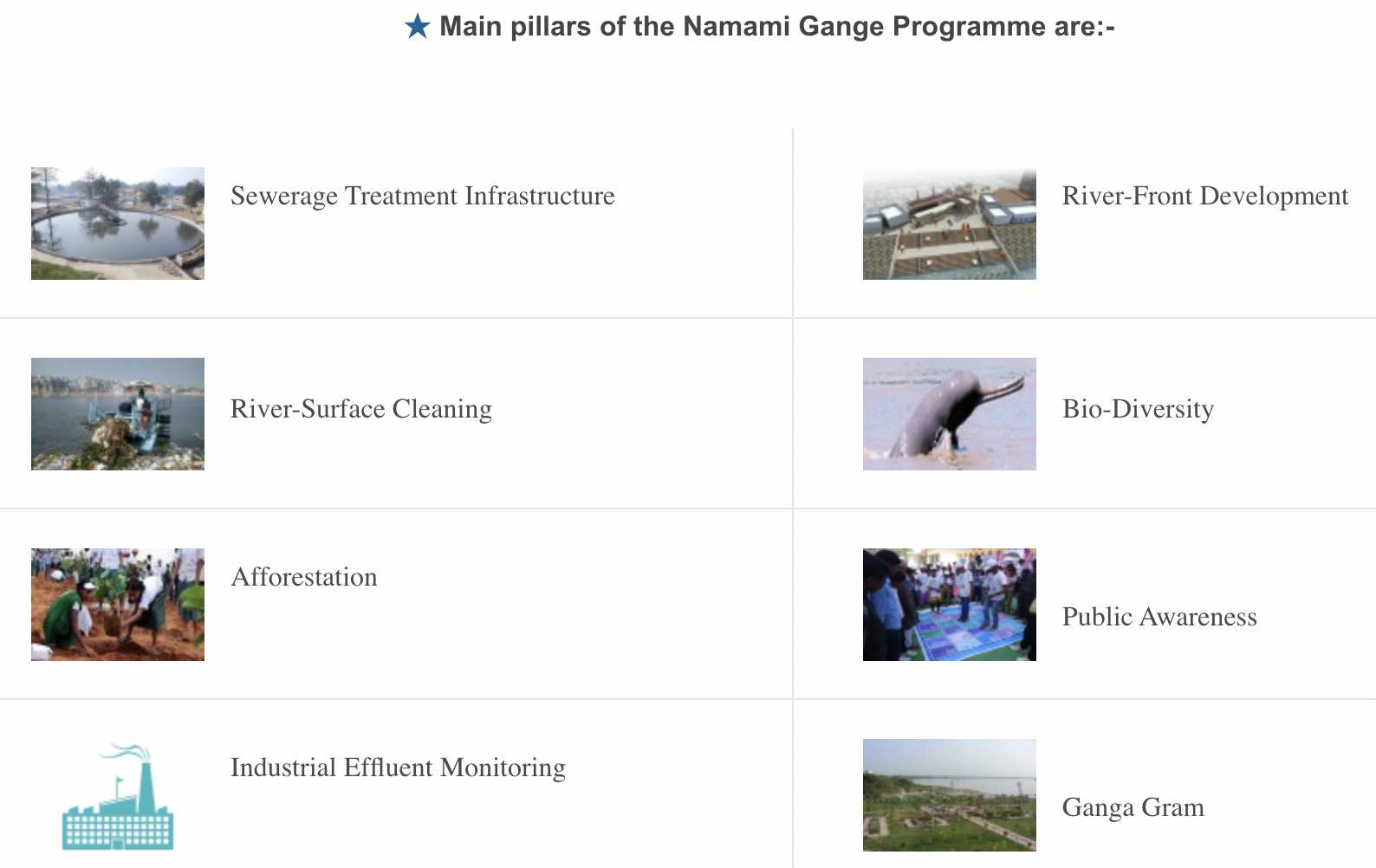
  • Arth Ganga is a sustainable viable economic model conceptualized under "Namami-Gange" program to integrate people in the basin with Ganga Rejuvenation. 
  • It focuses on the sustainable development of the Ganga and its surrounding areas, by focusing on economic activities related to the river.
  • At its core, the Arth Ganga model seeks to use economics to bridge people with the river.
  • Prime Minister of India first introduced the concept during the first National Ganga Council meeting in 2019, where he urged for a shift from Namami Gange, the Union Government’s flagship project to clean the Ganga, to the model of Arth Ganga.

There are six key verticals of intervention in the model, namely

  1. Promotion of Zero Budget Natural Farming (ZBNF), which includes promotion of Natural Farming in Ganga Basin.
  2. Monetization and reuse of treated wastewater and sludge. It refers to reuse of treated wastewater by ULBs for generation of revenue and conversion of sludge into usable products such as manure, pavers and bricks for revenue generation as well as safe disposal of sludge.
  3. Development of Livelihood generation opportunities through activities like ‘Ghat Main Haat’ for sale of local products of Ganga cities/towns along riverbanks; self-sustaining of Ghats and capacity building trainings of Ganga Praharis etc. Jalaj units for income generation activities for Ganga Praharis have been set up in many locations.
  4. Encouragement of Public Participation through organizing regular events such as Ganga Aartis, cleanliness drives, Ganga Guide Trainings, Yoga on Ghat, Ghat Pe Haat etc. in coordination with District Ganga Committees.
  5. Promotion of Cultural heritage and tourism by development of small local tourism and cultural circuits; introduction of boat tourism through community jetties; promotion of yoga and wellness, medical tourism, adventure tourism, eco-tourism, enhancement of cultural connection with the river through aartis & Ganga trails;
  6. Institution Building through setting up of decentralized monitoring and governance units like District Ganga Committees (DGCs); enhancement of the capacities of DGCs and other local administration institutions for better water governance and sustenance of the projects, post asset handover.

Namami Gange Programme

It is an Integrated Conservation Mission, approved as ‘Flagship Programme’ by the Union Government in 2014, to accomplish the twin objectives of effective abatement of pollution, conservation and rejuvenation of National River Ganga.

TPNRrG 6KxyKhu1dkD2fJqzNYlInJit8WXO4Sa8SW1o sTTk5xv8PqmHKfbsVc1KQBEJyRH5lOfSO9yUcsAoc1u2K0p3v1 GwvX2zg3C9M0OjgKbfU Mn7auUwu vdCT6sXem7B OruUwIzrde5d0g

National Mission for Clean Ganga (NMCG)

  • It was registered as a society under the Societies Registration Act 1860.
  • It acted as implementation arm of National Ganga River Basin Authority(NGRBA) which was constituted under the provisions of the Environment (Protection) Act (EPA),1986. 
  • The Act envisages five tier structure at national, state and district level to take measures for prevention, control and abatement of environmental pollution in river Ganga and to ensure continuous adequate flow of water so as to rejuvenate the river Ganga.
  • National Ganga Council under chairmanship of Hon’ble Prime Minister of India.

Aims and objectives of NMCG

  • To ensure effective abatement of pollution and rejuvenation of the river Ganga by adopting a river basin approach to promote inter-sectoral co-ordination for comprehensive planning and management.
  • To maintain minimum ecological flows in the river Ganga with the aim of ensuring water quality and environmentally sustainable development.

River Ganga

  • It rises in the Gangotri glacier near Gaumukh (3,900 m) in the Uttarkashi district of Uttarakhand. Here, it is known as the Bhagirathi.
  • At Devprayag, the Bhagirathi meets the Alaknanda; hereafter, it is known as the Ganga. 
  • The Alaknanda has its source in the Satopanth glacier above Badrinath.
  • The river has a length of 2,525 km. 
  • It is shared by Uttarakhand (110 km) and Uttar Pradesh (1,450 km), Bihar (445 km) and West Bengal (520 km). 
  • The Ganga river system is the largest in India having a number of perennial and non-perennial rivers originating in the Himalayas in the north and the Peninsula in the south, respectively. 
  • Right bank tributaries: Son , Yamuna, Tamsa (also called Tons), Karamnasa, Punpun, Ajoy, Damodar, Rupnarayan.
  • Left bank tributaries: Ramganga, Gomati, Ghaghara, Gandak, Kosi and Mahananda. 
  • The river finally discharges itself into the Bay of Bengal near the Sagar Island.

No cause for alarm

Context: More than three years after the COVID-19 pandemic began, newer variants have emerged with an uptick in cases, hospitalisations, and even deaths. 

Major Highlights:

  • After Kappa, Delta, BA.2.75, and BA.2.76, the latest variant (first detected in India) is the Omicron recombinant XBB.1.16. This variant accounts for over 30% of all sequenced genomes in March 2023, and its proportion has been increasing.
  • However, there is no need for alarm as there has been no concomitant increase in hospitalisations, even among vulnerable groups, which suggests that clinical severity in infected people might not be a concern.
    • India is fully relying on hybrid immunity arising from vaccination and natural infection for extended protection.
    • Fortunately, the estimated 95% of India’s population above 12 years possessing hybrid immunity has been shielding people from serious COVID-19 disease even when a few Omicron variants caused a spike in 2022.

Way Forward:

  • People, especially from vulnerable groups, carry a higher risk of infection from COVID, so they need to follow basic precautions such as wearing a mask in closed space settings when newer variants emerge.
  • There is a need to increase whole genome sequencing to help track the new variants that might emerge and gear the country for any major outbreak. 
Hybrid immunity will save India GFX

Hybrid immunity:

  • Hybrid immunity refers to the protection against a disease that results from a combination of natural immunity gained through infection and vaccination-induced immunity. E.g., A person who had previously contracted COVID-19 and then received a COVID-19 vaccine would have hybrid immunity to the virus. 
  • Research suggests that hybrid immunity may provide better protection against certain diseases than either natural or vaccine-induced immunity alone. However, the extent of protection and the duration of hybrid immunity is an area of active research and varies depending on the specific disease and the individual's immune response.

AFSPA removed from 3 police station limits in Nagaland

Context: According to a notification, The Ministry of Home Affairs (MHA) has further removed the Armed Forces (Special Powers) Act (AFSPA) from the jurisdiction of three police stations in Wokha and Zunheboto districts of Nagaland, while one more police station in Arunachal Pradesh has been declared as a “disturbed area” under the Act. 

The Armed Forces (Special Powers) Act, 1958

Powers to declare areas to be disturbed areas (Section 3) – If, in relation to any state or Union Territory to which this act extends, the Governor of that State or the administrator of that Union Territory or the Central Government, in either case, if of the opinion that the whole or any part of such State of Union territory, as the case may be, is in such a disturbed or dangerous condition that the use of armed forces in aid of the civil power is necessary, the Governor of that State or the Administrator of that Union Territory or the Central Government, as the case may be, may by notification in the Official Gazette, declare the whole or such part of such State or Union territory to be a disturbed area.

Application of AFSPA

  • The ASPA was first applied to the Seven Sister States of North East India, including Assam, Manipur, Tripura, Meghalaya, Arunachal Pradesh, Mizoram and Nagaland, on 1 September, 1958, to stop the North Eastern States seceding from the Indian Union. 
  • Later Punjab and Chandigarh also came within the purview of this act, which was later withdrawn in 1997. 
  • AFSPA was then applied to the state of Jammu and Kashmir in 1990 and has been in force since then.   

Special powers of the armed forces 

Any commissioned officer, warrant officer, non-commissioned officer or any other person of equivalent rank in the armed forces may, in a disturbed area:

  • For the maintenance of public order, after giving such due warning as he may consider necessary, fire upon or otherwise use force, even to the causing of death, against any person who is acting in contravention of any law or order.     
  • They can prohibit assembly of five or more persons or the carrying of weapons or of things capable of being used as weapons or of fire-arms, ammunition or explosive substances in the disturbed area. 
  • They can destroy any arms dump, prepared or fortified position or shelter or any structure used as a training camp for armed volunteers or utilised as a hide-out by armed gangs or absconders wanted for any offence.
  • Enter and search any premises without warrant and make any arrest or recover any person who are believed to be wrongfully restrained. 
  • No prosecution, suit or other legal proceeding shall be instituted, except with the previous sanction of the Central Government, against any person regarding anything done or purported to be done in exercise of the powers conferred under the Act. 

Arguments in favour of AFSPA

  • Needed to maintain morale of the force.
  • Insurgents will gain upper hand in absence of it.
  • Troops need such powers because the army is only deployed when national security is at serious risk from armed combatants.
  • Provides legal backing for the Armed Forces to act in domestic civilian areas. Currently, the armed forces act enables them to only act against enemies.

Arguments against AFSPA

  • Provision for immunity of security forces urges them to act more brutally.
  • Seen as a reason for increasing radicalization in insurgency ridden areas because of the little accountability for the excesses committed in discharge of power given by the act.
  • Instances of abuse and extra-judicial killings in Manipur have been upheld by even Supreme court in 2016. The Supreme Court in this case ruled that the armed forces cannot escape investigation for excesses during the discharge of their duty even in “disturbed areas.”
  • Though there are many violent insurrections in India which must be handled militarily but in the short run. Even after so many years, if the situation in these states has not changed, this points to some flaws in the law itself.

Checks and balances to stop misuse of AFSPA

  1. SC in 1998 on constitutionality of AFSPA: Upheld constitutional Validity of AFSPA. However, it suggested some measures that should be followed.
    • A Suo-motto declaration can be made by the Central Government; however, it is desirable that the state government should be consulted by the Central Government before making the declaration.
    • AFSPA does not confer arbitrary powers to declare an area as a 'disturbed area.
    • Declaration must be for a limited duration and there should be a periodic review of the declaration 6 months have expired.
    • While exercising the powers conferred upon him by AFSPA, the authorized officer should use minimal force necessary for effective action.
  2. Santosh hedge commission on Manipur encounter
    • FSPA was an impediment to achieving peace in regions such as J&K and the Northeast.
    • The law needs to be reviewed every six months to see whether its implementation is necessary in states where it is being enforced.
    • AFSPA does not provide blanket Immunity to the officers. Suggested fixing a period of three months for the central government to decide whether to prosecute security personnel engaged in extrajudicial killings or unruly behaviour in insurgency-hit regions.
    • Action can be taken but with prior sanction of the Central Government.
  3. BP Jeevan Reddy Commission in 2004
    • AFSPA should be repealed, and appropriate provisions should be inserted in the Unlawful Activities (Prevention) Act, 1967.
    • Unlawful Activities (UAPA) Act should be modified to clearly specify the powers of the armed forces and paramilitary forces.
    • Grievance redressal cells should be set up in each district where the armed forces are deployed.
  4. Second Administrative Reforms Commission
    • Recommended to repeal of AFSPA, 1958. Its scrapping would remove sentiments of discrimination and alienation among the people of the Northeast India.
    • Amend the Unlawful Activities (Prevention) Act, 1967 inserting a new chapter to deploy the armed forces of the Union in the North-eastern States.
    • Supported a new doctrine of policing & criminal justice inherent in an inclusive approach to governance.

Way Forward

Army must be completely transparent in investigating allegations of violations of human rights and bringing the violators to speedy justice. Exemplary punishment must be meted out where the charges are proved.   

Differing views emerge on MP disqualification

Context: Congress leader Rahul Gandhi’s conviction and sentencing in a 2019 defamation case by a court in Gujarat has put a question mark over his continuation as a Lok Sabha MP. Experts have differing views on whether the conviction and sentencing means immediate disqualification or the Wayanad MP gets time if he appeals.

So this particular raises two issues which are extremely pertinent in Indian context: 

  • Disqualification of elected members of the houses. 
  • Criminal Defamation and its utility in democratic India. 

So the following discussion will have two components: 

  • Disqualification
    • Disqualification and Its importance
    • Constitutional provisions 
    • Lily Thomas Case 
  • Defamation
    • What is defamation all about?
    • Defamation is an exception to the Right to Freedom of Speech
    • Why is defamation a crime? 
    • Why defamation should remain a criminal offence?

Disqualification and Its importance: 

  • The disqualification procedure in India is an important mechanism for maintaining the integrity of the electoral process and ensuring that elected representatives meet certain standards of conduct and eligibility.
  • Under the Constitution of India, certain criteria have been laid down (See below) for the eligibility of candidates contesting elections to the Lok Sabha (lower house of parliament) and the state legislative assemblies. These criteria include age, citizenship, and lack of criminal convictions, among others. If a person is found to be ineligible based on these criteria, they can be disqualified from holding elected office.
  • Similarly, if an elected representative violates certain rules or engages in behavior that is deemed unethical or illegal, they can be disqualified from their position.
    • For example, under the Representation of the People Act, an elected representative can be disqualified for offenses such as corrupt practices, electoral malpractices, or holding an office of profit.
  • The disqualification procedure is important because it ensures that those who are elected to public office are held to high standards of conduct and behavior. It also helps to prevent individuals who are ineligible or have engaged in unethical or illegal activities from holding elected office and making important decisions on behalf of the people.
  • Overall, the disqualification procedure in India plays a crucial role in maintaining the integrity of the electoral process and ensuring that elected representatives are held accountable for their actions.

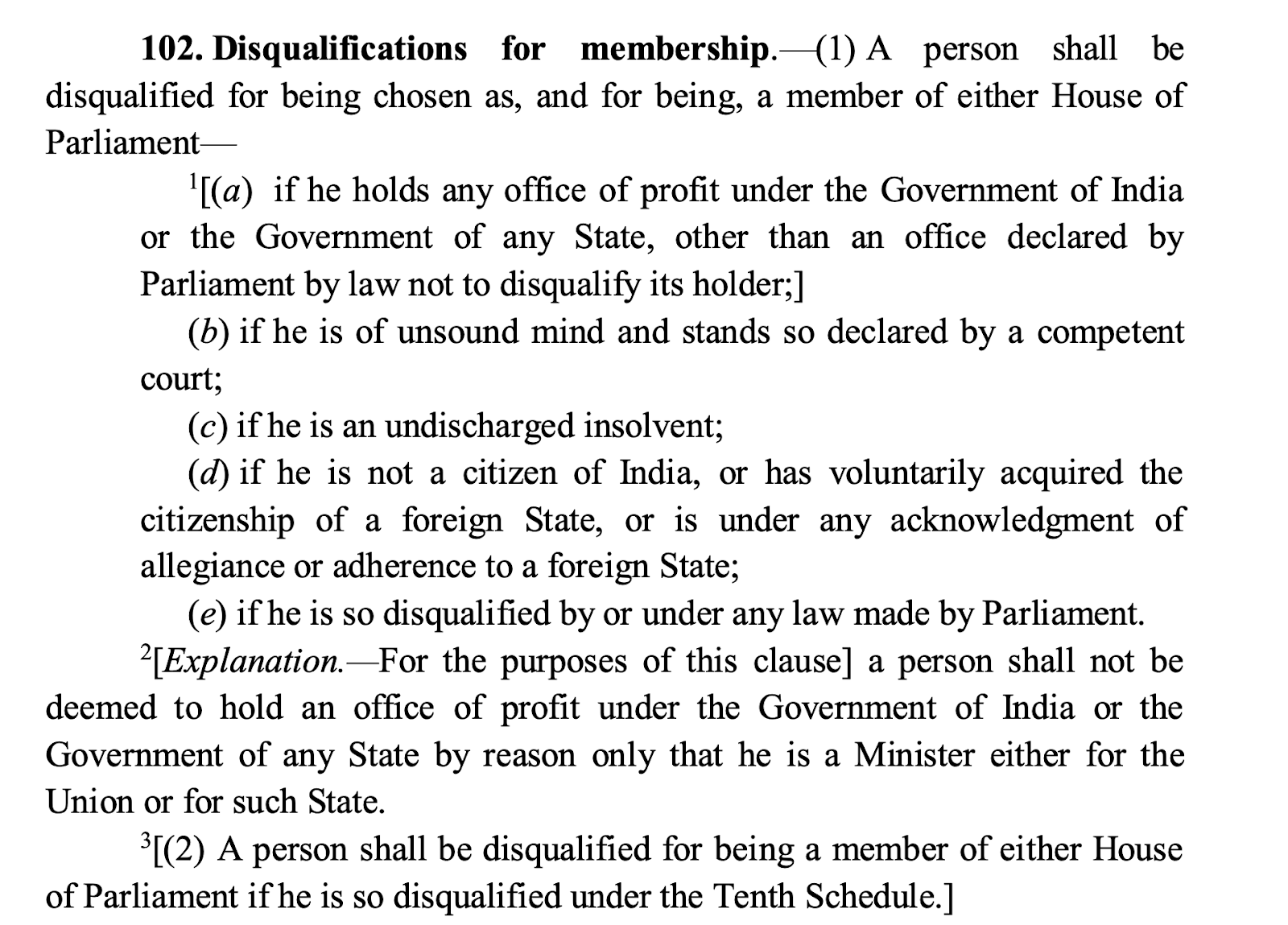
Disqualifications specified in the Constitution of India for Members of Parliament: 

Text, letter

Description automatically generated
Text, letter

Description automatically generated

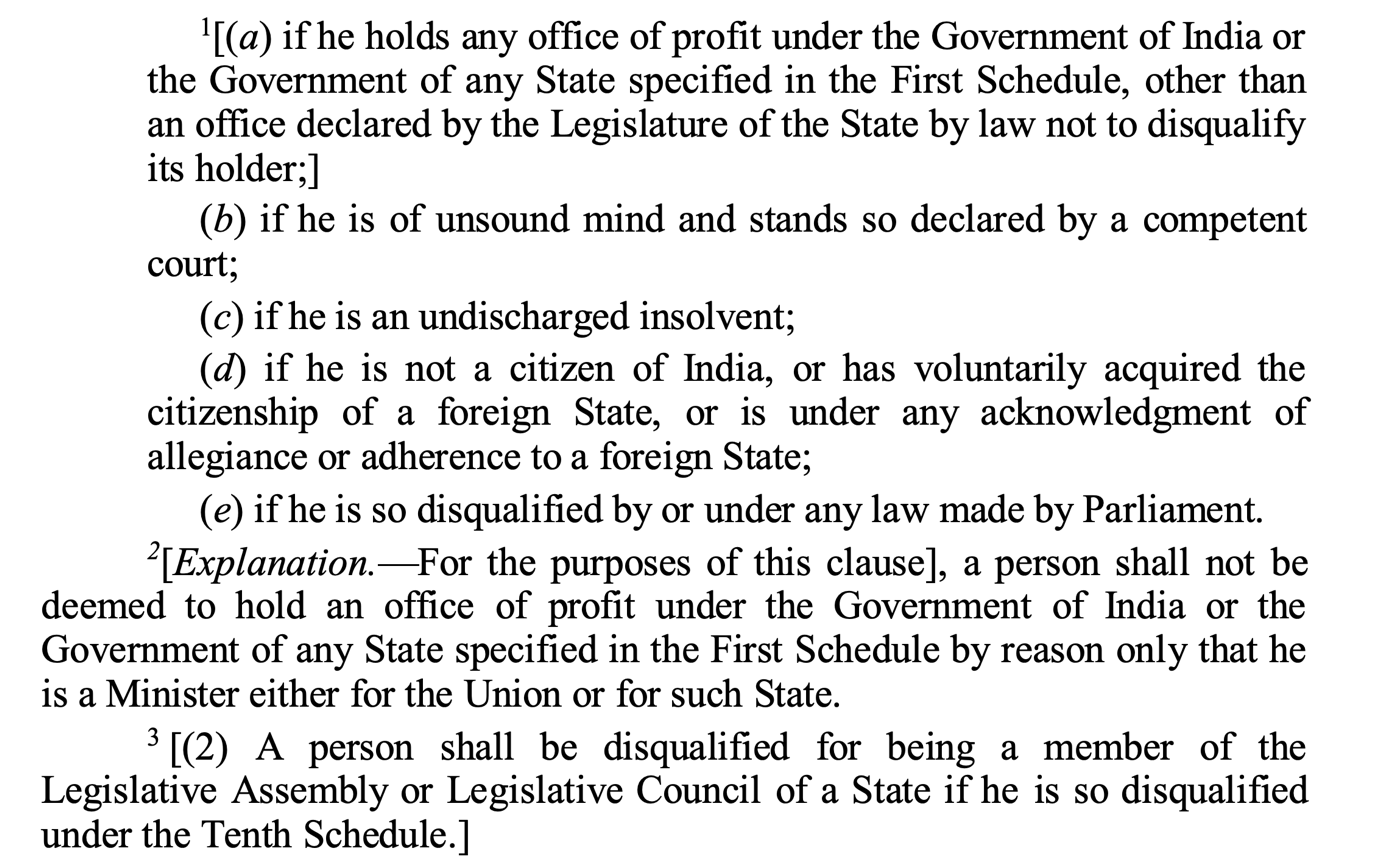
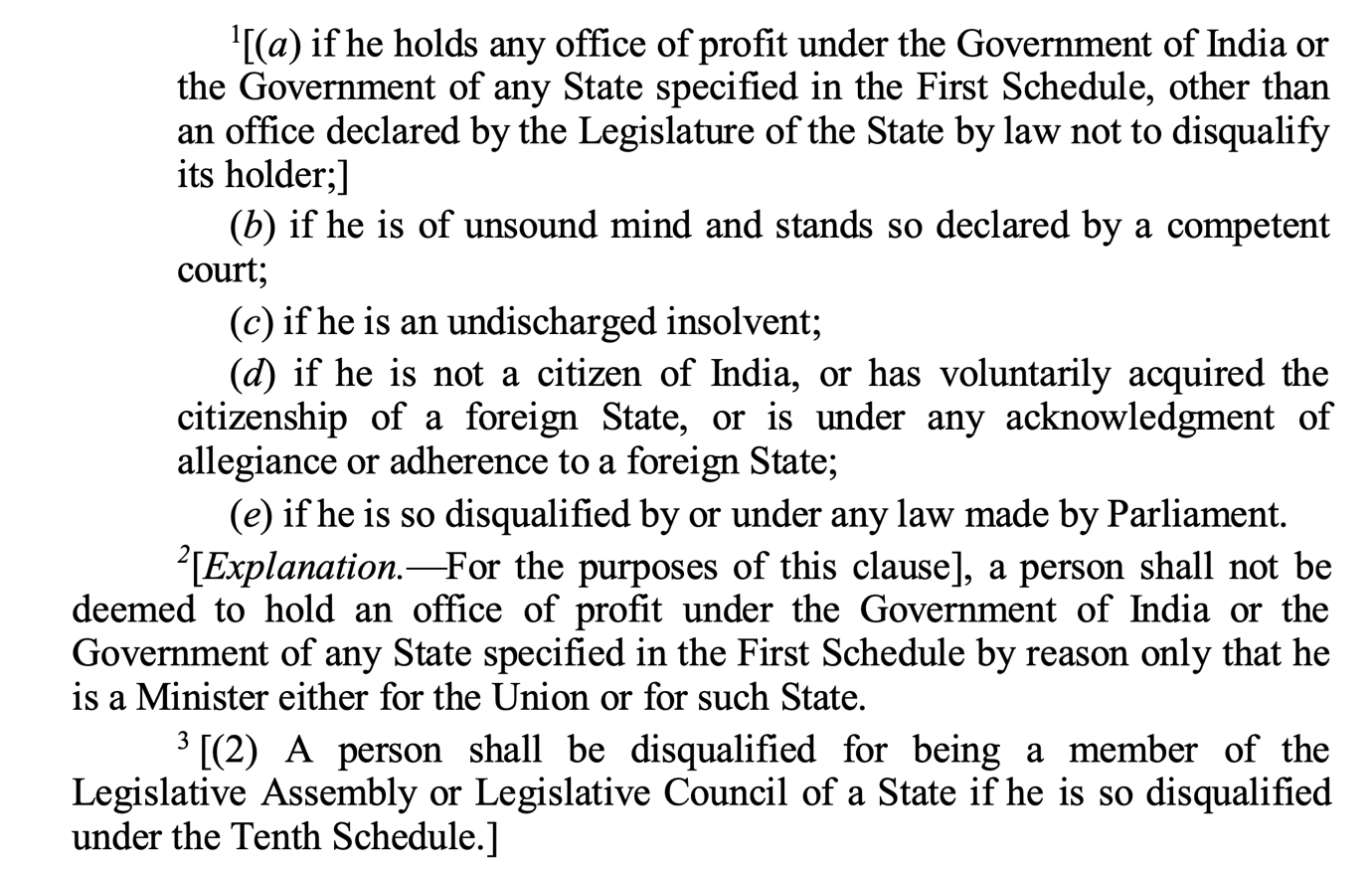
Disqualifications specified in the Constitution of India for Members of Legislative Assembly: 

Text

Description automatically generated
xJSSWl k4jFLXuwTaBA69aGmLjrt09qUcgbx98Kt1cCmC0FhqZ blYUNOLoI3NFa2N3CQc9bla mZ2RAAgeW

(Lily Thomas Case 2013) Immediate Disqualification of Convicted MPs and MLAs 

  • In 2013, the Supreme Court held that charge sheeted Members of Parliament and MLAs, on conviction for offences, will be immediately disqualified from holding membership of the House without being given three months’ time for appeal, as was the case before.
  • The concerned Bench of the Court struck down as unconstitutional Section 8 (4) of the Representation of the People Act (1951) that allows convicted lawmakers a three-month period for filing appeal to the higher court and to get a stay of the conviction and sentence. The Bench, however, made it clear that the ruling will be prospective and those who had already filed appeals in various High Courts or the Supreme Court against their convictions would be exempt from it.
  • The Bench said: “A reading of the two provisions in Articles 102 and 191 of the Constitution would make it abundantly clear that Parliament is to make one law for a person to be disqualified for being chosen as, and for being, a Member of either House of Parliament or Legislative Assembly or Legislative Council of the State. Parliament thus does not have the power under Articles 102 and 191 of the Constitution to make different laws for a person to be disqualified for being chosen as a member and for a person to be disqualified for continuing as a Member of Parliament or the State Legislature.”
  • The Bench said: “Section 8 (4) of the Act which carves out a saving in the case of sitting members of Parliament or State Legislature from the disqualifications under the Act or which defers the date on which the disqualification will take effect in the case of a sitting member of Parliament or a State Legislature is beyond the powers conferred on Parliament by the Constitution.”
  • The Bench held: “Looking at the affirmative terms of Articles 102 and 191 of the Constitution, we hold that Parliament has been vested with the powers to make law laying down the same disqualifications for person to be chosen as a member of Parliament or a State Legislature and for a sitting member of a House of Parliament or a House of a State Legislature. We also hold that the provisions of Article 101 and 190 of the Constitution expressly prohibit Parliament to defer the date from which the disqualification will come into effect in case of a sitting member of Parliament or a State Legislature. Parliament, therefore, has exceeded its powers conferred by the Constitution in enacting sub-section (4) of Section 8 of the Act and accordingly sub-section (4) of Section 8 of the Act is ultra vires the Constitution.”

In order to nullify the above ruling of the Supreme Court, the Representation of the People (Second Amendment and Validation) Bill, 2013 was introduced in the Parliament. However, the Bill was later withdrawn by the Government.

BASED ON HIGH COURT OR SUPREME COURT’S ORDER

When Disqualification ContinuesWhen Disqualification Ends
If the Higher Court on appeal stays the operation of only the execution of sentence of imprisonment passed by the trial Court >>> then such stay on the execution of sentence given by the Higher Courts will not have any effect on the person’s disqualification --- So, the disqualification continues.Disqualification will be suspended where the Higher Court stays both the conviction and the operation of sentence.  

Defamation:

So this has again brought the limelight on defamation issue. 

  • What is defamation all about?
  • Defamation is an exception to the Right to Freedom of Speech
  • Why is defamation a crime? 
  • Why defamation should remain a criminal offence?

What is defamation all about?

  • Defamation is the general term for a legal claim involving injury to one's reputation caused by a false statement of fact and includes both libel (defamation in written or fixed form) and slander (spoken defamation). The crux of a defamation claim is falsity. Truthful statements that harm another's reputation will not create liability for defamation (although they may open you up to other forms of liability if the information you publish is of a personal or highly private nature).
  • Defamation refers to the act of publication of defamatory content that lowers the reputation of an individual or an entity when observed through the perspective of an ordinary man. If defamation occurs in spoken words or gestures (or other such transitory form) then it is termed as slander and the same if in written or printed form is libel. Defamation in India is both a civil and a criminal offence.

Defamation is an exception to the Right to Freedom of Speech

  • Article 19 of the Constitution grants various freedoms to its citizens.
  • However, Article 19(2) has imposed reasonable exemption to freedom of speech and expression granted under Article 19(1) (a). Contempt of court, defamation and incitement to an offence are some exceptions.

Legal Provisions 

  • Sections 499 and 500 OF IPC
    • Sections 499 and 500 in the IPC deal with criminal defamation. While the former defines the offence of defamation, the latter defines the punishment for it.
    • Section 499: Whoever, by words either spoken or intended to be read, or by signs or by visible representations, makes or publishes any imputation concerning any person intending to harm, or knowing or having reason to believe that such imputation will harm, the reputation of such person, is said, except in the cases hereinafter expected, to defame that person.
  • Section 500:
    • Whoever defames another shall be punished with simple imprisonment for a term which may extend to two years, or with fine, or with both.

Why is defamation a crime? 

  • Reputation is an asset to each and every one. Any damage to such asset can be legally dealt with. Defamation laws have been enacted to prevent person maliciously using their right to freedom of speech and expression. The Indian law has rightly not made any distinction between libel and slander. Otherwise there could have been chances for committing slander and escaping from the laws that there is no written publication of matter.

Why defamation should remain a criminal offence?

Arguments ‘In favor’:

  • Income inequality
    • Defamation should remain a penal offence in India as the defamer may be too poor to compensate the victim in some cases.
  • Anonymity provided by Internet
    • Since there is no mechanism to censor the Internet from within, online defamation could only be adequately countered by retaining defamation as a criminal offence.
  • Article 21
    • Also, criminalization of defamation is part of the state’s “compelling interest” to protect the right to dignity and good reputation of its citizens.
  • Changes have been made from time to time
    • Sections 499 and 500 have 10 exceptions. 
    • These exceptions clearly exclude from its ambit any speech that is truthful, made in good faith and/or is for public good.

Arguments ‘Against’:

  • Against the global trend
    • Many countries worldwide are in favor of treating defamation as a civil wrong, not as a criminal offence. 
    • Also, in 2011, the Human Rights Committee of the International Covenant on Civil and Political Rights called upon states to abolish criminal defamation, noting that it intimidates citizens and makes them shy away from exposing wrongdoing.
  • Misuse by “Influential”
    • The misuse of law as an instrument of harassment is also pervasive in India. 
    • Often, the prosecutor’s complaint is taken at face value by courts, which send out routine notices for the appearance of defendants without any preliminary examination whether the offending comments or reports come under one of the exceptions spelt out in Section 499. 
    • Thus, the process itself becomes the punishment.
      • Criminal defamation has a pernicious effect on society: for instance, the state uses it as a means to coerce the media and political opponents into adopting self-censorship and unwarranted self-restraint.
      • The law can also be used by groups or sections claiming to have been hurt or insulted and abuse the process by initiating multiple proceedings in different places.
  • Public order concerns taken care by other sections
    • Defamatory acts that may harm public order are covered by Sections 124, 153 and 153A, and so criminal defamation does not serve any overarching public interest. Even though Section 499 provides safeguards by means of exceptions, the threat of criminal prosecution is in itself unreasonable and excessive.

Government will attempt to open corridor to Sharda Peeth in PoK for devotees: Shah

Context: In line with the Kartarpur Corridor, the government intends to establish a corridor to Sharda Peeth in Pakistan-occupied Kashmir (POK).

About Sharda Peeth

  • Location: Mount Harmukh, Neelum Valley in Jammu and Kashmir's Kupwara District.
  • As a centre of education
    • It was one of the most prestigious temple-educational institutions on the India-n subcontinent between the sixth and the twelfth century CE.  
    • Scholars travelled great distances for the texts since it was well renowned for its library.
    • It was crucial to the growth of the Sharada script in North India.
  • As a pilgrimage site
    • It is one of the Maha Shakti Peethas. 
    • Together with the Martand Sun Temple and the Amarnath Temple, it is one of the three holiest locations for Hindu pilgrims. 
    • It is also known for rise of Shaktism. 
  • Lalitaditya Muktapida (724 CE–760 CE) of the Karkota dynasty most likely commissioned it.
  • Historical traces of the temple
    • Al-Biruni first described the location as a venerated shrine with a wooden picture of Sharda, but this description is based only on hearsay as he had never visited Kashmir. 
    • Both the intellectual and spiritual components of Sharada Peeth are described by the Kashmiri poet Bilhana, who lived in the 11th century. He says that Sharada Peeth is the place that gave Kashmir its status as a centre of education.
    • Sharada Peeth is also mentioned in Kalhana's epic Rajatarangini (12th century).
    • Abu'l-Fazl has also described Sharada Peeth as a stone temple in the 16th century.
  • Architecture
    • The red sandstone temple was constructed in the Kashmiri architectural style. The compound is perched on a hill and is accessed from the west by a grand stone stairway. The temple is erected upon a plinth.
    • The temple is covered with a low single roof, even though Kashmiri architecture is most often characterised by a pyramidal stone roof.
    • Two Ancient Linga could be observed in a tiny opening on the north side of the wall.

Sharda Script

  • Almost 1200 years ago, it developed from the Western branch of Brahmi.
  • Between the 8th and 12th centuries, the script was widely used to write Kashmiri and Sanskrit in Kashmir and the surrounding territories of the Indian Subcontinent.
  • Its name comes from the goddess Sarada or Saraswati, the patron goddess of learning. It is a native script of Kashmir.
  • An early version of the Sharada script is used in the Bakhshali manuscript.
  • Regional variations in the Sharada script emerged in 10th century in Kashmir, the Hill States (which included parts of Himachal Pradesh), and Punjab.

No slander please, they are our freedom fighters first

Context: Writer has called for the due respect that should be given to all the unsung freedom fighters of modern Indian History.

Here is the list of four important freedom fighters that were mentioned in the editorial. 

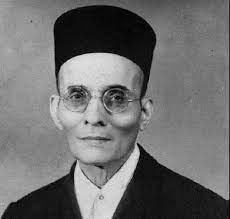
1. V D SAVARKAR

x80NBdbbAqqZobIYfMBfBhYB1RSoffrSSupFNsxATcKvtxtoj1VUTgQOrTIZdGgVg9o DPWaDWarKp61zOvYHisrsGQhtZybhyXrRIT6 6F9UGE2Mui 9CZf7ORISQHiZVJLEFPacAi34M0o6RpDBw
  • Born in 1883 at Nashik in Maharashtra.
  • Founded Abhinav Bharat Society (initially as Mitra Mela, 1899) along with brother G D Damodar in 1904. It was a secret society which also had connections with London.  
  • He was involved with India House (founded by Shyamji Krishna Varma in London to promote nationalist ideas among youth).
  • Savarkar went to London in 1906. He soon founded the Free India Society, along with Madam Bhikaji Cama based on the thoughts of the Italian nationalist Giuseppe Mazzini 
  • Functioned as president of Hindu Mahasabha from 1937 to 1943. He called against Quit India Movement.
  • Savarkar was convicted and sentenced to 50-years imprisonment also known as Kala Pani and transported in 1911 to the Cellular Jail in the Andaman and Nicobar Islands. Released in 1924.
  • He later joined Tilak’s Swaraj Party.
  • He advocated for the use of Hindi as a national language. He also fought against untouchability and caste-based discrimination.

Literary works of Savarkar

  • The History of the War of Indian Independence (on revolt of 1857)
  • ‘Hindutva: who is Hindu?’

2. Dr. Chembakaraman Pillai

q0sFakTvJRFZJp6iaqEgnJQiPE vM7gEAiZX7n4
  • Born in Thiruvananthapuram in 15 September 1891. 
  • He started his struggle for freedom by protesting the Partition of Bengal in 1905. 
  • He joined with Bala Gangadhara Tilak in his resistance against the Partition of Bengal. When the British police tried to arrest him because of his revolutionary speeches against the Travancore State government, he escaped to Germany in 1908 with the help of his friend Sir Walter Williams Strickland.
  • At Berlin University, he formed International Pro-Indian Committee to gather the support of the German people for India’s freedom struggle.
  • He came in touch with many revolutionary Indian leaders in Germany like Hardayal, Raja Mahendra Pratap, Dr. Prabhakar, and A. C. Nambiar. 
  • He started a newspaper called Pro-India to spread the message of the Indian freedom movement. 
  • He participated in the First World War on the German side to defeat the British.
  • Armed with an engineering degree he joined the German navy as an officer in the cruiser Emden which attacked British ships and shelled several places in India.
  • Madras was shelled on 22 September 1914 after a fierce sea battle with British ships.
  • He met Mahatma Gandhi in South Africa. He was the Foreign Minister when a temporary Free Government of India was established in Afghanistan on 1 December 1915.
  • He met Subhash Chandra Bose in Vienna in 1919. Though he joined in the German army, he criticized even Adolf Hitler, when he humiliated India in his speech. 
  • Dr. Chidambaram Pillai died on 26 May 1934 in Germany under mysterious circumstances.

3. Vanchinathan Iyer

  • Vanchinatha Iyer or Vanchinathan was born in Shenkottai. Vanchinathan alias Sankara Iyer was the son of Shri Raghupathy Iyer. 
  • He had studied upto primary standard and joined the Forest Department thereafter. 
  • He participated in revolutionary activities against the Britsh.
  • On 17 June 1911, Vanchi who was 25, assassinated Robert Ashe, the district collector of Tirunelveli, who was also known as Collector Dorai.
  • He shot Ashe at point-blank range when Ashe's train had stopped at the Maniyachi Station, enroute to Madras. He committed suicide thereafter. The railway station has since been renamed Vanchi Maniyachi.
  • The mastermind behind the assassination was Nilakanta Brahmachari who went around the Madras presidency in 1910 recruiting cadres and hatching plots against the British. In this venture, he was accompanied by Shankar Krishna Iyer, Vanchinathan's brother-in-law, who introduced the men to each other. 
  • Along with a few other men, Nilakanta Bramhachari, Vaanchinathan, and Shankar Krishna Aiyar found an organisation called Bharatha Matha Sangam which plots the assassination of influential British men.

4. Thillaiaadi Valliammai

akjSf6brESvjSPd Gp KDQ6Oqr1cpIF YAkS1VaBUFKJk0rw0ygTwQQrjoiCoPcTitHLfynKZN fnqhpWw bg80DN89HSyD 0qpk0b P3Q9Px74x0ougN02K
  • She was a South African Tamil girl who worked with Mahatma Gandhi in her early years when she developed her nonviolent methods in South Africa fighting its apartheid regime.
  • She joined her mother in the march by women from Transvaal to Natal – which was not legally permitted without passes.
  • They were protesting against the judgement given by Justice Searle which made all marriages invalid if not registered under the registrar office or not performed according to the Christian rituals. 
  • She was imprisoned for the protest against the South African government. She was imprisoned for three months, but due to severe illness she died at the age of 16 soon after the release. 

Semiconductors Manufacturing

Context: The Union Government has disbursed around ₹1,645 crore in performance-linked incentives (PLI) for electronics manufacturers so far, as part of its efforts to bring in more of the electronics supply chain to India. More and more nations are trying to turn away from China’s dominance in the space, following geopolitical pressures to de-leverage themselves from supply chain vulnerabilities.

What are semiconductors?

A semiconductor is a material that allows electrical conductivity between a conductor and an insulator. Semiconductors are made from pure elements like silicon or germanium, or compounds such as gallium arsenide. Sometimes their conductivity is changed through doping.

In a pure semiconductor, such as silicon or germanium, there are few free electrons or holes (missing electrons) available for conduction.

However, when impurities are intentionally introduced into the semiconductor, a process called doping, the number of free electrons or holes can be increased.

They are used to make electronic devices such as transistors, diodes, and integrated circuits (ICs). Transistors, which are used to amplify and switch electronic signals, are made by combining multiple p-n junctions.

Integrated circuits (ICs) are made by creating complex arrangements of transistors and other components on a single piece of semiconductor material. Semiconductors chips are the thumbnail-sized building blocks of almost every modern electronic device from smartphones to connected devices in the Internet of Things (IoT).

Semiconductors have revolutionized the electronics industry and are essential components in nearly all electronic devices, from smartphones to computers to automobiles. Semiconductors make the devices more compact, less expensive, and more powerful.

For instance, mobile phones weighed about 2 lbs, cost around $4,000, and held a charge for only about 30 minutes of talk time during their initial phase. However today an individual can buy a smartphone for 5000 rupees that would give a 1-day charge.

Semiconductor manufacturing in India

The semiconductor chip-making process is complex and highly exact, having multiple steps in the supply chain such as designing software for chips and patenting them through core Intellectual Property (IP) rights. They help give computational power to devices. The global semiconductor industry is currently valued at $500-$600 billion.

The chip-making industry is a highly-concentrated one, with the big players being Taiwan, South Korea and the U.S. among others. In fact, according to a New York Times estimate, 90% of 5nm (nanometre) chips are mass-produced in Taiwan, by the Taiwan Semiconductor Manufacturing Company (TSMC).

Globally, the entire value chain has seeped in the interdependence between a handful of countries like the USA, Taiwan, Japan, China, and some European nations. 

  • India has done well in design and verification for the semiconductor industry. Most of the global semiconductor companies having an R&D footprint in India.
  • However, 100% of our chips, memory, and display are imported into the country, 37% coming from China.
  • Chips import bill is estimated to touch $100 billion by 2025 from $24 billion now. 
  • Although India has two fabs — SITAR, a unit of the Defence Research and Development Organisation (DRDO) in Bengaluru, and a semiconductor laboratory in Chandigarh. These build silicon chips for strategic purposes like defense and space and not for commercial use.

Why is the government encouraging semiconductor manufacturing?

  • National Security: Semiconductors are essential components in many critical industries, including defense, telecommunications, power transmission etc that have implications for national security. Chips made locally will be designated as “trusted sources” and can be used in products ranging from CCTV cameras to 5G equipment. 
  • Strategic competition with China: Countries have spotted strategic value in cornering segments of the value chain for fabs, even as the sophistication and capital needed to run them have climbed to historic highs. China pulled ahead of Taiwan last year, in terms of share of global sales from fabs, according to a report by the Semiconductor Industry Association (SIA).
    • It’s not just India that is wary of this dominance. The U.S. passed the CHIPS Act last August, providing upwards of $280 billion in subsidies and investments to manufacturers opening fabs and making semiconductors in the U.S. This has been combined with restrictions on the Chinese semiconductor industry.
  • Geopolitical Benefits:  driven by data and the digital revolution. Further self-sufficiency will decrease reliance on Chinese chip imports especially during hard times like the recent Galwan Valley border clash.
  • Economic Growth
    • Development of the semiconductor and display ecosystem will have a multiplier effect across different sectors of the economy with deeper integration to the global value chain.
    • Indigenous manufacturing of chips will build its smartphone assembly industry and strengthen its electronics supply chain. 
    • According to the Electronics and IT Ministry, semiconductor demand in India would increase to $70-$80 billion by 2026 with the growing demand for digital devices and electronic products. 
    • This will create numerous employment opportunities for the Indian youth.
    • Indigenous capacity would attract local taxes and boost the export potential. 
    • Further, India would be required to import fewer semiconductor chips which would decrease the import bill.
  • Technological Leadership: Semiconductors are the building blocks of today’s technology. Semiconductor chips are widely used in (a) Computers and laptops; (b) Phones, mobile devices and other electronic gadgets; (c) Automobiles; (d) Aviation; (e) Medical devices especially diagnostics; (f) Military equipment among others.

These semiconductor chips are the drivers for ICT (Information and Communication Technologies). Semiconductors and displays are the foundation of modern electronics driving the next phase of digital transformation under Industry 4.0.

  • Supply Chain Resilience: The COVID-19 pandemic highlighted the vulnerabilities of global supply chains, including those in the semiconductor industry. Governments are encouraging domestic semiconductor manufacturing to increase supply chain resilience and reduce dependence on foreign suppliers. The pandemic and the subsequent lockdowns impacted the supply of chips to India. Automobile manufacturers like Mahindra & Mahindra and Tata group were compelled to reduce their production due to the shortage.
  • Environmental Concerns: The semiconductor manufacturing process can be energy-intensive and can produce hazardous waste. Governments are encouraging domestic semiconductor manufacturing to promote more sustainable and environmentally friendly practices.
  • Changing work and employment pattern 
    • Experts estimate that around 50 crore people will join the internet in the next decade thereby demanding more phones and laptops. 
    • Work from home culture warrants an enhanced demand for servers, internet connectivity, and cloud usage.

Initiatives taken to promote indigenous Semiconductor capacity

  • National Policy on Electronics 2019: It envisions positioning India as a global hub for Electronics System Design and Manufacturing (ESDM) sector. It aims to encourage the development of core components, including chipsets. 
  • Scheme for Promotion of Manufacturing of Electronic Components and Semiconductors (SPECS):
    • The government will provide a financial incentive of 25% on capital expenditure for a list of products that constitute the supply chain of electronic products. This includes products such as electronic components, semiconductors, and specialized sub-assemblies.
    • India would be offering more than $1 billion in cash to each semiconductor company that sets up manufacturing units in the country.
  • Modified Electronics Manufacturing Clusters (EMC 2.0) Scheme: Under this, the government will provide support for the setting up of Electronics Manufacturing Clusters (EMCs) and Common Facility Centres(CFCs).
  • Production Linked Incentive Scheme(PLI): Under this, the government will provide an incentive of 4% to 6% on goods manufactured in India and covered under target segments to eligible companies for a period of five years.
  • Incentive to all nodes of semiconductors: The new changes have been announced to harmonise government incentives for all technology nodes of semiconductors. In the previous version of the scheme, the Centre was offering to fund 30% of the project cost for 45nm to 65nm chip production, 40% for 28nm to 45nm, and 50% or half of the funding for chips 28nm or below. The modified scheme provides uniform 50% fiscal support for all nodes. Besides, it will provide 50% of capital expenditure for other steps of the process as well (chip design and ATMP).
  • Foreign Direct Investment: The Government of India has allowed 100 percent (FDI) under the automatic route in the Electronics Systems Design & Manufacturing sector.  

What are the challenges in front of India?

  • High Cost of establishment: Fabs are highly capital-intensive undertakings, costing billions of dollars for large facilities. As per a government estimate, it would cost roughly $5-$7 billion to set up a chip fabrication unit in India.  
  • Low Ease of doing business: The process of establishing an indigenous semiconductor facility requires clearances and approvals from multiple government departments. 
  • Technological Constraint: The indigenous manufacturing of semiconductors requires the use of high-end technologies. These technologies are licensed from patent holders at a very high price.
  • Lack of Fabrication Capacities: India has a decent chip design talent but it never built up chip fab capacity. The ISRO and the DRDO have their respective fab foundries but they are primarily for their own requirements and are also not as sophisticated as the latest in the world.
  • Structural constraint: FDI in electronics is less than 1% of the total FDI inflow because of the dearth of skilled labor, delays in land acquisition, and the uncertain tax regime.
  • Unstable power supply: The smooth production of semiconductors requires the availability of an uninterrupted 24*7 power supply. they require highly reliable and high-quality supply of water, electricity, and insulation from the elements, reflecting the high degree of precision, cost and capital needed to make the sophisticated circuits.
  • Resource Inefficient Sector: Chip fabs are also very thirsty units requiring millions of litres of clean water, an extremely stable power supply, a lot of land and a highly skilled workforce.

Suggestions

  • Augmenting Research and Development Potential: For instance, IIT Madras developed a microprocessor named ‘Moushik’ with funding support from the Ministry of Electronics and Information Technology.
  • Fiscal Support for All Elements of Chip-Making Chain: Considering India’s considerable talent and experience, it may be best if the new mission focuses fiscal support, at least for now, on other parts of the chip-making chain including design centres, testing facilities, packaging, etc.
  • Establishment of Sovereign Patent Fund (SPF): The proposed Sovereign Patent Fund under National Policy on electronics should be established expeditiously. It is a wholly or partly Government-backed entity that aims to bolster domestic businesses through the acquisition and licensing of patented technology.
  • Push for Quad Supply Chain Resilience Fund: India needs to push for a Quad Supply Chain Resilience Fund to immunise the supply chain from geopolitical and geographic risks.
  • Research ecosystem: government must focus on emerging technologies like LiDAR and Phased Array in which incumbents do not have a disproportionate advantage and the entry barrier is low.
  • Focus on Manufacturers' Assurance of Domestic Procurement – The manufacturers need to be given an assurance of minimum domestic procurement by the government and the private sector. The focus should be on manufacturing economical and technically viable options like 28nm chips.
  • Support for Acquisition of Semiconductor Manufacturing Units: The government should also support businesses in the acquisition of semiconductor manufacturing units in other countries. This is easier than setting up a domestic facility and can be done swiftly for ensuring a continuous supply of chips.
  • Free-Trade Agreement Negotiations: India and Taiwan have started negotiations for a free-trade agreement and setting up a semiconductor manufacturing hub in an Indian city, signalling their resolve to further expand the two-way economic engagement.

Lab Grown Diamonds

Context: Budget 2023-24 has introduced incentives for lab grown diamonds.

About Lab Grown Diamonds (LGDs)

  • Lab grown diamonds (also known as lab created diamonds, manmade diamonds, engineered diamonds, and cultured diamonds) are grown in highly controlled laboratory environments using advanced technological processes that duplicate the conditions under which diamonds naturally develop when they form in the mantle, beneath the Earth’s crust. 
  • These manmade diamonds consist of actual carbon atoms arranged in the characteristic diamond crystal structure. Since they are made of the same material as natural diamonds, they exhibit the same optical and chemical properties.
  • Lab Grown Diamonds is a technologically and innovation driven emerging sector with high employment potential. These environment friendly diamonds which have optically and chemically the same properties as natural diamonds. 

Reasons for interest in Lab Grown Diamonds

  • Mining Free: These diamonds are produced in laboratories. Hence, they are an environmentally responsible choice as a no mining is required.
  • Quality: Lab Grown Diamonds have same physical, chemical and optical properties as mined diamonds.
  • Value for Money & Affordable: Lab grown diamonds offer excellent value. They are more cost-effective than natural diamonds of comparable size and quality.
  • Scarcity of diamonds: As natural diamonds become scarce due to depleting reserves and escalating costs. 
  • Strengthening India’s Gems & Jewellery Industry: India is a global leader in cutting and polishing of natural diamonds, contributing about 3/4th of global turnover by value. With the depletion of natural diamonds, the industry is moving towards Lab Grown Diamonds. 

Process of making Lab-Grown Diamonds

  • Lab Grown diamonds are made in laboratories with a seed of natural diamonds, which is a slice of another diamond - on which the LGD is created. It takes less than month to make a distinctively shaped crystal of Lab Grown Diamond. 
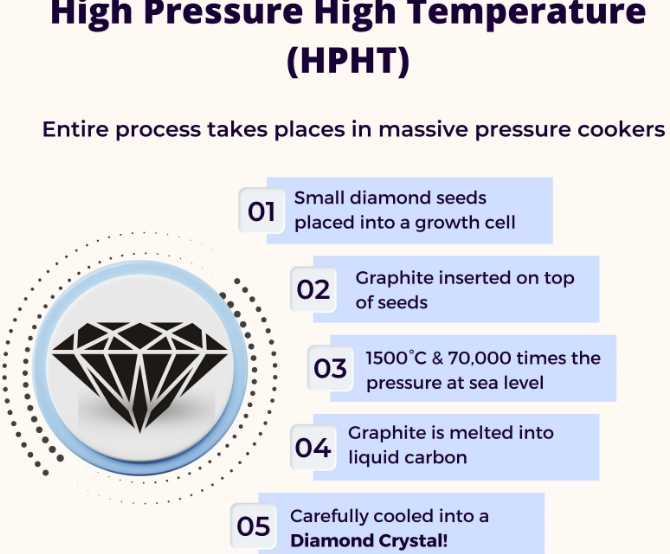
  • There are two methods by which LGDs are created: (i) Chemical Vapour Deposition (CVD) method (ii) High Pressure, High Temperature (HPHT) method.
  • High Pressure, High Temperature (HPHT) method: This process mimics the high-pressure, high-temperature conditions that occur under the Earth to form a natural diamond. The seed and graphite carbons are exposed to extreme temperatures (1,500oC) and with extremely high pressures to make LGDs. This method can also enhance the colour of diamonds making them colourless, pink, green, blue or yellow. Diamonds produced by this method may have some impurities of Boron or Nitrogen. This method is popular in China. 
high pressure high temp
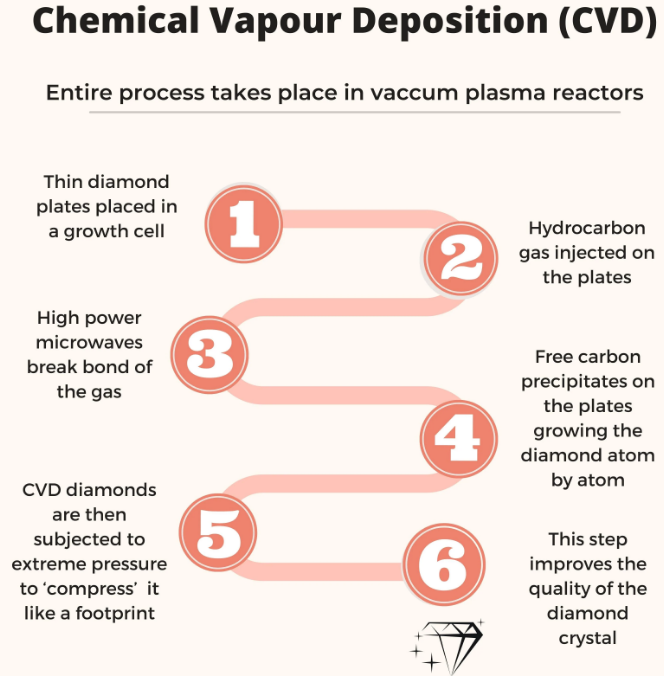
  • Chemical Vapour Deposition (CVD) method: It is a chemical process in which the seed is heated up to 800oC in a sealed chamber filled with molecules of carbon-rich gas such as methane. These gas molecules are broken down into carbon and hydrogen atoms, which get deposited on the seed giving it a shape of square, tabular diamond crystal. This process also requires heat or irradiation to give the crystal a colour effect. Diamonds produced by this method most chemically pure diamonds i.e., free from impurities of nitrogen and boron. CVD method is more popular in India. 
chemical vapour deposition

Identification of Laboratory Grown Diamonds

  • Laboratory grown diamonds require advanced testing in a gemmological laboratory to be identified with certainty. 

Proposals in Union Budget 2023-24 for Lab Grown Diamonds

  • Grant for R&D: To encourage indigenous production of LGD seeds and machines and to reduce import dependency, a R&D grant will be provided to one of the IITs (IIT Madras) for five years.
  • Relief in Customs duty: Budget 2023-24 has abolished customs duty on imports of seeds used for manufacturing of rough lab-grown diamonds. This will boost domestic manufacturing of LGDs and reduce imports of LGDs. 
  • Implications of Fiscal support: Fiscal support provided for LGDs is aimed at boosting exports of LGDs from India and to reduce dependence of imports for key inputs i.e., seeds and equipments. 
  • LGDs in India: In India, share of LGDs in overall diamond business is just 2-3% with LGDs being used majorly for jewelleries and exports. About 80% of cut and polished LGDs are exported, while only 20% are consumed globally. 
  • Trends in LGD trade: India imported rough LGDs worth Rs 7,656 crore in April-December 2022 and exported 10,587 crores of LGDs in the same period. US & Europe are key markets for India’s CVD labs grown diamonds. With further government support, LGD industry will become competitive globally. 

Diamond Simulants

  • Diamond stimulants, such as cubic zirconia and moissanite, look like diamonds but are not true carbon crystals. Simulants do not have the same chemical and physical properties as natural diamonds and therefore sell at much lower prices than lab created diamonds. 
  • Moissanite is a gemstone born from stars and was first discovered in a crater created by a meteorite in Arizona, USA. They are composed of crystal of silicon carbide and not of carbon as diamonds. However, they appear like Diamonds. 
  • Natural Moissanite is incredibly rare on Earth. Hence, most moissanite available today is laboratory created. Moissanite, referred to as a diamond simulant, is engineered to give the illusion of similarity to diamonds, but is compositionally and visually quite different from a real diamond.