Current Affairs

Lynx U2 fire control systems

Context: Ministry of Defence signed a contract with Bharat Electronics Limited for the procurement of 13 Lynx-U2 fire control systems for the Navy at a cost of over Rs 1,700 crore, under the Buy Indian – IDMM (Indigenously Designed Developed and Manufactured) category.

Lynx-U2 fire control system:

  • The Lynx-U2 system is a naval gun fire control system capable of accurately tracking and engaging targets amid sea as well as air or surface targets.
  • The fourth generation, completely indigenous systems, will be installed on New Generation Offshore Patrol Vessels to be built indigenously at Garden Reach Shipbuilders and Engineers and Goa Shipyard Limited. 

Next-generation Offshore Patrol Vessels

Context: Ministry of Defence has signed a deal to buy eleven Next Generation Offshore Patrol Vessels and six Next Generation Missile Vessels at Rs 19,600 crore. 

Next Generation Offshore Patrol Vessels (NGOPV):

  • The contract for 11 NGOPVs worth Rs 9,781 crore was signed between Goa Shipyard Limited and Garden Reach Shipyard Limited under Buy (Indian-IDDM) category. 
  • NGOPVs will increase the Navy’s various operational capabilities such as Anti-Piracy, Counter-Infiltration, Anti-Poaching, Anti-Trafficking, Non-Combatant Evacuation Operations, Search and Rescue (SAR), Protection of Offshore Assets etc.
    • An offshore patrol vessel (OPV) is a small surface ship designed for coastal defence.
    • They can carry a crew of up to 80-90 sailors, but are much more lightly armed — and therefore much cheaper — than capital warships like corvettes, frigates, or destroyers.
    • For performing tasks that do not require heavy fighting, OPVs offer a far more economical option than using heavily armed capital warships.
    • These warships are well equipped to tackle a range of roles such as maritime security, border control, anti-smuggling, counter-terrorism, disaster relief etc.

Next Generation Missile Vessels (NGMV):

  • The contract for constructing six Next Generation Missile Vessels (NGMVs) was signed with Cochin Shipyard (CSL) at Rs 9,805 crore.
  • NGMVs would be heavily armed war vessels incorporating stealth, high speed and offensive capability.
  • The primary role of the ships would be to provide offensive capability against enemy warships, merchantmen and land targets.
    • These warships will be capable of conducting maritime strike operations, Anti-Surface Warfare Operations and would be a potent instrument of sea denial for enemy ships, especially at choke points. 
    • In the defensive role, these ships would be employed for Local Naval Defence operations and seaward defence of the Offshore Development Area. 

Next-generation mobile maritime coastal batteries and BrahMos missile

Context: Ministry of Defence has signed a deal with BrahMos Aerospace Private Limited (BAPL) for the procurement of Next Generation Maritime Mobile Coastal Batteries (Long Range) and BrahMos missiles, valued at over Rs 1,700 crore, under Buy (Indian) category. 

Aim: To enhance the Indian Navy's maritime strike capabilities along the coast. 

Next-Generation Maritime Mobile Coastal Batteries (Long Range)

  • Next-Generation Maritime Mobile Coastal Batteries come equipped with new missiles like the BrahMos surface-to-surface cruise missiles. 
  • This system will allow the Indian Navy to target enemy platforms operating close to the Indian coast. 

Supersonic BrahMos missiles

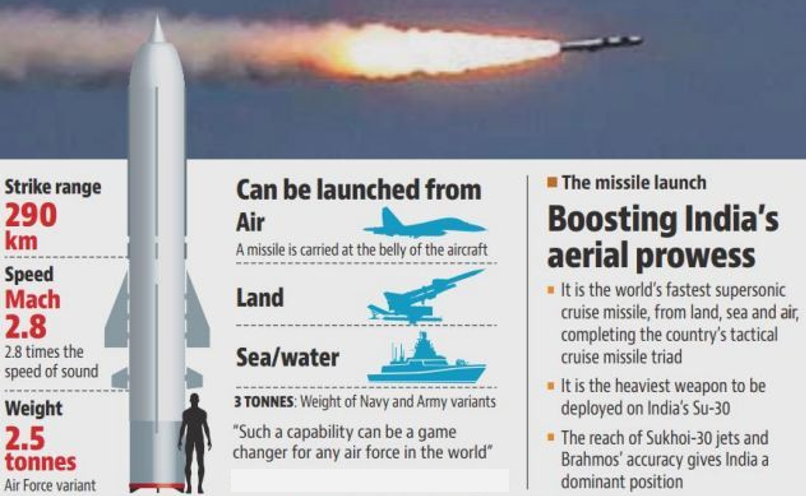
  • BrahMos is the fastest cruise missile in the world with a top speed of Mach 2.8 or almost three times the speed of sound.
  • It is a two-stage missile (solid propellant engine in the first stage and liquid ramjet in the second stage) with a range of 290 km.
  • The multiplatform missile can be launched from land, air, and sea with pinpoint accuracy during day and night irrespective of weather conditions.

Special features of BrahMos

  • Universal for multiple platforms
  • Stealth technology and guidance system
  • “Fire and Forget” principle of operation
  • Pinpoint accuracy with high lethal power 
  • Quicker engagement time and non-interception by any known weapon system
E5nmsj4rgImhlJnCyMWaJRED9NC ZcjyRiCEPykw87hiC8ED9II4J7S8hnd3tFPtPLJ0uOXpM8LgWtMp56RCT9WI8 f7mMAkXiVqfDWeE 5pVYW4bK6QweWAkg7 vEtqRLUFF0Hh9WKisOIccrZRew

Significance

  • Enhance the multi-directional maritime strike capability of the Indian Navy. 
  • Boost indigenous production of the critical weapon system and ammunition with the active participation of indigenous industries.
  • Generate employment of more than 90,000 man-days over a period of four years.

BrahMos Aerospace Pvt Ltd (BAPL)

  • BrahMos Aerospace Pvt Ltd is a joint venture between India and Russia that produces supersonic cruise missiles that can be launched from submarines, ships, aircraft, or land platforms.
  • BrahMos was established through an inter-governmental agreement in 1998 as a joint venture between India's state-run Defence Research and Development Organisation and NPO Mashinostroyenia of Russia.
  • Although BrahMos missiles still depend on Russian parts and raw materials, the percentage of local input had gone up to over 70% from around 15% at the start of the venture.

Swathi Weapon locating radar

Context: Ministry of Defence signed a contract for the Weapon locating radar Swathi (Plains) with Bharat Electronic Limited (BEL) at a cost of over Rs 990 crore. 

WLR Swathi:

  • Swathi weapon-locating radars provide fast, automatic, and accurate location of enemy weapons like mortars, shells and rockets within a 50-kilometre range.
  • The radars can simultaneously detect multiple projectiles fired from different weapons at different locations.
  • Indigenously developed by: Defence Research and Development Organisation 
  • Induction is planned to be completed in 24 months. 

CERT-in may be exempted from giving information under RTI Act

Context: Central Government has informed Parliament that Indian Computer Emergency Response Team (CERT-in) may soon be exempt from responding to queries under the Right to Information Act.

Major Highlights: 

  • The Department of Personnel and Training has reviewed a proposal from the Ministry of Electronics and Information Technology to include CERT-in in the Second Schedule to the RTI Act, which deals with exempted organisations like the Central Bureau of Investigation (CBI) and the Border Security Force.
  • The exemption would allow CERT-in to reject any application for information, even on policy-related matters. 

About CERT:

  • Indian Computer Emergency Response Team (CERT-IN) is the nodal agency to deal with cyber security threats like hacking and phishing and strengthens the security-related defence of the Indian Internet domain. 
  • CERT-IN was formed in 2004 by the Government of India under Information Technology Act, 2000 Section (70B). 
  • It is an office within the Ministry of Electronics and Information Technology. 
  • CERT-In has been designated to serve as the national agency to perform the following functions in the area of cyber security:
    • Collection, analysis and dissemination of information on cyber incidents.
    • Forecast and alerts of cyber security incidents.
    • Emergency measures for handling cyber security incidents.
    • Coordination of cyber incident response activities.
    • Issue guidelines, advisories, vulnerability notes and whitepapers relating to information security practices, procedures, prevention, response and reporting of cyber incidents.

COVID variant XBB.1.16

Context: As per the World Health Organization’s (WHO) latest data for February 27 to March 26, 2023, the South-East Asia Region has reported over 27,000 new COVID-19 cases, a 152% increase as compared to the previous 28-day period. 

  • The reason for the spike in cases is the XBB.1.16, the new Omicron variant. 
e3j4DsrcS he7D2TPNp YOYBz0e8lzrlDOm u2GPogbMZaIsXH6SaxFk3Fzj6VXrDyND5GvElLoHIjjaNyKlEtmJii FO2xowwbgVkM4fz GC0OBeDKyzH1QU1JF6qavoYCSCC5phKRNjDpq LISKQ

XBB.1.16 variant:

  • XBB.1.16 is the new sub-variant of Omicron which is a highly transmissible variant with a high infectivity rate. It can elude hybrid immunity and immunity gained by vaccination. 
    • It is a recombination of two omicron variants.
    • Omicron and its variants are usually more easily transmitted and has has more chances to escape immunity.
  • The sub-variant rapidly transmits and has additional mutations in its nucleotide and amino acids which have been associated with decreased antibody neutralisation, increased transmissibility, and pathogenicity. 
  • Symptoms: High-grade fever for more than 48 hours, cough, sore throat, body pain, severe headache, cold and abdominal discomfort. 

At-risk population: Patients with co-morbidities such as elderly population, or with cardiac conditions, previous pulmonary issues such as asthma, tuberculosis, diabetic and chronic kidney disease patients.

Centre allows the sale of declared hallmarked gold jewellery till Jun 30

Context: Recently the Central government allowed those jewellers to sell their old stock of gold jewellery or gold artefacts with old ‘four marks hallmarking’ till June 30, 2023, which they had declared prior to July 1, 2021—the date on which the 6-digit hallmarking ID (HUID) was introduced in the country.

About Hallmarking

  • Hallmarking is the accurate determination and official recording of the proportionate content of precious metal in the jewellery/artefacts or bullion/coins. 
  • Quality control order for mandatory hallmarking of gold jewellery/artefacts has been issued on 23 June 2021 by the Govt. of India which makes hallmarking mandatory in 256 districts of the country where there is at least one assaying and hallmarking centre. 
  • The Indian Standard on Gold Hallmarking IS 1417:2016 specifies three grades for hallmarking of gold jewellery/ artefacts which are 14 Carat, 18-carat and 22-carat. 
  • The same has been amended to include additional grades of 20 carats, 23 carats and 24 carats. 
  • Indian standard on silver hallmarking IS 2112: 2014 specifies six grades of silver alloys viz 990,970,925,900,835,800 used in the manufacture of jewellery/artefacts of silver.
  • For hallmarking of gold bullion and coins of fineness 995 and 999 parts per thousand, a refinery or a mint obtains a license and applies a hallmark during the manufacturing. At present 44 refineries have taken licences from BIS for refining gold.

Coding of Hallmarked article

  • The jeweller will submit the request for hallmarking online and the data for all the processes undertaken in the centre from inward receipt and weighing, XRF, Sampling, Fire assay and laser marking is maintained online and can be monitored on a real-time basis.
  • At the end of the testing, a unique six-digit alphanumerical code is generated from the BIS server for each jewellery article and is laser marked by the assaying and hallmarking centre on the jewellery along with the BIS logo and purity mark. 
  • Earlier (Before 1 July 2021) hallmarked Jewellery consists of the following four marks:
IPitycVuzK0rymnHGU3SgXoJmvBA yFQSoLbpvy60RSK waTvvU8e9ddHW1pomwqwKMIf

With the introduction of a six-digit alphanumeric code from 1 July 2021, the four marks have now been replaced by three marks for gold jewellery/ artefacts as given below

S2cjLBIDhwCYJsovLc41kYZ5CFSyF zVtlDcWyQ9qrmqRyCUcbEpocZsBUc7SzH0foHu awfDpqnv4q2 TWxxHwEiTW8XHS1w7OK9Vlu8dTOLGUe8D5rpyJF UAgB7BPdTXHlu5TkDHObypQjem jA

Registration of Jeweller with BIS

  • For hallmarking of jewellery, a jeweller who wants to sell hallmarked jewellery has to obtain a registration from BIS. 
  • The registration of the jeweller’s process has been made online. 
  • The registration of jewellers is free and valid for a lifetime. 
  • The registered jeweller submits the jewellery for hallmarking to BIS recognized Assaying & Hallmarking (A&H) centre.

About Assaying & Hallmarking (A&H) centre.

  • A&H centres are the testing centres where the jewellery is tested. 
  • After testing, the A&H centre applies a hallmark on the jewellery which is found to meet the requirement of the standard. 
  • The A&H centre can apply for recognition to BIS online. 
  • BIS has developed a digital solution wherein the entire workflow in the assaying and hallmarking centre is automated and made online. 
  • BIS also carries out periodic surveillance audits of the A&H centre to ascertain its continuation with the specified requirements. 

North Atlantic Treaty Organization (NATO)

Context: NATO chief Jens Stoltenberg said that Finland would formally become a member within days, as he congratulated its President on clearing the final hurdle to joining.

Earlier Finland and Sweden initial applied for membership last May, prompted by Russia’s invasion of Ukraine. And while the two countries were formally invited to join the alliance last summer, both Turkey and Hungary have been stalling on ratifying their memberships.  

About NATO

North Atlantic Treaty Organization (NATO)

  • Russia attacked Ukraine, highlighting that Ukraine acceding to NATO would be a security threat to Russia.
  • Ukraine has been seeking NATO’s support against Russia.
  • This attack started a debate about the cold war alliances. NATO is a Military alliance of countries from Europe and North America. It provides a link between the ‘Western countries’ of the two continents.
  • NATO membership is open to any other European country which adheres to the principles of NATO and contributes to the security of the North Atlantic area.
  • A NATO decision is the expression of the collective will of all 30 member countries since all decisions are taken by consensus.
  • NATO's core tasks are Collective defence, Crisis management & Cooperative security.
  • Principle of ‘Collective Defence’ under which an attack against one or several NATO members is considered an attack against all.
  • The principle of collective defence is enshrined in Article 5 of the Washington Treaty.
  • NATO invoked Article 5 for the first time in its history after the 9/11 terrorist attacks against the United States.
  • NATO has taken collective defence measures on several occasions, for instance in response to the situation in Syria and the wake of the Russia-Ukraine crisis.
  • NATO follows 'Open Door Policy' is based on Article 10 of its founding treaty.
  • Any decision to invite a country to join the Alliance is taken by North Atlantic Council based on consensus among all Allies (i.e., Existing Members of NATO).

Steps to Accession Process

  1. NATO members decide to invite a country to become a member of NATO and they officially invite the country to begin accession talks with the NATO.
  2. Accession Talks place between individual invitees and NATO experts at NATO headquarters in Brussels.
  3. Invitees send letters of intent to NATO, along with timetables for completion of reforms.
  4. Accession protocols are signed by NATO countries.
  5. Accession protocols are ratified by NATO countries. Once Accession Protocols are ratified the invitee countries become eligible to participate in NATO meetings as non-members.
  6. NATO Secretary General invites potential new members.

The Punjab crisis

Context: After the Punjab police launched a coordinated crackdown against the Dubai-returned radical preacher, Amritpal Singh, and his associates on March 18, there is growing concern about a revival of the Khalistan movement in Punjab.

Earlier thousands of Sikhs protested on Thursday for the release of Lovepreet Toofan, a close associate of Sikh leader Amritpal Singh. Later, the same peaceful protest turned violent when police used force to disperse the protesters.

The resurgence of Khalistan Demand

The book Blood for Blood: Fifty Years of the Global Khalistan Project, Canadian journalist Terry Milewski wrote how the Khalistan movement in Canada, the United Kingdom and India has been sustained for decades by Pakistan. The demand have always had a fringe but it has existed peacefully with the mainstream and performs a function of democracy

Recent issues

  • Punjab is an agrarian powerhouse, but its intense wheat-paddy agriculture cycle has depleted the ground water levels. Once the “breadbasket of the nation”, Punjab is fast becoming a desert. 
  • Heavy use of chemicals has turned the State into a cancer belt. Mafias dominate every revenue source, from sand to gravel to transport.
  • Punjab being a border State, the Centre has always been reluctant to install big industry here. Small- and medium-scale industry is dying out because of a huge electricity crisis and the labour exodus. 
  • Education levels have dropped, health facilities are dismal. Once the country’s number one State, Punjab has now moved to a middling 16th position in GDP ranking. 
  • The State’s loan burden is over Rs.3 lakh crore. The average individual farmer loan exceeds Rs.2 lakh. In the last two decades, about 20,000 farmers and labourers have died by suicide
  • A study conducted by the Post Graduate Institute of Medical Education and Research (PGIMER), revealed that in the state of 30 million people, 15% of the population are consuming drugs.
  • The 2021 economic survey reported that Punjab has an unemployment rate of 7.4%, one of the highest in India. Even though both drugs and unemployment have consistently ranked high as issues in political polls, politicians have yet to provide results.
  • A maverick separatist leader like Amritpal Singh becomes so quickly popular because rural Punjab is desperately seeking a hero to deliver it from its present penury.
  • The growing influence of the Deras and conversions to Christianity in Punjab and the thorny issue of Centre-State relations.
  • Incidents of storming and the lack of action taken against the mob will only “embolden radical elements“. It equally raises questions about police Intelligence.
  • Further as discussed a section of the diaspora sitting abroad  as well as the ISI (Pakistan’s Inter-Services Intelligence) have been continuing their nefarious activities to create trouble in Punjab.

History of the crisis

  • During the 1980s, Punjab was engulfed by a separatist movement which was transformed into a campaign of terror and which has been aptly described by some as a low-intensity war and a dangerous crisis for the Indian nation. 
  • The genesis of the problem lay in the growth of communalism in Punjab in the course of the twentieth century and, in particular, since 1947, and which erupted into extremism, separatism and terrorism after 1980 
  • Before 1947, communalism in Punjab was a triad with Muslim, Hindu and Sikh communalisms, opposing one another, and the latter two often joining forces against the first. After August 1947, Muslim communalism having disappeared from the Punjab, Hindu and Sikh communalisms were pitted against each other. The Akali leadership adopted certain communal themes which became the constitutive elements of Sikh communalism in all its phases. 
  • The Akalis asserted that religion and politics could not be separated as the two were essentially combined in Sikhism. They also claimed that the Akali Dal was the sole representative of the Sikh Panth which was defined as a combination of the Sikh religion and the political and other secular interests of all Sikhs. 
  • Akalis highlighted that Sikhs were being continuously subjected to discrimination, oppression, persecution, humiliation and victimization, and that there were all sorts of conspiracies against them. There was also constant anti Hindu rhetoric. Hindus were accused of designs to dominate Sikhs, of imposing Brahminical tyranny over them, and of threatening their ‘Sikh identity’. Akalis raised the cry of Sikh religion in danger. 
  • A commission appointed by Nehru in 1961. The  political scientist Baldev Raj Nayar was to point out in 1966 that though Sikhs ‘are less than 2 per cent of the Indian population, they constitute about 20 per cent of the Indian army , have double their proportionate share in the Indian administrative services, and that in the Punjab their share in the services, as also in the legislature, the cabinet, and the Congress Party organisation, is higher than their proportion in the population 
  • The use and manipulation of the institutions and symbols of the Sikh religion in order to harness religious sentiments and fervour to communal appeal. Nehru adopted three basic rules for dealing with militant agitations and their demands: no negotiations or political transactions with the leaders of a movement or acceptance of their demands if they had secessionist tendencies, if they took recourse to violence, or based their movement or demands on religion or communalism. Nehru was more than aware of the fascist character of extreme communalism, including its Akali variety under Master Tara Singh’s leadership. 
  • At the same time, Nehru, being very sensitive to the feelings of the minorities, tried to conciliate the Akalis by accommodating, as far as possible, their secular demands. This approach led him to sign pacts with the Akali Dal twice in 1948 and 1956 when it agreed to shed its communal character 
  • The accommodative strategy failed, however, to stem the growth of communalism in Punjab. New leaders soon emerged and resurrected the Akali Dal on a more extreme ideological and political basis, formulating and putting forward new lists of demands and grievances. Simultaneously , the Congress accommodation of the Akalis strengthened Hindu communal forces. 

Communalism

  1. The first issue was that of state language: to decide what was to be the language of administration and schooling in bilingual Punjab. The Hindu communalists wanted this status for Hindi and the Sikh communalists for Punjabi in the Gurmukhi script The issue was given a strong communal complexion by both the Sikh and Hindu communalists. 
  2. The second issue—that of the Punjabi Suba—proved to be more emotive and divisive. After the SRC was set up in 1955, the Akali Dal, the CPI, many Congressmen and Punjabi intellectuals put before it a demand for the reorganization of the state on linguistic lines, which would lead to the creation of Punjabi-speaking Punjab and Hindi-speaking Haryana. Though PEPSU was organised in 1956 but later Akali Dal under the leadership of Master Tara Singh soon organized a powerful agitation around the demand for the formation of a Punjabi Suba. Giving the demand a blatantly communal character, the Akali Dal alleged that the non-acceptance of the demand was an act of discrimination against Sikhs. 
  3. The Harijan Sikhs, known as Mazhabi Sikhs, who were mostly landless agricultural labourers, also opposed the demand for a Punjabi Suba because they were afraid that the new state would be dominated by their class opponents, the rich peasants, who as Jat Sikhs were the main supporters of the Akali Dal. 

The Akali Problem

  • After the formation of Punjab state, the Akali Dal failed to secure a majority in the 1967 and later elections. For one, the population arithmetic did not favour it as the Sikhs constituted less than 60 per cent of Punjab’s population 
  • Second, the Scheduled Caste Sikhs, constituting 25 to 30 per cent of the Sikh population, had, as agricultural labourers, a basic class contradiction with the rich and middle peasants, who were the main social base of the Akali Dal. They , therefore, voted for the Congress and the Communists till 1980. 
  • Third, and most important of all, Sikhs did not vote exclusively along communal lines. Most often, a good majority of Sikhs voted for the Congress and the Communists. 
  • In fact, from 1952 to 1980, the Akali votes hovered between 35 and 45 per cent of the Sikh votes. In the 1980 elections to the Punjab assembly , just before launching its most militant and communal movement, the Akali Dal secured only 26.9 per cent of the total vote. This meant that less than 50 per cent of Sikhs voted for it and that the majority of Sikhs rejected the Akali politics and ideology . 
  • Having lost the elections in 1980 and in order to widen their support base among Sikhs, the Akalis began to intensify the communal content of their politics and to continuously escalate their demands 
  • Akali Dal, headed by Sant Longowal, submitted to the prime minister a memorandum of forty- five religious, political, economic and social demands and grievances, including the issue of the sharing of Punjab’s river waters between Punjab, Haryana and Rajasthan and the question of the transfer of Chandigarh to Punjab, and launched a virulent campaign around them. Very soon, implementation of the Anandpur Sahib Resolution (ASR), adopted in 1973, became the most prominent demand. 

Terrorism

  • Terrorism made its appearance in Punjab in 1981 as a partial culmination of communal politics since 1947 and the policy of appeasement towards communalism followed by the Punjab Congress leadership, especially since the early 1970s. 
  • The initiator of terrorism was Sant Jarnail Singh Bhindranwale, who emerged in the late 1970s as a strong campaigner of Sikh orthodoxy . In this campaign he received the tacit support of the Punjab Congress led by Giani Zail Singh, who hoped to use him to undercut the Akalis. He was, however, to soon become a Frankenstein and turn against his erstwhile patrons. 
  • The terrorist campaign by Bhindranwale and the All India Sikh Students Federation, headed by AmrikSingh, began on 24 April 1980 with the assassination of the head of the Nirankari sect. This was followed by the killing of many Nirankaris, dissident Akalis and Congress workers. 
  • Bhindranwale was shielded from government action by Giani Zail Singh who had in 1980 become the home minister at the Centre. Bhindranwale moved in July 1982 to the sanctuary of Guru NanakNiwas, a building within the Golden Temple complex from where he directed the campaign of terrorism in Punjab. 
  • Bhindranwale was, however, since 1981, carrying on a verbal campaign of hatred against Hindus and ‘fallen’ Sikhs, that is, members of reformist Sikh sects, and inciting violence against them, especially through widely circulated audio cassettes. Later he started targeting Hindus on an increasing scale, and indiscriminate killing of Hindus began; this could be done with relative impunity as the Punjab administration and police were in a run-down condition and the Government of India was hesitant to take action against terrorism. 
  • He organized the looting of local banks, jewellery shops and home guard armouries, the killing of Nirankaris and government officials and random bomb explosions Bhindranwale also gave a call for a separation from and an armed struggle against the Indian state, emphasizing the separateness and sovereignty of Sikhs. 
  • Fearing arrest, in December 1983, Bhindranwale moved into the safe haven of the Akal Takht within the Golden Temple and made it his headquarters and armoury , and a sanctuary for his terrorist followers, many of whom were criminals and smugglers. He smuggled on a large scale light machine-guns and other sophisticated arms into the temple, and set up workshops there for fabricating Sten-guns, hand grenades and other arms . A large number of other gurudwaras were also used as sanctuaries and bases for terrorist activities. 
  • Bhindranwale hoped to gradually transform terrorism into a general insurgency and an armed uprising. They were fighting for political and ideological hegemony over the people of Punjab. All their activities were designed to prove that the Indian state was not capable of ruling in Punjab and, therefore, separation from India was a realizable objective 

Response of Akalis

  1. There was no open stand against the terrorists or unequivocal condemnation of their activities or the senseless killings or the vitriolic propaganda of Bhindranwale. Instead, even the moderate Akali leaders defended, directly or indirectly , those accused of terrorist acts. They condemned every concrete action of the police against the terrorists. They objected to any government action against Bhindranwale. 
  2. It was on rare occasions, the Akali leaders did condemn violence and individual killings, they put the blame on the government and the Congress, accusing them of organizing the violence and killings in order to tarnish the Sikh image. 
  3. The feeling that their leadership of the Sikh masses was in danger, they tried to keep up with Bhindranwale. As they lost ground to the latter, they took up more and more extreme positions, competing with him in demands and aggressive political and ideological posturing. 
  4. Akali leaders found it difficult oppose Bhindranwale was the fact that they shared a common political ideology with him and the extremists, even though they had tactical and strategic political differences. The Akalis equally whipped up communal feelings; and the public manifestations of the Akali ideology were indistinguishable from those of Bhindranwale and the extremists and, in fact, echoed them 

Response of Indira Gandhi

  • Instead of boldly confronting the communal and separatist challenge to the Indian polity , Indira Gandhi gave way to indecisiveness; her response, uncharacteristic of her political style, was to dither and vacillate between a policy of appeasement and tactical manoeuvring and firmness. 
  • Indira Gandhi carried on endless negotiations with G.S. Tohra, Parkash Singh Badal and H.S. Longowal. Knuckling under the Akali and terrorist threats, she failed to evolve what the situation demanded, namely, a strategy of combating communalism, secessionism and terrorism. 
  • K.P.S. Gill, former director- general of police in Punjab who directed the successful phase of the antiterrorist campaign there, has pointed out: ‘Nothing encourages the terrorists to greater audacity than the spectacle of weakness in the political leadership, and of confusion in the security forces 
  • An increasingly dangerous feature of the situation was Pakistan’s growing involvement in Punjab affairs. As a part of its strategy of waging low-intensity warfare against India, Pakistan had started providing training, weapons, ideological indoctrination, safe areas for hiding, and military guidance to terrorist organizations. Certain extremist Sikh groups abroad were also giving increasing encouragement to the secessionists and helping them with money and weapons. 

Operation Blue Star

  • By June 1984, the situation had reached an explosive point as terrorist activity escalated. There was in Punjab and in the country as a whole an intense feeling of danger to the peace and unity of the country. Fear and panic were spreading among Hindus in Punjab with an increasing number leaving the state. 
  • One of the most worrisome features of the situation was the increasing Hindu–Sikh divide in Punjab and the spread of Hindu communalism in the rest of the country , especially in North India. A warning came from Haryana when anti-Sikh rioting broke out in February.
  • The Government of India undertook military action, code-named Operation Blue Star. While there was no alternative to military action once the situation had worsened to the extent it had, there is no doubt, as later events were to show, that the operation was hastily conceived, undertaken without adequate information and proper planning and poorly executed, with the result that its political and emotional cost proved to be far higher than its planners had anticipated. 
  • The military operation turned into a full-scale battle, with the army having to deploy tanks in the end. What was worse, over a thousand devotees and temple staff were trapped inside the temple and many of them died in the crossfire. Moreover, the buildings in the temple complex were severely damaged, with the Akal Takht being virtually razed to the ground. Harmandir Sahib, the most hallowed of the Sikh shrines, was riddled with bullet marks, even though the army had taken special care at the cost of the lives of its soldiers not to damage it. 
  • Operation Blue Star produced a deep sense of anger and outrage among Sikhs all over the country . It was seen by most of them as a sacrilege and an affront to the community rather than as a necessary though unpleasant effort to deal with Bhindranwale and the terrorists.
  • Operation Blue Star had certain positive features. It established that the Indian state was strong enough to deal with secession and terrorism; it put an end to the charismatic Bhindranwale and his gang; and it created that minimum of law and order which enabled secular parties such as the Congress, CPI and CPM to move among the angry people and counter communal politics by explaining to them that the real responsibility for the Punjab situation lay with Bhindranwale, the terrorists, and the Akali communalists. 
  • Following Operation Blue Star, the terrorists vowed vengeance against Indira Gandhi and her family for having desecrated the Golden Temple. In October 1984, Indira Gandhi was assassinated by two Sikh members of her security guard. Earlier she had rejected her security chief’s suggestion that all Sikhs be removed from her security staff .
  • The assassination of the popular prime minister, in an atmosphere of heightened communalization in North India during 1981–84, led to a wave of horror, fear, anger and communal outrage among people all over the country , especially among the poor. This anger took an ugly and communal form in Delhi and some other parts of North India, where anti-Sikh riots broke out as soon as the news of the assassination was announced.

Response of Rajiv Gandhi

  • Rajiv Gandhi succeeded Indira Gandhi as prime minister in November 1984. He moved quickly after the general elections in December 1984 to tackle the Punjab problem. In January 1985, the major jailed leaders, including the Akali Dal president, H.S. Longowal, were released. A month later Rajiv Gandhi ordered an independent judicial enquiry into the November riots. 
  • Rajiv Gandhi soon initiated negotiations with the Akali leaders in the belief that a settlement with them would provide a lasting solution to the Punjab problem. 
  • Rajiv Gandhi and Longowal signed the Punjab Accord. The government conceded the major Akali demands and promised to have others reviewed. In particular, it was agreed that Chandigarh would be transferred to Punjab, a commission would determine which Hindi-speaking territories would be transferred from Punjab to Haryana, and the river water dispute would be adjudicated by an independent tribunal. 
  • The Akali government, headed by Surjit Singh Barnala, was, however, from the beginning riven with factionalism and, consequently , immobilized. The militant groups soon regrouped taking advantage of the soft policies of the Barnala government. There was, over time, a resurgence in terrorist activities, and the state government, riven with factionalism, was unable to contain them. Consequently, the central government dismissed the Barnala ministry and imposed President’s Rule in Punjab 
  • The fact is that the Akali Dal and an Akali government, sharing the ideological wavelength of the extremists and the terrorists, were incapable of confronting or fighting communalism and separatism. It was, therefore, a strategic error on the part of the Rajiv Gandhi government to stake all on Barnala and his supporters. Also despite President’s Rule, terrorism in Punjab went on growing, going through phases of waning and resurgence, especially as after 1985 it had begun to be openly funded, supported and even directed by Pakistan. 
  • Most of the terrorist gangs took to extortion, robbery, smuggling, drugs, abduction and rape, land grabbing, murder of innocents, and a lavish lifestyle. From 1987, they also began a systematic campaign to acquire political and ideological hegemony over the people. Their ban on meat, liquor, tobacco, and the use of sarees by women, their effort to determine the dress of schoolchildren, their restrictions on marriage rites and practices, their hoisting of the Khalistani flag on public buildings, their collection of parallel taxes, were all designed to convince the people that they were the rulers of tomorrow. 
  • The Rajiv Gandhi government several times came near getting an upper hand over the terrorists, but it lacked the determination to run the full course. It, thus, lost the advantage gained by strong state action, and inevitably led to higher levels of state violence against terrorism every time. The policy of ‘solving’ the Punjab problem through negotiations with and appeasement of the terrorists and extreme communalists was followed even more vigorously by the governments of V.P. Singh and Chandra Shekhar during 1990 and 199 1
  • The state did finally take strong action. A preview of such action was Operation Black Thunder,  undertaken by the Punjab police and paramilitary forces in May 1988, which succeeded in flushing out the terrorists from the Golden Temple. 
  • A hard policy towards terrorism was followed from mid-1991 onwards by the Narasimha Rao government at the Centre and after the February 1992 elections by the Congress government led by Beant Singh in Punjab. As a result of the approach by 1993, Punjab had been virtually freed of terrorism. 

Way forward

  1. There are certain elements who are trying to and have been trying to indulge in various activities, and surface time and again; but the people of Punjab, whatever the community, whatever their affiliations might be, everybody had suffered during the 1980s and none of them are ready to go back to that time.
  2. There is need for political mobilisation. All political parties, irrespective of whatever differences they may have on other issues, must ensure that on this particular issue an overwhelming part of the population, which is already in the democratic mainstream, continues to remain in that mainstream.
  3. The police should have all kinds of intelligence set-ups, they should ensure that they have prior information and have the identification of the specific person. 

Gujarat HC sets aside CIC order seeking information on Prime Minister’s MA degree, fines Arvind Kejriwal

Central Information Commission

  • It is constituted under the provision of Section-12 of RTI Act 2005.
  • The Central Information Commission shall consist of the Chief Information Commissioner (CIC) and such number of Central Information Commissioners not exceeding 10 as may be deemed necessary. 
  • The jurisdiction of the Commission extends over all Central Public Authorities.

Appointment

Chief information Commissioner and other commissioners are appointed by the president on the recommendation of a committee for which Section 12(3) of the RTI Act 2005 provides as follows :

(i) The Prime Minister, who shall be the Chairperson of the committee;
(ii) The Leader of Opposition in the Lok Sabha ; and
(iii) A Union Cabinet Minister to be nominated by the Prime Minister.

Eligibility 

  • The Chief Information Commissioner and Information Commissioners shall be persons of eminence in public life with wide knowledge and experience in law, science and technology, social service, management, journalism, mass media or administration and governance.
  • The Chief Information Commissioner or an Information Commissioner shall not be a Member of Parliament or Member of the Legislature of any State or Union Territory as the case may be , or hold any other office of profit or connected with any political party or carrying on any business or pursuing any profession.

Term of office 

  • The Chief Information Commissioner shall hold office for such term as may be prescribed by the Central Government and shall not be eligible for reappointment
  • No Chief Information Commissioner shall hold office as such after he has attained the age of sixty-five years.
  • Every Information Commissioner shall hold office for such term as may be prescribed by the Central Government or till he attains the age of sixty-five years, whichever is earlier, and shall not be eligible for reappointment as such Information Commissioner. 
  • However, Information commissioners are eligible for appointment as the Chief Information Commissioner .

Removal

  • The Chief Information Commissioner or any Information Commissioner shall be removed from his office only by order of the President on the ground of proved misbehaviour or incapacity. 
  • Removal can be done only after the inquiry report of the Supreme Court ,on a reference made to it by the President.

Powers and functions of Information Commissions

  1. As per the RTI Act 2005, it shall be the duty of the Central Information Commission or State Information Commission, as the case may be, to receive and inquire into a complaint from any person,

(a) Who has been unable to submit a request to a Central Public Information Officer or State Public Information Officer

(b) Who has been refused access to any information requested under this Act

(c) Who has not been given a response to a request for information or access to information within the time limit specified under this Act

(d) Who has been required to pay an amount of fee which he or she considers unreasonable

(e) Who believes that he or she has been given incomplete, misleading or false information under this Act 

(f) In respect of any other matter relating to requesting or obtaining access to records under this Act.

2. Where the Central Information Commission or State Information Commission, as the case may be, is satisfied that there are reasonable grounds to inquire into the matter, it may initiate an inquiry in respect thereof. ( i.e. Suo moto power)

3. The Central Information Commission or State Information Commission, as the case may be, shall, while inquiring into any matter under this section, have the same powers as are vested in a civil court .

ISRO releases images of Earth captured by its EOS-06 satellite

Context: The Indian Space Research Organisation (ISRO) has released images of Earth captured by the EOS-06 satellite. The space agency said that the images are a mosaic generated by the ISRO’s National Remote Sensing Centre (NRSC). ”NRSC/ISRO has generated a global False Colour Composite (FCC) mosaic from the images captured by the Ocean Colour Monitor (OCM) payload on board EOS-06.

About ISRO

  • The main space agency of the nation is the Indian Space Research Organisation, which has its headquarters in Bangalore.
  • The Chairman of ISRO also acts as the administrator of the Department of Space (DOS), which is overseen by the Prime Minister of India directly.
  • India's primary agency for tasks relating to space-based applications, space exploration, and related technology development is ISRO.
  • Just six government space agencies worldwide have comprehensive launch capabilities, cryogenic engines, the ability to launch interplanetary missions, and the capacity to manage vast networks of artificial spacecraft.

Earth Observation Satellites

  • The spacecraft with remote sensing capabilities are earth observation satellites. Information on the planet's physical, chemical, and biological processes is gathered via earth observation.
  • The use of several earth observation satellites in sun-synchronous orbit is common.
  • They are made to observe the planet from orbit for both military and non-military purposes, such as meteorology and mapping.

EOS-06 Satellite

  • The Oceansat EOS-06 third-generation satellite and eight Nano-satellites were launched by ISRO on November 26 on the PSLV-C54.
  • With a larger payload capacity and four payloads—OCM, Sea Surface Temperature Monitor, Ku-Band Scatterometer, and ARGOS—EOS-06 continues Oceansat-2's activities.
  • For use in oceanography, climatology, and meteorology, the EOS-06 is intended to gather data on ocean colour, sea surface temperature, and wind vector.
  • In addition, the satellite offers value-added services like potential fishing areas based on data from land-based geophysical systems, SST, wind speed, and chlorophyll.
  • With the OCM's ability to detect the Earth in 13 distinct wavelengths, the images provide information on the global plant cover on land and ocean biota.
  • A kind of nanosatellite known as Oceansat-3 was launched by ISRO as part of a larger collection of spacecraft used for oceanographic and atmospheric research.

Ocean Color Monitor

  • The sophisticated 13-channel OCM, which has a 1400 km swath and a spatial resolution of 360 m, will continuously monitor the dayside of the globe and provide vital information on the distribution of ocean algae, the building blocks of the marine ecosystem's food chain.
  • With a high signal-to-noise ratio, the OCM-3 is expected to improve accuracy in daily phytoplankton monitoring, which will be useful for a variety of operational and research purposes, such as managing fisheries resources, absorbing ocean carbon, warning of dangerous algal blooms, and analysing climate change.

Space design lab for startups opens in Ahmedabad

Context: India has unveiled a state-of-the-art design facility in Ahmedabad to help startups in the space industry convert their innovative concepts into workable models. V. Somanath, the chairman of ISRO, inaugurated the Space Systems Design Lab of the Indian National Space Promotion and Authorisation Centre (IN-SPACe) at Bopal near Ahmedabad. 

More about the news: 

  • The IN-SPACe design lab is equipped with cutting-edge analysis and simulation software for IN-SPACe, which models, visualises, and optimises payload and spacecraft, ground station, and launch vehicle avionics. 
  • Lab resources will assist in creating prototypes with the fewest iterations possible, drastically lowering turnaround time and R&D expenses for start-ups. 
  • The lab is equipped with 16 workstations and high-performance multi-core (400 core) servers for computation.

IN-SPACe for a New India Space Sector

  • In June 2020, the Indian government announced significant space reforms aimed at boosting the private sector space industry, including start-ups. 
  • Indian National Space Promotion and Authorization Centre (IN-SPACe), an independent nodal organisation under the Department of Space (formally launched in June, 2022), is the focal point of the country's space reforms.
  • Purpose:
    • Encourage, enable, authorise and supervise private firms and start-ups to engage in space operations. 
    • Tap into the vast untapped potential of the nation's technical know-how and human resources. 
    • Provide private and non-governmental organisations the ability to conduct their own autonomous space operations.

VISION:

To promote the space economy in the nation, and empower non-governmental entities (NGEs) to participate in space operations for a resurgent AatmaNirbhar Bharat.

Organisational Structure of In-SPACe

  • Headquarters: Ahmedabad, Gujarat
  • IN-SPACe is operating with three directorates and a joint secretary

Functions

  • The organization serves as the link between NGEs and ISRO and offers suggestions for improving the utilisation of India's space assets and boosting space-based activities.
  • To enable interested parties to carry out their space-related operations through IN-SPACe, and make use of already-existing ISRO infrastructure on both the ground and in space as well as data and scientific and technological resources.
  • In collaboration with ISRO, the organisation will assess the expectations of private sector businesses, particularly educational institutions, and determine how to better meet those wants.
  • The decisions of the organisation would be binding on- ISRO and private sector organisations. The organisation will concentrate on research and development, which was the core function of ISRO.