Current Affairs

Poverty Estimates and MPI

A recent report by NITI Aayog on multidimensional poverty shows that the percentage of the poor has gone down from 25% in 2015-16 to 15% in 2019-21 and around 135 million people were lifted out of poverty during this period. The Global MPI report (2023) of the UNDP also shows that the incidence of the multidimensional poverty index declined from 27.5% in 2015-16 to 16.2% in 2019-21. In this context let us analyse the need for MPI. 

Poverty: Poverty is a social condition that is characterised by the lack of resources necessary to meet a certain minimum level of living standards. 

Types of Poverty:

  • Absolute poverty: It refers to the inability of a person or a household to provide even the basic necessities of life, such as food, clothing and shelter. It is also known as “subsistence poverty”.
  • Relative Poverty: It is the condition in which people lack the minimum amount of income needed to maintain the average standard of living in the society in which they live. Relative poverty is measured in terms of judgements by members of a particular society of what is considered as a reasonable and acceptable standard of living according to the conventions of the day.

How to Measure Poverty?

Poverty is estimated through poverty line. Poverty line is the monetary value of some normative expenditure that is essential for satisfying basic needs. It is the minimum level of income a person or a family needs to live on. A minimum income level used as an official standard for determining the proportion of a population living in poverty.  

Various committees were constituted to define Poverty line and estimate poverty accordingly:

Y.K. Alagh committee (1979):

  • Official poverty counts began for the first time in India based on the approach of this Task Force.
  • Poverty line was defined as the per capita consumption expenditure level to meet average per capita daily calorie requirement of 2400 kcal per capita per day in rural areas and 2100 kcal per capita per day in urban areas.
  • Different poverty line baskets (PLBs) for rural and urban consumption.

Lakdawala Expert Group (1993):

  • It did not redefine the poverty line and retained the poverty lines recommended by the Alagh Committee at the national level based on minimum nutritional requirements.
  • However, it disaggregated them into state-specific poverty lines to reflect the inter-state price differentials.

Till then, individual’s expenditure on Education and Health were not incorporated in calculating poverty line as it was assumed that these items are provided by the government. But after 1990s, there has been significant increase in the participation of private players in provision of Education and Health. As a result, Tendulkar committee expenditure on these items in calculating the poverty line.

Tendulkar Expert Group (2009):

  • It recommended incorporation of private expenditure on health and education while estimating poverty.
  • It also recommended a shift away from basing the poverty lines based on intake norms to targeted outcomes. E.g., Shift from basing the poverty lines from calorie norms used in all poverty estimations since 1979 and towards targeting nutritional, educational and health outcomes respectively.
  • Instead of two separate PLBs for rural and urban poverty lines, it recommended a uniform all-India urban PLB across rural and urban India.

The latest poverty estimations available were calculated based on the Tendulkar committee method. 

image 87

Thus, the poverty estimations in India till now were made based on the consumption expenditure method. Poverty lines are calculated using the normative consumption expenditure required to meet the basic standards of living. However, there are some limitations with this method. Hence Multi-Dimensional Poverty Index (MPI) was poverty to overcome these limitations.

Need for MPI:

  • Income deprivation vs Multiple deprivations: Existing consumption-based poverty lime estimates do only emphasis on income-based deprivations ignoring the non-income based deprivations like discrimination based on gender, caste or geographical location in accessing the basic requirements to meet a decent standard of living. 
  • Incidence vs Intensity: The existing consumption-based method only emphasis on the incidence of the poverty. Simple headcount related measures do not provide information on the depth of poverty. It can only address the questions like Who is poor? and how many households are poor?  But it fails to reveal the degree of poverty. 

A person who is poor can suffer multiple disadvantages at the same time – like poor health or malnutrition, lack of clean water or electricity, poor quality of work or little schooling. Multi-dimensional poverty reveals a more comprehensive picture of poverty. 

  • Policy making: Multi-dimensional Poverty Index not only calculates how many are poor but also calculates how they are poor. policies to reduce income poverty may not affect other deprivations. As a result, Income poverty can’t suggest specific policy directive to the govt. Thus, MPI will help in making evidence-based policy making to alleviate poverty.  
  • Relative Poverty: Multi-dimensional poverty index not only measures absoluter poverty but also Relative poverty. 

Multi-dimensional Poverty Index of UNDP

DimensionsIndices and Weightage
HealthNutrition (1/6th)
Child mortality (1/6th)
EducationYears of Schooling (1/6th)
School attendance (1/6th)
Standard of LivingCooking fuel (1/18th)
Sanitation(1/18th)
Drinking water (1/18th)
Electricity (1/18th)
Housing (1/18th)
Assets(1/18th)

India’s MPI prepared by the NITI Aayog is comprehensive than the index prepared by UNDP. 

However, it is not to say that MPI should replace the consumption-expenditure based poverty estimation. Because, measuring MPI has its own challenges. 

  • Gathering of data for multidimensional indicators can be challenging.
  • Which and how many dimensions are relevant and should be considered are difficult to quote.
  • The weightage given to each indicator can be arbitrary. 

Thus, the shift from a single dimension to multi-dimensional enlarge the scope of the analysis and makes the measurement of poverty more difficult. 

Hence, consumption-based poverty estimation is still relevant to India. But the estimation needs to be strengthened by adding more dimensions like access to nutrition, health, education, access to government services and the quality of the environment. 

Reimagining the role of state universities in science education

What is the present status regarding STEM education in India?

  • India produces over 25 lakh graduates in science, technology, engineering, and mathematics (STEM) every year, across bachelors and masters courses.
  • Among STEM graduates, the aggregate enrolment of students in BSc courses is close to 50 lakh.
  • However, the number of science graduates drops to 2.9 lakh at the masters level (25% of BSc graduates), and even further at the doctoral level, with only 6,000 science PhDs awarded each year.
  • In the QS Global Ranking of 1,000 universities from 82 countries, there are only 23 Indian institutions, with IIT Mumbai at 152, followed by IIT Delhi at 182 and IISc Bengaluru at 184 ranks. 
  • India produced 25,550 doctorates in 2020-21, of which 14,983 were in science and engineering disciplines. This 59 per cent proportion in the overall doctorates compares well with other countries, putting India in the seventh rank overall. 
image 86

What are the associated challenges?

  • Lack of Funding - The expenditure on research as a proportion of GDP has gone down, from about 0.8 per cent at the start of this millennium to about 0.65 per cent now. For the last decade or so, this share has remained stagnant.
  • Lack of research - Only one per cent of universities engage in active research, according to the detailed project report on NRF on account of poor coordination between various departments and lack of interdisciplinary approach.
  • Intellectual property - In 2021, a total of 61,573 patents were filed in India, making it the sixth largest in the world. But this was nowhere close to the nearly 16 lakh patents filed in China, and about six lakhs in the United States that year.

What does NEP 2020 say about this?

  • NEP proposes to increase the overall proportion of Public Expenditure on Education from 10% to 20.9% in the next 10 years. 
  • Of this additional 10.9%, a major share of 5% has been assigned for strengthening the quality / faculty /operations at universities and colleges. 
  • In addition, it recommends greater contribution from the private sector and ‘Not-for-profit’ organisations in education.

What is NRF? 

It was recommended by N.E.P 2020 with a total estimated cost of Rs 50000 cr during five years (2023-28)An apex body to provide high-level strategic direction of scientific research in the country.

Department of Science and Technology (DST) will be the administrative Department of NRF which will be governed by a Governing Board consisting of eminent researchers and professionals across disciplines.Prime Minister will be the ex-officio President of the Board and the Union Minister of Science & Technology & Union Minister of Education will be the ex-officio Vice-Presidents. NRF’s functioning will be governed by an Executive Council chaired by the Principal Scientific Adviser to the Government of India.

NRF will forge collaborations among the industry, academia, and government departments and research institutions, and create an interface mechanism for participation and contribution of industries and State governments in addition to the scientific and line ministries. It will focus on creating a policy framework and putting in place regulatory processes that can encourage collaboration and increased spending by the industry on R&D.

Recently, the government has introduced NRF bill 2023 which will repeal the Science and Engineering Research Board (SERB) established by an act of Parliament in 2008 and subsume it into NRF which has an expanded mandate and covers activities over and above the activities of SERB.

What can be a way ahead?

  • Differentiate the needs for science and technology for a) Science education, b) Professional education and c) Vocational education.
  • Take definite steps to upgrade pedagogical capacity of the science teachers at school, college and university levels and ensure that every school has a science laboratory equipped with fundamental facilities.
  • Identify universities for research grants on the bases of their performance, scientific strength and any special needs which are location specific. 
  • A number of scientists of Indian origin are doing excellent research in the countries abroad. Such persons may be invited to work in India on sabbatical and mentor young researchers. 
  • Healthy collaboration with the private sector R&D facilities could be a win-win situation for faster development of technology and their innovative application. Best performing students may be given an opportunity to work as interns in the private labs with a possibility of placement.
  • Identify programmes in the critical fields for every five years. Strengthen the ones where India has a comparative advantage, or is at par with the global competence.

Amazon Summit of ACTO Countries

Context: Amazon Summit under the aegis of the Amazon Cooperation Treaty Organisation (ACTO) came to an in the  Belem City of  Brazil. The Summit produced an outcome document known as Belem Declaration. This is only the fourth summit-level meeting under ACTO. 

Amazon Cooperation Treaty Organisation (ACTO)

  • Amazon Cooperation Treaty Organisation (ACTO) is an intergovernmental organisation formed by 8 Amazonian countries: Bolivia, Brazil, Colombia, Ecuador, Guyana, Peru, Suriname and Venezuela (8 countries). 
  • The above Eight nations decided to create ACTO to strengthen and implement under the Amazon Cooperation Treaty in 1995 to strengthen and implement the Amazon Cooperation Treaty objectives. 
  • Permanent Secretariat of ACTO was established in Brasilia in 2002 and permanently installed in 2003. Permanent Secretariat of ACTO is to facilitate the exchange, knowledge, cooperation and joint projection among ACTO Member Countries to fulfil the mandate of Amazon Cooperation Treaty. 
  • Amazon Cooperation Treaty was signed in 1978 to promote the harmonious development of Amazonian territories in a way that joint actions of Amazonian countries produce equitable and mutually beneficial results in achieving the sustainable development of Amazon region.

Objectives of Amazon Cooperation Treaty Organisation

  • Facilitate exchange and cooperation among Member countries, promoting strategic sustainable development and livelihoods with emphasis on vulnerable populations, indigenous people and other tribal communities.
  • Ensure that the interests and sovereignty of Member Countries are respected and promoted.
  • Facilitate actions to preserve, protect, conserve and sustainably use forests, biodiversity and water resources of the Amazon.
  • Promote the management of Amazonian resources in harmony with nature and the environment.
  • Promote and disseminate the culture of Amazon and foster respect and protection of ancestral and current wisdom.
  • Promote coordination of plans for Member Countries for the development of Amazonian populations.

About Amazon River and its Basin

  • Amazon region makes up more than half of the world's tropical rainforest and is the world's largest tropical forest. The region stretches over an area twice the size of India. Two-thirds of it lies in Brazil and the remaining is shared by other 7 countries and one territory (French Suriname). The region also has a significant presence of savanna-like biogeography.
  • Amazon River: Largest & longest river on Earth. It originates at 5597 metres in the Peruvian Andes on the slopes of the Quehuisha volcano. 
  • Important tributaries of Amazon: Putumayo, Japurá and Negro River (north slope), Juruá, Purús, Madeira, Tapajós and Xingú.
  • Rich in biodiversity: Amazon's tropical forest biome accounts for 50% of Earth's existing biodiversity and is the most extensive and biodiversity-rich jungle on the planet. 
  • Climatic significance of Amazon: Amazon has a great influence on heat & water vapour transportation to higher latitude regions.
    • Regulates regional climate 
    • Regulates carbon absorption contributing to mitigating climate change.
    • Regulates evapotranspiration process
  • Cultural significance: Amazon basin is home to about 40 million inhabitants and is home to 400 indigenous peoples who speak more than 300 languages. 

Challenges to Amazon Ecosystem

  • Deforestation and land use changes in Amazon Region.
  • Oil exploration in Amazon region and other mineral exploration.
  • Countries of the Amazon region aim for economic development.
  • Scientists believe when 20-25% of Amazon's rainforest is destroyed, rainfall will dramatically decline
  • Exploitation of rights of indigenous people in the Amazonian region.
  • Expansion of agricultural cultivation in Amazon region.
  • Organised crime and drug trafficking in Amazon region

Yelagiri Hut Shelters

Context: More than two centuries ago, over 200 Malaiyali tribes built traditional clay huts on the flat peak of the picturesque Yelagiri hill in northern Tamil Nadu establishing an all-encompassing system for shelter, storage, farming, and cattle. 

image 4

About Yelagiri Hut Shelters:

  • Tribespeople settled in upper Nillavur, Yelagiri, and became foragers turned farmers who began cultivating its tabletop peak for food. They used local red loam clay to build 16x22 feet one-room homes, replacing huts.
  • The hut was meant for people to live in but eventually turned into a storage space for the seeds we collected before the sowing period began. Once the land was harvested, that space was occupied by grains till we sold or consumed them.
  • A unique feature of the munn veedu (mud house) or andara kotai (storage facility) is that it stands on a stilt-like structure also made of teak wood. This holds the house two feet above the ground to keep rodents at bay and to prevent the house from flooding during torrential rains. 
  • These shelters are made of dry bamboo leaves the thatched roof is waxed with cow dung to prevent it from leaking during the monsoon season.
  • After the crops were harvested, the area was filled with grains until they were either sold or consumed. This outer layer sometimes gives the impression of the house being smaller than it actually is from the external view. Nonetheless, the interior has ample room to accommodate eight individuals, along with a paran (attic) utilised for storing utensils and various domestic belongings.
  • They employed science to build these houses that remained unaffected come rain, sun, or storm. At the same time, the stilts provided extra storage space under the house that could be used for grains or even poultry.
  • Today, all that remains in the hut is a three-foot-long munn paanai (clay pot) and the remnants of a straw attic that once held an entire year’s worth of grains and seeds. 

About Malaiyali Tribe

  • The Malaiyali tribe – malai meaning “hill” and Yali meaning “people” is strewn across the Eastern Ghats in North Tamil Nadu.
  • They are usually hill farmers and they cultivate different types of millet.
  • They are believed to have ancestral connections to the Vellala caste of cultivators. According to historical accounts, around ten generations ago, there was a migration from the sacred city of Kanchi to the hills of their present-day region. This period coincided with the dominance of Muslim rulers in Southern India.

Metagenome sequencing technology is transforming pathogen surveillance

Context: Genome surveillance offers essential insights for devising early response strategies, identifying emerging strains, and monitoring animal species. As a result, advanced genomic technologies like Metagenome sequencing are becoming a fundamental tool against future pathogens, enabling countries to be better prepared and respond effectively. 

What is Genome sequencing?

  • Genome sequencing is the process of determining the complete DNA sequence of an organism's genome.
    • The genome is the entire set of genetic material or DNA (deoxyribonucleic acid) that carries the instructions necessary for the growth, development, functioning, and reproduction of an organism. It contains the information required to build and maintain an organism, including all its traits and characteristics.
  • Genome sequencing involves deciphering the order of nucleotide bases (Adenine, Thymine, Cytosine, and Guanine) along a DNA strand.
    • The DNA sequence is composed of a long string of these four bases, and the order in which they appear encodes the genetic information. 
  • Genome sequencing provides insights into an organism's genetic makeup, helping scientists understand the genes, regulatory regions, and other functional elements that contribute to its biology. 
Genome sequencing provides insights into an organism's genetic makeup, helping scientists understand the genes, regulatory regions, and other functional elements that contribute to its biology. 

Metagenomics vs Microbiology:

  • Metagenomics is a field of molecular biology that involves studying genetic material (DNA or RNA) collected from environmental samples containing a mixture of microorganisms, such as bacteria, viruses, archaea, and other microbes.
    • Unlike traditional genomics which focuses on the DNA of a single organism, metagenomics aims to analyse the genetic diversity and functional potential of entire microbial communities present in a given environment.
Metagenomics is a field of molecular biology that involves studying genetic material (DNA or RNA) collected from environmental samples containing a mixture of microorganisms, such as bacteria, viruses, archaea, and other microbes.
  • Microbiology is the broader field that studies individual microorganisms, such as bacteria, viruses, fungi, and archaea. It relies on techniques to isolate and grow these microorganisms in controlled conditions in a laboratory for study in detail. 

Metagenomics is revolutionising pathogen surveillance:

  • Metagenome sequencing technology (metagenomics) has revolutionised pathogen surveillance
  • During the COVID-19 pandemic, this method rapidly identified the virus by directly analysing genetic material from patient samples, without the need for traditional microbiology techniques.
  • This approach, which can be used without prior knowledge of the infectious agent, led to a surge in genome sequencing, making SARS-CoV-2 one of the most sequenced organisms in history.
  • Metagenomics changed how pathogens are identified, giving rise to technologies like the CovidSeq assay and global genome surveillance efforts like GISAID. This approach has also influenced public health policies based on genomic data.
    • Countries like India established genome-sequencing programs for SARS-CoV-2, setting a model for using advanced genomic techniques in pathogen surveillance.
    • The global deployment of genome sequencing infrastructure due to the COVID-19 pandemic has enabled rapid genomic surveillance of pathogens, aiding in early detection and response.
  • Applications: Metagenomics has applications in environmental science (studying microbial communities in various ecosystems), bioremediation (using microbes to clean up pollutants), understanding the human microbiome (the collection of microbes in and on the human body), and discovering novel genes and enzymes with potential applications in medicine and industry.

Karnataka CM urges Centre to make amendments to drought manual

Context: Karnataka Chief Minister Siddaramaiah has written to the Union government to bring changes to the Manual for Drought Management, 2016 (updated in 2020) for the declaration of drought by the States. 

Rationale and objectives: Drought declaration’ signifies the beginning of Government response to conditions representing a drought situation.

Indices & Parameters

Five categories of indices are recommended for developing a monitoring matrix for drought. The five categories of indices are Rainfall, Vegetation, Water, Crop and others.

  • The first step is to look at two mandatory indicatorsrainfall deviation and dry spell. Depending on these, the manual specifies various situations that may or may not be considered a drought trigger.
  • The second step is to look at four impact indicatorsagriculture, vegetation indices based on remote sensing, soil moisture, and hydrology. The manual States that States may consider any three of the four types of the Impact Indicators for assessment of drought and make a judgement. If all three chosen indicators are in the ‘severe’ category, it amounts to severe drought; and if two of the three chosen impact indicators are in the ‘moderate’ or ‘severe’ class, it amounts to moderate drought.
  • The third step comes in after both previous triggers have been set off. In that event, “States will conduct sample survey for ground truthing in order to make a final determination of drought. The finding of field verification exercise will be the final basis for judging the intensity of drought as ‘severe’ or ‘moderate’.”
  • Once a drought is determined, the state government needs to issue a notification specifying the geographical extent. The notification is valid for six months, unless de-notified earlier.

Challenges in Drought declaration:

  • Strict parameters – Various experts have opined that the parameters are so strict that it becomes very difficult to implement them and declare droughts.
  • One size fits all approach – There indices do not take regional variations into account. It is important to develop region specific criteria that consider local ecological factors, water availability, and agricultural practices.
  • Traditional practices - Many States still continue to rely on the traditional practice such as the annewari/ paisewari/ girdawari systems of eye estimation and crop cutting experiments.
  • Time taken to declare droughts – To estimate the losses in crops one has to wiat till the season end. For e.g, estimates for kharif crops are generally available by December or after, whereas those for rabi crops are available not before March. This delays the timely intervention.
  • Support from centre - Moderate drought is no longer eligible for relief funds from the Centre. The 2016 manual makes it clear that only if the calamity is of “severe nature” can the state governments submit a memorandum for financial assistance under the National Disaster Response Fund. For mild and moderate droughts, the states have to shell out their own funds. 

Cauvery Inter-state water Dispute

Context: Tamil Nadu government said it would move the Supreme Court over its due share of Cauvery water from Karnataka, as the neighbouring State has refused to share the water with Tamil Nadu.

About Cauvery River

The river has a total length of around 802 km, and a catchment area of 81,155 sq. km, of which 2,866 sq.km. lie in Kerala, 34,273 sq.km. in Karnataka and 44,016 sq.km. in Tamil Nadu.

Cauvery Inter-state water Dispute map

Flow of Cauvery

  • Cauvery, the Ganga of the South, rises at Thalakaveri, in the Brahmagiri range of hills of the Western Ghats, in Karnataka.
  • It receives the Harangi which has been dammed North-West of Mysore.
  • Two other tributaries-Hemavathy and Lakshmana-theertha join the Cauvery into the Harangi reservoir. 
  • The main river continues to flow Eastwards up to Sreerangapatnam and then changes its course South-East wards.
  • Then it receives Kabini, an important tributary that originates in the Wyanad district of Kerala.
  • Then, it joins with Suvarnavathy and takes a North-Easterly direction, passing the Eastern Ghats at Sivasamudram.
  • At Sivasamudram, after flowing through a very narrow gorge, it continues its East-ward journey and forms the boundary between the States of Karnataka and Tamil Nadu for about 64km. 
  • Below Sivasamudram, it receives the Shimsha, and then Arkavathy, just before entering the territory of Tamil Nadu.
  • In Tamil Nadu, the river Cauvery continues to flow Eastwards up to Hogenakal Falls and takes a Southerly course and enters the Mettur reservoir
  • It leaves the Eastern Ghats below Mettur and is joined by Bhavani downstream. 
  • Cauvery takes a more Easterly course after that and is joined by Noyil, and then by Amaravathy.
  • Amaravathy, an important tributary of the Cauvery, has its origin in Kerala, where it is known as Pambar, and carries rich flows in Kerala. 
  • Below Tiruchirappalli, the Cauvery splits into two branches, which are controlled by the Upper Anicut. 
  • The Northern branch, called the Coleroon flows in a North-Easterly direction to enter the Bay of Bengal near Porto Novo. 
  • The Southern branch, however, continues to trek under the name of Cauvery itself. It further divides into Cauvery and Vennar below the Grand Anicut.
  • The Cauvery branch descends into the Bay at Pompuhar, North of Tranqobar as an insignificant stream. 

The Dispute between Karnataka and Tamil Nadu 

The Cauvery water sharing dispute, dating back to the British Raj, remains a contentious issue between Karnataka and Tamil Nadu. Many of the districts in both states are dependent on the Cauvery for irrigation.

  • The Cauvery water dispute emerged in 1892 between British-ruled Madras Presidency and the princely state of Mysore over water sharing.
  • In 1910, the two states began conceptualising the idea of constructing reservoirs to store the river water.
  • The 1924 agreement presided over by the British gave Madras Presidency and the Mysore state the right to use surplus water from river Cauvery.
  • As per the agreement in 1924, Tamil Nadu and Puducherry would get 75% of the surplus water, while Karnataka would get 23%. The remaining would go to Kerala. 
  • There were also restrictions on how much land could be irrigated.

Post-Independence

The challenge of water sharing escalated following the state reorganization in 1956:

  • Through the late 20th century, Tamil Nadu was opposed to the construction of dams on the river by Karnataka.
  • Karnataka contended that the 1924 agreement's 50-year term expired in 1974, freeing the state from adhering to the regulations, especially since the river originated in the state.
  • Between 1960 and late 1980s, Karnataka built four dams on Cauvery – Hemavati, Harangi, Kabini and Suvarnavathy.
  • This became a problem for Tamil Nadu as the state had become dependent on Cauvery water especially huge area of agricultural land in the delta area.

Involvement of Supreme Court (SC) and Tribunal  

  • Tamil Nadu argued that being the lower riparian state put them in a precarious situation and approached the Supreme Court (SC).
    • Karnataka government’s arguments
      • Karnataka argued that river water sharing should follow international norms to divide the water in equal proportions. 
      • Karnataka proposed a 47% water allocation for each state, with the remaining divided equally between Kerala and Puducherry.
  • Tamil Nadu government’s arguments
    • Tamil Nadu wanted to stick to the 1924 agreement. 
  • In 1986, Tamil Nadu's farmers urged the SC for a tribunal to address water sharing. 
  • In 1990, the SC directed the Centre to establish a tribunal for inter-state water distribution.
    • The Cauvery Water Disputes Tribunal (CWDT) assessed 1980-1990 water inflow to Tamil Nadu. 
    • In 1991, it ordered Karnataka to provide 205 tmcft annual water and cease irrigated land expansion.
    • Karnataka rejected the tribunal’s award and sought an annulment in the Supreme Court. 
  • The SC struck down the state’s ordinance attempting to nullify the award and went on to uphold the tribunal’s order.
  • After which Karnataka said that the state was facing drought and hence could not release water.
  • The 1998-formed Cauvery River Authority (CRA), which included the Prime Minister as Chairperson and the Chief Ministers from four states as members, enforced CWDT's interim order. 
  • Cauvery Water Disputes Tribunal in 2007 gave out its final award.
    • CWDT directed Karnataka to release 192 tmcft annually, including 182 tmcft for Tamil Nadu with 10 tmcft for environment, at Billingundlu border. 
    • In a distress year, allocated shares shall be proportionately reduced among Kerala, Karnataka, Tamil Nadu and Puducherry. 

Constitutional provisions 

Part XI of the constitution under the title Relations between the Union and the States provides for Disputes relating to Waters.

Article 262: Adjudication of disputes relating to waters of inter-State rivers or river valleys.

  1. Parliament may by law provide for the adjudication of any dispute or complaint with respect to the use, distribution or control of the waters of, or in, any inter-State river or river valley.
  2. Notwithstanding anything in this Constitution, Parliament may by law provide that neither the Supreme Court nor any other court shall exercise jurisdiction in respect of any such dispute or complaint as is referred to in clause (1).

Seventh Schedule

Entry 56 of List I: Regulation and development of inter-State rivers and river valleys to the extent to which such regulation and development under the control of the Union is declared by Parliament by law to be expedient in the public interest.

Entry 17 of List II: Water, that is to say, water supplies, irrigation and canals, drainage and embankments, water storage and water power subject to the provisions of entry 56 of List I.

Provision used by Courts 

  • Tamil Nadu filed a preliminary complaint in 2001 of Article 131, in which it stated that interim measures were not effectively regulated. 
  • The States of Karnataka, Tamil Nadu and Kerala, disturbed by the decision of the Cauvery Water Dispute Tribunal in 2007, have applied for a special permit pursuant to Article 136. The Supreme Court accepts them.

Article 131: Original jurisdiction of the Supreme Court

Subject to the provisions of this Constitution, the Supreme Court shall, to the exclusion of any other court, have original jurisdiction in any dispute

  1. Between the Government of India and one or more States; 
  2. Between the Government of India and any State or States on one side and one or more other States on the other; 
  3. Between two or more States 

Art 136: Special leave to appeal by the Supreme Court

  1. Notwithstanding anything in this Chapter, the Supreme Court may, in its discretion, grant special leave to appeal from any judgment, decree, determination, sentence or order in any cause or matter passed or made by any court or tribunal in the territory of India. 
  2. Nothing in clause (1) shall apply to any judgment, determination, sentence or order passed or made by any court or tribunal constituted by or under any law relating to the Armed Forces.

Inter-State River Water Disputes Act, 1956

In Pursuant to the power conferred by the Constitution under Article 262, Parliament has enacted the Inter-State Water Disputes Act, 1956. Following are Its main features: 

  1.  Filing of dispute: A State Government which has a water dispute with another State Government requests the Central Government to refer the dispute to a tribunal for adjudication.
  2. Scope for negotiations: The Central Government, if it is of the opinion that the dispute cannot be settled by negotiation, refer the dispute to a Tribunal.
  3. Tribunal and its composition: As laid down by the act It consists of a chairman and two other members, nominated by the Chief Justice of India from among persons who, at the time of such nomination, are Judges of the Supreme Court or High Court.
  4. Appointment of Assessor: Central government in consultation with the Tribunal can appoint assessors to advise it in the proceedings before it.
  5. Investigation and Report: With the reference being made by the Central Government, the Tribunal investigates the matter and makes its report, embodying its decision. The decision is to be published by the centra government and is to be final and binding on the parties.
  6. Bar on Courts: Jurisdiction of the Supreme Court and other courts, in respect of the dispute referred to the Tribunal, is barred.
  7. Formulation of scheme: Central Government may frame a scheme, providing for all matters necessary to give effect to the decision of the Tribunal. It can provide for establishing an authority for implementing the scheme. (Section 6A)
  8. Dissolution of Tribunal: The Central Government dissolves the Tribunal after it has forwarded its report and the Central Government is satisfied that no further reference to the Tribunal would be necessary.

The River Boards Act 1956

The River Boards Act, 1956, provides for the establishment of River Boards, for the regulation and development of inter-State rivers and river valleys. 

  1. Establishment: The Central Government can establish a Board for “advising the Government of state”when a request is received from a State Government or otherwise. 
    1. Establishment: The established board deals in relation to matters concerning the regulation or development of an inter-State river or river valley, or any specified part as notified by the Central Government.
    2. Different Boards may be established for different inter-State rivers or river valleys.  
    3. The Board consist of the Chairman and such other members as the Central Government thinks fit to appoint. 
    4. The appointed member must have special knowledge and experience in irrigation, electrical engineering, flood control, navigation, water conservation, soil conservation, administration or finance. 
  2. Functions of the Board: As set out in the Act, they are very wide, covering conservation of the water resources of the inter-State river, schemes for irrigation and drainage, development of hydro-electric power, schemes for flood control, promotion of navigation, control of soil erosion and prevention of pollution.
    1. All functions of the Board are advisory and not adjudicatory. 
    2. The Board is directed to consult all the Governments concerned and to secure agreement among such governments, as far as possible. (Section 14(3))
  3. Formulation of scheme: The Board is empowered to frame schemes, obtain comments from the interested Governments and finalise a scheme. (Section 15(2)).
    1. The schemes so framed are not mandatory to implement, they are of an advisory nature. (Section 15(5)). 
  4. Central Assistance: The Central Government can “assist the state Governments interested”, in taking such steps as may be necessary, for execution of the scheme. (Section 15(6))
  5. Arbitration: The act provides for arbitration in the listed matters where any dispute or difference arises between two or more Government interested. (Section 22)

Five years of Ayushman Bharat (AB-PMJAY)

It has two components which are complementary to each other.

  • First component: Under this 1,50,000 Health & Wellness Centres (HWCs) will be created to deliver Comprehensive Primary Health Care, that is universal and free to users, with a focus on wellness and the delivery of an expanded range of services closer to the community. 
  • Second component: Pradhan Mantri Jan Arogya Yojana (PM-JAY) which provides health insurance cover of Rs. 5 lakhs per year to over 10 crore poor and vulnerable families for seeking secondary and tertiary care.
Five years of Ayushman Bharat (AB-PMJAY)

Provisions of PMJAY

  • The scheme is the world’s largest publicly funded health assurance scheme providing a health cover of Rs 5 lakh per family per year for secondary and tertiary care hospitalisation to the bottom 40 per cent of the population of India.
  • Costs of diagnostics and medicines are covered up to 3 days prehospitalization and 15 days posthospitalization and all preexisting conditions are covered.  
  • The Ayushman Card is like a pre-paid card worth Rs 5 lakh, which can be used to avail free treatment at more than 27,000 empanelled hospitals.
    • Every hospital must provide Pradhan Mantri Arogya Mitras (PMAMs) to assist beneficiaries.
  • This scheme has interstate portability.
  • Aadhaar-based authentication for card creation and registration for treatment has been mandated under the scheme.
  • The scheme is administered by the National Health Authority (NHA) which reports to the Ministry of Health and Family Welfare.
    • The NHA has a governing board with representatives from the central government, domain experts, and states.
    • NHA's call center contacts beneficiaries post-discharge (48 hrs) to assess treatment, followed by a second call (15 days) to check prognosis.
  • It is an inclusive scheme as it includes transgender individuals among its beneficiaries. Approximately 50 packages were designed, specifically for the community, including offerings like Sex Reassignment Surgery (SRS).
  • Under the scheme the National Anti-Fraud Unit (NAFU) designs, implements and oversees anti-fraud initiatives.
    • There are Anti-Fraud Units at the state level as well.

Five years of Ayushman Bharat

Achievements 

  • Nudging of state: The scheme has nudged the states/UTs, who are accountable for ensuring effective public health as it is a state subject, to extend it to more beneficiaries.
  • Effective fiscal management: it has reduced out-of-pocket expenditure (OOPE) and led to efficient utilisation of the government budget by reducing revenue losses.
  • Bridge the gap: The scheme has bridged the shortfall between healthcare providers and service-takers by uniting them through government channels.
  • Reduction in treatment cost: Treatment costs within AB-PMJAY are half compared to outside care, saving over Rs 1 lakh crore. 
  • Spirit of Inclusiveness: Notably, 48% of treatments are by women, and transgender individuals are also beneficiaries of the scheme. Service isn't denied if a beneficiary lacks an Ayushman card.
  • Regularisation of process: To bring out the participation of private service providers, health benefit packages (HBPs) covering all in-patient treatment have been revised five times in the last five years.
  • Early Claim settlement: Efforts are being made to settle the claims within a defined standard of 15 days. A few states like Uttarakhand have brought down the claims settlement time to less than seven days.
  • Reward to Hospitals: Efforts are being made to reward hospitals with a trustworthy record with an upfront payment of 50 per cent of the claim amount immediately after submission of claims, without adjudication.
  • Interoperability: Beneficial for migrants, especially in emergencies, the scheme aids the poor and marginalized. Its design mitigates healthcare access challenges for these sections through interoperability.
  • Effective Monitoring: End-to-end digital service delivery eliminates bias. NHA uses internal monitoring and a public dashboard for transparent day-to-day scheme tracking.
  • Fraud management: Establishment of institutions like NAFU has decreased the frauds in registration, verification and insurance claims.
  • Use of technology: The NHA has been using Artificial Intelligence (AI) and Machine Learning (ML) technologies to detect suspicious transactions/potential frauds.

Issues 

  • Regional disparity: There is significant interstate variation in the quality of the infrastructure of health centers as well as the quality of care provided in them, with the better governed states doing better than the rest.
  • Future Fiscal Burden: More focus has been given to insurance scheme but as coverage grows, hospitalization rates may rise, raising claims ratios and premiums. Insurers need profitable business, as higher premiums strain government finances. 
  • Infrastructural and man-power issues: Ten percent of Public Health Centers (PHCs) lack doctors, 56% of SCs lack staff washrooms, 73% lack separate washrooms, and 36% of PHCs lack gender-segregated facilities.
  • Process and Outcome Gap: Data gaps for process and outcome indicators hinder improvement and patient-centricity in healthcare. Bridging this gap is crucial for identifying areas to enhance care delivery.
  • Compliance Burden: Traveling to distant hospitals for medication significantly lowers compliance by over 80% in rural India, due to effort and expenses involved.
  • Double Charging: Publicly Funded Health Insurance Schemes (PFHIS) are prone to double charging, where the hospital makes the patient pay for some or all services/medicines/diagnostics which are covered under the PFHI and also claim the reimbursement from the PFHI.
  • Information Asymmetry: The inherently hierarchical nature of medical care provision coupled with its complexities amplifies the stark information asymmetries between the provider and the patients. Low awareness seems to lead to low utilization.
  • Outpatient Care: it does not cover outpatient care which accounts for between 40% and 80% of OOPHE and is a significant cause of increasing health expenditure and subsequent impoverishment.
  • Induced Demand: Several media reports have documented the phenomenon of supplier-induced demand in poorly regulated markets dominated by private insurers. 
  • Upcoding: Upcoding is the practice of fraudulent medical billing in which the bill for a medical service is more expensive than it should have been based on the service that was performed.

Issues highlighted by Comptroller and Auditor General of India (CAG) 

  • CAG has revealed that nearly 7.5 lakh beneficiaries were linked with a single cellphone number under PMJAY.
  • Hospital Empanelment and Management:
    • CAG included private hospitals performing procedures reserved for public hospitals.
    • There are hospitals with pending penalties amounting to multiple crores of rupees. 
    • Issue of fraudulent database errors.
    • Spending money on ineligible beneficiaries.
    • Shortages of infrastructure, equipment and doctors at empanelled hospitals.
    • Cases of medical malpractice.
  • Beneficiary Identification and Registration: According to the report, in the absence of adequate validation controls, errors were noticed in beneficiary databases, such as invalid names, unrealistic date of birth, duplicate PMJAY IDs, and unrealistic size of family members in a household.
  • Claims Management: 
    • It said that patients earlier shown as “dead” continued to avail treatment under the scheme.
    • Parallel transaction management systems by some states which has resulted in a possibility of overlap of beneficiaries of PMJAY with the beneficiaries of State specific schemes
  • Financial Management: The instructions of Government of India to track the expenditure flow through Public Financial Management System had not been fully complied with by NHA and State Health Authorities (SHAs).
  • Monitoring and Grievance Redressal: Many states have not formed or delayed the formation of SHAs, Anti-Fraud Cell, or Claim review committees.

Suggestions for improvement 

  • To realise the scheme’s full potential, the National Health Authority (NHA) along with its counterparts in the states should aim to provide every possible beneficiary with an Ayushman Card.
  • State governments which have not formed the SHAs, Fraud cells etc. should consult and through dialogue the bodies should be constituted to improve the interoperability of the scheme.
  • The issue of upcoding, dead patients availing benefits, double charging should be addressed by reducing information asymmetries and increasing the awareness of the people.
  • Parallel transactions management system creates ambiguities in management and ensuring accountability, states and Centre should come up with a unified and transparent system.

14 States are yet to join Centre’s flagship education scheme

Context: Kerala, Tamil Nadu and West Bengal are among 14 States and Union Territories which are yet to sign a crucial Memorandum of Understanding (MoU) with the Union Education Ministry, which mandates the implementation of the National Education Policy in order to avail funds worth almost ₹13,000 crore for the next three years, under the Centre’s flagship scheme Pradhan Mantri- Uchchatar Shiksha Abhiyan (PM-USHA) for State-run higher education.

About Pradhan Mantri- Uchchatar Shiksha Abhiyan (PM-USHA) 

Rashtriya Uchchatar Shiksha Abhiyan (RUSA) was a Centrally Sponsored Scheme to fund State/UTs institutions, with the vision to attain higher levels of access, equity, and excellence in the State higher education system with greater efficiency, transparency, accountability, and responsiveness.

The scheme's first phase was launched in 2013 and the second phase was established in 2018. Now, in the light of the National Education Policy, the RUSA scheme has been launched as Pradhan Mantri Uchchatar Shiksha Abhiyan (PM-USHA).

  • It covers government and government-aided institutions of the States and UTs.

Objectives of PM-USHA

  • To improve the overall quality of existing state higher educational institutions by ensuring their conformity to prescribed norms and standards and adoption of accreditation as a quality assurance framework; 
  • Usher transformative reforms in the State higher education system by creating a facilitating institutional structure for planning and monitoring at the state level, promoting autonomy in State Universities, and improving governance in institutions; 
  • Implementation of recommendations of the NEP 2020 through funding support provided to State HEIs;
  • Ensure governance, academic, and examination (and evaluation) reforms in the State higher educational institutions and establish backwards and forward linkages with school education on one hand and employment market, on the other hand, to facilitate self-reliance and thus create an Atma-Nirbhar Bharat; 
  • Create an enabling atmosphere in the higher educational institutions to devote themselves to research and innovations; 
  • Correct regional imbalances in access to higher education by facilitating access to high-quality institutions in urban & semi‐urban areas, creating opportunities for students from rural areas to get access to better quality institutions, and setting up institutions in unserved & underserved areas;
  • Developing infrastructure for ODL/Online/Digital mode of education in such States/UTs;
  • Improve equity in higher education by providing adequate opportunities for higher education to socially deprived communities; promote inclusion of women, minorities, SC/ST/OBCs, and special-abled persons; 
  • To identify and fill up the existing gaps in higher education, by augmenting and supporting the State Governments’ efforts; 
  • Enhancing employability through skilling and vocationalization; 
  • Improving the accreditation status of accredited institutions and getting accreditation of non-accredited institutions; 
  • Providing better hostel facilities in remote areas; 
  • Establishing New Model Degree Colleges in the districts where there are no Government and Government-aided institutions; 
  • Focusing on low GER, Left Wing Extremism (LWE), border area districts, aspirational districts and districts with higher SC/ ST populations; and 
  • Focus on multidisciplinary education, including STEM, commerce and humanities fields of education.

Ukraine says its drones damaged a Russian warship, showing Kyiv’s growing naval capability

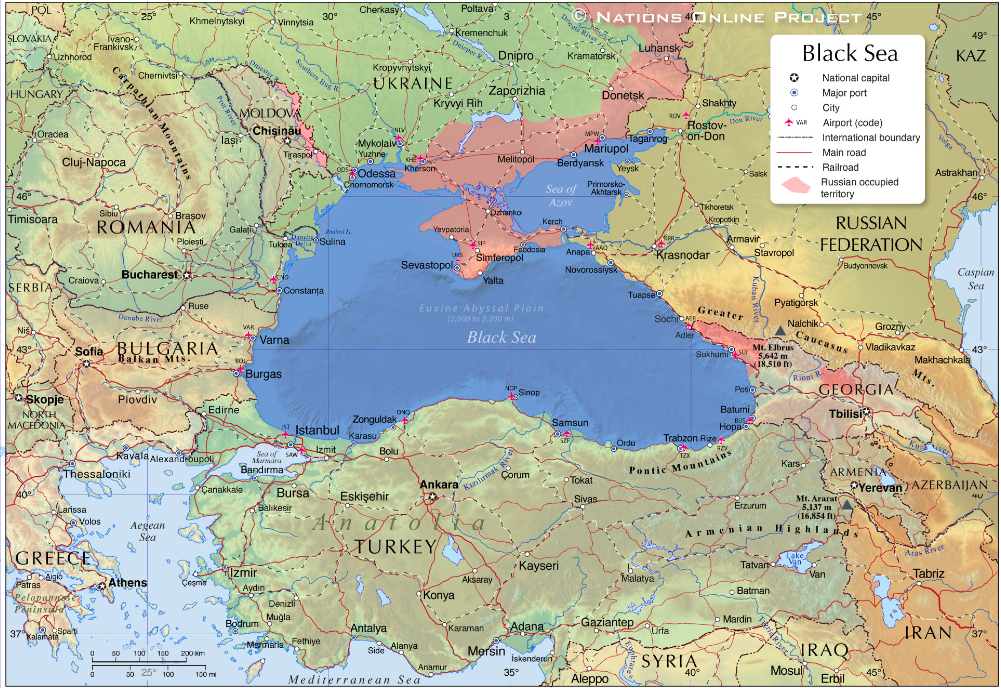
Context: Ukraine said its sea drones struck a major Russian port Friday and damaged a warship in an attack that underlined Kyiv’s growing capabilities as the Black Sea becomes an increasingly important battleground in the war.

Where is Black Sea Located?

Black Sea Located
  • It is a large inland sea situated at the south-eastern extremity of Europe. 
  • It is bordered by Ukraine to the north, Russia to the northeast, Georgia to the east, Turkey to the south, and Bulgaria and Romania to the west.
  • It is connected to the distant waters of the Atlantic Ocean by the Bosporus (which emerges from the sea’s southwestern corner), the Sea of Marmara, the Dardanelles, the Aegean Sea, and the Mediterranean Sea. 
  • The Crimean Peninsula thrusts into the Black Sea from the north, and just to its east the narrow Kerch Strait links the sea to the smaller Sea of Azov. 
  • Several large rivers flow into the Black Sea, such as the Danube, the Dnieper, the Dniester, the Southern Bug, the Russian Don and the Kuban rivers, Western Georgia's Rioni river, and the Turkish Kızılırmak and Sakarya rivers.
  • The Black Sea is connected to the North Sea via the Danube and the Rhine-Main-Danube Canal.

How Black Sea was formed?

  • Large-scale movements of the Earth's crust uplifted the mountain ranges that divided the ancient Tethys Ocean into several water basins, such as the Paratethys Ocean. The megalake of the late Miocene was probably the largest lake in Earth's history and extended from the region east of the Alps across Central Europe to Central Asia. Its remnants include the Black Sea, the Sea of Azov, the Caspian Sea and the Aral Sea.
  • During the last great ice age, which ended about 25,000 years ago, the Black Sea was a large freshwater lake. The Bosphorus, the connection to the Mediterranean Sea - and to saline water - was presumably formed about 6,500 to 7,500 years ago.

The Black Sea has experienced the worst environmental degradation of all of the world's oceans. The situation has become so severe that it has affected the health, well-being, and standard of living of the people in the immediate area

Can small modular nuclear reactors help India achieve net-zero?

Context: The world still depends on fossil fuels for 82% of its energy supply. The recent uptick in coal consumption in Europe, despite the increase in solar and wind power, suggests that reliable, 24/7 low-carbon electricity resources are critical to ensure the deep decarbonisation of power generation, along with grid stability and energy security. 

What are Small Modular Reactors (SMR)?

  • Small modular reactors (SMRs) are advanced nuclear reactors that have a power capacity of up to 300 MW(e) per unit, which is about one-third of the generating capacity of traditional nuclear power reactors. SMRs, which can produce a large amount of low-carbon electricity, are:
    • Small – physically a fraction of the size of a conventional nuclear power reactor.
    • Modular – making it possible for systems and components to be factory-assembled and transported as a unit to a location for installation.
    • Reactors – harnessing nuclear fission to generate heat to produce energy.
What are Small Modular Reactors

What are the benefits of SMR?

  • Due to smaller size, they can be sited on locations not suitable for larger nuclear power plants.
  • They have relatively lower carbon footprint as they have lower fuel requirements.
  • They are easy to manufacture, ship, transport and installed.
  • They offer savings in cost and construction time.
  • They can be deployed incrementally to match increasing energy demand. SMRs are designed to operate for 40-60 years with capacity factors exceeding 90%
  • They can be installed into an existing grid or remotely off-grid.
  • They are relatively safer as they operate on lower power and pressures and hence lower potential for the uncontrolled release of radioactive materials into the environment.
  • They require no human intervention or external power or force to shut down systems.

Hence, an efficient regulatory regime comparable to that in the civil aviation sector – which has more stringent safety requirements – is important if SMRs are to play a meaningful role in decarbonising the power sector. This can be achieved if all countries that accept nuclear energy direct their respective regulators to cooperate amongst themselves and with the International Atomic Energy Agency to harmonise their regulatory requirements and expedite statutory approvals for SMRs based on standard, universal designs.

What steps should be taken in India?

  • The Atomic Energy Act will need to be amended to allow the private sector to set up SMRs.
  • To ensure safety, security, and safeguards, control of nuclear fuel and radioactive waste must continue to lie with the Government of India.
  • The government will also have to enact a law to create an independent, empowered regulatory board with the expertise and capacity to oversee every stage of the nuclear power generation cycle, including design approval, site selection, construction, operations, certification of operators, and waste reprocessing.
  • The security around SMRs must remain under government control, while the Nuclear Power Corporation can operate privately-owned SMRs during the hand-holding process.
  • Indian government can negotiate with foreign suppliers to reprocess nuclear waste from all SMRs in a state-controlled facility under IAEA safeguards. The reprocessed material may also be suitable for use in other NPPs in India that use imported uranium. India can set up facility to reprocess spent fuel from SMRs.
  • Finally, the Department of Atomic Energy must improve the public perception of nuclear power in India by better disseminating comprehensive environmental and public health data of the civilian reactors, which are operating under international safeguards, in India.

Legionella bacteria

Context: Britain is taking a group of asylum seekers off a barge just days after moving them onto the vessel because Legionella bacteria was found in the water supply.

About Legionella bacteria:

Legionella bacteria
  • Legionella is a type of bacteria that can cause a severe and potentially fatal respiratory illness known as Legionnaires' disease. 
  • It commonly found in freshwater environments, such as lakes, rivers, and ponds. 
  • They can also survive and thrive in man-made water systems, including cooling towers, hot water tanks, and plumbing systems. 
  • The bacteria multiply in warm water and are transmitted to humans through the inhalation of aerosolized water droplets containing the bacteria. 
  • Legionnaires' disease is not transmitted through person-to-person contact.