Current Affairs

Renewable Energy Technology Action Platform (RETAP)

Context: US Department of Energy (DOE) and Ministry of New and Renewable Energy (MNRE) have together launched US-India Renewable Energy Technology Action Platform (RETAP) under the Strategic Clean Energy Partnership. 

About Renewable Energy Technology Action Platform

  • RETAP was announced by Prime Minister of India and President of USA during PM Modi's visit of USA in 2023 for expanding collaboration on new and emerging technologies to accelerate the clean energy transition. 
  • RETAP is intended to advance new and emerging renewable technologies for deployment and scaling up in result oriented, time bound technology focus orientation. 
  • The initial focus will be on green/clean hydrogen, wind energy, long duration energy storage, exploration of geothermal energy, ocean/tidal energy and other emerging technologies as mutually determined in the future.

Work under the RETAP is guided by five themes

  • Research & Development
  • Piloting & Testing of Innovative Technologies
  • Advanced Training & Skill Development
  • Policy & Planning for Advancing Renewable Energy Transition and enabling technologies
  • Investment, Incubation and Outreach programs

Awareness Campaign Launched for Sickle-cell disease (SCD)

Context: The Tribal Minister of India launched a training session for an awareness campaign that’s part of the government’s mission to make India free of Sickle-cell disease (SCD) by 2047.

image 124
  • It is a group of inherited red blood cell disorders that are caused by a mutation in the hemoglobin gene. This mutation leads to the production of abnormal hemoglobin, known as hemoglobin S (HbS), which causes red blood cells to take on a sickle-like (C-shaped) shape instead of their normal round shape.
  • It is caused by a change in hemoglobin, the protein in red blood cells that carries oxygen to all parts of the body. This type of hemoglobin is called hemoglobin S.
  • When red blood cells with hemoglobin S go through the smallest blood vessels, called capillaries, some of the cells form into rigid strands and become sticky. These rigid, sticky strands often get stuck, clogging the capillaries. As a result, different parts of the body do not get the oxygen they need. 

Types of SCD

  • There are several types of SCD. The specific type of SCD a person has depends on the genes they inherited from their parents. People with SCD inherit genes that contain instructions, or code, for abnormal hemoglobin.
  • If the sickle cell is inherited from one parent, it is called sickle cell trait or sickle cell carrier. If inherited from both parents, it is called sickle cell disease or sickle cell anaemia (homozygous sickle cell).
  • Sickle cell disease exists in two forms within the human body.
  • One is the Sickle Cell trait, in which the individual does not exhibit any disease or symptoms and lives a normal life. 
  • The second form is characterized by the presence of symptoms related to sickle cell disease.
  • If two individuals with Sickle Cell trait marry each other, there is a high probability that their child will have Sickle Cell disease.
  • By screening individuals for Sickle Cell trait before marriage, the spread of the disease can be prevented.

Signs and Symptoms 

Early symptoms of SCD may include:

  • Yellowing of the skin and whites of the eyes.
  • Fatigue or fussiness from anemia.
  • Painful swelling of the hands and feet.

Treatment

  • It is a lifelong illness. It is a genetic disorder, making complete elimination a challenge that requires a major scientific breakthrough.The only cure comes in the form of gene therapy and stem cell transplants — both costly and still in developmental stages.

Case fatality rate

  • Moreover, sickle cells die early, resulting in a shortage of red blood cells that deprive the body of oxygen. These obstructions and shortages may cause chronic anaemia, pain, fatigue, acute chest syndrome, stroke, and a host of other serious health complications.

SCD in India

  • India is the second-worst affected country in terms of predicted births with SCA — i.e., chances of being born with the condition.
  • In India, around 18 million people have sickle cell traits and 1.4 million patients have sickle cell disease.
  • It is widespread among the tribal population in India where about 1 in 86 births among STs have SCD.
  • A few states in India have a significantly higher SCD prevalence. These include Chhattisgarh, West Bengal, Uttar Pradesh, Maharashtra, Madhya Pradesh, Jharkhand, Gujarat, Odisha, Kerala and Rajasthan. Collectively, these states are referred to as the sickle cell belt.

Government Initiatives

  • Ministry of Health under the National Health Mission initiated the work on hemoglobinopathies (Thalassemia & Sickle Cell Disease) in 2016 wherein comprehensive guidelines on prevention and management of heamoglobinopathies were released and provision of funds towards screening and management of Sickle cell disease were made.
  • The Ministry of Health, in collaboration with the Ministry of Tribal Affairs and the states, has formulated a plan to screen approximately 70 million individuals aged 0-40 years belonging to tribal and other groups residing in nearly 200 districts of 17 states within the next few years.
  • Sickle Cell Anaemia Elimination Mission 2047: To eradicate the challenge of sickle cell. The government has allocated a sufficient budget, utilised advanced technology, provided training to healthcare workers, ensured necessary infrastructure, and made efforts in social awareness and participation to combat this disease.
  • Role of Ayushman Bharat in controlling SCDs: Through the Ayushman Bharat scheme, the country has established a network of 1.6 lakh Health and Wellness Centres since 2018 these centres will also play a significant role in eradicating sickle cell disease along with other diseases. 

Reroute rail track through gibbon sanctuary

Context: The Hollongapar Gibbon Sanctuary has been split in two by a railway track running through it. The presence of the railway track splits the gibbons' habitat and impedes their ability to move freely throughout the sanctuary area.

Canopy Bridge Proposal

  • The proposal put out by the Wildlife Institute of India (WII) suggests the development of an artificial canopy bridge with the aim of enabling the migration of hoolock gibbons over the railway track located inside the sanctuary.
  • The primary objective of this canopy bridge is to reestablish connectivity inside the fragmented habitat, facilitating unrestricted movement for the gibbons between the two distinct sections of the sanctuary.

Gibbon Habitat and Population

  • The Hollongapar Gibbon Sanctuary, situated in the Jorhat region of Assam, has a total land area of 21 square kilometers.
  • The sanctuary now houses around 125 hoolock gibbons, which represent the only ape species found in India.

Fragmentation and Threat to Habitat

  • The article emphasizes that, similar to the other 19 gibbon species worldwide, the hoolock gibbons residing in this sanctuary are also facing the threat of endangerment as a result of habitat loss and fragmentation.
  • The sanctuary has seen a loss of connectedness with the surrounding forest patches, resulting in the formation of a distinct ecological entity known as a "forest island."
  • Gibbons, being arboreal creatures that inhabit the top canopy of forested areas, exhibit sensitivity towards canopy gaps, hence making habitat fragmentation a matter of particular concern.

Gene isolation and survival

  • The presence of the railway track has resulted in the segregation of gibbon families on each side, so reducing their genetic diversity.
  • The genetic isolation of hoolock gibbons inside the sanctuary poses an additional risk to their survival, compounding the other vulnerabilities they currently face.

Hollongapar Gibbon Sanctuary

  • The establishment of the Hollongapar Gibbon Sanctuary in 1997 was largely motivated by the objective of conserving the Hoolock Gibbon species and its natural environment.
  • The Hollongapar Gibbon Sanctuary is located in the Jorhat district of Assam, in close proximity to the town of Mariani.
  • The geographical extent of the region is roughly 20.98 square kilometers (8.11 square miles).
  • The sanctuary exhibits distinct features of semi-evergreen and mixed deciduous forest, hence providing a wide array of habitats that support a broad variety of plant and animal species.
  • Bio-diversity
    • The sanctuary is well recognized for its significant contribution to the preservation efforts of the Western Hoolock Gibbon (Hoolock hoolock), a species that has been classified as Endangered according to the IUCN Red List.
    • In addition to gibbons, the sanctuary accommodates a diverse array of primate species, such as the Stump-tailed Macaque and Capped Langur.
    • The avian richness in the area is notable, showcasing a wide array of bird species like the Great Hornbill, Green Imperial Pigeon, and White-cheeked Partridge.
  • Vegetation
    • The sanctuary's flora comprises of semi-evergreen and mixed deciduous woods, characterized by a diverse array of tree species such as Holong (Dipterocarpus macrocarpus), which lends its name to the sanctuary.
    • The presence of various forest types plays a crucial role in providing essential habitats for both permanent and migratory species.

Western Hoolock Gibbon

Western Hoolock Gibbon
  • Hoolock hoolock, a member of the family Hylobatidae, is a primate species that is widely recognized as gibbons in the scientific community.
  • These organisms are distributed over several regions of South Asia, with a primary presence seen in India, Bangladesh, and Myanmar.
  • The current estimated population size of hoolock gibbons is around 12,000 individuals.
  • The Western Hoolock Gibbon is classified as one of the two distinct species of hoolock gibbons, with the other species being the Eastern Hoolock Gibbon (Hoolock leuconedys).
  • Hoolock gibbons, classified as "lesser apes," are little primates, distinct from the bigger "great apes" such as chimpanzees, gorillas, orangutans, and humans.
  • The Western Hoolock Gibbons have a distinctive physical appearance characterized by a fur coat that is black or dark brown in color, accompanied by a white facial ring and prominent eyebrows.
  • Both males and females exhibit comparable physical characteristics, however males tend to possess somewhat greater dimensions in comparison to females.
  • Their elongated appendages are highly specialized for the locomotive behavior of brachiation, enabling them to proficiently traverse from one tree branch to another.
  • Western Hoolock Gibbons inhabit many forest ecosystems, include tropical rainforests, subtropical woods, and mixed deciduous forests.
  • These organisms reside inside the uppermost levels of the tree canopy and have a strong preference for arboreal habitats, with seldom terrestrial activity.
  • The geographical distribution of the Western Hoolock Gibbon encompasses several regions in northeastern India, northern and western Myanmar (Burma), as well as southern China.
  • The range of this species in India encompasses many states, including Assam, Arunachal Pradesh, and Nagaland.
  • Gibbons are renowned for their noteworthy vocalizations, which serve as vital mechanisms for demarcating territory and fostering social unity among their groups. It is well recognized that they have the ability to generate musical compositions that possess the capacity to propagate audibly over considerable distances.
  • The gibbons have a mostly frugivorous diet, including a diverse range of fruits, leaves, and sometimes, insects.
  • The individuals live inside compact familial units including a monogamous dyad consisting of a male and female, with their progeny. Typically, these groups are comprised of two to four persons.
  • The social organization of this species is centered on strong pair ties established between males and females, often engaging in duets as a component of their territorial conduct.
  • The Western Hoolock Gibbon has been classified as an Endangered species according to the Red List of the International Union for Conservation of Nature (IUCN).
  • According to the International Union for Conservation of Nature (IUCN) Red List, the Eastern Hoolock Gibbon is classified as Vulnerable.
  • Both species are classified under Schedule 1 of the Indian (Wildlife) Protection Act 1972, therefore granting them the highest degree of legal protection in India.

Pragyan confirms Sulphur near South pole of Moon

Context: The Indian Space Research Organisation (ISRO) announced that Pragyan, the rover of the Chandrayaan-3 mission, has confirmed the presence of Sulphur on the moon’s surface, near its South pole. 

Major Highlights:

  • Laser-Induced Breakdown Spectroscopy (LIBS) instrument aboard the rover has made the first-ever in-situ measurements on the elemental composition of the lunar surface near the south pole. 
  • These in-situ measurements confirm the presence of Sulphur (S) in the region unambiguously, something that was not feasible by the instruments aboard the orbiters.
  • Preliminary analyses have unveiled the presence of Aluminum (Al), Sulphur (S), Calcium (Ca), Iron (Fe), Chromium (Cr), and Titanium (Ti) on the lunar surface. Further measurements have revealed the presence of manganese (Mn), silicon (Si), and oxygen (O). A thorough investigation regarding the presence of Hydrogen is underway.

Laser-Induced Breakdown Spectroscopy instrument (LIBS):

  • LIBS is a scientific technique that analyses the composition of materials by exposing them to intense laser pulses. A high-energy laser pulse is focused onto the surface of a material, such as a rock or soil, and generates localised plasma.
  • The collected plasma light is spectrally resolved and detected by charge-coupled devices. Since each element emits a characteristic set of wavelengths of light when in a plasma state, the elemental composition of the material can be determined.
image 123

Key Fact:

  • In the commemoration of the Chandrayaan-3 mission, August 23 will be celebrated as National Space Day.

Source: The Hindu

Election Commission of India and Challenges

Context: The Election Commission of India (ECI) has become a center of disagreement between the government and the judiciary. The recent conflict revolves around the process of appointing its officials. The Supreme Court ruled that the Chief Election Commissioner (CEC) and Election Commissioners (EC) should be appointed by the President based on a committee's advice, including the Prime Minister, the Leader of the Opposition in the Lok Sabha or the largest Opposition party leader, and the Chief Justice of India (CJI). This was a unanimous judgment by a five-judge Bench and aimed to strengthen the ECI's constitutional standing.

However, the government introduced a bill to change this procedure, seeking to remove the Chief Justice of India from the selection committee. The proposed committee would then consist of the Prime Minister (Chairperson), Leader of the Opposition in the Lok Sabha (Member), and a Union Cabinet Minister nominated by the Prime Minister (Member).

This move reflects the government's desire for more influence in appointing top election officials, potentially undermining the institution's independence.

Various committees and leaders have previously suggested a more representative selection process for ECI members. The idea was to reduce the ruling party's sway and ensure fairer elections. The current bill, introduced by the ruling party (BJP), contradicts its previous stance as an opposition party and aims to increase government control over the ECI.

Despite being respected for its reliability and responsible conduct, the ECI's autonomy and trust have been questioned due to perceived leniency towards the ruling party. The bill highlights the government's pursuit of a tighter grip on the ECI's functioning.

Election Commission of India (ECI) is a constitutional body (under Article-324) vested with the responsibilities of superintendence, direction and control of conduct of elections. It  consists of a Chief Election Commissioner and two Election Commissioners. 

Article 324 states that the Election Commission shall consist of Chief Election Commissioner and such numbers of other Election Commissioners, if any, as the President may from time to time fix and appointment of CEC and other ECs shall, subject to provisions of any law made in that behalf by the Parliament, be made by the President. 

Still, appointments in ECI is associated with various issues:

  • Lack of security of tenure for Election Commissioners (ECs).
    • Article 324(5) of the Constitution protects only CEC from removal, except if the manner and grounds of removal are the same as a judge of the Supreme Court. However, ECs can be removed by the government on the recommendation of the Chief Election Commissioner. 
  • The appointment of CEC and other ECs according to the Article 324, shall be done as per the law made by the Parliament in this regard. However, no such law has yet been made which leaves a “gap” and leaves the appointment of such a crucial post solely to the executives.
  • The constitution has not prescribed the qualifications (legal, educational, administrative, or judicial) of the members of election commission. 
  • The constitution has not debarred the retiring Election commissioner from any further appointment by the government. 
  • There is no clarity regarding the power division between the Chief Election Commissioner and other Election Commissioners.

Reforming the Election Commission of India: A Concise Action Plan

  • Legislation for Appointment: Create a clear law outlining how the Chief Election Commissioner and Election Commissioners are appointed, ensuring transparency and fair selection.
  • Qualifications Defined: Specify necessary qualifications and experience for Commissioners, focusing on legal expertise, administrative competence, and integrity.
  • Secure Tenure: Guarantee secure tenure for all Election Commissioners to prevent arbitrary removals and political influence.
  • Clear Powers Division: Clearly define roles and responsibilities of Chief Election Commissioner and other Commissioners to prevent conflicts.
  • Transparent Selection: Form a diverse selection committee including judiciary and civil society to assess candidates fairly.
  • Post-Retirement Rules: Introduce rules preventing retiring Commissioners from taking immediate government positions to prevent conflicts of interest.
  • Enhance Independence: Consider amending the Constitution to grant the Election Commission greater autonomy from government influence.
  • Capacity Building: Invest in regular training for Commissioners and staff to improve their understanding of electoral processes and technologies.
  • Public Awareness: Launch awareness campaigns to educate citizens about their voting rights and the significance of elections.
  • Ongoing Review: Periodically review and adapt the Commission's functioning to address emerging challenges and maintain electoral integrity.

Implementing these focused reforms will bolster the Election Commission's credibility, efficiency, and impartiality, strengthening India's democratic foundation.

Cyclone frequency may rise over Indian coast from the warming of Pacific

Context: A combination of global warming and a cyclical event called the Pacific Decadal Oscillation that repeats every 20-30 years, could make cyclones that originate near the Equator more frequent in the coming years.

What the study says?

  • In recent times, equatorial cyclones originating near the Equator have exhibited an unexpected trend of moderation. The most significant recent occurrence of such a cyclone was the 2017 Cyclone Okchi, which brought widespread destruction to regions including Kerala, Tamil Nadu, and Sri Lanka.
  • A convergence of factors, namely global warming and the cyclic phenomenon termed the Pacific Decadal Oscillation (PDO), which operates on a 20-30-year cycle, suggests a potential elevation in the frequency of these cyclones in the years ahead.
  • Between 1981 and 2010, equatorial-origin cyclones occurred at a strikingly lower rate of 43% compared to the period spanning 1951 to 1980. This decline aligns with the PDO's 'warmer' or positive phase.
    • A warming of the Central Equatorial Pacific, known as El Nino, often corresponds to decreased rainfall over India.
    • Conversely, cooler-than-normal temperatures, referred to as La Nina, are associated with heightened rainfall.
    • The interplay of these phenomena, collectively known as the El Nino Southern Oscillation (ENSO), recurs in the Pacific every two to seven years.
    • In contrast, the PDO follows a non-annual cycle and, over considerably longer timescales, results in warmer conditions in the Western Pacific Ocean and relatively cooler conditions in the Eastern Pacific.
    • Identifying a 'positive' or 'warmer phase' of PDO necessitates years of observing ocean temperatures and their interaction with the atmosphere.
    • Notably, in 2019, the PDO transitioned into a cooler, negative phase. If this state persists, it could potentially lead to an increase in the number of equatorial-origin tropical cyclones during the post-monsoon months.
  • Currently, an emerging El Nino event is evident in the Pacific, with its effects already manifesting in central and southern India, where rainfall deficits of 7% and 17% have been observed. 
  • While a positive PDO combined with ENSO typically yields unfavourable outcomes, a negative PDO coupled with the same phenomenon results in increased rainfall for India.

Important Terms: 

  • Pacific Decadal Oscillation (PDO): A recurring climatic cycle manifesting every 20-30 years in the Pacific Ocean. It results in fluctuations in sea surface temperatures. When in a positive phase, it is associated with warmer waters in the western Pacific and cooler waters in the eastern Pacific. This phenomenon significantly influences global climate dynamics and weather patterns.
  • El Nino Southern Oscillation (ENSO): A recurrent climate phenomenon observed in the Pacific Ocean, characterized by two primary states—El Nino (warmer-than-normal sea surface temperatures) and La Nina (cooler-than-normal temperatures). ENSO holds considerable sway over worldwide weather patterns, with implications for temperature and precipitation distributions.
  • Equatorial Cyclones: Cyclones originating in proximity to the Equator. Fuelled by warm waters and abundant moisture, these cyclones typically form at a distance from the Equator due to the Coriolis effect. Although infrequent, they can be exceptionally intense and cause significant damage.
image 122

What is Tropical Cyclone?

  • A tropical cyclone is a weather phenomenon characterized by a region of low atmospheric pressure that originates over warm tropical waters and subsequently advances towards coastal regions, unleashing powerful winds, intense rainfall, and storm surges.
  • The rotational direction of the winds within a tropical cyclone follows a distinctive pattern: counterclockwise in the northern hemisphere and clockwise in the southern hemisphere. This rotation is a consequence of the Coriolis effect, which influences the motion of air masses in relation to the Earth's rotation.

Critical conditions contribute to the formation of tropical cyclones:

  • Sea Temperature: The presence of an expansive sea surface with a temperature exceeding 27°C serves as a conducive environment for the genesis of tropical cyclones. Warm ocean waters provide the necessary energy for these systems to gather strength.
  • Geographical Location: Tropical cyclones tend to develop within specific geographical boundaries, specifically between the Tropic of Cancer and the Tropic of Capricorn. These areas offer optimal temperature conditions for their formation.
  • Coriolis Force: A crucial requirement for tropical cyclone formation is the presence of the Coriolis force, a result of the Earth's rotation. Consequently, these cyclones do not form near the equator but rather at latitudes where the Coriolis effect is sufficient to induce rotation.
  • Vertical Wind Speed: The presence of relatively stable vertical wind speeds, with minimal fluctuations, aids in the organization of a tropical cyclone's structure. This consistency facilitates the development and maintenance of the cyclonic circulation.
  • Upper Divergence: Successful tropical cyclone development necessitates a well-established upper-level divergence within the atmosphere. This divergence ensures the continual removal of rising air currents from within the cyclone, maintaining low pressure at its centre.
  • High Humidity: Adequate humidity levels, typically ranging between 50 to 60 percent, are essential in the mid-troposphere. This humidity is fundamental for the formation of towering cumulonimbus clouds, a significant component of tropical cyclones.

Influence of Climate Change on Tropical Cyclone Formation

  • Temperature Shifts: The temperature of both the ocean and the atmosphere plays a crucial role in the creation of tropical cyclones. As the climate warms, these storms gather strength by harnessing the energy released when evaporated ocean water condenses into rainfall within the cyclone.
  • Warmer Ocean Impact: The escalation in temperature leads to a warmer ocean, elevating evaporation rates. This, in turn, augments the moisture content in the atmosphere, intensifying the availability of water vapor.
  • Enhanced Rainfall: The rising temperature enables the atmosphere to retain more moisture, thereby increasing rainfall. The amplified rainfall not only releases more heat but also contributes to bolstering wind intensity.
  • Heightened Rainfall Rates: Recent investigations reveal a 7% surge in hurricane rainfall rates per degree of warming, underscoring the pronounced impact of rising temperatures on precipitation.
  • Storm Intensification: The warming climate is poised to elevate wind velocities, leading to a higher frequency of powerful Category 4 and 5 storms, with their potential for devastating impact.
  • Sea Level Rise Influence: Climatic warming elevates sea levels, augmenting the height of ocean water. This elevated water level permits storm surges to penetrate further inland.
  • Impact of Storm Slowing: The velocity of a storm significantly influences the cumulative rainfall in a given area. Slower-moving storms grant additional time for rainfall accumulation, heightening the potential for flooding.
  • Complex Storm Speed Changes: While studies indicate a reduction in storm speed, the underlying mechanisms behind this trend remain elusive.
  • Confluence of Storms: Within an increasingly warmer world, the merging of two significant tropical storms over global oceans could lead to the formation of extremely powerful mega cyclones.

The state of scholarships for minorities

Context: In the past few years, the Centre has discontinued two key educational schemes for religious minorities, narrowed the scope of another and gradually cut down on the expenditure incurred on multiple programmes of the Ministry of Minority Affairs.

Importance of Scholarships for Religious Minorities

  • India is home to over 30 crore (20%) people from religious minority communities. These include six religions notified under Section 2(c) of the National Commission for Minorities Act, 1992. Among them, Muslims make up the largest religious minority but face challenges in various sectors. 
  • Their participation in salaried jobs is low and many are engaged in the informal sector, characterised by low wages, weak social security and poor working conditions. The Justice Rajinder Sachar Committee was constituted by the UPA government to look into the social, economic and educational standing of Muslims in India. In a comprehensive 400-page report tabled in Parliament in 2006, the Sachar Committee concluded that the Muslim minority was neglected in almost all dimensions of development. “By and large, Muslims rank somewhat above SC/ST but below Hindu OBCs [Other Backward Classes], Other Minorities and Hindu General [mostly upper castes] in almost all indicators considered,” the report stated. 
  • Around the same time, the Manmohan Singh-led UPA government accepted the long-pending demand for a Ministry of Minority Affairs in 2006. The new Ministry was to “ensure a more focused approach” on issues affecting the notified minorities, especially “educational empowerment, economic empowerment, infrastructure development and special needs.”
  • Directive Principles of State Policy require the state to ensure the welfare of the citizens, for example, Article 38 requires the state to minimise the inequalities in terms of income, status, facilities and opportunities.
  • To achieve the objectives of the slogan sabka sath sabka vikas it is necessary to equal opportunity for quality education to sections of the society.
  • Access to quality education for sections of society is crucial to realise the objectives of the Preamble of the Indian Constitution.
  • We are aspiring to become a developed nation by 2047, inclusive development is the only way to achieve this aspiration.

Some of the Scholarships for Minority 

The Pre-Matric Scholarship Scheme-  One of the first central sector programmes implemented by the Ministry of Minority Affairs. The scholarship was initially awarded to minority students from class 1 to 10 and ranged between ₹1,000 and ₹10,700 for each selected candidate. The scheme has now been discontinued for classes 1 to 8, only covering classes 9 and 10 in its revised form. 

The Post-Matric Scholarship Scheme- for students of class 11 and above (till Ph.D). It aimed to give minority students access to quality higher education, with a scholarship ranging between ₹2,300 and ₹15,000. The funds for this scheme increased from ₹515 crore to ₹1,065 crore this fiscal year. 

The Merit-cum-Means based Scholarship Scheme- targeted professional and technical courses at undergraduate and postgraduate levels. Eligible candidates in any of the 85 institutes listed under the scheme are reimbursed full course fees, while those in other institutions are reimbursed course fees worth ₹20,000 per annum. The scholarship scheme saw a major reduction in funds in 2023-24. It was allotted ₹44 crore this year, while last year’s allotment was ₹365 crore. 

Maulana Azad National Fellowship (MANF)-The scheme provided financial assistance for five years to research scholars pursuing an M.Phil and PhD from institutions recognised by the University Grants Commission (UGC). Under the scheme, junior research fellows received a grant of ₹31,000 for the first two years while senior research fellows got ₹35,000 per month for the remaining tenure. The MANF benefited over 6,700 candidates between 2014-15 and 2021-22, with ₹738.85 crore paid before it was cancelled in 2022. 

The Padho Pardesh scheme was launched to provide better opportunities for higher education abroad, providing an interest subsidy on education loans for overseas studies to students belonging to economically weaker sections of minority communities. However, this scheme was discontinued from 2022-23. The scheme benefited 20,365 beneficiaries since its inception in 2006. 

The Begum Hazrat Mahal National Scholarship was for meritorious girls to pursue higher secondary education and was provided by the Maulana Azad Education Foundation (MAEF). The scholarship has had zero allocation this year. 

The Naya Savera was a separate programme launched to provide free coaching to minority students for entrance to technical and professional courses and competitive examinations. In the Union Budget 2023-24, the scheme was allotted ₹30 crore but the Centre has since discontinued the scheme stating that the New Education Policy 2020 does not support coaching programmes. Official records show that 1.19 lakh students benefited under the scheme. 

The Scheme for Providing Education to Madrasas and Minorities (SPEMM), a centrally sponsored umbrella programme, has a sub-scheme, the Scheme for Providing Quality Education in Madrasas (SPQEM), under which recognised madrasas receive financial assistance to introduce ‘modern’ subjects such as science, mathematics, social studies, Hindi and English in their curriculum. The scheme was allocated ₹10 crore for the financial year 2023-24 — more than 90% less than the allocation in 2022-23, which was ₹160 crore.

Consequences of discontinuation of scholarship programmes

Social consequences- The minority community is already backward as affirmed by the Sacher committee if the youth of this community are deprived of quality higher education then there is a higher chance that they may be trapped in social evils like communalism, and crimes.

Political repercussions-uneducated generations are breeding grounds for polarisation of the society by political parties as is evident from our own history. In the long run, depriving a  community of quality education can hamper the unity and integrity of the nation itself.

Economic fallouts- we can't achieve the goals of inclusive and sustainable development by depriving a section of quality education, because education is crucial to fostering productivity and equitable resource distribution.

Way forward

  • The government should adhere to constitutional morality of ensuring the welfare of all of its citizens without discriminating on the grounds of religion, race or region.
  • The government can promote the NGOs in this sector so that it can achieve its target of availing quality education with reduced economic burden.
  • Ensure adequate employment opportunities at the local level so that people can afford quality education on their own.
  • Community leaders can come forward to ensure quality education for the community by resource pooling.

Only the Central Government is entitled to conduct Census

Context: The Centre government has opposed the Bihar government's decision to conduct a caste-based survey in the state, stating that it is a 'Union subject'.

Major Highlights:

  • The Ministry of Home Affairs filed an affidavit before the Supreme Court, which stated, "According to the Centre, the census is a Union list subject (in the seventh schedule), and that it is the Centre only which can conduct it under the Section 3 of the Census Act 1948 Act."
  • The affidavit also states, "The central government is committed to taking all affirmative actions for the upliftment of the SC/ST/OBC in accordance with the provisions of the Constitution of India and the applicable law."
  • Background: The decision of a caste-based census was taken by the Bihar cabinet in 2022. The Supreme Court of India dismissed a plea challenging the Bihar caste survey in January 2023. The Bihar government’s Caste survey is now underway. In 2015, the Karnataka government conducted a caste survey which was not released.

Caste-based census in India:

  • Caste census means inclusion of caste-wise tabulation of India's population in the Census exercise. India has counted and published caste data — from 1951 to 2011 — of the Scheduled Castes and Scheduled Tribes only. 
  • A caste-based census gathers data on economic status and other caste-related information of every Indian family, both in rural and urban areas to help the authorities define deprivation indicators and map inequalities at a broader level. 
  • This data helps better policy-making by identifying both disadvantaged and privileged sections of society. Many political parties feel that the present reservation being based on the last caste census conducted in 1931 does not reflect the correct numbers.

The first and last caste census:

  • In India, there have been caste-based censuses conducted in the past. The first caste-based census took place in 1881 during the colonial period
  • The 1931 census was the last exercise to enumerate caste data. The population of OBCs was 52% as last recorded in the 1931 caste census.
  • The UPA government conducted Socio-Economic and Caste Census (SECC) in 2011. It was the first caste-based census since 1931. The data was, however, not published. 

Is Caste Census constitutionally mandated?

  • Article 340 of the Constitution authorises the appointment of a commission to investigate the conditions of SEBCs and the difficulties under which they labour. 
  • The commission is assigned to make recommendations for the Union or any State necessary for the removal of such difficulties and to improve the conditions of the Socially and Economically Backward Classes. E.g., Justice G Rohini Commission in 2017

Rationale behind the caste census:

  • For a significant period of time post-independence, there has been a certain level of “caste-blindness” to policy-making and this has been accompanied by the wishful thinking that if we do not address caste and make it even more glaring it will wither away. 
  • Caste has been deeply entrenched social structure in India for centuries. Census exercise in Independent India has never enumerated castes, except SC & ST, as a matter of policy. However, recently there has been growing demand for Caste enumeration in the census. 
  • The idea behind the caste-based census is to recognise what we mean to abolish (in order to abolish caste, caste-based discrimination, caste-based distribution of wealth and socio-cultural inequalities generated by caste it is essential to understand its expansiveness).

Need for Caste-based census: 

  • Demographic changes: Existing reservation limits of 27% to OBC, and overall 50% legally mandated cap on reservation is based on pre-independent census data, which needs to be revised/reviewed keeping in mind present-day demographic changes. 
  • Identifying Vulnerable Communities: Caste-based census can help identify the most disadvantaged and marginalised communities/caste groups to reveal disparities in literacy rates, income levels, access to healthcare etc. for targeted interventions. E.g., OBC Sub-categorisation can identify/prioritise the most deprived communities within OBC list. 
  • Accurate data for Policy Formulation: Can provide accurate/up-to-date data on socio-economic conditions of different caste groups for formulating evidence-based policies and reducing inclusion and exclusion errors. E.g., Evaluate legitimacy of reservation demands. 
  • Assessment of Affirmative Action: Enables government to measure effectiveness of previous policies/initiatives targeted towards specific castes and make necessary adjustments for better outcomes.
  • Constitutional Imperative: Article 340 calls for creation of a commission to evaluate the conditions of socially and educationally disadvantaged.

Significant challenges and concerns associated with conducting caste-based census:

  • Complexity: Data collection is complex due to huge population, multiple caste identities and presence of individuals unwilling to disclose their caste identity. 
  • Cost and Resources: Conducting comprehensive caste-based census requires significant financial and human resources. And often, due to challenges involved, the costs may outweigh the benefits involved.
  • Social Tensions: As Caste is a sensitive issue in India, conducting caste-based census may lead to heightened social tensions and conflicts.
  • Privacy and Misuse of Data: Caste-related information can be sensitive and raise privacy concerns. It can be misused for electoral purposes, vote-bank politics etc. rather than genuinely addressing social inequalities.
  • Perpetuate caste identity: Caste census can reinforce caste identity, intensify caste-based divisions and may perpetuate discrimination.
  • Political Resistance: Idea of caste-based census may face opposition from various groups/political entities, potentially delaying its implementation. 

Way Forward

  • Category-based, if not caste-based, enumeration of the census will not only help the government in collecting data that mirrors social inequalities but also make decisions for course correction. India needs to make bold decisions through data and statistics in the way the United States does to tackle race issues, by collecting data around race, class, language, inter-race marriages etc.
  • Caste may be the dominant but not the only/sole criterion of backwardness in the country. Need for improving HDI, education, health outcomes for the population irrespective of caste, and effective implementation of affirmative action policies for the upliftment of the marginalised sections. 

Global Biodiversity Framework Fund

Context: Representatives from 185 countries have officially agreed to launch a new fund to bolster investments in nations during the Seventh Assembly of the Global Environment Facility in Vancouver, Canada.

Introduction to the Global Biodiversity Framework Fund (GBFF):

  • The GBFF is devised to mobilize and accelerate investments in the conservation and sustainability of wild species and ecosystems.
  • The GBFF is exclusively dedicated to supporting the implementation of the goals and targets outlined in the Kunming-Montreal Global Biodiversity Framework.
  • GBFF is established as a new trust fund under the umbrella of the Global Environment Facility.
  • The fund offers an opportunity to secure funding from diverse sources and facilitate rapid disbursement through streamlined procedures, with an emphasis on providing enhanced access for indigenous peoples and local communities, in accordance with their own priorities.
  • The GBFF also presents an avenue for significantly increased involvement of Multilateral Development Banks and Development Finance Institutes, thereby aiding the mainstreaming of biodiversity, which is essential for effective implementation of the Framework.
  • This new fund will mobilize and distribute new and additional resources from public, private, and philanthropic sources, with a distinct focus on promoting the sustainability of biodiversity and ecosystems.
  • Indigenous peoples will be accorded priority: Approximately twenty percent (20%) of the GBFF's resources will be directed towards supporting initiatives led by indigenous communities aimed at protecting and conserving biodiversity.
  • Priority for Small Island Developing Countries and Least Developed Countries: One third of the resources of GBFF will be allocated to supporting Small Island Developing States and Least Developed Countries. 
  • Initial contributors: The United Kingdom and Canada have made initial contributions to the GBFF to initiate its capitalization.

Governance Structure of the Global Biodiversity Framework Fund (GBFF):

  • The GBFF Fund Council will be inclusive of representation from the following members, with a greater representation from developing countries as compared to developed ones:
    • 16 members from developing countries
    • 14 members from developed countries
    • 2 members from countries in central and eastern Europe and the former USSR.
  • Decisions of the GBFF Fund Council will be made through consensus, following the model of the GEF instrument.

Financial Management of the Global Biodiversity Framework Fund (GBFF):

  • The World Bank will serve as the Trustee of the GBFF Fund.

Temperature Profiling of Moon by Chandrayaan-3

Context: A payload onboard the Pragyaan Rover of Chadrayaan-3 mission has shared groundbreaking data on the temperature profile of the south pole of the moon. 

Chandrayaan-3 

Chandrayaan-3 is a mission to demonstrate end-to-end capability in safe landing and roving on the lunar surface. It consists of an indigenous Lander module (LM), Propulsion module (PM) and a Rover with an objective of developing and demonstrating new technologies required for Inter planetary missions.

  • It consists of Lander and Rover configuration. 
  • It will be launched by LVM3. 
  • The propulsion module will carry the lander and rover configuration till 100 km lunar orbit. 
  • The propulsion module has Spectro-polarimetry of Habitable Planet Earth (SHAPE) payload to study the spectral and Polarimetric measurements of Earth from the lunar orbit.
image 118

Lander Payloads

  • Chandra’s Surface Thermophysical Experiment (ChaSTE) to measure the thermal conductivity and temperature.
  • Instrument for Lunar Seismic Activity (ILSA) for measuring the seismicity around the landing site.
  • Rambha Langmuir Probe (LP) to estimate the plasma density and its variations. 
  • A passive Laser Retroreflector Array from NASA is accommodated for lunar laser ranging studies. 

Rover Payloads 

  • Alpha Particle X-ray Spectrometer (APXS) and Laser Induced Breakdown Spectroscope (LIBS) for deriving the elemental composition in the vicinity of landing site.
image 119

ChaSTE (Chandra's Surface Thermophysical Experiment)

image 120

ChaSTE is to study the heat conductivity of the Moon’s surface and measure the differences in temperatures at different points on and below the surface, with the overall objective of creating a thermal profile of the Moon.

  • ChaSTE  has a temperature probe equipped with a controlled penetration mechanism capable of reaching a depth of 10 cm beneath the surface.
  • The temperature probe is fitted with 10 individual thermal sensors.

Data Released

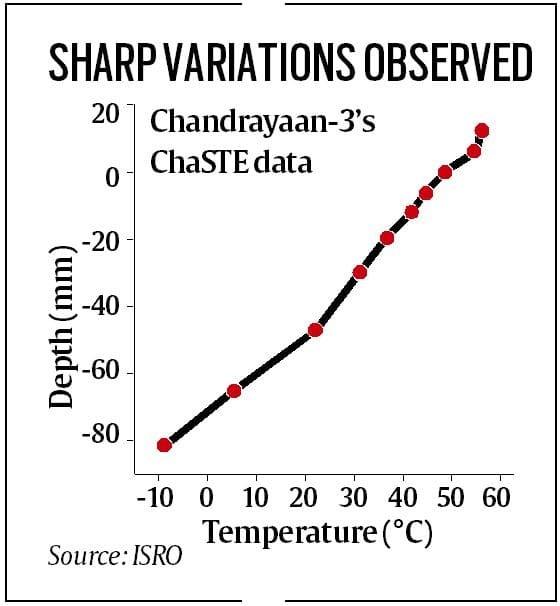
The graph released by ISRO illustrates the temperature variations of the lunar surface/near-surface at various depths, as recorded during the probe's penetration. On Moon, very hot to very cold — separated by just a few mm

  • The first set of data released by ISRO showed a very sharp difference in temperatures just above and below the surface of the Moon.
  • A graphical plot put out by ISRO showed that while temperatures on the surface were over 50 degree Celsius, they dropped to nearly -10 degree Celsius just a few millimetres below the surface.
  • The measurements suggested that the topsoil of the lunar surface did not conduct heat very well, and insulated the sub-surface from heat.
  • There were many indirect measurements done to know about the thermal profile of the Moon.
    • It was generally believed that the temperature on the moon’s surface was between 20 degree Celsius to 30 degree Celsius.
  • ChaSTE is the first direct measurement of temperatures of the topsoil and the subsoil near the South Pole of the Moon.

Known Facts About Moon

image 121
  • High Diurnal Range: The temperature on the moon can vary drastically between lunar days when the temperatures reach 120 degrees Celsius and reach -130 degrees Celsius during nighttime.
  • Positioning of Sun: At the lunar South Pole, the Sun hovers below or just above the horizon, creating temperatures of 54 degrees Celsius during the sunlit period. 
  • Deep Carter: Even during the day, the entire south pole is not lit by sunlight as the soaring mountains cast dark shadows and deep craters protect perpetual darkness inside the craters.
  • Lack of Atmosphere: The reason behind the variation of day and night temperatures is the lack of atmosphere which does not block the Sun’s rays and leads to large variation in day and night temperature. 
  • Change in Landforms: The lack of lunar atmosphere also means that craters and other landmarks do not erode like on Earth, leaving perpetual pockets of darkness near the moon’s poles that have the most frigid temperatures.

Benefits of Soil temperature Profiling of Moon’s south pole 

  • Human Habitation: Help in understanding the moon’s composition, surroundings and direct search for water ice on the moon, which could support human habitation on the Moon in future.
  • Human landing: Give an understanding of what kind of material can be used in varying temperature conditions and pave the way for future human landing.
  • Selection of Material: Give insight into what material can be used on the lunar surface as the temperature gradient is very high that may lead to appreciable thermal expansion or contraction in materials and affect experimental set-up and other infrastructure.
  • Material and associated exploration: Help in understanding the elemental composition of the moon, relative abundance of different materials and chemicals, the levels of radiation, and seismic activities.
  • Identification of Rocky Areas: Reveals information about the lunar rocks as it takes longer to heat up and cool down than lunar soil, which could then allow scientists to identify rocky areas.
  • Finding of Water Ice: Understanding the nature of the low-lying areas, that remain permanently shrouded in shadow and an ideal spot to maintain water ice.
  • Habitation in Low Temperature Regions: Some craters remain permanently shadowed and haven’t seen sunlight in billions of years and experience temperatures as low as -203 degrees Celsius. In view of this, the ChaSTE has interesting facts to offer about the unexplored side of the lunar surface.

Terms 

Heat ConductivityAlso known as thermal conductivity, is a measure of a material's ability to conduct heat. It indicates how well heat can travel through a substance. Materials with high thermal conductivity transfer heat more effectively.

Iqng4fEYkKW7Hc8mqzkat4HBqoVKRLE22KVBzTVxuo2O1d4RDGfBWdMTMbpShLHNMceS4DGY10TGRyXU8g zk0ObOAKizOK
Thermal ProfileThe distribution and variation of temperatures within a specific area or object. In the context of ChaSTE, the goal is to create a detailed understanding of how temperatures change across the Moon's surface and its subsurface.EkDNZzli079SVxf 03GuFcapoEbGmsYyCyOrv8aKveKpY vSnHzZhH kXwC4yNsIhIU2fBPS60w4GSaLSigbjzO3Wss6iShBTVYpj9zwWjiZASm XPII58U8BdUjLWVZsc el5lJNraEzILX4rM7NQ

Population growth and Economy

Context: Moody's Investors Service released a report stating that although India's population growth could expand its labor force, this alone wouldn't suffice to strengthen the economy or enhance fiscal outcomes due to the country's education quality. The report emphasized the importance of improved education to prevent job losses from technological advancements in sectors like call centers. 

Moody's compared India's education with Pakistan and Bangladesh, noting the need for quality education and infrastructure for economic benefits. The report highlighted India, along with other nations, contributing significantly to global population growth and workforce increase. It also pointed out educational disparities between these countries and their peers. Lastly, the report highlighted gender-based education gaps in India and Bangladesh.

The relationship between population growth and economic growth is complex and multifaceted. Economists and researchers have debated this topic for years, and the consensus has evolved over time. The relationship can vary depending on the specific context, the stage of development of a country or region, and various socio-economic factors. 

From the Point of View of UPSC mains syllabus, this is a very important topic. 

GS PAPER II 

  • Issues relating to development and management of Social Sector/Services relating to Health, Education, Human Resources.

So in this article, we are going to cover the following:

  • Relation between population growth and economic growth (For general understanding)
  • Factors responsible for India’s population growth
  • Challenges caused by growing population
  • Way ahead to harness the benefits of population growth 

Relation between population growth and economic growth:

  • Population Growth as a Driver of Economic Growth (Early Stages)
    • A larger population means a larger labor force, which can lead to increased production, consumption, and innovation. This phenomenon is often referred to as the demographic dividend. When the ratio of working-age individuals to dependents (children and elderly) is high, it can create a favorable environment for economic expansion.
  • Labor Force and Human Capital:
    • A growing population can provide a larger labor force, which, if properly educated and skilled, can contribute to higher productivity and economic growth. However, for population growth to positively impact economic growth, there must be adequate investments in education, healthcare, and skill development to ensure that the workforce is productive and capable of contributing to economic activities.
  • Consumption and Demand:
    • A larger population can lead to increased consumption and demand for goods and services, which can stimulate economic growth. Businesses may expand to meet this increased demand, leading to higher levels of investment and production.
  • Urbanization and Productivity:
    • Population growth often leads to urbanization, as people move from rural areas to cities in search of better opportunities. Urbanization can lead to increased productivity due to factors like economies of scale, improved infrastructure, and better access to markets and resources.
  • Resource Constraints and Negative Impacts:
    • Rapid population growth without corresponding economic development and resource management can lead to resource constraints, environmental degradation, and increased competition for limited resources. This can have negative effects on economic growth in the long run.
  • Demographic Transition:
    • As economies develop and standards of living improve, birth rates tend to decline. This results in a shift from high population growth rates to lower ones. During this demographic transition, countries can experience a period of accelerated economic growth due to a relatively smaller dependent population.
  • Aging Population:
    • In more advanced economies, declining birth rates and increased life expectancy can lead to an aging population. While this may result in a decline in the working-age population, it can also create opportunities for innovation and growth in industries related to healthcare, elderly care, and technology.
  • Quality of Institutions and Policies:
    • The relationship between population growth and economic growth is influenced by the quality of institutions and policies in place. Good governance, effective healthcare systems, education policies, and infrastructure development play a crucial role in determining how population growth impacts economic growth.

In summary, the relationship between population growth and economic growth is not deterministic, and its effects can vary widely based on numerous factors. While a growing population can potentially provide a demographic dividend and contribute to economic growth, this positive outcome depends on factors such as investments in human capital, infrastructure, and sound governance.

Additionally, as countries progress in their development, the relationship often becomes more nuanced, with demographic transitions and changing population structures influencing economic dynamics.

Factors responsible for India’s population growth

  • Falling mortality: The IMR has decreased from 40.7 in 2015-16 to 35.3 in 2019-21.
  • Increasing Life expectancy at birth: It reached to 69.7 years in the 2015-19 period from 31 in 1947.
  • Unintended pregnancies: 1 in every 7 unintended pregnancies of world occur in India.
  • Lack of female education, child marriage and early marriages, etc.

Challenges caused by growing population

  • Pressure on resources: As India has only 2.45% of the global surface area and 4% of the water resources. 
  • Pandemic outbreaks: Due to increasing urbanization and expansion of humans in wild habitats. 
  • Disruption and Conflicts: Due to rise in struggle for finite resource. 
  • Decline in social indicators: Due to suboptimal public expenditures on health and education may not be possible. 
  • Pressure on economy: Due to low skilled workforce, stagnant economy, unemployment, etc.
  • Widening gender gap: If expenditure on health and education decline, women would suffer the most.

Way ahead to harness the benefits of population growth 

  • Supporting Reproductive Justice: Provisions of safe and effective methods of family planning and freedom to make the best reproductive choice. 
  • Education for all: Educational attainment, particularly of girls, enhances intergenerational formation of human capital and has a positive impact on demographic behaviour with respect to nuptiality, fertility, health, etc. 
  • Foster Inclusive Growth developing democratic institutions to facilitate equity in the society. 
  • Facilitate migration to bridge the demand and supply of the workforce. 
  • Investment in green technology and social innovations to adapt to and mitigate climate and environmental changes. 
  • Better geriatric care, health insurance and pension facilities for 65+ age category.

List of Important Lakes in India - You Must Know for UPSC

Lakes in India play a significant role in the country's ecosystem by preserving biodiversity, providing drinking water, irrigation, and supporting livelihoods. From a UPSC Civil Services Exam perspective, understanding the geographical location, characteristics, and significance of these lakes is vital.

Important Lakes of India

Wular Lake

Located in Jammu and Kashmir, Wular Lake is one of the largest freshwater lakes in Asia. It's fed by the Jhelum River and plays a significant role in the valley's hydrography.

Dal Lake

Also in Jammu and Kashmir, Dal Lake is known as the 'Jewel in the crown of Kashmir' or 'Srinagar's Jewel.' The lake is famous for its floating gardens and 'Shikaras' - the wooden boats.

Chilika Lake

Situated in Odisha, Chilika Lake is the largest coastal lagoon in India and the second largest in the world. It's recognized as a 'Ramsar Site' due to its rich biodiversity, hosting numerous species of birds, especially during the winter migratory season.

Loktak Lake

Located in Manipur, Loktak Lake is the largest freshwater lake in Northeast India. It's notable for the floating 'phumdis' (mass of vegetation, soil, and organic matter) and is home to the Keibul Lamjao, the world's only floating national park.

Sambhar Lake

Sambhar Lake, situated in Rajasthan, is India's largest inland saltwater lake. It's a key source of salt production in India.

Vembanad Lake

Vembanad Lake, located in Kerala, is the longest lake in India. It's known for hosting the famous Nehru Trophy Boat Race and is a part of the Vembanad-Kol wetland system, recognized as a Ramsar site.

Pulicat Lake

Straddling the border of Andhra Pradesh and Tamil Nadu, Pulicat Lake is the second-largest brackish water lake in India. It hosts the Pulicat Lake Bird Sanctuary, home to many migratory birds.

Hussain Sagar

Located in Hyderabad, Hussain Sagar is a man-made lake built by Hazrat Hussain Shah Wali in 1562. It's known for the monolithic statue of Buddha installed in the center of the lake.

No.LakeState/UTTypeArea (Sq km)
1VembanadKeralaNatural – Half Brackish, Half Freshwater2,033
2ChilikaOdishaNatural Brackish1,165
3LoktakManipurNatural Freshwater287
4ShivsagarMaharashtraArtificial Freshwater891.7
5Sardar SarovarGujaratArtificial Freshwater375
6PulicatAndhra PradeshNatural Brackish450
7Indira SagarMadhya PradeshArtificial Freshwater627
8Pangong TsoLadakhNatural Saline700
9Nagarjuna SagarAP, TelanganaArtificial Freshwater285
10KolleruAndhra PradeshNatural Freshwater245
11WularJammu & KashmirNatural Freshwater259
12Sambhar SaltRajasthanNatural Saline230
13Gobind SagarHimachal PradeshArtificial Freshwater168
14DalJammu & KashmirNatural Freshwater22
15AshtamudiKeralaNatural Freshwater61.4
16DhebarRajasthanArtificial Freshwater87
17PushkarRajasthanArtificial Freshwater22
18Deepor BeelAssamNatural Freshwater40.1
19BhojtalMadhya PradeshArtificial Freshwater31
20VeeranamTamil NaduArtificial Freshwater25

Conclusion

A thorough understanding of the important lakes in India is crucial for aspirants preparing for the Civil Services Examination. These lakes are not only geographically significant but are also linked with the culture, economy, and biodiversity of the regions, making them an integral part of the UPSC syllabus. Aspirants should keep themselves updated on any recent developments concerning these lakes for a well-rounded preparation.