
Context: According to Niti Aayog, India’s multidimensional poverty rate has reduced to 11.28% in 2022-23 from 29.17% in 2013-14.

Findings of NITI Aayog:
- It estimated that around 24.82 crore people escaped multidimensional poverty in the last nine years.
- States like Uttar Pradesh, Bihar, Madhya Pradesh, and Rajasthan recorded the sharpest decline in the number of people classified as poor.
- Indicators in the standard of living dimension showed highest levels of deprivation in 2005-06. For instance, 74.4 per cent of the population was deprived of cooking fuel in 2005-06, which fell to 43.9 per cent between 2019-21.
- Similarly, 70.92 per cent of the population was deprived of adequate sanitation facilities in 2005-06, which reduced to 30.93 per cent between 2019-21.
- Bihar recorded a 53 per cent drop from 56.3 per cent share of MPI poor in 2013-14 to 26.59 per cent in 2022-23.
About Multidimensional Poverty:
- Multidimensional poverty encompasses the many deprivations that people can experience across different areas of their lives. This could include a lack of education or employment, inadequate housing, poor health and nutrition, low personal security, or social isolation.
- Applying a narrow definition of poverty and focusing on one dimension alone, such as income, fails to capture the true reality of people’s circumstances. In contrast, multidimensional poverty measurement offers a more holistic approach which better reflects peoples lived experiences.
About Multidimensional Poverty Index (MPI):
- Global MPI: Developed by Oxford Poverty & Human Development Initiative (OPHI) in collaboration with the UN Development Programme (UNDP), in its flagship Human Development Report since 2010 and is the most widely used non-monetary poverty index in the world. It captures overlapping deprivations in health, education and living standards.
- These dimensions are broken into ten indicators, including child mortality, nutrition, years of schooling, school attendance, cooking fuel, sanitation, drinking water, electricity, housing, and assets.
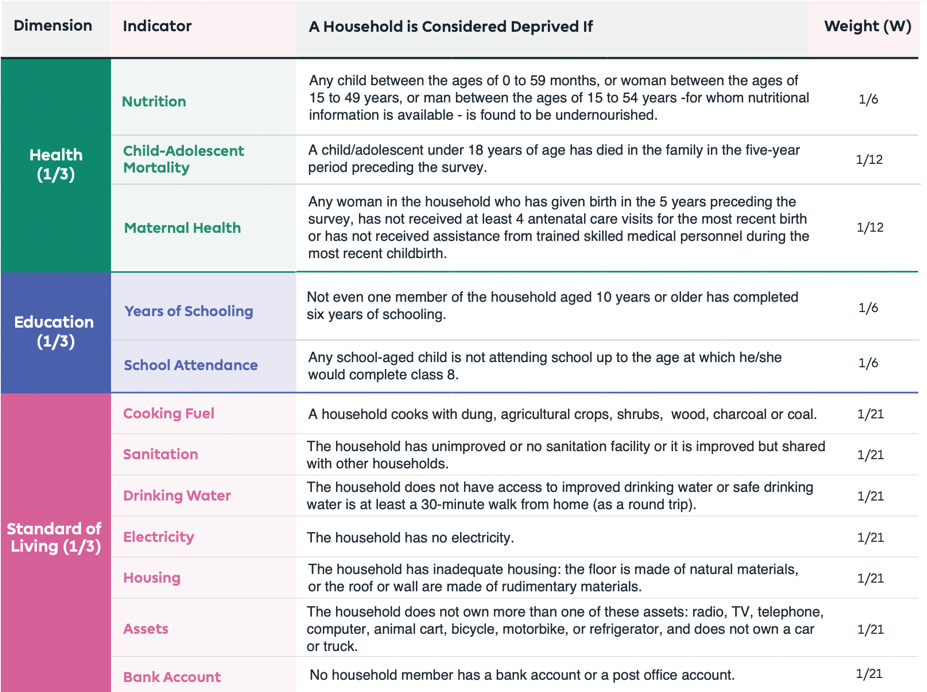
- National MPI: Niti Aayog released its Multidimension Poverty Index in 2021 for the first time.
- India’s national MPI is a contribution towards measuring progress on target 1.2 of the SDGs which aims at reducing “at least by half the proportion of men, women and children of all ages living in poverty in all its dimensions.
Government initiative to reduce poverty in all dimensions:
- Poshan Abhiyan: To reduce malnutrition and stunting in children, adolescent girls, and women. It focuses on promoting a healthy diet, proper nutrition, and addressing related health issues.
- Anemia Mukt Bharat: This initiative is part of the larger Poshan Abhiyan and focuses specifically on preventing and reducing the prevalence of anemia among women, children, and adolescents.
- Targeted Public Distribution System under the National Food Security Act: Covers 81.35 crore beneficiaries, providing food grains to rural and urban populations.
- Pradhan Mantri Garib Kalyan Anna Yojana: Provide additional free food grains to the poor and vulnerable sections of society to alleviate the hardships faced due to the COVID-19 pandemic.
- Ujjwala Yojana : To provide free LPG connections to women from below-poverty-line households.
- Saubhagya: Providing electricity to rural and urban areas, aiming to enhance the quality of life and economic development.
- Swachh Bharat Mission: To achieve universal sanitation coverage and make India open-defecation free.
- Jal Jeevan Mission: To provide piped water supply to all rural households by 2024.
- Pradhan Mantri Jan Dhan Yojana: To provide access to banking services for all households.
- PM Awas Yojana: To facilitate access to affordable housing for the low and moderate-income residents of the country.
Significance of multidimensional poverty:
- It is qualitative measure of poverty and it used non-monetary metrics to measure poverty in the world by measuring overlapping deprivations in access to health, education and living standards.
- Monetary measures of poverty based on poverty lines only give headcount ratios i.e., number of people who are poor. However, these measures fail to measure depth of poverty. It is possible that while the overall number of poor individuals reduce, while at the same time the poorest get poorer. Also, gains in quality of life may be completely missed unless the poor cross the poverty line or exit poverty.
- Thus, MPI provides insights not just into the distribution of poverty within a country but also indicates contribution of each indicator to multidimensional poverty.
- Using MPI, it has been possible to device schemes which target specific deprivations.
- Helps to create a comprehensive understanding of poverty by identifying who is poor and the manner in which they experience poverty.
Limitations with MPI:
- It does not capture intra-household inequality or inequality among the poor.
- The multitude of indicators can be overwhelming and may result in ineffective implementation.
- Determining the relevance of dimensions and deciding how many should be considered or prioritized is also challenging.
- Poverty is a complex issue with numerous factors, making it challenging to address all aspects.
- Collecting data for multidimensional indicators can be extremely challenging and demanding, requiring additional efforts from the agency to achieve meaningful results.
- MPI data released by NITI Aayog based on the National Family Health Survey (NFHS), which raises the issues of reliability of poverty assessments and subsequent policy decisions. (no independent assessment by NITI Aayog).
Way forward:
- Integrating the Multidimensional Poverty Index (MPI) with government policy measures can indeed enhance the effectiveness and precision of schemes like the Public Distribution System (PDS) and the Mahatma Gandhi National Rural Employment Guarantee Act (MGNREGA).
- Simplify the set of indicators to avoid overwhelming complexity. Prioritize the most relevant and impactful dimensions, taking into account the local context and priorities. This will help focus efforts on the most critical aspects of poverty.
- Involve local communities in the data collection process to enhance accuracy and inclusivity.
- Baseline survey should be conducted with the involvement of local communities to enhance accuracy and inclusivity.