Economy

Captive employment initiative under Deen Dayal Upadhyaya Kaushalya Yojana

Context: Recently Union Ministry of Rural Development onboarded 19 Captive Employers, a unique initiative under the Deen Dayal Upadhyaya Grameen Kaushalya Yojana (DDU-GKY). 

What is Captive Employment?

  • ‘Captive Employment’, is a first-of-its-kind initiative aimed at addressing the vision of a dynamic and demand-based skilling ecosystem catering to the requirements of industry partners assuring sustainable placements for rural poor youth
  • The initiative is a shot in the arm for the DDU-GKY programme, assuring post-training placement of candidates for a minimum of six months with a minimum CTC of Rs 10,000/-. 
  • This program will be a big boon for the rural poor to augment their job needs and improve their standard of living. This program shall also contribute to sustainable development goals.
  • The selected CAPTIVE EMPLOYERS will be providing training to rural poor youth in their respective industries, namely, hospitality, apparel & textiles, manufacturing, IT/ITeS, telecom, retail, Power etc. 
  • During the event, Memorandums of Understanding (MoU) was signed with 19 Employers to engage as captive employers in the ambitious initiative by the Ministry of Rural Development (MoRD) for providing livelihoods to the rural youth under the DDU-GKY programme.

About DDU-GKY:

  • Deen Dayal Upadhyaya Grameen Kaushalya Yojana (DDU-GKY) is a placement-linked skilling program of the Ministry of Rural Development under the aegis of the National Rural Livelihood Mission (NRLM). 
  • This program caters to rural poor youth
  • The program is currently being implemented in 27 States and 4 UTs for rural poor youth with an emphasis on placements. 
  • More than 877 PIAs (Project Implementation Agencies) are training rural poor youth in about 616 job roles through more than 2,369 training centres. 
  • A total of 14.08 lakh candidates have been trained and 8.39 lakh candidates placed since inception under the programme.
  • With changing times and changing aspirations of rural youth, the programme is transforming its Guidelines and Standard Operating Procedures. 
  • DDU-GKY 2.0 Guidelines are in the advanced stage of finalisation in the ministry. This new version of the program aspires to improve by skilling the ecosystem and making it more job oriented.

G20 expert group constituted for strengthening MDBs

Context: Under the aegis of India’s G20 Presidency, a 11-member expert group has been set up to explore measures to strengthen multilateral development banks (MDBs).

Professor Lawrence Summers, President Emeritus, Harvard University and N K Singh, former Chairperson of the 15th Finance Commission of India, are co-convenors of the G20 Expert Group.

Objectives for the panel

  • Making a road map for an updated MDB ecosystem for the 21st century, 
  • Touching upon all aspects of MDB evolution, and mechanisms for coordination among these banks to address and finance global development.
  • Looking into how can the World Bank contribute towards climate finance, critical for developing and LDCs to make a smooth transition to lower carbon emissions without compromising on growth. 

What is a Multilateral Development Bank?

  • It is an international financial institution chartered by two or more countries for the purpose of encouraging economic development in poorer nations. 
  • MDBs provide loans and grants to member nations to fund projects that support social and economic development, such as the building of new roads or providing clean water to communities.
  • They originated in the aftermath of World War II to rebuild war-ravaged nations and stabilize the global financial system.
  • Today, MDBs fund infrastructure, energy, education, and environmental sustainability in developing countries.
  • Examples: World Bank, Asian Development Bank, Asian Infrastructure Investment Bank. 

About G20

Group of Twenty is the premier forum of international economic cooperation. It plays an important role in shaping and strengthening global architecture on all major international economic issues.

  • Members of G20: 19 Countries and EU. Countries include Argentina, Australia, Brazil, Canada, China, France, Germany, India, Italy, Japan, South Korea, Mexico, Russia, Saudi Arabia, Turkey, UK and USA. G20 members represent around 85% of global GDP and 75% of global trade and 2/3rd of global population.
  • G20 does not have a permanent secretariat or staff.
  • G20 presidency rotates among the members and is selected from a different regional grouping of  countries. G20 member countries are divided into 5 groups comprising a maximum of four countries each.
  • Most groups are formed on a regional basis. However, Group 1 includes Australia, Canada, Saudi Arabia and USA) and Group 2 includes India, Russia, South Africa and Turkey do not follow the regional pattern. Group 3 includes Argentina, Brazil and Mexico; Group 4 includes France, Germany, Italy and UK and Group 5 includes China, Indonesia, Japan & South Korea. EU is a not a member of any of these regional groups.
  • Each year another country from a different group assumes G20 Presidency. The countries in a group are each equally entitled to take Presidency when it is their group’s turn.
  • G20 Summit is held annually, under the leadership of rotating presidency. G20 initially focused largely on economic and macroeconomic issues, but it has since expanded its agenda to include trade, sustainable development, health, agriculture, energy, environment, climate change and anti-corruption.
  • G20 Presidency is responsible for bringing together the G20 agenda in consultation with other members. The Presidency is supported by the Troika – previous, current and incoming Presidency of G20. During India’s Presidency, the troika will consist of Indonesia, India and Brazil respectively.
  • The theme of India’s G20 presidency is Vasudhaiv Kutumbakam or ‘One Earth, One Family, One Future’. The Sanskrit phrase in drawn from Maha Upanishad.
  • India holds the presidency of G20 from 1st December 2022 to 30th November 2022.
  • Inception of G20: G20 was founded in 1999 after the Asian Financial Crisis as a forum for Finance Ministers and Central Bank Governors to discuss global economic and financial issues.
  • Elevation to Leader’s Level: In 2008, G20 was upgraded to Heads of State/Government level in the wake of Global Financial crisis of 2007. In 2009, G20 was designated as the premier forum for international economic cooperation. First G20 Summit took place in 2008 in Washington.

Structure of G20

  • G20 consists of two parallel tracks: Finance Track & Sherpa Track.
  • SHERPA TRACK: Headed by Sherpa who is representative of the Leader. Focuses on socioeconomic issues such as agriculture, anti-corruption, climate, digital economy, education, employment, energy, environment, health, tourism, trade & investment.
  • FINANCE TRACK: Headed by Finance Ministers and Central Bank Governors, who generally meet four times a year, with two meetings being held on the sidelines of World Bank/IMF meetings. Focuses on Fiscal & Monetary Policy, International Financial Architecture, Infrastructure, financial regulation, international taxation etc.
  • The Sherpas oversee negotiations over the course of the year, discussing agenda items for the Summit and coordinating the substantive work of the G20.
  • ENGAGEMENT GROUPS: As part of G20 members’ commitment to consult relevant stakeholders communities, dialogue is facilitated through engagement groups, comprising non-government participants from each G20 member. These groups often draft recommendations to G20 Leaders that contribute to the policy making process. Some engagement groups are: Business20, Civil20, Labour20, Parliament20, Science20, SAI20, Startup20, Think20, Urban20, Women20, Youth20.

Other G20 Initiatives

  • Research & Innovation Initiative Gathering (RIIG): Aims to enhance, intensify and strengthen research & innovation collaboration among G20 member countries. RIIG is further the work of Academic Forum held during the Italian Presidency in 2021, by bringing together science, technology and innovation experts of G20 member countries.
  • G20 EMPOWER: G20 Alliance for Empowerment & Progression of Women’s Economic Representation (G20 EMPOWER) was launched during G20 Osaka Summit in 2019. It aims to accelerate women’s leadership and empowerment in private sector by leveraging its unique alliance among business leaders and governments across G20 countries.
  • Space Economy Leaders Meeting: Under India’s G20 Presidency, ISRO is organising fourth edition of Space Economy Leaders Meeting (SELM) to continue deliberations on significance of space in shaping the global economy.

About WORLD BANK GROUP

Set up along with the IMF in 1945 following the Bretton Woods agreements. Institutions under World Bank: 

  • International Bank for Reconstruction and Development (IBRD): Loans to middle-income & creditworthy low-income countries.
  • International Development Association (IDA): Interest-free loans & grants to governments of poorest countries.
  • International Finance Corporation (IFC): Lends money to private sector companies of its member countries thereby promoting economic development
  • Note: IFC has enabled investments into India through launch of Masala Bonds.
  • Multilateral Investment Guarantee Agency (MIGA): Promotes FDI into developing countries by offering political risk insurance (guarantees) to investors & lenders. 
  • International Centre for Settlement of Investment Disputes (ICSID): Provides international facilities for conciliation and arbitration of investment disputes.

Note: India is a member of all these institutions except ICSID.

World Bank: IBRD + IDA.

World Bank Group: IBRD+ IDA+ IFC+ ICSID+ MIGA.

Structure of World Bank

Board of Governors: Comprises of 189 member countries represented by their Minister for Finance; Highest decision-making body.

Board of Executive Directors: 25 Executive Directors responsible for day-to-day management. Five largest shareholders of World Bank appoint an executive director, while other member countries are represented by elected executive directors.

World Bank President: Selected by Board of Executive Directors for a five-year. As per the convention followed so far, World Bank President has been an American Citizen, while IMF President has been a European. 

Reports published by World Bank: Human Capital Index (HCI); World Development Report; Global Economic Prospects; Logistics Performance Index; Women, Business and Law; Global Financial Development Report

Green Tug Transition Program & initiatives for green shipping

Context: Ministry of Ports, Shipping & Waterways has launched the Green Tug Transition Program which will help in India’s aim of becoming Global Hub for Green Ship by 2030.

Ministry of Ports, Shipping & Waterways has launched the Green Tug Transition Program which will help in India’s aim of becoming Global Hub for Green Ship by 2030.

SALIENT FEATURES OF GREEN TUG TRANSITION PROGRAM

  • Launched by Ministry of Ports, Shipping & Waterways (MoPSW).
  • The program will start with Green Hybrid Tugs which will be powered by Green Hybrid Propulsion systems and subsequently adopting non-fossil fuel solutions like Methanol, Ammonia and Hydrogen. Initial Green Tugs will start working in all major ports by 2025.
  • At least, 50% of all Tugs are likely to be converted into Green Tugs by 2030, considerably reducing emissions at India. 

Tugboat or Tugs

  • A tugboat or tugs are marine vessels that manoeuvre ships by pushing or pulling them, mostly using tow lines.
  • These boats are known to tug ships in circumstances where the latter cannot or does not move using its own power. For ex in narrow harbours, canals etc.

NATIONAL CENTRE of EXCELLENCE in GREEN PORTS & SHIPPING (NCoEGPS)

Ministry of Ports, Shipping & Waterways (MoPSW) in partnership with The Energy & Resources Institute (TERI) are establishing will help India’s transition towards green shipping & green ports in Gurgaon, Haryana in TERI Complex. 

Functions of National Centre of Excellence in Green Ports & Shipping

  • Act as a nodal agency for the industry for India’s Global hub for building Green Ships by 2030 program.
  • Acts as a technological arm of MoPSW for providing the needed support on policy, research and cooperation in Green Shipping areas for Ports, Directorate General of Shipping, 
  • Host several technological arms to support port & shipping sector and provide solutions to a variety of problems being faced in shipping industry through scientific research. 
  • Carry out valuable education, applied research and technology transfer in maritime transportation at local, regional, national & international levels.
  • Focus areas: Energy management, Emission management, Sustainable Maritime Operations etc. and enable fast-track innovations to provide solutions to challenges in these sectors.
  • Create a pool of manpower for green shipping industry.

Ten Initial Projects of NCoEGPS

  • Developing a regulatory framework for use of wind energy for marine applications.
  • Identifying a suitable biofuel for blending with conventional marine fuels.
  • Identifying a fuel cell technology for long haul shipping
  • Developing a regulatory framework for transportation of hydrogen up to 700 bar pressure
  • Detailed project report on low energy consumption port
  • Detailed project report on offshore platform for tapping solar energy.
  • Detailed project report on production, storage and usage of Green Hydrogen

Other Major Projects for India’s Transition to Green Shipping

  • Transition towards renewables: India intends to increase share of renewable energy to 60% of total power demand at each of India’s major ports through solar and wind generated power. At present, about 99% of energy demand for coastal shipping sector is met by fossil fuels with fuel and marine gas oil (MGO).
  • Shore to ship power (electrification of ports): 50% of port equipments will be electrified by 2030 and all ports shall supply shore power to all visiting ships in a three-phased manner. Currently, India is already supplying shore power to ships with power demand less than 150 kW.
  • Ports to reduce Carbon emissions per ton of cargo handled by 30% by 2030. 
  • Maritime Vision Document 2050 released by MoPSW is a 10-year blueprint on India’s vision of a sustainable maritime sector and vibrant blue economy.
  • India has been selected as the first country under IMO Green Voyage 2050 Project of a pilot project related to Green Shipping. 
  • India will be implementing IMO energy efficiency requirements for existing ships and carbon intensity requirements on all its vessels whether coastal or international to help achieve IMO GHG reduction targets. 
  • India is working with Marine Environmental Protection Committee of IMO to help devise acceptable requirements for GHG emission in line with IMO GHG initial strategy. 
  • Adoption of mechanised mode of dry bulk handling, increasing green belt coverage, conversion of diesel RTGCs to electric or hybrids to reduce pollution in ports. 
  • Storage & bunkering facilities for environment friendly fuels like LNG, CNG, Green Hydrogen, Green Ammonia etc. Under the National Hydrogen Mission, MoPSW has identified Paradip Port, Deendayal Port (Kandla), V. O. Chidambarar Port in (Thoothukudi, Tamil Nadu) to be developed as Hydrogen Hubs i.e., capable of handling, storing and generation of green hydrogen by 2030. 

GREEN VOYAGE 2050 PROJECT

  • It is a joint project of International Maritime Organisation (IMO) and Norway to support developing countries in their efforts to reduce GHG emissions from ships and implementing IMO Strategy ON Reduction of GHG Emissions from Ships and Ports. 
  • IMO Strategy on Reduction of GHG Emissions from Ships aims to reduce total annual GHG emissions by at least 50% by 2050 compared to 2008. Carbon intensity of international shipping to decline to reduce CO2 emissions per transport work by at least 40% by 2030 and 70% by 2050 compared to 2008. Use of Energy Efficiency Design Index (EEDI) for new ships to strengthen energy efficiency design requirements.  
  • IMO resolution on ports encourages shipping and port sectors to cooperate for reducing GHG emissions from ships. This will be done by Onshore Power Supply, Safe & Efficient bunkering.
  • Green Voyage Project will strengthen MARPOL Annex VI compliance, facilitate sharing of operational best practices, catalyse uptake of energy efficient technologies and explore opportunities for low and zero-carbon fuels. 
  • IMO is the executing authority and Norway will provide funding for the project. 
  • India has been selected as the first country under IMO Green Voyage 2050 Project of a pilot project related to Green Shipping. 

Components of Green Voyage 2050 Project

  • Undertake an assessment of maritime emissions in national context.
  • Develop policy frameworks & national action plans (NAPs) to address GHG emissions from ships.
  • Draft legislation to implement MARPOL Annex VI into national law.
  • Assess emissions and develop port-specific emission reduction strategies.
  • Identify opportunities and deliver port projects, through the establishment of public private partnership & mobilisation of financial resources.
  • Establish partnerships with industry to develop new & innovative solutions to support low carbon shipping. 
  • Partner Countries: Green Voyage 2050 Project is working with 12 countries: Azerbaijan, Belize, China, Cook Islands, Ecuador, Georgia, India, Kenya, Malaysia, Solomon Islands, South Africa, Sri Lanka. 

GLOBAL INDUSTRY ALLIANCE TO SUPPORT LOW CARBON SHIPPING (LOW CARBON GIA)

  • It is a public private partnership under the framework of IMO-Norway Green Voyage 2050 Project that aims to bring together maritime industry leaders to support an energy efficient and low carbon maritime transport system. 
  • Leading shipowners & operators, classification societies, engine and technology builders and suppliers, big data providers, oil companies and ports have joined hand under Low Carbon GIA to collectively identify and implement solutions for uptake and implementation of energy efficiency technologies, operational best practices and alternative low and zero carbon fuels. 

Workstreams of Low Carbon GIA are:

  • Energy efficiency technologies (EETS) & operational best practices.
  • Alternative low and zero-carbon fuels.
  • Addressing emissions at ship-port interface.

INTERNATIONAL MARITIME ORGANISATION (IMO)

  • It is a specialised agency of the United Nations responsible for measures to improve the safety & security of international shipping and prevent pollution from ships. 
  • It is also involved in legal matters, including liability and compensation issues and facilitation of international maritime traffic. 
  • It came into existence in 1959. 
  • The IMO Assembly consists of all Member States and is the highest governing body of the Organization. It is responsible for approving the work programme, voting the budget and determining the IMO’s financial arrangements. 
  • IMO Council is elected by the Assembly for terms of two years. It acts as the Executive Organ of IMO and is responsible, under the Assembly, for supervising the work of the Organization.  
  • IMO has five main Committees: 
    • Maritime Safety Committee (MSC)   
    • Marine Environment Protection Committee (MEPC) 
    • Legal Committee 
    • Technical Cooperation Committee 
    • Facilitation Committee 
  • Currently, IMO has 175 member states and 66 intergovernmental organisations (observer status).
  • Organisation is led by the Secretary General supported by Secretariat.
  • Headquartered at London. 

INITIATIVE FOR SUSTAINABLE SHIPPING UNDER INTERNATIONAL MARITIME ORGANISATION

  1. ANNEX VI OF MARPOL CONVENTION: IMO adopted a Annex VI to it MARPOL Convention to address air pollution from ships. It addresses:
  • Main air pollutants contained in ships exhaust gas such as sulphur oxides (SOX) and nitrous oxides (NOX) and prohibited deliberate emissions of ozone depleting substances. 
  • Regulates shipboard incineration and emissions of volatile organic compounds (VOC) from tankers. 
  • Promotion of energy efficiency of ships – intended to limit emissions of greenhouse gases. (Added in 2011). This introduced compulsory energy efficiency components to ship design and management, promoting use of less polluting equipment and engines. From 2023, it is mandatory for all ships to calculate their attained Energy Efficiency Existing Ship Index (EEXI) to measure their energy efficiency and calculate their carbon intensity indicator (CII) and CII rating. 
  • Lower limit on sulphur content in fuel oil (Added in 2020). This measure was introduced because most ships were using fuel oil with a much higher sulphur content compared to other fuel sources. Implementation of this new limit would result in 77% reduction in sulphur oxide emissions from ships.
  1. IMO Strategy on Reduction of GHG Emissions from Ships (2018) aims to reduce total annual GHG emissions by at least 50% by 2050 compared to 2008. Carbon intensity of international shipping to decline to reduce CO2 emissions per transport work by at least 40% by 2030 and 70% by 2050 compared to 2008. Use of Energy Efficiency Design Index (EEDI) for new ships to strengthen energy efficiency design requirements.  
  2. IMO resolution on ports encourages shipping and port sectors to cooperate for reducing GHG emissions from ships. This will be done by Onshore Power Supply, Safe & Efficient bunkering.
  3. Green Voyage Project will strengthen MARPOL Annex VI compliance, facilitate sharing of operational best practices, catalyse uptake of energy efficient technologies and explore opportunities for low and zero-carbon fuels. 
  4. Particularly Sensitive Sea Areas (PSSA): Oceans areas of ecological, socio-economic or scientific significance can be granted special protection status of a Particularly Sensitive Sea Area (PSSA). PSSA status recognises that the area may be vulnerable to damage by international maritime activities and protection measures such as compulsory routeing of ship to avoid these areas may be enacted. 
  5. Addressing Biofouling: Biofouling is the process of accumulation of various aquatic organisms in ships’ hulls. Through the process of biofouling, invasive aquatic organisms can be introduced to new marine environments affecting marine biodiversity, coastal properties & infrastructure, fisheries and ocean renewable energy.
    1. IMO has found GloFouling Partnership to raise awareness, foster R&D, share best practices and help promote technical solutions for biofouling. 
    2. Ballast Water Management Convention, 2004 is international maritime treaty ensures that flag states to ensure that ships flagged by them comply with standards and procedures for management & control of ships ballast water and sediments. 

PPF, Sukanya Samriddhi interest rate hike unlikely

Context: Investors in the popular small saving schemes Public Provident Fund (PPF) and Sukanya Samriddhi Account (SSA), whose rates have not been hiked since January 2019, are unlikely to get higher returns anytime soon. 

Why:

This is because the government is no longer in complete agreement with the Shyamala Gopinath Committee formula adopted in April 2016 to reset small savings interest rates every quarter in line with the prevailing yields on government bonds of comparable tenures.

Sukanya Samriddhi Account Scheme

  1. What: It is a small saving scheme for the girl child launched under Beti Bachao Beti Padao.
  2. When: launched on 22 January 2015 in Panipat, Haryana by Prime Minister Narendra Modi.
  3. Administered under: Ministry of Finance
  4. Objective: aimed at the betterment of the girl child in the country by abolishing sex determination, gender discrimination, protection of girls, and higher participation of girls in education and other fields.
  5. Basic provisions of the scheme:
    • Minimum deposit ₹ 250/- Maximum deposit ₹ 1.5 Lakh in a financial year.
    • Account can be opened in the name of a girl child till she attains the age of 10 years.
    • Only one account can be opened in the name of a girl child.
    • Account can be opened in Post offices and in authorised banks.
    • Withdrawal shall be allowed for the purpose of higher education of the Account holder to meet education expenses.
    • The account can be prematurely closed in case of marriage of girl child after her attaining the age of 18 years.
    • The account can be transferred anywhere in India from one Post office/Bank to another.
    • The account shall mature on completion of a period of 21 years from the date of opening of account.
    • The rate of interest is decided by the government and is determined on a quarterly basis.
  6. Peripheral benefits of the scheme:
    • Deposit qualifies for deduction under Sec.80-C of Income Tax Act.
    • Interest earned in the account is free from Income Tax under Section -10 of Income Tax Act.

Suggestions of Shyamala Gopinath Committee

The committee had suggested that the interest rates of different schemes should be 25bps-100bps higher than the yields of the government bonds of similar maturity.

Source: The Hindu & PIB

India failed to create positive impression among businesses moving away from China

Context: Parliamentary committee on Commerce has submitted a report on the status of India’s positive business impression. 

Highlights of the report

  • India has not been able to take advantage of the “China Plus One Strategy,” through which multinationals shifted manufacturing and production away from China.
  • Southeast Asian countries such as Vietnam, Thailand, Cambodia, and Malaysia have become bigger beneficiaries of the strategy.
  • India’s competitive position in the pharmaceutical sector is undermined by its high import dependence for bulk drugs or active pharmaceutical ingredients (APIs), especially from China. 
  • In fiscal year 2022-23, till November 30, the value of total import of APIs stood at ₹27,209 crore, out of which imports from China stood at ₹18,973 crore, nearly 70% of the total share.

What is the China Plus 1 strategy: China Plus One or C+1 is the term ascribed to businesses avoiding investing solely in China and diversifying their business into other countries.

Who introduced the China Plus One strategy: The earliest use of the term “China Plus One” can be traced to 2013, but there is no individual to whom the concept has been credited.

What is the Europe Plus One strategy: Similar to the China strategy, Europe Plus One describes European industrialists who are exploring options to relocate their production outside of Europe.

Government’s reply

  • Government has replied that Production Linked Incentive (PLI) schemes have the capability to make India a more attractive location for companies looking to diversify their supply chains away from China. 
  • It added that more than 3,500 provisions have been decriminalised by the Ministries and the States. 
  • The Jan Vishwas Bill to amend 42 Central Acts has been introduced to enhance trust-based governance.

Committee’s suggestion

  • Rationalisation of direct taxes and indirect taxes must be done in sync with the international norms and laws to increase the competitiveness of domestic industries in the global markets.
  • It asked the government to pursue Free or Preferential Trade Agreements with countries that seek to invest in India under the ‘China Plus One Strategy’. 

RBI asked to monitor card spending under LRS for tax purposes

Context: As per the Union budget declarations this year, union government is going to impose 20 per cent tax at source on foreign remittances. For this, Reserve Bank of India is going to monitor credit card usage for foreign travel purpose. 

Background

  • Liberalized Remittance Scheme do not cover payments for foreign tours through credit card and such payments escape tax collection at source. 
  • The Union Budget 2023 proposed a TCS for foreign outward remittance under LRS other than for Education and medical purposes of 20 per cent applicable from July 1, 2023. Before this proposal, the TCS of 5 per cent was applicable on foreign outward remittances above ₹ 7 lakh.
  • Tax Collected at Source (TCS) is an income tax, collected by the seller of specified goods, from the buyer. TCS is a concept where a person selling specific items is liable to collect tax from a buyer at a prescribed rate and deposit the same with the government.

What is the Liberalised Remittance Scheme (LRS) 

  • Under the Liberalised Remittance Scheme, all resident individuals, including minors, are allowed to freely remit up to USD 2,50,000 per financial year (April – March) for any permissible current or capital account transaction or a combination of both. 
  • Further, resident individuals can avail of foreign exchange facility for various purposes ( such as private, gift, donation, employment, travel, studies) within the limit of USD 2,50,000 only.
  • The Scheme was introduced on February 4, 2004, with a limit of USD 25,000 (extended regularly).
  • In case of remitter being a minor, the LRS declaration form must be countersigned by the minor’s natural guardian. 
  • Remittances under the LRS facility can be consolidated (clubbed together) in respect of close family members subject to the individual family members complying with the terms and conditions of the Scheme.
  • There is no restrictions on the number of transactions but cumulative amount should not exceed 2.5 lakh dollar.
  • The remittances can be made in any freely convertible foreign currency (apart from dollars).
  • Only certain capital account transactions are allowed under LRS rules such as opening a bank account abroad i.e. a Foreign Currency Account, purchasing real estate property overseas, for making investments overseas which includes investing in shares, mutual funds, and debt instruments amongst others.
  • The Scheme is not available to corporates, partnership firms, HUF, Trusts etc.

Following are not permitted under the scheme

  1. Remittance for any purpose specifically prohibited under Schedule-I (like purchase of lottery tickets/sweep stakes, proscribed magazines, etc.) or any item restricted under Schedule II of Foreign Exchange Management (Current Account Transactions) Rules, 2000.
  2. Remittance from India for margins or margin calls to overseas exchanges / overseas counterparty.
  3. Remittances for purchase of FCCBs issued by Indian companies in the overseas secondary market.
  4. Remittance for trading in foreign exchange abroad.
  5. Capital account remittances, directly or indirectly, to countries identified by the Financial Action Task Force (FATF) as “non- cooperative countries and territories”, from time to time.
  6. Remittances directly or indirectly to those individuals and entities identified as posing significant risk of committing acts of terrorism as advised separately by the Reserve Bank to the banks.

Old vs New hotting up, government forms panel to relook at pension

Context: Union Finance minister announced the formation of a committee to look into improving the system of pension for government employees. The committee will be headed by Finance Secretary T V Somanathan

Details about National Pension System (NPS)

What is it? Pension cum investment scheme to provide old age security to Citizens of India. Regulated by Pension Fund Regulatory and Development Authority (PFRDA)

Who can Join? Any citizen of India (both resident and Non-resident) and Overseas Citizen of India (OCI) in the age group of 18-70 years. Earlier, the maximum age for entry was 65. In Aug 2021, PFRDA has increased the maximum age limit to 70.

Different Sectors

  1. Government Sector
    • Central Government: Introduced with effect from January 1, 2004 (except for armed forces). 
    • State Government: Almost all the State Governments (except few such as West Bengal) have also adopted NPS through their own notifications.
  2. Private Sector (Non-Government Sector):
    • Corporates
    • All Citizens of India: Any individual not being covered by any of the above sectors has been allowed to join NPS 2009 onwards.

Contribution: Govt. employees make a monthly contribution at the rate of 10% of their salary and Dearness allowance and a matching contribution is paid by the Govt. For central Govt. employees, the employer’s contribution rate has been enhanced to 14% from 1 April 2019. The State Governments have also been given an option to increase their contribution to 14% through their own gazette notification.

Different Types of NPS Account

CriteriaTier-1 AccountTier-2 Account
PurposePension accountinvestment account
Eligibilityany citizen between 18-70 yearsNRI/OCIs are not eligible
NatureCompulsoryoptional, Person needs to have tier-1 account to open tier-2 account.
Min. contribution per yearRs.1000Rs.250
Tax Benefits availableYesNo
Withdrawals allowed?Restricted as per rules and regulation.Unrestricted withdrawals.

What happens to the contribution? Invested in certain pension funds which in turn invest in different asset classes such as G-secs, shares, bonds etc. to generate higher returns.

Returns:  NPS is designed on Defined contribution basis wherein the subscriber contributes to his account. However, there is no defined benefit that would be available at the time of exit from the system. The accumulated wealth depends on the contributions made and the income generated from investment of such wealth.

Withdrawals

  • Upon Normal Superannuation – At least 40% of the accumulated pension wealth of the Subscriber has to be utilized for purchase of annuity providing for monthly pension of the Subscriber and the balance is paid as lump sum to the subscriber.
  • Upon Death – The entire accumulated pension wealth (100%) would be paid to the nominee/legal heir of the Subscriber and there would not be any purchase of annuity/monthly pension.
  • Exit from NPS Before the age of Normal Superannuation – At least 80% of the accumulated pension wealth of the Subscriber should be utilized for purchase of an annuity providing the monthly pension of the Subscriber and the balance is paid as a lump sum to the Subscriber.

Difference between New Pension Scheme and Old Pension Scheme

CriteriaNew Pension System (NPS)Old Pension Scheme
Nature of SchemeDefined Contribution Defined benefit
ContributionBoth by Government and EmployeeOnly the Government
BenefitNo Defined benefit as the accumulated wealth depends upon the contribution made.Defined benefit.
Pension of 50% of the last drawn salary.
Pension AmountDepends upon number of years of service.
Longer the years of service.
Higher Contribution.
Higher Pension.
Depends upon the last drawn salary.
Pension is equal to 50% of last drawn salary.

Blow for bond markets as Long-term tax benefit scrapped for debt Mutual Funds

Context: The government has proposed changes in taxation of debt mutual funds under which no benefit of indexation for calculation of long-term capital gains (LTCG) on debt mutual funds will be available for investments made on or after April 1, 2023.

From April 1, 2023, such debt mutual funds will be taxed at income tax rates as per an individual’s income. The move will remove the tax advantage a debt mutual fund has compared to bank deposits. 

Consequences

  • As a result, bank fixed deposits will become more attractive. 
  • This may have a negative impact on all debt funds, particularly in the retail category, as ultra-high net worth and high net worth individuals may choose to invest in safe havens like bank fixed deposits.
  • There will be a loss to the bond market which is already struggling for the liquidity. 

What is a mutual funds?

  • A mutual fund is a pool of money managed by a professional Fund Manager. 
  • It is a trust that collects money from a number of investors who share a common investment objective and invests the same in equities, bonds, money market instruments and/or other securities. And the income / gains generated from this collective investment is distributed proportionately amongst the investors after deducting applicable expenses and levies, by calculating a scheme’s “Net Asset Value” or NAV. Simply put, the money pooled in by a large number of investors is what makes up a Mutual Fund.

What is indexation?

  • Indexation is a process by which the cost of acquisition of an asset (mutual fund in this case) can be indexed (adjusted or inflated) over a period of time in order to bring it to current prices after taking inflation into consideration. 
  • Indexation is done through a mechanism using a Price Index which is adjusted for inflation. The Price Index adjusts for inflation at the time of purchase of an asset as well as at the time of its sale. 
  • It is a well-known fact that inflation erodes an asset’s value over a period of time. 
  • Indexation gives the investor an option to inflate (increase) the price of purchase of the asset. This helps in lowering the adverse cost impact due to inflation.

Indexation In Mutual Funds

  • Mutual fund investments generate Capital gains (Capital gain is a gain or profit realized by way of selling a property or other such asset/investment). These gains can either be Short Term or Long Term in nature, depending on the period for which these assets are held. 
  • However, indexation benefit is available only for capital gains realized in Debt mutual funds
  • A holding period of 36 months or more is considered as long term for Debt Funds. (For Equity mutual funds, long term means a holding period of 12 months or more)
  • Any holding period which is less than 36 months for Debt funds is treated as short term and the gains are added to the income of investor for tax calculation.

Fiscal Deficit

Context: The Centre will rein in the fiscal deficit at the targeted 6.4% of the gross domestic product in the current financial year despite some likely variations in revenues and expenditures from the respective revised estimates.

How will the Fiscal Deficit be reigned?

  • Government is on track to achieve the fiscal deficit target for FY23.
  • Sustained revenue buoyancy over the last 2 years.
  • Increasing average monthly gross GST collections.
  • Modest growth in debt-to-GDP (%) for India will reduce future interest liabilities.
  • Positive growth-interest rate differential keeps Government debt sustainable.

Challenges in Meeting Fiscal Deficit Targets

  • Likely shortfall in tax revenues given the large Budget with several spending and revenue collection heads.
  • Increase in Government’s expenditure: It was increased by Rs 2.42 trillion or 6.14% to Rs 41.87 trillion in the RE from the budget estimate (BE) of Rs 39.44 trillion, to cater to higher revenue expenditure on subsidies, including that on food and fertilisers.

About Fiscal Deficit

  • Fiscal deficit is the difference between the government's total expenditure and its total receipts excluding borrowing. 
  • Fiscal deficit arises due to either increase in expenditure or shortfall in revenues. 
  • Fiscal deficit can be financed through borrowing from domestic and foreign sources or by printing money. The borrowing can be either from the central bank of the country, or raising money from capital markets by issuing different instruments like treasury bills and bonds

Implications for the economy:

  • By printing new currency: But printing money in excess of what is justified for the growth of 'real' national income will lead to inflationary trends which will be a burden on the people. If deficit financing is maintained at a steady money level, it may not lead to 'spiral inflation' but will lead to price rise. The price rise can be minimised by either reducing the scale of deficit financing or imposing price control 
  • Borrowings from domestic sources: It consist of market borrowings, small savings of households, state provident funds and term loans from financial institutions. Financing by borrowing can be unsustainable if the interest rate involved exceeds the growth rate of GDP.
  • Non-productive current expenditure: If the borrowings are high and they are utilised for financing activities which give zero or low returns, the burden of interest payments will be unsustainable. The non-productive current expenditures will give rise to higher revenue deficits 
  • Reducing capital expenditure: If debt service payments form a high proportion of both revenues and expenditures, other activities of the government will suffer. Since expenditures on wages and salaries, defence expenditures, pensions, food subsidies, etc. are all committed expenditures, the main casualty will be capital expenditures in social and infrastructural spheres. 
  • Crowding out private investment: A high fiscal deficit, even if sustainable, will 'crowd out' private investment and adversely affect growth. Such impact on growth of GDP will be more direct and severe if the borrowings lead to unproductive public consumption.
  • High interest rates: A continued high level of public borrowing will put pressure on the interest rates. In order to finance the government deficit, the central bank (RBI in India) will have to keep the level of reserves high on deposits in commercial banks. This will necessitate banks to have higher margins on their commercial and lending activities thereby subjecting the rest of the economy to high interest rates.

Implications on macroeconomic stability

  • The effect of fiscal policy on economic growth has for long been a subject of debate in economic theory, empirical research, and economic policymaking. 
  • Rising budget deficit has been considered as one of the main constraints on economic growth in developing economies. 
  • Economists have generally agreed that large and persistent fiscal deficits are inimical to good macroeconomic performance. 
  • As pointed out earlier, such deficits tend to crowd out private investment and increase inflationary potential. 
  • It would also weaken the balance of payments position, make financial sector reforms more difficult and impose a burden of debt on future generations.

Implications on Economy

  • Though the fiscal deficit financed by domestic borrowing will result in increased government investment at the cost of private investment. But government spending will lead to an increase in aggregate demand and expansion of the economy. 
  • As the economy expands, the private sector and businesses will find it profitable to ramp up production to meet the rising consumer demand.
  • JM Keynes, the Cambridge economist, advocated deficit spending by the State during the Great Depression of the 1930s as a means of overcoming depression. He argued that in a period of recession, public spending would stimulate aggregate demand for goods and services and counter unemployment and deflation. The government spending or 'pump-priming', as it is referred to, will stimulate private spending, which in turn would lead to economic expansion. This approach was adopted by Franklin Roosevelt, the US President through his 'New Deal' programme to overcome the debilitating effects of the depression of 1930's.
  • After the Second World War, many of the newly independent countries, including India, which embarked on economic development and were faced with paucity of financial resources, resorted to deficit financing to meet developmental needs. 

Need for fiscal prudence

  • The dilemma faced in promoting economic growth and welfare is whether this is best achieved by the government itself, on the Keynesian approach of spending more than what it earns, or by restraining its expenditure to make space for private investment and market forces. 
  • Profligate spending and slippage in fiscal deficit target will end up in high inflation and retarded growth.
  • Against this background, adhering to a policy of fiscal prudence and reducing fiscal deficit assumes importance. 
  • The government must strive to keep the deficit under control so as not to hamper growth. Expenditure ought to be within limits to avoid massive deficits leading to debt financing and the crowding-out effect of private investment. 
  • If deficits become unsustainable, it can lead to higher interest liabilities, and the government may well even have to default.

Counter-cyclical measures

  • In the event of business cycles, with ups and downs affecting the economy, macroeconomic stability will call for a counter-cyclical policy stance, i.e., allow the deficit to go up when growth dips below the desired level, and contain it when growth spikes above the norm.
  • Most advanced economies and several emerging market economies now target structural deficit, which serves as an automatic counter-cyclical stabiliser. The structural deficit is the deficit consistent with sustainable public debt under conditions of normal growth. The actual deficit is allowed to exceed or fall below this target when growth is too low or too high.
  • Maintaining fiscal deficit as targeted is crucial for sustained economic growth. Lower fiscal deficit leads to lower interest rates and higher investment and growth. In exceptional circumstances such as the global financial crisis of 2007-08 which led to the 'Great Recession, fiscal stimulus may be required to counter recessionary trends even breaching the deficit target.

India’s Record in Managing Fiscal Deficit

  • Since the early years of planning in the 1950s, the Government of India adopted deficit financing as a means to mobilise resources necessary for the five-year plans as the levels of outlays were of such an order which could not be met only by taxation and borrowing from the public or external aid.
  • Also, in the early phase of planning, the private sector was not in a position to provide the necessary investment for industrialisation. Hence the government had to undertake investment in the public sector to develop the core sector of basic and heavy industries. This necessitated resorting to deficit financing.

Economic growth and Fiscal Deficit

  • Prudent fiscal management requires that revenue receipts not only meet revenue expenditures, but also generate surplus to finance the Plan and other capital and development outlays. 
  • But all through the 1980's, the government revenues fell short of expenditure. The fiscal imbalance persisted and worsened during the 1980's, and the gross fiscal deficit surged to 8% by the end of the decade. 
  • Another disturbing trend was that almost throughout the 1980s, non-development expenditure increased faster than development outlays which meant that long-term development of the country received less priority. The persistent fiscal imbalances accentuated inflationary pressures. 
  • These and the critical foreign exchange position towards the end of 1980s and the early 1990's  forced India to launch radical reform measures. 
  • With determined effort at fiscal consolidation, the central government brought down the combined deficit of the Centre and the states by the mid-1990s.
  • But later, instances such as hikes in salaries of government employees at both the Centre and the states, increase in subsidies, and payments to farmers towards debt relief made the government's task of adhering to fiscal deficit targets challenging. 

The FRBM Act and Fiscal prudence

  • An important step towards ensuring fiscal prudence was the enactment of the Fiscal Responsibility and Budget Management Act in 2003 which mandates the Central Government to ensure equity in fiscal management and long term macro-economic stability. 
  • The Act streamlined the Budget presentation process and helped to enforce fiscal discipline.
  • There was a view that instead of fixed fiscal deficit targets, it would be better to have a fiscal deficit 'range' as the target which would give necessary policy space to the government to deal with unforeseen and dynamic situations such as natural calamities or volatile global economic conditions which would have adverse repercussions on the economy.
  • Committee on FRBM Act: Therefore, in 2016, an Expert Committee, headed by N.K. Singh was set up to review the implementation of the Act. The Committee made the following important recommendations:
    • Public debt to GDP ratio should act as the medium-term anchor for fiscal policy. Combined debt-to-GDP ratio of the centre and states should be brought down to 60% by 2023 (40%- Centre, 20%- States).
    • Fiscal deficit as the operating target. Fiscal deficit should be reduced from 3.5% (2017) to 2.5% by 2023. This will help achieve the public debt target of 40% for the centre by 2023.
    • Formation of Fiscal Council to do fiscal analysis round the year, advise the government on any corrective action needed and advise if conditions exist Justify triggering the 'escape clauses’ for deviating from the fiscal deficit target.
    • Escape Clause to accommodate counter cyclical issues: Flexibility in fiscal deficit target (0.5%) to deal with economic instabilities.

Fiscal deficit: The real picture 

  • A key concern is that the fiscal deficit numbers, put out by the government, do not present the true picture of public finances. Though the deficit has been brought down over the years, the government's off-budget borrowings have increased manifold.
  • There is a problem with budget data because the central government overstates the receipts and understates the expenditures figures. The government borrows funds using off-budget' methods which enable it to finance capital and revenue expenditures while seemingly adhering to deficit targets.
  • For instance, fertiliser subsidies are cleared through special banking arrangements;  irrigation schemes are financed through borrowings by NABARD and power projects through Power Finance Corporation. 
  • Further, instead of paying the food subsidy bill during the current year, the central government carries it over to the following year which creates future liabilities and also adds to interest payment liabilities This leaves the fiscal deficit figures cited in Union budgets questionable.
  • These aspects have been pointed out by the Comptroller and Auditor General (CAG) also. 

Conclusion: 

  • Some experts suggest that during a prolonged slowdown in the economy, there is a need for a public expenditure-led booster to revive demand even if it means breaching the fiscal deficit target.
  • While the need for stimulating growth is paramount, there is a limit to which fiscal deficit may be stretched. The consequences of breaching the deficit target could be severe and it may last over a long period. It will also take longer to bring the debt-GDP ratio to the prescribed limit. 
  • The longer also will be the period during which interest payments claim an unduly large portion of revenue receipt In view of these considerations, it would be prudent to adhere to the path of fiscal discipline and fiscal deficit targets, save in exceptional situations of economic slowdown or recession requiring stimulus, or to meet other unforeseen contingency as pointed out by the Committee on FRBM Act. 

Additional Tier 1 (AT1 Bonds)

Context:

  • The biggest losers in the Credit Suisse fire sale are investors in the banking major’s riskiest bonds — called Additional Tier 1 or AT1 — who are faced with a $17 billion wipeout, potentially pushing Europe’s $275 billion market for these bonds into turmoil, with likely cascading impact across other geographies.
  • This is the biggest wipeout yet for Europe’s AT1 market.

About AT1 Bonds:

  • AT1 bonds, as these instruments are popularly known, are a type of perpetual debt instrument that banks use to augment their core equity base and thus comply with Basel III norms. These bonds were introduced by the Basel accord after the global financial crisis to protect depositors.

How are these bonds different from other debt instruments?

  • These bonds are perpetual in nature — they do not carry any maturity date. 
  • They offer higher returns to investors but compared with other debt products, these instruments carry a higher risk as well. 
  • If the capital ratios of the issuer fall below a certain percentage or in the event of an institutional failure, the rules allow the issuer to stop paying interest or even write down these bonds. 
  • These bonds are subordinate to all other debt and senior only to equity.

What can investors do with AT1 bonds?

  • AT1 bonds do not have a maturity date. Banks have a call option that permits them to redeem these bonds after a certain period.

Are they safe for investors?

  • Since these bonds can be written down by banks under the directions of the Reserve Bank of India (RBI) in the event of an institutional failure, they are seen as high-risk instruments. 
  • If the bank reaches the point of non-viability, AT1 bonds are the first part of debt that will be written down. 
  • For example, AT1 bonds worth Rs 8,414 crore were written off fully during the Yes Bank reconstruction scheme in March 2020. Those AT1 investors are still locked in a court battle with the RBI and the bank seeking the return of their investments. 
  • In this backdrop, it is fair to say that AT1 bonds are high-risk instruments for investors, especially retail investors.

Why do the banks tap the AT1 bond route?

  • Banks periodically raise money issuing such bonds. 
  • At one point, lenders used to even pitch these to retail investors as an attractive option, often with returns higher than a traditional fixed deposit would offer. 
  • Indeed, there used to be significant retail interest in AT1 bonds till the Yes Bank episode.
  • The market for AT1 bonds took a hit after the Yes Bank write-off, as part of the State Bank of India-led bailout in March 2020. Investors have begun to look at these instruments with caution since then.

Impact of Credit Suisse Crisis on Bond Market:

  • At nearly $130 trillion, the global bond market far outweighs the stock market in size, and plays an outsize role in the global financial system, especially in the way governments raise funds to manage their deficits. 
  • Rumblings in the bond markets could make it harder for other lenders to raise new AT1 debt, especially when the financial sector is facing tough times. 
  • Following FINMA’s announcement of the CHF 16 billion (about $17.3 billion) write-down of Credit Suisse’s AT1 bonds, European and Asian AT1 bonds tanked on Monday. 

Impact on Indian banks:

  • The decision to write down Credit Suisse’s AT1 bonds to zero after the lender’s takeover by UBS may contribute to a higher cost of capital for banks, including Indian lenders. 
  • The write-down will weigh on the pricing of such notes and spook investors.
  • In India, AT1 bonds of Yes Bank were written down in March 2020 after the Reserve Bank of India initiated a restructuring of the troubled lender. Since then, Indian banks have raised AT1 bonds at an up to 75 basis points premium over government bonds.
  • Some bankers, however, do not see a major impact on the fundraising capabilities of Indian banks through AT1 bonds:
    • Spread between regular bonds and AT1 bonds in India is less than 150 basis points, while in the EU and the US, it is 200-250 bps. Indian lenders have limited dependence on such securities. Indian lenders are capable of enduring any potential contagion effects emanating from the US banking turmoil and the Credit Suisse episode given their manageable exposures to global counterparts. 
    • Strong funding profiles, a high savings rate, and government support are among the factors that bolster the financial institutions and that domestic banks had sufficient buffers to withstand losses on their government securities portfolio due to rising interest rates.

Windfall Tax

Context: The Union government scrapped a 30-month old windfall tax on domestically produced crude oil and export of jet fuel (ATF), diesel and petrol following a decline in international oil prices.

Relevance of the topic: Prelims- Key facts about Windfall Tax.

What is the Windfall Tax?

  • A windfall tax is a higher tax levied by the government on specific industries when the industry experiences unexpected and above-average profits.
    • India first imposed the windfall tax on July 1, 2022, when crude oil prices were well over $100 per barrel, following the Russia-Ukraine war.
    • When an industry (in this case oil and gas sector) benefits from a one-off external situation and makes sudden profits, these profits are separately taxed, which are over and above the normal taxes.
  • Country’s upstream oil companies (ONGC, Oil India, GAIL) as well as private refiners Reliance Industries and Nayara Energy, who are the key buyers of discounted Russian supplies, were reaping major profits by aggressively boosting fuel exports instead of domestic sales.

Economic rationale for imposing windfall taxes: 

  • India’s trade deficit had increased to record high levels and a weak rupee had increased the value of India’s imports.
  • Government spending has gone up after it had cut Central Excise Duty and spent more on food and fertilisers.
  • The government then decided to levy windfall tax on oil companies to make up for this gap as the windfall tax adds to the government's earnings.

Economic rationale for removing windfall tax:

  • Falling oil prices; Global crude oil prices have been falling since June 2022, and are currently under $75 per barrel. This has led to a decline in profits for domestic oil producers. 
  • Relief to oil companies: The removal of the tax is expected to benefit major oil producers like Reliance Industries and ONGC by lifting their refining margins. 
  • Relief to consumers: The removal of the tax could lead to lower airfares for airlines, and lower prices for petrol, diesel, and ATF for oil companies. 
  • Reduced government revenue: The windfall tax was not generating significant revenue, with collections dropping from ₹25,000 crore in FY23 to ₹6,000 crore in FY25. 

Sugar Exports

Facts:

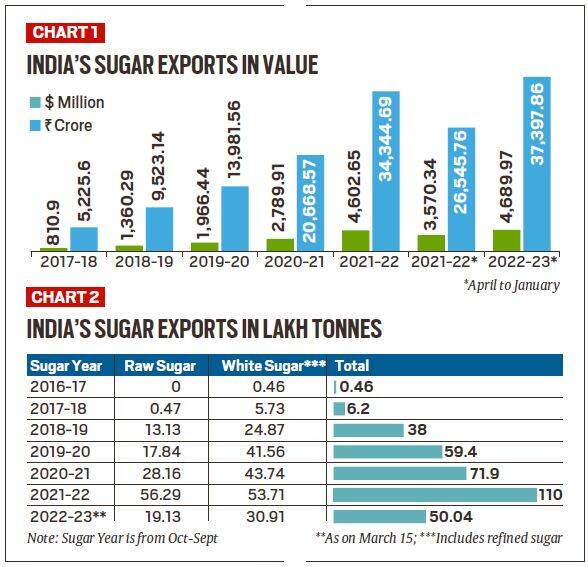
  • Between 2017-18 and 2021-22, sugar exports have soared from $810.9 million to $4.6 billion, and could cross $5.5 billion - or Rs 45,000 crore - in the fiscal year 2022-23.
  • The increase is even more significant in quantity terms. During the 2016-17 and 2017-18 sugar years (Oct-Sept), India’s shipments were a mere 0.46 lakh tonnes (lt) and 6.2 lt respectively, which zoomed to 110 lt by 2021-22.
  • Chart below shows  the value of sugar exports from India in US Dollars and Rupees (2017-18 to 2022-23), increasing year-on-year except in the 2021-22 period.nu5vfFH9f2mBTjjB P7bGHZVpd1m6liLEdM 9x8etXIdV QZ VoEsRHSp488BXjoITigsnt1T2DAAWmB e8TSlJo
  • India’s exports of both raw and white sugar. Chart below shows the quantity in lakh tonnes from 2016-17 to 2022-23. Till 2017-18, India hardly exported any raw sugar.
nu5vfFH9f2mBTjjB P7bGHZVpd1m6liLEdM 9x8etXIdV QZ VoEsRHSp488BXjoITigsnt1T2DAAWmB e8TSlJo
  • The efforts to push exports of raws got a further boost when Indonesia, in December 2019, agreed to tweak its ICUMSA norms to enable imports from India.
  • The Southeast Asian nation previously imported only raw sugar of 1,200 ICUMSA or more, largely from Thailand. Those levels were brought down to 600-1,200 to allow its refiners to process higher purity raws from India.
  • Out of India’s total 110 lt sugar exports in 2021-22, raws alone accounted for 56.29 lt. The biggest importers of Indian raw sugar were Indonesia (16.73 lt), Bangladesh (12.10 lt), Saudi Arabia (6.83 lt), Iraq (4.78 lt) and Malaysia (4.15 lt). 
  • The country also exported 53.71 lt of white/ refined sugar, the leading destinations for which included Afghanistan (7.54 lt), Somalia (5.17 lt), Djibouti (4.90 lt), Sri Lanka (4.27 lt), China (2.58 lt), and Sudan (1.08 lt).

What are Raw and White Sugar:

  • ICUMSA (short for the International Commission for Uniform Methods of Sugar Analysis), is a measure of the purity of sugar based on colour. The lower the value, the more the whiteness.
  • Raw sugar is what mills produce after the first crystallisation of juice obtained from crushing of cane. This sugar is rough and brownish in colour, with an ICUMSA value of 600-1,200 or higher. 
  • Raw sugar is processed in refineries for removal of impurities and decolourisation. The end product is refined white cane sugar having a standard ICUMSA value of 45. The sugar used by industries such as pharmaceuticals has ICUMSA of less than 20.
  • Till 2017-18, India mainly shipped plantation white sugar with 100-150 ICUMSA value. This was referred to as low-quality whites (LQW) in international markets.

Why are Raw Sugar Exports preferable?

  • Ease of Transport and Distribution: Much of the world sugar trade is in ‘raws’ that are transported vessels of 40,000-70,000 tonnes capacity as it requires no bagging or containerisation and can be loaded in bulk. The buyer of raw sugar is the refiner. Whereas, ‘Whites’ are usually packed in 50-kg polypropylene bags and shipped in 12,500-27,000-tonne container cargoes over shorter distances. The buyer of white sugar is the end-consumer.
  • Time Window: The refineries in countries such as Indonesia, Malaysia, South Korea, China and Bangladesh imported raws from Brazil. Brazilian mills operate from April to November, whereas our crushing is from October to April. We told them that they could source our raws during Brazil’s off-season. 
  • Freight Cost Savings: The voyage time from Kandla, Mundra or JNPT to Ciwandan Port of Indonesia is 13-15 days, compared to 43-45 days from Brazil’s Port of Santos.
  • Specific advantages of Indian raw sugar:
    • Dextran free raw sugar: Dextran is a bacterial compound formed when sugarcane stays in the sun for too long after harvesting. Indian raw is produced from fresh cane crushed within 12-24 hours of harvesting. The cut-to-crush time is 48 hours or more in Brazil.
    • Supply of raw sugar with a very high polarisation of 98.5-99.5%: Polarisation is the percentage of sucrose present in a raw sugar mass. The more the polarisation — it is only 96-98.5% in raws from Brazil, Thailand and Australia — the easier and cheaper it is to refine.
    • Enhanced awareness about the quality of Indian raw sugar: enables our raws today fetch a 4% premium over the global benchmark (New York No. 11 futures contract) price. This is in contrast to white sugar as our LQW sells at a $40/tonne discount to the world price (London No. 5 futures).

Challenges:

  • Dwindling availability for domestic market: Year-end stocks of sugar with Indian mills peaked at 143 lt in 2018-19. The concerted export drive, coupled with diversion of sugarcane juice to produce ethanol for blending with petrol, helped bring down closing stocks to about 70 lt by 2021-22 which was enough for just over 3 months of domestic consumption. This is in contrast to 2017-18, where closing stocks of sugar at 105 lt  enabled stocks accumulation to 5 months of domestic consumption.
  • Caps on Exports: Lower stocks and production dipping to an estimated 334 lt (from 359.25 lt in 2021-22) has led the government to cap India’s exports in the current sugar year to 61 lt. Out of that, over 50 lt have already been dispatched.
  • Reduced price realisation of sugar farmers: Mills in Maharashtra are now realising around Rs 32 for every kg of sugar sold in the domestic market. As against this, London white sugar prices are ruling at $585 per tonne. Even after factoring in the $40/tonne LQW discount and deducting Rs 2,500-3,000/tonne of internal transport and port expenses, the ex-mill realisations from exports work out much higher, at Rs 42-42.5/kg.

Way Forward:

  • The government may be concerned about domestic availability and food inflation. But overseas markets lost aren’t easy to regain.
  • Building export markets takes effort. Overseas buyers need to be convinced about the price competitiveness, product quality, and reliability of supplies from the exporting country.