Economy

Govt. vows swifter nod for exporters

Context: Ministry of Commerce has unveiled a New Trade Policy, 2023.

About Foreign Trade Policy (FTP):

  • It is a set of rules and procedures for facilitating imports into, augmenting exports from India and creating favourable balance of payment position. 
  • Department of Commerce looks in formulation and monitoring of FTP.
  • Powers to formulate a FTP policy or EXIM policy lies under the Foreign Trade Development and Regulation Act, 1992.
  • Director General of Foreign Trade implements FTP

Foreign Trade Policy - 2015-2020:

Goals: 

  • Increase India’s exports of merchandise and services to USD 900 billion by 2019-20
  • Raise India’s share in world exports from 2% to 3.5%.

Objectives:

  1. Stable and sustainable policy environment 
  2. Export Promotion Mission for India; 
  3. Diversification of India’s export basket 
  4. Achieve global competitiveness 
  5. Better integration with major regions and countries, 
  6. Provide boost to Make in India initiative; 
  7. To rationalize imports 
  8.  Reduce the trade imbalance.

Features:

  • FTP 2015-20 introduces two new schemes, namely ‘Merchandise Exports from India Scheme (MEIS)’ for export of specified goods to specified markets and ‘Services Exports from India Scheme (SEIS)’ for increasing exports of notified services.
  • Duty credit scrips issued under MEIS and SEIS and the goods imported against these scrips are fully transferable.
  • For grant of rewards under MEIS, the countries have been categorized into 3 Groups, whereas the rates of rewards under MEIS range from 2 per cent to 5 per cent. Under SEIS the selected Services would be rewarded at the rates of 3 per cent and 5 per cent.
  • Measures have been adopted to nudge procurement of capital goods from indigenous manufacturers under the EPCG scheme by reducing specific export obligation to 75per cent of the normal export obligation.
  • Measures have been taken to give a boost to exports of defense and hi-tech items.
  • E-Commerce exports of handloom products, books/periodicals, leather footwear, toys and customised fashion garments through courier or foreign post office would also be able to get benefit of MEIS (for values up to INR 25,000).
  • Manufacturers, who are also status holders, will now be able to self-certify their manufactured goods in phases, as originating from India with a view to qualifying for preferential treatment under various forms of bilateral and regional trade agreements. This ‘Approved Exporter System’ will help manufacturer exporters considerably in getting fast access to international markets.
  • A number of steps have been taken for encouraging manufacturing and exports under 100 per cent EOU/EHTP/STPI/BTP Schemes. The steps include a fast track clearance facility for these units, permitting them to share infrastructure facilities, permitting inter unit transfer of goods and services, permitting them to set up warehouses near the port of export and to use duty free equipment for training purposes.
  • 108 MSME clusters have been identified for focused interventions to boost exports. Accordingly, ‘Niryat Bandhu Scheme’ has been galvanised and repositioned to achieve the objectives of ‘Skill India’.
  • Trade facilitation and enhancing the ease of doing business are the other major focus areas in this new FTP. One of the major objective of new FTP is to move towards paperless working in 24x7 environment.

Why do we need a new Trade policy?

  • Policy of 2015 is old now and has been on extension for two years.
  • New sectors are making their mark: E-commerce, IT, mobile apps etc.
  • India’s export growth has not been very promising (missed last targets)
  • India’s trade deficit is ever widening.
  • Poor diversification of exports with respect to destinations and composition.
  • Poor performance of Free Trade agreements signed with partner nations.
  • New policies and schemes are not in line with Policy of 2015: Development of Enterprise and Service Hubs (DESH) Bill, One District One Product, etc.
  • Previous policy missed on the skill development with respect to external sector. 
  • India needs to take advantage of Transition goods and network goods. 

New Trade Policy 2023:

Target: to take India's exports to 2 trillion dollars by 2030. 

4 pillars of FTP 2023: Incentive to Remission, Export promotion through collaboration, Ease of doing business and Emerging Areas.

Provisions:

1. Process Re-Engineering and Automation: The policy emphasizes export promotion and development, moving away from an incentive regime to a regime which is facilitating, based on technology interface and principles of collaboration.

2. Towns of Export Excellence: Four new towns, namely Faridabad, Mirzapur, Moradabad, and Varanasi, have been designated as Towns of Export Excellence (TEE) in addition to the existing 39 towns. The TEEs will have priority access to export promotion funds under the Market Access Initiative scheme and will be able to avail Common Service Provider (CSP) benefits for export fulfilment under the EPCG Scheme. This addition is expected to boost the exports of handlooms, handicrafts, and carpets.

3. Recognition of Exporters: Exporter firms recognized with 'status' based on export performance will now be partners in capacity-building initiatives on a best-endeavor basis. Similar to the 'each one teach one' initiative, 2-star and above status holders would be encouraged to provide trade-related training based on a model curriculum to interested individuals.

4. Promoting export from the districts: The FTP aims at building partnerships with State governments and taking forward the Districts as Export Hubs (DEH) initiative to promote exports at the district level and accelerate the development of grassroots trade ecosystem. Efforts to identify export worthy products & services and resolve concerns at the district level will be made through an institutional mechanism – State Export Promotion Committee and District Export Promotion Committee at the State and District level, respectively.

5. Streamlining SCOMET Policy: A robust export control system in India would provide access of dual-use High end goods and technologies to Indian exporters while facilitating exports of controlled items/technologies under SCOMET from India.

6. Facilitating E-Commerce Exports:  FTP 2023 outlines the intent and roadmap for establishing e-commerce hubs and related elements such as payment reconciliation, book-keeping, returns policy, and export entitlements. As a starting point, the consignment wise cap on E-Commerce exports through courier has been raised from ₹5Lakh to ₹10 Lakh in the FTP 2023. Depending on the feedback of exporters, this cap will be further revised or eventually removed. Extensive outreach and training activities will be taken up to build capacity of artisans, weavers, garment manufacturers, gems and jewellery designers to onboard them on E-Commerce platforms and facilitate higher exports.

7. Facilitation under Advance authorization Scheme: Special Advance Authorisation Scheme extended to export of Apparel and Clothing sector under para 4.07 of HBP on self-declaration basis to facilitate prompt execution of export orders – Norms would be fixed within fixed timeframe. Benefits of Self-Ratification Scheme for fixation of Input-Output Norms extended to 2 star and above status holders in addition to Authorised Economic Operators at present.

8. Merchanting trade: FTP 2023 has introduced provisions for merchanting trade. Merchanting trade of restricted and prohibited items under export policy would now be possible. Merchanting trade involves shipment of goods from one foreign country to another foreign country without touching Indian ports, involving an Indian intermediary.

9. Amnesty Scheme: government is strongly committed to reducing litigation and fostering trust-based relationships to help alleviate the issues faced by exporters. In line with "Vivaad se Vishwaas" initiative, which sought to settle tax disputes amicably, the government is introducing a special one-time Amnesty Scheme under the FTP 2023 to address default on Export Obligations. All pending cases of the default in meeting Export Obligation (EO) of authorizations mentioned can be regularized on payment of all customs duties that were exempted in proportion to unfulfilled Export Obligation.

To watch in-depth analysis on New Foreign Trade Policy 2023, watch the Daily New Simplified dated 01, April 2023. Follow the link given below:

European Commission grants GI tag for Himachal’s Kangra tea

Context: Recently, Himachal Pradesh’s famous Kangra Tea has been awarded a protected Geographical Indication (GI) tag by the European Union (EU), opening up new opportunities for the tea to enter the European market.

The EC notified granting PGI on March 22 and this will come into effect from April 11, 2023.

The key characteristics of 'Kangra tea’

  • It is produced in the slopes of the Dhauladhar mountain ranges of the Western Himalayas. The tea is cultivated in various areas, including Palampur, Baijnath, Kangra, Dharmshala, Jogindernagar, and Bhatiyat.
  • It is grown at an elevation ranging from 900 to 1,400 metres above sea level with the annual rainfall being 270-350 cm.  
  • This unique tea is derived from the leaves, buds, and tender stems of the Camellia sinensis species cultivated in the Kangra Valley of Himachal Pradesh, India.
  • It is available in green, oolong, white, and orthodox black types. While the black tea has a sweet lingering after-taste, the green tea has a delicate woody aroma. 
  • The tea has a light colour, high body in liquor, and leaves that contain up to 13% catechins, 3% caffeine, and amino acids such as theanine, glutamine, and tryptophan.
  • Kangra tea is a little milder than Darjeeling tea in terms of flavour and has more body and liquor.
  • Kangra Tea previously received an Indian Geographical Indication tag in 2005, and since 1999, the cultivation and development of the tea have steadily improved in the Kangra region.

About geographical indication

  • A geographical indication (GI) is a sign used on products that have a specific geographical origin and possess qualities or a reputation that are due to that origin. In order to function as a GI, a sign must identify a product as originating in a given place.

In India

Geographical Indications registration is administered by the Geographical Indications of Goods (Registration and Protection) Act, 1999 which came into force with effect from September 2003.The Act would be administered by the Controller General of Patents, Designs and Trade Marks- who is the Registrar of Geographical Indications under Department for Promotion of Industry & Internal Trade, which is in turn under the Ministry of Commerce & Industry

  • The term “geographical indications”, in its broad sense, includes a variety of concepts used in international treaties and national/regional jurisdictions, such as: appellation of origin (AO), protected designation of origin (PDO) and protected geographical indication (PGI). 

For instance

  • “Appellation of origin” is defined in the Lisbon Agreement for the Protection of Appellations of Origin and their International Registration and in the Geneva Act of the Lisbon Agreement on Appellations of Origin and Geographical Indications.
  • “Protected Designation of Origin (PDO)” and “Protected Geographical Indication (PGI)” are terms used within the European Union.
  • Protected designation of origin (PDO): Product names registered as PDO are those that have the strongest links to the place in which they are made.

Specifications: Every part of the production, processing and preparation process must take place in the specific region.

Products: food, agricultural products and wines.

  • Protected geographical indication (PGI): PGI emphasises the relationship between the specific geographic region and the name of the product, where a particular quality, reputation or other characteristic is essentially attributable to its geographical origin.

Products: food, agricultural products and wines.

Specifications: For most products, at least one of the stages of production, processing or preparation takes place in the region. 

Revamped Credit Guarantee Scheme for Micro & Small Enterprises Scheme (CGTMSE Scheme)

Context: Ministry of MSME has issued guidelines for revamping of Credit Guarantee Scheme for Micro & Small Enterprises with effect from 1st April 2023. CGTMSE created a landmark by touching the milestone approving guarantees worth Rs 1 lakh crore during FY 2022-23. 

Revamped Credit Guarantee Scheme for Micro & Small Enterprises Scheme

  • Objective of CGTMSE Scheme: Aims to encourage first generation entrepreneurs to venture into self-employment opportunities by facilitating credit guarantee support for collateral free/third party guarantee free loans to Micro & Small enterprises (MSEs), especially in absence of collateral. To operationalise the scheme, Government of India and SIDBI set up the Credit Guarantee Fund Trust for Micro and Small Enterprises (CGTMSE).
  • Guarantee coverage ranges from 85% for Micro enterprises up to Rs 5 lakhs to 75% for others. 50% coverage for retail activity. 
Screenshot 2023 04 01 at 5.41.42 PM
  • Corpus of Credit Guarantee Fund Trust for Micro & Small Enterprises (CGTMSE) has been infused with a sum of Rs 8,000 crore to enable additional collateral free guaranteed credit of Rs 2 lakh crore and reduction in cost of credit by 1%.
  • Reduction of Annual Guarantee Fee for loans up to Rs 1 crore from a peak rate of 2% p.a. to as low as 0.37% per annum. This will reduce overall cost of credit to Micro & Small Enterprises to a great extent.
  • Limit on ceiling for guarantees has been enhanced from Rs 2 crore to 5 crores. Hence, under the scheme provides credit guarantee for loans up to Rs 5 crore, without collateral and third-party guarantee. 
  • No legal proceedings up to Rs 10 lakhs: For settlement of claims in respect of guarantees for loan outstanding up to Rs 10 lakh, initiation of legal proceedings will no longer be required.
  • Lending Institutions through which CGTMSE Scheme is eligible: Scheduled Commercial Banks including private banks, select Regional Rural Banks, Selected NBFCs and Small Finance Banks, NSIC, NEDFI, SIDBI and The Tamil Nadu Industrial Investment Corporation(TNIIC).

Unified Tariff Regime for National Gas Grid System

Context: Petroleum & Natural Gas Regulatory Board has amended PNGRB (Determination of Natural Gas Pipeline Tariff) Regulations to incorporate regulations pertaining to Unified Tariff for natural gas pipelines with a mission of 'One Nation, One Grid & One Tariff). National Gas Grid System means network of all such natural gas pipelines within India which are fully interconnected with each other (including those which are partly commissioned and so interconnected)

Salient Features of Unified Tariff Regime for Natural Gas Pipelines

  • Levelised Unified Tariff: PNGRB has notified a levelized Unified Tariff of Rs 73.93 per MMBTU additional GST tax will be Rs. 0.19/MMBTU. All entities part of National Gas Grid will get the tariff as per their entitlement while customers would pay Unified Tariff applicable for different zones. Difference between the entitlement tariffs to be earned by pipeline companies and unified tariffs paid by customers will be settled between pipeline entities by a settlement mechanism. 
  • Tariff zones for unified tariff:
    • First Tariff zone for unified tariff: Length of 300 km from the entry point on either side of national gas grid system.
    • Second Tariff zone for unified tariff: length between 300 to 1200 km on either side of the first tariff zone on national gas grid
    • Third Tariff zone for unified tariff: Remaining length of national gas grid system on either side of second tariff zone. 
UNIFIED ZONETARIFF (Rs./MMBTU on GCV basis)
Zone 139.45
Zone 274.97
Zone 399.90
  • Companies covered: National Gas Grid covers all interconnected pipeline networks owned and operated by following entities: Indian Oil Corporation, Oil & Natural Gas Corporation (ONGC), GAIL (India), Pipeline Infrastructure ltd., Gujarat State Petronet Ltd, Gujarat Gas, Reliance Gas Pipelines, GSPL India Gasnet & GSPL India Transco. All these entities will be members of Industry Committee. 
  • Settlement mechanism: The settlement mechanism will be applicable to all the entities including shippers availing transportation services through natural gas pipelines forming part of National Gas Grid System. Out of the members of the Industry Committee 5 members will be selected to form a part of Settlement Committee will decide the ratio of settlement among different entities part of National Gas Grid System. 

Significance of Unified Price for National Gas Grid System

  • Expansion of National Gas Grid: With commissioning of newer interconnected gas pipelines, the national gas grid will keep expanding for Union tariff.
  • Affordable access to natural gas in far-flung areas: This reform will specially benefit consumers located in far-flung areas by making natural gas available at competitive and affordable rates. In the current regime, additive rates are applicable for gas consumers in these areas. 
  • Transition to gas economy: India plans to raise the share of gas in the economy to about 15% by 2030 from 6.4% in 2022. The uniform price mechanism for transportation will aid in this regard. 

About Petroleum & Natural Gas Regulatory Board (PNGRB)

PNGRB is a statutory body formed under the Petroleum & Natural Gas Regulatory Board Act, 2006.

The Board is headed by a Chairperson, a Member (legal) and three other members to be appointed by Central Government.

Functions of PNGRB are:

  1. Protect interests of consumers by fostering fair trade and competition among entities.
  2. Register entities related to:
  3. Authorise entities to:
    • Lay, build, operate or expand a common carrier or contract carrier.
    • Lay, build, operate or expand city or local natural gas distribution network. (CNG networks)
  1. Declare pipelines as common carrier or contract carrier.
  2. Regulate
    • Access to common carrier or contract carrier to ensure fair trade and competition amongst entities.
    • Transportation rates for common carrier or contract carrier.
    • Access to city or local natural gas distribution network to ensure fair trade and competition.
  3. In respect of petroleum, petroleum products and natural gas:
    • Ensure adequate availability.
    • Ensure display of information about maximum retail prices
    • Monitor prices and take corrective measures to prevent restrictive trade practices by the entities.
    • Secure equitable distribution for petroleum and petroleum products
    • Provide and enforce retail service obligations for retail outlets and marketing service obligations for entities.
    • Monitor transportation rates and take corrective actions to prevent restrictive trade practices by entities.
    • Levy fees and other charges
    • Maintain a data bank of information on activities related to petroleum, petroleum products & natural gas.
    • Lay down technical standards, specifications & safety standards related to petroleum, petroleum products, natural gas, pipeline construction, operation & maintenance related to downstream petroleum and natural gas.
  4. Adjudicate and decide disputes arising amongst entities and receive complaints. 

FTP moots setting up e-com export hubs

Context: Union Minister of Commerce and Industry  has  launched the Foreign Trade Policy 2023 saying that it is dynamic and has been kept open ended to accommodate the emerging needs of the time.

More on news:

India's Foreign Trade Policy expands export benefits to e - commerce overseas shipments, with the aim to increase exports to $200 - $300 billion annually by 2030. There is a plan to create hubs for exports with designated zones for warehousing. These hubs will help e-commerce aggregators to undertake everything from stocking to customs clearances and processing of returned orders. These hubs would also include a processing facility for last mile activities like labelling, testing and repackaging. 

Foreign Trade Policy (FTP) 2023

  • It aims at process re-engineering and automation to facilitate ease of doing business for exporters. 
  • It also focuses on emerging areas like dual use high end technology items under SCOMET (Special Chemicals, Organism, Materials, Equipment and Technologies), facilitating e-commerce export, collaborating with States and Districts for export promotion.
  • It is introducing a one-time Amnesty Scheme for exporters to close the old pending authorizations and start afresh. 
  • It encourages recognition of new towns through “Towns of Export Excellence Scheme” and exporters through “Status Holder Scheme”. 
  • It will facilitate exports by streamlining the popular Advance Authorization and Export Promotion Capital Goods (EPCG) schemes, and enabling merchanting trade from India.
  • To develop India into a merchanting trade hub, it has introduced provisions for merchanting trade. Merchanting trade of restricted and prohibited items under export policy would now be possible. (Merchanting trade involves shipment of goods from one foreign country to another foreign country without touching Indian ports, involving an Indian intermediary). 

Key pillars of FTP 2023

  1. Incentive to Remission
  2. Export promotion through collaboration - Exporters, States, Districts, Indian Missions
  3. Ease of doing business, reduction in transaction cost and e-initiatives
  4. Emerging Areas – E - Commerce Developing Districts as Export Hubs and streamlining SCOMET policy

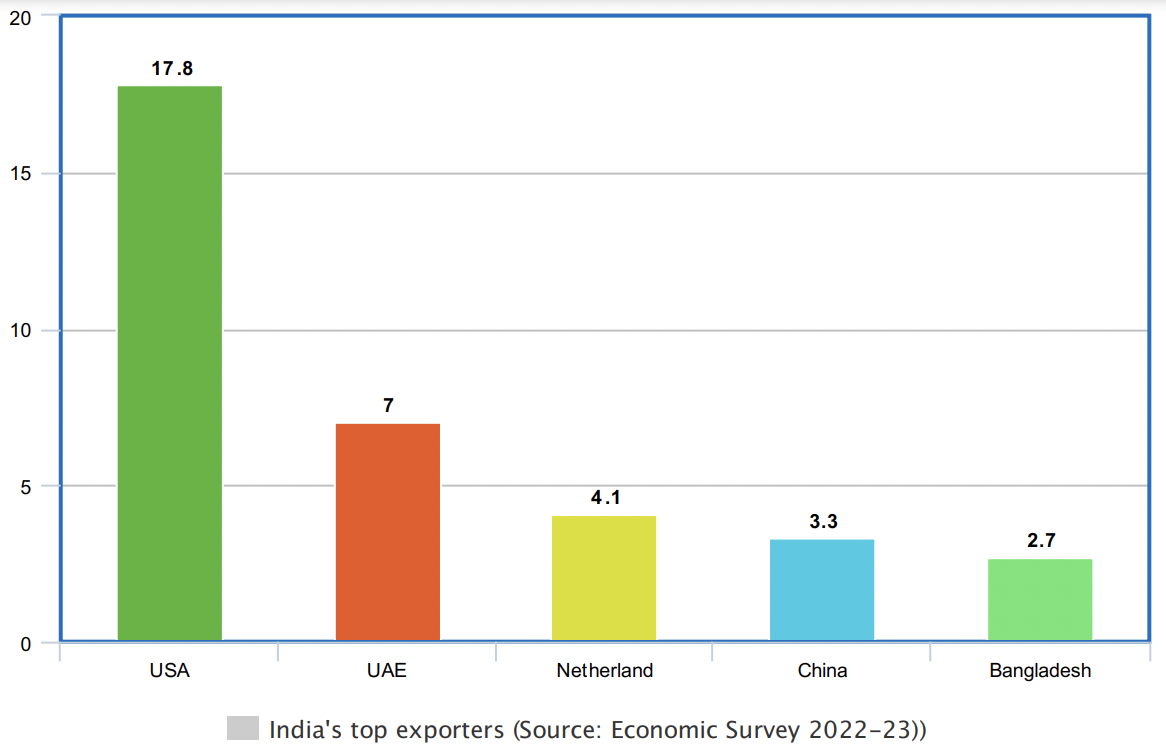
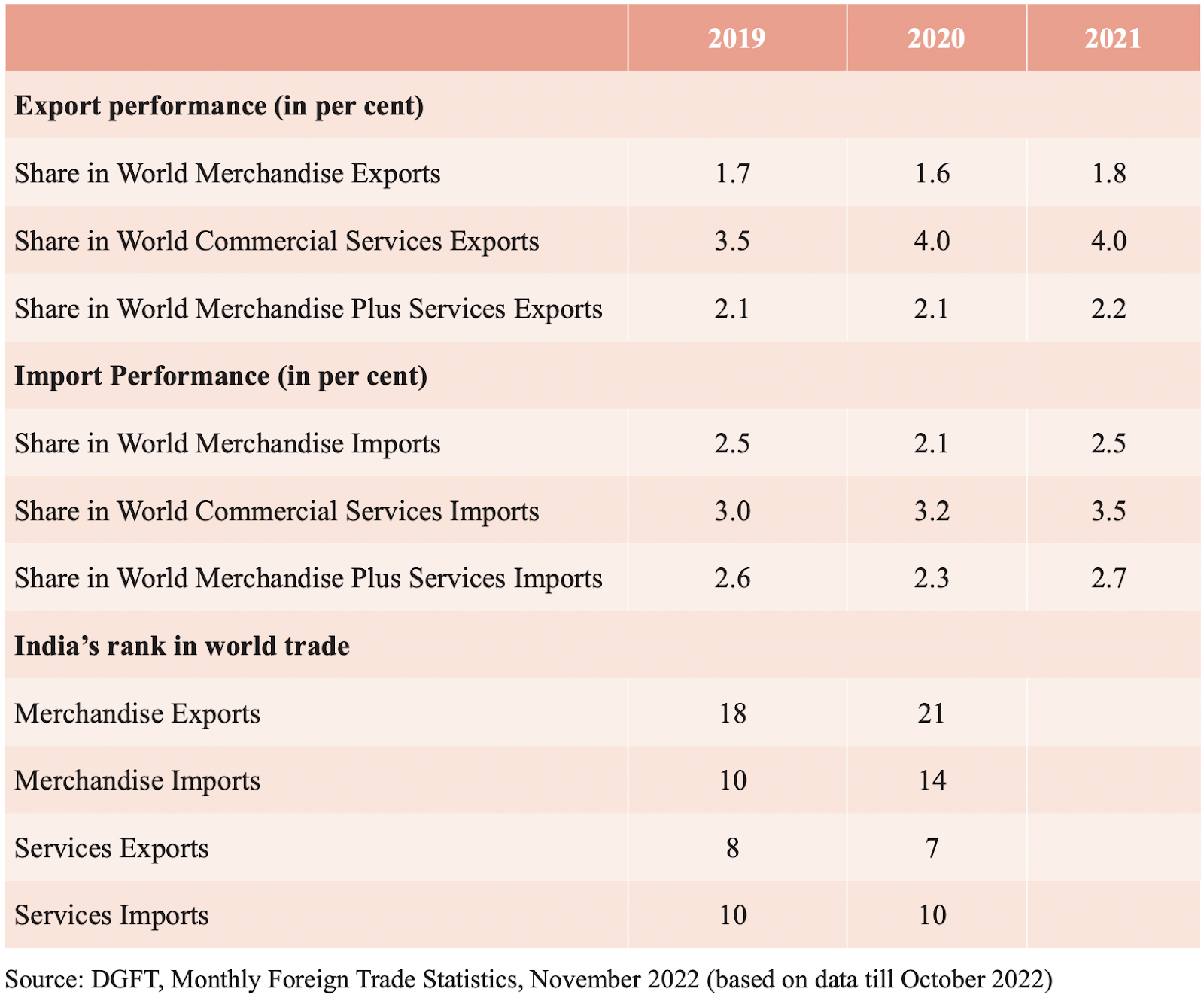
Status of exports in India

Bk98AQLEsDAku0tgKVPlj3OJGStr8O 8T3A3sztr k2DMqB kf0LHtqyiktwUi4iw4cFaje23 O0lxHNlsuA OUob4UygTmzgDBybcUqvb3cY e3nL91DQN1jDwcmGtZsAtwcLG4kjEJOebzFDP6A

India’s Exporters

2KB5lBG7ZLSP4N

Centre allows the sale of declared hallmarked gold jewellery till Jun 30

Context: Recently the Central government allowed those jewellers to sell their old stock of gold jewellery or gold artefacts with old ‘four marks hallmarking’ till June 30, 2023, which they had declared prior to July 1, 2021—the date on which the 6-digit hallmarking ID (HUID) was introduced in the country.

About Hallmarking

  • Hallmarking is the accurate determination and official recording of the proportionate content of precious metal in the jewellery/artefacts or bullion/coins. 
  • Quality control order for mandatory hallmarking of gold jewellery/artefacts has been issued on 23 June 2021 by the Govt. of India which makes hallmarking mandatory in 256 districts of the country where there is at least one assaying and hallmarking centre. 
  • The Indian Standard on Gold Hallmarking IS 1417:2016 specifies three grades for hallmarking of gold jewellery/ artefacts which are 14 Carat, 18-carat and 22-carat. 
  • The same has been amended to include additional grades of 20 carats, 23 carats and 24 carats. 
  • Indian standard on silver hallmarking IS 2112: 2014 specifies six grades of silver alloys viz 990,970,925,900,835,800 used in the manufacture of jewellery/artefacts of silver.
  • For hallmarking of gold bullion and coins of fineness 995 and 999 parts per thousand, a refinery or a mint obtains a license and applies a hallmark during the manufacturing. At present 44 refineries have taken licences from BIS for refining gold.

Coding of Hallmarked article

  • The jeweller will submit the request for hallmarking online and the data for all the processes undertaken in the centre from inward receipt and weighing, XRF, Sampling, Fire assay and laser marking is maintained online and can be monitored on a real-time basis.
  • At the end of the testing, a unique six-digit alphanumerical code is generated from the BIS server for each jewellery article and is laser marked by the assaying and hallmarking centre on the jewellery along with the BIS logo and purity mark. 
  • Earlier (Before 1 July 2021) hallmarked Jewellery consists of the following four marks:
IPitycVuzK0rymnHGU3SgXoJmvBA yFQSoLbpvy60RSK waTvvU8e9ddHW1pomwqwKMIf

With the introduction of a six-digit alphanumeric code from 1 July 2021, the four marks have now been replaced by three marks for gold jewellery/ artefacts as given below

S2cjLBIDhwCYJsovLc41kYZ5CFSyF zVtlDcWyQ9qrmqRyCUcbEpocZsBUc7SzH0foHu awfDpqnv4q2 TWxxHwEiTW8XHS1w7OK9Vlu8dTOLGUe8D5rpyJF UAgB7BPdTXHlu5TkDHObypQjem jA

Registration of Jeweller with BIS

  • For hallmarking of jewellery, a jeweller who wants to sell hallmarked jewellery has to obtain a registration from BIS. 
  • The registration of the jeweller’s process has been made online. 
  • The registration of jewellers is free and valid for a lifetime. 
  • The registered jeweller submits the jewellery for hallmarking to BIS recognized Assaying & Hallmarking (A&H) centre.

About Assaying & Hallmarking (A&H) centre.

  • A&H centres are the testing centres where the jewellery is tested. 
  • After testing, the A&H centre applies a hallmark on the jewellery which is found to meet the requirement of the standard. 
  • The A&H centre can apply for recognition to BIS online. 
  • BIS has developed a digital solution wherein the entire workflow in the assaying and hallmarking centre is automated and made online. 
  • BIS also carries out periodic surveillance audits of the A&H centre to ascertain its continuation with the specified requirements. 

Agricultural Market Information System

Context: 12th session of AMIS Rapid Response Forum met in Chandigarh, India on the margins of 2nd meeting of G20 Agriculture Deputies in 2023. 

About Agricultural Market Information System

  • AMIS is an inter-agency platform to enhance food market transparency and policy response for food security launched in 2011 by G20 Ministers of Agriculture following global food price hikes in 2007/08 and 2010.
  • By enhancing transparency and policy coordination in international commodity markets, AMIS has helped to prevent unexpected price hikes and strengthened global food security. 
  • It brings together principal trading countries of agricultural commodities, it assesses global food supplies (focusing on wheat, maize, rice & soybeans) and provides a platform for constructive dialogue.
  • Membership: Composed of G20 members plus Spain and 7 additional major exporting & importing countries of AMIS crops, representing a large share of global food markets.

Structure of AMIS: AMIS consists of three main bodies:

  • Global Food Market Information Group: Composed of technical representatives from AMIS participants to collect market & policy information.
  • Rapid Response Forum (RRF): Assembles policymakers to promote early discussion about critical market conditions and ways to address them. In the event of market instability, RRF of AMIS coordinates appropriate policy measures. 
  • Multiagency Secretariat: Currently, includes 11 international organisations and entities, produces short-term market outlooks, assessment and analyses, and supports all functions of the Information Group and the Rapid Response Forum. 

Outputs of AMIS

  • Market Monitor: Assessing global market situation and outlook for AMIS crops.
  • Indicator Portal: Featuring key measures to identify critical market conditions that might require policy action. 
  • Market Database: Providing latest forecasts on production, consumption, trade and stocks.
  • Policy Database: Compiling information on policies that might impact on global food markets.

FCRA regulation

Context: Recently the Supreme Court ordered 6,000 non-governmental organisations (NGOs) to go back to the government for the satisfaction of their grievances over the non-renewal of their Foreign Contribution Regulation Act (FCRA) registration. About 5,900 NGOs' FCRA registrations expired on December 31, 2021, either because the NGOs failed to apply for renewal before the deadline or because the MHA refused to renew them for suspected violations of the Act.

What is the FCRA? 

  • Foreign Contribution Regulation Act (FCRA) was enacted in 1976 to regulate foreign donations, which ensures that they do not jeopardise national security
  • It was updated in 2010 to include a raft of new regulations governing foreign donations. 

Who needs to comply with FCRA?

All associations, groups, and non-governmental organisations (NGOs) who want to receive foreign donations must comply with the FCRA.

Major provisions of FCRA

  • Registration under the FCRA is required of all such NGOs. 
  • The registration is valid for five years at first, after which it can be renewed if all requirements are met. 
  • Foreign contributions for social, educational, religious, economic, and cultural reasons are permitted for registered organisations. 
  • Annual returns, similar to those filed with the Internal Revenue Service, are required to be filed.

New guidelines under FCRA

In 2015, the Ministry of Home Affairs (MHA) issued new guidelines requiring NGOs 

  • To certify that accepting foreign funding will not jeopardise India's sovereignty and integrity, have a negative influence on friendly relations with other countries, or undermine communal harmony.
  • It further stated that all such NGOs would be required to have accounts in either nationalised or private banks with core banking services in order to provide security agencies with real-time access.

Who is ineligible to receive foreign donations? 

  • Originally Foreign contributions are illegal for members of the legislature and political parties, as well as government officials, judges, and journalists. 
  • However, the MHA in 2017 allowed political parties to receive contributions from a foreign firm's Indian affiliate or a foreign company in which an Indian owns 50% or more shares.

What other options are there for obtaining foreign funding? 

  • The alternative option is to request prior authorisation to receive foreign contributions. It is given in exchange for receiving a specified amount from a specific donor in order to carry out certain activities or initiatives. 
  • However, statutes such as the Societies Registration Act of 1860, the Indian Trusts Act of 1882, or Section 25 of the Companies Act of 1956 should be used to register the association. A letter of commitment from the overseas donor is also necessary, outlining the amount and purpose.

What happens if a registration is cancelled or suspended? 

  • The MHA can temporarily revoke an association's FCRA registration after inspecting its books and obtaining any negative feedback about its operations. Until a decision is made, the association is unable to accept new donations or use more than 25% of the funds in the designated bank account without approval from the MHA.
  • The MHA has the authority to cancel an organisation's registration, after which it will be ineligible for registration or granting of 'prior authorization' for three years. 
  • When an audit uncovers problems in an NGO's finances, such as misappropriation of foreign cash, registrations are also revoked. 
  • According to the FCRA, no certificate cancellation order can be granted until the person or NGO in question has had a reasonable opportunity to be heard. An NGO's registration is cancelled after three years, and it is not eligible for re-registration.
  • The government can also suspend an NGO's registration for 180 days while an investigation is conducted, as well as freeze its funds. 
  • The government's instructions can be overturned in the High Court
  • The majority of those whose registrations have been cancelled have been suspected of financial issues or "political activities." 
  • Following an inquiry into Amnesty's financial practices by the Enforcement Directorate in 2018, the organisation was forced to close its operations in India in 2020. 

PAHCHAN card to Handicraft artisans and Handloom Weavers

Context: Recently the Union Minister of State for Textiles, Smt. Darshana Jardosh in a written reply to a question in Lok Sabha today informed that the Ministry of Textiles has issued PAHCHAN cards to 30.53 lakhs handicrafts artisans and 30.90 lakhs handloom weavers across the country under the PAHCHAN initiative since its inception.

About PAHCHAN card

  • Pehchan’ cards scheme is a part of the initiative of the Union Textile Ministry to register and provide identity cards to handicraft artisans and link them to a national database. 
  • It is a newly upgraded ID card for artisans that will be linked with their Aadhaar numbers and bank accounts so that they can receive direct cash-transfer benefits.

Benefits of PAHCHAN card

  • All Insured Persons will be issued with two magnetic cards, one for Insured persons & the other for family members 
  • The central database will be created with demographic and biometric details of Insured persons and their families. 
  • Insured Persons and their family members can avail of treatment in any ESI Hospital or dispensary across India. 
  • Besides the ID card will enable the artisans to avail of easy loans at a four per cent interest rate and they get the benefit of life insurance and `1200 per year for their children studying between Class IX and Class XII. 
  • Biometric details (fingerprints) to verify and authenticate Insured Persons and their families through card swipes. 
  • Employers can submit their Return of Contribution online Employers can collect information on employees’ benefits availed by respective employees online. 
  • One-time registration. Employees will carry forward with the same set of cards every time they change employment to prevent duplication of enrolment can be avoided.

SEBI pushes norms to ensure better disclosures, boost transparency

Context: Security and Exchange Board of India has ordered the top 100 listed companies to improve disclosure norms and transparency by mandating that they confirm or deny price-sensitive market rumours, and in the case of material board decisions disclose them to exchanges within 30 minutes.. It also allowed Private Equity firms to own stakes in Asset Management Companies that operate mutual funds. 

About SEBI

  • The Securities and Exchange Board of India was constituted as a non-statutory body on April 12, 1988 through a resolution of the Government of India. The Securities and Exchange Board of India was established as a statutory body in the year 1992 and the provisions of the Securities and Exchange Board of India Act, 1992 (15 of 1992) came into force on January 30, 1992.
  • Basic function: to protect the interests of investors in securities and to promote the development of, and to regulate the securities market. 
  • It consists of one chairman, four whole time members and four part-time members. They together make up the board of SEBI.
  • Securities Appellate Tribunal is a statutory body established under the provisions of Section 15K of the Securities and Exchange Board of India Act, 1992 to hear and dispose of appeals against orders passed by the Securities and Exchange Board of India

Broad functions of SEBI

Development functions

  • Training of intermediaries
  • To promote trading in the security market. For example in permitted internet trading, made underwriting optional etc. 

Regulatory functions

  • Mandatory registration of brokers , sub brokers , share transfer agents , trustees, merchant bankers and others
  • Developed a code of conduct for intermediaries
  • Registration and regulating the working of mutual funds
  • Regulating takeover of companies
  • Audit of stock exchanges

For the discharge of its functions SEBI is given various powers.

Some of these powers are as follows:

1. To approve by- laws of stock exchanges

2. To ask stock exchanges to amend their by- laws

3. Inspect the books of accounts and call for periodical returns from recognised stock

4. Inspect books of accounts of financial intermediaries

5. Compel certain companies to list their shares in one or more stock exchanges

6. Registration of brokers

PROBLEMS AND EMERGING CHALLENGES

SEBI regulations are laws but the process through which regulations are drafted leaves a lot to be desired. Neither regulation making nor post-mortem analysis of regulations is shaped by evidence. 

Following are the problems and challenges ahead of SEBI:

Enforcement process

SEBI has made various regulations and issued orders as a civil court but only making regulations and giving orders is not enough if it is not able to enforce the same. SEBI need to strengthen its surveillance and enforcement functions.it needs to ensure that violations do not go unnoticed whether small or large.

Talent pool and market intelligence

In 2012 SEBI had 643 employees whereas the US security and exchange commission alone had 1000 people. As we all know, human resource is the most important resource for an organisation. SEBI needs to increase its human resource in both quality and quantity. It needs to significantly improve its market intelligence, technology and talent pool in order to improve its performance.

Deepening capital market

The number of participants in the capital market has not risen much. Still a large section of society does not deal in the security market. SEBI has done a lot to encourage people to participate in the capital market such as abolishing entry load on mutual funds, simplifying KYC norms but it needs to take some stronger steps to deepen participation in the capital market.

It should work deeper participation in equity by pension, superannuation and gratuity funds, developing a vibrant retail debt segment and reducing the cost of transaction.

Corporate debt and securitization market

Despite numerous attempts the debt market volume has increased but it has failed to attract sufficient liquidity. The regulator needs to develop a vibrant corporate debt market and securitization market but these largely remain part of the over the counter market.

Matching up to global standard

Capital markets are growing and the size of SEBI as compared to the security market is not sufficient to properly regulate the capital market. Like its peers (regulators of US and UK) it needs to establish self-regulatory organisations. They can focus on routine decisions and SEBI can work on more important issues.

Negatively charged

SEBI’s appointment process has always been criticized. Allegations of corruption by SEBI staff are frequently heard. The accountability mechanisms that envelope SEBI are quite poor. It is very important to make the recruitment process fair and transparent.

Reference: World wide journals

Committees constituted for the improvement of capital market regulations and development of corporate governance:

  1. Narayan Murthy Committee, 2002
  2. Uday Kotak Committee 2017
  3. Dr. D B Pathak Committee 2021
  4. Mahalingam Committee 2022

Various suggestions given by these committees have been incorporated to improve SEBI’s role in the capital market and investors’ protection. 

NCLAT upholds ₹1,338-crore penalty imposed on Google

Context:  The National Company Law Appellate Tribunal (NCLAT) upheld the ₹1,337-crore penalty imposed on Google by the Competition Commission of India (CCI) saying that the order did not violate the principles of natural justice.

Background: CCI imposed this fine on the charge that Google has misused its dominant position in the Android ecosystem showing the anti-competitive tendencies.

About the order:

However, NCLAT has restricted some directives of CCI where it called for allowing third party app stores on google play store. Google is also allowed by NCLAT to restrict uninstallation of its pre-installed apps.

About the NCLAT:

  • National Company Law Appellate Tribunal (NCLAT) was constituted under Section 410 of the Companies Act, 2013 for hearing appeals against the orders of National Company Law Tribunal(s) (NCLT), with effect from 1st June, 2016.
  • NCLAT is also the Appellate Tribunal for hearing appeals against the orders passed by NCLT(s) under Insolvency and Bankruptcy Code, 2016 (IBC), Competition Commission of India (CCI), and National Financial Reporting Authority.
  • Former judge of the Supreme Court, is the current chairperson of the tribunal.
  • Judgement given by the tribunal can be challenged in the supreme court on a point of law. For example, in the ArcelorMittal case, SC set aside the judgement of the tribunal.

About Competition Commission of India:

  • It is a statutory body created under the Competition Commission Act 2002 and its amendment in 2007. The Act prohibits anti-competitive agreements, abuse of dominant position by enterprises and regulates combinations (acquisition, acquiring of control and M&A), which causes or likely to cause an appreciable adverse effect on competition within India.
  • CCI consists of a Chairperson and 6 Members appointed by the Central Government.
  • It is the duty of the Commission to eliminate practices having adverse effects on competition, promote and sustain competition, protect the interests of consumers and ensure freedom of trade in the markets of India.
  • It ensures that two merging entities do not overtake the market. The Act prohibits abuse of dominant position by enterprises and regulates combinations (acquisition, acquiring of control and Merger and acquisition).
  • The Commission is also required to give opinion on competition issues on a reference received from a statutory authority established under any law and to undertake competition advocacy, create public awareness and impart training on competition issues.
  • It functions under the Ministry of Corporate Affairs.
  • It replaced the Monopolies and Restrictive Trade Practices Commission which was created under the Monopolies and Restrictive Trade Practices Act. 

ICAR-World Bank’s ‘Delhi declaration’ moots digitisation of Agri- Education

Context: Recently the three-day international conference on ‘Blended Learning Ecosystem for Higher Education in Agriculture 2023’, which was jointly hosted by the Indian Council of Agricultural Research (ICAR) and the World Bank, has come out with a ‘Delhi declaration’.

What is the Delhi declaration?

  • The declaration stresses the need to strengthen digital infrastructure, including e-learning content, and deployment of emerging immersive technologies across agricultural higher education institutions in India.
  • It emphasizes creating a renewed and resilient system for the gender-inclusive and sustainable agriculture education sector.
  • Multidisciplinary technology-facilitated education should be promoted and the policies on science, technology, engineering, agriculture and mathematics (STEAM) in agricultural higher education need to be transformed, the declaration said.