Context: India Navy is looking up to host its largest multilateral exercise early next year at Vishakhapatnam.
About Exercise MILAN
MILAN is a biennial multilateral naval exercise, which was incepted by the Indian Navy in 1995.
Milan exercises were originally conceived to boost India’s ‘Look East Policy’ and have been significantly expanded under the present ‘Act East Policy’.
Multiple countries participate in this exercise such as Singapore, Thailand, Sri Lanka, Indonesia etc.
Over 39 friendly foreign countries participated in the Milan Exercise in the 2022 edition. Participation is expected to increase to more than 50 countries in 2024 edition of Milan Exercises.
Context: The UAPA grants State agencies extensive powers, reducing judicial oversight effectiveness and undermining personal liberty within its broad scope as an "anti-terrorism law".
Unlawful Activities Prevention Act
The act was enacted to make powers available for dealing with activities directed against the integrity and sovereignty of India and to protect India from anti-social, radical elements. This law has been amended seven times 1969, 1972, 1986, 2004, 2008, 2013 and 2019.
Provisions
Unlawful Association
If the Central Government is of the opinion that any association is, or has become, an unlawful association, it may, by notification in the Official Gazette, declare such association to be unlawful subject to the confirmation by the tribunalconstituted under the act.
Membership
A person, who associates himself, or professes to be associated, with a terrorist organisation with intention to further its activities, commits an offence relating to membership of a terrorist organisation.
Unlawful activity (Section 2)
if an individual commits an act that is against the unity, integrity and sovereignty of the nation through words whether these words are spoken or written or even through pictorial representation.
Terrorist Activity (Section 15)
if an individual is acting against the unity, integrity and sovereignty of the nation through firearms or through ammunition or through weapons or through landmines and because of these acts it is leading to deaths of individuals or it is leading to injuries to individuals or it is leading to the destruction of any property.
Section 38 of UAPA
Defines Offence relating to membership of a terrorist organisation like gaining membership or professing the principle of banned organistation etc.
Section 39 of UAPA
DefineOffence relating to support given to a terrorist organisation such as further the activity of a terrorist organisation etc.
Section 16
It provides punishment of 5 years to life-imprisonment for unlawful or terrorist activities, in case it results in causing death it shall be punishable with death or imprisonment for life and shall also be liable to fine.
Amendments of 2019
UAPA
Amendment made in 2019
Only an organization could have been declared as an unlawful or a terrorist organization.
An individual can also be declared as a terrorist.
There was no such provision.
if the central government believes that an individual a is a terrorist such individual's name will be added to the fourth schedule to UAPA and ultimately this person shall be designated as a terrorist.
An officer of National Investigation Agency (NIA), a principal investigating agency which deals with terrorist activities and acts of crime related to terrorism have to conduct a raid in any state such officer has to take the permission of the Director-General of Police of that particular state.
An investigating officer of NIA in matter of conducting a raid must seek the permission of the Director-General of NIA.
All the cases of terrorism shall be investigated by an officer of the rank of Deputy Superintendent of Police.
Even an inspector of NIA is authorized to investigate in any terror-related case which is investigated by NIA.
Issue
Increasing ambit: In addition to the categorisation of organisations or groups as terrorist organisations, it extends the power to include an individual as terrorists within its extent.
Lack of substantive and procedural process
A member can be designated as a terrorist just by the addition of his name by the central government without following any due process.
The problem of excessive breadth to “membership clauses”, in which even possession of the material related to the banned organistaion is resulting in establishing membership.
Violation of Principle of Equality
Reasonable classification of a person on suspicion or central government’s subjective interpretation violates the principle non-arbitrariness.
Violation of freedom of speech
Central Government has been given unparallel powers which can result in curbing dissent.
Fear of getting arrested resulting in Chilling effect.
Court Cases
The People’s Union for Civil Liberties v. Union of India (2004)
The Court had decreed that if human rights are violated in combating terrorism, it will be self-defeating.
Union of India v. K A Najeeb (2021)
Supreme Court said that notwithstanding restrictions on bail under the UAPA, constitutional courts can still allow bail if they perceive that the accused’s fundamental rights have been violated.
Bail Issue of UAPA
Section 43(D)(5) of this Act, prevents the release of any accused person on bail if, on a perusal of the case diary, or the report made under Section 173 of the Code of Criminal Procedure, the court is of the opinion that “there are reasonable grounds for believing that the accusation against such person is prima facie true”.
Section 43D (5) of UAPA highlights that person accused under Chapter IV (Punishment for Terrorist Activities) or under Chapter VI (Terrorist Organisations and Individuals) of UAPA – SHALL NOT BE RELEASED ON BAIL – If the Court after going through the investigation report or case diary prepared by the Police - is of the opinion that there are reasonable grounds for believing that the accusation against such person is prima facie true.
Inconsistencies in Judicial Pronouncements on Granting Bail under UAPA
Supreme Court in National Investigation Agency vs Zahoor Ahmad Shah Watali (2019) has provided a narrow and strict interpretation of Section 43(D)(5) of UAPA which made it difficult to get bail for accused charged under UAPA.
Later in the case of Thwaha Fasal vs Union of India court made it easier to get bail for accused charged under sections of UAPA.
Case
Judgement
Impact of judgement
National Investigation Agency vs Zahoor Ahmad Shah Watali (2019)
Burden is on the accused to show that the charges framed by the state under UAPA are not prima facie true.
Courts were prohibited a thorough and deeper examination or investigation into materials and evidence - as per Section 43(D)(5)
Due to such a narrow interpretation of Section 43(D)(5) by Courts - bail pleas were rejected even when evidence was short. Many people including Sudha Bharadwaj, Siddique Kappan and even Stan Swamy were denied bail based on a narrow interpretation of the bail provision as done in Zahoor Ahmad Shah Watali judgment.
Thwaha Fasal vs Union of India
SC said that mere association with a terrorist organisation is not sufficient to attract the offences alleged. Unless and until the association and the support were “with intention of furthering the activities of a terrorist organisation”, offence under Section 38 or Section 39 is not made out. Mere possession of documents or books by the accused at a formative young age, or even their fascination for an ideology, does not ipso facto or ipso jure make out an offence.
The Court held that even the stringent provisions under Section 43D (5) do not curtail the power of the constitutional court to grant bail on the ground of violation of fundamental rights. Thwaha Fasal judgment has asserted the primacy of judicial process over the text of the enactment, by way of interpretation by also keeping the aspects of human rights in mind.
MANDATORY BAIL OR STATUTORY BAIL
Under Section 167, magistrate can either allow for police custody or judicial custody.
Magistrate may allow for police custody for a period of 15 days.
However, the accused can also be sent to judicial custody for a period of 90 days or 60 days.
Crime for which an accused can be sent to judicial custody of 90 days - crime which entails a punishment of death, life imprisonment or period of imprisonment exceeding 10 years and 60 days.
Crime for which an accused can be sent to judicial custody of 60 days - all other crimes.
Section 167(2) further provides that if at the end of the period (60 or 90 days) of judicial custody, if the investigation is not completed by the police, the court shall release the person “if he fulfill bail conditions”.
According to law or a statute (section 167 of CRPC) a magistrate cannot authorise a person’s judicial remand beyond the 60-or 90-day limit.
The stipulated period within which the charge sheet must be filed begins from the day the accused is remanded for the first time. It includes days undergone in both police and judicial custody, but not days spent in house-arrest.
Way Forward
Applying the utilitarianism principle, the greater good is securing national security by combating terrorism, at the cost of the liberty of individuals.
But in the case of UAPA, as criticisms indicate that prevention of terrorism is not effectively achieved, the act instead is being misused to a huge extent to suppress political dissent.
If liberty is sacrificed to some extent for the greater good, then it is acceptable because almost all rights come with reasonable restriction mainly for the greater good, that is social interest.
But if liberties are sacrificed not for national security but for political security, then such liberty becomes the greater good that must be protected at the cost of political security.
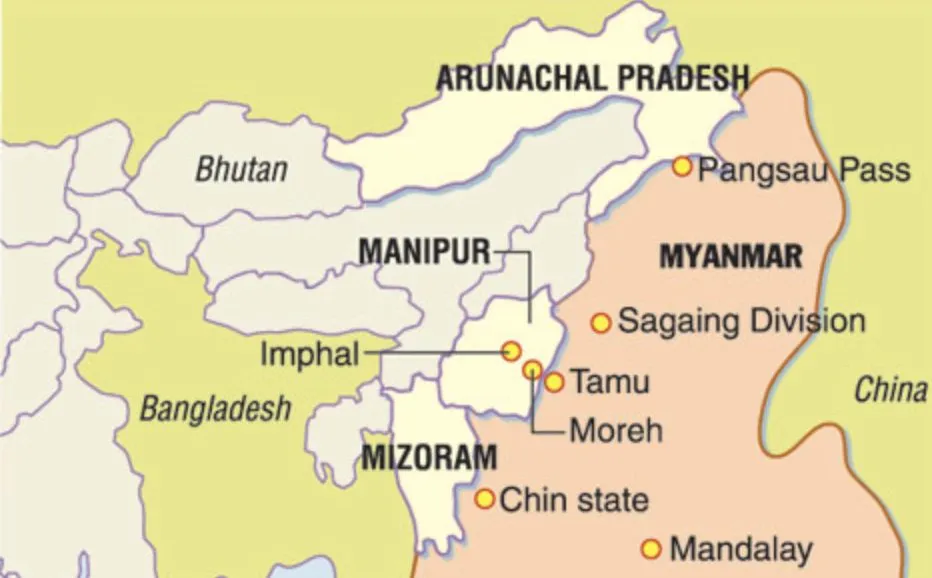
Context: A mob set on fire at least 30 houses and shops and engaged in a shootout with security forces in Manipur’s Moreh district.
Free Border Regime on India-Myanmar Border (IMB)
Free movement Regime
Free Movement Regime (FMR) allows residents of India and Myanmar border to go up to 16 kilometers into the other side and stay there up to 14 days without visas.
Need of FMR
It was implemented in 2018 as a part of Indian government’s Act East policy.
People in the region have strong ethnic and familial ties across the border.
In the Moreh region of Manipur, there are villages where some homes are in Myanmar.
In Nagaland’s Mon district, the border passes through the house of the chief of Longwa village, splitting his very home into two.
People on both sides of the border have cultural ties FMR gives them a needed space for cultural exchanges.
The livelihood and sustenance of people in this region depends upon their regular exchange and FMR gives an impetus to local trade and business.
The region has a long history of trans-border trade through customs and border haats.
The border peoples have access to business, education, and healthcare through these exchanges which are allowed by FMR.
Associated issues with FMR
Problem of illegal migrants:
Rohingya refugee crisis in 2017 led to people fleeing from Myanmar.
The ruling junta in Myanmar has launched a campaign of persecution against the Kuki-Chin peoples.
Illegally settling of migrants from Myanmar in new villages in the hills, leading to deforestation.
Cause of Insurgency: It promotes insurgency across and inside the border.
Trafficking: It is leading to illicit and informal trade drug trafficking, importing arms and weapons originating from China to the Indian side.
Drug lords or drug mafias instigate the locals who wish to earn easy money and thereafter use them to carry out illegal activities across the borders.
Difficulty of Monitoring: The border is almost entirely unfenced, runs through forested and undulating terrain.
Status of FMR
As the crisis in Myanmar escalated and the influx of refugees increased, India suspended the FMR in September 2022.
Way forward
Rather than removing it completely FMR should be better regulated.
India and Myanmar should execute a crystal-clear plan regarding the FMR which incorporate aspiration of the people into India's Myanmar strategy.
An accommodative and participatory approach that includes tribes of the region like Meities and locals in Moreh etc. and governments of both sides should be adopted to come up with a solution.
India is not a signatory to the 1951 Refugee Convention or its 1967 Protocol, thereby, India is under no international legal obligation to provide legal status, proper livelihood, education, or healthcare to any illegal migrant.
IMB is not just a porous or an unfenced boundary, rather, it reflects physical, ethnic, linguistic, cultural and fraternal linkages among the transborder villages.
Managing and administering the border areas effectively is pertinent for reducing drug trafficking and illegal cross-border movement via unfenced borders.
Assam Rifles (AR) have been deployed along this border to monitor and check infiltration across the border.
History of IMB
The border between India and Myanmar was demarcated by the British in 1826, without seeking the opinion of the people living in the region.
The border effectively split people of the same ethnicity and culture into two nations without their consent. The current IMB reflects the line drawn by the British.
Context: Manipur’s Kuki Zomi tribes are in conflict with the majority Meitei tribe which has tolled over 60 people in the state. MLAs belonging to the Kuki Zomi tribe now demand separate administration within the state.
History of Kuki’s Homeland demand
Demand for the separate Kuki Homeland has been burning since the 1980s when one Kuki insurgent group Kuki National Organisation (KNO) came into being.
After the acceptance of the new state of Telangana, there was a resurgence of demand for Kukiland by the Kuki State Demand Committee. It claims over 60 per cent of Manipur's area. They argued that Kuki habitations were not part of the British Protectorate after the Anglo-Manipur war in 1891. Hence, India cannot claim any rights over this tribal group or its habitation.
KNO has also complained about the grabbing of Kuki land by Naga insurgent groups.
About the Kuki Tribe:
Kukis are known by different names to different communities.
Some called them Lushai, some called them Kukis, Darlongs, Rokhums and among the Burma border they are known as Chins.
They called themselves Hare-ems. However ‘Kuki’ has been accepted as the generic name for the community.
As per 2011 Census all together Kukis are 10,965 persons in Tripura. In the past they lived in hill tops and maintained their livelihood through jhum cultivation and also by producing fruits.
Now-a-days they do plain land cultivation and rear livestock.
Linguistically they speak a language which is closely related to the Kuki-Chin linguistic family of Sino-Tibetan race. The Kukis have many clans and subclans.
Kukis are fond of music and dance. They work hard in Jhum field, garden and enjoy dance and music at community level.
Normally they do not arrange any marriage alliance outside their community. Traditionally they were not Christian but animist and worship different deities and spirits. But for the last 90(ninety) years the majority of them have embraced Christianity as their religion.
They have their own customary laws and village council.
LAL is a term to denote village chief. This is the reason for which Darlong uses Lal before their name.
The village chief generally looks up all sorts of social and religious disputes Including disputes related to marriage and divorce.
Presently Kukis are socio-economically advanced then other tribes.
About Meitei Tribe:
It is a majority tribal group of Manipur (53% of the population). They speak Meitei language (Manipuri language) which is a Tibeto-Burman language, also the official language of Manipur (written in Bengali language).
They are primarily settled in the Imphal Valley region (of Manipur), Assam, Tripura, Nagaland, Meghalaya, and Mizoram.
They are divided into various clans and do not intermarry.
Majority of them follow Hinduism, while more than 8% are Muslims.
Manipuri martial art Thang-ta is a combative sport which had its origin from the Meitei knights during the kings rule.
Lai Haraoba is the important dance festival celebrated in this tribe.
Context: Largescale violence broke out on May 3 triggered by the Manipur High Court’s direction to the State to pursue a 10-year-old recommendation to grant Scheduled Tribe (ST) status to the nontribal Meitei community.
What’s the issue?
Violent clashes erupted in Manipur during a Tribal Solidarity March organized by All-Tribal Students’ Union. The march aimed to oppose the inclusion of Meitei community in the state's Scheduled Tribes list.
The Army and Assam Rifles conducted flag marches in the affected areas, following an order by the Manipur High Court in favor of the Meitei community. Both the demand and the order, passed by a single judge of the High Court, have been strongly opposed by groups representing the state’s tribal communities.
The court’s order, released on April 14, asking the government to consider the demand, has brought the historical tensions between the valley-dwelling Meitei community and the state’s hill tribes to a boil.
Scheduled Tribe:
The Constitution of India in Article 366 (25) prescribe that the Scheduled Tribes means such tribes or tribal communities as are deemed under Article 342 of the Constitution to be Scheduled Tribes.
The provisions under Article 342 read as follows:
(1) The President may with respect to any State or Union Territory, and where it is a State, after consultation with the Governor thereof, by a public notification, specify the tribes or tribal communities or part of or groups within tribes or tribal communities as Scheduled Tribe in relation to that State or Union Territory as the case may be.
(2)Parliament may be law include in orexclude from the list of Scheduled Tribes specified in a notification issued under clause (1) any tribe or tribal community or part of or group within any tribe or tribal community but save as aforesaid a notification issued under the said clause shall not be varied by any subsequent notification.
Criteria for inclusion into the list of Scheduled Tribe:
The criteria presently followed for specification of a community as a Scheduled Tribe are:
indications of primitive traits
distinctive culture
geographical isolation
shyness of contact with the community at large
backwardness
Present status of Scheduled Tribes in India:
There are over 700 tribes (with overlapping communities in more than one State) which have been notified under Article 342 of the Constitution of India, spread over different States and Union Territories of the country.
The largest number of main tribal communities (62) has been specified in relation to the State of Orissa.
The Scheduled Tribes have been specified in relation to all the States and Union Territories except Haryana, Punjab, Chandigarh, Delhi, and Pondicherry.
Ethnic composition of Manipur State:
In Manipur, the Meiteis are the largest community, with approximately 64.6% of the population residing in the central valley.
The valley encompasses only 10% of the state's landmass and is also home to the Meitei Pangals.
The remaining 90% of the state comprises hills surrounding the valley, where about 35.4% of the population, consisting of 34 recognized tribes, live. These tribes are categorized into "Any Kuki Tribes" and "Any Naga Tribes."
Demand of Meitei community:
Since 2012, the Scheduled Tribes Demand Committee of Manipur (STDCM) has been leading an organized effort to push for the inclusion of the Meitei community in the list of Scheduled Tribes in the Indian Constitution.
Recently, the Meitei Tribe Union approached the Manipur High Court, seeking a direction to the state government to submit a recommendation to the Union Ministry for Tribal Affairs for the inclusion of the Meitei community as a "tribe among tribes in Manipur".
The petitioners argued that the Meitei community had been recognized as a tribe before the merger of the princely state of Manipur with the Union of India in 1949 but lost its identity as a tribe after the merger.
The demand for ST status is driven by the need to “preserve” the community, its ancestral land, tradition, culture, and language, as they have been victimized without any constitutional safeguards.
The STDCM has made several pleas to the state and central governments, highlighting that the Meiteis have been gradually marginalized in their ancestral land, and their population has reduced from 59% in 1951 to 44% as per 2011 Census data.
Why other tribal groups are opposing the demand of Meitei Community?
The tribal groups are concerned that granting ST status to the Meiteis, who have a dominant population and political representation in the valley region, could result in the loss of job opportunities and affirmative actions for the existing ST communities.
Some also argue that the Meiteis do not need ST status to protect their culture and identity, as they are already a dominant group with the state's support in safeguarding their cultural, political, and economic rights.
The government must take a proactive role in promoting peace and reconciliation, and work towards creating a more inclusive and harmonious society that values and respects the diversity of its people.
Context:The Army Commanders Conference (ACC) that was held. The ACC had decided to operationalise Command Cyber Operations and Support Wings (CCOSWs) in the immediate future with current focus on net-centric operations.
These organisations will assist the formations to undertake the mandated cyber security functions to strengthen the cyber security posture of the Army. As Cyberspace has emerged as an important component of military domain both in grey-zone warfare as well as conventional operations and Indian Army too is rapidly migrating towards net-centricity, which entails increased reliance on modern communication systems at all levels.
About Grey zone Warfare
Grey zone warfare refers to employing aggression and other actions to achieve national objectives below the threshold of armed conflict and the ambiguity it creates.
The characteristics of the Grey zone warfare can be identified by
Grey zone elements remain below the threshold that would justify a military response, often through the use of non-military tools.
The second common characteristic of grey zone activities is that they unfold gradually over time rather than involving bold, all-encompassing actions to achieve objectives in one step. The progressive unfolding of aggressive moves over the years, or even decades, reduces opportunities for decisive responses as a counter.
The third characteristic, which applies to some but not all the activities in this sphere, is a lack of attributability. Most grey zone campaigns involve actions, whereby the aggressor aims for plausible deniability of its action. Whether it is cyberattacks or disinformation campaigns or the use of proxy forces, these actions allow a grey zone aggressor to deflect responses—and obstruct the potential for successful deterrence—by simply denying that it is responsible.
For example in cases where grey zone actions are open and attributable, such as China’s approach in the South China Sea, they are justified using extensive legal and political argument. Fourthly, grey zone campaigns target specific vulnerabilities in the targeted countries. Grey zone aggressors also typically aim to put the defenders in situations where strong responses appear ruled out or counterproductive for strategic and domestic political reasons. In other words, grey zone warfare takes advantage of strategic ambiguity to achieve gradual gains.
Context:Ten security personnel returning from a counter-insurgency operation and a civilian driver were killed when Maoists blew up their vehicle in Dantewada of Chhattisgarh. The deceased jawans were members of the District Reserve Guard (DRG), a locally-raised force designed to carry out anti-Maoist operations. The tri-junction of Chhattisgarh, Telangana and Odisha located right at the southern tip of Sukma district in the south Bastar region is an area that witnesses the highest number of such incidents including the deadly 2010 Maoist ambush in Dantewada where 75 CRPF and one Chhattisgarh police personnel were killed.
Current trends in Left wing extremism in India:
The influence of Maoists and associated violence has been falling consistently in the country because of multiple factors, including a stronger push by security forces in Maoist strongholds, roads and civic amenities reaching the interiors to a greater extent than earlier, and a general disenchantment with the Maoist ideology among the youth, which has deprived the insurgent movement of new leadership.
Maoist violence in the country has gone down by 77% since 2010. The number of resultant deaths (security forces + civilians) has come down by 90 % from the all-time high of 1,005 in 2010 to 98 in 2022, the Ministry of Home Affairs (MHA)
The government has cut the number of districts declared to be Naxal-affected from over 200 in the early 2000s to just 90 now, and claims that the geographical spread of violence is actually restricted to just 45 districts.
The presence of Naxals is said to be minimal to zero in Andhra Pradesh, Telangana, Odisha, Jharkhand, and Bihar, which were at one time their strongholds.
Timing of the attack?
The CPI(Maoist) carries out Tactical Counter Offensive Campaigns (TCOCs) between February and June every year, in which the focus of its military wing is to inflict casualties on security forces
This period is chosen because with the onset of the monsoon in July, it becomes difficult to conduct offensive operations in the jungles. With the onset of the monsoon, both the Maoists and the security forces return to their camps.
Almost all major attacks by Maoists on security forces, including the 2010 Chintalnar massacre of 76 CRPF personnel, have taken place during the TCOC period.
Why Chhattisgarh still remains contested?
It is the only state in the country where Maoists continue to have a significant presence and retain the capability to mount big attacks. In the last five years (2018-22), 1,132 “violent incidents[were perpetrated by Left Wing Extremists”, in which 168 security forces personnel and 335 civilians lost their lives.
Chhattisgarh has accounted for more than a third of all Maoist-related violence in this period but the problem is the share in death is extremely high wherein it had a share of 70%-90% of deaths.
The violence graph in the state for this period has been up and down. Maoists mounted 275 attacks in 2018; the number fell to 182 in 2019, but rose to 241 in 2020. It then declined to 188 in 2021, but rose to 246 in 2022.
Delayed Response:
It is a widely accepted principle in counter-Maoist strategy that the war against Left Wing Extremism can only be won by the state police and not central forces. This is because the state police have local knowledge, understand the language, and have local networks that are essential for the generation of intelligence.
It was through the active involvement of local police in the leading role that states such as Andhra Pradesh, West Bengal, Odisha and Jharkhand were able to end their Maoist problem. All these states formed special units of their police forces with personnel and officers drawn from the state, gave them special training, and won the battle with concerted security and development efforts.
This process, security establishment started late in Chhattisgarh. By this time, police of neighbouring states had pushed Maoists from their states to Chhattisgarh, making it a concentrated zone of Maoist influence.
The special unit of the Chhattisgarh Police, the DRG, was raised from the local tribal population and trained to fight Maoists only a few years ago, and has become active relatively recently.
The absence of roads in the interiors of Bastar has stymied the operations of security forces.
Minimal presence of the administration in the interiors of South Bastar has ensured that Maoists continue to have influence in the region and enjoy local support through a mix of fear and goodwill.
Further security officials cite the lack of fool proof technology to detect IEDs and the increasing desperation of Maoists, who are avoiding direct combat with the forces, for such incidents.
Government measures to tackle Left Wing Extremism (LWE)
Central Government supports the LWE states through Security Related Expenditure (SRE), which focuses on equipping security forces to fight Maoists
Further the Special Infrastructure Scheme (SIS), which aims to strengthen local police and intelligence set ups
Special Central Assistance for building infrastructure such as roads in LWE districts, the Centre has maintained a massive presence of the CRPF in the affected states for almost two decades.
The Centre is also pushing for the erection of mobile towers in the interiors, which would help the local people connect with the mainstream, and also generate technical intelligence
The Centre has also unleashed the counter-terrorism National Investigation Agency (NIA) and the Enforcement Directorate on CPI(Maoist) cadres, leaders, and sympathisers with the aim to choke their funding.
The CRPF has also raised a Bastariya Battalion the recruits for which were taken from the local population, who knew the language and terrain, and could generate intelligence. This unit now has 400 recruits and regularly conducts operations in Chhattisgarh.
Further the CRPF has been consistently enlarging its footprint by opening new camps close to 20 forward operating bases have been set up in Bastar
Context: Lieutenant-Governor Vinai Kumar Saxena reviews the progress of the Central government-funded project, and issues instructions to complete the first phase of the ₹798-crore Operationalise Safe City Project by August.
About Operationalise Safe City Project
A Ministry of Home Affairs initiative in collaboration with the Ministry of Women and Child Development under the Nirbhaya Fund in eight metro cities — Delhi, Kolkata, Mumbai, Chennai, Bengaluru, Hyderabad, Ahmedabad and Lucknow.
The project aims to create a safe, secure and empowering environment for women and girls in public spaces.
Under the project, 10,582 CCTV cameras will be installed.
A command-and-control centre will also be set up with facilities for video analytics, AI, machine learning, facial recognition, etc., at police headquarters, district headquarters and police stations.
Two mobile command and control vehicles and 88 Prakhar Vans will also be deployed with mobile data terminals, body-worn cameras, etc.
The cost of the projects is shared in a 60:40 ratio between the Central government and the States concerned.
In Delhi, however, the Centre fully funded the project and implemented it through the Delhi Police through the Centre for Development of Advanced Computing (C-DAC).
The Pune-based C-DAC has appointed RailTel and NEC India to install CCTV cameras and connect them to feeders and main servers.
Context: The Indian Air Force is trying to keep up its strength of fighter squadrons as its fleet struggles with the gradual phase-out of existing jets as well as delays in the order and procurement of new jets. It is also placing much hope in indigenously manufactured aircraft.
The Present and Future of India’s fighter jets
Against the sanctioned strength of 42 fighter squadrons, the Air Force has 31 squadrons.
Out of the 31 squadrons at present, the three Mig-21 squadrons will be phased by 2025.
MIG-29s, inducted in the late 1980s, will start going out by the early 2040s.
India has an ambitious plan lined up for the acquisition of over 500 fighter jets.
How many aircraft are in Squadron?
Squadrons typically include between 12 and 24 aircraft, depending on the type of aircraft and the branch of the military.
Land-based squadrons with heavy aircraft may have around 12 aircraft in a squadron. However, fighter units may have 18 to 24 aircraft.
Indigenous fighter ecosystem
IAF is supposed to get the 40 LCA from HAL,
Defence Ministry signed a deal with HAL for 83 LCA-MK1A, the first three aircraft in 2024 and 16 aircraft per year for the subsequent five years.
A more capable and larger LCA-MK2, which received sanction from the Cabinet Committee on Security (CCS) in September 2022, is expected to be ready for production by 2027.
There is also a Twin Engine Deck Based Fighter (TEDBF) on the drawing board for the Navy’s aircraft carriers.
Navy Chief said that they may get up to 45 TEDBF by 2040 from HAL.
MRFA is a reincarnation of the earlier Medium Multi-Role Combat Aircraft (MMRCA) contest for 126 jets to be produced in India by a French company.
Characteristics of LCA
A light combat aircraft (LCA) is a light, multirole jet/turboprop military aircraft.
They are typically slower than larger multirole or strike aircraft such as the American F-18, F-15E Strike Eagle, or Russian MiG-29.
Most light combat aircraft are capable only of subsonic speeds, although some are capable of reaching Mach 1+.
An LCA will typically be equipped with bombs, gun pods, or short-range air-to-air missiles used for COIN or CAS missions.
Some aircraft integrate more advanced armaments such as smart bombs, air-to-ground missiles, ECM pods (Electronic Countermeasures), and electronic targeting systems.
These aircraft are usually used for self-defence or anti-hostile aircraft/helicopter missions, not for air-defence missions typically carried out by lightweight fighters.
Some LCAs are capable of air-to-air combat or point air defence missions if equipped with multi-mode radar systems. the majority cannot perform these missions due to their small design and limited capabilities.
LCAs are often used to patrol the skies and implement border patrol or air policing.
Characteristics of Twin Engine Deck Based Fighter (TEDBF)
The HAL Twin Engine Deck Based Fighter (TEDBF) is a canard delta wing, twin-engine, carrier-based, multirole combat aircraft.
The TEDBF is being designed and developed by the Aeronautical Development Agency (ADA) and will be manufactured by Hindustan Aeronautics Limited (HAL).
The TEDBF is intended to perform a multitude of missions, including air supremacy, air interdiction, anti-access/area denial (A2/AD), anti-ship warfare (ASW) and electronic warfare (EW) missions.
The TEDBF is expected to replace the Mikoyan MiG-29K onboard the INS Vikramaditya and the INS Vikrant.
The first flight is expected to be in 2026 with production planned for 2031.
The design's twin engines are expected to allow shorter take-offs from the Indian Navy’s Short Take-Off Barrier Arrested Recovery (STOBAR) aircraft carriers.
As a dedicated deck-based fighter, it will feature foldable wings for more compact storage. The TEDBF will predominantly be equipped with indigenous weapons systems.
Context:The article reflects that everything is not well in the Communist Party of India (Maoist) which, besides waging an armed struggle to capture political power, also claims to fight for gender equality. The Maoists profess discipline and integrity, but exploitation of women in the party is a stark reality. Women who join the party in the hope of bringing about a “revolution” for the proletariat and the landless class are often subject to the same structural violence that they are supposed to fight.
Gender issues within the movement
Under-representation: Women constitute 35%-40% of the total party members, but their representation in the Central Committee and the Dandakaranya Special Zonal Committee (DKSZC) is negligible.
Health issues: While jungle life is difficult for all cadres, the women have to face additional health challenges
The women cadres in the CPI(Maoist) don’t get even get sentry duty off and need to be alert all the time with a gun. In addition, they have to walk for miles daily to change their location.
Basic necessities ignored: Further Women are not permitted to liberally use water. Each cadre has to carry water in bottles for her own use. It is taboo to use water from streams or ponds for washing. Women are at the mercy of the unit commander who carries some medical necessities.
Lacking nutrition: Most women who are not conscious of their nutrition intake, particularly iron, become anaemic
Exploitation: There are instances of women cadres dying by suicide on account of ill treatment or suspicion.
Origin of left-wing movement in India
Naxalite are a group of left radical communist and the supporter of Maoist political ideology. The word Naxalite derived from the word "Naxalbari" which is the name of a village of west Bengal where a peasant insurgencies took place on 1967 against the landlords. Generally the majority of people of naxalite group are belongs to labourer, adibashi, and unemployed and mostly of them are living in remote area where the development failed to reach yet.
In India about 8% people are adhibasi and 92% of them living in tribal areas such as forest and hills and this tribal areas are far away from development or the government failed to give them a secure or peaceful life and this are the main causes for increasing number of naxalite movement in this areas. According shri Gadar "the revolutionary poet support Naxalism and said Naxalism is the result of failure of democracy."
The left-wing movementwas originated under the aegis of Kanu Sanyal, Charu Majumdar and Jangal Santhal. Kanu Sanyal, who was the follower of communist ideology thought that the economic freedom will come when you fight with maximum wealth holder
Charu Majumdar, who were inspired by the various ideology of Mao Zedong of China. He said, "That Indian peasants and lower class tribal's overthrow the government and upper class by force for whom he held responsible for their commitment." A large of urban elites were also attracted to the ideology, which spread through Charu Majumdar writing particularly the "eight historic documents" which formed basis naxalite ideology. Charu Majumdar wanted a prolonged people's war in India similar to Chinese revolution 1949.
The Naxalite movement first time appeared on 1967 in Naxalbari village of West Bengal by peasants against the landlords and this movement was leading by Charu Majumdar, Kanu Sanyal, and Jangal Santhal.. Initially the Naxalite movement originated in West Bengal and had later moved to the less developed rural areas in southern and eastern India including in the state of chhatisgarh, Odisha, Andhrapradesh, and telengana. This was testified by the fact that as per 1971 census, about 60% of people of the population were landless and the major share of land were in the hands of 4% richest peoples. The peasants were exploited by the landlords raised their bow and arrows in insurgencies. And this was the primary cause of this movement.
Causes of Left-Wing Extremism
Land Related Factors
Evasion of land ceiling laws.
Existence of special land tenures (enjoying exemptions under ceiling laws).
Encroachment and occupation of Government and Community lands (even the waterbodies) by powerful sections of society.
Lack of title to public land cultivated by the landless poor.
Poor implementation of laws prohibiting transfer of tribal land to non-tribals in the Fifth Schedule areas.
Non-regularisation of traditional land rights.
Displacement and Forced Evictions
Eviction from lands traditionally used by tribals.
Displacements caused by irrigation and power projects without adequate arrangements for rehabilitation.
Large scale land acquisition for ‘public purposes’ without appropriate compensation or rehabilitation.
Livelihood Related Causes
Lack of food security – corruption in the Public Distribution System (which is often non-functional).
Disruption of traditional occupations and lack of alternative work opportunities.
Deprivation of traditional rights in common property resources.
Social Exclusion
Denial of dignity.
Continued practice, in some areas, of untouchability in various forms.
Poor implementation of special laws on prevention of atrocities, protection of civil rights and abolition of bonded labour etc.
Governance Related Factors
Corruption and poor provision/non-provision of essential public services including primary health care and education.
Incompetent, ill-trained and poorly motivated public personnel who are mostly absent from their place of posting.
Misuse of powers by the police and violations of the norms of law.
Perversion of electoral politics and unsatisfactory working of local government institutions.
These causes are most glaring in forest areas predominantly inhabited by tribal populations who thus become the main instruments and victims of left extremist violence.
Sources of Funding for Naxalites
Financial mobilisation by Naxalites is in the form of extortion from local people and from contractors executing various projects in the affected areas. Besides, funds are also raised through forest and mining operations.
The extensive contractor-transporter-extremist nexus and its links with illegal mining and collection of forest produce in the entire region affected by left extremism yields a huge volume of funds for the extremists.
Government’s Approach And Action Plan To Curb Lwe
The Government of India has adopted an integrated and holistic approach to deal with the Left-Wing Extremist (LWE) insurgency by simultaneously addressing the areas of security, development and promoting good governance. To achieve this, a National Policy and Action Plan has been put in place that adopts a multi-pronged strategy in the areas of security, development, ensuring rights & entitlements of Other Traditional Dwellers /Tribals etc with focused attention on 106 Districts in 10 States and particularly in 35 most affected LWE districts in 07 States.
Specific Measures taken by Central government
‘Police’ and ‘public order’ are state subjects. Central government, however, closely monitors situation and coordinates and supplements their efforts in several ways to deal with the LWE problem.
Ban on CPI (Maoist): This organisation is responsible for most incidents of violence/casualties.
Strengthening the Intelligence Mechanism: This includes intelligence sharing through Multi-Agency Centre (MAC) at the Central level and State Multi Agency Centre (SMAC) at the State level on 24x7 basis.
Better Inter-State coordination: The menace of Maoists is spread across various states. Thus, Government of India has taken a number of steps to improve Inter-State coordination through periodic Inter-State meetings and facilitating interactions between the bordering districts of LWE affected States.
Tackling the problem of Improvised Explosive Devices (IEDs): Majority of casualties incurred by the Security force are attributable to IEDs. The Ministry of Home Affairs has formulated an SOP on ‘Issues related to Explosives/IEDs/Landmines in Naxal Affected Areas’ and circulated to all stakeholders concerned for compliance.
Deployment of the Central Armed Police Forces
India reserve (IR)/Specialised India Reserve Battalion (SIRB): The Left-Wing Extremism affected states have been sanctioned India Reserve (IR) battalions mainly to strengthen security apparatus at their level and to enable the States to provide gainful employment to youth, particularly in the LWE affected areas.
Development measures taken by Government Monitoring and Implementation of Flagship Programs:(a) Pradhan Mantri Gram Sadak Yojana (PMGSY)(b) National Rural Health Mission (NRHM)(c) Ashram School(d) Mahatma Gandhi National Rural Employment Guarantee Act (MGNREGA)(e) Sarva Shiksha Abhiyan (SSA)(f) National Rural Drinking Water Program (NRDWP)(g) Pradhan Mantri Kaushal Vikas Yojana (PMKVY)(h) Deen Dayal Upadhyay Gram Jyoti Yojana (DDUGJY)(I) Integrated Child Development Services (ICDS)(j) Scheduled Tribes and Other Traditional Forest Dwellers (Recognition of Forest Right) Act, 2006.
Way forward
Left extremism feeds on persistent and serious shortcomings in the domain of general and
development administration, resulting in the failure of the government to address the needs of the poor in areas pertaining to land, food, water and personal security, equity, ethnic/cultural identity etc. The ‘containment’ of the problem may inter alia require consideration of the following:
Most of the ‘participants’ in violence perpetrated under the banner of left extremist organisations are alienated sections of society rather than perpetrators of ‘high treason’ – they must be treated as such.
A fortiori police action over a long period is counterproductive; it is likely to affect the innocent more than the extremists.
Negotiations have a definite ameliorative role under the circumstances; this is the experience the world over.
Faithful, fair, and just implementation of laws and programs for social justice will go a long way to remove the basic causes of resentment among aggrieved sections of society.
Sustained, professionally sound and sincere development initiatives suitable to local conditions along with democratic methods of conflict resolution must be developed.
Context: Chief of Defence Staff (CDS) General Anil Chauhan has recently remarked that the very nature of warfare is on the cusp of major transformation and what is being witnessed is the militarisation of space and steady progress towards weaponisation. He also stated that space is being used to enhance combat capabilities in land, sea and cyber domains.
The militarization of space involves developing military technologies and conducting military operations in space and from space towards Earth. This includes developing space-based weapons as well as using space to support military forces on Earth like surveillance, communication, navigation, etc.
Space militarization began soon after the first artificial satellites were launched. Early efforts focused on space-based surveillance, intelligence gathering and ICBM detection using satellites. The Cold War spurred the growth of military space programs.
Space Surveillance
Early missile warning satellites: The US and USSR developed missile warning satellites during the Cold War to detect intercontinental ballistic missile (ICBM) launches. The US Vela and Defense Support Program satellites monitored the Soviet Union, while Soviet satellites monitored the US. These provide limited warning of an attack to initiate countermeasures.
Synthetic aperture radar satellites: SAR satellites provide all-weather, day-night imaging using radar signals. They penetrate clouds and darkness to generate high-resolution images useful for reconnaissance. Military space programs operate SAR satellites to monitor adversaries, assess damage from strikes and track space objects. Civilian programs also use them for applications like disaster relief.
High-resolution imaging satellites: Electro-optical imaging satellites provide visible light images for military surveillance and intelligence gathering. They monitor military installations, bases, ports, nuclear/missile sites, etc. Risks of misuse and overuse of data without oversight or regulation pose challenges. As technology improves, increasing resolution expands threats to privacy and security.
Space tracking and surveillance capabilities of major powers: The US, China and Russia have advanced space surveillance networks to detect, track and identify space objects and space-based threats. The US Space Surveillance Network uses telescopes/radars while Russia's Program for Space Observation warns of space attacks. China's space program remains opaque but focuses on counter-space capabilities like ASATs, surveillance and monitoring US space assets.
Satellite Communications
Military communication satellite programs: Major space powers operate dedicated military communication satellite constellations like the US Wideband Global SATCOM system and the Russian Raduga satellites. These provide jam-resistant, global communications to connect military commanders, aircraft, ships, land vehicles, and forward-deployed forces anywhere on the planet using radio frequency links and increasingly laser connections.
Laser and radio frequency communications: RF communications via satellites using microwave or radio bands support broadband data exchange for mobile users. Laser links beam tight narrow signals between satellites to relay data at high speeds with minimal interference/detection risk. Both expand available bandwidth for military use but lasers provide advantages like compact equipment, narrow beams and higher data rates for secure networking with a "low probability of intercept".
Importance for coordinating forces and expanding battlefield: Military satellite communications enable expeditionary operations in remote regions by providing links between manoeuvre forces, weapons systems, drones/robots and command centers. They expand the battlefield by connecting all war fighters and assets across land, air, space and sea to gain battlefield awareness and coordinate troop movements, targeting, logistics, search & rescue, etc. This connectivity and networking give strategic advantages to space powers that develop advanced high-bandwidth secure communications for war.
Space Weaponization
ASAT programs and ASAT weapons testing by various nations: The US, USSR/Russia, China, India and other nations have developed ASAT programs to demonstrate anti-satellite capabilities. The first successful intercepts were by the US (1960s) and USSR (1970s), followed by China (2007) and India (2019). While these programs claim defensive intentions, testing creates orbital debris and signal worries of offensives space weaponization. Notably, India's latest test created over 400 pieces of trackable debris threatening space objects.
Space-based weapons like lasers, railguns, interceptors, etc.: Concepts of space-based weapons include lasers to damage satellites, railguns to launch projectiles and space-based missile interceptors. While technologically challenging, weapons deployed in space undermine stability, threatening peaceful space access and fuelling arms races. US "Star Wars" programs explored these concepts during the Cold War but were abandoned due to feasibility issues; focus returned recently with growing counterspace threats but remains controversial.
Dangers of space weaponization including space debris: Space weaponization refers to placing weapons in space with the capability of damaging space systems and/or inflicting damage on Earth. Dangers include intensifying geopolitical conflicts by expanding the battlefield to space; creating clouds of long-lived debris from explosions that threaten all spacecraft; enabling preemptive strikes from space that compress response and escalation times; undermining cooperation in space by fueling distrust in programs' intentions; and costing resources that could fund peaceful space discovery.
Space Policy and Governance
Existing laws and treaties governing space like the Outer Space Treaty: The OST prohibits placing nuclear weapons in space but not other space weapons. It limits militarization but not weaponization of space. Amending or replacing the OST is controversial but may strengthen governance.
Proposals for space arms control, protecting space infrastructure, limiting space debris, etc.: Proposals include banning ASAT tests, limiting debris-producing weapons, adopting rules of responsible behavior in space, etc. But differences over definitions and verification pose challenges to multilateral agreements.
Challenges of attributing responsibility for irresponsible behavior in space like ASAT tests: ASAT tests destroying satellites at 800+ km altitudes create persistent debris fields, but lacking verifiable sensors in space, irresponsible tests may continue unpunished, signaling acceptability of dangerous actions.
Transparency and confidence-building measures for responsible militarization of space: Data sharing on space programs and notifications of unusual activities build trust. Reciprocal site visits and joint simulations enhance understanding and cooperation. Best practices codes and norms of behavior provide guidance should conflict arise in space.
Geopolitical dynamics and future trend
US-China space relations: China's space program is advancing quickly, fueling perceptions of a space race for tech/power dominance. But cooperation continues on some issues like space science or debris mitigation based on shared interests. Managing this mix of competition/cooperation is key to global space stability.
US-Russia space relations: Tensions have strained cooperation, but interests in space discovery and ISS operations persist. Renewing cooperation would benefit scientific progress and geopolitical stability. But realpolitik factors shape the potential here.
Europe's place: Europe allies with the US but also cooperates independently with other space powers like Japan or India to advance shared interests affordably. As a bloc, the EU shapes space geopolitics but national programs within also compete/cooperate.
India as a rising space power: India operates independently but also partners with space agencies worldwide to gain technical experience, cost-efficiencies and global legitimacy. How India balances national ambitions and shared interests with other space powers impacts geopolitical dynamics.
Japan and geopolitical balancing: Japan allies strongly with the US but also forges partnerships with Europe and other space powers to advance national interests and hedge geopolitical influence. Japan's space relations reflect its balancing on Earth.
Commercial space and geopolitics: Corporations form global alliances and supply chains, cooperating across borders, but also compete for government contracts and resources. Their influence on space policy is growing but complex as public and private sectors shape each other.
Globalization in space: Space tech upgrades and supply chains are increasingly globalized. While facilitating innovation, overreliance on other nations' tech poses risks if geopolitical tensions disrupt access or cooperation. Balancing globalization and national security is key.
The role of space in global power dynamics: Space access and technology provide strategic advantages and prestige to leading space powers. Losing relative gains to adversaries in space fuels geopolitical competition; cooperation provides opportunity to balance/hedge these dynamics constructively. But incentives differ between state actors.
Policy choices today determine trajectory: Investing in cooperative programs and partnerships versus competitive posture and weapons programs. Deterring/attributing irresponsible acts versus signalling acceptability. Integrating versus antagonizing commercial space. Prioritizing sustainability or national dominance. Choices now shape scenarios decades ahead; opportunity or peril emerge based on building shared purpose despite differences or stoking zero-sum competitions for power and control over this domain. The space future is within our grasp to build together or weaponize against one another.
In summary, space geopolitics emerge at the nexus of policy, technology, globalization and complex relationships between public and private actors across the world. While competitive dynamics drive militarization, the cooperative opportunity also exists to forge stability and shared benefit. The trajectories ahead depend on choices today - we navigate this new frontier for humanity's benefit or wage new battlegrounds of confrontation and distrust.
Overall, enlightened self-interest calls for cooperation regulation space without weaponizing, yet global politics often fuels default competition skyward. Forging purposes together remains challenging but necessary for sustainability as space becomes increasingly complex and intertwined geopolitically in the 21st century.