Renewable Energy & Green Transition

Compressed Biogas has a future

Context: Recent government data stated a growth in the number of compressed biogas (CBG) plants set up in India- from only 19 functional plants in 2020 to 125 currently in 2024.

Major Highlights: 

  • In October 2018, the Union government launched the ‘Sustainable Alternative Towards Affordable Transportation’ (SATAT) initiative. It aimed for 5000 CBG plants with a total output of 15 million tonnes a year by 2023-24.
  • While the government release mentions 125 plants, the SATAT portal says only 77 plants have been commissioned (target 5000 plants), and only 17,801 tonnes of gas was sold in 2024-25.

Background:

  • To promote clean energy transition, the government has set a goal of reaching up to 15% of energy supply from Natural Gas from the present level of about 6%.
    • Only 54% of CO2 is emitted in producing electricity from Natural Gas as compared to what is emitted in producing the same amount of electricity from coal. 
    • However, there is high import dependence on Natural gas (50% of the total gas consumed is imported). 
  • This challenge can be addressed to a large extent by blending domestically produced Compressed Biogas (CBG) with Natural Gas .

What is Biogas?

  • Biogas is produced when bio-degradable organic materials/wastes such as cattle-dung, biomass from farms, gardens, kitchens, industry, poultry droppings, night soil and municipals wastes are subjected to a scientific process, called Anaerobic Digestion (A.D.) in a Biogas Plants. 
Biogas
  • Biogas contains about 55-65 % of methane, 35- 44 % of carbon dioxide and traces of other gases, such as Hydrogen Sulphide, Nitrogen, water vapour, Nitrogen, Carbon monoxide and Ammonia.
  • The presence of water vapor, H2S, and CO2 make biogas very corrosive and unsuitable to be used as fuel.
image 7
  • The digested slurry produced from Biogas Plants as a by-product is a better source of nutrient enriched organic manure for use in Agriculture. It not only helps in improving the crop yield but also maintain soil health.

What is Compressed Biogas (CBG)?

  • The biogas is purified to remove hydrogen sulfide (H2S), carbon dioxide CO2), water vapor and compressed as Compressed Bio Gas (CBG), which has methane (CH4) content of more than 90%.
  • CBG has calorific value and other properties similar to CNG and hence can be utilized as green renewable automotive fuel. Thus it can replace CNG in automotive, industrial and commercial areas, given the abundance biomass availability within the country.
  • The most widely used technologies for biogas upgrading are water scrubbing, Pressure Swing Adsorption, membrane, and chemical scrubbing. Of these technologies, water scrubbing and Pressure Swing Adsorption are considered to be most appropriate on a small scale due to low cost and easy maintenance. 
image 1

Note- CNG stands for ‘compressed natural gas’. Bio-CNG is a renewable fuel obtained by purifying biogas – in contrast to CNG, a non-renewable source of energy. 

What are the benefits of Compressed Biogas

  • Import reduction of natural gas and crude oil.
  • Waste management- Utilization of agricultural residue, cattle dung and MSW.
  • Providing additional source of revenue to the farmers, increasing rural employment and amelioration of the rural economy.
  • Towards self-sufficiency in energy & providing a buffer against energy security concerns and crude/gas price fluctuations.
  • A boost towards fulfilment of National commitments in achieving climate change goals.

What are the challenges involved in scaling CBG?

  • Funding Issues: The Ministry of Petroleum and Natural Gas has issued multiple letters of intent  to the entrepreneurs to show that the targets under SATAT scheme are met. However, in reality the banks are not extending loans to entrepreneurs for more than one project, despite having multiple letters of intent.
  • Feedstock availability: The feedstock for CBG (primarily agricultural residue) is seasonally available and of varying quality. This leads to inconsistency in supply of raw materials.
  • High cost of production: CBG plants are typically set up in rural areas (where the feedstock biomass is available) and the gas is produced in low-consumption centres. Due to the lack of nearby demand, the producers have to incur additional costs in storage and transportation of CGB. Preliminary processes like collection, transportation, and segregation of raw material also increase operational complexity. 
  • Uncertain price realisation: Given the uncertainty in offtake (demand), the surplus gas is either flared or sold in the local market at unpredictable prices. E.g., In the SATAT scheme, oil marketing firms provide prices for transportation CBG only up to 25 km, leaving producers to bear additional costs.
  • Lack of supporting infrastructure: Lack of infrastructure to inject CBG into natural gas pipelines for transportation and distribution, hinders the scalability of CBG. 
  • Lack of skilled workforce: The production process requires skilled technicians, but the shortage of trained manpower exists. 
  • Standardisation issues: No specific standards exist in India for installation, operation, and maintenance of CBG plants.
  • Lack of incentives: For E.g., Currently, there is no mechanism for trading, purchasing, and monitoring of green attributes of CBG, such as carbon credits or premiums. Owing to which, the CBG scheme has not been able to encourage investors/ entrepreneurs to establish CBG plants.
  • Low returns on Investments: CBG plants have a very low internal rate of return and that the pricing of gas is not remunerative to the marketing companies. The CBG prices are linked to natural gas prices (at 20 per cent discount) which further impacts profitability. 
  • Funding Issues: The Ministry of Petroleum and Natural Gas has issued multiple letters of intent  to the entrepreneurs to show that the targets under SATAT scheme are met. However, in reality the banks are not extending loans to entrepreneurs for more than one project, despite having multiple letters of intent.

What are the steps taken by Government in this regard?

  • National Policy on Biofuels 2018 emphasizes on promotion of advanced Biofuels including CBG. 
  • Galvanizing Organic Bio-Agro Resources Dhan (GOBAR-DHAN) scheme to convert cattle dung and solid waste in farms to Bio-CNG (CBG) and compost. GOBAR-DHAN scheme proposes to cover 700 projects across the country.
  • Central Financial Assistance (CFA) for Bio-CNG has been notified by Ministry of New and Renewable Energy. Financial assistance under the program is available for Biogas generation, Bio CNG generation, Power generation from MSW, Biomass Gasifier etc.
  • SATAT Initiative: An initiative of Ministry of Petroleum and Natural Gas that promotes entrepreneurs to set up Compressed Biogas plants, produce and supply CBG to Oil Marketing Companies for sale as automotive and industrial fuels.

An Oil Ministry report has proposed trading CBG’s green attributes and the creation of an extra revenue stream for biogas producers by monetizing these attributes.

  • One key aspect involves proposing CBG blending mandates for entities marketing CNG and PNG. The report suggests trading CBG’s green attributes and the creation of an extra revenue stream for biogas producers by monetizing these attributes. This strategy involves creating certificates that hold a premium value over standard natural gas.
  • The National Biofuels Coordination Committee, led by the Union Petroleum Minister, announced the gradual mandatory blending of CBG in the CNG and PNG segments.
  • The Compressed Biogas Obligation (CBO), which is voluntary till FY25, is proposed to be made mandatory from FY26. 
  • The amended Energy Conservation Act, 2022 empowers the Centre to mandate consumption of a particular non­-fossil fuel in a laid down proportion.

Solar Energy: Prospects and Challenges

Solar Energy: 

  • India receives ample sunlight throughout the year, making it an ideal location for solar energy production. The country has a high solar irradiation level, particularly in regions like Rajasthan, Gujarat, and parts of Maharashtra.
  • The share of non-fossil fuel in the total electricity production during the FY 2023-24 (up to May 2023) was 22.45%.
  • The updated Nationally Determined Contribution (NDC) submitted to the United Nations Framework Convention for Climate Change (UNFCCC), India has committed to achieve about 50% cumulative electric power installed capacity from non-fossil fuel-based energy resources by 2030. 
  • Further, in line with the Prime Minister’s announcement at COP26, the Ministry of New and Renewable Energy is working towards achieving 500 GW of installed electricity capacity from non-fossil sources by 2030.
    • As of June 2023, a total of 176.49 GW renewable energy capacity has been installed in the country. 
    • India has an estimated solar power potential of 7,48,990 MW (748 GW). Till December 2023, a cumulative solar power capacity of 73.31 GW has been installed in the country. 
    • Meanwhile, rooftop solar installed capacity is around 11.08 GW as of December 2023.
    • In terms of total solar capacity, Rajasthan is at the top with 18.7 GW. Gujarat is at the second position with 10.5 GW. When it comes to rooftop solar capacity, Gujarat tops the list with 2.8 GW, followed by Maharashtra by 1.7 GW. 
image 127
image 128

Advantages:

  • Renewable and Sustainable: Solar energy is a renewable resource, meaning it is inexhaustible and can be replenished naturally. 
  • Reduced Air Pollution: Solar energy generation produces minimal air pollution compared to conventional energy sources like coal.
  • Reduced Dependence on Fossil Fuels/ Energy Security: By adopting solar energy, India can decrease its dependence on costly and fluctuating fossil fuel imports, enhancing energy security and reducing the trade deficit. This is especially important for a country like India, which is heavily reliant on coal for electricity generation.
  • Off-Grid Electrification: Solar energy can be used for decentralised and off-grid electrification in remote and rural areas where traditional power infrastructure is challenging to establish. Solar microgrids and standalone solar systems can power homes, schools, and healthcare centres in rural communities, improving their living standards and promoting development. Solar PV technology can be installed at the point of consumption, significantly reducing the need for large capital-intensive transmission infrastructure.
  • Job creation: The solar energy sector has the potential to create a significant number of jobs, particularly in rural and semi-urban areas. Solar projects require a workforce for installation, operation, and maintenance.

Challenges:

Solar energy has several challenges, including:

  • Cost: There is limited financing for residential consumers and Small and Medium Enterprises (SMEs) who want to install Roof Top Systems. Coupled with lukewarm responses from electricity distribution companies (DISCOMS) to supporting net metering, RTS continues to see low uptake across the country. 
  • Issues in domestic manufacturing capacities: 
    • Domestic manufacturing capacities in the solar sector do not match up to the present potential demand for solar power in the country. 
    • Crisil’s report on the subject highlights that as on March 31, 2021, India had 3 GW capacity for solar cell production and 8 GW for solar panel production capacity. Moreover, backward integration in the solar value chain is absent as India has no capacity for manufacturing solar wafers and polysilicon. 
    • In 2021-22, India imported nearly $76.62 billion worth solar cells and modules from China alone, accounting for 78.6% of India’s total imports that year. 
    • Low manufacturing capacities, coupled with cheaper imports from China have rendered Indian products uncompetitive in the domestic market.
  • Grid integration: Large solar power plants need to be integrated with the existing grid infrastructure to guarantee efficient and reliable delivery of power to customers. However, incorporating a large solar power plant into the grid can be a complex process as the plant must be able to handle fluctuations in both demand and supply. 
  • Environmental impact: Manufacturing and disposing of solar panels can have an environmental impact.
    • Solar Waste: By the end of 2030, India will likely produce nearly 34,600 metric tonnes of solar PV waste. 
    • Solar cells are made of silicon, which is made by heating quartz to very high temperatures, releasing a lot of carbon emissions.
    • Turning metallurgical-grade silicon into polysilicon creates the toxic compound silicon tetrachloride. 
  • Other Challenges:
    • There have been conflicts with local communities and biodiversity protection norms. 
    • India has achieved record low tariffs for solar power generation in the utility-scale segment, this has not translated into cheaper power for end-consumers.

Government Schemes:

1. International Solar Alliance: 

  • The International Solar Alliance was launched at the United Nations Climate Change Conference in Paris in 2015 by India and France, and came into force in 2017.
  • It seeks to bring together the countries which lie either completely or partly between the Tropic of Cancer and the Tropic of Capricorn for harnessing solar energy. The membership of the ISA has now been extended to UN member countries as well (presently 120+ members). 
  • Aim: Global deployment of over 1,000 GW of solar generation capacity and mobilisation of investment of over US$ 1000 billion into solar energy by 2030.
  • Global Solar Facility (GSF): A fund formed by ISA to stimulate investments into solar power projects. 
  • One Sun One World One Grid: OSOWOG envisions building and scaling a transnational electricity grid to share solar energy across the globe, leveraging the differences of time zones, seasons, resources, and prices between countries and regions.
  • Secretariat: Gurugram, Haryana. 

2. National Solar Mission:

  • Target: 100 GW of Solar Power by the end of 2022. 
  • Strategy: Solar Park and Ultra Mega Solar Power Projects: 40,000 MW of Solar power through 50 Solar Parks (Capacity of 500 MW and Above) + Grid-connected Roof up Solar Program: Target of 40,000 MW. Implemented through DISCOMs.

3. PM-KUSUM scheme:

  • Setting up of 10,000 MW of Grid-Connected Solar and Other Renewable energy plants on Barren/Uncultivable land –> Sell Power to DISCOMs and earn Income.
  • Off-Grid Areas: Replacement of diesel agriculture pump sets with 20 lakh Solar Agriculture Pumps –> Reduce the dependence of farmers on diesel and meet their irrigation needs.
  • Grid-connected Areas: Replacement of diesel agriculture pump sets with 15 lakh Solar Agriculture Pumps –> Use the generated solar power to meet the irrigation needs and the excess solar power will be sold to DISCOMs.

4. Production linked Incentive scheme for manufacturing of high-efficiency solar PV Modules: 

  • Close to 75 per cent of India’s solar power capacity is built on Chinese solar cells and modules. Hence, the PLI scheme is expected to ensure Atma Nirbhar Bharat in the solar energy sector.

5. Pradhanmantri Suryodaya Yojana:

  • The Pradhanmantri Suryodaya Yojana was announced with the target of installing rooftop solar on 1 crore houses.
  • It intends to supply power to households through solar rooftop installations while also providing extra money for excess electricity output.
    • Through the Pradhan Mantri Suryodaya Yojana, 1 crore families will be given access to rooftop solar energy. 
    • This scheme is meant to help poor and middle-income households lower their electricity bills.

Government’s previous rooftop solar programme

  • In 2014, the government initiated the Rooftop Solar Programme with the goal of attaining a total installed capacity of 40,000 megawatts (MW) or 40 gigawatts (GW) by 2022.
    • A watt, a unit of power, is determined as the quantity of energy utilised over time, specifically one Joule per second.
  • However, this target couldn’t be achieved. As a result, the government extended the deadline from 2022 to 2026. The Pradhan Mantri Suryodaya Yojana seems to be a new attempt to help reach the target of 40 GW rooftop solar capacity. 

Way Forward: 

  • Financial mechanisms: Governments, utilities, and banks will need to explore innovative financial mechanisms that bring down the cost of loans and reduce the risk of investment for lenders. Increased awareness, and affordable finance for RTS projects could potentially ensure the spread of RTS across the scores of SMEs and homes around the country. 
  • Aggregating roof spaces could also help reduce overall costs of RTS installations and enable developing economies of scale.
  • Circular economy model:
    • India should embrace a circular economy model for solar systems. This would allow solar PV waste to be recycled and reused in the solar PV supply chain. The International Renewable Energy Agency (IRENA) estimates that the global value of recoverable materials from solar PV waste could exceed $15 billion. 
    • India could look at developing appropriate guidelines around Extended Producer Responsibility (EPR), which means holding manufacturers accountable for the entire life cycle of solar PV products and creating standards for waste recycling. This could give domestic manufacturers a competitive edge and go a long way in addressing waste management and supply side constraints. 
  • Boost International collaboration on issues such as mobilising investments, capacity building, program support and advocacy and analytics on solar energy. Technology sharing and finance could also become important aspects of ISA in the future, allowing for meaningful cooperation between countries in the solar energy sector.

Ethanol Blending in Petrol

Context: As more than 100 countries at COP28 in Dubai pledged the tripling of global renewable energy capacity by 2030, India faces a tightrope walk with regard to its ethanol blending target. While ethanol blended petrol (EBP) increased from 1.6% in 2013-14 to 11.8% in 2022-23, the 20% target by 2025 has run into trouble with low sugar stocks in 2022-23 and the impending shortfall in sugarcane production this year. 

Ethanol blending:

  • Ethanol blending in petrol refers to the practice of mixing ethanol, a type of alcohol/biofuel, with petrol to create a blended fuel.
    • E10, is the most common blend, which consists of 10% ethanol and 90% petrol. 
    • E20, is a higher ethanol blend, which has 20% ethanol and 80% petrol. 
  • Ethanol is naturally produced by the fermentation of sugars by yeasts or via petrochemical processes such as ethylene hydration.
image 135

Ethanol blending target:

  • India launched its ethanol blending programme (EBP) in 2003. It is aimed at reducing the country’s dependence on crude oil imports, cutting carbon emissions and boosting farmers’ incomes.
  • The National Policy of Biofuels 2018 provided indicative targets of 20% ethanol blending in petrol and 5% biodiesel blending in diesel by 2030. 
  • Encouraged by the past 7 years performance under the Ethanol Blending Programme, the Government has advanced the targets of 20% ethanol blending in petrol from 2030 to Ethanol Supply Year (ESY) 2025-26.
    • In 2022, India’s blending programme achieved the significant milestone of 10 per cent ethanol blending in petrol.
  • In India, biofuels are primarily associated with first-generation (1G) ethanol, which is sourced from food crops like sugarcane and foodgrains.

Benefits:

  • Reduce dependence on non-renewable fossil fuels: Ethanol is often produced from renewable sources such as corn, sugarcane, or other biomass. Blending ethanol with petrol helps reduce dependence on non-renewable fossil fuels.
    • India's net import of petroleum was 185 million tonnes in 2020-21 costing USD 551 billion. 
  • Reduced Greenhouse Gas Emissions: Ethanol contains oxygen, which can improve the combustion of fuel, leading to more complete burning and lower emissions of certain pollutants like Carbon dioxide and carbon monoxide. 
  • Efficiency: Ethanol has a higher octane rating than petrol, which means it can improve the octane level of the blended fuel. Higher octane levels can contribute to better engine performance and efficiency. 
  • Farmer’s income: Ethanol produced from farm residue will boost farmers' income and also minimise air pollution by reducing stubble burning. 

Challenges:

  • Food security:
    • Lowering sugar stocks: 
      • Industry body Indian Sugar Mills Association (ISMA) has projected a 9 per cent fall in gross sugar production at 337 lakh tonnes for the 2023-24 marketing year starting (October-September). It has not estimated the diversion of sugar for ethanol production.
      • Cane growing districts in Maharashtra and Karnataka received as little as 56% of normal rainfall in 2023, as this year the monsoon was the weakest since 2018.
      • In what would be a major reversal after 2017, the growing pressures that could force India, which supplies 12% of globally traded sugar, to become a net importer from as early as the first half of 2025.
    • Grain-based ethanol: Government is looking at a major transition towards grains-based ethanol for meeting the target particularly by developing an organised maize-feed supply chain for ethanol. This risks food security as more area under the food grains can be diverted for growing food grains for ethanol production. 
image 136
  • Environmental concerns:
    • Water-intensive agriculture: Growing sugar cane and using food grains for ethanol production have significant implications for groundwater depletion. 
    • Agriculture’s GHG Emissions: Diverting crops towards fuel production increases greenhouse gas (GHG) emissions from the agriculture sector, counteracting the goal of reducing emissions in the transport sector.
    • No reduction in NOX emissions: Ethanol lessens emissions such as carbon monoxide. However, there is no reduction in nitrous oxides which is one of the major environmental pollutants.
  • Challenge of Scaling up: Balancing economies of scale with energy needs and costs for biomass collection and transport remains a challenge. 
  • Storage: The ethanol production capacity in India has increased from 423 crore litres in 2019-20 to 947 crore litres in 2022-23. As in 2023, India might need an additional 8-10 billion litres of ethanol production capacity to achieve the 20% petrol-ethanol blending requirement.
  • Ethanol Movement between states: The non-implementation of the amended provisions of the Industries (Development & Regulation) Act, 1951, by all states poses a significant challenge to ethanol blending in India due to restrictions on inter-state movement of ethanol. 

Way Forward:

  • Sustainable Biofuels: Sustainable biofuels, produced from crop residues and other low-impact sources, have a lower water and GHG footprint. Global Biofuels Alliance initiative aims to develop these sustainable alternatives and promote ethanol use. 
image 137
  • Invest in public infrastructure: Government needs more investment in public infrastructure and transportation facilities to facilitate their use.
  • Alternative energy sources: For emissions reduction, alternative mechanisms should be adopted like- improved infrastructure for Electric Vehicles like charging infrastructure, low cost batteries, and additional renewable generation capacity, green hydrogen mission. 

Fukushima N-wastewater controversy

Context: On April 13, 2021, Japan’s government announced plans to release over one million tonnes of contaminated water from the Fukushima nuclear plant into the sea over the next 30 years.

The wastewater is a by-product of the catastrophic 2011 earthquake and tsunami, which disabled the Fukushima Daiichi nuclear power plant, leading to the release of radioactive materials. After more than a decade of storing this wastewater, Japan says they are running out of storage space, and allege that the, now treated water is safe for release.

How is the water being treated and what is the controversy?  

  • The water is being treated by the Tokyo Electric Power Company (TEPCO).
  •  The water has been treated with multiple techniques, notably the Advanced Liquid Processing System (ALPS), which removes 62 types of radioactive materials.
  • However, it doesn’t remove tritium. 
  • TEPCO and the Japanese government argue that the concentration of tritium does not exceed international standards, in particular, those of the International Atomic Energy Agency (IAEA), the United Nations’ nuclear watchdog. According to TEPCO’s website, the radiation emitted by tritium is “extremely weak, and can be blocked with a single sheet of paper.” The concentration is also six times less than the limit for tritium in drinking water, set by the World Health Organization.
  • You can’t remove tritium because it is identical to hydrogen. So removing it, chemically extracting it from wastewater becomes quite impossible. 
  • Fears persist within the majority. A poll conducted by Japan’s Jiji Press in September shows that 16.3% of respondents are opposed to the discharge of the treated water, and 30.8% were neither opposed nor in favour. Several protests have been held in Seoul against the release, and many hoarded seafood ahead of the discharge. Some surveys show that 8085% of South Koreans oppose the water’s release. The Chinese government, which has been against Japan’s decision since the announcement was made, has already banned seafood from Japan. 

ANALYSING NUCLEAR ENRGY AS A WHOLE:

Points in favour of nuclear energy:

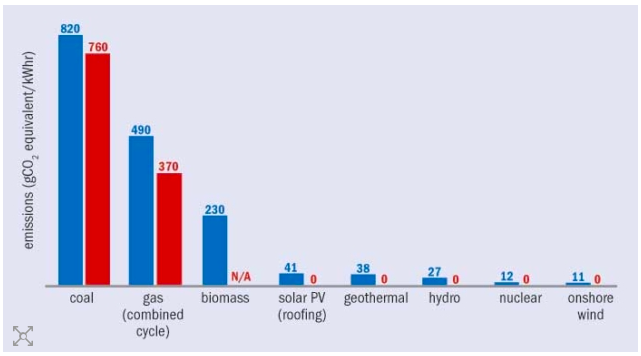
  • Nuclear is a zero-emission clean energy source: It generates power through fission, which is the process of splitting uranium atoms to produce energy. The heat released by fission is used to create steam that spins a turbine to generate electricity without the harmful by-products as emitted by fossil fuels.   
    Chart, bar chart

Description automatically generated
    Fig: A comparison of direct GHG emission (red bars) and full life cycle emissions (blue bars)

  • Nuclear energy’s land footprint is small: Despite producing massive amounts of carbon-free power, nuclear energy produces more electricity on less land than any other clean-air source. A typical 1,000-megawatt nuclear facility needs a little more than 1 square mile to operate which is 360 times less than wind plant and 75 times less than solar plant.
  • Nuclear energy produces minimal waste: Nuclear fuel is extremely dense. It’s about 1 million times greater than that of other traditional energy sources and because of this, the amount of used as nuclear fuel is not as big as you might think. 
image 12

Nuclear power is not without significant disadvantages and risks that warrant consideration:

  • Safety concerns: Nuclear accidents like Chernobyl and Fukushima have demonstrated the catastrophic dangers of nuclear power when safety systems fail. In Indian context high population density, limited water resources and seismic instability in some regions amplify the risks and potential impacts of an accident should one occur..
  • Weapons proliferation: Nuclear technologies and by-products like plutonium can potentially enable weapons proliferation if misused or mishandled. India must ensure its ambitious nuclear plans strengthen oversight, safeguards and the civilian orientation of its programs to avoid enabling weapons ambitions in unstable regions. 
  • Costs: Although nuclear energy is inexpensive once operational, nuclear power plants are highly capital intensive to construct. Project cost overruns are common. Ex: Flamanville reactor in France is 10 years behind schedule and costs have tripled to $12.7 billion. High costs could deter investment into nuclear and benefit cheaper renewable sources. 
  • Waste disposal: Nuclear plants generate radioactive waste that remains dangerous for thousands of years and there are unresolved issues around waste storage and disposal. Any country pursuing nuclear must develop safe, long-term waste solutions to avoid contamination. 
  • Opportunity costs: Large investments into nuclear energy could divert funds and focus away from renewable sources like solar and wind which are quickly achieving cost parity, often better matched to grid needs, and do not have the same economic, safety or waste risks as nuclear. A balanced approach is needed.
  • Domestic capacity: India's nuclear ambitions depend heavily on foreign reactor designs, fuel sources and technical cooperation, especially from Russia and France. This dependence could compromise India's aim for energy self-sufficiency and technology leadership. Investing in education and R&D is needed. 

Recent technological developments have addressed some nuclear concerns, but not eliminated them entirely:

  • Safety: New reactor designs like advanced light water reactors and fast breeder reactors incorporate more passive safety features, lower meltdown risks and higher tolerance for human error or natural disasters. Ex: AP1000 reactors can withstand earthquakes, tsunamis and have a 72-hour backup system. However, severe accidents remain possible and the "fail-safe" nature of reactors is still debated. Strict regulatory oversight is still needed.
  • Proliferation: Technologies like laser enrichment reduce proliferation risks by making the enrichment process more difficult to replicate, while new fuel types like mixed oxide (MOX) fuel make plutonium more difficult to extract for weapons. However, determined groups could potentially overcome these barriers, indicating safeguards must still be actively pursued. 
  • Costs: Standardized reactor designs, modular components, and improved construction techniques aim to reduce costs through replication and learning curve impacts. Ex: Modular reactors could cost 50-70% less. However, nuclear remains capital intensive, projects often run over-budget, and reliable cost reductions remain uncertain - especially where subsidies or public funds are used.
  • Waste: New reprocessing techniques can recycle used nuclear fuel and recover usable uranium and plutonium. The recycled fuel can power advanced reactors, minimizing waste. India uses a plutonium-uranium extraction process. However, reprocessing still results in radioactive byproducts that require storage. And it can increase proliferation risks which must be addressed.
  • Renewable integration: Nuclear technology startups are developing smaller, more flexible reactors to complement intermittent renewable sources, providing low-carbon baseload when needed. Ex: NuScale's small modular reactors can balance loads. However, variable renewable costs are rapidly declining as technologies and coupled with storage, could potentially reduce need for large baseload capacity from nuclear. 
  • Domestic capacity: India has established domestic manufacturing capabilities for nuclear components like coolant pipes, centrifuges, and control mechanisms through partnerships between the NPCIL and private industry. India also has a well-developed nuclear fuel cycle, including facilities for mining, milling, conversion, enrichment, and fuel fabrication, as well as facilities for reprocessing spent nuclear fuel. India is also developing advanced nuclear technologies, such as fast breeder reactors and thorium-based reactors. However, India still imports key reactor components from Russia and France due to limited technical experience. Developing a robust domestic supply chain will take time.
CONCERNS OF NUCLEAR ENERGYTECHNOLOGICAL ADDRESS OF THE CONCERNS
Safety concernsNew reactor designs like advanced light water reactors and fast breeder reactors incorporate more passive safety features, lower meltdown risks and higher tolerance for human error or natural disasters
Weapons proliferationTechnologies like laser enrichment reduce proliferation risks by making the enrichment process more difficult to replicate, while new fuel types like mixed oxide (MOX) fuel make plutonium more difficult to extract for weapons
High CostsModular reactors could cost 50-70% less.
Waste disposalNew reprocessing techniques can recycle used nuclear fuel and minimize waste. Ex: Fast breeder reactors can generate more fuel than they consume.
Opportunity costsRenewable integration: Nuclear technology startups are developing smaller, more flexible reactors to complement intermittent renewable sources, providing low-carbon baseload when needed. Ex: NuScale's small modular reactors can balance loads.
Domestic capacityIndia also has a well-developed nuclear fuel cycle, including facilities for mining, milling, conversion, enrichment, and fuel fabrication, as well as facilities for reprocessing spent nuclear fuel. India is also developing advanced nuclear technologies, such as fast breeder reactors and thorium-based reactors.

So nuclear technology offers promise but no panacea. Its viability, costs and necessity in any country's energy mix depends on a comparison to all available options - and selection of the optimal diverse, balanced and sustainable supply with fair consideration of risks and benefits. An open and honest appraisal is still most prudent with any pursuit of nuclear power.

  • Energy security: India has a severe energy deficit and high dependence on coal, with over 70% of electricity generated from coal. Nuclear power provides energy security by diversifying fuel sources for electricity and reducing overreliance on any single source. Ex: France derives over 70% of its electricity from nuclear, ensuring stable supply.
  • Energy poverty: Energy poverty is a major challenge in India, with millions of people lacking access to basic energy services. Nuclear power can help address this challenge by providing a reliable and affordable source of energy to remote and underserved areas.
  • Low-carbon source: Unlike coal, nuclear power does not emit greenhouse gases and particulate pollution. It can help India meet its climate change mitigation goals under the Paris Agreement as a low-carbon source for base load power. Ex: Sweden aims to phase out fossil fuels in favor of nuclear and renewable energy for a carbon-neutral grid. 
  • Economic benefits: The nuclear power industry creates many jobs in research, reactors construction, and supporting sectors. Kudankulam nuclear plant in Tamil Nadu employs over 2000 people. Nuclear also reduces the need to import expensive fossil fuels. Operation of nuclear plants over 60-100 year lifetimes provide long-term economic value.
  • Energy independence: Domestically produced nuclear fuel reduces dependence on imported energy sources like coal, oil and natural gas - providing greater energy security and independence. India aims to develop its domestic uranium resources and thorium-based reactors. Ex: Canada's uranium mining industry employs over 60,000 people and sustains remote communities. 
  • Reliable: Nuclear power plants operate at over 90% capacity for most of their lifetimes, providing a constant and stable source of baseload power to grids regardless of weather conditions or time of day. Ex: South Korea generates about 30% of its power from nuclear, operating at over 95% capacity.     
  • Existing investments: India has invested heavily in nuclear energy, with 22 commercial reactors operating and 7 under construction. Kudankulam plant alone cost $6.7 billion. Scrapping nuclear prematurely would lead to loss of this investment and wasted capital that could have gained from the plants' operation over 60+ years. 
  • Advanced technologies: New nuclear technologies can strengthen the case for nuclear in India, including more advanced light water reactors, fast breeder reactors, and thorium-based reactors which use domestically available fuel sources.
  • Technological penetration: Development of nuclear reactors can drive technological progress in India through several mechanisms:
    • Materials science: Nuclear reactors require advanced materials that can withstand high temperatures, pressures and radiation over long periods. Progress in materials like zirconium alloys, graphite, and new ceramics has applications in other industries like aerospace, defense, and electronics. India aims to develop silicon carbide composites for future reactors.
    • Manufacturing: High-precision manufacturing techniques are needed to produce nuclear reactor components. Electron beam welding, 3D printing processes etc require technical skills that translate to other sectors. India's Make in India initiative aims to localize nuclear supply chains to support manufacturing growth.
    • Robotics: Nuclear reactors utilize robotics for inspection, maintenance and handling of radioactive materials. Developments in robotics, sensors and remote tooling have spin-off benefits for fields like space exploration, mining, and hazardous waste management. 
    • Sensors and monitoring: Nuclear reactors employ advanced sensors, detectors and real-time monitoring technologies to control processes, detect anomalies and prevent accidents. Technologies like optical spectroscopy, radiation mapping and ultrasonic transducers have medical, security and industrial applications. 
  • Fusion: Research in nuclear fusion aims to develop clean, abundant energy by replicating the processes of the sun on earth. Fusion programs push boundaries in areas like advanced electromagnets, plasma physics and high-heat materials that ultimately benefit sectors like space travel, computing, and accelerator science. India operates an experimental tokamak fusion device.

Renewable Energy Technology Action Platform (RETAP)

Context: US Department of Energy (DOE) and Ministry of New and Renewable Energy (MNRE) have together launched US-India Renewable Energy Technology Action Platform (RETAP) under the Strategic Clean Energy Partnership. 

About Renewable Energy Technology Action Platform

  • RETAP was announced by Prime Minister of India and President of USA during PM Modi's visit of USA in 2023 for expanding collaboration on new and emerging technologies to accelerate the clean energy transition. 
  • RETAP is intended to advance new and emerging renewable technologies for deployment and scaling up in result oriented, time bound technology focus orientation. 
  • The initial focus will be on green/clean hydrogen, wind energy, long duration energy storage, exploration of geothermal energy, ocean/tidal energy and other emerging technologies as mutually determined in the future.

Work under the RETAP is guided by five themes

  • Research & Development
  • Piloting & Testing of Innovative Technologies
  • Advanced Training & Skill Development
  • Policy & Planning for Advancing Renewable Energy Transition and enabling technologies
  • Investment, Incubation and Outreach programs

Green Hydrogen Standard

Context: Ministry of New & Renewable Energy has notified the Green Hydrogen Standard which outlines the emission thresholds that must be met for hydrogen produced to be classified as 'Green', i.e., from renewable sources. This move is expected to bring a clarity to Green Hydrogen community in India and contribute to the progress of National Green Hydrogen Mission. India has become one of the first few countries in the world to announce a definition of Green Hydrogen.

Green Hydrogen Standard

  • Green Hydrogen shall mean Hydrogen produced using renewable energy, including production through electrolysis or conversion of biomass. Renewable energy also includes such electricity generated from renewable sources which is stored in an energy storage system or banked with grid in accordance with applicable regulations.
  • Green Hydrogen produced through electrolysis: Non-biogenic greenhouse gas emissions arising from water treatment, electrolysis, gas purification and drying and compression of hydrogen shall not be greater than 2 kg of CO2 equivalent per kg of Hydrogen, taken as an average over last 12 month period. 
  • Green Hydrogen produced through conversion of biomass: Non-biogenic greenhouse gas emissions arising from biomass processing, heat/steam generation, conversion of biomass to hydrogen, gas purification and drying and compression of hydrogen shall not be greater than 2 kg of CO2 equivalent per kg of Hydrogen taken as an average over last 12 month period.
  • Bureau of Energy Efficiency shall be the Nodal Authority for accreditation of agencies for monitoring, verification and certification of Green Hydrogen production projects. 
  • A detailed methodology for measurement, reporting, monitoring, on-site verification and certification of green hydrogen and its derivatives shall be specified by Ministry of New & Renewable Energy.

India may join offshore wind alliance

Context: India is “very actively" considering joining the Global Offshore Wind Alliance in an attempt to improve its energy transition standing, said Gauri Singh, deputy director general of the International Renewable Energy Agency (IRENA), which played a key role in forming the alliance.

What is global offshore wind alliance (GOWA)?

image 429
  • The alliance was initiated by the International Renewable Energy Agency (IRENA), Denmark and the Global Wind Energy Council.
  • It will bring together governments, the private sector, international organisations and other stakeholders to accelerate the deployment of offshore wind power.
  • It has the aim of reaching global offshore wind capacity of at least 380 GW by 2030.
  • Countries joining GOWA have agreed to work together to drive national, regional, and global ambitions and remove barriers to the deployment of offshore wind in new and existing markets. 
  • Offshore wind can be deployed at large scale, in short timeframes and at competitive cost.

What is Global Wind Energy Council (GWEC)?

  • The Global Wind Energy Council is the international trade association for the wind power industry.
  • GWEC is a member-based organisation that represents the entire wind energy sector. 
  • The members of GWEC represent over 1,500 companies, organisations and institutions in more than 80 countries, including manufacturers, developers, component suppliers, research institutes, national wind and renewables associations, electricity providers, finance and insurance companies.

GWEC India – a single advocacy and research body representing the entire value chain of India’s wind industry, from IPPs to OEMs to end-users to service-providers – will work closely with central and state governments to improve the enabling environment for sector growth, creating the conditions for inward investment in the tens of billions of dollars.

What is offshore wind energy?

Offshore wind power or offshore wind energy is the energy taken from the force of the winds out at sea, transformed into electricity and supplied into the electricity network onshore.
It is the clean and renewable energy that is produced on the high seas, where it reaches a higher and more constant speed than on land due to the absence of barriers. In order to make the most of this resource, mega-structures are installed that are seated on the seabed and equipped with the latest technical innovations.

Benefits:
1. Renewable, unlimited and non-polluting.

2. Reduces pressure on land resource.

3. Barrier free regions thus higher wind speed and efficiency

4. Visual and acoustic impact is small5. No issues of land acquisition.
6. The ease of maritime transport, which has few limitations with regard to cargo and dimensions in comparison with land transportation, has made it possible for offshore wind turbines to reach much larger unit capacities and sizes than onshore wind turbines.

India and offshore wind energy:


India is blessed with a coastline of about 7600 km surrounded by water on three sides and has good prospects of harnessing offshore wind energy. Considering this, the Government had notified the “National offshore wind energy policy” as per the Gazette Notification dated 6th October 2015. As per the policy, Ministry of New and Renewable Energy will act as the nodal Ministry for development of Offshore Wind Energy in India and work in close coordination with other government entities for Development and Use of Maritime Space within the Exclusive Economic Zone (EEZ) of the country and shall be responsible for overall monitoring of offshore wind energy development in the country. National Institute of Wind Energy (NIWE), Chennai will be the nodal agency to carryout resource assessment; surveys and studies in EEZ demarcate blocks and facilitate developers for setting up offshore wind energy farms.

Focus on Methane emissions at COP-28

Context: Speaking at the inaugural UAE Climate Tech summit,  COP28 President Designate Sultan Ahmed Al Jaber called upon the oil and gas industry to phase out methane emissions by 2030 and align in favour of comprehensive net-zero emission plans by or before 2050.

COP28, or the 28th United Nations Climate Change conference is scheduled to be held between November 30 and December 12 in the UAE.

Methane & Climate Change

  • Methane is the second most abundant anthropogenic GHG after carbon dioxide (CO2), accounting for about 20 percent of global emissions.
  • It is emitted from a variety of anthropogenic and natural sources.
  • Anthropogenic emission sources include landfills, oil and natural gas systems, agricultural activities, coal mining, stationary and mobile combustion, wastewater treatment, and certain industrial processes.
  • Methane emissions are among the top causes of global warming and according to Paris-based International Energy Agency (IEA), fossil fuel operations generate over one-third of all methane emissions from human activity. Thus, action on methane is seen as one of the most effective measures the energy sector can take to mitigate climate change.
  • It is a hydrocarbon that is a primary component of natural gas.
Methane hydrates is a frozen methane locked inside the microscopic cages composed of water molecules. They are found in continental slopes where pressure is high and temperature is low. India’s coastal region is rich in Methane Hydrates.
Methane

Initiatives

International Methane Emissions Observatory (IMEO)

  • The International Methane Emissions Observatory (IMEO) was launched at the G20 Summit, on the eve of the COP26 UN climate conference in Glasgow.
  • It is a data-driven, action-focused initiative by the UN Environment Programme (UNEP) with support from the European Commission to catalyse dramatic reduction of methane emissions, for achieving Paris agreement goals.
  • An Eye on Methane (2021) is the report by International Methane Emissions Observatory 2021
  • IMEO will initially focus on methane emissions from the fossil fuel sector, and then expand to other major emitting sectors like agriculture and waste.
  • This will allow IMEO to engage companies and governments around the world to utilize this data to target strategic mitigation actions and support
  • science-based policy options.
  • IMEO will provide the means to prioritize actions and monitor commitments made by state actors in the Global Methane Pledge (Launched at Glasgow, COP26) – a US and EU-led effort by over thirty countries to slash methane emissions by 30 per cent by 2030. 
  • India has not signed up for the pledge.

Global Methane Initiative

  • It is an international public private partnership focused on reducing barriers to the recovery and use of methane as a valuable energy source.
  • GMI provides technical support to deploy methane to energy projects around the world that enable Partner Countries to launch methane recovery and use projects. 
  • GMI advances methane mitigation in 3 key sectors: Oil & Gas, Biogas (including agriculture, municipal solid waste, and wastewater) and Coal Mines.
  • Methane emissions from Oil & Gas Sector: Methane emissions from oil and natural gas systems result from both normal operations and system disruptions. These emissions can be cost-effectively reduced by upgrading technologies or equipment, and by improving operations.
  • Methane emissions from Biogas Sector: Biogas produced from the anaerobic digestion of organic material or emitted directly from landfills can be treated to create pipeline-quality natural gas, used as a cooking fuel, used to generate electricity, and captured on-site to provide heat and power.
  • Methane emissions from Coal Mines Sector: Removing fugitive methane gas from underground coal mines and using it in profitable and practical ways can improve worker safety, enhance mine productivity, increase revenues, and reduce greenhouse gas emissions.
  • Membership: GMI Partner Countries account for approximately 70% of global manmade methane emissions. India is a member of this organisation.

Through these efforts, GMI aims to:

a. Decreasing greenhouse gas emissions

b. Improving human health

c. Increasing worker safety

d. Improving air and water quality

e. Enhancing energy security

f. Expanding economic growth

Global Methane Assessment

  • The assessment was launched by Climate & Clean Air Coalition (CCAC) together with UNEP.

Key findings:

  • Europe has greatest potential to curb methane emissions from farming, fossil fuel operations & waste management.
  • India has greatest potential to reduce methane emissions in the waste sector.
  • China’s mitigation potential is best in coal production and livestock.
  • Africa’s mitigation potential is in livestock, followed by oil and gas.
  • Methane in the atmosphere reached record levels in 2020, which is a cause of concern as it is an extremely powerful GHG and is responsible for about 30 per cent of warming since pre-industrial times. 
  • However, carbon dioxide levels have dropped during the Covid-19 pandemic due to the lockdowns and travel restrictions.

Over half of the heavy industry eyeing Low Carbon hydrogen

Context: As many as 62% of heavy industrial organisations across sectors are considering using low-carbon hydrogen to replace carbon-intensive systems, according to a recent report from the Capgemini Research Institute titled "Low Carbon Hydrogen - A Path to a Greener Future." According to the report, Energy and Utilities (E&U) companies anticipate Low-Carbon hydrogen to account for 18% of all energy use by 2050, and demand from more than half of organisations has increased by more than 10% in France, India, the United Kingdom, Japan, the United States, Germany, and Sweden.

Hydrogen as a fuel for the future

  • According to the International Energy Agency (IEA), hydrogen has the potential to be a key component of our transition to a clean energy future. 
  • However, for hydrogen to truly contribute to the energy transition, it must be used in industries where it is currently almost non-existent, such as transportation, construction, and power generation.
  • To identify ways to accelerate its adoption, the World Economic Forum developed the Accelerated Clean Hydrogen Initiative as part of its Climate Action Platform, Shaping the Future of Energy, Materials, and Infrastructure. 
  • Generating electricity from hydrogen does not produce pollution because the by-product is only heat and water.

Types of Hydrogen

When burned, hydrogen emits only water, although its production can be carbon intensive. As a result, several methods for reducing this impact have been devised, and depending on production methods, hydrogen can be grey, blue, or green, and sometimes pink, yellow, or turquoise, however naming practises vary across countries and over time.

iffrZk4QXZ9cizRJw2LI0Zgm x0rIuvAxDJ ZpgoQpR9rDOC4Wbp6BAJF0 QnNjPNe ijnvvcv44FHlZLYJB9DB2p83Sk6QIq hlRyNY65ixWnjwI6XsvBvtaxZGoldrKutYrxIDxfKR3 uT03oLjw

Green Hydrogen: 

  • The only variety that is created in a climate-neutral manner. It could be vital in the worldwide effort to achieve net-zero emissions by 2050. 
  • Also referred to as 'Clean hydrogen' is produced by splitting water into two hydrogen atoms and one oxygen (electrolysis process) atom using clean energy from surplus renewable energy sources such as solar or wind power. 
  • It presently accounts for roughly 0.1% of total hydrogen production, but this figure is likely to climb as renewable energy costs continue to fall. 
  • Ideal method to balance the Intermittency of Renewables: Storing excess energy during periods of low demand to be fed back into the grid when need increases, while de-carbonizing the chemical, industrial, and transportation sectors.

Grey hydrogen

  • It is the most prevalent type and is produced from natural gas, or methane, by a process known as "steam reforming". This technology emits far fewer emissions than black or brown hydrogen, which employ black (bituminous) or brown (lignite) coal in the hydrogen-production process. It produces carbon dioxide as a by-product.

Black/Brown Hydrogen

  • The main issue with black/ brown hydrogen is that they still produce a significant amount of greenhouse gases, and there is no Carbon Capture and Storage (CCS) as part of the process to mitigate this. Black and brown hydrogen are produced using fossil fuels. The process involves converting coal into gas.

Blue hydrogen

  • It is produced from hydrocarbons where the emissions generated from the process can be captured and stored. They are stored underground by industrial carbon capture storage (CSS). Therefore, sometimes referred to as being carbon neutral.
  • It is a better alternative compared to grey hydrogen.
  • There are arguments that it should be labelled as “low carbon”, as a more accurate description since 10 to 20% of the generated carbon cannot be captured.

Pink hydrogen

  • Nuclear produced hydrogen, often referred to as pink (or sometimes purple or red) is generated through electrolysis. The very high temperatures from nuclear reactors could also be used in other hydrogen productions by producing steam for more efficient electrolysis or fossil gas-based steam methane reforming.

Yellow hydrogen

  • It is the term used for hydrogen made through electrolysis of water using solar power, although some use it to mean hydrogen generated through electrolysis of water using mixed sources depending on what is available. 

Turquoise hydrogen

  • Its production is still in the experimental phase. It sits between blue and green hydrogen and uses methane pyrolysis as a production method. The outputs of this process are the hydrogen and carbon, however unlike steam reformation the carbon is solid.  This means there’s no requirement for CCS, the solid carbon can be used in other applications such as a soil improver or the manufacturing of goods like tyres.

Challenges

  • Economic Sustainability: One of the major obstacles that the industry faces in commercialising hydrogen is the economic sustainability of harvesting green or blue hydrogen. 
  • The electrolysis process, which is used to make green hydrogen, takes a considerable quantity of electricity, and renewable electricity is quite expensive. 
  • Nascent stage technology: Carbon capture and storage (CCS) and hydrogen fuel cell technologies are in their early stages and are expensive, which raises the cost of hydrogen production.
  • In India, there is currently a scarcity of infrastructure for the generation, storage, and transport of green hydrogen. This includes a scarcity of hydrogen refuelling stations and pipes for hydrogen transport.
  • Limited Adoption: Despite the potential benefits of green hydrogen, adoption of this technology in currently restricted. 
  • This is owing to a lack of public awareness and comprehension of green hydrogen, as well as a lack of incentives for businesses to use this technology.
  • Cost competitiveness: One of the main issues facing the industry in commercialising hydrogen, is the extraction of green hydrogen. 
  • On a per-mile basis, hydrogen must be cost-competitive with conventional fuels and technology for transportation fuel cells.

Way Forward

  • Increasing the use of renewable energy sources, so as to minimise the cost of green hydrogen generation.
  • Improve in infrastructure for its production, storage, and delivery: Construction of hydrogen refuelling stations as well as pipes, for transporting hydrogen and make green hydrogen more accessible. 
  • Role of Governments: By implementing regulatory incentives such as tax credits and subsidies to encourage the production and use of green hydrogen, the government can play a critical role in boosting its acceptance.

Carbon Capture, Utilisation & Storage (CCUS)

They are a group of technologies for capturing of CO2 from large and stationary CO2 emitting sources, such as fossil fuel-based powerplants and other industries. CCUS also involves the transport of the captured CO2 to sites, either for utilisation in different applications or injection into geological formations or depleted Oil & Gas fields for permanent storage and trapping of CO2.

Neef for Carbon Capture (CCUS) Technologies

  1. Necessary to decarbonise hard to electrify sectors: CCUS offers only known technology for decarbonising the hard to electrify and CO2 intensive sectors such as steel, cement, oil & gas, petrochemicals & chemicals and fertilisers.
  2. Hydrogen economy: CCUS is expected to play a critical role in enabling hydrogen economy through production of blue hydrogen (i.e., coal gasification based hydrogen production with CCUS) based on India’s rich coal endowments.
  3. Sustenance of existing emitters: Nearly two-thirds of India’s 144 mtpa crude steel capacity and 210 GW of coal-based power capacity have an age of less than 15 years and cannot be wished away or stranded and need to be made sustainable by retrofitting with CO2 capture and disposition infrastructure. 

Carbon Capture Technologies

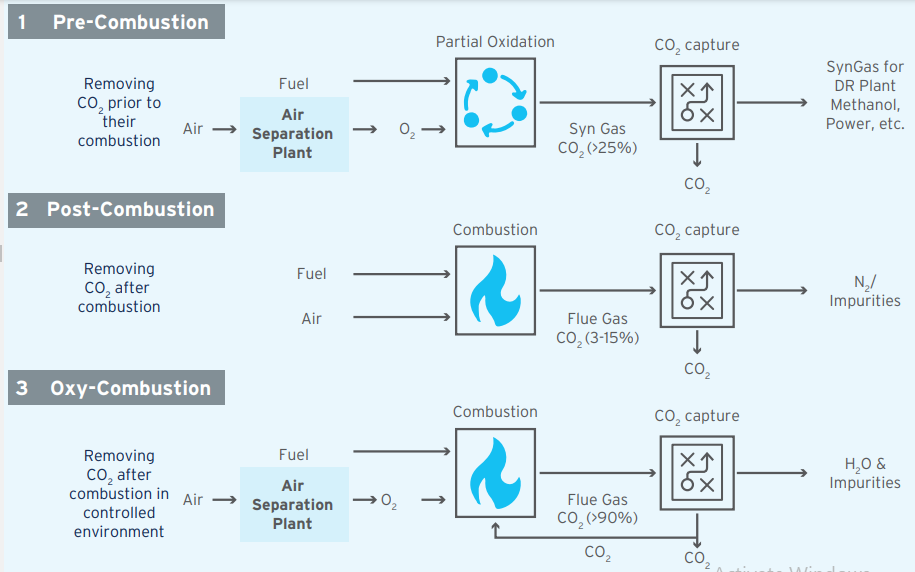
There are three broad categories of technologies for Capturing CO2:

  1. Post-combustion technologies: CO2 is separated from the flue gas after combustion. Fossil fuels like coal, oil, natural gas etc. are burnt in the presence of air. Hence, the flue gas is rich in N2 and the CO2 percentage typically varies between 3-15%. Since the partial pressure in CO2 in the flue gas is quite low, very high-volume chemical solvent (amine) circulation is required for CO2 capture. This makes post-combustion technologies energy and cost intensive.
  2. Pre-combustion technologies: This involve removing CO2 through upstream treatment of fossil fuels before combustion. Major difference between pre-combustion & post-combustion is that the former is favoured in cases where the gas stream has a higher partial pressure of CO2, such as in gasification of fossil fuels, natural gas based H2 production or sour gas processing. Since no chemical bonds need to be broken for solvent regeneration, the thermal energy penalty is much lower. The regeneration of physical solvent is primarily achieved by reducing pressure.
  3. Oxy-fuel combustion technologies: While post & pre-combustion carbon capture technologies have been commercially established, oxy-fuel combustion technologies are still in the development stage. Oxy-fuel combustion represents an emerging novel approach to near zero-emission. It is accomplished by burning the fuel in pure oxygen (O2) instead of air (O2 & N2). The flue gas stream would be primarily composed of water & CO2, rather than N2. High-purity CO2 can be recovered by condensation of water.

Direct Air Capture (DAC): DAC directly captures dilute CO2 (at 415 ppm) from the air and may also emerge as a form of carbon capture that has wide applicability, as it is independent of the source and concentration of the emission stream.

However, DAC is still in early stages and the economics and scale of operations are yet to be established.

a S4lT5UyfG6ni58lbbMX11afYdySzKM1RXYnwKseUvrRxU7TivLUqsO P0KvGWVG uHux3TxR4rrePvOIinQw0OYWKRDbh 9FafuFoLAUg9kNhxb6tTNg dTl43qZ9cak97KJf1mT4RIoTO 28H1A

CO2 Capture technologies

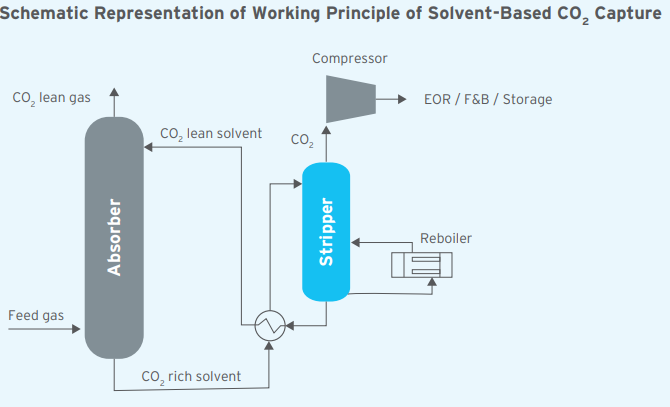
Solvent-based absorption: Solvent based CO2 capture processes have been used for processing natural (sour) gas, combustion flue gas and Fischer-Tropsch (FT) synthesis products. The fundamental principle on which solvent-based CO2 capture technologies work is selective absorption of CO2 over other gaseous constituents.  

The CO2  present in the feed/process gas is first selectively absorbed in an absorber using a solvent (physical  or chemical), the CO2 lean gas exits the absorber. The CO2 rich solvent is sent to a stripper type configuration where CO2 is released from the solvent and the lean solvent is regenerated for reuse. 

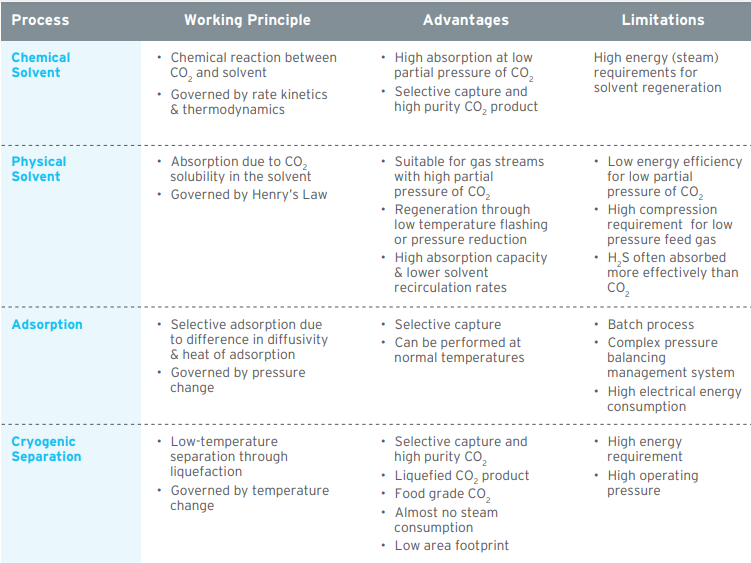
Solvent based CO2 capture technologies are classified into:

Diagram

Description automatically generated
  1. Physical solvent-based absorption: CO2 gets physically dissolved in the solvent. This method performs well at higher partial pressure of CO2. Ex. Higher gas stream pressure and CO2 concentration in Syngas of gasifiers and SMRs make physical absorption-based capture more suitable. 
  2. Chemical solvent-based absorption: CO2 reacts with solvent chemically. This method is better suited for gas-streams having low concentration and partial pressure of CO2 due to the high chemical affinity to CO2 to amine/carbonate based chemical solvents and faster rate kinetics.  Ex. In Low CO2 partial pressures in the flue gas of coal-fired power plants make amine based chemical absorption preferred technique. Common solvents used as: Amine based solvents, Non-Aqueous Solvents, Carbonate-based solvents etc. While primary and secondary amines (such as MEA, DGA, AEE, DEA) have higher reaction rates and lower CO2 carrying capacities, tertiary, and polyamines (such as MDEA and piperazine) have lower reaction kinetics and higher CO2 carrying capacities. 
  3. Adsorption: In this process, CO2 molecules selectively adhere to the surface of adsorbent material and form a film due to difference in diffusivities and heat of absorption values for feed gas stream components. This method is suitable for gas streams with moderate to high pressure and moderate CO2 concentration such as SMR flue gas or BF gas.
  4. Cryogenic separation: This process like conventional distillation process, except that it involves separation of components from a gaseous mixture (instead of liquid) based on the difference in their boiling points. This technology is preferred in cases where cost of power is low. This technology provides a unique advantage by generating additional hydrogen without increasing the amount of feedstock (natural gas)/producing the same quantity of hydrogen with lower natural gas consumption. 
  5. Microalgae based carbon capture: Microalgae utilise the sparsely concentrated CO2 from atmosphere via Carbon Concentrating Mechanism (CCM) and thus are well-qualified for CO2 capture from a more concentrated stream of flue gas. Microalgae use CO2 as a nutrient for cultivation of microalgae. Microalgae can be cultivated in saline water systems as well and do not compete with food crops for arable land for cultivation. Due to faster growth cycle of microalgae, they can typically entrap 10-50 times more CO2 compared to terrestrial plants. They can also deacidify the seawater or wastewater used for their cultivation. This technology is, however, in its nascent stage.
McxDF6Fnc Lzu5od3xS fMEmV1 Z6e0P3w3mpTmp8LahgF2IK8xAFlWJs1VsM4tBUwlduwXQZU5loU woyoZwINJDlOBEUXiD jmXZcGvwrOwg 0RKFyHfoWF2ItWXqQNnvi 9hjlc WtRyaoUoMog

End use of captured CO2 can be either utilisation or permanent storage. 

CO2 UTILISATION TECHNOLOGIES

Rising interest in CCUS as a decarbonisation solution across industries, there is an also a need to look at CO2 utilisation pathways and technologies that are most appropriate for India. Some proven technologies for utilisation of captured CO2 are:

  1. Enhanced Oil Recovery (EOR): CO2 is used in EOR to produce low-carbon oil from maturing oil fields. EOR can help India towards residual oil extraction that is environmentally sustainable and economically feasible.
  2. Green Urea: Urea production from green ammonia can utilise a significant part of CO2. India’s production of ammonia is primarily based on imported LNG. 
  3. F&B applications: CO2 can be utilised in applications such as carbonated drinks, dry ice and modified atmosphere packing. However, scales are quite small compared to the volume of CO2 generation.
  4. Building Materials (Concrete & Aggregates): Utilising CO2 for producing building materials (aggregates & concretes) is likely to be the most attractive and feasible option. CO2 can be used both during concrete curing & aggregate formation. 
  5. Chemicals (Methanol & Ethanol): CO2 can be used production of chemicals such as methanol and ethanol at commercial scales. 

Methanol is a low carbon hydrogen carrier that can support applications like fuel substitution and act as intermediate to produce various speciality chemicals like acetic acid, MTBE, DME and formaldehyde producing products like adhesives, foams, plywood subfloors etc. CO2 hydrogenation process is used to convert captured CO2 into methanol.

Ethanol can be produced by ethylene hydration or biological processes using H2, CO and CO2 by biological gas fermentation process. Ethanol can be blended with Petrol to reduce fuel import bill.

  1. Polymers: CO2 can be converted into various polymers such as polyether carbonates, polycarbonates, diphenyl carbonate, cyclic carbonates etc. A polymer product of CO2 named AirCarbon has found multiple applications (Laptop packaging, cell phone casings, furniture etc.)

CO2 Storage Options

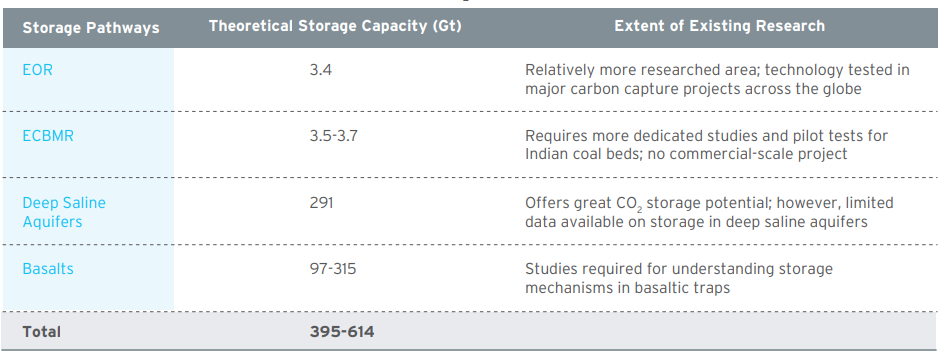
  1. Enhanced Oil Recovery (EOR): Ex. In India, Mumbai High, Assam shelf, Krishna Godavari basin & Cambay basins are prominent sites for storage of CO2. In CO2 EOR, compressed CO2 is injected into the reservoir. At high densities, CO2 is readily miscible with oil. It swells the oil and reduces its viscosity, thereby driving it away from rock formations and towards the production wells. It is estimated that 3.4 Gt of storage is available in India for CO2 storage. 
  2. Enhanced Coal Bed Methane Recovery (ECBMR): In this method, CO2 is injected into unmineable coal seams under supercritical conditions. The CO2 injected is accumulated in the coal cleats in a dense gas phase. This CO2 is adsorbed and absorbed in the coal. Since CO2 has a higher affinity for coal than CBM, it pushes the coal bed methane towards production wells, thus enhancing its primary recovery. Similar to CO2 EOR, ECBMR can help in permanently storing CO2 and the recovered methane can also help offset the cost of carbon captureThe potential for ECBMR is localized in the eastern region due to the presence of major coalfields. These can be storage clusters for industries that are close to the coalfields, such as steel and power plants.
  3. CO2 storage in Deep Saline Aquifers: Captured CO2 can be permanently stored in deep saline aquifers. Deep saline aquifers consist of porous rock formation that contains high quantities of unusable saltwater. Salt/mineral content is very high in this water rendering it unusable for human use. Brine water is called formation liquid and it is trapped by an impermeable rock called caprock. However, compared to EOR or ECBMR, injection of CO2 in deep saline aquifers has no economic benefit.  
  4. CO2 storage in Basalts: Basaltic rocks constitutes divalent cations of Ca, Mg and Fe. They can react with CO2 dissolved in water to form stable carbonate minerals and thus can offer a safe CO2 sequestration method. Compared to saline aquifers, basalt rocks offer faster reaction kinetics due to abundance of iron, calcium and magnesium oxides. Abundance of basalts on Earth’s surface is the reason interest in CO2 storage R&D programs in basalts. 
Table

Description automatically generated with medium confidence

Pumped Storage Projects

Presently, Pumped Storage Projects (PSP) and Battery Energy Storage Systems (BESS) are the major feasible options to store Renewable Energy. Recently, the Ministry of Power has issued draft guidelines to promote the development of Pump Storage Projects (PSP) in the country.

Under the draft guidelines, the ministry has asked the states to:

  • Consider exempting stamp duty and registration fees for the land for PSP projects.
  • Give government land at concessional rates for such projects.
  • Avoid double taxation, and provide relief in the State Goods and Services Tax (SGST).

Pumped Storage Projects (PSP):

  • Pumped storage projects (PSPs), often called ‘giant batteries,’ is a type of hydroelectric energy storage system. The internationally accepted technology is conventionally used to stabilise the grid and maintain peak power.
  • These projects store appreciable amounts of energy and release it when required. The present installed capacity of PSPs in the country is 4745 MW and another 1500 MW capacity is under active construction.
  • Some of the operational PSP plants exist in Telangana (Nagarjuna Sagar, Srisailam), Tamil Nadu (Kadamparai), Maharashtra (Bhira, Ghatgar), and Purulia in West Bengal.

Mechanism:

  • The PSPs comprise two water reservoirs connected through a tunnel or underground pipe at different heights.
  • When there is more electricity production and less demand, these projects pump water from the downward reservoir to the upward reservoir.
  • When more energy is needed, water is pushed from the uphill to the downhill via a turbine to produce the required power instantly.
image 22

Advantages:

  • PSPs are clean, megawatt-scale, domestically available, time-tested, and internationally accepted.
  • PSPs are clean, green, safe, and non-explosive as they do not produce any poisonous/ harmful by-products or pose disposal problems.

Concerns:

  • Several issues have halted the growth of PSPs in India including, higher upfront costs, the high tariff of power used to pump water uphill, and the long gestation period of such projects due to several approvals like environmental clearance and other formalities.

PSPs vs BESS:

  • Currently, the price of batteries is rising and stands around Rs. 8-10 per unit (1 kilowatt-hour), and their price is dynamic depending on changing geopolitics and other reasons. Although the upfront cost of PSPs is higher, its operational cost per KwH is lower than that of battery storage systems.
  • PSPs lose around 20-30% of the energy in their storage process but have a longer duration supply than battery systems. While the lead acid batteries can work up to 2-6 hours, PSPs can supply energy ranging from six to 20 hours.
  • PSPs have a long gestation period, and their capacity is dependent on location, however, they have a longer life. BESS have a short gestation period, and are non-dependent on location (mobile) but limited by the availability of minerals and technology.

Way Forward:

  • To improve the uptake of PSPs in the grid, differential pricing should be explored (instead of a flat energy charge) that will increase PSP profitability, and generation-based incentives should be provided.  
  • The government could consider allowing Foreign Direct Investment (FDI) for PSPs as they are available for other renewable projects.

Waste Management Technologies (SHESHA & RAPID COMPOSTING)

A Start-up Entrepreneurship Workshop was organized by Atal Incubation Centre (AIC) – BARC, DAE Convention Centre.

  • AIC-BARC is established under the ambit of the Atal Innovation Mission (AIM), NITI Aayog to create a start-up eco-system based on spin-off technologies of the Department of Atomic Energy (DAE).
  • AIC-BARC has been set up in line with the “Aatma Nirbhar Bharat”
  • In the workshop, two technologies namely SHESHA (for wet waste management) and Rapid Bio-composting (for dry waste management) were introduced by BARC scientific experts.

SHESHA TECHNOLOGY:

  • SHESHA is a novel, compact helical-shaped waste converter aimed to manage the biodegradable waste generated in small housing societies, restaurants, etc. in-situ, thus allowing decentralized processing of the biodegradable waste. 
  • The system has tremendous potential to process the waste as well as the generation of good quality fuel and manure required for soil applications. 
  • The name Shesha has been given on the basis of the serpentine shape of the digester (its resemblance to the snake Shesha) as well as the Sanskrit name of waste.

Ra0a3lxxdB95GA

fP ntXvw 5 mYRwBBtdSsXYi0o FAYMRZrnxZSRyMXfzW7BgwMx5ozkE umm4gLrrdiJCut7nvRg muawMQZN85UjOtXMwVthm8U9RBQhxzXIHIRpYNRo6NmaHjDX1Pt0 U5AJB8Mpk4N2dgQfvGmg

Advantages:

  • Helical-shaped digester made from low-cost PVC pipes.
  • Saving major costs of construction and MS dome required for conventional designs.
  • Suitable for skid mounting on vehicles or wheels required for processing waste from smaller societies/residential complexes.
  • Have inbuilt suitability for biogas recycling for methane enrichment.
  • Suitable for online monitoring of process parameters.

RAPID COMPOSTING TECHNOLOGY

  • ICAR -IISS (Indian Institute of Soil Science) developed this technique in collaboration with ICAR-CIAE, Bhopal and ICAR-NBAIM, Mau.
  • It is based on cellulolytic fungi named Trichoderma koningiopsis isolated from tree bark. 
  • It is safe for the environment and for human handling. 
  • The formulation is capable of composting kitchen waste, agricultural waste, garden waste (dry leaves including coconut leaves) and temple waste. 
  • This method, being completely aerobic in nature, is devoid of foul odour and hence has greater acceptability in society.

STEPS FOR BIO COMPOSTING

  • Collection of biowaste materials
  • Segregation of non-biodegradable materials
  • Waste materials mixed with fresh cow-dung
  • Inoculation with a consortium of organisms
  • All materials mixed together and fed to rapo-compost bioreactor
  • After one month the humified organic manure was allowed for curing
  • Sieved (4 mm sieves) and stored at 25% moisture condition

C2MiWleneK5RR4 IV5d0mWWpqe7DgG1HOumJ6Z6f zDIfe W7DFTLY1ZtRqobgDFyMr40kzWKgMNUq8bmRXLxA7wW6QjNTefl4TUXExDSmR Aixj5EhfqJW5lpn