Prelims Nuggets

NISAR Satellite

Context: National Aeronautics and Space Administration (NASA) and the Indian Space Research Organization (ISRO) have jointly manufactured an earth science satellite named, NISAR (NASA-ISRO Synthetic Aperture Radar) at a cost of about Rs 470 crore.

About NISAR

  • It is an Earth-observation satellite expected to be launched in January 2024 from Satish Dhawan Space Centre in Andhra Pradesh into a near-polar orbit.
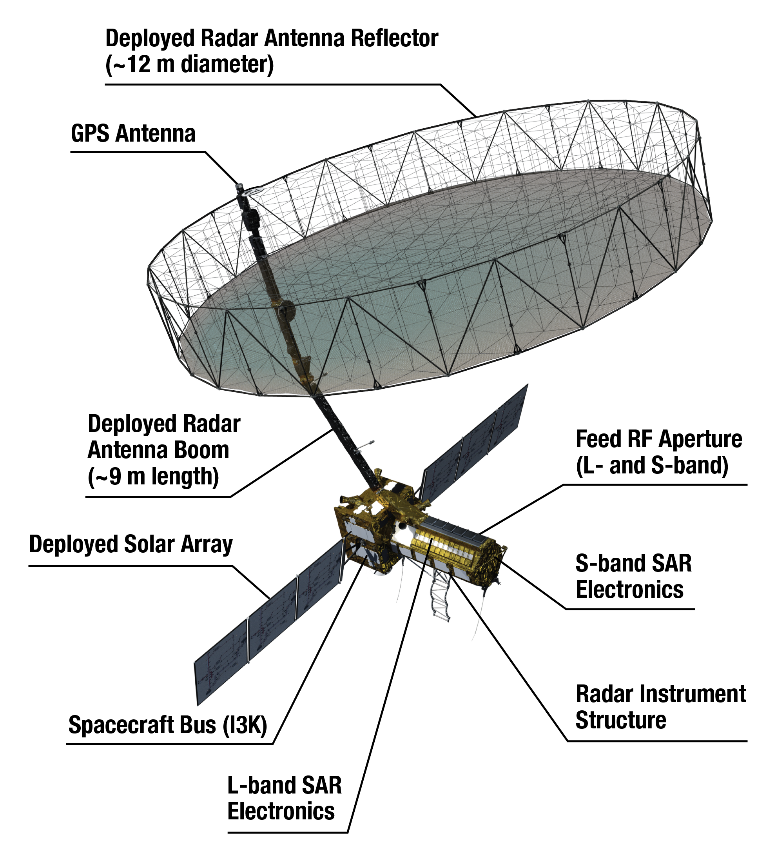
Overview | Observatory – NASA-ISRO SAR Mission (NISAR)

Features

  • The 2,800 kilograms satellite consists of both L-band and S-band synthetic aperture radar (SAR) instruments, which makes it a dual-frequencyimaging radar satellite. SAR is capable of penetrating clouds and can collect data day and night regardless of the weather conditions.
    • L-band SAR operates at a frequency of around 1 to 2 GHz. The lower frequency (higher wavelength) of L-band SAR allows it to penetrate through vegetation and soil, making it useful for monitoring changes in forest cover, soil moisture etc.
    • S-band SAR operates at a frequency of around 2 to 4 GHz. S-band SAR has a higher resolution than L-band SAR and is typically used for applications where higher detail is required, such as monitoring changes in urban areas or coastal zones. 
  • It has a large 39-foot stationary antenna reflector made of a gold-plated wire mesh which will be used to focus the radar signals emitted and received by the upward-facing feed on the instrument structure.
  • The spacecraft will orbit the Earth in a sun-synchronous orbit of 747 Km with an inclination of 98.4 degrees for a 12-day repeat cycle.

Utility

  • Study Earth’s dynamic land and ice surfaces in greater detail and observe subtle changes in Earth’s surfaces. E.g., Track flow rates of glaciers and ice sheets, landslide-prone areas and changes in the coastline etc.
  • Spot warning signs of natural disasters, such as volcanic eruptions, earthquakes and landslides. 
  • Measure groundwater levels, agricultural mapping, natural resource mapping and monitor Earth’s forest and agricultural regions to improve understanding of carbon exchange.

Guillotine, in Parliament

Context: Lok Sabha passed the Demands for Grants for Budget 2023-24 and the Appropriation Bill by a voice vote without any discussion. Speaker applied guillotine and put demands for grants of all ministries to vote.

Guillotine in the context of Indian legislature

  • Discussion on a matter of general public importance can take place only when motion made with the consent of the presiding officer.
  • Guillotine is a type of motion which falls under the category of closure motion.

Closure Motion 

It is a motion moved by a member to cut short the debate on a matter before the House. If the motion is approved by the House, debate is stopped forthwith and the matter is put to vote. 

Types of closure motions  

(a)Simple Closure: It is one when a member moves that the ‘matter having been sufficiently discussed be now put to vote’. 

(b)Closure by Compartments: In this case, the clauses of a bill or a lengthy resolution are grouped into parts before the commencement of the debate. The debate covers the part as a whole and the entire part is put to vote. 

(c)Kangaroo Closure: Under this type, only important clauses are taken up for debate and voting and the intervening clauses are skipped over and taken as passed. 

(d)Guillotine Closure: It is one when the undiscussed clauses of a bill or a resolution are also put to vote along with the discussed ones due to want of time (as the time allotted for the discussion is over). 

In legislative parlance, to “guillotine” means to bunch together and fast-track the passage of financial business. It is a common procedural exercise in Lok Sabha during the Budget Session.

Procedure 

  • Parliament goes into recess of three weeks after the presentation of the budget. This recess allows Standing committees of the house to examine the demands for grants and presenting its report for the same.
  • After the reassembly of the Parliament , Business Advisory committee (BAC) prepares a schedule for the discussion on demands for grant , but due to paucity of time BAC picks up few selected ministries for the discussion.
  • Once the House is done with these debates, the Speaker applies the “guillotine”, and all outstanding demands for grants are put to vote at once. This usually happens on the last day earmarked for the discussion on the Budget. The intention is to ensure timely passage of the Finance Bill, marking the completion of the legislative exercise with regard to the Budget.

Getting it right: a historian’s effort to document the life of Bhagat Singh

Context: The 23rd of March is commemorated as Martyrs Day in honour of Bhagat Singh and his comrades Rajguru and Sukhdev. The day is also known as Shaheed diwas.

Early life of Bhagat Singh

  • Born on September 27, 1907, in the Lyallpur area of the Punjab, now in Pakistan.
  • Bhagat Singh's uncle Ajit Singh was prominent in politics. Ajit Singh led the establishment of the radical Anjuman-i-Mohisban-i-Watan in Lahore and oversaw the publication of its newspaper, Bharat Mata. 
  • Ajit Singh also participated in the protests against the Canal Colonization Bill in 1907 and the Ghadar Movement in 1914–1915. His uncle Ajit Singh had an impact on Bhagat Singh.

Participation in the Indian Independence Struggle

  • He enrolled in the Lahore National College in 1923, which Lala Lajpat Rai established in reaction to Mahatma Gandhi's non-cooperation movement.
  • He also contributed to pamphlets issued by the Naujawan Bharat Sabha and wrote for publications in Punjabi and Urdu. He also contributed to Kirti, the publication of the Kirti Kisan Party.
  • Affiliation with Hindustan Republican Association Army or HRA/ Hindustan Socialist Republican Association (HSRA):
    • The organisation operated throughout the Bihar, Punjab, and United Provinces region.
    • It was founded in October 1924 in Kanpur.
    • Founded by: Ramprasad Bismil, Jogesh Chandra Chatterjee, and Sachin Sanyal.
    • Objective: Plan an armed uprising to depose the colonial administration and install a federal government based on the basis of adult franchise in India.
    • During a meeting held in Delhi's Ferozshah Kotla ruins in September 1928, the younger revolutionaries reorganised the group under the new name Hindustan Socialist Republican Association (HSRA), with socialism as its stated objective.
    • Reorganised by: Chandra Shekhar Azad, Bhagat Singh, Sukhdev, Bhagwaticharan Vohra, Bejoy Kumar Sinha, Shiv Verma, and Jaidev Kapur.
  • The killing of Saunders (Lahore, December 1928)
    • Cause: The death of Sher-i-Punjab Lala Lajpat Rai as a result of blows from a lathi charge during a procession against the Simon Commission.
    • Saunders, the police officer in command of the lathi charge in Lahore, was shot dead by Bhagat Singh, Azad, and Rajguru.
    • Defended the murder by stating that it was "an dishonour to the country" that a leader who was revered by millions of people was killed by an unqualified police officer.
  • Bomb in the Central Legislative Assembly (April 1929)
    • On April 8, 1929, Bhagat Singh and Batukeshwar Dutt threw a bomb in the Central Legislative Assembly to protest against the adoption of the Public Safety Bill and the Trade Disputes Bill.
    • Objective: To get arrested using the trial court as a platform for propaganda.
  • The Lahore Conspiracy Trial, which took place in 1929, saw the trial of Bhagat Singh, Sukhdev, and Rajguru.
  • Gandhi-Irwin Pact: On February 14, 1931, Viceroy Irwin and Gandhi agreed to a pact in Delhi. Gandhi's requests for a public investigation into police abuses and a life sentence instead of the death penalty for Bhagat Singh and his companions were both rejected by the viceroy.
  • The Congress's Karachi session: Bhagat Singh, Sukhdev, and Rajguru were executed six days prior to the session on March 23 (the session actually took place on March 29).
    • The Punjab Naujawan Bharat Sabha demonstrated with black flag protests throughout Gandhi’s trip to Karachi in retaliation for his failure to achieve the commuted death sentence for Bhagat and his companions.

Rethinking in Bhagat Singh's ideologies

  • Bhagat Singh transitioned his belief from violence and individual heroic action to Marxism and a popular broad-based movement.
  • This is why Bhagat Singh helped found the Punjab Naujawan Bharat Sabha (1926) as an open wing of revolutionaries to conduct political work among the youth, peasants, and workers. 
  • For students to engage in open, legal work, Bhagat and Sukhdev jointly established the Lahore Students' Union. 
  • He also understood that organising a mass movement of the exploited was necessary for a revolution to be successful.
  • The aim of the revolution was not just to end imperialism but also to stop "exploitation of man by man," and to establish a new socialist system.
  • He was a secular. The members of Punjab Naujawan Bharat Sabha were not allowed to be associated with sectarian organisations and were to promote tolerance in society.
  • Books by Bhagat Singh: Why I am an Atheist and Ideas of a Nation.

India joins AIM for Climate (AIM4C) Initiative

Context: India has joined AIM for Climate Initiative.

About AIM for Climate

  • AIM for Climate stands for Agriculture Innovation Mission for Climate launched at COP 26 of UNFCCC at Glasgow.
  • It is a joint initiative of USA and UAE to address climate change and global hunger by uniting participants to significantly increase investment in and providing other support for climate smart agriculture and food systems innovation over five years (2021-2025).

Objectives of AIM for Climate

  • Demonstrate collective commitment to significantly increase investment in agricultural innovation for climate smart agriculture and food systems over five years (2021-25).
  • Support frameworks and structures to enable technical discussions and promotion of expertise, knowledge and priorities across international and national levels of innovation to amplify the impact of participants' investments.
  • Establish appropriate structures for exchanges between Ministers and chief scientists as key focal points and champions for cooperation on climate related agricultural innovation. 

Innovation Sprints

  • An innovation sprint is an increase in aggregate self-financed investment from NGOs partners to achieve an outcome/output in agriculture innovation and for climate smart agriculture and food systems to be completed in an expedited timeframe. 
  • Focus areas of AIM for Climate Innovation sprints are: (i) Smallholder Farmers in Low & Middle Income Countries (ii) Methane Reduction (iii) Emerging Technologies (iv) Agroecological Research. 

Members of AIM for Climate

There are three avenues for participation in AIM for Climate coalition.

  1. Government partner: Governments who announce an increase in aggregate public investment in agricultural innovation for climate smart agriculture and food systems over the next 5 years. 45 countries have joined as Government partners. India is also a government partner in this initiative.
  2. Innovation sprint partner: Non-government participants who announce an increase in aggregate self-financed investment in agricultural innovation for climate-smart agriculture and food systems over the next five years (2021-2025) to enable investment for bold ideas to foster innovation in an expedited timeframe.
  3. Knowledge partner: They are non-government participants who intend to participate in activities of AIM for Climate and announce to amplify agricultural innovation through: insight sharing, innovation collaboration, coordination, demonstration and deployment etc.

Chandrayaan 3 likely to be launched in mid 2023: ISRO

Context: As per Indian Space Research Organisation (ISRO), the launch of Chandrayaan-3, India’s third lunar mission, and the first solar mission Aditya L1 will possibly happen by the middle of 2023. 

Chandrayaan-3

  • Chandrayaan-3 is a follow-on mission to Chandrayaan-2 to demonstrate end-to-end capability in safe landing and roving on the lunar surface. 
  • It consists of Lander and Rover configuration. It will be launched by Launch Vehicle Mark-3 (LVM 3) launch vehicle from SDSC, Sriharikota.
  • The propulsion module will carry the lander and rover configuration till the 100 km lunar orbit. 

Objectives

  • To demonstrate a Safe and Soft Landing on a specified lunar site 
  • To demonstrate Rover roving on the moon which will carry out in-situ chemical analysis of the lunar surface during the course of its mobility 
  • To conduct in-situ scientific experiments
chandrayaan 3 india 1 650ab4870b36e

Several advanced technologies in Chandrayaan

  • Propulsion module has Spectro-polarimetry of Habitable Planet Earth (SHAPE) payload to study the spectral and Polari metric measurements of Earth from the lunar orbit.
  • Lander payloads:
    • Chandra’s Surface Thermophysical Experiment (ChaSTE) to measure the thermal conductivity and temperature
    • Instrument for Lunar Seismic Activity (ILSA) for measuring the seismicity around the landing site
    • Langmuir Probe (LP) to estimate the plasma density and its variations.
    • Laser Retroreflector Array from NASA to understand the dynamics of Moon system.
    • Radio Anatomy of Moon Bound Hypersensitive ionosphere and Atmosphere (RAMBHA)
  • Rover payloads:
    • Alpha Particle X-ray Spectrometer (APXS) and Laser Induced Breakdown Spectroscope (LIBS) for deriving the elemental composition in the vicinity of the landing site. 

Chandrayaan 1 and Chandrayaan 2

CHANDRAYAAN 1CHANDRAYAAN 2
1st Lunar mission of IndiaFloow-up mission, 1st interplanetary mission
No landing of the surface of the moonA lander will make a soft landing
the net weight of the spacecraft -1380kgs.the spacecraft weights approx 3850
Launched by PSLVLaunched by GSLV Mk III
Carried a range of scientific equipment, both Indian and Internation; Mini-Synthetic Aperture Radar (Mini-SAR) found water-ice deposits in craters on the far side of the moon.
It carried five ISRO payloads and six payloads from other space agencies including NASA, ESA, and the Bulgarian Aerospace Agency.
It has three modules namely orbiter, Lander (Vikram) and Rover (Pragyan). The main aim is to study the moon's mineral and chemical composition, topology and seismology.
It carried 14 payloads; 13 Indian and 1 from NASA.

What is the IPCC synthesis report and what does it say?

Context: Climate change is a threat to human wellbeing and planetary health and there is a rapidly closing window of opportunity to secure a liveable and sustainable future for all, the Intergovernmental Panel on Climate Change (IPCC) said in a report. 

The current report synthesises findings from three working groups. It also integrates evidence from three special reports during the sixth assessment cycle.

Key observations

  • Human activities, principally through emissions of greenhouse gases, have unequivocally caused global warming, with global surface temperature reaching 1.1°C above 1850–1900 in 2011–2020. 
  • Global greenhouse gas emissions have continued to increase.
  • Adaptation planning and implementation has progressed across all sectors and regions, with documented benefits and varying effectiveness. Despite progress, adaptation gaps exist, and will continue to grow at current rates of implementation
  • Global GHG emissions in 2030 implied by nationally determined contributions (NDCs) announced by October 2021 make it likely that warming will exceed 1.5°C during the 21st century and make it harder to limit warming below 2°C.
  • Climatic and non-climatic risks will increasingly interact, creating compound and cascading risks that are more complex and difficult to manage.
  • The report, brings in to sharp focus the losses and damages we are already experiencing and will continue into the future, hitting the most vulnerable people and ecosystems especially hard.
Global greenhouse gas emissions have continued to increase IPCC

Implications for India

  • India’s priority should be to minimise loss and damage in terms of lives, livelihood and biodiversity, and accelerate equitable action and adaptation. 
  • It proposes an approach emphasising ‘climate resilient development’.
  • As a developing country, India can lower its per capita emissions through energy efficiency policies already being implemented in almost every sector.
  • It can also decarbonise the energy sector by using cleaner options like solar and renewable energy, she added.
Implications for India IPCC

About the IPCC

  • The Intergovernmental Panel on Climate Change (IPCC) is the United Nations body for assessing the science related to climate change. 
  • It was established by the United Nations Environmental Programme (UNEP) and the World Meteorological Organization (WMO) in 1988 to provide political leaders with periodic scientific assessments about climate change. 
  • The IPCC has 195 member states that are members of the UN or WMO.
  • The IPCC has three working groups:
    • Working Group I, which addresses with the physical science of climate change; 
    • Working Group II, which focuses on the impact, adaptation and vulnerability associated with climate change; and 
    • Working Group III, which deals with the mitigation of climate change. 
  • It also has a Task Force on Greenhouse Gas Inventories that develops methodologies for measuring emissions and removals.
  • IPCC assessments provide governments, at all levels, with scientific information they can use to develop climate policies. 
  • The UN panel does not itself undertake scientific assessments but only evaluates the state of scientific evidence on various aspects of climate change.

About the Sixth Assessment Cycle

The IPCC publishes comprehensive scientific assessments every six to seven years. The previous one, the Fifth Assessment Report, was completed in 2014 and provided the main scientific input to The Paris Agreement.

At its 41nd Session in February 2015, the IPCC decided to produce a Sixth Assessment Report (AR6).

The forecast after a fake news campaign in Tamil Nadu

Recently India witnessed an incidence of spread of fake news and subsequent law and order situation in the state of Tamilnadu. As most of the information in India is consumed through social media sources , fake news and its propagation poses biggest threat to democracy as well as internal security of India. 

Regulations abroad

  • The European Union (EU) – It has come up with the Code of Practice on Disinformation 2022. Some of the strengthened initiatives of the EU Code include transparency in political advertising, empowerment of fact­checkers and researchers, tools to flag disinformation, and measures to reduce manipulative behaviour. 
  • The United Kingdom - It has proposed enacting an Online Safety Bill which will expect social media platforms (intermediaries) to actively monitor problematic content. 
  • China - China has some of the strictest laws in the world when it comes to misinformation.
  • France – It passed a legislation in November 2018; this legislation provides for definition of “Fake News”. The legislation gives authorities the power to remove fake content spread via social media and even block the sites that publish it.
  • Germany - It Has a law, titled  (NetzDG), which forces online platforms to remove “obviously illegal” posts within 24 hours or risk fines of up to €50 million.

Regulations in India

  • India does not have a robust and exclusive framework for curbing the menace of the fake news.
  • However government by the use of Section 69A of the Information technology Act, 2000, has granted itself greater power to strike down any unpalatable content. 
  • Government has come up with the Information Technology (Intermediary Guidelines and Digital Media Ethics Code) Rules, 2021 , or IT Rules, 2021 to regulate content by online publishers of news and social media intermediaries.
  • The recent draft amendments to the IT Rules, 2021, empowers the Press Information Bureau, which functions under the Union Ministry of Information and Broadcasting to ‘flag inaccurate and fake news related to government bodies on social media platforms’ amounts to disinformation.

Supreme Court judgement
In Tehseen S. Poonawalla vs Union of India (2018)  case, Supreme Court held that it is duty of central and state governments to take steps for curbing the dissemination of fake/ objectionable content.

INFORMATION TECHNOLOGY (INTERMEDIARY GUIDELINES AND DIGITAL MEDIA ETHICS) RULES, 2021

Ministry of Electronics and Information Technology (MEITY) has notified the Information Technology (Intermediary Guidelines and Digital Media Ethics) Rules, 2021 to regulate IT intermediaries such as Twitter, Facebook and digital media outlets. While many IT intermediaries have complied to these rules Twitter has failed to comply with them.

NEED FOR REGULATING IT INTERMEDIARIES

  • IT intermediaries and social media sites have come to play a prominent role in the globalised era as it provides a forum for citizens across the globe to share information and ideas in real time.
  • IT intermediaries contend that the information posted by users on them is by citizens and they do not have any liability as the information posted is so large pool of people and from across the globe.
  • Communications Decency Act of USA gives immunity to social media platforms for content posted on them. In India, the IT (Intermediary Guidelines) Rules, 2011 gave this immunity to social media platforms.
  • The present rules update the earlier rules and introduce a soft touch self-regulatory mechanism for use of the social media.

This is justified since:

(a) Similar protection is not available for newspapers, magazines or websites. Social media companies have argued that they do not have editorial control to regulate control. However, social media companies have increasingly carrying out interventions to regulate content. E.g., Banning posts of President Trump of USA.

(b) Freedom of speech under the constitution is subject to reasonable restriction Article 19(2). Thus, social media platforms too can be regulated under the Constitutional scheme.

(c) Due to growing importance of social media platforms, they can be considered as a public utility serving a public function. Hence, some sort RIGHTS & RESERVATIONS of regulation is necessary from security point of view.

(d) To check the misuse and protection of citizens.

(e) Right of the sovereign to regulate communications.

CONCERNS HIGHLIGHTED ON IT RULES

  • Privacy versus National Security - The rules only make superficial attempts at balancing privacy and security interests as security interests are being given primacy over both civil liberty interests as well as economic interests.
  • Breaking End-to-end Encryption - The traceability obligation in the new rules is problematic as it would amount to breaking end-to-end encryption provided for all users on platforms such as WhatsApp. This will give greater powers of surveillance to state over personal affairs of citizens and tantamount to interference in right to privacy.
  • Data Theft & Hacking - Breaking of end-to-end encryption will increase chances of data theft and hacking.
  • Traceability clause capable of misuse - The rule as it’s currently drafted is vague and this allows the government to use traceability power in a broad way and therefore open to misuse. Thus, to use traceability powers, court must clarify the grounds and circumstances for its use by state authorities.
  • Guidelines against law on Subordinate Legislation - Ability to issue rules under a statute or law, to frame subordinate legislation, is by its nature a limited and constrained power. The current rules go beyond the realm of Information Technology Act, and thus in the garb of rulemaking, government has rather come up with primary set of legislation.
  • Rules have created new term in the Parent Act: Executive has created new term “significant social media intermediaries” which has not been defined in the Information Technology Act, 2000.
  • Limited Purview of IT Act - Regarding digital news and media portals, the purview of the Information Technology Act, 2000, is limited. It only extends to the blocking of websites and intermediary liabilities framework but does not extend to content authors and creators.
  • Rules have added New Chapter on Registration of Digital News Sites before the Ministry of Information and Broadcasting. Such provisions are absent in the parent Act.Pressure on Tech Companies - Platforms can also be arm-twisted into building in what’s called weakness by design into their product.

National party tag: Election Commission holds hearings with NCP, CPI, TMC

Context: Election commission is reviewing the status of National parties , which has been accorded to various political partis under the exercise of powers described under The Election Symbols (Reservation And Allotment) Order, 1968.

The Election Symbols (Reservation And Allotment) Order, 1968

  • Para 6A deals with Conditions for recognition as a State Party ; 
  • Para 6B deals with the Conditions for recognition as a National Party 
  • Para 6C delas with Conditions for continued recognition as a National or State party.

Conditions for recognition as a State Party (6A)

A political party shall be eligible for recognition as a State party in a State, if, and only if, any of the following conditions is fulfilled 

  1. At the last general election to the Legislative Assembly of the State, the candidates set up by the party have secured not less than six percent of the total valid votes polled in the State; and, in addition, the party has returned at least two members to the Legislative Assembly of that State at such general election; or 
  2. At the last general election to the House of the People from that State, the candidates set up by the party have secured not less than six percent of the total valid votes polled in the State; and, in addition, the party has returned at least one member to the House of the People from that State at such general election; or 
  3. At the last general election to the Legislative Assembly of the State, the party has won at least three percent of the total number of seats in the Legislative Assembly, or at least three seats in the Assembly, whichever is more; or 
  4. At the last general election to the House of the People from the State, the party has returned at least one member to the House of the People for every 25 members or any fraction thereof allotted to that State;] or 
  5. At the last general election to the House of the People from the State, or at the last general election to the Legislative Assembly of the State, the candidates set up by the Party have secured not less than eight percent of the total valid votes polled in the State.

Conditions for recognition as a National Party (6B)

A political party shall be eligible to be recognized as National party, if, and only if, any of the following conditions is fulfilled 

  1. The candidates set up by the party, in any four or more States, at the last general election to the House of the People, or to the Legislative Assembly of the State concerned, have secured not less than six percent of the total valid votes polled in each of those States at that general election; and, in addition, it has returned at least four members to the House of the People at the aforesaid last general election from any State or States; or 
  2. At the last general election to the House of the People, the party has won at least two percent of the total number of seats in the House of the People, and the party’s candidates have been elected to that House from not less than three States; or 
  3. The party is recognized as State party in at least four States.

Conditions for continued recognition as a National or State party (6C)  

If a political party is recognised as a State party under paragraph 6A, or as a National party under paragraph 6B, the question whether it shall continue to be so recognised after any subsequent general election to the House of the People or, as the case may be, to the Legislative Assembly of the State concerned, shall be dependent upon the fulfilment by it of the conditions specified in the said paragraphs on the results of that general election.

As per the Election Commission of India at present there are seven political parties which are the status of recognised National Parties. 

  1. All India Trinamool Congress
  2. Bahujan Samaj Party
  3. Bharatiya Janata Party
  4. Communist Party of India
  5. Communist Party of India (Marxist)
  6. Indian National Congress
  7. Nationalist Congress Party

Significance of being recognised as National or State Parties

  • Apart from those recognised as state or national party , the other parties are simply declared as registered-unrecognised parties.
  • RPA allows political parties to accept contributions voluntarily offered to it by any person or company other than a government company.
  • Candidates of registered parties get preference in allotment of election symbols. Other Candidates are identified as independents and do not get preference in symbol allocation.
  • If a party is recognised as a State Party’, it is entitled for exclusive allotment of its reserved symbol to the candidates set up by it in the State in which it is so recognised.
  • If a party is recognised as a `National Party’ it is entitled for exclusive allotment of its reserved symbol to the candidates set up by it throughout India.
  • Recognised `State’ and `National’ parties need only one proposer for filing the nomination and are also entitled for two sets of electoral rolls free of cost at the time of revision of rolls and their candidates get one copy of electoral roll free of cost during General Elections.
  • They get broadcast/telecast facilities over Akashvani/Doordarshan during general elections. 
  • A recognized National or State party can have a maximum of 40 “Star campaigners” and a registered un-recognised party can nominate a maximum of 20 ‘Star Campaigners”. The travel expenses of star campaigners are not to be accounted for in the election expense accounts of candidates of their party.

Commission for Control of Interpol’s Files (CCF)

CONTEXT: The Central Bureau of Investigation (CBI) on Tuesday said that it had taken up, with the Commission for Control of Interpol’s Files (CCF), the serious shortcomings and mistakes committed in reaching the “unfounded and perfunctory” decision to remove the Red Notice against fugitive Mehul Choksi. It has initiated measures to get the Interpol notice restored.

About Commission for Control of Interpol’s

The CCF is an independent body that ensures that all personal data processed through INTERPOL’s channels conforms to the rules of the Organization. It is not under the control of the Interpol Secretariat.

Role of the CCF

The Commission has three functions, as defined in Interpol’s Constitution

A supervisory role -  under which it monitors the application of the Organization's data protection rules to personal data processed by Interpol

An Advisory role - under it advises the Organization with regard to any operations or projects concerning the processing of personal information 

A Processing role - It processes requests for access and deletion to files and applications for revision.

Structure

The CCF comprises seven members appointed for a five-year term, renewable once for an additional term of three years. 

Members are appointed because of their expertise, and in such a way as to allow the CCF to carry out its mission completely independently. They are generally lawyers with experience and/or expertise in the following fields:

  • Data-protection;
  • International police matters, in particular international police cooperation;
  • International criminal law;
  • Human rights;
  • Senior judicial or prosecutorial role, preferably in international judicial cooperation.

To perform its functions, the Commission directly consults the INTERPOL General Secretariat, National Central Bureaus and other relevant entities.

What are the main principles in INTERPOL’s rules that are applicable to the CCF?

The main principles set out in INTERPOL’s rules are the following:

  • Respect of fundamental human rights.
  • Neutrality. 
  • National sovereignty.
  • Respect of data protection principles - primarily lawfulness and fairness, purpose, accuracy, access, proportionality, security, supervision and sanction, and non-discrimination.

About INTERPOL

Interpol stands for International Criminal Police Organization, an inter-governmental organization. It has 194 member countries and helps police in all of them to work together to make the world a safer place. 

  • In each country, an INTERPOL National Central Bureau (NCB) provides a central point of contact for General Secretariat and other NCBs. An NCB is run by national police officials and usually sits in the government ministry responsible for policing.
  • Central Bureau of Investigation (CBI) is designated as the National Central Bureau of India. INTERPOL Notices are international requests for cooperation or alerts allowing police in member countries to share critical crime-related information.
  • Notices are published by the General Secretariat at the request of a National Central Bureau and are made available to all our member countries.
  • Headquarters - LYON, FRANCE

Decision Making: General Assembly takes decisions. Each member country represented has one vote. Decision-making process is made by either a simple or two-thirds majority, depending on the subject matter. 

Funding :

There are two main sources of income: 

  • Statutory contributions from our membership: Each of our member countries pays a statutory contribution to INTERPOL each year; it is an obligatory payment. This contribution is based on economic weight. 
  • Voluntary funding for our activities: Most of the voluntary funding comes from government agencies, notably those responsible for policing, but there were also smaller contributions from international and non- governmental organizations, foundations and private entities. 

Global Complex for Innovation

Based in Singapore since 2015, the INTERPOL Global Complex for Innovation is the centre of our activities in cybercrime, research and development, and capacity building. It also provides an Asian base for the Organization in several crime areas. 

Interpol Metaverse

Interpol has developed its own virtual reality space to help users train and attend virtual meetings. This new virtual reality space can be only accessed through secure servers. It helps police officers to experience Metaverse, offering them an idea of what crimes could take place and how they could be handled in future. 

India’s Performance as the Non-permanent member of UNSC

CONTEXT:India concluded its eighth stint in the United Nations Security Council (UNSC) at the end of December 2022. And, by any yardstick, its two-year stint has been unprecedented.

India focused inter alia on maritime security, terrorism, UN peacekeeping, reformed multilateralism and the Global South. India was elected Chair of three important UNSC Committees: the Taliban Sanctions Committee, Libyan Sanctions Committee and Counter-terrorism Committee.

Following were the achievements of India at the end of two year tenure.

On Maritime security

As the head of UNSC meeting on maritime security the presidential Statement issued was the first holistic document on this issue which, for the first time, had a direct reference to UN Convention on the Law of the Sea as international law setting out the legal framework in the context of maritime activities. The statement also called for freedom of navigation, anti-piracy and combating terror and transnational crime at sea.

On Myanmar

In Myanmar the military coup took place. The Permanent-5 (P-5) were pulling in opposing directions while the Association of Southeast Asian Nations (ASEAN) counselled caution. India shares a nearly 1,700 kilometre-long border with Myanmar and it was vital to stop violence, bring in stability and ensure democratic processes went forward. India ensured balanced and comprehensive Council pronouncements, which finally culminated in a resolution on Myanmar 

On Afghanistan

In Afghanistan Taliban took over the control. India was able to steer the negotiations which resulted in UNSC Resolution 2593 laying down benchmarks: on stopping cross-border terrorism from Afghan soil, including from proscribed UN terrorist entities in Pakistan; protecting the rights of women, minorities and children; ensuring an inclusive government, and providing humanitarian assistance.

On Terrorism

As Chair of the UNSC Counter-terrorism Committee (CTC), India brought the CTC meeting to India in October 2022. Though India’s attempt to list terrorists under UNSC Resolution 1267 sanctions (along with the U.S.) was thwarted, in a significant development, the proposal to list Abdul Rehman Makki, Deputy Amir/Chief of the Lashkar-e-Taiba was approved by the UNSC. 

On Peacekeeping

India launched the UNITE Aware technology platform to strengthen real-time protection of peacekeepers. 

India introduced UNSC resolution, calling for accountability for crimes against peacekeepers.

India also gifted two lakh vaccines to all UN peacekeepers.

On Global South

India thwarted a move by the West to wrest climate change from the UN Framework Convention on Climate Change-led process and bring it under the ambit of the UNSC, where the P-5 are also major historical polluters. The draft resolution was defeated in the Council when India and Russia voted against. A change in the climate change architecture would have shut out the voice of the Global South, especially Small Island Developing States.

The conclusion under the India’s Presidency was the need for immediate reform of the Council. India’s performance over two years is testimony to why India needs to be at the horseshoe table permanently.

PRELIMS POINTER 

About Unite Aware

India, in collaboration with the UN, launched a technology platform to ensure the safety and security of peacekeepers who are operating in an increasingly complex and risky environments across the world. For the project India contributed USD 1.64 million.

  • It is a situational awareness software programme that will utilise modern surveillance technology for real time threat assessments to peacekeepers and help them enhance their security. 
  • This will access live video and satellite imagery, and in very volatile circumstances can also deliver early warnings to peacekeepers. It can also record data on critical incidents and events and follow daily operational activities.
  • Using the platform, the entire peacekeeping operation can be visualised, coordinated, and monitored on a real time basis.
  • India has developed the technology platform in partnership with the UN Department of Peacekeeping Operations and the Department of Operational Support.

Initial roll out

India has partnered with the UN to roll out the UNITE Aware platform initially in four UN Peacekeeping Missions: MINUSMA (Mali), UNMISS (South Sudan), UNFICYP (Cyprus) and AMISOM (Somalia).

About UNSC

United Nations Security Council

  • Security Council has primary responsibility, under the UN Charter, for maintenance of international peace and security. 
  • It has 15 Members (5 permanent and 10 non- permanent members). Each Member has one vote. 
  • Elections of Non-Permanent Members of UNSC: Each year the UN General Assembly elects 5 non- permanent members (out of total 10 non-permanent members) for a two-year term. The 10 non-permanent seats are distributed on a regional basis: Five for African & Asian States; One for Eastern European States; Two for Latin American & Caribbean States; Two for Western European and other States. 

A retiring member is not eligible for immediate re-election. 

  • The election is held by a secret ballot and there are no nominations. Non-permanent members of the UNSC are elected by two-thirds majority in UNGA. (India was elected as the non-permanent member of the UN Security Council on January 1, 2021. Term of India as non-permanent member ended on December 31, 2022. India has earlier been a non-permanent member of the Security Council in 1950-51, 1967-68, 1972-73, 1977-78, 1984-85, 1991-92 and 2011-12.) 
  •  UN Security Council is organised to be able to function as continuous body. Meetings of UNSC are held at the call of the President of UNSC at any time he deems necessary, but that interval between meetings shall not exceed 14 days. 
  • Under the Charter, all Member States are obligated to comply with Council decisions. 
  • PEACEKEEPING OPERATIONS: Consist of military, police and civilian personnel, who work to deliver security, political and early peacebuilding support. They are usually led by the Department of Peacekeeping Operations (DPKO) and many although not all – peacekeeping operations have a Chapter VII mandate. 

In addition, peacekeeping operations, as opposed to other missions, have a military or international police presence in the field. 

Additional Surveillance Measure (ASM)

  • In order to enhance market integrity and safeguard interest of investors, Securities and Exchange Board of India (SEBI) and Exchanges have been introducing various enhanced pre-emptive surveillance measures such as reduction in price band, periodic call auction and transfer of securities to Trade for Trade segment from time to time.
  • In continuation to various surveillance measures already implemented, SEBI and Exchanges have decided that along with the aforesaid measures there shall be Additional Surveillance Measures (ASM) on securities with surveillance concerns based on objective parameters viz. Price / Volume variation, Volatility etc.

There are two types of ASMs:

  • Short-term additional surveillance measures .
  • Long-term surveillance measures. 

Stocks that are moved to ASM can’t be pledged. If in case a stock that you have pledged is moved under ASM then you can’t receive collateral margins for it.

This is because according to ASM, 100% of the margin has to be levied.

The collateral value will decrease by the value of collateral obtained against that particular stock. Investors have the option of unplugging the stock or keep it pledged without collateral till it is removed from ASM.

Please note that corporate actions are not affected if a stock is under ASM. The shareholders are still eligible for all corporate benefits like bonus, dividend, stock split, etc. even when the stock is under ASM.

International Liquid Mirror Telescope at Devasthal

Context: Asia’s largest 4-metre International Liquid Mirror Telescope was inaugurated at Devasthal observatory in Uttarakhand. 

About the Telescope:

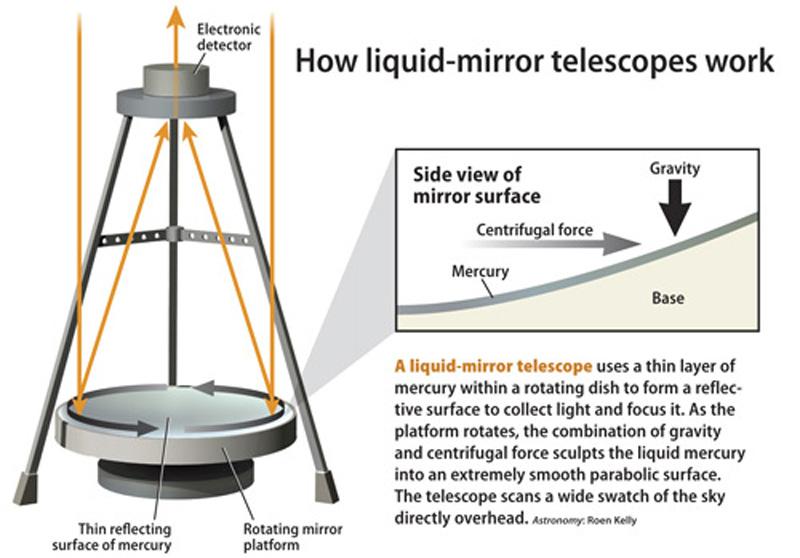
  • ILMT employs a 4-metre-diameter rotating mirror made up of a thin layer of liquid mercury, to collect and focus light.
    • Mercury has strong reflective power and stays in a liquid form at room temperature. Also, it is much cheaper than glass mirrors.
  • It is the first liquid mirror telescope designed exclusively for astronomical observations, the largest aperture telescope available in India and also the first optical survey telescope in the country. 
  • It is located at an altitude of 2450 metres at the Devasthal Observatory campus of Aryabhatta Research Institute of Observational Sciences (ARIES).

Composition:

  • There are primarily three ​components in a liquid mirror telescope: 
  1. A ​bowl ​containing ​a ​reflecting ​liquid ​metal ​(essentially ​mercury)
  2. An ​air ​bearing (or motor) ​on which ​the ​liquid mirror ​sits
  3. drive ​system
  • Liquid mirror telescopes take advantage of the fact that the surface of a rotating liquid naturally takes on a parabolic shape (under the influence of gravity and centrifugal force), which is ideal for focusing light.
  • The reflected light passes through a sophisticated multi-lens optical corrector that produces sharp images over a wide field of view. 
I read somewhere that mercury is being used to make liquid-mirror  telescopes. What are the advantages of collecting light this way? |  Astronomy.com

Significance:

  • ILMT is designed to survey the strip of the sky passing overhead each night, allowing it to detect transient or variable celestial objects such as supernovae, gravitational lenses, space debris, and asteroids.
  • While scanning the strip of the sky every night, the telescope will generate nearly 10-15 Gigabytes of data. This ILMT-generated data will permit the application of Big Data and Artificial Intelligence/Machine Learning (AI/ML) algorithms that will be implemented for classifying the objects observed with the ILMT. 
  • It enhances India’s capabilities to explore the mysteries of the deep celestial sky and astronomy. The data collected over an operational time of 5 years, will be ideally suited to perform a deep photometric and astrometric variability survey.