GS Paper 3

Understanding IMF bailouts

Context: The International Monetary Fund (IMF) last week confirmed a $3 billion bailout plan for Sri Lanka’s struggling economy. IMF officials are also in negotiations with Pakistan for a $1.1 billion bailout plan as the country faces a severe economic crisis marked by a falling currency and price rise.

Why do nations seek an IMF bailout?

  • Countries seek help from the IMF usually when their economies face a major macroeconomic risk, mostly in the form of a currency crisis. For instance in the case of Sri Lanka and Pakistan, both countries have witnessed domestic prices rise rapidly and the exchange value of their currencies drop steeply against the U.S. dollar. 
  • Such currency crises are generally the result of gross mismanagement of the nation’s currency by its central bank, often under the covert influence of the ruling government. 
  • Central banks may be forced by governments to create fresh money out of thin air to fund populist spending. 
  • Such spending eventually results in a rapid rise of the overall money supply, which in turn causes prices to rise across the economy and the exchange value of the currency to drop. 
  • A rapid, unpredictable fall in the value of a currency can destroy confidence in said currency and affect economic activity as people may turn hesitant to accept the currency in exchange for goods and services. 
  • Foreigners may also be unwilling to invest in an economy where the value of its currency gyrates in an unpredictable manner. 
  • In such a scenario, many countries are forced to seek help from the IMF to meet their external debt and other obligations, to purchase essential imports, and also to prop up the exchange value of their currencies. 
  • Bad luck can also contribute to a crisis. In the case of Sri Lanka, a decrease in foreign tourists visiting the country led to a steep fall in the flow of U.S. dollars into the nation.

How does the IMF help countries?

The IMF basically lends money, often in the form of special drawing rights (SDRs), to troubled economies that seek the lender’s assistance. 

SDRs simply represent a basket of five currencies, namely the U.S. dollar, the euro, the Chinese yuan, the Japanese yen, and the British pound. The IMF carries out its lending to troubled economies through a number of lending programs such as the extended credit facility, the flexible credit line, the stand-by agreement, etc. 

Countries receiving the bailout can use the SDRs for various purposes depending on their individual circumstances. 

Currently, both Sri Lanka and Pakistan are in urgent need for U.S. dollars to import essential items and also to pay their foreign debt. So any money that they receive from the IMF is likely to go towards addressing these urgent issues.

Are there any strings attached to an IMF bailout?

  • On giving loans to countries, the IMF makes the loan conditional on the implementation of certain economic policies. These policies tend to involve:
  1. Reducing government borrowing – Higher taxes and lower spending
  2. Higher interest rates to stabilise the currency.
  3. Allow failing firms to go bankrupt.
  4. Structural adjustment. Privatisation, deregulation, reducing corruption and bureaucracy.
  • The problem is that these policies of structural adjustment and macroeconomic intervention can make difficult economic situations worse.
  • For example, in the Asian crisis of 1997, many countries such as Indonesia, Malaysia and Thailand were required by the IMF to pursue tight monetary policy (higher interest rates) and tight fiscal policy to reduce the budget deficit and strengthen exchange rates. However, these policies caused a minor slowdown to turn into a serious recession with very high levels of unemployment.

What is the International Monetary Fund?

  • Its headquarters is in Washington DC.
  • Membership: 190 countries
  • The International Monetary Fund (IMF) is an international organization that:
  1. Promotes global economic growth and
  2. Promotes global financial stability, 
  3. Encourages international trade, and 
  4. Reduces poverty.
  • Origin: The IMF was originally created in 1945 as part of the Bretton Woods agreement, which attempted to encourage international financial cooperation by introducing a system of convertible currencies at fixed exchange rates.
  • Change in its role: Since the Bretton Woods system collapsed in the 1970s, the IMF has promoted the system of floating exchange rates, meaning that market forces determine the value of currencies relative to one another. This system remains in place today.

Functions of IMF: 

  1. The IMF collects massive amounts of data on national economies, international trade, and the global economy in aggregate and provides economic forecasts.
  2. One of the IMF's most important functions is to make loans to countries that are experiencing economic distress to prevent or mitigate financial crises.
  3. The IMF provides technical assistance, training, and policy advice to member countries through its capacity-building programs. These programs include training in data collection and analysis, which feed into the IMF's project of monitoring national and global economies.
  • The IMF gets its money through quotas and subscriptions from its member countries. These contributions are based on the size of the country's economy, making the U.S., with the world's largest economy, the largest contributor.
  • Quotas are a key determinant of the voting power in IMF decisions. Votes comprise one vote per SDR 100,000 of quota plus basic votes (same for all members). 
  • IMF Grants: These are given to charities in Washington D.C. and member countries. The grants are meant to foster economic independence through education and economic development." The average grant size is $15,000. 
  • Note: Membership of the IMF is compulsory to be part of the International Bank for Reconstruction and Development (IBRD or World Bank). 

50 years of Project Tiger & Tiger translocation

Context:

  • Project Tiger is in its 50th year since its launch in 1973, in India. 
  • In its 50th year, India has signed an MOU with Cambodia for reintroducing tigers (species: Panthera tigris) there through translocation. 
  • In Cambodia the species have become extinct.
  • So far, India has only translocated tigers within the country, not internationally. This will be the first time India will do so.
  • In 2022, African Cheetahs were successfully translocated from Namibia to India. It was the first wild to wild intercontinental translocation.

About Project Tiger

Background

  • It was launched in 1973 from Jim Corbett National Park, Uttarakhand to save the declining tigers population. It is a major wildlife conservation project in India.
  • At that time, Project Tiger included 9 tiger reserves spread over 18,278 sq km. 
  • It is governed by the Wildlife Act of 1972.
  • The initiative is funded by the Union Govt. of India and administrated under the Ministry of Environment, Forests and Climate Change.
  • National Tiger Conservation Authority (NTCA) is the immediate supervising agency.

Objectives

  • To identify factors causing a reduction in tiger habitats and mitigate them through suitable management practices. 
  • To maintain a viable tiger population for their economic, ecological, cultural, and aesthetic significance. 

Present Status

  • Currently, there are 53 tiger reserves covering more than 75,000 sq km (approximately 2.4% of the country’s geographical area) across India. 
  • With the current population of about 3,000 tigers, India harbours more than 70% of global wild tiger population, which is increasing at an annual rate of 6%.
  • India has the largest number of CAT-accredited tiger reserves in the world at 17.
  • Compensation for voluntary village relocation has also been enhanced from Rs 10 lakh per family to Rs 15 lakh in order to aid tiger conservation.

Conservation Status

  • Indian Wildlife (Protection) Act, 1972 - Schedule 1
  • International Union for Conservation of Nature (IUCN) Red List: Endangered.
  • Convention on International Trade in Endangered Species of Wild Fauna and Flora (CITES): Appendix I.

India failed to create positive impression among businesses moving away from China

Context: Parliamentary committee on Commerce has submitted a report on the status of India’s positive business impression. 

Highlights of the report

  • India has not been able to take advantage of the “China Plus One Strategy,” through which multinationals shifted manufacturing and production away from China.
  • Southeast Asian countries such as Vietnam, Thailand, Cambodia, and Malaysia have become bigger beneficiaries of the strategy.
  • India’s competitive position in the pharmaceutical sector is undermined by its high import dependence for bulk drugs or active pharmaceutical ingredients (APIs), especially from China. 
  • In fiscal year 2022-23, till November 30, the value of total import of APIs stood at ₹27,209 crore, out of which imports from China stood at ₹18,973 crore, nearly 70% of the total share.

What is the China Plus 1 strategy: China Plus One or C+1 is the term ascribed to businesses avoiding investing solely in China and diversifying their business into other countries.

Who introduced the China Plus One strategy: The earliest use of the term “China Plus One” can be traced to 2013, but there is no individual to whom the concept has been credited.

What is the Europe Plus One strategy: Similar to the China strategy, Europe Plus One describes European industrialists who are exploring options to relocate their production outside of Europe.

Government’s reply

  • Government has replied that Production Linked Incentive (PLI) schemes have the capability to make India a more attractive location for companies looking to diversify their supply chains away from China. 
  • It added that more than 3,500 provisions have been decriminalised by the Ministries and the States. 
  • The Jan Vishwas Bill to amend 42 Central Acts has been introduced to enhance trust-based governance.

Committee’s suggestion

  • Rationalisation of direct taxes and indirect taxes must be done in sync with the international norms and laws to increase the competitiveness of domestic industries in the global markets.
  • It asked the government to pursue Free or Preferential Trade Agreements with countries that seek to invest in India under the ‘China Plus One Strategy’. 

RBI asked to monitor card spending under LRS for tax purposes

Context: As per the Union budget declarations this year, union government is going to impose 20 per cent tax at source on foreign remittances. For this, Reserve Bank of India is going to monitor credit card usage for foreign travel purpose. 

Background

  • Liberalized Remittance Scheme do not cover payments for foreign tours through credit card and such payments escape tax collection at source. 
  • The Union Budget 2023 proposed a TCS for foreign outward remittance under LRS other than for Education and medical purposes of 20 per cent applicable from July 1, 2023. Before this proposal, the TCS of 5 per cent was applicable on foreign outward remittances above ₹ 7 lakh.
  • Tax Collected at Source (TCS) is an income tax, collected by the seller of specified goods, from the buyer. TCS is a concept where a person selling specific items is liable to collect tax from a buyer at a prescribed rate and deposit the same with the government.

What is the Liberalised Remittance Scheme (LRS) 

  • Under the Liberalised Remittance Scheme, all resident individuals, including minors, are allowed to freely remit up to USD 2,50,000 per financial year (April – March) for any permissible current or capital account transaction or a combination of both. 
  • Further, resident individuals can avail of foreign exchange facility for various purposes ( such as private, gift, donation, employment, travel, studies) within the limit of USD 2,50,000 only.
  • The Scheme was introduced on February 4, 2004, with a limit of USD 25,000 (extended regularly).
  • In case of remitter being a minor, the LRS declaration form must be countersigned by the minor’s natural guardian. 
  • Remittances under the LRS facility can be consolidated (clubbed together) in respect of close family members subject to the individual family members complying with the terms and conditions of the Scheme.
  • There is no restrictions on the number of transactions but cumulative amount should not exceed 2.5 lakh dollar.
  • The remittances can be made in any freely convertible foreign currency (apart from dollars).
  • Only certain capital account transactions are allowed under LRS rules such as opening a bank account abroad i.e. a Foreign Currency Account, purchasing real estate property overseas, for making investments overseas which includes investing in shares, mutual funds, and debt instruments amongst others.
  • The Scheme is not available to corporates, partnership firms, HUF, Trusts etc.

Following are not permitted under the scheme

  1. Remittance for any purpose specifically prohibited under Schedule-I (like purchase of lottery tickets/sweep stakes, proscribed magazines, etc.) or any item restricted under Schedule II of Foreign Exchange Management (Current Account Transactions) Rules, 2000.
  2. Remittance from India for margins or margin calls to overseas exchanges / overseas counterparty.
  3. Remittances for purchase of FCCBs issued by Indian companies in the overseas secondary market.
  4. Remittance for trading in foreign exchange abroad.
  5. Capital account remittances, directly or indirectly, to countries identified by the Financial Action Task Force (FATF) as “non- cooperative countries and territories”, from time to time.
  6. Remittances directly or indirectly to those individuals and entities identified as posing significant risk of committing acts of terrorism as advised separately by the Reserve Bank to the banks.

Old vs New hotting up, government forms panel to relook at pension

Context: Union Finance minister announced the formation of a committee to look into improving the system of pension for government employees. The committee will be headed by Finance Secretary T V Somanathan

Details about National Pension System (NPS)

What is it? Pension cum investment scheme to provide old age security to Citizens of India. Regulated by Pension Fund Regulatory and Development Authority (PFRDA)

Who can Join? Any citizen of India (both resident and Non-resident) and Overseas Citizen of India (OCI) in the age group of 18-70 years. Earlier, the maximum age for entry was 65. In Aug 2021, PFRDA has increased the maximum age limit to 70.

Different Sectors

  1. Government Sector
    • Central Government: Introduced with effect from January 1, 2004 (except for armed forces). 
    • State Government: Almost all the State Governments (except few such as West Bengal) have also adopted NPS through their own notifications.
  2. Private Sector (Non-Government Sector):
    • Corporates
    • All Citizens of India: Any individual not being covered by any of the above sectors has been allowed to join NPS 2009 onwards.

Contribution: Govt. employees make a monthly contribution at the rate of 10% of their salary and Dearness allowance and a matching contribution is paid by the Govt. For central Govt. employees, the employer’s contribution rate has been enhanced to 14% from 1 April 2019. The State Governments have also been given an option to increase their contribution to 14% through their own gazette notification.

Different Types of NPS Account

CriteriaTier-1 AccountTier-2 Account
PurposePension accountinvestment account
Eligibilityany citizen between 18-70 yearsNRI/OCIs are not eligible
NatureCompulsoryoptional, Person needs to have tier-1 account to open tier-2 account.
Min. contribution per yearRs.1000Rs.250
Tax Benefits availableYesNo
Withdrawals allowed?Restricted as per rules and regulation.Unrestricted withdrawals.

What happens to the contribution? Invested in certain pension funds which in turn invest in different asset classes such as G-secs, shares, bonds etc. to generate higher returns.

Returns:  NPS is designed on Defined contribution basis wherein the subscriber contributes to his account. However, there is no defined benefit that would be available at the time of exit from the system. The accumulated wealth depends on the contributions made and the income generated from investment of such wealth.

Withdrawals: 

  • Upon Normal Superannuation – At least 40% of the accumulated pension wealth of the Subscriber has to be utilized for purchase of annuity providing for monthly pension of the Subscriber and the balance is paid as lump sum to the subscriber.
  • Upon Death – The entire accumulated pension wealth (100%) would be paid to the nominee/legal heir of the Subscriber and there would not be any purchase of annuity/monthly pension.
  • Exit from NPS Before the age of Normal Superannuation – At least 80% of the accumulated pension wealth of the Subscriber should be utilized for purchase of an annuity providing the monthly pension of the Subscriber and the balance is paid as a lump sum to the Subscriber.

Difference between New Pension Scheme and Old Pension Scheme

CriteriaNew Pension System (NPS)Old Pension Scheme
Nature of SchemeDefined Contribution Defined benefit
ContributionBoth by Government and EmployeeOnly the Government
BenefitNo Defined benefit as the accumulated wealth depends upon the contribution made.Defined benefit.
Pension of 50% of the last drawn salary.
Pension AmountDepends upon number of years of service.
Longer the years of service.
Higher Contribution.
Higher Pension.
Depends upon the last drawn salary.
Pension is equal to 50% of last drawn salary.

Blow for bond markets as Long-term tax benefit scrapped for debt Mutual Funds

Context: The government has proposed changes in taxation of debt mutual funds under which no benefit of indexation for calculation of long-term capital gains (LTCG) on debt mutual funds will be available for investments made on or after April 1, 2023.

From April 1, 2023, such debt mutual funds will be taxed at income tax rates as per an individual’s income. The move will remove the tax advantage a debt mutual fund has compared to bank deposits. 

Consequences

  • As a result, bank fixed deposits will become more attractive. 
  • This may have a negative impact on all debt funds, particularly in the retail category, as ultra-high net worth and high net worth individuals may choose to invest in safe havens like bank fixed deposits.
  • There will be a loss to the bond market which is already struggling for the liquidity. 

What is a mutual funds?

  • A mutual fund is a pool of money managed by a professional Fund Manager. 
  • It is a trust that collects money from a number of investors who share a common investment objective and invests the same in equities, bonds, money market instruments and/or other securities. And the income / gains generated from this collective investment is distributed proportionately amongst the investors after deducting applicable expenses and levies, by calculating a scheme’s “Net Asset Value” or NAV. Simply put, the money pooled in by a large number of investors is what makes up a Mutual Fund.

What is indexation?

  • Indexation is a process by which the cost of acquisition of an asset (mutual fund in this case) can be indexed (adjusted or inflated) over a period of time in order to bring it to current prices after taking inflation into consideration. 
  • Indexation is done through a mechanism using a Price Index which is adjusted for inflation. The Price Index adjusts for inflation at the time of purchase of an asset as well as at the time of its sale. 
  • It is a well-known fact that inflation erodes an asset’s value over a period of time. 
  • Indexation gives the investor an option to inflate (increase) the price of purchase of the asset. This helps in lowering the adverse cost impact due to inflation.

Indexation In Mutual Funds

  • Mutual fund investments generate Capital gains (Capital gain is a gain or profit realized by way of selling a property or other such asset/investment). These gains can either be Short Term or Long Term in nature, depending on the period for which these assets are held. 
  • However, indexation benefit is available only for capital gains realized in Debt mutual funds. 
  • A holding period of 36 months or more is considered as long term for Debt Funds. (For Equity mutual funds, long term means a holding period of 12 months or more)
  • Any holding period which is less than 36 months for Debt funds is treated as short term and the gains are added to the income of investor for tax calculation.

Project Himshakti

Context: Ministry of Defence has inked a Rs 3,000 crore contract for the procurement of two Integrated Electronic Warfare Systems under Project Himshakti for the Army in mountainous terrain. 

Major Highlights:

  • The contract signed with defence PSU Bharat Electronics (BEL) is under the “Buy Indian-IDMM (indigenously designed, developed and manufactured)” category comprising contemporary and niche technologies. 

Significance:

  • Project Himshakti will generate employment of approximately three lakh man-days over a period of two years. 
  • The project is a significant leap forward in developing indigenous capabilities making the country ‘self-reliant’ in defence manufacturing. 

AFSPA removed from 3 police station limits in Nagaland

Context: According to a notification, The Ministry of Home Affairs (MHA) has further removed the Armed Forces (Special Powers) Act (AFSPA) from the jurisdiction of three police stations in Wokha and Zunheboto districts of Nagaland, while one more police station in Arunachal Pradesh has been declared as a “disturbed area” under the Act. 

The Armed Forces (Special Powers) Act, 1958

Powers to declare areas to be disturbed areas (Section 3) – If, in relation to any state or Union Territory to which this act extends, the Governor of that State or the administrator of that Union Territory or the Central Government, in either case, if of the opinion that the whole or any part of such State of Union territory, as the case may be, is in such a disturbed or dangerous condition that the use of armed forces in aid of the civil power is necessary, the Governor of that State or the Administrator of that Union Territory or the Central Government, as the case may be, may by notification in the Official Gazette, declare the whole or such part of such State or Union territory to be a disturbed area.

Application of AFSPA

  • The ASPA was first applied to the Seven Sister States of North East India, including Assam, Manipur, Tripura, Meghalaya, Arunachal Pradesh, Mizoram and Nagaland, on 1 September, 1958, to stop the North Eastern States seceding from the Indian Union. 
  • Later Punjab and Chandigarh also came within the purview of this act, which was later withdrawn in 1997. 
  • AFSPA was then applied to the state of Jammu and Kashmir in 1990 and has been in force since then.   

Special powers of the armed forces 

Any commissioned officer, warrant officer, non-commissioned officer or any other person of equivalent rank in the armed forces may, in a disturbed area:

  • For the maintenance of public order, after giving such due warning as he may consider necessary, fire upon or otherwise use force, even to the causing of death, against any person who is acting in contravention of any law or order.     
  • They can prohibit assembly of five or more persons or the carrying of weapons or of things capable of being used as weapons or of fire-arms, ammunition or explosive substances in the disturbed area. 
  • They can destroy any arms dump, prepared or fortified position or shelter or any structure used as a training camp for armed volunteers or utilised as a hide-out by armed gangs or absconders wanted for any offence.
  • Enter and search any premises without warrant and make any arrest or recover any person who are believed to be wrongfully restrained. 
  • No prosecution, suit or other legal proceeding shall be instituted, except with the previous sanction of the Central Government, against any person regarding anything done or purported to be done in exercise of the powers conferred under the Act. 

Arguments in favour of AFSPA

  • Needed to maintain morale of the force.
  • Insurgents will gain upper hand in absence of it.
  • Troops need such powers because the army is only deployed when national security is at serious risk from armed combatants.
  • Provides legal backing for the Armed Forces to act in domestic civilian areas. Currently, the armed forces act enables them to only act against enemies.

Arguments against AFSPA

  • Provision for immunity of security forces urges them to act more brutally.
  • Seen as a reason for increasing radicalization in insurgency ridden areas because of the little accountability for the excesses committed in discharge of power given by the act.
  • Instances of abuse and extra-judicial killings in Manipur have been upheld by even Supreme court in 2016. The Supreme Court in this case ruled that the armed forces cannot escape investigation for excesses during the discharge of their duty even in “disturbed areas.”
  • Though there are many violent insurrections in India which must be handled militarily but in the short run. Even after so many years, if the situation in these states has not changed, this points to some flaws in the law itself.

Checks and balances to stop misuse of AFSPA

  1. SC in 1998 on constitutionality of AFSPA: Upheld constitutional Validity of AFSPA. However, it suggested some measures that should be followed.
    • A Suo-motto declaration can be made by the Central Government; however, it is desirable that the state government should be consulted by the Central Government before making the declaration.
    • AFSPA does not confer arbitrary powers to declare an area as a 'disturbed area.
    • Declaration must be for a limited duration and there should be a periodic review of the declaration 6 months have expired.
    • While exercising the powers conferred upon him by AFSPA, the authorized officer should use minimal force necessary for effective action.
  2. Santosh hedge commission on Manipur encounter
    • FSPA was an impediment to achieving peace in regions such as J&K and the Northeast.
    • The law needs to be reviewed every six months to see whether its implementation is necessary in states where it is being enforced.
    • AFSPA does not provide blanket Immunity to the officers. Suggested fixing a period of three months for the central government to decide whether to prosecute security personnel engaged in extrajudicial killings or unruly behaviour in insurgency-hit regions.
    • Action can be taken but with prior sanction of the Central Government.
  3. BP Jeevan Reddy Commission in 2004
    • AFSPA should be repealed, and appropriate provisions should be inserted in the Unlawful Activities (Prevention) Act, 1967.
    • Unlawful Activities (UAPA) Act should be modified to clearly specify the powers of the armed forces and paramilitary forces.
    • Grievance redressal cells should be set up in each district where the armed forces are deployed.
  4. Second Administrative Reforms Commission
    • Recommended to repeal of AFSPA, 1958. Its scrapping would remove sentiments of discrimination and alienation among the people of the Northeast India.
    • Amend the Unlawful Activities (Prevention) Act, 1967 inserting a new chapter to deploy the armed forces of the Union in the North-eastern States.
    • Supported a new doctrine of policing & criminal justice inherent in an inclusive approach to governance.

Way Forward

Army must be completely transparent in investigating allegations of violations of human rights and bringing the violators to speedy justice. Exemplary punishment must be meted out where the charges are proved.   

Semiconductors Manufacturing

Context: The Union Government has disbursed around ₹1,645 crore in performance-linked incentives (PLI) for electronics manufacturers so far, as part of its efforts to bring in more of the electronics supply chain to India. More and more nations are trying to turn away from China’s dominance in the space, following geopolitical pressures to de-leverage themselves from supply chain vulnerabilities.

What are semiconductors?

A semiconductor is a material that allows electrical conductivity between a conductor and an insulator. Semiconductors are made from pure elements like silicon or germanium, or compounds such as gallium arsenide. Sometimes their conductivity is changed through doping.

In a pure semiconductor, such as silicon or germanium, there are few free electrons or holes (missing electrons) available for conduction.

However, when impurities are intentionally introduced into the semiconductor, a process called doping, the number of free electrons or holes can be increased.

They are used to make electronic devices such as transistors, diodes, and integrated circuits (ICs). Transistors, which are used to amplify and switch electronic signals, are made by combining multiple p-n junctions.

Integrated circuits (ICs) are made by creating complex arrangements of transistors and other components on a single piece of semiconductor material. Semiconductors chips are the thumbnail-sized building blocks of almost every modern electronic device from smartphones to connected devices in the Internet of Things (IoT).

Semiconductors have revolutionized the electronics industry and are essential components in nearly all electronic devices, from smartphones to computers to automobiles. Semiconductors make the devices more compact, less expensive, and more powerful.

For instance, mobile phones weighed about 2 lbs, cost around $4,000, and held a charge for only about 30 minutes of talk time during their initial phase. However today an individual can buy a smartphone for 5000 rupees that would give a 1-day charge.

Semiconductor manufacturing in India

The semiconductor chip-making process is complex and highly exact, having multiple steps in the supply chain such as designing software for chips and patenting them through core Intellectual Property (IP) rights. They help give computational power to devices. The global semiconductor industry is currently valued at $500-$600 billion.

The chip-making industry is a highly-concentrated one, with the big players being Taiwan, South Korea and the U.S. among others. In fact, according to a New York Times estimate, 90% of 5nm (nanometre) chips are mass-produced in Taiwan, by the Taiwan Semiconductor Manufacturing Company (TSMC).

Globally, the entire value chain has seeped in the interdependence between a handful of countries like the USA, Taiwan, Japan, China, and some European nations. 

  • India has done well in design and verification for the semiconductor industry. Most of the global semiconductor companies having an R&D footprint in India.
  • However, 100% of our chips, memory, and display are imported into the country, 37% coming from China.
  • Chips import bill is estimated to touch $100 billion by 2025 from $24 billion now. 
  • Although India has two fabs — SITAR, a unit of the Defence Research and Development Organisation (DRDO) in Bengaluru, and a semiconductor laboratory in Chandigarh. These build silicon chips for strategic purposes like defense and space and not for commercial use.

Why is the government encouraging semiconductor manufacturing?

  • National Security: Semiconductors are essential components in many critical industries, including defense, telecommunications, power transmission etc that have implications for national security. Chips made locally will be designated as “trusted sources” and can be used in products ranging from CCTV cameras to 5G equipment. 
  • Strategic competition with China: Countries have spotted strategic value in cornering segments of the value chain for fabs, even as the sophistication and capital needed to run them have climbed to historic highs. China pulled ahead of Taiwan last year, in terms of share of global sales from fabs, according to a report by the Semiconductor Industry Association (SIA).
    • It’s not just India that is wary of this dominance. The U.S. passed the CHIPS Act last August, providing upwards of $280 billion in subsidies and investments to manufacturers opening fabs and making semiconductors in the U.S. This has been combined with restrictions on the Chinese semiconductor industry.
  • Geopolitical Benefits:  driven by data and the digital revolution. Further self-sufficiency will decrease reliance on Chinese chip imports especially during hard times like the recent Galwan Valley border clash.
  • Economic Growth
    • Development of the semiconductor and display ecosystem will have a multiplier effect across different sectors of the economy with deeper integration to the global value chain.
    • Indigenous manufacturing of chips will build its smartphone assembly industry and strengthen its electronics supply chain. 
    • According to the Electronics and IT Ministry, semiconductor demand in India would increase to $70-$80 billion by 2026 with the growing demand for digital devices and electronic products. 
    • This will create numerous employment opportunities for the Indian youth.
    • Indigenous capacity would attract local taxes and boost the export potential. 
    • Further, India would be required to import fewer semiconductor chips which would decrease the import bill.
  • Technological Leadership: Semiconductors are the building blocks of today’s technology. Semiconductor chips are widely used in (a) Computers and laptops; (b) Phones, mobile devices and other electronic gadgets; (c) Automobiles; (d) Aviation; (e) Medical devices especially diagnostics; (f) Military equipment among others.

These semiconductor chips are the drivers for ICT (Information and Communication Technologies). Semiconductors and displays are the foundation of modern electronics driving the next phase of digital transformation under Industry 4.0.

  • Supply Chain Resilience: The COVID-19 pandemic highlighted the vulnerabilities of global supply chains, including those in the semiconductor industry. Governments are encouraging domestic semiconductor manufacturing to increase supply chain resilience and reduce dependence on foreign suppliers. The pandemic and the subsequent lockdowns impacted the supply of chips to India. Automobile manufacturers like Mahindra & Mahindra and Tata group were compelled to reduce their production due to the shortage.
  • Environmental Concerns: The semiconductor manufacturing process can be energy-intensive and can produce hazardous waste. Governments are encouraging domestic semiconductor manufacturing to promote more sustainable and environmentally friendly practices.
  • Changing work and employment pattern 
    • Experts estimate that around 50 crore people will join the internet in the next decade thereby demanding more phones and laptops. 
    • Work from home culture warrants an enhanced demand for servers, internet connectivity, and cloud usage.

Initiatives taken to promote indigenous Semiconductor capacity

  • National Policy on Electronics 2019: It envisions positioning India as a global hub for Electronics System Design and Manufacturing (ESDM) sector. It aims to encourage the development of core components, including chipsets. 
  • Scheme for Promotion of Manufacturing of Electronic Components and Semiconductors (SPECS):
    • The government will provide a financial incentive of 25% on capital expenditure for a list of products that constitute the supply chain of electronic products. This includes products such as electronic components, semiconductors, and specialized sub-assemblies.
    • India would be offering more than $1 billion in cash to each semiconductor company that sets up manufacturing units in the country.
  • Modified Electronics Manufacturing Clusters (EMC 2.0) Scheme: Under this, the government will provide support for the setting up of Electronics Manufacturing Clusters (EMCs) and Common Facility Centres(CFCs).
  • Production Linked Incentive Scheme(PLI): Under this, the government will provide an incentive of 4% to 6% on goods manufactured in India and covered under target segments to eligible companies for a period of five years.
  • Incentive to all nodes of semiconductors: The new changes have been announced to harmonise government incentives for all technology nodes of semiconductors. In the previous version of the scheme, the Centre was offering to fund 30% of the project cost for 45nm to 65nm chip production, 40% for 28nm to 45nm, and 50% or half of the funding for chips 28nm or below. The modified scheme provides uniform 50% fiscal support for all nodes. Besides, it will provide 50% of capital expenditure for other steps of the process as well (chip design and ATMP).
  • Foreign Direct Investment: The Government of India has allowed 100 percent (FDI) under the automatic route in the Electronics Systems Design & Manufacturing sector.  

What are the challenges in front of India?

  • High Cost of establishment: Fabs are highly capital-intensive undertakings, costing billions of dollars for large facilities. As per a government estimate, it would cost roughly $5-$7 billion to set up a chip fabrication unit in India.  
  • Low Ease of doing business: The process of establishing an indigenous semiconductor facility requires clearances and approvals from multiple government departments. 
  • Technological Constraint: The indigenous manufacturing of semiconductors requires the use of high-end technologies. These technologies are licensed from patent holders at a very high price.
  • Lack of Fabrication Capacities: India has a decent chip design talent but it never built up chip fab capacity. The ISRO and the DRDO have their respective fab foundries but they are primarily for their own requirements and are also not as sophisticated as the latest in the world.
  • Structural constraint: FDI in electronics is less than 1% of the total FDI inflow because of the dearth of skilled labor, delays in land acquisition, and the uncertain tax regime.
  • Unstable power supply: The smooth production of semiconductors requires the availability of an uninterrupted 24*7 power supply. they require highly reliable and high-quality supply of water, electricity, and insulation from the elements, reflecting the high degree of precision, cost and capital needed to make the sophisticated circuits.
  • Resource Inefficient Sector: Chip fabs are also very thirsty units requiring millions of litres of clean water, an extremely stable power supply, a lot of land and a highly skilled workforce.

Suggestions

  • Augmenting Research and Development Potential: For instance, IIT Madras developed a microprocessor named ‘Moushik’ with funding support from the Ministry of Electronics and Information Technology.
  • Fiscal Support for All Elements of Chip-Making Chain: Considering India’s considerable talent and experience, it may be best if the new mission focuses fiscal support, at least for now, on other parts of the chip-making chain including design centres, testing facilities, packaging, etc.
  • Establishment of Sovereign Patent Fund (SPF): The proposed Sovereign Patent Fund under National Policy on electronics should be established expeditiously. It is a wholly or partly Government-backed entity that aims to bolster domestic businesses through the acquisition and licensing of patented technology.
  • Push for Quad Supply Chain Resilience Fund: India needs to push for a Quad Supply Chain Resilience Fund to immunise the supply chain from geopolitical and geographic risks.
  • Research ecosystem: government must focus on emerging technologies like LiDAR and Phased Array in which incumbents do not have a disproportionate advantage and the entry barrier is low.
  • Focus on Manufacturers' Assurance of Domestic Procurement – The manufacturers need to be given an assurance of minimum domestic procurement by the government and the private sector. The focus should be on manufacturing economical and technically viable options like 28nm chips.
  • Support for Acquisition of Semiconductor Manufacturing Units: The government should also support businesses in the acquisition of semiconductor manufacturing units in other countries. This is easier than setting up a domestic facility and can be done swiftly for ensuring a continuous supply of chips.
  • Free-Trade Agreement Negotiations: India and Taiwan have started negotiations for a free-trade agreement and setting up a semiconductor manufacturing hub in an Indian city, signalling their resolve to further expand the two-way economic engagement.

Lab Grown Diamonds

Context: Budget 2023-24 has introduced incentives for lab grown diamonds.

About Lab Grown Diamonds (LGDs)

  • Lab grown diamonds (also known as lab created diamonds, manmade diamonds, engineered diamonds, and cultured diamonds) are grown in highly controlled laboratory environments using advanced technological processes that duplicate the conditions under which diamonds naturally develop when they form in the mantle, beneath the Earth’s crust. 
  • These manmade diamonds consist of actual carbon atoms arranged in the characteristic diamond crystal structure. Since they are made of the same material as natural diamonds, they exhibit the same optical and chemical properties.
  • Lab Grown Diamonds is a technologically and innovation driven emerging sector with high employment potential. These environment friendly diamonds which have optically and chemically the same properties as natural diamonds. 

Reasons for interest in Lab Grown Diamonds

  • Mining Free: These diamonds are produced in laboratories. Hence, they are an environmentally responsible choice as a no mining is required.
  • Quality: Lab Grown Diamonds have same physical, chemical and optical properties as mined diamonds.
  • Value for Money & Affordable: Lab grown diamonds offer excellent value. They are more cost-effective than natural diamonds of comparable size and quality.
  • Scarcity of diamonds: As natural diamonds become scarce due to depleting reserves and escalating costs. 
  • Strengthening India’s Gems & Jewellery Industry: India is a global leader in cutting and polishing of natural diamonds, contributing about 3/4th of global turnover by value. With the depletion of natural diamonds, the industry is moving towards Lab Grown Diamonds. 

Process of making Lab-Grown Diamonds

  • Lab Grown diamonds are made in laboratories with a seed of natural diamonds, which is a slice of another diamond - on which the LGD is created. It takes less than month to make a distinctively shaped crystal of Lab Grown Diamond. 
  • There are two methods by which LGDs are created: (i) Chemical Vapour Deposition (CVD) method (ii) High Pressure, High Temperature (HPHT) method.
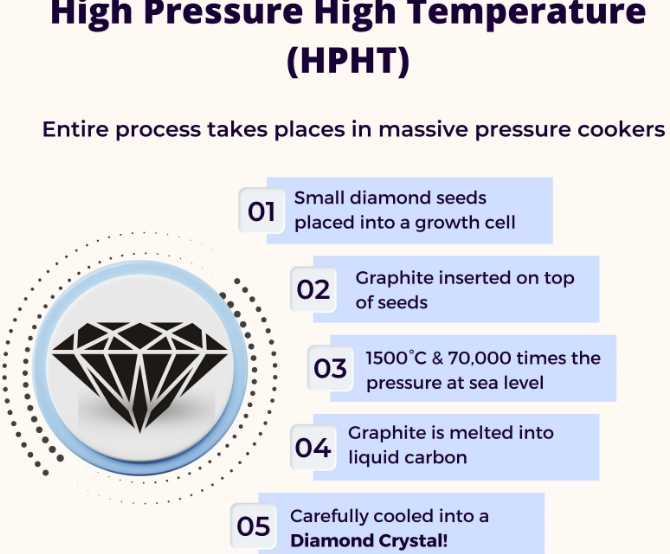
  • High Pressure, High Temperature (HPHT) method: This process mimics the high-pressure, high-temperature conditions that occur under the Earth to form a natural diamond. The seed and graphite carbons are exposed to extreme temperatures (1,500oC) and with extremely high pressures to make LGDs. This method can also enhance the colour of diamonds making them colourless, pink, green, blue or yellow. Diamonds produced by this method may have some impurities of Boron or Nitrogen. This method is popular in China. 
high pressure high temp
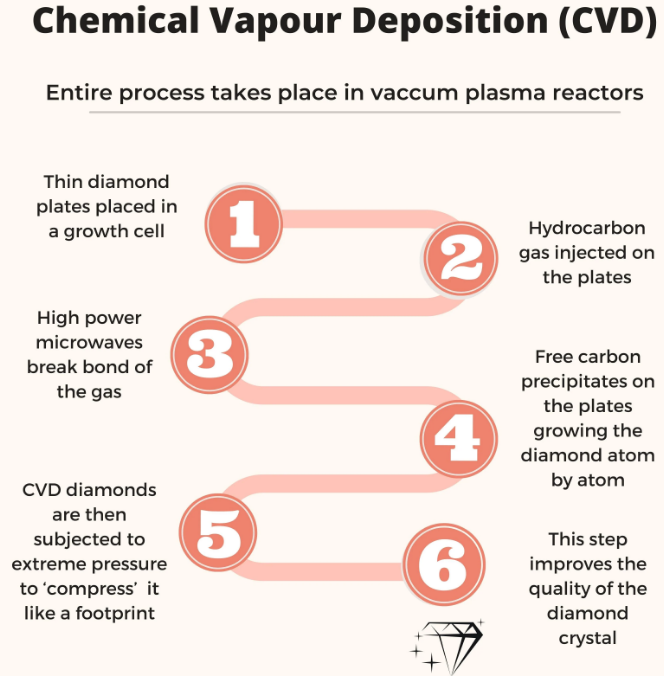
  • Chemical Vapour Deposition (CVD) method: It is a chemical process in which the seed is heated up to 800oC in a sealed chamber filled with molecules of carbon-rich gas such as methane. These gas molecules are broken down into carbon and hydrogen atoms, which get deposited on the seed giving it a shape of square, tabular diamond crystal. This process also requires heat or irradiation to give the crystal a colour effect. Diamonds produced by this method most chemically pure diamonds i.e., free from impurities of nitrogen and boron. CVD method is more popular in India. 
chemical vapour deposition

Identification of Laboratory Grown Diamonds

  • Laboratory grown diamonds require advanced testing in a gemmological laboratory to be identified with certainty. 

Proposals in Union Budget 2023-24 for Lab Grown Diamonds

  • Grant for R&D: To encourage indigenous production of LGD seeds and machines and to reduce import dependency, a R&D grant will be provided to one of the IITs (IIT Madras) for five years.
  • Relief in Customs duty: Budget 2023-24 has abolished customs duty on imports of seeds used for manufacturing of rough lab-grown diamonds. This will boost domestic manufacturing of LGDs and reduce imports of LGDs. 
  • Implications of Fiscal support: Fiscal support provided for LGDs is aimed at boosting exports of LGDs from India and to reduce dependence of imports for key inputs i.e., seeds and equipments. 
  • LGDs in India: In India, share of LGDs in overall diamond business is just 2-3% with LGDs being used majorly for jewelleries and exports. About 80% of cut and polished LGDs are exported, while only 20% are consumed globally. 
  • Trends in LGD trade: India imported rough LGDs worth Rs 7,656 crore in April-December 2022 and exported 10,587 crores of LGDs in the same period. US & Europe are key markets for India’s CVD labs grown diamonds. With further government support, LGD industry will become competitive globally. 

Diamond Simulants

  • Diamond stimulants, such as cubic zirconia and moissanite, look like diamonds but are not true carbon crystals. Simulants do not have the same chemical and physical properties as natural diamonds and therefore sell at much lower prices than lab created diamonds. 
  • Moissanite is a gemstone born from stars and was first discovered in a crater created by a meteorite in Arizona, USA. They are composed of crystal of silicon carbide and not of carbon as diamonds. However, they appear like Diamonds. 
  • Natural Moissanite is incredibly rare on Earth. Hence, most moissanite available today is laboratory created. Moissanite, referred to as a diamond simulant, is engineered to give the illusion of similarity to diamonds, but is compositionally and visually quite different from a real diamond. 

Why is India’s CAMPA at odds with new IPCC report?

Context - Synthesis Report of the Intergovernmental Panel on Climate Change (IPCC), a U.N. expert body, states that not degrading existing ecosystems in the first place will do more to lower the impact of the climate crisis than restoring ecosystems that have been destroyed — a finding that speaks to an increasingly contested policy in India that has allowed forests in one part of the country to be cut down and ‘replaced’ with those elsewhere.

Background - To compensate the loss of forest area and to maintain the sustainability, the Government of India came up with a well-defined Act, known as CAMPA (Compensatory Afforestation Fund Management and Planning Authority).

Key features of the CAMPA Act

  1. To compensate the loss of forest area and to maintain the sustainability, the Government of India came up with a well-defined Act, known as CAMPA (Compensatory Afforestation Fund Management and Planning Authority).
  2. The law establishes the National Compensatory Afforestation Fund under the Public Account of India, and a State Compensatory Afforestation Fund under the Public Account of each state.
  3. These Funds will receive payments for: (i) compensatory afforestation, (ii) net present value of forest (NPV), and (iii) other project specific payments. 
  4. The National Fund will receive 10% of these funds, and the State Funds will receive the remaining 90%.
  5. According to the Act’s provision, a company diverting forest land must provide alternative land to take up compensatory afforestation.
  6. For afforestation, the company should pay to plant new trees in the alternative land provided to the state.
In 2002, the Supreme Court had observed that collected funds for afforestation were under-utilised by the states and it ordered for centrally pooling of funds under ad hoc Compensatory Afforestation Fund.
The court had set up the ad hoc National Compensatory Afforestation Fund Management and Planning Authority (CAMPA) to manage the fund. In 2009, states had also set up state CAMPAs that received 10 per cent of funds from the national CAMPA to use for afforestation and forest conservation.

NET PRESENT VALUE- ANALYSIS

Under the Forest Conservation Act, 1980 (FCA), developers who use forest land for their projects are required to pay a one-time monetary valuation, called Net Present Value (NPV), to the government in lieu of cutting down forests.

It depends on factors such as the quality and type of forests. Since 2009, the government has been charging between Rs. 438,000 and Rs. 1.04 million as the NPV for diverting every hectare of forest.According to a 2008 Supreme Court order, the NPV was supposed to be revised by the Indian government in three years.

But it failed to do so despite recommendations from several committees.In January 2021, the Union Ministry of Environment, Forest and Climate Change (MoEFCC) proposed to hike the NPV by 1.51 times which was based on the Wholesale Price Index (WPI).

However, while doing so, it set aside the recommendation of a four-time increase in the NPV by another expert group the ministry had constituted earlier in 2014.

Existing Issues

  • Against Ecological principles – The act allows afforestation activities to be taken place in some other areas. New forests cannot replace the age old natural forests. For e.g. Creating single species plantations in, say, Haryana does not really come close to a natural sal forest lost to a development project in, say, Central Indian forests in terms of biodiversity, local livelihoods, hydrological services, and sequestered carbon,
  • Methodology – Experts feel that the NPV is miscalculated and is undervalued as it does not take ecosystem services into account while calculating the value. 
  • Non revision - According to a 2008 Supreme Court order, the NPV was supposed to be revised by the Indian government in three years. But it failed to do so despite recommendations from several committees.
  • Underutilization of funds - The FSI collected data on total money allocated by the central government to the state government and forest cover in India between 2009-10 and 2016-17Its analysis showed that funding by the central government increased at a rate of 84.67 per cent in the period, but the forest cover increased by only 2.42 per cent. So, increase in CAMPA funding by the central government has clearly not resulted in significant increase in forest cover.
  • Misutilization of funds - Several state governments are not utilising it properly. An amount of Rs 86 lakh from CAMPA funds meant for afforestation was reportedly spent on litigation work in Punjab.
  • Lack of focus on species specific plantation - At several places, the loss of natural species is compensated with plantation of non-native species in the name of the artificial plantation. It serves as a threat to even the existing ecosystem.

Way ahead?

The central government should adopt the concept of outcome budgeting for allocation of funds to the state government in which funding will be done on instalment basis by checking the outcome of previous funds. Then, state governments should restore the existing forests rather than creating new ones.

NISAR Satellite

Context: National Aeronautics and Space Administration (NASA) and the Indian Space Research Organization (ISRO) have jointly manufactured an earth science satellite named, NISAR (NASA-ISRO Synthetic Aperture Radar) at a cost of about Rs 470 crore.

About NISAR

  • It is an Earth-observation satellite expected to be launched in January 2024 from Satish Dhawan Space Centre in Andhra Pradesh into a near-polar orbit.
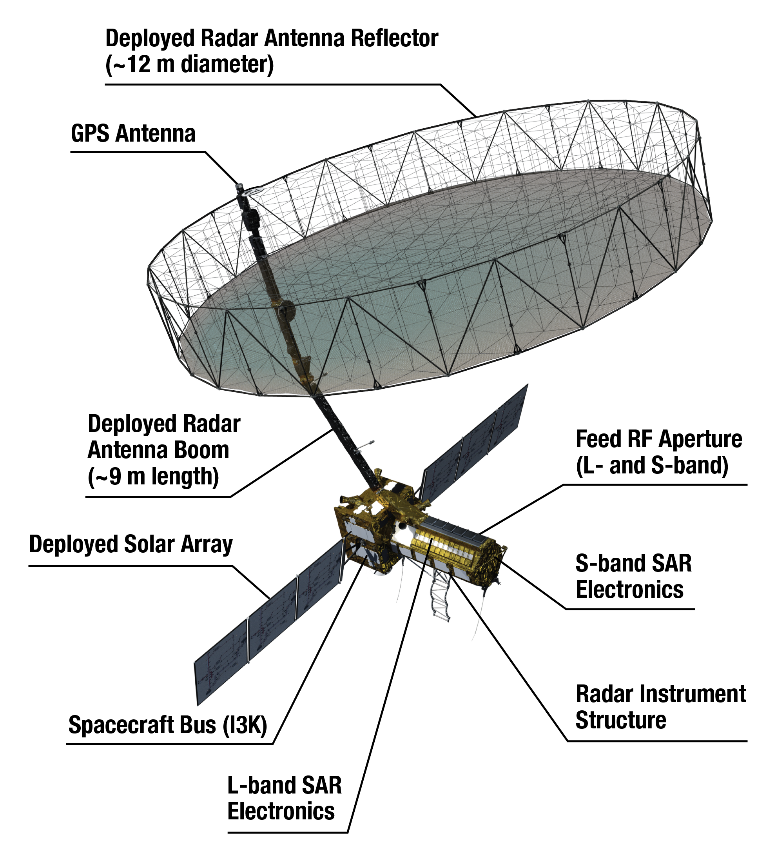
Overview | Observatory – NASA-ISRO SAR Mission (NISAR)

Features

  • The 2,800 kilograms satellite consists of both L-band and S-band synthetic aperture radar (SAR) instruments, which makes it a dual-frequencyimaging radar satellite. SAR is capable of penetrating clouds and can collect data day and night regardless of the weather conditions.
    • L-band SAR operates at a frequency of around 1 to 2 GHz. The lower frequency (higher wavelength) of L-band SAR allows it to penetrate through vegetation and soil, making it useful for monitoring changes in forest cover, soil moisture etc.
    • S-band SAR operates at a frequency of around 2 to 4 GHz. S-band SAR has a higher resolution than L-band SAR and is typically used for applications where higher detail is required, such as monitoring changes in urban areas or coastal zones. 
  • It has a large 39-foot stationary antenna reflector made of a gold-plated wire mesh which will be used to focus the radar signals emitted and received by the upward-facing feed on the instrument structure.
  • The spacecraft will orbit the Earth in a sun-synchronous orbit of 747 Km with an inclination of 98.4 degrees for a 12-day repeat cycle.

Utility

  • Study Earth’s dynamic land and ice surfaces in greater detail and observe subtle changes in Earth’s surfaces. E.g., Track flow rates of glaciers and ice sheets, landslide-prone areas and changes in the coastline etc.
  • Spot warning signs of natural disasters, such as volcanic eruptions, earthquakes and landslides. 
  • Measure groundwater levels, agricultural mapping, natural resource mapping and monitor Earth’s forest and agricultural regions to improve understanding of carbon exchange.