GS Paper 2

Scope and issues related to SC’s power to do complete justice (Article 142)

Context: The Supreme Court, while using its extraordinary power under Article 142, ordered the appointment of a citizen as a postal assistant on a probationary basis in order to ensure complete justice for someone who had fought for it for nearly three decades.

Article 142

Enforcement of decrees and orders of Supreme Court and orders as to discovery, etc.—

(1) The Supreme Court in the exercise of its jurisdiction may pass such decree or make such order as is necessary for doing complete justice in any cause or matter pending before it, and any decree so passed or order so made shall be enforceable throughout the territory of India in such manner as may be prescribed by or under any law made by Parliament and, until provision in that behalf is so made, in such manner as the President may by order prescribe. 

(2) Subject to the provisions of any law made in this behalf by Parliament, the Supreme Court shall, as respects the whole of the territory of India, have all and every power to make any order for the purpose of securing the attendance of any person, the discovery or production of any documents, or the investigation or punishment of any contempt of itself. 

In simple terms, Article 142 empowers the Supreme Court (SC) to issue such orders or decrees as needed to achieve complete justice. This is a special and exclusive power granted to the SC by the constitution, which even the high courts do not possess.

Need of Article 142 

The Constitution's framers believed this provision was crucial for those suffering due to judicial system delays.

To Fill the Legislative vacuum:

  • When there's a legal void for certain offenses, as seen in the Bhanwari Devi case in 2002, where there was no law addressing workplace sexual harassment, the SC introduced the Vishaka guidelines to ensure justice.

To Correct the Executive non-compliance: 

  • The executive's non-compliance in Bihar during trials resulted in a high number of undertrials, leading to the SC’s  intervention in the 1979 Hossainara Khatoon Case, the first Public Interest Litigation (PIL) in India.

About Supreme Court’s Power Under Article 142

  • These are SC's plenary powers for ensuring complete justice are inherent and complement its other constitutional and statutory powers.
  • These powers are of wide amplitude and are supplementary in nature.
  • No independent proceeding or procedure is required before the court seeking the application of such powers.
  • The application of such powers depends upon the discretion of the apex court.
  • The application of these powers cannot be done while ignoring or overriding the existing statutory or constitutional provisions.
  • These constitutional powers cannot, in any way, be controlled by any statutory provisions.

Article 142: Source of Judicial Legislation

Judicial legislation is the process by which judges create or modify laws. This can be done through the interpretation of law, or the issuance of judicial decrees. 

Article 142 of the Indian Constitution gives the SC the power to issue any order or decree that it deems necessary to do complete justice, even if it is not specifically mentioned in the law.  

Environmental Protection:

  • The SC issued directions to ensure green belts and open spaces, emphasising the importance of ecological balance in M C Mehta case of 1996.
  • Prohibited stone-crushing activities near residential complexes to safeguard public health in M C Mehta case of 1992.

Indigenous Rights:

  • Earmarked a portion of reserved forests for Adivasis to ensure their habitat and means of livelihood, recognising the importance of protecting indigenous communities in the Banwasi Seva Ashram case of 1993.

Public Health:

  • Compelled the municipal authorities of the Delhi Municipal Corporation to perform their statutory obligations for protecting the health of the community in B. L. Wadhera case of 1996.

Cultural Heritage:

  • Issued directions to regulate the level of air pollution around the Taj Mahal, recognising the need to protect cultural heritage sites in M. C. Mehta case of 1997.

Legislative Void Filling and Criminal Justice Reforms:

  • Filled legislative gaps in various areas such as inter-country adoption, sexual harassment at workplaces, ensuring the independence and autonomy of the Central Bureau of Investigation (CBI) in Vineet Narain case of 1998, arrest procedures, treatment of undertrials, and advance directives.

Women's Rights:

  • Addressed issues of sexual harassment at workplaces, thereby enhancing the protection of women's rights in the workplace. (Vishaka judgement)

Public Interest Litigation:

  • Emergence of PIL allowed the judiciary to play a pivotal role in safeguarding public interest, environmental conservation, human rights, and administrative accountability, often resulting in the government giving direction, forming guidelines etc.

Appointment and encroachment in executive domain: 

  • Provided a procedure of the appointment of Election Commissioner of India and held that ECI shall be appointed by a committee in Anoop Baranwal case of 2023.

Issue with Judicial Legislation 

  • Lack of Expertise: The Court is composed of judges who are experts in law, but they may not have the same expertise in policy or other areas that are relevant to law-making.
  • Lack of Legitimacy: Laws made by the Court are not subject to the same scrutiny and debate as laws passed by Parliament. This raises concerns about the legitimacy of judicial legislation.
  • Uncertainty: When the Court makes new laws or modifies existing ones, it can be difficult for people to know what the law is leading to uncertainty and confusion among citizens.
  • Hurts the doctrine of separation of power: Encroachment in the areas of legislative and executive domains create imbalance in the power of three organs of government and impact doctrine of separation of power.
  • Lack of accountability: The Constitution under collective responsibility makes the executive accountable to people’s mandate. Courts while legislating bypass such responsibility.

Ambiguity: 

  • In certain cases SC gives direction, change or modify the application of law without clarifying whether it is under article 142 or not. 
  • Subjective application in different cases by the court has created ambiguity, e.g., in NALSA court applied the article but in Sama sex marriage case it refused to apply it.

Judicial Restraints provided by the Court

  • In Prem Chand Garg Court, it was established that an order to ensure complete justice must align with both constitutional rights and relevant statutory laws.
  • In certain cases, SC held that it cannot be used to take away any fundamental rights and cannot supersede Article 32. 
  • The possibility of a conflict between powers under article 142 and other provisions of the constitution necessitate application of the rule of harmonious construction.

Case Laws 

  • In Justice K.S.Puttaswamy(Retd) vs Union Of India Court used Article 142 to expand the scope of the right to life and personal liberty to include the right to privacy.
  • In Vishaka and Others v. State of Rajasthan, Court used Article 142 to lay down guidelines for the prevention of sexual harassment at the workplace.

Way Forward

  • The primary purpose of Article 142 is to enable judges to alleviate the strict application of the law in situations where doing so is essential for the administration of justice.
  • In essence this power must always operate within the bounds of constitutional and statutory provisions. Going beyond these limits may lead to injustices rather than the delivery of justice itself.
  • The exercise of this power places a significant responsibility on the Supreme Court to use it with great care, keeping in mind democratic system and upholding the principles of justice, and constitutional values.

Article 142 should be invoked judiciously and with restraint. It is not a universal remedy for all legal issues. Supreme Court judges must neither become "good men not obeying the law too well," which means they can deviate from strict legal procedures when necessary for justice, nor should they turn into "knights errant roaming at will in pursuit of their own ideal of beauty or goodness," which would be considered an abuse of judicial discretion.

Politicization of Bureaucracy

Context: Recently, a circular by Central government has asked the Senior Civil Servants to act as “rath prabharis” to highlight the achievements of Central government in past 9 years.

Politicization of Bureaucracy: It refers to the process by which Civil Service become influenced and controlled by political considerations and partisan interests, rather than being driven by the principles of neutrality, professionalism, and public service.

Ideally, Civil Servants are expected to be politically neutral and objectively serve elected governments coming from various shades of political spectrum with equal commitment.

Civil servants as citizens can have political choices and viewpoints but as a key functionary of the executive wing, he/she is expected to follow elected governments with equal commitment.

Norms with respect to Political Executive-Bureaucrat relationship

  • Being impersonal and apolitical is one of the foundational values of Civil Services in India.
  • The Central Civil Services (Conduct) Rules 1964 and The All-India Services (Conduct) Rules, 1968 explicitly direct to maintain political neutrality and prohibit association with any political party, political canvassing or furthering of political interests of any party by Civil Servants.

Reasons for politicization of bureaucracy:

  • Patronage based appointments: While the recruitment is done based on open competitive examination, the power of transfer and posting rests with political executive.
  • High degree of discretion: Civil servants enjoy high degree of discretion with no oversight. This leads to lack of answerability makes civil servants susceptible to poetical pressure.

Outcome of politicization of bureaucracy:

Individual level:

  • Undermines the principle of neutrality and impartiality: The foundational principles of political neutrality and impartiality is violated.
  • Harassment: Leads to individual arm twisting and harassment of honest officers.
  • Integrity: It compromises the integrity of honest civil servants.
  • Erosion of independence in decision-making.
  • Attitude: It blocks the passage for attitudinal change which leads to nepotism and non-responsive conduct in civil servants.
  • Insecurity and low morale: When civil servants are appointed based on political considerations, it leads to reduced morale and motivation.
  • Fuels political ambitions: Lure of post-retirement benefits also compromises the values of honesty and integrity.

Organizational level:

  • Against Conduct rules: Central Civil Services Conduct rules 1964 explicitly prohibits Civil Servants from taking part in political activity.
  • Undermining Rule of Law: Politicization can undermine the rule of law as the bureaucracy is used to bypass legal procedures to implement decisions that are not in accordance with the law.
  • Creation of lobbies: Leads to creation of various lobby groups an interest groups amongst the civil servants which eye for offices of profit, rewards, and post-retirement benefits.
  • Weakened Public Institutions: A politicized bureaucracy weaken public institutions and undermine their credibility, erosion of trust in public institutions creates long-term negative impact for governance.
  • Impacts principle of separation of power: Taking partisan roles impacts the principle of separation of executive from partisan politics.
  • Inefficiency and lack of accountability: When civil servants start taking political sides, it is observed that they do not hold themselves accountable to organization’s hierarchy.
  • Rules centricity is compromised: They adhere to the political orders rather than duty and rule bound decision making.
  • Independence: Civil servants are supposed to function irrespective of political considerations, politicization leads to biased decision making.

Societal level:

  • Leads to a sense of apathy in civil servants.
  • Perpetuates social inequality: Politicized civil service leads to influenced decisions which serve a specific social group instead of serving the overall society.
  • Leads to corruption: Politicization of bureaucracy leads to a culture of collusive corruption, ultimately compromising with the quality of governance.
  • Lack of transparency in decision making: Leads to decisions based on political consideration and not on objective standards.
  • Loss of public trust on civil services: Politicized bureaucracy starts serving the interests of political masters instead of public leading to loss of public trust.

Suggestions and way forward

  • Civil Services board: Constituting civil services board at Center and States to regulate transfer and postings of senior civil servants as per TSR Subramaniyan case.
  • Fixed tenure: Fixing tenure at senior position to at least 2 years to insulate civil services from political interference.
  • Cool off period: No civil servant should be allowed to join any political party and hold a political office, including a ministerial position or Governorship within at least four years from the date of his retirement on superannuation. However, those civil servants who still have five or more years to superannuate may be permitted to join any political party after a cooling-off period of two years.
  • No Pension: Civil service members who are willing to waive their pension are not required to observe the above cooling-off period.
  • Independent Constitutional body for selection of senior civil servants: Selection of civil servants for various regulatory bodies and other statutory/constitutional positions should be done through an independent constitutional body whose members cannot be removed by the political executive and such members must be selected and appointed to such positions when they still have at least three years to superannuate.
  • No Extension of service: No Civil Servant shall be given any extension of service under any circumstances.
  • Appointment as Governors: The practice of appointing Civil Servants as Governors/Lt Governors should either be discouraged or only civil servants with exceptional integrity and no involvement in active politics be appointed as Governors/Lt. Governors.

Geopolitics of Solomon Island

Context: Recently, a Chinese Community Party delegation visited the Solomon Islands. China has been aggressively courting the Pacific islands to have greater geopolitical leverage in the Pacific.

About Solomon Islands

  • Solomon Islands is a country in the southwestern Pacific Ocean.
  •  It consists of a double chain of volcanic islands and coral atolls in Melanesia.
  •  The country comprises most of the Solomons chain—except for Buka and Bougainville, two islands at the northwestern end that form an autonomous region of Papua New Guinea.
  • Once a British protectorate, Solomon Islands achieved independence as a republic in 1978.
  • Honiara, on the north coast of Guadalcanal Island, is Solomon Islands’ capital and largest city.
image 86

Recent Geopolitics of Solomon Islands

  • 2022 - Solomon Islands signs a memorandum of understanding (MOU) on policing cooperation with China in March and is reported to be in the process of concluding a security agreement with China, which could allow a Chinese military and naval presence in the islands.
  • 2023 - In response to China's overtures to the islands, the US reopens an embassy on the Solomons after a 30-year absence.
  • June 2023-Mr. Sogavare called for review of its security treaty with Australia, which has historically provided policing support to the Solomon Islands.
  • July,2023-China had signed a policing pact with the Solomon Islands as both countries upgraded their ties to a “comprehensive strategic partnership”.

India and Solomon Island

  • Diplomatic relations between India & Solomon Islands were established in 1987.
  • India’s relationship with Pacific Island Countries (PIC) has deepened with evolution of Act East Policy, resulting in setting up of action-oriented Forum for India–Pacific Island Cooperation (FIPIC).
  • India has been aiding Solomon Island in capacity building in diverse fields under ITEC program (Indian Technical and Economic Cooperation).

India-Qatar Relations

Context: The recent death sentence for eight Indian individuals accused of espionage in Qatar has deeply shocked the Ministry of External Affairs. This situation is a significant test for the government's diplomatic skills. The trial was highly secretive, with limited information on charges and evidence. Indian officials' efforts to seek leniency and transparency have been ineffective. Strained ties resulting from this sentencing would harm both nations. The Indian government must act swiftly to provide strong support during the appeals process for these citizens.

India-Qatar Relations

About Indian and Qatar relations

  • Throughout the 20th century, India's interactions with Qatar were primarily centred around a modest yet thriving pearl import trade and the export of spices.
  • The turning point for Qatar came with the discovery of onshore Dukhan oil field in 1940, followed by the country's first offshore oil field two decades later, coinciding with a substantial increase in global oil prices.

Economic Ties

  • In recent years, the trade volume between India and Qatar has experienced noticeable fluctuations
  •  During the fiscal year 2015-2016, trade exchange between the State of Qatar and the Republic of India saw impressive growth, reaching a remarkable $10 billion.
  • However, in the past few years, there has been a noticeable decline in the trade volume between the two countries due to the decreasing rates of gas and oil in the international market.

Trade Statistics and Import Dependence

  • In the fiscal year 2022-23, India's total imports from Qatar amounted to $16.81 billion.
  • India's major imports from Qatar are related to fossil fuels, including liquefied petroleum gas (LPG), plastics, and petrochemical products.
  • In contrast, India's exports to Qatar were valued at just $1.97 billion during the same fiscal year, encompassing items such as cereals, copper articles, iron and steel products, vegetables, fruits, spices, and processed food items.

Investment Interests and Collaborative Projects

  • Qatari authorities, including the Qatar Investment Authority, have expressed their interest in making investments in India, particularly in infrastructure development, encompassing roads, highways, economic corridors, in addition to projects related to gas and fertilizers.
  • In return, India is keen on direct investments in the manufacturing and production of liquefied natural gas and associated chemical industries, with a special focus on fertilizer production, urea, petrochemicals, and infrastructure projects related to the natural gas industry, oil drilling, minerals, and power.

India's Growing Energy Needs

  • Given India's economic development and the tangible growth experienced in recent years, the nation's demand for energy sources is on the rise.
  • India has adopted an ‘Energy Security’ policy, relying on politically and socially stable countries to provide energy sources.
  • The energy partnership traces back to an agreement signed by both nations in 1990, wherein India committed to purchasing 7.5 million tonnes of LNG annually over a 25-year period.
  • Subsequently, in December 2015, both parties further solidified their collaboration by agreeing that Qatar would augment its LNG supply to India by an additional one million tonnes annually.

Collaboration in Defence Affairs

  • India's engagement in defence collaboration with Qatar has predominantly focused on training, participation in each other's conferences and events, as well as visits by Indian Navy and Coast Guard vessels.
  • A notable instance of this collaboration is evident in the naval exercise termed ‘Zair-Al-Bahr’ (Roar of the Sea), which signifies a significant joint effort between the Indian and Qatari Navies.
  • Both India and Qatar have expressed a mutual commitment to working together in combatting the financing of terrorism.

Cultural Interaction

  • Indian Cultural Centre (ICC) functions as the leading organization overseeing Indian community associations, operating under the auspices of the Embassy of India in Doha and benefiting from support by private sponsors.
  • India places immense significance on Qatar's role as a co-sponsor of a United Nations General Assembly Resolution, a historic unanimous resolution backed by 177 co-sponsors, which designates June 21 as the International Day of Yoga (IDY).

Indian Diaspora in Qatar

  • The Indian community in Qatar constitutes the largest expatriate group, estimated to be approximately 700,000 strong.
  • Their contributions span various sectors, with notable involvement in projects related to the preparation of the Qatar 2022 FIFA World Cup.
  • The remittances sent by the Indian expatriate community in Qatar to India are estimated to be approximately 750 million dollars annually.

Irreplaceable Role of Qatar as an LNG Supplier

The linchpin of this bilateral trade relationship remains liquefied natural gas (LNG), with Qatar supplying 80% of India's LNG needs. This critical energy connection underscores the importance of India's economic ties with Qatar, even if the overall value of bilateral trade may appear modest in comparison to the United Arab Emirates (UAE).

1.Trade Imbalance:

In the case of India and Qatar, trade significantly favours Qatar. This trade imbalance is predominantly attributed to the prominence of natural gas, particularly LNG. LNG not only constitutes a substantial portion of India's imports from Qatar but also represents nearly 50% of India's total imports in terms of value from the country.

2. India's Increasing Reliance:

The Indian government is actively promoting increased natural gas consumption, this reliance is expected to grow in the coming years, even with a potential increase in domestic natural gas production. India's largest LNG importer, the government-owned Petronet LNG, has a substantial long-term contract with Qatar for LNG imports. As India aims to raise the share of natural gas in its primary energy mix to 15% by 2030, it's inevitable that LNG imports will see a substantial increase.

3. Cleaner Energy Alternative:

Natural gas is regarded as a cleaner and more cost-effective alternative to traditional petroleum fuels like diesel and petrol. Given India's high dependency on crude oil imports (over 85%), natural gas not only offers a cleaner energy source but also aligns with India's energy transition objectives. Consequently, the case of the Indian naval personnel facing the death penalty in Qatar presents a delicate diplomatic challenge, as the secure supply of natural gas is pivotal to India's energy security.

4. Qatar's Dominance:

India imported a total of 19.85 million tonnes of LNG in the fiscal year 2022-23, with approximately 54% of this LNG. This significant reliance on Qatar, both through long-term contracts and spot purchases, underscores the challenge of diversifying India's sources of LNG.

5. Qatar's Strength in the Global LNG Market:

In the global LNG market, Qatar holds a unique position of strength, particularly in the wake of Russia's invasion of Ukraine and the subsequent disruption in Russian natural gas supplies to Europe. This geopolitical situation has increased price volatility in LNG spot cargoes, making long-term contracts more attractive for securing stable supplies. Qatar, as the world's largest LNG exporter, has capitalized on this trend by entering into numerous long-term LNG supply agreements with various countries.

India, recognizing the need for energy security and price stability, is actively pursuing long-term LNG contracts with major suppliers, with Qatar being a prominent choice. Despite the possibility of the global LNG market transitioning into a buyer's market due to upcoming export projects, India's continued dependence on Qatar is expected to persist for several years.

Leveraging Opportunities for Enhanced Relations

  • Protection of Indian Expatriate Workers: India should prioritize negotiations to safeguard the rights and well-being of its expatriate workers in Qatar, many of whom have faced labor-related challenges.
  • Collaboration on Environmental Sustainability: India and Qatar can work together to develop a cleaner and more energy-efficient environment.
  • Cultural Exchange and Soft Power: Given the popularity of Bollywood among Qataris, India should explore additional avenues for cultural exchange to bolster its soft power influence.
  • Education Sector Cooperation: The presence of Western universities in Qatar offers an opportunity for Indian students to receive quality education abroad without the usual long distances and high living costs. Strengthening cooperation in the education sector could further enhance the India-Qatar relationship, which has demonstrated resilience throughout the seemingly intractable diplomatic crisis.

What is APAAR ID, One Nation One Student?

Context: Several state governments requested schools to seek parental consent for the creation of a new student identity card known as the Automated Permanent Academic Account Registry (APAAR)

About APAAR ID

  • Under the initiative, each student would get a lifelong APAAR ID, making it easy for the learners, schools, and governments to track academic progress like literacy rates, dropout rates  from pre-primary education to higher education.
  • Every individual will have a unique APAAR ID, which will be linked to the Academic Bank Credit (ABC), which is a digital storehouse that contains information of the credits earned by students throughout their learning journey. 
  • With the APAAR ID, students would be able to store all their certificates and credits, whether they come from formal education or informal learning.
  • It is part of the 'One Nation, One Student ID' initiative outlined in the National Education Policy of 2020.
  • Registration for creating APAAR ID is voluntary, not mandatory.

Working of APAAR ID

  • To sign up for APAAR, students will have to provide basic information such as name, age, date of birth, gender, and a photograph. This information will be verified using their Aadhar number.
  • Students will need to sign a consent form, and they can choose to either accept or decline sharing their Aadhar number and demographic information with the Ministry of Education for creating the APAAR ID.
  • For minors, parents will have to sign the consent form, allowing the Ministry to use the student’s Aadhar number for authentication with UIDAI. 
  • If the student changes schools, whether within the state or to another state, all her data in the ABC gets transferred to her new school just by sharing the APAAR ID, no need to provide physical documents or transfer certificates.
  • It would also serve as a gateway to Digilocker, a digital system where students can store their important documents and achievements, making it easier to access and use them in the future for, say, pursuing higher education or finding a job.

Significance of APAAR ID

  • Aims to reduce fraud and duplicate educational certificates by providing a single, trusted reference for educational institutions. Only first party sources that issue certificates will be allowed to deposit credits into the system, ensuring authenticity.
  • Also to make education hassle-free and reduce the need for students to carry physical documents.

Investigations in India

Context: Supreme Court in case of Rajesh and Another v. State of Madhya Pradesh acquitted three persons who were alleged to have been involved in the murder and related offence on the ground of illegalities in investigation.

Argument by Court for Their Acquittal 

The Court argued that a person could not be said to be in police custody till he was formally arrested, as he did not figure as an accused person in the First Information Report (FIR) and was not accused of any offence till his arrest.

The Court emphasising on seeking compliance under Section 100(4) and Section 100(5) of the Code of Criminal Procedure (CrPC) called out many irregularities in the investigation.

Police Custody 

When a person is arrested by police for charges of committing a heinous crime or on suspicion, he is detained in police custody. 

Judicial Custody 

When a person is kept in custody by a magistrate, it is called judicial custody. Unlike police custody, here a person is kept in jail on the orders of the magistrate for a certain temporary period.

Challenges with Investigation in India 

  • Budgetary Constraints: Dismal budget allocation by the state government affects many areas such as lack of skills, insufficient training, appropriate or insufficiency of equipment, and logistic support affecting their operational capacity. 
  • Dual responsibility of Maintaining order and investigation are two different responsibilities of the police officers, which in turn lead to suboptimal investigation.
  • Excessive workload due to inadequacy of manpower and long working hours even on holidays and the absence of a shift system.
  • Forensic Science: Lack of technology and research in forensic results in the faulty fingerprint, footprints etc. at the scene of crime compromising the investigation. 
  • Lack of Public Cooperation: Many times, eyewitnesses are reluctant to give statements to the police officers decreasing efficiency of investigation.
  • Political Interference: Investigations, particularly in cases where high-profile people are involved, get compromised due to direct or indirect political interference.
  • Transfer of police officers by the government during an investigation delays the investigation as new officers need to understand the case from the scratch.
  • During investigation, the media while disseminating news sometimes help the culprit in compromising evidence and can also help the criminals in executing plans e.g., 26/11 Mumbai attack.
  • Witnesses may be influenced, coerced, unduly remunerated by the culprit or others and may turn hostile halting the investigation.
  • Lack of coordination with other sub-system of the Criminal Justice System in crime prevention, control, and search for truth.
  • Uneven compliance with the recommendation of committees or court directives e.g., 17 states have taken steps to separate law and order and investigation wings.

Malimath Committees Recommendation

  • Establish an independent complaints authority to investigate complaints against police officers so that the process is fair and unbiased.
  • Set up a National Police Commission to oversee the functioning of the police and to ensure that they are working effectively and efficiently.
  • Improve the forensic capabilities and training of the police to help them collect and analyse evidence.
  • Introduce a witness protection program to ensure their safety, and their identities should be kept confidential to prevent retaliation.
  • Increase the use of technology in the justice system and allow the prosecution to rely on electronic evidence to prove its case.
  • Recommended that the investigation wing should be separate from that of the law-and-order wing.

Law Commission’s Recommendation Under Report 239 

  • Networking of all police stations to establish a link with all the courts.
  • Digital videography to be installed at police stations. At the time of receiving an FIR/complaint, videography should be made compulsory.
  • Each Police Station should be provided with secure interrogation rooms, with simultaneous audio-visual recording facilities.
  • At least, all District Headquarters should be provided with mobile forensic vans which should accompany the homicide teams to the place of occurrence.

Exclusion of Meitei Community from the Schedule Tribes List 

Context: A proposal on the inclusion of the Meitei community in the Scheduled Tribes list has been examined and rejected twice over the last four decades as accessed by The Hindu under the Right to Information Act, 2005.

The Process of Inclusion or Exclusion From the Scheduled Tribes or Schedule Castes list

StepsProcessAbout
1Initiation at the State or Union Territory Level It begins with a State or Union Territory government or administration expressing the desire to include or exclude a particular community from the SC or ST list. 
2State Government Recommendation State governments can recommend specific communities for addition or subtraction from the SC or ST lists based on their discretion.  These recommendations may be informed by studies or research, as seen in the case of the Hatti community in Himachal Pradesh. 
3Proposal Submission to Union Ministry The State government sends its proposal to the Union Ministry of Tribal Affairs, which proceeds with its own internal deliberations. 
4Examination by the Ministry of Tribal Affairs The Ministry of Tribal Affairs examines the proposal and, upon approval, forwards it to the Registrar General of India (RGI). 
5RGI Approval Once the RGI approves the proposal, it is then submitted to the National Commission for Scheduled Castes or National Commission for Scheduled Tribes for further consideration. 
6Union Government Approval Following the review by the respective National Commissions, the proposal is returned to the Union government. It undergoes inter-ministerial deliberations and is sent to  the Cabinet for final approval.
7Legislative Amendment The inclusion or exclusion of any community in the SC or ST lists only takes effect when a Bill amending the Constitution (SC) Order of 1950 and the Constitution (ST) Order of 1950 is passed by the Parliament.
These orders initially provided the complete list of SCs and STs after India's independence through a presidential order, and any alterations to this list must be passed by Parliament by law.
8Presidential Notification The final decision lies with the President's office, which issues a notification detailing the changes.  The President exercises these powers under Articles 341 and 342 of the Indian Constitution.
image 80

Meitei Community of Manipur

  • The Meitei community of Manipur is the dominant community in the state and is mostly located in the city of Imphal. 
  • The community consists of Hindus, and forms more than 50% of the entire population of Manipur, according to the 2011 census data of India.
    • 8% of the Meiteis are Muslims called Meitei Pangals.
  • The Meities are mostly settled in the plains of Manipur but certain sections can also be found in the hills. 
  • The Meitei community is fighting for the right to be included in the ST list in Manipur, which has caused a rift between them and the Naga and Kuki communities.

Naga and Kuki Scheduled Tribal Community of Manipur 

  • The Naga and Kuki tribes make up about 40 percent of the population of Manipur, and fall into the ‘Scheduled Tribes’ category.
  • They enjoy certain benefits such as land-owning rights in the hills and forests, and the make-up of the majority of the people living in the hills.

Constitutional Provisions with Respect to Schedule Castes and Scheduled Tribes341.

Scheduled Castes.—(1) The President may with respect to any State or Union territory, and where it is a State, after consultation with the Governor thereof, by public notification, specify the castes, races or tribes or parts of or groups within castes, races or tribes which shall for the purposes of this Constitution be deemed to be Scheduled Castes in relation to that State or Union territory, as the case may be.

(2) Parliament may by law include in or exclude from the list of Scheduled Castes specified in a notification issued under clause (1) any caste, race or tribe or part of or group within any caste, race or tribe, but save as aforesaid a notification issued under the said clause shall not be varied by any subsequent notification.  

342. Scheduled Tribes.— (1) The President may with respect to any State or Union territory, and where it is a State, after consultation with the Governor thereof, by public notification, specify the tribes or tribal communities or parts of or groups within tribes or tribal communities which shall for the purposes of this Constitution be deemed to be Scheduled Tribes in relation to that State or Union territory, as the case may be.

(2) Parliament may by law include in or exclude from the list of Scheduled Tribes specified in a notification issued under clause (1) any tribe or tribal community or part of or group within any tribe or tribal community, but save as aforesaid a notification issued under the said clause shall not be varied by any subsequent notification.  

Primary Health Centre (PHC)

Context: This editorial emphasize on ‘Ayushman Bharat Scheme’. The launch of this  flagship health program i.e. Ayushman Bharat, in 2018, the Indian government has consistently emphasized the importance of enhancing medical accessibility, particularly in rural areas. This initiative aims to transform 150,000 public health centers (PHCs) into health and wellness centers (HWCs) to "bring healthcare closer to people's homes." It was evident from the beginning that achieving this goal would necessitate addressing the chronic shortages of doctors, frontline medical professionals, and healthcare infrastructure.

Given that healthcare falls under the purview of individual states in India, the central government's commitment to this endeavour necessitates a corresponding commitment from state governments. Unfortunately, most states that have traditionally lagged behind on welfare indicators have not adequately risen to this challenge.

The latest edition of the Centre’s Rural Health Statistics shows that the medical system outside urban areas continues to be plagued by a shortfall of doctors and infrastructure. Barely 45 per cent PHCs adhere to their mandate of functioning 24×7.A study published in The Lancet in February placed UP among the five states where district hospitals offer only 1 per cent of the basic services.

About Primary Health Centre (PHC)

  • PHCs are the cornerstone of rural health services- a first port of call to a qualified doctor of the public sector in rural areas for the sick and those who directly report or are referred from Sub-Centres for curative, preventive and promotive health care
  • The concept of Primary Health Centre (PHC) is not new to India. The Bhore Committee in 1946 gave the concept of PHC as a basic health unit to provide as close to the people as possible, an integrated curative and preventive health care to the rural population with emphasis on preventive and promotive aspects of health care.
  • The Government of India's initiative to create and expand the presences of Primary Health Centres throughout the country is consistent with the eight elements of primary health care outlined in the Alma-Ata declaration. 

Examples of primary health care services include routine check-ups, immunizations, screening tests, chronic disease management, and referrals to specialists when needed. Primary health care providers can include general practitioners, nurse practitioners, midwives, and community health workers.

Why primary health care is so important

  • Promotes preventative care: Primary health care helps prevent illness and disease by promoting healthy living, encouraging vaccinations, and providing regular check-ups and screenings.
  • Increases accessibility: Primary health care is often the most accessible form of healthcare, as it is typically delivered in local clinics or health centers that are close to where people live and work.

The share of primary healthcare in Current Government Health Expenditure (CGHE) has increased from 51.3% in 2014-15 to 55.9% in 2019-20. The increased focus on primary healthcare reinforces the government’s decisions to prioritize primary healthcare in the country.

image 79
Figure: Share of Primary Health Care in Current Government Health Expenditure (%)
  • Reduces healthcare costs: Early detection and management of illnesses through primary health care can reduce the need for more expensive and specialized care, ultimately saving individuals and healthcare systems money.( It reduces the need for expensive secondary and tertiary healthcare.)
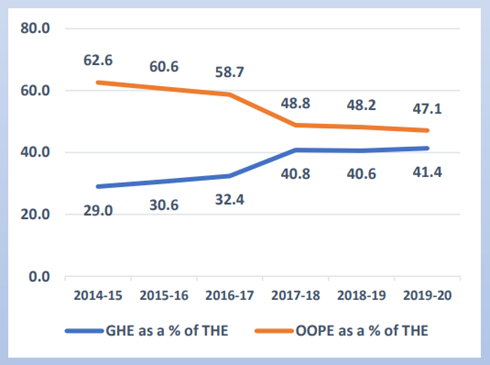
    • Acc to  National Health Accounts Estimates for India (2019-20)- Strengthening the PHC and focusing on preventive care will reduce the Out-of-Pocket Expenditure. The share of Out-of-Pocket Expenditure (OOPE) in total Health Expenditure (THE) declined from 62.6% to 47.1%. The continuous decline in the OOPE in the overall health spending show progress towards ensuring financial protection and Universal Health Coverage for citizens.

lLgAHDJMST2dss3HtvL1S1Q83tXZuTJfXuAXh2FTLTNbcXxUzzqP5TxmV8EE8e KKNj0HFshipwQWRyMAiqMXAVCOfQ6GZpeS y1 cZ9 Xc8nyw5NYb2aZQp9zX692lEsXR6FPWImTOAAkhBu1PwIQ

Figure 2: Government Health Expenditure and Out-of-pocket expenditure as % of Total Health Expenditure (%)

  • Improves overall health outcomes: By providing comprehensive and continuous care, primary health care can help manage chronic conditions and improve overall health outcomes, including reducing mortality rates.
  • Addresses health inequalities: Primary health care can help address health inequalities by providing equitable access to healthcare services regardless of income, race, gender, or location.
  • Primary health related to Climate Change: Primary health care has an important role in responding to the climate change related threats to human health like injuries related to extreme weather events like storms, fires and floods; infectious disease outbreaks due to changing patterns of vector borne diseases; poor nutrition from reduced food availability because of drought; the psychological impact due to displacement of communities.  
  • Primary healthcare in developed nations: The majority of developed countries' federal healthcare budgets go towards primary care, including the UK, Australia, Canada, the Netherlands, and Sweden.

Problems of PHC in India

  • Limited in scope- The existing primary healthcare model in the country covers only 15% of the health issues people seek care for, primarily related to pregnancy, limited childcare, and national health programs. Expanding its scope is essential for comprehensive healthcare coverage.
  • Funding: The funding for general healthcare is quite low, leaving insufficient funds for primary healthcare.
The central and state governments’ budgeted expenditure on healthcare touched 2.1 % of GDP in FY23 which was substantially lower that other BRICS countries (Brazil: 3.8%, China: 3.1%, Russia: 3.7%, South Africa: 4.2%)
  • Inadequate Infrastructure: According to the National Health Profile 2019 report, 22% of primary health centers do not have a separate room for immunization and family planning services.
In Rajasthan, the population is often so dispersed (especially in hilly areas in the south and in the desert in the west) that a family may need to travel 10-20 km to reach the nearest PHC according to an analysis by the Centre for Economic and International.
  • Shortage of Healthcare Professionals: The delivery of quality health services is hampered by supply shortages, inadequate management, and the absence of proper training and supervision for healthcare workers. These issues can lead to interruptions in care, inefficiency, and outdated practices, all of which impact patient well-being.
The rural healthcare infrastructure is three-tiered and includes a sub-center, primary health center (PHC) and CHC. Indian PHCs are short of more than 3,000 doctors, with the shortage up by 200% over the last 10 years to 27,421, as IndiaSpend reported in 2016.

Lack of Access to Medicines:

The high cost of medicines is a significant barrier to healthcare access in India, with many people unable to afford even basic medications.

The government's free medicines program, which provides essential medicines to patients for free, has been plagued by shortages and supply chain issues.

The lack of access to medicines has led to many patients turning to unlicensed and unregulated pharmacies, which may sell substandard or counterfeit drugs.

Poor Quality of Care:

A study published in the Lancet found that around 50% of patients in India do not receive the appropriate care for their health conditions.

The lack of quality healthcare services is due to a range of factors, including a shortage of qualified healthcare professionals, inadequate infrastructure, and poor regulation of healthcare providers.

In addition, many patients in India lack awareness about their health conditions and may not seek timely medical treatment, leading to complications and poor health outcomes.

An analysis by the Centre for Economic and International - India has a large network of primary health centres (PHCs), each supposed to serve a population of 25,000. In many poor states, such as Madhya Pradesh, Bihar and Jharkhand, however, a PHC covers as many as 45,000, 49,000 and 76,000 people.
  • Under-investment in primary healthcare : also means that PHCs continue to remain under-equipped and lacking supplies and drugs to provide comprehensive primary care. 
For example, of the 709 PHCs surveyed in 2009 by the International Institute for Population Sciences, Mumbai, about 24% did not have an electricity connection and 63% did not have piped water supply.

At the same time, PHCs are expected to deliver centrally designed, targeted vertical programs, alienating them further from communities. As a result, even those families that can access PHCs continue to look elsewhere for their critical healthcare needs.

  • Urban Neglect in Indian Healthcare System: The primary healthcare system in India has historically overlooked the growing urban population, as its focus has mainly been on rural areas. This neglect stems from historical policies and infrastructure designed for rural regions, despite the increasing urban population. 

Way Forward

  • Srinath Reddy committee recommendation: The High-Level Expert Group (HLEG) on Universal Health Coverage (UHC) headed by K. Srinath Reddy recommended that expenditures on primary health care, including general health information and promotion, curative services at the primary level, screening for risk factors at the population level, and cost-effective treatment, targeted toward specific risk factors, should account for at least 70% of all health care expenditures. 
  • Ayushman Bharat scheme seeks to upgrade more than 1.5 lakh health facilities like Sub Centres and Primary Health Centres to health and wellness Centres (HWC).  These centres would deliver Comprehensive Primary Health Care (CPHC) bringing healthcare closer to the homes of people. This has to be implemented properly. 
  • Telemedicine: Telemedicine provides patients remote access to medical consultations and treatments via telecommunications technology. In turn, this contributes to closing the gaps in healthcare access, particularly in rural and remote areas. Telemedicine has proven to be a boon for Indians during the uncertain times of lockdowns, and it has the potential to make remote, optimized healthcare accessible to every corner of India in the future.
  • Health Information Exchange (HIE): HIE systems enable the seamless sharing of patient health information between various healthcare providers, enhancing care coordination and substantially reducing medical errors.
  • Mobile Health (mHealth): mHealth is an emerging concept involving the utilization of mobile devices and technology for health services, such as appointment scheduling, remote monitoring, and medication reminders. It can significantly improve patient access to care and treatment plan adherence.
  • Government must increase budgetary allocations to healthcare to at least 3-4% of GDP so that public expenditure on healthcare is at least 70% of total health expenditure.

QR Code on Food Labels to help visually disabled

Context: The Food Safety and Standards Authority of India (FSSAI) has recommended the inclusion of QR code on food products for accessibility by visually impaired individuals under its Food Safety and Standards (Labelling and Display) Regulations 2020.

About QR Code on Food Labels to help visually disabled

image 78
  • The information on food labels includes product name, shelf life, nutrition facts, vegetarian/non-vegetarian logos, ingredient lists, allergen warnings, and other product specific labelling requirements. 
  • This information aims to help consumers make informed food choices and ensure safe food access for all, including individuals with special needs like the visually impaired.
  • It will also provide inclusive access to information, guaranteed by Article 19 as a fundamental right of citizens.
  • Furthermore, this will complement The Rights of Persons with Disabilities Act 2016, which acknowledges the needs and rights of people with disabilities and places a strong emphasis on accessibility and the promotion of their health.

About Food Safety and Standards (Labelling and Display) Regulations 2020

  • The regulations prescribe the labelling requirements of pre-packed foods and display essential information about premises where food is manufactured, processed, served, and stored.
  • The non-veg symbol shall consist of a brown colour-filled triangle inside a square with a brown outline having sides not less than the minimum size specified in the regulation.
  • Recommended Dietary Allowance (RDA) is mandatory to be displayed on the label.
  • Mandatory declaration of allergen information.
  • Some new logos were established to identify foods with different categories, such as for Fortified Foods, organic foods.
  • E-commerce platforms are required to provide for mandatory labelling of food products offered for sale through their platform with certain exceptions.
  • Also included restaurant operators with large networks of chains within its scope.

About FSSAI

Body: Statutory body under the Food Safety and Standards Act 2006.

Nodal Ministry: Ministry of Health & Family Welfare.

Headquarters: Delhi

Replaced various acts: Prevention of Food Adulteration Act, 1954, Fruit Products Order, 1955, Meat Food Products Order, 1973, Vegetable Oil Products (Control) Order, 1947, Edible Oils Packaging (Regulation)Order 1988, Solvent Extracted Oil, De- Oiled Meal and Edible Flour (Control) Order, 1967, Milk and Milk Products Order, 1992 etc. were repealed after commencement of FSS Act, 2006. 

Appointment of chairperson and CEO: By Government of India. 

Objective: Responsible for protecting and promoting public health through the regulation and supervision of food safety.

Despite challenges, why the USA continues the Global Hegemon?

Context: Large number of simultaneous ongoing conflicts in Ukraine, Middle East (Israel-Palestine) and the South China Sea, where in China-Russia-Iran are challenging the USA in different theatres is questioning the American grand strategy.

The question is that whether will over-stretched and fatigued in responding to these conflicts, which will further demonstrate to the world about the fall of American Hegemony and primacy in the world affairs.

Decline of American Hegemony and Primacy in the world

External Reasons

  1. Rise of China (Economic, Political & Strategic): The rise of China’s economic, military and strategic capabilities has helped bridge the power differential between both the countries. China is the world’s second largest economy and has the second largest military. China has emerged as the overwhelming challenger to the US led system.
  2. Rise of Anti-America Coalitions of China, Russia and Iran: Growing closeness among China, Russia and Iran have been challenging the USA’s interests in the different theatres of Indo-pacific, Europe and Middle East. They together have been able to challenge and stretch USA.
  3. Lapses on part of America's moral hegemony: USA’s interventions in Iraq and Afghanistan lacked moral authority. These regime-change policies displayed that USA’s unilateral policies were unwelcome by much of the developing world. 
  4. Decline of American economic primacy: Despite being the largest global economy, US enjoys relatively less power in the global economic architecture. This is visible from the emergence of G20 as the primary global economic agenda body replacing the G7. More and more global economy is being decentralized with Asia being the driver of global economy.
  5. Unable to tackle global challenges: Despite being the global hegemon, USA’s attitude towards global challenges such as terrorism, pandemic, climate change has been not very assuring. President Trump took the US out of the Paris Climate Deal; USA did not collaborate on providing waiver for COVID-vaccines. This has given space for other countries to rise to the occasion.
  6. Rise of Middle Powers: Middle powers such as India, Brazil, Turkey, South Africa, South Korea have emerged as important players in the global politics. These actors are swing states in great power politics and enjoy considerable regional dominance. The US thus must coordinate with these actors and not dominate or dictate them. Thus, constraining US space to operate.
  7. Emerging differences in US-Led Order and groupings such as NATO: The trans-Atlantic partnership which was the essence of US’s foreign policy has been strained due to increasing US expectation of Europe taking extra steps militarily and financially to aid and limit Russia in the European Region. Also, the differences between UK and EU and between the EU countries over the policy towards Russia have made NATO and EU less effective.

Internal Reasons

  1. Deep polarization in American politics compromising domestic consensus over global issues: 
    • There is a growing lack of consensus over foreign policy issues in the domestic US policy. 
    • President Trump actively argued for an isolationist foreign policy as external military participation led to overwhelming costs which the American exchequer paid.
    • On Ukraine, Recently, USA Congress dropped the aid package supporting Ukraine. Some sections of the Republic Party have been arguing against the unending support for Ukraine and concentrating more on balancing China as more desirable USA foreign policy goal. These sections have been asking the European countries to take more responsibility in helping Ukraine preserve its sovereign existence.
  1. Slowing economic growth and deglobalization
  2. Energy security following the shale revolution.
  3. Fatigue with long stretched military commitments in the Iraq, Afghanistan, and Syria

This somewhat perceived and real decline of the hegemony and primacy of USA has further emboldened countries like Russia, China, and Iran to challenge the US led world order. 

Testimony Of USA's Continued Dominance

However, despite the decline the US remains the overwhelming most powerful country of the world. The testimony to the overwhelming power and hegemony of USA despite some transformation in US policy is visible through these instances:

  1. In Europe: Finland and Sweden, two traditionally neutral countries joined the NATO as a guarantee of their security against the aggressive tactics of Russia. 
  2. In Asia: 
    • USA has convinced a hitherto pacifist Japan to increase its military expenditure to counter China and promoted the normalization of ties between Japan & South Korea. (to address China's aggressiveness against Japan).
    • Expanded military support to Taiwan to make it costly for China to invade the island.
    • USA has renewed its defence pact with Philippines and has signed a comprehensive strategic partnership agreement with Vietnam. (both countries at the receiving end of China's aggressiveness in the South China Sea)
    • USA has entered partnership with the UK and Australia to empower Australian Navy with nuclear submarines. 
    • Strengthening of the QUAD Partnership involving USA, Japan, Australia, and India to balance China in the Asia-Pacific region.
  1. In Middle East: 
  • USA has aimed to make bridges between Israel and the Arab world in the form of Abraham Accords, wherein, UAE and Bahrain have accepted normalization of relations with Israel. A similar pact is being negotiated between Saudi Arabia.
  • USA has floated groupings such as I2U2 and IMEC Corridor for the economic growth and multilateral cooperation in the middle east region.
  • Just after the recent Israel-Palestine conflict, US President Biden visited Israel to establish peace.

Factors Behind Continued Dominance Of USA

  1. Ability to forge coalitions: A remarkable advantage the US enjoys the system of alliances that Russia and China are still aiming to build. Recent, US policy has focused on widening the array of traditional allies with which the US coordinates and acts globally to maintain its hegemony. For ex. US has aimed to bring countries wary of China (Japan, India, Australia, Vietnam, Philippines etc.) under its fold and enhanced the deterrent against China in the region. 
  2. Military superiority: USA is the overwhelming military superpower in the world. USA's military expenditure alone is more than the combined expenditure of next 10 countries, including China and India. USA has ability to project its military superiority which is unmatchable by any other country. For ex. After the rise of tensions between Israel and Palestine, US deployed two aircraft carriers in the eastern Mediterranean Sea. 
  3. Strength of US establishment to rise above domestic politics and pursuit the USA's national interests. 
  4. Economic superiority: Despite the relative decline in of the US economy vis-a-vis China, US continues to be the largest economy in the world with a share of 24%. The eminent slowdown of the Chinese economy due to structural reasons means that the USA will continue to have a lead over China's economy in the foreseeable future.
  5. Geographical Isolation: The location of US which is separated by Pacific Ocean and Atlantic Ocean from both China and Russia allows the US to take a detached view of the balance of power dynamics playing out in the Asia and Europe. This allows the US to shift its policies and exploit the contradictions in the growing closeness between China and Russia. For ex. In the 1970s, US exploited the contradictions between Russia and China.
  6. Agenda setting: Despite the ever-growing closeness of China and Russia, US continues to have more leverage than other powers with both Israel and the Arabs. Thus, there is no doubt that US continues to have more power to shape the regional and global agenda. 
  7. Technological superiority: US companies and military establishment define the cutting edge of technologies. Companies like Google, Microsoft, Apple, Facebook dominate the world in software. In the military sphere, US companies like Boeing, General Electric etc. are at the cutting edge of military technology.  
  8. Knowledge superiority: US attracts the brightest individuals globally. Also, US dominates the global R&D expenditure and patent filing in the world. This gives the power to US to dominate the knowledge systems and cutting-edge technologies.
  9. Looking beyond democracies: USA has been traditionally invested in promoting democracies in the world and working closely with them. However, recently USA has showed its ability to show a realist bend and work with all countries which have diverse political systems provided they abide by the UN Charter. 

Conclusion

Despite the growing challenge to USA hegemony by Russia, China and Tehran combine, USA continues to have the resources and will for continue geopolitical maneuver and pursue its dominance and national interest. 

Enhancing India's Higher Education Ecosystem: The Need for Reformed Student Visa Policies

Why is it necessary to focus on attracting international students to India?

Annually, around 7.5 lakh Indian students seek education abroad, leading to a surge in private universities aiming to meet this demand. While these institutions have succeeded in attracting foreign faculty, they face challenges in bringing in international students. This limits the cross-cultural exposure essential in modern education. To address this gap, India's National Education Policy 2020 focuses on internationalization. It advocates curricular improvements, campuses open to foreign scholars and students, and joint degree programs with foreign institutions. These changes aim to enhance the competitiveness and inclusiveness of Indian higher education.

Further, Strategies to enhance attraction of International Students in India:

  • Fostering Post-Education Opportunities: One drawback for international students studying in India is that, despite the country's thriving corporate and start-up sectors, they are unable to obtain work experience while pursuing their degrees. This is a significant obstacle for many such students. It is necessary to change India's "S" Visa or student policy in order to address this.
  • Creating a Talent Ecosystem : Many Indian organisations are multinationals or aspire to be multinationals, thus they need staff that understands Indian markets, business etiquette, rules, and culture in-depth. These enterprises can create a network of international talent that acts as a cultural bridge by hiring foreign talent from Indian campuses and employing Indian graduates who are returning home.

For Eg- The big three US tech companies — Google, Meta, and Microsoft — are all headed by Indian alumni of US universities. Former Afghan President Hamid Karzai who studied in India kept bilateral relations warm through difficult times.

  • Addressing Workforce Challenges : Concerns that foreign students may take jobs away from Indian students are unfounded. India’s population growth has dipped below the replacement rate of 2.1 per cent, and the country will begin ageing soon, like China, according to the UN Population Fund. India's declining population growth and impending aging population mean that a dwindling working-age population will soon become a reality. Sustaining growth under these circumstances requires innovative solutions.
  • Learning from Global Practices : Countries like the US, UK, Australia, New Zealand, and Canada have successfully addressed workforce challenges by offering post-study student work visas. Europe, on the other hand, has focused on migration, bringing about political implications. India has the opportunity to learn from these diverse approaches.
  • Expansion of Student Work Visas: An expanded provision of student work visas can unlock several advantages, including accommodating the 4,000 scholarships offered to foreigners annually under various Indian programs. It can also facilitate field experience for foreign students in areas like mining and agriculture.
  • Strategies for Advancing Higher Education as an Export Industry in India:

Prime Minister Narendra Modi has identified higher education as a key export sector.

So, to unlock the full potential of internationalization in higher education, India must amend its student visa policies. This involves multi-ministry coordination, encompassing the Ministry of Home Affairs, Ministry of Finance, Ministry of Education, and active involvement from Indian multinational companies and business chambers.

In conclusion, reformed student visa policies will not only boost India's higher education but also create a sustainable talent ecosystem that benefits the nation's economic and cultural exchange.

IMF Bailout - Bangladesh

Context: Bangladesh has sealed a bailout agreement with IMF to boost its cash strapped economy.

Reasons for seeking Bailout from IMF

  • Balance of Payment crisis: A nation may seek a bailout when it faces a deficit in its balance of payments, which includes trade imbalances, a shortage of foreign exchange reserves, and difficulties in meeting external debt obligations. It can be a result of political instability, populist measures such freebies etc.
  • Unsustainable Debt: When a country accumulates unsustainable levels of debt, it may become unable to service its debt obligations, potentially leading to default. E.g., Sri Lanka and Pakistan.
  • External shocks: Natural disasters, global economic crises, or other external shocks like pandemic (COVID-19) can severely affect a country's economic stability. E.g., Bangladesh  following the Russia Ukraine war its dollar reserves have shrunk by more than 1/3rd due to costly oil imports. 
  • Currency depreciation due to inappropriate monetary & fiscal policies. E.g., overly expansionary monetary policies, such as printing excessive money or keeping interest rates too low for too long, can lead to high inflation and exchange rate instability.

IMF helps countries in following ways

  • It basically lends money, often in the form of special drawing rights (SDRs), to troubled economies that seek the lender’s assistance. 
  • SDRs simply represent a basket of five currencies, namely the U.S. dollar, the euro, the Chinese yuan, the Japanese yen, and the British pound. 
  • Currently, Bangladesh is in urgent need for U.S. dollars to import essential items such as fuel and also to pay their foreign debt. 

Conditionalities of IMF Bailout

  1. Reducing government borrowing – Higher taxes and lower spending
  2. Higher interest rates to stabilise the currency.
  3. Structural adjustment such Privatisation, deregulation of certain sectors.

Issue with IMF conditions

  • The policies of structural adjustment and macroeconomic intervention can make difficult economic situations worse.
  • For instance, in the Asian crisis of 1997, countries such as Indonesia, Malaysia and Thailand were required by the IMF to pursue tight monetary policy (higher interest rates) and tight fiscal policy to reduce the budget deficit and strengthen exchange rates. However, these policies caused a minor slowdown to turn into a serious recession with very high levels of unemployment.

Does the IMF charge for its loans?

All IMF members have access to financial support through the General Resources Account (GRA), which is subject to various charges. These charges are designed to cover the operational costs of the IMF and support its activities, including those related to providing policy advice and capacity development to member countries. 

About IMF

  • The IMF is an independent international organization. 
  • It is a cooperative of 190 member countries, whose objective is to promote world economic stability and growth.
  • It was originally created in 1945 as part of the Bretton Woods agreement, which attempted to encourage international financial cooperation by introducing a system of convertible currencies at fixed exchange rates.
  • The member countries are the shareholders of the cooperative, providing the capital of the IMF through quota.
  • It is one of several autonomous organizations designated by the United Nations (UN) as “Specialized Agencies,” with which the UN has established working relationships.
  • It is a permanent observer at the UN.
  • Its headquarters is in Washington DC.
  • The IMF began its operations in 1947, and France became the first country to draw funds from the IMF in 1947.
  • Membership of the IMF is compulsory to be part of the International Bank for Reconstruction and Development (IBRD or World Bank). 

IMF’s lending provisions

  • Extended Fund Facility: It provides financial assistance to countries facing serious medium-term balance of payments problems because of structural weaknesses that require time to address.
  • Extended credit Facility: It provides medium-term financial assistance to low-income countries (LICs) with protracted balance of payments problems.
  • Rapid Financing Instrument: It provides prompt financial assistance to any IMF member country facing an urgent balance of payments need. It is one of the facilities under the General Resources Account (GRA) that provide financial support to countries, including in times of crisis.
  • Rapid Credit Facility: It provides fast concessional financial assistance to low-income countries (LICs) facing an urgent balance of payments need. 
  • Flexible Credit Line: It is designed to meet the demand for crisis-prevention and crisis-mitigation lending for countries with very strong policy frameworks and track records in economic performance.
  • Resilience and Sustainability Facility: It provides affordable long-term financing to countries undertaking reforms to reduce risks to prospective balance of payments stability, including those related to climate change and pandemic preparedness.