
Context: In India there was an estimated 30 per cent decline in cases and 34 per cent decline in deaths compared to 2021 according to WHO’s World Malaria Report 2023.
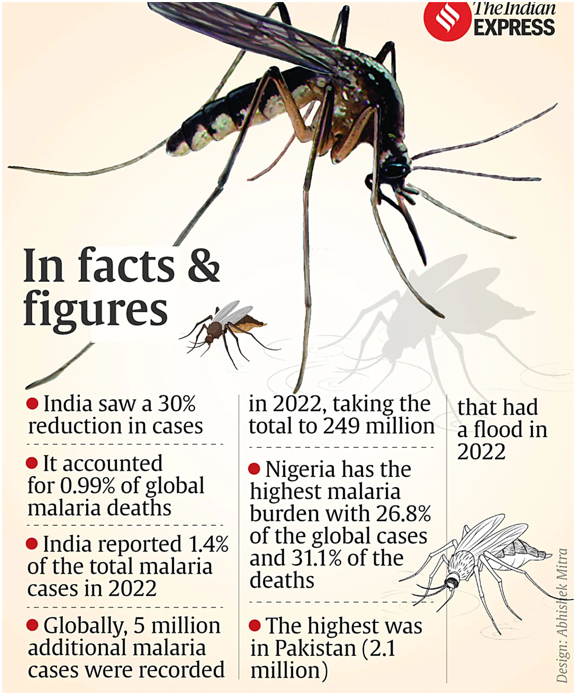
Key findings of the report:
- Globally around 5 million additional cases were recorded in 2022 compared to the 249 million cases in 2021.
- The number of malaria deaths globally also remained higher than the pre-pandemic levels 608,000 deaths were reported in 2022 compared to 576,000 cases in 2019.
- India accounted for 1.4 per cent of the global malaria cases and just 0.9 per cent of deaths.
- Vivax malaria accounts for over 40 per cent of malaria cases in India.
- Apart from India, Bangladesh, Bhutan, the Democratic People’s Republic of Korea, Nepal, Thailand and Timor-Leste also managed to reduce their malaria incidence by 55 per cent or more since 2015.
- Africa was the worst-hit, with 94 per cent of all malaria cases and 95 per cent global malaria deaths in 2022.
- Pakistan saw the largest increase, with about 2.6 million cases in 2022 compared to 500 000 in 2021. Significant increases were also observed in Ethiopia, Nigeria, Papua New Guinea and Uganda.
- Climate change exaggerates the spread of malaria because the parasite is extremely sensitive to temperature, humidity, and rainfall.
About Malaria
- About: It is a life-threatening disease caused by parasites that are transmitted to people through the bites of infected female Anopheles mosquitoes. It is preventable and curable.
- Transmission: Through blood transfusion, organ transplant, or the shared use of needles or syringes contaminated with blood because the malaria parasite is found in red blood cells of an infected person.
- Types: There are 5 parasite species that cause malaria in humans, and 2 of these species: Plasmodium falciparum and Plasmodium vivax pose the greatest threat.
- The vivax plasmodium is known to hide in the liver and cause recurrent infections.
- Symptoms: Fever, chills, sweats, headaches, muscle aches, and fatigue. In severe cases, it can lead to complications such as organ failure and death.
- Diagnosis: Through blood tests.
- Antimalarial medications: Chloroquine, artemisinin-based combination therapies (ACTs), and others are commonly used, but drug resistance is a growing concern.
- Prevention: To control the vector, insecticide-treated bed nets (ITNs) are used by endemic countries.
- Vaccine: RTS,S/AS01 (brand name Mosquirix) and R21/Matrix M.
- Path to malaria eradication: By WHO: Reducing case incidence and mortality rates by 75 per cent in 2025 and 90 per cent in 2030.
- By India: Malaria-free by 2027 and to eliminate the disease by 2030.