Current Affairs

Parliamentary Standing Committee Questions Huge Cut in MGNREGA Outlays

Parliamentary Standing Committee on Rural Development and Panchayati Raj in its report has expressed concerns over reduction of Rs 29,400 crore in the budget for the Mahatma Gandhi National Rural Guarantee Scheme (MGNREGS)  rural job scheme for financial year 2023-24 when compared to Revised Estimates of 2022-23.

Parliamentary Standing Committees makes the Executive more Accountable by Considering the demands for grants of the related Ministries/ Departments and report thereon. The report shall not suggest anything of the nature of cut motions; Examining Bills pertaining to the related Ministries/ Departments, referred to the Committee by the Chairman or the Speaker, as the case may be, and report thereon; Considering Annual Reports of the Ministries/Departments and report thereon; and Considering National Basic Long Term Policy Documents presented to the Houses, if referred to the Committee by the Chairman or the Speaker and report on such policy documents.  

Understanding MGNREGA

  • The Mahatma Gandhi National Rural Employment Guarantee Act, 2005 is the foundation for the Mahatma Gandhi National Rural Employment Guarantee Scheme Mahatma Gandhi NREGS) and provides guaranteed employment.
  • Demand Based Employment - MGNREGA is bottom-up, people centred, demand-driven, self-selecting and rights-based programme. It provides a legal guarantee for wage employment by providing allowances and compensation both in cases of failure to provide work on demand and delays in payment of wages for work undertaken.
  • Involvement of Panchayats - Plans and decisions regarding the nature and choice of works to be undertaken, the order in which each worksite selection etc., are all to be made in open assemblies of the Gram Sabha (GS) and ratified by the Gram Panchayat.    
  • Social audit is a new feature of MGNREGA which creates accountability of performance, especially towards immediate stakeholders.  
  • The mandate of the MGNREGA is to provide at least 100 days of guaranteed wage employment in a financial year to every rural household whose adult members volunteer to do unskilled manual work.
  • The core objectives of the MGNREGS are:
  • Providing not less than one hundred days of unskilled manual work as a guaranteed employment in a financial year to every household in rural areas as per demand, resulting in creation of productive assets of prescribed quality and durability.
  • There is also a provision for additional 50 days of unskilled wage employment in a financial year in drought/natural calamity notified rural areas.
  • Strengthening the livelihood resource base of the poor.
  • Proactively ensuring social inclusion and
  • Strengthening Panchayati Raj Institutions. 

Goals of MGNREGA are

  • Social protection for the most vulnerable people living in rural India by guaranteeing wage employment opportunities.
  • Enhance livelihood security of the rural poor through generation of wage employment opportunities in works leading to creation of durable assets.
  • Rejuvenate natural resource base of rural areas.
  • Create a durable and productive rural asset base.
  • Empowerment of the socially disadvantaged, especially, women, Scheduled Castes (SCs) and Scheduled Tribes (STs), through the processes of a rights-based legislation.
  • Strengthen decentralised, participatory planning through convergence of various anti-poverty and livelihoods initiatives.
  • Deepen democracy at the grassroots by strengthening Panchayati Raj Institutions.
  • State Government may by notification make rules to carry out the provisions of Act subject to the conditions of consistency with Mahatma Gandhi NREGA and rules made by the Central Government.
  • Transfer of Funds - MGNREGA is demand driven wage employment programme and resource transfer from Centre to States is based on the demand for employment in each State.  

Permissible Work under MGNREGA

  • Mahatma Gandhi National Rural Employment Guarantee Act allows Central Government to add new works in the permissible list of works under Schedule 1 of the Act.
  • As per Schedule 1 of Act, there are 265 permissible works under Mahatma Gandhi NREGA.
  • The demand from States to add work in the list of permissible works is examined in consultation with stakeholders.
  • Also, the list of permissible works is reviewed annually by a Committee of Central Government having different States as member of the Committee.
  • Recently, plantation of Dragon-fruit under horticulture plantation has been permitted under the Scheme against the request from States keeping in view the local requirements and the objective of MGNREGA Act.
  • Some of recently added works in the list of permissible works under Mahatma Gandhi NREGA are given below:
  • Construction of bio-gas plant for individual
  • Unskilled wage component towards the construction of bio-gas plant for community;
  • Maintenance of tunnel constructed by Border Road Organisation (BRO); and
  • Maintenance of bridges constructed by Border Road Organisation (BRO)

Employment Status under MGNREGA

  • Data on Job Employment - The details of households demanded employment and households offered employment under Mahatma Gandhi NREGS in last three financial years 2019-2020, 2020-2021, 2021-2022 and current financial year 2022-23 (as on 31.07.2022) is given below:   
Financial Year2019-202020-212021-222022-23
Households demanded employment (in crores)6.168.558.065.09
Households offered employment (in crore)6.158.548.025.08
  • MGNREGA provided employment during COVID Pandemic – not only to the members of rural household but also to the families which migrated back from the cities due to job loss and lockdown.       
  • Demand for work under MGNREGA increased during the Pandemic – Upto 72% more household demanded work in July 2020 as compared to July 2019 and upto 66% more household demanded work in August 2020 as compared to August 2019.
  • Significant proportion of women worked under the employment guarantee scheme
image 37
image 38

Important Highlights of the Standing Committee’s Report

  • Important Role Played during COVID - The Report highlighted the important role played by MGNREGA during COVID pandemic it acted as a ray of hope for the needy in times of distress. 
  • Increased Outlay during COVID - The importance of the scheme got highlighted through the substantially huge increment at the Revised Estimate stage in 2020-21 and 2021-22 from Rs 61,500 crore to Rs 1,11,500 crore, and Rs 73,000 crore to Rs 99,117.53 crore, respectively, to meet the increase in demand of work during the pandemic.
  • The Committee is unable to comprehend the rationale for reduced allocation of funds under MGNREGA and strongly feels that the matter needs to be looked afresh.
  • Ministry of Rural Development should Apprise Min. of Finance of Ground Reality - The Committee “strongly” recommended that the Department of Rural Development apprise itself of the still-existing high demand for jobs under MGNREGA at the ground level “more realistically and press upon the Ministry of Finance to increase allocation for MGNREGA.
  • Problems in Uploading Attendance - The Committee also highlighted the problems faced by workers on updating their attendance through mobile app twice a day. Digital capturing of attendance of the workers takes place through the National Mobile Monitoring System, a mobile based application.
  • MGNREGA beneficiaries belong to extremely deprived sections of the society, and come from different linguistic milieu. It is difficult to expect that MGNREGA workers are well-versed with the functioning and language of the mobile app and depending upon a nodal human intervention for attendance further compounds the problem.
  • Delay in Compensation – The Committee further flagged a chronic problem of non-adherence to the provision of delay compensation which has been pointed out by several activists and organisations working in the field.
  • Increase Rates under MGNREGA - The committee has recommended that the government should increase wage rates under MGNREGA by linking it to a suitable pricing index and explore the feasibility of notifying a uniform wage rate under MGNREGA for the entire country.

Recommendations of Sixth Common Review Mission (CRM) for MGNREGA

National Level Monitoring, Common Review Mission and Internal Audits are some of the periodic exercises carried out to monitor implementation of MGNREGA at grassroot level. The Ministry of Rural Development in its Sixth Common Review Mission (CRM) has called for decentralisation of the programme to allow greater flexibility in its implementation.

  • Need for greater diversification of permissible work under the MGNREGA Act
  • Broad categories of work should be listed and flexibility should be given at the ground level to select types of work.
  • Job Card needs to be updated for better access and information despite presence of digital records.
  • Payments to material vendors need to be done in timely manner.
  • Timely and Regular flow of the funds needs to be ensured as effective fund flow is the backbone of any government scheme.
  • Option of Revolving Fund may be explored to ensure timely flow of funds. Revolving Fund is a fund or an account that remains available to finance an organization's continuing operations without any fiscal year limitation.
  • There is a need for common vertical and social audit for all schemes of Ministry of Rural Development and Ministry of Panchayati Raj.
Distribution of Net Proceeds among States

Context: 

  • With population given a higher weightage over performance, the revenue-sharing formula has created friction between States and the Centre.
  • Southern states feel that horizontal distribution of net proceeds by the Centre as per formula suggested by 15th Finance Commission are “inequitable”, putting them at a disadvantage vis-a-vis Northern states.

Facts:

  • The Centre’s tax collections are pooled-in from States and a part of it is distributed among them, based on the Finance Commission’s (FC) formula. 
  • The share of taxes that each state gets is decided by a formula. The largest weight in this formula is given to what is called the “income distance” parameter, which is essentially the inverse of the per capita income of a state. Thus, the lower the per capita income, the more the state gets.
  • India’s poorest states, Bihar and Uttar Pradesh, therefore, have the highest share in tax devolution to states, much higher than they would get if population was the only parameter
  • The 15th FC formula is skewed in favour of some States, resulting in wide inter-State variations. As population is given a higher weightage, it tilts the balance in favour of some northern States. 
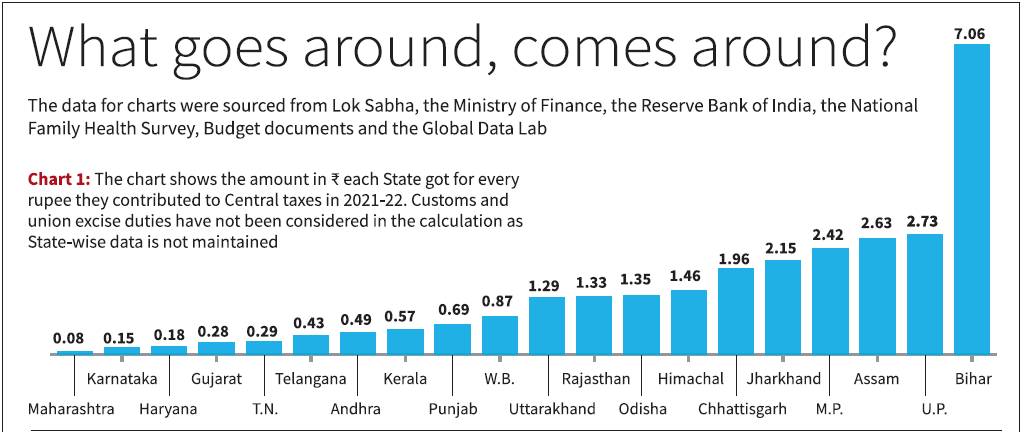
  • For every one rupee that Tamil Nadu gives the Centre, it gets back 29 paise. On the other hand, Uttar Pradesh gets ₹2.73, and Bihar gets back ₹7.06.
gBk
  • The 15th FC had arrived at the States’ share in the divisible pool of taxes based on each State’s needs (population, area and forest and ecology), equity (per capita income difference) and performance (own tax revenue and lower fertility rate).
  • The weight assigned to needs was 40%, equity 45%, and 15% for performance.
    • This formula meant that Uttar Pradesh and Bihar got 17.9% and 10%, respectively in the XVFC. Karnataka, Kerala and Tamil Nadu got 3.65%, 1.93% and 4.08%, respectively. 
    • Chart below shows that in successive FCs, the share of southern States has seen a consistent decline.
ZiAmM0WgbmJKzxk xX6tK0jkflisUZc6APQaXwCw7vze bHT8sxa1O5jKm3SfqoNl1wb72sUPYl YXNSuH7yLoppM Clw0wwig9z l5j9 zoKo y2gm8wpJjVd6kfQK6bh6 Y208AfLUDo6rcgYvA
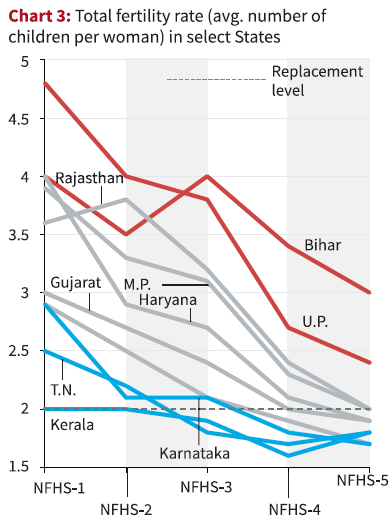
  • Also, the 15th FC introduced the fertility rate in the formula to reward States which had reduced the fertility levels.
  • While this does favour the developed States which have pushed their TFR below replacement rate as shown in the chart below, the weightage given to the component is relatively lower than equity and need
nn6ODZJjgRXuR8p9z2uhIR0VZNAL7t NjfSUg6TWfIBCT1kMoB45 ZleaEUuskPhvGEz43sQWyMKFOPTd8ZwD9BuF3y8kQ

Rationale for Equitable Distribution

  • Active state intervention was envisaged to reduce the developmental disparities. 
  • The mechanism employed to achieve these goals was the transfer of resources from the Centre to the states.
  • These transfers, which are more heavily directed to populous and poorer states, were channelled in the past through the Finance Commission and the Planning Commission.

Arguments:

  • In Favour: The objective is not to return the money you get from a State. Transfers enable a State to provide comparable levels of services. The basic rationale is horizontal equity. Taxes accrued to Tamil Nadu are not necessarily from the State. Yes, per capita income levels increased substantially in Karnataka, Kerala and Tamil Nadu. Now, the increase need not necessarily have to do only with the States’ efforts.
  • Against: The southern States have grown faster, and contribute larger revenue to the central kitty. The argument is that both Northern as well as Southern states should get equally higher amounts. Equity needs to be balanced so that it does not adversely impact efficiency of Southern states. The Centre needs to incentivise developing States to generate more tax revenue for an even more effective distribution.

Article 280 of the Indian Constitution:

  • Clause (1): The President shall, within two years from the commencement of this Constitution and thereafter at the expiration of every fifth year or at such earlier time as the President considers necessary, constitute a Finance Commission which shall consist of a Chairman and four other members to be appointed by the President.
  • Clause (2): Parliament may by law determine the qualifications which shall be requisite for appointment as members of the Commission and the manner in which they shall be selected.
  • Clause (3): It shall be the duty of the Commission to make recommendations to the President as to:
    • (a) the distribution between the Union and the States of the net proceeds of taxes which are to be, or may be, divided between them under this Chapter and the allocation between the States of the respective shares of such proceeds;
    • (b) the principles which should govern the grants in-aid of the revenues of the States out of the Consolidated Fund of India;
    • (bb) the measures needed to augment the Consolidated Fund of a State to supplement the resources of the Panchayats in the State on the basis of the recommendations made by the Finance Commission of the State; 
    • (c) the measures needed to augment the Consolidated Fund of a State to supplement the resources of the Municipalities in the State on the basis of the recommendations made by the Finance Commission of the State;
    • (d) any other matter referred to the Commission by the President in the interests of sound finance.
  • Clause (4): The Commission shall determine their procedure and shall have such powers in the performance of their functions as Parliament may by law confer on them.

15th Finance Commission:

Criteria for Horizontal distribution of taxes among States:

  • The criteria for distribution of central taxes among states for the 2021-26 period is the same as that for 2020-21.
Criteria14th Finance Commission15th Finance Commission
Income Distance5045
Population (1971 Census)17.5Not Considered
Population (2011 census)1015
Demographic PerformanceNot Considered12.5
Forest Cover7.5Not Considered
Forest and EcologyNot Considered10
Area1515
Tax EffortNot considered2.5
Total100100

Way Forward:

  • The inequalities between rich and poor states are manifest in almost every economic dimension. Incomes, assets and discretionary purchasing power are higher in the richer states. They are the locus of formal employment and of high value jobs, which is why the hunger for government jobs is so much more intense in the poorer regions of India. The overwhelming majority of foreign investment comes to the richer states. They have better healthcare, higher levels of literacy and better public services than the poorer states.
  • Therefore, any scheme of allocation should take into account both development needs as well as past performance, with the latter serving both to incentivize better performance and to allocate resources where they can be most effectively used.
  • ‘Committee for Evolving a Composite Development Index of States’ in 2013 proposed a general method for allocating funds from the Centre to the states based both on a state’s development needs as well as its development performance.
  • The methodology developed by the Committee first allocates funds across states based on need. Need is based on a simple index of (under) development. The index proposed here is an average of the following ten sub-components: (i) monthly per capita consumption expenditure, (ii) education, (iii) health, (iv) household amenities, (v) poverty rate, (vi) female literacy, (vii) percent of SC-ST population, (viii) urbanisation rate, (viii) financial inclusion, and (x) connectivity.
    • The proposed allocation scheme accommodates differences in needs, even while recognizing that the truly needy should be given disproportionately more. Less developed states rank higher on the index, and would get larger allocations based on the need criteria.
  • Given that poor administration or weak institutions in a recipient state can fritter away allocated resources to the detriment of the population, there should be some recognition for effective governance and the efficiency of resource use. This becomes all the more necessary since the proposal to give substantially more to underdeveloped states might create a mild disincentive to develop.
  • In sum, 8.4% of funds will be allocated as a fixed basic allocation. Of the remaining 91.6%, we choose parameters such that 3/4th of it is allocated based on need and 1/4th based on performance. 
  • A positive feature of this formula for allocation of funds is that the incremental reward for performance is increasing in the level of underdevelopment – this is because the reward for performance is multiplied by need.

Entry of Foreign Lawyers in India approved by Bar Council of India

Bar Council of India (BCI) has decided to permit foreign lawyers and law firms to practice law in India on reciprocity basis along with certain restrictions including prohibitions on appearance in Indian Courts. BCI has released The Bar Council of India Rules For Registration and Regulation of Foreign Lawyers and Foreign Law Firms in India, 2022, to facilitate the registration and practice of international lawyers in India. The Advocates Act, 1961 provides for constituting Bar Council of India and also respective State Bar Councils. Registration and enrollment with respective State Bar Council as an advocate is a must for every law graduate to appear before various Courts in India.

About Bar Council of India

  • It is a statutory body constituted under the Advocates Act, 1961.
  • It performs regulatory function by prescribing standards of professional conduct and etiquette and by exercising disciplinary jurisdiction over the bar.
  • It also sets standards for legal education and grants recognition to Universities whose degree in law will serve as qualification for enrolment as an advocate.
  • In addition, it perform certain representative functions by protecting the rights, privileges and interests of advocates and through the creation of funds for providing financial assistance to organise welfare schemes for them.

Composition of Bar Council of India

  • There shall be a Bar Council for the territories to which this Act extends to be known as the Bar Council of India which shall consist of the following members, namely:
  • The Attorney-General of India, ex officio;
  • The Solicitor-General of India, ex officio;
  • One member elected by each State Bar Council from amongst its members.
  • No person shall be eligible for being elected as a member of the Bar Council of India unless he/she possesses the following qualifications: persons who have for at least ten years been advocates on a State roll.

Functions Allocated to Bar Council under the Advocates Act

  • To lay down standards of professional conduct and etiquette for advocates.
  • To lay down procedure to be followed by its disciplinary committee and the disciplinary committees of each State Bar Council.
  • To safeguard the rights, privileges and interests of advocates.
  • To promote and support law reform.
  • To deal with and dispose of any matter which may be referred to it by a State Bar Council.
  • To promote legal education and to lay down standards of legal education. This is done in consultation with the Universities in India imparting legal education and the State Bar Councils.
  • To recognise Universities whose degree in law shall be a qualification for enrolment as an advocate - The Bar Council of India visits and inspects Universities, or directs the State Bar Councils to visit and inspect Universities for this purpose.
  • To conduct seminars and talks on legal topics by eminent jurists and publish journals and papers of legal interest.
  • To organise legal aid to the poor.
  • To recognise on a reciprocal basis, the foreign qualifications in law obtained outside India for the purpose of admission as an advocate in India.
  • To manage and invest the funds of the Bar Council.
  • To provide for the election of its members who shall run the Bar Councils.

The Bar Council of India can also constitute funds for the following purposes:

  1. Giving financial assistance to organise welfare schemes for poor, disabled or other advocates,
  2. Giving legal aid, and
  3. Establishing law libraries.

The Bar Council of India can also receive grants, donations, and gifts for any of these purposes.

Legal Challenge for Foreign Law Firms entering Indian Legal Market

  • With the advent of opening of market, legal and other service areas also saw relaxation and branches of foreign law firms started operating in India by providing back end support to lawyers abroad. This proved cost-effective business for such firms as legal service is expensive abroad.
  • The matter came up before the Bombay High Court for the first time in 2009 in the case of Lawyers Collective v Union of India.
  • The Bombay High Court interpreted Section 29 of the Advocates Act, which states that only advocates enrolled with BCI can practise law. The HC also held that ‘practice’ would include both litigious and non-litigious practice. So foreign firms can neither advise their clients in India nor appear in court. 
  • In 2012, the same matter came up before the Madras High Court in A.K. Balaji v Union of India.
ADVOCATES ACT, 1961
Section 29 - Advocates to be the only recognised class of persons entitled to practise law ― Subject to the provisions of this Act and any rules made thereunder, there shall, as from the appointed day, be only one class of persons entitled to practise the profession of law, namely, advocates.
 
Section 30 - Right of advocates to practise ― Subject to the provisions of this Act, every advocate whose name is entered in the State roll shall be entitled as of right to practise throughout the territories to which this Act extends,―
(i)     in all courts including the Supreme Court;
(ii)    before any tribunal or person legally authorised to take evidence; and
before any other authority or person before whom such advocate is by or under any law for the time being in force entitled to practise.

Madras High Court Judgment –A.K. Balaji v Union of India

  • Foreign law firms or foreign lawyers cannot practice the profession of law in India either on the litigation or non-litigation side, unless they fulfill the requirement of the Advocates Act, 1961 and the Bar Council of India Rules.
  • However, there is no bar either in the Act or the Rules for the foreign law firms or foreign lawyers to visit India for a temporary period on a "fly in and fly out" basis, for the purpose of giving legal advise to their clients in India regarding foreign law or their own system of law and on diverse international legal issues.
  • Moreover, having regard to the aim and object of the International Commercial Arbitration introduced in the Arbitration and Conciliation Act, 1996, foreign lawyers cannot be debarred to come to India and conduct arbitration proceedings in respect of disputes arising out of a contract relating to international commercial arbitration.   

Supreme Court’s Decision in Bar Council of India vs. AK Balaji & Ors - 2018

  • Both the Madras and Bombay High Court judgments were challenged by the BCI and Lawyer’s Collective respectively before the Apex Court. 
  • Supreme Court upheld both the High Court judgments and states that foreign law firms/companies or foreign lawyers cannot practice profession of law in India - litigation or in non-litigation side.
  • Supreme Court however held that there was no bar for the foreign law firms or foreign lawyers to visit India for a temporary period on a “fly in and fly out” basis for the purpose of giving legal advice to their clients in India regarding foreign law or their own system of law and on diverse international legal issues.
  • The expression “fly in and fly out” will only cover a casual visit not amounting to “practice” and the Bar Council of India can further regulate this aspect of practice by foreign lawyers.
  • If the Rules of Institutional Arbitration apply or the matter is covered by the provisions of the Arbitration Act, foreign lawyers may not be debarred from conducting arbitration proceedings arising out of international commercial arbitration in view of Sections 32 and 33 of the Advocates Act.
  • Supreme Court also held that the Bar Council of India is free to frame rules to govern practices of foreign lawyers and foreign law firms in India. 

Why BCI is now allowing foreign lawyers and foreign law firms to practice in India?

  • Bar Council of India has now framed Rules to govern practices of foreign lawyers and foreign law firms in India based on the Supreme Court decision in Bar Council of India vs. AK Balaji & Others.
  • According to the Bar Council of India, opening up of law practice in India to foreign lawyers in the field of practice of foreign law; diverse international legal issues in non-litigious matters and in international arbitration cases would go a long way in helping legal profession/domain grow in India to the benefit of lawyers in India too.      
  • Standards of Indian lawyers in proficiency in law is comparable with the international standards and the legal fraternity in India is not likely to suffer any disadvantage in case law practice in India is opened up to foreign lawyers in a restricted and well controlled and regulated manner on the principle of reciprocity.
  • Such reciprocity would be mutually beneficial for lawyers from India and abroad and the Rules framed by BCI are an attempt in this direction.
  • These rules will also help to address the concerns expressed about flow of Foreign Direct Investment in the country and making India a hub of International Commercial Arbitration.

If foreign lawyers are not allowed to work in India now, legal fraternity of India may be left behind in providing legal/professional expertise in accordance to the rule of law in a manner consistent with the best interests of this fast growing class of clients in India.

What is Allowed and What Prohibited For Foreign Lawyers & Foreign Law Firms under
The BCI Rules, 2022
AllowedProhibited
They shall be allowed to practice in non-litigation matters (where arguing before court is not needed) on transactional or corporate work such as joint ventures, mergers and acquisitions, intellectual property matters, appearing in international arbitration cases, drafting of contracts and other related matters on reciprocal basis.Foreign lawyer or law firm shall not be entitled to practice law in India without registration with the BCI.
The foreign lawyers or foreign law firms shall not be permitted to appear before any courts, tribunals or other statutory or regulatory authorities.
They shall not be involved or permitted to do any work pertaining to the conveyancing of property, Title investigation or other similar works.
They are also allowed to provide legal expertise/advise and appearing as a lawyer for a person, firm, company, corporation, trust, society etc. who/which is having an address or principal office or head office in a foreign country in any international arbitration case which is conducted in India and in such arbitration case “foreign law may or may not be involvedIndian Lawyer enrolled with any State Bar Council in India working with foreign law firms as Partner or Associate registered in India

* can take up only the non-litigious matters

* can advise on issues relating to countries other than the Indian Laws only.

* Such Lawyer shall have no advantage or right of his being an Advocate enrolled in India and cannot appear before Courts in India

Exception Created for Foreign Firms Operating on Fly in and Fly Out Basis.
Registration with BCI is not mandatory for such foreign lawyers or foreign law firms who operate on a ‘fly in and fly out basis’ for the purpose of giving legal advice to the client in India regarding foreign law and on diverse international legal issues.
Such foreign lawyer or foreign law firm who operate on‘fly in and fly out basis’ do not maintain an office in India for the purpose of such practice and such practice in India for one or more periods does not, in aggregate, exceed 60 days in any period of 12 months.BCI may also refuse to register any foreign lawyer or law firm if “in the opinion of the Council, the number of Foreign Lawyers or Foreign Law Firms of any particular Foreign country registered in India is likely to become disproportionate to the number of Indian Lawyers or Indian Law Firms registered or allowed to practice law in the corresponding foreign country.

Other Important Highlights of the BCI Rules, 2022

  • A foreign lawyer or foreign law firm may apply for registration under these rules along with registration fee and guarantee amount either in person or through registered Post. 
  • The registration by the foreign lawyers or foreign law firms shall be valid for a period of 5 years only and the foreign lawyer and/or Law Firm would be required to renew it by filing an application for renewal within 6 months before the date on which such validity expires.

The registered foreign lawyer or foreign Law Firm shall be entitled to do the following things in connection with the practice of law in India:

  • Open law office or offices in India for carrying on law practice in India. Bar Council of India shall be kept informed of the particulars of such office/offices viz. postal address, name of the owner/lessee of the property in which the office/offices are located and related documents. 
  • Engage and procure legal expertise/advise of one or more Indian Advocates Registered as foreign lawyers.
  • Procure the legal expertise/advise of any Advocate enrolled with any State Bar Council in India on any subject relating to Indian Laws. But such registered foreign lawyer or foreign Law Firm shall not be entitled to appear before any Indian Court, Tribunal or any other statutory forum.
  • Enter into Partnership with one or more Foreign Lawyers or Foreign Law Firm registered in India under these rules.  

Domestic Systemically Important Banks (D-SIBs)

Under the D-SIB framework, the RBI was required to disclose the names of banks designated as D-SIBs, and to place them in appropriate buckets depending upon their Systemic Importance Scores (SISs).

Depending on the bucket in which a D-SIB is placed, an additional common equity requirement is applicable to it. The additional CET1 requirement was in addition to the capital conservation buffer. It means that these banks have to earmark additional capital and provisions to safeguard their operations.

Background:

  • The Basel, Switzerland-based Financial Stability Board (FSB), an initiative of G20 nations, has identified, in consultation with the Basel Committee on Banking Supervision (BCBS) and Swiss national authorities, a list of global systemically important banks (G-SIBs).
  • There are 30 G-SIBs currently, including JP Morgan, Citibank, HSBC, Bank of America, Bank of China, Barclays, BNP Paribas, Deutsche Bank, and Goldman Sachs. No Indian bank is on the list.

Why create SIBs?

  • 2008 crisis - problems faced by large and highly interconnected financial institutions hampered the orderly functioning of the global financial system - negatively impacting the real economy.
    • Government intervention - became necessary to ensure financial stability.
    • Cost of public sector intervention, and the consequential increase in moral hazard, required that future regulatory policies should aim at reducing the probability and the impact of the failure of SIBs.
  • In October 2010, the FSB recommended that all member countries should put in place a framework to reduce risks attributable to Systemically Important Financial Institutions (SIFIs) in their jurisdictions.
  • SIBs are perceived as banks that are ‘Too Big To Fail (TBTF)’, due to which these banks enjoy certain advantages in the funding markets.
    • However, this perception creates an expectation of government support at times of distress, which encourages risk-taking, reduces market discipline, creates competitive distortions, and increases the probability of distress in the future.
    • It is therefore felt that SIBs should be subjected to additional policy measures to guard against systemic risks and moral hazard issues.
  • While the Basel-III Norms prescribe a capital adequacy ratio (CAR) — the bank’s ratio of capital to risk — of 8%, the RBI has been more cautious and mandated a CAR of 9% for scheduled commercial banks and 12% for public sector banks.

Two-step process to assess the systemic importance of banks:

  • First, a sample of banks to be assessed for their systemic importance is decided. All banks are not considered — many smaller banks would be of lower systemic importance, and burdening them with onerous data requirements on a regular basis may not be prudent.
    • Banks are selected for computation of systemic importance based on an analysis of their size (based on Basel-III Leverage Ratio Exposure Measure) as a percentage of GDP. Banks having a size beyond 2% of GDP will be selected in the sample.
    • Once the sample of banks is selected, a detailed study to compute their systemic importance is initiated. Based on a range of indicators, a composite score of systemic importance is computed for each bank.
    • Banks that have a systemic importance above a certain threshold are designated as D-SIBs.
  • Second, the D-SIBs are segregated into buckets based on their systemic importance scores, and subjected to a graded loss absorbency capital surcharge, depending on the buckets in which they are placed.
  • A D-SIB in the lower bucket will attract a lower capital charge, and a D-SIB in the higher bucket will attract a higher capital charge.

Border dispute between Karnataka & Maharashtra

Karnataka Chief Minister Basavaraj Bommai on Wednesday said he would take steps to stop the Maharashtra government from implementing its flagship health insurance scheme in all 865 dispute border villages in Karnataka.

Background of this dispute

  • Maharashtra and Karnataka have sparred over the inclusion of some towns and villages along the state border ever since the passage of State Reorganisation Act of 1956, which in turn was based on the findings of the Justice Fazal Ali Commission, which was appointed in 1953.
  • In 1956, Mysore state (later renamed Karnataka) was formed, and differences between the state and the neighbouring Bombay state (later Maharashtra) erupted.
  • Since its creation in 1960, Maharashtra has claimed that 865 villages, including Belagavi (then Belgaum), Carvar and Nipani, should be merged into Maharashtra (these areas are predominantly Marathi-speaking). Karnataka, however, has refused to part with its territory.

Centres response

  • The Mahajan Commission (led by former Chief Justice of India Mehr Chand Mahajan) was set up by the Government of India in October 1966 to look into the border dispute.
  • It submitted its report in 1967, where it recommended that 264 villages should be transferred to Maharashtra, and that Belgaum and 247 villages should remain with Karnataka.
  • Maharashtra rejected the report, calling it biased and illogical. Despite demands from Karnataka, the Centre never implemented the report.
Exploiting public sentiments, Karnataka changed the name of Belgaum to Belagavi and made it the second capital of the state.In 2007, Karnataka started building the Suvarna Vidhana Soudha (Legislative Assembly) in Belagavi to assert its control over the region (winter legislature sessions are held here annually).  

What is the status of the border dispute now?

  • In 2004, the Maharashtra government filed a petition in the Supreme Court, staking claim over Marathi-speaking villages in Karnataka. However, the border row has been pending before the Supreme Court since 2004.
  • In 2010, the Centre in its affidavit had stated that the transfer of certain areas to then Mysore (now Karnataka) was neither arbitrary nor wrong.

Weapons of Mass Destruction & Their Delivery Systems (Amendment) Act, 2022

Parliament amended 'The Weapons of Mass Destruction and their Delivery Systems (Prohibition of Unlawful Activities) Act, 2005 (WMD Act, 2005) to fulfil international obligations relating to financing of weapons of mass destruction. The amendment prohibits financing of any prohibited activity under the WMD Act, 2005 and empowers taking financial and other measures to prevent such financing related to WMDs and their delivery systems.

About Weapons of Mass Destruction & Their Delivery Systems (Prohibition of Unlawful Activities) Act, 2005

Need for the Act:

  • Prohibits unlawful activities related to weapons of mass destruction and their delivery systems.
  • India is committed not to transfer nuclear weapons or other nuclear explosive devices or assist , encourage or induce any other country to manufacture nuclear weapons or other nuclear explosive devices.
  • Provides legal framework to the objective of global nuclear disarmament,
  • India is a member of Chemical Weapons Convention (CWC) and Biological Weapons Convention (BWC). Thus, this act empowers India to exercise controls over export of chemicals, organisms, materials, equipment and technologies related to weapons of mass destruction and their delivery systems.
  • The Act was passed to meet an international obligation enforced by the UN Security Council Resolution (UNSCR) 1540 of 2004.

UN Security Council Resolution 1540

  • UN Security Council Resolution 1540 address the growing threat of non-state actors gaining access to WMD material, equipment or technology to undertake acts of terrorism.
  • It established binding obligations on all UN member states under Chapter VII of UN Charter.
  • Nations were mandated to take and enforce effective measures against proliferation of WMD, their means of delivery and related materials to non-state actors.
  • UNSCR 1540 enforced three primary obligations upon countries:

(i) To not provide any form of support to non-state actors seeking to acquire WMD, related materials or their means of delivery.

(ii) To adopt and enforce laws criminalising the possession and acquisition of such items by non-state actors.

(iii) To adopt and enforce domestic controls over relevant materials, in order to prevent their proliferation.

  • UNSCR 1540 undergoes periodic reviews to determine the success of its implementation and identify gaps in enforcement.

Salient Features of the Weapons of Mass Destruction & Their Delivery System (Prohibition of Unlawful Activities) Act, 2005:

  • Weapons of Mass Destruction (WMD): WMDs under the Act includes any biological, chemical or nuclear weapons.
  • Extent: Extends to whole of India including the Exclusive Economic Zone.
  • Application: Provisions of this Act applies to export, transfer, re-transfer, transit and trans-shipment of material, equipment or technology of any description as are identified, designated, categorised or considered by Central Government as Weapons of Mass Destruction and their delivery systems.
  • Provisions of this Act apply to:
  • Citizens of India outside India.
  • Companies or bodies corporate, registered or incorporated in India or having their associates, branches or subsidiaries, outside India.
  • Any ship, aircraft or other means of transport registered in India or outside India.
  • Foreigners while in India
  • Persons in service of Government of India, within and beyond India.
  • Central may identify, designate, categorise or regulate the export, transfer, re-transfer, transhipment or transit of any item related to Weapons of Mass Destruction.
  • Prohibition related to Weapons of Mass Destruction
  • Nuclear Weapons: No person shall unlawfully manufacture, acquire, possess, develop or transport or transfer (directly or indirectly) a nuclear weapon or other nuclear explosive device and their means of delivery.
  • Chemical & Biological Weapons: No person shall unlawfully manufacture, acquire, possess, develop or transport (directly or indirectly) a biological or chemical weapon or their means of delivery.
  • Missiles: No person shall unlawfully transfer, directly or indirectly, to any one missiles specially designed for delivery of weapons of mass destruction.
  • Non-state actors or terrorists: No person shall, directly or indirectly, transfer to a non-State actor or terrorist, any material, equipment and technology related to Weapons of Mass Destruction.
  • Brokering: No person who is a resident of India shall, for a consideration, knowingly facilitate execution of any transaction which is prohibited or regulated under this Act.
  • Export: No person shall export any material, equipment or technology knowing that such material, equipment or technology is intended to be used in the design or manufacture of a biological weapon, chemical weapon, nuclear weapon or their missile delivery system.
  • Punishment: Heavy punishments have been provided for contravening or abeting the provisions of this act.

Need for Amendments

  • The risk of proliferation of WMDs to non-state actors is increasing due to rapid advances in science, technology and international commerce.
  • FATF has expanded the scope of targeted financial sanctions and demanded tighter controls on the financing of WMD activities.
  • New kinds of threats: Developments in the fields of drones or unauthorised work in biomedical labs that could be maliciously used for terrorist activities.

Changes introduced by Weapons of Mass Destruction & Their Delivery System (Amendment) Act, 2022

Prohibition on financing: No person shall finance any activity prohibited under this Act or UN (Security Council) Act, 1947 in relation to WMDs and their delivery systems.

For preventing financing by any person of above activities, the Central Government will have power to:

  • Freeze, seize or attach funds or other economic resources owned or controlled, wholly or jointly, directly or indirectly by such person.
  • Prohibit any person from making funds, financial assets or economic resources related to unlawful transfer of WMDs.

Green National Highway Corridors Project

The Government of India and the World Bank have signed an agreement for the construction of Green National Highway Corridors Project (GNHCP) in an aggregate length of 781 km in the states of Himachal Pradesh, Rajasthan, Uttar Pradesh and Andhra Pradesh, with loan assistance of US $ 500 million against total project cost of US $ 1288.24 million (Rs. 7,662.47 crore).

About Green National Highway Corridors Project (GNHCP)

  • It is an initiative under the Green Highways (Plantation, Transplantation, Beautification & Maintenance) Policy, 2015.
  • The policy was launched in the year 2015 by the Union Ministry of Road Transport & Highways and shipping (MoRTH).
  • The aim of the policy is to promote greening of Highway corridors with participation of the community, farmers, private sector, NGOs, and government institutions. 

Objectives of Green National Highway Corridors Project (GNCHP)

  • To demonstrate safe and green highway keeping in view climate resilience and use of green technologies by incorporating the provisions of conservation of natural resources.
  • This would be achieved by using cement treated sub base/reclaimed asphalt pavement, use of local/ marginal material such as lime, fly ash, waste plastic, bio-engineering measures for slope protection such as hydroseeding, coco/jute fibre etc., which will enhance the ability of Ministry to bring Green technologies into the mainstream.

This project has three components

  • The first component includes upgradation and maintenance for five years of selected stretches of existing National Highways in the states of Rajasthan, Himachal Pradesh, Uttar Pradesh and Andhra Pradesh incorporating green technologies and demonstrating resource efficiency, climate resilience, green and safety aspects.
  • The second component focuses on Institutional Capacity Enhancement.
  • The third component focuses on  Road Safety.

Significance

  • The project will enhance the capacity of the MoRTH in mainstreaming safety and green technologies.
  • This project will also support analytics to map the freight volume and movement pattern on the national highway network, identify constraints, and provide innovative logistics solutions.
  • The project will support the ministry with an in-depth analysis of gender-related issues in the transport sector. It will also help in creating jobs for women by training women-led micro enterprises and women collectives to implement green technologies in the highway corridors.
  • The project will strengthen and widen existing structures; construct new pavements, drainage facilities and bypasses; improve junctions; and introduce road safety features.
  • The project will provide efficient transportation for road users in the four states, connect people with markets and services and promote efficient use of construction materials.

ROSTL Scheme

Scheme for Rebate of State and Central Taxes and Levies on Export of Garments and Made-ups

  • The scheme has replaced the Rebate of State Levies (RoSL) Scheme. The difference between RoSL & RoSCTL Scheme is that under RoSL Scheme, there was no benefit on the central tax and Levies.

Significant Features

  • Intends to compensate the State and Central Taxes and Levies in addition to the Duty Drawback Scheme on export of apparel/ garments and Made-ups by way of rebate.
  • The Rebate of State Taxes and Levies includes: VAT on fuel used in transportation, captive power, farm sector, mandi tax, duty of electricity, stamp duty on export documents, embedded SGST paid on inputs such as pesticides, fertilizers etc.
  • The Rebate of Central Taxes and Levies includes: Central excise duty on fuel used in transportation, embedded CGST paid on inputs such as pesticides, fertilizer etc.
  • The rebate under the RoSCTL Scheme shall be given to the exporter in the form of duty credit scrips which will be maintained in the electronic duty credit ledger.
  • The value cap per unit of exported product have also been specified for several items and the rebate amount cannot exceed the said amount.
  • The period of validity of the e-scrip (one year) will not change on account of its transfer.
  • Eligibility: All the exporters of garments/Apparels and made-ups manufactured in India. However, entities under the Denied Entity List of the Directorate General of Foreign Trade are kept out.
  • Under: Ministry of Textiles and came into effect from March, 2019.
  • Regulatory body: Department of Revenue.

RoDTEP Scheme- Remission of Duties or Taxes on Export Products Scheme

  • The scheme was introduced by the Government of India through the amendments made in the Foreign Trade Policy 2015-20.

Significant Features

  • Rebate of all hidden Central, State, and Local duties/taxes/levies on the goods exported which have not been refunded under any other existing scheme.
  • It does not only include the direct cost incurred by the exporter but also the prior stage cumulative indirect taxes.
  • Benefits would be provided in the form of transferable duty credit scrip, or in the form of electronic scrip which.
  • All exporters irrespective of their status in respect of the goods manufactured in India are eligible. Also, there is no turnover limit criterion to claim the benefit.
  • The scheme follows the global principle that the taxes/duties should not be exported and therefore, WTO compliant.
  • Under: Ministry of Commerce and Industry
  • Administered by: Department of Revenue
  • The scheme is not applicable to- Apparel and made-ups which are benefitted under RoSCTL scheme.

Protection of Indian Heritage & Artefacts

Recent investigation by the Indian Express and the International Consortium of Investigative Journalists highlights that the Archaeological Survey of India needs to be equipped with resources to protect objects within its mandate.

The Government is trying to bring the lost heritage and artefacts of the country back and therefore, has also signed agreements with the Museums in the UK, US and Australia to repatriate Indian Antiquities.

Challenges faced to bring back historical artefacts:

  1. The major challenge is to find out the background detail of the objects that have been moved out of India.
  2. There are also large gaps between what have been reported as missing and the number of objects and artefacts that are being found in the foreign museums.
  3. The Law enforcement agencies involved in the process lack the resources. For example: CAG report has brought to the light that the Archaeological Survey of India (ASI) has no vigilance or the monitoring cell that would deter the crimes of theft relating to antiquities.
  4. To attract the best talent/domain experts the ASI will need more autonomy from the Union Ministry of Culture.
  5. Parliamentary Standing Committee Reports on Transport, Tourism and Culture:
  6. 2005: Access to the latest technology: Archaeologists in the ASI are dependent on laboratories in the developed/first world countries for the analysis of pottery.
  7. 2021: Lack of resources in the Museums in India.

Way forward:

  1. Mirdha Committee, 1984: It recommended that the ASI needs to be given the status of a ‘scientific and technical institution’ and to be made more autonomous for better functioning.
  2. The Agencies need to be equipped with latest technologies and adequate resources. For example: Goa’s Advanced Antiquities Management System (AAMS) launched by the state’s Directorate of Archives and Archaeology.
  3. Also, there is a need to bring expertise so as to preserve the antiquities and heritage of India in an ambitious manner.

Lithium Reserves in India

About 5.9 Million Tonnes of Lithium Reserves have been discovered in the Union Territory of Jammu and Kashmir (First in India). It is discovered in the Salal-Haimana area of Reasi District.    

Lithium Distribution:

  • Although lithium is widely distributed on Earth, it does not naturally occur in elemental form due to its high reactivity.
  • According to the US Geological Survey (USGS), there are around 80 million tonnes of identified reserves globally as of 2019.
image 31
  • Argentina, Bolivia, and Chile make up the “lithium triangle.” The three countries, along with Peru, contain about 67% of proven lithium reserves and produce about half of the global supply, according to the U.S. Geological Survey.
  • The Salar de Uyuni salt flat in Bolivia is the world's single-largest lithium resource, and is visible from space

Physical and Chemical properties of Lithium (atomic number 3)

  • It belongs to an alkali metal group, lightest of the solid elements (can float on water). It is soft, white and lustrous.
  • It has the lowest density of any metal.
  • It has high specific heat which is the calorific capacity. Other properties are its enormous temperature interval in the liquid state, high thermal conductivity.
  • It is also found in brine deposits and as salts in mineral springs. 
  • It constitutes about 0.002 percent of Earth’s crust.
  • It is produced by electrolysis of a fused mixture of lithium and potassium chlorides. 

Uses and application of Lithium:

  • Among minerals, lithium offers one of the highest energy-to-weight performance—a lithium-ion battery’s energy density is 260-270 Wh/kg, compared to a lead-acid battery’s 50-100 Wh/kg.
  • Used as a scavenger (remover of impurities) in the refining of such metals as iron, nickel, copper, and zinc and their alloys.
  • Used as an initiator of polymerization in the production of synthetic rubber.
  • It is also extensively used in the production of other organic chemicals, especially pharmaceuticals
  • Lightweight lithium-magnesium alloys and tough lithium-aluminium alloys, harder than aluminium alone, have structural applications in the aerospace and other industries.
  • Most extensive use of Lithium is in rechargeable batteries (cell phones, laptops, e-mobility etc).

Note:  lithium-ion batteries are rechargeable while lithium batteries are single-use.

Benefits of such discovery to India;

  • Decrease imports: As of now, India is importing all its lithium requirements (95% coming from Hong Kong > China > Indonesia > Singapore > Korea).
  • Save foreign exchange: In the near future imports would fall further (saving foreign exchange).In last three years, imports of Lithium and Lithium ion has reduced by 8-10%.
  • Employment: Mining and exploration would further enhance the job creation in the reserve areas.
  • Industrial hub: It would developed battery industry (a sunrise sector) in India.
  • Exports: With development of battery industry, India could enter the global supply of lithium ion batteries (export promotion). It would help India in gaining faster momentum in the electronics and digital devices market globally.
  • Reduce production cost: Replacing expensive imports of lithium with domestic cheaper alternatives would reduce the cost of production in battery industry and make it more competitive.

Potential of Lithium in India:

  • Expected reserves in: Union Territory of Jammu and Kashmir, Mandya and Yadgir districts of Karnataka, Bihar, Chhattisgarh, Himachal Pradesh, Jharkhand, Madhya Pradesh, Arunachal Pradesh, Meghalaya and Rajasthan.
  • India has emerged as one of the largest producer, consumer and exporter of mobiles phones (second largest producer in 2021). Lithium ion batteries are the backbone of mobile phone industries. Domestic lithium would push India further ahead in this race.
  • Government in 2021 approved the Production Linked Incentive (PLI) Scheme for manufacturing of Advance Chemistry Cell (ACC) in the country. The scheme envisages establishing a competitive ACC battery manufacturing set-up in the country (50 Giga Watt hour-GWh). This PLI scheme will facilitate reduction of import dependence of ACC battery.
  • Vikram Sarabhai Space Centre (VSSC) has decided to transfer its own in-house lithium ion (Li ion) cell technology to successful Indian industries and start-ups.
  • The government has allowed 100 percent foreign direct investment (FDI) in electric mobility and encouraged domestic manufacturing of battery packs. Due to this measure, LiB technology has overtaken lead-acid batteries in mobile and stationary applications.

Why is India lagging behind in Lithium?

  • Natural availability of Lithium in India is the least (almost insignificant)
  • Research and exploration in the lithium is at nascent stage. 
  • India has very limited participation in the exploration of lithium. Most of the current exploration of Lithium is conducted as per the Geological survey of India. 
  • Till 2021, i.e. rolling out of production linked incentive, there was no dedicated policy for lithium battery development in India.

Way-forward:

  • Creation of additional demand in the automobile sector.
  • Opening the exploration and mining for the private sector under regulatory framework.
  • Ease of exports of Lithium-ion batteries.

Anticipatory or pre-arrest bail

Karnataka BJP MLA Madal Virupakshappa has been granted pre-arrest bail (subjected to cooperate in investigation) by the High Court, a decision challenged in Supreme Court by the state Lokayukta.

Previously, Virupakshappa approached a civil court in Bengaluru and obtained a temporary injunction against defamatory media reporting in the corruption case against 45 media outlets.

What is pre-arrest bail?

  • Bail is a process of procuring “the release of a person from legal custody, by undertaking that he shall appear at the time and place designated and submit himself to the jurisdiction and judgment of the court.”
  • Although “bail” has not been expressly defined in Indian statutes, the Code of Criminal Procedure (CrPC) differentiates between “bailable” and “non-bailable” offenses. It also defines three kinds of bail that can be granted —
  • regular bail under Sections 437 and 439;
  • interim bail or short-term bail which is given when regular or anticipatory bail application is pending before the court;
  • anticipatory or pre-arrest bail.
  • The provision for “anticipatory bail” was introduced under Section 438 of the CrPC after the 41st Law Commission Report in 1969 recommended the need for a measure that protects against arbitrary violation of one’s personal liberty, such as when politicians detain their opponents in false cases.

When can anticipatory bail be granted?

  • When “any person has reason to believe that he may be arrested on an accusation of having committed a non-bailable offence”.
  • Granted by the High Court or the Court of Session, under this section, for non-bailable offenses for which one anticipates arrest, even if the actual arrest has not happened or the FIR has not been registered.
  • Non-bailable offenses are more serious offenses, punishable with at least three years imprisonment and above.
  • Amendment in 2005, following which it laid down principles for consideration for the grant of anticipatory bail under subsection such as whether the accused is likely to flee, is a habitual offender, or is likely to tamper with evidence along with his antecedents, such as previously being arrested for a cognizable offense.