About Warehousing Development & Regulatory Authority (WDRA)
WDRA is a statutory body created under the Warehousing (Development & Regulation) Act, 2007 and shall have the duty to regulate and ensure implementation of WDRA, 2007 and promote orderly growth of warehousing business.
It is headed by a Chairman and two full-time members.
WDRA aims to ensure that interests of farmers are protected through
Growth and development in warehousing sector.
Improve fiduciary trust of depositors and banks.
Increase in liquidity in rural areas.
Encourage scientific warehousing of goods.
Lower cost of financing.
Promote shorter and efficient supply chains.
Enhance reward for grading and quality.
Ensure better price risk management.
Only Warehouses registered with the WDRA can issue negotiable warehouse receipts.
Requirements for warehouses for registration with WDRA:
Warehouse should be constructed as per BIS/CWC/FCI standards and is storage worthy.
Has all safety and security arrangements for stock and premises.
Has got requisite manpower with adequate experience in warehousing.
Availability of requisite infrastructure in weighing, grading and preservation.
Warehouse should have its own Standard Operating Procedures (SOPs) or adopts model SOP of WDRA.
Adequate insurance is taken for stock against fire, theft, burglary, misappropriation, riots, strikes or terrorism.
Financial network and security deposit for securing negotiable warehouse receipts issued.
Commodities covered against which NWRs can be issued by WDRA: Currently, 136 agricultural commodities including cereals, pulses, oilseeds, spices, rubber, tobacco, coffee etc. are notified under the WDRA Act for issuing negotiable warehouse receipts. Also, 24 horticultural commodities for cold storage and 9 non-agricultural commodities have been notified.
About Negotiable Warehouse Receipts (NWRs):
NWRs issued by WDRA will help farmers to seek loans from banks against the NWRs to avoid distress sales of agricultural produce during the peak marketing season and to avoid the post-harvest storage loss. WDRA Act allows issue of NWRs in writing form or electronic form.
Benefits of NWRs
Increased liquidity in rural areas.
Encouragement of scientific storage of goods and thereby reducing post-harvest losses.
Lower cost of financing
Shorter and more efficient supply chains
Enhanced rewards for standard section, grading and quality.
Better price risk management
Better returns to farmers and better services (Quality of Goods) to consumers.
About Electronic Negotiable Warehouse Receipt (e-NWRs):
According to Amendment to Warehousing (Development & Regulation) Registration of Warehouses Rules, 2017, no registered warehouses under the WDRA act will issue NWRs in physical form and shall register with one or more repositories registered with WDRA for issuing negotiable warehouse receipts has migrated to system of launching electronic Negotiable Warehouse Receipt in 2018 which is a IT based eNWR ecosystem.
Repositories for eNWRs: Two repositories have been notified for issuing eNWRs: National E-Repository and CDSL Commodity Repository.
Benefits of eNWR
Avoidance of forgery/loss/tamper/mutilation of a physical NWR.
Avoidance of multiple financing against the same NWR.
Reduction of monitoring costs and building credibility amongst market participants.
Market participants to have secured accessible to view and manage their warehouse receipts via online portal.
Easy access to finance by enabling multiple transfers without physical movement of goods.
Splitting of NWRs for partial sale/pledge/withdrawal.
Steps for Mainstreaming of eNWRs
RBI’s Priority Sector Lending Guidelines prescribes for loan against pledge/hypothecation of agricultural produce. Thus, loans up to Rs 75 lakhs can be given against eNWRs.
Integration of e-NWRs with e-NAM Platforms: farmers/holders of an e-NWR issued by a registered warehouse can sell their underlying stocks on e-NAM platform and have better price discovery. The registered warehouse is required to be declared as a market sub-yard by the state authority for trade on e-NAM APMC market.
Challenges restricting expansion of NWR ecosystem:
Warehousing sector has been mostly un-organised and highly fragmented.
Registration of warehouses is voluntary and hence scope for increase in the number of registered warehouses is limited.
There is inadequate regulatory framework under the Act.
Registration system and issuance of NWRs had been paper based.
Monitoring & surveillance system of registered warehouses had been inadequate.
Way Forward
Easier registration of warehouses with WDRA.
Making it mandatory for newer warehouses getting assistance under government schemes to register with WDRA.
Training and capacity building of warehousemen.
Awareness among farmers about benefits and access of Negotiable Warehouse Receipts.
The Ministry of Environment, Forest and Climate Change (MoEFCC) launched Mission Sahbhagita in 2022 with a mission of ‘a healthy and effectively managed network of 75 wetlands of national and international significance.
Mission Sahbhagita aims to enable a society ownership approach for participatory conservation and wise use of Wetlands.
The Supreme Court has reserved its judgment on petitions to "fine-tune" a 2017 verdict which laid down guidelines for designation of lawyers as senior advocates.
Constitutional courts bestow 'senior advocate' status to lawyers as a recognition of their distinct ability in or specialised knowledge of law. This designation is however is not constitutional. It has been provided in Senior Advocates Act, 1961
Senior Advocates Act, 1961
The Act provides that there shall be two classes of advocates, namely, senior advocates and other advocates. An advocate may, with his consent, be designated as senior advocate if the Supreme Court or a High Court is of opinion that by virtue of his ability, standing at the Bar or special knowledge or experience in law, he is deserving of such distinction.
Senior advocates shall, in the matter of their practice, be subject to such restrictions as the Bar Council of India may, in the interest of legal profession, prescribe. An advocate of the Supreme Court Who was a senior advocate of that Court immediately before the appointed day shall, for this purpose be deemed to be a senior advocate.
Later on in an important judgement of High Court of Delhi Designation of Senior Advocate Rules, 2018, Supreme court laid down detailed guidelines for the selection of lawyers for such designations.
In the artificial intelligence (AI) field, there has been a lot of talk about a significant statement made by OpenAI. The company recently released GPT-4, a sizable multimodal model that can handle both text and visual inputs. This new language model is an improvement on its predecessor, GPT-3, which was already revolutionary in and of itself.
GPT-4 and its features
Large-scale multimodal model GPT-4 was developed by OpenAI.
Text is just one component of multimodal models; GPT-4 also takes picture input. GPT-3 and GPT-3.5, on the other hand, only supported text as a mode of operation, which limited users to typing out queries.
Moreover, GPT-4 "displays human-level performance on numerous academic and professional criteria."
The language model's stronger general knowledge and problem-solving skills enable it to pass a mock bar exam with a score in the top 10% of test takers and to solve challenging questions more accurately.
It may, for instance, "address tax-related queries, arrange a meeting for three busy individuals, or determine a user's creative writing style."
A more comprehensive range of use cases, including lengthy discussions, document search and analysis, and long-form content production, is now possible because of GPT-4's ability to handle texts longer than 25,000 words.
How is GPT-4 different from GPT-3?
Here are some of the major differences:
GPT-4 can ‘see’ images now
The most obvious modification to GPT-4 is that it is multimodal, enabling it to comprehend input from several informational modalities.
GPT-3 and ChatGPT's GPT-3.5 could only read and write text, hence they were restricted to text input and output. GPT-4, however, may be instructed to produce data in response to pictures that are supplied to it.
It makes sense if this makes you think of Google Lens. Lens, however, only looks for data that is relevant to a picture.
GPT-4 is far more sophisticated in that it can comprehend and analyse images.
An illustration of an outrageously huge iPhone connection with the language model explaining the humour was supplied by OpenAI. The main drawback is that picture inputs are currently at the research preview stage and are not accessible to the general public.
GPT-4 is harder to trick
The tendency of generative models like ChatGPT and Bing to periodically go off course and provide suggestions that raise questions or, worse, outright scare users is one of their major shortcomings.
They may also mess up the facts and spread false information.
The company's "best-ever results on factuality, steerability, and refusing to stray outside of guardrails" were achieved, according to OpenAI, after 6 months of training GPT-4 using lessons from its "adversarial testing programme" and ChatGPT.
GPT-4 can process a lot more information at a time
Despite having been trained on trillions of parameters and infinite quantities of data, there are limitations to how much information Large Language Models (LLMs) can handle during a conversation.
The GPT-3.5 model of ChatGPT was capable of handling 4,096 tokens, or around 8,000 words, while GPT-4 increases those capacities to 32,768 tokens or over 64,000 words.
This improvement implies that, unlike ChatGPT, which could only process 8,000 words at a time before losing track of things, GPT-4 can continue to function properly for far longer talks.
Moreover, it can handle longer documents and produce long-form material, which was much more restricted on GPT-3.5.
GPT-4 has an improved accuracy
OpenAI acknowledges that GPT-4 still lacks complete reliability and commits reasoning gaffes, much as earlier iterations.
Nonetheless, "GPT-4 dramatically lowers hallucinations compared to earlier models" and receives a factuality assessment score 40% higher than GPT-3.5.
It will be far more difficult to persuade GPT-4 to generate undesired outputs like hate speech and false information.
GPT-4 is better at understanding languages that are not English
Training LLMs in other languages might be difficult since machine learning data and most of the content on the internet nowadays are primarily in English.
Yet, OpenAI has shown that it beats GPT-3.5 and other LLMs by correctly answering thousands of multiple-choice questions across 26 languages, whereas GPT-4 is more multilingual.
With an accuracy rate of 85.5%, it clearly handles English the best, although Indian languages like Telugu aren't far behind at 71.4%.
This implies that consumers will be able to utilise chatbots built on GPT-4 to provide outputs in their local languages that are more accurate and clear.
Variety of risks that can arise out of GPT-4
GPT-4 is still susceptible to manipulation by cyber hackers who want to create harmful programmes.
It entails utilising the C++ programming language to create malware that can gather sensitive Portable Document Format (PDF) files and send them to distant servers through a covert file transfer mechanism.
Additional risks that Check Point's researchers may utilise include the "PHP Reverse Shell" technique, which hackers use to access a device and its data remotely, writing Java code to download malware remotely, and developing phishing draughts by pretending to be bank and employee emails.
With advancements in technologies like GPT-4, people in outlying towns and cities may now launch more complex social engineering assaults, which can produce a significant amount of cyber threats.
With one of the numerous generative AI tools, a significantly greater number of users who would not have been proficient at writing realistic phishing and spam letters can easily produce social engineering draughts, such as posing as an employee or a corporation, to target new customers.
Is GPT-4 available for the public right now?
For various reasons, GPT-4 has already been included in services like Duolingo, Stripe, and Khan Academy.
Even though it hasn't yet been made freely accessible to everyone, a $20 per month ChatGPT Plus membership may get you to access right now. Although this is going on, GPT-3.5 continues to form the foundation of ChatGPT's free tier.
There is, however, an "unofficial" option to start utilising GPT-4 right away if you don't want to pay.
According to Microsoft, the new Bing search interface is now powered by GPT-4, and you can use it right now at bing.com/chat.
The Election Commission (EC) has proposed to change the rules pertaining to the conduct of elections to facilitate the Electronically Transmitted Postal Ballot System (ETPBS) for overseas Indian voters. For this purpose, EC is in discussion with the Ministry of External Affairs to iron out logistical challenges in implementing the same.
There are three categories of Electors in India: 1. General Electors, 2. Overseas (NRI) Electors and 3. Service Electors or Voters. Union Law Minister stated that the total number of overseas voters on January 1 stood at over 1.15 lakh.
Who can Enroll as Overseas Elector/NRI Voter? A citizen of India, absent from the country owing to employment, education etc. who has not acquired citizenship of any other country and are otherwise eligible to be registered as a voter in the address mentioned in your passport.
Manner and procedure of registration of overseas electors It has been prescribed by the Registration of Electors (Amendment) Rules, 2011, notified by the Ministry of Law and Justice, Legislative Department, Government of India. According to Rule 8A of Registration of Electors Rules, 1960 application for registration as Overseas Electors has to be made to Election Registration Officers in Form 6A.
Constitution of India
Article 326 declares that elections to the House of the People and to the Legislative Assemblies of States shall be on the basis of adult suffrage and every person who is a citizen of India and who is not less than 18 years of age on a prescribed date and is not otherwise disqualified under this Constitution or any law made by the appropriate Legislature on the ground of non-residence, unsoundness of mind, crime or corrupt or illegal practice, shall be entitled to be registered as a voter at any such election.
Further Section 62 of Representation of People Act, 1951 provides for the process of right to vote.
Important highlights - Section 62 - Right to vote (RPA-1952)
Only such persons shall be entitled to vote whose name is registered in a constituency.
A person shall not vote if he/she is disqualified under Section 16, RPA-1950.
If any person votes in more than one constituency, then their votes in every constituency shall be void.
Voting more than once in the same constituency will also result in making the votes void.
If a person is confined in a prison, whether under a sentence of imprisonment or transportation or otherwise, or is in the lawful custody of the police – then such person cannot vote. However, a person in preventive detention can vote including voting in the Presidential elections.
However, a person can vote as proxy for another candidate and such proxy vote shall not be declared as void.
Prior to 2010
An Indian citizen who was an eligible voter and was residing abroad for more than six months owing to employment, education or otherwise was not allowed to vote.
This was because the NRI’s name was deleted from electoral rolls if he or she stayed outside the country for more than six months at a stretch.
Post 2010
The Representation of the People (Amendment) Act, 2010 - eligible NRIs who had stayed abroad beyond six monthswere allowed to vote, but only in person at the polling station where they have been enrolled as an overseas elector. (Section 20A)
Overseas Indian citizens like other Indian citizens are therefore allowed to vote but have to be physically present.
In the case of overseas voters, their address mentioned in the passport is taken as the place of ordinary residence and chosen as the constituency for the overseas voter for enrollment.
THE REPRESENTATION OF THE PEOPLE ACT, 1950
Section 20A - Special provisions for citizens of India residing outside India –
(1) Notwithstanding anything contained in this Act, every citizen of India—
whose name in not included in the electoral roll;
who has not acquired the citizenship of any other country; and
who is absenting from his place of ordinary residence in India owing to his employment, education or otherwise outside India (whether temporarily or not),
shall be entitled to have his name registered in the electoral roll in the constituency in which his place of residence in India as mentioned in his passport is located.
(2) The time within which the name of persons referred to in sub-section (1) shall be registered in the electoral roll and the manner and procedure for registering of a person in the electoral roll under sub-section (1) shall be such as may be prescribed.
(3) Every person registered under this section shall, if otherwise eligible to exercise his franchise, be allowed to vote at an election in the constituency.
Service Voters
Service voter is a voter having service qualification. According to Section 20 (8) of Representation of People Act, 1950,service qualification means:
Being a member of the armed Forces of the Union; or
Being a member of a force to which provisions of the Army Act, 1950 (46 of 1950), have been made applicable whether with or without modification;
Being a member of an Armed Police Force of a State, and serving outside that state; or
Being a person who is employed under the Government of India, in a post outside India.
Election Commission during the Lok Sabha Elections of 2019 allowed voting through Electronically Transmitted Postal Ballot System (ETPBS).
The service voters were sent postal ballots electronically one way to save processing time, resources and avoid human errors.
Electronically transmitted postal ballot system(ETPBS)
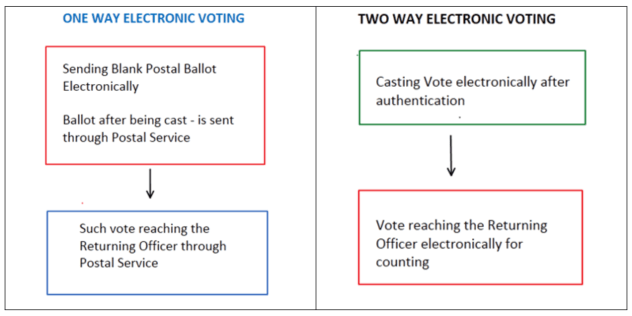
Electronically Transmitted Postal Ballot System (ETPBS) is the one-way electronic transmission of the Postal ballots to the Service Voters.
The Service Voter then cast their vote and send it to the respective returning officer via Post. The complete process is secured by way of multiple checks and transmission protocol to ensure safe transmission.
Upon receipt of the postal ballot at the counting centres, the returning officer validates the receipt by a series of QR codes with that of the transmitted system.
Functionality of ETPBS
Returning Officer generates ballot paper electronically by a specific desktop application. This ballot then gets encrypted in the system is ready to be sent.
The first functionality is the ability to generate the postal ballot online for transmitting through ETPBS.
Through ETPBS system, the ballots are automatically assigned to Service Voters based upon their constituency and get then gets transmitted.
The unit officer downloads the Postal ballots on behalf of the service voter. These downloaded ballots will be password protected.
The downloaded Postal Ballot can now be e-transmitted / hand-delivered using their secured network/infrastructure to the individual service voters.
The PIN will be transmitted/ dispatched to the individual service voters by the Record Officer to ensure that the downloaded Postal Ballot is opened by the concerned service voter only.
Thus ETPBS transmits the Postal ballot from the returning officer to the service voters electronically by a series of security protocol.
Two way electronic voting
Two-way electronic transmission of vote envisages that - a registered voter from any location in India, once his identity is proved, will be able to cast his vote electronically through a secure encrypted system and the same will reach the designated returning officer for counting.
EC is currently experimenting by using blockchain technology to facilitate two way electronic voting.
Providing Overseas Voters the Right to Vote
BENEFITS
CONCERNS
It will increase voter participation.
Logistical Challenge to conduct voting either at Indian Embassies abroad or some other place which needs to be sanitized for voting.
It will cater to the vast Indian diaspora living abroad.
It may impact several rights (employment, residence etc.) of such NRIs who intend to settle permanently in foreign countries.
Remove compulsions on part of Indians to travel to India especially for voting purpose.
It will fulfill the mandate of Article 326 and Section 62 of RPA, 1951 – which provides for right to vote for every citizen registered in the electoral roll.
Key Concerns on Online Voting using Blockchain Technology
Despite the benefits, security concerns have been raised by experts on the following grounds:
Hacking of Blockchain Technology may result in:
Impersonation of voters
Transfer of votes for rival candidates
Cloning of biometric authentication
Denial-of-service attack might disallow citizens to register and vote
Disenfranchise a group or community of citizens
Decrypting votes casted
Open to misuse by foreign intelligence & corporates
Voting Preference and Pattern may become Public which is opposed to secret ballot
What Needs to be Done to Allow Online Voting for NRIS – Way Forward
If online voting is to be allowed by the government, then Section 20A of Representation of People Act, 1950 along with the Registration of Electors Rules, 1960 needs to be amended to allow online voting by NRIs even from outside India.
Aspects related to logistics must be sorted out with the help of Ministry of External Affairs to allow smooth voting process for the overseas voters.
Two Way Electronic Voting can also be considered by the Election Commission by plugging the loopholes of online voting for the overseas voters.
National Family Health Survey (NFHS) data show that higher education levels could play a greater role than wealth in delaying a woman’s marriage.
Laws that prescribe minimum age for marriage in India:
The Hindu marriage act (1955), Indian Christian marriages act (1872) and special marriages act (1954) prescribed the minimum age of marriage as 18 years for the bride and 21 years for the groom.
Prohibition of Child Marriage Act, 2006 prohibits marriage below 18 years for women and 21 years for men.
Child Marriages
Child marriage refers to a marriage to which either of the contracting parties is a child (if a male, has not completed 21 years of age, and if a female, has not completed 18 years of age). In India, it is estimated that there are over 24 million child brides. According to the National Family Health Survey, 40% of the World’s 60 million child marriages take place in India. According to NFHS-5 data, the share of women aged 20-24 who married before turning 18 is around 23%. Child marriage is far more prevalent amongst girls and this highlighted the gender dimension of the problem.
Causes
Poverty: Poor families resort to child marriages to avoid all sorts of burden of a female child, like expenditure on education, dowry etc.
Patriarchy: Girl in our patriarchal(patrilocal) set up is believed to be somebody’s property and are considered to be a liability as they are not seen as individuals who can contribute productively to the family. These beliefs lead parents to marry the girl child.
Social mobility: The institution of marriage is often used to strengthen economic and social ties between different families and a young girl may be offered to a family in order to improve the financial and social standing of the girl’s family.
Insecurity: To secure from offences like assaults, eve teasing against unmarried girls, their parents are in a hurry to marry their daughters soon after she attains puberty or even before that.
Avoiding share in Ancestral Property: Early marriage is a way of denying share of ancestral property to females.
Dropout of school: Dropout of teenage girls from school due to lack of basic amenities like toilets or for helping in the household work when both the parents go out for work, is one of the reasons for early marriage of girls.
Legal conundrum: Prohibition of child marriage act prohibits marriage of any women before the age of 18 but Muslim personal law mentions puberty or age of 15 years as minimum age of marriage for women.
Age of Marriage
Rationale behind raising the minimum age of Marriage for women:
The Constitution guarantees gender equality as part of the fundamental rights and also guarantees prohibition of discrimination on the grounds of sex. The existing law do not adequately secure the Constitutional mandate of gender equality in marriageable age among men and women.
Incidence of early marriage and childbearing are amongst the important causes of undernutrition in India. Children born to teenage mothers are more likely to be undernourished than children of adult mothers. India is home to more stunted children than any other country and is one of the ten countries with the largest burden of teenage pregnancy.
It is important to bring down the incidence of teenage pregnancies, which are not only harmful for women's overall health but also result in more miscarriages and stillbirths.
Early marriage often reduces the women labour force participation and increasing the legal limit of minimum age will give more chance for women to work.
Early marriages reduces the educational and employment opportunities for women and make them financially dependent on men, which eventually results in skewed division of labour in domestic sphere.
Age of marriage of females is a key factor that influences fertility. Demographic studies have revealed the apparent link between early marriage and increasing fertility rates.
Arguments against
Restriction on choice of marriage: It can be used by parents to punish their daughters who marry against their wishes or elope to evade forced marriages, domestic abuse and housework.
Legal limits are not successful: According to NFHS-5 (2019-2021), 23.3% of women aged 20-24 years married before the age of 18, which shows that the Prohibition of Child Marriage Act (PCMA), 2006, has not been successful in preventing child marriages.
Depriving legal protection: Increasing the legal age at marriage for girls will expand the number of persons deemed underage and render them without legal protection.
Declining fertility rates: India’s fertility rates have already been declining to well below replacement levels in many States, including those with higher levels of child marriage.
Poverty is the underlying reason: Poverty and lack of higher education are major underlying reasons for early marriages. According to an analysis of NFHS-4 (2015-2016) data, 56% girls were married below the age of 21 and this figure was as high as 75% among the poorest category of population.
Way forward
Instead of focusing on age of marriage, following steps may eventually reduce the age of marriage
Conditional cash transfer schemes to improve the attendance of girls in schools and skill training.
Providing Increased access to contraceptives.
Ensuring a safe environment to women free from the constant threat of rape and sexual assault which is why girls are married off early.
Stepping up from its ongoing initiative of providing potable water in six islands of Lakshadweep using Low Temperature Thermal Desalination (LTTD) technology, the Chennai-based National Institute of Ocean Technology (NIOT) is working at making this process free of emissions.
What is Low Temperature Thermal Desalination (LTTD) technology?
It is based on Ocean Thermal Energy Conversion (OTEC) principle.
It is one process that uses the availability of a temperature gradient between two water bodies or flows to evaporate the warmer water at low pressure and condense the resultant vapour with the colder water to obtain freshwater.
While ocean, with its temperature variation across its depth, presents one such scenario of two water bodies, a coast based thermal power plant discharging huge amounts of condenser reject water into the nearby ocean represents an alternate scenario.
Note: Near Lakshwadeep there is a difference of about 15 - 20 degree Celsius between sea surface water and deep sea water.
Warm surface sea water is flash evaporated at low pressure and the vapour is condensed with cold deep sea water.
LTTD exploits the difference in temperature (nearly 15°C) in ocean water at the surface and at depths of about 600 feet.
This cold water condenses water at the surface, that is warmer but whose pressure has been lowered using vacuum pumps.
Such de-pressurised water can evaporate even at ambient temperatures and this resulting vapour when condensed is free of salts and contaminants and fit to consume.
Note: Sea water is salty. When water evaporates, it leaves the salts behind. Those vapours when get condensed, are transformed into pure fresh water.
The LTTD technology does not require any chemical pre and post-treatment of seawater and thus the pollution problems are minimal and suitable for island territories.
Since no effluent treatment is required, it gives less operational maintenance problems compared to other desalination processes.
The cost per liter of desalination would depend on the technology used and cost of electricity which varies from place to place.
Existing issue: Currently the desalination plants, each of which provides at least 100,000 litres of potable water everyday, are powered by diesel generator sets — there being no other source of power in the islands. However, the need for diesel power to reduce the water pressure means that the process is not fossil-fuel free and also consumes diesel, a precious commodity in the islands that has to be shipped from the mainland critical for powering the electric grid.
International Wheat Council as established by the International Wheat Agreement, 1949 was renamed as International Grains Council by the Grains Trade Convention, in 1995. It is located in London.
International Grains Council is an inter-governmental organisation that administers the Grains Trade Convention.
Scope: Food Items Covered under the definition of Grains are Rice (added later), Pulses (added later), barley, maize, oats, rye, sorghum, triticale and wheat and their products.
Functions of International Grains Council:
Further international cooperation in grain trade.
Promote expansion, openness and fairness in grains sector.
Contribute to grain market stability and enhance world food security.
Forum for exchange of information and discussion of members regarding trade in grains
International Grains Council has been formed under the Grains Trade Convention, 1995 and also administers the GTC.
Membership: Membership of IGC consists of all parties to the Grain Trade Convention, 1995 with 30 countries as members. Each member is designated as an importer or exporter based on its average trade in grains, rice and oilseeds. India is a member of this organisation. Department of Food & Public Distribution under Ministry of Consumer Affairs, Food & Public Distribution Acts as the nodal agency on behalf of government of India in International Grains Council.
Chairperson and Vice-Chairperson of this council are elected annually by the council.
IGC holds two regular Council Sessions each year, either in London or by invitation in member countries.
IGC also acts as the secretariat of Food Assistance Convention, 2013. (Food Assistance Convention aims to reduce hunger, improve food security and improve nutritional status of the most vulnerable populations. India is not a party to this convention).
Initiatives of the International Grains Council
Grains & Oilseeds Index: An index developed by International Grains Council which provides daily updates on variation of prices of commodities covered by International Grains Council.
Grain Market Report: It is a monthly publication that reviews the situation and outlook for wheat (including durum), maize (corn), barley, sorghum, oats, rye, rice, soybeans, soy meal and rapeseed/canola markets.
Agricultural Market Information System (AMIS):International Grains Council joined the Secretariat of Agricultural Market Information System (AMIS) in 2012. AMIS was established at the request of Agriculture Ministers of G20. It covers four crops (Wheat, Maize, Rice and Soyabeans). AMIS aims to promote food market transparency and coordination of policy action in response to market uncertainty.
Grains Trade Convention, 1995 (GTC)
GTC is the only international treaty covering trade in grains, rice and oilseeds trade.
Scope: Food Items Covered under the definition of Grains are Rice (added later), Pulses (added later), barley, maize, oats, rye, sorghum, triticale and wheat and their products.
Recently, Egypt which is one of the largest importers of Wheat in the world, withdrew from the Grains Trade Convention, 1995.
Despite the government’s successful implementation of successive e-governance tools such as Crime and Criminal Tracking Network & Systems CCTNS, Inter-Operable Criminal Justice which also includes integration of e-Courts and e-Prisons, it will not automatically improve governance especially with respect to the way criminal justice system operates in India. Even after implementation of such e-governance technology, success rates for investigation, lodging of First Information Report (FIR), filing charge-sheet by police before the Court, prosecution and successful conviction will vary for different states.
Crime and Criminal Tracking Network & Systems (CCTNS)
Crime and Criminal Tracking Network & Systems (CCTNS) is a plan scheme conceived in the light of experience of a non-plan scheme namely - Common Integrated Police Application (CIPA).
CCTNS is a Mission Mode Project under the National e-Governance Plan (NeGP) of Govt. of India.
CCTNS aims at creating a comprehensive and integrated system for enhancing the efficiency and effectiveness of policing through adopting of principle of e-Governance.
CCTNS also aims at creation of a nationwide networking infrastructure for evolution of IT-enabled-state-of-the-art tracking system around 'Investigation of crime and detection of criminals'.
CCTNS connects police stations and digitises registration of FIR, investigation and charge sheets.
The objectives of the Scheme can broadly be listed as follows:
Make the Police functioning citizen friendly and more transparent by automating the functioning of Police Stations.
Improve delivery of citizen-centric services through effective usage of ICT.
Provide the Investigating Officers of the Civil Police with tools, technology and information to facilitate investigation of crime and detection of criminals.
Improve Police functioning in various other areas such as Law and Order, Traffic Management etc.
Facilitate Interaction and sharing of Information among Police Stations, Districts, State/UT headquarters and other Police Agencies.
Assist senior Police Officers in better management of Police Force
Keep track of the progress of Cases, including in Courts
Reduce manual and redundant Records keeping
Implementation Framework – CCTNS
CCTNS has been implemented in alignment with the National e-Governance Plan principle of "centralized planning and de-centralized implementation".
Ministry of Home Affairs (MHA) and National Crime Records Bureau (NCRB) are playing a key role in planning the program in collaboration with the Police leadership within States, in the development of a few core components and in monitoring and reviewing the program.
It is the States and Union Territories (UT) that drives the planning and implementation at the State and UT level.
The role of the Centre (MHA and NCRB) focuses primarily around planning, providing the Core Application Software (CAS) (to be configured, customized, enhanced and deployed in States.
Whereas the States and UTs drives the implementation at the state level and have continued to own the system after deployment.
The central feature of CCTNS implementation at the State level is the "bundling of services" concept. According to this, each States selected one System Integrator (SI) who is the single point of contact for the State for all the components of CCTNS.
These components include the application (the changes made to the core application provided by MHA), hardware, communications infrastructure, associated services such as Capacity Building and Handholding, etc.
Expected Benefits for Various Stakeholders
A. Benefits to Police Department
Enhanced tools for investigation.
Centralized crime and criminal information repository along with the criminal images and fingerprints with advanced search capabilities.
Enhanced ability to analyze crime patterns and/ or modus operandi
Enhanced ability to analyze road incidents and other accidents.
Faster turnaround time for the analysis results (criminal and traffic) to reach the officers on the field.
Reduced workload for the police stations back-office activities such as preparation of regular and ad-hoc reports and station records management.
A collaborative knowledge-oriented environment where knowledge is shared across different regions and units.
Better co-ordination and communication with external stakeholders through implementation of electronic information exchange systems.
B. Benefits to Ministry of Home Affairs (NCRB)
Standardized means of capturing the crime and criminal data across the police stations in the country.
Faster and easier access to crime and criminal information across the country in a manner amenable for trend and pattern analysis.
Enhanced ability to detect crime patterns through modus operandi across the States/UTs and communicate to the state police departments for aiding in crime prevention.
The ability to respond faster and with greater accuracy to inquiries from the parliament, citizens and citizens groups; and to RTI queries.
Easy and low-cost scalability of crime and criminal systems in the future.
C. Benefits to Citizens
Multiple channels to access services from police.
Simplified process for registering petitions.
Simplified process for accessing general services such as requests for certificates, verifications, and permissions.
Simplified process and accurate means of tracking the progress of the case during trials.
Simplified and accurate access to view/report unclaimed/recovered vehicles and property.
Simplified process and channel for grievance registration.
Improved relationship management for victims and witnesses
Faster and assured response from police to any emergency calls for assistance.
D. Benefits to external departments
Seamless integration with police systems for better citizen service delivery and improved law enforcement.
Quick exchange of accurate information with the police department.
Inter-operable Criminal Justice System
Inter-operable Criminal Justice System (ICJS) aims to integrate the Crime and Criminals Tracking Network and Systems (CCTNS) project with the e-courts and e-prisons databases, as well as with other pillars of the criminal justice system such as Forensics, Prosecution, and Juvenile homes in a phased manner.
ICJS is thus a common platform for information exchange and analytics of all the pillars of the criminal justice system comprising of Police, Forensics, Prosecution, Courts& Prisons.
Invested under the CCTNS project of the MHA, the ICJS enables a nationwide search on police, prisons & courts databases across all States/ UTs in the country.
e-Courts Project
The eCourts Project was conceptualized on the basis of the “National Policy and Action Plan for Implementation of Information and Communication Technology (ICT) in the Indian Judiciary – 2005” submitted by e-Committee, Supreme Court of India with a vision to transform the Indian Judiciary by ICT enablement of Courts.
E-committee is a body constituted by the Government of India in pursuance of a proposal received from Hon'ble the Chief Justice of India to constitute an e-Committee to assist him in formulating a National policy on computerization of Indian Judiciary and advise on technological communication and management related changes.
The e-Courts Mission Mode Project, is a Pan-India Project, monitored and funded by Department of Justice, Ministry of Law and Justice, Government of India for the District Courts across the country.
The E-Courts Mission Mode Project (Phase I 2010-15; Phase II 2015-19) is a national e - Governance project for ICT enablement of district and subordinate courts of the country. The major objectives of the Project are –
To make whole judicial system ICT enabled by putting in place adequate and modern hardware and connectivity;
Automation of workflow management in all courts;
Electronic movement of records from taluka/trial to appeal courts;
Installation of video conferencing (VC) facility and recording of witness through Video Conferencing; connecting all courts in the country to the National Judicial Data Grid (NJDG) through WAN and additional redundant connectivity;
Citizen centric facilities such as electronic filing, e-payment and use of mobile applications in all courts;
Touch screen based kiosks in each court complex, full computerisation of State and district level judicial and service academies and centres.
The e-Court Project Envisages
To provide efficient & time-bound citizen centric services delivery as detailed in eCourt Project Litigant's Charter.
To develop, install & implement decision support systems in courts.
To automate the processes to provide transparency in accessibility of information to its stakeholders.
To enhance judicial productivity, both qualitatively & quantitatively, to make the justice delivery system affordable, accessible, cost effective, predictable, reliable and transparent.
E-PRISON PROJECT
e-Prisons have been operationalised across all states and Union Territories by the Ministry of Home Affairs. The e-prison data has been integrated with Police and court system under the Inter-Operable Criminal Justice System.
The system can be accessed through the secure National Informatics Centre (NIC) network, exclusively by authorising officials of law enforcement agencies and prisons through inter-operable Criminal Justice System.
e-Prisons Application Suite, developed by National Informatics Centre (NIC), is cloud-based product designed with easy to use GUI and embedded with comprehensive security features. It can be easily adopted by any State Prisons Department with minimum customization efforts since all the possible customization features are parameterized and can be configured by the users.
e-prison application
The e-Prisons application suite integrates all the activities related to prison and prisoner management.
It provides vital information about the inmates lodged in the prisons in a real-time environment to the courts, prison officials and other entities, involved in the Criminal Justice System.
The e-Prisons Project of Ministry of Home Affairs aims at computerization of the functioning of prisons in the country including digitisation and availability of prisoner’s data (convicts, under-trials, detenues etc.) in an electric platform which will be accessible to designated authorities of central and state governments.
e-Prisons Project will help in creating centralised standard information database.
e-Prisons uses data maintained by the States and Union Territories on the National Prisons Information Portal as per protocols notified for e-Prisons.
Components of e-Prison Project
E-Prisons Management Information System (MIS) – Management Information System used at the prisons for their day to day regular activities. The major modules of e-Prisons MIS are:
Prisoner Information Management System (PIMS);
Visitor Management System (e-Visitor);
Hospital Management System (e-Hospital);
Legal Aid Management System;
Inventory Management System;
Prison Management System (PMS);
Police Intelligence System;
Court Monitoring; and
Kiosk Information.
National Prisons Information Portal (NPIP) – It is a citizen-centric portal that displays statistical data from the country’s numerous prisons.
Visitors can use this portal to schedule visits with their wards inside the prison;
Grievances about their wards can also be submitted using the portal;
This portal also provides with inmate tracking facilities in a secured way to various investigating agencies.
Kara Bazaar – Portal for showing and selling things made by convicts in various jails across the country. All of the state prison departments now have access to the necessary technology for on boarding.
Concerns in Implementation of e-Governance Tools to improve Criminal Justice System
Implementation of CCTNS across police stations with respect to steps towards digitisation of police records and its sharing with other police stations is not uniform.
Thus, 97 per cent of police stations may have been connected to CCTNS, but the figure is 77 per cent for West Bengal (as of January 2022).
Investigation Rates vary across states and in general for crimes under Indian Penal Code, it is only 65 per cent. This leaves the question about the remaining 35 per cent and also the fact that investigation need not lead to lodging of FIR.
Under-staffed police stations is another reason for non-uniformity in implementation of CCTNS across police stations in different states.
Police and Prisons are in the State List of Seventh Schedule and accordingly it is upto the respective state governments to implement the Model Prison Manual brought by MHA in 2016. So, states having antiquated prison manuals will not achieve much with new e-prison norms.
Even the functioning of Police based on the old and archaic Police Act of 1861 will not achieve much unless Model Police Act, 2015 is adopted by respected state governments as suggested by the The Police Act Drafting Committee or Soli Sorabjee Committee.
Way Forward – With the above stated shortcomings, it will be difficult to achieve the principles of “one country”, “one police” and “one prison”. Thus, in order for the e-governance tools such as CCTNS, e-Prison, e-Courts etc. to become successfully operable in India, differences in the functioning of police in different states needs to be resolved and also needs to be harmonised.
The deal highlights a long-standing ally of the US — Saudi Arabia accepted and acknowledged publicly the mediatory role of China, which is locked in a sharpening, all-round confrontation with the US, cannot be regarded as anything less than a major diplomatic setback for Washington
Saudi Arabia and Iran have agreed to revive two key agreements they concluded during an earlier phase of positive bilateral relations.
One is a 1998 agreement on economic, trade and investment cooperation;
The other is an agreement on internal security cooperation, concluded in 2001, which covered organised crime, terrorism and drug trafficking.
WHY US IS WITHDRAWING ?
The US is also distancing itself from the region as it is no longer dependent on energy imports from the region.
It has itself emerged as a significant exporter of both oil and gas.
America knows that its survival in the region is very costly, because it will remain under the strikes of the Axis of Resistance, which has grown and gained great influence in last decade, meaning that the American presence is no longer without cost, but rather the price will rise if US stays.
The only reason US remains engaged because its major allies are still dependent on energy supplies from the region.
US also has a stake in the security of Israel, which also serves as its key regional ally.
AXIS OF RESISTANCE The term Axis of Resistance (also Resistance and Deterrence Axis) commonly refers to a Shiite anti-Israel and anti-Westernalliance between Iran, Syria, the Lebanese Militant group Hezbollah and Hamas.
This Iran-led alliance aims to oppose Western, namely United States and Israel, interests in the region.
FOR INDIA
India has done well in recent years in forging much closer relations with key Gulf states like Saudi Arabia, the UAE and Oman.
India has been able to do so even while forging a close strategic partnership with Israel. The Abraham Accords opened the door to the I2U2 initiative which brought together India, Israel, the UAE and the US in a quadrilateral regional framework, akin to the Quadrilateral (Quad) in the Indo-Pacific.
But the deal brokered by China highlights the growing clout, following this if the multi-billion dollar($400bn) deal between Iran and China is materialized and partnership with Saudi is strengthened it will put brakes on ambitious targets set under I2U2
SILVER LINING
American President Joe Biden has earlier assured, the US is not leaving the Middle East and that America “will not walk away and leave a vacuum to be filled by China, Russia, or Iran”.
Earlier US saw itself as the sole provider of regional security, now this approach is changing with US effort to craft a Middle East Air Defence coalition is an example of this.
US focus on national interest found an echo in the Middle East. The region earlier focused on transcendental notions of “pan Arabism” and “pan Islamism”. Arab leaders now are not willing to let that come in the way of normalisation of relations with Israel. Ex Abraham Accords
Thus India must find ways to revive and expand its energy partnership with Iran and fast-track the implementation of the Chabahar port and the transport corridor that would link it to Central Asia. India’s western flank is far too important to be accorded second place to the Indo-Pacific.
Within the last year, the Gujarat Cooperative Milk Marketing Federation has raised the maximum retail price (MRP) of its Amul brand full-cream milk (containing 6% fat and 9% SNF or solids-not-fat) in Delhi from Rs 58 to Rs 64 per litre.
The National Dairy Development Board (NDDB)-owned Mother Dairy went further — from Rs 57 to Rs 66 per litre — between March 5 and December 27, 2022.
Reasons for the price rise:
Crash in prices following the Covid-induced lockdowns as a result of demand destruction led dairies to slash procurement prices of milk and its products. Farmers responded by:
Shrinking (or at least not expanding) the size of their herds, as milk prices would not cover the cost of feeding and maintaining the animals
Underfeeding the calves and the pregnant/ dry cattle who did not give milk. The calves that were underfed during the lockdown are today’s cows. Most of them, even if they have survived, are poor milkers. This is evidenced by dairies across India reporting lower milk procurement
Supply side issues - Increase in cost of animal feed:
The cattle feeding cost alone has increased by around 20% compared to last year, on the back of more expensive ingredients such as cotton-seed, rapeseed and groundnut extractions, soybean meal, maize, de-oiled rice bran and molasses.
Availability of straw (particularly wheat, due to a poor 2021-22 crop) and fodder (because of near-incessant rains, especially in the South, from October-December 2021 through 2022, which did not allow the grass to fully come out) has also been an issue.
Zoonotic Diseases: Some major milk-producing states have seen a rise in cases of disease among cattle. Lumpy Skin Disease, which leads to fall in milk output, has been reported in Gujarat, Punjab and Haryana.
There has also been a rise in transport, logistics, manpower, and energy costs.
Demand side issues - the lifting of lockdown restrictions and revival of economic activity from late-2021 coincided precisely with the building up of supply pressures.
This was exacerbated by India exporting more than 46,000 tonnes of milk fat between April 2021-November 2022, against a mere 15,600 tonnes in 2020-21.
Higher exports of butter, ghee, and anhydrous milk fat, enabled by soaring international prices, have added to the domestic shortage.
Way Forward:
Allow duty-free imports of butter oil and SMP. Butter fat imports currently attract 40% duty. For SMP imports, it is 15% up to 10,000 tonnes per year and 60% for quantities more than that.
The government can permit NDDB to import fat and SMP at zero duty for building up a buffer stock necessary for the summer, when milk supplies will dry up in the normal course.
In recent times, there has been increasing demand for delisting of tribal communities, from the list of Scheduled tribes under Article 342 of Constitution, who have converted to other religions, primarily Christianity. This has raised debate over the criteria followed by the government to designate a community as a scheduled tribe.
Union Ministry of Tribal Affairs established a task force under the leadership of erstwhile Tribal Affairs secretary Hrushikesh Panda in 2014. Panda committee compiled a list of over 40 communities from India that should be included in Scheduled Tribe List on a priority basis. (26 Tea-tribes, 9 from Odisha, 8 from Chhattisgarh, few from Andhra Pradesh and Tamil Nadu).
Salient features of Tribes
An amalgam of the various traits ascribed to tribal groups include:
Tribes have a segmentary but egalitarian system.
They are not mutually inter-dependent, as are castes in a system of organic solidarity.
Absence of complex political structures
Endogamy
Strong and functional kinship bonds, cooperation
Territorial integrity
Cultural and linguistic distinctiveness
Lower levels of technology
Sustained by relatively primitive subsistence technology such as shifting cultivation, hunting, and gathering
Many tribes follow Animism as a form of religion
TRIBE
CASTE
Egalitarian
Hierarchy
Segmentary
Organic
Communal ownership of resources
Individual ownership
Endogamy to preserve tribal identity
Endogamy based on the purity-pollution principle
EXISTING CRITERIA AND PROCESS
Existing criteria followed by the government for the specification of a community a scheduled tribe as defined by the Lokur committee (1965) are:
Indications of primitive traits,
Distinctive culture,
Geographical isolation,
Shyness of contact with the community at large, and
Backwardness.
These are not mentioned in the Constitution.
PROCEDURE FOR LISTING COMMUNITIES AS SCHEDULED TRIBES
STEP-1:Representations are received by State Governments or Union Ministry of Tribal Affairs for inclusion/exclusion of any community in/from the list of Scheduled Tribes of a State/UT under Article 342 of Constitution.
STEP-2: State government or UT administration needs to first recommend and forward the proposal to the Union Ministry of Tribal Affairs. If the State Government or UT Administration does not recommend the community’s case for inclusion will die down.
STEP-3:After State government/UT administration has recommended for inclusion of the community in ST list, Union Ministry of Tribal Affairs forwards the proposal to Registrar General of India (RGI). If the RGI is not satisfied, the case for inclusion ends.
STEP-5: After the consent of the NCST recommendation, the proposal is taken to Union Cabinet for its consent.
STEP-6: After the consent of the NCST, the matter is taken up by the Parliament in the form of a bill to amend the Presidential Order issued under Article 342 of the Constitution, which lists the scheduled tribes in each State and UT.
ISSUES WITH PRESENT CRITERIA FOR SCHEDULING
Transition and Acculturation: Over the period, tribal communities have been undergoing the processes of transition & acculturation due to impacts of planned change, modernization & globalization. Tribes do show some distinctness in their culture but the regional variations cannot be ruled out due to acculturation influence of adjoining populations. Most tribes got converted to mainstream religions like Hinduism and Christianity.
Issues with Isolation: Migrations in India were frequent for political, economic and ecological reasons. Even the most isolated groups were part of a wider network of economic relations. There are only a few tribes, which are isolated like the Jarawa and the Sentinelese in Andaman and Nicobar Islands.
Problematic Idea of ‘Primitiveness’: The term "primitive" has been challenged as a value-loaded term indicating a condescending attitude by outsiders. Besides, the so-called primitivity is a stage in evolution of a community through which all communities have passed or passing. The tribals themselves resent being called primitive.
Reasons identified by Panda Committee why some communities are not included as STs:
Some existing communities who form sub-sets among the existing Scheduled Tribe have not got benefit of Scheduled Tribes.
Phonetic Variations: Some communities are known by names which have little phonetic or spelling differences with existing ST tribes.
Bifurcation of States: Few communities were left out when States were bifurcated i.e., they were included as ST in one state and left out of ST list in other state.
Due to forced migration: There are communities who were denied inclusion in ST list, as they were forcibly taken away from their homelands as indentured labour to other states or were displaced due to industrialisation, where they were left out of the ST list. Thus, there is a need to differentiate between voluntary migration and forced displacement and thus, these communities should be included in ST List. Ex. Tea Tribes of Assam who were forcibly taken as indentured labourers from Bihar, Jharkhand, Odisha to Assam. Tribes who have had to be resettled from one state to another due to hydropower and irrigation projects on Narmada River affected STs in Madhya Pradesh.
If these outdated criteria are still going to be adopted, there may be hardly few communities to qualify for ST status and many of the existing ST communities will lose their ST status. Hence, there emerges the need to revisit the existing criteria so that apparent historical injustice can be addressed practically and contextually. A more flexible criterion should be adopted for this purpose, rather than following a rigid and dogmatic approach.
ISSUES WITH CURRENT PROCUEDURE FOR SCHEDULING
Procedure for inclusion of communities defeats Constitution agenda for affirmative action and inclusion is cumbersome and time consuming.
The proposal must get consent of States government/UT administration, Registrar General of India, National Commission for Scheduled Tribes, Union Cabinet and Parliament. If the proposal is defeated at any one spot it is rejected.
Office of Registrar General of India lacks expertise of Anthropologists and sociologists to comment on proposals for exclusion and inclusion of community into ST list.
Registrar General of India has not created a databank on tribes/castes based on ethnographic study/surveys. This limits the ability to do justice to identifying communities as STs.
RGI’s decision is based on census records. However, there are inconsistencies in the census records. For ex. Census 1891 listed tribes as ‘Tribal religion’, 1901 and 1911 census described them as ‘Tribal animists’, 1921 census included them under ‘Hill and forest tribes’, 1931 census described them as ‘primitive tribes’ and 1941 census as ‘tribes’. After Census 1951, they are under the constitutional category of Scheduled Tribes.
PROPOSED CRITERIA FOR INCLUSION OF NEW COMMUNITIES IN ST LIST
The following criteria points are proposed for consideration by National Commission for Scheduled Tribe and must be looked at from a holistic perspective, rather than as an isolated criterion. These criteria have been suggested by Hrushikesh Panda Committee. All the following criteria should be looked at holistically and none should take precedence over another.
Common Community Names for Group Identityor may have different names such as sub-tribes/sections, synonyms/ phonetic variations or the name/names by which they identify themselves and the names by which their neighbours call them.
Distinct Language/Dialect which may or may not exist today. The community may be bilingual speaking own language among themselves and local/regional language to communicate with others.
Presence of a Core Culture relating to life cycle, songs, dances, paintings, folklore.
Endogamy or marital relationship primarily within their community & with other Scheduled Tribes.
Autonomous Religious Beliefs and Practices where traditional magico-religious functionaries are from the community, though practicing Hindu 'way of life' would not be a bar.
Traditional Institutions of Social Control relatively intact.
Low Level of Techno-Economy: Simple, less diversified, simple exchange of goods and services, mutual interdependence.
Relative Socio-Economic & Educational backwardness when compared to rest of population of the State.
Historical geographical isolationwhich may or may not exist today.
Reforming the procedure for inclusion:Office of RGI should merely be required to provide information available with it.
Reformed procedure: Panda Committee suggested a reformed procedure suggesting that once a proposal is received from a State government, it should be circulated simultaneously to NCST, RGI and Anthropological Survey of India (AnSI), each of which needs to give their opinions in 6 months. After opinions of the above institutions should then be considered by a special committee on Scheduling of Communities which will be headed by Tribal Affairs Secretary, and representatives from NCST, RGI, AnSI, State Governments and State Tribal Research Institute.