Context: The Payments Council of India (PCI), an industry body representing payment fintechs in the country, has requested finance minister to restore Merchant Discount Rate (MDR) for RuPay debit cards, as payment aggregator fintechs continue to lose on revenue lines for processing payments through the card infrastructure.
Merchant Discount Rate:
MDR (Merchant Discount Rate) refers to a fee that a merchant is charged by their issuing bank for accepting payments from their customers via credit and debit cards. It is also known as Transaction Discount Rate (TDR). While the card-issuing bank gets a share of it, the remaining amount is distributed between the payment network and point-of-sale terminal providers.
Push for Digitalisation:
The Government had mandated that large businesses (With turnover greater than ₹50 crore) provide customers with low-cost digital modes of payment and had asked banks to levy zero charges on the same.
The finance minister gave this initiative a further push by mandating that no MDR charges will be applicable on digital transactions via the Rupay and UPI platforms.
Concerns of Fintechs:
Payment aggregator fintechs are claiming that a loss of Rs 5,500 crore from no revenue being earned on UPI and RuPay debit card transactions. To compensate for this, the body has sought an incentive of Rs 4,000 crore in its representations to the ministry.
Zero MDR is also seen as a hindrance in attracting more players to adopt these payment modes and invest more in the development of the tech infrastructure to handle the huge volumes of transactions.
Context: In May, a United Nations report showed that India was among the 10 countries that together accounted for 60% of global maternal deaths, stillbirths and new born deaths. India accounted for over 17% of such deaths in 2020.
Reasons for Poor Maternal Health:
Malnutrition: Undernourished girls have a greater likelihood of becoming undernourished mothers who in turn have a greater chance of giving birth to low-birth-weight babies, perpetuating an intergenerational cycle of undernourishment.
Low literacy: According to 2011 census, around 35% of female is illiterate in India. Lack of adequate literacy deprives women awareness about nutrient-rich diet, good feeding practices and personal hygiene which ultimately impacts their maternal health.
Child Marriages: According to NFHS-5, about 25% of women aged 18-29 got married before reaching the minimum legal age of marriage. Increasing incidences of teenage pregnancies due to child marriages and inadequate access to contraceptives impacts their maternal health and one of the leading causes for Maternal mortality in India.
Climate change:
Studies shows that soaring temperatures due to heatwaves severely impact the maternal health of pregnant women. Women suffer more from yeast infections and UTIs (Urinary Tract Infections) in hot summers. Dietary habits that keep changing according to temperatures also impact Menstrual cycle.
Rapid climate changes globally have given rise to climate-driven food insecurities which disproportionately impacts the nutritional health of women in a patriarchal society.
A special bulletin was released by Registrar general of India on Maternal mortality ratio. Key findings of the report are:
Maternal mortality ratio (MMR) of India has declined by 10 points. It has declined from 113 in 2016-18 to 103 in 2017-19, an 8.8% decline.
The country has been witnessing a progressive reduction in the MMR from 130 in 2014-16, 122 in 2015-17 and 113 in 2016-18 to 103 in 2017-19.
With this persistent decline, India is on the verge of achieving the National Health Policy (NHP) target of 100 per lakh live births by 2020 and certainly on the track to achieve the Sustainable Development Goal (SDG) target of 70 per lakh live births by 2030.
This improvement has been possible due to continued efforts of government of India like
Janani suraksha yojana:
Implemented by Ministry of Health and family welfare
It is a safe motherhood intervention under the National Health Mission. It is being implemented with the objective of reducing maternal and neonatal mortality by promoting institutional delivery among poor pregnant women.
Cash incentives are given to beneficiaries for undergoing institutional deliveries.
The scheme focuses on poor pregnant woman with a special dispensation for states that have low institutional delivery rates, namely, the states of Uttar Pradesh, Uttarakhand, Bihar, Jharkhand, Madhya Pradesh, Chhattisgarh, Assam, Rajasthan, Orissa, and Jammu and Kashmir. While these states have been named Low Performing States (LPS), the remaining states have been named High Performing states (HPS).
Janani shishu suraksha karyakram:
A scheme under MoH&FW
It is an initiative to provide completely free and cashless services to pregnant women including normal deliveries and caesarean operations.
Free entitlements to pregnant women under this scheme are
launched by the Ministry of Health & Family Welfare (MoHFW)
Under PMSMA, all pregnant women in the country are provided fixed day, free of cost assured and quality Antenatal Care.
As part of the campaign, a minimum package of antenatal care services (including investigations and drugs) is being provided to the beneficiaries on the 9th day of every month.
The Abhiyan also involves Private sector’s health care providers as volunteers to provide specialist care in Government facilities.
LaQshya:
Labour Room & Quality Improvement Initiative (LaQshya) program will benefit every pregnant woman and newborn delivering in public health institutions. Program will improve quality of care for pregnant women in labour room, maternity Operation Theatre and Obstetrics Intensive Care Units (ICUs) & High Dependency Units (HDUs).
National food security act:
Special provisions have been made for pregnant women and lactating mothers by entitling them to receive nutritious meal through a wide network of ICDS centres.
Pregnant women and lactating mothers are further entitled to receive cash maternity benefit of not less than Rs. 6000 to partly complement the wage loss during the period of pregnancy and also to supplement nutrition.
Integrated Child Development Services (ICDS) Scheme:
Under Ministry of women and child development
The scheme provides Supplementary nutrition, immunizations and regular health check-ups of pregnant and lactating mothers.
PM Matru Vandana yojana:
Pradhan Mantri Matru Vandana Yojana (PMMVY) is a Maternity Benefit Programme that is implemented in all the districts of the country in accordance with the provision of the National Food Security Act, 2013.
All eligible Pregnant & Lactating Mothers would receive a Cash incentive of Rs 5000 in three instalments for first childbirth. Conditions attached to these instalments are
Early registration of pregnancy at the Anganwadi Centre (AWC)
Receiving at least one ante-natal check-up (ANC)
Registration of childbirth and vaccination of first cycle vaccines (BCG, OPV, DPT and Hepatitis-B).
Maternity Benefit Amendment Act:
Duration of the maternity leave increased to 26 weeks from 12 weeks.
Maternity leaves were extended to adopting and commissioning mothers. A commissioning mother is defined as a biological mother who uses her egg to create an embryo implanted in another woman.
The act provided that the employer may permit a nursing woman (after 26 weeks of maternity leave) to work from home if the nature of work permits.
All organizations with 50 or more employees are required to provide a Creche facility and during working hours, the concerned female employee must be allowed four visits to the crèche.
Context: While the IMD has predicted that the monsoon will be delayed this year, that’s not a cause for concern. Regional variations in rainfall, extreme rainfall events, and the developing El Nino are bigger worries.
What is onset of monsoon?
The monsoon season in India typically lasts from June to September, although its timing and intensity can vary across different regions.
The monsoon in India is primarily influenced by the seasonal reversal of winds, known as the Indian Ocean Dipole (IOD), and the movement of the Inter-Tropical Convergence Zone (ITCZ).
Pre-monsoon period (March to May): During this time, temperatures rise across the country due to the increasing solar radiation. As summer approaches, the landmass of the Indian subcontinent heats up faster than the surrounding oceans, causing a low-pressure area to develop over the region.
Arrival of the southwest monsoon (end of May to mid-June): The southwest monsoon is responsible for the majority of the rainfall in India. It begins with the onset of the monsoon over the Andaman Sea and the Bay of Bengal. Moisture-laden winds from the Indian Ocean are drawn towards the low-pressure area over the Indian subcontinent, creating a monsoon trough.
Factors affecting onset of monsoon:
Intense heating of the Indian landmass and formation of intense low pressure.
Deflection of SE trades after crossing the equator towards Indian west coast.
Advancement of the monsoon (June to July): The monsoon winds gradually advance across the country, starting from the southernmost state of Kerala and progressing northwards. This northward progression is known as the "monsoon onset line" and is closely monitored by meteorological departments.
Onset over different regions: The onset of the monsoon occurs at different times across various regions of India. The western coast and northeastern states receive the monsoon rains first, followed by the central and northern parts of the country. The Himalayan region experiences the monsoon last.
Monsoon progression and rainfall: Once the monsoon sets in, it brings heavy rainfall to different parts of India. The amount and distribution of rainfall vary from region to region. The western coast and north eastern states generally receive more rainfall compared to the arid regions in the northwest.
What is Indian ocean dipole?
IOD measures differences in sea surface temperatures between the western and eastern parts of the Indian Ocean. It is basically like the El Nino weather system that develops in the Pacific Ocean. It is characterized by an irregular oscillation of sea-surface temperatures in the eastern and western Indian Ocean
Impact on weather patterns: IOD alters the wind, temperature, and rainfall patterns in the Indian Ocean region.
Positive IOD event is known to bring floods to eastern Africa and droughts and bushfires to eastern Asia and Australia. Ex. 2020 Australian Bushfires.
Positive IOD is known to increase the intensity of Monsoon in the Subcontinent and leads to above normal rainfall. A simultaneous occurrence of Positive IOD and El Nino balances the negative impact of El Nino on the Indian Monsoon rainfall. Ex. above normal rainfall in India in 2019.
In contrast, Negative IOD coupled with El - Nino leads to poor Monsoon rainfall. Ex. Deficient rainfall in 1992.
Context:As Prime Minister Narendra Modi steps up engagement with the US and its allies — at the G7 summit in Hiroshima this week, the Quad summit in Canberra week after, and bilateral visits to Washington and Paris in June and July— the restructuring of the global economic order will figure high on India’s bilateral and multilateral agenda. In the geopolitical domain and so in the geoeconomic, there is a growing convergence of interests between Delhi and Washington. Translating that into concrete outcomes will demand much hard work and some creative solutions
The United States today is seeking wider international consensus on the new economic approach from its allies and partners, including India. The Unites states is pushing its efforts to build a “New Washington Consensus” as there is also a geoeconomic competition between Washington and Beijing which had begun to develop in the Trump years and President Joe Biden has intensified it and lent a plausible ideological framework to it.
The term “Washington Consensus”, which gained ground in the late 1980s, referred to the shared prescriptions from the International Monetary Fund, World Bank, and US Treasury on deregulation, privatisation, and free trade for economic modernisation. By the 1990s, these recommendations gained widespread policy traction in the chancelleries of the world, including in India.
However the Washington Consensus has started showing fissures and the lacunas in the approach which are highlighted by the following reasons:
The conviction that the “markets know best” approach led to the hollowing out of the US industrial base. It was argued that in the name of oversimplified market efficiency, entire supply chains of strategic goods along with the industries and jobs that made them moved overseas. It was realised that deep trade liberalisation though helped America export goods, but not jobs and capacity.
Secondly the notion that “all growth was good growth”, led to the privileging of some sectors like finance “while other essential sectors, like semiconductors and infrastructure, atrophied”.
Thirdly, the old assumption “that economic integration would make nations more responsible and open, and that the global order would be more peaceful and cooperative”, also led to distortion wherein Unites States referred to the premise underlying China’s admission into the WTO in 2001 wherein admitting countries into the rules-based order should have incentivised them to adhere to its rules”. However the problems triggered by the integration of a “large non-market economy” like China into the WTO.
It was realised that the America’s economic policy must confront the urgent need for a “just and efficient transition” to green economic growth and the political imperative of reducing economic inequality at home that has undermined American democracy. Thus for this purpose the United States has offered a five-fold policy framework under the New Washington Consensus
The first is to return to industrial policy that was the hallmark of US economic development historically, but dismissed by economic neoliberalism in the last few decades. For this the US has restored the role of the state in pumping investments into semiconductor production and promoting the development and deployment of green technologies.
Second, the United States under its new approach is not seeking autarky or promoting protectionism. The US is not going alone, and wants to develop a joint effort with US allies and partners, including India.
Third, United States wants its friends and partners to look beyond traditional trade policies. Wherein he highlighted the US-proposed Indo-Pacific Economic Framework is not a free trade agreement.
Fourth, the US is trying to mobilise “trillions in investment into emerging economies with solutions that those countries are fashioning on their own, but with capital enabled by a different brand” of US economic diplomacy. This primarily involves offering an alternative to China’s Belt and Road Initiative, addressing the global debt crisis, and reforming multilateral development banks.
Lastly United States is also pushing the efforts to develop a new set of export controls on sensitive technology that will limit national security threats from China and other rivals.
ABOUT WASHINGTON CONSENSUS
A list of policies that had gained support among Latin American policymakers in response to the macroeconomic turbulence and debt crisis of the early to mid-1980s. These policies also had the backing of experts at Washington's international institutions—especially the International Monetary Fund and the World Bank, as well as the US Treasury—to help the recovery from the debt crisis and popularly came to be known as Washington Consensus
Redirection of public spending from subsidies ("especially indiscriminate subsidies") toward broad-based provision of key pro-growth, pro-poor services like primary education, primary health care and infrastructure investment;
Tax reform broadening the tax base and adopting moderate marginal tax rates;
Interest Rates that are market determined and positive (but moderate) in real terms;
Competitive exchange rates
Trade liberalization: liberalization of imports, with particular emphasis on elimination of quantitative restrictions (licensing, etc.); any trade protection to be provided by low and relatively uniform tariffs.
Liberalization of inward foreign direct investment
Privatization of state enterprises
Deregulation: abolition of regulations that impede market entry or restrict competition, except for those justified on safety, environmental and consumer protection grounds, and prudential oversight of financial institution
Legal security for property rights.
INDIA AND WASHINGTON CONSENSUS
Pursuit of this policy resulted in annual economic growth breaking out of the 3 to 5 percent band of the pre-1991 era. But redistribution of the extra wealth has been skewed. Those already better off have improved their living standards further whereas the large majority who lagged behind before have stagnated or grown poorer.
The emphasis of the WTO and the IMF on export-led growth encouraged cultivators to switch from food crops to fertilizer-intensive cash crops like cotton, coffee, sugarcane, groundnuts, pepper and vanilla. As a consequence, the daily per capita availability of food grains declined from 510 grams in 1991 to 422 grams in 2005.
Conclusion
It is for India to understand that the common themes in the economic strategies are many and these include China’s geoeconomic challenge, the dangers of dogmatic commitment to globalisation, the need for industrial policy to develop national manufacturing, technological cooperation among like-minded partners, building resilient supply chains, addressing the economic concerns of the Global South, and reforming the global financial institutions.
It is also important to understand that there will also be many disagreements on the identification of priorities as well as on the details of the specific outcomes in rearranging the global economic order. But Building on new opportunities and resolving new problems must be viewed as a historic opportunity for India’s economic statecraft. As the US is ready for substantive engagement with its partners and Delhi must be ready to respond.
Context: Recently, the Central Drugs Standard Control Organisation (CDSCO) put out a list of over 50 medicines that were either found to be spurious or ‘not of standard quality’, raising a furore.
What is CDSCO
India takes pride in its pharmaceutical industry, being the largest global producer of generic medicines that benefit the global poor.
However, the industry has faced challenges, including struggles to achieve scale and defamatory claims about the ineffectiveness and harm caused by Indian drugs.
Quality concerns persist, with numerous drugs failing to meet standards, leading to substandard drugs in routine use and adverse events.
Global regulators have raised issues with compliance, potentially damaging India's reputation. Recommendations include amending regulations, centralizing the drug regulatory system, enhancing transparency, and focusing on producing quality generics and innovative drugs.
About Central Drugs Standard Control Organisation (CDSCO)
It functions as India's national regulatory body overseeing cosmetics, pharmaceuticals, and medical devices.
The CDSCO is organized with the Drug Controller General of India (DCGI) overseeing pharmaceuticals and medical devices.
It is assigned duties under Drugs and Cosmetics Act, 1940.
The DCGI is situated within the Ministry of Health and Family Welfare and receives guidance from the Drug Technical Advisory Board (DTAB) and the Drug Consultative Committee (DCC).
The CDSCO operates through zonal offices that conduct inspections prior to licensing, post-licensing inspections, post-market surveillance, and, if necessary, initiates drug recalls.
The right to reproductive choice means that women have a right to choose whether or not to reproduce, including the right to decide whether to carry or terminate an unwanted pregnancy and the right to choose their preferred method of family planning and contraception.
Women need some means to enforce these Reproductive rights:
Education: Education creates awareness among women and encourages them to adopt health family planning methods.
Financial Independence: Financial independence among women guarantees women the agency over reproduction.
Access to Contraceptives reduces unwanted pregnancies
Legal machinery: Strong lawsto address the issues like Child marriages and vesting agency over their reproductive choices.
E.g., Prohibition of child marriages Act (2006), Medical Termination of Pregnancy Act.
The above-mentioned means not only ensures women enforcing their Reproductive rights but also reduces Total fertility rates and hence arrests population growth. Thus, guaranteeing reproductive rights to women is essential to control population growth.
Reproductive rights and Gender justice:
India placed 130 out of 155 nations in the Gender Inequality Index (GII) 2020 released by the UNDP. One of the index's measurement pillars is "Reproductive Health “. This implies that reproductive rights are important for ensuring overall gender equality.
Maternal Health: Access to antenatal and postpartum care that is safe and of high quality will lower MMR.
Agency over reproduction: "Unwanted daughters" emerged in India as a result of women's lack of agency about reproductive choices and son-meta preference. This illustrates how crucial reproductive rights are to achieving gender equality.
Maternity leave: Providing maternity leave entitlements would ensure that young mothers’ ability to participate in the workforce is not hindered because of childbearing and child-rearing responsibilities.
Access to Contraceptives: High fertility is both a cause and symptom of poverty. Thus, the core causes of poverty would be addressed by making contraceptives and safe & legal abortion options accessible.
Menstrual leave: Menstrual leave and access to basic sanitation facilities for working women improve health outcomes and remove the stigma associated with the menstrual cycle in society.
Context: The Reserve Bank of India has directed the banks and other financial institutions to move away from the LIBOR (London Interbank Offered Rate) and move to any Alternative Reference Rates (ARR).
What is LIBOR?
LIBOR stands for the London Interbank Offered Rate. It is a benchmark interest rate that indicates the average rate at which major banks in London are willing to borrow from each other in the interbank market. LIBOR serves as a reference rate for a wide range of financial products and transactions, including loans, derivatives, and other financial contracts.
The British Bankers' Association (BBA) used to administer LIBOR until 2014, after which the Intercontinental Exchange Benchmark Administration (ICE Benchmark Administration) took over the responsibility.
LIBOR is calculated for various currencies and different borrowing periods, ranging from overnight to one year.
The calculation of LIBOR involves a panel of major banks submitting their borrowing rates, which are then used to determine an average rate. These rates are supposed to reflect the rates at which banks can borrow funds in the London wholesale money market.
How Is Libor Calculated?
Each day, 18 international banks submittheir ideas of the rates they think they would pay if they had to borrow money from another bank on the interbank lending market in London.
To safeguard against extreme highs or lows, the Intercontinental Exchange (ICE) Benchmark Administration strips out the four highest submissionsand the four lowest submissions before calculating an average.
It’s important to note that Libor isn’t set on what banks actually pay to borrow funds from each other. Instead, it’s based on their submissions related to what they think they would pay. As a result, it’s possible for banks to submit lower rates and manipulate Libor fairly easily.
Libor Scandals and the 2008 Financial Crisis
During the crisis, banks manipulated the LIBOR rates for their own benefit. They understated or manipulated their reported rates to create an illusion of financial health and to appear more creditworthy than they actually were.
By manipulating LIBOR rates, banks were able to lower their borrowing costsand increase their profits. This also gave them a false sense of security and credibility in the eyes of investors and counterparties.
The manipulation of LIBOR distorted the true pricing of financial products, leading to mispricing and increased risk in the global financial system.
Many financial institutions around the world relied on LIBOR as a benchmark for pricing and valuing their financial products. The manipulation of LIBOR undermined the integrity of these markets and eroded trust among market participants.
The impact of the LIBOR manipulation was far-reaching. It affected trillions of dollars' worth of financial contracts globally, including loans, mortgages, and derivatives. This, in turn, had a significant impact on individuals, businesses, and the overall economy.
The revelation of the LIBOR manipulation sparked a wave of investigations, lawsuits, and regulatory actions against banks involved in the scandal. Several major financial institutions faced substantial fines and penalties for their involvement.
The 2008 financial crisis exposed the vulnerabilities and weaknesses in the LIBOR benchmark system. It highlighted the need for reform and the development of alternative, more robust benchmark rates to ensure the integrity and stability of financial markets.
In response to the crisis, efforts were made to transition away from LIBOR as a benchmark rate. Various alternative reference rates, such as the Secured Overnight Financing Rate (SOFR) in the United States, were introduced to replace LIBOR and mitigate the risk of manipulation.
The RBI has directed all banks in India to end all contracts with LIBOR by 31 Dec and use the Mumbai Interbank Forward Offer rate (MIFOR).
What is MIFOR?
MIFOR stands for Mumbai Interbank Forward Offer Rate. It is a benchmark interest rate used in India to determine the pricing of various financial instruments, particularly forward rate agreements (FRAs) and interest rate swaps (IRS).
MIFOR is derived from a combination of the Mumbai Interbank Offered Rate (MIBOR) and the corresponding foreign currency benchmark rate. MIBOR is the interest rate at which banks in Mumbai, India, lend to one another in the interbank market.
The foreign currency benchmark rate used in the calculation of MIFOR depends on the currency involved in the transaction.
MIFOR is commonly used in India for hedging and pricing purposes in the derivatives market. It reflects the market's expectations of future interest rates in India and provides a reference point for interest rate-related transactions.
It's worth noting that the information provided is accurate up until my last knowledge update in September 2021. There might have been updates or changes in the financial landscape since then, so it's always a good idea to consult up-to-date sources and experts for the most recent information.
Context: The Supreme Court on Tuesday cautioned the Enforcement Directorate (ED) against creating an “atmosphere of fear”, after the Chhattisgarh government alleged that the Central agency was “running amok” in the State to “implicate” Chief Minister Bhupesh Baghel in a money laundering case linked to a ₹2,000crore liquor scam.
The Directorate of Enforcement
The Directorate of Enforcement is a multi-disciplinary organization mandated with investigation of offence of money laundering and violations of foreign exchange laws. the Directorate is under the administrative control of Department of Revenue, Ministry of Finance, Government of India.
Evolution of directorate
The origin of this Directorate goes back to 1st May, 1956, when an ‘Enforcement Unit’ was formed in the Department of Economic Affairs for handling Exchange Control Laws violations under Foreign Exchange Regulation Act, 1947 (FERA ’47). There were 02 branches – at Bombay and Calcutta.
In the year 1957, this Unit was renamed as ‘Enforcement Directorate’, and another branch was opened at Madras. In 1960, the administrative control of the Directorate was transferred from the Department of Economic Affairs to the Department of Revenue.
With the passage of time, FERA’ 47 was repealed and replaced by FERA, 1973. Presently, the Directorate is under the administrative control of Department of Revenue, Ministry of Finance, Government of India.
With the onset of the process of economic liberalization, FERA, 1973, which was a regulatory law, was repealed and in its place, a new law viz. the Foreign Exchange Management Act, 1999 (FEMA) came into operation w.e.f. 1st June 2000. Further, in tune with the International Anti Money Laundering regime, the Prevention of Money Laundering Act, 2002 (PMLA) was enacted and ED was entrusted with its enforcement w.e.f. 1st July 2005.
Recently, with the increase in number of cases relating to economic offenders taking shelter in foreign countries, the Government has passed the Fugitive Economic Offenders Act, 2018 (FEOA) and ED is entrusted with its enforcement with effect from 21st April, 2018.
Statutory Functions
The statutory functions of the Directorate include enforcement of following Acts:
1.The Prevention of Money Laundering Act, 2002 (PMLA): It is a criminal law enacted to prevent money laundering and to provide for confiscation of property derived from, or involved in, money-laundering and for matters connected therewith or incidental thereto. ED has been given the responsibility to enforce the provisions of the PMLA by conducting investigation to trace the assets derived from proceeds of crime, to provisionally attach the property and to ensure prosecution of the offenders and confiscation of the property by the Special court.
2. The Foreign Exchange Management Act, 1999 (FEMA): It is a civil law enacted to consolidate and amend the laws relating to facilitate external trade and payments and to promote the orderly development and maintenance of foreign exchange market in India. ED has been given the responsibility to conduct investigation into suspected contraventions of foreign exchange laws and regulations, to adjudicate and impose penalties on those adjudged to have contravened the law.
3. The Fugitive Economic Offenders Act, 2018 (FEOA): This law was enacted to deter economic offenders from evading the process of Indian law by remaining outside the jurisdiction of Indian courts. It is a law whereby Directorate is mandated to attach the properties of the fugitive economic offenders who have escaped from the India warranting arrest and provide for the confiscation of their properties to the Central Government.
4. The Foreign Exchange Regulation Act, 1973 (FERA): The main functions under the repealed FERA are to adjudicate the Show Cause Notices issued under the said Act upto 31.5.2002 for the alleged contraventions of the Act which may result in imposition of penalties and to pursue prosecutions launched under FERA in the concerned courts.
5. Sponsoring agency under COFEPOSA: Under the Conservation of Foreign Exchange and Prevention of Smuggling Activities Act, 1974 (COFEPOSA), this Directorate is empowered to sponsor cases of preventive detention with regard to contraventions of FEMA.
Structure of Directorate of Enforcement
It is headed by Director of Enforcement and it is headquartered in New Delhi.
It has five regional offices headed by Special Directors and are located in Mumbai , Chennai , Kolkata, Chandigarh and New Delhi.
Further it has 10 zonal and 11 sub zonal offices headed by Deputy Directors and Assistant Directors respectively.
►EXTENDING TENURE OF ED CHIEF Central Vigilance Commission (Amendment) Act, 2021 has extended the tenure of Director of Enforcement Directorate one year at a time, maximum up to five years. The Amendment provides that in public interest, the tenure of Director of ED can be extended up to 1 year at a time on the recommendation of the Committee in writing. The bill extends the tenure up to a maximum period of 5 years in total including the period mentioned in the initial appointment. This means that the Director apart from his fixed tenure of two- years, can get three extensions of 1 year each by the central government.
Jurisdiction
Both FEMA or PMLA applies to the whole India including Jammu and Kashmir. So, the Enforcement Directorate can take action against any person on which this act applies.
The agency has jurisdiction over a person or any other legal entity who commits a crime whether he is a politician or a businessman. All the public servants come under the jurisdiction of the agency if they are involved in any offence related to the money laundering.
Reporting Matter to ED
A person cannot directly approach Enforcement Directorate. If someone wants to report a matter related to the violation of FEMA or PMLA act, he has to register a complaint with any other agency or Police than ED.
ED cannot take an action suo motu. One has to complaint to any other agency or Police first and then ED will investigate the matter and will identify the accused.
Functioning of ED under The Prevention of Money Laundering Act, 2002 ( PMLA )
The PMLA was brought in 2002, but was enacted only in 2005. The objective was to prevent parking of the money outside India and to trace out the layering and the trail of money.
So as per the Act, the ED got its power to investigate under Sections 48 (authorities under act) and 49 (appointment and powers of authorities and other officers).
If money has been laundered abroad, the PMLA court (constituted as per the Act) has the right to send a letter of rogatory under Section 105 (reciprocal arrangements regarding processes) of the Code of Criminal Procedure. The said government can then share the documents and evidence needed by the agency.
Whenever any offence is registered by a local police station, which has generated proceeds of crime over and above ₹1 crore, the investigating police officer forwards the details to the ED.
Alternately, if the offence comes under the knowledge of the Central agency, they can then call for the First Information Report (FIR) or the chargesheet if it that has been filed directly by police officials. This will be done to find out if any laundering has taken place.
The ED carries out search (property) and seizure (money/documents) after it has decided that the money has been laundered, under Section 16 (power of survey) and Section 17 (search and seizure) of the PMLA.
On the basis of that, the authorities will decide if arrest is needed as per Section 19 (power of arrest). Under Section 50 (powers of authorities regarding summons, production of documents and to give evidence etc), the ED can also directly carry out search and seizure without calling the person for questioning. It is not necessary to summon the person first and then start with the search and seizure.
If the person is arrested, the ED gets 60 days to file the prosecution complaint (chargesheet) as the punishment under PMLA doesn’t go beyond seven years. If no one is arrested and only the property is attached, then the prosecution complaint along with attachment order is to be submitted before the adjudicating authority within 60 days.
Context: The Prime Minister of India made reference to the Uttaramerur inscription located in Kanchipuram, Tamil Nadu during a discussion on India’s democratic history.
Uttaramerur
Situated in present-day Kanchipuram district, southeast of Chennai, Tamil Nadu. It was established during the reign of Nandivarman II, a Pallava king who ruled around 750 A.D.
Over the years, Uttaramerur was successively governed by the Pallavas, Cholas, Pandyas, Sambuvarayars, Vijayanagara Rayas, and Nayaks.
Historical temples: The village boasts three significant temples: the Sundara Varadaraja Perumal temple, the Subramanya temple, and the Kailasanatha temple.
Significance of Uttaramerur Inscription (920 A.D.)
Uttaramerur contains multiple inscriptions, with the most important one dating back to the rule of Parantaka I (907-953 AD).
This particular inscription on the walls of the village assembly (mandapa), provides comprehensive information about the functioning of the elected village assembly.
According to scholars, village assemblies might have existed before the time of Parantaka Chola, but it was during his rule that the village administration underwent significant refinement and became a well-operating system through the implementation of elections.
Local Elections
A comprehensive account of the operations of the Sabha (village assembly) is provided in the inscription The Sabha consisted exclusively of brahmans and comprised specialized committees responsible for various tasks. It also outlines the process of selecting members, qualifications, responsibilities and basis of disqualifications.
Constituting Sabha: There would be 30 wards, and individuals residing in these wards would gather to choose a representative for the village assembly.
Qualifications
Age group: Male, above 35 but below 75
Possession of Land and a house
Knowledge of mantras and Brahmanas from the Vedic corpus.
Exception: If the person had learned at least one Veda and four Bhashyas, exception was made regarding land ownership.
Disqualifications
Not submitting accounts while previously serving in a committee,
Committing any of the first four of the five 'great sins' (killing a brahman, drinking alcohol, theft, and adultery), associating with outcastes, and consuming 'forbidden' dishes.
Election Process
The entire selection process, under the guidance of priests was conducted through an elaborated lottery draw in the inner hall of the assembly building (mandapa).
The names of qualified candidates from each ward were written on Palm leaf tickets and placed in a pot (Kudavolai).
The oldest member of the assembly assigned a boy to randomly select a slip.
Responsibilities:
There were several important committees within the Sabha, each with its specific functions, which included:
Annual committee (an executive committee that required prior experience and knowledge)
Committee for supervision of justice (overseeing appointments and addressing wrongdoings)
Gold committee (responsible for the village temple's gold)
The assignments of the committees lasted for 360 days, after which the members retired.
It was important for the member to maintain accurate accounts, as any discrepancies could disqualify Sabha members.
Right to recall:
The villagers had the right to recall elected representatives who failed in their duties.
The committee for Supervision of Justice was responsible for this duty and with the assistance of an arbitrator, it conducted another selection following the prescribed process.
Imperial Cholas (c. 850 – 1200 CE)
According to the records, after the Sangam age, the Cholas remained as the subordinates of the Pallavas in the Kaveri region.
Vijayalaya (850-871 CE), conquered the Kaveri delta from the Muttariyar Dynasty. He founded the city of Thanjavur and established the Kingdom.
The copper plate inscriptions of Vijayalaya’s successors trace the Cholas’ lineage back to Karikala (most renowned Chola ruler during the Sangam age).
Successors of Vijayalaya
Parantaka Chola was instrumental in territorial expansion of the kingdom and also is credited with strengthening the governance of the Chola empire.
As dominant kingdom:
Rajaraja I (985–1014) (credited for Brihadeeswara temple in Thanjavur) and his son Rajendra I (1012–1044), conducted successful naval expeditions reaching Sri Vijaya (in maritime Southeast Asia).
They solidified the achievements of their predecessors and established Chola dominance throughout peninsular India.
Chola Administration
Monarchy: The governance during that period was led by a hereditary monarchy.
Addressed with titles: Peruman or Perumagan (great man), Chakkaravarti (emperor) and Tiribhuvana Chakkaravarti (emperor of three worlds).
Legitimacy: The kings established their legitimacy by asserting that they were comrades of the gods (thambiran thozhar).
Patronised Brahmins: The rulers appointed Brahmins as spiritual mentors or rajagurus. Patronizing Brahmins was seen as a means to enhance their prestige and legitimacy.
Land Grants: As a result, the Chola kings granted vast land estates to Brahmins known as brahmadeyams and chaturvedimangalams.
Provinces: The Chola state had been experiencing a continuous expansion of its territories since the reign of Vijayalaya.
These regions were under the rule of local chiefs commonly referred to as Feudatories.
Rajaraja I undertook the integration of these territories and appointed Viceroys to govern these regions.
Examples: Chola-Lankeswara in Sri Lanka and Chola-Ganga in the Gangavadi region of southern Karnataka.
The End of Chola Rule
Weakened central authority:
From the ninth to the thirteenth centuries, the Chola dynasty held a position of paramount importance in South India.
By the end of the twelfth century, local chiefs began to rise in power.
Invasion:
The frequent invasions from the Pandyas eroded its once formidable strength.
In 1264, Sundara Pandyan I, the ruler of the Pandyan kingdom, sacked the Chola capital of Gangaikondacholapuram.
The Cholas lost Kanchipuram earlier to the Telugu Cholas and with the capture of Gangaikondacholapuram, the remaining Chola territories fell into the hands of the Pandyan king.
In 1279, Kulasekara Pandyan I defeated the last Chola king, Rajendra Chola III, establishing Pandyan rule.
Context:Innovations for Defence Excellence (iDEX), the Ministry of Defence's flagship initiative, achieved a significant milestone with the signing of its 250th contract.
What is iDEX?
The Union Government introduced the Innovations for Defence Excellence (iDEX) framework to stimulate innovation and technological advancements in the Defence and Aerospace Sector.
This initiative engages various stakeholders, including Industries, MSMEs, start-ups, individual innovators, R&D institutes, and academia, with the goal of promoting self-reliance.
The scheme's primary objective is to offer financial assistance to approximately 300 Start-ups/MSMEs/individual innovators and approximately 20 Partner Incubators through the Defence Innovation Organisation (DIO).
In order to encourage the participation of start-ups, the Government provides substantial grants and facilitates their contributions to the defence sector.
Additionally, start-ups are granted easier and faster access to test facilities and infrastructure available with various Government agencies.
The framework promotes co-creation and co-innovation, streamlining operating procedures and reducing the need for extensive documentation.
Furthermore, the Government facilitates procurement processes, creating a conducive environment for start-ups to develop the aerospace sector within the country.
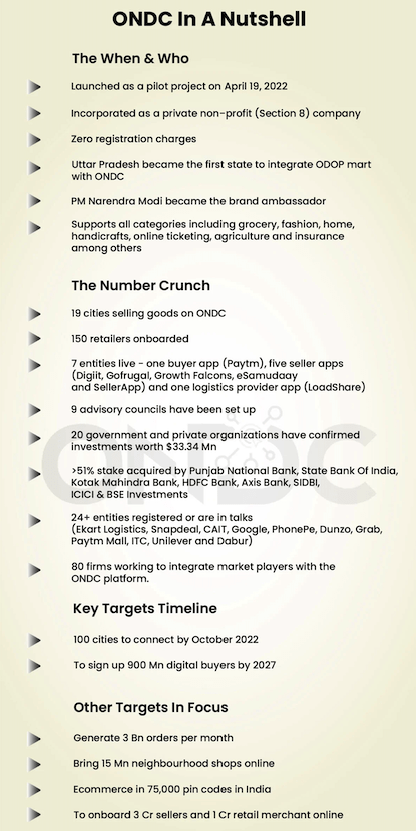
Context: Despite best efforts, the Government's Open Network for Digital Commerce could go in vain if proper supply chain management is not being developed.
What is Open Network for Digital Commerce?
Open Network for Digital Commerce (ONDC) is an initiative aiming at promoting open networks for all aspects of exchange of goods and services over digital or electronic networks (like e-commerce).
Sponsored by DPIIT (the Department for Promotion of Industry and Internal Trade), the non-profit programme, will bring together all stakeholders – buyers, sellers, logistics players, and digital payment providers – on one platform for convenience and growth.
ONDC is to be based on open-sourced methodology, using open specifications and open network protocols independent of any specific platform.
ONDC are to be open protocols for all aspects in the entire chain of activities in exchange of goods and services, similar to hypertext transfer protocol for information exchange over internet, simple mail transfer protocol for exchange of emails and unified payments interface for payments.
These open protocols would be used for establishing public digital infrastructure in the form of open registries and open network gateways to enable exchange of information between providers and consumers.
Providers and consumers would be able to use any compatible application of their choice for exchange of information and carrying out transactions over ONDC.
Benefits:
The initiative will not only facilitate the rapid adoption of e-commerce but also boost and strengthen the growth of startups in India. By facilitating scalable and cost-effective e-commerce through the open protocol, ONDC will empower startups to grow collaboratively.
ONDC will take ecommerce penetration to 40-50% in the coming years, as opposed to the current 10% share within India’s overall retail market.
For businesses, this will help create a level playing field and further drive open commerce, similar to how the United Payments Interface (UPI) democratised the digital payments segment.
Buyers, too, will benefit from easy access to a massive merchant base, great pricing, faster delivery, and enhanced customer experience.
ONDC will keep referral commissions capped at 3-5% at a later stage (for now, it is free), a massive reduction in costs compared to what businesses have to pay now for selling their goods online. According to a Gofrugal estimate, this is 7 to 10 times less than the usual online-selling commission rate of 23% to 28% on the cart value.
Challenge to ONDC:
ONDC does not have the best of the supply chain management when compared to other ecommerce giants like Amazon or Flipkart.
It still depends upon the ability of the others to facilitate logistics and warehousing.
Number of participants is still very low (not very popular among people).
Context: The National Human Rights Commission (NHRC) has taken suo motu cognisance of a media report that cited a 250-300% increase in the circulation of child sexual abuse material (CSAM) on social media in India. The NHRC said the content is of foreign origin, and Indian investigation agencies have not come across any Indian-made child sexual abuse material so far.
Why are we covering it?
Because UPSC main syllabus has this line
Since NHRC is an important statutory body, we should cover it.
Also, it is always in news because of its functioning. More often than not we see it as an enervated organization unable to serve the primary objective: Protection of human Rights.
This can be substantiated by following instances:
In June 2016, the current chair of the NHRC and former chief justice of India, HL Dattu, described this institution over which he presided as “a toothless tiger.
In 2017, the Supreme Court of India seemed to support Justice Dattu’s remarks while dealing with the alleged extra-judicial killings of 1,528 persons in Manipur by police and armed forces.
So it behoves us to prepare the Issues and challenges plaguing NHRC (Mains perspective). As far as prelims perspectives is concerned, that is straight forward and you can find it in Prelims Pointer and/or PDF.
What is NHRC?
The National Human Rights Commission (NHRC) of India was established on 12 October, 1993. The statute under which it is established is the Protection of Human Rights Act (PHRA), 1993 as amended by the Protection of Human Rights (Amendment) Act, 2006.
It is in conformity with the Paris Principles, adopted at the first international workshop on national institutions for the promotion and protection of human rights held in Paris in October 1991, and endorsed by the General Assembly of the United Nations by its Regulations 48/134 of 20 December, 1993.
The NHRC is an embodiment of India’s concern for the promotion and protection of human rights.
Section 2(1)(d) of the PHRA defines Human Rights as the rights relating to life, liberty, equality and dignity of the individual guaranteed by the Constitution or embodied in the International Covenants and enforceable by courts in India.
Composition Of The Commission
The Commission consists of a Chairperson, five full-time Members and seven deemed Members. The statute lays down qualifications for the appointment of the Chairperson and Members of the Commission.
There are four other members. These are:
There should be one Member who is, or has been, a Judge of the Supreme Court.
There should be one Member who is, or has been, the Chief Justice of the High Court.
Two other members should be there who have the knowledge or practical experience in matters related to human rights.
The ex officio members of the Commission can be:
The Chairpersons of the National Commission for Minorities,
The Chairpersons of the National Commission for Women,
The Chairperson of the National Commission for Scheduled Castes, and
The Chairperson of the National Commission for Scheduled Tribe.
Appointment of the members
On the recommendation of a committee, the President of India appoints the chairperson and the members of the National Human Rights Commission. The committee consists of the following members:
Prime Minister of India [CHAIRPERSON]
Home Minister of India
Speaker of Lok Sabha Leader of Opposition [Lok Sabha]
Leader of Opposition [Rajya Sabha]
Deputy Chairperson of Rajya Sabha
The Commission shall, perform all or any of the following functions, namely:-
Inquire, on its own initiative or on a petition presented to it by a victim or any person on his behalf, into complaint of-
violation of human rights or abetment oR
negligence in the prevention of such violation, by a public servant;
intervene in any proceeding involving any allegation of violation of human rights pending before a court with the approval of such court;
visit, under intimation to the State Government, any jail or any other institution under the control of the State Government, where persons are detained or lodged for purposes of treatment, reformation or protection to study the living condition of the inmates and make recommendations thereon;
review the safeguards by or under the Constitution or any law for the time being in force for the protection of human rights and recommend measures for their effective implementation;
review the factors, including acts of terrorism that inhibit the enjoyment of human rights and recommend appropriate remedial measures;
study treaties and other international instruments on human rights and make recommendations for their effective implementation;
Issues and challenges of NHRC
Autonomy of the NHRC
The Commission is supposed to be completely independent in its functioning, even though the Protection of Human Rights Act, (PHRA), 1993 does not say so.
In fact, there are provisions in the Act which underscore the dependence of the Commission on the government.
For example:
Section 11 of the Act makes it dependent on the government for its manpower requirements.
Section 32 of the Act makees it financially dependent on the central government:
Central govt. shall pay to the Commission by way of grants such sums of money as it may consider fit.
Thus, in respect of the two most important requirements i.e. human resources and money, the Commission is not independent.
Even the limited finds are not being used for human rights related functions
Large chunks of the budget of commissions go in office expenses, leaving disproportionately small amounts for other crucial areas such as research and rights awareness programmes.
Lacks enforcing powers
NHRC does not have the backing of the Protection of Human Rights Act to penalise authorities which do not implement its orders hence maming it impossible for NHRC’s recommendations do not reach to the ground level as the
The Act does not categorically empower the NHRC to act when human rights violations through private parties take place.
Lacks specialized persons who have dealt in Human rights issues
The Act requires that three of the five members of a human rights commission must be former judges but does not specify whether these judges should have a proven record of human rights activism or expertise or qualifications in the area.
Regarding the other two members, the Act is vague, saying simply: “persons having knowledge and experience of human rights.
Bureaucratic style of functioning of govt staff :
On top of that, as human rights commissions primarily draw their staff from government departments – either on deputation or reemployment after retirement – the internal atmosphere is usually just like any other government office.
Strict hierarchies are maintained, which often makes it difficult for complainants to obtain documents or information about the status of their case.
As non-judicial member positions are increasingly being filled by ex-bureaucrats, credence is given to the contention that the NHRC is more an extension of the government, rather than an independent agency exercising oversight.
Delay in disposal of cases
Expectations from the commission was to keep a tight grip on its disposal, so that pendency was not allowed to increase.
Unfortunately, this did not happen and the number of cases pending with the Commission has been increasing sharply every year.
Under staffed:
Either the Commission needs to get its staff strength increased or change methods of disposal so that the backlog of accumulated undisposed cases does not become heavy.
Low level of awareness about the Human rights in populace
Among general populace
An awareness of rights is not institutionalized in our curriculum.
It is limited both in geography and knowledge as far as the public is concerned.
Among Lawenforcers (Primary violators)
Eighty per cent of the training of a policeman in India is devoted to regimentation and a very little time was left to develop forensic skills or human rights awareness.
Knowledge of the laws and one’s interpretation are limited to small groups of people who are educated and legally literate.
Delay in publication of reports:
Delay in publication of annual reports by two or three years has been a constant problem. Annual reports for calendar years should be put online as soon as possible and no later than March of the succeeding year.
The hard copy of the report should also be published at the same time.
Constrained against armed forces
Since a very large number of complaints of human rights violations are directed against the members of the “armed forces”, the Act obviously weakens the NHRC’s effectiveness in providing redress to the public in such cases.
All that the Commission, under Section 19 of the Act can do is to call for reports from the central government in such cases and then make recommendations to the government or not “proceed with the complaint” at all. Under the Act, the Commission has no power to enforce its decisions. The Act must be amended to make the Commission a strong, and vibrant institution, supporting democracy and good governance.
Preventing the NHRC from independently investigating complaints against the military and security forces not only compounds the problems but also furthers impunity.
So, NHRC has to develop a strong image as a protector of the poor, marginalised and vulnerable groups. But that will not be possible without substantial changes in the legal framework itself.