Ethics

Muthuvan Tribe Latest News

image 6

A recent report by the Kerala State Food Commission has highlighted significant discrepancies in the distribution of ration supplies in Edamalakkudy, Kerala’s only tribal panchayat, predominantly inhabited by the Muthuvan tribe. The issue points to challenges in last-mile delivery of welfare schemes in remote tribal regions, including poor accessibility, transportation constraints, and administrative inefficiencies.

About Muthuvan Tribe

  • The Muthuvans, also known as Mudugars, live in the Western Ghats in the Indian states of Kerala and Tamil Nadu.
  • They speak the Muthuvan language, which belongs to the Dravidian language family.
  • The tribe is divided into two major groups—Malayalam Muthuvan and Pandi Muthuvan—based on dialectal variations.
  • They are known for their harmonious coexistence with wildlife and deep understanding of hill ecosystems.
  • The community possesses rich traditional knowledge, especially in herbal medicine, which is preserved and passed down through generations.

Muthuvan Tribe Social Organization

  • The Muthuvan society is divided into six clans known as Koottams, which are further subdivided into sub-clans.
  • These divisions regulate marriage alliances, social status, and lineage.
  • The tribe follows community endogamy and clan exogamy.
  • They follow a traditional governance system known as the Kani System.
  • The Kani (headman), selected by elders, leads the council responsible for maintaining law and order.
  • The council enforces customary laws and prescribes penalties for violations of social norms.

Muthuvan Tribe Religion and Beliefs

  • The Muthuvans are primarily animists and spirit worshippers.
  • They worship forest deities and believe in the spiritual presence of their ancestors.
  • Ancestors are regarded as the earliest settlers of the hill forests.
  • Over time, elements of Hindu religion have also been adopted due to cultural interaction with mainstream society.

Muthuvan Tribe Occupation

  • Their primary occupation is virippukrishi (shifting cultivation).
  • Agriculture is subsistence-based, aimed at self-consumption rather than commercial purposes.
  • Major crops include:
    • Ragi (Little Millet)
    • Maize (Sorghum)
    • Thina (Italian Millet)
    • Varagu and Chama rice
    • Vegetables such as tomato, carrot, potato, and sweet potato
  • Their farming practices are eco-friendly and adapted to hilly terrain.

Conclusion

The recent findings in Edamalakkudy highlight systemic gaps in welfare delivery to remote tribal populations. Addressing infrastructure issues, improving administrative accountability, and ensuring inclusion of indigenous communities like the Muthuvans in policy implementation are essential for achieving equitable development while preserving their cultural identity.

Land Inequality in Rural India

image 5

Context

A recent report titled “Land Inequality in India: Nature, History, and Markets” by the World Inequality Lab highlights the severe concentration of land ownership in rural India, revealing persistent socio-economic inequalities.

The report is based on the Socio-Economic Caste Census (SECC), 2011, covering nearly 650 million individuals across 2.7 lakh villages.

Gini Coefficient and Land Inequality

0≤Gini Coefficient≤10 \leq Gini\ Coefficient \leq 10≤Gini Coefficient≤1

The Gini Coefficient measures inequality in the distribution of income, wealth, or assets:

  • 0 → Perfect Equality
  • 1 → Maximum Inequality

A higher Gini value indicates greater concentration of land ownership.

Key Findings of the Report

High Land Concentration

  • Top 10% rural households own 44% of total land.
  • Top 5% own 32% of land.
  • Top 1% alone control 18% of land.

Large-scale Landlessness

Nearly 46% of rural households are landless, indicating exclusion from productive assets and agrarian opportunities.

State-Level Variations

High Inequality States

Bihar, Punjab, Kerala, and Tamil Nadu exhibit high land concentration. Landlessness Patterns

Punjab records the highest landlessness at around 73%, while Bihar and Madhya Pradesh also show high levels.

Impact on Rural Society

Land inequality:

  • Deepens poverty,
  • Reinforces caste disparities,
  • Reduces agricultural productivity,
  • Weakens rural livelihoods and economic mobility.

Causes of Land Inequality

Historical Legacy

Areas formerly under the zamindari system continue to show higher land concentration.

Socio-economic Factors

Caste-based exclusion and unequal access to resources contribute significantly to inequality.

Market and Geographic Factors

Regions with fertile land and better market connectivity often witness greater land concentration.

Weak Land Reforms

Poor implementation of land ceiling laws and tenancy reforms has limited equitable redistribution.

Measures to Address Land Inequality

Effective Land Reforms

Strict enforcement of land ceiling and tenancy laws is necessary for equitable land distribution.

Digitisation of Land Records

The Digital India Land Records Modernisation Programme aims to improve transparency and ownership security.

Support to Small Farmers

Providing:

  • Institutional credit,
  • Irrigation,
  • Technology,
  • Market access,

can improve productivity and incomes.

Land Leasing Reforms

Legal and secure leasing frameworks can protect tenant farmers and improve land-use efficiency.

Inclusive Rural Development

Promotion of non-farm employment and skill development can reduce excessive dependence on agriculture.

Conclusion

Land inequality remains one of the most significant structural challenges in rural India. Addressing unequal land ownership through effective reforms, inclusive rural development, and social justice measures is essential for achieving equitable growth and sustainable agrarian transformation.

Impact of Rising Energy Costs on Migrant Labourers

image 4

Context

Rising LPG prices and fuel shortages in urban areas are increasing the financial burden on migrant labourers, forcing many workers to temporarily return to villages and reconsider urban livelihoods.

Impact of Rising Energy Costs on Migrants

Inflationary Pressure

Increasing fuel prices raise cooking, transportation, and food expenses, worsening the cost of living for low-income migrant households.

Food Insecurity

High LPG costs compel families to:

  • Skip meals,
  • Reduce nutritional intake,
  • Shift towards cheaper and less nutritious food options.

Economic Uncertainty

Irregular incomes, coupled with rising expenses, create stress and insecurity among migrant workers, especially those employed in informal sectors.

Unsafe Fuel Alternatives

Many migrants increasingly rely on:

  • Firewood,
  • Coal,
  • Waste materials,

which expose them to respiratory diseases, fire hazards, and unhealthy living conditions.

Major Issues Faced by Migrant Labourers

Job Insecurity

Most migrant workers are employed informally without contracts, social protection, or stable wages.

Poor Living Conditions

They often live in overcrowded settlements lacking sanitation, healthcare, and safe drinking water.

Wage Exploitation

Migrants frequently face delayed wages, wage discrimination, and exploitation by contractors.

Lack of Social Security

Interstate mobility restricts access to welfare schemes due to documentation and portability challenges.

Data Deficiency

The absence of real-time migrant worker data hampers targeted policy interventions during crises.

Government Measures & Initiatives

Universal Social Security

The e-Shram Portal provides a national database for unorganised workers and access to welfare schemes.

Portability of Welfare Benefits

One Nation One Ration Card enables migrants to access subsidised food across India.

Livelihood Support

PM SVANidhi provides collateral-free loans to street vendors and urban informal workers.

Health & Pension Security

  • Ayushman Bharat PM-JAY offers portable health coverage.
  • Pradhan Mantri Shram Yogi Maandhan Yojana ensures pension support for unorganised workers.

Skill Development

Schemes like Pradhan Mantri Kaushal Vikas Yojana promote upskilling and formal employment integration.

Conclusion

Rising energy costs have exposed the economic vulnerability of migrant labourers in India’s urban economy. Ensuring social security portability, affordable energy access, and dignified living conditions is essential for inclusive urban development and labour welfare.

Bauxite Mining Conflict in Odisha

image 3

The recent violent clashes between police and tribal villagers in Odisha over the Sijimali bauxite mining project have once again highlighted the growing conflict between economic development, environmental protection, and tribal rights in India. The dispute reflects broader concerns regarding mining activities in ecologically sensitive and tribal-dominated regions.

Bauxite is the primary raw material used for producing alumina and aluminium, which are essential for sectors such as transport, construction, energy, and aerospace. Consequently, securing bauxite resources is strategically important for India’s industrial growth.

Sijimali Bauxite Mining Project

The Sijimali bauxite block is located in the Rayagada and Kalahandi districts of Odisha. In 2023, the project was allotted to Vedanta Limited to supply raw material to its Lanjigarh alumina refinery.

However, the project has generated strong opposition from local tribal communities due to concerns regarding:

  • Loss of traditional livelihoods
  • Displacement and land alienation
  • Cultural and religious disruption
  • Environmental degradation
  • Alleged fraudulent consent processes

The project area falls within Scheduled (Fifth Schedule) Areas, where tribal rights receive constitutional protection. Under the Forest Rights Act, 2006 and Panchayats (Extension to Scheduled Areas) Act, 1996 (PESA), Gram Sabha consent is mandatory before undertaking such projects.

Concerns have also been raised regarding the principle of Free, Prior and Informed Consent (FPIC), which requires affected indigenous communities to be adequately informed and voluntarily consulted before project approval.

Ecological Concerns

The Sijimali region lies in an ecologically sensitive zone within the Eastern Ghats. The proposed mining area includes:

  • Elephant habitats
  • Biodiverse forest ecosystems
  • Erosion-prone hilly terrain

Large-scale mining in such regions can lead to:

  • Deforestation
  • Biodiversity loss
  • Soil erosion
  • Water contamination
  • Habitat fragmentation

These environmental risks threaten both ecological sustainability and local livelihoods dependent on forests and natural resources.

Importance of Odisha’s Bauxite Deposits

Odisha is India’s most mineral-rich state and plays a central role in the country’s aluminium industry.

Major Significance

  • Odisha accounts for nearly 41% of India’s bauxite resources.
  • It contributes around 73% of national bauxite production.
  • The state possesses nearly 17% of India’s total mineral reserves.

The proximity of bauxite deposits in the Eastern Ghats to alumina refineries such as Lanjigarh reduces transportation costs and improves industrial efficiency.

Thus, projects like Sijimali are economically significant for ensuring raw material security for India’s aluminium sector.

Tribal Rights and Governance Issues

Mining conflicts in Odisha highlight persistent governance challenges in balancing industrialisation with constitutional safeguards for tribal communities.

Key issues include:

  • Weak implementation of FRA and PESA provisions
  • Inadequate Gram Sabha consultations
  • Displacement and livelihood insecurity
  • Lack of transparency in land acquisition processes

The conflict also raises questions regarding sustainable development and environmental justice in tribal regions.

The Niyamgiri Precedent

The Sijimali dispute draws comparisons with the landmark Niyamgiri Hills case.

In the Niyamgiri mining dispute, the indigenous Dongria Kondh tribe strongly opposed bauxite mining due to their deep cultural and religious connection with the hills, which they worship as Niyam Raja.

In 2013, the Supreme Court of India ruled that Gram Sabha consent was mandatory for mining projects in Scheduled Areas involving tribal rights.

Subsequently, all 12 Gram Sabhas rejected the proposed mining project, leading to its cancellation. The judgment became a landmark victory for tribal rights, environmental protection, and decentralised governance.

Way Forward

A balanced approach is necessary to reconcile economic development with ecological sustainability and tribal welfare.

Strengthen Tribal Consent Mechanisms

Ensure genuine implementation of Gram Sabha consent under FRA and PESA through transparent and participatory processes.

Sustainable Mining Practices

Adopt scientific mining methods, ecological restoration, and strict environmental safeguards in sensitive areas.

Protect Livelihoods and Culture

Rehabilitation and compensation policies should prioritise livelihood security, cultural preservation, and community participation.

Improve Governance

Enhance transparency, environmental monitoring, and accountability in mining approvals and land acquisition processes.

Conclusion

The Odisha bauxite mining conflict reflects the complex challenge of balancing industrial growth with environmental sustainability and tribal rights. While bauxite remains strategically important for India’s development, long-term progress requires inclusive governance, ecological responsibility, and respect for constitutional protections granted to indigenous communities.

B’nei Menashe: Identity, Migration, and the “Lost Tribes” Debate

image 2

Introduction

Around 250 members of the B’nei Menashe from Manipur and Mizoram recently arrived in Tel Aviv under an official relocation programme supported by the Israeli government. Numbering about 7,000, this community—drawn largely from Mizo and Kuki tribes—claims descent from one of the “Ten Lost Tribes of Israel.” The latest development marks a new phase of state-backed resettlement.

The ‘Lost Tribes of Israel’: Historical Context

The origins of the B’nei Menashe claim lie in the Assyrian conquest of Israel. Around 722 BCE, ten tribes of northern Israel—including Manasseh, Ephraim, and others—were exiled. Over time, their descendants became known as the “Lost Tribes of Israel,” with their locations remaining uncertain.

Across centuries, Jewish communities have searched for traces of these tribes globally, including in South Asia.

The B’nei Menashe Claim

  • The community identifies itself as descendants of the tribe of Manasseh
  • “B’nei Menashe” literally means “sons of Manasseh”
  • Oral traditions suggest migration from ancient Israel through Persia and Afghanistan into Northeast India

Interestingly, this identity emerged after exposure to Biblical narratives, following conversion to Christianity.

Evolution of Identity: Christianity to Judaism

Missionary Influence

  • 19th-century Protestant missionaries introduced Biblical texts
  • Existing local beliefs helped assimilation of Christian ideas

🔄 Revival and Identity Shift

  • Christian revival movements (1930s–1960s)
  • Regional unrest encouraged rethinking of identity

🌙 Turning Point (1951 Vision)

A Mizo mystic, Challianthanga (Mela Chala), claimed a divine vision that local tribes were descendants of Israelites. This catalysed a shift toward Jewish identity.

Institutional Support and Judaic Transformation

  • Israeli organisation Amishav facilitated connections with Israel
  • Mizo Israel Zionist Organization formalised the movement
  • By the 1980s, many adopted Judaism formally

However, a large section of the population in Manipur and Mizoram continues to remain Christian.

Recognition and Migration

🕍 Official Recognition

In 2005, the Chief Rabbinate of Israel recognised the B’nei Menashe as the “Lost Seed of Israel.”

  • Genetic studies (including by Technion – Israel Institute of Technology) remained inconclusive
  • Recognition was based largely on cultural and historical claims

✈ Migration Trends

  • Migration to Israel has been ongoing since the 1990s
  • Conducted in small batches due to policy and logistical constraints
  • In November 2025, Israel approved funding to relocate ~5,000 members

The recent relocation to Tel Aviv represents a significant expansion of state-backed resettlement.

Challenges Faced

⚠ Identity and Integration

  • Cultural differences with mainstream Israeli society
  • Language barriers and adaptation issues

⚠ Social Discrimination

  • Reports of racial discrimination
  • Differences in physical features affecting acceptance

Scientific and Historical Debate

  • Genetic evidence remains inconclusive
  • Claims rely heavily on oral traditions and cultural practices
  • Scholars remain divided on the authenticity of lineage

Other ‘Lost Tribes’ Claims

Another Indian group, B’nei Ephraim, claims descent from the tribe of Ephraim.

  • Belong largely to Dalit communities
  • Migration narrative via Central Asia
  • Identity sometimes linked to social mobility and escape from caste discrimination

Significance for India and Israel

🇮🇳 India

  • Highlights cultural diversity of Northeast India
  • Raises questions of identity, migration, and minority rights

🇮🇱 Israel

  • Part of the broader policy of “ingathering of exiles”
  • Expands the global Jewish diaspora

Conclusion

The story of the B’nei Menashe lies at the intersection of history, faith, migration, and identity politics. While scientific evidence remains inconclusive, their recognition and relocation reflect the power of cultural memory and belief. The challenge ahead lies in ensuring dignified integration while respecting the complexities of identity and heritage.

Ethical Dilemmas in navigating Farmer Protests

Context: A prominent farmer leader is on an indefinite hunger strike demanding legal guarantee for Minimum Support Price, while following Gandhian principles of Non-violence. The government faces criticism from courts for not providing medical care, while farmers threaten mass mobilisation if force is used. 

Relevance of the Topic: Mains: Ethics and Human Interface: Essence, determinants and consequences of ethics in human actions. 

Ethical Analysis of the Situation

  1. Deontological Ethics (Kant): "Act only according to rules you could as universal law."
    • Government's categorical duty to protect life is absolute
    • Farmer's right to protest cannot override duty to preserve life
    • Medical care is a moral imperative regardless of circumstances.
  2. Utilitarian Ethics (Bentham): "Greatest good for greatest number"
    • Calculate total welfare impact on farmers, consumers, economy
    • Consider long-term effects on agricultural sustainability
    • Balance individual sacrifice against collective benefit.
  3. Virtue Ethics (Aristotle): "Moral excellence comes about as a result of habit"
    • Courage shown by protest leader
    • Government's prudence in handling situation
    • Finding meaning between force and inaction (Golden Mean Principle).
  4. Gandhian Philosophy: "Non-violence is the greatest force at Mankind's disposal". In a gentle way you can change the world - Gandhiji
    • Satyagraha as moral force
    • Self-suffering to highlight injustice
    • Non-violent resistance against perceived wrong.
  5. Social Contract Theory (Rousseau, Locke): "Government derives legitimacy from people's consent"
    • State's obligation to protect citizens
    • Citizens' right to protest unjust policies
    • Balance between individual and collective rights.
  6. Care Ethics (Nel Noddings): "Moral Action stems from Compassion"
    • Empathy for farmer's situation
    • Responsibility for protestor's wellbeing
    • Community relationships and interdependence.
  7. Buddhist Ethics: "Avoid extremes, follow Middle Path"
    • Reduce suffering of all parties
    • Seek compromise and harmony
    • Compassion for all stakeholders.
  8. Contemporary Rights Theory (Rawls): "Justice as Fairness"
    • Fair distribution of benefits and burdens
    • Protection of basic liberties (Liberty principle)
    • Special consideration for disadvantaged groups (Difference principle)

Resolution Framework with Philosophical Underpinnings

1. Immediate Actions: 

  • Medical Care Approach: Hippocratic Tradition
    • "First, do no harm" principle guides medical intervention
    • Balance autonomy with protection of life - Respects individual choice while ensuring survival
    • Respect dignity while ensuring care - Maintains human rights during medical intervention
  • Dialogue Framework (Habermas):
    • Communicative action theory for conflict resolution
    • Create conditions for authentic discourse
    • Enable rational consensus-building
  • Peace Maintenance (Perpetual Peace - Kant):
    • Establish provisional arrangements 
    • Create conditions for lasting resolution
    • Maintain civil order without force

2. Medium-term Solutions:

  • Policy Development (Amartya Sen):
    • Capability approach to agricultural policy
    • Development as freedom concept
    • Participatory policy-making
  • Stakeholder Engagement (Freeman):
    • Multiple stakeholder consideration
    • Balanced interest representation
    • Ethical business approach

3. Long-term Structural Changes:

  • Social Justice (Rawls):
    • Difference principle in agricultural policy
    • Fair equality of opportunity
    • Just savings principle
  • Sustainable Development (Hans Jonas):
    • Imperative of responsibility
    • Future generations consideration
    • Environmental sustainability

4. Implementation Framework:

  • Administrative Ethics (Max Weber):
    • Bureaucratic responsibility
    • Rational-legal authority
    • Professional duty
  • Democratic Theory (Dahl):
    • Inclusive participation
    • Effective opposition
    • Institutional accountability

5. Monitoring Mechanisms:

  • Social Accountability (Rousseau):
    • General will consideration
    • Public oversight
    • Transparent governance
  • Ethics of Care (Gilligan):
    • Relationship maintenance
    • Community healing
    • Trust rebuilding. 

Overall the action must integrate philosophical wisdom with practical governance needs, ensuring both theoretical soundness and implementational feasibility. 

China is World’s largest Debt Collector

Context: Recently, the International Debt Report 2024 was released by the World Bank. Among other trends, the report shows that over 25% of the world’s bilateral external debt was owed to China in 2023, making the country the leading debt collector in the world. 

This has raised ethical concerns over the debt trap diplomacy used by China.

Relevance of the Topic: Mains: Ethics in contemporary International Aid. 

Discussion of Ethical Issues:

1. Deontological Duty Kantian deontology focuses on respecting sovereignty and autonomy.  

  • Example: China's $8 billion loan to Sri Lanka maximised infrastructure development (utilitarian good) but violated the country's right to self-determination when it had to surrender Hambantota port (deontological violation).

2. Virtue Ethics in International Relations Focuses on character traits like benevolence, justice, and integrity in lending practices.

  • Example: China's lending to 16 cobalt mines in Democratic Republic of Congo demonstrates lack of virtuous lending - prioritising resource acquisition over genuine development assistance.

3. Care Ethics and Relational Responsibilities – Emphasises contextual relationships and responsibilities toward vulnerable parties.

  • Example: China's 75% debt hold over Laos shows failure of care ethics - exploiting rather than nurturing development relationships despite obvious vulnerability.

4. Social Contract Theory International aid should reflect mutually beneficial agreements between equal parties.

  • Example: Pakistan owing 60% bilateral debt to China violates social contract principles - creates coercive rather than cooperative relationships.

5. Rawlsian Justice Theory - Aid should benefit least advantaged and ensure fair equality of opportunity.

  • Example: China's Belt and Road Initiative violates difference principle - targets strategic advantages rather than helping neediest nations improve their position. Concentration of debt ownership (25% of world's bilateral external debt held by China). Disproportionate burden on lower-income countries.

Also Read: China’s Debt Trap Diplomacy

Ethical framework for International Aid

1. Foundational Justice (John Rawls)

  • The 'veil of ignorance' test: Aid policies should be designed as if we don't know which country we'll be born in
  • Difference Principle: Aid should prioritize improving conditions for the worst-off nations
  • Fair Equality of Opportunity: Aid should create genuine development opportunities, not dependence

2. Capability Development (Amartya Sen & Martha Nussbaum)

  • Aid should enhance recipients' fundamental capabilities and freedoms.
  • Focus on developing human capital and institutional capacity.
  • Respect for local agencies in determining development priorities.

3. Relational Ethics (Nel Noddings & Virginia Held)

  • Aid relationships should be based on care and mutual respect.
  • Emphasis on long-term relationships over transactional assistance.
  • Recognition of contextual needs and cultural sensitivities.

4. Cosmopolitan Responsibility (Peter Singer & Thomas Pogge)

  • Global moral obligations transcend national boundaries
  • Wealthy nations have positive duties to assist poorer ones
  • Addressing structural inequalities in global economic system

5. Sustainable Development (Hans Jonas)

  • Imperative of responsibility toward future generations
  • Environmental and social sustainability in aid programs
  • Long-term viability over short-term gains

6. Practical Implementation:

  1. Trust & Accountability (Onora O'Neill)
  2. Democratic Participation (Jürgen Habermas)
  3. Local Empowerment (Paulo Freire)
  4. Cultural Respect (Charles Taylor)
  5. Strategic Effectiveness (Peter Drucker)

Conclusion: International aid must balance moral imperatives with practical effectiveness while respecting recipient autonomy and dignity.

Privacy Rights Vs Security

Context: While the government maintains that collection of individual data is necessary to streamline services delivery, however, the explosion of data generation, coupled with the rise of cyber threats, underscores the importance of safeguarding personal information. 

Relevance of the Topic: Mains: GS-IV- Ethical concerns and dilemmas in government and private institutions; Accountability and ethical governance. 

1. Utilitarian Perspective on Privacy vs Security focuses on maximising overall Societal Welfare.

Moral Consequences:

  • Lives saved through prevented terrorism/crime
  • Reduced criminal activity through deterrence
  • Enhanced investigation capabilities
  • More efficient law enforcement resource allocation

Moral Considerations:

  • Erosion of public trust
  • Violation of moral authority. 
  • Potential data misuse for political gain
  • Reduced innovation due to privacy concerns
  • Psychological burden of constant surveillance
  • Discouragement to alternative security measures' effectiveness

Quantitative Analysis:

  • Cost-benefit calculations of surveillance programs
  • Statistical likelihood of preventing attacks
  • Economic impacts of privacy loss
  • Healthcare costs from surveillance-induced stress

The utilitarian approach requires gathering empirical evidence about outcomes while acknowledging measurement challenges for intangible costs like lost privacy.

2. Social Contract Theory analysis of Surveillance vs Privacy:

Core Principles:

  • Citizens come together to surrender certain rights for collective security.
  • Government's power derives from consent of the governed.
  • Mutual obligations between state (moral authority) and citizens (civic duty).
  • Transparency and accountability requirements for trustworthiness.

Key Questions:

  • Have citizens meaningfully consented to surveillance?
  • Is the social contract being upheld by both parties?
  • Are surveillance powers being used as agreed?
  • Do citizens have adequate oversight mechanisms?

Institutional Requirements:

  • Clear legal frameworks limiting state power
  • Independent oversight bodies
  • Protections of the due process
  • Regular public reporting
  • Democratic discussion on surveillance policies

Legitimacy Conditions:

  • Proportional measures only
  • Equal application across society
  • Protection of fundamental rights
  • Redress mechanisms for abuse
  • Regular review and reform of surveillance authority

The social contract approach emphasises procedural safeguards and democratic consent rather than just outcomes.

‘Just War Theory’ in the Syrian situation

Context: Turkish backed rebels in Syria have overthrown President Bashar Al Assad, ending the Assad family’s 5 decades rule in the country. The offensive is led by Hayat Tahrir al-Sham (HTS) formerly known as the Nusra Front (It is a the Syrian branch of al-Qaeda).

Relevance of the Topic: Mains- Essence, determinants and consequences of ethics in human actions. 

Jus ad bellum (Right to War) considerations: 

  • Just cause: Was overthrowing the Assad regime justified?
    • The militant group HTS claimed justification based on Assad's documented human rights violations, including chemical weapons attacks.
    • However, HTS's own history of extremist violence and al-Qaeda links raises questions about their moral standing.
  • Right intention: Were the rebels' motives primarily humanitarian or politically/religiously motivated?
  • Legitimate authority: 
    • HTS lacks clear international recognition or broad-based Syrian support 
    • The absence of UN Security Council authorization raises questions of legitimacy
  • Proportionality: Whether benefits outweigh costs of civil war and instability?
    • The rapid military advance appears to have minimized immediate civilian casualties.
    • However, the long-term costs of potential instability, refugee flows, and economic disruption must be considered.
    • The risk of wider regional conflict involving Iran and Russia remains high.
  • Last Resort: While diplomatic efforts like the UN peace process had stalled, it's debatable whether all peaceful options were exhausted. The timing appears driven more by tactical opportunity than systematic exploration of alternatives.
  • Reasonable Chance of Success
    • The initial military success is clear, but the ability to establish stable governance remains uncertain.
    • Risk of prolonged insurgency or state fragmentation.
    • Questions about HTS's capacity to manage a complex modern state

There are significant challenges in meeting traditional Just War criteria. While Assad's regime allegedly committed serious violations warranting intervention, HTS's legitimacy, intentions, and governance capacity raise serious moral concerns. The international community's muted response reflects these ethical ambiguities.

Imminent challenges:

Post-conflict justice:

  • How to handle former regime officials and security forces?
  • Preventing revenge killings and sectarian violence
  • Establishing legitimate transitional justice mechanisms
  • Balancing accountability with reconciliation

Governance Responsibilities:

  • Occupying force's obligations to maintain order and services
  • Protection of religious and ethnic minorities
  • Managing relationship with international community
  • Economic stabilisation and reconstruction

Regional Implications:

  • Impact on neighboring states and refugee populations
  • Risk of proxy conflicts between external powers
  • Management of cross-border militant groups
  • Regional security architecture. 

Just War Theories must evolve to address contemporary challenges while maintaining its core ethical principles. The Syrian case demonstrates the complex interplay between military necessity, civilian protection, and post-conflict responsibilities.

Artificial Intelligence and its Regulation

Context: Artificial Intelligence is the science of making machines perform tasks that require human intelligence. It allows machines to learn from experience, adjust to new inputs, and perform human-like tasks.

Applications of Artificial Intelligence

1. Education: Optimising learning for individuals

2. Smart cities: Improving safety, Enabling intelligent infrastructure, Optimising complex transportation hubs, Sustaining the environment

3. Applications for basic sciences & space research: Enabling extended & flexible space exploration. E.g., the development of autonomous spacecraft & smart habitats.

4. Applications in Healthcare

  • Enhanced drug discovery and development: AI in drug design- Predicting the 3D structure of target proteins, AI in pharmacology, AI in drug repurposing and drug screening. 
  • For patients: More personalized diagnosis, prognosis and therapy, Enhanced relationship with the care provider, Computer vision for diagnosis and surgery (AI-enabled medical imaging), and Intelligent personal health records. 

5. Robotics & AI-powered devices: Robots are being used extensively in healthcare to replace the human workforce, augment human abilities and assist human healthcare professionals. E.g., Robots for surgical procedures such as laparoscopic operations, Mitigating effects of disabilities. E.g., assisting the visually impaired with a Chatbot. 

6. Applications of AI in Agriculture

  • Crop yield prediction & price forecasts: Identify the output yield of crops and forecast prices for the next few weeks will help farmers obtain maximum profits.
  • Intelligent spraying: AI-based sensors can detect weed-affected areas and can precisely spray herbicides in the right region reducing the usage of herbicides.
  • Predictive insights: Insights on the right time to sow seeds for maximum productivity. Insights on the impacts created by the weather conditions.
  • Agriculture robots: Using autonomous robots for harvesting huge volumes of the crop at a higher volume and faster pace.
  • Crop & soil monitoring: Using AI, farmers can monitor crop health for diagnosing pests/soil defects, nutrient deficiencies in soil etc.
  • Disease diagnosis: Using AI farmers can preempt diseases in their crops. This will help increase the productivity of farming.

7. Applications of AI in national security. E.g., Detecting and responding to cyber threats, identifying vulnerabilities, and conducting cyber attacks.

Fear of AI 

  • The growth of AI technologies and their deployment has raised certain fears related to privacy and surveillance, job automation leading to loss of employment, and the possibility of a loss of control over AI resulting in existential risks for humanity. 
  • However, an important difference between humans and AI machines is the uniqueness and capability of the human mind known as Artificial general intelligence. This means humans can think about a problem from scratch and try to solve it, which the AI machines are presently not capable of. 

Need to regulate AI

There is a need for regulating AI due to several concerns, which include: 

  • Propagate bias: AI systems can perpetuate and even amplify biases into decision-making algorithms through machine learning if trained on biased data. 
  • Privacy concerns: AI systems can collect and process large amounts of personal data which raises concerns about privacy and data security. Additionally, AI can understand consumer preferences and can influence customer behaviour. 
  • Lack of transparency: Algorithms of AI can be so inordinately complex that even those who created the algorithm cannot thoroughly explain how the variables led to the resulting prediction. This opacity poses the risk of exclusion and discrimination by AI in decision-making. 
  • Loss of jobs: AI systems have the potential to automate tasks traditionally performed by humans, which could lead to job displacement and economic disruption. 
  • Security risks: AI can be used for malicious purposes, such as cyberattacks, especially by cybercriminals using the deep web, which is already unregulated. 
  • Ethical concerns: There is no legal accountability and responsibility arising out of the decisions made by AI. 
  • Technological rivalry and regulations: In the absence of regulations, intensifying rivalry between technological giants like the United States and China, may risk misuse of AI for malicious purposes.

Way Forward

Hence, AI should be regulated to ensure that the technology’s development is guided by human-centric principles. The solutions include: 

  • Simple regulatory framework: Government can create a simple regulatory framework that defines the several capabilities of AI and identify the ones that are more susceptible to misuse than the others to promote the responsible use of AI.
  • Ensure privacy protection: As data is the backbone of AI; businesses must learn to access data while ensuring its privacy, integrity and security. There is a need for laws to deploy AI-based systems to comply with Supreme Court requirements under the right to privacy judgment for specific use cases. E.g., European Union has implemented the General Data Protection Regulation to protect the privacy of individuals when their data is used by AI systems. 
  • Elimination of black-box approach: Mandatory explanation for AI systems that how a particular result was reached or details of the steps involved in the analysis will usher in transparency and review the data in each step to unearth biased results.
  • Creating oversight bodies: Governments can create agencies or committees to oversee the development and deployment of AI. These bodies can be responsible for ensuring compliance with regulations and monitoring the impact of AI on society.
  • Common International regulation of AI: Governments, together with other stakeholders, must work together to design guardrails for private-sector innovation and develop a common framework for international regulation of AI.
  • Reskilling of workers: Providing AI-related skill training to workers to remain relevant in the job market like expertise in programming, data analysis, and algorithm development. 

Read in Detail: What is Artificial Intelligence (AI) ?

A very different conception of ‘Ram Rajya’

Context: Shashi Tharoor (Member of Parliament), have talked in his books, ‘Why I Am a Hindu’ and ‘The Battle of Belonging’, the principles of Gandhiji and his ideas about ‘Ram Rajya’.

About the concept of ‘Ram Rajya’

Ram Rajya is a term that was popularized by Mahatma Gandhi. It's an ideal society that he envisioned, based on the rule of Lord Rama. The concept of Ram Rajya reflects the idea of an ideal society where everyone is equal, and justice prevails. 

The term represents the ideal king who ruled with wisdom, compassion, and justice. His rule was characterized by the following principles:

  • Equality: Gandhi emphasized the importance of equality in his concept of Ram Rajya. He believed that all individuals, regardless of their caste, creed, or gender, should have equal opportunities and rights.
  • Justice: Ram Rajya was a society where justice was served, and no one was above the law. Gandhi emphasized the importance of self-discipline and self-sufficiency in achieving justice. He believed that individuals should work to become self-sufficient, both economically and spiritually, in order to be better equipped to address injustices in society.
  • Non-Violence: Ram Rajya was a society where violence was shunned, and conflicts were resolved through peaceful means. Non-violence is the cornerstone of Gandhi's concept of Ram Rajya. He believed that violence only begets violence and that the use of force can never bring about lasting peace. Instead, he advocated the use of non-violent means such as satyagraha (civil disobedience), ahimsa (non-violence), and self-control to achieve one's goals.
  • Self-Rule: Ram Rajya was a society where people should be self-governing and should have the power to make decisions that affect their lives.
  • Prosperity: Ram Rajya was a society where everyone had access to the basic necessities of life and had the opportunity to pursue their dreams.
  • Moral and Spiritual Values: Gandhi's vision of Ram Rajya was not merely a political system but rather a society based on moral and spiritual values. He believed that society should be grounded in truth, love, compassion, and forgiveness. Individuals follow conscience to serve others, not self-interest.
  • Decentralization of Power: Gandhi believed that power should be decentralized and that decision-making should be made at the local level. He advocated for the establishment of Gram Sabhas, or village assemblies, where the people could come together to make decisions that affect their community.
  • Trusteeship: Gandhi believed that Trusteeship was essential for creating an equitable and just society. He argued that wealth was not an end in itself, but a means to serve the common good. In Ram Rajya, the wealthy and powerful would act as trustees, using their resources for the betterment of the poor and the needy.
    • Gandhi's idea of Trusteeship was based on the principle of non-violence and voluntary cooperation. He believed that the wealthy and powerful should voluntarily surrender their wealth for the betterment of society, rather than through force or coercion.
  • Economic Equality: Gandhi believed that economic inequality was one of the root causes of social unrest. He advocated for the abolition of the caste system and the establishment of a society based on economic equality.
  • Self-Sufficiency: Gandhi believed that self-sufficiency was crucial for the development of society. He advocated for the establishment of small-scale industries and the use of local resources to promote self-sufficiency.
  • Education: Gandhi believed that education was essential for the development of individuals and society. He emphasized the importance of holistic education, which includes both intellectual and moral development.

Other Theories Of Ideal Society

Several other philosophers and thinkers have envisioned ideal states and governance systems similar to Gandhiji's Ram Rajya:

  • Plato proposed an ideal just society in his book 'The Republic' where kings are philosophers and philosophers are kings. He envisioned a state built on reason, justice, courage and temperance. The rulers and guardians govern to maximize the welfare of citizens.
  • John Stuart Mill advocated a liberal form of governance in his work 'On Liberty' where individual liberty is balanced with social good. He proposed democratic self-government with representation of all citizens, free speech and protection of minorities. The state protects people's basic liberties and welfare.
  • Henry David Thoreau put forth the idea of a minimalist governance in his essay 'Civil Disobedience'. He believed that government is best which governs the least. Individual conscience is the moral guide. People govern themselves with self-restraint and don't need an overbearing state apparatus. Simple living and high thinking are valued.
  • Leo Tolstoy's vision of an ideal society in 'The Kingdom of God is Within You' renounced violence and preached universal love, truth, morality and service to others. He believed individuals can transform society through enlightenment and moral development, not political means. Ethical and spiritual uprising, not material progress, leads to human well-being. 
  • Aurobindo Ghose theorized the 'Rule of the Spirit' in his work where the inner moral and spiritual elements govern society, not outer political machinery. Truth, unity, harmony and a higher consciousness emerge from within individuals. There is a collective moral aspiration to realize the divine in each human being. 
  • Sarvepalli Radhakrishnan believed in the 'Rule of Spiritual Truth' where reason, morality and justice prevail; and education develops integral personalities. He envisioned a world federation of free individuals in free societies guided by the spiritual truth of oneness of humanity.
  • Dalai Lama advocates a 'spiritual democracy' where compassion, ethics and conscience shape society. There is no tyranny of the majority. Well-being of all humans including future generations is core. Outer liberal values emerge from inner morality and wisdom in each person.

Comparison Between Gandhian "Ram Rajya" And Plato's Just Society

ParametersGandhian "Ram Rajya"Plato's Just Society
JusticeSatya and dharma are the guiding principles. Means and ends should be moral.Knowledge of the Good guides rulers. Justice is harmony between reason, spirit and appetites.
Justice within the individualsGandhiji focused on spiritual self-sufficiency in order to be better equipped to address injustices in society.
Philosopher-KingsGandhian concept does not emphasize the role of rulers or philosopher-kings in governance.Plato's Just Society places great emphasis on the role of philosopher-kings, who possess wisdom and virtue, in governing society.
TrusteeshipLeaders act as trustees of citizens. Power is not concentrated but decentralized.Philosopher-kings rule for the benefit of all. No private advantage or privilege.
Non-violenceGandhian concept places great emphasis on non-violence, or ahimsa, as a means of achieving social change and justice. Conflicts are resolved through mutual understandingAuxiliaries enforce orders and defend the state
Simplicity in governanceGandhian concept emphasizes simplicity in governance, with a focus on decentralization and community participation in decision-making. Administration focuses on meeting. basic needs of allStrict control over luxuries and private property. Necessities provided by the state.
Representation in governanceAll sections participate in governance.Society divided into rational rulers, spirited auxiliaries and appetitive producers but share a sense of community.
Common good educationResources and facilities distributed equitably so none remain in wretched conditions.Though classes have different natures, they share a common interest in justice and welfare of the whole.
Social ClassesThe concept of social class was not relevant as he believed in equality and universal brotherhood.Rational rulers, spirited auxiliaries and appetitive producers
Women's equalityGandhian concept emphasizes women's equality and empowerment. He said, “To call woman the weaker sex is a libel; it is man's injustice to woman. If by strength is meant moral power, then woman is immeasurably man's superior.”Plato's Just Society does not necessarily prioritize women's equality. He however said that women could also become philosopher-kings if they had the necessary qualities and virtues.
Communal livingGandhian concept emphasizes communal living and the need for voluntary renunciation of personal property and wealth.Plato's Just Society does not emphasize communal living as a key concept.

ICMR releases ethical guidelines for AI usage in healthcare

Context: The Indian Council of Medical Research (ICMR) has released the country’s first ‘Ethical Guidelines for Application of Artificial Intelligence in Biomedical Research and Healthcare’, aimed at creating “an ethics framework which can assist in the development, deployment, and adoption of AI-based solutions” in the fields specified.

Ethical Principles for AI Technology in Healthcare

The implementation and advancement of AI technology in healthcare should be guided by ethical values and principles followed by all relevant stakeholders.

AI technology employs diverse data sets and algorithms including supervised, semi-supervised, and unsupervised learning. Although AI holds promise in healthcare, its complex and machine-driven analytical processes warrant vigilance among healthcare professionals and researchers.

Unlike other AI fields, AI for Health has a direct impact on human life and may have significant implications on patients' well-being.

Thus, an ethical and prudent approach is essential before integrating these algorithms into routine healthcare practices. Additionally, safety and confidentiality issues pertaining to patients' health data must be cautiously addressed during all phases of AI for Health development and deployment.

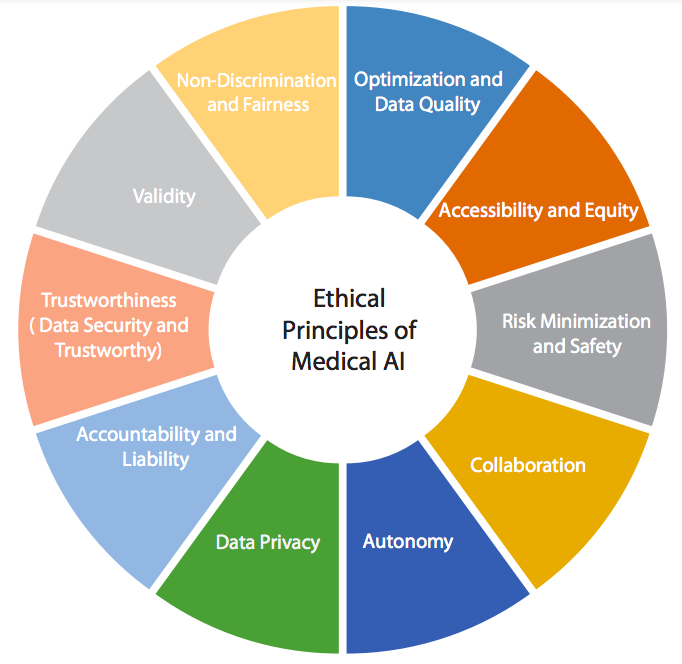
MVAggM7SP0IEnzTF lCkGp1pcZEfJjaUEexdYRqbgDYno7X2Y SnlSNeFEpWlyAgFYRCEuBeMxXhbYE9kMVOS8A5L8DO17ezESyA4

The ten ethical principles in the above figure addresses issues specific to AI for health. These principles are patient-centric and are expected to guide all the stakeholders in the development and deployment of responsible and reliable AI for health. These principles are as follows –

  1. Autonomy – The use of AI in healthcare raises concerns about the potential for the system to operate independently and compromise human autonomy. Incorporating AI into healthcare may result in machines taking over the responsibility of decision-making. It is essential that humans maintain full control over AI-based healthcare systems and medical decision-making. Under no circumstances should AI technology interfere with patient autonomy.
  1. Safety and Risk Minimization – Before widespread implementation, it is necessary to ensure that any AI technology-based system will operate safely and reliably. All stakeholders involved in the development and deployment of the technology bear the responsibility of ensuring participant safety. Patient dignity, rights, safety, and well-being must be the highest priority. Risk levels associated with deploying AI technology in clinical research or patient care depend on the use case and deployment methodology. For instance, unsupervised models run the risk of being more hazardous than those supervised by AI researchers and healthcare professionals. Similarly, the deployment of AI-enabled tools in high-risk patient care areas is riskier than their deployment in other areas.
  1. Trustworthiness Trustworthiness is the most desirable quality of any diagnostic or prognostic tool to be used in AI healthcare. Clinicians need to build confidence in the tools that they use and the same applies to AI technologies. In order to effectively use AI, clinicians and healthcare providers need to have a simple, systematic and trustworthy way to test the validity and reliability of AI technologies.
  1. Data Privacy AI-based technology should ensure privacy and personal data protection at all stages of development and deployment. Maintaining the trust of all the stakeholders including the recipient of healthcare over the safe and secure Ethical Guidelines for Application of Artificial Intelligence in Biomedical Research and Healthcare 19 use of their data is of prime importance to the successful and widespread deployment of AI. Data privacy must aim to prevent unauthorized access, modification, and/ or loss of personal data. The application of AI to personal data must not unreasonably curtail people’s real or perceived liberty.
  1. Accountability and Liability – The concept of accountability entails that an individual or organization is responsible for their actions and should be transparent about their activities. When it comes to AI technologies for healthcare, it is crucial that they are subject to scrutiny by relevant authorities at any given time. Regular internal and external audits must be conducted to ensure that the AI technologies are functioning effectively. The results of these audits should be made available to the public.
  1. Optimization of Data Quality – The performance of AI technology heavily relies on the data utilized for training and testing purposes, making it a data-driven technology. In the healthcare sector, the quality and size of the dataset are critical as a skewed or insufficient dataset can result in issues such as data bias, errors, and discrimination. Data bias is regarded as the most significant risk to data-driven technologies like AI in healthcare. It is crucial to exercise due diligence to ensure that the training data is unbiased and represents a substantial portion of the target population.
  1. Accessibility, Equity and Inclusiveness – The use of computers for development as well as the deployment of AI technologies in healthcare presupposes wider availability of infrastructure. The digital divide is known to exist in almost all countries and is more prominent in low- and middle-income countries (LMICs). The heavy reliance on technology may therefore interfere with the wider application of promising tools in areas where it is expected to make a greater difference. 
  1. Collaboration –  In the field of AI for health, having a large and well-curated dataset is crucial for effective utilization of AI. This can only be achieved through fostering collaboration at all levels. With the rapidly changing landscape of AI technology, it is essential to collaborate among AI experts during research and development to ensure the most appropriate techniques and algorithms are used to address healthcare issues. Collaboration between AI researchers and healthcare professionals throughout the development and adoption of AI-based solutions is expected to enhance the benefits of this promising technology.
  1. Non Discrimination and Fairness Principles: In order to refrain from biases and inaccuracies in the algorithms and ensure quality, the following principles should be followed:
    • The data set used for the training algorithm must be accurate and representative of the population in which it is used. The researcher has the responsibility to ensure data quality.
    • Inaccuracy and biases can cause suboptimal or malfunctioning of AI technologies external independent algorithmic audits and continuous end-user feedback analysis should be performed to minimize inaccuracies and biases. The AI developers/researchers must acknowledge any biases involved and should take the necessary steps to rectify it.
    • AI should never be used as a tool for exclusion. Special attention must be given to under-represented and vulnerable groups like children, ethnic minorities, persons with disabilities, etc. The AI developers should promote the active inclusion of women and minority groups.
    • Developers should give special attention to promoting and protecting the equality of individuals. Freedom, rights and dignity, should be treated with equality and justice.
    • AI technologies should be designed for universal usage. Discrimination of individuals or groups on the grounds of race, age, caste, religion, social status is unethical.
    • The reversibility of decisions made by the AI technology should be considered; if harm has occurred to any patient/ participant. Before implementing the technology, the option for reversibility of decision must be integrated with the AI design.
    • In case of any unfortunate events arise from the malfunctioning of the AI technology occurs, then there should be an appropriate redressal mechanism for the victim. The manufacturer must ensure that there is a provision for proper grievance redressal.
    • There must be a safe mechanism to raise concerns pertaining to the AI technology the issues can be technical, functional, ethical, or misuse of technology. There should be a proper mechanism for protecting the whistleblower.
  1. Validity – AI technology applied in healthcare must undergo rigorous validation in both clinical and field settings to ensure its safety and efficacy for patients or participants. Differences in datasets used for training AI algorithms can amplify the divergence of AI-based algorithms. This discordance in diagnostic abilities among different AI solutions may cause confusion for end-users, including health professionals and patients. It is essential to have an internal mechanism to monitor such issues and provide appropriate feedback to developers while considering the clinical context. An efficient feedback mechanism is also crucial for necessary updates when AI technology affects individuals or healthcare systems. The application of AI-based decisions in clinical settings can lead to potential health hazards or mismanagement.