Daily Current Affairs

August 2023

Current Affairs

List of Major Important Dams in India [Map]

Dams play a vital role in a country's water management system, including irrigation, flood control, hydroelectric power generation, and water supply. A clear understanding of the important dams in India, their geographical location, and associated rivers is essential for the UPSC Civil Services Examination.

Important Dams in India

Important largest Dams in India on Map

Bhakra Nangal Dam

Located in Himachal Pradesh on the Sutlej River, Bhakra Nangal Dam is one of the highest gravity dams in the world. The dam's primary purposes include electricity generation and irrigation in Himachal Pradesh, Punjab, Haryana, and Rajasthan.

Hirakud Dam

Constructed across the Mahanadi River in Odisha, Hirakud Dam is one of the world's longest man-made dams. It is primarily used for irrigation, flood control, and power generation.

Tehri Dam

Tehri Dam, located on the Bhagirathi River in Uttarakhand, is the highest dam in India. It serves the dual purpose of hydroelectric power production and water supply for irrigation.

Sardar Sarovar Dam

Built on the Narmada River in Gujarat, Sardar Sarovar Dam is a part of the Narmada Valley Project. It provides irrigation facilities to Gujarat and Rajasthan, and electricity generation for four Indian states.

Nagarjuna Sagar Dam

Nagarjuna Sagar Dam, constructed on the Krishna River, lies between Telangana and Andhra Pradesh. The dam provides irrigation water to the Nalgonda, Prakasam, Khammam, and Guntur districts.

Indira Gandhi Canal

Although not a dam, it's crucial to mention the Indira Gandhi Canal, which originates from the Harike Barrage at the confluence of the Beas and Sutlej rivers in Punjab. This canal system is one of the largest in India and primarily provides irrigation in the Thar Desert region of Rajasthan.

Tungabhadra Dam

Tungabhadra Dam is built on the Tungabhadra River, a tributary of the Krishna River. Located in Karnataka, the dam provides irrigation and hydroelectricity to parts of Karnataka and Telangana.

DamLocation
Bhakra Nangal DamHimachal Pradesh
Hirakud DamOdisha
Tehri DamUttarakhand
Sardar Sarovar DamGujarat
Nagarjuna Sagar DamAndhra Pradesh & Telangana
Indira Gandhi CanalRajasthan
Tungabhadra DamKarnataka

What is the largest dam in India, and what are its key features?

The Tehri Dam, located in Uttarakhand, is the tallest dam in India. It serves multiple purposes, including electricity generation, irrigation, and flood control, with a significant capacity for hydroelectric power production.

How do dams contribute to India's electricity supply?

Dams contribute significantly to India's electricity supply by harnessing the potential of hydroelectric power, a renewable energy source that plays a crucial role in the nation's energy mix.

What role do dams play in flood control and irrigation in India?

Dams are instrumental in controlling floods by regulating river flow and providing a reliable water supply for irrigation, supporting agriculture in various regions.

Conclusion

Understanding the importance and geographical location of key dams in India forms a crucial part of the UPSC Civil Services Examination syllabus, primarily under Indian Geography. Aspirants should keep themselves updated with recent developments related to these dams, their significance, and the challenges associated with them.

This knowledge will enrich their answers and perspectives in both the Preliminary and Mains stages of the examination.

The Mines and Minerals (Development and Regulation) Amendment Bill, 2023

Context: India’s Parliament passed a law allowing the government to auction and mine its newly  discovered reserves of lithium, among other minerals, increasing the mining of the critical input for EV batteries. 

The Mines and Minerals (Development and Regulation) Amendment Bill, 2023 amends the Mines and Minerals (Development and Regulation) Act, 1957.  

  • The Act regulates the mining sector.  For regulation, the Act classifies mining-related activities into: 
  1. reconnaissance, which involves a preliminary survey to determine mineral resources.
  2. prospecting, which includes exploring, locating, or proving mineral deposits.
  3. mining, the commercial activity of extraction of minerals.

Key features of the amendment bill:

  1. Private sector involvement - It seeks grant of exploration licence to private sector players for deep-seated and critical minerals. 
  2. Reconnaissance to include sub-surface activities:  The Act defines reconnaissance operations as operations undertaken for preliminary prospecting and includes: (i) aerial surveys, (ii) geophysical, and (iii) geochemical surveys.  It also includes geological mapping.  The Act prohibits pitting, trenching, drilling, and sub-surface excavation as part of reconnaissance.  The Bill allows these prohibited activities.
  3. Exploration licence for specified minerals:  The Act provides for following types of concessions:

(i) a reconnaissance permit for reconnaissance, 

(ii) a prospecting licence for prospecting, 

(iii) mining lease for undertaking mining, and 

(iv) a composite licence, for prospecting and mining.  

The Bill introduces an exploration licence, which will be issued for 29 minerals specified in the Seventh Schedule.  

These include gold, silver, copper, cobalt, nickel, lead, potash, and rock phosphate.  

These also include six minerals classified as atomic minerals under the Act:

(i) beryl and beryllium, (ii) lithium, (iii) niobium, (iv) titanium, (v) tantallium, and (vi) zirconium.  

The Bill declassifies them as atomic minerals.  Unlike other minerals, the prospecting and mining of atomic minerals is reserved for government entities under the Act.

  1. Exclusive auction mining lease to centre - It empowers the central government to exclusively auction mining lease and composite licence for certain critical minerals.
  2. Time limits - Blocks explored by the exploration licence holder would be auctioned for mining lease within a prescribed timeline.

Merits:

  • Rationalization of minerals - Many of the minerals listed as atomic minerals have numerous non-atomic applications in space industry, electronics, technology and communications, energy sector, electric batteries etc. In most cases, the non-atomic uses of these minerals far outweigh their atomic use. Many such minerals are not fissile or radioactive in nature. 
  • Reduced financial burden on government - Deep-seated minerals such as gold, silver, copper, zinc, lead, nickel, cobalt, platinum group of minerals, and diamonds are difficult and expensive to explore and mine hence involving them may reduce the financial burden on government.
  • Geopolitical advantage – It may reduce the dependence of India over the imports of such minerals thereby reducing the relative geopolitical vulnerabilities.
  • Increase in efficiency - Only 19 blocks of minerals have been auctioned so far by the State Government viz. graphite, nickel and phosphate out of 107 blocks handed over to the various State Governments. As these critical minerals are vital for the growth of our economy, authorizing the Central Government to auction concession for these critical minerals would increase the pace of auction and early production of the minerals.
  • Innovation in mining - Private participation will improve the scope of mining and innovation in this sector. 
  • Improving revenue to states - Timebound auctioning will help state to have better revenues.
  • Boost to manufacturing- Reducing the government monopoly will eventually bring competition in this sector boosting the mining of such minerals which are very critical when it comes to E.V manufacturing, chip industries etc. 

Issues involved :

  1. Private participation may lead to misuse, irresponsible and excessive mining. This can have several detrimental socio-environmental implications.
  2. Already stressed Public sector undertakings may further take the backseat. 
  3. Issue of federalism because of exclusive right to centre to auction mining lease.
  4. The Bill also dispenses with cumbersome forest clearances for mine reconnaissance and prospecting operations. This may affect the ecology of the concerned region. 

Millets in India: Millet Varieties & their Importance [Map]

The importance of millets in India cannot be overstated. These are primarily rainfed crops, making them highly suitable for areas with erratic rainfall patterns or water scarcity. They have high nutritional content and are beneficial for both human health and the environment.

This article offers an insight into the varieties of millets in India, their regional distribution, and their significance for the Indian economy and food security, all important aspects for the UPSC Civil Services Examination.

Millets: A Brief Overview

Millets are small-seeded grasses, drought-resistant and are capable of growing well in less fertile and marginal soils. The consumption of millets is an integral part of the food culture in many parts of India.

There are several types of millets, including Pearl Millet (Bajra), Finger Millet (Ragi), Foxtail Millet (Kangni), Proso Millet (Chena), Kodo Millet (Kodon), Little Millet (Kutki), and Barnyard Millet (Sanwa). Each of these millets has unique benefits, both nutritionally and environmentally.

Distribution and Production of Millets in India

Millets in India - MAP
Image Source: News18 & Lok Sabha
  • India is the largest producer of millets globally. Millet cultivation is widespread, although it varies in terms of concentration across states.
  • Pearl Millet: It is the most widely grown millet in India and constitutes a significant part of the diet in the states of Rajasthan, Gujarat, and Haryana.
  • Finger Millet: This is primarily cultivated in the dry regions of Karnataka, Andhra Pradesh, Tamil Nadu, Odisha, and Maharashtra.
  • Foxtail, Proso, Kodo, Little, and Barnyard Millets: These are predominantly grown in the central and eastern regions of India, in states like Madhya Pradesh, Uttar Pradesh, and Bihar.

Types of millets in India

There are several types of millets grown across different regions of India, known for their nutritional benefits and adaptability to diverse climatic conditions.

Here are the primary types of millets and some insights into their cultivation and nutritional profile:

Pearl Millet (Bajra):

  • Primarily grown in Rajasthan, Maharashtra, Gujarat, and Uttar Pradesh.
  • High in protein, fiber, and essential micronutrients like iron, zinc, and B vitamins.

Finger Millet (Ragi):

  • Majorly cultivated in Karnataka, Tamil Nadu, Andhra Pradesh, and Maharashtra.
  • Rich in calcium, iron, and amino acids, it's often recommended for bone health and diabetes management.

Foxtail Millet (Kangni):

  • Cultivated across Andhra Pradesh, Tamil Nadu, and Karnataka.
  • Known for its carbohydrate content, it also provides a good amount of dietary fiber, minerals, and essential fatty acids.

Barnyard Millet (Jhangora):

  • Grown in Uttarakhand, Maharashtra, and Madhya Pradesh.
  • It's a good source of protein and is rich in dietary fiber.

Kodo Millet (Kodon):

  • Cultivated in the central and southern regions of India.
  • Contains high amounts of polyphenols, an antioxidant that benefits general health.

Little Millet (Kutki):

  • Grown in Karnataka, Tamil Nadu, Andhra Pradesh, and West Bengal.
  • High in magnesium, which can help improve heart health.

Proso Millet (Chena):

  • Cultivated in regions of Maharashtra, Madhya Pradesh, and Tamil Nadu.
  • Known for its high protein content and the absence of gluten.

Sorghum Millet (Jowar):

  • Primarily cultivated in Maharashtra, Karnataka, and Andhra Pradesh.
  • Packed with nutrients including protein, fiber, and B vitamins.

Significance of Millets

Nutritional Value: Millets are rich in dietary fiber, iron, calcium, and B vitamins, providing a myriad of health benefits. For instance, Finger Millet is a remarkable source of calcium, while Pearl Millet is packed with protein.

Climate Resilient: Millets are climate-resilient crops and are typically grown in the semi-arid tropics of Asia and Africa, making them perfect for regions with harsh weather conditions and poor soil quality.

Food Security: The ability of millets to grow in difficult environmental conditions makes them a crucial crop for ensuring food security in the face of climate change.

Economic Significance: Millets play a significant role in rural economies, providing both food and fodder. They also contribute to the livelihood of small and marginal farmers.

Millets and Indian Government Initiatives

Recognizing the significance of millets, the Indian government has launched various initiatives to promote its cultivation and consumption. The government declared 2018 as the 'National Year of Millets' to boost the millet sector.

The 'Initiative for Nutritional Security through Intensive Millet Promotion (INSIMP)' scheme aims to increase millet production and awareness about their health benefits.

Additionally, millets have been incorporated into the Public Distribution System (PDS) and the Mid-Day Meal scheme to improve their accessibility and consumption.

Conclusion

Understanding the varieties of millets, their distribution in India, their nutritional and economic significance, as well as the government's initiatives to promote their cultivation and consumption is crucial from the UPSC Civil Services Examination perspective.

Millets are not just agricultural commodities; they are part of the solution for various socio-economic and environmental issues such as malnutrition, poverty, climate change, and sustainable development.

Thus, candidates must have a comprehensive understanding of this topic, as it intersects with various aspects of the IAS syllabus, including geography, economics, and issues related to health and the environment.

Are millets good for health?

Yes, millets are good for health. They are a good source of protein, fiber, key vitamins, and minerals.

What is National Millets Mission?

The National Millets Mission (NMM) is a government of India initiative launched in 2007 to promote the production and consumption of millets. The mission aims to increase the area under millet cultivation, improve the productivity of millet crops, and develop new millet-based products.

What is Shree Anna?

‘Shree’ means divine grace and ‘Anna’ means food grain, especially rice, So Shree Anna means a food grain with divine grace. In Union Budget 2023-24, Finance Minister named Millets as Shree Anna.

See also:

Geographical Indication Tags (GI)Major Tribes of India
Major ports in IndiaWhat is Millet?

Article 370 of the Indian Constitution

Context: The Supreme Court will decide the constitutionality of the Presidential Orders that removed Jammu and Kashmir’s special constitutional status under Article 370.

Article 370

Article 370

Article 370 was inserted in the twenty-first part of the constitution that proclaimed it to be Temporary, Transitional and Special Provision.

  • It provided for a special status to Jammu and Kashmir, which was granted to it through the Presidential Order of 1954.  
  • According to it Jammu and Kashmir have a constitution of their own
  • The Centre must take the concurrence of the state's constituent assembly before passing any legislation or an act on the state. 
  • The boundary of the state and name cannot be altered under Article 3 of the Indian Constitution.
  • The President is empowered to make an order to amend or abrogate the article, but he can only do this with consent of the state's constituent assembly.
  • The amendment concerning Article 368 will only be applicable when it is applied by the President's order
  • In Article 370(3), the President may declare Article 370 to be inoperative but for this he requires the consent of the constituent assembly of the state. 

On 5 August 2019, the Government of India issued a Presidential Order superseding the 1954 order and making all the provisions of the Indian constitution applicable to Jammu and Kashmir. 

The order was based on the resolution passed in both houses of India's parliament. A further order made all the clauses of Article 370 except clause 1 to be inoperative.

Issue with abrogation 

  • State of J&K historically represented a unique relationship unlike princely states like Hyderabad, Junagarh etc. which integrated into the Union.
  • Article 370 cannot be revoked, as concurrence of constituent assembly was necessary according to the constitution of India.
  • The Governor took on the role of the ‘State government’ after keeping the State Legislative Assembly in suspended animation who lack the representation of state.
  • There is a fear that this will threaten the local culture of the state by increasing the inflow from the other states. 

Arguments in favour of abrogation 

  • The Constituent assembly is not a permanent body like parliament so the provision making the Constituent Assembly’s ‘recommendation’ necessary before abrogation has no application at present.
  • Article 370 was mentioned in the Constitution only as a “temporary” provision and not with other permanent features.
  • This abrogation will realise the true spirit of unity and lead to the economic benefits and development of the J&K state.
  • This may decrease the separatism and terrorism tendencies prevailing in the state.

Court cases 

Sampat Prakash v. Jammu & Kashmir (1968)

The Supreme Court said:

  • Article 370 will only dissolve upon the recommendation of the Constituent Assembly under Article 370(3).
  • The power to issue orders includes the power to add, amend, vary or rescind them.

SBI v. Santosh Gupta (2016)

  • The Supreme Court overturned the J&K high court judgment, holding that Parliament had legislative competence to enact the provisions because India’s Constitution is superior to Jammu & Kashmir’s.
  • The court held that Article 370(1)(b) does not limit Parliament’s power because the Constitution of India is applicable to Jammu & Kashmir via the 1954 Presidential Order.

What is the North-South Divide?

Context: Coming delimitation exercise can increase the already present North-south divide of India.

North-South Divide

DimensionsSouthern state Northern state 
Medium of Instruction (As per NSSO education survey of 2018)English is the medium of teaching till Class 12 in a high percentage of schools in south India63% in Telangana, 60.7% in Kerala, 59% in Andhra Pradesh, 44% in Tamil Nadu, 35% in Karnataka etc.In contrast, in Bihar it is 6% and for UP, it is 14%.
Gross Enrollment Ratio (As per the All-India Survey on Higher Education (AISHE) 2020–21Nearly 50% of the youth in the age-group 18–23 years are enrolled in a higher education institution which is higher than all-India average which is 27%.Bihar with a GER of 16% and UP with 23% are the poorest performers in terms of GER.
Public Libraries Three-fourths of the 27,682 public libraries in India are in the southern states.These states have less than 1/4th of the public libraries.
Inequality of income The per capita incomes of these states are higher e.g., Andhra Pradesh (Rs. 1,14,324), Karnataka (1,54,123), Maharashtra (1,33,356), Kerala (1,34,878) and Tamil Nadu (1,45,528)Per capita incomes of these states are on the lower side e.g., Bihar (28,127), Chhattisgarh (72,236), Madhya Pradesh (58,334), Rajasthan (74,009) and Uttar Pradesh (39,371)
Population shareThe share of the southern states in India’s population has drastically come down from 24.8% in 1971 to 19.9% in 2021 In these states, for example in UP and Bihar, the population has gone up from 23 per cent to 26 per cent.
Poverty In 2009-10, average (weighted) poverty rate (combined for rural and urban areas) in the southern states was 19 per cent.It was higher (38%) in the northern states.
GovernanceThe decreased poverty, decreasing population, increasing literacy shows the improved governance in these states  Counter to southern states their governance parameters remained on the lower side.
what % of people in each state are poor- North-South Divide

Implication delimitation on North-South divide:

  • Political Implication 
    • Controlled population growth and emphasis on women’s education has contributed to a fall in the total fertility rates and put the south in the zone of less than replacement rate. 
    • Less population means less seat in Parliament so, the exercise of delimitation could reduce the political clout of the southern states.
  • Political marginalisation of southern states: Uttar Pradesh is likely to get more seats while Kerala’s representation will remain unchanged and that of Tamil Nadu will increase only by a margin. This political marginalisation of the south for demographic reasons could create tensions.
  • Reducing fund availability for southern states: Use of new population data by Finance Commission will decrease the devolution of taxes from the central government to the states in south. 
  • Issue with the migration 
    • Differences in standard of living will lead to interstate migrations, largely from northern states to the more prosperous southern states which combined with cultural threat and xenophobia can lead to eruption of many conflicts in the region.

Way Forward 

Regional balance of power in a federal structure is essential and if not maintained it may lead to conflict between the federal units which in turn threatens the sovereignty, security and integrity of India. 

  • Indian can adopt USA model in which she has given the same number of seats to all the units in one chamber of their parliament. 
  • A new yardstick which has multiple factors like literacy level, government efforts to control population etc. can be deliberated to such that the issue of southern states can be addressed while northern states try to improve on the same.

List of Major important ports in India

India, with its vast coastline stretching over 7,500 kilometers, is dotted with several important ports that play a crucial role in the country's trade and economy. An understanding of the key ports in India, their geographical location, and operational significance is fundamental for aspirants of the UPSC Civil Services Examination.

Important Major Ports in India

Major Ports in India:

  • India has a total of 13 major ports, of which 12 ports are Government-owned and 1 is private. (Kamarajar Major Port in Ennore is privately owned).
  • The country has 7517 kilometres of coastline and its major ports handled 795 million tonnes of cargo in FY23.
List of Major important ports in India
(Current Major Ports in India)

About Vadhavan Port

  • Vadhavan Transhipment Port when developed will be a deep-sea port  in Palghar district of Maharashtra.
  • The port will be built on coast of the Arabian Sea.
  • Vadhavan port will form a major part of the proposed ‘India Middle-East Europe Economic Corridor (IMEC’).
  • It’s a key project within the Indian government’s Sagarmala initiative to enhance the performance of the country’s logistics sector.
image 38

Major Ports of India on Eastern Coast: 

1. Kolkata Port

  • Kolkata Port, now called Syama Prasad Mookerjee Port, is India’s oldest major river port situated in Kolkata, West Bengal.
  • It was built by the British East India Company.
  • Unlike most ports, Kolkata is a freshwater port with no salt content.
  • It has two main sections: Kolkata Dock in the city and a Deep-water dock at Haldia Dock Complex. 

2. Paradip Port

  • Paradip Port is a natural, deep-water harbour on the East coast of India in Paradip, in Odisha, 
  • It is where the Mahanadi River meets the Bay of Bengal.
  • The port is managed by the Paradip Port Authority (PPA), which is an independent corporation fully owned by the Government of India.

3. Visakhapatnam Port

  • Visakhapatnam Port is one of India’s twelve big ports and the main port of Andhra Pradesh. 
  • It’s the third largest state-owned port in India in terms of cargo volume, and the biggest on the Eastern Coast.
  • Positioned about halfway between Kolkata Port and Chennai Port, it is situated at a strategic location along the Bay of Bengal coast.

4. Kamarajar Port

  • Kamarajar Port Limited, previously known as Ennore Port, sits on the Coromandel coast in Tamil Nadu. 
  • It is India’s 12th major port and the first to be a public company and the only major port organized as a company.
  • Chennai Port Trust took over major ownership (90%) of Kamarajar Port Limited from the government 

5. Chennai Port

  • Chennai Port, previously called Madras Port, is India’s second-largest container port, after Mumbai’s Jawaharlal Nehru Port. 
  • It’s the biggest port in the Bay of Bengal. 
  • Maritime trade through the port began much earlier in 1639 on the undeveloped coast.

6. Tuticorin Port

  • The V.O. Chidambaranar Port is located in Tamil Nadu, and is one of India’s 13 major ports.
  • It was designated as a major port in 1974.
  • It ranks as the second-largest port in Tamil Nadu and the third-largest container terminal in India.
  • The V.O. Chidambaranar Port is man-made.

Major Ports of India on Western Coast

  • The Western Coast of India is dotted with several major ports that are instrumental in handling a significant portion of the country’s maritime trade.
  • The Western coastal plains of India extend from Gujarat in the North to Kerala in the South, passing through the states of Maharashtra, Karnataka, and Goa.
  • It lies between the Western Ghats and the Arabian Sea. 

7. Kandla Port

  • Kandla Port, officially renamed as Deendayal Port Trust in 2017, is a vital maritime facility located on the northwestern coast of India, in the Kutch District of Gujarat.
  • Established in 1952, the port was constructed to serve as a major trading hub, especially after the partition of India, which led to the loss of the Karachi port to Pakistan.

8. Jawaharlal Nehru Port

  • Jawaharlal Nehru Port, also known as Nhava Sheva, is the largest container port in India. 
  • Located in Maharashtra, close to Mumbai, it was commissioned in 1989 to augment the port capacity of Mumbai.
  • Managed by the Jawaharlal Nehru Port Trust, it plays a pivotal role in India’s international trade, handling a significant portion of the country’s containerized cargo.
  • It is the busiest port in India in terms of container traffic. It handles the largest volume of containerized cargo among all the ports in India.
  • The port’s strategic location near Mumbai, India’s financial capital, and its state-of-the-art facilities contribute to its status as the busiest port in the nation.

9. Mumbai Port

  • Mumbai Port, one of India’s oldest major ports, is located on the west coast in Mumbai, Maharashtra.
  • Established in 1873, it has played a vital role in the maritime trade of India.
  • Primarily handling bulk cargo, it is known for its deep natural harbour and strategic location, serving both as a key facility for imports and exports and as a hub for passenger traffic.

10. Mormugao Port

  • Mormugao Port, located in Goa, is one of the country’s premier iron ore export ports. 
  • Established in 1888, it’s a natural harbour that has played a significant role in the maritime trade, particularly in the export of iron ore from India.
  • Over the years, Mormugao has diversified its cargo handling capabilities to include other bulk and general cargoes.

11. New Mangalore Port

  • New Mangalore Port, situated in Karnataka. 
  • Established in 1974, it is known for handling a diverse range of cargoes including crude oil, LPG, coffee, and cashew.
  • It plays a vital role in the economic development of the region, serving the hinterland of Karnataka as well as parts of Kerala.

12. Cochin Port

  • Established in 1928, it plays a crucial role in the maritime trade of the region.
  • The port is strategically positioned along major international sea routes and has a natural harbour.
  • Cochin Port facilitates the export and import of goods and is known for its container transhipment facility.

13. Port Blair

The 13th major port is Port Blair Port which is a seaport in South Andaman district of Andaman and Nicobar in India. 

  • Located on the Andaman Sea, it is one of major ports in India.
  • All major provisions of the Major Port Trusts Act, 1963, have become applicable to the port of Port Blair. 
  • It is the only major port in Andaman and Nicobar.

Read: Ports Infrastructure of India

See also:

Geography NotesGeography Prelims PYQ

Unlawful Activities Prevention Act (UAPA)

Context: The UAPA grants State agencies extensive powers, reducing judicial oversight effectiveness and undermining personal liberty within its broad scope as an "anti-terrorism law".

Unlawful Activities Prevention Act

The act was enacted to make powers available for dealing with activities directed against the integrity and sovereignty of India and to protect India from anti-social, radical elements. This law has been amended seven times 1969, 1972, 1986, 2004, 2008, 2013 and 2019.

Provisions

Unlawful AssociationIf the Central Government is of the opinion that any association is, or has become, an unlawful association, it may, by notification in the Official Gazette, declare such association to be unlawful subject to the confirmation by the tribunal constituted under the act.
MembershipA person, who associates himself, or professes to be associated, with a terrorist organisation with intention to further its activities, commits an offence relating to membership of a terrorist organisation.
Unlawful activity (Section 2)if an individual commits an act that is against the unity, integrity and sovereignty of the nation through words whether these words are spoken or written or even through pictorial representation.
Terrorist Activity (Section 15)if an individual is acting against the unity, integrity and sovereignty of the nation through firearms or through ammunition or through weapons or through landmines and because of these acts it is leading to deaths of individuals or it is leading to injuries to individuals or it is leading to the destruction of any property.
Section 38 of UAPADefines Offence relating to membership of a terrorist organisation like gaining membership or professing the principle of banned organistation etc.
Section 39 of UAPADefine Offence relating to support given to a terrorist organisation such as further the activity of a terrorist organisation etc.
Section 16It provides punishment of 5 years to life-imprisonment for unlawful or terrorist activities, in case it results in causing death it shall be punishable with death or imprisonment for life and shall also be liable to fine.

Amendments of 2019

UAPAAmendment made in 2019
Only an organization could have been declared as an unlawful or a terrorist organization.An individual can also be declared as a terrorist.
There was no such provision. if the central government believes that an individual a is a terrorist such individual's name will be added to the fourth schedule to UAPA and ultimately this person shall be designated as a terrorist.
An officer of National Investigation Agency (NIA), a principal investigating agency which deals with terrorist activities and acts of crime related to terrorism have to conduct a raid in any state such officer has to take the permission of the Director-General of Police of that particular state.  An investigating officer of NIA in matter of conducting a raid must seek the permission of the Director-General of NIA.
All the cases of terrorism shall be investigated by an officer of the rank of Deputy Superintendent of Police. Even an inspector of NIA is authorized to investigate in any terror-related case which is investigated by NIA.

Issue

  • Increasing ambit: In addition to the categorisation of organisations or groups as terrorist organisations, it extends the power to include an individual as terrorists within its extent.
  • Lack of substantive and procedural process
    • A member can be designated as a terrorist just by the addition of his name by the central government without following any due process.
    • The problem of excessive breadth to “membership clauses”, in which even possession of the material related to the banned organistaion is resulting in establishing membership.
  • Violation of Principle of Equality 
    • Reasonable classification of a person on suspicion or central government’s subjective interpretation violates the principle non-arbitrariness. 
  • Violation of freedom of speech 
    • Central Government has been given unparallel powers which can result in curbing dissent. 
    • Fear of getting arrested resulting in Chilling effect. 

Court Cases

The People’s Union for Civil Liberties v. Union of India (2004)

The Court had decreed that if human rights are violated in combating terrorism, it will be self-defeating.

Union of India v. K A Najeeb (2021) 

Supreme Court said that notwithstanding restrictions on bail under the UAPA, constitutional courts can still allow bail if they perceive that the accused’s fundamental rights have been violated.

Bail Issue of UAPA 

  • Section 43(D)(5) of this Act, prevents the release of any accused person on bail if, on a perusal of the case diary, or the report made under Section 173 of the Code of Criminal Procedure, the court is of the opinion that “there are reasonable grounds for believing that the accusation against such person is prima facie true”.
  • Section 43D (5) of UAPA highlights that person accused under Chapter IV (Punishment for Terrorist Activities) or under Chapter VI (Terrorist Organisations and Individuals) of UAPA – SHALL NOT BE RELEASED ON BAIL – If the Court after going through the investigation report or case diary prepared by the Police - is of the opinion that there are reasonable grounds for believing that the accusation against such person is prima facie true.    

Inconsistencies in Judicial Pronouncements on Granting Bail under UAPA

Supreme Court in National Investigation Agency vs Zahoor Ahmad Shah Watali (2019) has provided a narrow and strict interpretation of Section 43(D)(5) of UAPA which made it difficult to get bail for accused charged under UAPA.

Later in the case of Thwaha Fasal vs Union of India court made it easier to get bail for accused charged under sections of UAPA. 

CaseJudgement Impact of judgement 
National Investigation Agency vs Zahoor Ahmad Shah Watali (2019)Burden is on the accused to show that the charges framed by the state under UAPA are not prima facie true.

Courts were prohibited a thorough and deeper examination or investigation into materials and evidence - as per Section 43(D)(5)  
Due to such a narrow interpretation of Section 43(D)(5) by Courts - bail pleas were rejected even when evidence was short.
Many people including Sudha Bharadwaj, Siddique Kappan and even Stan Swamy were denied bail based on a narrow interpretation of the bail provision as done in Zahoor Ahmad Shah Watali judgment.
Thwaha Fasal vs Union of IndiaSC said that mere association with a terrorist organisation is not sufficient to attract the offences alleged.
Unless and until the association and the support were “with intention of furthering the activities of a terrorist organisation”, offence under Section 38 or Section 39 is not made out.
Mere possession of documents or books by the accused at a formative young age, or even their fascination for an ideology, does not ipso facto or ipso jure make out an offence.
The Court held that even the stringent provisions under Section 43D (5) do not curtail the power of the constitutional court to grant bail on the ground of violation of fundamental rights.
Thwaha Fasal judgment has asserted the primacy of judicial process over the text of the enactment, by way of interpretation by also keeping the aspects of human rights in mind.   

MANDATORY BAIL OR STATUTORY BAIL

  • Under Section 167, magistrate can either allow for police custody or judicial custody.
  • Magistrate may allow for police custody for a period of 15 days.
  • However, the accused can also be sent to judicial custody for a period of 90 days or 60 days.
    • Crime for which an accused can be sent to judicial custody of 90 days - crime which entails a punishment of death, life imprisonment or period of imprisonment exceeding 10 years and 60 days. 
    • Crime for which an accused can be sent to judicial custody of 60 days - all other crimes.
  • Section 167(2) further provides that if at the end of the period (60 or 90 days) of judicial custody, if the investigation is not completed by the police, the court shall release the person “if he fulfill bail conditions”.
  • According to law or a statute (section 167 of CRPC) a magistrate cannot authorise a person’s judicial remand beyond the 60-or 90-day limit.   
  • The stipulated period within which the charge sheet must be filed begins from the day the accused is remanded for the first time. It includes days undergone in both police and judicial custody, but not days spent in house-arrest.    

Way Forward 

Applying the utilitarianism principle, the greater good is securing national security by combating terrorism, at the cost of the liberty of individuals. 

  • But in the case of UAPA, as criticisms indicate that prevention of terrorism is not effectively achieved, the act instead is being misused to a huge extent to suppress political dissent. 
  • If liberty is sacrificed to some extent for the greater good, then it is acceptable because almost all rights come with reasonable restriction mainly for the greater good, that is social interest.
  • But if liberties are sacrificed not for national security but for political security, then such liberty becomes the greater good that must be protected at the cost of political security.

Geographical Indication Tags (GI)

Context: The Geographical Indications Registry in Chennai granted the Geographical Indication (GI) tag to seven products from different regions of India.

What is a GI tag? 

  • Geographical Indications of goods refer to the place of origin of a product. GI tags are a form of Intellectual Property Rights (IPR) that convey an assurance of quality and distinctiveness, attributable to the fact of its origin in a specific geographical locality, region or country. E.g., Tirupathi laddu, Nagpur oranges. 
  • The Department for Promotion of Industry and Internal Trade, Ministry of Commerce and Industry awards GI Tag in India. 
  • A GI registration is given to an area, not a trader, but once a product gets the registration, traders dealing in the product can apply to sell it with the GI logo.
    • Any trader’s body, association, or organisation can apply for a GI tag. The applicants need to prove the uniqueness of the item with historical records and a complete breakdown of how the product is made.
    • Authorised traders are each assigned a unique GI number. 
    • The raw materials for such products do not have to come from that region (unless it is an agricultural tag). E.g.,
      • Leaf in Banarasi paan is not grown in Varanasi; it comes from Bihar, West Bengal, or Odisha.
      • Mulberry silk used in Kancheepuram sarees comes from Karnataka and the gold zari from Surat.
  • If any unauthorised trader tries selling the product under that name, they can be prosecuted under The Geographical Indications of Goods (Registration and Protection) Act, 1999.
    • India, as a member of the World Trade Organisation (WTO) has enacted the Geographical Indications of Goods (Registration & Protection) Act, 1999 which came into force in 2003.
    • Under Articles 1 (2) and 10 of the Paris Convention for the Protection of Industrial Property, geographical indications are covered as an element of IPRs.

Categories of GI products: 

  • There are over 500 GI tags as of January 7, 2023. There are 34 classes of products that can get GI tags, ranging from chemicals and paint to foodstuff, handicrafts, musical instruments, firearms, locomotives etc. 
  • The products in the GI registry fall under five major categories (Chart 1). Handicrafts dominate the list, with over half the GI tags being given to products crafted by skilled artisans.
image 29

GI tags across States:

  • Every State in India has at least one GI tag which is a proxy for unique cultural items.
  • If a State has more GI tags compared to another, it does not necessarily mean that the state is more culturally rich; it just means that more items have been registered.
    • Tamil Nadu (61) has the highest number of GI tags compared to other States. 
    • Uttar Pradesh (56) has the second highest number of GI tags.
      • Banaras offers 11 unique crafts and agricultural items (the highest from a single place), including the famous Banarasi paan. 

Benefits of GI tags: 

  • Prevents unauthorised use of GI tag products by others.
  • Helps consumers to get quality products of desired traits and is assured of the authenticity.
  • Promotes economic prosperity of producers of GI tag goods by enhancing their demand in national and international markets.

About the Products 

image 7

Jalesar Dhatu Shilp (metal craft)

  • Jalesar is located in the Etah district of Uttar Pradesh and was the capital of Magadha King Jarasandha.
  • The metal art of Jalesar is highly esteemed for its intricate designs and exceptional craftsmanship, blending elements of both traditional and contemporary styles.  
  • Skilled artisans employ various techniques such as casting, molding, hammering, engraving, and filigree work to create a diverse array of metal products. 

Goa Mankurad mango

  • The mango was given the name ‘Malcorada’ by the Portuguese, which translates to ‘poor coloured’.
  • Over time, this word evolved into ‘Mankurad’ and in the Konkani language, it came to be known as ‘aamo’ which means mango.

Goan Bebinca

  • Bebinca, a traditional Indo-Portuguese dessert, is a type of pudding widely recognized as the ‘Queen of Goan desserts.’ 
image 8

Udaipur Koftgari metal craft

  • The ancient art of Koftgari is used to create exquisitely ornamental weaponry.
  • This damascene technique involves a complex process of etching designs, heating, and cooling the metal, while also embedding gold and silver wire into the surface. 
  • Unlike inlaid metal ornamentation, the wire does not sink into the iron; instead, it remains on the surface and is mechanically bound through pressing, burnishing, and polishing. 
  • After the design is complete, burnishing tools known as Opani are used to push and bind the overlaid silver firmly.
  • Lastly, the surface is polished using a hakek stone to achieve the final stunning appearance.
  • The term ‘Koftgari’ originates from the Persian and Urdu words 'kuft-gari,' meaning 'beaten work,' and the artisans who practice this art are called 'kuftgars' or gilders. 
  • Historically, Koftgari was brought to India by Persian craftsmen during the 16th century when they served Mughal rulers.
  • The Mughal Emperors, had a significant iron workshop called the Mughal Silehkhana that produced ornamented swords and weapons for the imperial army. 
image 9

Bikaner Kashidakari craft

  • The technique involves printing diverse patterns on fabrics through the tie and dye method. 
  • The thread used in the embroidery varies from the finest silk to the thickest wool. It is often combined with glass, sequins, and various types of stitches to create rich and detailed patterns, typically worked in chain stitches.
  • The embroidery creates a captivating contrast between colours, with dramatic effects achieved through the use of vibrant traditional hues like yellow, black, red, and green.
  • Geometric forms are harmoniously balanced with depictions of trees, peacocks, and other motifs.
image 10

Jodhpur Bandhej craft

  • Bandhej is a popular traditional craft of Rajasthan, with Jodhpur being one of the prominent centres for this art form.
  • Bandhej patterns: Dot pattern known as Bandhani, the wave pattern called Leheriya, and even the Japanese motif called Shibori.
  • The art of Bandhej is primarily practiced by the skilled women artisans of the Rangrez community, meaning ‘dyer’ in Persian.
  • The process starts with preparing the fabric, which is typically cotton or silk. The fabric is thoroughly washed to remove impurities and then dyed in a base colour, often red, blue, green, or yellow. 
  • Skilled artisans meticulously tie small, tight knots on the fabric using thread, creating various patterns like dots, squares, waves, or stripes.
  • After tying the fabric, it is immersed in a dye bath. The areas where the knots are tied resist the dye, resulting in a unique and mesmerizing pattern on the fabric.
image 11

Bikaner Usta Kala craft

  • The Bikaner Usta Kala craft is also known as gold nakashi work or gold manauti work, owing to the predominant use of golden colour in its exquisite designs, created with actual gold during the earlier periods.
  • It is a unique form of miniature painting practiced on metal surfaces.
  • The skilled artisans, known as ‘Ustads’, have inherited their craft techniques from their ancestors, and they have diligently preserved this art form through generations. 
  • The metal surface is first cleaned and polished meticulously, providing a smooth and ideal canvas for the upcoming artwork.
  • To impart a distinctive shimmering effect, the designated areas of the artwork are adorned with a layer of gold or silver leaf.
  • Employing natural pigments and carefully selected colours, the Ustad adorns the artwork with intricate brushwork, creating a harmonious and vibrant appearance. 
  • The motifs and themes often draw inspiration from Mughal and Persian influences, showcasing elaborate floral patterns, geometric designs, and captivating scenes from epics and mythology.

Climate finance adds another layer of inequity to climate change

Context: In the last few years, climate Justice activists have been campaigning for the world’s economically developed countries to raise their investments in climate adaptation and mitigation, including paying for other countries’ abilities to deal with the effects of climate change

Background:

According to the United Nations Framework Convention on Climate Change (UNFCCC) Standing Committee on Finance, climate finance is "finance that aims at reducing emissions and improving greenhouse gas sinks, as well as reducing vulnerability of, and maintaining and increasing the resilience of, human and ecological systems to negative climate change impacts."

The term has been used in a narrow sense to refer to transfers of public resources from developed to developing countries, considering their UN Climate Convention obligations to provide "new and additional financial resources", and in a wider sense to refer to all financial flows relating to climate change mitigation and adaptation.

UNFCCC, Kyoto Protocol and Paris Agreement call for financial assistance. In accordance with the principle of “common but differentiated responsibility and respective capabilities” set out in the Convention, developed country Parties are to provide financial resources to assist developing country Parties in implementing the objectives of the UNFCCC. The Convention has created Financial Mechanisms to offer cash to developing nation Parties to help with this. 

  • Since the Convention's entrance into force in 1994, the Global Environment Facility (GEF) has acted as the financial mechanism's operating institution. 
  • Copenhagen Accord: Parties agreed for a "goal" for the world to raise $100 billion per year by 2020, from "a wide variety of sources", to help developing countries cut carbon emissions (mitigation). 
  • COP 16 (2010): Parties established the Green Climate Fund (GCF) and in 2011 (COP 17) also designated it as an operating entity of the financial mechanism. 
  • Establishment of special funds: Special Climate Change Fund (SCCF), the Least Developed Countries Fund (LDCF), both managed by the GEF; and the Adaptation Fund (AF) under the Kyoto Protocol in 2001. 

Performance till Date:

  • According to UNFCCC standing committee report, the $100b targets have not been met yet. 
  • Even the effort to move finances through private players have also met with comprehensive failure. 
  • There is a huge variation in estimates. For eg- OECD reports that around $83b have been moved but Oxfam claims it to be just around $21 b - $24b
A graph showing the global economy

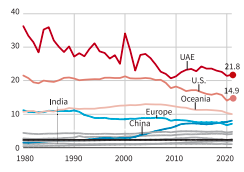
Description automatically generated with medium confidenceChart shows the carbon dioxide emissions per capita emitted in 1980­2021 by various geographical Regions. It also shows (as a fixed black line) a baseline target of carbon dioxide emissions (2.3 tonnes per capita) needed to limit global warming to 1.5° Celsius. The global average emissions per capita is currently double this target, and has stayed above 4.7 tonnes per capita since 2010, whereas Africa and India have both been consistently under. China crossed the global average in 2004.
A graph of different colored bars

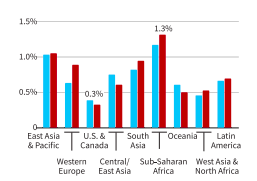
Description automatically generated with medium confidenceIt shows the total investment in climate ­related activities as a fraction of that region’s total GDP in 2019 and 2020. This includespublic and private investment. In both years, Sub ­ Saharan Africa had the highest investment fraction in climate finance (1.3% ofits GDP), followed by East Asia and the Pacific (1%) and South Asia (0.9%). The U.S. and Canada had the lowest proportionate investment, at only 0.3% of their GDP.
A graph of different colored bars

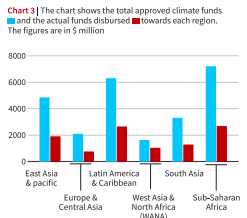
Description automatically generated with medium confidenceIt shows the total approved funds and theactual funds disbursed towards each region. Since 2003, for example, $3.3 billion was approved to be disbursed to South Asia, but only $1.3 billion was actually disbursed. Most regions received only 40% of the approved funding for that region, on average.

CHALLENGES IN CLIMATE FINANCE 

  • Definitions & reporting of climate finance: Even 10 years after COP 15, there is no general agreement on what form of funding can be counted as climate finance under the GCF in support of the Copenhagen pledge. Even 7 years after the Paris Climate Deal, there is no agreement regarding definition of climate finance. 
  • Insufficient Amounts: For instance, global annual fossil fuel subsidies together with their externalities cost about $5.3 trillion. Experts have suggested that even $100b/year pledge is not sufficient to tackle the issue. 
  • Climate Finance Governance: Equally challenging is how international climate change funding should be effectively governed and delivered to developing countries. 
  • Reporting and Verification: Currently there is a lack of mandatory verification mechanism in reporting. Reporting requirements around the projected financing provisions remain weak. 

Conclusion

Countries in Sub ­ Saharan Africa, Latin America, and South Asia have historically contributed the least to global warming; yet, they are bearing the bigger brunt of climate disasters – both in the form of extreme natural phenomena and debt distress. On the other hand, countries in North America and Europe have contributed and continue to contribute the most, and are also the creditors of the debt crisis.

Major Tribes of India [List, Map]

In this article, we are going to share details about some of the major tribes of India. India, with its diverse culture and rich heritage, is home to numerous tribal communities, each having a distinct culture, tradition, language, and social structure. 

An understanding of major tribes, their types, names, and features, is essential for aspirants preparing for the UPSC Civil Services Examination.

Scheduled Tribes in India

Scheduled Tribes, often referred to as Adivasis, are indigenous communities recognized by the Indian Constitution, which provides them with certain privileges and protections. The classification of tribes varies across states, reflecting India's diversity.

According to the 2011 census, there are over 700 tribal communities in India, constituting about 8.6% of the country's total population.

Key Tribes and Their Features

Major Tribes of India in Map

1. Gonds: They are one of the largest tribal groups in India, predominantly residing in Madhya Pradesh, Chhattisgarh, Maharashtra, and Andhra Pradesh. Gonds are known for their Gondi language and Gond art.

2. Bhils: Bhils are majorly found in the states of Rajasthan, Gujarat, Madhya Pradesh, and Maharashtra. They are known for their folk dance called 'Ghoomar.

3. Santhals: Primarily residing in the states of Jharkhand, West Bengal, Bihar, Odisha, and Assam, Santhals are known for their Santhali language and rich cultural heritage.

4. Great Andamanese: The Great Andamanese tribe is one of the indigenous tribes of the Andaman Islands. They were the first tribe to come into contact with the British, and their population has drastically reduced over the years.

5. Khasi: Khasis predominantly reside in the Khasi Hills of Meghalaya. They follow a matrilineal system where lineage and inheritance are traced through women.

6. Munda: Munda tribe is one of the oldest tribes in India, primarily found in Jharkhand, Odisha, West Bengal, and Chhattisgarh. They are known for their Munda language, a part of the Austroasiatic language family.

7. Naga Tribes: Nagas are a group of several tribes residing in Nagaland, Manipur, Assam, Arunachal Pradesh, and Myanmar. They are known for their vibrant festivals, particularly the Hornbill festival.

8. Todas: The Toda tribe is one of the most ancient and unusual tribes in India, living in the Nilgiri Hills of Tamil Nadu. They are recognized for their unique customs, distinct dialect, and barrel-shaped huts.

Understanding the major tribes of India, their geographical distribution, and unique characteristics forms an integral part of the UPSC Civil Services Exam preparation, especially under Indian Society and Anthropology optional.

It's vital for aspirants to be aware of the government's tribal welfare schemes and the constitutional provisions related to tribal rights and welfare. Regular updating of knowledge about any recent developments concerning tribal communities will add value to an aspirant's preparation.

Draft National Deep Tech Startup Policy (NDTSP)

Context: The draft National Deep Tech Startup Policy released by the office of the principal scientific advisor to the government, has sought comments from the public.

Draft National Deep Tech Startup Policy (NDTSP) 

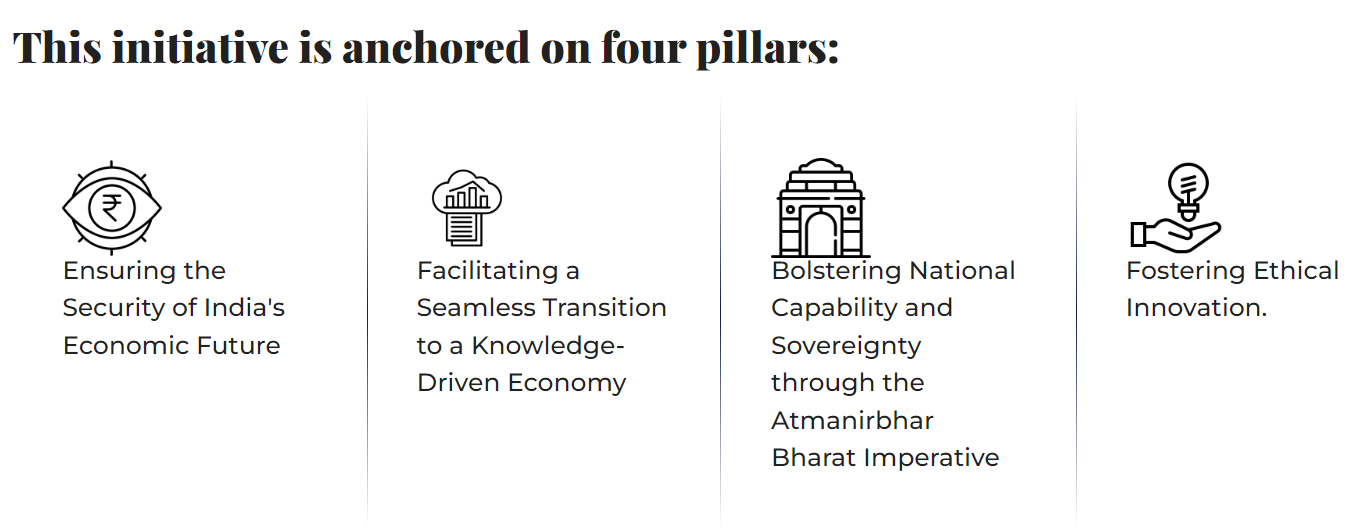
four pillars of Draft National Deep Tech Startup Policy

Objective 

  • To “ensure India’s position in the global deep tech value chain,” in areas such as semiconductors, Artificial Intelligence (AI) and space technology.
  • To bolster R&D in deep tech start-ups working on fundamental and technical problems.
  • To find approaches to provide financing to deep tech start-ups at critical moments.
  • To significantly strengthen India's capabilities and enhance global competitiveness.
  • To stimulate innovation, spur economic growth, and promote societal development through the effective utilization of deep tech research-driven innovations.
  • To solidify India's financial stability and stimulating the transition towards a knowledge-centric economy, consequently augmenting India’s overall productivity.
  • To stimulate ripple effects throughout the economy and lay the groundwork for deep tech industry creation.
  • To address the challenges confronting deep tech startups through definitive policy interventions to create a conducive ecosystem.
  • To simplify the intellectual property regime for deep tech start-ups, ease regulatory requirements, and propose measures to promote these firms. 

Provisions of Draft NDTSP 

  • It proposes an organisation “The Centre for Deep Tech Translation” to assess Indian research (publications, patents, etc.) for potential commercialisation.
  • It suggests creation of Export Promotion Board to ease barriers of entry for Indian deep tech start-ups into foreign markets.
  • It promotes setting up an Open Science and Data Sharing Platform for encouraging collaboration and knowledge sharing among the stakeholders to promote deep tech innovations.
  • It suggests establishing a Single Window Platform that enables a Unified IP Framework, customised for deep tech startups.
  • It suggests creating a thematically focused Fund of Funds (FoF) dedicated to deep tech investments; 
  • It suggests the use of Technology Impact Bonds to invite investment from the public and philanthropic entities.
  • The policy insists on expanding skill enhancement grants, and incentivising venture capitalists to invest in female-led deep tech startups.

Priorities Under The Policy 

Priority- 01 R&D innovation Strengthen the Research and Innovation ecosystem leading to scientific breakthroughs and technological advancements, boosting India’s knowledge-driven economy.
Priority- 02Intellectual property Bolster the Indian Intellectual Property regime and make it competitive for international deep tech startups to establish and operate their entities in India.
Priority- 03Funding Facilitate access to diverse sources of capital via specialized funding programs, increased venture capital investments and tailored government financial support avenues.
Priority- 04Infrastructure Enable Infrastructure and resource sharing with academic institutions, R&D laboratories, and large manufacturing corporations for faster product development.
Priority- 05Standards and certification Create a conducive regulatory environment for innovation to thrive by using streamlined frameworks, laying out clear regulatory requirements and introducing exemptions and incentives.
Priority- 06Diversity and capacity building Attract and retain the finest human capital for sustained superior deep tech innovations keeping equity, diversity and inclusion as the core tenets.
Priority- 07Adoption Promote public and private adoption of indigenous deep technologies through favourable procurement rules and innovative adoption mechanisms and tap into global markets for Indian deep tech products.
Priority- 08Policy interlinkages Interlink with the priorities of existing national policies and missions to ensure India’s position in the global deep tech value chain.
Priority- 09Sustenance Facilitate the sustenance of deep tech startups by helping them overcome the Valley of Death (VoD) phase through targeted solutions addressing funding limitations, resource constraints, limited business knowledge, and risk management.

Deep Technology 

Deep Technology refers to innovations founded on advanced scientific and technological breakthroughs. It is a classification of organization, or more typically startup company, with the expressed objective of providing technology solutions based on substantial scientific or engineering challenges. 

Due to their disruptive nature, they have the potential to solve India’s most pressing societal issues.  

According to the BCG research, the overall investment in deep tech starting from 2015 increased by 300% to more than $60 million in 2020.  

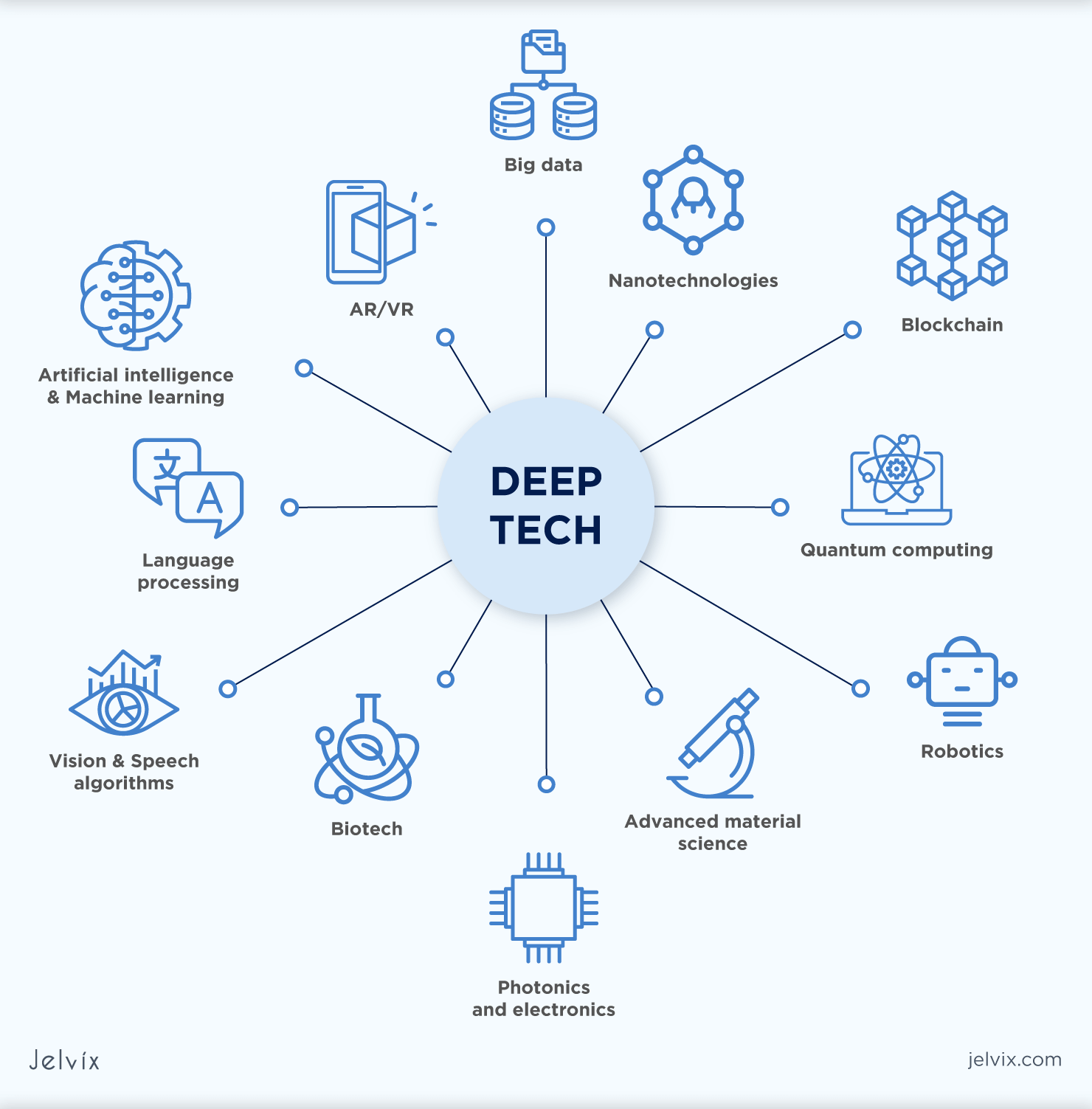
Components of Deep Tech

Characteristics

  • Deep tech typically needs large investments over a longer term and profound research of a certain problem.
  • The commercial success of this type of project will also take more time to achieve due to the disruptive technologies it creates, unlike in general-tech and high-tech scopes.  

Some Examples Of Deep Tech  

BorderPass (Malaysia)An intelligent management project that leverages biometric data to enable automated and secure solutions for airports (check-in, boarding, etc.). 
ViSenze (Singapore)Smart product discovery platform that empowers visual search and image processing tools for online retailers across diverse fields.   
Beit (EU)  It is developing and implementing novel quantum algorithms to create versatile and powerful software solutions for quantum computers.  
Helix (US)It enables healthcare organizations to accelerate the integration of genomic data into patient care and public health decision-making.  
Fundbox (US)An AI-powered financial platform for small and mid-sized businesses that offer fast and intuitive access to business credit up to $150,000.  

Prime Minister's Science, Technology and Innovation Advisory Council (PM-STIAC)

The PM-STIAC is an overarching Council that facilitates the Office of the Principal Scientific Adviser to the Government of India (O/o PSA) to assess the status in specific science and technology domains, comprehend challenges in hand, formulate specific interventions, develop a futuristic roadmap and advise the Prime Minister accordingly. 

O/o PSA also oversees the implementation of such interventions by concerned S&T Departments, agencies and other government Ministries.

Missions under PM-STIAC

  • Natural Language Translation Mission
  • Quantum Frontier Mission
  • Artificial Intelligence Mission 
  • National Biodiversity Mission
  • Electric Vehicles Mission 
  • Bioscience for Human Health Mission
  • Waste To Wealth Mission
  • Deep Ocean Exploration Mission 
  • AGNIi (Accelerating Growth of New India's Innovations) Mission

What is the Akira ransomware?

Context: India's Computer Emergency Response Team issued an alert for ransomware called Akira. The ransomware, found to target both Windows and Linux devices, steals and encrypts data, forcing victims to pay double ransom for decryption and recovery.

About Ransomware

image
  • It is a type of malicious software (malware) designed to block access to a computer system or data until a ransom is paid to the attacker. 
  • Its attacks can target individuals, businesses, or even government organizations. It has quickly become the most prominent and visible type of malware.
  • It is typically spread through spear phishing emails that contain malicious attachments in the form of archived content (zip/rar) files. 
  • Other methods used to infect devices include drive-by-download, a cyber-attack that unintentionally downloads malicious code onto a device, and specially crafted web links in emails, clicking on which downloads malicious code.
  • It also spreads through insecure Remote Desktop connections.

About Akira Ransomware:

  • It is designed to encrypt data, create a ransomware note and delete Windows Shadow Volume copies on affected devices.
  • The ransomware gets its name due to its ability to modify the filenames of all encrypted files by appending them with the akira extension.
  • The ransomware is designed to close processes or shut down Windows services that may keep it from encrypting files on the affected system.
  • It uses Virtual Private Network (VPN) services, especially when users have not enabled two-factor authentication, to trick users into downloading malicious files.

Mechanism of Akira ransomware

  • The ransomware deletes the Windows Shadow Volume copies on the affected device. These files are instrumental in ensuring that organisations can back up data used in their applications for day-to-day functioning. 
  • Volume Shadow Copy Service (VSS) facilitates communication between different components without the need to take them offline, thereby ensuring data is backed up while it is also available for other functions. Once the ransomware deletes the VSS files it proceeds to encrypt files with the pre-defined the akira extension.
  • The ransomware also terminates active Windows services using the Windows Restart Manager API, preventing any interference with the encryption process. It is designed to not encrypt Program Data, Recycle Bin, Boot, System Volume information, and other folders instrumental in system stability. It also avoids modifying Windows system files with extensions like .syn. .msl and .exe.
  • Once sensitive data is stolen and encrypted, the ransomware leaves behind a note named akira_readme.txt which includes information about the attack and the link to Akira’s leak and negotiation site.
  • Each victim is given a unique negotiation password to be entered into the threat actor’s Tor site. Unlike other ransomware operations, this negotiation site just includes a chat system that the victim can use to communicate with the ransomware gang.\

Prevention measures against Akira Ransomware

CERT-In has advised users to follow basic internet hygiene and protection protocols to ensure their security against ransomware. These include:

  • Maintaining up-to-date offline backups of critical data, to prevent data loss in the event of an attack.
  • Update all operating systems and networks regularly, with virtual patching for legacy systems and networks. 
  • Companies must establish Domain-based Message Authentication, Reporting, and Conformance, Domain Keys Identified Mail (DKIM), and Sender policy for organizational email validation, which prevents spam by detecting email spoofing. 
  • Strong password policies and multi-factor authentication (MFA) must be enforced.
  • There should also be a strict external device usage policy in place and data-at-rest and data-in-transit encryption along with blocking attachment file types like .exe, .pif, or .url to avoid downloading malicious code. 
  • Periodic security audits of critical networks/systems, especially database servers.