GS Paper 1

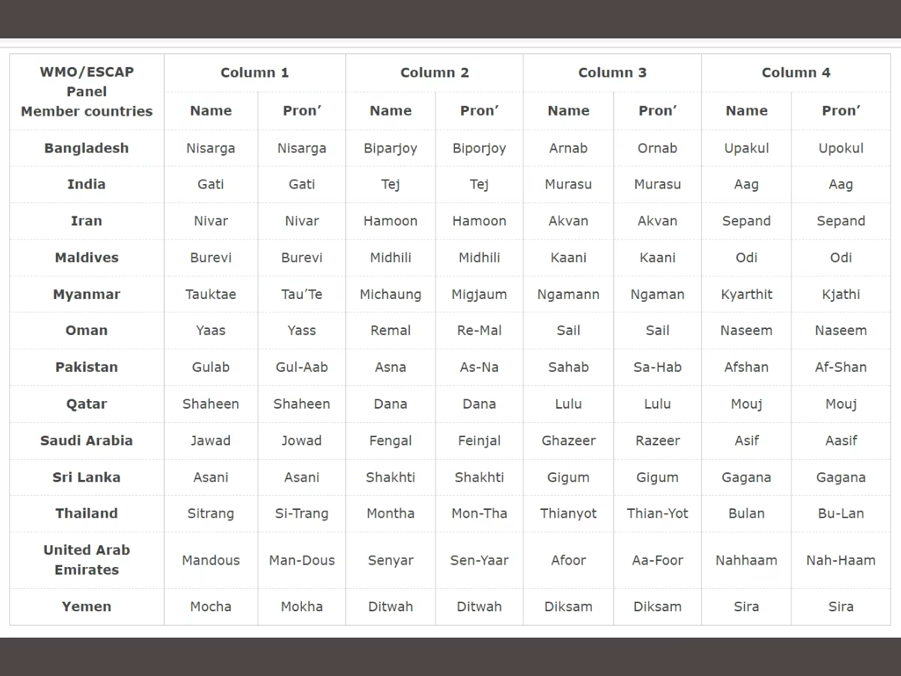
Cyclone Michaung

Context: Cyclone Michaung is the first cyclone to cross the Andhra Pradesh coast after cyclone Gulab which developed in September 2021.

About Cyclone Michaung

  • Cyclone over South-West Bay of Bengal.
  • Michaung is named after a suggestion given by Myanmar. It means strength and resilience. 
  • Upon formation, cyclone Michuang will become the fourth Bay of Bengal cyclonic storm and the sixth cyclone formed in the Indian Ocean in 2023.
Cyclone Michaung on map

Naming of cyclone:

  • The World Meteorological Organization (WMO) oversees the management of rotating name lists tailored for each tropical cyclone basin. 
  • Cyclones arising in various ocean basins globally receive their names from regional specialized meteorological centers (RSMCs) and Tropical Cyclone Warning Centers (TCWCs) within those areas. 
  • There are a total of six RSMCs across the world.
  • Member nations of the RSMCs propose the names for tropical cyclones. For instance, the Indian RSMC, comprising 13 nations, puts forward 13 names each for cyclones formed in the region.
  • In the earlier practice, before the official adoption of naming conventions, tropical cyclones were named based on locations, objects, or the feast days of saints on which they occurred. 
  • The names will be used sequentially column wise. The first name will start from the first row of column one and continue sequentially to the last row in the column thirteen.
  • The names of tropical cyclones over the north Indian Ocean will not be repeated, once used it will cease to be used again. 
  • The name of a tropical cyclone from south China Sea which crosses Thailand and emerge into the Bay of Bengal as a Tropical cyclone will not be changed. 

Guidelines to adopt names of cyclones

  • The proposed name should be neutral to (a) politics and political figures (b) religious believes, (c) cultures and (d) gender.
  • Cyclone Biparjoy Tropical Cyclones Naming System Nomenclature Science  Behind Formation
  • Name should be chosen in such a way that it does not hurt the sentiments of any group of population over the globe
  • It should not be very rude and cruel in nature
  • It should be short, easy to pronounce and should not be offensive to any member
  • The maximum length of the name will be eight letters.
  • The proposed name should be provided with its pronunciation and voice over.
  • The names of tropical cyclones over the north Indian Ocean will not be repeated. Once used, it will cease to be used again. Thus, the name should be new.
Indonesia's Marapi volcano erupts

Context: Indonesia's Marapi volcano in West Sumatra erupted on Sunday, spewing volcanic ash as high as 3,000 m into the air. 

VOLCANISM & VOLCANICITY

  • A volcano on Earth is a vent or fissure in the crust through which lava, ash, rock and gases erupt.
  • Sometimes they can be preceded by emissions of steam and gas from small vents in the ground.
  • Nuée ardente, or pyroclastic flow is a fluidized mixture of hot gas and incandescent particles that sweeps down a volcano’s flanks, incinerating everything in its path.

VOLCANO ANATOMY

image

When volcanoes erupt, magma moves upward from a magma chamber and into a vent or conduit. It flows out from a crater at the top, or sometimes emerges at a secondary site on the side of the volcano resulting in a flank eruption. Erupted materials accumulate around the vent forming a volcanic mountain.

The accumulated material might consist of layers of solidified lava, called lava flows, but it might also include fragments of various sizes that have been thrown from the volcano.

MECHANISM & CAUSES OF VULCANISM

Mechanism of volcanism is closely associated with several interconnected processes.

  • Average increase of temperature with increasing depth at the rate of 25-32 degree Celsius per km.
  • Origin of magma due to lowering of melting point caused by reduction in the pressure of overlying super incumbent load.
  • Origin of gases and vapour due to heating of water which reaches underground through percolation.
  • Ascent of magma forced by enormous volume of gases and vapour.
  • Occurrence of volcanic eruptions.
Why Indonesian region experience so many volcanos?

5jjecxzw9pp5q1v 5fr2cv2iNqc9VZU9z 7iyWJeTFhmiln7voNPyF6F4ZqSvQPfdW 4F4F5B3 JYR ef8 tmZKCpnUFUEuVnZ5wBRpTHonM7 CNrBbv9NTmBzZT4RkAqbXmzEqzNOvUhggPMOt Cg

The region is located on one of the most volatile regions of the world experiencing intense tectonic convergence and subduction.
As the world's largest archipelago — spread across 17,500 islands — Indonesia sits between the world's most active seismic region — the notorious Pacific Ring of Fire — and the world's second most active region — the Alpide belt.
Being sandwiched between such seismicity has meant the islands experience some of the strongest earthquakes and most powerful volcanic eruptions. 

Kolkali Art

Context: The mothers’ grouping of the Thrissur Archdiocese performed ‘Kolkali, a folk art’, on the Lour des Metropolitan Cathedral premises in remembrance of St. Thomas’ arrival in India.

image 4

About Kolkali Art:

  • Having a historical lineage of approximately two centuries, Kolkali emerged as a folk art performed in the North Malabar region of Kerala, with influences drawn from Kalaripayattu, a martial art tradition prevalent in both Kerala and Tamil Nadu.
  • In the realm of Kolkali, each participant holds a stick, executing circular movements, striking a rhythmic chord that resonates with the accompanying music.
  • Typically, a group of 12 to 24 dancers move rhythmically in a circle around a ceremonial lamp named ‘Nilavilakkua,’ synchronizing foot taps with the manipulation of lengthy wooden sticks in their hands.
  • On occasions, this dance unfolds on a specially constructed on a wooden stage, thus it is also called, ‘Thattinmelkalia.’
  • The songs interwoven into Kolkali performance narrate devotional stories depicting regional deities, with the primary musical accompaniment emanating from the rhythmic sounds of the sticks.
  • The dance is enhanced by musical instruments such as Chenda, Elathalam, Mathalam, and Chengala.
  • Traditionally an annual post-harvest celebration, Kolkali united villagers across caste and creed. However, in contemporary times, the dance has transcended its seasonal roots, finding a place in various tribal festivals and celebratory events, including wedding ceremonies.
  • The influence of Kolkali extends beyond Kerala's borders, influencing folk dance forms in Bengal, Gujarat, Punjab, and Maharashtra. In Tamil Nadu, it is recognized as Kolattam, while in Andhra Pradesh, it goes by the name Kolamu.
  • Currently, Kolkali enjoys widespread popularity and has become a prominent feature in the Kerala School Youth Festival, lauded as one of the largest cultural events in Asia.
  • This evolution underscores the enduring allure and cultural resonance that Kolkali brings to the forefront of artistic expression in the region.

Arrival of St. Thomas in India:

  • During his initial mission, St. Thomas arrived at the capital of Parthian King Gondophares (c. 19 – c. 46), who governed the regions of Afghanistan and Punjab, with Takshasila as the capital.
  • Accompanying him was the trader Abbanes. On his subsequent mission, St. Thomas journeyed to a kingdom in South India, ruled by a dynasty from the 1st Century.
  • According to tradition, St. Thomas preached in this region before crossing over to the Coromandel Coast in Southeast India.
  • Unfortunately, he was killed while fulfilling his mission at Mylapore near Madras.

What is Domestic Violence?

Context: Forty years after the introduction of the domestic violence provision in the Indian Penal Code, women are still at risk of having their complaints dismissed or disbelieved by police and judiciary.

About domestic violence

Protection of Women from domestic violence Act 2005 (PWDVA): The act provides the definition of domestic violence as: Harms or injures or endangers the health, safety, life, limb or well-being, whether mental or physical, of the aggrieved person or tends to do so and includes causing physical abuse, sexual abuse, verbal and emotional abuse and economic abuse. 

Crime against women

  • Crimes against women have increased year on year. As per the National Crime Records Bureau (NCRB) report 2015, every day 21 women die because of dowry in India.
  • According to the NCRB report 2019, 4 lakh cases were registered under Section 498A of the Indian Penal Code (IPC). 
  • As per the National Family Health Survey 5 (2019- 20), 30 percent of women between the ages of 18 and 49 experienced physical violence from the age of 15 (that's over 20 crore women), while six per cent experienced sexual violence in their lifetime.
  • In 2021, 136,000 complaints were registered under Indian Penal Code Section 498A (cruelty by husband or his relatives).
  • According to NFHS data, 87 per cent of married women who are victims of marital violence do not seek help.
image 3

Cause for domestic violence against women

Cultural factors 

  • Patriarchy: It is a cultural value that places men in power and authority over women. This leads to an unequal power dynamic between the sexes. This imbalance of power can lead to the use of physical force to exert control over women.
  • Collectivism: This cultural value places a greater emphasis on the requirements of the community and family over those of the individual, and honour and reputation within the family are highly valued in collectivist societies. As a direct consequence of this, instances of domestic violence go unreported, thus ensuring that the cycle of abuse continues. 
  • Religious beliefs: In traditionalist societies, religion is used to justify domestic violence, with men citing religious texts to support that male is superior than female.

Socio-economic factors

  • Lack of education: A lack of education might result in a lack of knowledge regarding women's rights and gender equality. As a result, women may experience domestic violence and be treated as less valuable.
  • Poverty:  Due to the tension that financial strain can cause inside families, poverty can make domestic violence worse. Due to their possible financial dependence on their abusers, women in low-income households may be especially susceptible to domestic violence.
  • Alcohol and substance misuse: In India, alcohol and drug misuse might be risk factors for domestic violence. Alcoholism can cause people to lose their inhibitions and act violently.
  • Dowry: It is often linked to social status and can be seen as a measure of a family's wealth and prestige. In situations where the dowry is not considered sufficient, the bride may face mistreatment as a way for the groom's family to assert dominance and control, reinforcing power imbalances.

Initiative taken by government:

  • Dowry Prohibition Act 1961: The court is empowered to act in its own knowledge or on a complaint by any recognized welfare organization on dowry murder. Indian Evidence Act is also amended to shift the burden of proof to the husband & his family when the bride dies within 7 yrs. of marriage.
  • Amendment to Criminal Act 1983: This Act talks about domestic violence as an offence, rape is also made a punishable offence.
  • Protection of Women from domestic violence Act 2005(PWDVA, 2005): Any person who has reason to believe that an act of domestic violence has been, or is being, or is likely to be committed, may give information about it to the concerned Protection Officer/police.
  • The act also defines physical abuse, sexual abuse, verbal and emotional abuse and economic abuse.
  • Indian Penal Code (IPC): 
  • Section 498A IPC: It was introduced in 1983 with the objective to tackle the problem of the large number of women dying in their homes. The section addresses the subjection of any woman to cruelty (whether mental or physical of such a nature that is likely to drive the woman to commit suicide or to cause grave injury or danger to life, limb or health and also with unlawful demand for any property or valuable security.
  • Sections 319 to 338 of the IPC: Deal with assaults and grievous hurt in various forms.
  • National Commission for Women (NCW): The NCW is an organisation that works to support and assist women who have experienced domestic abuse. Their helpline number is 1091.
  • Domestic Violence Helpline: It is a toll-free hotline that offers victims of domestic violence support and assistance around-the-clock. Their phone number for their helpline is 181.

Challenges in Addressing the issues of domestic violence

  • Misuse of law:  In Rakesh and Reena Rajput v The State of Jharkhand case, the Jharkhand High Court said , "There is a phenomenal increase in matrimonial disputes in recent years and it appears that in many cases, the object of Section 498A IPC is being misused and the section is used as weapon rather than shield by dis gruntled wives, this is one of the reason where innocent individuals have been wrongly implicated.
  • Under the PWDVA law, state governments are required to appoint protection officers (POs). Several States are yet to implement POs. And where they are in post, they are under-resourced, under-skilled and overworked.
  • Inadequate support services: Insufficient availability of shelters, counselling services, and legal support can hinder women from leaving abusive relationships. Adequate funding and resources for support services are critical. In Delhi only, there are 13 women shelters and short-stay homes for women and most are overcrowded and used mainly by the underprivileged, according to Ending Domestic Violence Through Non-Violence: A Manual for PWDVA Officers, published by Lawyers Collective.
  • Social shame: Societal stigma and the fear of judgment can prevent women from disclosing their experiences of domestic violence. The stigma attached to being a victim may lead to feelings of shame and isolation.
  • Threats and intimidation tactics: Many women face the fear of retaliation from their abusers, making it difficult for them to speak out or seek help. Threats and intimidation tactics can be powerful barriers to reporting abuse.
  • Lack of reliable and periodical data: On violence against women (VAW) and girls, which leads to a situation of speculations and sensationalism; it also creates an atmosphere of fear and anxiety. 
  • Attitudinal problem: Across many States, it is observed that the police were more likely to send women back to violent households to reconcile with the perpetrator or go for counselling.

Way forward

  • Prevention of violence requires numerous immediate, medium and long term interventions including large scale campaigns to sensitise and educate men and women on VAW.
  • The intervention should begin by focusing on gender equality in education since the quality of education received by women has not equipped them to question the patriarchy.
  • Trauma-informed institutional response, revamping of the support systems based on impact assessments and increasing the number of one-stop centres with adequate professionals are some of the other measures needed.
  • Draft National Policy for Women, 2016: 
    • Strict monitoring of response of enforcement agencies to violence against women will be put in place. Efforts will be made to ensure speedy /time bound trial of crimes against women. 
    • Alternate dispute redressal systems such as family courts, Nari Adalats etc., will be strengthened. 
    • Efforts will be made to increase the representation of women in judicial positions across the board as female judges often bring a heightened sensitivity to gender-related cases and their presence can lead to fairer and more informed decisions in such cases.
    • Efforts will be made to streamline data systems through review of various data sources (Census, NFHS, NSS, NCRB) to develop a compatible and comprehensive data base on Violence Against Women. 
    • Gender specific training incorporating gender sensitivity and a thorough briefing on the specific laws for women will be undertaken continuously for all ranks and categories of police personnel. 

Case study of VAW: Mararikulam Panchayat

The Mararikulam Panchayat implemented the mapping programme through the Kudumbashree community network as part of their effort to make Mararikkulam a women-friendly Panchayat. 

A crime-mapping exercise and awareness campaign on the issue of VAW taken up.

Migrant Workers

Context: The migrant labor force plays vital role in nation's growth and development, but they are often disregarded and considered forgotten citizens. Moreover, the state mechanisms show lack of care and attention towards the migrant workers.

About migrant workers

  • According to the Census, a person is considered a migrant if his/her place of birth is different from the place where he is enumerated. It also uses place of last residence or if the place in which he is enumerated during the census is other than his place of immediate last residence.
  • Migration is the geographic movement of people across a specified boundary various reasons especially social, economic, political reasons. Along with fertility and mortality, migration is a component of the population change. 
  • The term “in migration” and “out migration” are used for migration within a country and are comparable to the terms “immigration” and “emigration” used in international migration.

Factors for migration:

image 10

Status of Migration in India

  • As per the census 2011, the total number of internal migrants in India is 46 crore or 37% of the country’s population.

cCQzadWu8qeb2N2YLpADkxUsA

  • As per NSS 2020-21 Survey: One in three Urban Indians is a ‘migrant’ but mostly intra-state. Among migrants, 55% have moved between villages mostly women moving after marriage.
  • Marriage is a larger driver of migration than jobs for women. Jobs are the biggest reason of migration from men.
  • Himachal Pradesh and Telangana have the highest share of job-related migrants in their total urban male population.
  • Delhi has the highest share of persons (21.3%) who have come from outside its territory.

Challenges faced by migrant workers:

  • Discrimination: Migrant workers may face discrimination based on language, ethnicity, or cultural differences, that can leads to social isolation and access essential services.
  • Health issues : Workers often live in overcrowded and substandard housing conditions with limited access to sanitation facilities contributes to health issues, like stagnant water around the settlement becomes a breeding ground for vector borne disease.
  • Lack of social safety: Many migrant workers lack of social safety nets such as healthcare, insurance, and retirement plans during economic shocks and health crises .E.g.: During Covid-19 pandemic, more than 80 percent workers in the informal sector lost employment in India and about 75 percent of these workers were small traders & daily wage-labourers, according to Centre for Monitoring Indian Economy.
  • Education exclusion: Frequent relocations of migrant families often face difficulties in ensuring access to education for their children. 
  • Low wage: Migrant workers often engage in unorganized and informal sectors where they receive wages below the minimum standard and lack job security, rendering them vulnerable to exploitation.
  • Lack of realistic data: The current data structure lacks a realistic statistical account of the number of migrant workers and a comprehensive understanding of the nature of their mobility.
  • Political exclusion: Migrants do not usually have voting rights in their destination states, which leaves migrants unable to make political demands for entitlements and seek reforms.
  • Risk of exclusion: This Public Distribution System (PDS), may face risk of exclusion because many sections of society who still don’t have Aadhar Cards, consequently depriving them of food security.

A roadmap to improve the conditions of migrant workers:

  • Promote social integration by creating programs that facilitate cultural exchange and understanding between migrant workers and local communities that help migrants adapt to their new environments.
  • Establish a system for regular updates to keep the database current and reflective of the changing circumstances of migrant workers.
  • Recommendations of Niti Aayog: 
    • Enabling the political inclusion of migrant workers so they can demand their entitlements. This will enhance the accountability of political leadership towards the welfare of migrant workers in their respective states.
    • Setting up inter-state coordination mechanisms between source states and destination states to work with each other.
    • The Ministry of Labour and Employment should set up a special unit for migrant workers, that manages migration resource centres in high migration zones.
    • A national labour helpline should be established. 
    • Embedding a migration wing in each state’s labour department. Creation of night shelters, short-stay homes and seasonal accommodations for migrants in cities.

Government intervention for migrant workers

  • e-SHRAM portal: To create a national database of unorganised workers seeded with Aadhaar. It is also to facilitate delivery of Social Security and welfare Schemes to such workers.
  • One Nation One Ration Card: To create a technology systems that will be used for enabling migrants to access Ration from any Fair Price Shop in India.
  • Affordable Rental Housing Complexes (ARHC) for Migrant Workers/Urban Poor (under Pradhan Mantri Awas Yojana-Urban ): To caters to the housing needs to eligible beneficiaries.
  • Code on Social Security, 2020: The code broadens the definition of an employee to encompass informal workers to extend the existing social security net. Under this central government will establish social security funds for informal workers, gig workers, and platform workers.
  • Prime Minister Street Vendor’s AtmaNirbhar Nidhi (PM-SVANidhi): To offer affordable working capital loans to street vendors, enabling them to restart their livelihoods adversely affected by the Covid-19 lockdown.
  • State migrant cell: Established to develop a database of migrant workers in various states, along with comprehensive mapping.
  • Election Commission's remote voting plan for migrants: That would allow domestic migrants to vote in national and regional elections for enabling political inclusion of migrant workers so they can demand their entitlements.

Gwalior listed as ‘City of Music’ under UNESCO’s Creative Cities Network

Context: Gwalior, in Madhya Pradesh, earned a place in UNESCO's Creative Cities Network for ‘Music’, in recognition of its steadfast dedication to nurturing culture and creativity. The state's profound cultural legacy is evident in UNESCO-listed landmarks such as the prehistoric rock art caves of Bhimbetka, the temples of Khajuraho, and the heritage sites of Sanchi. 

Evolution of Gwalior, as a ‘City of Music’: 

  • The Gwalior Gharana is distinguished by its simplicity, favouring well-known ragas and emphasizing ‘sapaat taans’.
  • ‘Bandish’ holds the key, providing the melody, while ‘bol-baant’ and ‘behlava’ showcase the unique nuances of the Gwalior style.
  • The Gwalior gharana, predating the categorization of various gharanas, emerged as the first proper musical ideology under Mughal rule.
  • Ustads like Naththan Khan and Naththan Pir Baksh played pivotal roles in shaping the gharana's identity.
  • Khayal singing, a prominent feature today, evolved from dhrupad under the Gwalior gharana, blending elements of qawwali.
  • The Bangash gharana continued Gwalior's musical legacy, with Ustad Hafiz Ali Khan being a prominent figure. His influence extended to Ustad Amjad Ali Khan and Pt. Bhimsen Joshi. 
  • Krishnarao Shankar Pandit, a pivotal figure, established the Shankar Gandharva Mahavidyalaya in Gwalior. His contributions, spanning Khayal, Tappa, and Tarana singing, earned him accolades and recognition, including the Padma Bhushan.
image 60

About Tansen

  • Tansen is considered to be one of the most influential personalities of the North Indian Hindustani School of Music. 
  • Mian Tansen, born in Gwalior, trained under Swami Haridas and later became a court musician for King Ram Chandra Singh of Rewa. His original name was Ramtanu.
  • He later became the court poet of Raja Man Singh of Gwalior. Raja Man Singh renamed Ramtanu as Tansen. 
  • His musical brilliance caught the attention of Akbar, leading to his invitation to the Mughal court. Akbar conferred the title of ‘Mian’ to Tansen. Tansen was one of the nine Navratnas of court of Akbar. 
  • Tansen is remembered for his mastery in Dhrupad style of musical composition and creating several new ragas.
  • Books authored by Tansen: Sri Ganesh Stotra and Sangita Sara. 

Contributions of Raja Man Singh Tomar in the field of Music

  • During the 15th century, under Raja Man Singh Tomar's patronage, the Gwalior gharana, flourished.
  • Man Singh, inheriting his great grandfather Dungarendra Singh Tomar's musical legacy, not only revived Indian classical music but also invented the classical genre of dhrupad.
  • Raja Man Singh authored a book named as Mankautuhal. This was translated into Persian in 1673 by Faquirullah by the name, ‘Raga Darpan’. 
  • Man Singh popularised Dhrupad style of singing. 
  • Sufi saints, consulted by the king, further enriched his musical endeavours.
  • To make Indian music more accessible, Man Singh replaced Sanskrit songs with those in simple Hindi, fostering a broader understanding of high art.
  • Raja Man Singh composed some new Ragas like Gurjari Todi, Mal Gujari and Gurjari. 

About city of Gwalior: 

  • The earliest historical record of Gwalior is from Hun ruler Mihirakula's inscription, highlighting his father Toramana as a ruler.
  • The Gurjara-Pratihara dynasty, in the 9th century, constructed the Teli ka Mandir temple. The Kachchhapaghata dynasty, from the 10th to the 12th century, left architectural marvels like the Sasbahu Temple.
  • Under Muslim rule in the 13th century, Gwalior faced attacks but stood resilient.
  • Raja Veer Singh established Tomar rule in 1375, marking a golden period.
  • The city came under the Mughal Empire, followed by the Marathas in 1754.
  • In the 18th century, the Scindia dynasty of the Maratha empire assumed control. Gwalior remained a princely state under British Raj until India gained independence in 1947, with the Scindia family as the local rulers.
  • Gwalior's unique role in the 1857 rebellion is notable: 
    • While the city initially did not join the rebellion, Rani Lakshmibai sought refuge at Gwalior fort after the fall of Jhansi.
    • The Maharaja of Gwalior, Jayajirao Scindia, initially reluctant to yield, eventually surrendered, leading to a brief possession by rebel forces.
    • The British swiftly retook Gwalior in a battle fought by Lakshmibai, leaving a lasting legacy of resistance.
  • Princely state of Gwalior
    • Gwalior emerged as a significant regional power, featuring prominently in the Anglo-Maratha Wars.
    • Despite a brief period of rebel control during the Indian rebellion of 1857, the Scindia family continued to rule until India gained independence in 1947.
    • Maharaja Jivajirao Scindia's accession to the Government of India led to Gwalior's merger with other princely states, forming the new Indian state of Madhya Bharat. 

Kozhikode included as ‘City of Literature’ under UNESCO’s Creative Cities Network

Context: Kozhikode has recently earned the distinction of being recognized as the City of Literature within the UNESCO Creative Cities Network. The city in North Kerala stands as a cradle for numerous influential figures in the state's literary and cultural sphere. 

More information from the news article:

  • The UNESCO recognition places Kozhikode in the prestigious position of being India's first City of Literature.
  • UNESCO' recognition extend beyond literature to various creative domains, including film, crafts, folk arts, and design. Gwalior, this year, joins the ranks as a City of Music, adding to the list that includes Varanasi (2015) and Chennai (2017).
  • Kozhikode's journey to UNESCO recognition is a result of meticulous planning and dedication. The presence of numerous libraries, publishing houses, and events like the Keral Literature Festival (KLF) played pivotal roles. 
    • Kozhikode holds the distinction of being the birthplace of the first Malayalam novel, Kundalatha, penned by Appu Nedungadi in 1887. 
    • The KLF, since its inception in 2016, has become a grand celebration of creativity and literature.
    • Kozhikode boasts a rich literary heritage, home to iconic writers like M.T. Vasudevan Nair, Vaikom Muhammad Basheer, and S.K. Pottekkatt.
    • Kozhikode has been historically celebrated for its love of music, football, and delectable cuisine. The city's rich football culture, producing Olympian Rahman, and its culinary delights contribute to its multifaceted cultural identity.

Kerala's Literary Legacy:

  • UNESCO's recognition of Kozhikode is not an isolated event; it reflects the broader literary fervour in Kerala.
  • Cities like Thiruvananthapuram, Thrissur, and Kottayam, the first 100% literate town in India, also celebrate literary tradition. 
  • Despite the digital age, publishing thrives in Kerala, with a growing trend of translating Malayalam literature and embracing translations from diverse languages.

UNESCO's acknowledgment not only crowns Kozhikode as a City of Literature but also highlights Kerala's enduring love for the written word across its diverse cities.

About Kozhikode

  • Kozhikode, also known as Calicut, stands along the Malabar Coast in the state of Kerala. 
  • Throughout ancient and the medieval period, it earned the name ‘City of Spices’ due to its pivotal role as a major trading hub for Indian spices.
  • Historically, it was the capital of an autonomous kingdom governed by the Samoothiris (Zamorins).
  • The port of Kozhikode played a crucial role as the entry point to the medieval South Indian coast, attracting traders from China, Persia, Arabia, and eventually Europe.

Under Zamorins

  • Kozhikode was initially part of the Polanad kingdom, a vassal state to the Kolathunadu of North Malabar ruled by the Porlatiri.
  • The Eradis of Nediyiruppu at Kondotty in Eranad sought a trade outlet to the sea, leading to the conquest of the area around Panniankara.
  • Following this, Kozhikode emerged as a prominent city in the 13th century CE, with the Eradis relocating their headquarters to Kozhikode.
  • The title ‘Zamorin’ is derived from the European interpretation of ‘Swami Nambiyathiri Thirumulpad’ or ‘Samuri’.
  • During the zenith of their reign, the Zamorins ruled a region stretching from Kollam to Panthalayini Kollam.
  • The discovery of the sea route from Europe to Kozhikode in 1498 marked a turning point, leading to Portuguese territorial expansion and control of the seas between Ormus and the Malabar Coast.

Portuguese conflicts

  • First battle of Cannanore in 1502 initiated Portuguese conflicts in the Indian Ocean, culminating in their dominance of the spice trade.
  • Continuous wars with the Zamorin navy, led by Kunjali Marakkars, reduced Kozhikode's significance as a trade centre.

Dutch intervention

  • In the early 17th century, the Zamorin expelled the Portuguese with the assistance of the Dutch East India Company.
  • The Dutch presence in Kozhikode commenced in 1604, marked by a treaty that facilitated trade and mutual cooperation against the Portuguese.

Advent of British influence

  • The British presence in Kerala traces its origins to 1615, marked by the arrival of a group led by Captain William Keeling at Kozhikode. 
  • Among them was Sir Thomas Roe, a British envoy, who visited Jahangir, the fourth Mughal emperor.
  • In 1755, Travancore established dominance in Kerala by defeating the Zamorin of Kozhikode in the Battle of Purakkad.
  • Subsequently, Kozhikode fell under British rule following the Mysorean conquest of Malabar in the late 18th century CE.
  • Kozhikode served as the capital city of the Malabar district, one of the two districts along the western coast (Malabar Coast) of the Madras Presidency.
  • In 1866, the Kozhikode municipality was established under the Madras Act X of 1865 (Amendment of the Improvements in Towns Act 1850), becoming the first modern municipality in the state.

The early history of Kozhikode and the prevailing conditions can be known from the accounts of foreign travellers: 

  • Ibn Battuta visited Kozhikode and portrayed it as ‘one of the great ports of the district of Malabar,’ attracting merchants from around the world.
  • A Chinese sailor under the imperial fleet, Ma Huan (1403) lauded Kozhikode as a significant emporium of trade frequented by merchants worldwide. He observed the city's unique religious diversity, finger-and-toe counting system still in use, and the matrilineal system of succession.
  • Abdur Razzak (1442–43): As the ambassador of Persian Emperor Shahruhk, Abdur Razzak (1442-23) found Kozhikode's harbour perfectly secured and noted active trade with maritime nations, including Abyssinia, Zirbad, and Zanzibar.
  • An Italian traveller, Niccolo de Conti (1445), described Kozhikode as rich in pepper, lac, ginger, cinnamon, myrobalans, and zedoary.
  • In 1498, Vasco Da Gama reached Kozhikode, establishing a trading route with Europe that later contributed to Portugal's colonization of the region. 
  • Russian traveller Afanasy Nikitin (1468-74), along with Italians Ludovico di Varthema (1503–1508) and Duarte Barbosa, contributed to the diverse accounts of Kozhikode from foreign visitors.

About UNESCO's City of Literature in the Creative Cities Network: 

  • The UNESCO City of Literature program is an integral component of the expansive Creative Cities Network, a global initiative aimed at fostering creativity and cultural innovation. 
  • Launched in 2004, this network encompasses member cities spanning seven diverse creative fields, including Crafts and Folk Art, Design, Film, Gastronomy, Media Arts, and Music.

Criteria for Cities of Literature:

Cities aspiring to attain the esteemed title of City of Literature must adhere to a set of criteria established by UNESCO. These criteria serve as benchmarks to evaluate the city's commitment to promoting literature and cultural diversity.

  • Quality, quantity, and diversity of publishing: Presence of high-quality, diverse publishing within the city.
  • Educational programs, focusing on domestic and foreign literature at primary, secondary, and tertiary levels.
  • Cultural significance of literature, drama, and poetry
  • Literary events and festivals: Active participation in hosting literary events and festivals that celebrate both domestic and foreign literature.
  • Infrastructure for literary preservation: The existence of libraries, bookstores, and public or private cultural centres actively involved in preserving, promoting, and disseminating domestic and foreign literature.
  • Publishing sector involvement: Engagement of the publishing sector in translating literary works from diverse national languages and foreign literature.
  • Media involvement: Active participation of traditional and new media in promoting literature and bolstering the market for literary products.

City candidacy process:

  • Cities aspiring to receive the City of Literature designation undergo a formal process of submitting bids to UNESCO.
  • This involves a comprehensive presentation of the city's cultural and literary assets, demonstrating its commitment to meeting the established criteria.

UNESCO's monitoring and review mechanism:

  • To ensure the continued adherence to the set standards, the UNESCO City of Literature designations undergo meticulous monitoring and review every four years.
  • This periodic evaluation ensures that designated cities maintain their cultural and literary vibrancy, contributing to the overall success and impact of the Creative Cities Network.

‘Ghol Fish’ - State Fish of Gujarat

Context: The black-spotted croaker, or the ghol fish — considered a fisherman’s lottery — was declared the state fish of Gujarat.

Why Declare a State Fish?

  • Every state can declare a state fish. 
  • Reasons for Gujarat:
    • Uniqueness of the fish species. This fish is not easily available. Catches that are reported are far and few between. 
    • The second factor is the economic value of the fish.
    • The government felt the need to conserve it and prevent it from over-exploitation.

About the Ghol Fish

Ghol Fish
  • IUCN Conservation Status: Near Threatened
  • Importance of Ghol Fish: 
    • Considered a delicacy in many countries. Hence it is in high demand in international markets. The meat of the fish is exported as frozen fillet or whole fish to European and Middle Eastern countries.
    • It is a marine fish. 
    • It’s air bladder - is mainly exported to China, Hong Kong and other Asian countries where it is in high demand for its medicinal values.
  • Distribution & Habitat
    • The blackspotted croaker has a wide Indo-Pacific distribution from the Persian Gulf east into the Pacific Ocean where it extends north to Japan and south to northern Australia. 
    • It is found in coastal waters, usually no deeper than 60 m (200 ft), over mud substrates. It occasionally enters estuaries and the tidal reaches of rivers.

Art historian B N Goswamy’s work on Indian miniature painting tradition

Context: Renowned Indian art historian and critic Brijinder Nath Goswamy, celebrated for his extensive research on the Indian miniature painting tradition, has recently passed away in Chandigarh after battling prolonged illness. As a recipient of the Padma Bhushan, Goswamy gained prominence following the release of his seminal 1968 article, 'Pahari Painting: The Family as the Basis of Style.' 

image 40

More from the news article: 

  • Brijinder Nath Goswamy, was born on August 15, 1933, was a distinguished Indian art critic and historian. 
  • The Government of India acknowledged Goswamy's contributions with the prestigious Padma Shri in 1998 and later honoured him with the Padma Bhushan in 2008.
  • In his article, 'Pahari Painting: The family as the basis of style,' Goswamy delved into the intricate family lineages of renowned artists.
    • His expertise in Pahari painting, a traditional miniature art form originating in the Punjab region's hills, was exemplified through detailed studies of artists like Pandit Seu, Nainsukh, and Manaku.
  • His literary knowledge extended across various themes, with notable works such as 'A Place apart: Painting in Kutch, 1720-1820.' He explored Kutch's visual history, highlighting the influence of Mughal connections on the region's art.
  • The landmark work, 'Painters at the Sikh court,' delved into the wealth and patronage of Sikh courts.
    • Utilizing historical documents, he provided a comprehensive narrative of Punjab's post-British occupation art scene, shedding light on the lives of painters during that period.
  • In the edited book 'Life at Court: Art for India’s rulers, 16th-19th centuries,' he explored subjects in Rajput and Mughal painting, offering unique insights into the lives of India's rulers. 

Esteemed for his profound understanding of Indian art, B. N. Goswamy's contributions continue to shape the discourse in art history. His enduring publications remain essential resources for studying India's rich artistic heritage, making him a revered figure in the realm of Indian art and culture.

About Miniature paintings: 

  • Miniature painting, an exquisite art form IS characterized by details on a small scale, captivating with its vibrant colours and intricate patterns, as noted by the World Art Community.
  • One distinctive aspect of miniature paintings lies in their diminutive size, crafted with intricate brushwork that contributes to their unique identity.
  • Natural sources such as vegetables, indigo, precious stones, gold, and silver provide the vibrant colours.
  • While artists worldwide convey diverse themes through paintings, Indian miniature paintings often centre around Ragas (musical notes patterns), religious narratives, and mythological stories.
  • This delicate tradition traces its origins back to the Buddhist Pala dynasty which ruled Bengal and Bihar from the 8th to the 11th century. These intricate artworks emerged as a response to the religious teachings of Buddha. 
  • Initially manifesting as illustrations of religious texts on Buddhism and Jainism, these early paintings graced palm leaves until the advent of paper in the 11th to 13th centuries.
  • Around 960 A.D., miniature paintings made their way to the western regions of India, introduced by the rulers of the Chalukya Dynasty.
  • However, the true flourishing of the miniature painting tradition began during the Mughal Empire in the early 1500s. Humayun and his descendants played a pivotal role in elevating court painting, particularly in the form of Mughal miniatures. 

Schools of Miniature paintings:

Indian miniature painting evolved through the centuries, with each school bearing the imprint of the social, religious, economic, and political milieu of its region.

image 41

1. Pala school (8th century A.D.):

With a focus on symbolic colour usage, these paintings drew inspiration from Buddhist tantric rituals.  This style radiated across South-East Asia, reaching Sri Lanka, Nepal, Burma, and Tibet.

2. Jain school (11th century A.D.): 

  • The Jain school portrayed religious texts like 'Kalpa Sutra' and 'Kalkacharya Katha' through miniature paintings.
  • Originating on palm leaves and transitioning to paper in the 12th century, these paintings featured vibrant colours, enlarged eyes, and intricate depictions of Tirthankara goddesses. 
  • This school witnessed a decline in the late 16th century.
image 42

3. Orissa school (17th century A.D.): 

  • The Orissa school maintained its tradition by using palm leaves despite widespread paper usage.
  • This school predominantly depicted the love stories of Radha and Krishna, Krishna Leela, and Gita Govinda.
  • The paintings, rich in colour, vividly captured the eastern landscapes of India with bold and expressive strokes.
image 43

4. Mughal school (16th-18th centuries): 

  • The Mughal School, an amalgamation of Indian and Persian styles, flourished under Akbar's reign.
  • This era witnessed a fusion of the Indian artistic tradition with the Persian style, giving birth to the distinctive Mughal style of painting.
  • Scenes from the royal court, hunting expeditions, and battles graced these paintings. The Mughal influence extended to Hindu painters, who incorporated stories from 'Ramayana' and 'Mahabharata.' 
  • Yet, this golden era experienced a decline during Aurangzeb's reign, prompting skilled miniaturists to migrate to the princely courts of Rajasthan, the lower Himalayan hill kingdoms, and the plains of Punjab.
image 44

4. Rajasthani school: 

  • Rajasthan, too, witnessed the rise of diverse schools of miniature painting, including Kishangarh, Bundi, Jaipur, Mewar, and Marwar.
  • The miniature paintings of Rajasthan, while retaining traces of Mughal influence, carved out their own unique identity.
  • These artworks often delved into the royal lifestyle, narrating tales of bravery, and weaving mythological stories around revered figures like Lord Krishna and Radha.
image 45

5. Pahari school (17th-19th centuries A.D.)

  • In regions like Himachal Pradesh, Jammu, Tehri-Garhwal, a fresh artistic expression emerged known as Pahari painting.
  • Pahari paintings depicted both religious and secular themes, featuring detailed renditions of epics such as Mahabharat, Ramayana, Puranas, and Gita.
  • Schools like Guler, Basohli, Garhwal, Chamba, and Kangra thrived.
  • Gods and goddesses, along with the scenic beauty of the Himalayas, were common themes. 
  • Influenced by both Mughal and Rajasthani styles, these paintings featured bold colours and ornate frames.
image 46

6. Deccan school (16th-19th centuries A.D.): 

  • This style, born after the dissolution of the Bahmani Sultanate in 1520, initially developed independently of Mughal influences. 
  • Thriving in places like Ahmednagar, Golconda, Tanjore, Hyderabad, and Bijapur, the Deccan school drew from the rich traditions of the Deccan and influences from Turkey, Persia, and Iran.
  • Unlike its Mughal counterpart, it showcased intense colours, sensuous female figures, geometrically accurate buildings, and multi-dimensional effects.

Each school of Indian miniature painting serves as a testament to the nation's artistic diversity, offering a captivating journey through time and cultural influences.

Sant Mirabai Janmotsav

Context: 'Sant Mirabai Janmotsav,' an event dedicated to celebrating the 525th birth anniversary of Sant Mirabai is scheduled to take place in Mathura, Uttar Pradesh. During the event, the Prime Minister will unveil a commemorative stamp and coin as a tribute to Mirabai. This event will signify the commencement of a year-long series of programs in honour of Mirabai.

Mirabai (1498-1546):

pexels a vasan 13770653 655efe4fd6e14
  • Mirabai (Meera), was born into the Rathore Rajput royal family in Kudki, located in the present-day Pali district of Rajasthan.
  • She spent her formative years in Merta and was the great-granddaughter of Rana Jodhaji, the founder of Jodhpur.
  • In 1516, she was unwillingly married to Bhoj Raj, the crown prince of Mewar, and faced various challenges in her marital life.
  • Mirabai's life took a transformative turn when she became a devoted follower of Lord Krishna. Her unwavering devotion led her to abandon the royal palace and embark on a spiritual journey. She saw Krishna as the beloved and is considered to be high example of Premabhakti.
  • After the death of her husband, she left the kingdom of Mewar and embarked on pilgrimages.
  • In her later years, she is said to have lived in Dwarka or Vrindavan. 
  • Mirabai advocated for the inclusion of all, irrespective of factors like birth, poverty, age, and sex, in receiving divine grace.
  • Mirabai's contribution to the Bhakti movement is manifested in her devotional songs and lyrics, constituting a rich cultural heritage and her bhajans continue to be sung across India.
  • Mirabai's legacy endures through the continued singing of her compositions, especially the popular ‘Payoji Maine Naam Ratan Dhan Payo.’ 
  • She is mentioned in Bhaktamal written by Nabha Dass. 

About Bhaktamal (Bhaktamaal)

  • Bhaktamal (written in early 17th century) is a poem written in Braj Language by Nabha Dass. 
  • Bhaktamal compiles life history of more 200 bhaktas from Puranic times to Bhakti movement.
  • Though written as hagiography, the book recounts no miraculous events and is widely believed to be an unbiased account of bhaktas across all sectarian paths. 
  • Nabha Dass belonged to the sect of Ramananda Sampradaya, the sect following the teachings of Saint Ramananda.

Bhakti movement in India

  • It originated in the Tamil region during the 6th-7th centuries AD and gained prominence through the poetic expressions of the Alvars and Nayanars, representing Vaishnavite and Shaivite perspectives, respectively. 
  • In the 12th century, Basavanna initiated a significant phase of the Bhakti movement in the Kannada region.
    • Despite posing a threat to the caste hierarchy and societal fabric, Basavanna (a minister of King Bijjala from Kalachuri Dynasty) and his disciples, including Akkamahadevi, Allama Prabhu, and Devara Dasimayya, produced a rich literary tradition known as Vachana sahitya.
    • These Vachanas conveyed profound observations on spiritual and social aspects.
  • In Maharashtra, the Bhakti movement gained momentum in the late 13th century, led by the Varkaris. Influential figures like Jnanadev, Namdev, and Tukaram played a pivotal role, leaving behind verses that encapsulated the essence of Bhakti.
    • Tukaram, a Shudra by caste, rebelled against societal norms by becoming a merchant and defying Brahminical injunctions against writing on religious matters. 
    • Writing in Marathi rather than Sanskrit, Tukaram faced opposition from the orthodoxy. 

Expansion of Bhakti movement to the North:

  • As the Bhakti movement gained traction in South India, Vaishnava scholars and saints played a pivotal role in elucidating its philosophical teachings. 
  • Ramanuja, for instance, introduced the doctrine of Vishistadvaita, also known as qualified monism, which stood in contrast to the absolute monism advocated by Adi Sankara.
  • The Bhakti movement originating in Kerala and Tamil Nadu, subsequently spread to Karnataka, Maharashtra, and eventually reached North India in the 15th century.
  • It reached its pinnacle during the 15th and 17th centuries.

Causes for the origin of Bhakti movement:

Social evils and dissatisfaction

  • The genesis of the Bhakti movement can be traced to the prevalent social evils in Hindu society.
  • The rigid caste system, irrelevant rituals, blind faiths, and economic disparities due to casteism created discontent among common people.
  • The monopolization of religion by Brahmins further fuelled dissatisfaction, prompting a need for a more liberal form of religion.

Challenge from Islam

  • The emergence of Islam in India posed a significant challenge to Hinduism.
  • Unlike Buddhism and Jainism, which lost vitality over time due to the tolerant outlook of Hinduism, Islam presented a formidable challenge.
  • With Muslims becoming rulers by the 13th century AD, their religion, characterized by universal brotherhood, equality, absence of caste system, and monotheism, attracted Hindus, especially the oppressed Sudras.

Influence of Sufism

  • Sufism, a reform movement within Islam, played a crucial role in the origin of the Bhakti movement.
  • Prominent Sufi saints like Hazrat Khwaja Moinuddin Chisti and Hazrat Khwaja Nizamuddin Auliya fostered a spirit of reconciliation between Hindus and Muslims. 
  • The liberal approach of Sufism influenced Hindu saints, contributing to the development of Bhakti ideals. 

Appeal of simple devotion

  • The complexity of Vedic and Upanishadic philosophy led common people to seek a simpler form of worship and religious practices.
  • The paths of Gnana marga and Karma marga were perceived as difficult, making Bhakti marga, a simple way of devotion, an appealing alternative for salvation from worldly life.

Role of religious reformers

  • Hindu religious reformers responded to the egalitarian message of Islam, especially appealing to the lower classes of Hindu society.
  • The medieval period witnessed various revivalist movements in Hinduism under different sages and saints, all rooted in the Bhakti philosophy. 

Salient features of Bhakti movement:

  • Bhakti reformers championed the principle of monotheism, advocating the belief in the oneness of God. This foundational concept sought to unify spiritual practices and direct devotion towards a singular divine entity.
  • The Bhakti movement underscored the significance of self-surrender as a means to attain divine bliss and grace. Devotees were encouraged to submit themselves entirely to the will of God in their spiritual journey.
  • Recognizing the need for guidance, Bhakti reformers acknowledged the role of gurus as mentors and preceptors. These spiritual leaders played a crucial part in guiding individuals on their path to salvation.
  • A key principle of the Bhakti movement was the promotion of universal brotherhood. Bhakti leaders rejected societal divisions based on birth, emphasizing the idea that all living beings, including humans, were children of God.
  • Bhakti reformers were vocal critics of idol worship, challenging the prevalent practice of revering physical representations of deities. They argued for a more direct and personal connection with the divine.
  • A distinctive feature of the Bhakti movement was the stress on singing hymns with profound devotion. Devotees expressed their love and devotion to God through the composition and recitation of devotional songs.
  • Bhakti leaders vehemently condemned the caste system, emphasizing that all individuals, regardless of their birth, were considered as God's children. This stance aimed at breaking down social barriers and fostering equality.
  • The Bhakti movement rejected the significance of ritualistic practices, pilgrimages, and fasting as a means of achieving spiritual growth. Instead, emphasis was placed on the purity of heart and devotion.
  • A notable aspect of the Bhakti movement was its disregard for the sanctity of any particular language. Bhakti leaders composed poems and hymns in the language of the common people, making spirituality accessible to a wider audience.

Some of the important proponents of the Bhakti movement:

  • Kabir
    • Despite limited historical evidence on his life, he is believed to have been a weaver and a disciple of Ramananda.
    • Kabir's poetry emphasized on the universality of God, attracting a wide following.
    • A religious radical, Kabir denounced the narrowness of both Hindu and Islamic sectarianism. 
    • His message resonated strongly with the lower classes of Hindu society.
    • Denunciated polytheism, idolatry, and caste divisions, seeking to break barriers between Hindus and Muslims.
  • Ravidas
    • Ravidas, a poet saint of the 15th to 16th century Bhakti movement, is venerated as a guru in regions like Punjab, Rajasthan, Maharashtra, and Madhya Pradesh.
    • Spoke against caste and gender divisions, advocating unity in the pursuit of personal spiritual freedoms.
  • Guru Nanak
    • Guru Nanak, born in 1469, founded Sikhism, emphasizing monotheism and strict morality. Over two centuries, Sikhism expanded under the leadership of its ten gurus.
    • Sikhism stressed the oneness of God and adherence to strict moral principles.
    • Sikh teachings fostered a strong sense of community among adherents.
    • Gurus faced conflicts with the Mughal empire, leading to persecution and martyrdom. 
    • Guru Govind Singh was the last guru, after whom the Granth Sahib became the religious authority.
  • Chaitanya Mahaprabhu (1485–1533)
    • Chaitanya of Bengal presented a distinctive aspect of the Bhakti movement, focusing on the exaltation of Krishna over other deities.
    • Unlike Kabir, Chaitanya's movement was revivalist and centred on the worship of Vishnu, particularly in the form of Krishna.
    • Bengal Vaishnavites, under Chaitanya's influence, did not seek to reform Hinduism but stressed devotion to Krishna.
    • Chaitanya made disciples from all classes, popularizing group devotional singing accompanied by ecstatic dancing.

Significance of the Bhakti movement:

The Bhakti movement played a pivotal role in redefining the accessibility of salvation. Previously confined to the first three social orders, salvation became inclusive, offering a path to spiritual redemption for everyone. Women and individuals from the lower strata of society found an all-encompassing route to salvation through the Bhakti movement.

Impact on Medieval Indian society:

  • Social impact of Bhakti movement:
    • One of the most significant social impacts was the rejection of caste distinctions by followers of the Bhakti movement. They mingled based on equality, sharing meals from a common kitchen, and aimed to loosen the bonds of caste.
    • The movement fostered harmony among different societal sections and elevated the status of women.
    • The practice of 'Sati' faced resistance, and the Bhakti saints emerged as social reformers condemning various social evils.
  • Religious impact:
    • The Bhakti movement awakened Hindus and Muslims to the futility of ritualism and superstitions.
    • The movement encouraged religious toleration, exemplified by the inclusion of messages from different sects in the Guru Granth Sahib, the holy book of the Sikhs.
  • Promotion of regional languages:
    • The Bhakti saints communicated their teachings through local languages, making spirituality accessible to the common people.
    • This shift from Sanskrit, Arabic, and Persian contributed to the promotion of regional languages.
    • Saints like Kabir, Surdas, and Tulsidas expressed their devotion in languages like a mixture of Hindi, Braj Bhasha, and Awadhi.
    • The use of regional languages made religious knowledge more inclusive, allowing people from all walks of life to actively participate in and understand the spiritual discourse.
  • Moral values:
    • The movement instilled a spirit of piety in daily life, promoting hard work, honest means of earning wealth, and social service to the poor. It emphasized humanitarian values, contentment, and self-control. 

While the Bhakti movement had a profound impact on society, its two-fold objective—reforming Hinduism and fostering harmonious relations between Hindus and Muslims—was only partially realized. The movement gave rise to Sikhism and contributed to the broad outlook of rulers like Akbar. However, it also led to further divisions within the Hindu society, exemplified by the emergence of distinct groups like the followers of Kabir known as Kabir Panthis.

Lachit Borphukan

Context: An animated masterpiece, titled ‘Lachit: The Warrior,’ chronicling the heroic exploits of the iconic Ahom general Lachit Barphukan, has earned a prestigious spot in the Indian Panorama section of the International Film Festival of India (IFFI) 2023, set to unfold in Goa. Crafted over 19 minutes, the film, directed and written by Partha Sarathi Mahanta, an Indian Police Service officer in Assam, is poised to captivate a global audience with its screening.

About Lachit Borphukan:

Lachit Barphukan image
  • Lachit Barphukan was born on 24 November 1622 in Charaideo, Assam. He was the son of Momai Tamuli Borbarua and Kunti Moran.
  • His father Momai Tamuli Barbarua served as the commander-in-chief of the Ahom army and held the prestigious position of the last Barbarua (Phu-Ke-Lung) of upper-Assam under Prataap Singha.
  • Lachit Barphukan's journey in the service of the Ahom state began with his appointment as the commander of 'Hanstidhara Tamuli' by the state minister.

Battles against the Mughals: 

  • The invasion by Mir Jumla, acting on the orders of Mughal ruler Aurangzeb, marked a dark chapter for Assam.
  • The Mughals captured Garhgaon, the capital of the Ahom Dynasty, leading to the signing of the treaty of Ghilajharighat in 1663.
  • This treaty imposed territorial concessions, war indemnities, an annual tribute, and the distressing demand to send the Ahom king's daughter to the imperial harem in Delhi, deeply denting Assamese nationalist pride.
  • Chakradhwaj Singha, determined to reclaim Assam, initiated extensive preparations by training soldiers, bolstering the armament industry, and constructing boats. 
  • In 1667, Lachit, was entrusted with leading the Ahom army, holding the rank of Barphukan.
  • Launching a swift and aggressive campaign, the Ahom army, under Lachit's command, destroyed Mughal outposts until reaching the pivotal target of Guwahati.
  • The subsequent siege culminated in a frontal attack on November 4, 1667, resulting in a victory for the Ahoms and the expulsion of Mughal forces beyond the river Manas.
  • In 1669, Mughal troops, led by Ram Singh (Battle of Alaboi), arrived to launch an attack.
    • Despite the Ahom army not being fully prepared, Lachit Barphukan, with wisdom and readiness, faced the potential threat.
    • The Ahom forces suffered losses, but Lachit, though momentarily upset, remained undeterred and resolute in his commitment to duty and bravery.
  • Utilizing the natural advantage of hillocks along the Brahmaputra, earthen ramparts were erected to create a protective ring around the city.
  • The subsequent period saw sporadic engagements until the famous Battle of Saraighat in March 1671.
    • In the final stages of the Battle of Saraighat, as Mughals attacked from the river. 
    • Lachit, aboard seven boats, confronted the Mughal fleet, urging his soldiers to fight. His inspiring words reignited their spirit, leading to a desperate battle on the Brahmaputra.
    • Lachit's courageous leadership proved triumphant. The Mughals were forced to retreat from Guwahati.
    • Following a strategic decision, the Borphukan instructed his men not to attack the retreating Mughal army.

Legacy:

  • The courage and foresight displayed by Lachit in the Battle of Saraighat continue to resonate in the hearts and minds of the Assamese people, underscoring his indispensable role in shaping their nation.
  • In recognition of his leadership and valour, the Lachit Barphukan gold medal was instituted in 1999, awarded to the best cadet from the National Defence Academy.

The Klyuchevskoy volcano

Context: The Klyuchevskoy volcano, one of the highest active volcanoes in the world, erupts in Russia’s northern Kamchatka Peninsula.

About The Klyuchevskoy volcano 

  • Klyuchevskaya Volcano, is an active volcano on the Kamchatka Peninsula, in far eastern Russia. 
  • Klyuchevskoy is one of the most active stratovolcanoes in Russia.
image 26
  • It is one of the highest active volcanoes (tallest active volcano in Eurasia) in the world, rising to a height of 15,584 feet (4,750 meters), the highest point on the peninsula. 

Stratovolcano

Stratovolcanoes have relatively steep sides and are more cone-shaped than shield volcanoes ( Shield Volcanoes - Where a volcano produces low viscosity, runny lava, it spreads far from the source and forms a volcano with gentle slopes) They are formed from viscous, sticky lava that does not flow easily. The lava therefore builds up around the vent forming a volcano with steep sides.

Stratovolcanoes are more likely to produce explosive eruptions due to gas building up in the viscous magma. Andesite (named after the Andes Mountains), is the most common rock type of stratovolcanoes, but stratovolcanoes also erupt a wide range of different rocks in different tectonic settings.

Kamchatka Peninsula

Location: It is located in far eastern Russia. It is bordered by the Sea of Okhotsk on the west and the Pacific Ocean and Bering Sea on the east. 

image 24

Mountain ranges: Two mountain ranges, the Sredinny (“Central”) and Vostochny (“Eastern”) extend along the peninsula. 

River: The trough between these mountain chains is occupied for much of its length by the Kamchatka River. 

Climate: The climate of the Kamchatka Peninsula is severe, with prolonged, cold, and snowy winters and wet, cool summers. Most of Kamchatka is tundra supporting mosses and lichens.

Economic Activity: Fishing is the only important economic activity, especially crabbing, around the coasts. There is limited agricultural activity and some cattle and reindeer are kept. The main centre is the city and port of Petropavlovsk-Kamchatsky, which is located on the southeastern coast of the peninsula. 

Inhabitants: Most of the inhabitants are Russian, with indigenous Koryak, Chukchi, and Kamchadal.

Pacific Ring of Fire: The Kamchatka Peninsula is the northern link in the 2000 km Kuril-Kamchatka island arc. This region contains 68 active volcanoes, over 10 percent of the total found on land anywhere on Earth. This arc is part of the "Ring of Fire," a string of volcanoes that encircles the Pacific Ocean.

image 25