Astronomy & Space Technology

Artemis Mission

Context: SpaceX has postponed the first test flight of the Starship rocket due to a technical issue. 

  • NASA has picked the Starship spacecraft for the Artemis III mission. Starship consists of a 50-metre-tall spacecraft designed to carry crew and cargo which is atop a 230-foot-tall first-stage Super Heavy booster rocket. It is the most powerful rocket ever built which is designed to send astronauts to the moon and Mars and beyond.

Artemis Mission

  • The Artemis program is a series of missions for Moon exploration led by the United States National Aeronautics and Space Administration (NASA) along with three partner agencies—the European Space Agency (ESA), the Japan Aerospace Exploration Agency (JAXA), and the Canadian Space Agency (CSA).
  • Aim:
    • Take humans to the Moon, explore the possibilities of extended stay there, and establish a permanent base on the Moon. 
    • Investigate the potential to use the Moon as a launch pad for deep space explorations and to facilitate human missions to Mars.

Artemis 1

  • The first in the series, NASA’s Artemis 1 mission was successfully lifted off from the Kennedy Space Centre, Florida on November 16, 2022.
  • Artemis 1 is an unmanned lunar orbiter mission to test the Space Launch System rocket of NASA and the Orion space capsule, in which astronauts will ride on future missions. 

Artemis 2

  • Artemis 2 will be a 10-day long crewed mission where the four astronauts will fly around the Moon and return to Earth. The mission aims to test and stress Orion’s life-support systems to make sure that it is capable of supporting astronauts to live and work in deep space and collect valuable flight test data.
  • After multiple manoeuvres, it will place the crew on a “lunar free return trajectory,” where Earth’s gravity will naturally pull the spacecraft back home after flying by the Moon.
    • In the lunar free return trajectory, the spacecraft does not need any propulsion on its return journey. It takes advantage of the Earth-Moon gravity field to ensure the planet’s gravity naturally pulls it back.
  • Expected to launch by 2024. 

Artemis 3

  • Artemis 3 is a crewed mission which aims at landing humans on the Moon. It would be the first human landing on the moon by NASA since Apollo 17 in 1972.
    • It will land the first woman and first person of colour on the moon.
  • The four astronauts aboard the Orion module will dock with the Lunar Gateway and remain in space for 30 days. The landing system will then take two astronauts down to the Moon's South Pole, a region previously unvisited by humans.
  • The astronauts are expected to spend a week exploring the surface and perform a variety of scientific studies, including sampling water ice - first detected on the Moon in 1971.
  • Expected to launch by 2025. 

NISAR satellite to map Himalayas’ seismic zones

Context: NISAR satellite jointly developed by the Indian Space Research Organisation (ISRO) and the National Aeronautics and Space Administration (NASA) will map the most earthquake-prone regions in the Himalayas. The data generated can potentially give an advance warning of land subsidence, as recently observed in Joshimath, Uttarakhand, and point places that are at greatest risk from earthquakes.

About NISAR: 

  • NISAR (NASA-ISRO Synthetic Aperture Radar) is an Earth-observation satellite expected to be launched in January 2024 from Satish Dhawan Space Centre in Andhra Pradesh into a sun-synchronous orbit. 
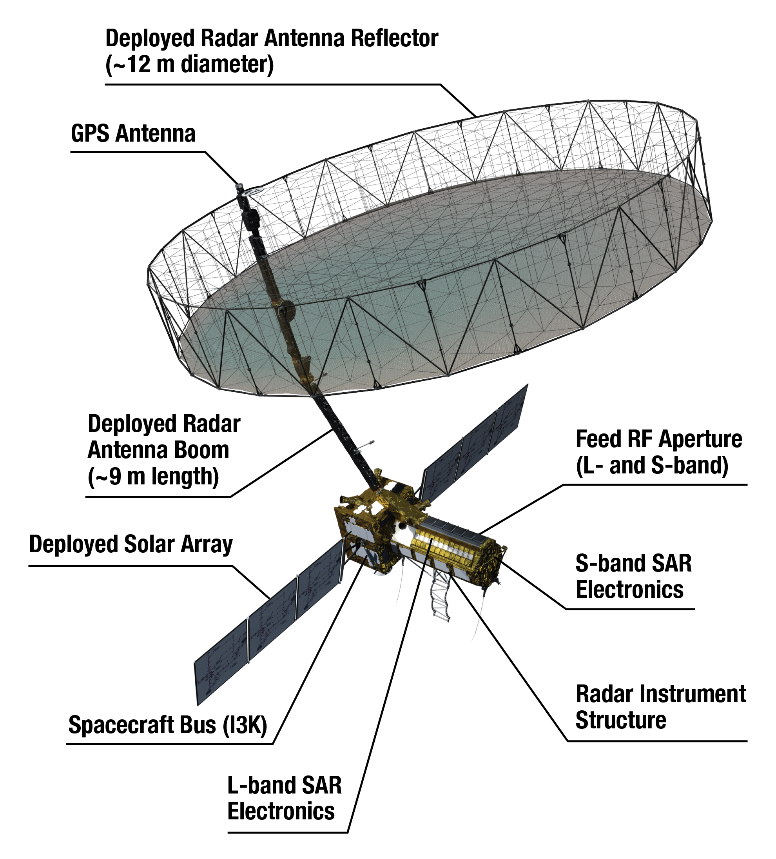
  • The 2,800 kilograms satellite consists of both L-band and S-band synthetic aperture radar (SAR) instruments, which makes it a dual-frequencyimaging radar satellite. SAR is capable of penetrating clouds and can collect data day and night regardless of the weather conditions.
    • L-band SAR operates at a frequency of around 1 to 2 GHz. The lower frequency (higher wavelength) of L-band SAR allows it to penetrate through vegetation and soil, making it useful for monitoring changes in forest cover, soil moisture etc.
    • S-band SAR operates at a frequency of around 2 to 4 GHz. S-band SAR has a higher resolution than L-band SAR and is typically used for applications where higher detail is required, such as monitoring changes in urban areas or coastal zones. 
  • The spacecraft will orbit the Earth in a sun-synchronous orbit of 747 Km with a 12-day repeat cycle. 
Overview | Observatory – NASA-ISRO SAR Mission (NISAR)

Significance:

  • The NISAR satellite with two frequency bands: L-band and S-band will image the seismically active Himalayan region that will create a “deformation map” every 12 days and provide high-resolution, all-weather data.
    • While satellite imagery to study deformation in land is already employed in India, the frequency at which observations are taken and the clarity of the images is critical. 
    • With a frequency of 12 days and the ability to be able to provide images even under cloudy conditions, NISAR would be a valuable tool to study deformation patterns, such as in Joshimath. 

Other Applications:

  • Study Earth’s dynamic land and ice surfaces in greater detail and observe subtle changes in Earth’s surfaces. E.g., Track flow rates of glaciers and ice sheets, landslide-prone areas and changes in the coastline etc.
  • Spot warning signs of natural disasters, such as volcanic eruptions, earthquakes and landslides. 
  • Measure groundwater levels, agricultural mapping, natural resource mapping and monitor Earth’s forest and agricultural regions to improve understanding of carbon exchange. 

Jupiter Icy Moons Explorer Mission (JUICE)

Context: The JUpiter ICy Moons Explorer (Juice) mission is scheduled to lift off on Europe's most powerful rocket - the Ariane-5.

Juice Mission:

  • Juice is on an eight-year-long voyage to make detailed observations on Jupiter and three of its ocean-bearing moons — Ganymede, Callisto and Europa. 
  • The objective is to explore the moons in search of signs of life and to explore if it is possible to live around giants or for habitability. 
  • During its voyage, the spacecraft will complete fly-bys of Venus, Earth, and the Earth-Moon system to arrive at its destination in 2031.
  • The mission has instruments including a remote sensing package with spectral imaging capabilities, a laser altimeter (GALA), a radar sounder (RIME) for exploring the moon’s surface and subsurface, instruments to study the particle environment (PEP), a magnetometer (J-MAG), and a radio and plasma wave instrument (RPWI).
  • JUICE Mission will orbit Ganymede and end its life there. 
  • Operations of JUICE Mission will overlap with NASA’s Europa Clipper Mission.

About Jupiter:

  • Jupiter is the fifth planet from the Sun and the largest in the Solar System.
  • It is a gas giant primarily composed of hydrogen, followed by helium. 
  • It is the third brightest natural object in the Earth's night sky after the Moon and Venus. 
  • Jupiter is surrounded by a faint planetary ring system and has a powerful magnetosphere. The Great Red Spot is a gigantic storm (anticyclone) that is about twice as wide as Earth, circling the planet in its southern hemisphere.
  • Jupiter has the highest number of moons in our Solar System (95 known moons till date) including Ganymede which is the largest (larger than the planet Mercury).

About Ganymede

  • Largest moon in our solar system. It is even bigger than planet Mercury.
  • There is strong evidence that Ganymede has underground saltwater ocean that may hold more water than all the water on Earth’s surface.
  • It is the only moon known have its own magnetic field – typically only found on planets like Earth. 
  • Ganymede has a faint oxygen atmosphere; however, it is far too thin to breathe.

About Callisto

  • Jupiter’s second largest moon and third largest moon in our solar system.
  • Surface of Callisto is heavily cratered created of ice and rock.
  • Scientists believe that Callisto may have an underground salty ocean making it a potential habitat for life. 

About Europa

  • Europa is slightly smaller than Earth’s moon and barely one-quarter the diameter of Earth itself. 
  • Surface of Europa is composed of solid water ice and it has extremely thin oxygen atmosphere. 
  • Europa is believed to be most promising place in our solar system to have environment suitable for life.
  • Beneath the icy surface of Europa is a salty-water ocean thought to contain twice as much water as Earth’s oceans combined. 

Awaiting lift-off into the Second Space Age

Context: The Space Age began in 1957 with the launch of satellite Sputnik 1, and in 1961, cosmonaut Yuri Gagarin became the world’s first person in space. Neil Armstrong made history by walking on the moon in 1969. The First Space Age became reality.. 

Some of the key highlights of space exploration include

  • The first artificial satellite Sputnik 1 launched by Soviet Union in 1957. This marked the beginning of the space age and the space race between the Soviet Union and the United States.
  • The first human spaceflight by Soviet cosmonaut Yuri Gagarin in 1961. This demonstrated the possibility of safe space travel and return to Earth.
  • The Apollo 11 mission in 1969 which landed the first humans on the Moon. Neil Armstrong and Buzz Aldrin became the first men to walk on the lunar surface. This remains one of the greatest technological and scientific achievements in human history.
  • The launch of space stations like Salyut 1, Skylab and Mir that allowed long-duration human habitation in space. This paved the way for today's International Space Station.
  • The exploration of the solar system using robotic spacecraft like the Voyager probes which revealed mysteries of the outer planets. Spacecraft have explored Mars, Venus, Jupiter, Saturn, Uranus and Neptune.
  • Major space-based observatories like the Hubble Space Telescope that have expanded our understanding of the universe. Astronomers have discovered new exoplanets, black holes, dark matter and distant galaxies with these observatories.
  • Commercial spaceflight has now become a reality with companies like SpaceX and Blue Origin developing reusable rockets and spaceships. Space tourism may soon become available to more people.

Today, the Second Space Age is here. Though there is no precise date for its beginning, the contrast in today’s space domain is stark. Between the 1950s to 1991, a period dominated by the Cold War, 60 to 120 space launches took place annually and 93% of these were by the United States and the erstwhile Union of Soviet Socialist Republic (USSR) governments.

Three decades later, there are not only many more actors in the space scene, but a majority are also private companies. Last year, there were 180 rocket/space launches, 61 by Elon Musk’s Space X; 90% of global space launches since 2020 are by and for the private sector.

The 'Second Space Age' refers to the period from the 1990s onwards which saw increased private sector involvement in space exploration. Some key aspects of the Second Space Age:

  • Commercialization of space: Private space companies like SpaceX, Blue Origin, Virgin Galactic, etc. have emerged that offer launch services and space tourism. They are developing reusable rocket technology to lower the cost of access to space. SpaceX's Falcon 9 rocket and Dragon spacecraft have transformed space transportation.
  • Space mining: Companies like Planetary Resources and Deep Space Industries aim to mine asteroids for resources like water and precious metals. Space mining could revolutionize space-based industries if it becomes economically viable.
  • Space tourism: Companies like Virgin Galactic and Blue Origin are developing spacecraft for suborbital space tourism. SpaceX has also announced plans to send tourists on a flight around the Moon aboard its Starship spaceship. Space tourism can make space accessible to more people.
  • Advancements in robotics: Robotic spacecraft have explored much of the solar system. Robotic probes like New Horizons explored Pluto, Dawn explored Ceres and Hayabusa2 explored asteroid Ryugu. Robotic spacecraft can reach distant and harsh environments where humans cannot easily go.
  • Private space stations: Companies like Axiom Space and Bigelow Aerospace are developing private space stations. Axiom Space aims to build a commercial module for the ISS and eventually a free-flying space station. Private space stations can provide more opportunities for tourism, research and manufacturing in space.
  • Space-based solar power: Concepts like space solar power satellites that can harness solar energy in space and transmit it to Earth have been proposed. They could provide a constant source of renewable energy but face major technical and economic hurdles.
  • Space mining and space-based economy: If space mining and space-based solar power become viable, it could lead to a space-based economy with space resources and space-based products. However, we are still far from developing a strong space-based economy.
  • Deep space exploration: Robotic and manned missions are envisioned to destinations like Mars, Venus, asteroids, etc. SpaceX's Starship aims to send humans to Mars. Robotic probes could explore ice giants like Neptune and Uranus. Future space telescopes could study exoplanets and distant galaxies.

India’s space journey begins

India's space program began in the 1960s and has made tremendous progress in the decades since. Some key highlights of India's space journey:

  • The Indian Space Research Organisation (ISRO) was established in 1969 to develop space technology and its application to national development. It replaced the erstwhile Indian National Committee for Space Research (INCOSPAR) set up in 1962.
  • India's first satellite Aryabhata was launched by the Soviet Union in 1975. This marked the beginning of India's space program.
  • The Satellite Launch Vehicle (SLV) program in the 1980s aimed to develop indigenous satellite launch capability. The first SLV rocket successfully launched the Rohini RS-1 satellite in 1980.
  • The Polar Satellite Launch Vehicle (PSLV) program began in the 1990s. PSLV rocket is capable of launching payloads into the Earth’s polar orbit. It has had over 50 successful missions.
  • The Geosynchronous Satellite Launch Vehicle (GSLV) program aims to launch payloads into geostationary orbit. GSLV Mk III, India's most powerful rocket, successfully launched Chandrayaan-2 in 2019.
  • The Indian Remote Sensing (IRS) program has launched several remote sensing satellites used in fields like agriculture, water resources, forestry and disaster management.
  • Chandrayaan-1, launched in 2008, was India's first lunar mission. It provided evidence for water molecules on the Moon's surface.
  • The Mars Orbiter Mission (MOM) or Mangalyaan, launched in 2013, made India the first Asian nation to reach Mars orbit. It is studying the Martian surface and atmosphere.
  • Chandrayaan-2 and Gaganyaan are upcoming missions. Chandrayaan-2 will land a rover on the lunar surface. Gaganyaan aims to send Indian astronauts to space by 2021.
  • Applications of space technology have led to advances in fields like telemedicine, teleeducation, weather forecasting, GIS and navigation. Space technology has become deeply linked with serving societal needs.

India has one of the world's most successful space programs despite its limited resources. Ambitious future goals include human spaceflight, space station, crewed missions to the Moon and Mars, and developing reusable rocket technology. The increasing commercialization of space may provide new opportunities for international collaboration. India's progress in space has established it as a leader in space science and technology across the globe.

Space potential

The origins of the Second Space Age can be traced to the Internet. In India, the process began accelerating as the 1990s saw the emergence of private TV channels, together with cable TV followed by direct-to-home transmissions.

The demand for satellite transponders and ground-based services exploded. Today, more than half the transponders beaming into Indian homes are on foreign satellites.

The last 15 years witnessed another transformation, and this time India was in lockstep with the developed world. The age of mobile telephony, followed by smartphones has shown the world what a data-hungry and data-rich society India is.

Broadband, OTT and now 5G promise a double-digit annual growth in demand for satellite-based services.

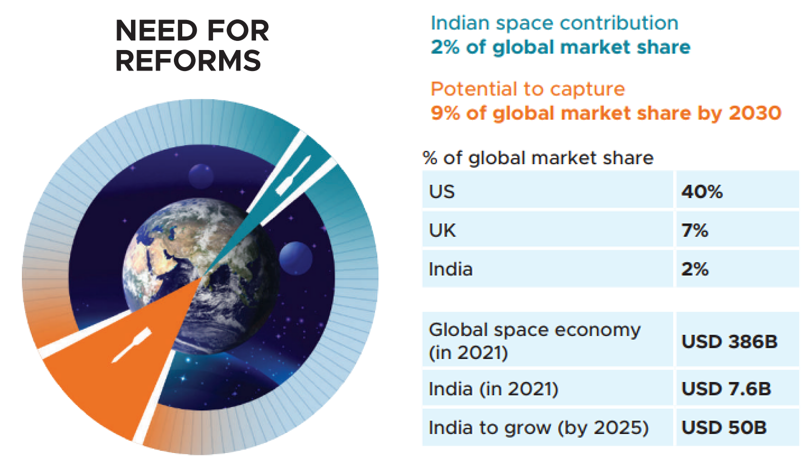
In 2020, the global space economy was estimated at $450 billion, growing to $600 billion by 2025. The Indian space economy, estimated at $9.6 billion in 2020, is expected to be $13 billion by 2025. However, the potential is much greater with an enabling policy and regulatory environment. The Indian space industry could easily exceed $60 billion by 2030, directly creating more than two lakh jobs.

Potential of space exploration and space-based technologies

  • Space mining: Asteroids contain precious metals like gold, platinum, cobalt, etc. and water in the form of ice. Space mining could provide resources for space-based industries and space exploration. However, it remains technologically and economically challenging.
  • Space-based solar power: Giant solar panels in geostationary orbit could collect solar energy and beam it to Earth as microwaves. This could provide a constant source of renewable energy. But it requires major technological capabilities and high costs.
  • Space tourism: Suborbital and orbital space tourism could make space accessible to more people. SpaceX, Virgin Galactic, Blue Origin, etc. are developing spacecraft for space tourism. While suborbital tourism is emerging, orbital space tourism remains expensive.
  • Private space stations: Companies are developing private space stations, either modules attached to ISS or independent space stations. They aim to host tourists, researchers, manufacturers, etc. But space stations require huge investments and the demand for their services is still not proven.
  • Space colonization: Establishing long-term human habitation beyond Earth, on the Moon, Mars, space colonies, etc. This could hedge against threats to humanity on Earth and eventually "backup" our species. But space colonization faces daunting technological, economic and physiological challenges.
  • Asteroid mining robots: Robotic spacecraft could explore and mine asteroids to extract resources useful for space-based or Earth-based applications. Robots can reach harsh space environments, but robotic manipulation of resources and transportation back to Earth requires major advancements.
  • Space-based solar power satellites: Satellites in geosynchronous orbit could capture and transmit solar energy as microwaves to receiver stations on Earth. They could provide a constant renewable energy source. But technology for efficient energy conversion, transmission and receival does not yet exist.
  • Space manufacturing: Microgravity environment enables production of materials, composites and biological tissues difficult or impossible to create on Earth. ZBLAN fibers for telescopes and organs grown from stem cells are examples. But space manufacturing and transportation back to Earth needs to become more economically viable. 
  • Space resources for deep space exploration: Access to space resources like water, oxygen, hydrogen, etc. on the Moon and asteroids could make deep space exploration more feasible by reducing the amount of supplies launched from Earth. But we have a long way to go to utilize space resources for human missions into deep space.

In summary, while space offers exciting possibilities, most space-based technologies and concepts remain at an early stage and require major advancements before providing tangible and economically sustainable services. Government and private sector support for space technology development and space exploration will be crucial to harnessing these opportunities. Overall, the potential of space is promising but much work lies ahead to unlock the promise.

Creating an enabling environment

  • The Indian space start-up industry is growing rapidly with increasing investment and number of start-ups. It has the potential to boost the space sector like the IT industry did for the economy.
  • ISRO currently manages limited launches and satellites compared to other space agencies like China. While ISRO has worked with private companies, they were mainly vendors. Space start-ups need a different relationship as their business depends on space.
  • ISRO plays multiple roles as an operator, user, service provider, licensor, regulator and incubator. It needs to now focus on research based on its expertise and resources. The government has taken some steps to promote private participation like draft space laws, NSIL, IN-SPACe, etc.
  • Specific policies for satcom, earth observation and FDI have been proposed but legislation like a space act is needed to provide a legal framework, set up a regulator and enable venture funding for space start-ups.
  • India has an opportunity to be part of the Second Space Age with increased private sector involvement but it needs to act fast before the opportunity is lost.
  • A space act should provide guidelines for licensing of space activities, a regulatory body to oversee compliance, and set the overall framework for public-private partnership in space sector. It can boost investment in space start-ups by providing clarity.
  • The existing and proposed government initiatives show there is willingness to bring private companies into space sector. But a comprehensive space act is vital to give shape to these efforts and transition ISRO's role to open up the space sector.
  • Space start-ups in India want to do more than just build to ISRO's specs. They need freedom and incentives to innovate which can be enabled by a progressive space policy and regulatory environment. Partnership with ISRO remains key but needs to evolve.
  • There is significant interest and talent within the private sector to take up new opportunities in space. An enabling policy and regulatory environment can unleash the potential of space start-ups to support the growth of India's space sector. But the window to do so may be limited.
  • India's space sector is poised for major transformation with increased private participation. ISRO and government's role in providing an enabling environment through policy, regulation and partnership will influence the pace and scope of this transformation. Overall support for innovation and risk-taking can power India's journey to the forefront of the global space race.

India's LIGO Project to be built by 2030

Context: The Union Cabinet has approved a gravitational-wave detector project in Maharashtra costing Rs 2,600 crores, estimated to be built by 2030.

Laser Interferometer Gravitational-wave Observatory

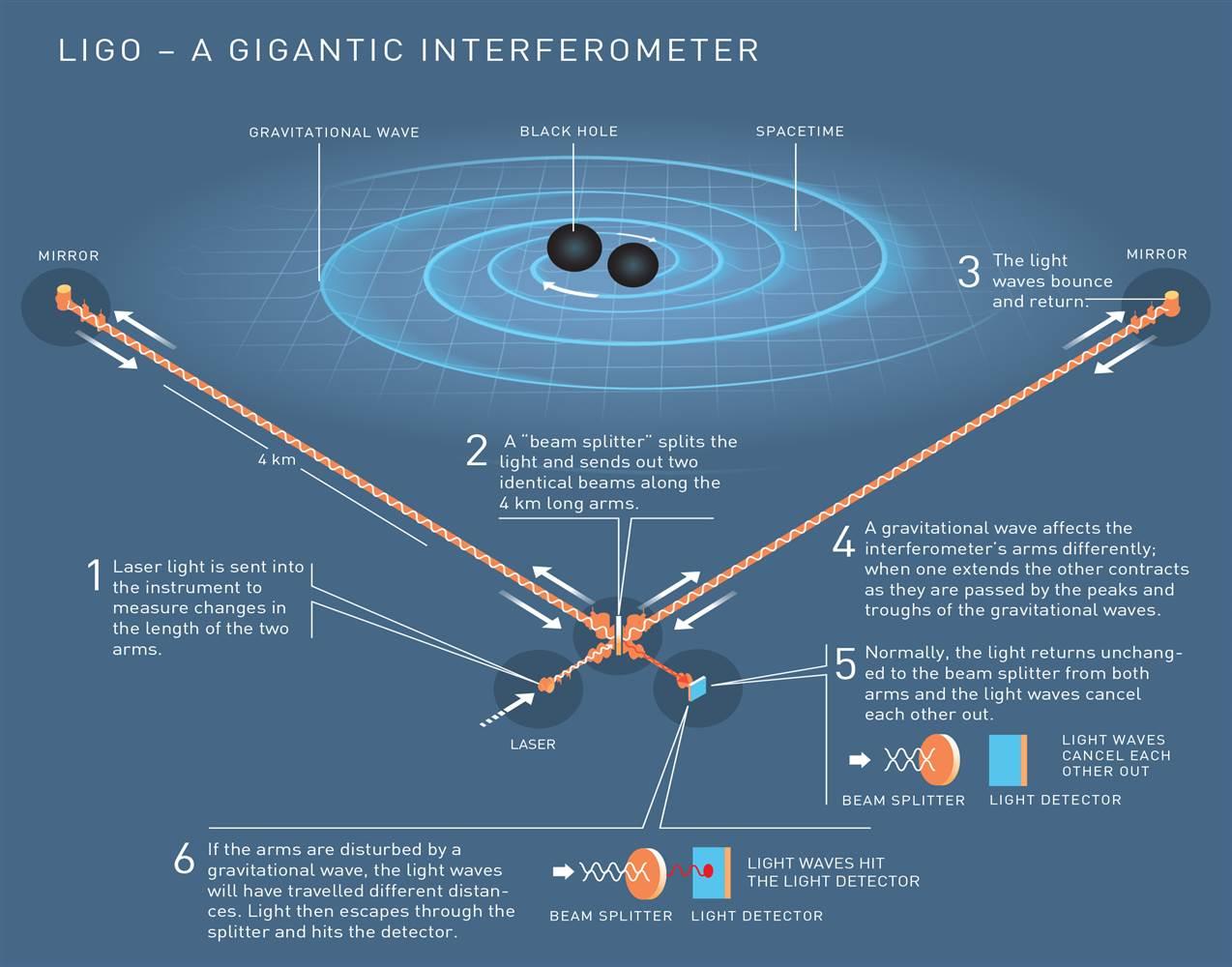
  • LIGO, or Laser Interferometer Gravitational-Wave Observatory, is an international network of laboratories meant to detect gravitational waves — ripples in space-time produced by the movement of large celestial bodies such as stars and planets.
  • LIGO comprises two enormous laser interferometers located 3000 kilometres apart in Hanford, Washington and Livingston, Louisiana, the United States.
    • The gravitational waves were first discovered in 2015 by two LIGOs based in the United States. 

LIGO India Project

  • A third gravitational-wave detection facility is being built in India as part of the LIGO-India collaboration to:
    • increase the chances of detecting gravitational waves from anywhere in the observable universe.
    • improve the detectors’ collective ability to pinpoint sources of gravitational waves in the sky. 
  • To be located in the Hingoli district of Maharashtra, LIGO-India is scheduled to begin its scientific runs in 2030. 
  • The Department of Atomic Energy and the Department of Science and Technology are building LIGO-India in partnership with the U.S. National Science Foundation and various national and international research institutions.

Mechanism

  • The L-shaped LIGO instrument has two arms, each measuring 4 km long that constitute the most sensitive interferometers in the world. Laser pulses are fired simultaneously through both arms, bouncing off the mirrors at the ends to return to the vertex. A detector analyses whether the pulses coincide upon return. Detecting gravitational waves involves recording and analysing the slightly out-of-time pulses in the detector produced by their passage.
LIGO

Need for the project

  • While two LIGOs can detect gravitational waves, a third observatory is required for better triangulation of the location of a source of gravitational waves in the sky. A more ideal setup requires four observatories to record the same wave. To this end, researchers are setting up and upgrading detectors in Italy and Japan.
    • Triangulation refers to analysing the results of the same study using different methods of data collection to enhance the validity, reliability, and comprehensiveness of research findings.

Significance

  • The observatory will help in better understanding astronomical objects like neutron stars and black holes and for the in-depth study of gravitational waves.
  • The project would have several spin-off benefits to Indian science, apart from making India an integral part of one of the most prestigious international scientific experiments.
  • India could become a global site of gravitational physics research, aiding training and the handling of precision technologies and sophisticated control systems, ultimately, cementing a reputation for successfully running an experimental Big Science project.
    • The starting requirement here is the timely release of funds for construction, followed by issuing the allocated resources without delay.

Gravitational Waves

  • Gravitational waves are ripples in space-time caused when massive objects move with extreme accelerations (similar to ripples in a water pond). 
  • The waves are invisible, travel at the speed of light and squeeze and stretch anything in their path as they pass by. 
  • Gravitational radiation is exceedingly difficult to detect because gravity by nature is much weaker than electromagnetic radiation.
    • Gravity is the weakest of the four fundamental forces of nature i.e., electromagnetic force, strong nuclear force and weak nuclear force. 
    • Due to the extremely low strength of gravitational waves, a high-precision instrument like LIGO is required for their detection. 
  • The most powerful gravitational waves are created when objects move at very high speeds. Some examples of events that could cause a gravitational wave are:
    • when a star explodes asymmetrically (called a supernova)
    • when two big stars orbit each other
    • when two black holes orbit each other and merge. 

Govt. nod for Indian Space Policy 2023

Context: Central Government approved the Indian Space Policy 2023 that seeks to institutionalise the private sector participation in the space sector, with Indian Space Research Organisation (ISRO) focusing on research and development of advanced space technologies.

Major Highlights

  • Indian Space Policy-2023 delineated the roles and responsibilities of ISRO, space sector PSU NewSpace India Limited (NSIL) and Indian National Space Promotion and Authorization Center (IN-SPACe).
    • ISRO will not do any operational and production work for the space sector and focus its energies on developing new technologies, new systems and research and development. 
    • NSIL, a public sector undertaking under the Department of Space, will work in a demand-driven mode and carry out the strategic activities related to the space sector. 
    • IN-SPACe will be the interface between Indian Space Research Organisation and non-governmental entities. 
  • The focus of the policy would be to increase the participation of the private players in the space sector.
    • It will allow the private sector to take part in end-to-end space activities that include building satellites, rockets, and launch vehicles and data collection and dissemination.
    • It creates the framework for the private sector to use ISRO facilities for a small charge and encourage them to invest in creating new infrastructure for the sector. 

Significance

  • Entry of the private sector in the space sector would enable the ISRO to channelise its focus on research and development of advanced space technologies.
  • It offers much-required clarity in space reforms and augment private industry participation to drive the space economy opportunity for the country. 
  • It will enable larger participation between the research academia, startups, and industry. 
  • Increase investments from private companies in the space sector, with players such as OneWeb and more planning to offer commercial services in near future.
mI SpzmMPMHnvT CWXg8wQNOISeB4TT52lpo8IVjODyNUBELt41 7jh62OfAW2YcChYINu0lLJmUeAf7H6SxxaxHhkhSSVwDRoxR9dwxLfoPcpB7lSlcmCeg4Im 1u0omL88s31j N23ozV9V7bPYg

Indian Space Sector

  • In June 2020, the government opened the space sector to allow participation of private firms in the entire gamut of space activities.
    • As part of these reforms, the government set up New Space India Limited (NSIL), the country's first public sector undertaking in the space sector, and Indian National Space Promotion and Authorization Centre (IN-SPACe), as the promoter and regulator of space activities in India by non-government and private entities.
    • As a result, within 3 years, the number of startups has reached about 150 in ISRO. 
  • Presently, Foreign Direct Investment (FDI) in space sector is allowed up to 100% in Satellites-Establishment and Operations through Government route only.

ISRO’s Reusable Launch Vehicle landing test successful

Context: Indian Space Research Organisation (ISRO) has successfully conducted landing experiment of Reusable Launch Vehicle – Technology Demonstration (RLV - TD) programme.

More on news

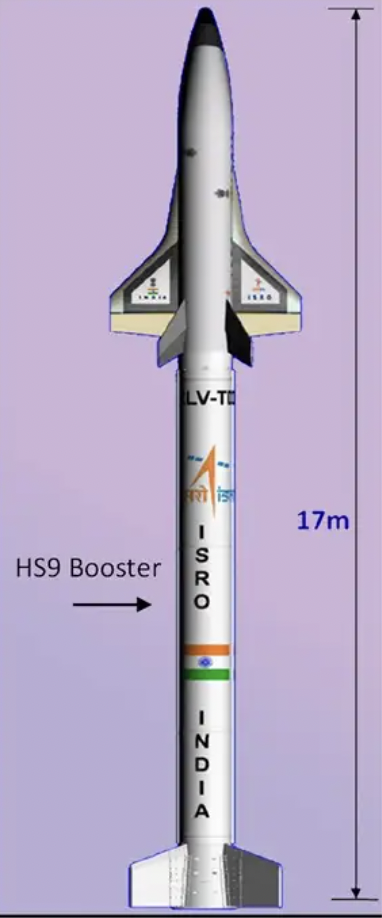
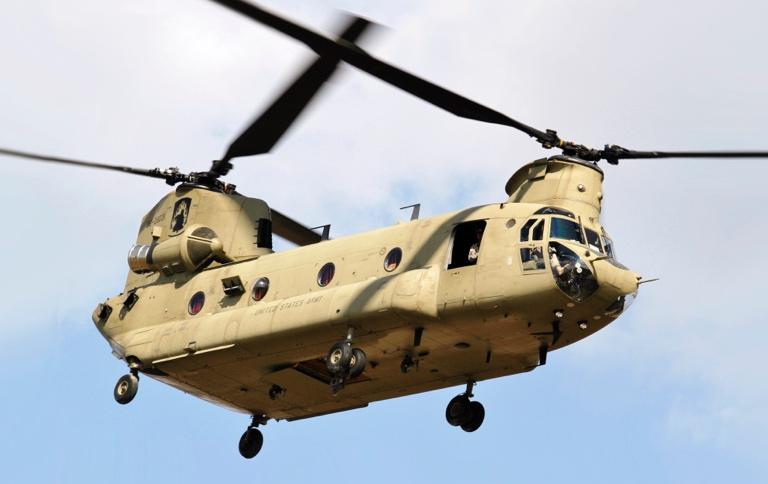
For the first time in the world, a winged body has been carried to an altitude of 4.5 km by a helicopter (Chinook) and released for carrying out an autonomous landing on a runway. The release of the RLV was autonomous, as it performed approach and landing manoeuvres using Integrated Navigation, Guidance and Control System and completed the landing on the airstrip.

sECXYAaPu27MBN SjAX oh5sptkXAyQaMLwTs0sXLU97WkoQQb k1Y7TcnMoxUz7hUdKznpGAi mii9kjTK5Pu UWQlP

RLV – TD

ISRO's RLV-TD is a technology demonstrator for a fully reusable launch vehicle, featuring hypersonic flight, autonomous landing, and powered cruise flight technologies. It has a winged aircraft-like configuration with a fuselage, double delta wings, twin vertical tails, and active control surfaces. It was boosted to Mach no: 5 by a solid booster and will be scaled up to become India's first stage of a reusable two-stage orbital launch vehicle. 

Objectives of RLV – TD

  1. Hypersonic aero thermodynamic characterisation of wing body
  2. Evaluation of autonomous Navigation, Guidance and Control (NGC) schemes 
  3. Integrated flight management 
  4. Thermal Protection System Evaluation

Indian Space Research Organisation (ISRO)

  • It is the space agency of India which is involved in science, engineering and technology to harvest the benefits of outer space for India and the mankind. 
  • ISRO was previously the Indian National Committee for Space Research (INCOSPAR), set up by the Government of India in 1962, as envisioned by Dr. Vikram Ambalal Sarabhai
  • ISRO was formed on August 15, 1969 and superseded INCOSPAR with an expanded role to harness space technology. 
  • Department of Space (DOS) was set up and ISRO was brought under DOS in 1972. 
  • ISRO has its headquarters in Bengaluru
  • The activities of ISRO are guided by its Chairman, who would also be the secretary of DOS and Chairman of Space commission – the apex body that formulates the policies and overseas the implementation of the Indian Space Programme.
Centres & Units of ISROActivities
Vikram Sarabhai Space Centre (VSSC), ThiruvananthapuramBuilding of Launch Vehicles
U R Rao Satellite Centre (URSC), BengaluruDevelopment and designing of Satellites
Satish Dhawan Space Centre (SDSC), SriharikotaIntegration and launching of satellites and launch vehicles
Liquid Propulsion Systems Centre (LPSC), Valiamala & BengaluruDevelopment of liquid stages including cryogenic stage
Space Applications Centre (SAC), AhmedabadSensors for Communication and Remote Sensing satellites and application aspects of the space technology
National Remote Sensing Centre (NRSC), Hyderabad. Remote Sensing satellite data reception processing and dissemination

Chinook Helicopter

XTtOMPllLzk4a2MBk1loPA 38D8OiVCJ1 2PbnW hFV
  • The Boeing CH-47 Chinook is a tandem rotor helicopter developed by American rotorcraft company Vertol and manufactured by Boeing Vertol. 
  • The Chinook is a heavy-lift helicopter that is among the heaviest lifting Western helicopters.
  • It has a top speed of 310 km per hour and is one of the fastest helicopters in the world.
  • It is also very effective in rescue and relief missions during national disasters, due to capability to carry heavy loads.
  • The Indian Air Force operates a fleet of 15 Boeing made Chinook helicopters, which were acquired from the US in 2015 and were inducted into service in 2019.

Space design lab for startups opens in Ahmedabad

Context: India has unveiled a state-of-the-art design facility in Ahmedabad to help startups in the space industry convert their innovative concepts into workable models. V. Somanath, the chairman of ISRO, inaugurated the Space Systems Design Lab of the Indian National Space Promotion and Authorisation Centre (IN-SPACe) at Bopal near Ahmedabad. 

More about the news: 

  • The IN-SPACe design lab is equipped with cutting-edge analysis and simulation software for IN-SPACe, which models, visualises, and optimises payload and spacecraft, ground station, and launch vehicle avionics. 
  • Lab resources will assist in creating prototypes with the fewest iterations possible, drastically lowering turnaround time and R&D expenses for start-ups. 
  • The lab is equipped with 16 workstations and high-performance multi-core (400 core) servers for computation.

IN-SPACe for a New India Space Sector

  • In June 2020, the Indian government announced significant space reforms aimed at boosting the private sector space industry, including start-ups. 
  • Indian National Space Promotion and Authorization Centre (IN-SPACe), an independent nodal organisation under the Department of Space (formally launched in June, 2022), is the focal point of the country's space reforms.
  • Purpose:
    • Encourage, enable, authorise and supervise private firms and start-ups to engage in space operations. 
    • Tap into the vast untapped potential of the nation's technical know-how and human resources. 
    • Provide private and non-governmental organisations the ability to conduct their own autonomous space operations.

VISION:

To promote the space economy in the nation, and empower non-governmental entities (NGEs) to participate in space operations for a resurgent AatmaNirbhar Bharat.

Organisational Structure of In-SPACe

  • Headquarters: Ahmedabad, Gujarat
  • IN-SPACe is operating with three directorates and a joint secretary

Functions

  • The organization serves as the link between NGEs and ISRO and offers suggestions for improving the utilisation of India's space assets and boosting space-based activities.
  • To enable interested parties to carry out their space-related operations through IN-SPACe, and make use of already-existing ISRO infrastructure on both the ground and in space as well as data and scientific and technological resources.
  • In collaboration with ISRO, the organisation will assess the expectations of private sector businesses, particularly educational institutions, and determine how to better meet those wants.
  • The decisions of the organisation would be binding on- ISRO and private sector organisations. The organisation will concentrate on research and development, which was the core function of ISRO.

Space Sustainability Rating (SSR) For Debris Management

Context: The world is witnessing rapid increase in creative business models and new technologies leading to launch of thousands of satellites in Low-Earth Orbit. There is growing risk that Earth’s capacity to accommodate such a large set of new objects safely may be in jeopardy. In this context, Space Sustainability Rating is an initiative that seeks to foster voluntary action by satellite operators to reduce the risk of space debris, on-orbit collisions and unsustainable space operations.

About Space Sustainability Rating

  • Space Sustainability Rating is tool developed for a more sustainable use of space by encouraging space actors to design & implement sustainable space missions and operations.
  • It seeks foster voluntary and bold action by satellite operators to reduce risk of space debris, on-orbit collisions and unsustainable space operations.
  • Members: It has been developed by World Economic Forum (WEF), European Space Agency (ESA), Space Enabled research group at MIT, University of Texas at Austin & BryceTech. It is based at eSpace at Ecole Polytechnique Lausanne in Switzerland.  
  • Rating methodology: 
    • It is a tiered scoring system that takes a series of metrics based on models to quantify and measure sustainability decision taken by operators. 
    • Credits (Points) are awarded for actions leading to positive impact on space environment, actions that result in more sustainable impact receive more points. 
    • It is formulated as a combined score based on evaluation of individual modules, where different aspects of space sustainability are covered. 
    • To rate a mission, the operator in charge of it voluntarily reaches out to the SSR to start the process. The SSR team collects relevant information regarding different aspects of the mission's sustainability efforts and then sends these data to their computation partners. Afterwards, the non-profit gathers it all and computes the rating.
  • Tier Score: A rated entity receives a ‘Tier Score’ that will determine the rating between Bronze, Silver, Gold or Platinum. Each of the SSR tiers are achieved after earning a certain combined score between 0 (low) and 1 (high), based on combined evaluation of individual modules. 
  • Bonus ‘Step’ Indicator: Enables the possibility to earn additional credit towards a bonus ‘step’ indicator, which highlights certain steps a mission can take to ‘go over and beyond’ the baseline rating towards space sustainability. Bonuses are reported separately and do not contribute to baseline rating of a requesting identity. 

Indicators used in Space Sustainability Rating

  • Mission Index: This module is directly derived from European Space Agency’s (ESA) debris index and quantifies the level of harmful physical interference caused by planned design and mission operation. It measures the impact of a space mission on space environment, using the Environmental Consequences of Orbital Breakups (ECOB) based on mission characteristics, collision avoidance strategy and disposal strategy. 
  • Detectability, Identification & Trackability: Aims to encourage satellite operators to consider how physical attributes of their satellite design and their operational approach during launch, operations and disposal affect the level of difficulty. Small objects which might be operational but cannot be reliably included in space surveillance and tracking products form a risk to other objects in the space. Also, identification is required for registration and liability purposes. 
  • Collision Avoidance Capabilities: These are essential capabilities satellite operators should have to improve their ability to identify, respond to and mitigate collisions. This module aims to emphasise the steps which can be taken by operators to reduce the risk of accidental collision with debris and among active operators. 
  • Data Sharing: Measures the information that satellite and launch vehicle operators should share with peers and stakeholders and contribution of such information sharing to spaceflight safety. Sharing of space situational awareness and other information by operators is critical to space safety.
  • Design & operation standards: Adoption of internationally endorsed standards in space domain is essential for ensuring compatibility in understanding between operators among themselves and between an operator and space environment, which is being used. Successfully addressing the problem of space sustainability when it comes to avoiding the creation of space debris and operating in congested environments can only be achieved by means of common understanding and objectives.
  • External services: Includes a wide range of activities and identifies classes of action that satellite operators can take to make their mission more amenable to receive External Services (ES) or to increase the probability of successful external services such as fixing, improving and reviving satellites and refers to any work to refuel, repair, replace or augment a satellite in space. 

About Space Debris

  • According to estimates, there are around 20,000 objects which are drifting through low-earth orbits. 
  • Kessler Syndrome: It is a phenomenon in which the amount of junk in orbit around Earth reaches a point where it creates more and more space debris. 
  • Conjunctions: Due to rapid increase in number of low-earth objects, close encounters between these objects known as ‘conjunctions’ are at an all-time high, meaning satellites and other spacecraft or debris fragments are increasingly at risk of colliding with each other. 
  • Anti-satellite weapons and space warfare are expected to increase space debris by multiple times. For ex. India’s Anti-Satellite Weapon. 

Initiatives for Space Debris Sustainability

  • Zero Debris Approach: ESA aims to totally stop the generation of debris in valuable orbits by 2030. ESA has also launched Clean Space Initiative for testing various technologies for debris management.
  • Grapple Fixtures: They are used on spacecraft or other objects to provide a secure connection for a robotic arm. 
  • Graveyard Orbits: A graveyard orbit, also called a junk orbit or disposal orbit, is an orbit that lies away from common operational orbits. Satellites are moved into such orbits at the end of their operational life to reduce the probability of colliding with operational spacecraft and generating debris. 
  • Space Net: Japan’s JAXA launched a test space net satellite to collect space junk. 
  • E.Deorbit: A planned active space debris removal mission being developed by Europe’s European Space Agency as part of Clean Space Initiative. It aims to take down a derelict satellite. 
  • ClearSpace-1 will be the first space mission to remove an item of debris from orbit, planned for launch in 2025.
  • Remove Debris Mission: Aims to test the efficacy of several ADR technologies on mock targets in low earth orbit. The platform is equipped with a net, a harpoon, a laser ranging instrument, a dragsail and two CubeSats. 
  • International Guidelines for Space Debris Management: Currently, there is no international treat minimising space debris. However, UN Committee on Peaceful Uses of Outer Space has published voluntary guidelines in 2007 for space debris management.  

Suggestions for space debris

  • Design rockets and spacecraft to minimise the amount of ‘shedding’ – material becoming detached during launch and operation, due to the harsh conditions of space.
  • Prevent explosions by releasing stored energy, ‘passivating’ spacecraft once at the end of their lives.
  • Move defunct missions out the way of working satellites – either by de-orbiting them or moving them to a ‘graveyard orbit’.
  • Prevent in-space crashes through careful choice of orbits and by performing ‘collision avoidance manoeuvres’.

Massive coronal hole found on sun, it's 20 times larger than Earth: Experts

Context: The sun has developed a massive “hole” 20 times larger than Earth, marking the second such occurrence in a week. The coronal hole is unleashing solar winds of 2.9 million km/h toward Earth. 

More on the news: Scientists are carefully monitoring the situation to assess if the winds will impact our planet’s magnetic field and satellites – with the potential for knock-on effects on the internet, mobile phone networks, and GPS. It is also noteworthy to scientists as it has appeared near the sun’s equator. NASA’s Solar Dynamics Observatory captured holes.

Coronal holes

  • Coronal holes are areas of the Sun's corona where the magnetic field is open and allows for the escape of high-speed solar wind particles. 
  • Coronal holes are usually harmless, experts say and are usually found near the sun’s poles.
  • These areas appear as dark regions in images of the Sun's corona taken in ultraviolet and X-ray wavelengths. 
  • Coronal holes are characterized by low magnetic field strength and low temperatures compared to the surrounding areas.
  • Coronal holes are thought to be related to the Sun's magnetic field and the Sun's 11-year solar cycle, with more coronal holes appearing during times of high solar activity.
  • They are cooler, less dense areas of the star and appear during the less active stage of the sun’s 11-year cycle.
  • Coronal holes are magnetically open areas that are one source of the high-speed solar wind.
  • At times, the solar wind can generate aurora at higher latitudes on Earth. That coronal hole produced auroras far further south than usual, with the skies over Arizona turning an electric purple and green.
  • The solar wind particles that escape from coronal holes can impact Earth's magnetic field, causing auroras and other geomagnetic disturbances. Scientists study coronal holes to better understand the Sun's magnetic field and its effects on the space environment around Earth.

SOLAR ENERGETIC PARTICLES (SEP), SOLAR WINDS AND FLARES, AND CORONAL MASS EJECTIONS (CMES)

Solar flares and Coronal Mass Ejections (CMEs)

  • CMEs and Solar flares are both explosions that occur on the sun. Sometimes they occur together, but they are not the same thing - they emit different things, they look and travel differently, and they have different effects near planets.
  • Both eruptions are created when the motion of the sun’s interior contorts its own magnetic fields. Both originate from corona. 
  • Solar flares are giant burst of X-rays and energy which travel at the speed of light in all directions. 
  • CME are giant cloud of particles (mostly protons and electrons and powerful magnetic fields) hurled into the space, in particular direction. CMEs take one to three days to reach the earth. Flares only takes eight minutes. 
  • Flares and CMEs have different effects at Earth as well. The energy from a flare can disrupt the area of the atmosphere through which radio waves travel. This can lead to degradation and, at worst, temporary blackouts in navigation and communications signals. On the other hand, CMEs can funnel particles into near-Earth space. A CME can jostle Earth’s magnetic fields creating currents that drive particles down toward Earth's poles. When these react with oxygen and nitrogen, they help create the aurora, also known as the Northern and Southern Lights.
  • A solar flare is a sudden flash of increased brightness on the Sun, usually observed near its surface and in close proximity to a sunspot group. Powerful flares are often, but not always, accompanied by a coronal mass ejection. 
  • Solar flares affect all layers of the solar atmosphere (photosphere, chromosphere, and corona).
  • Flares occur in active regions around sunspots, where intense magnetic fields penetrate the photosphere to link the corona to the solar interior.
  • Flares are powered by the sudden release of magnetic energy stored in the corona.

Solar winds constantly occur due to the corona of the sun continually expanding. The solar wind is a stream of charged particles consisting of electrons, protons and alpha particles with kinetic energy between 0.5 and 10 keV. The composition of the solar wind plasma also includes a mixture of materials found in the solar plasma: trace amounts of heavy ions and atomic nuclei C, N, O, Ne, Mg, Si, S, and Fe.

Solar energetic particles (SEP) 

  • They are high-energy particles coming from the Sun. 
  • They were first observed in the early 1940s. 
  • They consist of protons, electrons and high-energy nuclei with energy ranging from a few tens of keV to many GeV. 
  • They are of particular interest and importance because they can endanger life in outer space (especially particles above 40 MeV). But their onset is extraordinarily hard to predict, in part because we still don’t know exactly where on the Sun they come from.
  • The greatest mystery about gradual SEPs is not what speeds them up, but where they come from in the first place. For reasons still not fully understood, SEPs contain a different mix of particles than the other solar material streaming off the Sun in the solar wind – fewer carbon, sulfur, and phosphorous ions, for instance. 
  • Many scientists thought Solar Energetic Particles would be found at the edges of the active region where the magnetic field is already open and material can escape directly. But the fingerprint matched only in regions where the magnetic field is still closed.
  • The SEPs had somehow broken free from strong magnetic loops connected to the Sun at both ends. These loops trap material near the top of the chromosphere, one layer below where solar flares and coronal mass ejections erupt.

ISRO puts 36 satellites into orbit

Context: Indian Space Research Organisation's Launch Vehicle Mark-3 (LVM3) placed 36 OneWeb satellites in a low earth orbit (LEO) following a successful launch from the Satish Dhawan Space Centre at Sriharikota.

OneWeb satellites:

  • OneWeb is a United Kingdom-based company, backed by the UK government and India’s Bharti Enterprises, which is implementing a constellation of LEO satellites.
    • The global communication network powered from space plans to enable connectivity for governments, businesses, and communities.
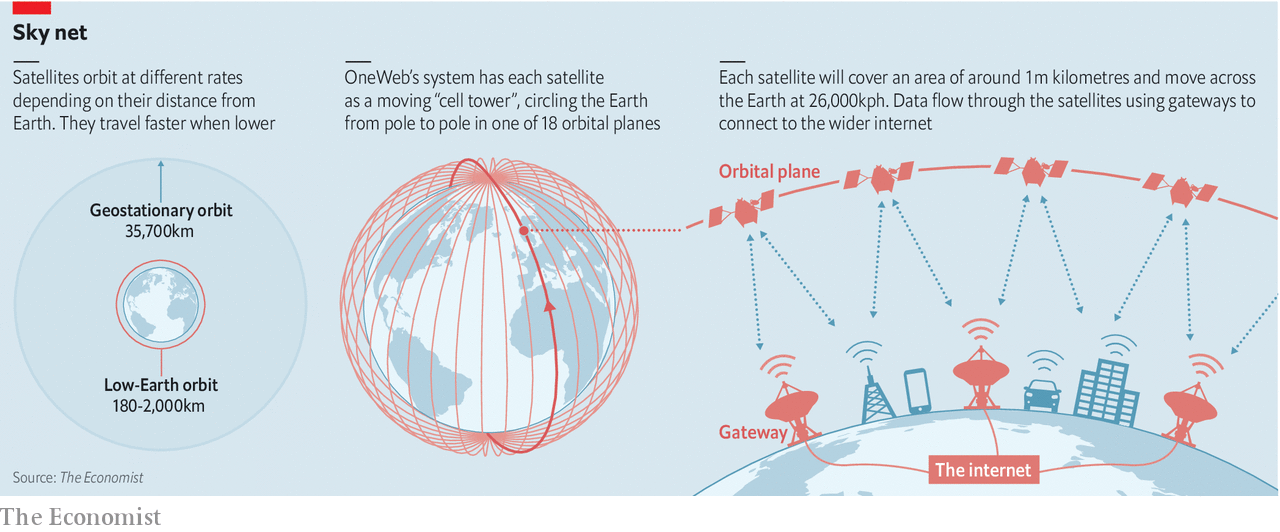
  • This is OneWeb’s 18th launch (second launch from India) which completed OneWeb’s constellation of 618 low earth orbit satellites that would allow it to offer high-speed, low-latency broadband internet services from space in every corner of the world.
  • The first set of 36 satellites was launched by the LVM3/OneWeb India-1 mission by ISRO on October 23, 2022.
Satellites may connect the entire world to the internet | The Economist

Significance:

  • OneWeb uses a constellation of LEO satellites to provide broadband internet access instead of the traditional method of using satellites placed in geostationary orbits (GEO) 36,000 km above the equator.
  • LEO satellites placed in orbits ranging from 200 km to 1,500 km from earth – compared to 36,000km for GEO satellites – significantly increase bandwidth and reduce latency in space to around 50-70 milliseconds (ms).
    • Latency refers to the time taken by a data packet to be transmitted from a user to the internet service provider through the satellite network.
    • The latency for GEO satellite networks is in the range of 500-700 ms, which limits their use to 2G and 3G communications. 

NISAR Satellite

Context: National Aeronautics and Space Administration (NASA) and the Indian Space Research Organization (ISRO) have jointly manufactured an earth science satellite named, NISAR (NASA-ISRO Synthetic Aperture Radar) at a cost of about Rs 470 crore.

About NISAR

  • It is an Earth-observation satellite expected to be launched in January 2024 from Satish Dhawan Space Centre in Andhra Pradesh into a near-polar orbit.
Overview | Observatory – NASA-ISRO SAR Mission (NISAR)

Features

  • The 2,800 kilograms satellite consists of both L-band and S-band synthetic aperture radar (SAR) instruments, which makes it a dual-frequencyimaging radar satellite. SAR is capable of penetrating clouds and can collect data day and night regardless of the weather conditions.
    • L-band SAR operates at a frequency of around 1 to 2 GHz. The lower frequency (higher wavelength) of L-band SAR allows it to penetrate through vegetation and soil, making it useful for monitoring changes in forest cover, soil moisture etc.
    • S-band SAR operates at a frequency of around 2 to 4 GHz. S-band SAR has a higher resolution than L-band SAR and is typically used for applications where higher detail is required, such as monitoring changes in urban areas or coastal zones. 
  • It has a large 39-foot stationary antenna reflector made of a gold-plated wire mesh which will be used to focus the radar signals emitted and received by the upward-facing feed on the instrument structure.
  • The spacecraft will orbit the Earth in a sun-synchronous orbit of 747 Km with an inclination of 98.4 degrees for a 12-day repeat cycle.

Utility

  • Study Earth’s dynamic land and ice surfaces in greater detail and observe subtle changes in Earth’s surfaces. E.g., Track flow rates of glaciers and ice sheets, landslide-prone areas and changes in the coastline etc.
  • Spot warning signs of natural disasters, such as volcanic eruptions, earthquakes and landslides. 
  • Measure groundwater levels, agricultural mapping, natural resource mapping and monitor Earth’s forest and agricultural regions to improve understanding of carbon exchange.